
1 Kings 19:20

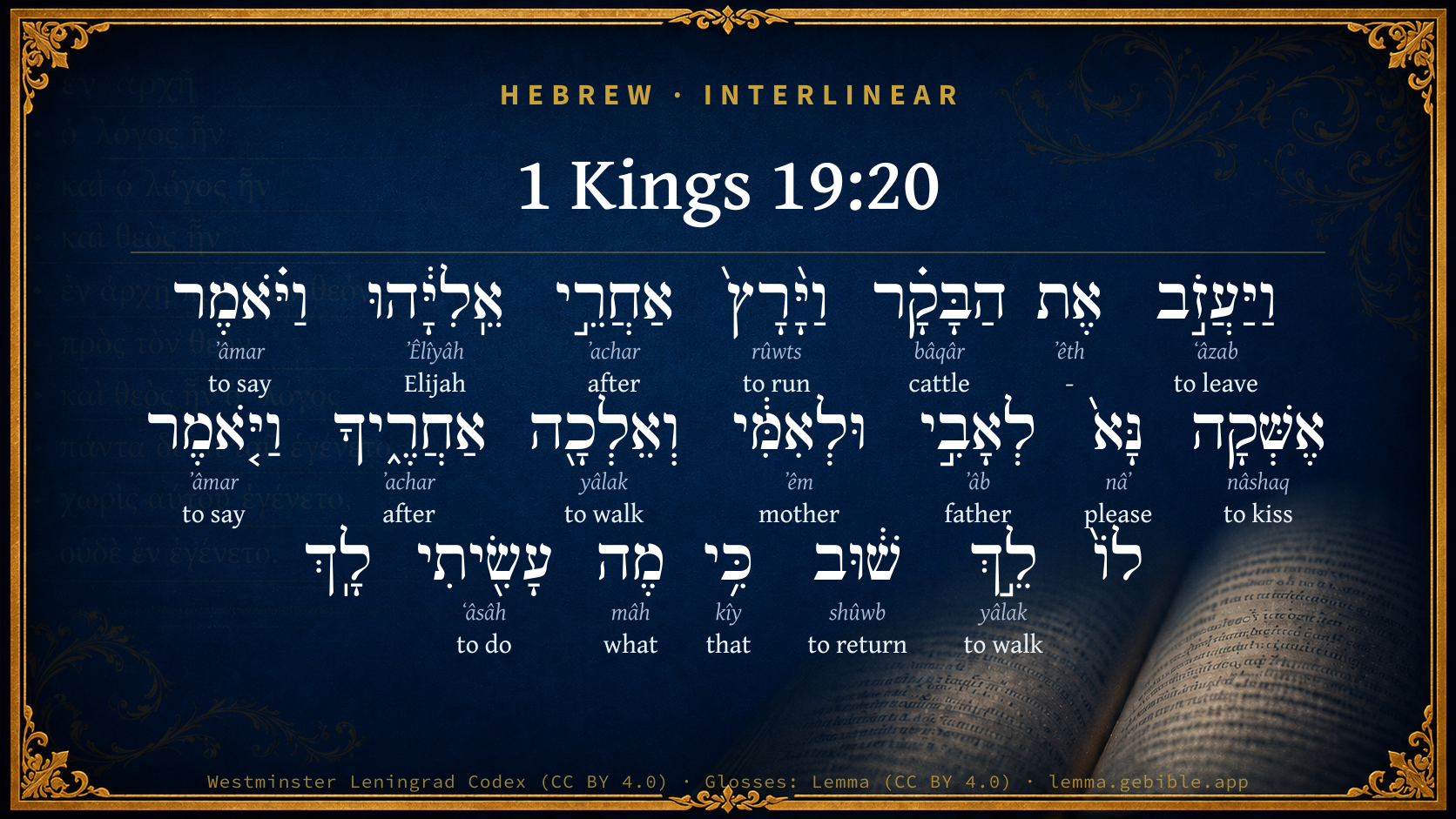
Hebrew (Westminster Leningrad Codex) 1 Kings 19:20 appears in the Hebrew Old Testament. The text above is from the Westminster Leningrad Codex. Each word links to its Strong’s number, a concise gloss, and parsing drawn from the Open Scriptures Hebrew Bible morphology. Click any word for its full Brown-Driver-Briggs (BDB) entry.
Download image
Cite this verse

1 Kings 19:20 (World English Bible). Public Domain. Lemma interlinear Bible study tool, https://lemma.gebible.app/v/1-kings/19/20.

Show BibTeX & RIS
BibTeX
RIS
English Translation
He left the oxen, and ran after Elijah, and said, Let me, I pray you, kiss my father and my mother, and then I will follow you. He said to him, Go back again; for what have I done to you?
World English Bible · Public Domain
Download a study sheet

One document with this verse’s original text, its word-by-word gloss line, the meaning frame, cross-references with their text, attributed commentary, and full source and license credits — printable, and it pastes into notes with its structure intact.

This verse Autodidact and up

Study sheet (.html) Plain text (.txt)

A passage Seminary Student

Up to 50 verses in one chapter. A passage sheet keeps up to 6 commentary sources and 12 cross-references per verse, in the order this page ranks them, and says so on the sheet whenever that leaves anything out. Ask for a single verse and you get the Autodidact verse sheet above.

Everything on this page stays free to read, with no account — the sheet is a download of what is already on screen, not access to it.

Want to remove ads? Support Godless Engineer
Compare translations 3

The same verse in 3 English versions, stacked beneath the original-language interlinear above. Click any original word for its lexicon entry.

Each is an independent rendering of the whole verse — the interlinear is not word-aligned to these translations.

Highlighted words mark where these versions differ — a whole-verse word diff, not a word-by-word alignment.

  • World English Bible Public Domain
    He left the oxen, and ran after Elijah, and said, Let me, I pray you, kiss my father and my mother, and then I will follow you. He said to him, Go back again; for what have I done to you?
  • King James Version Public Domain
    And he left the oxen, and ran after Elijah, and said, Let me, I pray thee, kiss my father and my mother, and then I will follow thee. And he said unto him, Go back again: for what have I done to thee?
  • unfoldingWord Literal Text CC BY-SA 4.0
    And he left the oxen, and he ran after Elijah, and he said, “Please let me kiss my father and my mother, then let me go after you.” And he said to him, “Go, return, for what have I done to you?”

unfoldingWord Literal Text — © unfoldingWord, licensed CC BY-SA 4.0. Word-aligned USFM3 via Door43 (git.door43.org/unfoldingWord/en_ult).

Versions to compare (up to 4)

3 of 4 selected

Show all 18 translations

Every available English version of this verse, each an independent rendering of the whole verse.

  • World English Bible Public Domain
    He left the oxen, and ran after Elijah, and said, Let me, I pray you, kiss my father and my mother, and then I will follow you. He said to him, Go back again; for what have I done to you?
  • Berean Standard Bible Public Domain
    So Elisha left the oxen, ran after Elijah, and said, “Please let me kiss my father and mother goodbye, and then I will follow you.” “Go on back,” Elijah replied, “for what have I done to you?”
  • Majority Standard Bible Public Domain
    So Elisha left the oxen, ran after Elijah, and said, “Please let me kiss my father and mother goodbye, and then I will follow you.” “Go on back,” Elijah replied, “for what have I done to you?”
  • King James Version Public Domain
    And he left the oxen, and ran after Elijah, and said, Let me, I pray thee, kiss my father and my mother, and then I will follow thee. And he said unto him, Go back again: for what have I done to thee?
  • American Standard Version (1901) Public Domain
    And he left the oxen, and ran after Elijah, and said, Let me, I pray thee, kiss my father and my mother, and then I will follow thee. And he said unto him, Go back again; for what have I done to thee?
  • Revised Version (1885) Public Domain
    And he left the oxen, and ran after Elijah, and said, Let me, I pray thee, kiss my father and my mother, and then I will follow thee. And he said unto him, Go back again; for what have I done to thee?
  • Geneva Bible (1599) Public Domain
    And he left the oxen, and ran after Eliiah, and sayde, Let mee, I pray thee, kisse my father and my mother, and then I wil follow thee. Who answered him, Go, returne: for what haue I done to thee?
  • Douay-Rheims (1899) Public Domain
    And he forthwith left the oxen and ran after Elias, and said: Let me, I pray thee, kiss my father and my mother, and then I will follow thee. And he said to him: Go, and return back: for that which was my part, I have done to thee.
  • Young's Literal Translation Public Domain
    and he forsaketh the oxen, and runneth after Elijah, and saith, `Let me give a kiss, I pray thee, to my father and to my mother, and I go after thee.' And he saith to him, `Go, turn back, for what have I done to thee?'
  • Literal Standard Version CC BY-SA 4.0
    and he forsakes the ox, and runs after Elijah, and says, “Please let me give a kiss to my father and to my mother, and I go after you.” And he says to him, “Go, turn back, for what have I done to you?”
  • Unlocked Literal Bible CC BY-SA 4.0
    Then Elisha left the oxen and ran after Elijah; he said, “Please let me kiss my father and my mother, and then I will follow you.” Then Elijah said to him, “Go back, but think about what I have done to you.”
  • unfoldingWord Literal Text CC BY-SA 4.0
    And he left the oxen, and he ran after Elijah, and he said, “Please let me kiss my father and my mother, then let me go after you.” And he said to him, “Go, return, for what have I done to you?”
  • Darby Bible Public Domain
    And he left the oxen, and ran after Elijah, and said, Let me, I pray thee, kiss my father and my mother, and I will follow thee. And he said to him, Go back again; for what have I done to thee?
  • World Messianic Bible Public Domain
    Elisha left the oxen and ran after Elijah, and said, “Let me please kiss my father and my mother, and then I will follow you.” He said to him, “Go back again; for what have I done to you?”
  • Webster's Bible Public Domain
    And he left the oxen, and ran after Elijah, and said, Let me, I pray thee, kiss my father and my mother, and then I will follow thee. And he said to him, Go back again: for what have I done to thee?
  • Free Bible Version CC BY-SA 4.0
    Elisha left the oxen, ran after Elijah, and said, “Please let me go and kiss my father and mother goodbye, and then I will follow you.” “Go on home,” Elijah replied. “I've never done anything for you.”
  • Bible in Basic English Public Domain
    And letting the oxen be where they were, he came running after Elijah, and said, Only let me give a kiss to my father and mother, and then I will come after you. But he said to him, Go back again; for what have I done to you?
  • JPS Tanakh (1917) Public Domain
    And he left the oxen, and ran after Elijah, and said: 'Let me, I pray thee, kiss my father and my mother, and then I will follow thee.' And he said unto him: 'Go back; for what have I done to thee?'

Literal Standard Version (2020), Covenant Press — licensed CC BY-SA 4.0. Text via the HelloAO Bible API (eBible.org). Unlocked Literal Bible (unfoldingWord) — licensed CC BY-SA 4.0. Text via the HelloAO Bible API (eBible.org). unfoldingWord Literal Text — © unfoldingWord, licensed CC BY-SA 4.0. Word-aligned USFM3 via Door43 (git.door43.org/unfoldingWord/en_ult). Free Bible Version, Dr. Jonathan Gallagher — licensed CC BY-SA 4.0. Text via the HelloAO Bible API (eBible.org).

Word by word

More ways to search: Search by grammar → Find every occurrence → Compare this word →

Practice this passage: Drill this verse → Learn its vocabulary →

אֶשְּׁקָה
nâshaq
H5401
“to kiss”
Verb, Qal, Cohortative, 1st Person, Common, Singular
Part of Speech
Verb
Stem
Qal
Form
Cohortative
Person
1st Person
Gender
Common
Number
Singular
Full BDB Definition

Origin: a primitive root [identical with H5400 , through the idea of fastening up

TWOT: 1435 , 1436

to put together, kiss - (Qal) to kiss - (Piel) to kiss - (Hiphil) to touch gently - to handle, be equipped with - (Qal) to be equipped
  1. וַיַּעֲזֹ֣ב ʻâzab H5800 “and · to leave” Conjunction + Verb, Qal, Sequential Imperfect, 3rd Person, Masculine, Singular
  2. אֶת ʼêth H853 “-” Particle, Direct Object
  3. הַבָּקָ֗ר bâqâr H1241 “the · cattle” Particle, Definite Article + Noun, Common, Both, Singular, Absolute
  4. וַיָּ֨רָץ֙ rûwts H7323 “and · to run” Conjunction + Verb, Qal, Sequential Imperfect, 3rd Person, Masculine, Singular
  5. אַחֲרֵ֣י ʼachar H310 “after” Preposition
  6. אֵֽלִיָּ֔הוּ ʼÊlîyâh H452 “Elijah” Noun, Proper
  7. וַיֹּ֗אמֶר ʼâmar H559 “and · to say” Conjunction + Verb, Qal, Sequential Imperfect, 3rd Person, Masculine, Singular
  8. נָּא֙ nâʼ H4994 “please” Particle, Interjection
  9. לְאָבִ֣י ʼâb H1 “to/for · father · my” Preposition + Noun, Common, Masculine, Singular, Construct + Suffix, Personal, 1st Person, Common, Singular
  10. וּלְאִמִּ֔י ʼêm H517 “and · to/for · mother · my” Conjunction + Preposition + Noun, Common, Feminine, Singular, Construct + Suffix, Personal, 1st Person, Common, Singular
  11. וְאֵלְכָ֖ה yâlak H3212 “and · to walk” Conjunction + Verb, Qal, Cohortative, 1st Person, Common, Singular
  12. אַחֲרֶ֑יךָ ʼachar H310 “after · you” Preposition + Suffix, Personal, 2nd Person, Masculine, Singular
  13. וַיֹּ֤אמֶר ʼâmar H559 “and · to say” Conjunction + Verb, Qal, Sequential Imperfect, 3rd Person, Masculine, Singular
  14. לֵ֣ךְ yâlak H3212 “walk” Verb, Qal, Imperative, 2nd Person, Masculine, Singular
  15. שׁ֔וּב shûwb H7725 “return” Verb, Qal, Imperative, 2nd Person, Masculine, Singular
  16. כִּ֥י kîy H3588 “that” Conjunction
  17. מֶה mâh H4100 “what” Particle, Interrogative
  18. עָשִׂ֖יתִי ʻâsâh H6213 “to do” Verb, Qal, Perfect, 1st Person, Common, Singular

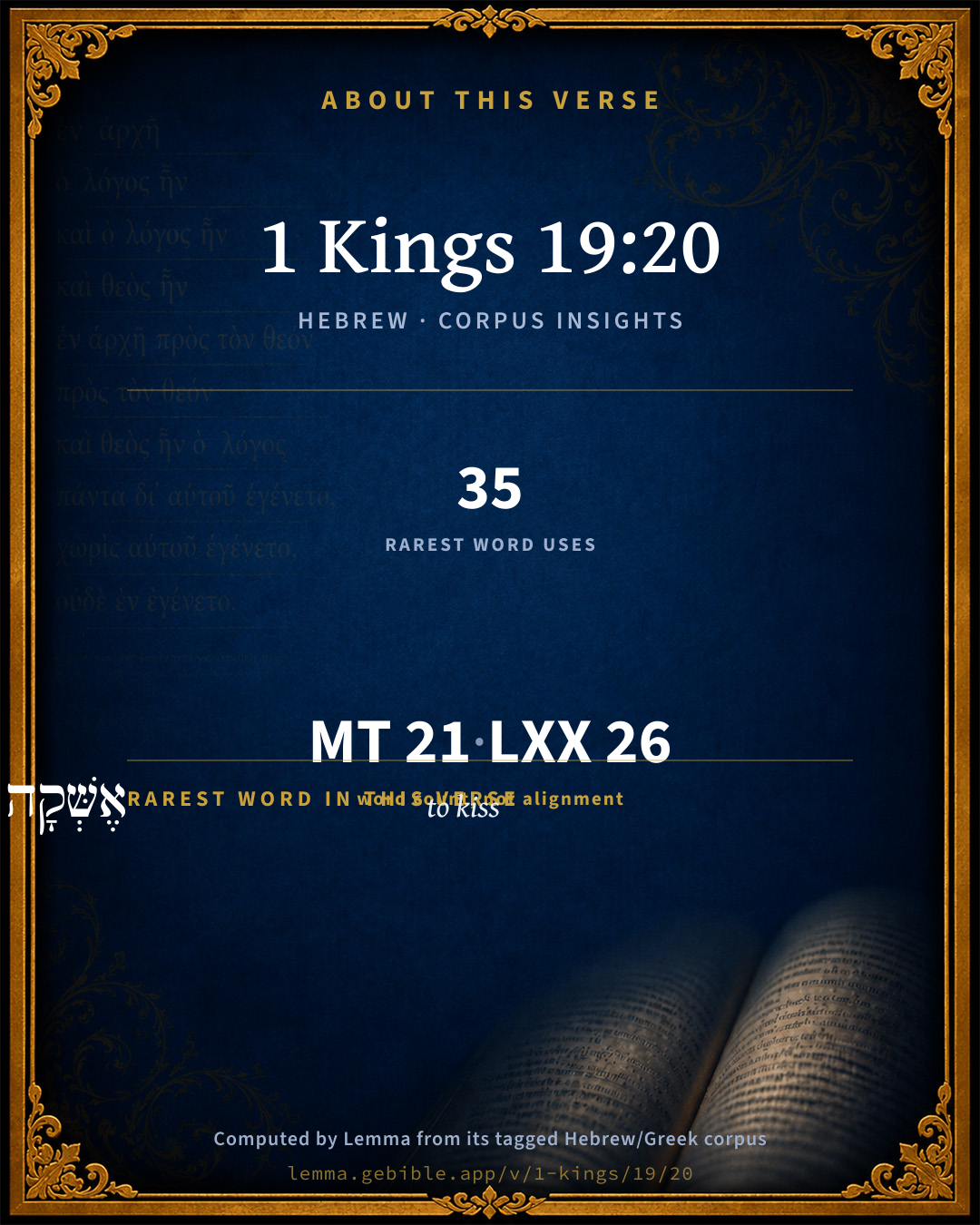
About this verse

These counts appear in no published source. They are computed here, from the morphology-tagged text and Lemma’s own curated glosses. What Lemma adds →

21
words
16
distinct lemmas
Historical
section

Shared distinctive vocabulary

אֶשְּׁקָה to kiss H5401 occurs in 35 verses of the Hebrew Bible. Also found in:

Grammatical profile

  • 9 verbs
  • 4 nouns
  • 4 prepositions
  • 1 conjunction
  • 3 particles

Verb forms

  • וַיַּעֲזֹ֣ב Qal · Sequential Imperfect
  • וַיָּ֨רָץ֙ Qal · Sequential Imperfect
  • וַיֹּ֗אמֶר Qal · Sequential Imperfect
  • אֶשְּׁקָה Qal · Cohortative
  • וְאֵלְכָ֖ה Qal · Cohortative
  • וַיֹּ֤אמֶר Qal · Sequential Imperfect
  • לֵ֣ךְ Qal · Imperative
  • שׁ֔וּב Qal · Imperative
  • עָשִׂ֖יתִי Qal · Perfect

Repetition

Words recur within this verse — often emphatic in Hebrew:

  • אַחֲרֵ֣י after H310 ×2
  • וַיֹּ֗אמֶר to say H559 ×2
  • וְאֵלְכָ֖ה to walk H3212 ×2

Hebrew & Septuagint length

In English translation the verse runs 41 words from the Hebrew and 32 from the Septuagint (LXX English) — closely comparable.

A rough comparison of the two English renderings, which tokenize alike — not a word-level alignment.

Word counts can differ between the Hebrew and the Greek without any difference in meaning — e.g. the Hebrew direct-object marker אֵת has no separate Greek word, and Greek often adds the article ὁ.

In the original languages it is 21 Hebrew tokens and 26 Greek tokens — but the two are counted differently (Hebrew bundles its prefixes and suffixes into one token; the Greek is in lemma form), so that isn’t a like-for-like length.

Cross-references

7

Topical passages linked to 1 Kings 19:20 in the Treasury of Scripture Knowledge — connected by theme and wording, ordered by reader-vote popularity; previews shown in the World English Bible.

  • Matthew 8:21–22 Another of his disciples said to him, "Lord, allow me first to go and bury my father."
  • Luke 9:61–62 Another also said, "I want to follow you, Lord, but first allow me to bid farewell to those who are at my house."
  • Acts 20:37 They all wept a lot, and fell on Paul's neck and kissed him,
  • Matthew 4:20 They immediately left their nets and followed him.
  • Matthew 4:22 They immediately left the boat and their father, and followed him.
  • Matthew 9:9 As Jesus passed by from there, he saw a man called Matthew sitting at the tax collection office. He said to him, "Follow me." He got up and followed him.
  • Matthew 19:27 Then Peter answered, "Behold, we have left everything, and followed you. What then will we have?"

Cross-references courtesy of OpenBible.info (CC BY 4.0).

Hebrew and Greek witnesses Masoretic Hebrew ↔ Greek Septuagint

The same verse in the two great witnesses to the Old Testament, shown verse-for-verse.

These are two independent witnesses, not word-aligned to each other, and the Septuagint is shown in lemma (dictionary) form.

Hebrew 1 Kings 19:20 Masoretic · Westminster Leningrad Codex

וַיַּעֲזֹ֣ב אֶת הַבָּקָ֗ר וַיָּ֨רָץ֙ אַחֲרֵ֣י אֵֽלִיָּ֔הוּ וַיֹּ֗אמֶר אֶשְּׁקָה נָּא֙ לְאָבִ֣י וּלְאִמִּ֔י וְאֵלְכָ֖ה אַחֲרֶ֑יךָ וַיֹּ֤אמֶר לוֹ֙ לֵ֣ךְ שׁ֔וּב כִּ֥י מֶה עָשִׂ֖יתִי לָֽךְ

He left the oxen, and ran after Elijah, and said, Let me, I pray you, kiss my father and my mother, and then I will follow you. He said to him, Go back again; for what have I done to you?

World English Bible · Public Domain

Greek LXX 1 Kings 19:20 Septuagint · lemma form

καί καταλείπω ελισαιε ὁ βοῦς καί κατατρέχω ὀπίσω ηλιου καί εἶπον καταφιλέω ὁ πατήρ ἐγώ καί ἀκολουθέω ὀπίσω σύ καί εἶπον ηλιου ἀναστρέφω ὅτι ποιέω σύ

And Elisaie left the cattle, and ran after Eliu and said, I will kiss my father, and follow after you. And Eliu said, Return, for I have done a work for you.

LXX2012 (modern English Septuagint) · Public Domain

Hebrew: Westminster Leningrad Codex (CC BY 4.0). Greek: Septuagint (public domain); English from LXX2012 (modern English Septuagint) (Public Domain). How the Septuagint differs from the Hebrew →

Targum (Aramaic paraphrase)

1

The Targum is the ancient Jewish Aramaic paraphrase of the Hebrew Scriptures — an interpretive translation, not the Hebrew text itself. Onkelos (literal) and Pseudo-Jonathan (expansive) render the Torah, and Jonathan the Prophets. Coverage is partial: where no permissively-licensed English translation exists for a verse, only the Aramaic is shown. This is verse-level text, not a word-by-word alignment to the Hebrew.

  1. Targum Jonathan Prophets (Joshua–Malachi)
    וּשְׁבַק יַת תּוֹרַיָא וּרְהַט בָּתַר אֵלִיָהוּ וַאֲמַר אֶנְשׁוֹק כְּעַן לְאַבָּא וּלְאִמָא וֶאֱהַךְ בַּתְרָךְ וַאֲמַר לֵיהּ אֱזֵיל תּוּב אֲרֵי מָה עֲבָדִית לָךְ:

    (no public-domain English translation for this verse)

    Targum Jonathan — Aramaic: “Mikraot Gedolot” (public domain). English: “Sefaria Community Translation” (CC0 1.0 (public-domain dedication)); “London "Chaldee Paraphrase," 1871” (public domain). Text via Sefaria.

Commentary

Notes on 1 Kings 19:20 from classic Christian and Jewish commentators (each source and its license shown beneath its notes). The classic Christian expositions comment on the surrounding passage and are grouped to its opening verse, so a note may address several verses; the Jewish commentaries on the Tanakh (Rashi and others) are per-verse, so they appear only where the commentator wrote on this verse.

Lemma curates 59 commentaries, every one of them public domain or Creative Commons licensed, each selected and text-cleaned for this edition rather than reprinted as found. About our sources →

Trapp's Complete Commentary

John Trapp

1Ki 19:20 And he left the oxen, and ran after Elijah, and said, Let me, I pray thee, kiss my father and my mother, and [then] I will follow thee. And he said unto him, Go back again: for what have I done to thee?

Ver. 20. Go back again.] Heb. Go return, q.d., Go thou must; but see thou return speedily, and wait on thy office. "Neglect not the grace of God that is in thee," the powerful impression made by God upon thy spirit.

John Trapp, A Commentary or Exposition upon All the Books of the Old and New Testament (1647–1656) — public domain. Text from a community e-Sword module.

Joseph Benson's Commentary

1Ki 19:20. He left the oxen and ran after Elijah — Being powerfully moved to follow him, and wholly give himself up to his function. And said — Or, but he said, or, yet he said, Let me kiss my father, &c. — That is, bid them farewell by the usual ceremony. And he said Go back again — Take thy leave of them, as thou desirest, and then return to me again. For what have I done unto thee? — Either, first, to hinder thee from performing that office: that employment to which I have called thee doth not require an alienation of thy heart from thy parents, nor the total neglect of them. Or, secondly, to make such a change in thee, that thou shouldest be willing to forsake thy parents, and lands, and all, that thou mayest follow me. Whence comes this marvellous change? It is not from me, who did only throw my mantle over thee, but from a higher power, even from God’s Spirit, which hath changed thy heart, and consecrated thee to thy prophetical office; which, therefore, it concerns thee vigorously to execute, and wholly to devote thyself to it.

Joseph Benson's Commentary on the Old and New Testaments (1811–1818) — public domain. Text from a community e-Sword module.

Geneva Bible (1599)

Geneva Bible translators

Though this natural affection is not to be contemned, yet it ought not to move us when God calleth us to serve him.

Geneva Bible (1599) marginal notes — public domain. Text via Bolls.life.

Jamieson, Fausset & Brown

Robert Jamieson, A. R. Fausset & David Brown

what have I done to thee?--that is, Go, but keep in mind the solemn ceremony I have just performed on thee. It is not I, but God, who calls thee. Do not allow any earthly affection to detain you from obeying His call.

Jamieson, Fausset & Brown — Commentary Critical and Explanatory on the Whole Bible (1871) — public domain (CC PDM 1.0). Text via the HelloAO Bible API.

Adam Clarke's Commentary

Verse 20. Let me - kiss my father and my mother] Elisha fully understood that he was called by this ceremony to the prophetic office: and it is evident that he conferred not with flesh and blood, but resolved, immediately resolved, to obey; only he wished to bid farewell to his relatives. See below.

What have I done to thee?] Thy call is not from me, but from God: to him, not to me, art thou accountable for thy use or abuse of it.

Adam Clarke's Commentary on the Bible (1810–1826) — public domain. Text from a community e-Sword/MySword module.

Ellicott's Commentary for English Readers

(20) Let me, I pray thee.—It is impossible not to compare this with the similar request made to our Lord (Luk_9:61-62) by one who declared readiness to follow Him. The comparison suggests that the answer of Elijah is one of half-ironical rebuke of what seemed hesitation—“Go back, if thou wilt; what have I done to constrain thee?” In both cases we have the stern but necessary rejection of half-hearted service, even if the heart be distracted by the most natural and sacred love. But Elijah sees that Elisha means simply farewell, and he apparently waits till it is over.

A Bible Commentary for English Readers, edited by Charles John Ellicott (1878–1897) — public domain. Text from a community e-Sword module.

The Cambridge Bible for Schools and Colleges

gen. ed. J. J. S. Perowne

20. kiss my father and my mother] He was sensible that the separation was to be permanent, and that a higher call than that of earthly parentage was laid upon him. This is the ground for his petition. Thus will he make known to his parents the reason of his departure.

Go back again: for what have I done to thee?] Elijah grants his request, but accompanies the permission with words which must remind Elisha that he cannot now stay amid his home duties, ‘Go back again,’ he says, ‘but let it be only for the filial leave-taking, for what have I done to thee? Have I not chosen thee to be my companion and helper? Is not God’s voice calling thee, through me, to do Him service?’

The Cambridge Bible for Schools and Colleges (gen. ed. J. J. S. Perowne; Cambridge University Press, 1878–1918) — public domain. Text from a community e-Sword module.

John Gill's Exposition

And he left the oxen, and ran after Elijah,.... His heart being touched by the Lord at the same time, and his mind enlightened to understand what was meant by that action:

and said, let me, I pray thee, kiss my father and my mother; take his leave of them in this way, which was what was used by friends at parting, see Rut 1:9.

and then I will follow thee; which he understood was meant by his casting his mantle over him:

and he said unto him, go back again; to his plough:

for what have I done to thee? he had only cast the skirts of his mantle over him, and had said nothing to him; this he said to try him, and get out of him what was in his heart, and how it had been touched by the Spirit of God; and if so, then he suggests it was not what he had done, but what the Lord had impressed upon him, that would oblige him to return, and follow him, after he had taken his leave of his parents.

John Gill's Exposition of the Whole Bible (1746–1763) — public domain (CC PDM 1.0). Text via the HelloAO Bible API.

Albert Barnes' Notes on the Bible

Let me, I pray thee, kiss my father ... - Not an unnatural request before following his new spiritual father. Elijah sees in his address a divided heart, and will not give the permission or accept the service thus tendered. Hence, his cold reply. See Luk 9:61-62.

Go back again ... - i. e., “Go, return to thy plowing ... why shouldest thou quit it? Why take leave of thy friends and come with me? What have I done to thee to require such a sacrifice? for as a sacrifice thou evidently regardest it. Truly I have done nothing to thee. Thou canst remain as thou art.”

Albert Barnes' Notes on the Bible (1834–1885) — public domain. Text from a community e-Sword/MySword module.

Haydock's Catholic Bible Commentary

Kiss, and bid them adieu. (Menochius) --- To thee. I have no farther orders. Obey the Spirit of God. Hoc age. Hebrew, "for what have I done to thee?" Did I require thee to follow me? Act as God may direct thee. Yet remember the ceremony which thou hast seen, and do not turn back (Calmet) to neglect thy office. (Haydock) (Matthew viii. 22., and Luke ix. 62.)

George Leo Haydock (1774–1849), Haydock's Catholic Family Bible and Commentary, 1859 edition — public domain. Excludes Psalms (Douay-Rheims chapter numbering differs from Protestant) and Deuterocanonical books (Catholic canon only).

Matthew Poole's English Annotations

He ran after Elijah; being powerfully moved by God’s Spirit to follow Elijah, and wholly to give up himself to his affection.

And said; or, but he said; or, yet he said.

Let me kiss my father and my mother, i.e. bid them farewell, by the usual ceremony. See Gen 29:11; 31:28; Act 20:37.

Go back again, and take thy leave of them, as thou desirest, and then return to me again.

What have I done to thee? either, first, To hinder thee from performing that office. That employment to which I have called thee doth not require an alienation of thy heart from thy parents, nor the total neglect of them. Or, secondly, To make such a change in thee, that thou shouldst be willing to forsake thy parents, and lands, and all, and desire only this liberty to go and bid them farewell, that thou mayest follow me. Whence comes this marvellous change? It is not from me, who did only throw my mantle over thee; but from a higher power, even from God’s Spirit, which hath changed thy heart, and consecrated thee to thy prophetical office; which therefore it concerns thee vigorously to execute, and wholly to devote thyself to it.

Matthew Poole's English Annotations on the Holy Bible (1683–1685) — public domain. Text from a community e-Sword/MySword module.

Whedon's Commentary on the Bible

Daniel D. Whedon

20. Ran after Elijah — Elijah, as he cast his mantle on Elisha, walked rapidly away, and this was as much as to say, “Follow me.”

Let me… kiss my father and my mother — Elisha was at this time a young man, living with his parents, and probably unmarried. Like others who have been called with a holy calling, his heart yearns for his home and his kindred. Compare Mat_8:21; Luk_9:61.

Go back again: for what have I done to thee — There is something uncertain and mysterious about these words. Here is no clear permission to go and kiss his parents farewell, and whether he did so or not is an unsettled question. Elijah would throw the whole responsibility of the matter on the conscience of Elisha. “Go home and stay there, if you have such desire; and as regards your duty in view of what I have done to you, settle that matter yourself.”

Daniel D. Whedon (gen. ed.), Commentary on the Old and New Testaments (1874–1909) — public domain. Text from a community e-Sword module.

The Pulpit Commentary

And he left the oxen As, being the last in the line, he could do, without stopping the others. It is probable too that, Elisha being the last, Elijah"s action would not have been observed by the rest, and ran after Elijah It is clear that Elisha both understood the act, and made up his mind at once. No doubt he too had long sighed and prayed over the demoralization of his country and the dishonour done to his God. Elijah, after casting the mantle, strode on, leaving it for Elisha to take or reject it. The latter soon showed his choice by running after him, and said, Let me, I pray thee, kiss my father and my mother, and then I will follow thee. And he said unto him; Go back again Heb. go, return: for what have I done to thee? There is not a word of reproof here, as Wordsworth and Rawlinson imagine. Indeed, it would have been strange if there had been. A greater readiness to obey the prophetic summons, Elisha could not well have showed. Forthwith, as soon as he realized his call, "he left the oxen and ran after" his newmaster. True, he asks permission and why should he not? for "grace is no enemy to good nature to give a parting embrace to the father and mother to whom he owed his life, and whom he had been required by God to honour. But there is no proof of "a divided heart" here. If he had begged to be allowed to stay and bury his mother and father (St. Luk_9:59-61) it might have been otherwise. But he suggests nothing of the kind. He says: "One kiss, one farewell, and then I will follow thee." It is a complete mistake, consequently, to interpret Elijah"s words to mean, "Go, return to thy ploughing, for why shouldst thou quit it? Thou canst remain as thou art" (Rawlinson). Their true meaning, as evidenced by the sequel (ver. 21), clearly was, "Go back and kiss them; why shouldst thou not? For what have I done to thee? I have summoned thee to follow me. But I have not required thee to repudiate thine own flesh and blood.

He left the oxen." No service without sacrifice. Sometimes it is only ships and nets, (Mar_1:20) sometimes it is houses and lands, father and mother, wife and child. (Mat_19:29)

Go back again." Why should he not kiss his father and mother? "For God commanded, saying, Honour thy father and mother," and it is not for the greatest of the prophets to make the commandment of God of none effect. (Mat_15:4-6) Religion developes and intensifies the domestic affections. Ties of flesh become stronger and closer when cemented and consecrated by grace. It would be strange if the religion of love made husband or wife, parent or child, love each other less.

The Pulpit Commentary (1880–1919), ed. H.D.M. Spence-Jones & Joseph S. Exell — public domain. Text from a community e-Sword module.

John Wesley's Explanatory Notes

He ran - Being powerfully moved by God's spirit to follow Elijah, and wholly give up himself to his function. Let me kiss - That is, bid them farewell. Go - And take thy leave of them, and then return to me again. For what, &c. - Either first, to hinder thee from performing that office. That employment to which I have called thee, doth not require an alienation of thy heart from thy parents, nor the total neglect of them. Or, secondly, to make such a change in thee, that thou shouldst be willing to forsake thy parents, and lands, and all, that thou mayest follow me. Whence comes this marvelous change? It is not from me, who did only throw my mantle over thee; but from an higher power, even from God's spirit, which both changed thy heart, and consecrated thee to thy prophetical office: which therefore it concerns thee vigourously to execute, and wholly to devote thyself to it.

John Wesley, Explanatory Notes Upon the Whole Bible (1754–1765) — public domain. Text via the GEBible commentary corpus.

Rashi

Rabbi Shlomo Yitzchaki (Rashi)

Go back. From following me.

For what have I done to you. That you should follow me.

Rashi on the Tanakh — English translations: “The Judaica Press complete Tanach with Rashi, translated by A. J. Rosenberg” (CC BY 4.0); “Pentateuch with Rashi's commentary by M. Rosenbaum and A.M. Silbermann, 1929-1934” (public domain); “The Metsudah Tanach series, Lakewood, N.J” (CC BY 4.0); and “The Book of Joshua, Metsudah Publications, 1997” (CC BY 4.0). Text via Sefaria.

Lesson kit

Teaching starters — assembled from the data on this page, not authored interpretation. Every prompt links to the verse data it draws on. Edit before teaching.

1 Kings, in the Historical, opens this verse with 21 words (16 distinct Hebrew lemmas). Its most distinctive word is nâshaq (“to kiss”). A historical commentator’s framing appears above. Read the whole chapter for the surrounding context.

Discussion questions

  1. What does “to kiss” (nâshaq) contribute to the verse as a whole?
  2. How does Genesis 27:26, which shares the word «to kiss», read alongside this verse?
  3. What does the repetition of “after” (2× in this one verse) do in this verse?
  4. These translations render this verse differently; the difference is in the English rendering, not the original. What questions does that raise?
  5. «וַיַּעֲזֹ֣ב» is a Qal Sequential Imperfect verb. How does that grammatical form shape the action described?
  6. Compare how Trapp's Complete Commentary and Joseph Benson's Commentary read this verse. Where do they agree or differ?

Things to notice

Reading settings

Reading text

Shown beneath each verse's original-language words.

Old Testament
Old Testament edition

Read the OT as the Masoretic Hebrew (MT) or the Greek Septuagint (LXX).

English shown for the Greek Septuagint (in the Hebrew ↔ Greek comparison).

Comparing translations? Open the Compare panel on any verse page to stack up to four side by side.