
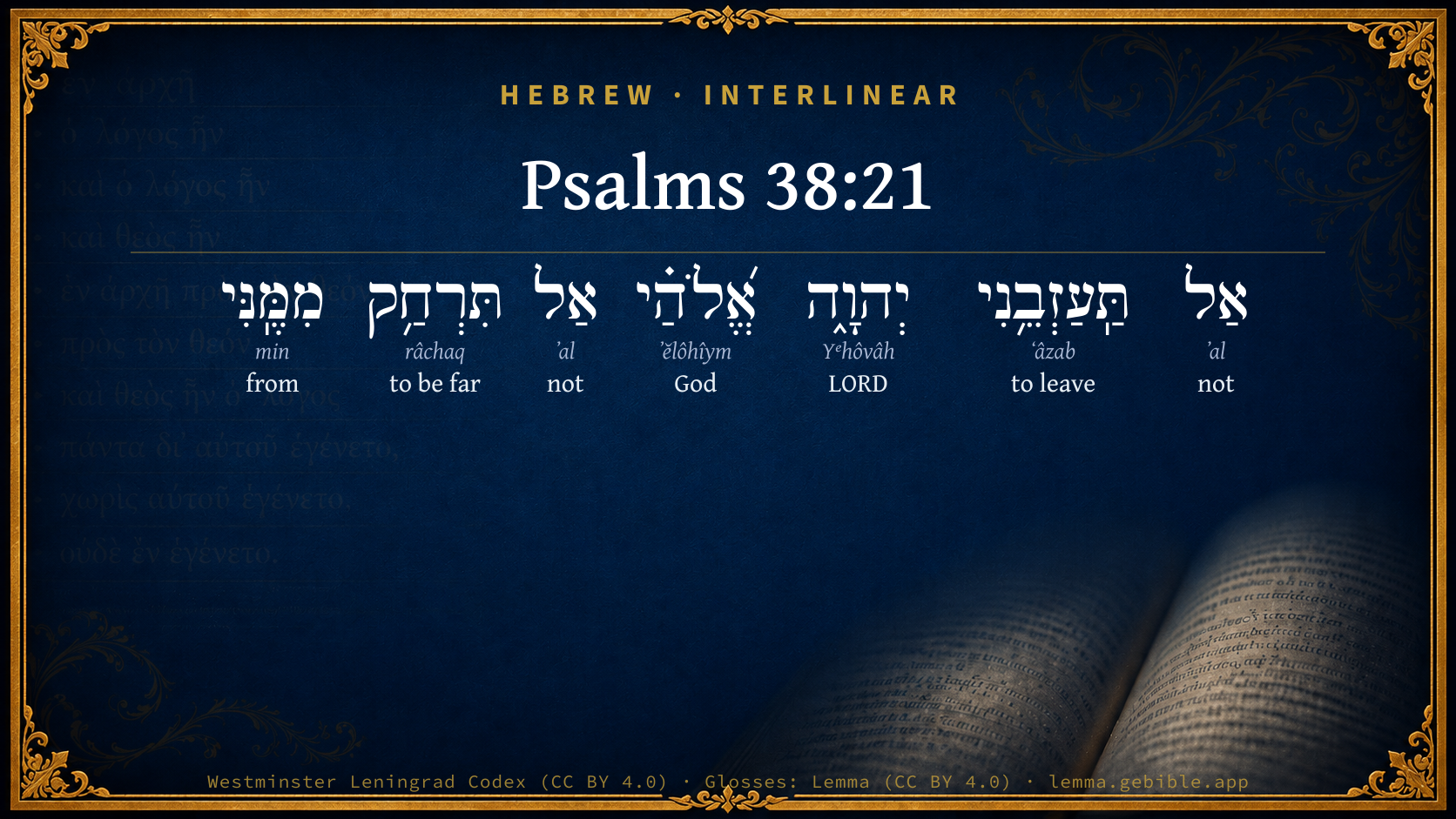
Psalms 38:21

Hebrew (Westminster Leningrad Codex) Psalms 38:21 appears in the Hebrew Old Testament. The text above is from the Westminster Leningrad Codex. Each word links to its Strong’s number, a concise gloss, and parsing drawn from the Open Scriptures Hebrew Bible morphology. Click any word for its full Brown-Driver-Briggs (BDB) entry.
Download image
Cite this verse

Psalms 38:21 (World English Bible). Public Domain. Lemma interlinear Bible study tool, https://lemma.gebible.app/v/psalms/38/21.

Show BibTeX & RIS
BibTeX
RIS
English Translation
Don't forsake me, Yahweh. My God, don't be far from me.
World English Bible · Public Domain
Download a study sheet

One document with this verse’s original text, its word-by-word gloss line, the meaning frame, cross-references with their text, attributed commentary, and full source and license credits — printable, and it pastes into notes with its structure intact.

This verse Autodidact and up

Study sheet (.html) Plain text (.txt)

A passage Seminary Student

Up to 50 verses in one chapter. A passage sheet keeps up to 6 commentary sources and 12 cross-references per verse, in the order this page ranks them, and says so on the sheet whenever that leaves anything out. Ask for a single verse and you get the Autodidact verse sheet above.

Everything on this page stays free to read, with no account — the sheet is a download of what is already on screen, not access to it.

Want to remove ads? Support Godless Engineer
Compare translations 3

The same verse in 3 English versions, stacked beneath the original-language interlinear above. Click any original word for its lexicon entry.

Each is an independent rendering of the whole verse — the interlinear is not word-aligned to these translations.

Highlighted words mark where these versions differ — a whole-verse word diff, not a word-by-word alignment.

  • World English Bible Public Domain
    Don't forsake me, Yahweh. My God, don't be far from me.
  • King James Version Public Domain
    Forsake me not, O LORD: O my God, be not far from me.
  • unfoldingWord Literal Text CC BY-SA 4.0
    Do not forsake me, Yahweh; my God, do not be far from me.

unfoldingWord Literal Text — © unfoldingWord, licensed CC BY-SA 4.0. Word-aligned USFM3 via Door43 (git.door43.org/unfoldingWord/en_ult).

Versions to compare (up to 4)

3 of 4 selected

Show all 18 translations

Every available English version of this verse, each an independent rendering of the whole verse.

  • World English Bible Public Domain
    Don't forsake me, Yahweh. My God, don't be far from me.
  • Berean Standard Bible Public Domain
    Do not forsake me, O LORD; be not far from me, O my God.
  • Majority Standard Bible Public Domain
    Do not forsake me, O LORD; be not far from me, O my God.
  • King James Version Public Domain
    Forsake me not, O LORD: O my God, be not far from me.
  • American Standard Version (1901) Public Domain
    Forsake me not, O Jehovah: O my God, be not far from me.
  • Revised Version (1885) Public Domain
    Forsake me not, O LORD: O my God, be not far from me.
  • Geneva Bible (1599) Public Domain
    Forsake me not, O Lord: be not thou farre from me, my God.
  • Douay-Rheims (1899) Public Domain
    They that render evil for good, have detracted me, because I followed goodness.
  • Young's Literal Translation Public Domain
    Do not forsake me, O Jehovah, My God, be not far from me,
  • Literal Standard Version CC BY-SA 4.0
    Do not forsake me, O YHWH, || My God, do not be far from me,
  • Unlocked Literal Bible CC BY-SA 4.0
    Do not abandon me, Yahweh; my God, do not stay far away from me.
  • unfoldingWord Literal Text CC BY-SA 4.0
    Do not forsake me, Yahweh; my God, do not be far from me.
  • Darby Bible Public Domain
    Forsake me not, Jehovah; O my God, be not far from me.
  • World Messianic Bible Public Domain
    Don’t forsake me, LORD. My God, don’t be far from me.
  • Webster's Bible Public Domain
    \\38:20\\They also that render evil for good are my adversaries; because I follow the thing that is good.
  • Free Bible Version CC BY-SA 4.0
    Don't give up on me, my Lord and my God, don't stay away from me.
  • Bible in Basic English Public Domain
    Do not give me up, O Lord; O my God, be near to me.
  • JPS Tanakh (1917) Public Domain
    (38-22) Forsake me not, O LORD; O my God, be not far from me.

Literal Standard Version (2020), Covenant Press — licensed CC BY-SA 4.0. Text via the HelloAO Bible API (eBible.org). Unlocked Literal Bible (unfoldingWord) — licensed CC BY-SA 4.0. Text via the HelloAO Bible API (eBible.org). unfoldingWord Literal Text — © unfoldingWord, licensed CC BY-SA 4.0. Word-aligned USFM3 via Door43 (git.door43.org/unfoldingWord/en_ult). Free Bible Version, Dr. Jonathan Gallagher — licensed CC BY-SA 4.0. Text via the HelloAO Bible API (eBible.org).

Word by word

More ways to search: Search by grammar → Find every occurrence → Compare this word →

Practice this passage: Drill this verse → Learn its vocabulary →

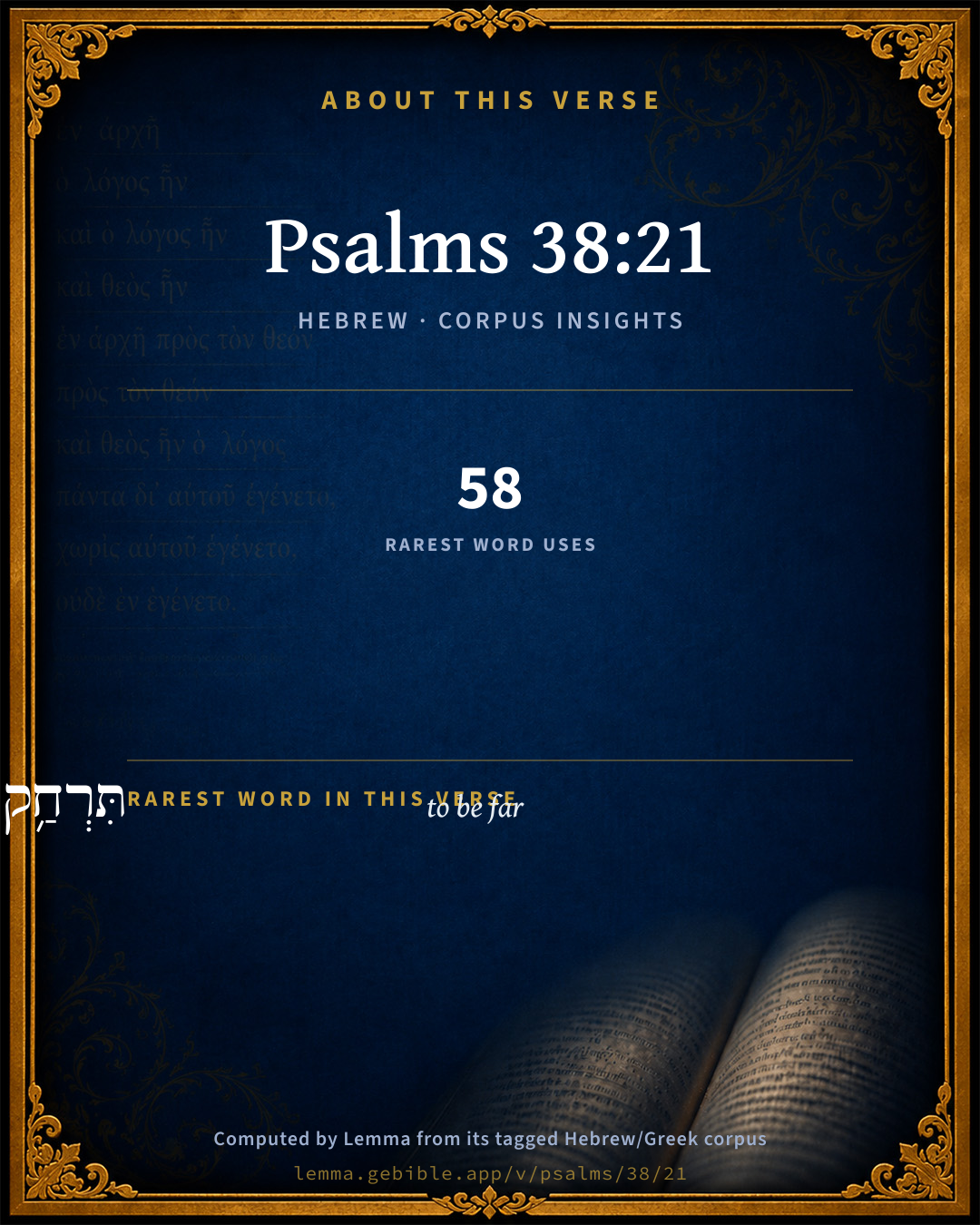
About this verse

These counts appear in no published source. They are computed here, from the morphology-tagged text and Lemma’s own curated glosses. What Lemma adds →

7
words
6
distinct lemmas
Wisdom
section

Shared distinctive vocabulary

תִּרְחַ֥ק to be far H7368 occurs in 56 verses of the Hebrew Bible. Also found in:

Grammatical profile

  • 2 verbs
  • 2 nouns
  • 1 preposition
  • 2 particles

Verb forms

  • תַּֽעַזְבֵ֥נִי Qal · Jussive
  • תִּרְחַ֥ק Qal · Jussive

Repetition

A word recurs within this verse — often emphatic in Hebrew:

  • אַל not H408 ×2

Hebrew & Septuagint length

In English translation the verse runs 11 words from the Hebrew and 11 from the Septuagint (LXX English) — the same length.

A rough comparison of the two English renderings, which tokenize alike — not a word-level alignment.

Word counts can differ between the Hebrew and the Greek without any difference in meaning — e.g. the Hebrew direct-object marker אֵת has no separate Greek word, and Greek often adds the article ὁ.

Cross-references

5

Topical passages linked to Psalms 38:21 in the Treasury of Scripture Knowledge — connected by theme and wording, ordered by reader-vote popularity; previews shown in the World English Bible.

  • Psalms 22:19 But don't be far off, Yahweh. You are my help: hurry to help me.
  • Psalms 22:24 For he has not despised nor abhorred the affliction of the afflicted, Neither has he hidden his face from him; But when he cried to him, he heard.
  • Psalms 22:11 Don't be far from me, for trouble is near. For there is none to help.
  • Psalms 35:21–22 Yes, they opened their mouth wide against me. They said, "Aha! Aha! Our eye has seen it!"
  • Psalms 22:1 My God, my God, why have you forsaken me? Why are you so far from helping me, and from the words of my groaning?

Cross-references courtesy of OpenBible.info (CC BY 4.0).

Hebrew and Greek witnesses Masoretic Hebrew ↔ Greek Septuagint

The same verse in the two great witnesses to the Old Testament, shown verse-for-verse.

You’re reading Greek Psalm 37 (Hebrew Psalm 38). The Septuagint counts the superscription, so verse numbers can differ from the Hebrew — chapter-level alignment, not verse-by-verse. Numbering follows Rahlfs.

These are two independent witnesses, not word-aligned to each other, and the Septuagint is shown in lemma (dictionary) form.

Hebrew Psalms 38:21 Masoretic · Westminster Leningrad Codex

אַל תַּֽעַזְבֵ֥נִי יְהוָ֑ה אֱ֝לֹהַ֗י אַל תִּרְחַ֥ק מִמֶּֽנִּי

Don't forsake me, Yahweh. My God, don't be far from me.

World English Bible · Public Domain

Greek LXX Greek Psalm 37:21 Septuagint · lemma form

ὁ ἀντι ἀποδίδωμι κακός ἀντί ἀγαθός ἐν διαβάλλω ἐγώ ἐπεί καταδιώκω δικαιοσύνη καί ἀποῥίπτω ἐγώ ὁ ἀγαπητός ὡσεί νεκρός βδελύσσω

Forsake me not, O Lord my God: depart not from me.

LXX2012 (modern English Septuagint) · Public Domain

Hebrew: Westminster Leningrad Codex (CC BY 4.0). Greek: Septuagint (public domain); English from LXX2012 (modern English Septuagint) (Public Domain). How the Septuagint differs from the Hebrew →

Commentary

Notes on Psalms 38:21 from classic Christian and Jewish commentators (each source and its license shown beneath its notes). The classic Christian expositions comment on the surrounding passage and are grouped to its opening verse, so a note may address several verses; the Jewish commentaries on the Tanakh (Rashi and others) are per-verse, so they appear only where the commentator wrote on this verse.

Lemma curates 59 commentaries, every one of them public domain or Creative Commons licensed, each selected and text-cleaned for this edition rather than reprinted as found. About our sources →

Trapp's Complete Commentary

John Trapp

Psa 38:21 Forsake me not, O LORD: O my God, be not far from me.

Ver. 21. Forsake me not, O Lord] This was that he most of all feared, spiritual desertion. So Jeremiah, Be not thou a terror unto me, O God; and then I care not what else can befall me.

O my God, be not far from me] Though my friends stand aloof, Psa 38:11, yet be thou ever at hand to help me.

John Trapp, A Commentary or Exposition upon All the Books of the Old and New Testament (1647–1656) — public domain. Text from a community e-Sword module.

J. A. Alexander on Psalms

Joseph Addison Alexander

22. (Psa 38:21). Leave me not (O) Jehovah! (O) my God, be not far from me! Having twice described his urgent need, he now resumes the tone of complaint with which the psalm began. The petition in this verse is one of frequent occurrence in the Psalms. See above, Psa 10:1; Psa 13:2 (1), Psa 22:2 (1), Psa 35:22. The most striking parallel, however, is Psa 22:20 (19).

Joseph Addison Alexander, The Psalms Translated and Explained (1850) — public domain. Text from a community e-Sword module.

Jamieson, Fausset & Brown

Robert Jamieson, A. R. Fausset & David Brown

(Compare Psa 22:19; Psa 35:3). All terms of frequent use. In this Psalm the language is generally susceptible of application to Christ as a sufferer, David, as such, typifying Him. This does not require us to apply the confessions of sin, but only the pains or penalties which He bore for us.

Next: Psalms Chapter 39

Jamieson, Fausset & Brown — Commentary Critical and Explanatory on the Whole Bible (1871) — public domain (CC PDM 1.0). Text via the HelloAO Bible API.

Adam Clarke's Commentary

Verse 21. Forsake me not, O Lord] Though all have forsaken me, do not thou.

Be not far from me] Though my friends keep aloof, be thou near to help me.

Adam Clarke's Commentary on the Bible (1810–1826) — public domain. Text from a community e-Sword/MySword module.

John Calvin's Commentaries

In these concluding verses, David briefly states the chief point which he desired, and the sum of his whole prayer; namely, that whereas he was forsaken of men, and grievously afflicted in every way, God would receive him and raise him up again. He uses three forms of expression; first, that God would not forsake him, or cease to take care of him; secondly, that he would not be far from him; and, thirdly, that he would make haste to help him. David was, indeed, persuaded that God is always near to his servants, and that he delays not a single moment longer than is necessary. But, as we have seen in another place, it is not at all wonderful that the saints, when they unburden themselves of their cares and sorrows into the bosom of God, should make their requests in language according to the feeling of the flesh. They are not ashamed to confess their infirmity, nor is it proper to conceal the doubts which arise in their minds. Although, however, waiting was wearisome to David according to the flesh, yet in one word he plainly shows that he did not pray in uncertainty when he calls God his salvation, or the author of his salvation. Some render it to my salvation, but this is forced. David rather sets up this as a wall of defense against all the devices by which, as we have seen, his faith was assailed, That whatever might happen, he was, nevertheless, well assured of his salvation in God.

John Calvin's Commentaries (1540-1563) — public domain. Text from the Calvin Translation Society English edition (1840s-50s) via the Christian Classics Ethereal Library (ccel.org). Calvin's coverage is partial (roughly two-thirds of the Bible); uncommented books and verses are honest gaps, never fabricated. The 19th-century editor's footnotes and remarks are omitted so the notes are faithfully Calvin's own voice.

The Cambridge Bible for Schools and Colleges

gen. ed. J. J. S. Perowne

21. Cp. Psa_22:1; Psa_10:1.

“The light has not yet dawned upon the darkness of God’s wrath. Fides supplex is not yet transformed into fides triumphans. But the difference between Cain’s repentance and David’s repentance is shewn in the concluding words. True repentance includes faith: it despairs of itself, but not of God.” Delitzsch.

21, 22. Concluding prayer.

The Cambridge Bible for Schools and Colleges (gen. ed. J. J. S. Perowne; Cambridge University Press, 1878–1918) — public domain. Text from a community e-Sword module.

John Gill's Exposition

Make haste and help me,.... Or, "for my help"; his case required haste, and God does help his people when none else can, and that right early;

O Lord, my salvation; by which it appears that his prayer was a prayer of faith; he saw that his salvation was in the Lord, and in no other; and though he had been and was in such a low condition, both in soul and body, yet his faith was not lost; that is an abiding grace, and will continue under the influence of the author and finisher of it, until the end of it is received, the salvation of the soul. R. Moses (r) thinks the phrase "make haste" is to be repeated here, and read thus, "make haste, O Lord, to my salvation".

(r) In Aben Ezra & R. Joseph Kimchi in R. David Kimchi in loc.

Next: Psalms Chapter 39

John Gill's Exposition of the Whole Bible (1746–1763) — public domain (CC PDM 1.0). Text via the HelloAO Bible API.

Albert Barnes' Notes on the Bible

Forsake me not, O Lord - That is, Do not leave me in my troubles, my sickness, my sorrow. Leave me not to die; leave me not to complain and dishonor thee; leave me not to the reproaches of my enemies.

O my God, be not far from me - See Psa 35:22. Compare Psa 10:1; Psa 13:1.

Albert Barnes' Notes on the Bible (1834–1885) — public domain. Text from a community e-Sword/MySword module.

The Treasury of David

Charles H. Spurgeon

Ver. 21. Forsake me not, O Lord. Now is the time I need thee most. When sickness, slander, and sin, all beset a saint, he requires the especial aid of heaven, and he shall have it too. He is afraid of nothing while God is with him, and God is with him evermore. Be not far from me. Withhold not the light of thy near and dear love. Reveal thyself to me. Stand at my side. Let me feel that though friendless besides, I have a most gracious and all sufficient friend in thee.

None.

None.

Psalms 38:22*

Charles H. Spurgeon's The Treasury of David (1869–1885) — public domain. Psalms only. Text from a community e-Sword/MySword module.

The Pulpit Commentary

Forsake me not, O Lord. (comp. Psa_27:9 Psa_71:9:18 Psa_119:8) God never really forsakes his saints. (Psa_37:28) He withdraws sometimes for wise purposes the sense of his presence and favour, so that they feel as if they were forsaken; but this is only temporary., O my God, be not far from me. (comp. Psa_22:19 Psa_35:22 Psa_71:12)

The Pulpit Commentary (1880–1919), ed. H.D.M. Spence-Jones & Joseph S. Exell — public domain. Text from a community e-Sword module.

unfoldingWord translationNotes

Door43 World Missions Community

Do not abandon me ... do not stay far away from me

These two phrases have very similar meanings. (See: Parallelism)

do not stay far away from me

Because Yahweh has not yet answered the writer's request, he speaks of Yahweh as if Yahweh were standing far away from the writer. (See: Metaphor)

Come quickly to help me

God is spoken of as if he is running to the writer to help him. (See: Metaphor)

my salvation

The abstract noun "salvation" can be stated as an action. AT: "you are the one who saves me" (See: Abstract Nouns)

translationWords

save

unfoldingWord translationNotes — © Distant Shores Media and the Door43 World Missions Community, licensed CC BY-SA 4.0. Source: git.door43.org/Door43/en_tn.

Rashi

Rabbi Shlomo Yitzchaki (Rashi)

for my pursuit of goodness Because we cleave to the Holy One, blessed be He, and to His commandments.

Rashi on the Tanakh — English translations: “The Judaica Press complete Tanach with Rashi, translated by A. J. Rosenberg” (CC BY 4.0); “Pentateuch with Rashi's commentary by M. Rosenbaum and A.M. Silbermann, 1929-1934” (public domain); “The Metsudah Tanach series, Lakewood, N.J” (CC BY 4.0); and “The Book of Joshua, Metsudah Publications, 1997” (CC BY 4.0). Text via Sefaria.

Lesson kit

Teaching starters — assembled from the data on this page, not authored interpretation. Every prompt links to the verse data it draws on. Edit before teaching.

Psalms, in the Wisdom, opens this verse with 7 words (6 distinct Hebrew lemmas). Its most distinctive word is râchaq (“to be far”). A historical commentator’s framing appears above. Read the whole chapter for the surrounding context.

Discussion questions

  1. The word râchaq carries the sense “to be far.” How does it shape the verse?
  2. Genesis 21:16 shares the word «to be far» with this verse. How do the two illuminate each other?
  3. “not” occurs 2× in this one verse. What is the effect of the repetition?
  4. These translations render this verse differently. What is at stake in choosing one wording over another?
  5. The verb «תַּֽעַזְבֵ֥נִי» is Qal Jussive. How does its form color the action?
  6. Reading how Trapp's Complete Commentary and J. A. Alexander on Psalms read this verse, where do the two commentators agree and where do they part?

Things to notice

Reading settings

Reading text

Shown beneath each verse's original-language words.

Old Testament
Old Testament edition

Read the OT as the Masoretic Hebrew (MT) or the Greek Septuagint (LXX).

English shown for the Greek Septuagint (in the Hebrew ↔ Greek comparison).

Comparing translations? Open the Compare panel on any verse page to stack up to four side by side.