
Jeremiah 16:11

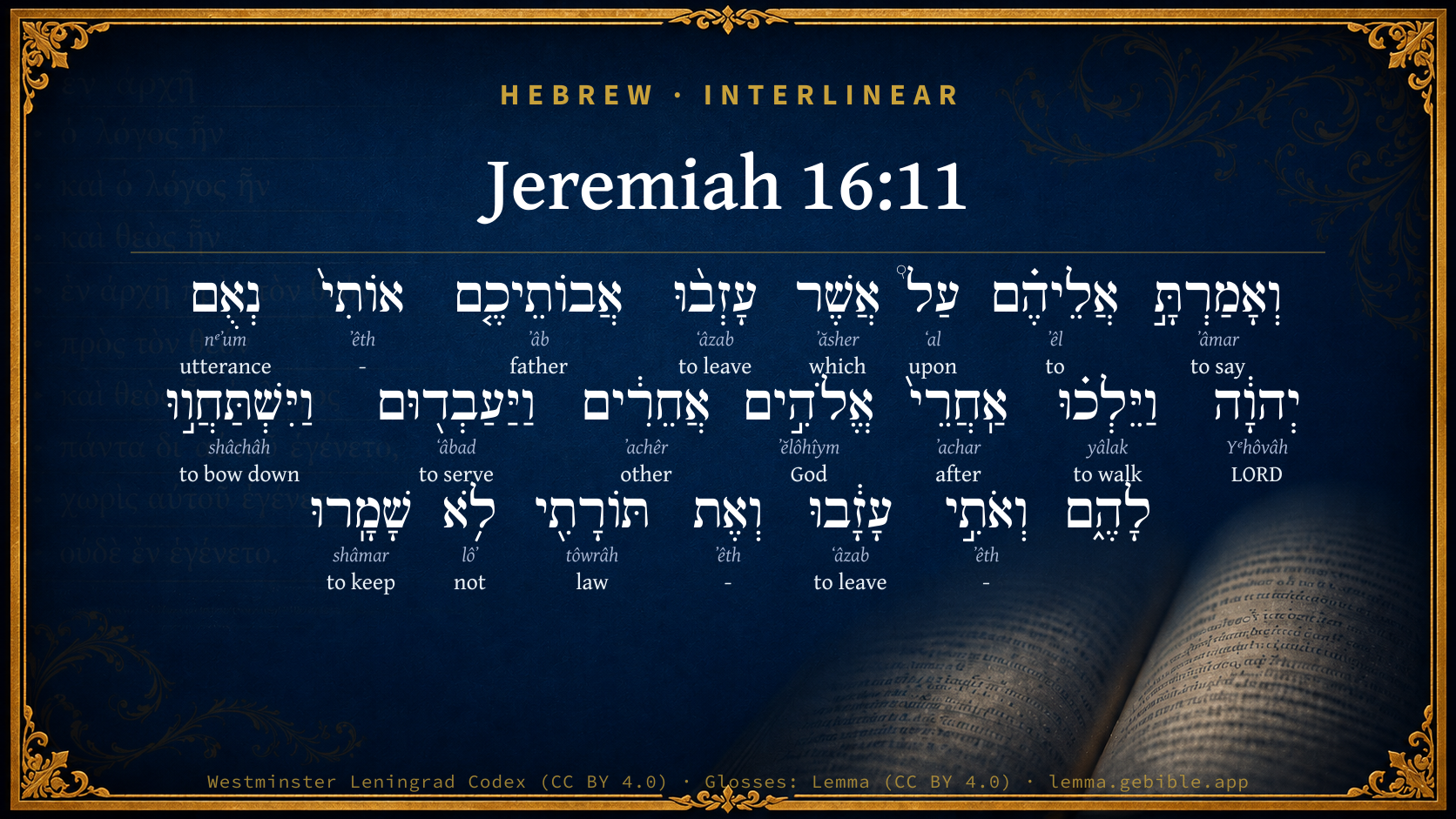
Hebrew (Westminster Leningrad Codex) Jeremiah 16:11 appears in the Hebrew Old Testament. The text above is from the Westminster Leningrad Codex. Each word links to its Strong’s number, a concise gloss, and parsing drawn from the Open Scriptures Hebrew Bible morphology. Click any word for its full Brown-Driver-Briggs (BDB) entry.
Download image
Cite this verse

Jeremiah 16:11 (World English Bible). Public Domain. Lemma interlinear Bible study tool, https://lemma.gebible.app/v/jeremiah/16/11.

Show BibTeX & RIS
BibTeX
RIS
English Translation
Then shall you tell them, Because your fathers have forsaken me, says Yahweh, and have walked after other gods, and have served them, and have worshiped them, and have forsaken me, and have not kept my law;
World English Bible · Public Domain
Download a study sheet

One document with this verse’s original text, its word-by-word gloss line, the meaning frame, cross-references with their text, attributed commentary, and full source and license credits — printable, and it pastes into notes with its structure intact.

This verse Autodidact and up

Study sheet (.html) Plain text (.txt)

A passage Seminary Student

Up to 50 verses in one chapter. A passage sheet keeps up to 6 commentary sources and 12 cross-references per verse, in the order this page ranks them, and says so on the sheet whenever that leaves anything out. Ask for a single verse and you get the Autodidact verse sheet above.

Everything on this page stays free to read, with no account — the sheet is a download of what is already on screen, not access to it.

Want to remove ads? Support Godless Engineer
Compare translations 3

The same verse in 3 English versions, stacked beneath the original-language interlinear above. Click any original word for its lexicon entry.

Each is an independent rendering of the whole verse — the interlinear is not word-aligned to these translations.

Highlighted words mark where these versions differ — a whole-verse word diff, not a word-by-word alignment.

  • World English Bible Public Domain
    Then shall you tell them, Because your fathers have forsaken me, says Yahweh, and have walked after other gods, and have served them, and have worshiped them, and have forsaken me, and have not kept my law;
  • King James Version Public Domain
    Then shalt thou say unto them, Because your fathers have forsaken me, saith the LORD, and have walked after other gods, and have served them, and have worshipped them, and have forsaken me, and have not kept my law;
  • unfoldingWord Literal Text CC BY-SA 4.0
    Then you shall say to them, ‘Because your fathers have abandoned me,’—the declaration of Yahweh—‘and they have walked after other gods and they have served them and they have bowed down to them and they have abandoned me and they have not kept my law.

unfoldingWord Literal Text — © unfoldingWord, licensed CC BY-SA 4.0. Word-aligned USFM3 via Door43 (git.door43.org/unfoldingWord/en_ult).

Versions to compare (up to 4)

3 of 4 selected

Show all 18 translations

Every available English version of this verse, each an independent rendering of the whole verse.

  • World English Bible Public Domain
    Then shall you tell them, Because your fathers have forsaken me, says Yahweh, and have walked after other gods, and have served them, and have worshiped them, and have forsaken me, and have not kept my law;
  • Berean Standard Bible Public Domain
    Then you are to answer them: ‘It is because your fathers have forsaken Me, declares the LORD, and followed other gods, and served and worshiped them. They abandoned Me and did not keep My instruction.
  • Majority Standard Bible Public Domain
    Then you are to answer them: ‘It is because your fathers have forsaken Me, declares the LORD, and followed other gods, and served and worshiped them. They abandoned Me and did not keep My instruction.
  • King James Version Public Domain
    Then shalt thou say unto them, Because your fathers have forsaken me, saith the LORD, and have walked after other gods, and have served them, and have worshipped them, and have forsaken me, and have not kept my law;
  • American Standard Version (1901) Public Domain
    Then shalt thou say unto them, Because your fathers have forsaken me, saith Jehovah, and have walked after other gods, and have served them, and have worshipped them, and have forsaken me, and have not kept my law;
  • Revised Version (1885) Public Domain
    Then shalt thou say unto them, Because your fathers have forsaken me, saith the LORD, and have walked after other gods, and have served them, and have worshipped them, and have forsaken me, and have not kept my law;
  • Geneva Bible (1599) Public Domain
    Then shalt thou say vnto them, Because your fathers haue forsaken me, sayth the Lord, and haue walked after other gods, and haue serued them, and worshipped them, and haue forsaken me, and haue not kept my Law,
  • Douay-Rheims (1899) Public Domain
    Thou shalt say to them: Because your fathers forsook me, saith the Lord: and went after strange gods, and served them, and adored them: and they forsook me, and kept not my law.
  • Young's Literal Translation Public Domain
    Then thou hast said unto them: Because that your fathers have forsaken Me, An affirmation of Jehovah, And go after other gods, and serve them, And they bow themselves to them, And Me have forsaken, and My law not kept,
  • Literal Standard Version CC BY-SA 4.0
    Then you have said to them: Because that your fathers have forsaken Me, || A declaration of YHWH, || And go after other gods, and serve them, || And they bow themselves to them, || And have forsaken Me, and not kept My law,
  • Unlocked Literal Bible CC BY-SA 4.0
    So say to them, 'Because your ancestors abandoned me—this is Yahweh's declaration—and they went after other gods and worshiped and bowed down to them. They abandoned me and have not kept my law.
  • unfoldingWord Literal Text CC BY-SA 4.0
    Then you shall say to them, ‘Because your fathers have abandoned me,’—the declaration of Yahweh—‘and they have walked after other gods and they have served them and they have bowed down to them and they have abandoned me and they have not kept my law.
  • Darby Bible Public Domain
    then shalt thou say unto them, Because your fathers have forsaken me, saith Jehovah, and have walked after other gods, and have served them, and have worshipped them, and have forsaken me, and have not kept my law;
  • World Messianic Bible Public Domain
    then you shall tell them, ‘Because your fathers have forsaken me,’ says the LORD, ‘and have walked after other gods, have served them, have worshiped them, have forsaken me, and have not kept my law.
  • Webster's Bible Public Domain
    Then shalt thou say to them, Because your fathers have forsaken me, saith the LORD, and have walked after other gods, and have served them, and have worshiped them, and have forsaken me, and have not kept my law;
  • Free Bible Version CC BY-SA 4.0
    Answer them: It's because your forefathers deserted me, declares the Lord. They went and followed other gods, serving them and worshiping them. They abandoned me and didn't keep my laws.
  • Bible in Basic English Public Domain
    Then you will say to them, Because your fathers have given me up, says the Lord, and have gone after other gods and become their servants and their worshippers, and have given me up and have not kept my law;
  • JPS Tanakh (1917) Public Domain
    then shalt thou say unto them: 'Because your fathers have forsaken Me, saith the LORD, and have walked after other gods, and have served them, and have worshipped them, and have forsaken Me, and have not kept My law;

Literal Standard Version (2020), Covenant Press — licensed CC BY-SA 4.0. Text via the HelloAO Bible API (eBible.org). Unlocked Literal Bible (unfoldingWord) — licensed CC BY-SA 4.0. Text via the HelloAO Bible API (eBible.org). unfoldingWord Literal Text — © unfoldingWord, licensed CC BY-SA 4.0. Word-aligned USFM3 via Door43 (git.door43.org/unfoldingWord/en_ult). Free Bible Version, Dr. Jonathan Gallagher — licensed CC BY-SA 4.0. Text via the HelloAO Bible API (eBible.org).

Word by word

More ways to search: Search by grammar → Find every occurrence → Compare this word →

Practice this passage: Drill this verse → Learn its vocabulary →

אֲחֵרִ֔ים
ʼachêr
H312
“other”
Adjective, Adjective, Masculine, Plural, Absolute
Part of Speech
Adjective
Type
Adjective
Gender
Masculine
Number
Plural
State
Absolute
Full BDB Definition

Origin: from H309

TWOT: 68a

another, other, following - following, further - other, different
  1. וְאָמַרְתָּ֣ ʼâmar H559 “and · to say” Conjunction + Verb, Qal, Sequential Perfect, 2nd Person, Masculine, Singular
  2. אֲלֵיהֶ֗ם ʼêl H413 “to · them” Preposition + Suffix, Personal, 3rd Person, Masculine, Plural
  3. עַל֩ ʻal H5921 “upon” Preposition
  4. אֲשֶׁר ʼăsher H834 “which” Particle, Relative
  5. עָזְב֨וּ ʻâzab H5800 “to leave” Verb, Qal, Perfect, 3rd Person, Common, Plural
  6. אֲבוֹתֵיכֶ֤ם ʼâb H1 “fathers · your” Noun, Common, Masculine, Plural, Construct + Suffix, Personal, 2nd Person, Masculine, Plural
  7. אוֹתִי֙ ʼêth H853 “- · me” Particle, Direct Object + Suffix, Personal, 1st Person, Common, Singular
  8. נְאֻם nᵉʼum H5002 “utterance of” Noun, Common, Masculine, Singular, Construct
  9. יְהוָ֔ה Yᵉhôvâh H3068 “LORD” Noun, Proper
  10. וַיֵּלְכ֗וּ yâlak H3212 “and · to walk” Conjunction + Verb, Qal, Sequential Imperfect, 3rd Person, Masculine, Plural
  11. אַֽחֲרֵי֙ ʼachar H310 “after” Preposition
  12. אֱלֹהִ֣ים ʼĕlôhîym H430 “God(s)” Noun, Common, Masculine, Plural, Absolute
  13. וַיַּעַבְד֖וּם ʻâbad H5647 “and · to serve · them” Conjunction + Verb, Qal, Sequential Imperfect, 3rd Person, Masculine, Plural + Suffix, Personal, 3rd Person, Masculine, Plural
  14. וַיִּשְׁתַּחֲו֣וּ shâchâh H7812 “and · to bow down” Conjunction + Verb, Hithpael, Sequential Imperfect, 3rd Person, Masculine, Plural
  15. וְאֹתִ֣י ʼêth H853 “and · - · me” Conjunction + Particle, Direct Object + Suffix, Personal, 1st Person, Common, Singular
  16. עָזָ֔בוּ ʻâzab H5800 “to leave” Verb, Qal, Perfect, 3rd Person, Common, Plural
  17. וְאֶת ʼêth H853 “and · -” Conjunction + Particle, Direct Object
  18. תּוֹרָתִ֖י tôwrâh H8451 “law · my” Noun, Common, Feminine, Singular, Construct + Suffix, Personal, 1st Person, Common, Singular
  19. לֹ֥א lôʼ H3808 “not” Particle, Negative
  20. שָׁמָֽרוּ shâmar H8104 “to keep” Verb, Qal, Perfect, 3rd Person, Common, Plural

About this verse

These counts appear in no published source. They are computed here, from the morphology-tagged text and Lemma’s own curated glosses. What Lemma adds →

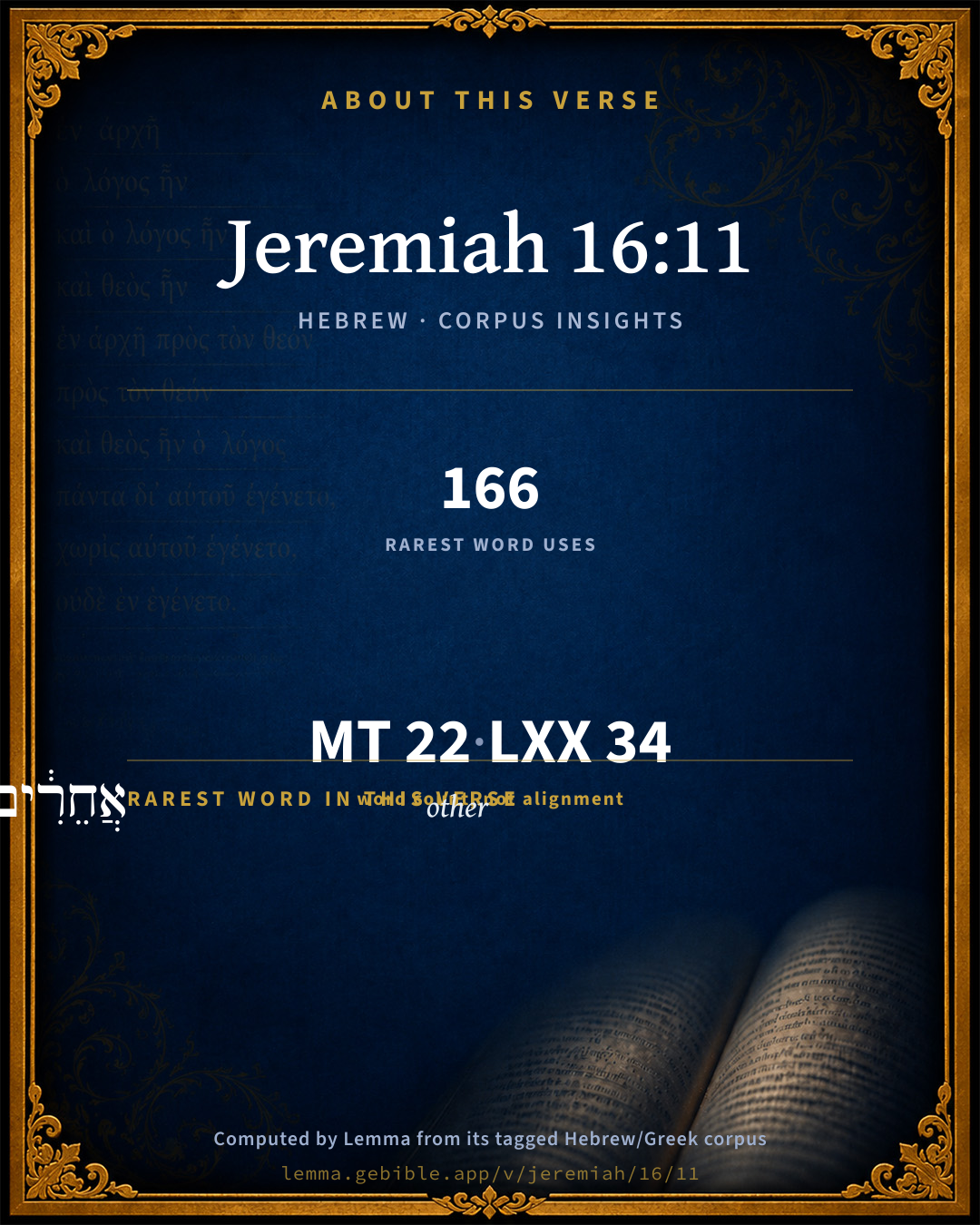
22
words
18
distinct lemmas
Prophets
section

Grammatical profile

  • 7 verbs
  • 5 nouns
  • 1 adjective
  • 4 prepositions
  • 5 particles

Verb forms

  • וְאָמַרְתָּ֣ Qal · Sequential Perfect
  • עָזְב֨וּ Qal · Perfect
  • וַיֵּלְכ֗וּ Qal · Sequential Imperfect
  • וַיַּעַבְד֖וּם Qal · Sequential Imperfect
  • וַיִּשְׁתַּחֲו֣וּ Hithpael · Sequential Imperfect
  • עָזָ֔בוּ Qal · Perfect
  • שָׁמָֽרוּ Qal · Perfect

Repetition

A word recurs within this verse — often emphatic in Hebrew:

  • עָזְב֨וּ to leave H5800 ×2

Hebrew & Septuagint length

In the original languages it is 22 Hebrew tokens and 34 Greek tokens — but the two are counted differently (Hebrew bundles its prefixes and suffixes into one token; the Greek is in lemma form), so that isn’t a like-for-like length.

Cross-references

14

Topical passages linked to Jeremiah 16:11 in the Treasury of Scripture Knowledge — connected by theme and wording, ordered by reader-vote popularity; previews shown in the World English Bible.

  • Psalms 106:35–41 But mixed themselves with the nations, And learned their works.
  • Deuteronomy 29:25–26 Then men shall say, Because they forsook the covenant of Yahweh, the God of their fathers, which he made with them when he brought them forth out of the land of Egypt,
  • 1 Kings 9:9 and they shall answer, Because they forsook Yahweh their God, who brought forth their fathers out of the land of Egypt, and laid hold on other gods, and worshiped them, and served them: therefore has Yahweh brought all this evil on them.
  • Nehemiah 9:26–29 Nevertheless they were disobedient, and rebelled against you, and cast your law behind their back, and killed your prophets that testified against them to turn them again to you, and they committed awful blasphemies.
  • Jeremiah 5:7–9 How can I pardon you? your children have forsaken me, and sworn by them that are no gods: when I had fed them to the full, they committed adultery, and assembled themselves in troops at the prostitutes' houses.
  • Jeremiah 8:2 and they shall spread them before the sun, and the moon, and all the host of the sky, which they have loved, and which they have served, and after which they have walked, and which they have sought, and which they have worshiped: they shall not be gathered, nor be buried, they shall be for dung on the surface of the earth.
  • Jeremiah 22:9 Then they shall answer, Because they forsook the covenant of Yahweh their God, and worshiped other gods, and served them.
  • Ezekiel 11:21 But as for them whose heart walks after the heart of their detestable things and their abominations, I will bring their way on their own heads, says the Lord Yahweh.
  • 1 Peter 4:3 For we have spent enough of our past time doing the desire of the Gentiles, and having walked in lewdness, lusts, drunken binges, orgies, carousings, and abominable idolatries.
  • Judges 2:12–13 and they forsook Yahweh, the God of their fathers, who brought them out of the land of Egypt, and followed other gods, of the gods of the peoples who were round about them, and bowed themselves down to them: and they provoked Yahweh to anger.
  • Judges 10:13–14 Yet you have forsaken me, and served other gods: therefore I will save you no more.
  • Jeremiah 2:8 The priests didn't say, Where is Yahweh? and those who handle the law didn't know me: the rulers also transgressed against me, and the prophets prophesied by Baal, and walked after things that do not profit.
  • Jeremiah 9:14 but have walked after the stubbornness of their own heart, and after the Baals, which their fathers taught them;
  • Daniel 9:10–12 neither have we obeyed the voice of Yahweh our God, to walk in his laws, which he set before us by his servants the prophets.

Cross-references courtesy of OpenBible.info (CC BY 4.0).

Hebrew and Greek witnesses Masoretic Hebrew ↔ Greek Septuagint

The same verse in the two great witnesses to the Old Testament, shown verse-for-verse.

These are two independent witnesses, not word-aligned to each other, and the Septuagint is shown in lemma (dictionary) form.

Hebrew Jeremiah 16:11 Masoretic · Westminster Leningrad Codex

וְאָמַרְתָּ֣ אֲלֵיהֶ֗ם עַל֩ אֲשֶׁר עָזְב֨וּ אֲבוֹתֵיכֶ֤ם אוֹתִי֙ נְאֻם יְהוָ֔ה וַיֵּלְכ֗וּ אַֽחֲרֵי֙ אֱלֹהִ֣ים אֲחֵרִ֔ים וַיַּעַבְד֖וּם וַיִּשְׁתַּחֲו֣וּ לָהֶ֑ם וְאֹתִ֣י עָזָ֔בוּ וְאֶת תּוֹרָתִ֖י לֹ֥א שָׁמָֽרוּ

Then shall you tell them, Because your fathers have forsaken me, says Yahweh, and have walked after other gods, and have served them, and have worshiped them, and have forsaken me, and have not kept my law;

World English Bible · Public Domain

Greek LXX Structure differs

In the Septuagint, Jeremiah is about an eighth shorter than the Hebrew and arranges its material differently — the Oracles Against the Nations (Hebrew chapters 46–51) appear in the middle of the Greek book, after 25:13. Because the chapter and verse boundaries do not line up, a verse-for-verse comparison with the Hebrew is not shown.

A verse-for-verse comparison isn’t shown here because the chapters and verses don’t line up. Switch to the LXX edition with the MT / LXX toggle above to read the Greek directly.

Hebrew: Westminster Leningrad Codex (CC BY 4.0). Greek: Septuagint (public domain); English from a public-domain English Septuagint. How the Septuagint differs from the Hebrew →

Targum (Aramaic paraphrase)

1

The Targum is the ancient Jewish Aramaic paraphrase of the Hebrew Scriptures — an interpretive translation, not the Hebrew text itself. Onkelos (literal) and Pseudo-Jonathan (expansive) render the Torah, and Jonathan the Prophets. Coverage is partial: where no permissively-licensed English translation exists for a verse, only the Aramaic is shown. This is verse-level text, not a word-by-word alignment to the Hebrew.

  1. Targum Jonathan Prophets (Joshua–Malachi)
    וְתֵימַר לְהוֹן עַל דִשְׁבַקוּ אֲבָהָתְכוֹן פּוּלְחָנִי אָמַר יְיָ וּטְעוֹ בָתַר טַעֲוָת עַמְמַיָא וּפְלַחוּנוּן וּסְגִידוּ לְהוֹן וּפוּלְחָנִי שְׁבַקוּ וְיַת אוֹרַיְתִי לָא נְטַרוּ:

    (no public-domain English translation for this verse)

    Targum Jonathan — Aramaic: “Mikraot Gedolot” (public domain). English: “Sefaria Community Translation” (CC0 1.0 (public-domain dedication)); “London "Chaldee Paraphrase," 1871” (public domain). Text via Sefaria.

Commentary

Notes on Jeremiah 16:11 from classic Christian and Jewish commentators (each source and its license shown beneath its notes). The classic Christian expositions comment on the surrounding passage and are grouped to its opening verse, so a note may address several verses; the Jewish commentaries on the Tanakh (Rashi and others) are per-verse, so they appear only where the commentator wrote on this verse.

Lemma curates 59 commentaries, every one of them public domain or Creative Commons licensed, each selected and text-cleaned for this edition rather than reprinted as found. About our sources →

Trapp's Complete Commentary

John Trapp

Jer 16:11 Then shalt thou say unto them, Because your fathers have forsaken me, saith the LORD, and have walked after other gods, and have served them, and have worshipped them, and have forsaken me, and have not kept my law;

Ver. 11. Because your fathers.] See Jer 2:5; Jer 7:24-25.

John Trapp, A Commentary or Exposition upon All the Books of the Old and New Testament (1647–1656) — public domain. Text from a community e-Sword module.

Tyndale Open Study Notes

Tyndale Open Resources

16:11-13 Jeremiah’s reply was the message he received when he was commissioned: The people had abandoned the Lord for idols (ch 2), so the Lord would abandon them.

Tyndale Open Study Notes — © Tyndale Open Resources, licensed CC BY-SA 4.0. Text via the HelloAO Bible API.

Jamieson, Fausset & Brown

Robert Jamieson, A. R. Fausset & David Brown

(Jer 5:19; Jer 13:22; Jer 22:8-9).

Jamieson, Fausset & Brown — Commentary Critical and Explanatory on the Whole Bible (1871) — public domain (CC PDM 1.0). Text via the HelloAO Bible API.

John Calvin's Commentaries

But he then says, Thou shalt answer them, Because your fathers forsook me; they went after foreign gods, served and worshipped them; and me they forsook and my law they kept not, and ye have done worse God in the first place accused their fathers, not that punishment ought to have fallen on their children, except they followed the wickedness of their fathers, but the men of that age fully deserved to be visited with the judgment their fathers merited. Besides well known is that declaration, that God reckons the iniquities of the fathers to their children; (Exodus 20:5; Exodus 34:7; Deuteronomy 5:9) and he acts thus justly, for he might justly execute vengeance for sins on the whole human race, according to what Christ says,

“On you shall come the blood of all the godly, from righteous Abel to Zachariah the son of Barachiah.” (Matthew 23:35; Luke 11:51)

Thus then the Scripture often declares, that children shall be punished with their fathers, because God will at one time or another require an account of all sins, and thus will make amends for his long forbearance, for as he waits for men and kindly invites them through his patience to repent, so when he sees no hope he inflicts all his scourges. It is hence no wonder that children are more grievously punished after iniquity has prevailed for many ages.

We hence see that these two things are not inconsistent — that God connects the punishment of children with that of their fathers, and that he does not punish the innocent. We indeed see this fulfilled,

“The soul that sinneth it shall die; the children shall not bear the iniquity of their fathers, nor the father the iniquity of his child,” (Ezekiel 18:4, 20)

for God never blends children with their fathers except they be their associates in wickedness. But yet there is nothing to prevent God to punish children for the sins of their fathers, especially when they continually rush headlong into worse sins, when the children, as we shall hereafter see, exceed their fathers in all kinds of wickedness.

We further learn from this passage, that they bring forward a vain pretense who allege against us the examples of the Fathers, as we see to be done now by those under the Papacy; for the shield they boldly set up against us is this, that they imitate the examples of the fathers. But God declares here that they were worthy of double punishment who repented not when they saw that their fathers had been ungodly and transgressors of the law.

Let us now notice the sins which God mentions: he says, that they had forsaken him. That people could not make any excuse for going astray, like the unhappy heathens, to whom no Prophet had been sent, and no law had been given. Hence the heathens had some excuse more than the Jews. The truth indeed respecting all was, that they were all apostates, for God had bound the human race to himself, and all they who followed superstitions were justly charged with the sin of apostasy; there was yet a greater atrocity of wickedness in the Jewish people, for God had set before them his law, they had been brought up as it were in his school, they knew what true religion was, they were able to distinguish the true God from fictitious gods. We now then see the meaning of the expression, They have forsaken me: and it is twice repeated, because it was necessary thus to prove the Jews guilty, that their mouths might be stopped; for we have seen that they were to be thus roused from their insensibility, inasmuch as they would have never yielded nor acknowledged their sins, were they not constrained.

He says further, that they went after foreign gods, served them, and worshipped them Now this statement enhances again their sins, for the Jews preferred their own inventions to the true God, who had by so many signs and testimonies manifested his glory and made known his power among them. As then God had abundantly testified his power, it was by no means an endurable ingratitude in them to follow strange gods, of whom they had only heard. The heathens indeed vainly boasted of their idols, and spread abroad many fables to allure unhappy men to false and corrupt worship, but the Jews knew who the true God was. To believe the fables of the heathens, rather than the law and their own experience, was not this the basest impiety? This then was the reason why God complained that foreign gods were worshipped by them.

Then he adds, They served and worshipped them The verb to serve is often used by the Hebrews to express worship, as we have stated elsewhere; and thus is refuted the folly of the Papists who deny that they are idolaters, because they worship pictures and statues with dulla, that is, with service, if we may so render it, and not with latria, as though Scripture in condemning idolatry never used this verb. But God condemns here the Jews because they served strange gods, because they gave credit to the false and vain fictions of the heathens; and then he adds the outward action, that they prostrated themselves before their idols.

At the end of this verse he shews how he had been forsaken, even because they kept not his law. He then confirms what I have already stated, that there was on this account a worse apostasy among the Jews, for they had knowingly and wilfully forsaken the fountain of living water, as we have seen in the second chapter: hence simple ignorance is not what is here reprehended, as though they had sinned through error or want of knowledge, but they had rejected the worship of God as it were designedly. The rest I shall defer till to-morrow.

John Calvin's Commentaries (1540-1563) — public domain. Text from the Calvin Translation Society English edition (1840s-50s) via the Christian Classics Ethereal Library (ccel.org). Calvin's coverage is partial (roughly two-thirds of the Bible); uncommented books and verses are honest gaps, never fabricated. The 19th-century editor's footnotes and remarks are omitted so the notes are faithfully Calvin's own voice.

John Gill's Exposition

And ye have done worse than your fathers,.... Not only committed the same sins, but greater, or, however, attended with more aggravating circumstances; they were wilfully and impudently done, and obstinately persisted in; and therefore deserving of the great evil of punishment pronounced against them.

For, behold, ye walk everyone after the imagination of his evil heart; they walked not as the word of God directs, but as their own evil heart dictated; the imagination of which was evil, and that continually, Gen 6:5.

That they may not hearken unto me; to the word of the Lord, and obey that; their minds being blinded, and their hearts hardened, and they obstinately bent on their own evil ways.

John Gill's Exposition of the Whole Bible (1746–1763) — public domain (CC PDM 1.0). Text via the HelloAO Bible API.

Albert Barnes' Notes on the Bible

The severe sentence passed upon them is the consequence of idolatry persisted in through many generations until it has finally deepened into national apostasy.

Albert Barnes' Notes on the Bible (1834–1885) — public domain. Text from a community e-Sword/MySword module.

Matthew Poole's English Annotations

Your fathers; the idolatrous kings of Judah that were before Manasseh’s time, since whose time there were hardly forty years yet elapsed.

Matthew Poole's English Annotations on the Holy Bible (1683–1685) — public domain. Text from a community e-Sword/MySword module.

Lesson kit

Teaching starters — assembled from the data on this page, not authored interpretation. Every prompt links to the verse data it draws on. Edit before teaching.

Jeremiah, in the Prophets, opens this verse with 22 words (18 distinct Hebrew lemmas). Its most distinctive word is ʼachêr (“other”). A historical commentator’s framing appears above. Read the whole chapter for the surrounding context.

Discussion questions

  1. What does “other” (ʼachêr) contribute to the verse as a whole?
  2. Psalms 106:35–41 shares this passage’s theme. How do the two illuminate each other?
  3. “to leave” occurs 2× in this one verse. What is the effect of the repetition?
  4. These translations render this verse differently; the difference is in the English rendering, not the original. What questions does that raise?
  5. The verb «וְאָמַרְתָּ֣» is Qal Sequential Perfect. How does its form color the action?
  6. Reading how Trapp's Complete Commentary and Tyndale Open Study Notes read this verse, where do the two commentators agree and where do they part?

Things to notice

Reading settings

Reading text

Shown beneath each verse's original-language words.

Old Testament
Old Testament edition

Read the OT as the Masoretic Hebrew (MT) or the Greek Septuagint (LXX).

English shown for the Greek Septuagint (in the Hebrew ↔ Greek comparison).

Comparing translations? Open the Compare panel on any verse page to stack up to four side by side.