
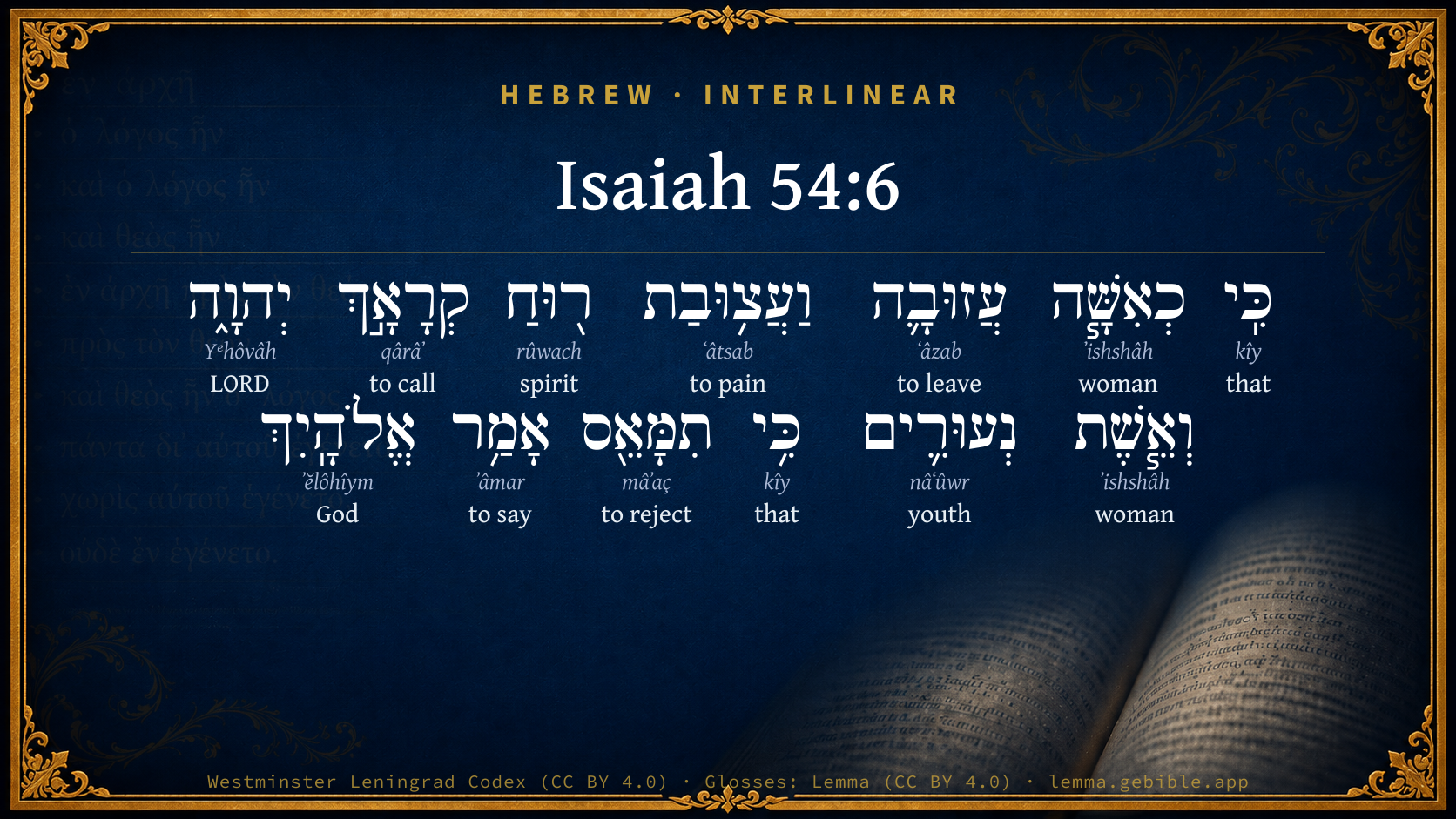
Isaiah 54:6

Hebrew (Westminster Leningrad Codex) Isaiah 54:6 appears in the Hebrew Old Testament. The text above is from the Westminster Leningrad Codex. Each word links to its Strong’s number, a concise gloss, and parsing drawn from the Open Scriptures Hebrew Bible morphology. Click any word for its full Brown-Driver-Briggs (BDB) entry.
Download image
Cite this verse

Isaiah 54:6 (World English Bible). Public Domain. Lemma interlinear Bible study tool, https://lemma.gebible.app/v/isaiah/54/6.

Show BibTeX & RIS
BibTeX
RIS
English Translation
For Yahweh has called you as a wife forsaken and grieved in spirit, even a wife of youth, when she is cast off, says your God.
World English Bible · Public Domain
Download a study sheet

One document with this verse’s original text, its word-by-word gloss line, the meaning frame, cross-references with their text, attributed commentary, and full source and license credits — printable, and it pastes into notes with its structure intact.

This verse Autodidact and up

Study sheet (.html) Plain text (.txt)

A passage Seminary Student

Up to 50 verses in one chapter. A passage sheet keeps up to 6 commentary sources and 12 cross-references per verse, in the order this page ranks them, and says so on the sheet whenever that leaves anything out. Ask for a single verse and you get the Autodidact verse sheet above.

Everything on this page stays free to read, with no account — the sheet is a download of what is already on screen, not access to it.

Want to remove ads? Support Godless Engineer
Compare translations 3

The same verse in 3 English versions, stacked beneath the original-language interlinear above. Click any original word for its lexicon entry.

Each is an independent rendering of the whole verse — the interlinear is not word-aligned to these translations.

Highlighted words mark where these versions differ — a whole-verse word diff, not a word-by-word alignment.

  • World English Bible Public Domain
    For Yahweh has called you as a wife forsaken and grieved in spirit, even a wife of youth, when she is cast off, says your God.
  • King James Version Public Domain
    For the LORD hath called thee as a woman forsaken and grieved in spirit, and a wife of youth, when thou wast refused, saith thy God.
  • unfoldingWord Literal Text CC BY-SA 4.0
    For Yahweh has called you like a wife abandoned and grieved of spirit, and a wife of youth when she has been rejected,” says your God.

unfoldingWord Literal Text — © unfoldingWord, licensed CC BY-SA 4.0. Word-aligned USFM3 via Door43 (git.door43.org/unfoldingWord/en_ult).

Versions to compare (up to 4)

3 of 4 selected

Show all 18 translations

Every available English version of this verse, each an independent rendering of the whole verse.

  • World English Bible Public Domain
    For Yahweh has called you as a wife forsaken and grieved in spirit, even a wife of youth, when she is cast off, says your God.
  • Berean Standard Bible Public Domain
    For the LORD has called you back, like a wife deserted and wounded in spirit, like the rejected wife of one’s youth,” says your God.
  • Majority Standard Bible Public Domain
    For the LORD has called you back, like a wife deserted and wounded in spirit, like the rejected wife of one’s youth,” says your God.
  • King James Version Public Domain
    For the LORD hath called thee as a woman forsaken and grieved in spirit, and a wife of youth, when thou wast refused, saith thy God.
  • American Standard Version (1901) Public Domain
    For Jehovah hath called thee as a wife forsaken and grieved in spirit, even a wife of youth, when she is cast off, saith thy God.
  • Revised Version (1885) Public Domain
    For the LORD hath called thee as a wife forsaken and grieved in spirit, even a wife of youth, when she is cast off, saith thy God.
  • Geneva Bible (1599) Public Domain
    For the Lord hath called thee, being as a woman forsaken, and afflicted in spirite, and as a yong wife when thou wast refused, sayth thy God.
  • Douay-Rheims (1899) Public Domain
    For the Lord hath called thee as woman forsaken and mourning in spirit, end se a wife cast off from her youth, said thy God.
  • Young's Literal Translation Public Domain
    For, as a woman forsaken and grieved in spirit, Called thee hath Jehovah, Even a youthful wife when she is refused, said thy God.
  • Literal Standard Version CC BY-SA 4.0
    For as a woman forsaken and grieved in spirit, || YHWH has called you, || Even a youthful wife when she is refused,” said your God.
  • Unlocked Literal Bible CC BY-SA 4.0
    For Yahweh has called you back as a wife abandoned and grieved in spirit, like a woman married young and rejected,” says your God.
  • unfoldingWord Literal Text CC BY-SA 4.0
    For Yahweh has called you like a wife abandoned and grieved of spirit, and a wife of youth when she has been rejected,” says your God.
  • Darby Bible Public Domain
    For Jehovah hath called thee as a woman forsaken and grieved in spirit, and as a wife of youth, that hath been refused, saith thy God.
  • World Messianic Bible Public Domain
    For the LORD has called you as a wife forsaken and grieved in spirit, even a wife of youth, when she is cast off,” says your God.
  • Webster's Bible Public Domain
    For the LORD hath called thee as a woman forsaken and grieved in spirit, and a wife of youth, when thou wast refused, saith thy God.
  • Free Bible Version CC BY-SA 4.0
    The Lord has called you to come back, like a wife who's been abandoned and deeply hurt, a wife who was married when she was young, only to be rejected, says your God.
  • Bible in Basic English Public Domain
    For the Lord has made you come back to him, like a wife who has been sent away in grief of spirit; for one may not give up the wife of one's early days.
  • JPS Tanakh (1917) Public Domain
    For the LORD hath called thee as a wife forsaken and grieved in spirit; and a wife of youth, can she be rejected? saith thy God.

Literal Standard Version (2020), Covenant Press — licensed CC BY-SA 4.0. Text via the HelloAO Bible API (eBible.org). Unlocked Literal Bible (unfoldingWord) — licensed CC BY-SA 4.0. Text via the HelloAO Bible API (eBible.org). unfoldingWord Literal Text — © unfoldingWord, licensed CC BY-SA 4.0. Word-aligned USFM3 via Door43 (git.door43.org/unfoldingWord/en_ult). Free Bible Version, Dr. Jonathan Gallagher — licensed CC BY-SA 4.0. Text via the HelloAO Bible API (eBible.org).

Word by word

More ways to search: Search by grammar → Find every occurrence → Compare this word →

Practice this passage: Drill this verse → Learn its vocabulary →

וַעֲצ֥וּבַת
ʻâtsab
H6087
“and · pained”
Conjunction + Verb, Qal, Participle Passive, Feminine, Singular, Construct
Part of Speech
Conjunction + Verb
Stem
Qal
Form
Participle Passive
Gender
Feminine
Number
Singular
State
Construct
Full BDB Definition

Origin: a primitive root

TWOT: 1666 , 1667

to hurt, pain, grieve, displease, vex, wrest - (Qal) to hurt, pain - (Niphal) to be in pain, be pained, be grieved - (Piel) to vex, torture - (Hiphil) to cause pain - (Hithpael) to feel grieved, be vexed - to shape, fashion, make, form, stretch into shape, (TWOT) worship - (Piel) to shape, form - (Hiphil) to form, copy, fashion
  1. כִּֽי kîy H3588 “that” Conjunction
  2. כְאִשָּׁ֧ה ʼishshâh H802 “like/as · woman” Preposition + Noun, Common, Feminine, Singular, Absolute
  3. עֲזוּבָ֛ה ʻâzab H5800 “left” Verb, Qal, Participle Passive, Feminine, Singular, Absolute
  4. ר֖וּחַ rûwach H7307 “spirit” Noun, Common, Both, Singular, Absolute
  5. קְרָאָ֣ךְ qârâʼ H7121 “to call · you” Verb, Qal, Perfect, 3rd Person, Masculine, Singular + Suffix, Personal, 2nd Person, Feminine, Singular
  6. יְהוָ֑ה Yᵉhôvâh H3068 “LORD” Noun, Proper
  7. וְאֵ֧שֶׁת ʼishshâh H802 “and · woman of” Conjunction + Noun, Common, Feminine, Singular, Construct
  8. נְעוּרִ֛ים nâʻûwr H5271 “youth” Noun, Common, Both, Plural, Absolute
  9. כִּ֥י kîy H3588 “that” Conjunction
  10. תִמָּאֵ֖ס mâʼaç H3988 “to reject” Verb, Niphal, Imperfect, 3rd Person, Feminine, Singular
  11. אָמַ֥ר ʼâmar H559 “to say” Verb, Qal, Perfect, 3rd Person, Masculine, Singular
  12. אֱלֹהָֽיִךְ ʼĕlôhîym H430 “God(s) · your” Noun, Common, Masculine, Plural, Construct + Suffix, Personal, 2nd Person, Feminine, Singular

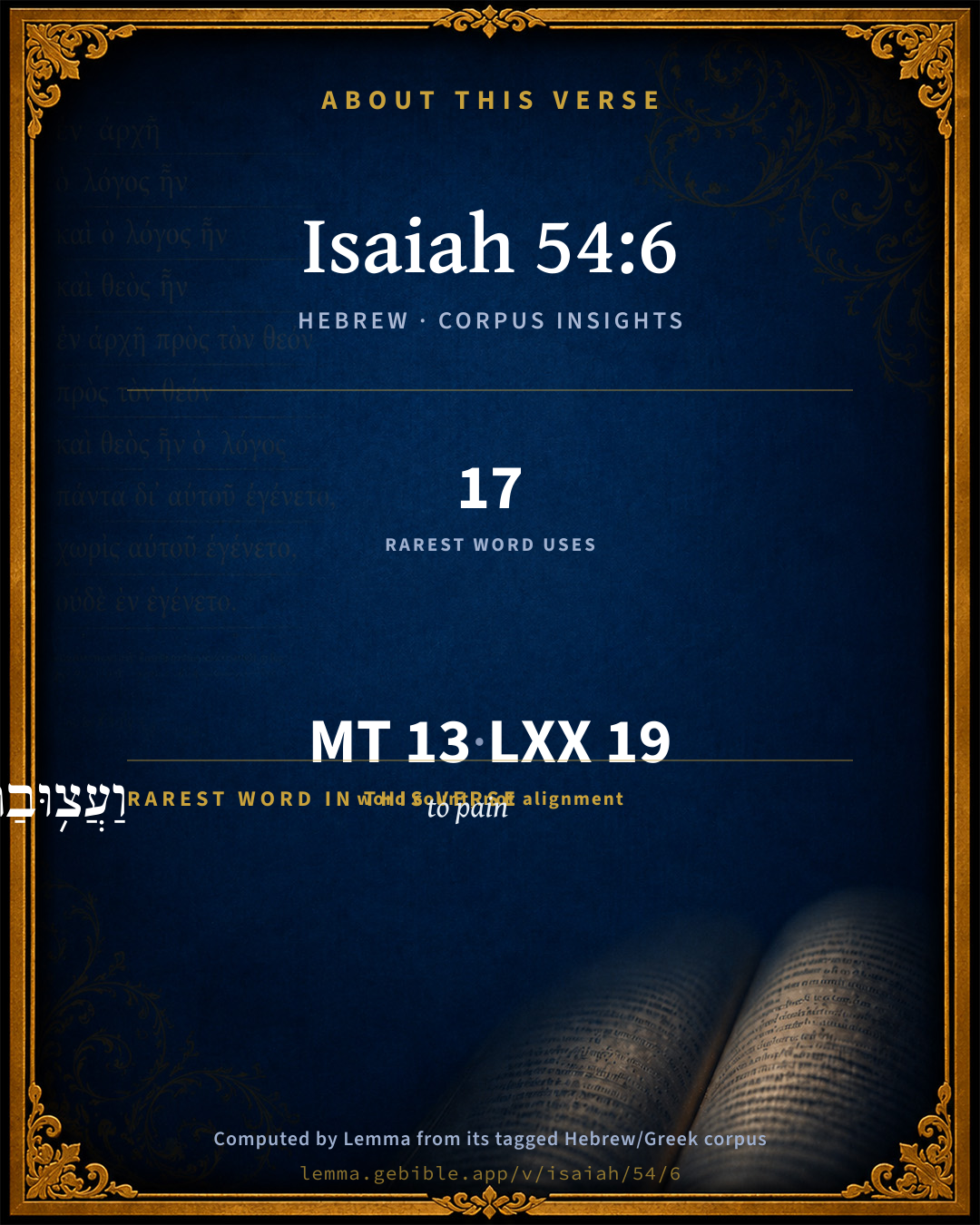
About this verse

These counts appear in no published source. They are computed here, from the morphology-tagged text and Lemma’s own curated glosses. What Lemma adds →

13
words
11
distinct lemmas
Prophets
section

Notable vocabulary

The rarest word here is וַעֲצ֥וּבַת to pain H6087 — appearing just 17 times in the whole Hebrew Bible.

Shared distinctive vocabulary

וַעֲצ֥וּבַת to pain H6087 occurs in 17 verses of the Hebrew Bible. Also found in:

Grammatical profile

  • 5 verbs
  • 6 nouns
  • 2 conjunctions

Verb forms

  • עֲזוּבָ֛ה Qal · Participle Passive
  • וַעֲצ֥וּבַת Qal · Participle Passive
  • קְרָאָ֣ךְ Qal · Perfect
  • תִמָּאֵ֖ס Niphal · Imperfect
  • אָמַ֥ר Qal · Perfect

Repetition

Words recur within this verse — often emphatic in Hebrew:

  • כְאִשָּׁ֧ה woman H802 ×2
  • כִּֽי that H3588 ×2

Hebrew & Septuagint length

In English translation the verse runs 26 words from the Hebrew and 23 from the Septuagint (LXX English) — closely comparable.

A rough comparison of the two English renderings, which tokenize alike — not a word-level alignment.

Word counts can differ between the Hebrew and the Greek without any difference in meaning — e.g. the Hebrew direct-object marker אֵת has no separate Greek word, and Greek often adds the article ὁ.

In the original languages it is 13 Hebrew tokens and 19 Greek tokens — but the two are counted differently (Hebrew bundles its prefixes and suffixes into one token; the Greek is in lemma form), so that isn’t a like-for-like length.

Cross-references

11

Topical passages linked to Isaiah 54:6 in the Treasury of Scripture Knowledge — connected by theme and wording, ordered by reader-vote popularity; previews shown in the World English Bible.

  • Isaiah 62:4 You shall no more be termed Forsaken; neither shall your land any more be termed Desolate: but you shall be called Hephzibah, and your land Beulah; for Yahweh delights in you, and your land shall be married.
  • Proverbs 5:18 Let your spring be blessed. Rejoice in the wife of your youth.
  • Ecclesiastes 9:9 Live joyfully with the wife whom you love all the days of your life of vanity, which he has given you under the sun, all your days of vanity: for that is your portion in life, and in your labor in which you labor under the sun.
  • Hosea 2:1–2 "Say to your brothers, 'My people!' And to your sisters, 'My loved one!'
  • Hosea 2:14–15 "Therefore, behold, I will allure her, And bring her into the wilderness, And speak tenderly to her.
  • Isaiah 49:14–21 But Zion said, Yahweh has forsaken me, and the Lord has forgotten me.
  • Isaiah 50:1–2 Thus says Yahweh, Where is the bill of your mother's divorce, with which I have put her away? or which of my creditors is it to whom I have sold you? Behold, for your iniquities were you sold, and for your transgressions was your mother put away.
  • Malachi 2:14 Yet you say, 'Why?' Because Yahweh has been witness between you and the wife of your youth, against whom you have dealt treacherously, though she is your companion, and the wife of your covenant.
  • 2 Corinthians 7:9–10 I now rejoice, not that you were made sorry, but that you were made sorry to repentance. For you were made sorry in a godly way, that you might suffer loss by us in nothing.
  • Matthew 11:28 "Come to me, all you who labor and are heavily burdened, and I will give you rest.
  • 2 Corinthians 7:6 Nevertheless, he who comforts the lowly, God, comforted us by the coming of Titus;

Cross-references courtesy of OpenBible.info (CC BY 4.0).

Hebrew and Greek witnesses Masoretic Hebrew ↔ Greek Septuagint

The same verse in the two great witnesses to the Old Testament, shown verse-for-verse.

These are two independent witnesses, not word-aligned to each other, and the Septuagint is shown in lemma (dictionary) form.

Hebrew Isaiah 54:6 Masoretic · Westminster Leningrad Codex

כִּֽי כְאִשָּׁ֧ה עֲזוּבָ֛ה וַעֲצ֥וּבַת ר֖וּחַ קְרָאָ֣ךְ יְהוָ֑ה וְאֵ֧שֶׁת נְעוּרִ֛ים כִּ֥י תִמָּאֵ֖ס אָמַ֥ר אֱלֹהָֽיִךְ

For Yahweh has called you as a wife forsaken and grieved in spirit, even a wife of youth, when she is cast off, says your God.

World English Bible · Public Domain

Greek LXX Isaiah 54:6 Septuagint · lemma form

οὐ ὡς γυνή καταλείπω καί ὀλιγόψυχος καλέω σύ κύριος οὐδέ ὡς γυνή ἐκ νεότης μισέω εἶπον ὁ θεός σύ

The Lord has not called you as a deserted and faint-hearted woman, nor as a woman hated from her youth, says your God.

LXX2012 (modern English Septuagint) · Public Domain

On this verse, Albert Barnes' Notes on the Bible discusses the Septuagint’s reading. Read the note in Commentary ↓

Hebrew: Westminster Leningrad Codex (CC BY 4.0). Greek: Septuagint (public domain); English from LXX2012 (modern English Septuagint) (Public Domain). How the Septuagint differs from the Hebrew →

Targum (Aramaic paraphrase)

1

The Targum is the ancient Jewish Aramaic paraphrase of the Hebrew Scriptures — an interpretive translation, not the Hebrew text itself. Onkelos (literal) and Pseudo-Jonathan (expansive) render the Torah, and Jonathan the Prophets. Coverage is partial: where no permissively-licensed English translation exists for a verse, only the Aramaic is shown. This is verse-level text, not a word-by-word alignment to the Hebrew.

  1. Targum Jonathan Prophets (Joshua–Malachi)
    אֲרֵי כְאִתָּא שְׁבִיקָא וְעָיְקַת רוּחַ עַרְעָךְ שְׁכִנְתָּא דַייָ וּכְאִתַּת עוּלֵמִין דְאִתְרַחֲקַת אֲמַר אֱלָהָיִךְ:

    For as a woman forsaken, and afflicted in spirit, the Shekinah, the Lord, met thee, like a woman of youth which was forsaken, saith thy God.

    Targum Jonathan — Aramaic: “Mikraot Gedolot” (public domain). English: “Sefaria Community Translation” (CC0 1.0 (public-domain dedication)); “London "Chaldee Paraphrase," 1871” (public domain). Text via Sefaria.

Commentary

Notes on Isaiah 54:6 from classic Christian and Jewish commentators (each source and its license shown beneath its notes). The classic Christian expositions comment on the surrounding passage and are grouped to its opening verse, so a note may address several verses; the Jewish commentaries on the Tanakh (Rashi and others) are per-verse, so they appear only where the commentator wrote on this verse.

Lemma curates 59 commentaries, every one of them public domain or Creative Commons licensed, each selected and text-cleaned for this edition rather than reprinted as found. About our sources →

Matthew Henry's Commentary

The seasonable succour and relief which God sent to his captives in Babylon, when they had a discharge from their bondage there, are here foretold, as a type and figure of all those consolations of God which are treasured up for the church in general and all believers in particular, in the covenant of grace.

I. Look back to former troubles, and in comparison with them God's favours to his people appear very comfortable, Isa 54:6-8. Observe, 1. How sorrowful the church's condition had been. She had been as a woman forsaken, whose husband was dead, or had fallen out with her, though she was a wife of youth, upon which account she is grieved in spirit, takes it very ill, frets, and grows melancholy upon it; or she had been as one refused and rejected, and therefore full of discontent. Note, Even those that are espoused to God may yet seem to be refused and forsaken, and may be grieved in spirit under the apprehensions of being so. Those that shall never be forsaken and left in despair may yet for a time be perplexed and in distress. The similitude is explained (Isa 54:7, Isa 54:8): For a small moment have I forsaken thee. In a little wrath I hid my face from thee. When God continues his people long in trouble he seems to forsake them; so their enemies construe it (Psa 71:11); so they themselves misinterpret it, Isa 49:14. When they are comfortless under their troubles, because their prayers and expectations are not answered, God hides his face from them, as if he regarded them not nor designed them any kindness. God owns that he had done this; for he keeps an account of the afflictions of his people, and, though he never turned his face against them (as against the wicked, Psa 34:16), he remembers how often he turned his back upon them. This arose indeed from his displeasure. It was in wrath that he forsook them and hid his face from them (Isa 57:17); yet it was but in a little wrath: not that God's wrath ever is a little thing, or to be made light of (Who knows the power of his anger?), but little in comparison with what they had deserved, and what others justly suffer, on whom the full vials of his wrath are poured out. He did not stir up all his wrath. But God's people, though they be sensible of ever so small a degree of God's displeasure, cannot but be grieved in spirit because of it. As for the continuance of it, it was but for a moment, a small moment; for God does not keep his anger against his people for ever; no, it is soon over. As he is slow to anger, so he is swift to show mercy. The afflictions of God's people, as they are light, so they are but for a moment, a cloud that presently blows over. 2. How sweet the returns of mercy would be to them when God should come and comfort them according to the time that he had afflicted them. God called them into covenant with himself when they were forsaken and grieved; he called them out of their afflictions when they were most pressing, Isa 54:6. God's anger endures for a moment, but he will gather his people when they think themselves neglected, will gather them out of their dispersions, that they may return in a body to their own land, - will gather them into his arms, to protect them, embrace them, and bear them up, - and will gather them at last to himself, will gather the wheat into the barn. He will have mercy on them. This supposes the turning away of his anger and the admitting of them again into his favour. God's gathering his people takes rise from his mercy, not any merit of others; and it is with great mercies (Isa 54:7), with everlasting kindness, Isa 54:8. The wrath is little, but the mercies are great; the wrath is for a moment, but the kindness everlasting. See how one is set over against the other, that we may neither despond under our afflictions nor despair of relief.

II. Look forward to future dangers, and in defiance of them God's favours to his people appear very constant, and his kindness everlasting; for it is formed into a covenant, here called a covenant of peace, because it is founded in reconciliation and is inclusive of all good. Now,

1. This is as firm as the covenant of providence. It is as the waters of Noah, that is, as that promise which was made concerning the deluge that there should never be the like again to disturb the course of summer and winter, seed-time and harvest, Isa 54:9. God then contended with the world in great wrath, and for a full year, and yet at length returned in mercy, everlasting mercy; for he gave his word, which was as inviolable as his oath, that Noah's flood should never return, that he would never drown the world again; see Gen 8:21, Gen 8:22; Gen 9:11. And God has ever since kept his word, though the world has been very provoking; and he will keep it to the end; for the world that now is is reserved unto fire. And thus inviolable is the covenant of grace: I have sworn that I would not be wroth with thee, as I have been, and rebuke thee, as I have done. He will not be so angry with them as to cast them off and break his covenant with them (Psa 89:34), nor rebuke them as he has rebuked the heathen, to destroy them, and put out their name for ever and ever, Psa 9:5.

2. It is more firm than the strongest parts of the visible creation (Isa 54:10): The mountains shall depart, which are called everlasting mountains, and the hills be removed, though they are called perpetual hills, Hab 3:6. Sooner shall they remove than God's covenant with his people be broken. Mountains have sometimes been shaken by earthquakes, and removed; but the promises of God were never broken by the shock of any event. The day will come when all the mountains shall depart and all the hills be removed, not only the tops of them covered, as they were by the waters of Noah, but the roots of them torn up; for the earth and all the works that are therein shall be burned up; but then the covenant of peace between God and believers shall continue in the everlasting bliss of all those who are the children of that covenant. Mountains and hills signify great men, men of bulk and figure. Do these mountains seem to support the skies (as Atlas) and bear them up? They shall depart and be removed. Creature-confidences shall fail us. In vain is salvation hoped for from those hills and mountains. But the firmament is firm, and answers to its name, when those who seem to prop it are gone. When our friends fail us our God does not, nor does his kindness depart? Do these mountains threaten, and seem to top the skies, and bid defiance to them, as Pelion and Ossa? Do the kings of the earth, and the rulers, set themselves against the Lord? They shall depart and be removed. Great mountains, that stand in the way of the salvation of the church, shall be made plain (Zac 4:7); but God's kindness shall never depart from his people, for whom he loves he loves to the end; nor shall the covenant of his peace ever be removed, for he is the Lord that has mercy on his people. Therefore the covenant is immovable and inviolable, because it is built not on our merit, which is a mutable uncertain thing, but on God's mercy, which is from everlasting to everlasting.

Matthew Henry's Commentary on the Whole Bible (1708–1710) — public domain (CC PDM 1.0). Text via the HelloAO Bible API.

Trapp's Complete Commentary

John Trapp

Isa 54:6 For the LORD hath called thee as a woman forsaken and grieved in spirit, and a wife of youth, when thou wast refused, saith thy God.

Ver. 6. For the Lord hath called thee.] Or, Recalled thee.

As a woman forsaken, grieved in spirit.] Because forsaken. This the Lord, out of his conjugal affection, cannot endure.

And a wife of youth.] Which can least of all bear such a rejection, as being in her prime, and likely to be a long time desolate and disconsolate. If the Church in this condition can but say, as that Duchess Dowager of Milan once did, Sola facta solum Deum sequor, he will say, as in Jer 2:2, "I remember thee, the kindness of thy youth, the love of thine espousals."

John Trapp, A Commentary or Exposition upon All the Books of the Old and New Testament (1647–1656) — public domain. Text from a community e-Sword module.

The Biblical Illustrator

Joseph S. Exell

Isa_54:6-13

For the Lord hath called thee as a woman forsaken

God is love

None of those who came before the Lord Jesus ventured to define God as love.

But it does not follow, as we sometimes assume, that the holy men who were moved by the Holy Ghost before Christ came into the world did not know and teach the fatherly and redeeming love of God. They could not be so familiar with that love as we are; but that they recognized it, and insisted on it with rare force and pathos, that they did all that mere words could do to convince and persuade men of it, no candid student of the Old Testament will deny, although when they were most profoundly moved by it we can still detect in their language a certain accent of almost incredulous surprise. Isaiah, for example, as he utters these pathetic phrases of my text, can hardly believe for joy and wonder. Again and again he is compelled to remind himself that it is God who is speaking in him and through him. The tender phrases which, were they not so tender, might run on with even flow, are again and again broken with such words as saith thy God, or saith the Lord thy Redeemer, or saith the Lord that hath compassion on thee. Do you wonder that Isaiah, who knew God so well, found it hard to believe in a love so tender and true, and so feared that his hearers would find it quite impossible to believe Ah, but consider who and what they were on whom he was told that God had set His heart, and all the treasures of His love and compassion I God had lavished on them every possible means of grace, insomuch that He both could, and did, appeal to them whether there was even one single thing He could have done for him which He had not done. Yet, despite His singular and boundless grace, they had sunk to the level, and below the level, of the heathen around them. Was it likely that God should love them? Consider, too, how stern and dreadful was the burden which Isaiah had been commissioned to denounce upon them. And God had been as good as His word. Assyrian and Chaldean armies had swept the land of its inhabitants; their cities were burned with fire, and the once fertile and wealthy land turned into a desert. All who were left of the people were carried away captive, and left to weep for seventy years over their unstrung harps as they sat by the waters of Babylon. It was to these sinful, miserable captives and exiles that the prophet was moved to proclaim the tender and inalienable love of God! The words authenticate themselves. None but God could have spoken them. No man would have dared to conceive of God--no man, untaught of Heaven, ever has conceived of God, as yearning with love for the human race; and still less could any man have invented the tender, melting, beseeching phrases in which Isaiah has clothed that conception. (S. Cox, D. D.)

The wonderful love of God

Mark what the words do convey. God is speaking to men who had persistently sinned against all the influences of His love and grace, to men who were being consumed by the inevitable results of their transgressions. And He tells these poor miserable creatures that they are as dear to Him as the bride to her husband; that, though their offences against Him have been so many and so deep, He cannot tear His love for them out of His heart. Nay, as if this were not enough, He goes on to say that, though the blame is none of His, He is willing to take all the blame of their offences on Himself. Instead of reproaching them for their sins against HIS love, He compares them to a wife forsaken and grieved in spirit, to a young and tender bride whose husband has despised and disgraced her, refusing to live with her and sending her away from his tent. It is He who has abandoned her, not she who has abandoned Him. It is He who has been hard and stern, not she who has been wilful and gone astray. But He never meant to be hard and stern. It was only for a brief moment that He left her, and in a momentary flush of anger. If she will return to Him, and give Him another chance, He will welcome her with great mercies and comfort her with an everlasting kindness. How shall He persuade her to return, to trust in Him? how convince her that He will be angry with her no more? He calls heaven and earth to witness to His truth, His fidelity, His deathless and unchanging love. He can appeal to His covenant with her, with Israel. She may think that that has been broken both by Him and by herself. But there was one of His covenants that had never been broken, an unconditional covenant, the covenant with Noah, which did not depend on men and their obedience, which depended only on God and on His faithfulness to His word. Henceforth His covenant with her shall be as the waters of Noah; He will no more fall in His love to her than He will suffer the earth to be wasted by another flood. He will never forsake her, even though she should forsake Him; never be wroth with her, nor rebuke her, even though she should still be wilful and provoke Him to anger. Nay, more; as if even this great promise were not enough, He casts about for another and a still more reassuring figure, and goes on to say: The mountains were planted and the hills stood firm before the Deluge swept over the earth; even the waters of Noah could not wash them away, nor as much as make them quake. And His love shall henceforth be firm and unchanging as the mountains and hills; nay, more firm and unchanging. The mountains may remove and the hills may quake; but His lovingkindness shall never remove, His covenant of peace shall never quake. Even all this, wonderful and incredible as it is, is not enough. There is the sigh of an infinite compassion and truth in the exclamation, O thou afflicted, tossed with tempest, not comforted! There is an unbounded and Divine generosity in the promise to the bride, to the woman, that, if she will only come back to Him, her very palace shall be built of rare gems; and in the promise to the mother, than which no promise could be more dear to a mothers heart, All thy children shall be taught of the Lord, and great shall be the peace of thy children. Is that a fable of mans invention? Can it be? Would any man have dared to give it as a statement of the facts, or possible facts of human life? (S. Cox, D. D.)

The Biblical Illustrator, edited by Joseph S. Exell (c. 1880s–1900s) — public domain. Text from a community e-Sword module.

Joseph Benson's Commentary

Isa 54:6-8. For the Lord hath called thee — To return and come again to him; as a woman forsaken — When thou wast like a woman forsaken by her husband, who had given her a bill of divorce; and grieved in spirit — For the loss of her husband’s favour and society, and for the reproach attending it; and a wife of youth — As affectionately as a husband recalleth his wife whom he married in her and his own youth, whom, though he might on some provocation put away, yet he soon repents of doing it, and his affection for her reviving, he invites her to return to him; when thou wast refused — Though for a time thou wast refused and rejected by him; saith thy God — Jehovah, who will again show himself to be thy God, and will renew his covenant with thee. For a small moment — For the space of some few years, as seventy years in Babylon, and some such intervals, which may well be called a small moment, in comparison of God’s everlasting kindness, mentioned in the next verse: have I forsaken thee — Withdrawn my favour and help from thee, and left thee in thine enemies’ hands. But with great mercies — Such as are very precious, and of long continuance; will I gather thee — From all the places where thou art dispersed, from all parts of the world. In a little wrath I hid my face from thee — I removed the means and pledges of my presence and kindness; but with everlasting kindness will I have mercy, &c. — With kindness to thee, and thy seed, through all succeeding generations, in time, and to all eternity.

Joseph Benson's Commentary on the Old and New Testaments (1811–1818) — public domain. Text from a community e-Sword module.

Geneva Bible (1599)

Geneva Bible translators

As a wife which wast forsaken in thy youth.

Geneva Bible (1599) marginal notes — public domain. Text via Bolls.life.

Jamieson, Fausset & Brown

Robert Jamieson, A. R. Fausset & David Brown

called--that is, recalled: the prophetic past for the future.

forsaken--that had been forsaken.

when thou--or, "when she was rejected"; one who had been a wife of youth (Eze 16:8, Eze 16:22, Eze 16:60; Jer 2:2) at the time when (thou, or) she was rejected for infidelity [MAURER]. "A wife of youth but afterwards rejected" [LOWTH].

Jamieson, Fausset & Brown — Commentary Critical and Explanatory on the Whole Bible (1871) — public domain (CC PDM 1.0). Text via the HelloAO Bible API.

Ellicott's Commentary for English Readers

(6) For the Lord hath called thee.—The words find their explanation, perhaps their starting-point, in the history of Hosea and Gomer (Hosea 1-3). The husband has punished the faithless wife by what seemed a divorce, but his heart yearns after her, and he takes her back again.

When thou wast refused.—Some critics render Can she be rejected . . .? with the implied answer. “No, that is impossible,” but the Authorised version is tenable, and gives an adequate meaning.

A Bible Commentary for English Readers, edited by Charles John Ellicott (1878–1897) — public domain. Text from a community e-Sword module.

The Cambridge Bible for Schools and Colleges

gen. ed. J. J. S. Perowne

6. Although Zion is temporarily estranged from Jehovah, she is yet a “wife of youth” holding a permanent place in her husband’s affections.

For the Lord hath called thee] i.e. “calls thee” now (Cheyne, “hath recalled thee”). The reference is not to the first espousals of the nation at the exodus, but to the renewal of conjugal intercourse in the restoration from exile.

as a wife (R.V.) forsaken and grieved in spirit] neglected by her husband, and left to her own bitter reflexions, but not cast off. Cf. Hos_3:3.

and a wife of youth, when thou wast refused] R.V. “even a wife of youth, when she is cast off.” The clause is difficult. Probably it is an exclamation: and a wife of youth—can she be rejected? (so Cheyne, after Ewald); it is impossible that she should be finally disowned.

a wife of youth] one who has been wooed and won in youth; Pro_5:18; Mal_2:14 f.

The Cambridge Bible for Schools and Colleges (gen. ed. J. J. S. Perowne; Cambridge University Press, 1878–1918) — public domain. Text from a community e-Sword module.

John Gill's Exposition

For the Lord hath called thee as a woman forsaken and grieved in spirit,.... That has lost her husband by death, is solitary upon it, is like one forsaken, and mourns for the loss of him; or is forsaken by a living husband, rejected by him, having a bill of divorce from him, and so she grieves at his unkindness to her, and the reproach cast upon her; as such an one was the church when it was first constituted, when the members of which it consisted were called out of the world by the grace of God, and formed into a church state; almost as soon as ever they were thus embodied together, Christ was taken from them by death, and they were left alone, and filled with grief and trouble: the apostles and first preachers of the Gospel were persecuted from place to place, and all of them lost their lives for the cause in which they were engaged; and the church endured grievous persecutions during the three first centuries, when she seemed to be forsaken of God, and was greatly oppressed and grieved in spirit. Some understand this of the Gentiles, and of their state and condition when called, as described in Eph 2:10, but rather it may be interpreted of the Jews, now cut off and forsaken; and who, when they come to be sensible of their case, will be grieved and mourn, even when they shall be called and converted in the latter day; but I think the first sense is best:

and a wife of youth, when thou wast refused, saith thy God; or, "and as a wife of youth (m)"; whom a man marries in his youth, and she a young woman herself, which makes it the more grievous to be despised, refused, and forsaken, or to seem to be so. The words may be rendered thus, "and", or "but, a wife of youth thou art, though thou wast despised" (n), or "refused, saith thy God"; that is, though thou hast been seemingly despised and cast off, my providential dispensations towards thee may be so interpreted by thyself and others; yet I am thy God, thy Maker, Redeemer, and Husband, and thou art as dear to me as the wife of a man's youth, for whom he has the most passionate love; and which agrees with what follows.

(m) , Sept.; sic Arab. & Targum; "et velut foeminam", Tigurine version, Castalio; "et ut uxorem", Vitringa. (n) "quamvis spreta sis", Junius & Tremellius; "fueris", Piscator.

John Gill's Exposition of the Whole Bible (1746–1763) — public domain (CC PDM 1.0). Text via the HelloAO Bible API.

Albert Barnes' Notes on the Bible

For the Lord hath called thee - This is designed to confirm and illustrate the sentiment in the previous verse. God there says that he would be a husband to his people. Here he says, that although he had for a time apparently forsaken them, as a husband who had forsaken his wife, and although they were cast down and dejected like a woman who had thus been forsaken, yet he would now restore them to favor.

Hath called thee - That is, will have called thee to himself - referring to the future times when prosperity should be restored to them.

As a woman forsaken - Forsaken by her husband on account of her offence.

And grieved in spirit - Because she was thus forsaken.

And a wife of youth - The Septuagint renders this very strangely, ‘The Lord hath not called thee as a wife forsaken and disconsolate; nor as a wife that hath been hated from her youth;’ showing conclusively that the translator here did not understand the meaning of the passage, and vainly endeavored to supply a signification by the insertion of thee negatives, and by endeavoring to make a meaning. The idea is that of a wife wedded in youth; a wife toward whom there was early and tender love, though she was afterward rejected. God had loved the Hebrew people as his people in the early days of their history. Yet for their idolatry he had seen occasion afterward to cast them off, and to doom them to a long and painful exile. But he would yet love them with all the former ardor of affection, and would greatly increase and prosper them.

When thou wast refused - Or, that hath been rejected. Lowth, ‘But afterward rejected.’ It may be rendered, ‘Although (כי kı̂y has often the sense of although) thou wert rejected,’ or ‘although she was rejected.’ The idea is, that she had been married in youth, but had been afterward put away.

Albert Barnes' Notes on the Bible (1834–1885) — public domain. Text from a community e-Sword/MySword module.

Haydock's Catholic Bible Commentary

Youth. This enhances her fault. God is pleased to overlook it, in the captives (chap. l. 1.) and Gentiles.

George Leo Haydock (1774–1849), Haydock's Catholic Family Bible and Commentary, 1859 edition — public domain. Excludes Psalms (Douay-Rheims chapter numbering differs from Protestant) and Deuterocanonical books (Catholic canon only).

Matthew Poole's English Annotations

The Lord hath called thee, to return and come again to him. As a woman forsaken; when thou wast like a woman forsaken. Or, as a husband recalleth his wife. Forsaken by her husband, who hath given her a bill of divorce.

Grieved in spirit, for the loss of her husband’s flavour and society, and for the reproach attending upon it.

And a wife of youth; or, and as (which note of similitude is supplied here by the LXX. and Chaldee interpreters, and is easily understood out of the foregoing clause, in which it is expressed) a wife of youth, i.e. as readily and affectionately as a husband recalleth his wife which no married in her and his own youth, of whom see on Pro 5:18, whom though he might through a sudden and violent passion put away, yet he soon repents of it, and his affections work towards her, and he invites her to return to him.

When thou wast refused; when thou wast in a desolate estate, and hadst been for some time rejected by me, then I recalled thee. Or, although thou wast refused, or dismissed, or despised by me, and that justly; yet I had mercy upon thee, and freely offered reconciliation to thee. Saith thy God; who will again be, and still show himself to be, thy God, and will renew his covenant with thee.

Matthew Poole's English Annotations on the Holy Bible (1683–1685) — public domain. Text from a community e-Sword/MySword module.

Whedon's Commentary on the Bible

Daniel D. Whedon

6. The Lord hath called thee — The Lord hath taken thee back again to the relation of a beloved wife — the closest and dearest of all relations. The divorcement has to thee been very painful; made thee consciously forsaken, and conscious of no true spouse at hand as thy helper; but it has brought thee to the deepest penitence.

And a wife of youth — Once rejoicing in early marriage, but soon fallen and therefore soon rejected; but on account of thy repentance, the Lord receives thee back again.

Daniel D. Whedon (gen. ed.), Commentary on the Old and New Testaments (1874–1909) — public domain. Text from a community e-Sword module.

The Pulpit Commentary

For the Lord hath called thee; i.e. recalled thee to himself summoned thee to return, and once more resume the office of a wife. As a woman forsaken and grieved in spirit; i.e. as one whom her husband has cast off, and whose spirit is grieved by the repudiation. No doubt a large number of the captives had the same spirit of penitence as Daniel. (Dan_9:5-19) A wife of youth. One wooed and won in youth, therefore more dearly loved, more regretfully repudiated, more joyfully restored when seen to be penitent. When thou wast refused; rather, when she has been cast off. Jehovah takes back Israel into the old relationship, as a man takes back "the wife of his youth," when she has been for a long time cast off.

Vers. 6-10. Superabounding goodness.

The prevailing thought here is the prevalence of God"s goodness over his severity. For a small moment he had forsaken, but with great mercies he would comfort his people. Against the "little wrath" in which his face was hidden there was to be set the everlasting kindness" with which he would redeem them. The largely preponderant, completely outweighing, superabounding goodness of the Lord is manifest on every side. We see it

I IN THE NATURAL WORLD. There is a great deal of misery beneath the sky. How could it be otherwise when there is so much of cruelty and sin? But if we look long at all that happens as the direct result of God"s handiwork, we shall find that "mercy triumphs over wrath," good over ill. There is a large and blessed preponderance of light over darkness, of pleasure over pain, of joy over sorrow, of hope over despair, of confidence over distrust, of fertility over barrenness, of plenty over poverty, of society over solitude, of life over death. But for the disturbing and destructive element of sin, this would obviously be the case in a very much larger degree than it is now.

II IN THE CHURCH OF GOD. The Church of God has been represented at different times by different communities. At one time by the suffering community in Egypt; at another, by the Church in the wilderness; at another, by the distracted society under the judges; at another, by the triumphant nation under David and Solomon; at another, by Israel in exile; at another, by the returned and rejoicing people of God who had. come home from captivity. It is now represented by the Churches of Christ scattered over many lands, and forming apparently many distinct religious bodies. Sometimes God has lifted upon his people the light of his countenance, and they have rejoiced in his manifested favour; at other times he has withdrawn his face, and made his people to feel the weight of his chastening hand. But upon the whole it has been found, and in the end it will be found, that his manifestations of mercy and grace have triumphed greatly over those of wrath and penalty. There were times in the history of the Jewish Church when its light nearly went out in the surrounding darkness, but it did not expire; by the Divine hand it was guarded and fed, and has now become, under other conditions, a glorious sun, giving light and heat to all the nations. Mountains and hills, in the shape of kingdoms and powers, have departed and been removed; but God"s kindness to his Church will not depart, nor will his faithfulness fail. With everlasting kindness will God be merciful to the Church which bears the name, and teaches the truth, and extends the kingdom, of his Son.

III IN THE CAREER OF HIS FAITHFUL SERVANTS. There is no uniform course which the life of piety is found to take; it takes almost every variety of ways. Sometimes it lies much in the sunshine and but little in the shadow; and sometimes it is shaded nearly the whole way through. And how many kinds of shadow fall on the good man"s path! It is the apparent withdrawal of God"s favour from his soul; or it is the false charge which takes away his fair fame; or it is overwhelming loss involving others as well as himself in struggle or even in penury; or it is early separation from those most dearly beloved. There is "the hiding of God"s face;" the hour comes when nothing but the Master"s words will utter the feelings of the heart, "My God, my God, why hast thou forsaken me?" But all this is temporary; nay, everything being counted, it is but momentary. God has in reserve infinite resources which, afterwards if not now, yonder if not here, will make up a thousandfold for all that he sends of trial and suffering. Let the faithful soul build on the immovable rock of God"s integrity. Mountains may melt and hills may flee away, the foundations of the solid earth may be broken up, but God"s kindness cannot depart, because his Word cannot fail; that is the one absolutely and eternally impossible thing. C.

The Pulpit Commentary (1880–1919), ed. H.D.M. Spence-Jones & Joseph S. Exell — public domain. Text from a community e-Sword module.

John Wesley's Explanatory Notes

Called thee - To return to him. As forsaken - When thou wast like a woman forsaken. And grieved - For the loss of her husband's favour. Of youth - As affectionately as an husband recalls his wife which he married in his youth.

John Wesley, Explanatory Notes Upon the Whole Bible (1754–1765) — public domain. Text via the GEBible commentary corpus.

Keil & Delitzsch

C. F. Keil & F. Delitzsch

And this relation He now renews. "For Jehovah calleth thee as a wife forsaken and burdened with sorrow, and as a wife of youth, when once she is despised, saith thy God." The verb קרא, which is the one commonly used in these prophecies to denote the call of grace, on the ground of the election of grace, is used here to signify the call into that relation, which did indeed exist before, but had apparently been dissolved. קראך is used here out of pause (cf., Isa 60:9); it stands, however, quite irregularly for the form in ēkh, which is the one commonly employed (Jdg 4:20; Eze 27:26). "And as a wife:" ואשׁת is equivalent to וּכאשׁת. The hypothetical תמּאס כּי belongs to the figure. Jehovah calls His church back to Himself, as a husband takes back the wife he loved in his youth, even though he may once have been angry with her. It is with intention that the word נמאסה is not used. The future (imperfect) indicates what partially happens, but does not become an accomplished or completed fact: He is displeased with her, but He has not cherished aversion or hatred towards her.

Keil & Delitzsch — Biblical Commentary on the Old Testament (1861–1891) — public domain (CC PDM 1.0). Text via the HelloAO Bible API. (Old Testament only.)

J. A. Alexander on Isaiah

Joseph Addison Alexander

“For as a wife forsaken and grieved in spirit has Jehovah called thee, and (as) a wife of youth; for she shall be rejected, said thy God.” Reduced to a prosaic form and order, this verse seems to mean, that Jehovah had espoused her in her youth; then cast her off for her iniquities, and now at last recalled her from her solitude and grief to be His wife again. (Compare Hos 2:4; Hos 2:7; Hos 2:14; Hos 2:16; Hos 2:19). A wife of youth, not merely a young wife, but one married early. (See Pro 5:18, and Mal 2:14). The sense is not that she had been wedded to Jehovah in her youth and now recalled, but that He now recalled her as a husband might recall the long rejected wife of his youth. The common version of the last clause, ‘when thou wast refused’, is ungrammatical. The last clause is an explanation of the first, in which she is said to have been recalled as a forsaken wife, and that a wife of youth, because her God had said to her at that time, ‘thou shalt be rejected’. This explanation, while it simplifies the syntax, leaves the meaning of the verse unaltered.

Joseph Addison Alexander, The Prophecies of Isaiah (1846–1847; New York: Scribner, 1870–1878) — public domain. Text from a community e-Sword module.

Kretzmann's Popular Commentary

Paul E. Kretzmann

The Lord’s Promise of Eternal Love and Faithfulness

v. 6. For the Lord hath called thee as a woman forsaken and grieved in spirit, one who had been rejected and therefore sat mourning, and a wife of youth, surrounded by the love of her husband, when thou wast refused, saith thy God. This assurance was given to Zion by Him who, although He had once cast her aside, yet is her God and will forever remain her God.

v. 7. For a small moment have I forsaken thee, forsaking her at a time of great excitement of mind, under stress of a momentary anger; but with great mercies will I gather thee, drawing her to Him again in the overwhelming power of His love.

v. 8. In a little wrath I hid My face from thee for a moment, while His anger, as it were, burned with a sudden flame; but with everlasting kindness will I have mercy on thee, in a flood of tenderness and grace, saith the Lord, thy Redeemer, He who is ever the Vindicator of His people.

v. 9. For this is as the waters of Noah unto Me, namely, the present flood of wrath which had struck Israel; for as I have sworn that the waters of Noah, the Deluge with its general destruction, should no more go over the earth, an oath which, as all men knew, had been kept all these centuries, so have I sworn that I would not be wroth with thee nor rebuke thee, giving vent to His anger in various punishments.

v. 10. For the mountains shall depart and the hills be removed, although the most awful cataclysms of nature should occur, so that the very foundations of the earth are shaken, but My kindness shall not depart from thee, so that the wonderful union and communion of love between Christ and His Church would be disturbed or disrupted, neither shall the covenant of My peace be removed, that of the Messianic promise, as first given to Abraham and then repeated throughout the Old Testament, saith the Lord that hath mercy on thee. The depth and the certainty of God’s love is thus set forth in a manner which makes this promise basic for the faith of all Christians of all times. What was written here is written for our comfort; we should believe these promises and rejoice in them always.

Paul E. Kretzmann, Popular Commentary of the Bible (1921–1924) — public domain. Text from a community e-Sword module.

Rashi

Rabbi Shlomo Yitzchaki (Rashi)

who was rejected When she is rejected at times that her husband is a little wroth with her.

Rashi on the Tanakh — English translations: “The Judaica Press complete Tanach with Rashi, translated by A. J. Rosenberg” (CC BY 4.0); “Pentateuch with Rashi's commentary by M. Rosenbaum and A.M. Silbermann, 1929-1934” (public domain); “The Metsudah Tanach series, Lakewood, N.J” (CC BY 4.0); and “The Book of Joshua, Metsudah Publications, 1997” (CC BY 4.0). Text via Sefaria.

Ibn Ezra

Rabbi Abraham ibn Ezra

As a woman forsaken, etc. The reproach of Israel’s widowhood, the scorn heaped upon the Israelites by other nations, for not having a king of their own, having been mentioned before (ver. 4), the prophet continues in the name of God: Israel has been, it is true, like a woman that is forsaken, and has grieved at the absence of her husband, but her husband is yet alive, etc.; comp. thy Maker is thy husband, etc., (ver. 5)—עצובת grieved is an adjective, not a participle, which it resembles in form—the text continues therefore, the Lord hath called thee. ואשת נעורים כי תמאס And like a wife of youth, when she is refused, thou hast been.

Ibn Ezra on the Tanakh — English translations: “Sefaria Community Translation” (CC0 1.0 (public-domain dedication)); “Yalkut, Sifsei Chachomim Chumash, Metsudah Publications, 2009” (CC BY 4.0); and “Commentary of Ibn Ezra on Isaiah - trans. by M. Friedlander, 1873” (public domain). Text via Sefaria.

Lesson kit

Teaching starters — assembled from the data on this page, not authored interpretation. Every prompt links to the verse data it draws on. Edit before teaching.

Isaiah, in the Prophets, opens this verse with 13 words (11 distinct Hebrew lemmas). Its most distinctive word is ʻâtsab (“to pain”). A historical commentator’s framing appears above. Read the whole chapter for the surrounding context.

Discussion questions

  1. What does “to pain” (ʻâtsab) contribute to the verse as a whole?
  2. Genesis 6:6 shares the word «to pain» with this verse. How do the two illuminate each other?
  3. “woman” occurs 2× in this one verse. What is the effect of the repetition?
  4. These translations render this verse differently. What is at stake in choosing one wording over another?
  5. The verb «עֲזוּבָ֛ה» is Qal Participle Passive. How does its form color the action?
  6. Reading how Matthew Henry's Commentary and Trapp's Complete Commentary read this verse, where do the two commentators agree and where do they part?

Things to notice

Reading settings

Reading text

Shown beneath each verse's original-language words.

Old Testament
Old Testament edition

Read the OT as the Masoretic Hebrew (MT) or the Greek Septuagint (LXX).

English shown for the Greek Septuagint (in the Hebrew ↔ Greek comparison).

Comparing translations? Open the Compare panel on any verse page to stack up to four side by side.