
Isaiah 42:16

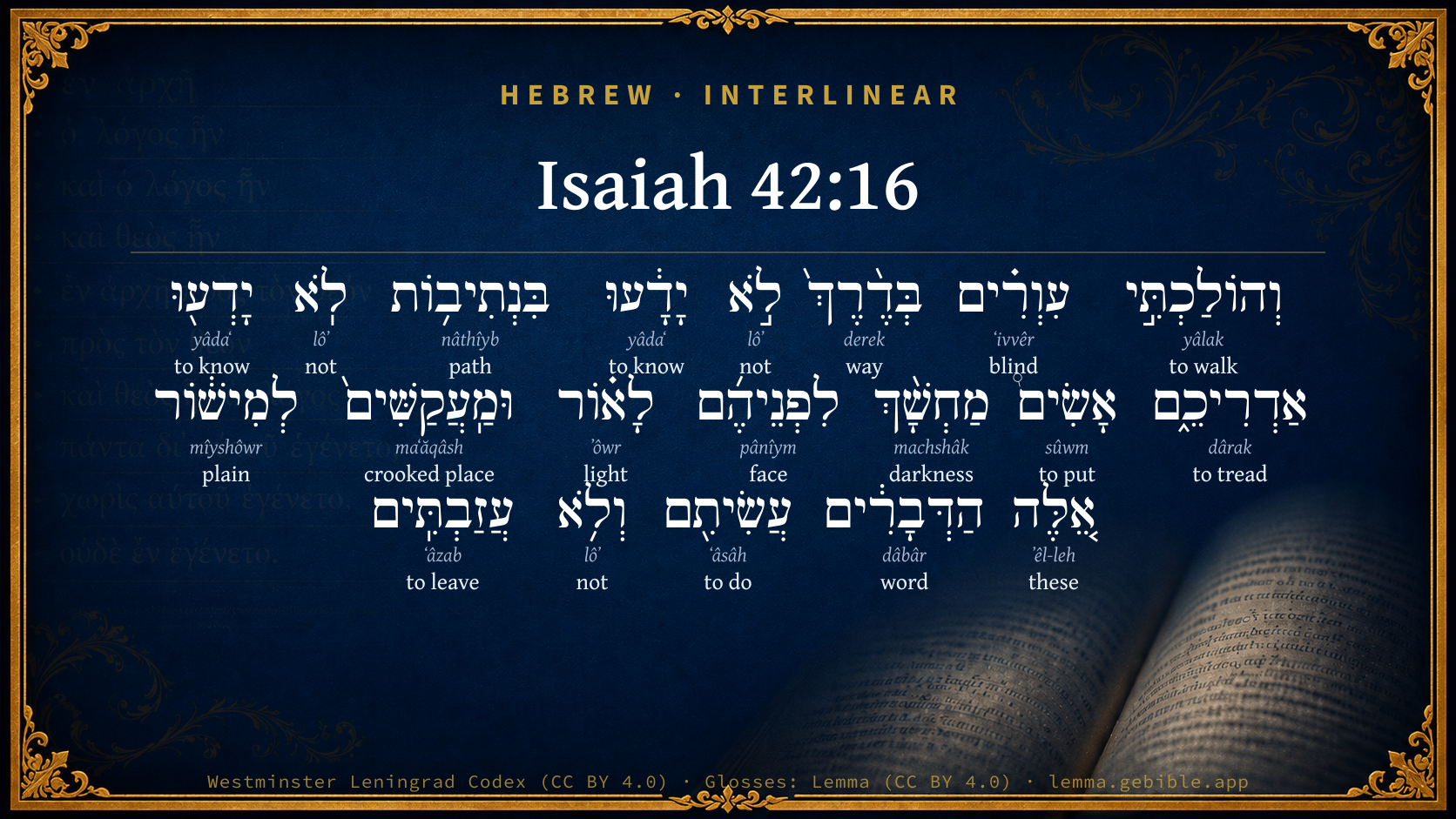
Hebrew (Westminster Leningrad Codex) Isaiah 42:16 appears in the Hebrew Old Testament. The text above is from the Westminster Leningrad Codex. Each word links to its Strong’s number, a concise gloss, and parsing drawn from the Open Scriptures Hebrew Bible morphology. Click any word for its full Brown-Driver-Briggs (BDB) entry.
Download image
Cite this verse

Isaiah 42:16 (World English Bible). Public Domain. Lemma interlinear Bible study tool, https://lemma.gebible.app/v/isaiah/42/16.

Show BibTeX & RIS
BibTeX
RIS
English Translation
I will bring the blind by a way that they don't know; in paths that they don't know will I lead them; I will make darkness light before them, and crooked places straight. These things will I do, and I will not forsake them.
World English Bible · Public Domain
Highlights
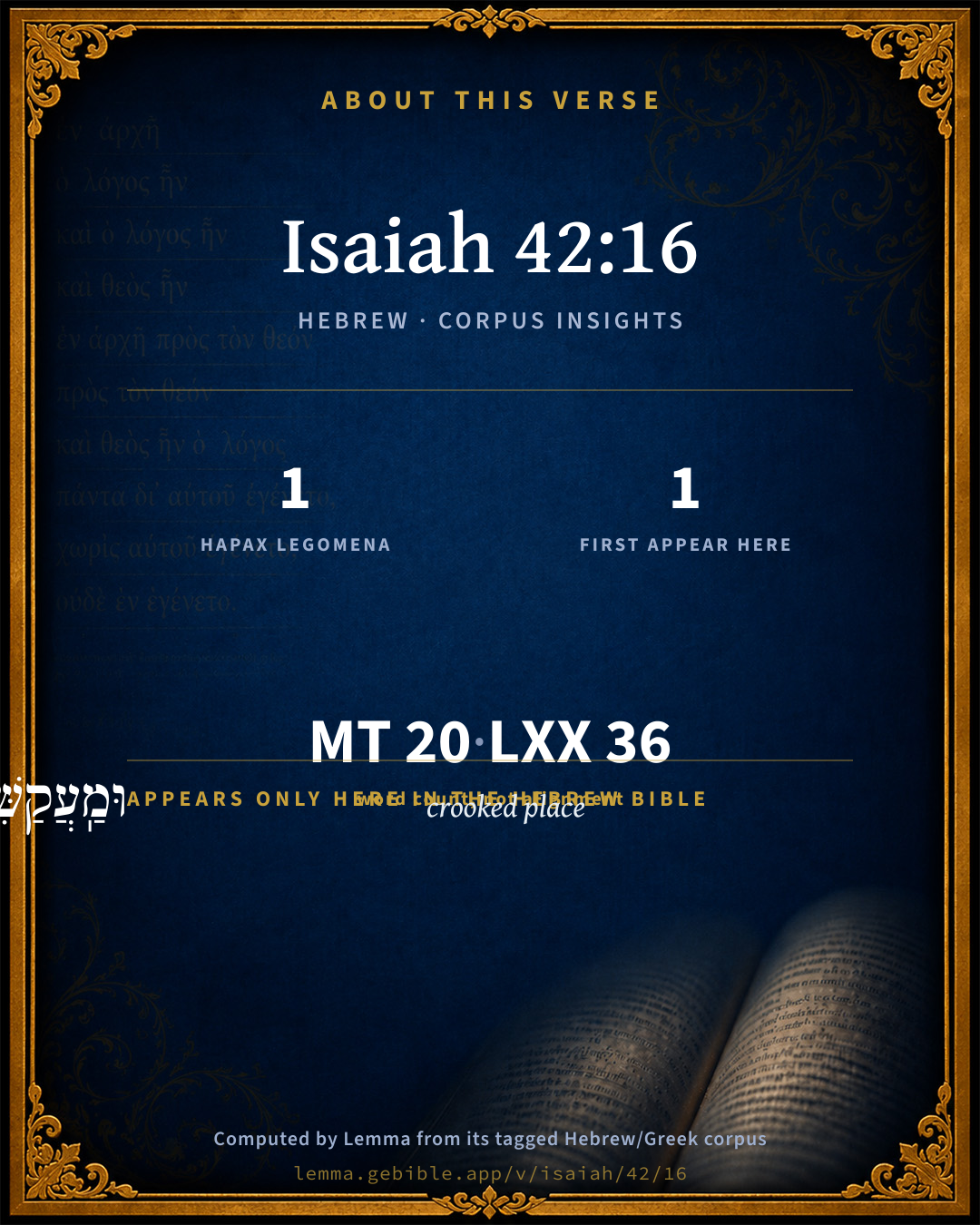
  • 1 hapax legomenon — only here in the Hebrew Bible
  • 1 first appearance in the Hebrew Bible
Full analysis ↓
Download a study sheet

One document with this verse’s original text, its word-by-word gloss line, the meaning frame, cross-references with their text, attributed commentary, and full source and license credits — printable, and it pastes into notes with its structure intact.

This verse Autodidact and up

Study sheet (.html) Plain text (.txt)

A passage Seminary Student

Up to 50 verses in one chapter. A passage sheet keeps up to 6 commentary sources and 12 cross-references per verse, in the order this page ranks them, and says so on the sheet whenever that leaves anything out. Ask for a single verse and you get the Autodidact verse sheet above.

Everything on this page stays free to read, with no account — the sheet is a download of what is already on screen, not access to it.

Want to remove ads? Support Godless Engineer
Compare translations 3

The same verse in 3 English versions, stacked beneath the original-language interlinear above. Click any original word for its lexicon entry.

Each is an independent rendering of the whole verse — the interlinear is not word-aligned to these translations.

Highlighted words mark where these versions differ — a whole-verse word diff, not a word-by-word alignment.

  • World English Bible Public Domain
    I will bring the blind by a way that they don't know; in paths that they don't know will I lead them; I will make darkness light before them, and crooked places straight. These things will I do, and I will not forsake them.
  • King James Version Public Domain
    And I will bring the blind by a way that they knew not; I will lead them in paths that they have not known: I will make darkness light before them, and crooked things straight. These things will I do unto them, and not forsake them.
  • unfoldingWord Literal Text CC BY-SA 4.0
    And I will make the blind walk by a way they have not known; on paths they have not known, I will make them tread. I will make darkness into light to their faces, and rough places into level ground. I will do these things, and I will not abandon them.

unfoldingWord Literal Text — © unfoldingWord, licensed CC BY-SA 4.0. Word-aligned USFM3 via Door43 (git.door43.org/unfoldingWord/en_ult).

Versions to compare (up to 4)

3 of 4 selected

Show all 18 translations

Every available English version of this verse, each an independent rendering of the whole verse.

  • World English Bible Public Domain
    I will bring the blind by a way that they don't know; in paths that they don't know will I lead them; I will make darkness light before them, and crooked places straight. These things will I do, and I will not forsake them.
  • Berean Standard Bible Public Domain
    I will lead the blind by a way they did not know; I will guide them on unfamiliar paths. I will turn darkness into light before them and rough places into level ground. These things I will do for them, and I will not forsake them.
  • Majority Standard Bible Public Domain
    I will lead the blind by a way they did not know; I will guide them on unfamiliar paths. I will turn darkness into light before them and rough places into level ground. These things I will do for them, and I will not forsake them.
  • King James Version Public Domain
    And I will bring the blind by a way that they knew not; I will lead them in paths that they have not known: I will make darkness light before them, and crooked things straight. These things will I do unto them, and not forsake them.
  • American Standard Version (1901) Public Domain
    And I will bring the blind by a way that they know not; in paths that they know not will I lead them; I will make darkness light before them, and crooked places straight. These things will I do, and I will not forsake them.
  • Revised Version (1885) Public Domain
    And I will bring the blind by a way that they know not; in paths that they know not will I lead them: I will make darkness light before them, and crooked places straight. These things will I do, and I will not forsake them.
  • Geneva Bible (1599) Public Domain
    And I will bring the blinde by a way, that they knewe not, and lead them by paths that they haue not knowen: I will make darkenesse light before them, and crooked thinges straight. These thinges will I doe vnto them, and not forsake them.
  • Douay-Rheims (1899) Public Domain
    And I will lead the blind into the way which they know not: and in the paths which they were ignorant of I will make them walk: I will make darkness light before them, and crooked things straight: these things have I done to them, and have not forsaken them.
  • Young's Literal Translation Public Domain
    And I have caused the blind to go, In a way they have not known, In paths they have not known I cause them to tread, I make a dark place before them become light, And unlevelled places become a plain, These `are' the things I have done to them, And I have not forsaken them.
  • Literal Standard Version CC BY-SA 4.0
    And I have caused the blind to go, || In a way they have not known, || I cause them to tread in paths they have not known, || I make a dark place become light before them, || And unleveled places become a plain, || These [are] the things I have done to them, || And I have not forsaken them.
  • Unlocked Literal Bible CC BY-SA 4.0
    I will bring the blind by a way that they do not know; in paths that they do not know I will lead them. I will turn the darkness into light before them, and make the crooked places straight. These things I will do, and I will not abandon them.
  • unfoldingWord Literal Text CC BY-SA 4.0
    And I will make the blind walk by a way they have not known; on paths they have not known, I will make them tread. I will make darkness into light to their faces, and rough places into level ground. I will do these things, and I will not abandon them.
  • Darby Bible Public Domain
    And I will bring the blind by a way that they know not, in paths that they know not will I lead them; I will make darkness light before them, and crooked things straight. These things will I do unto them, and not forsake them.
  • World Messianic Bible Public Domain
    I will bring the blind by a way that they don’t know. I will lead them in paths that they don’t know. I will make darkness light before them, and crooked places straight. I will do these things, and I will not forsake them.
  • Webster's Bible Public Domain
    And I will bring the blind by a way that they knew not; I will lead them in paths that they have not known: I will make darkness light before them, and crooked things straight. These things will I do for them, and not forsake them.
  • Free Bible Version CC BY-SA 4.0
    I will lead the blind along a road they don't know; I will guide them along paths they don't know. I will turn darkness into light before them, and smooth out the rough places. This is what I'm going to do for them; I won't let them down.
  • Bible in Basic English Public Domain
    And I will take the blind by a way of which they had no knowledge, guiding them by roads strange to them: I will make the dark places light before them, and the rough places level. These things will I do and will not give them up.
  • JPS Tanakh (1917) Public Domain
    And I will bring the blind by a way that they knew not, in paths that they knew not will I lead them; I will make darkness light before them, and rugged places plain. These things will I do, and I will not leave them undone.

Literal Standard Version (2020), Covenant Press — licensed CC BY-SA 4.0. Text via the HelloAO Bible API (eBible.org). Unlocked Literal Bible (unfoldingWord) — licensed CC BY-SA 4.0. Text via the HelloAO Bible API (eBible.org). unfoldingWord Literal Text — © unfoldingWord, licensed CC BY-SA 4.0. Word-aligned USFM3 via Door43 (git.door43.org/unfoldingWord/en_ult). Free Bible Version, Dr. Jonathan Gallagher — licensed CC BY-SA 4.0. Text via the HelloAO Bible API (eBible.org).

Word by word

More ways to search: Search by grammar → Find every occurrence → Compare this word →

Practice this passage: Drill this verse → Learn its vocabulary →

וּמַֽעֲקַשִּׁים֙
maʻăqâsh
H4625
“and · crooked places”
Conjunction + Noun, Common, Masculine, Plural, Absolute
Part of Speech
Conjunction + Noun
Type
Common
Gender
Masculine
Number
Plural
State
Absolute
Full BDB Definition

Origin: from H6140

TWOT: 1684c

crooked place, twisted, crooked things
  1. וְהוֹלַכְתִּ֣י yâlak H3212 “and · to walk” Conjunction + Verb, Hiphil, Sequential Perfect, 1st Person, Common, Singular
  2. עִוְרִ֗ים ʻivvêr H5787 “blind” Adjective, Adjective, Masculine, Plural, Absolute
  3. בְּדֶ֨רֶךְ֙ derek H1870 “in/at · way” Preposition + Noun, Common, Both, Singular, Absolute
  4. לֹ֣א lôʼ H3808 “not” Particle, Negative
  5. יָדָ֔עוּ yâdaʻ H3045 “to know” Verb, Qal, Perfect, 3rd Person, Common, Plural
  6. בִּנְתִיב֥וֹת nâthîyb H5410 “in/at · paths” Preposition + Noun, Common, Both, Plural, Absolute
  7. לֹֽא lôʼ H3808 “not” Particle, Negative
  8. יָדְע֖וּ yâdaʻ H3045 “to know” Verb, Qal, Perfect, 3rd Person, Common, Plural
  9. אַדְרִיכֵ֑ם dârak H1869 “to tread · them” Verb, Hiphil, Imperfect, 1st Person, Common, Singular + Suffix, Personal, 3rd Person, Masculine, Plural
  10. אָשִׂים֩ sûwm H7760 “to put” Verb, Qal, Imperfect, 1st Person, Common, Singular
  11. מַחְשָׁ֨ךְ machshâk H4285 “darkness” Noun, Common, Masculine, Singular, Absolute
  12. לִפְנֵיהֶ֜ם pânîym H6440 “to/for · face(s) · their” Preposition + Noun, Common, Both, Plural, Construct + Suffix, Personal, 3rd Person, Masculine, Plural
  13. לָא֗וֹר ʼôwr H216 “to/for the · light” Preposition, Determined + Noun, Common, Both, Singular, Absolute
  14. לְמִישׁ֔וֹר mîyshôwr H4334 “to/for · plain” Preposition + Noun, Common, Masculine, Singular, Absolute
  15. אֵ֚לֶּה ʼêl-leh H428 “these” Pronoun, Demonstrative, Common, Plural
  16. הַדְּבָרִ֔ים dâbâr H1697 “the · words” Particle, Definite Article + Noun, Common, Masculine, Plural, Absolute
  17. עֲשִׂיתִ֖ם ʻâsâh H6213 “to do · them” Verb, Qal, Perfect, 1st Person, Common, Singular + Suffix, Personal, 3rd Person, Masculine, Plural
  18. וְלֹ֥א lôʼ H3808 “and · not” Conjunction + Particle, Negative
  19. עֲזַבְתִּֽים ʻâzab H5800 “to leave · them” Verb, Qal, Perfect, 1st Person, Common, Singular + Suffix, Personal, 3rd Person, Masculine, Plural

About this verse

These counts appear in no published source. They are computed here, from the morphology-tagged text and Lemma’s own curated glosses. What Lemma adds →

20
words
17
distinct lemmas
Prophets
section

Notable vocabulary

1 hapax legomenon — a word that appears only here in the entire Hebrew Bible:

  • וּמַֽעֲקַשִּׁים֙ crooked place H4625

First appearance in Scripture

This word makes its first canonical appearance in the Hebrew Bible here:

  • וּמַֽעֲקַשִּׁים֙ crooked place H4625

Shared distinctive vocabulary

מַחְשָׁ֨ךְ darkness H4285 occurs in 7 verses of the Hebrew Bible. Also found in:

Grammatical profile

  • 7 verbs
  • 8 nouns
  • 1 adjective
  • 1 pronoun
  • 3 particles

Verb forms

  • וְהוֹלַכְתִּ֣י Hiphil · Sequential Perfect
  • יָדָ֔עוּ Qal · Perfect
  • יָדְע֖וּ Qal · Perfect
  • אַדְרִיכֵ֑ם Hiphil · Imperfect
  • אָשִׂים֩ Qal · Imperfect
  • עֲשִׂיתִ֖ם Qal · Perfect
  • עֲזַבְתִּֽים Qal · Perfect

Repetition

Words recur within this verse — often emphatic in Hebrew:

  • יָדָ֔עוּ to know H3045 ×2
  • לֹ֣א not H3808 ×3

Hebrew & Septuagint length

In English translation the verse runs 44 words from the Hebrew and 49 from the Septuagint (LXX English) — closely comparable.

A rough comparison of the two English renderings, which tokenize alike — not a word-level alignment.

Word counts can differ between the Hebrew and the Greek without any difference in meaning — e.g. the Hebrew direct-object marker אֵת has no separate Greek word, and Greek often adds the article ὁ.

In the original languages it is 20 Hebrew tokens and 36 Greek tokens — but the two are counted differently (Hebrew bundles its prefixes and suffixes into one token; the Greek is in lemma form), so that isn’t a like-for-like length.

Cross-references

30

Topical passages linked to Isaiah 42:16 in the Treasury of Scripture Knowledge — connected by theme and wording, ordered by reader-vote popularity; previews shown in the World English Bible.

  • Isaiah 30:21 and your ears shall hear a word behind you, saying, This is the way, walk you in it; when you turn to the right hand, and when you turn to the left.
  • Luke 3:5 Every valley will be filled. Every mountain and hill will be brought low. The crooked will become straight, And the rough ways smooth.
  • Isaiah 35:8 A highway shall be there, and a way, and it shall be called The way of holiness. The unclean shall not pass over it, but is shall be for for him who walks in the Way. Wicked fools will not go there.
  • Isaiah 60:19–20 The sun shall be no more your light by day; neither for brightness shall the moon give light to you: but Yahweh will be to you an everlasting light, and your God your glory.
  • Isaiah 40:4 Every valley shall be exalted, and every mountain and hill shall be made low; and the uneven shall be made level, and the rough places a plain:
  • Luke 1:78–79 Because of the tender mercy of our God, Whereby the dawn from on high will visit us,
  • Ephesians 5:8 For you were once darkness, but are now light in the Lord. Walk as children of light,
  • Isaiah 32:3 The eyes of those who see shall not be dim, and the ears of those who hear shall listen.
  • Jeremiah 32:39–41 and I will give them one heart and one way, that they may fear me forever, for the good of them, and of their children after them:
  • Psalms 94:14 For Yahweh won't reject his people, Neither will he forsake his inheritance.
  • Hebrews 13:5 Be free from the love of money, content with such things as you have, for he has said, "I will in no way leave you, neither will I in any way forsake you."
  • Isaiah 29:18 In that day shall the deaf hear the words of the book, and the eyes of the blind shall see out of obscurity and out of darkness.
  • Isaiah 45:2 I will go before you, and make the rough places smooth; I will break in pieces the doors of brass, and cut in sunder the bars of iron;
  • Isaiah 48:17 Thus says Yahweh, your Redeemer, the Holy One of Israel: I am Yahweh your God, who teaches you to profit, who leads you by the way that you should go.
  • Jeremiah 31:8–9 Behold, I will bring them from the north country, and gather them from the uttermost parts of the earth, [and] with them the blind and the lame, the woman with child and her who travails with child together: a great company shall they return here.
  • Isaiah 35:5 Then the eyes of the blind shall be opened, and the ears of the deaf shall be unstopped.
  • Romans 5:8–10 But God commends his own love toward us, in that while we were yet sinners, Christ died for us.
  • 1 Peter 1:3–5 Blessed be the God and Father of our Lord Jesus Christ, who according to his great mercy became our father again to a living hope through the resurrection of Jesus Christ from the dead,
  • Isaiah 29:24 They also who err in spirit shall come to understanding, and those who murmur shall receive instruction.
  • Isaiah 60:1–2 Arise, shine; for your light is come, and the glory of Yahweh is risen on you.
  • Hosea 2:6 Therefore, behold, I will hedge up your way with thorns, And I will build a wall against her, That she can't find her way.
  • Hosea 2:14 "Therefore, behold, I will allure her, And bring her into the wilderness, And speak tenderly to her.
  • Joshua 3:4 Yet there shall be a space between you and it, about two thousand cubits by measure: don't come near to it, that you may know the way by which you must go; for you have not passed this way heretofore.
  • Romans 8:29–31 For whom he foreknew, he also predestined to be conformed to the image of his Son, that he might be the firstborn among many brothers.
  • Ecclesiastes 1:15 That which is crooked can't be made straight; and that which is lacking can't be counted.
  • Ecclesiastes 7:13 Consider the work of God, for who can make that straight, which he has made crooked?
  • Isaiah 54:13 All your children shall be taught of Yahweh; and great shall be the peace of your children.
  • Ezekiel 14:23 They shall comfort you, when you see their way and their doings; and you shall know that I have not done without cause all that I have done in it, says the Lord Yahweh.
  • 2 Thessalonians 2:13–14 But we are bound to always give thanks to God for you, brothers loved by the Lord, because God chose you from the beginning for salvation through sanctification of the Spirit and belief in the truth;
  • Isaiah 41:3 He pursues them, and passes on safely, even by a way that he had not gone with his feet.

Cross-references courtesy of OpenBible.info (CC BY 4.0).

Hebrew and Greek witnesses Masoretic Hebrew ↔ Greek Septuagint

The same verse in the two great witnesses to the Old Testament, shown verse-for-verse.

These are two independent witnesses, not word-aligned to each other, and the Septuagint is shown in lemma (dictionary) form.

Hebrew Isaiah 42:16 Masoretic · Westminster Leningrad Codex

וְהוֹלַכְתִּ֣י עִוְרִ֗ים בְּדֶ֨רֶךְ֙ לֹ֣א יָדָ֔עוּ בִּנְתִיב֥וֹת לֹֽא יָדְע֖וּ אַדְרִיכֵ֑ם אָשִׂים֩ מַחְשָׁ֨ךְ לִפְנֵיהֶ֜ם לָא֗וֹר וּמַֽעֲקַשִּׁים֙ לְמִישׁ֔וֹר אֵ֚לֶּה הַדְּבָרִ֔ים עֲשִׂיתִ֖ם וְלֹ֥א עֲזַבְתִּֽים

I will bring the blind by a way that they don't know; in paths that they don't know will I lead them; I will make darkness light before them, and crooked places straight. These things will I do, and I will not forsake them.

World English Bible · Public Domain

Greek LXX Isaiah 42:16 Septuagint · lemma form

καί ἄγω τυφλός ἐν ὁδός ὅς οὐ γιγνώσκω καί τρίβος ὅς οὐ οἶδα πατέω ποιέω αὐτός ποιέω αὐτός ὁ σκότος εἰς φῶς καί ὁ σκολιός εἰς εὐθύς οὗτος ὁ ῥῆμα ποιέω καί οὐ ἐν καταλείπω αὐτός

And I will bring the blind by a way that they knew not, and I will cause them to tread paths which they have not known: I will turn darkness into light for them, and crooked things into straight. These things will I do, and will not forsake them.

LXX2012 (modern English Septuagint) · Public Domain

On this verse, Adam Clarke's Commentary discusses the Septuagint’s reading. Read the note in Commentary ↓

Hebrew: Westminster Leningrad Codex (CC BY 4.0). Greek: Septuagint (public domain); English from LXX2012 (modern English Septuagint) (Public Domain). How the Septuagint differs from the Hebrew →

Targum (Aramaic paraphrase)

1

The Targum is the ancient Jewish Aramaic paraphrase of the Hebrew Scriptures — an interpretive translation, not the Hebrew text itself. Onkelos (literal) and Pseudo-Jonathan (expansive) render the Torah, and Jonathan the Prophets. Coverage is partial: where no permissively-licensed English translation exists for a verse, only the Aramaic is shown. This is verse-level text, not a word-by-word alignment to the Hebrew.

  1. Targum Jonathan Prophets (Joshua–Malachi)
    וָאֱדַבֵּר לְבֵית יִשְׂרָאֵל דְדָמִין כְּסָמָן בְּאוֹרַח דְלָא יְדָעוּ בִּשְׁבִילִין דְלָא אֲלִיפוּ אַדַרְכִינוּן אֲשַׁוֵי קְבַל קֳדָמֵיהוֹן לִנְהוֹר וְכַפְלָא לְמֵישְׁרָא אִלֵין פִּתְגָמַיָא אַעְבְדִינוּן וְלָא אַרְחִיקִינוּן:

    And I will lead the house of Israel, who are like the blind, in a way which they knew not, in paths they have not learned I will lead them; I will make darkness light before them, and the rugged place a plain. These things will I do for them, and will not forsake them.

    Targum Jonathan — Aramaic: “Mikraot Gedolot” (public domain). English: “Sefaria Community Translation” (CC0 1.0 (public-domain dedication)); “London "Chaldee Paraphrase," 1871” (public domain). Text via Sefaria.

Commentary

Notes on Isaiah 42:16 from classic Christian and Jewish commentators (each source and its license shown beneath its notes). The classic Christian expositions comment on the surrounding passage and are grouped to its opening verse, so a note may address several verses; the Jewish commentaries on the Tanakh (Rashi and others) are per-verse, so they appear only where the commentator wrote on this verse.

Lemma curates 59 commentaries, every one of them public domain or Creative Commons licensed, each selected and text-cleaned for this edition rather than reprinted as found. About our sources →

Trapp's Complete Commentary

John Trapp

Isa 42:16 And I will bring the blind by a way [that] they knew not; I will lead them in paths [that] they have not known: I will make darkness light before them, and crooked things straight. These things will I do unto them, and not forsake them.

Ver. 16. And I will bring the blind by a way.] This was fulfilled, in the letter, to the Jews brought back from Babylon, where they had been close prisoners, and, in the mystery, to all Christ’s converts - more especially to that blind boy presented to Bishop Hooper, martyr, the day before his death, at Gloucester, where the boy had not long before suffered imprisonment for confessing the truth. {a}

I will make darkness light before.] By bringing them out of darkness into my marvellous light. {1Pe 2:9}

{a} Acts and Mon.

John Trapp, A Commentary or Exposition upon All the Books of the Old and New Testament (1647–1656) — public domain. Text from a community e-Sword module.

The Biblical Illustrator

Joseph S. Exell

Isa_42:16

And I will bring the blind by a way that they knew not

God leading the blind

The blind are they whom transgression and wickedness have robbed of power of spiritual insight.

The unknown ways in which Jehovah leads them are the ways of redemption, known to Him alone and now revealed in the fulness of times. (F. Delitzsch, D. D.)

The unknown path

God would lead Israel by a way that had not yet been trodden; He would redeem her from Babylon, not as He delivered her from Egypt in the distant past, but by inclining towards her the heart of her captor.

I. THE UNKNOWN, UNTRODDEN PATH BEFORE US.

1. It is an unknown path which we are about to tread. Let the child or even the young man draw an outline of his anticipated career, and let that line he compared with the one which really marks his course; what a divergence will there be l

2. It is an untrodden path. As the second great Divine deliverance of Israel differed materially from the first, so Gods dealings with individual men differ with the several periods of their life.

II. THE GUIDANCE OF OUR GOD. I will bring. I will lead. There are two ways by which God leads His people.

1. By controlling their circumstances. God may preserve us from taking the wrong path by providentially blocking the way in which we might otherwise have walked; or, He may keep us from a false movement, or induce us to make the true one by bringing us unto the fellowship of some wise friend whose timely counsel either dissuades or determines us.

2. By influencing their minds. He is nearer to us than our nearest friends; and He can influence us more powerfully than the wisest and strongest of our teachers or guardians.

III. HIS DISPOSITION AND FREEDOM TO HELP US.

1. That God is disposed to help us, we need not doubt.

(1) His sovereignty over Israel would account for all His watchfulness over that people; and His Fatherhood of every human spirit will certainly ensure His Divine interest in each one of His children. And if this were an insufficient bond to constrain such condescending notice, we have but to remember that Jesus Christ is the Divine Saviour and Friend of every one of His people, most tenderly united to each of them by the strongest ties. The Good Shepherd cares, and cares much, for every sheep of His flock.

(2) Our Lords intimation of the Fathers care for all His creatures, and His own a fortiori argument therefrom (Ye are of more value than many sparrows) is convincing proof to all Christian minds that our God is thinking upon us, that He is mindful of our necessities, and is shaping our course from day to day.

2. That God is free to help us, we may also be assured. Nothing is more incredible than that the Father of spirits, the Saviour of souls, should, by the established order of nature which He has constructed, have to cut Himself off from His human family that, however earnestly they cried to Him, He would not be at liberty to respond to them. That He should not weaken our sense of the imperative claims of duty and diligence by too obviously and constantly interposing on our behalf, we can readily understand. It is but necessary that He should touch some link in the chain of causes which is out of our sight; thus, with unseen but unfettered hand, He works on our behalf.

IV. OUR DUTY AND OUR COMFORT.

1. Our duty is threefold.

(1) To become His children indeed, in the very fullest sense, by living faith in Jesus Christ.

(2) To live before God as His obedient children, that our service and submission may win His Fatherly delight and His parental longing to bless us.

(3) To ask for His constant guidance in daily prayer.

2. Our comfort is great indeed. God will be our guide. He will be our vanguard, and be our rereward (Isa_52:12). (The Thinker.)

God the Guide of His blind people

True wisdom will confirm the decision of Scripture, not only as to spiritual things but as to all things, when it says, If any man thinketh that he knoweth anything, i.e if he regard himself as perfect in knowledge, he knoweth nothing yet as he ought to know. If we look to our own path in life, we find ourselves uninformed concerning that which lies before us. But the Word of God does not more explicitly reveal to us our ignorance and blindness, than it offers to us a great and infallible Guide. Let our minds be directed to the inquiry, whether or no this promise is verified in the experience of Gods people.

I. In answer to this question we first reply that such a guidance may be traced in the dealings of God with His children BY HIS PROVIDENCE. A historian of the Reformation has placed in the forefront of his immortal work this sentence respecting it: This history takes as its guiding star the simple and pregnant truth that God is in history (DAubigne). And that single sentence contains a world of important truth. The recorded history of the Jewish nation affords a beautiful illustration of the truth that God is active in all human affairs. And had God inspired another prophet to write the history of any other nation, yea, had God inspired a prophet to write your individual history, or my own, we should be astonished to see how busy the hand of God had been in its every stage and turn.

II. God leads His children by a way they know not IN THE DEALINGS OF HIS GRACE, e.g., the woman of Samaria; the assembly which stood before Peter on the Day of Pentecost; the blaspheming, persecuting Saul; the jailer at Philippi. God is characteristically a God who is found of them that sought Him not. The Divine methods for leading the believer to growth in grace are not less unexpected. Even on the believers deathbed is often and gloriously illustrated the teaching of our text. As the path by which God leads His people is, in its beginning, and in all its progress, so is it in its termination, one which they know not. It doth not yet appear what we shall be. (W. E. Schenck.)

Divine guidance

1. In Scripture the word blind is used respecting the prejudiced and the proud. Their minds are perverted. The Pharisees could see no beauty in Christ, no excellence in His teaching, no evidence of Divine mission in His works. They were blind leaders of the blind. It is employed also to denote the characteristic dulness and stupidity of the Israelites, as a people, perpetually lapsing into idolatry, breaking off from God, unable to see the blessedness of the path of truth and righteousness.

2. But there is still another meaning that is important. The word may mean simple ignorance. It may describe one who cannot see the right path because there is a mist upon it, and he is perplexed on account of this. There may be tenderness in the word rather than anger; gentle purposes of love implied rather than condemnation or rebuke. This helps us to understand the passage. The way of providence and grace in the darkness and perplexity of life may be thus graphically and forcibly expressed.

I. We have the frequent MYSTERY of God in providence and grace. We know not, and cannot trace, the way of God. The material, the vegetable, the animal, worlds are full of what is inscrutable. Thus it is with the course of individual life. We pursue our path, not knowing what may arise. We go forth like Abraham, not knowing whither we go. Yet there is an eye that sees all, a mind that directs an, a hand that overrules all. We believe that every man lives in the Divine thought. Each has his separate course, duties, and responsibilities, from which he can no more escape than his shadow. Every one, like John, is called to fulfil this course. And God knows all. But to us, life has to discover itself as we go on, and often passages in it, and the end, look strange as compared with the beginning. We purpose one thing but God means another, e.g. Joseph, Elisha, Amos, Win. Carey, etc. So also as to grace. The leadings of God to fulfil His purposes are leadings of the blind. The methods He takes to enlighten the mind have infinite variety. While unconsciously men pursue a path they think their own, lo! it leads them within the circle of Divine influences which they never anticipated. Who would have thought that the vehement persecutor who stood by while the stones crashed down on Stephen, before he entered Damascus on his further errand of malice, would be met and subdued by all-conquering mercy? Who could have predicted that Lydia, of Thyatira, in pursuit of her business at Philippi, would find her heart opened to receive the truth, and be led to rejoice in far greater riches than the most prosperous trade could bring? What a surprise to Philemon that his runaway slave, who had played the thief, should be blessed under the apostles ministry at Rome! Little did Francis Xavier think, when he entered the college of St. Barbs a gay and haughty youth, that one whom he scorned and despised would be the means of his conversion, and that the text, What shall it profit a man? so frequently repeated, would be the arrow of the Almighty to his soul. Little did West, the sceptical lawyer, think, when he sat down to tear in pieces, as he purposed, the arguments that prove the resurrection of Christ, that he would end in owning their unanswerableness, and his own spirit should bow before God. As little did another conceive that in attempting to hold up in caricature and contempt the apostle Paul, the spiritual power and greatness he beheld should lead him to become a disciple too. Passing words, casual association, incidental events, have had wonderful spiritual results. Men have regretted circumstances that have yet been made instrumental to their conversion. A young man has wept to lose a situation, but unwittingly has been led to another, where Divine grace has made him a new creature. God works invisibly; His instrumentalities and agencies we often fall to recognise; but they are mighty to fulfil the counsels of His will, and thus He brings the blind by a way they know not.

II. The KINDNESS as well as mystery of the Divine method is taught us in this passage. Probably, at some time, occasion has prompted you to guide for a few steps a blind man. He has wished to cross the road, and there is peril; or, groping his way along, there is some object which, unless he avoids it, will cause injury. The human tenderness that is in you has led you to be kind and true. But if such a spirit animates an imperfect man, shall we not take the Scripture assurance that the spirit of kindness characterises the infinite God, whose name is announced as Love T

1. The Divine guidance is kind because it is wise. Our God is of infinite counsel He knows our nature, tendencies, capacities, impulses, the action and influence of everything upon us. There are mountain passes, we are told, before traversing which the guides blindfold the travellers. They could not endure to see the awful precipices on either side. So it may be in some of the paths of life there are perils, and God guidance is an enigma, because He is dealing with us thus.

2. Gods guidance is kind because it is patient. He bears with our disobedience and ingratitude, puts up with our manifold affronts and defiance, suffers long with our infirmities, and still exerts new influences that His gentleness may prevail.

3. Gods guidance is kind because it is supporting. You have sometimes in country walks approached a hill It has seemed to rise with special steepness, but you have advanced, and strength has been equal, refreshing air and pleasant scenery have cheered. You have threaded your way through some intricate route towards a house or village, and thought you would never find it; but a token here and a footstep there have encouraged, and your journeys end has been gained. So up lifes hills of difficulty and along its tortuous paths, a Divine hand leads and a Divine voice cheers.

III. The FAITHFULNESS Of the Divine guidance. Not forsake. You have sometimes seen, perhaps, standing on the pavement or in a passage some little crying child. A careless mother has left it for a while, little thinking of distress or danger. Every sentiment of pity within you is moved, as in its sobs it cannot tell either its name or home. You may be reassured- The mother will return soon. But if it were indeed abandoned to cold and misery, in the driving storm and falling snow, no heart so hard but must be deeply compassionate. But this would be surpassed by the thought of a Christian, forsaken, if we could so conceive. A child of God deserted, with promises broken, blessings withdrawn, hopes disappointed, cast off in caprice and weariness--the woe of such an one would rise to the very height of distress. But this can never be. He has pledged His word, and with Moses we should exclaim, What would become of Thy great name? The universe in ruins would be an appalling wreck. But this could be nothing compared with the wreck of the Divine character. Dr. Whewell has said, The whole earth from pole to pole, from centre to circumference, is employed in keeping a snowdrop in the position best suited for the promotion of its vegetable health. Doth God provide for the flower; and shall He not guard His people? (G. Macmichael, B. A.)

The way in which God leads His people

Our object will be to show that, from the beginning to the end of their pilgrimage, God leads His people in a way, which previous to experience they know not.

I. The true nature of CONVICTION OF SIN is a thing of which the called of God have no distinct knowledge, prior to experience. There is, no doubt, a great diversity in the exercises and circumstances of souls under conviction. Before this they may have formed a conception of the feelings of a convinced sinner. They imagined that by some flash, like lightning, conviction of sin would be effected. Very, commonly the awakened person strives to produce conviction of the kind conceived, by bringing up to view the most frightful images. But if the convinced sinner could realise all the feelings of which he has conceived, and for which he longs and prays, the end of conviction would not be at all answered; for the end of conviction is to lead the sinner out of himself; to destroy all self-confidence and self-complacency. But if he could experience such feelings as he wishes, he would think well of himself, as being in the frame in which he ought to be. The views and feelings produced by the conviction of the Spirit, lead the soul to despair--to despair of ever saving itself. It is an unexpected thing, of which the blind could form no practical conception, that the nearer the sinner approaches towards deliverance, the further he recedes from hope and comfort, in his own apprehension. That is found true, therefore, in spiritual things, which has been noticed in natural things; that the darkest hour is that which immediately precedes the dawning of the day.

II. CONVERSION also turns out in experience to be a very different thing from what was anticipated. Awakened sinners, having heard of persons being translated from darkness to the marvellous light of the Gospel, and having, perhaps, heard or read of some remarkable conversions, expect to be brought through the new birth in a way perfectly similar to these extraordinary cases, which, however, are very imperfectly understood. They, therefore, endeavour to place them selves in the same circumstances as those in which others were when they found peace with God; and they continue to look and wait for some sudden and almost miraculous change. These expectations are never realised, and are always erroneous; for when this blessed change actually occurs, the light is commonly like that of the dawn; obscure at first, but shining more and more to the perfect day; and instead of the views being miraculous or strange, they appear to rise in the mind like other thoughts and feelings. The only marked difference is, not in the manner of the views, but in the spiritual beauty and glory of the objects contemplated. The soul, under the leadings of the Spirit, is often brought near to Christ, when it apprehended He was far off.

III. God leads His once blind but chosen people in the way which they know not, as it relates to THE MEANS AND PROGRESS OF THEIR SANCTIFICATION.

IV. Another thing in the dispensations of God to His people which, prior to experience, they never distinctly understood, and which cannot easily be explained, is His leaving them for a season to back slide; and then RECOVERING THEM by the exercise of the same sovereign grace which first brought them into the path of life.

V. Finally, the people of God are often CONDUCTED THROUGH THE VALLEY AND SHADOW OF DEATH in an unexpected manner. (A. Alexander, D. D.)

The blind travellers

The experience of the Jews and the experience of Christians are so closely analogous that the one is used in Scripture as a type of the other.

I. THE CONDITION DESCRIBED.

1. The blindness of the traveller. Is the figure too strong to describe our case? You can look upon the past, and memory will throw her clear light on salient points of the journey. But when you turn round and try to explore the future, you are struck blind, you can see nothing! You cannot tell how long the journey is going to be, or how short; what heights, what depths, you may have to cross, or where they are.

2. The strangeness of the way. A way they knew not--paths they have not known. You once drew out a map of the course you intended to pursue--will you lay beside it the map of the course you have pursued? What a difference between programme and performance! And so it will be in the future--It is not in man that walketh to direct his steps.

3. The obstacles in the road. My text tells of crooked things and crooked places; how true to nature and experience!

II. THE CONSOLATION PRESENTED. Remember that it is addressed to Gods own people--in other words, to penitent sinners, to humble believers.

1. Here is a promise of the wisest guidance. Blind man, you dont know the way--but God does!

2. Here is a promise of the mightiest help. I will make darkness light before them, and crooked places straight.

3. Here is a promise of the firmest faithfulness.

III. THERE IS ANOTHER JOURNEY TO BE MADE. This is the journey to heaven itself--that more glorious Canaan than any that the Jews sighed,, for in their captivity m Babylon. But it is the land that is very far off--and how shall we find the way? Now this is not so easy as some would have us suppose; for here, too, we are blind travellers-and the way is strange--and there are terrible obstacles in the road. It is a mercy when we discover our condition, and cease trying to guide ourselves; and cry, Lord, we are blind--do Thou lead us! Lord, save us--or we perish! What provision has been made for us in the mercy of God? Christ--Who is the Way, the Truth, and the Life! Lay hold of Christ, blind traveller! and never for a moment relax your hold. Here is guidance, help, faithfulness, all-sufficient and unchanging. (F. Tucker, B. A.)

Guidance for the blind

I. THE CONDITION OF SPIRITUAL BLINDNESS. By the fall of our first parent, darkness hath come over the spirit of every man born into the world. In heathen nations and in heathen days, although there were some faint and feeble aspirings after truth, in the main men were in the depths of darkness. This is not merely the original condition of every man, but is in part the condition of the regenerate also. Yet there are things, unto which man, even at the most advanced of his earthly condition, cannot attain. It is not hard to point out some of the advantages that result from this state of concealment in which God keeps His people.

1. It tends to their humility.

2. It keeps them dependent.

3. This blindness belongs to the very nature of faith; without it, faith can have no existence.

4. Moreover, it tends to the comfort of Gods children. If all were laid open, then sorrow and sadness would come before their time.

II. THE PROMISE OF DIVINE DIRECTION. I will make darkness light before them, etc. Mainly God delivers information to His people in two ways.

1. He gives it by the written Word.

2. He has given us the volume of providence to be the commentary upon the volume of revelation. (S. Robins, M. A.)

Mysterious providences

I. SHOW THAT THE LORDS WAYS ARE MYSTERIOUS. Of this we have many instances in His works, both of providence and grace.

1. Take, e.g., the case of Moses. Or, turn from the leaders to the people who were led.

2. But to turn from Scripture to individual experience. How mysterious Gods dealings with each one of ourselves, from our birth to the present day.

3. If we turn from God s works of providence without, to His work of grace within, how mysterious indeed are the ways of our God!

II. Though Gods ways are mysterious, HIS INTENTIONS ARE NEVERTHELESS MERCIFUL.

III. THROUGHOUT THE WHOLE HIS LOVE IS ABIDING. Conclusion--

1. If Gods ways are mysterious, be careful to avoid forming rash judgments respecting them; beware lest you speak of them unadvisedly with your lips.

2. Still further, if we know Gods intentions to be merciful, how safe are our ways in His hands!

3. If Gods love be abiding, should we not lie in His hands, as clay in the hands of the potter? Should we not seek to bring every thought unto the obedience of Christ? Should we not shelter ourselves under every trial in Him who is a strong tower and house of defence? (J. Lombard.)

The spiritual condition of man

I. THE SUBJECTS OF DIVINE GRACE.

II. THE OPERATIONS OF DIVINE GRACE. There are more paths than one. The path of repentance is followed by the path of faith in Jesus--faith in the truths of the Gospel--faith in the promises of God. There is another path, which, by nature, is not known--the path of obedience. They are led in the way of holiness.

III. THE EFFECTS OF DIVINE GRACE. I Will make darkness light before them, and crooked things straight. Who can make darkness light before them but the Fountain, the Author, the Source of light and life and being, and all the blessings connected with life? (S. Drew, M. A.)

Divine leadings

I. THE SPECIAL DEALINGS OF THE LORD WITH HIS PEOPLE. I will bring the blind, etc.

II. THE UNALTERABLE DECISION ON THEIR BEHALF. And not forsake them. (James Walls.)

Darkness made light

This text is a prophecy of the return of Israel from Babylon after their captivity. We find from the history of Ezra how the little remnant that set out from Babylon was brought safely to Jerusalem. Their way from Babylon was a striking picture of our way to the heavenly home that is promised to us.

I. MARK THE WAYS OF GOD AS MYSTERIOUS WAYS; that is, not understood by the light of nature, or of intellect.

1. Gods children by nature are blind (Eph_2:3; Psa_13:3).

2. We cannot understand savingly a single truth of Gods Word by our own light, inquiry, teaching, application. We know not the nature of sin, nor God as a God of pardon, peace, and hope.

3. We continue blind until each step is unfolded to our view, and spiritual apprehension clears our way (1Co_2:9-10).

4. Blind also to the way God is really dealing with His children.

II. View GODS WAYS AS MERCIFUL LEADINGS. I will make darkness light before them. All the paths of the Lord are mercy and truth All! Some clearly in sunshine. But how is it in trial, when He thwarts instead of indulges?. There may be times when we are unable to see what is the next step to take. Watch the Lord s time. Wait at the throne of grace. Dont forget that trial is Gods appointed mercy. There is mercy in the end, if not in the beginning. By our not seeing our way we are taught to live by faith.

III. THE WISDOM OF HIS DEALINGS. I will make crooked things straight, etc. Solomon asks (Ecc_7:13) who can make the crooked straight? Why, none but God. Many of Gods ways in providence and in grace seem to us very crooked, but we must trust, and judge of them by the end. Job, Joseph, etc. Judge God in His own way and wait. Out of apparent confusion comes real order. Apparent severity shows itself to be real kindness.

IV. GODS DEALINGS ARE FAITHFUL. These things will I do . . . and not forsake them. Think of the character of Him who makes the promise. (C. Bridges.)

The blind befriended

I. TO WHOM THE PROMISE IS MADE.

II. THE PROMISE THAT IS MADE TO THEM. I will bring, etc.

1. God Himself will be the guide of His people when they feel their blindness. To lead blind men is not an office generally sought; it is not supposed to be attended with any great honour; but it is a very kindly office, and one which any Christian man may be right glad to render to his afflicted friend. But only think of God Himself coming and guiding the blind! He will not leave you to stumble and grope your way, nor will He bid you depend upon your fellow-Christian, who is as blind as yourself, but He will be your guide.

2. Being their guide, He will lead them in ways they never went before. Of course, when a blind man knows the way, he can almost go without the guide.

3. Although the way by which we go be a way that we know not, we shall be led safely in it; for it is not only said, I will lead them, but I will bring them, which is more. You may lead a man, but he may be unable to follow you.

III. WHAT SHALL COME OF IT? I Will make darkness light, etc.

1. If you are in the darkness of trouble, trust in God and the trouble will vanish. The trouble may remain, but it will no longer distress you.

2. There is a crook in every lot, but trust in God. He can make the most crooked thing that ever did happen suddenly turn out to be the very straightest thing that ever occurred for our welfare.

IV. WHAT WILL BE THE END OF IT? Your life will be strewn with mercies, fulfilled promises. These things will I do unto them and not forsake them. (C. H.Spurgeon.)

The blind led

I. OUR GLORIOUS LEADER I will bring them, the Lord says, I will lead them. In other places He tells us He has prepared a kingdom for us; here He tells us He will conduct us to it. But He does not accomplish this in His own person. In the beginning of this chapter, He introduces His dear Son to us as His servant, chosen by Him to bring to pass all His merciful designs concerning us. That dear Son therefore is become to us a Leader and Guide. Behold, I have given Him the Lord says elsewhere for a witness to the people, a Leader and Commander to the people; and St. Paul, when speaking of God as bringing His many sons unto glory, places immediately the Lord Jesus at their head, calling Him the Captain of their salvation, at once their Saviour, their Ruler, and their Guide. Here is another proof then that Christs appointed work was not ended when He had offered Himself for our sins. That was the beginning, rather than the end, of it.

II. THOSE WHOM THE LORD IS LEADING. The blind.

III. THE ROAD ALONG WHICH THE LORD IS LEADING US. He speaks of it--

1. As new to us.

2. As dark or mysterious.

IV. THE OCCASIONAL LIGHT AND RELIEF WHICH THE LORD PROMISES TO HIS PEOPLE IN THEIR WAY. I will make darkness light before them, and crooked things straight. It is useless for us to attempt to do it. Nor must we look to our fellow-men to do it for us. Our help in this case, as in every other, cometh from the Lord.

V. A PROMISE OF PERMANENCY AND UNCHANGEABLENESS IN JEHOVAHS LOVE TO THE PEOPLE HE IS GUIDING. These things will I do unto them, and not forsake them. The Lord speaks here like one who has fully made up His mind to do what He promises, knows He can do it, and is determined He will. (C. Bradley, M. A.)

Safe walking for the blind

I. THE PERSONS HERE SPOKEN OF.

II. THE WAY, THE PATHS, IN WHICH THEY ARE FOUND.

III. THE BLESSED GUIDE THEY HAVE, AND WHAT HE DOES FOR THEM. The Eternal God trusts them not to cherubs nor seraphs; to angels nor archangels; to ministers nor men; He, trusts them not to themselves, but He is Himself their guide. It was He that brought them out of darkness; and it is He that keeps them out of darkness. (J. H. Evans, M. A.)

The leader of the blind

The sky is not more beautifully bespangled with stars than the Bible is filled with promises. How completely these promises have been fulfilled in all those who have reached Immanuels land! But, Christians, you are not as yet come to the rest and to the inheritance which the Lord your God giveth you; but thus far He has been your helper. What He has done for you is only a pledge of what He will do. Let us survey Him--

I. AS OUR LEADER.

II. AS OUR INTERPRETER. I will make darkness light before them, and crooked things straight. This is clearly distinguished from the former. You may lead the blind by a way that they know not, and in paths that they have not known, while you may not explain to them, but only tell them to depend on you as a guide, while they are unconscious of anything except progress. But it is not so with God. God illumines all whom He guides. The knowledge He gives to His people is gradual; and we may observe four instances in which He makes darkness light before them, and crooked things straight.

1. As to doctrine.

2. As to experience. In regard to prayer they are sometimes perplexed. It is the same also with regard to joy. Milne, the ecclesiastical historian, said, Had I been as destitute of comfort some years ago as I am now, I should have been exceedingly confounded; but I have learned not to live on lively frames, but on Gods own word. I know that He is faithful who hath promised. So, also, in regard to assurance.

3. With regard to practical duties.

4. With regard to some of HIS providential duties. Gods way is sometimes in the sea, and His footsteps are not known. But sometimes the darkness is dispelled even now.

III. As His PEOPLES UNCHANGEABLE FRIEND. These things will I do unto them, and not forsake them. They deserve to be forsaken, and this they will acknowledge readily enough. They may think them selves forsaken, and we have instances of this upon record. But they may be forsaken., God Himself speaks of this in His Word. But observe the time: For a small moment have I forsaken thee. So it is in the apprehension of faith; so it is always very short when compared with eternity. Then Observe the manner, of His forsaking, them, for however we may explain this, it must be consistent with His assurance of not forsaking: These things will I do unto them, and not forsake them. There are three ways in which God may forsake His people, and yet the promise of the text may remain substantially the same--

1. In their outward condition. He can reduce them in their circumstances, bereave them of their dearest relations, remove their possession and enjoyments, and leave them bare and destitute. But all this is very compatible with His presence.

2. As to the enjoyment of spiritual comfort. Thou didst hide Thy face, and I was troubled. But when these spiritual consolations are suspended, there are great searchings of heart, much that shows the Spirit of God to be with them; for this could not come from nature.

3. As to the exercise of grace, not the existence thereof. Here we may refer to good Hezekiah. God, in the midst of trouble and a fearful invasion, left him for a while to see what was in his heart. Peter for a season also was left to himself. Jesus said, I have prayed for thee that thy faith fail not; but it did fail. It did as to its exercise, not as to its principle. (W. Jay, M. A.)

God conceals that He may guide

Away in the interior of Chins, I once climbed a precipice that was almost perpendicular, if indeed it did not overhang. Steps had been cut out for the feet in the sandstone, and stout iron chains had been pinned within a few inches of the steps to afford support to the hands. My face was turned towards the rock as I went up, and I never thought of the gulf that yawned beneath. When I came to descend, I found I could not accomplish it with my face turned towards empty space and my eye looking down into the dim abyss, and with no solid object in the field of view. I was mastered by an inveterate dizziness, and should have dropped, but for the timely assistance of a friend. I had to shut out the thought of the terrible abyss by turning my face to the rock, whilst my friend preceded me in the descent, and guided my feet into the successive stepping-places. Many of Gods mysteries are things that He has hidden from us to the glory of His pity and gentleness. He has to guide us over a great many of the perilous places of life in blindness. It would be death if the veil were taken away. He has to bring us down a great many fearsome descents with our face to the dead rock. If we could take in the whole position we should be overwhelmed. (T. G. Selby.)

Providence in the life of Cowper

Of all the writings of William Cowper, probably the hymn, God moves in a mysterious way, is best known. How Cowper came to write this hymn forms one of the most remarkable episodes of his eventful life. Cowper had one of his fits of melancholy, and persuaded himself, so his biographers assert, that God wanted him to offer himself as a sacrifice. He decided to carry out this idea, and, hiring a post-chaise, drove to the river Ouse. The night was dark, and the coachman by some means or other mistook the way, and instead of arriving at the exact spot where Cowper had intended to drown himself, the poet found himself at his own door. On entering the house Cowper sat down and composed his most famous hymn. (Christian Budget.)

God blindfolds that He may lead

We are so timid and tender and unschooled that God has often to place the shadow of His hand across our vision, just as the Alpine guide will blindfold a nervous traveller, so that he may guide him unharmed across some terrific chasm. (T. G. Selby.)

Obedient following

A traveller in South Africa was anxious to go to a certain place which could only be reached by the aid of a Kaffir guide. Into his hands the traveller was compelled to commit his life, and he says: It was not long before I saw that the old man was guiding me along some recognised path invisible to my eyes, but plainly designed to carry us round clumps of thorn and treacherous stones. Not a landmark could I see to indicate the turnings of the route, but our guide was never at a loss. Only by implicit obedience did the traveller reach his goal. (Christian.)

I will make darkness light before them

Darkness, light; and crooked things straight

I. THE BELIEVERS DARKNESS IS TURNED INTO LIGHT, AND THE CROOKS OF HIS LOT ARE STRAIGHTENED.

1. The frequent grim darkness.

(1) Much of it is of his own imagining. Many of our sorrows are purely homespun, and some minds are specially fertile in self-torture.

(2) Much existing darkness is exaggerated.

(3) Troubles disappear just when we expect them to become overwhelming.

(4) When the trial comes, God has a way of making His peoples trials cease Just as they reach their culminating point.

(5) Every trial was foreseen, and has been forestalled.

(6) However severe the trial, God has promised that as our days our strength shall be.

(7) Especially dwell upon the promise that the Lord will make your darkness light. How is it done? Sometimes by the sun of His providence. Often by the moon of Christian experience, which shines with borrowed light, but yet with sweet and tranquil brightness. Frequently by a sight of Jesus going before, and by hearing Him say, Follow Me; fear not; for in all your afflictions I am afflicted.

2. The crooks of the believers lot.

(1) One may lie in your poverty.

(2) Another in some very crooked calamity.

(3) If free from these, he has at least a crooked self. The others would matter little but for this. It may be you have crooked temptations-temptations to profanity, etc.

3. God will make all the crooked things straight.

(1) It may be that some are straight now; the making straight is only to make them seem so to us. Our crosses are our best estates.

(2) God can bend the crooked straight, and what will not bend He can break. The crooked character has been bent straight; the judgment of God has taken away the crook out of the household, so that the righteous might have peace. If He do not this, He will give power to overleap the difficulty 2Sa_22:30).

II. SOME WORDS TO THE SEEKER.

1. Some doctrines are dark to you. God makes all light to faith.

2. Perhaps your darkness rises from deep depression of mind. Faith must precede its dispersion.

3. Your crooked natural disposition God can make straight. Note--

(1) That which saves is not what is, but what will be.

(2) It is not what you can do, but what God can do.

(3) This work may not be yours at once, but it shall be soon.

III. TWO LESSONS TO BELIEVERS.

1. If God will thus make all your darkness light and all your crooked things straight, do not forestall your troubles.

2. Always believe in the power of prayer. (C. H. Spurgeon.)

God brings safely through

How shall we pass through this trial, dear? asked an anxious wife of her Christian husband at a time of great perplexity. Ask me six months hence, he replied, how we have passed through it, and I will tell you.

The Biblical Illustrator, edited by Joseph S. Exell (c. 1880s–1900s) — public domain. Text from a community e-Sword module.

Joseph Benson's Commentary

Isa 42:16-17. And I will bring the blind — The ignorant Gentiles, represented as blind, Isa 42:7, and in many other parts of Scripture, and accounted blind by the Jews; by a way that they knew not — By the way of truth, which hitherto hath been hidden from them. I will make darkness light before them, &c. — I will enlighten their dark minds, rectify their perverse wills and affections, and direct them in the right way, until I have brought them, with safety and comfort, to the end of their journey. They shall be turned back, &c. — This may be understood, either, 1st, Of the converted Gentiles, turned back from their former sinful courses, and sincerely grieving, and being ashamed, that they should ever have been guilty of such folly and wickedness as to worship and trust in idols; or, 2d, Of those Gentiles who, when their brethren embraced the true religion, persisted obstinately in their idolatrous practices.

Joseph Benson's Commentary on the Old and New Testaments (1811–1818) — public domain. Text from a community e-Sword module.

MacLaren's Expositions of Holy Scripture

Alexander MacLaren

Isaiah

THE BLIND MAN’S GUIDE

Isa 42:16.

The grand stormy verses before these words, with all their dread array of natural convulsions, have one object-the tender guidance promised in the text. So we have the combination of terror and love, the blending in the divine government of terrible judgments and most gentle guidance. The words apply, of course, primarily to the redemption of Israel; but through them shines a picture of the greater redemption of humanity.

1. The blind travellers. They are blind, and their road is unknown to them. It is a symbol of our condition and of our paths in life. Our limited foresight cannot discern certainly even the next moment. It is always the unexpected that happens. We cannot tell what lies behind the next bend in the road, and there are so many bends; and behind one of them, we cannot tell whether it may be the next, sits ‘the Shadow feared of man.’ Life is like the course of the Congo, which makes so mighty a bend northward that, till it had been followed from source to mouth, no one could have supposed that it was to enter the ocean far away to the west. Not only God’s mercies, but our paths, are ‘new every morning.’ Experience, like conscience, sheds light mainly on what lies behind, and scarcely ‘doth attain to something of prophetic strain.’

2. The Leader. How tenderly God makes Himself the leader of the blind pilgrims! It does not matter about being blind, if we put our hands in His. Then He will ‘be to us instead of eyes.’ Jesus took the blind man by the hand.

So here is the promise of guidance by Providence, Word, Spirit. And here is the condition of receiving it, namely, our conscious blindness and realisation of the complexities of life, leading to putting ourselves into His hands in docile faith.

3. The gradual light. Darkness is made light. We receive the knowledge of each step, when it needs to be taken; the light shines only on the next; we are like men in a fog, who are able only to see a yard ahead.

4. The clearing away of hindrances. ‘Crooked things straight.’ A careful guide lifts stones out of a blind man’s way. How far is this true? There will be plenty of crooked things left crooked, but still so many straightened as to make our road passable.

5. The perpetual Presence. If God is with me, then all these blessings will surely be mine. He will be with me if I keep myself with Him. It is His felt presence that gives me light on the road, and levels and straightens out the crookedest and roughest path.

Alexander MacLaren, Expositions of Holy Scripture (1904–1910) — public domain. Text from a community e-Sword module.

Geneva Bible (1599)

Geneva Bible translators

That is, my poor people, which are in perplexity and care.

Geneva Bible (1599) marginal notes — public domain. Text via Bolls.life.

Jamieson, Fausset & Brown

Robert Jamieson, A. R. Fausset & David Brown

blind--God's people, Israel, in captivity, needing a guide. In the ulterior sense the New Testament Church, which was about to be led and enlightened by the Son of God as its leader and shepherd in the wilderness of the Roman empire, until it should reach a city of habitation. "A way . . . they knew not," refers to the various means ployed by Providence for the establishment of the Church in the world, such as would never have occurred to the mind of mere man. "Blind," they are called, as not having heretofore seen God's ways in ordering His Church.

make darkness light, &c.--implies that the glorious issue would only be known by the event itself [VITRINGA]. The same holds good of the individual believer (Isa 30:21; Psa 107:7; compare Hos 2:6, Hos 2:14; Eph 5:8; Heb 13:5).

Jamieson, Fausset & Brown — Commentary Critical and Explanatory on the Whole Bible (1871) — public domain (CC PDM 1.0). Text via the HelloAO Bible API.

Adam Clarke's Commentary

Verse 16. In paths] The Septuagint, Syriac, Vulgate, and nine MSS., (two ancient,) read ובנתיבות ubenotiboth.

Will I do unto them] עשיתם asitem. This word, so written as it is in the text, means "thou wilt do," in the second person. The Masoretes have indeed pointed it for the first person; but the י yod in the last syllable is absolutely necessary to distinguish the first person; and so it is written in forty MSS., עשיתים asithim.

Jarchi, Kimchi, Sal. ben Melec, c., agree that the past time is here put for the future, עשיתי asithi for אעשה and indeed the context necessarily requires that interpretation. Farther it is to be observed that עשיתים asithim is put for עשיתי להם asithi lahem, "I have done them," for "I have done for them;" as עשיתני asitheni is for עשיתי לי asiti li, "I have made myself," for "I have made for myself," Eze 29:2; and in the celebrated passage of Jephthah's vow, Jdg 11:31, והעליתיהו עולה veheelitihu olah for העליתי לו עולה heelithi lo olah, "I will offer him a burnt-offering," for "I will offer unto him (that is, unto JEHOVAH) a burnt-offering;" by an ellipsis of the preposition of which Buxtorf gives many other examples, Thes. Grammat. lib. ii. 17. See also Clarke's note on "Isa 65:5". A late happy application of this grammatical remark to that much disputed passage has perfectly cleared up a difficulty which for two thousand years had puzzled all the translators and expositors, had given occasion to dissertations without number, and caused endless disputes among the learned on the question, whether Jephthah sacrificed his daughter or not; in which both parties have been equally ignorant of the meaning of the place, of the state of the fact, and of the very terms of the vow; which now at last has been cleared up beyond all doubt by my learned friend Dr. Randolph, Margaret Professor of Divinity in the University of Oxford, in his Sermon on Jephthah's Vow, Oxford, 1766. - L.

Adam Clarke's Commentary on the Bible (1810–1826) — public domain. Text from a community e-Sword/MySword module.

The Cambridge Bible for Schools and Colleges

gen. ed. J. J. S. Perowne

16. The prophet hastens on to the gracious issue of God’s interposition, the homebringing of the captives through the trackless desert.

the blind here are hardly the spiritually blind, those who cannot discern God’s purpose (as Isa_42:18); what is meant is that the travellers cannot see their path, just as the desert is the region of “darkness” because it has no track (cf. Jer_2:6; Jer_2:31). For knew and have known, render know, with R.V.

crooked things straight] crooked places a plain (cf. ch. Isa_40:4).

these things … forsake them] Better: These are the things I have determined to do (perf. of resolution) and not leave undone.

The Cambridge Bible for Schools and Colleges (gen. ed. J. J. S. Perowne; Cambridge University Press, 1878–1918) — public domain. Text from a community e-Sword module.

John Gill's Exposition

And I will bring the blind by a way that they knew not,.... The Targum interprets this of the people of Israel, thus,

"I will lead the house of Israel, which are like to the blind, in a way which they knew not.''

But it is better to understand it of the Gentiles, who, before the light of the Gospel came among them, were blind as to the true knowledge of God, and especially as in Christ; and of Christ, and the way of peace, life, and salvation by him; and of themselves, and their miserable estate and condition; and of the Spirit of God, and his operations; and of the Scriptures, the Gospel, and the doctrines of it; and which is the case of all men in a state of nature: but the Lord, by his Spirit, opens the eyes of their understandings, and shows them those things they were blind in, and ignorant of, and brings them by a way they knew not before; which way is Christ, the only way to the Father; the way of peace, righteousness, and life; the way to heaven, and eternal happiness: this they knew not before, but thought they must make their own way to God, and their peace with him; must be justified by their own works, and work out their own salvation; but, in conversion, this way to Christ is made known and plain unto them; and in this way the Lord brings all his people to eternal glory:

I will lead them in paths that they have not known; in the paths of duty and truth; in the paths of faith, righteousness, and holiness, and in the ordinances of the Gospel; which they were aliens and strangers to before:

I will make darkness light before them; by going before them himself, as before the children of Israel in a pillar of fire by night; by giving his word to enlighten them; by granting his good Spirit, as a spirit of illumination to them; and by lifting up the light of his countenance on them:

and crooked things straight; remove all obstructions, bear them up under all discouragements, and carry them through all difficulties:

these things will I do unto them, and not forsake them; which may be depended upon, being promised by him that is able to perform, is true, and faithful, and changes not; and, when done, shall not be the last done for them; he will never leave them, nor forsake them, till he has brought them safe to glory.

John Gill's Exposition of the Whole Bible (1746–1763) — public domain (CC PDM 1.0). Text via the HelloAO Bible API.

Albert Barnes' Notes on the Bible

And I will lead the blind - Having said in the previous verses what he would do to his enemies, God now speaks of his people. He would conduct them to their own land, as a blind people that needed a guide, and would remove whatever obstacle there was in their way. By the ‘blind’ here, he refers doubtless to his own people. The term is applied originally to his people in captivity, as being ignorant, after their seventy years’ exile, of the way of return to their own land. It is possible that it may have a reference to the fact, so often charged on them, that they were characteristically a stupid and spiritually blind people. But it is more probable that it is the language of tenderness rather than that of objurgation; and denotes their ignorance of the way of return, and their need of a guide, rather than their guilt, and hardness of heart. If applied to the people of God under the New Testament - as the entire strain of the prophecy seems to lead ns to conclude - then it denotes that Christians will feel their need of a leader, counselor, and guide; and that Yahweh, as a military leader, will conduct them all in a way which they did not know, and remove all obstacles from their path.

By a way that they knew not - When they were ignorant what course to take; or in a path which they did not contemplate or design. It is true of all the friends of God that they have been led in a way which they knew not. They did not mark out this course for themselves; they did not at first form the plans of life which they came ultimately to pursue; they have been led, by the providence of God, in a different path, and by the Spirit of God they have been inclined to a course which they themselves would never have chosen (compare the note at Isa 30:21).

I will make darkness light before them - Darkness, in the Scriptures, is the emblem of ignorance, sin, adversity, and calamity. Here it seems to be the emblem of adverse and opposing events; of calamities, persecutions, and trials. The meaning is, that God would make those events which seemed to be adverse and calamitous, the means of furthering his cause, and promoting the spirit of the true religion, and the happiness of his people. This has been eminently the case with the persecutions which rite church has endured. The events which have been apparently most adverse, have been ultimately overruled to the best interests of the true religion. Such was the case with the persecutions under the Roman emperors, and in general such has been the case in all the persecutions which the church has been called to suffer.

And crooked things straight - Things which seem to be adverse and opposing - the persecutions and trials which the people of God would be called to endure.

And not forsake them - (See Isa 41:10, note, Isa 41:13, note).

Albert Barnes' Notes on the Bible (1834–1885) — public domain. Text from a community e-Sword/MySword module.

Haydock's Catholic Bible Commentary

Blind captives, or converts to Christianity.

George Leo Haydock (1774–1849), Haydock's Catholic Family Bible and Commentary, 1859 edition — public domain. Excludes Psalms (Douay-Rheims chapter numbering differs from Protestant) and Deuterocanonical books (Catholic canon only).

Matthew Poole's English Annotations

The blind; the Gentiles, who were blind, and were called so, above, Isa 42:7, and in many other places of Scripture, and were so accounted by the Jews.

By a way that they know not; by the way of truth, which hitherto hath been hidden from them, until by my word and Spirit I revealed it to them.

I will make darkness light before them, and crooked things straight; I will take away all hinderances, and give them all advantages and conveniences for their journey. I will direct them in the right way. I will enlighten their dark minds, and rectify their perverse wills and affections.

And not forsake them, until I have brought them with safety and comfort to the end of their journey.

Matthew Poole's English Annotations on the Holy Bible (1683–1685) — public domain. Text from a community e-Sword/MySword module.

Whedon's Commentary on the Bible

Daniel D. Whedon

16. And — Antithetic continuance, equivalent to but. The result of catastrophes in preceding verse is the redemption of God’s people, and of others not incorrigible.

The blind — Such as have lost spiritual sight through sin are brought to the truth, though not in their own self-prescribed way. Jehovah alone knows the true way, and therein he leads them. This applies, not only to the blinded Gentiles, but also often to him who had been a better-instructed Hebrew.

Daniel D. Whedon (gen. ed.), Commentary on the Old and New Testaments (1874–1909) — public domain. Text from a community e-Sword module.

The Pulpit Commentary

I will bring the blind by a way that they knew not. "The blind" here can only be captive Israel, still dim-sighted from the effect of its old sins against light, and therefore greatly needing God"s guidance. God promises to "bring them" out of captivity "by a way not hitherto known to them the way of voluntary release by the favour of a new king (see the comment on ver. 9). I will make darkness light before them; either, I will illuminate with rays of light and hope the dark and cheerless life that they have been leading (Delitzsch), or, I will throw light upon that dark future which has hitherto stretched before them, and allow them to penetrate its obscurity, and see what is about to happen. Crooked things; rather, rough places; i.e. difficulties of any and every kind. Straight; rather, smooth, level, flat, . These things will I do unto them, and not forsake them. Dr. Kay translates, "These things have I done, and have n o t forsaken them;" Mr. Cheyne, "These are the things that I will do, and will not let them slip;" Delitzsch, "These are the things that I carry out and do not leave." According to the two latter renderings, the clause is a mere solemn confirmation of the previous promises.

Light and right.

"I will make darkness light before them, and crooked things straight." These words are prophecy and history also; for Christ has fulfilled these words.

I DANKNESS ILLUMINED. There was:

1. Darkness over the face of God.

2. Darkness over the destiny of man.

But Christ has revealed the Divine fatherhood, and brought life and immortality to light.

II WRONG RIGHTENED. Crooked or warped things have been twisted or "wrung from which our word "wrong" comes; and Christ Jesus has brought in an everlasting righteousness.

1. Man"s way was wrong.

2. Man"s ideal was wrong, it was self instead of God.

3. Man"s heart was wrong.

And there are "crooked" things in experience, in addition to crooked tastes and tempers. And Christ makes the path of duty clear to us, and removes the mountains from our paths. W.M.S.

The unrecognized path

"I will bring the blind by a way that they knew not; I will lead them in paths that they have not known." The general truth here is that the all-wise God is working on our behalf in ways which are mysterious at the time. If we consider our finiteness and his infinity, our ignorance and his omniscience, we shall see that this must be so. If we consider how little we can understand of the great designs of the wisest of mankind when we have but a partial view of them, we shall cease to wonder at the mystery which attends the providence of God. How can we be otherwise than "blind" to the large and long purposes of him "whose way is in the sea," and to whom "a thousand years are as one day"? The thought of the prophet is illustrated in

I GOD"S DEALINGS WITH HIS PEOPLE ISRAEL, At one period, when languishing in captivity, it was black night to the people of God. It was dark twilight to Isaiah, looking on and down from the peaks of prophecy. It was early morning when the Israelites entered Jerusalem on their return. It was later morning yet when Paul caught a glimpse of God"s large purposes in all the way he led them. (Rom_11:33) But all along he was leading the blind by a way they knew not.

II HIS DEALINGS WITH MANKIND. Through what dark days has the Church of Christ passed as it has come through the centuries! How many times has God seemed to have forsaken it, when it has undergone a threatening eclipse from:

1. Savage attack from outside; the trials and perils of unrelenting persecution.

2. Chilling coldness within; spirituality of worship, consistency of life, evangelizing zeal, having declined and almost expired.

3. Depressing faithlessness around; a dark shadow of scepticism surrounding, and, at points, invading and infecting it. Yet out of these miseries and temporary defeats God has brought it, turning darkness into light and making the crooked things straight.

III HIS LEADING OF OUR INDIVIDUAL LIFE. Dark days come to us all; we fail where we counted on success; they become unfriendly on whose faithfulness we had confidently reckoned; the road which promised to lead up to prosperity and joy takes a sudden turn down into adversity and sorrow. We have been seeking Divine direction, but the guiding hand seems to have been withheld; God seems to have forsaken us. But we must not "speak thus, or we should offend against" the truth of God"s word and the ultimate experience of his children. Others before and beside us have gone down into the darkness and come up into the light. Once the Master himself went a way he knew not; the Divine Father seemed to have forsaken him. And many a one, since that scene at Calvary, has been inclined to cry out, "My God, my God, why hast thou forsaken me?" It is for us to remember that we are as blind men before the all-seeing God, discerning but a mere speck of all that has to be surveyed. God is leading us by a way that we cannot recognize now; but soon the darkness will be light and the crooked straight. It is the hour for trusting. Any one can trust God in the sunshine; we have to show our sonship by trusting him wholly in the deep shadows. "When we in darkness walk, Nor feel the heavenly flame, Then is the time to trust our God, And rest upon his Name. C.

The surprising Life-Guide.

"I will bring the blind by a way that they knew not." Only the figure is taken from the gracious Divine arrangements made for the return of the captives from Babylon. That is indeed prominent in the prophet"s mind, but only as illustrative of God"s constant dealings as the Life-Guide of his people. Let us, in any vivid and impressive way, see God"s working and providing in any one instance, and we learn what he really is, and what he really does, in all instances. Therefore is every man"s life dotted over with special scenes of rescue and deliverance, when ways were made for him altogether beyond his imagination, that he might learn to say from the heart, "This God is our God for ever and ever: he will be our Guide even unto death." Matthew Arnold paraphrases the verse thus: "I will bring my faint-hearted, incredulous, and undiscerning people safe through the desert to their own land." Prominent are two things:

(1) the inability of man;

(2) the perplexity of his circumstances.

The Divine guidance ensures a safe, good way through all. This may be fully opened and illustrated on the following lines.

I WE CANNOT GRASP THE PURPOSE OF LIFE. God holds it. What arc we here for? God knows. How will our work fit into the work of others? God knows. We are only servants working at parts of a plan which has never been shown us. The Divine Architect is our Guide, and shows us just what we have to do. Men are, in a despairing spirit, asking "Is life worth living?" We answer, "Certainly it is, if only it is put into God"s hands for the guiding." Perhaps we shall never reach to grasp the purpose of our life on the earth better than this it is our becoming holy, and the agents in helping others to become holy. That is God"s thought for us, and towards its realization he is ever working, ever guiding.

II WE CANNOT MAKE A WAY OF LIFE. We plan, but life does not carry out our plan. We wish, but life will not fulfil our desires. Every one of us has to say, when life closes, "I could not have imagined the way in which! have been led." "It is not in man that walketh to direct his steps." "The future we explore in vain, so little understood." God opens it. He knows the way of life for every man. He "leads in paths that we have not known." Two striking instances may be taken, one from Old Testament and the other from New Testament Scripture. David tending his sheep could not even imagine the way of life he was to take; yet God was guiding him step by step along a way he had marked out for him. Tell Saul, the zealous Hebrew, that his way lay round from Jerusalem to Illyricum, preaching the gospel of the crucified Nazarene, and he will exclaim, "Impossible!" But, under God"s guidance, it was the way that he took.

III WE CANNOT MEET THE CLAIMS OF LIFE. God can help us. Those claims seem often as impossible for us as a command to carry sufficient water with them for all their long desert-journey would have been for those returning exiles. At times the responsibilities resting upon us seem quite overwhelming, and heart and flesh fail. Then we need to be reminded of the amazing contrast between what a man can do by himself, and what a man can do when God is with him. Wonderful becomes his "enduring" when he can "see him who is invisible." The ever-strengthening conviction, which makes spiritual giants, is that God never gives any man any work to do without holding out, ready for him, grace for the doing.

IV WE CANNOT PROVIDE FOR THE NEEDS OF LIFE. God is the to use an Eastern figure Sheikh of the caravan, and he provides. What is wanted is the knowledge that anticipates all wants, and the abilities that can meet all. The various needs of life may be gathered under one head the need of renewals, Renewals of body, by sleep; of health, by air, food, medicine; of mind, by knowledge; of heart, by love. it is nothing short of a Divine thing to arrange for all the needs of a single life many of them needs to which the man himself is "blind," of them he knows nothing. God knows, guides, and provides.

V WE CANNOT MASTER THE ILLS OF LIFE. God overrules. Again and again we have to face calamities in conscious helplessness. What can Job do with the ills of life? The Sabaeans carry off his flocks, and he can do nothing. Mighty winds bring the house down upon his sons and daughters, and he can do nothing. Painful diseases afflict his own body, and he can do nothing. He can master none of the ills of life. Darkness is round him; things are crooked. Yet God is the Life-Guide. Circumstances are all in his control. He overrules. He makes the very ills turn to good, by securing for Job, through them, a new and more spiritual hold of himself, and by making Job the supreme example of patience for the whole world. He brings light on the darkness, and makes the crooked things go straight. In conclusion, urge that, in view of our helplessness and God"s all-sufficing helpfulness, we may well lift eyes and hearts up unto him, saying, "My Father, thou shalt be the Guide of my life. R.T.

The Pulpit Commentary (1880–1919), ed. H.D.M. Spence-Jones & Joseph S. Exell — public domain. Text from a community e-Sword module.

John Wesley's Explanatory Notes

The blind - The Gentiles. By a way - By the way of truth, which hitherto has been hidden from them, yea, I will take away all hindrances; I will direct then in the right way; I will enlighten their dark minds, and rectify their perverse wills and affections, until I have brought theirs to the end of their journey.

John Wesley, Explanatory Notes Upon the Whole Bible (1754–1765) — public domain. Text via the GEBible commentary corpus.

Keil & Delitzsch

C. F. Keil & F. Delitzsch

The great thing which is brought to pass by means of this catastrophe is the redemption of His people. "And I lead the blind by a way that they know not; by steps that they know not, I make them walk: I turn dark space before them into light, and rugged places into a plain. These are the things that I carry out, and do not leave." The "blind" are those who have been deprived of sight by their sin, and the consequent punishment. The unknown ways in which Jehovah leads them, are the ways of deliverance, which are known to Him alone, but which have now been made manifest in the fulness of time. The "dark space" (machshâk) is their existing state of hopeless misery; the "rugged places" (ma‛ăqasshı̄m) the hindrances that met them, and dangers that threatened them on all sides in the foreign land. The mercy of Jehovah adopts the blind, lights up the darkness, and clears every obstacle away. "These are the things" (haddebhârı̄m): this refers to the particulars already sketched out of the double manifestation of Jehovah in judgment and in mercy. The perfects of the attributive clause are perfects of certainty.

Keil & Delitzsch — Biblical Commentary on the Old Testament (1861–1891) — public domain (CC PDM 1.0). Text via the HelloAO Bible API. (Old Testament only.)

J. A. Alexander on Isaiah

Joseph Addison Alexander

“And I will make the blind walk in a way they know not, in paths they know not I will make them tread; I will set (or turn) darkness before them to light, and obliquities to straightness. These are the words; I have made them (or done them) and have not left them.” The combination of these two antitheses (light and dark, crooked and straight) shows clearly that they are both metaphorical expressions for the same thing that is represented under other figures in the verse preceding, viz. total change; in what respect and by what means, the metaphors themselves do not determine. And yet some writers understand the first clause as specifically meaning, that the exiles in Babylon should be delivered at a time and in a manner which they had not expected; while another class apply the words exclusively to spiritual exercises or religious experience. To both these objects the description admits of an easy application; but neither of them is to be considered its specific subject. It is impossible, without the utmost violence, to separate this one link from the chain of which it forms a part, that is to say, from the series of strong and varied metaphors, by which the Prophet is expressing the idea of abrupt and total change. The same thing that is meant by the wasting of cultivated hills, the withering of herbage, and the drying up of streams and lakes, is also meant by the leading of blind men in a new path, (i.e., causing them to witness things of which they had had no previous experience). The simplest and most regular construction of the last clause is that which refers the pronouns not to a noun understood but to the expressed antecedent. These are the words (i.e., my promises), I have performed them and have not abandoned them, that is to say, I have not relinquished my design until it was accomplished. (Compare the last clause of Eze 17:24) The translation of these verbs as futures has arisen merely from a feeling on the part of the interpreter that the words ought to contain a promise; whereas the promise is implied or rather superseded by the declaration that the work is done already, or at least that the effect is already secured. The usual construction, which makes one a preterite and one a future, is doubly arbitrary and capricious.

Joseph Addison Alexander, The Prophecies of Isaiah (1846–1847; New York: Scribner, 1870–1878) — public domain. Text from a community e-Sword module.

unfoldingWord translationNotes

Door43 World Missions Community

General Information:

Yahweh continues speaking.

I will bring the blind by a way that they do not know; in paths that they do not know I will lead them

These two phrases mean basically the same thing. AT: "I will lead the blind in paths that they do not know" (See: Parallelism)

the blind

Yahweh speaks of his people being helpless as if they could not see because they were blind. (See: Metaphor)

that they do not know

Possible meanings are 1) "that they have never traveled" or 2) "with which they are unfamiliar."

I will turn the darkness into light before them

Yahweh speaks of his people being helpless as if they could not see because they walked in darkness, and of his helping them as if he caused light to shine in the darkness. (See: Metaphor)

translationWords

darkness

light

unfoldingWord translationNotes — © Distant Shores Media and the Door43 World Missions Community, licensed CC BY-SA 4.0. Source: git.door43.org/Door43/en_tn.

Rashi

Rabbi Shlomo Yitzchaki (Rashi)

And I will lead the blind Israel, who were heretofore blind from looking to Me, I will lead in the good way, upon which they did not know to walk.

I will do them Heb. עֲשִׂיתִם [lit. I did them], I will do. So is the language of prophecy, to speak of the future as if it was already done.

Rashi on the Tanakh — English translations: “The Judaica Press complete Tanach with Rashi, translated by A. J. Rosenberg” (CC BY 4.0); “Pentateuch with Rashi's commentary by M. Rosenbaum and A.M. Silbermann, 1929-1934” (public domain); “The Metsudah Tanach series, Lakewood, N.J” (CC BY 4.0); and “The Book of Joshua, Metsudah Publications, 1997” (CC BY 4.0). Text via Sefaria.

Ibn Ezra

Rabbi Abraham ibn Ezra

And I will bring the blind by a way that they knew not; for even the blind, if accustomed to a path, go there without a guide. I will make darkness light before them, and crooked things straight. Some refer this to the return of the Israelites from Babylon.

Ibn Ezra on the Tanakh — English translations: “Sefaria Community Translation” (CC0 1.0 (public-domain dedication)); “Yalkut, Sifsei Chachomim Chumash, Metsudah Publications, 2009” (CC BY 4.0); and “Commentary of Ibn Ezra on Isaiah - trans. by M. Friedlander, 1873” (public domain). Text via Sefaria.

Lesson kit

Teaching starters — assembled from the data on this page, not authored interpretation. Every prompt links to the verse data it draws on. Edit before teaching.

Isaiah, in the Prophets, opens this verse with 20 words (17 distinct Hebrew lemmas). Its most distinctive word is maʻăqâsh (“crooked place”). A historical commentator’s framing appears above. Read the whole chapter for the surrounding context.

Discussion questions

  1. How does “crooked place” (maʻăqâsh) shape what this verse is saying?
  2. This verse holds 1 word here found nowhere else in the Hebrew Bible. What might the rare word draw attention to?
  3. The word “crooked place” first appears here in Scripture. What is being introduced at this debut?
  4. Psalms 74:20 shares the word «darkness» with this verse. How do the two illuminate each other?
  5. “to know” occurs 2× in this one verse. What is the effect of the repetition?
  6. These translations render this verse differently. What is at stake in choosing one wording over another?
  7. The verb «וְהוֹלַכְתִּ֣י» is Hiphil Sequential Perfect. How does its form color the action?
  8. Reading how Trapp's Complete Commentary and The Biblical Illustrator read this verse, where do the two commentators agree and where do they part?

Things to notice

  • 1 word in this verse appears nowhere else in the Hebrew Bible.
  • 1 word makes its first canonical appearance in Scripture here.
  • This verse counts 20 Hebrew ↔ 36 Greek words.
  • These translations choose different wording for 20 words in this verse.
  • “to know” occurs 2× in this single verse.

Reading settings

Reading text

Shown beneath each verse's original-language words.

Old Testament
Old Testament edition

Read the OT as the Masoretic Hebrew (MT) or the Greek Septuagint (LXX).

English shown for the Greek Septuagint (in the Hebrew ↔ Greek comparison).

Comparing translations? Open the Compare panel on any verse page to stack up to four side by side.