
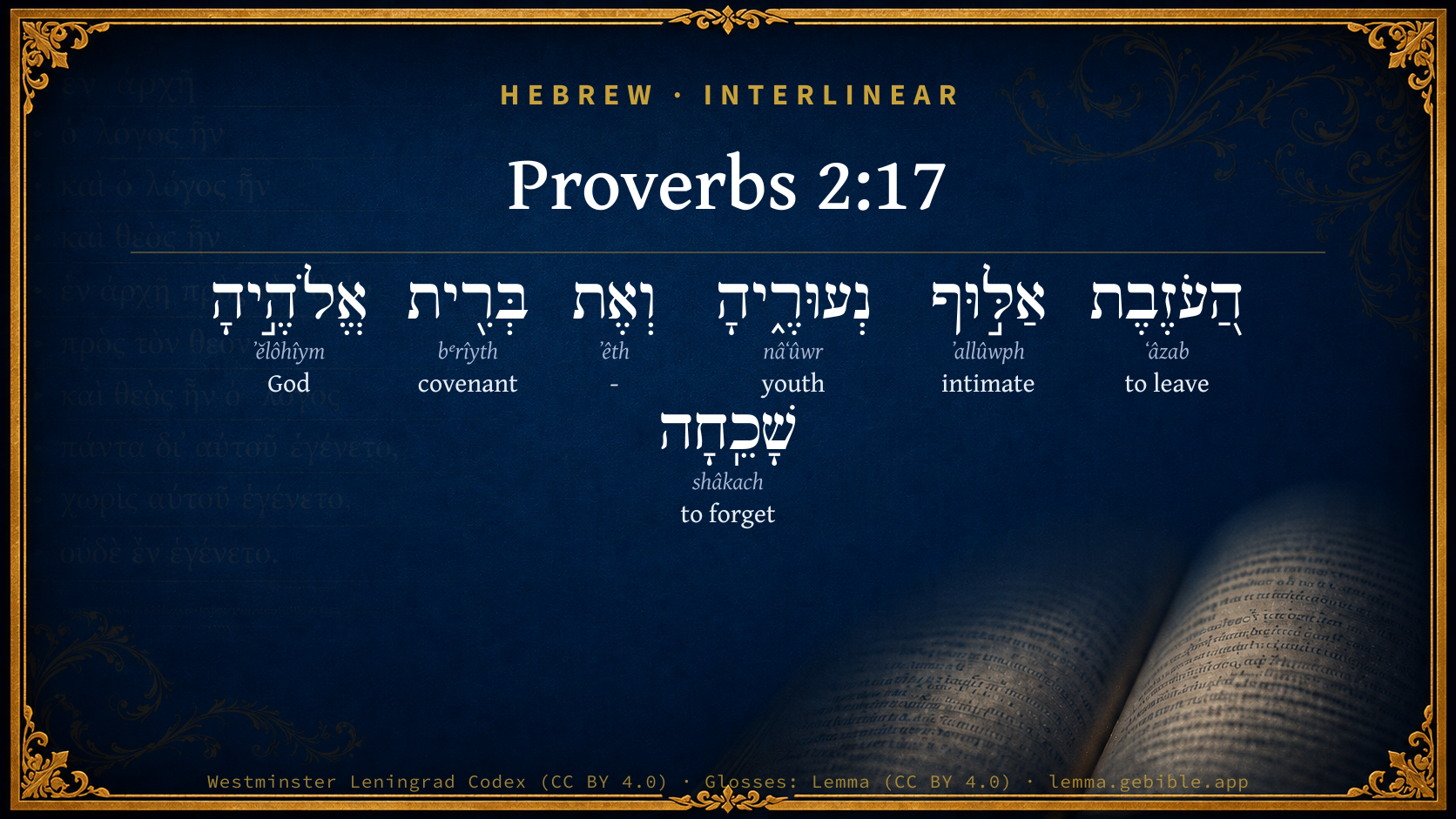
Proverbs 2:17

Hebrew (Westminster Leningrad Codex) Proverbs 2:17 appears in the Hebrew Old Testament. The text above is from the Westminster Leningrad Codex. Each word links to its Strong’s number, a concise gloss, and parsing drawn from the Open Scriptures Hebrew Bible morphology. Click any word for its full Brown-Driver-Briggs (BDB) entry.
Download image
Cite this verse

Proverbs 2:17 (World English Bible). Public Domain. Lemma interlinear Bible study tool, https://lemma.gebible.app/v/proverbs/2/17.

Show BibTeX & RIS
BibTeX
RIS
English Translation
Who forsakes the friend of her youth, And forgets the covenant of her God:
World English Bible · Public Domain
Download a study sheet

One document with this verse’s original text, its word-by-word gloss line, the meaning frame, cross-references with their text, attributed commentary, and full source and license credits — printable, and it pastes into notes with its structure intact.

This verse Autodidact and up

Study sheet (.html) Plain text (.txt)

A passage Seminary Student

Up to 50 verses in one chapter. A passage sheet keeps up to 6 commentary sources and 12 cross-references per verse, in the order this page ranks them, and says so on the sheet whenever that leaves anything out. Ask for a single verse and you get the Autodidact verse sheet above.

Everything on this page stays free to read, with no account — the sheet is a download of what is already on screen, not access to it.

Want to remove ads? Support Godless Engineer
Compare translations 3

The same verse in 3 English versions, stacked beneath the original-language interlinear above. Click any original word for its lexicon entry.

Each is an independent rendering of the whole verse — the interlinear is not word-aligned to these translations.

Highlighted words mark where these versions differ — a whole-verse word diff, not a word-by-word alignment.

  • World English Bible Public Domain
    Who forsakes the friend of her youth, And forgets the covenant of her God:
  • King James Version Public Domain
    Which forsaketh the guide of her youth, and forgetteth the covenant of her God.
  • unfoldingWord Literal Text CC BY-SA 4.0
    the one who forsakes the companion of her youth, and the covenant of her God, she has forgotten.

unfoldingWord Literal Text — © unfoldingWord, licensed CC BY-SA 4.0. Word-aligned USFM3 via Door43 (git.door43.org/unfoldingWord/en_ult).

Versions to compare (up to 4)

3 of 4 selected

Show all 18 translations

Every available English version of this verse, each an independent rendering of the whole verse.

  • World English Bible Public Domain
    Who forsakes the friend of her youth, And forgets the covenant of her God:
  • Berean Standard Bible Public Domain
    who abandons the partner of her youth and forgets the covenant of her God.
  • Majority Standard Bible Public Domain
    who abandons the partner of her youth and forgets the covenant of her God.
  • King James Version Public Domain
    Which forsaketh the guide of her youth, and forgetteth the covenant of her God.
  • American Standard Version (1901) Public Domain
    That forsaketh the friend of her youth, And forgetteth the covenant of her God:
  • Revised Version (1885) Public Domain
    Which forsaketh the friend of her youth, and forgetteth the covenant of her God:
  • Geneva Bible (1599) Public Domain
    Which forsaketh the guide of her youth, and forgetteth the couenant of her God.
  • Douay-Rheims (1899) Public Domain
    And forsaketh the guide of her youth,
  • Young's Literal Translation Public Domain
    Who is forsaking the guide of her youth, And the covenant of her God hath forgotten.
  • Literal Standard Version CC BY-SA 4.0
    Who is forsaking the guide of her youth, || And has forgotten the covenant of her God.
  • Unlocked Literal Bible CC BY-SA 4.0
    She forsakes the companion of her youth and forgets the covenant of her God.
  • unfoldingWord Literal Text CC BY-SA 4.0
    the one who forsakes the companion of her youth, and the covenant of her God, she has forgotten.
  • Darby Bible Public Domain
    who forsaketh the guide of her youth, and forgetteth the covenant of her God;
  • World Messianic Bible Public Domain
    who forsakes the friend of her youth, and forgets the covenant of her God;
  • Webster's Bible Public Domain
    Who forsaketh the guide of her youth, and forgetteth the covenant of her God.
  • Free Bible Version CC BY-SA 4.0
    Such a woman has left her husband she married when she was young, forgetting the promises she made before God.
  • Bible in Basic English Public Domain
    Who is false to the husband of her early years, and does not keep the agreement of her God in mind:
  • JPS Tanakh (1917) Public Domain
    That forsaketh the lord of her youth, and forgetteth the covenant of her God.

Literal Standard Version (2020), Covenant Press — licensed CC BY-SA 4.0. Text via the HelloAO Bible API (eBible.org). Unlocked Literal Bible (unfoldingWord) — licensed CC BY-SA 4.0. Text via the HelloAO Bible API (eBible.org). unfoldingWord Literal Text — © unfoldingWord, licensed CC BY-SA 4.0. Word-aligned USFM3 via Door43 (git.door43.org/unfoldingWord/en_ult). Free Bible Version, Dr. Jonathan Gallagher — licensed CC BY-SA 4.0. Text via the HelloAO Bible API (eBible.org).

Word by word

More ways to search: Search by grammar → Find every occurrence → Compare this word →

Practice this passage: Drill this verse → Learn its vocabulary →

About this verse

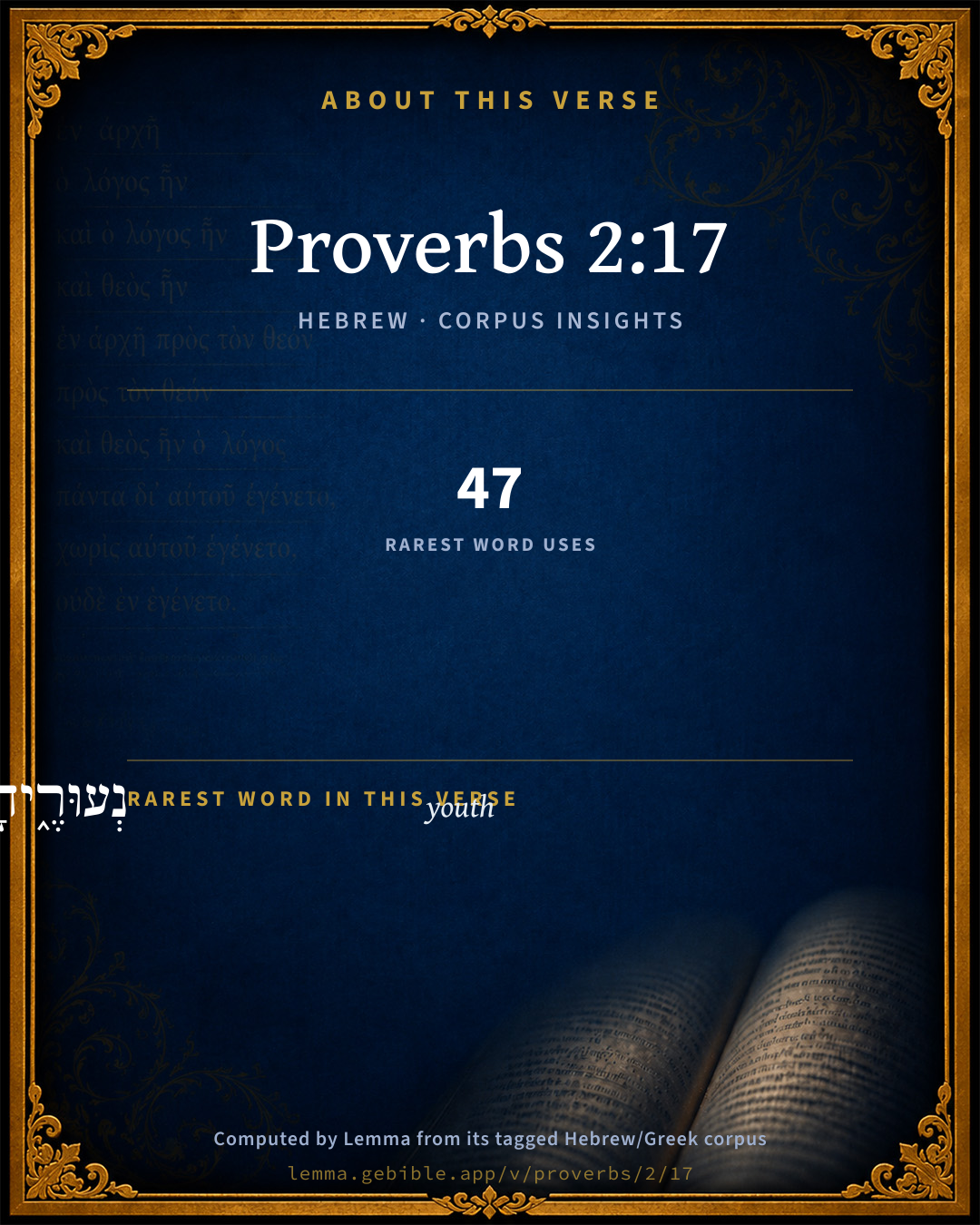
These counts appear in no published source. They are computed here, from the morphology-tagged text and Lemma’s own curated glosses. What Lemma adds →

7
words
7
distinct lemmas
Wisdom
section

Shared distinctive vocabulary

נְעוּרֶ֑יהָ youth H5271 occurs in 46 verses of the Hebrew Bible. Also found in:

Grammatical profile

  • 2 verbs
  • 3 nouns
  • 1 adjective
  • 1 particle

Verb forms

  • הַ֭עֹזֶבֶת Qal · Participle Active
  • שָׁכֵֽחָה Qal · Perfect

Hebrew & Septuagint length

In English translation the verse runs 14 words from the Hebrew and 16 from the Septuagint (LXX English) — closely comparable.

A rough comparison of the two English renderings, which tokenize alike — not a word-level alignment.

Word counts can differ between the Hebrew and the Greek without any difference in meaning — e.g. the Hebrew direct-object marker אֵת has no separate Greek word, and Greek often adds the article ὁ.

Cross-references

5

Topical passages linked to Proverbs 2:17 in the Treasury of Scripture Knowledge — connected by theme and wording, ordered by reader-vote popularity; previews shown in the World English Bible.

  • Ezekiel 16:59–60 For thus says the Lord Yahweh: I will also deal with you as you have done, who have despised the oath in breaking the covenant.
  • Jeremiah 3:4 Will you not from this time cry to me, My Father, you are the guide of my youth?
  • Ezekiel 16:8 Now when I passed by you, and looked at you, behold, your time was the time of love; and I spread my skirt over you, and covered your nakedness: yes, I swore to you, and entered into a covenant with you, says the Lord Yahweh, and you became mine.
  • Proverbs 5:18 Let your spring be blessed. Rejoice in the wife of your youth.
  • Malachi 2:14–16 Yet you say, 'Why?' Because Yahweh has been witness between you and the wife of your youth, against whom you have dealt treacherously, though she is your companion, and the wife of your covenant.

Cross-references courtesy of OpenBible.info (CC BY 4.0).

Hebrew and Greek witnesses Masoretic Hebrew ↔ Greek Septuagint

The same verse in the two great witnesses to the Old Testament, shown verse-for-verse.

These are two independent witnesses, not word-aligned to each other, and the Septuagint is shown in lemma (dictionary) form.

Hebrew Proverbs 2:17 Masoretic · Westminster Leningrad Codex

הַ֭עֹזֶבֶת אַלּ֣וּף נְעוּרֶ֑יהָ וְאֶת בְּרִ֖ית אֱלֹהֶ֣יהָ שָׁכֵֽחָה

Who forsakes the friend of her youth, And forgets the covenant of her God:

World English Bible · Public Domain

Greek LXX Proverbs 2:17 Septuagint · lemma form

υἱός μή σύ καταλαμβάνω κακός βουλή ὁ ἀπολείπω διδασκαλία νεότης καί διαθήκη θεῖος ἐπιλανθάνω

of her who has forsaken the instruction of her youth, and forgotten the covenant of God.

LXX2012 (modern English Septuagint) · Public Domain

On this verse, Whedon's Commentary on the Bible discusses the Septuagint’s reading. Read the note in Commentary ↓

Hebrew: Westminster Leningrad Codex (CC BY 4.0). Greek: Septuagint (public domain); English from LXX2012 (modern English Septuagint) (Public Domain). How the Septuagint differs from the Hebrew →

Commentary

Notes on Proverbs 2:17 from classic Christian and Jewish commentators (each source and its license shown beneath its notes). The classic Christian expositions comment on the surrounding passage and are grouped to its opening verse, so a note may address several verses; the Jewish commentaries on the Tanakh (Rashi and others) are per-verse, so they appear only where the commentator wrote on this verse.

Lemma curates 59 commentaries, every one of them public domain or Creative Commons licensed, each selected and text-cleaned for this edition rather than reprinted as found. About our sources →

Trapp's Complete Commentary

John Trapp

Pro 2:17 Which forsaketh the guide of her youth, and forgetteth the covenant of her God.

Ver. 17. Which forsaketh the guide of her youth.] That is, Her husband; as Helena, Herodias, Bernice, {Act 25:13} and other odious harlots. Adulterium quasi ad alterum, vel ad alterius torum. {a} This wanton never wants one, though her husband be ever so near.

And forgetteth the covenant of her God.] Marriage is a mixed covenant, partly religious and partly civil: the parties tie themselves first to God, and then to one another. The bond is made to God, who also will be ready enough to take the forfeiture. For whores and adulteresses God will judge. {Heb 13:3}

{a} Becman.

John Trapp, A Commentary or Exposition upon All the Books of the Old and New Testament (1647–1656) — public domain. Text from a community e-Sword module.

The Biblical Illustrator

Joseph S. Exell

Pro_2:17

Which forsaketh the guide of her youth.

The peril of taking life into our own control

We all shrink with horror from that lowest depth of human depravity here described; but we may not therefore lose the lessons of this solemn and masterly description. Forsaking and forgetting God is the one danger of life; forsaking that guidance which is from Him and leads to Him, and forgetting that covenant which binds us unto Him. The course of degradation and mischief of the unhappy person here portrayed is derived from the two facts of the text. Who remembers not, who regrets not, the fresh and balmy morning of youth? Then we were guided in the ways of righteousness. There is a season when youth becomes independent and intolerant, and chafes under the most gentle guidance. These are the days of second thoughts, days when the sweetness of forbidden waters is tasted, when the border of the debatable land is crossed. These are critical days in every mans life. Some have slipped and recovered the steps which had almost gone. With some the reason of self-guidance and independence has never passed away. They have forsaken the guide of their youth. The reason of this woful departure and falling away is thus given. She forgetteth the covenant of her God. And are not our young people bound in covenant? Baptism and confirmation are its seals. Alas! that so many tokens of the forgetfulness of the covenant of our God are evident on the very surface of society to-day, and met with in common associations. (Dean Alford.)

The Biblical Illustrator, edited by Joseph S. Exell (c. 1880s–1900s) — public domain. Text from a community e-Sword module.

Whedon's Commentary on the Bible

Daniel D. Whedon

17. Forsaketh the guide of her youth — The word rendered guide here means familiar friend or partner, and the weight of criticism inclines to the meaning, her husband. For “guide” the Septuagint has instruction. The Hebrews generally married young. According to the rabbins men should marry at eighteen, and they may marry at thirteen. The virgins are often espoused or betrothed very early, but not married till after they are twelve. From this come such expressions as spouse, friend, or guide of one’s youth. Comp. Jer_3:4; Joe_1:8; Pro_5:18; Isa_54:6; Mal_2:14-15. Forgetteth the covenant of her God — Supposed to be her marriage vows, and recognising some kind of religious ceremony in connexion therewith. It is certain that foreign women, Canaanites, on being tolerated in the land contrary to the command, set up tippling houses and brothels, tempting the Israelites to debauchery and idolatry. (See Pro_7:5-27.) Thus they became traps and snares to the Israelites; “scourges in their sides and thorns in their eyes.” Jos_23:13; Num_33:55. Nevertheless, it is equally clear from the manner in which this woman is spoken of, (Pro_2:17,) that not a foreign woman by birth is intended, but a Hebrew who was unfaithful to her husband and her God. The seductions of the sacred prostitutions introduced from Tyre and Sidon won even the Hebrew females from both the worship of Jehovah and the paths of purity. This woman was an apostate Hebrew harlot, consecrated in a temple of a foreign licentious religion.

Daniel D. Whedon (gen. ed.), Commentary on the Old and New Testaments (1874–1909) — public domain. Text from a community e-Sword module.

Keil & Delitzsch

C. F. Keil & F. Delitzsch

17 Who forsakes the companion of her youth,

And forgets the covenant of her God;

18 For she sinks down to death together with her house,

And to the shadow of Hades her paths -

19 All they who go to her return not again,

And reach not the paths of life

אלּוּף, as here used, has nothing to do with the phylarch-name, similar in sound, which is a denom. of אלף; but it comes immediately from אלף, to accustom oneself to a person or cause, to be familiar therewith (while the Aram. אלף, ילף, to learn, Pa. to teach), and thus means, as the synon. of רע, the companion or familiar associate (vid., Schultens). Parallels such as Jer 3:4 suggested to the old interpreters the allegorical explanation of the adulteress as the personification of the apostasy or of heresy. Pro 2:18 the lxx translate: ἔθετο γὰρ παρὰ τῷ θανάτῳ τὸν οἶκον αὐτῆς: she (the dissolute wife) has placed her house beside death (the abyss of death). This שׁחה [ἔθετο] is perhaps the original, for the text as it lies before us is doubtful, though, rightly understood, admissible. The accentuation marks בּיתהּ as the subject, but בּית is elsewhere always masc., and does not, like the rarer ארח, Pro 2:15, admit in usage a double gender; also, if the fem. usage were here introduced (Bertheau, Hitzig), then the predicate, even though ביתה were regarded as fem., might be, in conformity with rule, שׁח, as e.g., Isa 2:17. שׁחה is, as in Psa 44:26, 3rd pr. of שׁוּח, Arab. sâkh, to go down, to sink; the emendation שׁחה (Joseph Kimchi) does not recommend itself on this account, that שׁחה and שׁחח mean, according to usage, to stoop or to bend down; and to interpret (Ralbag, השׁפילה) שׁחה transitively is inadmissible. For that reason Aben Ezra interprets ביתה as in apposition: to death, to its house; but then the poet in that case should say אל־שׁאול, for death is not a house. On the other hand, we cannot perceive in ביתה an accus. of the nearer definition (J. H. Michaelis, Fl.); the expression would here, as 15a, be refined without purpose. Bttcher has recognised ביתה as permutative, the personal subject: for she sinks down to death, her house, i.e., she herself, together with all that belongs to her; cf. the permutative of the subject, Job 29:3; Isa 29:23 (vid., comm. l.c.), and the more particularly statement of the object, Exo 2:6, etc. Regarding רפאים, shadows of the under-world (from רפה, synon. חלה, weakened, or to become powerless), a word common to the Solomonic writings, vid., Comment. on Isaiah, p. 206. What Pro 2:18 says of the person of the adulteress, Pro 2:19 says of those who live with her ביתה, her house-companions. בּאיה, "those entering in to her," is equivalent to בּאים אליה; the participle of verbs eundi et veniendi takes the accusative object of the finite as gen. in st. constr., as e.g., Pro 1:12; Pro 2:7; Gen 23:18; Gen 9:10 (cf. Jer 10:20). The ישׁוּבוּן, with the tone on the ult., is a protestation: there is no return for those who practise fornication,

(Note: One is here reminded of the expression in the Aeneid, vi. 127-129:

Revocare gradum superasque evadere ad auras,

Hoc opes, hoc labor est.

See also an impure but dreadful Talmudic story about a dissolute Rabbi, b. Aboda zara, 17a.)

and they do not reach the paths of life from which they have so widely strayed.

(Note: In correct texts ולא־ישיגו has the Makkeph. Vid., Torath Emeth, p. 41; Accentuationssystem, xx. 2.)

Keil & Delitzsch — Biblical Commentary on the Old Testament (1861–1891) — public domain (CC PDM 1.0). Text via the HelloAO Bible API. (Old Testament only.)

Tyndale Open Study Notes

Tyndale Open Resources

2:17 By pursuing another man, an immoral woman has abandoned her husband. Her marriage covenant . . . before God included vows of faithfulness (cp. Mal 2:14-16).

Tyndale Open Study Notes — © Tyndale Open Resources, licensed CC BY-SA 4.0. Text via the HelloAO Bible API.

Geneva Bible (1599)

Geneva Bible translators

That is, her husband, which is her head and guide to govern her, from whom she ought not to depart, but remain in his subjection.

Which is the promise made in marriage.

Geneva Bible (1599) marginal notes — public domain. Text via Bolls.life.

Jamieson, Fausset & Brown

Robert Jamieson, A. R. Fausset & David Brown

guide . . . youth--lawful husband (Jer 3:4).

covenant . . . God--of marriage made in God's name.

Jamieson, Fausset & Brown — Commentary Critical and Explanatory on the Whole Bible (1871) — public domain (CC PDM 1.0). Text via the HelloAO Bible API.

Adam Clarke's Commentary

Verse 17. Which forsaketh the guide of her youth] Leaves her father's house and instructions, and abandons herself to the public.

The covenant of her God.] Renounces the true religion, and mixes with idolaters; for among them prostitution was enormous. Or by the covenant may be meant the matrimonial contract, which is a covenant made in the presence of God between the contracting parties, in which they bind themselves to be faithful to each other.

Adam Clarke's Commentary on the Bible (1810–1826) — public domain. Text from a community e-Sword/MySword module.

Ellicott's Commentary for English Readers

(17) The guide of her youth.—Or rather, friend with whom she has lived in intimacy: that is, the husband of her youth; in other words, her first love. Jeremiah uses the same phrase (Pro_3:4). (Comp. “wife of thy youth,” Pro_5:18; Mal_2:14.)

Forgetteth the covenant of her God—i.e., the marriage covenant, made in the presence of God. (Comp. “wife of thy covenant,” Mal. l.c.)

A Bible Commentary for English Readers, edited by Charles John Ellicott (1878–1897) — public domain. Text from a community e-Sword module.

The Cambridge Bible for Schools and Colleges

gen. ed. J. J. S. Perowne

17. the guide of her youth] or, friend, R.V. or, associate, i.e. her husband to whom she was married in her youth. See Jer_3:4, where the same phrase occurs in the same sense. Comp. “wife of thy youth,” Pro_5:18; Mal_2:14.

covenant of her God] The marriage contract, which is of Divine origin and sanction (Gen_2:24; Mat_19:4-6). Comp. “the wife of thy covenant,” Mal_2:14, and note there in this Series. To the tender memories of “the kindness of youth and the love of espousals” (Jer_2:2) is added the binding force of “the vow and covenant betwixt them made.”

The Cambridge Bible for Schools and Colleges (gen. ed. J. J. S. Perowne; Cambridge University Press, 1878–1918) — public domain. Text from a community e-Sword module.

John Gill's Exposition

Which forsaketh the guide of her youth,.... Not God, the God of her life, and who had provided for her from her youth up; nor her parent that had taken care of her in her infancy, and had been the guardian of her virgin state; but her husband, to whom she was married in her youth, and to whom she gave up herself to be guided and directed, ruled and governed, by: and as it is an aggravation of evil in a man to deal treacherously against the wife of his youth, and the wife of his covenant, Mal 2:14; so it is in a woman to forsake "the friend" or "companion of her youth" (w), as the phrase may be rendered; who loved her and espoused her in his youthful age, and with whom he had lived long in love and friendship, and in great happiness, but now forsakes him; her affections being alienated from him, leaves his company and bed, and associates with others. Gersom interprets this of the human understanding, appointed to govern the other powers and faculties of the soul;

and forgetteth the covenant of her God: not the covenant made with Noah, in which adultery, as well as other things, were forbidden; nor the law of Moses, or covenant at Sinai, in which it was condemned; but the marriage covenant, which she entered into with her husband when espoused to him, and when they mutually obliged themselves to be faithful to one another: and this is called "the covenant of God"; not only because God is the author and institutor of marriage, and has directed and enjoined persons to enter into such a contract with one another; but because he is present at it, and is a witness of such an engagement, mid is appealed unto in it; which, as it adds to the solemnity of it, makes the violation of it the more criminal. So the church of Rome has forsook Christ, who was her guide in her first settlement, and her husband she professed to be espoused to, as a chaste virgin; and has followed other lovers, and become the mother of harlots; so false teachers leave their guide, the Scriptures, and bring in damnable heresies, and deny the Lord that bought them, Pe2 2:1.

(w) "amieum adolescentiae suae", De Dieu, Michaelis; "socium juventutis suae", Schultens.

John Gill's Exposition of the Whole Bible (1746–1763) — public domain (CC PDM 1.0). Text via the HelloAO Bible API.

Albert Barnes' Notes on the Bible

The guide of her youth - Better, the familiar friend (compare Pro 16:28; Pro 17:9). The “friend” is, of course, the husband, or the man to whom the strange woman first belonged as a recognized concubine. Compare Jer 3:4

The covenant of her God - The sin of the adulteress is not against man only but against the Law of God, against His covenant. The words point to some religious formula of espousals. Compare Mal 2:14.

Albert Barnes' Notes on the Bible (1834–1885) — public domain. Text from a community e-Sword/MySword module.

Haydock's Catholic Bible Commentary

Youth. Her husband, whom she married young when love is more lasting. This increases her guilt. It may also signify her father, or preceptor.

George Leo Haydock (1774–1849), Haydock's Catholic Family Bible and Commentary, 1859 edition — public domain. Excludes Psalms (Douay-Rheims chapter numbering differs from Protestant) and Deuterocanonical books (Catholic canon only).

Matthew Poole's English Annotations

The guide of her youth, to wit, her husband, whom she took to be her guide and governor, and that in her youth: which circumstance is added to aggravate her sin and shame, because love is commonly most sincere and fervent between a husband and wife of youth, as they are for that reason emphatically called, Pro 5:18; Isa 54:6; Joe 1:8; Mal 2:14,15.

Forgetteth, i.e. violateth or breaketh, as that word is commonly used in a practical sense.

The covenant of her God; the marriage covenant; so called, partly because God is the author and institutor of that society and mutual obligation; and partly because God is called to be the witness and judge of that solemn promise and covenant, and the avenger of the transgression of it.

Matthew Poole's English Annotations on the Holy Bible (1683–1685) — public domain. Text from a community e-Sword/MySword module.

The Pulpit Commentary

The guide of her youth (pWLa hyrWn, alluph n"ureyah); properly, the associate or companion of her youth. The Hebrew, pWLa (alluph), being derived from the root pla, (alaph), "to accustom one"s self to," or "to be accustomed to" or "familiar with" anyone. The word is rendered as "friend" in Pro_17:9 Pro_16:28 Mic_7:5. The idea of guidance, which is adopted in the Authorized Version, and appears also in the Vulgate dux. and Targum ducatus, is a secondary idea, and is derived probably from the relation in which the husband stands to his wife. Various interpretations have been given to the expression. It occurs again Jer_3:4, where Jehovah applies it to himself, and says, through his prophet, to the religiously adulterous Judah, "Wilt thou not from this time cry unto me, My Father, thou art the Guide of my youth (yrun pWLa, alluph n"ura)?" It has also been understood as referring to the woman"s parents, her father and mother, who were her natural guardians. But the context seems to require that it should be taken as designating her husband. It will then be the correlative of "the wife of thy youth" of Mal_2:14. The covenant of her God; i.e. the marriage covenant, called "the covenant of her God," because entered into in his presence. The forsaking of the guide of her youth is essentially bound up with a forgetfulness of the solemn covenant which she had entered into in the presence of God. No specific mention is made in the Pentateuch of any religious ceremony at marriage; yet we may infer, from Mal_2:14, Mal_2:15, where God is spoken of as "a Witness" between the husband and "the wife of his youth," "the wife of thy covenant," that the marriage contract was solemnized with sacred rites. The Proverbs thus give a high and sacred character to marriage, and so carry on the original idea of the institution which, under the gospel dispensation, developed late the principle of the indissolubility of the marriage tie. It is no objection to this view that the monogamic principle was infringed, and polygamy countenanced. The reason of this latter departure is given in Deu_22:28 and Exo_22:16. The morality of the Proverbs always represents monogamy as the rule, it deprecates illicit intercourse, and discountenances divorce. It is in entire accordance with the seventh commandment. The woman who commits adultery offends, not only against her husband, but against her God.

The Pulpit Commentary (1880–1919), ed. H.D.M. Spence-Jones & Joseph S. Exell — public domain. Text from a community e-Sword module.

John Wesley's Explanatory Notes

Forsaketh - Her husband whom she took to be her guide and governor, in her youth. The covenant - The marriage covenant: so called because God is the author of that mutual obligation: and because God is called to be the witness and judge of that solemn promise and covenant.

John Wesley, Explanatory Notes Upon the Whole Bible (1754–1765) — public domain. Text via the GEBible commentary corpus.

Lesson kit

Teaching starters — assembled from the data on this page, not authored interpretation. Every prompt links to the verse data it draws on. Edit before teaching.

Proverbs, in the Wisdom, opens this verse with 7 words (7 distinct Hebrew lemmas). Its most distinctive word is nâʻûwr (“youth”). A historical commentator’s framing appears above. Read the whole chapter for the surrounding context.

Discussion questions

  1. The word nâʻûwr carries the sense “youth.” How does it shape the verse?
  2. How does Genesis 8:21, which shares the word «youth», read alongside this verse?
  3. These translations render this verse differently. What is at stake in choosing one wording over another?
  4. «הַ֭עֹזֶבֶת» is a Qal Participle Active verb. How does that grammatical form shape the action described?
  5. Compare how Trapp's Complete Commentary and The Biblical Illustrator read this verse. Where do they agree or differ?

Things to notice

Reading settings

Reading text

Shown beneath each verse's original-language words.

Old Testament
Old Testament edition

Read the OT as the Masoretic Hebrew (MT) or the Greek Septuagint (LXX).

English shown for the Greek Septuagint (in the Hebrew ↔ Greek comparison).

Comparing translations? Open the Compare panel on any verse page to stack up to four side by side.