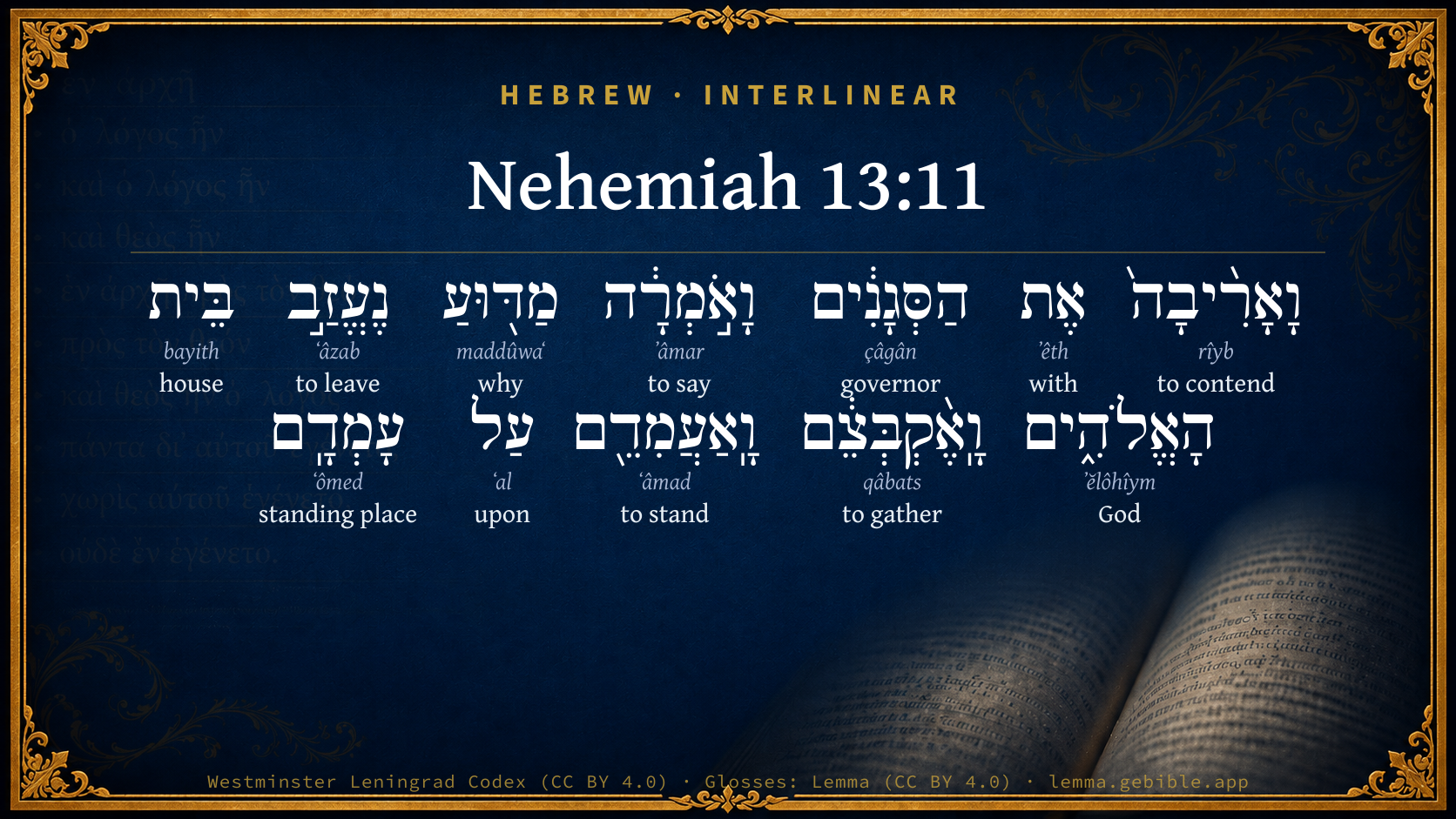
Nehemiah 13:11

Hebrew (Westminster Leningrad Codex) Nehemiah 13:11 appears in the Hebrew Old Testament. The text above is from the Westminster Leningrad Codex. Each word links to its Strong’s number, a concise gloss, and parsing drawn from the Open Scriptures Hebrew Bible morphology. Click any word for its full Brown-Driver-Briggs (BDB) entry.
Download image
Cite this verse

Nehemiah 13:11 (World English Bible). Public Domain. Lemma interlinear Bible study tool, https://lemma.gebible.app/v/nehemiah/13/11.

Show BibTeX & RIS
BibTeX
RIS
English Translation
Then contended I with the rulers, and said, Why is the house of God forsaken? I gathered them together, and set them in their place.
World English Bible · Public Domain
Download a study sheet

One document with this verse’s original text, its word-by-word gloss line, the meaning frame, cross-references with their text, attributed commentary, and full source and license credits — printable, and it pastes into notes with its structure intact.

This verse Autodidact and up

Study sheet (.html) Plain text (.txt)

A passage Seminary Student

Up to 50 verses in one chapter. A passage sheet keeps up to 6 commentary sources and 12 cross-references per verse, in the order this page ranks them, and says so on the sheet whenever that leaves anything out. Ask for a single verse and you get the Autodidact verse sheet above.

Everything on this page stays free to read, with no account — the sheet is a download of what is already on screen, not access to it.

Want to remove ads? Support Godless Engineer
Compare translations 3

The same verse in 3 English versions, stacked beneath the original-language interlinear above. Click any original word for its lexicon entry.

Each is an independent rendering of the whole verse — the interlinear is not word-aligned to these translations.

Highlighted words mark where these versions differ — a whole-verse word diff, not a word-by-word alignment.

  • World English Bible Public Domain
    Then contended I with the rulers, and said, Why is the house of God forsaken? I gathered them together, and set them in their place.
  • King James Version Public Domain
    Then contended I with the rulers, and said, Why is the house of God forsaken? And I gathered them together, and set them in their place.
  • unfoldingWord Literal Text CC BY-SA 4.0
    And I contended with the prefects, and I said, “Why is the house of God forsaken?” And I gathered them and caused them to stand at their stations.

unfoldingWord Literal Text — © unfoldingWord, licensed CC BY-SA 4.0. Word-aligned USFM3 via Door43 (git.door43.org/unfoldingWord/en_ult).

Versions to compare (up to 4)

3 of 4 selected

Show all 18 translations

Every available English version of this verse, each an independent rendering of the whole verse.

  • World English Bible Public Domain
    Then contended I with the rulers, and said, Why is the house of God forsaken? I gathered them together, and set them in their place.
  • Berean Standard Bible Public Domain
    So I rebuked the officials and asked, “Why has the house of God been neglected?” Then I gathered the Levites and singers together and stationed them at their posts,
  • Majority Standard Bible Public Domain
    So I rebuked the officials and asked, “Why has the house of God been neglected?” Then I gathered the Levites and singers together and stationed them at their posts,
  • King James Version Public Domain
    Then contended I with the rulers, and said, Why is the house of God forsaken? And I gathered them together, and set them in their place.
  • American Standard Version (1901) Public Domain
    Then contended I with the rulers, and said, Why is the house of God forsaken? And I gathered them together, and set them in their place.
  • Revised Version (1885) Public Domain
    Then contended I with the rulers, and said, Why is the house of God forsaken? And I gathered them together, and set them in their place.
  • Geneva Bible (1599) Public Domain
    Then reproued I the rulers and sayd, Why is the house of God forsaken? And I assembled them, and set them in their place.
  • Douay-Rheims (1899) Public Domain
    And I pleaded the matter against the magistrates, and said: Why have we forsaken the house of God? And I gathered them together, and I made them to stand in their places.
  • Young's Literal Translation Public Domain
    And I strive with the prefects, and say, `Wherefore hath the house of God been forsaken?' and I gather them, and set them on their station;
  • Literal Standard Version CC BY-SA 4.0
    And I strive with the prefects, and say, “Why has the house of God been forsaken?” And I gather them, and set them on their station;
  • Unlocked Literal Bible CC BY-SA 4.0
    So I confronted the officials and said, “Why is the house of God neglected?” I gathered them together and stationed them at their posts.
  • unfoldingWord Literal Text CC BY-SA 4.0
    And I contended with the prefects, and I said, “Why is the house of God forsaken?” And I gathered them and caused them to stand at their stations.
  • Darby Bible Public Domain
    Then I contended with the rulers, and said, Why is the house of God forsaken? And I gathered them together and set them in their place.
  • World Messianic Bible Public Domain
    Then I contended with the rulers, and said, “Why is God’s house forsaken?” I gathered them together, and set them in their place.
  • Webster's Bible Public Domain
    Then I contended with the rulers, and said, Why is the house of God forsaken? and I assembled them, and set them in their place.
  • Free Bible Version CC BY-SA 4.0
    I went and confronted the leaders, asking, “Why is God's Temple being neglected?” I called the Levites back and made sure they were carrying out their responsibilities.
  • Bible in Basic English Public Domain
    Then I made protests to the chiefs, and said, Why has the house of God been given up? And I got them together and put them in their places.
  • JPS Tanakh (1917) Public Domain
    Then contended I with the rulers, and said: 'Why is the house of God forsaken?' And I gathered them together, and set them in their place.

Literal Standard Version (2020), Covenant Press — licensed CC BY-SA 4.0. Text via the HelloAO Bible API (eBible.org). Unlocked Literal Bible (unfoldingWord) — licensed CC BY-SA 4.0. Text via the HelloAO Bible API (eBible.org). unfoldingWord Literal Text — © unfoldingWord, licensed CC BY-SA 4.0. Word-aligned USFM3 via Door43 (git.door43.org/unfoldingWord/en_ult). Free Bible Version, Dr. Jonathan Gallagher — licensed CC BY-SA 4.0. Text via the HelloAO Bible API (eBible.org).

Word by word

More ways to search: Search by grammar → Find every occurrence → Compare this word →

Practice this passage: Drill this verse → Learn its vocabulary →

עָמְדָֽם
ʻômed
H5977
“standing place · their”
Noun, Common, Masculine, Singular, Construct + Suffix, Personal, 3rd Person, Masculine, Plural
Part of Speech
Noun
Type
Common
Gender
Masculine
Number
Singular
State
Construct
Full BDB Definition

Origin: from H5975

TWOT: 1637a

standing place
  1. וָאָרִ֨יבָה֙ rîyb H7378 “and · to contend” Conjunction + Verb, Qal, Sequential Imperfect, 1st Person, Common, Singular + Suffix, h
  2. אֶת ʼêth H854 “with” Preposition
  3. הַסְּגָנִ֔ים çâgân H5461 “the · governors” Particle, Definite Article + Noun, Common, Masculine, Plural, Absolute
  4. וָאֹ֣מְרָ֔ה ʼâmar H559 “and · to say” Conjunction + Verb, Qal, Sequential Imperfect, 1st Person, Common, Singular + Suffix, h
  5. מַדּ֖וּעַ maddûwaʻ H4069 “why” Particle, Interrogative
  6. נֶעֱזַ֣ב ʻâzab H5800 “to leave” Verb, Niphal, Perfect, 3rd Person, Masculine, Singular
  7. בֵּית bayith H1004 “house of” Noun, Common, Masculine, Singular, Construct
  8. הָאֱלֹהִ֑ים ʼĕlôhîym H430 “the · God(s)” Particle, Definite Article + Noun, Common, Masculine, Plural, Absolute
  9. וָֽאֶ֨קְבְּצֵ֔ם qâbats H6908 “and · to gather · them” Conjunction + Verb, Qal, Sequential Imperfect, 1st Person, Common, Singular + Suffix, Personal, 3rd Person, Masculine, Plural
  10. וָֽאַעֲמִדֵ֖ם ʻâmad H5975 “and · to stand · them” Conjunction + Verb, Hiphil, Sequential Imperfect, 1st Person, Common, Singular + Suffix, Personal, 3rd Person, Masculine, Plural
  11. עַל ʻal H5921 “upon” Preposition

About this verse

These counts appear in no published source. They are computed here, from the morphology-tagged text and Lemma’s own curated glosses. What Lemma adds →

12
words
12
distinct lemmas
Historical
section

Notable vocabulary

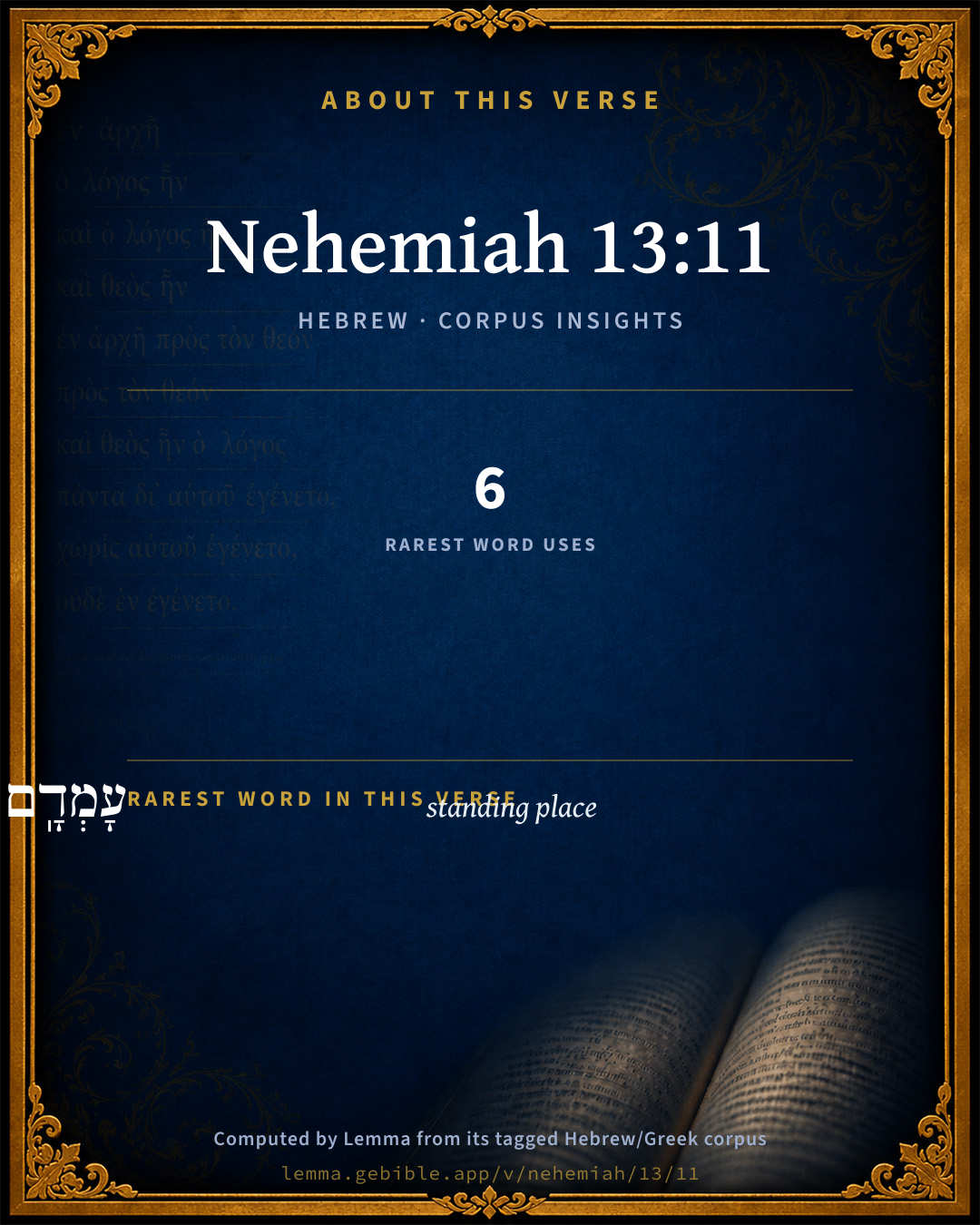
The rarest word here is עָמְדָֽם standing place H5977 — appearing just 6 times in the whole Hebrew Bible.

Shared distinctive vocabulary

עָמְדָֽם standing place H5977 occurs in 6 verses of the Hebrew Bible. Also found in:

Grammatical profile

  • 5 verbs
  • 4 nouns
  • 2 prepositions
  • 1 particle

Verb forms

  • וָאָרִ֨יבָה֙ Qal · Sequential Imperfect
  • וָאֹ֣מְרָ֔ה Qal · Sequential Imperfect
  • נֶעֱזַ֣ב Niphal · Perfect
  • וָֽאֶ֨קְבְּצֵ֔ם Qal · Sequential Imperfect
  • וָֽאַעֲמִדֵ֖ם Hiphil · Sequential Imperfect

Cross-references

8

Topical passages linked to Nehemiah 13:11 in the Treasury of Scripture Knowledge — connected by theme and wording, ordered by reader-vote popularity; previews shown in the World English Bible.

  • Nehemiah 10:39 For the children of Israel and the children of Levi shall bring the heave-offering of the grain, of the new wine, and of the oil, to the chambers, where are the vessels of the sanctuary, and the priests who minister, and the porters, and the singers: and we will not forsake the house of our God.
  • Nehemiah 13:17 Then I contended with the nobles of Judah, and said to them, What evil thing is this that you do, and profane the Sabbath day?
  • Nehemiah 13:25 I contended with them, and cursed them, and struck certain of them, and plucked off their hair, and made them swear by God, [saying], You shall not give your daughters to their sons, nor take their daughters for your sons, or for yourselves.
  • 1 Samuel 2:17 The sin of the young men was very great before Yahweh; for the men despised the offering of Yahweh.
  • Nehemiah 5:6–13 I was very angry when I heard their cry and these words.
  • Job 31:34 Because I feared the great multitude, And the contempt of families terrified me, So that I kept silence, and didn't go out of the door--
  • Proverbs 28:4 Those who forsake the law praise the wicked; But those who keep the law contend with them.
  • Malachi 3:8–11 Will a man rob God? Yet you rob me! But you say, 'How have we robbed you?' In tithes and offerings.

Cross-references courtesy of OpenBible.info (CC BY 4.0).

Hebrew and Greek witnesses Masoretic Hebrew ↔ Greek Septuagint

The same verse in the two great witnesses to the Old Testament, shown verse-for-verse.

These are two independent witnesses, not word-aligned to each other, and the Septuagint is shown in lemma (dictionary) form.

Hebrew Nehemiah 13:11 Masoretic · Westminster Leningrad Codex

וָאָרִ֨יבָה֙ אֶת הַסְּגָנִ֔ים וָאֹ֣מְרָ֔ה מַדּ֖וּעַ נֶעֱזַ֣ב בֵּית הָאֱלֹהִ֑ים וָֽאֶ֨קְבְּצֵ֔ם וָֽאַעֲמִדֵ֖ם עַל עָמְדָֽם

Then contended I with the rulers, and said, Why is the house of God forsaken? I gathered them together, and set them in their place.

World English Bible · Public Domain

Greek LXX Structure differs

The Septuagint has no separate book of Nehemiah. Its Greek text is the second half of Esdras B (2 Esdras), chapters 11–23; Ezra is the first half (1–10).

A verse-for-verse comparison isn’t shown here because the chapters and verses don’t line up. Switch to the LXX edition with the MT / LXX toggle above to read the Greek directly.

On this verse, The Cambridge Bible for Schools and Colleges discusses the Septuagint’s reading. Read the note in Commentary ↓

Hebrew: Westminster Leningrad Codex (CC BY 4.0). Greek: Septuagint (public domain); English from a public-domain English Septuagint. How the Septuagint differs from the Hebrew →

Commentary

Notes on Nehemiah 13:11 from classic Christian and Jewish commentators (each source and its license shown beneath its notes). The classic Christian expositions comment on the surrounding passage and are grouped to its opening verse, so a note may address several verses; the Jewish commentaries on the Tanakh (Rashi and others) are per-verse, so they appear only where the commentator wrote on this verse.

Lemma curates 59 commentaries, every one of them public domain or Creative Commons licensed, each selected and text-cleaned for this edition rather than reprinted as found. About our sources →

Trapp's Complete Commentary

John Trapp

Neh 13:11 Then contended I with the rulers, and said, Why is the house of God forsaken? And I gathered them together, and set them in their place.

Ver. 11. Then contended I with the rulers] Who had let loose the golden reins of authority, and, by a passive ministry at least, suffered this sacrilege, whilst they bare the sword in vain, if they were not chief actors in it; as Luther complaineth of the rulers of his time, Nisi superesset spolium Aegypti quod rapuimus Papae, &c., If we had not some of the spoils of Egypt, pulled from the pope, all we ministers of the gospel might be famished; and this little that is left us is violently taken from us by the civil magistrate. Parishes and schools are polled and spoiled by them, as if they meant to starve us all. Thus Luther, and more to this purpose.

Why is the house of God forsaken?] By your slackness and covetousness, contrary to your covenant? Neh 10:39.

And I gathered them together] i.e. The scattered Levites, that God’s service might be no longer intermitted, and his wrath thereby provoked. Thus Nehemiah, whatever his hand found to do, did it with all his might, Ecc 8:10; as David danced, Baruch builded, &c., he went throughly about his work.

And set them in their place] Heb. Made them stand in their standing, as if absque stationibus istis non staret mundus, without those standings the world could not stand.

John Trapp, A Commentary or Exposition upon All the Books of the Old and New Testament (1647–1656) — public domain. Text from a community e-Sword module.

The Biblical Illustrator

Joseph S. Exell

Neh_13:11

Then contended I with the rulers.

Work and worship

Then the topic is not new. It is a question which propounds itself in every age. The particular aspect of the question we have to deal with at present is this, Why does the working man forsake the house of God? Many of the reasons given arise out of the industrial conditions of the working classes.

1. One of the reasons given by working men is that the conditions of their industrial existence afford them no leisure time. Is this a reason or an excuse? It is true that there is a considerable number of working men who are doomed to drag on a weary, dreary, grinding, rayless life. They have no leisure. The only rest they have is the unconscious rest of sleep. The system that perpetuates this state of things is unrighteous, inhuman, and hostile to the teachings of the Bible. But this is not true of the majority of working men; their absence arises not from want of leisure, but from want of inclination.

2. Another reason assigned is that the Christian ministry is in league with the employers. I am not here to hold a brief for the ministry, but I am here to defend the interests of truth, and I wish to ask where this weak and effeminate ministry is to be found? I venture to believe that there never was a time when the pulpits were ringing with a clearer and more unambiguous note, when there was more straight and wholesome teaching on the obligations of power and the responsibilities of wealth. I believe that to-day there is far more preaching to the rich than there is to the poor, and this charge of sinful silence and sinful flattery cannot be sustained.

3. Another reason advanced is that ministers do not take their rightful position as leaders of secular progress, and that they are not to be found in the van of social and political reform. This is a more reasonable objection. I wish to confess candidly and frankly that in my opinion the pulpit has been too speculative, too abstract, too unpractical, too other-worldly. But this reproach is now being rapidly rolled away, and the ministry are giving both hands to the neglected work of social reform.

4. Working men further complain that when they do come to church they meet with a cold and unfriendly reception. In the church there is respect unto persons. It is charged against us that our profession of brotherhood is a mere pretence. It is said that men will sit by their fellows in the house of God for years, will pray and sing of their brotherliness and love, and then outside the church will ignore and pass them by without so much as recognition. Against such conduct no word can be too outspoken or too severe.

5. Another reason is that the church is not democratic, and that the workman has no voice or influence in its affairs. This reason has been confirmed and emphasised by the editors of our daffy press. But it is a statement altogether too sweeping. If the working man wants democratic churches he need not seek far to find them.

6. One speaker at a meeting convened to consider this question, declaimed against the pulpit because it treats of such topics as the restoration of man and the forgiveness of sins. He declared that there is no practical value in such teaching, and that the working man does not hold to it or believe in it. Here there is no room for compromise. Oh! fellow-men, the Nazarene wears many crowns, and among His crowns is that of Social Reformer. But there is another crown brighter by far than that of Reformer, the crown of Redeemer. The gospel we have to preach is not a mere uprooter of social wrongs, an equaliser of mens estates; it is a regenerator of the human heart. The supreme aim of the gospel is not to beautify mans circumstances, but to beautify mans life. The Master Himself told us how useless it is to reform a mans house unless you redeem the man. The gospel is preached, then, that man may be rectified, and that rectified man may transform the world. The work of the Redeemer includes the work of the Reformer, but redemption is the first and dominant note in the Churchs song. On the other hand, if we are truly Christs we are genuine reformers, The Church of Christ should be the centre of all the reforming agencies of our time. All true reformers get their weapons from Christ. (J. A. Jowett, M. A.)

The Biblical Illustrator, edited by Joseph S. Exell (c. 1880s–1900s) — public domain. Text from a community e-Sword module.

Joseph Benson's Commentary

Neh 13:11. Then contended I with the rulers — I sharply reproved those priests to whom the management of those things was committed, for the neglect of their duty, and breach of their late solemn promise. Why is the house of God forsaken? — So that there are few or no Levites or priests to attend there. You have not only injured men, in withholding their dues, but you have occasioned the neglect of God’s house and service, insomuch that little or no public worship is maintained. And I gathered them together — To Jerusalem, from their several country possessions. And set them in their place — Restored them to the exercise of their office. “A Levite in his field,” says Henry, “is out of his station: God’s house is his place, and there let him be found. Say to Archippus, Take heed to thy ministry.”

Joseph Benson's Commentary on the Old and New Testaments (1811–1818) — public domain. Text from a community e-Sword module.

Adam Clarke's Commentary

Verse 11. Why is the house of God forsaken?] They had all solemnly promised, Ne 10:39, that they would never forsake the house of their God; but, alas, how soon is this forgotten! Nehemiah used their own words here by way of reproof.

Adam Clarke's Commentary on the Bible (1810–1826) — public domain. Text from a community e-Sword/MySword module.

Ellicott's Commentary for English Readers

(11) Contended I with the rulers.—See their express covenant in Neh_10:39. The rich men had taken advantage of Nehemiah’s absence to indulge their covetousness.

And I gathered them together.—The Levites were summoned back from their fields.

A Bible Commentary for English Readers, edited by Charles John Ellicott (1878–1897) — public domain. Text from a community e-Sword module.

The Cambridge Bible for Schools and Colleges

gen. ed. J. J. S. Perowne

11. contended I] Cf. Neh_13:17-25, Neh_5:7.

the rulers] R.V. marg. ‘Or, deputies’.

forsaken] Neglected by the Jews and deserted by the Levites.

I gathered them together] Nehemiah caused a muster of the Levites.

in their place] i.e. in their proper positions. See notes Neh_8:7, Neh_9:3. LXX. ἐπὶ στάσει αὐτῶν. Vulg. ‘in stationibus suis.’

The Cambridge Bible for Schools and Colleges (gen. ed. J. J. S. Perowne; Cambridge University Press, 1878–1918) — public domain. Text from a community e-Sword module.

John Gill's Exposition

Then brought all Judah the tithe of corn, and the new wine, and the oil, into the treasuries. When they saw a reformation made, and things were going in their proper channel, and a right use would be made of their tithes, these given to proper persons, who were now reinstated in their office.

Then brought all Judah the tithe of corn, and the new wine, and the oil, into the treasuries. When they saw a reformation made, and things were going in their proper channel, and a right use would be made of their tithes, these given to proper persons, who were now reinstated in their office.

Nehemiah 13:13

neh 13:13

neh 13:13

neh 13:13And I made treasurers over the treasuries,.... New ones, since the others appointed were either dead or unfaithful to their trust, Neh 12:44,

Shelemiah the priest, and Zadok the scribe; who also was a priest, as Ezra was both priest and scribe; one that besides his office as a priest was expert in the law, and capable of instructing others:

and of the Levites, Pedaiah, and next to them was Hanan the son of Zaccur, the son of Mattaniah, for they were counted faithful; had a good report of all that knew them, for men of fidelity and uprightness, and so fit for such a trust:

and their office was to distribute unto their brethren; to deliver to them their share in the tithes, first fruits, &c.

John Gill's Exposition of the Whole Bible (1746–1763) — public domain (CC PDM 1.0). Text via the HelloAO Bible API.

Albert Barnes' Notes on the Bible

I gathered them together - Nehemiah gathered the Levites from their lands, and reinstated them in their set offices.

Albert Barnes' Notes on the Bible (1834–1885) — public domain. Text from a community e-Sword/MySword module.

Haydock's Catholic Bible Commentary

Pleaded. Accusing them of treachery, in not opposing the wicked attempt. --- Have we. He placed himself in the number of the guilty, in order to soften the reproach. (Septuagint, &c.) (Calmet) --- "Why is the house of God forsaken?" (Protestants)

George Leo Haydock (1774–1849), Haydock's Catholic Family Bible and Commentary, 1859 edition — public domain. Excludes Psalms (Douay-Rheims chapter numbering differs from Protestant) and Deuterocanonical books (Catholic canon only).

Matthew Poole's English Annotations

I sharply reproved those priests to whom the management of these things was committed, for neglect of their duty, and breach of their late solemn promise.

Why is the house of God forsaken? you have not only injured men in withholding their dues, but you have occasioned the neglect of God’s house and service.

I gathered them together to Jerusalem, from their several country possessions, in which they were dispersed.

Set them in their place; restored them to the exercise of their office.

Matthew Poole's English Annotations on the Holy Bible (1683–1685) — public domain. Text from a community e-Sword/MySword module.

Whedon's Commentary on the Bible

Daniel D. Whedon

11. The rulers — Whose duty it was to see that the tithes were collected, and the temple service properly sustained.

Why is the house of God forsaken — They had bound themselves not to forsake the house of God, Neh_10:39, where see note. Nehemiah now demands why they have violated that solemn covenant.

I gathered them — That is, gathered the Levites, who had gone to seek sustenance in the fields of their cities, (Neh_13:10,) and restored them to their proper places in the temple service.

Daniel D. Whedon (gen. ed.), Commentary on the Old and New Testaments (1874–1909) — public domain. Text from a community e-Sword module.

The Pulpit Commentary

Then contended I with the rulers. While the guilt of profaning the temple lay especially with the priestly class, that of withholding the tithes was mainly chargeable on the "rulers," or "nobles." These persons, as wealthy landowners, had of course a pecuniary interest in keeping back the tithe. When they felt the control of a strong hand they made the payments regularly enough; (Neh_12:47 Neh_13:12) but no sooner was this control removed by Nehemiah"s departure than they relapsed into the covetous habits in which they had indulged before he was made governor. (Neh_10:37) The Church in all ages has suffered wrong from the cupidity of wealthy men among its members. Why is the house of God forsaken? Why, contrarily to the distinct pledge given at the time of the renewal of the covenant, (Neh_10:39) have you suffered the house of God to become a solitude, driving the Levites away from it by depriving them of their legal sustenance? I gathered them together. Nehemiah brought the Levites back to the temple from their country residences, and re-established them in their proper offices.

Forsaking the house of God.

"Why is the house of God forsaken?" The question addressed by Nehemiah to the rulers may well have had respect at once to their own neglect, the withholding of contributions by the people, and the consequent abandonment of the temple by the Levites. We may apply it to the neglect to attend and support public worship by a large proportion of the population of our country. It is

I A QUESTION FOR MINISTERS. They have the greatest power to attract to, or repel from, the house of God. Let them ask whether the house of God may not be forsaken on account of defects in

1. Their preaching. Let them consider whether it is what it ought to be in

(1) Substance. Consisting of the presentation of the great truths of the gospel in their varied application to the spiritual needs of men.

(2) Intelligence. Addressing itself to the understanding as well as to the feelings. Not mere dogmatic utterance, unaccompanied by reasons.

(3) Intelligibility. Not obscure through the effort to seem intellectual or original.

(4) Adaptation. Suited to the mental condition of the hearers and those who might become hearers.

(5) Fervour. Arising from sincere love to Christ and men, and desire to do good.

2. Their conduct. Inconsistancies of character, indolence, self-indulgence, unapproachableness, priestly pretensions, airs of infallible authority, mercenariness, all tend to alienate the people from the sanctuary. Neglect of pastoral visitation, whether through indifference, or indolence, or preference for other pursuits, or being too much occupied with the business of religion, may have a like effect. Or people may feel no interest in ministers and their teaching because ministers show no interest in their general well-being.

II A QUESTION FOR CONGREGATIONS. Defects in those who do attend Divine service may have much to do with the absence of others. Let them consider whether they are wanting in

1. Due support and encouragement of their ministers. Pecuniary support; sympathy and co-operation in efforts for the good of those without; encouragement of a style of preaching adapted to interest them; avoidance of unnecessary demands on the time and strength of their pastors. A minister"s power of usefulness depends largely on the temper and conduct towards him of his congregation.

2. Care to make the services attractive. By due attention to the building, the singing, etc.

3. Provision of sufficient and suitable accommodation.

4. Efforts to induce the neglecters of public worship to attend.

5. Hearty welcome of those who are induced to attend.

6. A life fitted to recommend religion. In their general conduct. In their families. In their relations to those around, as merchants, tradesmen, employers of labour, etc. In the Church: unity, peace, earnestness.

III A QUESTION FOR THOSE WHO NEGLECT PUBLIC WORSHIP.

1. Partially. Why not regular and constant in attendance? If attendance be a duty at all, it must be a duty to be regular. If occasional attendance be good, constant would be better. Irregularity reveals want of religious principle in the matter, and that no spiritual profit has yet been received by attendance. It discourages ministers and congregations, hinders the salvation of those who are guilty of it, injures their families, and sets an evil example.

2. Wholly. Why do you forsake the house of God? Is it that you feel no interest in what is said and done there? This reveals a state of heart deplorable and perilous; alienation from God, indifference to your highest welfare, unfitness for heaven. Is it that you prefer the society and habits of the ungodly, or fear their ridicule? But will you sacrifice your souls to them? Can you think with pleasure of sharing their future lot? Is it that, wearied with the toils of the week, you think yourself entitled to spend the Lord"s day in idle repose? Its hours are sufficient for both rest and public worship, and the engagements of God"s house are themselves restful. Is it that you dislike some who attend Divine worship, or think them to be hypocrites? But, supposing you to be right in your judgment, you ought not to condemn and separate from all on account of the faults of a few; and their wrong conduct in one direction is no excuse for your going wrong in another; and if sincere in worship, you will be blessed, whatever becomes of them. Do you say that you can read your Bible and worship God at home? It is to be hoped that you do; but if it were to good purpose, you would surely value the exercises of public worship, and the opportunities and helps which it affords. Do consider anew the reasons for not forsaking God"s house.

(1) The claims and commands of God.

(2) The needs and worth of your souls.

(3) The good of your families.

(4) The good of society, so largely promoted by public worship and instruction.

(5) The account you must give hereafter to God, and the awful issues in eternity of a godless life.

The Pulpit Commentary (1880–1919), ed. H.D.M. Spence-Jones & Joseph S. Exell — public domain. Text from a community e-Sword module.

John Wesley's Explanatory Notes

Contended - I sharply reproved those priests to whom the management of those things was committed, for neglect of their duty, and breach of their late solemn promise. Why, &c. - You have not only injured men in with-holding their dues, but you have occasioned the neglect of God's house and service. Gathered - To Jerusalem from their several country possessions. Set - Restored them to the exercise of their office.

John Wesley, Explanatory Notes Upon the Whole Bible (1754–1765) — public domain. Text via the GEBible commentary corpus.

Rashi

Rabbi Shlomo Yitzchaki (Rashi)

And I gathered them I gathered the priests and the Levites to station them on their watches in their service, and all of Israel brought them their gifts there.

Rashi on the Tanakh — English translations: “The Judaica Press complete Tanach with Rashi, translated by A. J. Rosenberg” (CC BY 4.0); “Pentateuch with Rashi's commentary by M. Rosenbaum and A.M. Silbermann, 1929-1934” (public domain); “The Metsudah Tanach series, Lakewood, N.J” (CC BY 4.0); and “The Book of Joshua, Metsudah Publications, 1997” (CC BY 4.0). Text via Sefaria.

Lesson kit

Teaching starters — assembled from the data on this page, not authored interpretation. Every prompt links to the verse data it draws on. Edit before teaching.

Nehemiah, in the Historical, opens this verse with 12 words (12 distinct Hebrew lemmas). Its most distinctive word is ʻômed (“standing place”). A historical commentator’s framing appears above. Read the whole chapter for the surrounding context.

Discussion questions

  1. What does “standing place” (ʻômed) contribute to the verse as a whole?
  2. How does 2 Chronicles 30:16, which shares the word «standing place», read alongside this verse?
  3. These translations render this verse differently. What is at stake in choosing one wording over another?
  4. «וָאָרִ֨יבָה֙» is a Qal Sequential Imperfect verb. How does that grammatical form shape the action described?
  5. Compare how Trapp's Complete Commentary and The Biblical Illustrator read this verse. Where do they agree or differ?

Things to notice

Reading settings

Reading text

Shown beneath each verse's original-language words.

Old Testament
Old Testament edition

Read the OT as the Masoretic Hebrew (MT) or the Greek Septuagint (LXX).

English shown for the Greek Septuagint (in the Hebrew ↔ Greek comparison).

Comparing translations? Open the Compare panel on any verse page to stack up to four side by side.