
2 Chronicles 11:14

Hebrew (Westminster Leningrad Codex) 2 Chronicles 11:14 appears in the Hebrew Old Testament. The text above is from the Westminster Leningrad Codex. Each word links to its Strong’s number, a concise gloss, and parsing drawn from the Open Scriptures Hebrew Bible morphology. Click any word for its full Brown-Driver-Briggs (BDB) entry.
Download image
Cite this verse

2 Chronicles 11:14 (World English Bible). Public Domain. Lemma interlinear Bible study tool, https://lemma.gebible.app/v/2-chronicles/11/14.

Show BibTeX & RIS
BibTeX
RIS
English Translation
For the Levites left their suburbs and their possession, and came to Judah and Jerusalem: for Jeroboam and his sons cast them off, that they should not execute the priest's office to Yahweh;
World English Bible · Public Domain
Download a study sheet

One document with this verse’s original text, its word-by-word gloss line, the meaning frame, cross-references with their text, attributed commentary, and full source and license credits — printable, and it pastes into notes with its structure intact.

This verse Autodidact and up

Study sheet (.html) Plain text (.txt)

A passage Seminary Student

Up to 50 verses in one chapter. A passage sheet keeps up to 6 commentary sources and 12 cross-references per verse, in the order this page ranks them, and says so on the sheet whenever that leaves anything out. Ask for a single verse and you get the Autodidact verse sheet above.

Everything on this page stays free to read, with no account — the sheet is a download of what is already on screen, not access to it.

Want to remove ads? Support Godless Engineer
Compare translations 3

The same verse in 3 English versions, stacked beneath the original-language interlinear above. Click any original word for its lexicon entry.

Each is an independent rendering of the whole verse — the interlinear is not word-aligned to these translations.

Highlighted words mark where these versions differ — a whole-verse word diff, not a word-by-word alignment.

  • World English Bible Public Domain
    For the Levites left their suburbs and their possession, and came to Judah and Jerusalem: for Jeroboam and his sons cast them off, that they should not execute the priest's office to Yahweh;
  • King James Version Public Domain
    For the Levites left their suburbs and their possession, and came to Judah and Jerusalem: for Jeroboam and his sons had cast them off from executing the priest's office unto the LORD:
  • unfoldingWord Literal Text CC BY-SA 4.0
    For the Levites left their open lands and their property. And they went to Judah and to Jerusalem, for Jeroboam and his sons rejected them from serving as priests to Yahweh.

unfoldingWord Literal Text — © unfoldingWord, licensed CC BY-SA 4.0. Word-aligned USFM3 via Door43 (git.door43.org/unfoldingWord/en_ult).

Versions to compare (up to 4)

3 of 4 selected

Show all 18 translations

Every available English version of this verse, each an independent rendering of the whole verse.

  • World English Bible Public Domain
    For the Levites left their suburbs and their possession, and came to Judah and Jerusalem: for Jeroboam and his sons cast them off, that they should not execute the priest's office to Yahweh;
  • Berean Standard Bible Public Domain
    For the Levites left their pasturelands and their possessions and went to Judah and Jerusalem, because Jeroboam and his sons had rejected them as priests of the LORD.
  • Majority Standard Bible Public Domain
    For the Levites left their pasturelands and their possessions and went to Judah and Jerusalem, because Jeroboam and his sons had rejected them as priests of the LORD.
  • King James Version Public Domain
    For the Levites left their suburbs and their possession, and came to Judah and Jerusalem: for Jeroboam and his sons had cast them off from executing the priest's office unto the LORD:
  • American Standard Version (1901) Public Domain
    For the Levites left their suburbs and their possession, and came to Judah and Jerusalem: for Jeroboam and his sons cast them off, that they should not execute the priest's office unto Jehovah;
  • Revised Version (1885) Public Domain
    For the Levites left their suburbs and their possession, and came to Judah and Jerusalem: for Jeroboam and his sons cast them off, that they should not execute the priest’s office unto the LORD:
  • Geneva Bible (1599) Public Domain
    For the Leuites left their suburbes and their possession, and came to Iudah and to Ierusalem: for Ieroboam and his sonnes had cast them out from ministring in the Priestes office vnto the Lord.
  • Douay-Rheims (1899) Public Domain
    Leaving their suburbs, and their possessions, and passing over to Juda, and Jerusalem, because Jeroboam and his sons had cast them off, from executing the priestly office to the Lord.
  • Young's Literal Translation Public Domain
    for the Levites have left their suburbs and their possession, and they come to Judah and to Jerusalem, for Jeroboam and his sons have cast them off from acting as priests to Jehovah,
  • Literal Standard Version CC BY-SA 4.0
    for the Levites have left their outskirts and their possession, and they come to Judah and to Jerusalem, for Jeroboam and his sons have cast them off from acting as priests for YHWH,
  • Unlocked Literal Bible CC BY-SA 4.0
    For the Levites left their pasturelands and property in order to come to Judah and Jerusalem, for Jeroboam and his sons had driven them away, so that they could no longer perform priestly duties for Yahweh.
  • unfoldingWord Literal Text CC BY-SA 4.0
    For the Levites left their open lands and their property. And they went to Judah and to Jerusalem, for Jeroboam and his sons rejected them from serving as priests to Yahweh.
  • Darby Bible Public Domain
    for the Levites left their suburbs and their possessions, and came to Judah and Jerusalem: for Jeroboam and his sons had cast them off from exercising the priesthood to Jehovah;
  • World Messianic Bible Public Domain
    For the Levites left their pasture lands and their possessions, and came to Judah and Jerusalem; for Jeroboam and his sons cast them off, that they should not execute the priest’s office to the LORD.
  • Webster's Bible Public Domain
    For the Levites left their suburbs and their possession, and came to Judah and Jerusalem: for Jeroboam and his sons had cast them off from executing the priest's office to the LORD:
  • Free Bible Version CC BY-SA 4.0
    The Levites even left their pasturelands and properties behind, and came to Judah and Jerusalem, because Jeroboam and his sons refused to allow them to serve as priests of the Lord.
  • Bible in Basic English Public Domain
    For the Levites gave up their living-places and their property, and came to Judah and Jerusalem; for Jeroboam and his sons had sent them away, not letting them be priests to the Lord;
  • JPS Tanakh (1917) Public Domain
    For the Levites left their open land and their possession, and came to Judah and Jerusalem; for Jeroboam and his sons cast them off, that they should not execute the priest's office unto the LORD;

Literal Standard Version (2020), Covenant Press — licensed CC BY-SA 4.0. Text via the HelloAO Bible API (eBible.org). Unlocked Literal Bible (unfoldingWord) — licensed CC BY-SA 4.0. Text via the HelloAO Bible API (eBible.org). unfoldingWord Literal Text — © unfoldingWord, licensed CC BY-SA 4.0. Word-aligned USFM3 via Door43 (git.door43.org/unfoldingWord/en_ult). Free Bible Version, Dr. Jonathan Gallagher — licensed CC BY-SA 4.0. Text via the HelloAO Bible API (eBible.org).

Word by word

More ways to search: Search by grammar → Find every occurrence → Compare this word →

Practice this passage: Drill this verse → Learn its vocabulary →

הִזְנִיחָ֤ם
zânach
H2186
“to reject · them”
Verb, Hiphil, Perfect, 3rd Person, Masculine, Singular + Suffix, Personal, 3rd Person, Masculine, Plural
Part of Speech
Verb
Stem
Hiphil
Form
Perfect
Person
3rd Person
Gender
Masculine
Number
Singular
Full BDB Definition

Origin: a primitive root meaning to push aside

TWOT: 564

to cast off, reject, spurn - (Qal) to reject - (Hiphil) to forcefully reject someone - to stink, emit stench, become odious - (Hiphil) stink (perfect)
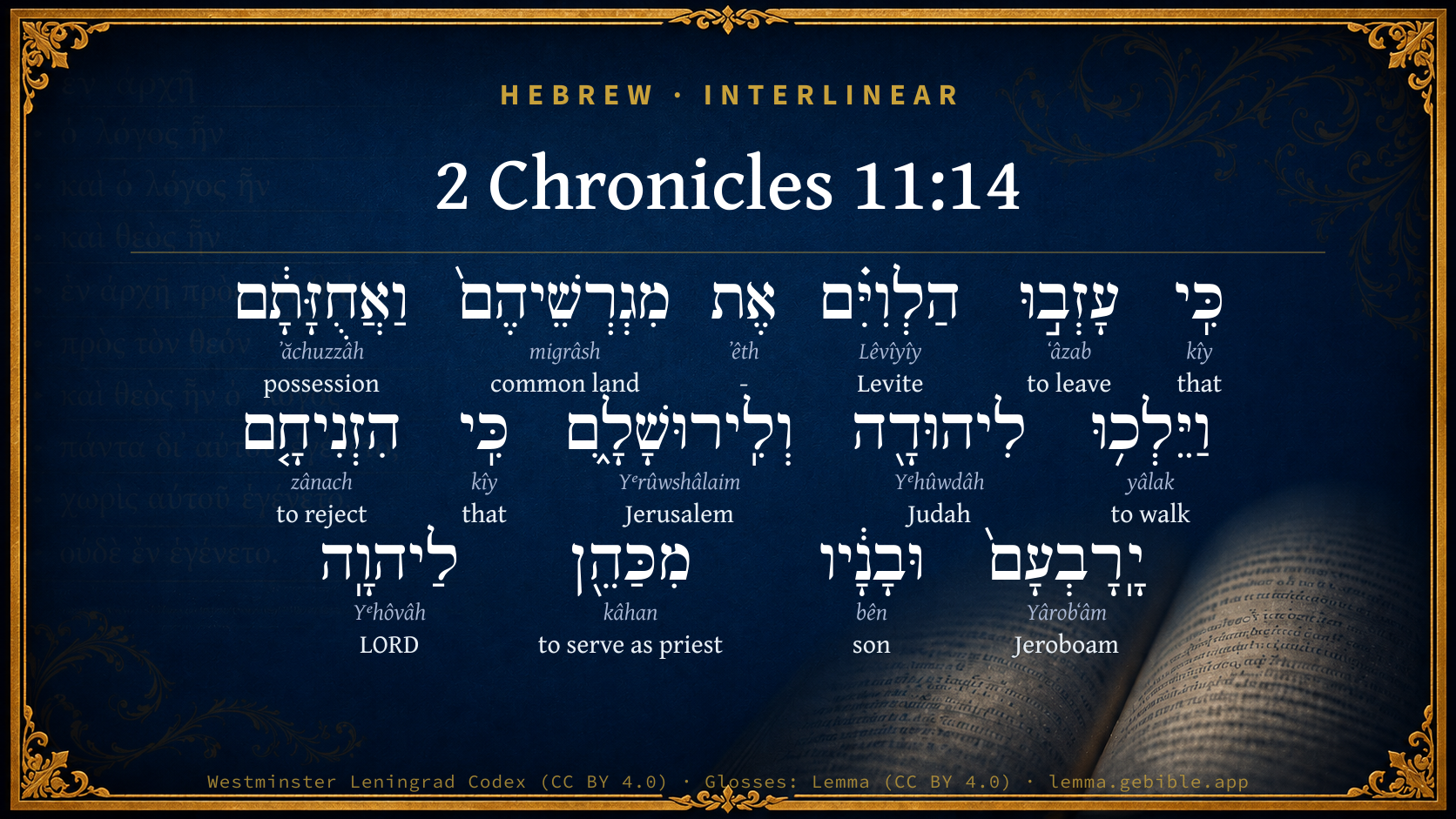
  1. כִּֽי kîy H3588 “that” Conjunction
  2. עָזְב֣וּ ʻâzab H5800 “to leave” Verb, Qal, Perfect, 3rd Person, Common, Plural
  3. הַלְוִיִּ֗ם Lêvîyîy H3881 “the · Levites” Particle, Definite Article + Noun, Gentilic, Masculine, Plural, Absolute
  4. אֶת ʼêth H853 “-” Particle, Direct Object
  5. מִגְרְשֵׁיהֶם֙ migrâsh H4054 “common lands · their” Noun, Common, Masculine, Plural, Construct + Suffix, Personal, 3rd Person, Masculine, Plural
  6. וַאֲחֻזָּתָ֔ם ʼăchuzzâh H272 “and · possession · their” Conjunction + Noun, Common, Feminine, Singular, Construct + Suffix, Personal, 3rd Person, Masculine, Plural
  7. וַיֵּלְכ֥וּ yâlak H3212 “and · to walk” Conjunction + Verb, Qal, Sequential Imperfect, 3rd Person, Masculine, Plural
  8. לִיהוּדָ֖ה Yᵉhûwdâh H3063 “to/for · Judah” Preposition + Noun, Proper
  9. וְלִֽירוּשָׁלִָ֑ם Yᵉrûwshâlaim H3389 “and · to/for · Jerusalem” Conjunction + Preposition + Noun, Proper
  10. כִּֽי kîy H3588 “that” Conjunction
  11. יָֽרָבְעָם֙ Yârobʻâm H3379 “Jeroboam” Noun, Proper
  12. וּבָנָ֔יו bên H1121 “and · sons · his” Conjunction + Noun, Common, Masculine, Plural, Construct + Suffix, Personal, 3rd Person, Masculine, Singular
  13. מִכַּהֵ֖ן kâhan H3547 “from · to serve as priest” Preposition + Verb, Piel, Infinitive Construct
  14. לַיהוָֽה Yᵉhôvâh H3068 “to/for · LORD” Preposition + Noun, Proper

About this verse

These counts appear in no published source. They are computed here, from the morphology-tagged text and Lemma’s own curated glosses. What Lemma adds →

15
words
14
distinct lemmas
Historical
section

Notable vocabulary

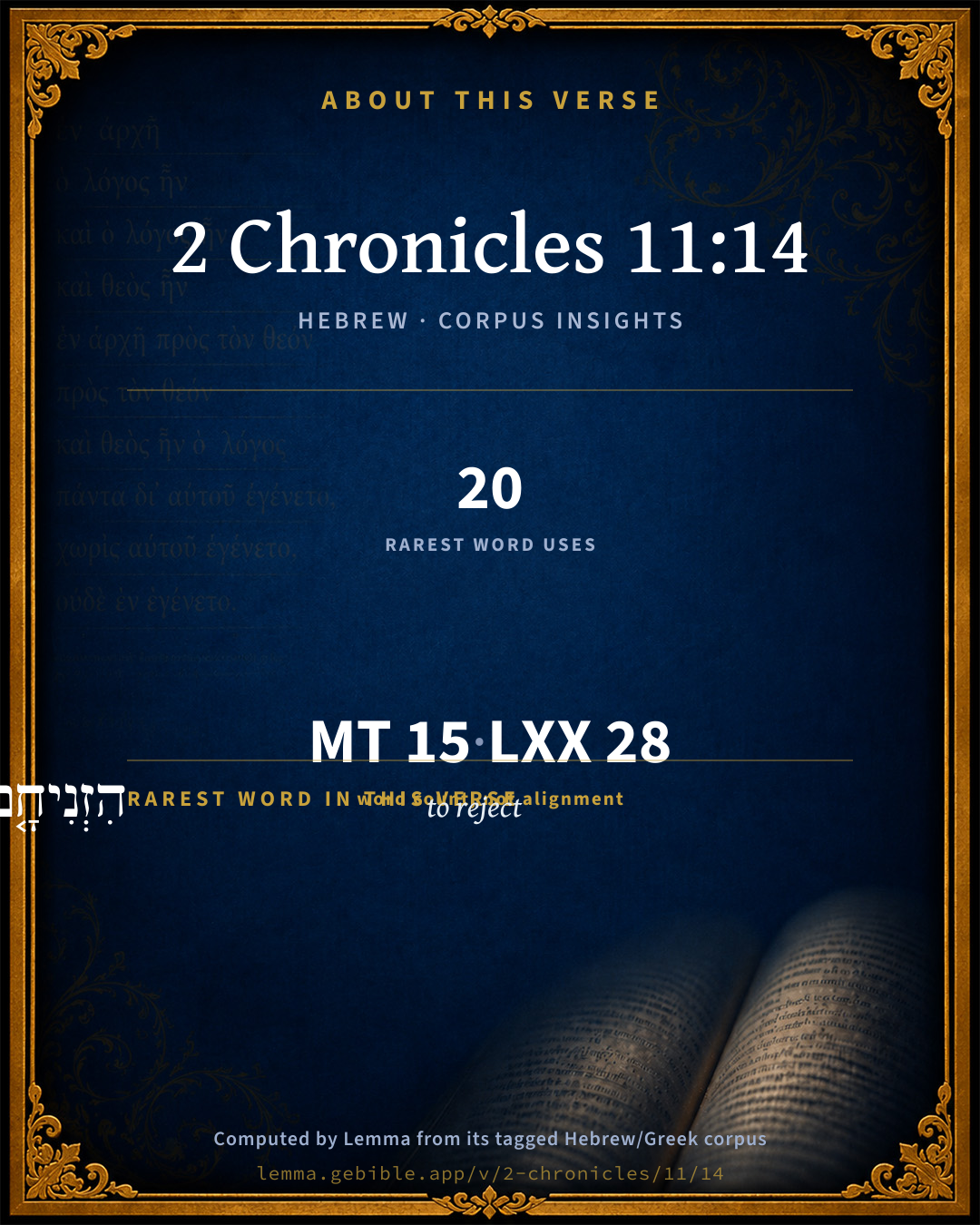
The rarest word here is הִזְנִיחָ֤ם to reject H2186 — appearing just 20 times in the whole Hebrew Bible.

Shared distinctive vocabulary

הִזְנִיחָ֤ם to reject H2186 occurs in 20 verses of the Hebrew Bible. Also found in:

Grammatical profile

  • 4 verbs
  • 8 nouns
  • 2 conjunctions
  • 1 particle

Verb forms

  • עָזְב֣וּ Qal · Perfect
  • וַיֵּלְכ֥וּ Qal · Sequential Imperfect
  • הִזְנִיחָ֤ם Hiphil · Perfect
  • מִכַּהֵ֖ן Piel · Infinitive Construct

Repetition

A word recurs within this verse — often emphatic in Hebrew:

  • כִּֽי that H3588 ×2

Hebrew & Septuagint length

In English translation the verse runs 33 words from the Hebrew and 32 from the Septuagint (LXX English) — closely comparable.

A rough comparison of the two English renderings, which tokenize alike — not a word-level alignment.

Word counts can differ between the Hebrew and the Greek without any difference in meaning — e.g. the Hebrew direct-object marker אֵת has no separate Greek word, and Greek often adds the article ὁ.

In the original languages it is 15 Hebrew tokens and 28 Greek tokens — but the two are counted differently (Hebrew bundles its prefixes and suffixes into one token; the Greek is in lemma form), so that isn’t a like-for-like length.

Cross-references

8

Topical passages linked to 2 Chronicles 11:14 in the Treasury of Scripture Knowledge — connected by theme and wording, ordered by reader-vote popularity; previews shown in the World English Bible.

  • 2 Chronicles 13:9 Haven't you driven out the priests of Yahweh, the sons of Aaron, and the Levites, and made you priests after the manner of the peoples of [other] lands? so that whoever comes to consecrate himself with a young bull and seven rams, the same may be a priest of [those who are] no gods.
  • Numbers 35:2–5 Command the children of Israel that they give to the Levites of the inheritance of their possession cities to dwell in; and suburbs for the cities round about them shall you give to the Levites.
  • 1 Kings 12:28–33 Whereupon the king took counsel, and made two calves of gold; and he said to them, It is too much for you to go up to Jerusalem: see your gods, Israel, which brought you up out of the land of Egypt.
  • Leviticus 27:30–34 "'All the tithe of the land, whether of the seed of the land or of the fruit of the trees, is Yahweh's. It is holy to Yahweh.
  • Numbers 18:21–28 To the children of Levi, behold, I have given all the tithe in Israel for an inheritance, in return for their service which they serve, even the service of the tent of meeting.
  • Joshua 21:20–42 The families of the children of Kohath, the Levites, even the rest of the children of Kohath, they had the cities of their lot out of the tribe of Ephraim.
  • 1 Kings 13:33 After this thing Jeroboam didn't return from his evil way, but made again from among all the people priests of the high places: whoever would, he consecrated him, that there might be priests of the high places.
  • 1 Chronicles 6:66–81 Some of the families of the sons of Kohath had cities of their borders out of the tribe of Ephraim.

Cross-references courtesy of OpenBible.info (CC BY 4.0).

Hebrew and Greek witnesses Masoretic Hebrew ↔ Greek Septuagint

The same verse in the two great witnesses to the Old Testament, shown verse-for-verse.

These are two independent witnesses, not word-aligned to each other, and the Septuagint is shown in lemma (dictionary) form.

Hebrew 2 Chronicles 11:14 Masoretic · Westminster Leningrad Codex

כִּֽי עָזְב֣וּ הַלְוִיִּ֗ם אֶת מִגְרְשֵׁיהֶם֙ וַאֲחֻזָּתָ֔ם וַיֵּלְכ֥וּ לִיהוּדָ֖ה וְלִֽירוּשָׁלִָ֑ם כִּֽי הִזְנִיחָ֤ם יָֽרָבְעָם֙ וּבָנָ֔יו מִכַּהֵ֖ן לַיהוָֽה

For the Levites left their suburbs and their possession, and came to Judah and Jerusalem: for Jeroboam and his sons cast them off, that they should not execute the priest's office to Yahweh;

World English Bible · Public Domain

Greek LXX 2 Chronicles 11:14 Septuagint · lemma form

ὅτι ἐν καταλείπω ὁ λευείτης ὁ σκήνωμα ὁ κατάσχεσις αὐτός καί πορεύομαι πρός ἰούδας εἰς ἰερουσαλήμ ὅτι ἐκβάλλω αὐτός ιεροβοαμ καί ὁ υἱός αὐτός ὁ μή λειτουργέω κύριος

For the Levites left the tents of their possession, and went to Juda to Jerusalem, because Jeroboam and his sons had ejected them so that they should not minister to the Lord.

LXX2012 (modern English Septuagint) · Public Domain

Hebrew: Westminster Leningrad Codex (CC BY 4.0). Greek: Septuagint (public domain); English from LXX2012 (modern English Septuagint) (Public Domain). How the Septuagint differs from the Hebrew →

Commentary

Notes on 2 Chronicles 11:14 from classic Christian and Jewish commentators (each source and its license shown beneath its notes). The classic Christian expositions comment on the surrounding passage and are grouped to its opening verse, so a note may address several verses; the Jewish commentaries on the Tanakh (Rashi and others) are per-verse, so they appear only where the commentator wrote on this verse.

Lemma curates 59 commentaries, every one of them public domain or Creative Commons licensed, each selected and text-cleaned for this edition rather than reprinted as found. About our sources →

Joseph Benson's Commentary

2Ch 11:14. For Jeroboam and his sons cast them off — They would not suffer them to instruct the Israelites in the worship of God, nor to go up to Jerusalem to worship in their courses: and these priests would not join with them in the worship of the calves, as they were commanded by Jeroboam to do; and therefore they willingly forsook all their patrimonies and possessions for God’s sake. No secular advantages whatsoever should detain us there, where we are in danger of making shipwreck of faith and a good conscience. It was a mercy to these priests and Levites that they had a place of refuge to flee to; and that, when Jeroboam cast them off, there were those so near that would receive and bid them welcome; and that they were not forced to flee into the lands of the heathen. And it was an evidence that they loved their work better than their maintenance, in that they left their suburbs and possessions in the country, where they might have lived at ease upon their own property, because they were restrained from serving God there, and in that, casting themselves upon God’s providence, and the charity of their brethren, they came where they might have the full enjoyment of God’s ordinances, according to his own institution. They judged that poverty, in the way of duty, was to be chosen, rather than plenty, in the way of sin; and that it was better to live upon alms, or die in a prison, with a good conscience, than roll in wealth and pleasure with a prostituted one. At the same time, it was the wisdom and praise of Rehoboam and his people, that they bid them welcome, though they probably incommoded themselves to make room for them. Conscientious refugees bring a blessing along with them to the countries that entertain them, as they leave a curse behind them with those that expel them.

Joseph Benson's Commentary on the Old and New Testaments (1811–1818) — public domain. Text from a community e-Sword module.

Adam Clarke's Commentary

Verse 14. The Levites left their suburbs] They and the priests were expelled from their offices by Jeroboam, lest they should turn the hearts of the people to the true God, and then they would revolt to Judah, 1Kg 12:26; and therefore he established a new worship, and made new gods.

Adam Clarke's Commentary on the Bible (1810–1826) — public domain. Text from a community e-Sword/MySword module.

Ellicott's Commentary for English Readers

(14) Their suburbs.—Pasture-grounds (Num_35:1-8).

And their possession—i.e., the cities assigned to them among the ten tribes.

Jeroboam and his sons had cast them off from executing the priest’s office unto the Lord.—See 1Ki_12:26-31. There we are told that, as a matter of policy, Jeroboam established two centres of worship within his own dominions, so that his subjects might cease to visit the Temple of Jerusalem. In appointing priests chosen promiscuously from all classes of the people to minister in the new sanctuaries, Jeroboam struck a direct blow at the Levitical order, and “thrust them out from acting as priests to Jehovah,” as our verse declares.

And his sons.—Usually explained to mean his successors on the throne. (Comp. 1Ch_3:16.) “For in this matter all the kings of Israel walked in the footsteps of Jeroboam” (Keil). Of Jeroboam’s own sons Nadab was the only one who reigned (1Ki_15:25 sqq.); and the narrative of Kings (1 Kings 14, 15) mentions but one other son of this king. It does not, however, exclude the possibility of there having been more than these two, and if there were, they may have co-operated with their father in his religious policy.

A Bible Commentary for English Readers, edited by Charles John Ellicott (1878–1897) — public domain. Text from a community e-Sword module.

The Cambridge Bible for Schools and Colleges

gen. ed. J. J. S. Perowne

14. suburbs] See note on 1Ch_5:16.

had cast them off from executing] R.V. cast them off, that they should not execute. In 1 Kin. (1Ki_12:31; 1Ki_13:33) it is not said that Jeroboam rejected the tribe of Levi, but only that he allowed men of any tribe to become priests; “he … made priests from among all the people” (R.V.).

The Cambridge Bible for Schools and Colleges (gen. ed. J. J. S. Perowne; Cambridge University Press, 1878–1918) — public domain. Text from a community e-Sword module.

John Gill's Exposition

And after them out of all the tribes of Israel,.... Besides the priests and Levites, and after their example, many of the common people, out of all the ten tribes:

such as set their hearts to seek the Lord God of Israel; to seek his face and favour, where he was to be found; to worship him according to his revealed will, and to receive doctrine or instruction from him, as the Targum:

came to Jerusalem to sacrifice to the Lord God of their fathers; to sacrifice where only sacrifices were to be offered up, and by the priests of the Lord, who were gone thither, and to their fathers' God, whom the ten tribes had revolted from.

John Gill's Exposition of the Whole Bible (1746–1763) — public domain (CC PDM 1.0). Text via the HelloAO Bible API.

Albert Barnes' Notes on the Bible

Jeroboam probably confiscated the Levitical lands for the benefit of this new priesthood. Under these circumstances the priests and Levites emigrated in large numbers to the southern kingdom; an act which was followed by a general emigration of the more pious Israelites 2Ch 11:16.

Albert Barnes' Notes on the Bible (1834–1885) — public domain. Text from a community e-Sword/MySword module.

Haydock's Catholic Bible Commentary

Off. This was done at different times; so that almost all the Levites took refuge in the dominions of Juda. Yet some prevaricated. Ezechiel (xliv. 12.) only exempts the family of Sadoc. (Calmet) --- The rest set before us a noble example to endure temporal loss, rather than to neglect the practice of religion, or to conform to a false one. (Worthington)

George Leo Haydock (1774–1849), Haydock's Catholic Family Bible and Commentary, 1859 edition — public domain. Excludes Psalms (Douay-Rheims chapter numbering differs from Protestant) and Deuterocanonical books (Catholic canon only).

Matthew Poole's English Annotations

They would not suffer them to instruct and assist the Israelites in the worship and service of God, nor to go up to Jerusalem to worship in their courses; and these priests would not join with them in the worship of the calves, as they were desired and commanded to do; and therefore they willingly forsook all their patrimonies and possessions for God’s sake.

Matthew Poole's English Annotations on the Holy Bible (1683–1685) — public domain. Text from a community e-Sword/MySword module.

Whedon's Commentary on the Bible

Daniel D. Whedon

14. For Jeroboam… cast them off — The priests and Levites probably opposed Jeroboam’s innovations, and for that reason suffered persecution, and many of them may have been obliged to leave their suburbs and possessions.

Daniel D. Whedon (gen. ed.), Commentary on the Old and New Testaments (1874–1909) — public domain. Text from a community e-Sword module.

The Pulpit Commentary

Left their suburbs (so Lev_25:34; Num_35:1; Jos_14:4 Jos_21:12) Jeroboam had east them off. This glimpsereveals to us, with exceeding probability, that there had been some struggle on the solemn matter; we may readily imagine that Jeroboam had either tried it on in vain with the true priests and Levites, or had learned very conclusively beforehand that it would be vain to try it on. (2Ch_13:9)

The Pulpit Commentary (1880–1919), ed. H.D.M. Spence-Jones & Joseph S. Exell — public domain. Text from a community e-Sword module.

John Wesley's Explanatory Notes

Cast them off - They would not suffer them to instruct the Israelites in the worship of God, nor to go up to Jerusalem to worship in their courses: and these priests would not join with them in the worship of the calves, as they were commanded to do; and therefore they, willingly forsook all their patrimonies and possessions for God's sake. No secular advantages whatsoever should detain us there, where we are in danger of making shipwreck of faith and a good conscience.

John Wesley, Explanatory Notes Upon the Whole Bible (1754–1765) — public domain. Text via the GEBible commentary corpus.

Rashi

Rabbi Shlomo Yitzchaki (Rashi)

For the Levites had abandoned their open land that was in the entire land of the ten tribes.

because Jeroboam...had coerced them to abandon He coerced them to abandon serving and ministering to the Lord.

Rashi on the Tanakh — English translations: “The Judaica Press complete Tanach with Rashi, translated by A. J. Rosenberg” (CC BY 4.0); “Pentateuch with Rashi's commentary by M. Rosenbaum and A.M. Silbermann, 1929-1934” (public domain); “The Metsudah Tanach series, Lakewood, N.J” (CC BY 4.0); and “The Book of Joshua, Metsudah Publications, 1997” (CC BY 4.0). Text via Sefaria.

Lesson kit

Teaching starters — assembled from the data on this page, not authored interpretation. Every prompt links to the verse data it draws on. Edit before teaching.

2 Chronicles, in the Historical, opens this verse with 15 words (14 distinct Hebrew lemmas). Its most distinctive word is zânach (“to reject”). A historical commentator’s framing appears above. Read the whole chapter for the surrounding context.

Discussion questions

  1. How does “to reject” (zânach) shape what this verse is saying?
  2. How does 1 Chronicles 28:9, which shares the word «to reject», read alongside this verse?
  3. What does the repetition of “that” (2× in this one verse) do in this verse?
  4. These translations render this verse differently; the difference is in the English rendering, not the original. What questions does that raise?
  5. «עָזְב֣וּ» is a Qal Perfect verb. How does that grammatical form shape the action described?
  6. Compare how Joseph Benson's Commentary and Adam Clarke's Commentary read this verse. Where do they agree or differ?

Things to notice

Reading settings

Reading text

Shown beneath each verse's original-language words.

Old Testament
Old Testament edition

Read the OT as the Masoretic Hebrew (MT) or the Greek Septuagint (LXX).

English shown for the Greek Septuagint (in the Hebrew ↔ Greek comparison).

Comparing translations? Open the Compare panel on any verse page to stack up to four side by side.