

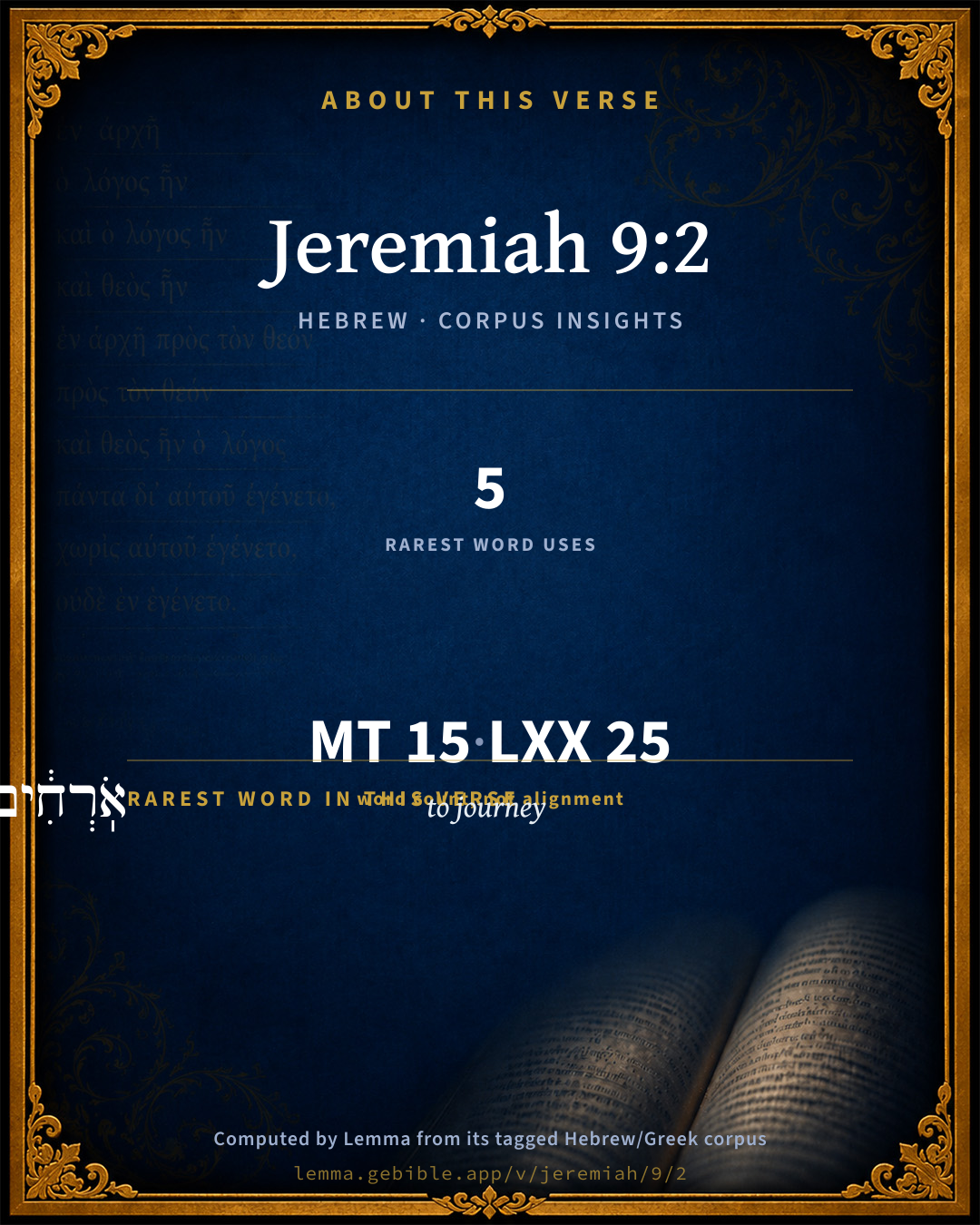
Jeremiah 9:2

Hebrew (Westminster Leningrad Codex) Jeremiah 9:2 appears in the Hebrew Old Testament. The text above is from the Westminster Leningrad Codex. Each word links to its Strong’s number, a concise gloss, and parsing drawn from the Open Scriptures Hebrew Bible morphology. Click any word for its full Brown-Driver-Briggs (BDB) entry.
Download image
Cite this verse

Jeremiah 9:2 (World English Bible). Public Domain. Lemma interlinear Bible study tool, https://lemma.gebible.app/v/jeremiah/9/2.

Show BibTeX & RIS
BibTeX
RIS
English Translation
Oh that I had in the wilderness a lodging-place of wayfaring men; that I might leave my people, and go from them! for they are all adulterers, an assembly of treacherous men.
World English Bible · Public Domain
Download a study sheet

One document with this verse’s original text, its word-by-word gloss line, the meaning frame, cross-references with their text, attributed commentary, and full source and license credits — printable, and it pastes into notes with its structure intact.

This verse Autodidact and up

Study sheet (.html) Plain text (.txt)

A passage Seminary Student

Up to 50 verses in one chapter. A passage sheet keeps up to 6 commentary sources and 12 cross-references per verse, in the order this page ranks them, and says so on the sheet whenever that leaves anything out. Ask for a single verse and you get the Autodidact verse sheet above.

Everything on this page stays free to read, with no account — the sheet is a download of what is already on screen, not access to it.

Want to remove ads? Support Godless Engineer
Compare translations 3

The same verse in 3 English versions, stacked beneath the original-language interlinear above. Click any original word for its lexicon entry.

Each is an independent rendering of the whole verse — the interlinear is not word-aligned to these translations.

Highlighted words mark where these versions differ — a whole-verse word diff, not a word-by-word alignment.

  • World English Bible Public Domain
    Oh that I had in the wilderness a lodging-place of wayfaring men; that I might leave my people, and go from them! for they are all adulterers, an assembly of treacherous men.
  • King James Version Public Domain
    Oh that I had in the wilderness a lodging place of wayfaring men; that I might leave my people, and go from them! for they be all adulterers, an assembly of treacherous men.
  • unfoldingWord Literal Text CC BY-SA 4.0
    Who will give me a lodging place of travelers in the desert, that I might leave my people and walk away from them. For all of them are adulterers, an assembly of ones dealing treacherously!

unfoldingWord Literal Text — © unfoldingWord, licensed CC BY-SA 4.0. Word-aligned USFM3 via Door43 (git.door43.org/unfoldingWord/en_ult).

Versions to compare (up to 4)

3 of 4 selected

Show all 18 translations

Every available English version of this verse, each an independent rendering of the whole verse.

  • World English Bible Public Domain
    Oh that I had in the wilderness a lodging-place of wayfaring men; that I might leave my people, and go from them! for they are all adulterers, an assembly of treacherous men.
  • Berean Standard Bible Public Domain
    If only I had a traveler’s lodge in the wilderness, I would abandon my people and depart from them, for they are all adulterers, a crowd of faithless people.
  • Majority Standard Bible Public Domain
    If only I had a traveler’s lodge in the wilderness, I would abandon my people and depart from them, for they are all adulterers, a crowd of faithless people.
  • King James Version Public Domain
    Oh that I had in the wilderness a lodging place of wayfaring men; that I might leave my people, and go from them! for they be all adulterers, an assembly of treacherous men.
  • American Standard Version (1901) Public Domain
    Oh that I had in the wilderness a lodging-place of wayfaring men; that I might leave my people, and go from them! for they are all adulterers, an assembly of treacherous men.
  • Revised Version (1885) Public Domain
    Oh that I had in the wilderness a lodging place of wayfaring men; that I might leave my people, and go from them! for they be all adulterers, an assembly of treacherous men.
  • Geneva Bible (1599) Public Domain
    Oh, that I had in the wildernes a cottage of wayfaring men, that I might leaue my people, and go from them: for they be all adulterers and an assembly of rebels,
  • Douay-Rheims (1899) Public Domain
    Who will give me in the wilderness a lodging place of wayfaring men, and I will leave my people, and depart from them? because they are all adulterers, an assembly of transgressors.
  • Young's Literal Translation Public Domain
    Who doth give me in a wilderness A lodging-place of travellers? And I leave my people, and go from them, For all of them `are' adulterers, An assembly of treacherous ones.
  • Literal Standard Version CC BY-SA 4.0
    Who gives me in a wilderness || A lodging-place for travelers? And I leave my people, and go from them, || For all of them [are] adulterers, || An assembly of treacherous ones.
  • Unlocked Literal Bible CC BY-SA 4.0
    If only someone would give me a place for travelers in the wilderness to stay, where I could go to abandon my people. If only I could leave them, since all of them are adulterers, a band of traitors!
  • unfoldingWord Literal Text CC BY-SA 4.0
    Who will give me a lodging place of travelers in the desert, that I might leave my people and walk away from them. For all of them are adulterers, an assembly of ones dealing treacherously!
  • Darby Bible Public Domain
    Oh that I had in the wilderness a traveller's lodging-place, that I might leave my people, and go away from them! For they are all adulterers, an assembly of treacherous men.
  • World Messianic Bible Public Domain
    Oh that I had in the wilderness a lodging place of wayfaring men, that I might leave my people and go from them! For they are all adulterers, an assembly of treacherous men.
  • Webster's Bible Public Domain
    Oh that I had in the wilderness a lodging-place of way-faring men; that I might leave my people, and go from them! for they are all adulterers, an assembly of treacherous men.
  • Free Bible Version CC BY-SA 4.0
    I wish I had a temporary shelter in the desert—I would give up on my people and leave them, because they're all adulterers, a bunch of traitors!
  • Bible in Basic English Public Domain
    If only I had in the waste land a night's resting-place for travellers, so that I might go away, far from my people! for they are all untrue, a band of false men.
  • JPS Tanakh (1917) Public Domain
    (9-1) Oh that I were in the wilderness, in a lodging-place of wayfaring men, that I might leave my people, and go from them! For they are all adulterers, an assembly of treacherous men.

Literal Standard Version (2020), Covenant Press — licensed CC BY-SA 4.0. Text via the HelloAO Bible API (eBible.org). Unlocked Literal Bible (unfoldingWord) — licensed CC BY-SA 4.0. Text via the HelloAO Bible API (eBible.org). unfoldingWord Literal Text — © unfoldingWord, licensed CC BY-SA 4.0. Word-aligned USFM3 via Door43 (git.door43.org/unfoldingWord/en_ult). Free Bible Version, Dr. Jonathan Gallagher — licensed CC BY-SA 4.0. Text via the HelloAO Bible API (eBible.org).

Word by word

More ways to search: Search by grammar → Find every occurrence → Compare this word →

Practice this passage: Drill this verse → Learn its vocabulary →

אֹֽרְחִ֔ים
ʼârach
H732
“journeying”
Verb, Qal, Participle Active, Masculine, Plural, Absolute
Part of Speech
Verb
Stem
Qal
Form
Participle Active
Gender
Masculine
Number
Plural
State
Absolute
Full BDB Definition

Origin: a primitive root

TWOT: 161

to wander, journey, go, keep company with - (Qal) - to journey, go - (participle) - wandering, wayfarer, journeying - (substantive) - wanderer, wayfarer, traveller
  1. מִֽי mîy H4310 “who” Particle, Interrogative
  2. יִתְּנֵ֣נִי nâthan H5414 “to give · me” Verb, Qal, Imperfect, 3rd Person, Masculine, Singular + Suffix, Personal, 1st Person, Common, Singular
  3. בַמִּדְבָּ֗ר midbâr H4057 “in/at the · wilderness” Preposition, Determined + Noun, Common, Masculine, Singular, Absolute
  4. מְלוֹן֙ mâlôwn H4411 “inn of” Noun, Common, Masculine, Singular, Construct
  5. וְאֶֽעֶזְבָה֙ ʻâzab H5800 “and · to leave” Conjunction + Verb, Qal, Cohortative, 1st Person, Common, Singular
  6. אֶת ʼêth H853 “-” Particle, Direct Object
  7. עַמִּ֔י ʻam H5971 “people · my” Noun, Common, Masculine, Singular, Construct + Suffix, Personal, 1st Person, Common, Singular
  8. וְאֵלְכָ֖ה yâlak H3212 “and · to walk” Conjunction + Verb, Qal, Cohortative, 1st Person, Common, Singular
  9. מֵֽאִתָּ֑ם ʼêth H854 “from · with · them” Preposition + Preposition + Suffix, Personal, 3rd Person, Masculine, Plural
  10. כִּ֤י kîy H3588 “that” Conjunction
  11. כֻלָּם֙ kôl H3605 “all · their” Noun, Common, Masculine, Singular, Construct + Suffix, Personal, 3rd Person, Masculine, Plural
  12. מְנָ֣אֲפִ֔ים nâʼaph H5003 “committing adultery” Verb, Piel, Participle Active, Masculine, Plural, Absolute
  13. עֲצֶ֖רֶת ʻătsârâh H6116 “assembly of” Noun, Common, Feminine, Singular, Construct
  14. בֹּגְדִֽים bâgad H898 “betraying” Verb, Qal, Participle Active, Masculine, Plural, Absolute

About this verse

These counts appear in no published source. They are computed here, from the morphology-tagged text and Lemma’s own curated glosses. What Lemma adds →

15
words
15
distinct lemmas
Prophets
section

Notable vocabulary

The rarest word here is אֹֽרְחִ֔ים to journey H732 — appearing just 5 times in the whole Hebrew Bible.

Shared distinctive vocabulary

אֹֽרְחִ֔ים to journey H732 occurs in 5 verses of the Hebrew Bible. Also found in:

Grammatical profile

  • 6 verbs
  • 5 nouns
  • 1 preposition
  • 1 conjunction
  • 2 particles

Verb forms

  • יִתְּנֵ֣נִי Qal · Imperfect
  • אֹֽרְחִ֔ים Qal · Participle Active
  • וְאֶֽעֶזְבָה֙ Qal · Cohortative
  • וְאֵלְכָ֖ה Qal · Cohortative
  • מְנָ֣אֲפִ֔ים Piel · Participle Active
  • בֹּגְדִֽים Qal · Participle Active

Hebrew & Septuagint length

In the original languages it is 15 Hebrew tokens and 25 Greek tokens — but the two are counted differently (Hebrew bundles its prefixes and suffixes into one token; the Greek is in lemma form), so that isn’t a like-for-like length.

Cross-references

15

Topical passages linked to Jeremiah 9:2 in the Treasury of Scripture Knowledge — connected by theme and wording, ordered by reader-vote popularity; previews shown in the World English Bible.

  • Jeremiah 5:7–8 How can I pardon you? your children have forsaken me, and sworn by them that are no gods: when I had fed them to the full, they committed adultery, and assembled themselves in troops at the prostitutes' houses.
  • Jeremiah 23:10 For the land is full of adulterers; for because of swearing the land mourns; the pastures of the wilderness are dried up. Their course is evil, and their might is not right;
  • Hosea 4:2 There is cursing, lying, murder, stealing, and committing adultery; They break boundaries, and bloodshed causes bloodshed.
  • Jeremiah 12:1 Righteous are you, Yahweh, when I contend with you; yet would I reason the cause with you: why does the way of the wicked prosper? why are all they at ease who deal very treacherously?
  • Jeremiah 12:6 For even your brothers, and the house of your father, even they have dealt treacherously with you; even they have cried aloud after you: don't believe them, though they speak beautiful words to you.
  • Hosea 7:4 They are all adulterers. They are burning like an oven that the baker stops stirring, From the kneading of the dough, until it is leavened.
  • Psalms 55:6–8 I said, "Oh that I had wings like a dove! Then I would fly away, and be at rest.
  • Psalms 120:5–7 Woe is me, that I live in Meshech, That I dwell among the tents of Kedar!
  • Ezekiel 22:10–11 In you have they uncovered their fathers' nakedness; in you have they humbled her who was unclean in her impurity.
  • Hosea 5:7 They are unfaithful to Yahweh; For they have borne illegitimate children. Now the new moon will devour them with their fields.
  • Hosea 6:7 But they, like Adam, have broken the covenant. They were unfaithful to me, there.
  • Micah 7:1–7 Misery is mine! Indeed, I am like one who gathers the summer fruits, as gleanings of the vinyard: There is no cluster of grapes to eat. My soul desires to eat the early fig.
  • Zephaniah 3:4 Her prophets are arrogant and treacherous people. Her priests have profaned the sanctuary. They have done violence to the law.
  • Malachi 2:11 Judah has dealt treacherously, and an abomination is committed in Israel and in Jerusalem; for Judah has profaned the holiness of Yahweh which he loves, and has married the daughter of a foreign god.
  • James 4:4 You adulterers and adulteresses, don't you know that friendship with the world is enmity with God? Whoever therefore wants to be a friend of the world makes himself an enemy of God.

Cross-references courtesy of OpenBible.info (CC BY 4.0).

Hebrew and Greek witnesses Masoretic Hebrew ↔ Greek Septuagint

The same verse in the two great witnesses to the Old Testament, shown verse-for-verse.

These are two independent witnesses, not word-aligned to each other, and the Septuagint is shown in lemma (dictionary) form.

Hebrew Jeremiah 9:2 Masoretic · Westminster Leningrad Codex

מִֽי יִתְּנֵ֣נִי בַמִּדְבָּ֗ר מְלוֹן֙ אֹֽרְחִ֔ים וְאֶֽעֶזְבָה֙ אֶת עַמִּ֔י וְאֵלְכָ֖ה מֵֽאִתָּ֑ם כִּ֤י כֻלָּם֙ מְנָ֣אֲפִ֔ים עֲצֶ֖רֶת בֹּגְדִֽים

Oh that I had in the wilderness a lodging-place of wayfaring men; that I might leave my people, and go from them! for they are all adulterers, an assembly of treacherous men.

World English Bible · Public Domain

Greek LXX Structure differs

In the Septuagint, Jeremiah is about an eighth shorter than the Hebrew and arranges its material differently — the Oracles Against the Nations (Hebrew chapters 46–51) appear in the middle of the Greek book, after 25:13. Because the chapter and verse boundaries do not line up, a verse-for-verse comparison with the Hebrew is not shown.

A verse-for-verse comparison isn’t shown here because the chapters and verses don’t line up. Switch to the LXX edition with the MT / LXX toggle above to read the Greek directly.

On this verse, John Gill's Exposition discusses the Septuagint’s reading. Read the note in Commentary ↓

Hebrew: Westminster Leningrad Codex (CC BY 4.0). Greek: Septuagint (public domain); English from a public-domain English Septuagint. How the Septuagint differs from the Hebrew →

Targum (Aramaic paraphrase)

1

The Targum is the ancient Jewish Aramaic paraphrase of the Hebrew Scriptures — an interpretive translation, not the Hebrew text itself. Onkelos (literal) and Pseudo-Jonathan (expansive) render the Torah, and Jonathan the Prophets. Coverage is partial: where no permissively-licensed English translation exists for a verse, only the Aramaic is shown. This is verse-level text, not a word-by-word alignment to the Hebrew.

  1. Targum Jonathan Prophets (Joshua–Malachi)
    וְאַלִיפוּ יַת לִישַׁנְהוֹן פִתְגָמֵי שְׁקַר דָמַן אִינוּן כְּקַשְׁתָּא נְכִילָא וְלָא לְהֵימָנוּתָא תַּקִיפוּ בְאַרְעָא אֲרֵי מִבִּישְׁתָּא לְבִישְׁתָּא נְפָקוּ וּמֵידַע דְחַלְתִּי לָא אֲלִיפוּ אֲמַר יְיָ:

    (no public-domain English translation for this verse)

    Targum Jonathan — Aramaic: “Mikraot Gedolot” (public domain). English: “Sefaria Community Translation” (CC0 1.0 (public-domain dedication)); “London "Chaldee Paraphrase," 1871” (public domain). Text via Sefaria.

Commentary

Notes on Jeremiah 9:2 from classic Christian and Jewish commentators (each source and its license shown beneath its notes). The classic Christian expositions comment on the surrounding passage and are grouped to its opening verse, so a note may address several verses; the Jewish commentaries on the Tanakh (Rashi and others) are per-verse, so they appear only where the commentator wrote on this verse.

Lemma curates 59 commentaries, every one of them public domain or Creative Commons licensed, each selected and text-cleaned for this edition rather than reprinted as found. About our sources →

Trapp's Complete Commentary

John Trapp

Jer 9:2 Oh that I had in the wilderness a lodging place of wayfaring men; that I might leave my people, and go from them! for they [be] all adulterers, an assembly of treacherous men.

Ver. 2. Oh that I had in the wilderness a lodging place.] Some sorry shed, such as those worthies had who dwelt in dens and caves of the earth, {Heb 11:38} such as Athanasius had, who lived, say some, six years in a well without the light of the sun, forsaken of friends, and everywhere hunted by enemies; such as the ancient hermits and monks had, who, because they lived in caves and subterranean holes, they were named Mandrites {a} and Troglodites. A godly man desireth to converse as much as may be with God, and as little as may be with men, unless they were better. Lot had little joy of Sodom; {2Pe 2:7-8} Aaron of the Israelites: "Thou knowest," saith he to Moses, "that this people is wholly set upon wickedness"; {Exo 32:22} and indeed so is the whole world. {Job 5:19; Job 2:10} Hence good men are oft put upon David’s wish, "Oh that I had the wings of a dove." {Psa 55:6} Or if that "Oh" will not set them at liberty, they take up that "Woe" of his to express their misery, "Woe is me that I sojourn in Mesech." {Psa 120:5} Who will give me a traveller’s lodge in the wilderness, that I might leave my people, whose wicked courses are a continual eyesore and heartbreak unto me?

For they are all adulterers.] Both corporal and spiritual.

An assembly of treacherous.] A pack of perfidious wretches; a rabble of rebels conspiring against heaven. {Isa 1:4}

{a} Mandrae signifieth caves or holes.

John Trapp, A Commentary or Exposition upon All the Books of the Old and New Testament (1647–1656) — public domain. Text from a community e-Sword module.

Albert Barnes' Notes on the Bible

From their punishment the prophet now turns to their sins.

Jer 9:2

The prophet utters the wish that he might be spared his daily striving, and in some lone wilderness give way to his sorrow, without restraint.

A lodging place - It was usual to build in the desert, either by private charity or at the public expense, caravanserais, to receive travelers for a single night, who had however to bring their own supplies with them.

An assembly - Or, a gang.

Treacherous - Faithless toward one another.

Jer 9:3

Rather, “And they bend their tongue to be their bow of lies, i. e.” just as men before a battle get their bows ready, so they of set purpose make ready to do mischief, only their arrows are lying words: “neither do they rule faithfully in the land, i. e.” Judaea.

Jer 9:4

In a state of such utter lawlessness, the bonds of mutual confidence are relaxed, and suspicion takes its place.

Utterly supplant - An allusion to the name of Jacob Gen 27:36. It might be rendered, “every brother is a thorough Jacob.”

Will walk with slanders - Or, slandereth.

Jer 9:6

A continuation of the warning given in Jer 9:4. “Trust no one: for thou dwellest surrounded by deceit on every side.” Their rejection of God is the result of their want of honesty in their dealings with one another 1Jo 4:20.

Jer 9:7

I will melt them, and try them - The punishment is corrective rather than retributive. The terms used are those of the refiner of metals, the first being the smelting to separate the pure metal from the ore; the second the testing to see whether the metal is pure, or still mixed with alloy. God will put the nation into the crucible of tribulation, that whatever is evil being consumed in the fire, all there is in them of good may be purified.

For how shall I do ... - Rather, “for how” else could I act with reference to the “daughter of my people?”

Jer 9:8

An arrow shot out - Rather, “a murderous arrow.”

In heart he layeth his wait - Rather, “inwardly he layeth his ambush.”

Albert Barnes' Notes on the Bible (1834–1885) — public domain. Text from a community e-Sword/MySword module.

The Biblical Illustrator

Joseph S. Exell

Jer_9:2

Oh that I had in the wilderness a lodging place of wayfaring men.

Two prayers of Jeremiah

(with Jer_14:8-9):--In all the fellowship of, the prophets Jeremiah is by far the most unwilling and reluctant. If Isaiahs watchword was Here am I--send me, Jeremiahs might have been, I would be anywhere else but here--let me go. It was out of this besetting mood of his that the prayer rose which I have taken as the first of my texts, Oh that I had in the wilderness a lodging place of wayfaring men, that I might leave my people and go from them. That is not a prayer for solitude. It is some wayside caravanserai or hotel which Jeremiah longs for; and there he would have been far less alone than in his unshared home at Jerusalem. No, it is not a prayer for solitude, but a prayer to be set where a man can enjoy all the interest of life without having any of its responsibility. Oh, to have no other work in life than to watch the street from the balcony window, than to feel the interest and glitter of life, and achieve your duty towards your fellows, by a kindliness and a courtesy that are never put to the strain of prolonged acquaintance! But our prayers often outrun themselves in the very utterance; and Jeremiahs wish, too, carried within it its own denial Look at the words, That I might leave my people. Emphasise the last two--My people. They are the answer to Jeremiahs prayer. God had not sent him to earth to be as separate from the life of men as a musing man is from the river flowing past his feet; God had sent him, not to watch life from a balcony, but leaping down to share it; not to live in an inn where a man is not even responsible for the housekeeping, but has only his way to pay. God had begotten Jeremiah into a nation. He had made him a citizen. He had given him a patriots lot, with the patriots conscience and heart. So he stayed on where he was in Jerusalem, and the world may have lost certain studies in human life in the great caravanserai of the Lebanon or Arabian desert roads, for wherever he went Jeremiah would not have kept his brain and pen idle. We may even have lost a book, something between Job and Ecclesiastes, but we have gained the book of Jeremiah, the book of the citizen-prophet, and who, because he was a citizen-prophet, and not a caravanserai one, was also a citizen-priest, the first man who entered into the true meaning of vicarious suffering, and therefore stands out clear from all the shadows of the Old Testament--so clear a symbol of our Saviour Jesus Christ. Look now at the main elements of Jeremiahs experience as he thus stood to his post of prophet and priest at Jerusalem. I take these elements to be mainly three.

1. The first was the reality of sin. A prophet has got to begin there, or he had better not begin at all. And he has got to begin there not in order to satisfy some dogma or another, but because the facts are there. There is a kind of preaching about sin far too prevalent in our day, which treats of it doctrinally and not practically, which lays its strength to proving to a man that he must be a sinner, instead of touching his conscience with the knowledge that he is one. But Jeremiah laid his finger on the actual plague spots of the people. He was very definite with these. But there was another note which Jeremiah sounded equally with that on the reality of sin.

2. It was the note of the swiftness and irretrievableness of time where character and salvation are concerned. Live with men in the city, grow old with the same individuals and groups, and learn things--how inexorable habit is; how irrecoverable are the chances of youth; how short and swift is the summer granted to each mans character to ripen in; learn how even the Gospel of the grace of God is just like the sybil of old coming back each time: you have forced him to return with less power of promise and persuasion; and how even repentance--that great freedom of man, that joy of God and the angels--has its times and its places, which, being missed, are not found again, though we seek them with tears. Upon these thoughts the roll of Jeremiahs prophecy rises every now and again with a great sob. What distinguished Jeremiah from all the prophets who had gone before him was that he did not stand on the banks while all Israel rushed rapidly past him irretrievably to ruin, but that he was with the people, taking their reproach as his reproach, and sharing the penalty of their sins.

3. This suffering for the sins of others, being the sin-bearer as well as the conscience of his people, is the third element of Jeremiahs experience. How did he come to it? It is interesting to watch, for in Gods providence he was the first forerunner of Christ in this path. Well, first of all he loved his people; he had a very rich, tender heart, and he loved his people with the whole of it. And then God gave him a conscience about them, that conscience of their sin, and of the penalty to which it was leading. It was in the meeting of such a heart and such a conscience that Jeremiah knew how one man can suffer for others. Oh! it is a terrible fate to be the conscience of those you love, to be their only conscience, to feel their sins as you know they do not feel them themselves, and to be aware of the inevitable judgment to which they are so indifferent. Jeremiah often wondered at it. It perplexed him. After clearly stating the causes why God should smite Israel, he would suddenly turn round in his sympathy with the doomed people, and exclaim, like a beaten animal looking up in the face of his master, Why hast Thou smitten me? And again, that strange prayer of his, O Lord, Thou hast deceived me, and I am deceived. Thou art stronger than I. What can we answer to the perplexed prophet except this, that if a man have the Divine gift of a pure conscience and a more loving heart than his fellows, there comes with such gifts the necessary, the inevitable, obligation of suffering. The physical results of Israels sin Jeremiah did not bear for the people. He bore these with the people in the most heroic and self-denying patience, but he did not do so for or instead of his people. But the spiritual distress, the keener conscience, the agony of estrangement from God, the knowledge of His wrath upon sin--these Jeremiah did bear instead of the dull impenitent Israel. And is it too much to say that it was for his sake that in the end Israel was saved from utter extinction? Now, with this knowledge of what Jeremiah came through, look at his second prayer. The two chief words are exactly the same as before a wayfaring man: and Oh that I were in a lodge of wayfaring men; and the verb to spend the night, is the same word as the noun lodge or inn of wayfaring men--literally a place to pass the night. Jeremiahs second prayer, therefore, is just this, that God would be to the people what Jeremiah himself had tried to be. (Prof. G. A. Smith.)

Jeremiah, a lesson for the disappointed

No prophet commenced labours with greater encouragements than Jeremiah. A king reigned who was bringing back the times of the man after Gods own heart. This devout and zealous king was young. What might not therefore be effected in course of years? Schism, too, was at an end since Israels captivity. Kings of the house of David again ruled over the whole land. Idolatry was destroyed by Josiah in all the cities. Thus, at first sight, it seemed reasonable to anticipate further and permanent improvements.

I. Everyone begins with being sanguine. Jeremiah did. Gods servants entered on their office with more lively hopes than their after fortunes warranted. Very soon the cheerful prospect was overcast for Jeremiah, and he was left to labour in the dark.

1. Huldahs message fixed the coming fortunes of Judah: she foretold the early death of the good king and a fierce destruction to the unworthy nation. This prophecy came five years after Jeremiah entered office; so early in his course were his hopes cut away.

2. Or, the express word of God came to and undeceived him.

3. Or, the hardened state of sin in which the nation lay destroyed his hopes.

II. Resignation a more blessed state of mind than sanguine hope.

1. To expect great efforts from our religious exertions is natural and innocent, but arises from inexperience of the kind of work we have to do--to change the heart and will of men.

2. Far nobler frame of mind to labour, not with hope of seeing fruit, but for conscience sake, as matter of duty, and in faith, trusting good will be done though we see it not.

3. The Bible shows that though Gods servants began with success, they ended with disappointment. Not that Gods purposes or instruments fail, but because the time for reaping is not here, but hereafter.

III. The vicissitude of feeling which this transition from hope to disappointment produces. Affliction, fear, despondency, sometimes restlessness, even impatience under his trials, find frequent expression in Jeremiahs writings (Jer_5:3; Jer_5:30-31; Jer_12:1-3; Jer_15:10-18; Jer_20:7-14).

IV. The issue of these changes and conflicts of feeling was resignation. He comes to use language which expresses that chastened spirit and weaned heart which is the termination of all agitation and anxiety in religious minds. He, who at one time could not comfort himself, was sent to comfort a brother; and in comforting Baruch he speaks in that nobler temper of resignation which takes the place of sanguine hope and harassing fear, and betokens calm and clear-sighted faith and inward peace. (J. H. Newman, D. D.)

The Biblical Illustrator, edited by Joseph S. Exell (c. 1880s–1900s) — public domain. Text from a community e-Sword module.

Joseph Benson's Commentary

Jer 9:2. O that I had in the wilderness, &c. — The prophet here wishes that he had a lodging-place, or tent, such as travellers in this country were wont to lodge in when they travelled over the deserts, professing that he would rather pass his days in such a habitation in some desert place, than at Jerusalem, which was filled with wicked men. That I may leave my people and go from them — Not chiefly because of the ill usage he met with among them, but rather because his righteous soul was vexed from day to day, as Lot’s was in Sodom, with the wickedness of their conversation, 2Pe 3:7-8. It made him even weary of his life to see them dishonouring God and destroying themselves. Time was when the place where God had chosen to put his name, there were the desire and delight of good men. David, in the wilderness, longed to be again in the courts of God’s house; but now Jeremiah, in the courts of God’s house, (for there he was when he said this,) wishes himself in a wilderness! Those have made themselves very vile and very miserable, that have made God’s people and ministers weary of them, and desirous to get from among them. It may not be improper to observe here, that “travellers in the East are not, nor ever were, accommodated at inns on the road, after the manner of the European nations. In some places indeed there are large public buildings provided for their reception, which they call caravansaries; but these afford merely a covering, being absolutely without furniture; and the traveller must carry his own provisions and necessaries along with him, or he will not find any. Nor are even these empty mansions always to be met with; so that if the weary traveller at night comes into a town where there is no caravansary, or πανδοχειον, as it is called Luk 10:34, he must take up his lodging in the street, unless some charitable inhabitant will be pleased to receive him into his house, as we find Jdg 19:15. And if he passes through the desert, it is well for him if he can light upon a cave, or a hut, which some one before him may have erected for a temporary shelter. And this last is what I conceive to be here meant by מלון ארחים, a solitary and not very comfortable situation, but yet preferable to the chagrin of living continually in the society of men of profligate manners.” — Blaney. For they be all adulterers — The expression seems here to be metaphorical, implying that they were apostates from God, to whose service they were engaged by the most solemn covenant, like that which obliges a wife to be faithful to her husband. See note on Jer 2:2; and compare Mat 16:4; Jas 4:4.

Joseph Benson's Commentary on the Old and New Testaments (1811–1818) — public domain. Text from a community e-Sword module.

Tyndale Open Study Notes

Tyndale Open Resources

9:2 Jeremiah wanted to run away and build a shack in the desert to blot the reality of war from his memory (Ps 55:6-8). He understood that his people were adulterers and liars who deserved their punishment, but he did not want to be in Jerusalem to watch it happen.

Tyndale Open Study Notes — © Tyndale Open Resources, licensed CC BY-SA 4.0. Text via the HelloAO Bible API.

Geneva Bible (1599)

Geneva Bible translators

He showeth that this were more quietness and greater safety for him to dwell among the wild beasts than among this wicked people, save that God hath enjoined him this charge.

Utterly turned from God.

Geneva Bible (1599) marginal notes — public domain. Text via Bolls.life.

Jamieson, Fausset & Brown

Robert Jamieson, A. R. Fausset & David Brown

lodging-place--a caravanseral for caravans, or companies travelling in the desert, remote from towns. It was a square building enclosing an open court. Though a lonely and often filthy dwelling, Jeremiah would prefer even it to the comforts of Jerusalem, so as to be removed from the pollutions of the capital (Psa 55:7-8).

Jamieson, Fausset & Brown — Commentary Critical and Explanatory on the Whole Bible (1871) — public domain (CC PDM 1.0). Text via the HelloAO Bible API.

Adam Clarke's Commentary

Verse 2. O that I had in the wilderness] In the eastern countries there are no such inns or houses of entertainment as those in Europe. There are in different places public buildings called caravanserais, where travellers may lodge: but they are without furniture of any kind, and without food. Indeed they are often without a roof, being mere walls for a protection against the wild beasts of the desert. I wish to hide myself any where, in the most uncomfortable circumstances, that I may not be obliged any longer to witness the abominations of this people who are shortly to be visited with the most grievous punishments. Several interpreters suppose this to be the speech of GOD. I cannot receive this. I believe this verse to be spoken by the prophet, and that God proceeds with the next verse, and so on to the ninth inclusive.

Adam Clarke's Commentary on the Bible (1810–1826) — public domain. Text from a community e-Sword/MySword module.

John Calvin's Commentaries

Here the Prophet entertains another wish: He had before wished that his head were waters, that he might shed tears, and he had wished his eyes to be the fountains of tears; but now, after having duly considered the wickedness of the people, he puts off every feeling of humanity, and as one incensed, he desires to move elsewhere, and wholly to leave the people; for their impiety had so prevailed that he could no longer live among them. It is indeed certain that the Prophet had no common grief, when he perceived that God’s dreadful vengeance was not far distant: it is also certain that he was moved and constrained by their detestable conduct to desire to be removed elsewhere. But he speaks not only for his own sake; for he regards his own nation, and expresses his feelings, that he might more effectually touch their hearts. We must then understand, that so great was the sympathy of the Prophet, that he was not satisfied with shedding tears, but that he wished that his whole head would flow into fearn It appears, also, that he was so moved with idignation, that he wished wholly to leave his own people. But, as I have said, his object was to try whether he could restore them to the right way.

He then shews, in this verse, that the Jews had become so detestable, that all the true servants of God wished to be removed far away from them: Who then will set me in the desert? He seeks not for himself another country; he desires not to dwell in a pleasant situation, or that some commodious asylum should be offered to him? but he desires to be placed in the desert, or in the lodging of travelers. He speaks not of those lodgings or inns, which were in villages and towns; but of a lodging in the desert; according to what is the case, when a long and tedious journey is made through forests, some sheds are formed, that when a traveler is over — taken by the darkness of night, he might be protected by some covering, and not He down in the open air. It is of this kind of lodging that the Prophet speaks: then he no doubt means a shed; but as to the word, we may retain, as I have said, its proper meaning. What is meant is, that to dwell in the desert alllong wild beasts was better than to be among that abominable people. By expressing this wish he inflamed no doubt the fury of the whole people, or at least of most of them; but it was necessary thus forcibly to address them: as they submitted to no kind and wholesome warnings and counsels, they were to be forcibly stimulated and urged by such reproofs as these.

I will leave my people This had an emphatic, bearing; for delightful to every one is his native soil, and it is also delightful to dwell among one’s own people. As then the Prophet wished to be removed into the desert,, and to leave his own people, all his relatives and the nation from which he sprang, and to depart frora them, it follows that they nmst have come to extremities.

And the reason is added, For all are adulterers I take the word מנאפים menaphim, adulterers, in a metaphorical sense, as meaning all those who had departed from God, and abandoned themselves to ungodly superstitions, or those who had become so vitiated and corrupt as to retain no integrity. He does not then call them adulterers, because they were given to whoredoms, but because they were immersed in all kinds of defilements. He afterwards calls them an assembly of apostates, or of perfidious men. The word עצר, otsar, means to prohibit, to restrain: hence the noun עצרת ostaret, means a summoned assembly, when, according to an oath or laws, men are forced to meet; and after the assembly is proclaimed, they dare not depart. Then the Prophet by this word points out the consent and union that existed among that people, as though he had said, that they no less clave to their sins, that if by a solemn rite or authority or ordinance they had been summoned together and were prohibited to depart. We hence see that he condemns the impious consent that was among the people, and also their pertinacity; for they could by no means be restored to a right mind. And for this reason he calls them also בגדים begadim, transgressors; for by this word the Hebrews mean, not every kind of sinners, but those who are wholly wicked: and hence the prophets, when, they speak of apostates and revolters, ever call them בגדים, begadim, as in this passage. I shall not proceed farther.

John Calvin's Commentaries (1540-1563) — public domain. Text from the Calvin Translation Society English edition (1840s-50s) via the Christian Classics Ethereal Library (ccel.org). Calvin's coverage is partial (roughly two-thirds of the Bible); uncommented books and verses are honest gaps, never fabricated. The 19th-century editor's footnotes and remarks are omitted so the notes are faithfully Calvin's own voice.

Ellicott's Commentary for English Readers

(2) Oh, that I had . . .!—Literally, as before, Who will give . . .?

A lodging place of wayfaring men.—i.e., a place of shelter, a khan or caravanserai, such as were built for travellers, such, e.g., as the “inn” of Gen_42:27, the “habitation” of Chimham (Jer_41:17), which the son of Barzillai had erected near Bethlehem, as an act of munificent gratitude to his adopted country (2Sa_19:40). In some such shelter, far from the cities of Judah, the prophet, with a feeling like that of the Psalmist (Psa_55:6-8) would fain find refuge from his treacherous enemies—“adulterers,” alike spiritually and literally (Jer_5:8).

A Bible Commentary for English Readers, edited by Charles John Ellicott (1878–1897) — public domain. Text from a community e-Sword module.

The Cambridge Bible for Schools and Colleges

gen. ed. J. J. S. Perowne

2. a lodging place] a caravanserai, hospice (khan). Shelter was all that they afforded. The most desolate spot is to the prophet’s mind better than the sights which thrust themselves upon him in Jerusalem.

adulterers] See on last words of ch. Jer_2:20.

The Cambridge Bible for Schools and Colleges (gen. ed. J. J. S. Perowne; Cambridge University Press, 1878–1918) — public domain. Text from a community e-Sword module.

John Gill's Exposition

Oh that I had in the wilderness a lodging place of wayfaring men,.... Such as travellers take up with in a desert, when they are benighted, and cannot reach a town or village. This the prophet chose, partly that he might have an opportunity to give vent to his grief, being alone; for which reason he did not desire to be in cities and populous places, where he might be amused and diverted while his people were in distress: and partly to show his sympathy, not being able to bear the sight of their misery; and also some degree of indignation at their impieties, which had brought ruin upon them; on account of which it was more eligible to dwell with the wild beasts of the desert than with them in his native country: wherefore it follows,

that I might leave my people, and go from them; which of itself was not desirable; no man chooses to leave his country, his own people, and his father's house, and go into distant lands and strange countries; and especially into a wilderness, where there is neither suitable food nor agreeable company: wherefore this shows, that there must be something very bad, and very provoking, to lead him to take such a step as this: the reason follows,

for they be all adulterers; either in a literal or figurative sense; the latter seems rather intended; for though corporeal fornication and adultery might greatly prevail among them, yet not to such a height as that "all" of them were guilty; whereas idolatry did generally obtain among them: an assembly of treacherous men; not a few only, but in general they were apostates from God and from true religion, and treacherous to one another. The Septuagint calls them "a synod"; and Joseph Kimchi interprets it "a kingdom"; deriving the word from as it signifies to have rule and dominion; denoting, that the kingdom in general was false and perfidious.

John Gill's Exposition of the Whole Bible (1746–1763) — public domain (CC PDM 1.0). Text via the HelloAO Bible API.

Haydock's Catholic Bible Commentary

Men. Why cannot I retire (Menochius) from this scene of misery, or afford some consolation to the captives? Septuagint, "Who will give me the last station in the desert?" (Haydock)

George Leo Haydock (1774–1849), Haydock's Catholic Family Bible and Commentary, 1859 edition — public domain. Excludes Psalms (Douay-Rheims chapter numbering differs from Protestant) and Deuterocanonical books (Catholic canon only).

Matthew Poole's English Annotations

He proceeds in his lamentation, which in the former verse he did, by way of compassion, in this in a way of indignation, Wishing for some retiring place, or sorry shed, or night cottage; See Poole "Isa 24:20"; though it were but some mean and sorry lint in the wilderness, as David, Psa 55:6,7, such as might but shelter him from the injuries of the weather: LXX., in some remotest station or corner, where he might not be an eye-witness of their miseries to grieve him so at the heart, Psa 119:136,158; see 2Pe 2:7,8; and where he might hope to find better entertainment from the savage beasts than from his own countrymen.

They be all adulterers, i.e. for the most part, Jer 5:8, both properly and metaphorically, being full of idolatrous practices; or, there is no integrity found among them.

An assembly of treacherous men; that deal perfidiously with God and man in all the concerns they are conversant about, Isa 1:4. And though the word here for assembly is most ordinarily used for a holy assembly, Lev 23:36; Num 29:35, which causeth some to understand it of their being most vile when they should be most devout; yet here it most naturally signifies a kind of combination among them, as such that have conspired one among another to act all manner of villanies.

Matthew Poole's English Annotations on the Holy Bible (1683–1685) — public domain. Text from a community e-Sword/MySword module.

Whedon's Commentary on the Bible

Daniel D. Whedon

2. From his own sorrows the prophet now turns to the people’s sins. He sighs for solitude rather than contact with the prevailing wickedness. Similarly has a modern poet spoken in a passage which is not merely an imitation, but almost a literal translation of this:

O for a lodge in some vast wilderness,

Some boundless contiguity of shade,

Where rumour of oppression and deceit,

Of unsuccessful or successful war,

Might never reach me more! — Cowper.

Wilderness — An uninhabited place away from the homes and haunts of men.

Lodging place — Caravansary. They were created on the route of caravans for their accommodation. They were often a mere enclosure, lonely and filthy, but preferred by the prophet to a dwelling among a corrupt people.

An assembly — This word here has some suggestion of disparagement, like gang or crew.

Daniel D. Whedon (gen. ed.), Commentary on the Old and New Testaments (1874–1909) — public domain. Text from a community e-Sword module.

The Pulpit Commentary

Vers. 2-22. Complaint of the treachery and folly of the people; lamentation over their consequences.

A lodging place of wayfaring men; a "khan" or "caravanserai," to use the terms now so familiar from Eastern travel, where "wayfaring men" could at least find shelter, and the means of preparing their provisions. Comp., besides the parallel passage in Psa_55:6, Psa_55:7, our own Cowper"s fine reminiscence of Jeremiah: "Oh for a lodge in some vast wilderness!" etc. Adulterers... treacherous men. (see Jer_2:20 Jer_3:8, 9 3:20 5:11)

Vers. 2, 3. The man of God"s longing for seclusion.

I IT IS THE NATURAL RECOIL OF A PURE HEART FROM WICKEDNESS. When the knowledge and love of God are in the heart, sin appears more loathsome. The love of goodness will show itself in a hatred of evil, and a desire to be separated from its workers. In some this love of God and goodness overpowers even the natural attachments and ties of life. And it may be carried to such an excess as to become a spiritual disease, in its way as sinful as the causes that give rise to it. Monasticism has its root in a good and proper feeling carried to excess, and without the restraining and modifying considerations that ought to accompany it. In the instance before us (and like instances)

II IT SPRINGS FROM NO SELFISH MOTIVE. Jeremiah did not seek for the "luxury" of grief; sufficient the wanderer"s tent, or the comfortless caravanserai of the desert. Nor has he any desire to attitudinize. It is a loneliness that shall not be conspicuous; a losing of himself amongst strangers who care not for him and notice him not. Nor did he seek to evade the duties of life. If he separated himself, it was not to escape from the impending dangers he had announced; nor to intermit his spiritual activities. "He wished there to weep for them" (Zinzendorf); to study the problem in fresh and more hopeful aspects; to recover his mental and spiritual calm; to recruit his spiritual energies for a new and more successful effort. So in our own day, the underlying motive must ever determine the lawfulness, the character, and the continuance of our spiritual retirements.

III GOD DID NOT REBUKE IT, BUT HE DID NOT SEE FIT TO GRATIFY IT. Here the longing, if it ever grew into a prayer, was not answered, at least at once, or in the way conceived of. Whilst the day of grace lasted, and God"s people were open to repent and to be influenced by his words, he is detained amongst them. When all possibilities were exhausted, then the dungeon of the king"s prison or the shame of the Egyptian exile might serve the purpose. But even then the essential craving was satisfied. There is a longing that is its own answer. To some it is given to experience solitude and spiritual detachment in the midst of the busy throng of transgressors for whom they yet ceaselessly work. This centrifugal tendency may be productive of greater concentration, real compassion, and capacity for usefulness, when it is controlled and overcome by a sense of overmastering responsibility, and a "heart"s desire and prayer to God for Israel, that they may be saved. M.

Vers. 2-6. The self-opposition and futility of the sinner"s life.

A strong argument against the practice of a thing may often be found in the supposition that it should become universal. This is valid in the case of the practices and desires of wicked men. The idea of Hobbes concerning the original state of human society is ingenious and conceivable from this very reason, were it not contradicted by the world"s history.

I ONE SIN ENTAILS ANOTHER, AND CRIME LEADS TO CRIME. (Ver. 3)

II UNIVERSAL WICKEDNESS PRODUCES UNIVERSAL DISTRUST AND MISERY. (Ver. 5)

III EVIL-DOING IS A WEARY AND FRUITLESS TOIL.

IV ITS FUTILITY CULMINATES WHEN IT ROBS A MAN OF THE KNOWLEDGE AND FELLOWSHIP OF CLOD, AND EVEN OF THE DESIRE FOR THEM. (Ver. 6) M.

Sighings after the wilderness.

The text reminds us of Psa_55:5, "Oh that I bad wings," etc.! of Elijah"s longing that he might die; of the similar dejection of Moses. Even our Lord said, "O faithless generation, how long shall I be with you? how long shall I suffer you?" But such desire as that of the text is in itself

I UNNATURAL. We are formed to mingle with our fellow-men, to live with them, not away from them.

1. It is in intercourse with them life becomes interesting to us. We are taken out of ourselves, fresh sources of pleasure and advantage are continually opened up to us.

2. Sympathy also is in fellowship. Our joys are more than doubled and our sorrows more than halved by the power of that sympathy which solitude can never know.

3. Opportunities of doing good are not to be had "in the wilderness," and when we "leave" our people.

4. Nor are the benefits they can confer on us to be found there. Heart and mind and soul are blessed by companionship and injured by solitude and isolation. Hence such wish as that of the text is, apart from the motive given, unnatural.

II AND IT MAY BE WRONG.

1. It is so when it is the child of impatience. Doubtless there is much often to try our patience, and to make us wish that we could have done with it all. But we should not think much of the laborer who, because the toil was arduous, threw up his work ere the day was done; or of the soldier who left in the midst of the campaign.

2. Yet more culpable is it when it springs from indolence. There are many who dislike real work in any form. Exertion and effort are shrunk from everywhere. And in their religious life it is the same. And from such poor motive such wish as that of the text sometimes springs.

3. Still worse is it when it comes of unbelief. When all faith is gone, and the dark, dread falsehood begins to get hold of a man, that rest is only to be gained by breaking out of this life altogether.

III BUT IT MAY PROCEED FROM CAUSES WHICH (JAN ONLY EXCITE OUR COMPASSION.

1. Extremity of suffering: Job, Paul.

2. Experience of human infidelity, as in Psalm 55.

3. When all the purposes for which God ordained us to live in fellowship with one another are unattainable. Such was the case with Jeremiah. Pleasurable interest in such fellowship as was his could not be for him, but only daily vexation of his righteous soul (cf. Lot). Sympathy he could neither give nor find. Ever so desirous of doing them good, they spurned and despised all his efforts. And as to gaining good from them, it was but a continual contact with pollution. What wonder, then; that Jeremiah longed to be away from such a scene? The hermits of the East, the anchorites of the desert, are more closely linked with ourselves in feeling than some at first may think. Our impulses are often identical with theirs; and if our actions vary it is because our standard of right, not our nature, is changed. In the life of each man there are hours when he sighs for the desert; hours when, bowed down by the sense of sin in himself and the sight of it in others, wearied out by striving to teach a stiffnecked generation, disheartened at seeing the "good cause" advance so slowly, he cart scarcely refrain from following, in his small way, the example of that emperor who exchanged the palace for the cloister, and the crown for the cowl." These are moments such as came to Jeremiah now. "The Emperor Charles uttered in deeds what we have all breathed in sighs. We do and we must long to flee away and be at rest; but then it must remain a longing, and nothing more" (G. Dawson).

IV AND GOD HAS MADE PROVISION FOR ITS SATISFACTION. Not by giving us permission to retire to desert solitudes, except, as with Elijah and Paul, it may be for a while to prepare for future and higher service. But in the manner that the psalmist suggests where he says, "Oh that I had wings like a dove! for then," etc. Yes, wings like a dove will bear us into the present rest of God. The dove is the emblem of meekness.

Like the lamb amongst the beasts, so the dove amongst the birds is the symbol of lowly meekness and gentleness. But lowly meekness is the way to rest, the rest God gives, the peace of God. Listen to our Savior: "Come unto me, all ye that labor... Take my yoke for I am meek and lowly in heart: and ye shall find rest unto your souls" (Matthew 11). The dove is the emblem of purity. It was not only amongst those birds that were counted clean, but was especially selected for presentation to God in sacrifice, as that which was pure alone could be. The doves were allowed to fly about the temple and to rest on its roofs and pillars (see H. Hunt"s picture of the "Finding in the Temple"). But purity opens the door of heaven, and enraptures the beholder with the beatific vision there. "Blessed are the pure in heart; for they shall see God." Wings are these, therefore, well likened to those of a dove, "covered with silver, and her feathers with yellow gold." Yes," keep thyself unspotted from the world," and God shall so manifest himself to thee that thy soul shall be at rest, let the wicked rage around thee as they may. And the dove was the selected symbol of the Holy Spirit. "I saw the Holy Spirit descending like a dove," said John the Baptist. But his wings will bear thee where thou mayest see the fatherly love of God, his wisdom guiding all, and his gracious purpose being more and more accomplished. "He will take of the things of Christ and show them unto thee." And in them thou shalt have peace. The psalmist"s passionate longing may then be fulfilled for us, We may have "wings like a dove." These, of meekness, purity, and the blessed Spirit of God. And so, without quitting the station assigned us or departing to any wilderness, we may have even now the rest of God. C.

The lodging-place in the wilderness.

I WHAT IT IS THE PROPHET WISHES FOR. The occurrence of the word "wilderness" may easily mislead us into thinking that the prophet"s wish was for solitude, and thus we may be disposed to reproach him, as if, Timon-like, he wanted to get away from his fellow-men altogether. But it is not on the word "wilderness" that we must fix our attention to discover the prophet"s feeling. The reference to a travelers lodging-place is the main thing to be considered. It is not between some hermit"s humble, solitary shelter and the well-built house, which is but one out of many making up the stately city, that the contrast is made, but rather between the inn of the traveler and the abode of the man who, day after day, has to mingle busily in the society of which he forms a part. If you are staying at an inn for the night, it matters very little, so far as acquaintance is concerned, who your fellow-guests may be. You scarcely meet them; you are in their company for a few hours, and on the morrow each takes his several way. Jeremiah prefers to live in an inn, whore he would see a succession of strange faces, to living even amongst his own people. Then that the inn should be in a wilderness was a sort of necessity, to round his wish off and make it perfectly express the state of his mind. Travelers had often wide stretches of wilderness-land to cross, where, just because it was wilderness, some sort of shelter needed to be provided for the night. But it might not be an inn in anything like our understanding of the word perhaps nothing more than a rough enclosure, where only that was provided which the bare necessities of the moment demanded.

II WHY THE PROPHET WISHES FOR THIS. The settled society in which the prophet has been living has become rotten in all its important relations. Jeremiah has a people whom he must describe as "my people." He is connected with them by a tie of nature which no repugnance of his can destroy. But, though they are his people, that cannot make him to overlook, excuse, or tolerate their iniquities. Nay, the very fact that they are his people helps to make the iniquity more burdensome to him; for with one"s own people one has so much to do. A righteous son of Sodom, if such a character were imaginable, sickened with all the abominations around him, might well have left his kinsfolk, if they would not listen to his warning or profit by his refusal to join in their wrong-doing. And Jeremiah may be looked on here pretty much as if he had been a dweller in Sodom, for Jerusalem was spiritually Sodom. Adultery, knavery, habitual lying and wrong-doing, these were sad elements to be charged as going to the substance of the social life of the people. And the prophet wished to be free from all entanglement with such. Of course we are not to take his wish literally. It is but an emphatic way of indicating how separated he was in the spirit of his mind from such considerations as ruled in only too many hearts of Israel. Though among his people, he was not of them. United according to the flesh, there was a great gulf between them according to the spirit. His people though they were, he yet was compelled to look upon them as travelers whom he casually met just for a little time. And so must God"s people ever learn to look upon many of those whom they are continually meeting on earth. For enduring society there must be something more than natural ties, frequent intercourse, or community of intellectual tastes and pursuits. It is a small thing to be brought together in the concerns of time if we are not also brought together in the concerns of eternity. Sad it is to think that there may be a closer bend between those who have never met on earth than between those who, on earth, have lived for years together I Those who are travelling to the same place may never meet by the way, but when they do meet it is not in the traveler"s mere lodging-place, but where there are many mansions, and whence they "go out no more for ever." A mansion is itself a place that abides, and those who dwell in it are meant to abide also. Y.

The Pulpit Commentary (1880–1919), ed. H.D.M. Spence-Jones & Joseph S. Exell — public domain. Text from a community e-Sword module.

John Wesley's Explanatory Notes

A lodging place - Some retiring place, though it were but some mean hut in the wilderness.

John Wesley, Explanatory Notes Upon the Whole Bible (1754–1765) — public domain. Text via the GEBible commentary corpus.

Rashi

Rabbi Shlomo Yitzchaki (Rashi)

They have directed Lit. trodden. This expression is appropriate for the preparation of the bow to shoot an arrow, and a bow (קשת) is (arbalete in French), and they tread it with their feet. Therefore, he calls it treading, and the prophet compared their tongue to a treacherous bow, for they directed their tongue like a treacherous bow.

from evil to evil From sin to sin.

Rashi on the Tanakh — English translations: “The Judaica Press complete Tanach with Rashi, translated by A. J. Rosenberg” (CC BY 4.0); “Pentateuch with Rashi's commentary by M. Rosenbaum and A.M. Silbermann, 1929-1934” (public domain); “The Metsudah Tanach series, Lakewood, N.J” (CC BY 4.0); and “The Book of Joshua, Metsudah Publications, 1997” (CC BY 4.0). Text via Sefaria.

Lesson kit

Teaching starters — assembled from the data on this page, not authored interpretation. Every prompt links to the verse data it draws on. Edit before teaching.

Jeremiah, in the Prophets, opens this verse with 15 words (15 distinct Hebrew lemmas). Its most distinctive word is ʼârach (“to journey”). A historical commentator’s framing appears above. Read the whole chapter for the surrounding context.

Discussion questions

  1. How does “to journey” (ʼârach) shape what this verse is saying?
  2. Judges 19:17 shares the word «to journey» with this verse. How do the two illuminate each other?
  3. These translations render this verse differently; the difference is in the English rendering, not the original. What questions does that raise?
  4. The verb «יִתְּנֵ֣נִי» is Qal Imperfect. How does its form color the action?
  5. Reading how Trapp's Complete Commentary and Albert Barnes' Notes on the Bible read this verse, where do the two commentators agree and where do they part?

Things to notice

Reading settings

Reading text

Shown beneath each verse's original-language words.

Old Testament
Old Testament edition

Read the OT as the Masoretic Hebrew (MT) or the Greek Septuagint (LXX).

English shown for the Greek Septuagint (in the Hebrew ↔ Greek comparison).

Comparing translations? Open the Compare panel on any verse page to stack up to four side by side.