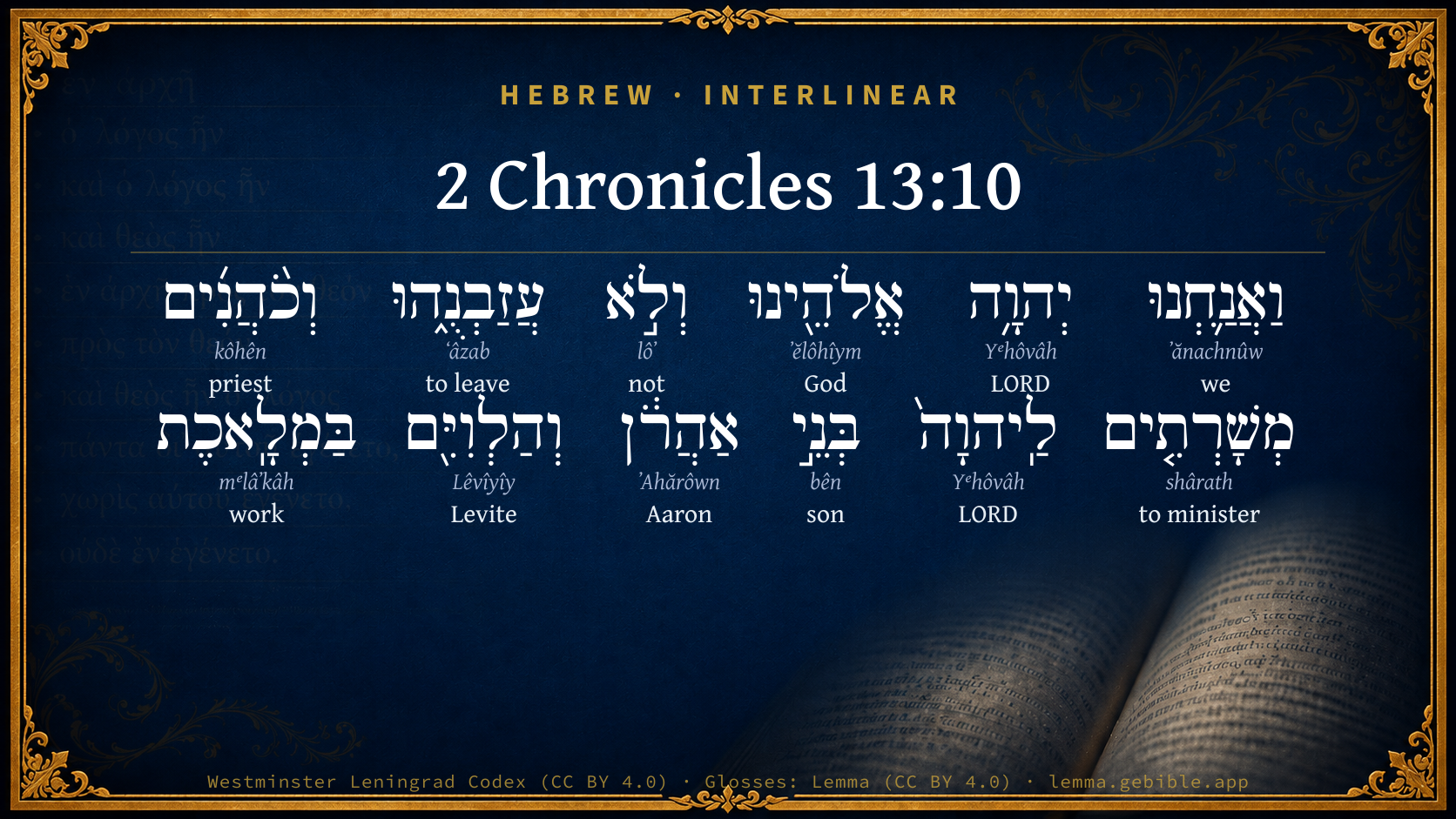
2 Chronicles 13:10

Hebrew (Westminster Leningrad Codex) 2 Chronicles 13:10 appears in the Hebrew Old Testament. The text above is from the Westminster Leningrad Codex. Each word links to its Strong’s number, a concise gloss, and parsing drawn from the Open Scriptures Hebrew Bible morphology. Click any word for its full Brown-Driver-Briggs (BDB) entry.
Download image
Cite this verse

2 Chronicles 13:10 (World English Bible). Public Domain. Lemma interlinear Bible study tool, https://lemma.gebible.app/v/2-chronicles/13/10.

Show BibTeX & RIS
BibTeX
RIS
English Translation
But as for us, Yahweh is our God, and we have not forsaken him; and [we have] priests ministering to Yahweh, the sons of Aaron, and the Levites in their work:
World English Bible · Public Domain
Download a study sheet

One document with this verse’s original text, its word-by-word gloss line, the meaning frame, cross-references with their text, attributed commentary, and full source and license credits — printable, and it pastes into notes with its structure intact.

This verse Autodidact and up

Study sheet (.html) Plain text (.txt)

A passage Seminary Student

Up to 50 verses in one chapter. A passage sheet keeps up to 6 commentary sources and 12 cross-references per verse, in the order this page ranks them, and says so on the sheet whenever that leaves anything out. Ask for a single verse and you get the Autodidact verse sheet above.

Everything on this page stays free to read, with no account — the sheet is a download of what is already on screen, not access to it.

Want to remove ads? Support Godless Engineer
Compare translations 3

The same verse in 3 English versions, stacked beneath the original-language interlinear above. Click any original word for its lexicon entry.

Each is an independent rendering of the whole verse — the interlinear is not word-aligned to these translations.

Highlighted words mark where these versions differ — a whole-verse word diff, not a word-by-word alignment.

  • World English Bible Public Domain
    But as for us, Yahweh is our God, and we have not forsaken him; and [we have] priests ministering to Yahweh, the sons of Aaron, and the Levites in their work:
  • King James Version Public Domain
    But as for us, the LORD is our God, and we have not forsaken him; and the priests, which minister unto the LORD, are the sons of Aaron, and the Levites wait upon their business:
  • unfoldingWord Literal Text CC BY-SA 4.0
    But us, Yahweh is our God, and we have not abandoned him. And priests, are ministering to Yahweh, the sons of Aaron, and the Levites, in the work.

unfoldingWord Literal Text — © unfoldingWord, licensed CC BY-SA 4.0. Word-aligned USFM3 via Door43 (git.door43.org/unfoldingWord/en_ult).

Versions to compare (up to 4)

3 of 4 selected

Show all 18 translations

Every available English version of this verse, each an independent rendering of the whole verse.

  • World English Bible Public Domain
    But as for us, Yahweh is our God, and we have not forsaken him; and [we have] priests ministering to Yahweh, the sons of Aaron, and the Levites in their work:
  • Berean Standard Bible Public Domain
    But as for us, the LORD is our God. We have not forsaken Him; the priests who minister to the LORD are sons of Aaron, and the Levites attend to their duties.
  • Majority Standard Bible Public Domain
    But as for us, the LORD is our God. We have not forsaken Him; the priests who minister to the LORD are sons of Aaron, and the Levites attend to their duties.
  • King James Version Public Domain
    But as for us, the LORD is our God, and we have not forsaken him; and the priests, which minister unto the LORD, are the sons of Aaron, and the Levites wait upon their business:
  • American Standard Version (1901) Public Domain
    But as for us, Jehovah is our God, and we have not forsaken him; and `we have' priests ministering unto Jehovah, the sons of Aaron, and the Levites in their work:
  • Revised Version (1885) Public Domain
    But as for us, the LORD is our God, and we have not forsaken him; and we have priests ministering unto the LORD, the sons of Aaron, and the Levites in their work:
  • Geneva Bible (1599) Public Domain
    But wee belong vnto the Lord our God, and haue not forsaken him, and the Priestes the sonnes of Aaron minister vnto the Lord, and the Leuites in their office.
  • Douay-Rheims (1899) Public Domain
    But the Lord is our God, whom we forsake not, and the priests who minister to the Lord are the sons of Aaron, and the Levites are in their order.
  • Young's Literal Translation Public Domain
    `As for us, Jehovah `is' our God, and we have not forsaken Him, and priests are ministering to Jehovah, sons of Aaron and the Levites, in the work,
  • Literal Standard Version CC BY-SA 4.0
    As for us, YHWH [is] our God, and we have not forsaken Him, and priests are ministering to YHWH, sons of Aaron and the Levites, in the work,
  • Unlocked Literal Bible CC BY-SA 4.0
    But as for us, Yahweh is our God, and we have not forsaken him. We have priests, descendants of Aaron, serving Yahweh, and the Levites, who are at their work.
  • unfoldingWord Literal Text CC BY-SA 4.0
    But us, Yahweh is our God, and we have not abandoned him. And priests, are ministering to Yahweh, the sons of Aaron, and the Levites, in the work.
  • Darby Bible Public Domain
    But as for us, Jehovah is our God, and we have not forsaken him; and the priests that serve Jehovah are the sons of Aaron, and the Levites are at their work:
  • World Messianic Bible Public Domain
    “But as for us, the LORD is our God, and we have not forsaken him. We have priests serving the LORD, the sons of Aaron, and the Levites in their work.
  • Webster's Bible Public Domain
    But as for us, the LORD is our God, and we have not forsaken him; and the priests, who minister to the LORD, are the sons of Aaron, and the Levites wait upon their business:
  • Free Bible Version CC BY-SA 4.0
    But for us, the Lord is our God! We have not abandoned him. We have priests serving the Lord who are descendants of Aaron, and we have Levites who help them in their ministry.
  • Bible in Basic English Public Domain
    But as for us, the Lord is our God, and we have not been turned away from him; we have priests who do the work of the Lord, even the sons of Aaron and the Levites in their places;
  • JPS Tanakh (1917) Public Domain
    But as for us, the LORD is our God, and we have not forsaken Him; and we have priests ministering unto the LORD, the sons of Aaron, and the Levites in their work;

Literal Standard Version (2020), Covenant Press — licensed CC BY-SA 4.0. Text via the HelloAO Bible API (eBible.org). Unlocked Literal Bible (unfoldingWord) — licensed CC BY-SA 4.0. Text via the HelloAO Bible API (eBible.org). unfoldingWord Literal Text — © unfoldingWord, licensed CC BY-SA 4.0. Word-aligned USFM3 via Door43 (git.door43.org/unfoldingWord/en_ult). Free Bible Version, Dr. Jonathan Gallagher — licensed CC BY-SA 4.0. Text via the HelloAO Bible API (eBible.org).

Word by word

More ways to search: Search by grammar → Find every occurrence → Compare this word →

Practice this passage: Drill this verse → Learn its vocabulary →

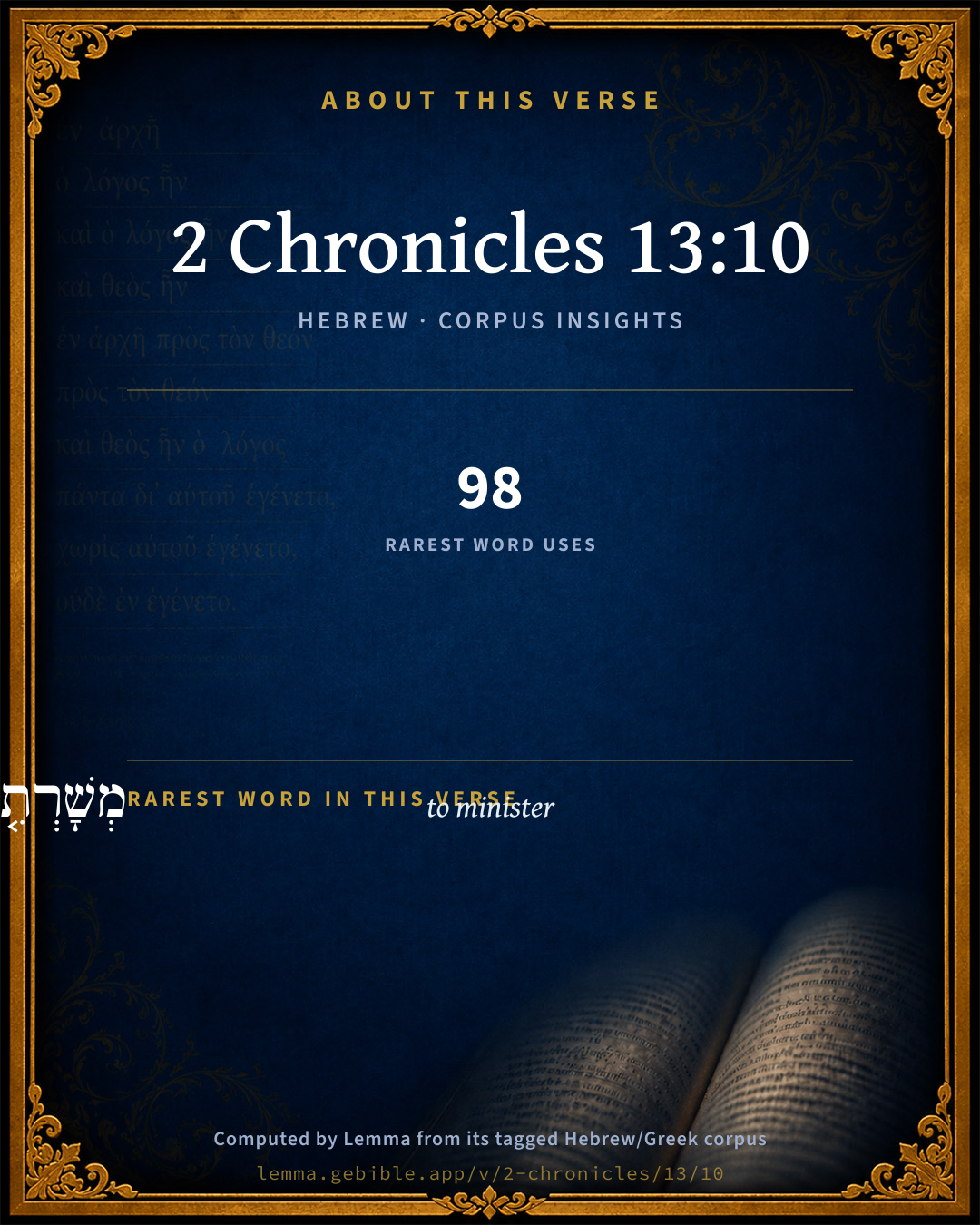
מְשָׁרְתִ֤ים
shârath
H8334
“ministering”
Verb, Piel, Participle Active, Masculine, Plural, Absolute
Part of Speech
Verb
Stem
Piel
Form
Participle Active
Gender
Masculine
Number
Plural
State
Absolute
Full BDB Definition

Origin: a primitive root

TWOT: 2472

(Piel) to minister, serve, minister to
  1. וַאֲנַ֛חְנוּ ʼănachnûw H587 “and · we” Conjunction + Pronoun, Personal, 1st Person, Common, Plural
  2. יְהוָ֥ה Yᵉhôvâh H3068 “LORD” Noun, Proper
  3. אֱלֹהֵ֖ינוּ ʼĕlôhîym H430 “God(s) · our” Noun, Common, Masculine, Plural, Construct + Suffix, Personal, 1st Person, Common, Plural
  4. וְלֹ֣א lôʼ H3808 “and · not” Conjunction + Particle, Negative
  5. עֲזַבְנֻ֑הוּ ʻâzab H5800 “to leave · him” Verb, Qal, Perfect, 1st Person, Common, Plural + Suffix, Personal, 3rd Person, Masculine, Singular
  6. וְכֹ֨הֲנִ֜ים kôhên H3548 “and · priests” Conjunction + Noun, Common, Masculine, Plural, Absolute
  7. לַֽיהוָה֙ Yᵉhôvâh H3068 “to/for · LORD” Preposition + Noun, Proper
  8. בְּנֵ֣י bên H1121 “sons of” Noun, Common, Masculine, Plural, Construct
  9. אַהֲרֹ֔ן ʼAhărôwn H175 “Aaron” Noun, Proper
  10. וְהַלְוִיִּ֖ם Lêvîyîy H3881 “and · the · Levites” Conjunction + Particle, Definite Article + Noun, Gentilic, Masculine, Plural, Absolute
  11. בַּמְלָֽאכֶת mᵉlâʼkâh H4399 “in/at the · work” Preposition, Determined + Noun, Common, Feminine, Singular, Absolute

About this verse

These counts appear in no published source. They are computed here, from the morphology-tagged text and Lemma’s own curated glosses. What Lemma adds →

12
words
11
distinct lemmas
Historical
section

Grammatical profile

  • 2 verbs
  • 8 nouns
  • 1 pronoun
  • 1 particle

Verb forms

  • עֲזַבְנֻ֑הוּ Qal · Perfect
  • מְשָׁרְתִ֤ים Piel · Participle Active

Repetition

A word recurs within this verse — often emphatic in Hebrew:

  • יְהוָ֥ה LORD H3068 ×2

Hebrew & Septuagint length

In English translation the verse runs 31 words from the Hebrew and 28 from the Septuagint (LXX English) — closely comparable.

A rough comparison of the two English renderings, which tokenize alike — not a word-level alignment.

Word counts can differ between the Hebrew and the Greek without any difference in meaning — e.g. the Hebrew direct-object marker אֵת has no separate Greek word, and Greek often adds the article ὁ.

Cross-references

6

Topical passages linked to 2 Chronicles 13:10 in the Treasury of Scripture Knowledge — connected by theme and wording, ordered by reader-vote popularity; previews shown in the World English Bible.

  • Exodus 19:5–6 Now therefore, if you will indeed obey my voice, and keep my covenant, then you shall be my own possession from among all peoples; for all the earth is mine;
  • Exodus 29:1–37 "This is the thing that you shall do to them to make them holy, to minister to me in the priest's office: take one young bull and two rams without blemish,
  • Numbers 16:40 to be a memorial to the children of Israel, to the end that no stranger, who isn't of the seed of Aaron, comes near to burn incense before Yahweh; that he not be as Korah, and as his company: as Yahweh spoke to him by Moses.
  • Numbers 18:1–7 Yahweh said to Aaron, You and your sons and your fathers' house with you shall bear the iniquity of the sanctuary; and you and your sons with you shall bear the iniquity of your priesthood.
  • 2 Chronicles 11:16–17 After them, out of all the tribes of Israel, such as set their hearts to seek Yahweh, the God of Israel, came to Jerusalem to sacrifice to Yahweh, the God of their fathers.
  • Zechariah 13:9 I will bring the third part into the fire, And will refine them as silver is refined, And will test them like gold is tested. They will call on my name, and I will hear them. I will say, 'It is my people;' And they will say, 'Yahweh is my God.'"

Cross-references courtesy of OpenBible.info (CC BY 4.0).

Hebrew and Greek witnesses Masoretic Hebrew ↔ Greek Septuagint

The same verse in the two great witnesses to the Old Testament, shown verse-for-verse.

These are two independent witnesses, not word-aligned to each other, and the Septuagint is shown in lemma (dictionary) form.

Hebrew 2 Chronicles 13:10 Masoretic · Westminster Leningrad Codex

וַאֲנַ֛חְנוּ יְהוָ֥ה אֱלֹהֵ֖ינוּ וְלֹ֣א עֲזַבְנֻ֑הוּ וְכֹ֨הֲנִ֜ים מְשָׁרְתִ֤ים לַֽיהוָה֙ בְּנֵ֣י אַהֲרֹ֔ן וְהַלְוִיִּ֖ם בַּמְלָֽאכֶת

But as for us, Yahweh is our God, and we have not forsaken him; and [we have] priests ministering to Yahweh, the sons of Aaron, and the Levites in their work:

World English Bible · Public Domain

Greek LXX 2 Chronicles 13:10 Septuagint · lemma form

καί ἐγώ κύριος ὁ θεός ἐγώ οὐ ἐν καταλείπω καί ὁ ἱερεύς αὐτός λειτουργέω ὁ κύριος ὁ υἱός ἀαρών καί ὁ λευείτης ἐν ὁ ἐφημερία αὐτός

But we have not forsaken the Lord our God, and his priests, the sons of Aaron, and the Levites, minister to the Lord; and in their daily courses

LXX2012 (modern English Septuagint) · Public Domain

Hebrew: Westminster Leningrad Codex (CC BY 4.0). Greek: Septuagint (public domain); English from LXX2012 (modern English Septuagint) (Public Domain). How the Septuagint differs from the Hebrew →

Commentary

Notes on 2 Chronicles 13:10 from classic Christian and Jewish commentators (each source and its license shown beneath its notes). The classic Christian expositions comment on the surrounding passage and are grouped to its opening verse, so a note may address several verses; the Jewish commentaries on the Tanakh (Rashi and others) are per-verse, so they appear only where the commentator wrote on this verse.

Lemma curates 59 commentaries, every one of them public domain or Creative Commons licensed, each selected and text-cleaned for this edition rather than reprinted as found. About our sources →

Trapp's Complete Commentary

John Trapp

2Ch 13:10 But as for us, the LORD [is] our God, and we have not forsaken him; and the priests, which minister unto the LORD, [are] the sons of Aaron, and the Levites [wait] upon [their] business:

Ver. 10. But as for us, the Lord is our God, &c.] Summa ratio est quae pro religione facit, saith Papinian. Abijah was none of the best, and yet pretendeth to a great deal of religion, and pleadeth hard for it; though he "walked in all the sins of his father" Rehoboam. {1Ki 15:3} Hypocrites want for no fair words. Some think that Abijah, when he went forth to battle, was indifferent good; but puffed up with his great victory, he fell away. Pellican holdeth that he was ever naught: only the worship of God was by him externally maintained and magnified; wherewith because God was well pleased, it being of his own ordaining, he now took part with him.

John Trapp, A Commentary or Exposition upon All the Books of the Old and New Testament (1647–1656) — public domain. Text from a community e-Sword module.

Joseph Benson's Commentary

2Ch 13:10. But the Lord is our God — Hebrew, Jehovah, the only true and great God. And we have not forsaken him — We maintain his honour and worship, which you have ungratefully rejected. And he is able to protect us and give us success.

Joseph Benson's Commentary on the Old and New Testaments (1811–1818) — public domain. Text from a community e-Sword module.

Tyndale Open Study Notes

Tyndale Open Resources

13:10-11 Abijah’s speech portrays him as concerned about the purity of worship at Jerusalem. The account in Kings says nothing of Abijah’s devotion (1 Kgs 15:3-4).

Tyndale Open Study Notes — © Tyndale Open Resources, licensed CC BY-SA 4.0. Text via the HelloAO Bible API.

Adam Clarke's Commentary

Verse 10. The Lord is our God] We have not abandoned the Lord; and we still serve him according to his own law.

Adam Clarke's Commentary on the Bible (1810–1826) — public domain. Text from a community e-Sword/MySword module.

Ellicott's Commentary for English Readers

(10) We have not forsaken him.—Comp. 1Ki_15:3. “he walked in all the sins of his father,” “his heart was not perfect with the Lord his God.” But that passage is by no means incompatible with the present as some have asserted. What Abijah here states is surely true—viz.,that Judah had maintained the Levitical priesthood, and its associated worship. And the following words prove this to be his meaning: “and the priests which minister unto the Lord are the sons of Aaron; and the Levites wait upon their business,” (literally, are in the work). The work of the service of Jehovah could be duly performed by none but Levites.

A Bible Commentary for English Readers, edited by Charles John Ellicott (1878–1897) — public domain. Text from a community e-Sword module.

The Cambridge Bible for Schools and Colleges

gen. ed. J. J. S. Perowne

10. and the priests, which minister unto the Lord, are the sons of Aaron] R.V. and we have priests ministering unto the LORD, the sons of Aaron.

wait upon their business] R.V. in their work (sc. ministering to the Lord as above). Part of the ideal of the Priestly Code was that the Levites should be restricted to the duty of helping the priests, and should be prevented from executing priestly functions themselves. With this ideal the Chronicler plainly sympathised, but it could not always be realised.

The Cambridge Bible for Schools and Colleges (gen. ed. J. J. S. Perowne; Cambridge University Press, 1878–1918) — public domain. Text from a community e-Sword module.

John Gill's Exposition

And they burn unto the Lord, every morning and every evening, burnt sacrifices and sweet incense,.... That is, the priests; the one they did on the altar of burnt offering, and the other on the altar of incense, and both every day, morning and evening:

the shewbread also set they in order upon the pure table; the shewbread table, every sabbath day, when they took the old bread off, which had stood there a week:

and the candlestick of gold, with the lamps thereof, to burn every evening; these were lighted every evening, and dressed every morning; and though there were ten tables and ten candlesticks in Solomon's temple, yet only one of each was used at a time; and therefore from hence it is not to be concluded that all the rest were taken away by Shishak:

for we keep the charge of the Lord our God; observe all the rites and ceremonies, laws, and ordinances enjoined by him; the Targum is,"the charge of the Word of the Lord our God:"

but ye have forsaken him; his fear or worship, as the same paraphrase.

John Gill's Exposition of the Whole Bible (1746–1763) — public domain (CC PDM 1.0). Text via the HelloAO Bible API.

Matthew Poole's English Annotations

The Lord, Heb. Jehovah, the only true and great God.

We have not forsaken him; we maintain his honour and worship, which you have ungratefully rejected.

Matthew Poole's English Annotations on the Holy Bible (1683–1685) — public domain. Text from a community e-Sword/MySword module.

The Pulpit Commentary

Vers. 10, 11. The professions summarized in these two verses were confessedly formally true of the king and priests and nation, although Abijah and kingdom certainly did not carry a clean conscience in them (Mat_15:8; Mar_12:33; 1Sa_15:22; Isa_1:11, Isa_1:16, Isa_1:19) They were, moreover, beyond a doubt really true of multitudes of individuals in the kingdom of Judah and Benjamin. And these were "the salt of the" kingdom. (Mat_5:13) They burnt sweet incense (so 2Ch_2:4; Exo_30:7; Rev_8:3, Rev_8:4) The pure table the candlestick. Although ten of each of these were made, only one was used, or only one at the time (see our note on (2Ch_4:8, compared with (2Ch_29:18; 1Ki_7:48) We have not forsaken him ye have forsaken him. If all the difference that these words have it in them to express could have been put to the credit of Abijsh, what tremendous strength would have now belonged to his position and to his heart!

The Pulpit Commentary (1880–1919), ed. H.D.M. Spence-Jones & Joseph S. Exell — public domain. Text from a community e-Sword module.

John Wesley's Explanatory Notes

The Lord - Hebrew. Jehovah, the only true God. We - Maintain his worship which you have rejected.

John Wesley, Explanatory Notes Upon the Whole Bible (1754–1765) — public domain. Text via the GEBible commentary corpus.

unfoldingWord translationNotes

Door43 World Missions Community

as for us

The word "us" refers to the people of the southern kingdom of Judah.

who are at their work

The word "work" can be translated with a verb. AT: "who are working" (See: Abstract Nouns)

the bread of the presence

The "bread of the presence" refers to twelve loaves of bread that the priests placed on a golden table in the tabernacle or temple building as a sacrifice to God and as a symbol of God's presence.

they also tend the lampstand

"they also take care of the lampstand"

for them to burn every evening

"so that the lamps burn every evening" or "and light the lamps every evening"

translationWords

forsake

burnt offering

servant

works

incense

bread

lampstand

command

unfoldingWord translationNotes — © Distant Shores Media and the Door43 World Missions Community, licensed CC BY-SA 4.0. Source: git.door43.org/Door43/en_tn.

Rashi

Rabbi Shlomo Yitzchaki (Rashi)

engage in the work i.e., in their work; this one to sing, and that one to guard the gates, every man to his work, as David prepared it.

Rashi on the Tanakh — English translations: “The Judaica Press complete Tanach with Rashi, translated by A. J. Rosenberg” (CC BY 4.0); “Pentateuch with Rashi's commentary by M. Rosenbaum and A.M. Silbermann, 1929-1934” (public domain); “The Metsudah Tanach series, Lakewood, N.J” (CC BY 4.0); and “The Book of Joshua, Metsudah Publications, 1997” (CC BY 4.0). Text via Sefaria.

Lesson kit

Teaching starters — assembled from the data on this page, not authored interpretation. Every prompt links to the verse data it draws on. Edit before teaching.

2 Chronicles, in the Historical, opens this verse with 12 words (11 distinct Hebrew lemmas). Its most distinctive word is shârath (“to minister”). A historical commentator’s framing appears above. Read the whole chapter for the surrounding context.

Discussion questions

  1. How does “to minister” (shârath) shape what this verse is saying?
  2. How does Exodus 19:5–6, which shares this passage’s theme, read alongside this verse?
  3. What does the repetition of “LORD” (2× in this one verse) do in this verse?
  4. The translations on this page render this verse differently — a whole-verse word diff, not a word-by-word alignment. What might account for the different wordings?
  5. «עֲזַבְנֻ֑הוּ» is a Qal Perfect verb. How does that grammatical form shape the action described?
  6. Compare how Trapp's Complete Commentary and Joseph Benson's Commentary read this verse. Where do they agree or differ?

Things to notice

Reading settings

Reading text

Shown beneath each verse's original-language words.

Old Testament
Old Testament edition

Read the OT as the Masoretic Hebrew (MT) or the Greek Septuagint (LXX).

English shown for the Greek Septuagint (in the Hebrew ↔ Greek comparison).

Comparing translations? Open the Compare panel on any verse page to stack up to four side by side.