
2 Chronicles 29:6

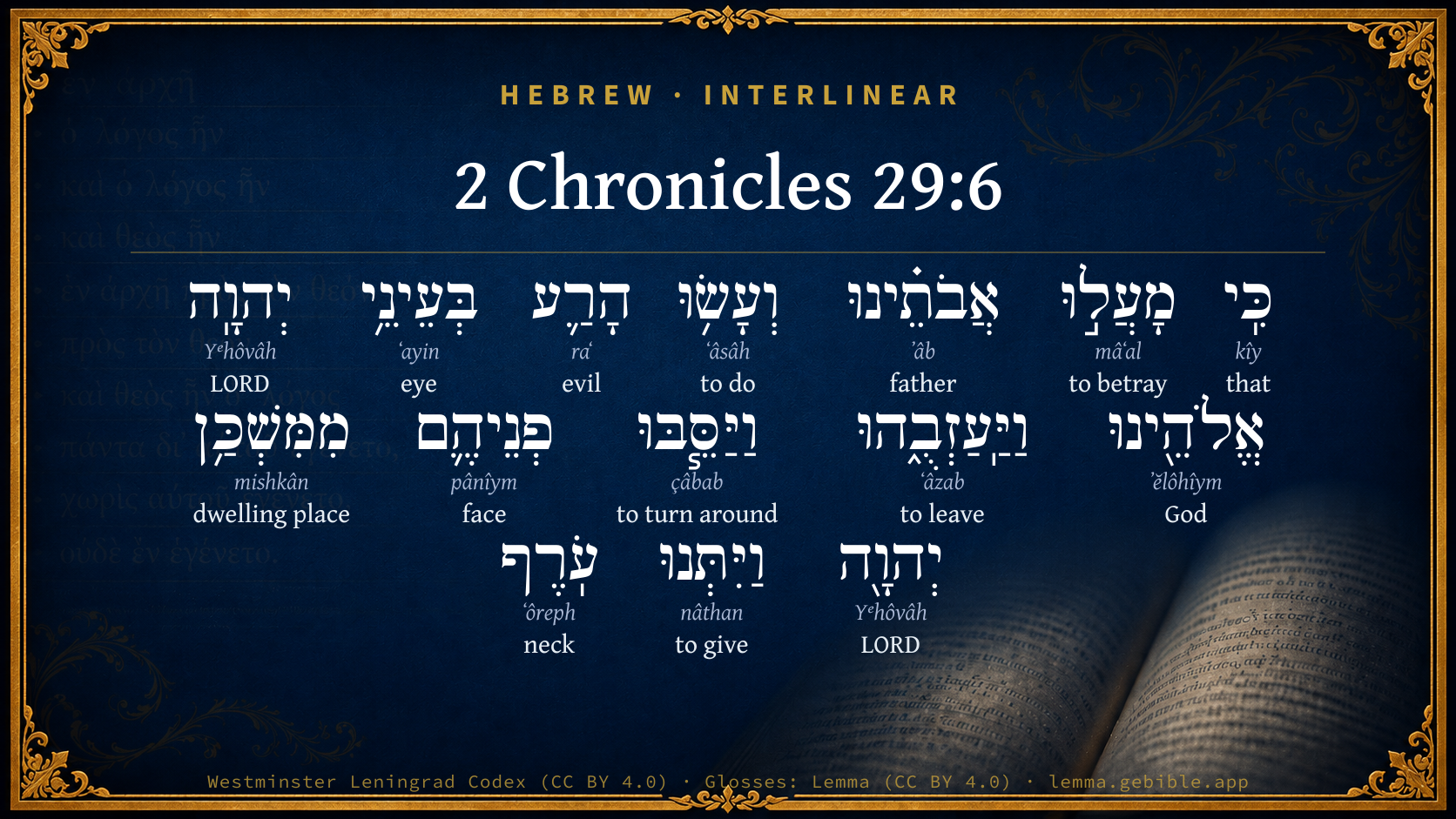
Hebrew (Westminster Leningrad Codex) 2 Chronicles 29:6 appears in the Hebrew Old Testament. The text above is from the Westminster Leningrad Codex. Each word links to its Strong’s number, a concise gloss, and parsing drawn from the Open Scriptures Hebrew Bible morphology. Click any word for its full Brown-Driver-Briggs (BDB) entry.
Download image
Cite this verse

2 Chronicles 29:6 (World English Bible). Public Domain. Lemma interlinear Bible study tool, https://lemma.gebible.app/v/2-chronicles/29/6.

Show BibTeX & RIS
BibTeX
RIS
English Translation
For our fathers have trespassed, and done that which was evil in the sight of Yahweh our God, and have forsaken him, and have turned away their faces from the habitation of Yahweh, and turned their backs.
World English Bible · Public Domain
Download a study sheet

One document with this verse’s original text, its word-by-word gloss line, the meaning frame, cross-references with their text, attributed commentary, and full source and license credits — printable, and it pastes into notes with its structure intact.

This verse Autodidact and up

Study sheet (.html) Plain text (.txt)

A passage Seminary Student

Up to 50 verses in one chapter. A passage sheet keeps up to 6 commentary sources and 12 cross-references per verse, in the order this page ranks them, and says so on the sheet whenever that leaves anything out. Ask for a single verse and you get the Autodidact verse sheet above.

Everything on this page stays free to read, with no account — the sheet is a download of what is already on screen, not access to it.

Want to remove ads? Support Godless Engineer
Compare translations 3

The same verse in 3 English versions, stacked beneath the original-language interlinear above. Click any original word for its lexicon entry.

Each is an independent rendering of the whole verse — the interlinear is not word-aligned to these translations.

Highlighted words mark where these versions differ — a whole-verse word diff, not a word-by-word alignment.

  • World English Bible Public Domain
    For our fathers have trespassed, and done that which was evil in the sight of Yahweh our God, and have forsaken him, and have turned away their faces from the habitation of Yahweh, and turned their backs.
  • King James Version Public Domain
    For our fathers have trespassed, and done that which was evil in the eyes of the LORD our God, and have forsaken him, and have turned away their faces from the habitation of the LORD, and turned their backs.
  • unfoldingWord Literal Text CC BY-SA 4.0
    For our fathers acted unfaithfully, and they did evil in the eyes of Yahweh our God. And they have abandoned him. And they turned their faces from the tabernacle of Yahweh, and they turned the back.

unfoldingWord Literal Text — © unfoldingWord, licensed CC BY-SA 4.0. Word-aligned USFM3 via Door43 (git.door43.org/unfoldingWord/en_ult).

Versions to compare (up to 4)

3 of 4 selected

Show all 18 translations

Every available English version of this verse, each an independent rendering of the whole verse.

  • World English Bible Public Domain
    For our fathers have trespassed, and done that which was evil in the sight of Yahweh our God, and have forsaken him, and have turned away their faces from the habitation of Yahweh, and turned their backs.
  • Berean Standard Bible Public Domain
    For our fathers were unfaithful and did evil in the sight of the LORD our God. They abandoned Him, turned their faces away from the dwelling place of the LORD, and turned their backs on Him.
  • Majority Standard Bible Public Domain
    For our fathers were unfaithful and did evil in the sight of the LORD our God. They abandoned Him, turned their faces away from the dwelling place of the LORD, and turned their backs on Him.
  • King James Version Public Domain
    For our fathers have trespassed, and done that which was evil in the eyes of the LORD our God, and have forsaken him, and have turned away their faces from the habitation of the LORD, and turned their backs.
  • American Standard Version (1901) Public Domain
    For our fathers have trespassed, and done that which was evil in the sight of Jehovah our God, and have forsaken him, and have turned away their faces from the habitation of Jehovah, and turned their backs.
  • Revised Version (1885) Public Domain
    For our fathers have trespassed, and done that which was evil in the sight of the LORD our God, and have forsaken him, and have turned away their faces from the habitation of the LORD, and turned their backs.
  • Geneva Bible (1599) Public Domain
    For our fathers haue trespassed, and done euill in the eyes of the Lord our God, and haue forsaken him, and turned away their faces from the Tabernacle of the Lord, and turned their backes.
  • Douay-Rheims (1899) Public Domain
    Our fathers have sinned and done evil in the sight of the Lord God, forsaking him: they have turned away their faces from the tabernacle of the Lord, and turned their backs.
  • Young's Literal Translation Public Domain
    for our fathers have trespassed, and done that which is evil in the eyes of Jehovah our God, and forsake him, and turn round their faces from the tabernacle of Jehovah, and give the neck.
  • Literal Standard Version CC BY-SA 4.0
    for our fathers have trespassed, and done that which is evil in the eyes of our God YHWH, and forsake him, and turn around their faces from the Dwelling Place of YHWH, and give the neck.
  • Unlocked Literal Bible CC BY-SA 4.0
    For our ancestors trespassed and did what was evil in the sight of Yahweh our God; they forsook him, turned away their faces from the place where Yahweh lives, and turned their backs on it.
  • unfoldingWord Literal Text CC BY-SA 4.0
    For our fathers acted unfaithfully, and they did evil in the eyes of Yahweh our God. And they have abandoned him. And they turned their faces from the tabernacle of Yahweh, and they turned the back.
  • Darby Bible Public Domain
    For our fathers have transgressed, and done evil in the sight of Jehovah our God, and have forsaken him and turned away their faces from the habitation of Jehovah, and have turned their backs.
  • World Messianic Bible Public Domain
    For our fathers were unfaithful, and have done that which was evil in the LORD our God’s sight, and have forsaken him, and have turned away their faces from the habitation of the LORD, and turned their backs.
  • Webster's Bible Public Domain
    For our fathers have trespassed, and done that which was evil in the eyes of the LORD our God, and have forsaken him, and have turned away their faces from the habitation of the LORD, and turned their backs.
  • Free Bible Version CC BY-SA 4.0
    For our fathers were sinful, and did what was evil in the Lord's sight. They abandoned him and paid no attention to the Lord's Temple, turning their backs on him.
  • Bible in Basic English Public Domain
    For our fathers have done evil, sinning in the eyes of the Lord our God, and have given him up, turning away their faces from the house of the Lord, and turning their backs on him.
  • JPS Tanakh (1917) Public Domain
    For our fathers have acted treacherously, and done that which was evil in the sight of the LORD our God, and have forsaken Him, and have turned away their faces from the habitation of the LORD, and turned their backs.

Literal Standard Version (2020), Covenant Press — licensed CC BY-SA 4.0. Text via the HelloAO Bible API (eBible.org). Unlocked Literal Bible (unfoldingWord) — licensed CC BY-SA 4.0. Text via the HelloAO Bible API (eBible.org). unfoldingWord Literal Text — © unfoldingWord, licensed CC BY-SA 4.0. Word-aligned USFM3 via Door43 (git.door43.org/unfoldingWord/en_ult). Free Bible Version, Dr. Jonathan Gallagher — licensed CC BY-SA 4.0. Text via the HelloAO Bible API (eBible.org).

Word by word

More ways to search: Search by grammar → Find every occurrence → Compare this word →

Practice this passage: Drill this verse → Learn its vocabulary →

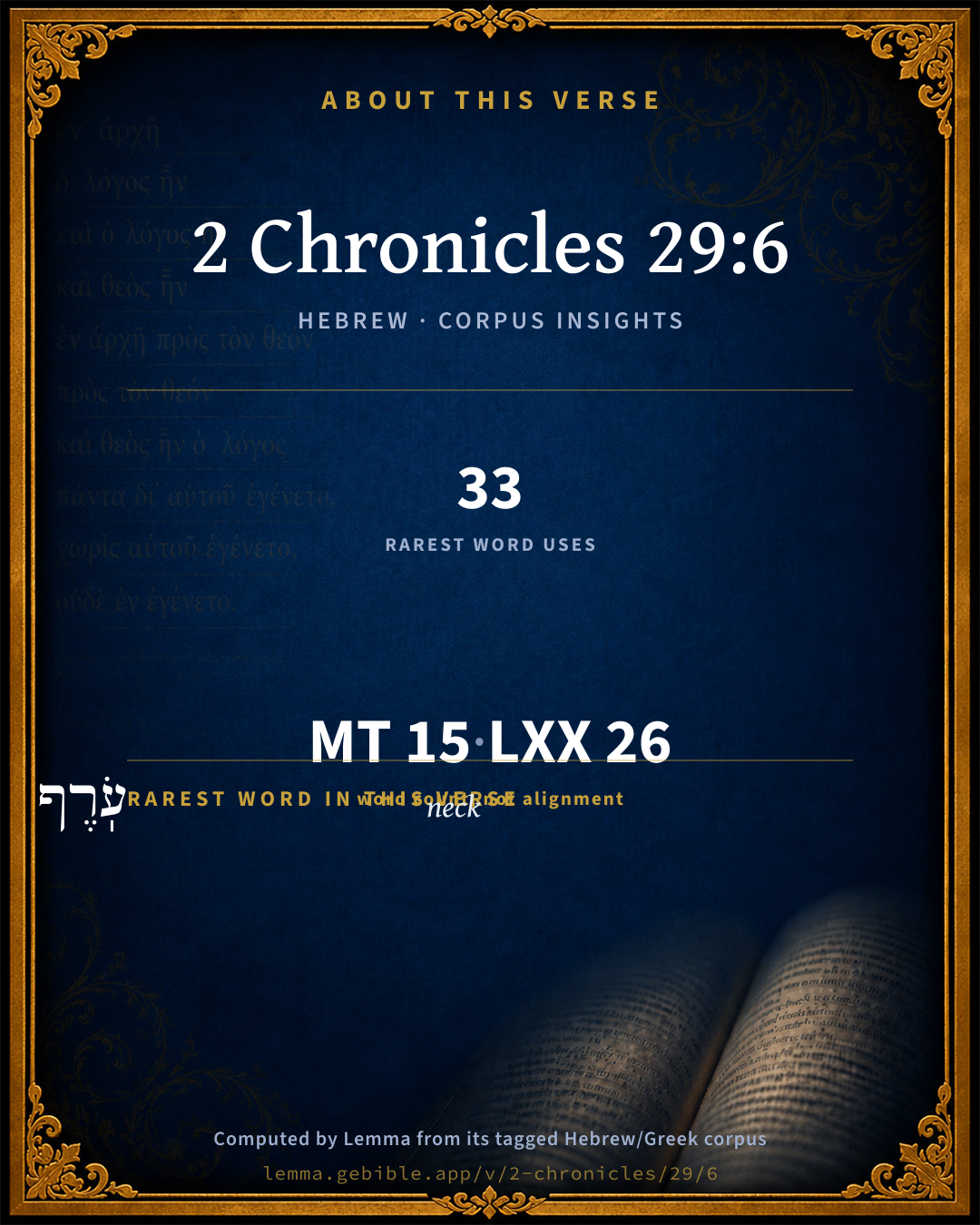
עֹֽרֶף
ʻôreph
H6203
“neck”
Noun, Common, Masculine, Singular, Absolute
Part of Speech
Noun
Type
Common
Gender
Masculine
Number
Singular
State
Absolute
Full BDB Definition

Origin: from H6202

TWOT: 1700a

neck, back of the neck, back - back of the neck - of fleeing foe - of apostasy (figuratively) - stiff of neck, obstinate (figuratively)
  1. כִּֽי kîy H3588 “that” Conjunction
  2. מָעֲל֣וּ mâʻal H4603 “to betray” Verb, Qal, Perfect, 3rd Person, Common, Plural
  3. אֲבֹתֵ֗ינוּ ʼâb H1 “fathers · our” Noun, Common, Masculine, Plural, Construct + Suffix, Personal, 1st Person, Common, Plural
  4. וְעָשׂ֥וּ ʻâsâh H6213 “and · to do” Conjunction + Verb, Qal, Perfect, 3rd Person, Common, Plural
  5. הָרַ֛ע raʻ H7451 “the · evil” Particle, Definite Article + Adjective, Adjective, Masculine, Singular, Absolute
  6. בְּעֵינֵ֥י ʻayin H5869 “in/at · eyes of” Preposition + Noun, Common, Both, Dual, Construct
  7. יְהוָֽה Yᵉhôvâh H3068 “LORD” Noun, Proper
  8. אֱלֹהֵ֖ינוּ ʼĕlôhîym H430 “God(s) · our” Noun, Common, Masculine, Plural, Construct + Suffix, Personal, 1st Person, Common, Plural
  9. וַיַּֽעַזְבֻ֑הוּ ʻâzab H5800 “and · to leave · him” Conjunction + Verb, Qal, Sequential Imperfect, 3rd Person, Masculine, Plural + Suffix, Personal, 3rd Person, Masculine, Singular
  10. וַיַּסֵּ֧בּוּ çâbab H5437 “and · to turn around” Conjunction + Verb, Hiphil, Sequential Imperfect, 3rd Person, Masculine, Plural
  11. פְנֵיהֶ֛ם pânîym H6440 “face(s) · their” Noun, Common, Both, Plural, Construct + Suffix, Personal, 3rd Person, Masculine, Plural
  12. מִמִּשְׁכַּ֥ן mishkân H4908 “from · dwelling place of” Preposition + Noun, Common, Masculine, Singular, Construct
  13. יְהוָ֖ה Yᵉhôvâh H3068 “LORD” Noun, Proper
  14. וַיִּתְּנוּ nâthan H5414 “and · to give” Conjunction + Verb, Qal, Sequential Imperfect, 3rd Person, Masculine, Plural

About this verse

These counts appear in no published source. They are computed here, from the morphology-tagged text and Lemma’s own curated glosses. What Lemma adds →

15
words
14
distinct lemmas
Historical
section

Shared distinctive vocabulary

עֹֽרֶף neck H6203 occurs in 32 verses of the Hebrew Bible. Also found in:

Grammatical profile

  • 5 verbs
  • 8 nouns
  • 1 adjective
  • 1 conjunction

Verb forms

  • מָעֲל֣וּ Qal · Perfect
  • וְעָשׂ֥וּ Qal · Perfect
  • וַיַּֽעַזְבֻ֑הוּ Qal · Sequential Imperfect
  • וַיַּסֵּ֧בּוּ Hiphil · Sequential Imperfect
  • וַיִּתְּנוּ Qal · Sequential Imperfect

Repetition

A word recurs within this verse — often emphatic in Hebrew:

  • יְהוָֽה LORD H3068 ×2

Hebrew & Septuagint length

In English translation the verse runs 37 words from the Hebrew and 37 from the Septuagint (LXX English) — the same length.

A rough comparison of the two English renderings, which tokenize alike — not a word-level alignment.

Word counts can differ between the Hebrew and the Greek without any difference in meaning — e.g. the Hebrew direct-object marker אֵת has no separate Greek word, and Greek often adds the article ὁ.

In the original languages it is 15 Hebrew tokens and 26 Greek tokens — but the two are counted differently (Hebrew bundles its prefixes and suffixes into one token; the Greek is in lemma form), so that isn’t a like-for-like length.

Cross-references

17

Topical passages linked to 2 Chronicles 29:6 in the Treasury of Scripture Knowledge — connected by theme and wording, ordered by reader-vote popularity; previews shown in the World English Bible.

  • Ezekiel 8:16 He brought me into the inner court of Yahweh's house; and see, at the door of the temple of Yahweh, between the porch and the altar, were about twenty-five men, with their backs toward the temple of Yahweh, and their faces toward the east; and they were worshipping the sun toward the east.
  • Jeremiah 2:27 who tell a stock, You are my father; and to a stone, You have brought me forth: for they have turned their back to me, and not their face; but in the time of their trouble they will say, Arise, and save us.
  • 2 Chronicles 28:2–4 but he walked in the ways of the kings of Israel, and made also molten images for the Baals.
  • 2 Chronicles 28:23–25 For he sacrificed to the gods of Damascus, which struck him; and he said, Because the gods of the kings of Syria helped them, [therefore] will I sacrifice to them, that they may help me. But they were the ruin of him, and of all Israel.
  • 2 Chronicles 34:21 Go you, inquire of Yahweh for me, and for those who are left in Israel and in Judah, concerning the words of the book that is found; for great is the wrath of Yahweh that is poured out on us, because our fathers have not kept the word of Yahweh, to do according to all that is written in this book.
  • Ezra 5:12 But after that our fathers had provoked the God of heaven to wrath, he gave them into the hand of Nebuchadnezzar king of Babylon, the Chaldean, who destroyed this house, and carried the people away into Babylon.
  • Ezra 9:7 Since the days of our fathers we have been exceeding guilty to this day; and for our iniquities have we, our kings, and our priests, been delivered into the hand of the kings of the lands, to the sword, to captivity, and to plunder, and to confusion of face, as it is this day.
  • Nehemiah 9:16 But they and our fathers dealt proudly and hardened their neck, and didn't listen to your commandments,
  • Nehemiah 9:32 Now therefore, our God, the great, the mighty, and the awesome God, who keep covenant and loving kindness, don't let all the travail seem little before you, that has come on us, on our kings, on our princes, and on our priests, and on our prophets, and on our fathers, and on all your people, since the time of the kings of Assyria to this day.
  • Jeremiah 2:13 For my people have committed two evils: they have forsaken me, the spring of living waters, and hewed them out cisterns, broken cisterns, that can hold no water.
  • Jeremiah 2:17 Haven't you procured this to yourself, in that you have forsaken Yahweh your God, when he led you by the way?
  • Jeremiah 16:19 Yahweh, my strength, and my stronghold, and my refuge in the day of affliction, to you shall the nations come from the ends of the earth, and shall say, Our fathers have inherited nothing but lies, [even] vanity and things in which there is no profit.
  • Jeremiah 44:21 The incense that you burned in the cities of Judah, and in the streets of Jerusalem, you and your fathers, your kings and your princes, and the people of the land, didn't Yahweh remember them, and didn't it come into his mind?
  • Lamentations 5:7 Our fathers sinned, and are no more; We have borne their iniquities.
  • Daniel 9:16 Lord, according to all your righteousness, let your anger and please let your wrath be turned away from your city Jerusalem, your holy mountain; because for our sins, and for the iniquities of our fathers, Jerusalem and your people are become a reproach to all who are round about us.
  • Matthew 10:37 He who loves father or mother more than me is not worthy of me; and he who loves son or daughter more than me isn't worthy of me.
  • Matthew 23:30–32 and say, 'If we had lived in the days of our fathers, we wouldn't have been partakers with them in the blood of the prophets.'

Cross-references courtesy of OpenBible.info (CC BY 4.0).

Hebrew and Greek witnesses Masoretic Hebrew ↔ Greek Septuagint

The same verse in the two great witnesses to the Old Testament, shown verse-for-verse.

These are two independent witnesses, not word-aligned to each other, and the Septuagint is shown in lemma (dictionary) form.

Hebrew 2 Chronicles 29:6 Masoretic · Westminster Leningrad Codex

כִּֽי מָעֲל֣וּ אֲבֹתֵ֗ינוּ וְעָשׂ֥וּ הָרַ֛ע בְּעֵינֵ֥י יְהוָֽה אֱלֹהֵ֖ינוּ וַיַּֽעַזְבֻ֑הוּ וַיַּסֵּ֧בּוּ פְנֵיהֶ֛ם מִמִּשְׁכַּ֥ן יְהוָ֖ה וַיִּתְּנוּ עֹֽרֶף

For our fathers have trespassed, and done that which was evil in the sight of Yahweh our God, and have forsaken him, and have turned away their faces from the habitation of Yahweh, and turned their backs.

World English Bible · Public Domain

Greek LXX 2 Chronicles 29:6 Septuagint · lemma form

ὅτι ἀποἵστημι ὁ πατήρ ἐγώ καί ποιέω ὁ πονηρός ἐναντίον κύριος καί ἐν καταλείπω αὐτός καί ἀποστρέφω ὁ πρόσωπον ἀπό ὁ σκηνή κύριος καί δίδωμι αὐχήν

For our fathers have revolted, and done that which was evil before the Lord our God, and have forsaken him, and have turned away their face from the tabernacle of the Lord, and have turned their back.

LXX2012 (modern English Septuagint) · Public Domain

Hebrew: Westminster Leningrad Codex (CC BY 4.0). Greek: Septuagint (public domain); English from LXX2012 (modern English Septuagint) (Public Domain). How the Septuagint differs from the Hebrew →

Commentary

Notes on 2 Chronicles 29:6 from classic Christian and Jewish commentators (each source and its license shown beneath its notes). The classic Christian expositions comment on the surrounding passage and are grouped to its opening verse, so a note may address several verses; the Jewish commentaries on the Tanakh (Rashi and others) are per-verse, so they appear only where the commentator wrote on this verse.

Lemma curates 59 commentaries, every one of them public domain or Creative Commons licensed, each selected and text-cleaned for this edition rather than reprinted as found. About our sources →

Trapp's Complete Commentary

John Trapp

2Ch 29:6 For our fathers have trespassed, and done [that which was] evil in the eyes of the LORD our God, and have forsaken him, and have turned away their faces from the habitation of the LORD, and turned [their] backs.

Ver. 6. And have turned their backs.] With greatest scorn and disdain, openly, basely, and opprobriously.

John Trapp, A Commentary or Exposition upon All the Books of the Old and New Testament (1647–1656) — public domain. Text from a community e-Sword module.

Joseph Benson's Commentary

2Ch 29:6. Our fathers have trespassed — He does not say my father, because it became him, as a son, to be as tender as might be of his father’s name; and because his father would not have been permitted to do all these things, if the people had not neglected their duty. Urijah the priest, in particular, had joined with Ahaz in setting up an idolatrous altar. Have turned away their faces, &c., and turned their backs — Have wilfully and obstinately forsaken God and his worship; that posture being a signification of contempt.

Joseph Benson's Commentary on the Old and New Testaments (1811–1818) — public domain. Text from a community e-Sword module.

Jamieson, Fausset & Brown

Robert Jamieson, A. R. Fausset & David Brown

our fathers have trespassed--Ahaz and the generation contemporary with him were specially meant, for they "turned away their faces from the habitation of the Lord," and whether or not they turned east to the rising sun, they abandoned the worship of God. They "shut up the doors of the porch," so that the sacred ritual was entirely discontinued.

Jamieson, Fausset & Brown — Commentary Critical and Explanatory on the Whole Bible (1871) — public domain (CC PDM 1.0). Text via the HelloAO Bible API.

Ellicott's Commentary for English Readers

(6) Trespassed.—Dealt unfaithfully.

Turned away their faces from the habitation of the Lord.—Comp. Jer_2:27 : “They have turned their backs unto me, and not their faces.” (Comp. also Eze_8:16.)

Turned their backs.—Literally, gave neck (nathan ‘ôreph); a phrase here used as equivalent to turned neck (pânâh ‘ôreph), Jer_2:27, et al. The ordinary meaning is “to put to flight,” as in Psa_18:41. It is clear from the next verse that the description is meant to apply to Ahaz and his generation.

A Bible Commentary for English Readers, edited by Charles John Ellicott (1878–1897) — public domain. Text from a community e-Sword module.

The Cambridge Bible for Schools and Colleges

gen. ed. J. J. S. Perowne

6. from the habitation of the Lord] Cp. 2Ch_24:18 “they left the house of the Lord” (see note).

habitation] Heb. “tabernacle,” as in Exo_25:9, al.

The Cambridge Bible for Schools and Colleges (gen. ed. J. J. S. Perowne; Cambridge University Press, 1878–1918) — public domain. Text from a community e-Sword module.

John Gill's Exposition

Also they have shut up the doors of the porch,.... So that there was no entering into the temple, Ch2 28:24.

and put out the lamps; for the priests not being able to go in morning and evening to light them, and dress them, they in course went out; the Jews say (n), that on the eighteenth of Ab, which answers to part of July and August, the western lamp was extinct in the days of Ahaz, for which a fast was kept on that day:

and have not burnt incense, nor offered burnt offerings in the holy place unto the God of Israel; but had done these in the high places to idols, Ch2 28:3.

(n) Schulchan Aruch, par. 1. c. 580. sect. 2.

John Gill's Exposition of the Whole Bible (1746–1763) — public domain (CC PDM 1.0). Text via the HelloAO Bible API.

Matthew Poole's English Annotations

Either,

1. Metaphorically; they have wilfully, and obstinately, and contumeliously forsaken God, and his house and worship; that posture being a signification of contempt. Or,

2. Literally and properly. For Ahaz having removed the altar of God into a by-place, 2Ki 16, and directing his worship towards the east, after the manner of the heathens, whom he designed to follow; and not to the west, as the Israelites did by God’s command, in which quarter the ark was; he must needs consequently turn his back upon the altar, and house, and ark of God.

Matthew Poole's English Annotations on the Holy Bible (1683–1685) — public domain. Text from a community e-Sword/MySword module.

Whedon's Commentary on the Bible

Daniel D. Whedon

6. Our fathers have trespassed — He calls no names, but means Ahaz and his contemporaries.

Daniel D. Whedon (gen. ed.), Commentary on the Old and New Testaments (1874–1909) — public domain. Text from a community e-Sword module.

John Wesley's Explanatory Notes

Turned, &c. - They have wilfully and obstinately forsaken God and his worship; that posture being a signification of contempt.

John Wesley, Explanatory Notes Upon the Whole Bible (1754–1765) — public domain. Text via the GEBible commentary corpus.

unfoldingWord translationNotes

Door43 World Missions Community

what was evil in the sight of Yahweh our God

The word "sight" here represents judgment. Yahweh saw and did not approve of their ancestors' actions. AT: "what Yahweh our God judged to be evil" or "what Yahweh our God considered to be evil" (See: Metaphor)

turned away their faces from the place where Yahweh lives, and turned their backs on it

These two phrases share similar meanings. The words "faces" and "backs" represent the people who turned so that their faces were away from the temple and their backs were towards it. AT: "turned away from the place where Yahweh lives" (See: Parallelism and Synecdoche)

turned away their faces from the place where Yahweh lives, and turned their backs on it

Rejecting Yahweh and no longer worshiping him is spoken of as if the people had turned away from the temple. AT: "abandoned Yahweh's temple and stopped worshiping him" (See: Metaphor)

the place where Yahweh lives

This refers to the temple. AT: "the temple where Yahweh lives" (See: Assumed Knowledge and Implicit Information)

translationWords

trespass

God

forsake

incense

burnt offering

Israel

unfoldingWord translationNotes — © Distant Shores Media and the Door43 World Missions Community, licensed CC BY-SA 4.0. Source: git.door43.org/Door43/en_tn.

Lesson kit

Teaching starters — assembled from the data on this page, not authored interpretation. Every prompt links to the verse data it draws on. Edit before teaching.

2 Chronicles, in the Historical, opens this verse with 15 words (14 distinct Hebrew lemmas). Its most distinctive word is ʻôreph (“neck”). A historical commentator’s framing appears above. Read the whole chapter for the surrounding context.

Discussion questions

  1. What does “neck” (ʻôreph) contribute to the verse as a whole?
  2. How does Genesis 49:8, which shares the word «neck», read alongside this verse?
  3. What does the repetition of “LORD” (2× in this one verse) do in this verse?
  4. The translations on this page render this verse differently — a whole-verse word diff, not a word-by-word alignment. What might account for the different wordings?
  5. «מָעֲל֣וּ» is a Qal Perfect verb. How does that grammatical form shape the action described?
  6. Compare how Trapp's Complete Commentary and Joseph Benson's Commentary read this verse. Where do they agree or differ?

Things to notice

Reading settings

Reading text

Shown beneath each verse's original-language words.

Old Testament
Old Testament edition

Read the OT as the Masoretic Hebrew (MT) or the Greek Septuagint (LXX).

English shown for the Greek Septuagint (in the Hebrew ↔ Greek comparison).

Comparing translations? Open the Compare panel on any verse page to stack up to four side by side.