
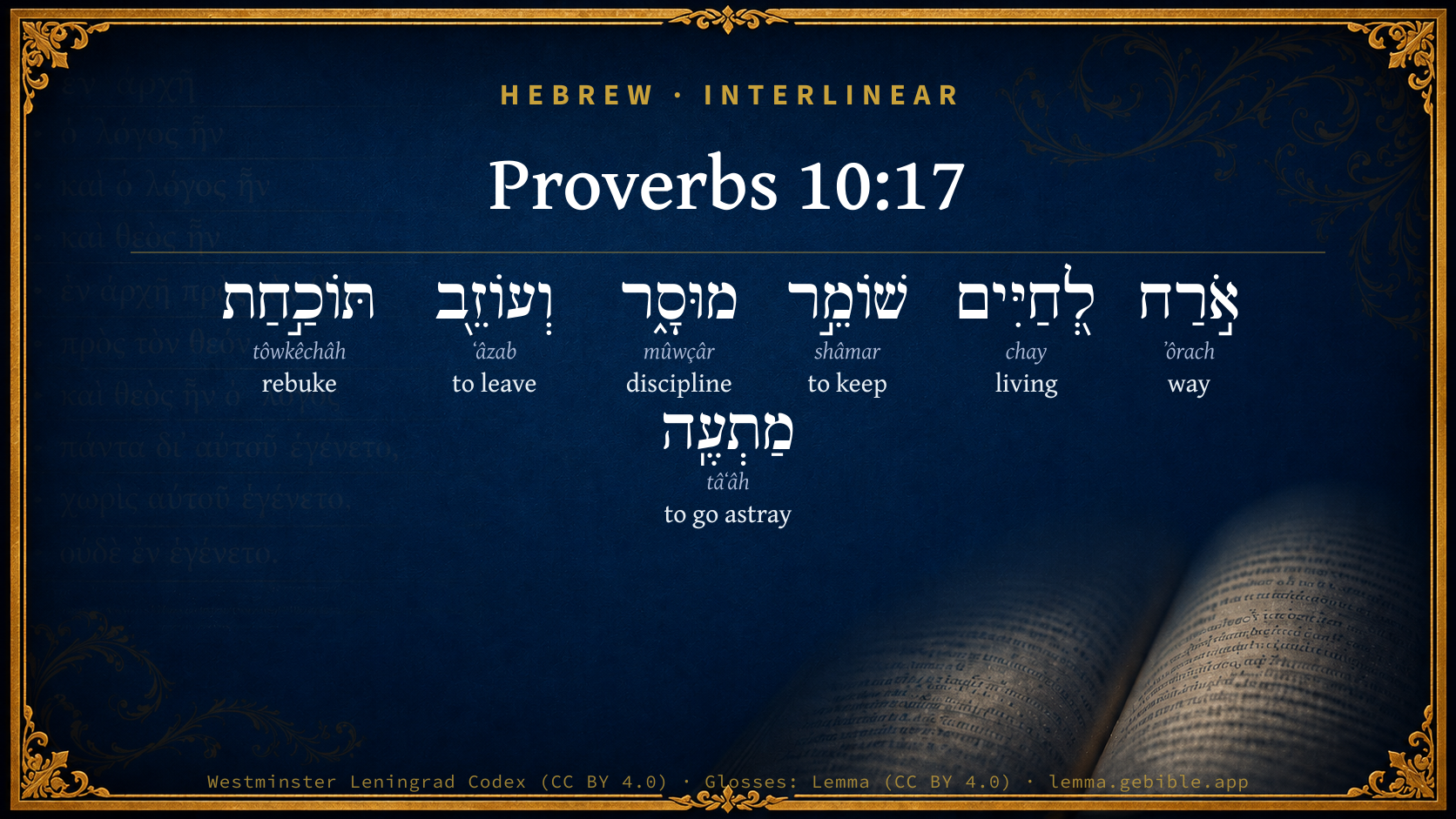
Proverbs 10:17

Hebrew (Westminster Leningrad Codex) Proverbs 10:17 appears in the Hebrew Old Testament. The text above is from the Westminster Leningrad Codex. Each word links to its Strong’s number, a concise gloss, and parsing drawn from the Open Scriptures Hebrew Bible morphology. Click any word for its full Brown-Driver-Briggs (BDB) entry.
Download image
Cite this verse

Proverbs 10:17 (World English Bible). Public Domain. Lemma interlinear Bible study tool, https://lemma.gebible.app/v/proverbs/10/17.

Show BibTeX & RIS
BibTeX
RIS
English Translation
He is in the way of life who heeds correction, But he who forsakes reproof leads others astray.
World English Bible · Public Domain
Download a study sheet

One document with this verse’s original text, its word-by-word gloss line, the meaning frame, cross-references with their text, attributed commentary, and full source and license credits — printable, and it pastes into notes with its structure intact.

This verse Autodidact and up

Study sheet (.html) Plain text (.txt)

A passage Seminary Student

Up to 50 verses in one chapter. A passage sheet keeps up to 6 commentary sources and 12 cross-references per verse, in the order this page ranks them, and says so on the sheet whenever that leaves anything out. Ask for a single verse and you get the Autodidact verse sheet above.

Everything on this page stays free to read, with no account — the sheet is a download of what is already on screen, not access to it.

Want to remove ads? Support Godless Engineer
Compare translations 3

The same verse in 3 English versions, stacked beneath the original-language interlinear above. Click any original word for its lexicon entry.

Each is an independent rendering of the whole verse — the interlinear is not word-aligned to these translations.

Highlighted words mark where these versions differ — a whole-verse word diff, not a word-by-word alignment.

  • World English Bible Public Domain
    He is in the way of life who heeds correction, But he who forsakes reproof leads others astray.
  • King James Version Public Domain
    He is in the way of life that keepeth instruction: but he that refuseth reproof erreth.
  • unfoldingWord Literal Text CC BY-SA 4.0
    a path to life one who keeps instruction, but one who forsakes rebuke goes astray.

unfoldingWord Literal Text — © unfoldingWord, licensed CC BY-SA 4.0. Word-aligned USFM3 via Door43 (git.door43.org/unfoldingWord/en_ult).

Versions to compare (up to 4)

3 of 4 selected

Show all 18 translations

Every available English version of this verse, each an independent rendering of the whole verse.

  • World English Bible Public Domain
    He is in the way of life who heeds correction, But he who forsakes reproof leads others astray.
  • Berean Standard Bible Public Domain
    Whoever heeds instruction is on the path to life, but he who ignores reproof goes astray.
  • Majority Standard Bible Public Domain
    Whoever heeds instruction is on the path to life, but he who ignores reproof goes astray.
  • King James Version Public Domain
    He is in the way of life that keepeth instruction: but he that refuseth reproof erreth.
  • American Standard Version (1901) Public Domain
    He is in the way of life that heedeth correction; But he that forsaketh reproof erreth.
  • Revised Version (1885) Public Domain
    He is in the way of life that heedeth correction: but he that forsaketh reproof erreth.
  • Geneva Bible (1599) Public Domain
    He that regardeth instruction, is in the way of life: but he that refuseth correction, goeth out of the way.
  • Douay-Rheims (1899) Public Domain
    The way of life, to him that observeth correction: but he that forsaketh reproofs goeth astray.
  • Young's Literal Translation Public Domain
    A traveller to life `is' he who is keeping instruction, And whoso is forsaking rebuke is erring.
  • Literal Standard Version CC BY-SA 4.0
    A traveler to life [is] he who is keeping instruction, || And whoever is forsaking rebuke is erring.
  • Unlocked Literal Bible CC BY-SA 4.0
    There is a path to life for the one who follows discipline, but the one who rejects correction is led astray.
  • unfoldingWord Literal Text CC BY-SA 4.0
    a path to life one who keeps instruction, but one who forsakes rebuke goes astray.
  • Darby Bible Public Domain
    Keeping instruction is the path to life; but he that forsaketh reproof goeth astray.
  • World Messianic Bible Public Domain
    He is in the way of life who heeds correction, but he who forsakes reproof leads others astray.
  • Webster's Bible Public Domain
    He is in the way of life that keepeth instruction: but he that refuseth reproof erreth.
  • Free Bible Version CC BY-SA 4.0
    If you accept instruction, you're on the path to life, but if you reject correction you'll go astray.
  • Bible in Basic English Public Domain
    He who takes note of teaching is a way of life, but he who gives up training is a cause of error.
  • JPS Tanakh (1917) Public Domain
    He is in the way of life that heedeth instruction; but he that forsaketh reproof erreth.

Literal Standard Version (2020), Covenant Press — licensed CC BY-SA 4.0. Text via the HelloAO Bible API (eBible.org). Unlocked Literal Bible (unfoldingWord) — licensed CC BY-SA 4.0. Text via the HelloAO Bible API (eBible.org). unfoldingWord Literal Text — © unfoldingWord, licensed CC BY-SA 4.0. Word-aligned USFM3 via Door43 (git.door43.org/unfoldingWord/en_ult). Free Bible Version, Dr. Jonathan Gallagher — licensed CC BY-SA 4.0. Text via the HelloAO Bible API (eBible.org).

Word by word

More ways to search: Search by grammar → Find every occurrence → Compare this word →

Practice this passage: Drill this verse → Learn its vocabulary →

About this verse

These counts appear in no published source. They are computed here, from the morphology-tagged text and Lemma’s own curated glosses. What Lemma adds →

7
words
7
distinct lemmas
Wisdom
section

Shared distinctive vocabulary

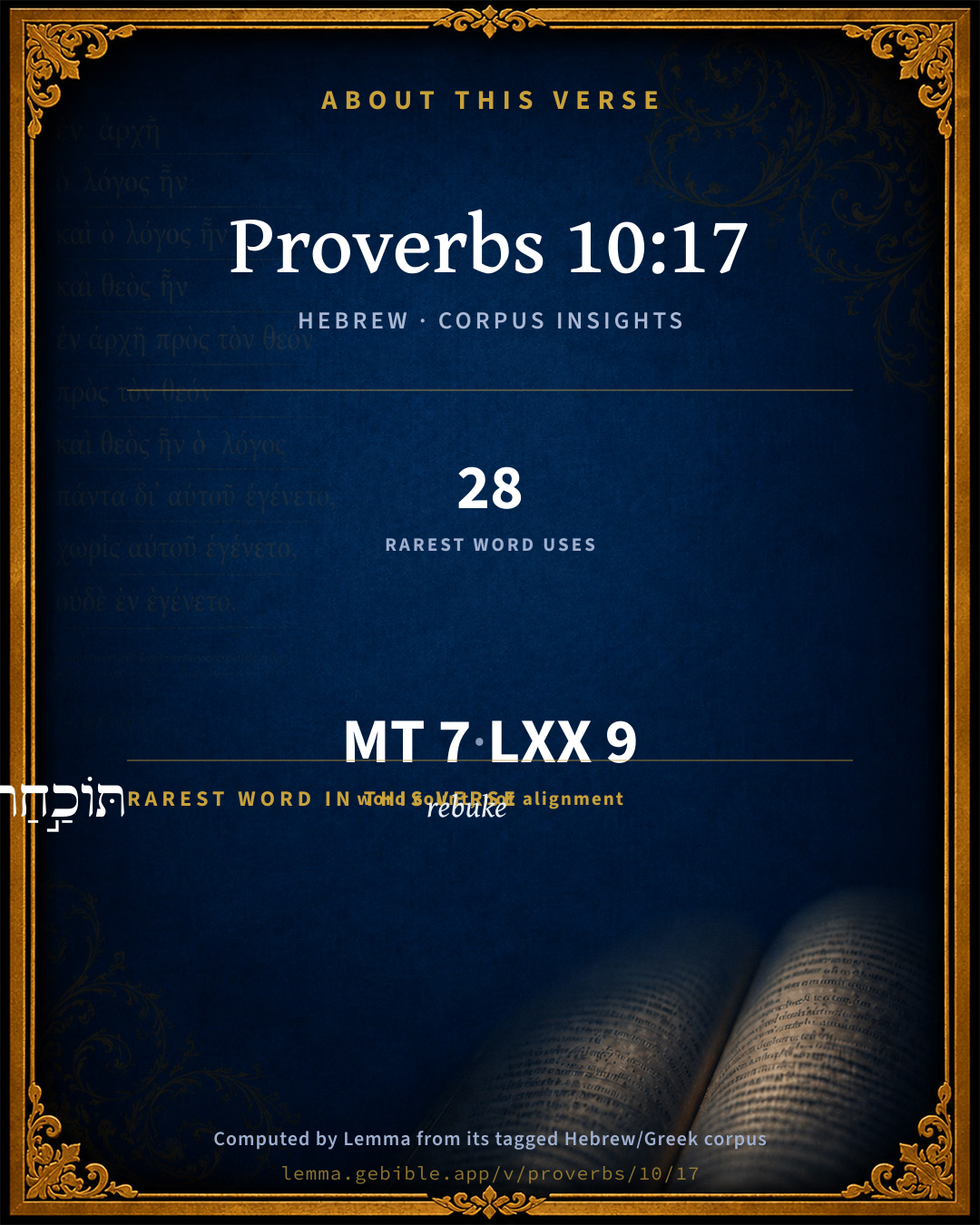
תּוֹכַ֣חַת rebuke H8433 occurs in 28 verses of the Hebrew Bible. Also found in:

Grammatical profile

  • 3 verbs
  • 4 nouns

Verb forms

  • שׁוֹמֵ֣ר Qal · Participle Active
  • וְעוֹזֵ֖ב Qal · Participle Active
  • מַתְעֶֽה Hiphil · Participle Active

Hebrew & Septuagint length

In English translation the verse runs 18 words from the Hebrew and 12 from the Septuagint (LXX English) — the Septuagint runs noticeably shorter here. See the side-by-side →

A rough comparison of the two English renderings, which tokenize alike — not a word-level alignment.

Word counts can differ between the Hebrew and the Greek without any difference in meaning — e.g. the Hebrew direct-object marker אֵת has no separate Greek word, and Greek often adds the article ὁ.

In the original languages it is 7 Hebrew tokens and 9 Greek tokens — but the two are counted differently (Hebrew bundles its prefixes and suffixes into one token; the Greek is in lemma form), so that isn’t a like-for-like length.

Cross-references

18

Topical passages linked to Proverbs 10:17 in the Treasury of Scripture Knowledge — connected by theme and wording, ordered by reader-vote popularity; previews shown in the World English Bible.

  • 2 Peter 1:5–11 Yes, and for this very cause adding on your part all diligence, in your faith supply moral excellence; and in moral excellence, knowledge;
  • Proverbs 15:10 There is stern discipline for one who forsakes the way: Whoever hates reproof shall die.
  • Proverbs 5:12 And say, "How I have hated instruction, And my heart despised reproof;
  • Proverbs 6:23 For the commandment is a lamp, And the law is light. Reproofs of instruction are the way of life,
  • Luke 11:28 But he said, "On the contrary, blessed are those who hear the word of God, and keep it."
  • Proverbs 3:18 She is a tree of life to those who lay hold of her. Happy is everyone who retains her.
  • Proverbs 4:13 Take firm hold of instruction. Don't let her go. Keep her, for she is your life.
  • Proverbs 12:1 Whoever loves correction loves knowledge, But he who hates reproof is stupid.
  • Proverbs 3:1–2 My son, don't forget my teaching; But let your heart keep my commandments:
  • Proverbs 29:1 He who is often rebuked and stiffens his neck Will be destroyed suddenly, with no remedy.
  • Matthew 7:24–27 "Everyone therefore who hears these words of mine, and does them, I will liken him to a wise man, who built his house on a rock.
  • Proverbs 1:25–26 But you have ignored all my counsel, And wanted none of my reproof;
  • Proverbs 4:4 He taught me, and said to me: "Let your heart retain my words. Keep my commandments, and live.
  • Ecclesiastes 5:6 Don't allow your mouth to lead you into sin. Don't protest before the messenger that this was a mistake. Why should God be angry at your voice, and destroy the work of your hands?
  • Proverbs 1:30 They wanted none of my counsel. They despised all my reproof.
  • Hebrews 2:1 Therefore we ought to pay greater attention to the things that were heard, lest perhaps we drift away.
  • Hebrews 12:25 See that you don't refuse him who speaks. For if they didn't escape when they refused him who warned on the Earth, how much more will we not escape who turn away from him who warns from heaven,
  • 2 Chronicles 25:16 It happened, as he talked with him, that [the king] said to him, Have we made you of the king's counsel? Stop! Why should you be struck down? Then the prophet stopped, and said, I know that God has determined to destroy you, because you have done this, and have not listened to my counsel.

Cross-references courtesy of OpenBible.info (CC BY 4.0).

Hebrew and Greek witnesses Masoretic Hebrew ↔ Greek Septuagint

The same verse in the two great witnesses to the Old Testament, shown verse-for-verse.

Here the Septuagint runs noticeably shorter than the Hebrew — LXX2012 (modern English Septuagint) 12 words vs World English Bible 18. A rough length comparison of the two English translations, not a word-level alignment — read both below.

These are two independent witnesses, not word-aligned to each other, and the Septuagint is shown in lemma (dictionary) form.

Hebrew Proverbs 10:17 Masoretic · Westminster Leningrad Codex

אֹ֣רַח לְ֭חַיִּים שׁוֹמֵ֣ר מוּסָ֑ר וְעוֹזֵ֖ב תּוֹכַ֣חַת מַתְעֶֽה

He is in the way of life who heeds correction, But he who forsakes reproof leads others astray.

World English Bible · Public Domain

Greek LXX Proverbs 10:17 Septuagint · lemma form

ὁδός δίκαιος ζωή φυλάσσω παιδεία παιδεία δέ ἀνεξέλεγκτος πλανάω

Instruction keeps the right ways of life; but instruction unchastened goes astray.

LXX2012 (modern English Septuagint) · Public Domain

On this verse, The Pulpit Commentary discusses the Septuagint’s reading. Read the note in Commentary ↓

Hebrew: Westminster Leningrad Codex (CC BY 4.0). Greek: Septuagint (public domain); English from LXX2012 (modern English Septuagint) (Public Domain). How the Septuagint differs from the Hebrew →

Commentary

Notes on Proverbs 10:17 from classic Christian and Jewish commentators (each source and its license shown beneath its notes). The classic Christian expositions comment on the surrounding passage and are grouped to its opening verse, so a note may address several verses; the Jewish commentaries on the Tanakh (Rashi and others) are per-verse, so they appear only where the commentator wrote on this verse.

Lemma curates 59 commentaries, every one of them public domain or Creative Commons licensed, each selected and text-cleaned for this edition rather than reprinted as found. About our sources →

Trapp's Complete Commentary

John Trapp

Pro 10:17 He [is in] the way of life that keepeth instruction: but he that refuseth reproof erreth.

Ver. 17. He is in the way of life.] Rich fools refuse reproof; hold themselves above admonition, Tange montes et fumigabunt, and are therefore, by the just judgment of God, led through a fool’s paradise into a true prison. Divitibus ideo amicus deest, quia nihil deest. Rich men have few faithful counsellors.

John Trapp, A Commentary or Exposition upon All the Books of the Old and New Testament (1647–1656) — public domain. Text from a community e-Sword module.

Joseph Benson's Commentary

Pro 10:17. He is in the way of life — The way which leadeth to life and blessedness; that keepeth instruction — That observeth the wholesome counsels of God and good men: but he that refuseth reproof erreth — Namely, from the way of life, or into the ways of sin, and so of death. Hebrew, מתעה, causeth to err, or seduceth, namely, himself: he knowingly and willingly exposes himself to temptation and wickedness, because he rejects that admonition which is a proper preservative from it.

Joseph Benson's Commentary on the Old and New Testaments (1811–1818) — public domain. Text from a community e-Sword module.

The Preacher's Complete Homiletical Commentary

Joseph S. Exell (gen. ed.)

CRITICAL NOTES.—

Pro_10:17. Not, He is in the way, but “He is the way.” Erreth, causeth others to err.

MAIN HOMILETICS OF Pro_10:17

THE INFLUENCE OF EXAMPLE

We take here the rendering of all recent commentators as given in the Critical Notes, and understand the verse to set forth the truth that “no man liveth to himself.” His character is reproduced in others.

I. A good man is a way, because he is the means to an end. The way to the city is the road by which we reach it. The life of a holy man is a way to spiritual and eternal life, because it is the means by which men come home to God. If there were no good men in the world, there would be no means by which sinners could be brought from death unto life. Christ is pre-eminently “the way,” because His life is the great means by which men learn to know and to return to God. “No man cometh unto the Father but by Me” (Joh_14:6). The longer a path is trodden the more distinctly it proclaims itself as a way. So a good man becomes a more evident way the longer he lives. A good life is so distinct in its teachings that both sage and savage are compelled to admit its influence, and the longer it exerts its power for good the more pronounced it becomes. The Son of God has for ages been the way to life, and the longer He continues to be so the more distinctly is He seen to be the means to this end.

II. The conditions to be fulfilled in order to become a way of life.

1. The man must keep instruction. It is not enough to receive it. The Word of God must not only be heard, but must be remembered. The commandments of God must not only be received, but must be kept. “If ye know these things, happy are ye if ye do them” (Joh_13:17).

2. He must submit to discipline even when it takes the form of reproof. This is implied in the last clause of the verse, “He that refuseth reproof causeth to err.” The man who has attained a position in any profession, and has thereby become qualified to lead others, has done so because he has submitted to discipline even when it has been in the unpalatable form of reproof. Such a man can well exhort others to submit to that by which he has become fit to be their guide. Even the Son of God “learned obedience by the things which He suffered” (Heb_5:8).

III. An ungodly man injures others as well as himself. He not only wanders from the path himself, but he “causeth (others) to err.” We often hear it said of a godless man—of one “who refuseth reproof”—that “he is nobody’s enemy but his own.” This cannot be. It has been truly said that “nothing leaves us wholly as it found us. Every man we meet, every book we read, every picture or landscape we see, every word or tone we hear, mingles with our being and modifies it.” This being so, every man makes every man with whom he comes in contact better or worse, and as every good man draws others into the path of life, so every man who refuses to submit to Divine discipline drags others with him in the broad road that leads to destruction.

OUTLINES AND SUGGESTIVE COMMENTS

St. Basil, answering the question, “With what mind anyone ought to receive the instructions of reproof administered unto him,” giveth this answer, “With the same mind that befitteth him who, being sick of some disease and troubled for the preserving of life, receiveth a medicine, namely, with the greatest desire of recovering his health.” For there is a way of life though a man be not sick but dead unto sin. And the hand that putteth into this way is instruction, and that which must keep us in the way is the keeping of instruction: for he that refuseth reproof erreth, erreth in refusing, erreth more by refusing.—Jermin.

This is the idea of other verses (11–13): that a man going to heaven blazes a path for others. He is a way. Others travel upon him in his prayers and in his example.—Miller.

The Preacher's Complete Homiletical Commentary (gen. ed. Joseph S. Exell; Funk & Wagnalls, c. 1892) — public domain (pre-1929). A full-Bible homiletical/sermon-outline anthology covering 65 of 66 books (2 John is absent from the source module). Text from a community e-Sword module.

Tyndale Open Study Notes

Tyndale Open Resources

10:17 Wise people are not afraid to have their thinking or behavior corrected—they accept discipline as an opportunity to grow in wisdom.

Tyndale Open Study Notes — © Tyndale Open Resources, licensed CC BY-SA 4.0. Text via the HelloAO Bible API.

Matthew Henry's Commentary

See here, 1. That those are in the right that do not only receive instruction, but retain it, that do not let it slip through carelessness, as most do, nor let it go to those that would rob them of it, that keep instruction safely, keep it pure and entire, keep it for their own use, that they may govern themselves by it, keep it for the benefit of others, that they may instruct them; those that do so are in the way of life, the way that has true comfort in it and eternal life at the end of it. 2. That those are in the wrong that do not only not receive instruction, but wilfully and obstinately refuse it when it is offered them. They will not be taught their duty because it discovers their faults to them; that instruction which carries reproof in it they have a particular aversion to, and certainly they err; it is a sign that they err in judgment, and have false notions of good and evil; it is a cause of their erring in conversation. The traveller that has missed his way, and cannot bear to be told of it and shown the right way, must needs err still, err endlessly; he certainly misses the way of life.

Matthew Henry's Commentary on the Whole Bible (1708–1710) — public domain (CC PDM 1.0). Text via the HelloAO Bible API.

Jamieson, Fausset & Brown

Robert Jamieson, A. R. Fausset & David Brown

keepeth--observes (Pro 3:18; Pro 4:22).

refuseth--or, "turns from reproof," which might direct him aright.

Jamieson, Fausset & Brown — Commentary Critical and Explanatory on the Whole Bible (1871) — public domain (CC PDM 1.0). Text via the HelloAO Bible API.

Adam Clarke's Commentary

Verse 17. He is in the way of life] The truly religious man accumulates knowledge that he may the better know how to live to God, and do most good among men.

Adam Clarke's Commentary on the Bible (1810–1826) — public domain. Text from a community e-Sword/MySword module.

Ellicott's Commentary for English Readers

(17) Erreth.—Literally, committeth error. This is probably the true sense, and harmonises better with being “in the way of life,” which occurs just before, than the marginal rendering, “causeth to err.” The word occurs in a similar sense in Jer_42:20 (there translated, “ye have dissembled”).

A Bible Commentary for English Readers, edited by Charles John Ellicott (1878–1897) — public domain. Text from a community e-Sword module.

The Cambridge Bible for Schools and Colleges

gen. ed. J. J. S. Perowne

17. in the way &c.] Rather (with R.V. marg.),

A way of life is he that heedeth correction:

But he that forsaketh reproof causeth to err.

The one by his example and influence is a way of life to his fellow men; in measure and degree he can say what only the Perfect Example could say fully, “I am the way.” The other on the contrary not only goes himself, but leads others, astray.

The Cambridge Bible for Schools and Colleges (gen. ed. J. J. S. Perowne; Cambridge University Press, 1878–1918) — public domain. Text from a community e-Sword module.

John Gill's Exposition

He is in the way of life,.... Of eternal life, which is truly, properly, and by way of eminency, "life", Mat 19:17; and which is a life of glory; a life of perfection, of perfect holiness, knowledge, obedience, love, peace, and joy; a life free from all the inconveniences of the present life, animal or spiritual; a life of pleasure, and which will last for ever: the "way" to it is not by works of righteousness done by men, since by these the law is not fulfilled, nor justice satisfied; and therefore no justification of life by them, or what entitles to eternal life; it is sinful, dangerous, and a vain thing, to seek for eternal life in this way; Christ is the only true way to it; who, by his obedience, sufferings, and death, has opened the new and living way; and through his blood, righteousness, and sacrifice, way is made for all that believe in him to enter into eternal life: and such are in the way to it who are in Christ, secretly in election, openly in the effectual calling; when they are made new creatures, are quickened by the Spirit and grace of Christ, and have that principle in them which is a well of living water, springing up unto everlasting life; who have a sight of Christ, and come unto him by faith; who truly believe in him, with which eternal life is connected. Particularly he is in the way unto it

that keepeth instruction; the instruction in righteousness which the Scriptures give, especially the Gospel part of them; which is an instruction into the mind and will of God about man's salvation; into the grace of God, as displayed therein; into the person and offices of Christ, and salvation by him; into the doctrines of peace, pardon, righteousness, and life, through him. Now he to whom this instruction comes with power, and is the savour of life unto life; who receives it in the love of it; who "observes" (i) it, as the word here used signifies; takes notice of and follows its direction, pointing out Christ as the way of salvation, instructing to look to him and believe in him, and be saved; and who retains and holds fast such instruction, and abides by it; and finds the word of the Gospel, and eats it, and is nourished by it unto everlasting life; he is most assuredly in the way of it;

but he that refuseth reproof erreth; that is, from the way of life. He that rejects the counsel and advice, the admonitions and reproofs, given in the word of God, by the ministers of it; or by parents and masters, friends or relations, that wish him well; he wanders far off from the way that leads to life, and goes into the paths of sin, and consequently is in the way of death. Some render it, "causeth to err" (k); either others, as Aben Ezra; or both himself and others, as Jarchi: and then it may be understood of him "that forsaketh reproof" (l), as it may be rendered; that is, that declines giving reproof, when it lies in his way, and is his duty to do it. Aben Ezra reads this clause in connection with the former, as said of one and the same person,

"he is in the way of life that keepeth instruction, and forsakes or rejects the reproof of him that causeth to err.''

(i) "observat", Tigurine version; "servat", Cocceius; "observans", Schultens. (k) "faciens errare", Montanus, Gejerus; "seduceus sese", Tigurine version; "errare facit", some in Vatablus; "facit oberrare", Cocceius. (l) "qui relinquit increpationem", Pagninus; "deserens", Montanus, Schultens; "derelinquit", Piscator; "deserit", Cocceius.

John Gill's Exposition of the Whole Bible (1746–1763) — public domain (CC PDM 1.0). Text via the HelloAO Bible API.

Albert Barnes' Notes on the Bible

literally, A way of life is he that keepeth instruction. The verb “erreth” is better rendered in the margin. The influence for good or evil spreads beyond the man himself.

Albert Barnes' Notes on the Bible (1834–1885) — public domain. Text from a community e-Sword/MySword module.

Matthew Poole's English Annotations

The way of life; which leadeth to life and blessedness. That keepeth instruction; that observeth and obeyeth the wholesome counsels of God, and of good men.

Erreth, to wit, from the way of life, or into the ways of sin, and so of death; Heb. leadeth into error, or seduceth, to wit, himself, as appears by the opposition of this to the former clause; he wittingly and willingly exposeth himself to temptation and wickedness, because he rejecteth that admonition which is a proper preservative from it.

Matthew Poole's English Annotations on the Holy Bible (1683–1685) — public domain. Text from a community e-Sword/MySword module.

Whedon's Commentary on the Bible

Daniel D. Whedon

17. He is in the way of life — “A way of life is he that heedeth instruction.” — Zockler. So, substantially, Stuart and Miller. “He is himself a way to life.” As Miller says, “He blazes the way to heaven.”

Erreth — מתעה(math’heh;) causes others to err, leads astray. The sense of the verse is: The way of life (to others) is he that pre-serveth discipline; but he that neglects admonition causeth (others) to err; that is, he permits them to err by his neglect to admonish them. So, substantially, Zockler, Stuart, Conant, Fausset, Miller, etc.

Daniel D. Whedon (gen. ed.), Commentary on the Old and New Testaments (1874–1909) — public domain. Text from a community e-Sword module.

The Pulpit Commentary

He is in the way of life. (Pro_5:6) It is a way of life when a man keepeth instruction, taketh to heart what is taught by daily providences and the wisdom of experience. Such teachableness leads to happiness here and hereafter. Erreth; (Jer_42:20) not "causeth to err," as in the margin, which weakens the antithesis. Septuagint, "Instruction (paideia ) guardeth the ways of life, but he who is unaffected by instruction goeth astray". (comp. Heb_12:7, etc.)

The Pulpit Commentary (1880–1919), ed. H.D.M. Spence-Jones & Joseph S. Exell — public domain. Text from a community e-Sword module.

Keil & Delitzsch

C. F. Keil & F. Delitzsch

The group of proverbs now following bring again to view the good and bad effects of human speech. The seventeenth verse introduces the transition:

17 There is a way to life when one gives heed to correction;

And whoever disregards instruction runs into error.

Instead of ארח חיּים (Pro 5:6), there is here ארח לחיים; and then this proverb falls into rank with Pro 10:16, which contains the same word לחיים. The accentuation denotes ארח as subst.; for ארח way, road = ארח [a wayfarer, part. of ארח] would, as שׁסע, Lev 11:7, נטע, Psa 94:9, have the tone on the ultima. It is necessary neither to change the tone, nor, with Ewald, to interpret ארח as abstr. pro concreto, like הלך, for the expression "wanderer to life" has no support in the Mishle. Michaelis has given the right interpretation: via ad vitam est si quis custodiat disciplinam. The syntactical contents, however, are different, as e.g., Sa1 2:13, where the participle has the force of a hypothetical clause; for the expression: "a way to life is he who observes correction," is equivalent to: he is on the way to life who...; a variety of the manner of expression: "the porch was twenty cubits," Ch2 3:4, particularly adapted to the figurative language of proverbial poetry, as if the poet said: See there one observant of correction - that (viz., the שׁמר [שׁמר, to watch] representing itself in this שׁמר) is the way to life. מוּסר and תּוכחת are related to each other as παιδεία and ἔλεγχος; עזב [עזב, to leave, forsake] is equivalent to בּלתּי שׁמר. מתעה would be unsuitable as a contrast in the causative sense: who guides wrong, according to which Bertheau understands 17a, that only he who observes correction can guide others to life. We expect to hear what injuries he who thinks to raise himself above all reproach brings on himself. Hitzig, in his Commentary (1858), for this reason places the Hithpa. מתּעה (rather write מתּעה) in the place of the Hiph.; but in the Comm. on Jeremiah (1866), 42:20, he rightly remarks: "To err, not as an involuntary condition, but as an arbitrary proceeding, is suitably expressed by the Hiph." In like manner הוסיף, הגּיע (to touch), הרחיק (to go to a distance), denote the active conduct of a being endowed with reason; Ewald, 122, c. Jewish interpreters gloss מתעה by supplying נפשׁו; but it signifies only as inwardly transitive, to accomplish the action of the תּעות.

Keil & Delitzsch — Biblical Commentary on the Old Testament (1861–1891) — public domain (CC PDM 1.0). Text via the HelloAO Bible API. (Old Testament only.)

Bridges on Proverbs

Charles Bridges

Mercy unspeakable is it, that the way of life is opened! Instruction sets the way before us. He that keepeth instruction cannot fail of finding and enjoying 1it. (Pro 8:34-35 .) The more we value that most needful part of instruction — discipline (Pro 6:23, Pro 22:17 ), the more shall we regard every practical lesson in the heavenly school. To refuse the reproof; to be deaf to the voice that would save us from ruin — is a most fearful error — the proof of a foolish and unhumbled heart (Pro 12:1 . 2Ch 16:7-10 ; 2Ch 25:15-16 ); the certain forerunner, if not corrected, of irremediable destruction. (Pro 1:25-26, Pro 1:30 ; Pro 5:12 ; Pro 15:10 ; Pro 29:1 Jer 6:10 . Zep 3:2 .) Child of God! is it not matter of shame and sorrow, that you should be so slow to keep such inestimable instruction; so prone to err from the way of life; and, though having the full promise of Divine guidance, still so often acting as the slave of your own will?

Charles Bridges, An Exposition of the Book of Proverbs (1846) — public domain. Text from a community e-Sword module.

Kretzmann's Popular Commentary

Paul E. Kretzmann

v. 17. He is in the way of life, on the highway to the true enjoyment of life, that keepeth instruction, heeding and accepting correction; but he that refuseth reproof, turning from it, impatient of being led aright, erreth, goes astray and may lead others astray.

Paul E. Kretzmann, Popular Commentary of the Bible (1921–1924) — public domain. Text from a community e-Sword module.

Rashi

Rabbi Shlomo Yitzchaki (Rashi)

The way to life He who keeps discipline—that is the way to life.

but he who forsakes reproof misleads himself and others.

Rashi on the Tanakh — English translations: “The Judaica Press complete Tanach with Rashi, translated by A. J. Rosenberg” (CC BY 4.0); “Pentateuch with Rashi's commentary by M. Rosenbaum and A.M. Silbermann, 1929-1934” (public domain); “The Metsudah Tanach series, Lakewood, N.J” (CC BY 4.0); and “The Book of Joshua, Metsudah Publications, 1997” (CC BY 4.0). Text via Sefaria.

Lesson kit

Teaching starters — assembled from the data on this page, not authored interpretation. Every prompt links to the verse data it draws on. Edit before teaching.

Proverbs, in the Wisdom, opens this verse with 7 words (7 distinct Hebrew lemmas). Its most distinctive word is tôwkêchâh (“rebuke”). The Greek Septuagint runs shorter here. A historical commentator’s framing appears above. Read the whole chapter for the surrounding context.

Discussion questions

  1. The word tôwkêchâh carries the sense “rebuke.” How does it shape the verse?
  2. 2 Kings 19:3 shares the word «rebuke» with this verse. How do the two illuminate each other?
  3. Compared with the Hebrew, the Septuagint runs shorter here. What questions does that raise?
  4. These translations render this verse differently; the difference is in the English rendering, not the original. What questions does that raise?
  5. The verb «שׁוֹמֵ֣ר» is Qal Participle Active. How does its form color the action?
  6. Reading how Trapp's Complete Commentary and Joseph Benson's Commentary read this verse, where do the two commentators agree and where do they part?

Things to notice

Reading settings

Reading text

Shown beneath each verse's original-language words.

Old Testament
Old Testament edition

Read the OT as the Masoretic Hebrew (MT) or the Greek Septuagint (LXX).

English shown for the Greek Septuagint (in the Hebrew ↔ Greek comparison).

Comparing translations? Open the Compare panel on any verse page to stack up to four side by side.