
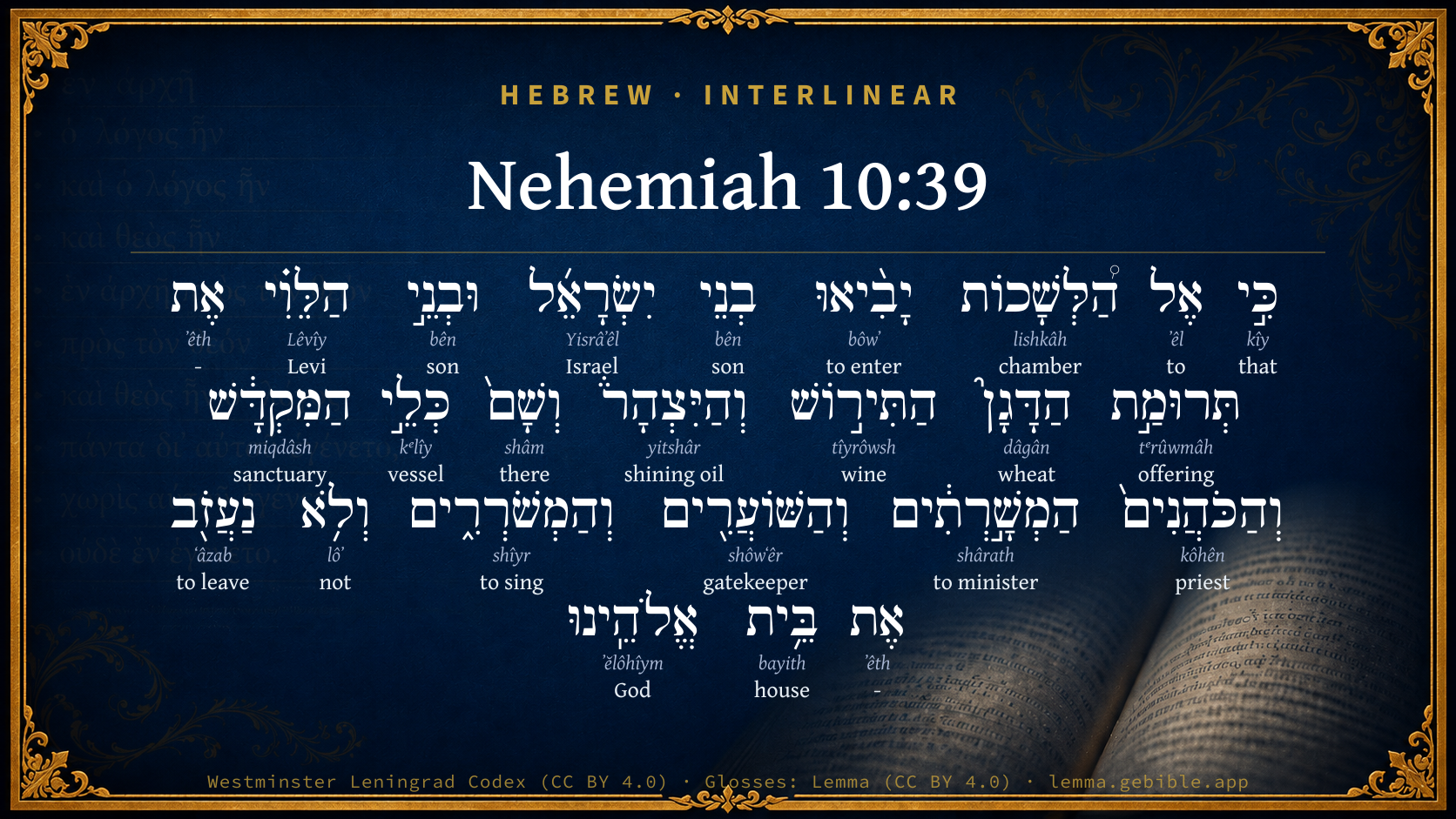
Nehemiah 10:39

Hebrew (Westminster Leningrad Codex) Nehemiah 10:39 appears in the Hebrew Old Testament. The text above is from the Westminster Leningrad Codex. Each word links to its Strong’s number, a concise gloss, and parsing drawn from the Open Scriptures Hebrew Bible morphology. Click any word for its full Brown-Driver-Briggs (BDB) entry.
Download image
Cite this verse

Nehemiah 10:39 (World English Bible). Public Domain. Lemma interlinear Bible study tool, https://lemma.gebible.app/v/nehemiah/10/39.

Show BibTeX & RIS
BibTeX
RIS
English Translation
For the children of Israel and the children of Levi shall bring the heave-offering of the grain, of the new wine, and of the oil, to the chambers, where are the vessels of the sanctuary, and the priests who minister, and the porters, and the singers: and we will not forsake the house of our God.
World English Bible · Public Domain
Download a study sheet

One document with this verse’s original text, its word-by-word gloss line, the meaning frame, cross-references with their text, attributed commentary, and full source and license credits — printable, and it pastes into notes with its structure intact.

This verse Autodidact and up

Study sheet (.html) Plain text (.txt)

A passage Seminary Student

Up to 50 verses in one chapter. A passage sheet keeps up to 6 commentary sources and 12 cross-references per verse, in the order this page ranks them, and says so on the sheet whenever that leaves anything out. Ask for a single verse and you get the Autodidact verse sheet above.

Everything on this page stays free to read, with no account — the sheet is a download of what is already on screen, not access to it.

Want to remove ads? Support Godless Engineer
Compare translations 3

The same verse in 3 English versions, stacked beneath the original-language interlinear above. Click any original word for its lexicon entry.

Each is an independent rendering of the whole verse — the interlinear is not word-aligned to these translations.

Highlighted words mark where these versions differ — a whole-verse word diff, not a word-by-word alignment.

  • World English Bible Public Domain
    For the children of Israel and the children of Levi shall bring the heave-offering of the grain, of the new wine, and of the oil, to the chambers, where are the vessels of the sanctuary, and the priests who minister, and the porters, and the singers: and we will not forsake the house of our God.
  • King James Version Public Domain
    For the children of Israel and the children of Levi shall bring the offering of the corn, of the new wine, and the oil, unto the chambers, where are the vessels of the sanctuary, and the priests that minister, and the porters, and the singers: and we will not forsake the house of our God.
  • unfoldingWord Literal Text CC BY-SA 4.0
    For the sons of Israel and the sons of Levi shall bring to the chambers the offerings of grain, wine, and oil. And there shall be the vessels for the sanctuary, and the priests, the ones who are ministering, and the gatekeepers, and the ones who sing. And we shall not neglect the house of our God.

unfoldingWord Literal Text — © unfoldingWord, licensed CC BY-SA 4.0. Word-aligned USFM3 via Door43 (git.door43.org/unfoldingWord/en_ult).

Versions to compare (up to 4)

3 of 4 selected

Show all 18 translations

Every available English version of this verse, each an independent rendering of the whole verse.

  • World English Bible Public Domain
    For the children of Israel and the children of Levi shall bring the heave-offering of the grain, of the new wine, and of the oil, to the chambers, where are the vessels of the sanctuary, and the priests who minister, and the porters, and the singers: and we will not forsake the house of our God.
  • Berean Standard Bible Public Domain
    For the Israelites and the Levites are to bring the contributions of grain, new wine, and oil to the storerooms where the articles of the sanctuary are kept and where the ministering priests, the gatekeepers, and the singers stay. Thus we will not neglect the house of our God.”
  • Majority Standard Bible Public Domain
    For the Israelites and the Levites are to bring the contributions of grain, new wine, and oil to the storerooms where the articles of the sanctuary are kept and where the ministering priests, the gatekeepers, and the singers stay. Thus we will not neglect the house of our God.”
  • King James Version Public Domain
    For the children of Israel and the children of Levi shall bring the offering of the corn, of the new wine, and the oil, unto the chambers, where are the vessels of the sanctuary, and the priests that minister, and the porters, and the singers: and we will not forsake the house of our God.
  • American Standard Version (1901) Public Domain
    For the children of Israel and the children of Levi shall bring the heave-offering of the grain, of the new wine, and of the oil, unto the chambers, where are the vessels of the sanctuary, and the priests that minister, and the porters, and the singers: and we will not forsake the house of our God.
  • Revised Version (1885) Public Domain
    For the children of Israel and the children of Levi shall bring the heave offering of the corn, of the wine, and of the oil, unto the chambers, where are the vessels of the sanctuary, and the priests that minister, and the porters, and the singers: and we will not forsake the house of our God.
  • Geneva Bible (1599) Public Domain
    For the children of Israel, and the children of Leui shall bring vp the offerings of the corne, of the wine, and of the oyle, vnto the chabers: and there shalbe the vessels of the Sanctuarie, and the Priestes that minister, and the porters, and the fingers, and we will not forsake the house of our God.
  • Douay-Rheims (1899) Public Domain
    For the children of Israel and the children of Levi shall carry to the treasury the firstfruits of corn, of wine, and of oil: and the sanctified vessels shall be there, and the priests, and the singing men, and the porters, and ministers, and we will not forsake the house of our God.
  • Young's Literal Translation Public Domain
    for unto the chambers do they bring in -- the sons of Israel and the sons of Levi -- the heave-offering of the corn, the new wine, and the oil, and there `are' vessels of the sanctuary, and the priests, those ministering, and the gatekeepers, and the singers, and we do not forsake the house of our God.
  • Literal Standard Version CC BY-SA 4.0
    for they bring to the chambers—the sons of Israel and the sons of Levi—the raised-offering of the grain, the new wine, and the oil, and there [are] vessels of the sanctuary, and the priests, those ministering, and the gatekeepers, and the singers, and we do not forsake the house of our God.
  • Unlocked Literal Bible CC BY-SA 4.0
    For the people of Israel and the descendants of Levi are to bring the contributions of grain, new wine, and oil to the storerooms where the articles of the sanctuary are kept and where the priests who are serving, and the gatekeepers, and the singers stay. We will not neglect the house of our God.
  • unfoldingWord Literal Text CC BY-SA 4.0
    For the sons of Israel and the sons of Levi shall bring to the chambers the offerings of grain, wine, and oil. And there shall be the vessels for the sanctuary, and the priests, the ones who are ministering, and the gatekeepers, and the ones who sing. And we shall not neglect the house of our God.
  • Darby Bible Public Domain
    For the children of Israel and the children of Levi shall bring the heave-offering of the corn, of the new wine and the oil, into the chambers, where are the vessels of the sanctuary, and the priests that minister, and the doorkeepers and the singers. And we will not forsake the house of our God.
  • World Messianic Bible Public Domain
    For the children of Israel and the children of Levi shall bring the wave offering of the grain, of the new wine, and of the oil, to the rooms where the vessels of the sanctuary are, and the priests who minister, with the gatekeepers and the singers. We will not forsake the house of our God.
  • Webster's Bible Public Domain
    For the children of Israel and the children of Levi shall bring the offering of the corn, of the new wine, and the oil, to the chambers, where are the vessels of the sanctuary, and the priests that minister, and the porters, and the singers: and we will not forsake the house of our God.
  • Free Bible Version CC BY-SA 4.0
    The people of Israel and the Levites are to bring the offerings of grain, new wine, and olive oil to the storerooms where the sanctuary objects are kept, where the ministering priests, the gatekeepers, and the singers are. We will not forget the Temple of our God.”
  • Bible in Basic English Public Domain
    For the children of Israel and the children of Levi are to take the lifted offering of the grain and wine and oil into the rooms where the vessels of the holy place are, together with the priests and the door-keepers and the makers of music: and we will not give up caring for the house of our God.
  • JPS Tanakh (1917) Public Domain
    (10-40) For the children of Israel and the children of Levi shall bring the heave-offering of the corn, of the wine, and of the oil, unto the chambers, where are the vessels of the sanctuary, and the priests that minister, and the porters, and the singers; and we will not forsake the house of our God.

Literal Standard Version (2020), Covenant Press — licensed CC BY-SA 4.0. Text via the HelloAO Bible API (eBible.org). Unlocked Literal Bible (unfoldingWord) — licensed CC BY-SA 4.0. Text via the HelloAO Bible API (eBible.org). unfoldingWord Literal Text — © unfoldingWord, licensed CC BY-SA 4.0. Word-aligned USFM3 via Door43 (git.door43.org/unfoldingWord/en_ult). Free Bible Version, Dr. Jonathan Gallagher — licensed CC BY-SA 4.0. Text via the HelloAO Bible API (eBible.org).

Word by word

More ways to search: Search by grammar → Find every occurrence → Compare this word →

Practice this passage: Drill this verse → Learn its vocabulary →

וְהַיִּצְהָר֒
yitshâr
H3323
“and · the · shining oil”
Conjunction + Particle, Definite Article + Noun, Common, Masculine, Singular, Absolute
Part of Speech
Conjunction + Particle + Noun
Type
Common
Gender
Masculine
Number
Singular
State
Absolute
Full BDB Definition

Origin: from H6671

TWOT: 1883c

fresh oil, shining (pure) oil
  1. כִּ֣י kîy H3588 “that” Conjunction
  2. אֶל ʼêl H413 “to” Preposition
  3. הַ֠לְּשָׁכוֹת lishkâh H3957 “the · chambers” Particle, Definite Article + Noun, Common, Feminine, Plural, Absolute
  4. יָבִ֨יאוּ bôwʼ H935 “to enter” Verb, Hiphil, Imperfect, 3rd Person, Masculine, Plural
  5. בְנֵי bên H1121 “sons of” Noun, Common, Masculine, Plural, Construct
  6. יִשְׂרָאֵ֜ל Yisrâʼêl H3478 “Israel” Noun, Proper
  7. וּבְנֵ֣י bên H1121 “and · sons of” Conjunction + Noun, Common, Masculine, Plural, Construct
  8. הַלֵּוִ֗י Lêvîy H3878 “the · Levi” Particle, Definite Article + Noun, Proper
  9. אֶת ʼêth H853 “-” Particle, Direct Object
  10. תְּרוּמַ֣ת tᵉrûwmâh H8641 “offering of” Noun, Common, Feminine, Singular, Construct
  11. הַדָּגָן֮ dâgân H1715 “the · wheat” Particle, Definite Article + Noun, Common, Masculine, Singular, Absolute
  12. הַתִּיר֣וֹשׁ tîyrôwsh H8492 “the · wine” Particle, Definite Article + Noun, Common, Masculine, Singular, Absolute
  13. וְשָׁם֙ shâm H8033 “and · there” Conjunction + Adverb
  14. כְּלֵ֣י kᵉlîy H3627 “vessels of” Noun, Common, Masculine, Plural, Construct
  15. הַמִּקְדָּ֔שׁ miqdâsh H4720 “the · sanctuary” Particle, Definite Article + Noun, Common, Masculine, Singular, Absolute
  16. וְהַכֹּהֲנִים֙ kôhên H3548 “and · the · priests” Conjunction + Particle, Definite Article + Noun, Common, Masculine, Plural, Absolute
  17. הַמְשָׁ֣רְתִ֔ים shârath H8334 “the · ministering” Particle, Definite Article + Verb, Piel, Participle Active, Masculine, Plural, Absolute
  18. וְהַשּׁוֹעֲרִ֖ים shôwʻêr H7778 “and · the · gatekeepers” Conjunction + Particle, Definite Article + Noun, Common, Masculine, Plural, Absolute
  19. וְהַמְשֹׁרְרִ֑ים shîyr H7891 “and · the · singing” Conjunction + Particle, Definite Article + Verb, Polel, Participle Active, Masculine, Plural, Absolute
  20. וְלֹ֥א lôʼ H3808 “and · not” Conjunction + Particle, Negative
  21. נַעֲזֹ֖ב ʻâzab H5800 “to leave” Verb, Qal, Imperfect, 1st Person, Common, Plural
  22. אֶת ʼêth H853 “-” Particle, Direct Object
  23. בֵּ֥ית bayith H1004 “house of” Noun, Common, Masculine, Singular, Construct
  24. אֱלֹהֵֽינוּ ʼĕlôhîym H430 “God(s) · our” Noun, Common, Masculine, Plural, Construct + Suffix, Personal, 1st Person, Common, Plural

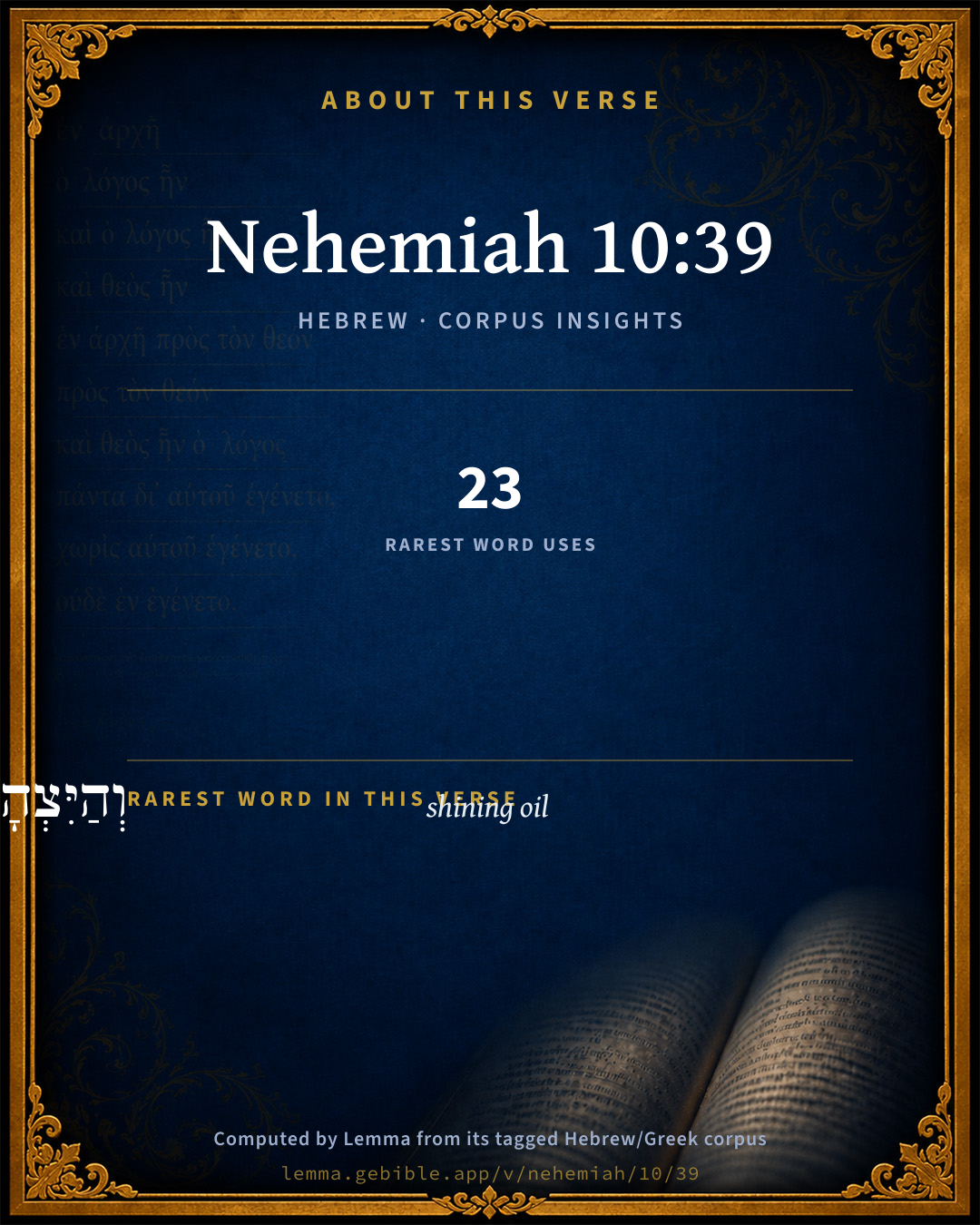
About this verse

These counts appear in no published source. They are computed here, from the morphology-tagged text and Lemma’s own curated glosses. What Lemma adds →

25
words
23
distinct lemmas
Historical
section

Notable vocabulary

The rarest word here is וְהַיִּצְהָר֒ shining oil H3323 — appearing just 23 times in the whole Hebrew Bible.

Shared distinctive vocabulary

וְהַיִּצְהָר֒ shining oil H3323 occurs in 23 verses of the Hebrew Bible. Also found in:

Grammatical profile

  • 4 verbs
  • 15 nouns
  • 1 preposition
  • 1 conjunction
  • 1 adverb
  • 3 particles

Verb forms

  • יָבִ֨יאוּ Hiphil · Imperfect
  • הַמְשָׁ֣רְתִ֔ים Piel · Participle Active
  • וְהַמְשֹׁרְרִ֑ים Polel · Participle Active
  • נַעֲזֹ֖ב Qal · Imperfect

Repetition

A word recurs within this verse — often emphatic in Hebrew:

  • בְנֵי son H1121 ×2

Cross-references

8

Topical passages linked to Nehemiah 10:39 in the Treasury of Scripture Knowledge — connected by theme and wording, ordered by reader-vote popularity; previews shown in the World English Bible.

  • 2 Chronicles 31:12 They brought in the offerings and the tithes and the dedicated things faithfully: and over them Conaniah the Levite was ruler, and Shimei his brother was second.
  • Numbers 18:30 Therefore you shall tell them, When you heave the best of it from it, then it shall be reckoned to the Levites as the increase of the threshing floor, and as the increase of the wine-press.
  • Deuteronomy 14:23–27 You shall eat before Yahweh your God, in the place which he shall choose, to cause his name to dwell there, the tithe of your grain, of your new wine, and of your oil, and the firstborn of your herd and of your flock; that you may learn to fear Yahweh your God always.
  • Hebrews 10:25 not forsaking our own assembling together, as the custom of some is, but exhorting one another; and so much the more, as you see the Day approaching.
  • Deuteronomy 12:6–11 and there you shall bring your burnt offerings, and your sacrifices, and your tithes, and the heave-offering of your hand, and your vows, and your freewill-offerings, and the firstborn of your herd and of your flock:
  • Deuteronomy 12:17 You may not eat within your gates the tithe of your grain, or of your new wine, or of your oil, or the firstborn of your herd or of your flock, nor any of your vows which you vow, nor your freewill-offerings, nor the heave-offering of your hand;
  • Nehemiah 13:10–12 I perceived that the portions of the Levites had not been given them; so that the Levites and the singers, who did the work, were fled everyone to his field.
  • Psalms 122:9 For the sake of the house of Yahweh our God, I will seek your good.

Cross-references courtesy of OpenBible.info (CC BY 4.0).

Hebrew and Greek witnesses Masoretic Hebrew ↔ Greek Septuagint

The same verse in the two great witnesses to the Old Testament, shown verse-for-verse.

These are two independent witnesses, not word-aligned to each other, and the Septuagint is shown in lemma (dictionary) form.

Hebrew Nehemiah 10:39 Masoretic · Westminster Leningrad Codex

כִּ֣י אֶל הַ֠לְּשָׁכוֹת יָבִ֨יאוּ בְנֵי יִשְׂרָאֵ֜ל וּבְנֵ֣י הַלֵּוִ֗י אֶת תְּרוּמַ֣ת הַדָּגָן֮ הַתִּיר֣וֹשׁ וְהַיִּצְהָר֒ וְשָׁם֙ כְּלֵ֣י הַמִּקְדָּ֔שׁ וְהַכֹּהֲנִים֙ הַמְשָׁ֣רְתִ֔ים וְהַשּׁוֹעֲרִ֖ים וְהַמְשֹׁרְרִ֑ים וְלֹ֥א נַעֲזֹ֖ב אֶת בֵּ֥ית אֱלֹהֵֽינוּ

For the children of Israel and the children of Levi shall bring the heave-offering of the grain, of the new wine, and of the oil, to the chambers, where are the vessels of the sanctuary, and the priests who minister, and the porters, and the singers: and we will not forsake the house of our God.

World English Bible · Public Domain

Greek LXX Structure differs

The Septuagint has no separate book of Nehemiah. Its Greek text is the second half of Esdras B (2 Esdras), chapters 11–23; Ezra is the first half (1–10).

A verse-for-verse comparison isn’t shown here because the chapters and verses don’t line up. Switch to the LXX edition with the MT / LXX toggle above to read the Greek directly.

On this verse, The Cambridge Bible for Schools and Colleges discusses the Septuagint’s reading. Read the note in Commentary ↓

Hebrew: Westminster Leningrad Codex (CC BY 4.0). Greek: Septuagint (public domain); English from a public-domain English Septuagint. How the Septuagint differs from the Hebrew →

Commentary

Notes on Nehemiah 10:39 from classic Christian and Jewish commentators (each source and its license shown beneath its notes). The classic Christian expositions comment on the surrounding passage and are grouped to its opening verse, so a note may address several verses; the Jewish commentaries on the Tanakh (Rashi and others) are per-verse, so they appear only where the commentator wrote on this verse.

Lemma curates 59 commentaries, every one of them public domain or Creative Commons licensed, each selected and text-cleaned for this edition rather than reprinted as found. About our sources →

The Cambridge Bible for Schools and Colleges

gen. ed. J. J. S. Perowne

39. For] Explaining the mention of ‘the chambers’ as the receptacles of all these offerings.

the children of Israel] i.e. the laity as distinguished from the priests and the Levites.

the offering] R.V. heave offering. This ‘heave offering’ includes both ‘the firstfruits’ of the children of Israel (Neh_10:36-37) and ‘the tithe of the tithe’ paid by the Levite to the priests (37). It is the special designation of the tithe paid both by Israel and by the house of Levi in Num_18:24-28.

the new wine] R.V. the wine. Marg. ‘Or, the vintage.’ the word in the Hebrew is the same as that used in Neh_10:37.

and the oil] R.V. and of the oil.

On ‘the chambers’ see especially Neh_13:4-12.

the vessels of the sanctuary] In Neh_13:9 it is again mentioned that ‘the vessels of the sanctuary’ were stored in these chambers. What they were, we are not told; but that they comprised instruments for sacrifice, vessels for libations and lustrations, and plate for sacred feasts, would appear from the short inventory in Ezr_1:9-10.

priests … porters … singers] i.e. the Aaronic house and those of the Levites whose work was especially connected with the maintenance of the Temple and the Temple worship. From this combination we might conclude (1) that the Levitical community, with the exception of the ‘porters’ and ‘singers,’ were for the most part in Nehemiah’s time not resident at Jerusalem, but quartered in the country districts, cf. Neh_11:20, Neh_12:27; (2) that the porters and singers participated with the priests in the offerings of the people.

we will not forsake] The object of the new regulations is to maintain the efficiency of the Temple worship and to provide for the welfare of those that ministered in it; ‘we will not forsake’ is equivalent to ‘we will not neglect or diminish the contributions to the Temple, which we have publicly undertaken.’

Note on ‘the Tithe.’ It must be noticed that ‘the tithe’ spoken of in this context is described as ‘tithes of our ground,’ ‘tithes in all the cities of our tillage,’ and is probably here (Neh_10:39) represented along with ‘the heave offering,’ as consisting of corn, wine and oil, as indeed it is spoken of in Neh_13:5; Neh_13:12. In other words ‘the tithe’ is a vegetable one; and this is also the impression which we gather from the description of ‘tithe’ in Numbers 18 and Mal_3:8-11.

Now in Lev_27:32-33 ‘a tithe of the herd or the flock’ is called ‘holy to the Lord,’ and with this agrees the mention of ‘the tithe of oxen and sheep’ in 2Ch_31:6. It is needless to point out what an enormous addition this ‘tithe of the herd or the flock’ would make to the wealth of the Priesthood and the treasury of the Temple. How then does it come to pass that neither in the regulations contained in Numbers 18 and Deuteronomy 14, nor in Nehemiah 10, 12, 13 is any allusion made to the tithe of herd and flock? Two explanations are forthcoming:

(1) It is possible that Lev_27:32 embodies a primitive pastoral law of tithing, which having fallen into desuetude was omitted at the time of the codification of the laws in Numbers 18 and Deuteronomy 14. In support of this view it should be remembered that Jacob’s vow to dedicate a tenth (Gen_28:22) certainly referred to the tithe of property in herds and flocks, while the possibility of exacting a ‘tenth’ of the flocks even for civil purposes is contemplated in 1Sa_8:17. According to this view, Hezekiah would have revived a religious custom, which was inherited from the time when the nation was more pastoral than agricultural. It is natural to suppose that the Jewish community at Jerusalem in Nehemiah’s days was too poor to maintain this additional burden. The objection to this explanation is that the appearance of Lev_27:32 in relation to its immediate context is not that of a survival from an earlier legislation; while the children of Israel could never have so far abandoned the pastoral in favour of agricultural life as to make it worth while to surrender the claim to so important a source of revenue for the service of the Temple.

(2) It is possible, as is maintained in some quarters, that ‘the animal tithe-law’ of Lev_27:32 may be an interpolation later than Nehemiah’s time, made in the interest of the Priesthood. There is more to be said for this startling supposition than might perhaps be expected. A close inspection of Lev_27:30-33 shows that Neh_10:32 is strangely and abruptly introduced between Neh_10:31 and Neh_10:33, which deal with the subject of the redemption of the vegetable-tithe mentioned in Neh_10:30. Again, in 2 Chronicles 31 we find that, after the mention in Neh_10:5 of ‘tithe of all things’ being given by ‘the children of Israel’, another sentence (Neh_10:6) tells us that ‘the children of Israel and Judah that dwelt in the cities of Judah, they also brought in the tithe of oxen and sheep and the tithe of consecrated things, &c.’ which is not improbably a later expansion of the previous words. It is obviously an objection to this view that the insertion of a clause making so large a claim upon the property of the Jews could rarely at any time have been secretly foisted into the text of the Pentateuch; and that, supposing it to have been possible, such an interpolation made in the interest of the Priestly families would have had the smallest chance of success at a time when the Scribes controlled the transcription of the text.

The solution of the problem has not yet been reached. The difficulty illustrates the variations in Israelite law, in which are reflected the altered circumstances of different centuries. It must be admitted that Lev_27:32 wears an appearance not altogether free from suspicion; and an interpolation in an age, when, as we know from the LXX. version, the text of the Pentateuch was not yet fully settled, is not outside the range of probability.

The Cambridge Bible for Schools and Colleges (gen. ed. J. J. S. Perowne; Cambridge University Press, 1878–1918) — public domain. Text from a community e-Sword module.

Trapp's Complete Commentary

John Trapp

Neh 10:39 For the children of Israel and the children of Levi shall bring the offering of the corn, of the new wine, and the oil, unto the chambers, where [are] the vessels of the sanctuary, and the priests that minister, and the porters, and the singers: and we will not forsake the house of our God.

Ver. 39. And we will not forsake the house of God] But frequent it ourselves, and see that the priests that minister, the porters and singers, forsake it not, for want of necessary maintenance; as they were shortly after this forced to do, and to flee every one to his field, Neh 13:10, for a subsistence.

John Trapp, A Commentary or Exposition upon All the Books of the Old and New Testament (1647–1656) — public domain. Text from a community e-Sword module.

The Biblical Illustrator

Joseph S. Exell

Neh_10:39

And we will not forsake the house of our God.

Zeal for the sanctuary

Why should we say of the habitation of Gods house, We will not forsake it?

1. God has clearly ordained public worship. He made man to be social--social in virtue of his sorrows, joys, wants, affections, and relationships. He also made man to be social in things spiritual. The isolation of selfishness is sin. Union is cherished by communion, and communion strengthened by public worship. Jesus honoured the temple. The faithful in every age have desired to dwell in the house of the Lord.

2. The special manifestations of the Divine presence, vouch-salad in the congregations of the saints, ought to endear to us such privileged scenes.

3. As the sanctuary has been the place of the Lords rest, so has it been the scene where He has imparted the richest gifts to His worshippers.

4. The servant of God will love the courts of the Lord, and not forsake them, because in them he tastes most of heaven below. You cannot form a better conception of heaven than by fixing on the happiest Sabbath, and the happiest hour of worship on the happiest Sabbath, you ever enjoyed in the assembly of the saints. (Canon Stowell.)

Zeal for Gods house expressed in a holy resolution not to forsake it

I. A resolution well becoming Christians themselves. This resolution comprehends the following particulars:

1. That we will never cast off the profession of our faith, nor make a defection from the truth and ways of the gospel, for any cause, nor upon any account whatsoever.

2. That we will not neglect the ordinances of Divine worship, nor be wanting in our attendance on them whenever we are called, and have an opportunity of appearing before God in His house.

(1) Jesus Christ, as Lord of His own house, has appointed divers ordinances to be observed.

(2) There must be an assembly of people meeting together for the public administration of these holy ordinances.

(3) There must be some proper and convenient places appointed and agreed upon for such religious assemblies where they can be had.

(4) There are particular times and seasons for the holding these religious assemblies.

(5) There are certain persons whose work and duty it is to go before others in these holy administrations.

3. That we will promote as far as in us lies the interests of religion, and spread the kingdom of Christ in the world.

II. It is not only lawful, but may be useful and expedient for Christians in societies to engage themselves to God, and the duties they owe to him and one another.

III. Offer reasons both for making this resolution and obliging ourselves to make it good.

1. Because it is Gods house.

(1) To forsake Gods house would be to forsake our own mercies.

(2) To leave this house is to forsake the place which God Himself hath chosen and where He delights to dwell.

(3) To forsake this house is to forsake God Himself. We cannot quit the inheritance of the Lord but in effect we go and serve other gods.

2. Because our particular good is lodged in the public interest.

3. This is the noblest way of imitating the great God Himself, and conforming to the example of our blessed Saviour.

4. This makes men real blessings to the world. Such men really are the strength and security of a nation. For their sakes God sometimes preserves others from those judgments which their crying sins would otherwise pull down upon their guilty heads. Sodom had been preserved for the sake of ten righteous men, could so many have been found in the place.

5. This will be our rejoicing and comfort another day. Application: Having made this resolution, we must oblige ourselves to make it good. Because of the inconstancy and deceitfulness of our hearts. Such engagements will help to fix us more firmly in the interests of religion, and make us more successful in resisting all temptations to apostasy. Hereby we are rendered more capable of serving the interests of religion. A force when united becomes the stronger. The joint concurrence of many gives a great advantage to a design, and a better prospect of success. (Matthew Clarke.)

Attachment to Gods house

Consider--

I. The resolution itself: We will not forsake, etc. This resolution includes--

1. Constant and regular attendance.

2. A lively interest in its welfare and prosperity.

II. The grounds of this resolution.

1. Our gracious union with God. All connected with God should be dear and sacred to us--His Word, ordinances, people; therefore His house.

2. Our clear and imperative duty. Public worship is of His own appointment.

3. Our public profession.

4. The special advantages we shall derive from it. Exaltation of desires; soul elevation; enlargement of mind; soul enrichment with all spiritual blessings in Christ. A day in Thy courts is better than a thousand, etc. They that wait upon the Lord, etc.

5. The connection of the house of God with the celestial world. It is the gate of heaven.

Application:

1. Where professors are indifferent to the welfare of Gods house, it is an unfailing indication that the heart is not right with God.

2. Let the subject inspire the sincere friends of Christ to more ardent zeal for the diffusion of the Divine glory.

3. How suited is Gods house to every description. The reckless here are warned, the supine aroused, the inquirer directed, the mourner comforted, the faithful established, etc. (J. Burns, D. D.)

.

The Biblical Illustrator, edited by Joseph S. Exell (c. 1880s–1900s) — public domain. Text from a community e-Sword module.

Joseph Benson's Commentary

Neh 10:39. The offering of the corn, of the new wine, and the oil — See the margin. Unto the chambers where are the vessels, &c. — Where holy things were kept, and where God’s ministers attended, for whose use they were designed, and they were brought thither at the charge of those who offered them. And we will not forsake the house of our God — We do here solemnly declare and engage ourselves, that we will take care, from time to time, that the house and service of God be not neglected or forsaken, for want of necessary provisions to support it. Though they paid great taxes to the kings of Persia, and had much hardship put upon them, they would not make that an excuse for not paying their tithes; but would render to God the things that were his, as well as to Cesar the things that were his. We must do what we can in works of piety and charity, notwithstanding the taxes we pay to the government; and cheerfully perform our duty to God amidst our burdens, which will be the surest way to ease and liberty in God’s due time.

Joseph Benson's Commentary on the Old and New Testaments (1811–1818) — public domain. Text from a community e-Sword module.

Geneva Bible (1599)

Geneva Bible translators

We will not leave it destitute of that that shall be necessary for it.

Geneva Bible (1599) marginal notes — public domain. Text via Bolls.life.

Jamieson, Fausset & Brown

Robert Jamieson, A. R. Fausset & David Brown

and we will not forsake the house of our God--This solemn pledge was repeated at the close of the covenant as an expression of the intense zeal by which the people at this time were animated for the glory and the worship of God. Under the pungent feelings of sorrow and repentance for their national sins, of which apostasy from the service of the true God was the chief, and under the yet fresh and painful remembrance of their protracted captivity, they vowed, and (feeling the impulse of ardent devotion as well as of gratitude for their restoration) flattered themselves they would never forget their vow, to be the Lord's.

Next: Nehemiah Chapter 11

Jamieson, Fausset & Brown — Commentary Critical and Explanatory on the Whole Bible (1871) — public domain (CC PDM 1.0). Text via the HelloAO Bible API.

Adam Clarke's Commentary

Verse 39. We will not forsake the house of our God.] Here was a glorious resolution; and had they been faithful to it, they had been a great and good people to the present day. But what is implied in, We will not forsake the house of our God? I answer:-

I. The Church of God is the house of God; there he has his constant dwelling-place.

II. True believers are his family in this house; and this family consists of,

1. Fathers and mothers;

2. Young persons;

3. Little children; And

4. Servants.

III. The ministers of the word of God are the officers and overseers of this house and family.

IV. The worship of God is the grand employment of this family.

V. The ordinances of God are the food of the members of this family; or the means of their spiritual support.

VI. Those who do not forsake the house of their God are those,

1. Who continue in the faith;

2. Who grow in grace;

3. Who labour in the vineyard;

4. Who bring forth fruit;

5. Who conscientiously attend all the ordinances; and

6. Who take care that the offerings of the house of God shall be duly made, providing for those who labour in the word and doctrine.

READER,

1. Art thou of this house?

2. Art thou in this house?

3. To what part of the family dost thou belong?

4. Art thou still an infant in this house?

5. Dost thou attend the ordinances of this house?

6. Hast thou forsaken this house? These questions are of great importance; answer them as in the sight of God.

Adam Clarke's Commentary on the Bible (1810–1826) — public domain. Text from a community e-Sword/MySword module.

Ellicott's Commentary for English Readers

(39) Shall bring.—The priests themselves were exempted from the care of gathering the tithes.

We will not forsake the house of our God.—Both the pledge and the violation of it in the sequel are explained by Neh_13:11-14.

A Bible Commentary for English Readers, edited by Charles John Ellicott (1878–1897) — public domain. Text from a community e-Sword module.

Matthew Poole's English Annotations

Unto the chambers, where are the vessels of the sanctuary; where other things belonging to the temple are laid up, and therefore these things also shall be put there.

And the priests that minister, and the porters, and the singers, i.e. where also are the priests and others that minister in their courses, for whose use these provisions are made.

We will not forsake the house of our God, i.e. we do here solemnly declare and engage ourselves that we will take care, from time to time, that the house and service of God be not neglected or forsaken for want of necessary provisions to support it.

Matthew Poole's English Annotations on the Holy Bible (1683–1685) — public domain. Text from a community e-Sword/MySword module.

Whedon's Commentary on the Bible

Daniel D. Whedon

39. We will not forsake the house — By failure to provide wood, and offerings, and tithes, according to the law. This covenant also bound the priests and Levites to their proper work of seeing that the temple service was constantly attended to, and that no man left his post of duty. We find in Neh_13:10-11, that this covenant was soon after broken. Backsliding followed reform.

Daniel D. Whedon (gen. ed.), Commentary on the Old and New Testaments (1874–1909) — public domain. Text from a community e-Sword module.

The Pulpit Commentary

The children of Israel and the children of Levi shall bring the offering. The priests were not to be troubled with the conveyance of any of the offerings. The first-fruits and other oblations of the people were to be brought to the temple by the people themselves; and the "tithe of the tithe," which was the priests" due, by the Levites. Thus the priests would not be drawn away from their duty of ministering in the temple by secular employments and matters of mere worldly business. We will not forsake, or neglect, the house of our God. We will not suffer, that is, any interruption of the continual service of the temple, we will not be parties to any neglect or slovenliness in the conduct of it. So far as we are concerned, everything shall be done to enable the priests and Levites to remain constantly at Jerusalem in full numbers, and to devote themselves wholly to their sacred duties in God"s house. With this emphatic declaration of their intentions the people concluded the engagements by which they voluntarily bound themselves.

Cleaving to the house of God.

"We will not forsake the house of our God." Introduce, by reference to the context

I THE PLACE. "The house of our God." The temple thus designated in a sense quite peculiar. In a deeper sense, however, the Christian Church is God"s house, and each member of it. (1Co_3:16 1Co_6:19 Eph_2:21, 22 1Ti_4:15) In a lower sense, the name may be given to buildings set apart for Christian worship. In the Old Testament seems to be used of synagogues. (Ecc_5:1) Such buildings may be called houses of God because

1. Devoted specially to him. There is a sense in which all buildings should be devoted to God (motto over the Royal Exchange); but the meetinghouses of the Church are peculiarly consecrated to him, his worship; the publication of his great name, his laws, invitations, promises, threatenings; endeavours to promote his kingdom. Yet places of worship are not always devoted to God, and never perfectly.

2. Blessed and honoured by him. By his presence, and gracious operations, in the enlightenment, conversion, sanctification, consoling, strengthening, etc. of the worshippers. God"s works in the sanctuary are amongst his greatest and best better than the turning of the material chaos into kosmov .

II THE RESOLVE RESPECTING IT. "We will not forsake," etc.. (see also Neh_13:10, Neh_13:11) The declaration means more than it expresses. It is equivalent to saying, "We will interest ourselves in it, support it, promote its prosperity.

1. By our gifts. The main point here. See preceding verses.

2. By attendance on its services.

Temptations in the present day to a total or partial neglect of public worship, or a wandering which is almost as injurious. Temptations from unbelief, worldliness, perpetual or occasional want of interest in the services, poverty, even sorrow.

3. By effort and prayer for its prosperity.

III REASONS FOR MAKING IT OUR OWN.

1. Because it is God"s house house of our God.

2. Because of the pleasure to be there enjoyed.

3. Because of the profit to be there gained.

4. Because of attachment to the people who meet there.

5. Because of the good of others which is there promoted. The highest welfare of individuals and of society is bound up with the maintenance of public Christian worship and instruction.

6. Because of what has been already expended upon it. Love, zeal, contributions, work. They who have done most for their place of worship will be most attached to it. Let the young make and keep this resolution. Especially let those who have left home and the minister and friends of their early life be careful not to forsake the house of God. They will thus be preserved from temptation, secure new friendships helpful to their character and happiness, and, if sincere in their worship, the guidance and blessing of God, and eternal salvation.

The Pulpit Commentary (1880–1919), ed. H.D.M. Spence-Jones & Joseph S. Exell — public domain. Text from a community e-Sword module.

unfoldingWord translationNotes

Door43 World Missions Community

General Information:

In these verses, the people finish describing the content of the oath they were making in Nehemiah 10:29.

the storerooms where the articles of the sanctuary are kept

This can be stated in active form. AT: "the rooms where the priests keep the things that are used in the temple" (See: Active or Passive)

We will not neglect the house of our God

This can be stated in positive form. AT: "We will care for the temple"

We will

The pronoun "we" here includes Nehemiah and all the people of Israel but does not include the reader of this book. (See: Exclusive and Inclusive "We")

translationWords

people group

Israel

descend

Levi

grain

wine

oil

sanctuary

priest

servant

house of God

unfoldingWord translationNotes — © Distant Shores Media and the Door43 World Missions Community, licensed CC BY-SA 4.0. Source: git.door43.org/Door43/en_tn.

Rashi

Rabbi Shlomo Yitzchaki (Rashi)

at the [Levites’] tithing Heb. בַּעְשֵּׂר;an expression meaning at the tithing.

the tithe of the tithe for the Levites would take a tithe from the tithe and bring it up to the priests, who did not leave the Temple.

Rashi on the Tanakh — English translations: “The Judaica Press complete Tanach with Rashi, translated by A. J. Rosenberg” (CC BY 4.0); “Pentateuch with Rashi's commentary by M. Rosenbaum and A.M. Silbermann, 1929-1934” (public domain); “The Metsudah Tanach series, Lakewood, N.J” (CC BY 4.0); and “The Book of Joshua, Metsudah Publications, 1997” (CC BY 4.0). Text via Sefaria.

Lesson kit

Teaching starters — assembled from the data on this page, not authored interpretation. Every prompt links to the verse data it draws on. Edit before teaching.

Nehemiah, in the Historical, opens this verse with 25 words (23 distinct Hebrew lemmas). Its most distinctive word is yitshâr (“shining oil”). A historical commentator’s framing appears above. Read the whole chapter for the surrounding context.

Discussion questions

  1. What does “shining oil” (yitshâr) contribute to the verse as a whole?
  2. Numbers 18:12 shares the word «shining oil» with this verse. How do the two illuminate each other?
  3. “son” occurs 2× in this one verse. What is the effect of the repetition?
  4. These translations render this verse differently. What is at stake in choosing one wording over another?
  5. The verb «יָבִ֨יאוּ» is Hiphil Imperfect. How does its form color the action?
  6. Reading how The Cambridge Bible for Schools and Colleges and Trapp's Complete Commentary read this verse, where do the two commentators agree and where do they part?

Things to notice

Reading settings

Reading text

Shown beneath each verse's original-language words.

Old Testament
Old Testament edition

Read the OT as the Masoretic Hebrew (MT) or the Greek Septuagint (LXX).

English shown for the Greek Septuagint (in the Hebrew ↔ Greek comparison).

Comparing translations? Open the Compare panel on any verse page to stack up to four side by side.