
Job 20:19

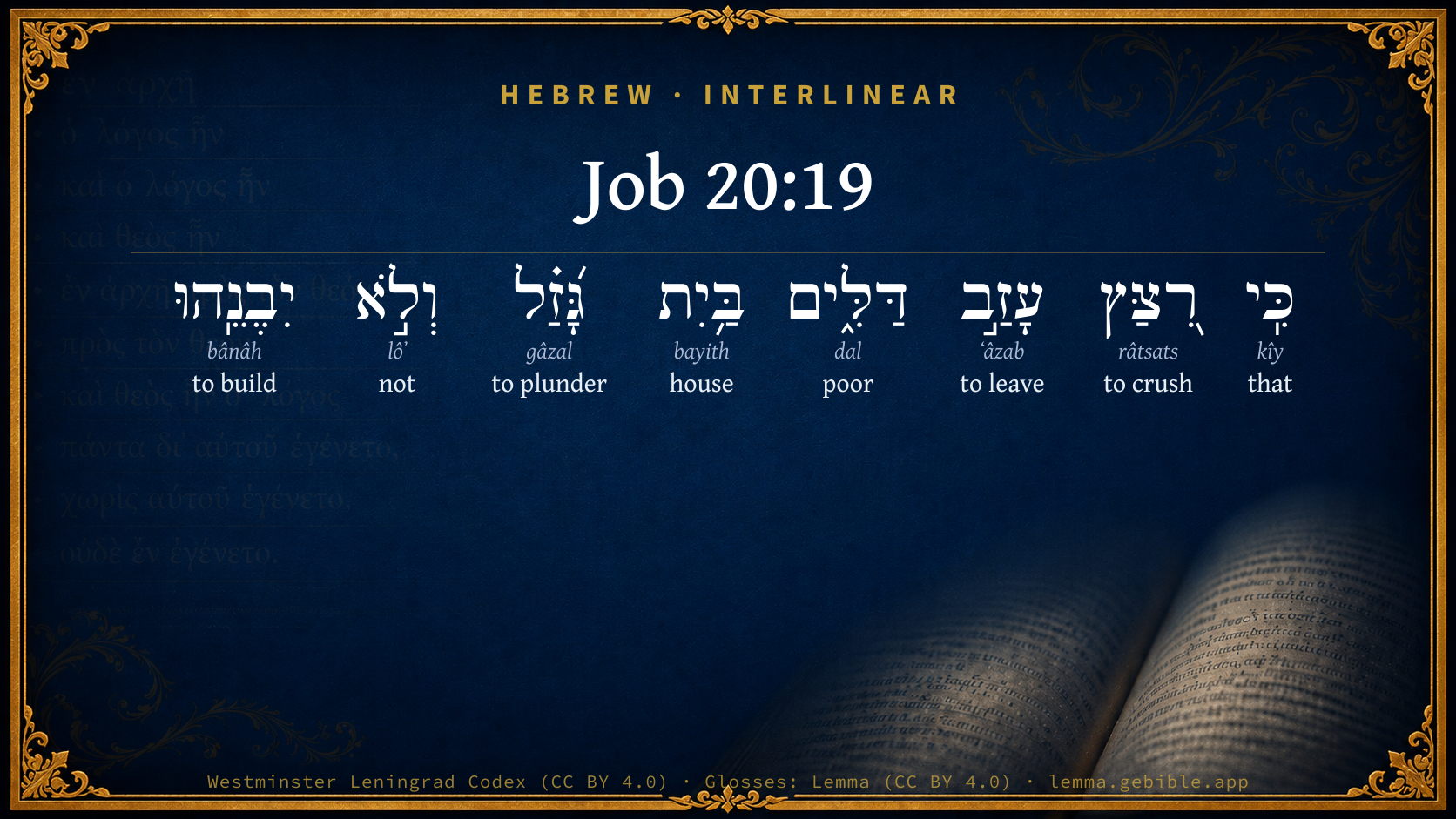
Hebrew (Westminster Leningrad Codex) Job 20:19 appears in the Hebrew Old Testament. The text above is from the Westminster Leningrad Codex. Each word links to its Strong’s number, a concise gloss, and parsing drawn from the Open Scriptures Hebrew Bible morphology. Click any word for its full Brown-Driver-Briggs (BDB) entry.
Download image
Cite this verse

Job 20:19 (World English Bible). Public Domain. Lemma interlinear Bible study tool, https://lemma.gebible.app/v/job/20/19.

Show BibTeX & RIS
BibTeX
RIS
English Translation
For he has oppressed and forsaken the poor. He has violently taken away a house, and he shall not build it up.
World English Bible · Public Domain
Download a study sheet

One document with this verse’s original text, its word-by-word gloss line, the meaning frame, cross-references with their text, attributed commentary, and full source and license credits — printable, and it pastes into notes with its structure intact.

This verse Autodidact and up

Study sheet (.html) Plain text (.txt)

A passage Seminary Student

Up to 50 verses in one chapter. A passage sheet keeps up to 6 commentary sources and 12 cross-references per verse, in the order this page ranks them, and says so on the sheet whenever that leaves anything out. Ask for a single verse and you get the Autodidact verse sheet above.

Everything on this page stays free to read, with no account — the sheet is a download of what is already on screen, not access to it.

Want to remove ads? Support Godless Engineer
Compare translations 3

The same verse in 3 English versions, stacked beneath the original-language interlinear above. Click any original word for its lexicon entry.

Each is an independent rendering of the whole verse — the interlinear is not word-aligned to these translations.

Highlighted words mark where these versions differ — a whole-verse word diff, not a word-by-word alignment.

  • World English Bible Public Domain
    For he has oppressed and forsaken the poor. He has violently taken away a house, and he shall not build it up.
  • King James Version Public Domain
    Because he hath oppressed and hath forsaken the poor; because he hath violently taken away an house which he builded not;
  • unfoldingWord Literal Text CC BY-SA 4.0
    For he has oppressed, he has forsaken the poor; he has seized a house and he did not build it.

unfoldingWord Literal Text — © unfoldingWord, licensed CC BY-SA 4.0. Word-aligned USFM3 via Door43 (git.door43.org/unfoldingWord/en_ult).

Versions to compare (up to 4)

3 of 4 selected

Show all 18 translations

Every available English version of this verse, each an independent rendering of the whole verse.

  • World English Bible Public Domain
    For he has oppressed and forsaken the poor. He has violently taken away a house, and he shall not build it up.
  • Berean Standard Bible Public Domain
    For he has oppressed and forsaken the poor; he has seized houses he did not build.
  • Majority Standard Bible Public Domain
    For he has oppressed and forsaken the poor; he has seized houses he did not build.
  • King James Version Public Domain
    Because he hath oppressed and hath forsaken the poor; because he hath violently taken away an house which he builded not;
  • American Standard Version (1901) Public Domain
    For he hath oppressed and forsaken the poor; He hath violently taken away a house, and he shall not build it up.
  • Revised Version (1885) Public Domain
    For he hath oppressed and forsaken the poor; he hath violently taken away an house, and he shall not build it up.
  • Geneva Bible (1599) Public Domain
    For he hath vndone many: he hath forsaken the poore, and hath spoyled houses which he builded not.
  • Douay-Rheims (1899) Public Domain
    Because he broke in and stripped the poor: he hath violently taken away a house which he did not build.
  • Young's Literal Translation Public Domain
    For he oppressed -- he forsook the poor, A house he hath taken violently away, And he doth not build it.
  • Literal Standard Version CC BY-SA 4.0
    For he oppressed—he forsook the poor, || He has taken a house away violently, || And he does not build it.
  • Unlocked Literal Bible CC BY-SA 4.0
    For he has oppressed and neglected poor people; he has violently taken away houses that he did not build.
  • unfoldingWord Literal Text CC BY-SA 4.0
    For he has oppressed, he has forsaken the poor; he has seized a house and he did not build it.
  • Darby Bible Public Domain
    For he hath oppressed, hath forsaken the poor; he hath violently taken away a house that he did not build.
  • World Messianic Bible Public Domain
    For he has oppressed and forsaken the poor. He has violently taken away a house, and he will not build it up.
  • Webster's Bible Public Domain
    Because he hath oppressed and hath forsaken the poor; because he hath violently taken away a house which he did not build.
  • Free Bible Version CC BY-SA 4.0
    For they have oppressed and abandoned the poor; they have seized houses they did not build.
  • Bible in Basic English Public Domain
    Because he has been cruel to the poor, turning away from them in their trouble; because he has taken a house by force which he did not put up;
  • JPS Tanakh (1917) Public Domain
    For he hath oppressed and forsaken the poor; he hath violently taken away a house, and he shall not build it up.

Literal Standard Version (2020), Covenant Press — licensed CC BY-SA 4.0. Text via the HelloAO Bible API (eBible.org). Unlocked Literal Bible (unfoldingWord) — licensed CC BY-SA 4.0. Text via the HelloAO Bible API (eBible.org). unfoldingWord Literal Text — © unfoldingWord, licensed CC BY-SA 4.0. Word-aligned USFM3 via Door43 (git.door43.org/unfoldingWord/en_ult). Free Bible Version, Dr. Jonathan Gallagher — licensed CC BY-SA 4.0. Text via the HelloAO Bible API (eBible.org).

Word by word

More ways to search: Search by grammar → Find every occurrence → Compare this word →

Practice this passage: Drill this verse → Learn its vocabulary →

רִ֭צַּץ
râtsats
H7533
“to crush”
Verb, Piel, Perfect, 3rd Person, Masculine, Singular
Part of Speech
Verb
Stem
Piel
Form
Perfect
Person
3rd Person
Gender
Masculine
Number
Singular
Full BDB Definition

Origin: a primitive root

TWOT: 2212

to crush, oppress - (Qal) - to crush, get crushed, be crushed - to crush, oppress (figuratively) - crushed (participle passive) - (Niphal) to be crushed, be broken - (Piel) - to crush in pieces - to grievously oppress (figuratively) - (Poel) to oppress (figuratively) - (Hiphil) to crush - (Hithpoel) to crush each other
  1. כִּֽי kîy H3588 “that” Conjunction
  2. עָזַ֣ב ʻâzab H5800 “to leave” Verb, Qal, Perfect, 3rd Person, Masculine, Singular
  3. דַּלִּ֑ים dal H1800 “poor” Adjective, Adjective, Masculine, Plural, Absolute
  4. בַּ֥יִת bayith H1004 “house” Noun, Common, Masculine, Singular, Absolute
  5. גָּ֝זַ֗ל gâzal H1497 “to plunder” Verb, Qal, Perfect, 3rd Person, Masculine, Singular
  6. וְלֹ֣א lôʼ H3808 “and · not” Conjunction + Particle, Negative
  7. יִבֶנֵֽהוּ bânâh H1129 “to build · him” Verb, Qal, Imperfect, 3rd Person, Masculine, Singular + Suffix, Personal, 3rd Person, Masculine, Singular

About this verse

These counts appear in no published source. They are computed here, from the morphology-tagged text and Lemma’s own curated glosses. What Lemma adds →

8
words
8
distinct lemmas
Wisdom
section

Notable vocabulary

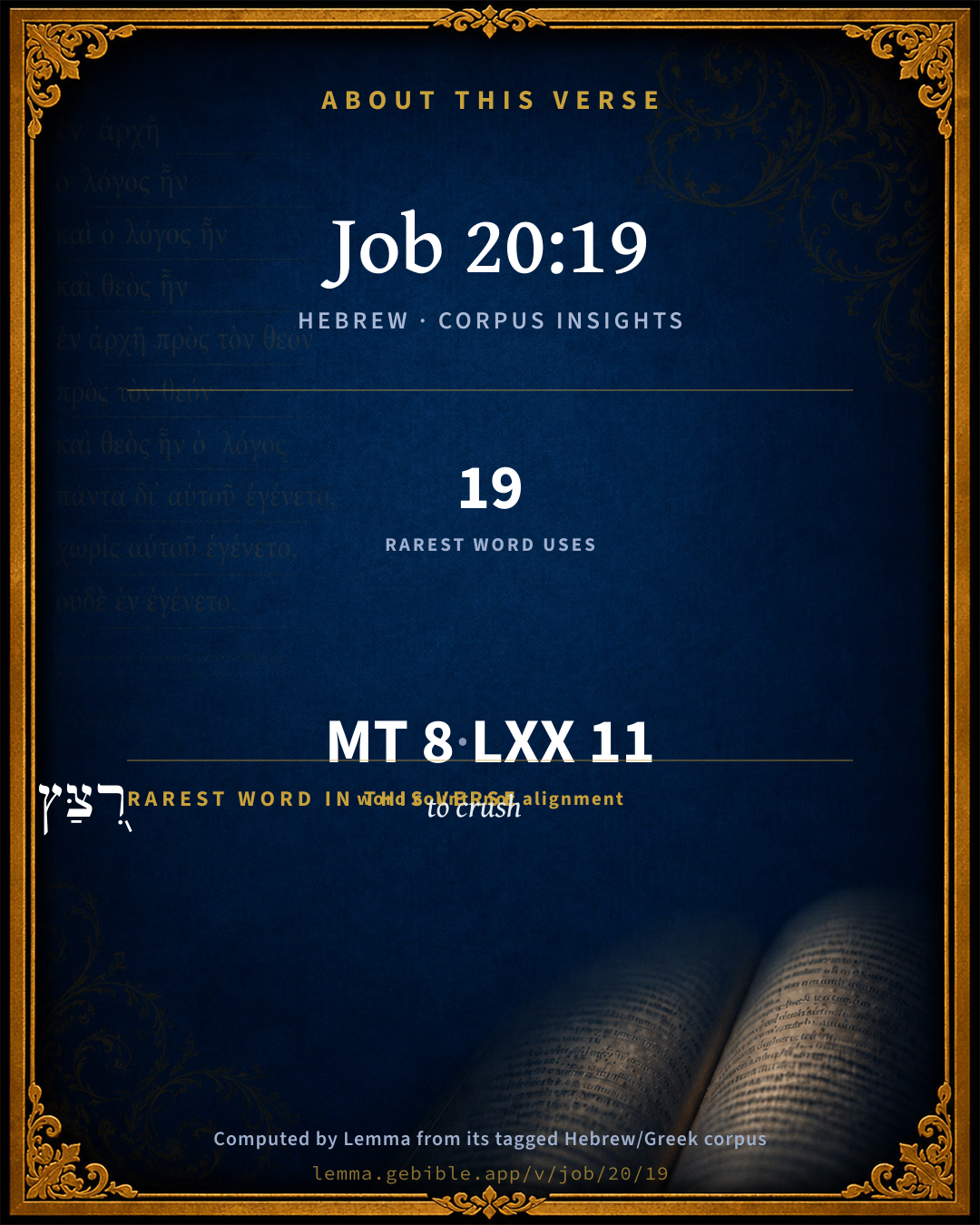
The rarest word here is רִ֭צַּץ to crush H7533 — appearing just 19 times in the whole Hebrew Bible.

Shared distinctive vocabulary

רִ֭צַּץ to crush H7533 occurs in 18 verses of the Hebrew Bible. Also found in:

Grammatical profile

  • 4 verbs
  • 1 noun
  • 1 adjective
  • 1 conjunction
  • 1 particle

Verb forms

  • רִ֭צַּץ Piel · Perfect
  • עָזַ֣ב Qal · Perfect
  • גָּ֝זַ֗ל Qal · Perfect
  • יִבֶנֵֽהוּ Qal · Imperfect

Hebrew & Septuagint length

In English translation the verse runs 22 words from the Hebrew and 22 from the Septuagint (LXX English) — the same length.

A rough comparison of the two English renderings, which tokenize alike — not a word-level alignment.

Word counts can differ between the Hebrew and the Greek without any difference in meaning — e.g. the Hebrew direct-object marker אֵת has no separate Greek word, and Greek often adds the article ὁ.

In the original languages it is 8 Hebrew tokens and 11 Greek tokens — but the two are counted differently (Hebrew bundles its prefixes and suffixes into one token; the Greek is in lemma form), so that isn’t a like-for-like length.

Cross-references

25

Topical passages linked to Job 20:19 in the Treasury of Scripture Knowledge — connected by theme and wording, ordered by reader-vote popularity; previews shown in the World English Bible.

  • Job 35:9 "By reason of the multitude of oppressions they cry out; They cry for help by reason of the arm of the mighty.
  • Proverbs 14:31 He who oppresses the poor shows contempt for his Maker, But he who is kind to the needy honors him.
  • Proverbs 22:22–23 Don't exploit the poor, because he is poor; And don't crush the needy in court;
  • Ezekiel 22:29 The people of the land have used oppression, and exercised robbery; yes, they have vexed the poor and needy, and have oppressed the foreigner wrongfully.
  • James 2:6 But you have dishonored the poor man. Don't the rich oppress you, and personally drag you before the courts?
  • James 2:13 For judgment is without mercy to him who has shown no mercy. Mercy triumphs over judgment.
  • James 5:4 Behold, the wages of the laborers who mowed your fields, which you have kept back by fraud, cry out, and the cries of those who reaped have entered into the ears of the Lord of Hosts.
  • Deuteronomy 28:33 The fruit of your ground, and all your labors, shall a nation which you don't know eat up; and you shall be only oppressed and crushed always;
  • 1 Samuel 12:3–4 Here I am: witness against me before Yahweh, and before his anointed: whose ox have I taken? or whose donkey have I taken? or whom have I defrauded? whom have I oppressed? or of whose hand have I taken a ransom to blind my eyes therewith? and I will restore it you.
  • 1 Kings 21:19 You shall speak to him, saying, Thus says Yahweh, Have you killed and also taken possession? You shall speak to him, saying, Thus says Yahweh, In the place where dogs licked the blood of Naboth shall dogs lick your blood, even yours.
  • Job 18:15 There shall dwell in his tent that which is none of his. Sulfur shall be scattered on his habitation.
  • Job 21:27–28 "Behold, I know your thoughts, The devices with which you would wrong me.
  • Job 22:6 For you have taken pledges from your brother for nothing, And stripped the naked of their clothing.
  • Job 24:2–12 There are people who remove the landmarks. They violently take away flocks, and feed them.
  • Job 31:13–22 "If I have despised the cause of my man-servant Or of my maid-servant, When they contended with me;
  • Job 31:38–39 If my land cries out against me, And the furrows of it weep together;
  • Psalms 10:18 To judge the fatherless and the oppressed, That man who is of the earth may terrify no more.
  • Psalms 12:5 "Because of the oppression of the weak and because of the groaning of the needy, I will now arise," says Yahweh; "I will set him in safety from those who malign him."
  • Ecclesiastes 4:1 Then I returned and saw all the oppressions that are done under the sun: and, behold, the tears of those who were oppressed, and they had no comforter; and on the side of their oppressors there was power; but they had no comforter.
  • Ecclesiastes 5:8 If you see the oppression of the poor, and the violent taking away of justice and righteousness in a district, don't marvel at the matter: for one official is eyed by a higher one; and there are officials over them.
  • Isaiah 5:7–8 For the vineyard of Yahweh of Hosts is the house of Israel, And the men of Judah his pleasant plant: And he looked for justice, but, behold, oppression; For righteousness, but, behold, a cry of distress.
  • Lamentations 3:34 To crush under foot all the prisoners of the earth,
  • Amos 4:1–3 Listen to this word, you cows of Bashan, who are on the mountain of Samaria, who oppress the poor, who crush the needy, who tell their lords, "Bring, and let us drink."
  • Micah 2:2 They covet fields, and seize them; And houses, and take them away: And they oppress a man and his house, Even a man and his heritage.
  • Micah 2:9 You drive the women of my people out from their pleasant houses; From their young children you take away my blessing forever.

Cross-references courtesy of OpenBible.info (CC BY 4.0).

Hebrew and Greek witnesses Masoretic Hebrew ↔ Greek Septuagint

The same verse in the two great witnesses to the Old Testament, shown verse-for-verse.

These are two independent witnesses, not word-aligned to each other, and the Septuagint is shown in lemma (dictionary) form.

Hebrew Job 20:19 Masoretic · Westminster Leningrad Codex

כִּֽי רִ֭צַּץ עָזַ֣ב דַּלִּ֑ים בַּ֥יִת גָּ֝זַ֗ל וְלֹ֣א יִבֶנֵֽהוּ

For he has oppressed and forsaken the poor. He has violently taken away a house, and he shall not build it up.

World English Bible · Public Domain

Greek LXX Job 20:19 Septuagint · lemma form

πολύς γάρ ἀδύνατος οἶκος θλάω δίαιτα δέ ἁρπάζω καί οὐ ἵστημι

For he has broken down the houses of many mighty men: and he has plundered an habitation, though he built it not.

LXX2012 (modern English Septuagint) · Public Domain

Hebrew: Westminster Leningrad Codex (CC BY 4.0). Greek: Septuagint (public domain); English from LXX2012 (modern English Septuagint) (Public Domain). How the Septuagint differs from the Hebrew →

Commentary

Notes on Job 20:19 from classic Christian and Jewish commentators (each source and its license shown beneath its notes). The classic Christian expositions comment on the surrounding passage and are grouped to its opening verse, so a note may address several verses; the Jewish commentaries on the Tanakh (Rashi and others) are per-verse, so they appear only where the commentator wrote on this verse.

Lemma curates 59 commentaries, every one of them public domain or Creative Commons licensed, each selected and text-cleaned for this edition rather than reprinted as found. About our sources →

Trapp's Complete Commentary

John Trapp

Job 20:19 Because he hath oppressed [and] hath forsaken the poor; [because] he hath violently taken away an house which he builded not;

Ver. 19. Because he hath oppressed and forsaken the poor]. Heb. Because he hath crushed or broken in pieces. The original word importeth (as one well observeth) tyrannical oppression without mercy or moderation, without ho or hold; some give full scope to their rage and wrath, they put neither bond nor bridle upon their covetousness and cruelty: such are characterized by this word.

And forsaken the poor] Or, Left men poor; viz. by leaving them without a livelihood, and so as good as without life. A poor man in his house is like a snail in his shell; crush that, and you kill him. They which read it, And forsaken the poor, give us this good note, that as it is sinful to forsake the poor, though we have never oppressed them, Mat 25:35-36 (not to do justice is injustice, not to show mercy is cruelty, Mar 3:4), so to oppress, and then forsake them, is far more sinful.

Because he hath violently taken away] Violently and in open view, in an impudent manner. He pulleth down men’s houses, but never thinketh of repairing them; so some read this text. Let our depopulators look to it, who build themselves desolate places, and desire to live alone in the earth. This hath been noted as a great fault in our nation. And therefore Goropius thinketh that the English were called Angli because they were so good anglers, having skill to lay various baits when they fished for other men’s livings.

John Trapp, A Commentary or Exposition upon All the Books of the Old and New Testament (1647–1656) — public domain. Text from a community e-Sword module.

The Biblical Illustrator

Joseph S. Exell

Job_20:19

Because he hath oppressed, and hath forsaken the poor.

Social wickedness

What is it that excites all this Divine antagonism and judgment? Was the object of it a theological heretic? Was the man pronounced wicked because he had imbibed certain wrong notions? Was this a case of heterodoxy of creed being punished by the outpouring of the vials of Divine wrath? Look at the words again. His philanthropy was wrong. The man was wicked socially--wicked in relation to his fellow men. All wickedness is not of a theological nature and quality, rising upward into the region of metaphysical conceptions and definitions of the Godhead, which only the learned can present or comprehend; there is a lateral wickedness, a wickedness as between man and man, rich and poor, poor and rich young and old; a household wickedness, a market place iniquity. There we stand on solid rock. If you have been led away with the thought that wickedness is a theological conception, and a species of theological nightmare, you have only to read the Bible, in its complete sense, in order to see that judgment is pronounced upon what may be called lateral wickedness--the wickedness that operates among ourselves, that wrongs mankind, that keeps a false weight, and a short measure, that practises cunning and deceit upon the simple and innocent, that fleeces the unsuspecting,--a social wickedness that stands out that it may be seen in all its black hideousness, and valued as one of the instruments of the devil. There is no escape from the judgment of the Bible. If it pronounced judgment upon false opinions only, then men might profess to be astounded by terms they cannot comprehend: but the Bible goes into the family, the market place, the counting house, the field where the labourer toils, and insists upon judging the actions of men, and upon sending away the richest man from all his bank of gold, if he have oppressed and forsaken the poor. (Joseph Parker, D.D.)

.

The Biblical Illustrator, edited by Joseph S. Exell (c. 1880s–1900s) — public domain. Text from a community e-Sword module.

Joseph Benson's Commentary

Job 20:19. Because he hath oppressed and forsaken the poor — By his oppression he brought men to utter poverty, and then forsook them in that destitute state, affording them no mercy nor help. Or, the meaning is, He made some poor by his oppressions, and others, that were poor, he suffered to perish for want of that relief which he might have afforded them. He hath violently taken away a house, &c. — Namely, for his own use; which he builded not — Which was none of his.

Joseph Benson's Commentary on the Old and New Testaments (1811–1818) — public domain. Text from a community e-Sword module.

Jamieson, Fausset & Brown

Robert Jamieson, A. R. Fausset & David Brown

oppressed--whereas he ought to have espoused their cause (Ch2 16:10).

forsaken--left helpless.

house--thus leaving the poor without shelter (Isa 5:8; Mic 2:2).

Jamieson, Fausset & Brown — Commentary Critical and Explanatory on the Whole Bible (1871) — public domain (CC PDM 1.0). Text via the HelloAO Bible API.

Adam Clarke's Commentary

Verse 19. He hath oppressed and hath forsaken the poor] Literally, He hath broken in pieces the forsaken of the poor; כי רצץ עזב דלים ki ritstsats azab dallim. The poor have fled from famine, and left their children behind them; and this hard-hearted wretch, meaning Job all the while, has suffered them to perish, when he might have saved them alive.

He hath violently taken away a house which he builded not] Or rather, He hath thrown down a house, and hath not rebuilt it. By neglecting or destroying the forsaken orphans of the poor, mentioned above, he has destroyed a house, (a family,) while he might, by helping the wretched, have preserved the family from becoming extinct.

Adam Clarke's Commentary on the Bible (1810–1826) — public domain. Text from a community e-Sword/MySword module.

Ellicott's Commentary for English Readers

(19) Because he hath oppressed and forsaken . . .—For these insinuations there was not a vestige of ground, but Job formally rebuts them in Job 31

A Bible Commentary for English Readers, edited by Charles John Ellicott (1878–1897) — public domain. Text from a community e-Sword module.

The Cambridge Bible for Schools and Colleges

gen. ed. J. J. S. Perowne

19. and hath forsaken] Abandoned them, after oppressing them, to their destitution. Thus, though joining house to house (Isa_5:8) and dispossessing the poor, the houses which he robs he shall not build up—as Is. says, Many houses shall be desolate, even great and fair without inhabitant (ch. Job_5:9).

The Cambridge Bible for Schools and Colleges (gen. ed. J. J. S. Perowne; Cambridge University Press, 1878–1918) — public domain. Text from a community e-Sword module.

John Gill's Exposition

Because he hath oppressed and hath forsaken the poor,.... Having oppressed, crushed, and broken the poor to pieces, he leaves them so without pity and compassion for them, and without giving them any relief; he first by oppression makes them poor, or however poorer still, and then leaves them in such circumstances; for this does not suppose that he once was a favourer of them, and afforded them assistance in their necessities, and afterwards forsook them; but rather, as Ben Gersom gives the sense, he does not leave the poor until he has oppressed and crushed them, and then he does; Mr. Broughton's reading of the words agrees with the former sense, "he oppresseth and leaveth poor":

because he hath violently taken away an house which he built not; an house which did not belong to him, he had no property in or right unto, which, as he had not bought, he had not built; and therefore could lay no rightful claim unto it, and yet this he took in a violent manner from the right owner of it, see Mic 2:2; or "and", or "but shall not build it" (a), or "buildeth it not"; he took it away with an intention to pull it down, and build a stately palace in the room of it; but either his substance was taken from him, or he taken away by death before he could finish it, and so either through neglect, or want of opportunity, or of money, did not what he thought to have done.

(a) "et non aedificabit eam", Pagninus, Montanus; "et non aedificat eam", Cocceius, Schultens; "non autem", Beza; "sed non", Schmidt, Michaelis.

John Gill's Exposition of the Whole Bible (1746–1763) — public domain (CC PDM 1.0). Text via the HelloAO Bible API.

Albert Barnes' Notes on the Bible

Because he hath oppressed - Margin, “crushed.” Such is the Hebrew.

And forsaken the poor - He has plundered them, and then forsaken them - as robbers do. The meaning is, that he had done this by his oppressive manner of dealing, and then left them to suffer and pine in want.

He hath violently taken away an house which he builded not - That is, by overreaching and harsh dealings he has come in possession of dwellings which he did not build, or purchase in any proper manner. It does not mean that he had done this by violence - for Zophar is not describing a robber, but he means that he took advantage of the needs of the poor and obtained their property. This is often done still. A rich man takes advantage of the needs of the poor, and obtains their little farm or house for much less than it is worth. He takes a mortgage, and then forecloses it, and buys the property himself for much less than its real value, and thus practices a species of the worst kind of robbery. Such a man, Zophar says, must expect punishment - and if there is any man who has occasion to dread the wrath of heaven it is he.

Albert Barnes' Notes on the Bible (1834–1885) — public domain. Text from a community e-Sword/MySword module.

Matthew Poole's English Annotations

By his oppression he brought men to utter poverty, and then forsook or left them in that forlorn estate, affording no mercy nor help to them. Or, some he made poor by his oppression, and others that were poor he suffered to perish for want of that relief which he should and might have afforded them; which is a crying sin in God’s sight, and one of those sins for which God destroyed Sodom, Eze 16:49, and therefore fitly mentioned here as one of the sins for which God punished this wicked man. Or, he oppresseth and leaveth poor, as Broughton renders it.

An house which he built not, i.e. which was none of his. Heb. he hath violently taken away an house, and (or but) did not build (or repair, as building is oft used) it, to wit, that house for his own use, i.e. he did not build or possess that house, as he intended to do, but was cut off by God’s hand before he could enjoy the fruit of his oppressions.

Matthew Poole's English Annotations on the Holy Bible (1683–1685) — public domain. Text from a community e-Sword/MySword module.

Whedon's Commentary on the Bible

Daniel D. Whedon

19. A house which he builded not — Literally, A house hath he plundered, but he shall not build it up. “House” is used collectively for houses. The prerogative of the wicked is, that they destroy; (Ecc_9:18;) for them there is no counterpart, such as of “building up.” He finally fails in all his desires and efforts, for they are founded in wrong.

Daniel D. Whedon (gen. ed.), Commentary on the Old and New Testaments (1874–1909) — public domain. Text from a community e-Sword module.

The Pulpit Commentary

Because he hath oppressed and hath forsaken the poor. These charges are now for the first time insinuated against Job; later on, they are openly brought by Eliphaz. (Job_22:5-9) Job denies them categorically in Job_29:11-17. They seem to have been pure calumnies, without an atom of foundation. Because he hath violently taken away a house which he builded not. Another calumny, doubtless. Something like it was insinuated by Eliphaz in Job_15:28.

Vers. 19, 20. Oppressing the poor.

This is a sin most frequently referred to in the Bible, a common wrong against which the prophets of Israel continually pretested with vehement indignation. Christ, usually mild and gentle, spoke in great anger of this wickedness. (Mat_23:14) St. James denounced it as not unknown among Christians. (Jam_5:4)

I THE SIN.

1. Its various forms. It is not always seen in the bare and open fashion of primitive times. The sheik exacts more than is due from his tribe, the Eastern landowner grinds down his fellaheen, the baron enslaves and robs his serfs, and we denounce the manifest wrong. But is not the same evil to be seen in the more decorous injustice of modern Western civilization? The great body of working men is now emancipated from the tyranny of past ages, and is able to assert itself and claim its rights. But below this powerful class is a mass of unskilled workers, the helpless men and women who crowd the lower quarters of great cities the really poor. When advantage is taken of the poverty of these miserable people to grind them down, they are being robbed. With us the sweating system takes the place of the old territorial oppression.

2. Its invariable wickedness. Is the modern commercial oppression one whit less guilty than the old lordly tyranny? The evil is more disguised with us; it is more difficult to bring it home to its authors; our complicated civilization hushes it up yet the cruelty and wickedness are as real as ever.

II THE PUNISHMENT. The writers of the Bible who denounced the sin of oppressing the poor continually threatened punishment to the guilty oppressors.

1. Direct loss. Zophar contemplates the actual loss of ill-gotten gains. This may happen in the present life. It will certainly occur at death. The oppressor can take none of the profits of his cruelty out of the world with him.

2. Disappointment. In the fulness of his sufficiency he shall be in straits. Even without the loss of property difficulties will arise. The rich man may be murdered in his palace. Most oppressors live in fear. Trouble of mind mingles like gall in the sweetest cup of pleasures got by cruelty.

III THE CURE. Punishment is not cure. The fear of it may act as somewhat of a check. But we must go deeper for "the root of the matter" if we would cure it. Now undoubtedly in this case the root is not hard to find, for it is simply unmitigated selfishness. Therefore until men can be taught to substitute brotherliness for selfishness, oppression of the poor must continue. No social revolution, no legal enactment, no forcible change, can eradicate the evil. We must go for the cure of social evils to Christ. He is concerned with society as well as with the individual, and there is no hope for society until he is recognized as its Saviour and its Lord. Christianity instills brotherliness. No man can be a Christian who is destitute of this grace. Oppression of the poor belies the most sanctimonious profession of religion. We want to get back to the religion, of Christ, which made more of brotherliness than even of faith; the religion of St. Paul and St. John, which taught that love is the greatest thing in the world. W.F.A.

The Pulpit Commentary (1880–1919), ed. H.D.M. Spence-Jones & Joseph S. Exell — public domain. Text from a community e-Sword module.

Rashi

Rabbi Shlomo Yitzchaki (Rashi)

When he oppressed, he abandoned the poor After he oppressed the poor, he abandoned the poor and was banished from the world and went his way, and they return and collect their stolen items from him.

[The expression] כִּי רָצַץ [means] when he oppressed, like (Exod. 18:16), “Whenever (כי) they have a concern, they come to me,” which means when they have.

Rashi on the Tanakh — English translations: “The Judaica Press complete Tanach with Rashi, translated by A. J. Rosenberg” (CC BY 4.0); “Pentateuch with Rashi's commentary by M. Rosenbaum and A.M. Silbermann, 1929-1934” (public domain); “The Metsudah Tanach series, Lakewood, N.J” (CC BY 4.0); and “The Book of Joshua, Metsudah Publications, 1997” (CC BY 4.0). Text via Sefaria.

Lesson kit

Teaching starters — assembled from the data on this page, not authored interpretation. Every prompt links to the verse data it draws on. Edit before teaching.

Job, in the Wisdom, opens this verse with 8 words (8 distinct Hebrew lemmas). Its most distinctive word is râtsats (“to crush”). A historical commentator’s framing appears above. Read the whole chapter for the surrounding context.

Discussion questions

  1. What does “to crush” (râtsats) contribute to the verse as a whole?
  2. How does Genesis 25:22, which shares the word «to crush», read alongside this verse?
  3. The translations on this page render this verse differently — a whole-verse word diff, not a word-by-word alignment. What might account for the different wordings?
  4. «רִ֭צַּץ» is a Piel Perfect verb. How does that grammatical form shape the action described?
  5. Compare how Trapp's Complete Commentary and The Biblical Illustrator read this verse. Where do they agree or differ?

Things to notice

Reading settings

Reading text

Shown beneath each verse's original-language words.

Old Testament
Old Testament edition

Read the OT as the Masoretic Hebrew (MT) or the Greek Septuagint (LXX).

English shown for the Greek Septuagint (in the Hebrew ↔ Greek comparison).

Comparing translations? Open the Compare panel on any verse page to stack up to four side by side.