
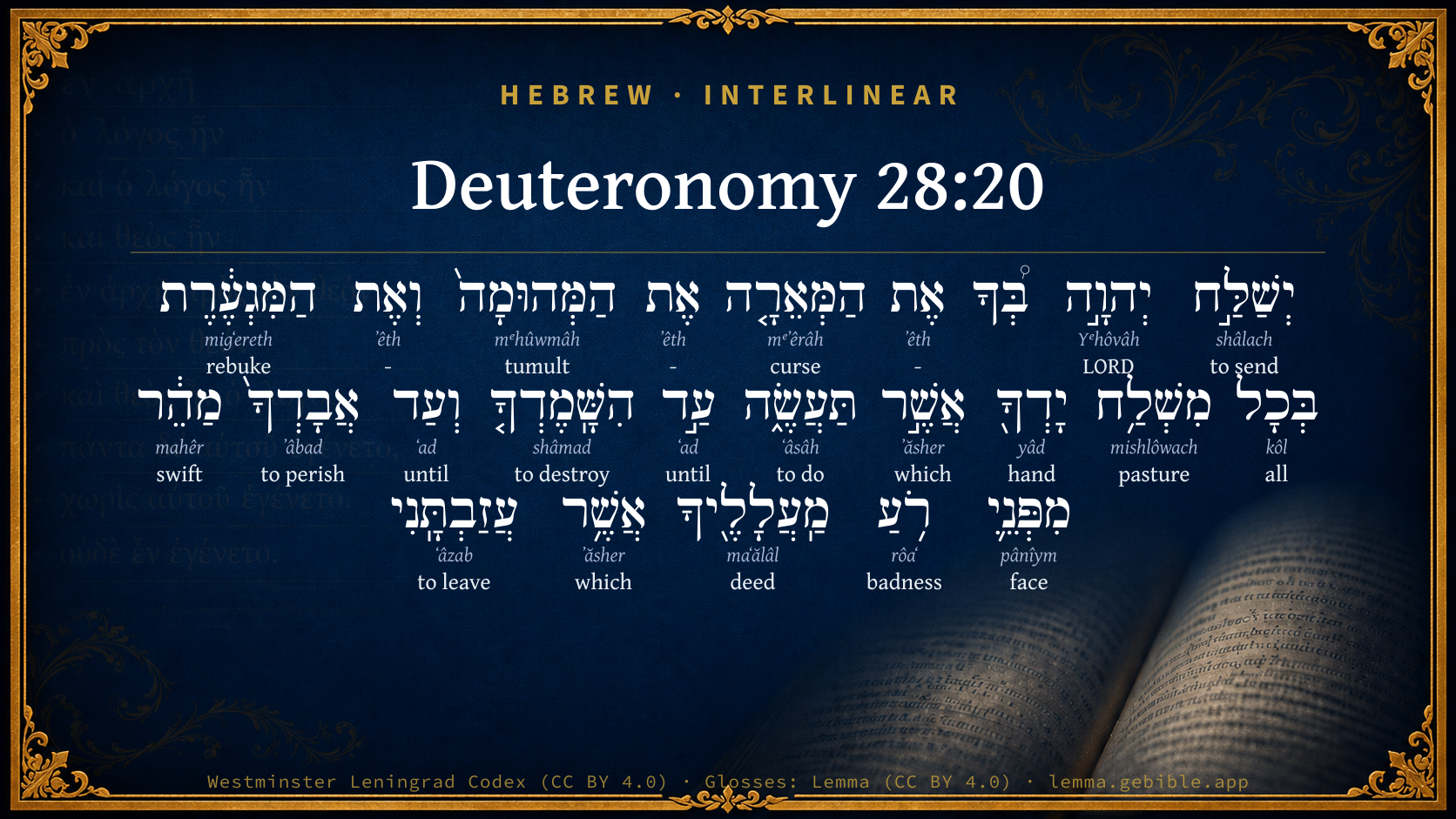
Deuteronomy 28:20

Hebrew (Westminster Leningrad Codex) Deuteronomy 28:20 appears in the Hebrew Old Testament. The text above is from the Westminster Leningrad Codex. Each word links to its Strong’s number, a concise gloss, and parsing drawn from the Open Scriptures Hebrew Bible morphology. Click any word for its full Brown-Driver-Briggs (BDB) entry.
Download image
Cite this verse

Deuteronomy 28:20 (World English Bible). Public Domain. Lemma interlinear Bible study tool, https://lemma.gebible.app/v/deuteronomy/28/20.

Show BibTeX & RIS
BibTeX
RIS
English Translation
Yahweh will send on you cursing, confusion, and rebuke, in all that you put your hand to do, until you are destroyed, and until you perish quickly; because of the evil of your doings, by which you have forsaken me.
World English Bible · Public Domain
Highlights
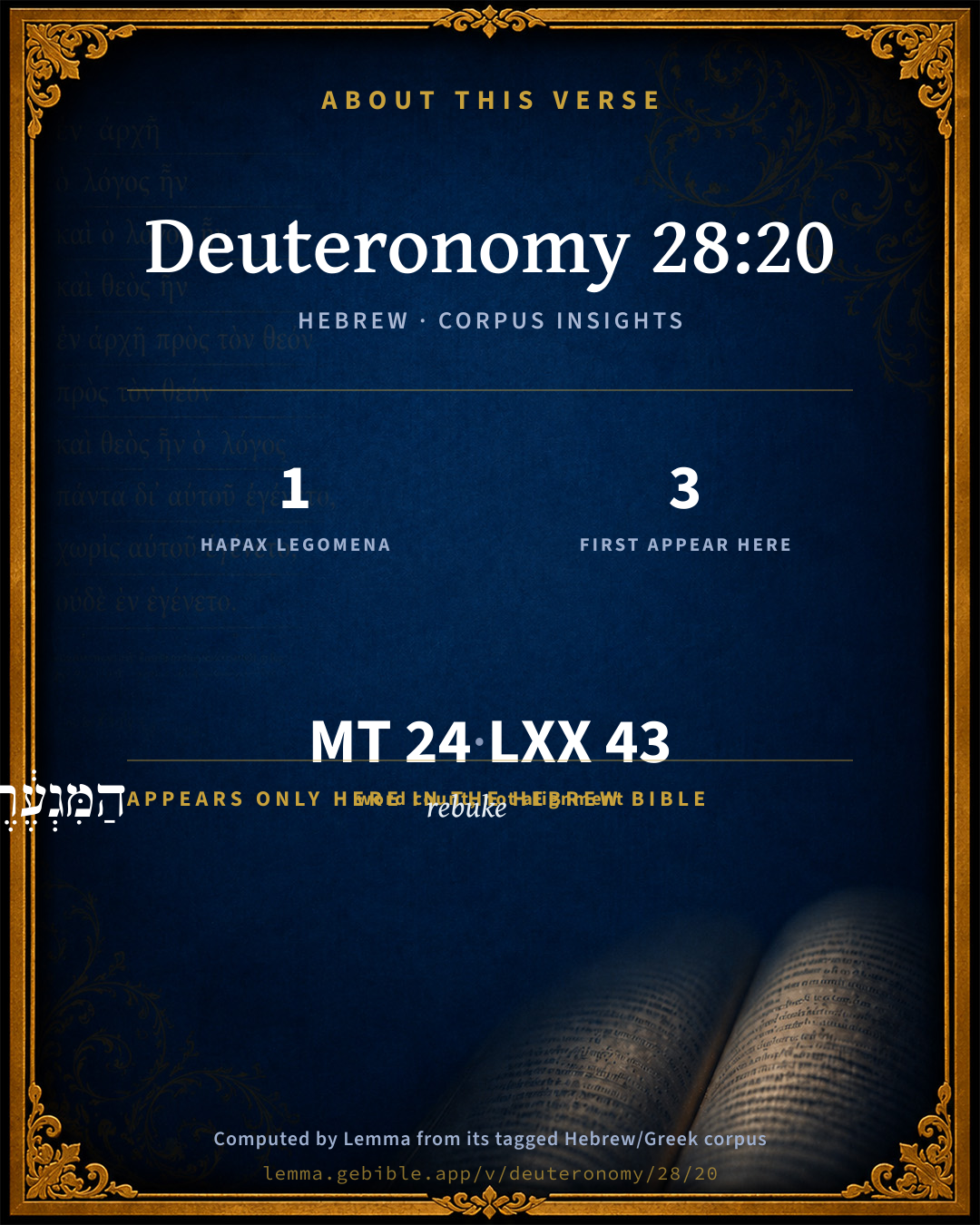
  • 1 hapax legomenon — only here in the Hebrew Bible
  • 3 first appearances in the Hebrew Bible
Full analysis ↓
Download a study sheet

One document with this verse’s original text, its word-by-word gloss line, the meaning frame, cross-references with their text, attributed commentary, and full source and license credits — printable, and it pastes into notes with its structure intact.

This verse Autodidact and up

Study sheet (.html) Plain text (.txt)

A passage Seminary Student

Up to 50 verses in one chapter. A passage sheet keeps up to 6 commentary sources and 12 cross-references per verse, in the order this page ranks them, and says so on the sheet whenever that leaves anything out. Ask for a single verse and you get the Autodidact verse sheet above.

Everything on this page stays free to read, with no account — the sheet is a download of what is already on screen, not access to it.

Want to remove ads? Support Godless Engineer
Compare translations 3

The same verse in 3 English versions, stacked beneath the original-language interlinear above. Click any original word for its lexicon entry.

Each is an independent rendering of the whole verse — the interlinear is not word-aligned to these translations.

Highlighted words mark where these versions differ — a whole-verse word diff, not a word-by-word alignment.

  • World English Bible Public Domain
    Yahweh will send on you cursing, confusion, and rebuke, in all that you put your hand to do, until you are destroyed, and until you perish quickly; because of the evil of your doings, by which you have forsaken me.
  • King James Version Public Domain
    The LORD shall send upon thee cursing, vexation, and rebuke, in all that thou settest thine hand unto for to do, until thou be destroyed, and until thou perish quickly; because of the wickedness of thy doings, whereby thou hast forsaken me.
  • unfoldingWord Literal Text CC BY-SA 4.0
    Yahweh will send against you curses, confusion, and rebukes in all the sending out of your hand that you will do until you are destroyed and until you perish quickly from the faces of your wicked deeds by which you will have forsaken me.

unfoldingWord Literal Text — © unfoldingWord, licensed CC BY-SA 4.0. Word-aligned USFM3 via Door43 (git.door43.org/unfoldingWord/en_ult).

Versions to compare (up to 4)

3 of 4 selected

Show all 18 translations

Every available English version of this verse, each an independent rendering of the whole verse.

  • World English Bible Public Domain
    Yahweh will send on you cursing, confusion, and rebuke, in all that you put your hand to do, until you are destroyed, and until you perish quickly; because of the evil of your doings, by which you have forsaken me.
  • Berean Standard Bible Public Domain
    The LORD will send curses upon you, confusion and reproof in all to which you put your hand, until you are destroyed and quickly perish because of the wickedness you have committed in forsaking Him.
  • Majority Standard Bible Public Domain
    The LORD will send curses upon you, confusion and reproof in all to which you put your hand, until you are destroyed and quickly perish because of the wickedness you have committed in forsaking Him.
  • King James Version Public Domain
    The LORD shall send upon thee cursing, vexation, and rebuke, in all that thou settest thine hand unto for to do, until thou be destroyed, and until thou perish quickly; because of the wickedness of thy doings, whereby thou hast forsaken me.
  • American Standard Version (1901) Public Domain
    Jehovah will send upon thee cursing, discomfiture, and rebuke, in all that thou puttest thy hand unto to do, until thou be destroyed, and until thou perish quickly; because of the evil of thy doings, whereby thou hast forsaken me.
  • Revised Version (1885) Public Domain
    The LORD shall send upon thee cursing, discomfiture, and rebuke, in all that thou puttest thine hand unto for to do, until thou be destroyed, and until thou perish quickly; because of the evil of thy doings, whereby thou hast forsaken me.
  • Geneva Bible (1599) Public Domain
    The Lord shall sende vpon thee cursing, trouble, and shame, in all that which thou settest thine hand to do, vntil thou be destroyed, and perish quickely, because of the wickednesse of thy workes whereby thou hast forsaken me.
  • Douay-Rheims (1899) Public Domain
    The Lord shall send upon thee famine and hunger, and a rebuke upon all the works which thou shalt do: until he consume and destroy thee quickly, for thy most wicked inventions, by which thou hast forsaken me.
  • Young's Literal Translation Public Domain
    `Jehovah doth send on thee the curse, the trouble, and the rebuke, in every putting forth of thy hand which thou dost, till thou art destroyed, and till thou perish hastily, because of the evil of thy doings `by' which thou hast forsaken Me.
  • Literal Standard Version CC BY-SA 4.0
    YHWH sends the curse, the trouble, and the rebuke on you, in every putting forth of your hand which you do, until you are destroyed, and until you perish quickly, because of the evil of your doings [by] which you have forsaken Me.
  • Unlocked Literal Bible CC BY-SA 4.0
    Yahweh will send on you curses, confusion, and rebukes in all that you put your hand to, until you are destroyed, and until you perish quickly because of your wicked actions by which you will have forsaken me.
  • unfoldingWord Literal Text CC BY-SA 4.0
    Yahweh will send against you curses, confusion, and rebukes in all the sending out of your hand that you will do until you are destroyed and until you perish quickly from the faces of your wicked deeds by which you will have forsaken me.
  • Darby Bible Public Domain
    Jehovah will send upon thee cursing, confusion, and rebuke, in all the business of thy hand which thou doest, until thou be destroyed and until thou perish quickly, because of the wickedness of thy doings, whereby thou hast forsaken me.
  • World Messianic Bible Public Domain
    The LORD will send on you cursing, confusion, and rebuke in all that you put your hand to do, until you are destroyed and until you perish quickly, because of the evil of your doings, by which you have forsaken me.
  • Webster's Bible Public Domain
    The LORD shall send upon thee cursing, vexation, and rebuke, in all that thou undertakest to perform, until thou shalt be destroyed, and until thou shalt perish quickly; because of the wickedness of thy doings by which thou hast forsaken me.
  • Free Bible Version CC BY-SA 4.0
    The Lord will send you curses, making you confused and frustrated in everything you do, until you are brought down and die quickly because of the evil that you've done by abandoning him.
  • Bible in Basic English Public Domain
    The Lord will send on you cursing and trouble and punishment in everything to which you put your hand, till sudden destruction overtakes you; because of your evil ways in which you have been false to me.
  • JPS Tanakh (1917) Public Domain
    The LORD will send upon thee cursing, discomfiture, and rebuke, in all that thou puttest thy hand unto to do, until thou be destroyed, and until thou perish quickly; because of the evil of thy doings, whereby thou hast forsaken Me.

Literal Standard Version (2020), Covenant Press — licensed CC BY-SA 4.0. Text via the HelloAO Bible API (eBible.org). Unlocked Literal Bible (unfoldingWord) — licensed CC BY-SA 4.0. Text via the HelloAO Bible API (eBible.org). unfoldingWord Literal Text — © unfoldingWord, licensed CC BY-SA 4.0. Word-aligned USFM3 via Door43 (git.door43.org/unfoldingWord/en_ult). Free Bible Version, Dr. Jonathan Gallagher — licensed CC BY-SA 4.0. Text via the HelloAO Bible API (eBible.org).

Word by word

More ways to search: Search by grammar → Find every occurrence → Compare this word →

Practice this passage: Drill this verse → Learn its vocabulary →

הַמִּגְעֶ֔רֶת
migʻereth
H4045
“the · rebuke”
Particle, Definite Article + Noun, Common, Feminine, Singular, Absolute
Part of Speech
Particle + Noun
Type
Common
Gender
Feminine
Number
Singular
State
Absolute
Full BDB Definition

Origin: from H1605

TWOT: 370b

rebuke, reproof
  1. יְשַׁלַּ֣ח shâlach H7971 “to send” Verb, Piel, Imperfect, 3rd Person, Masculine, Singular
  2. יְהוָ֣ה Yᵉhôvâh H3068 “LORD” Noun, Proper
  3. אֶת ʼêth H853 “-” Particle, Direct Object
  4. הַמְּאֵרָ֤ה mᵉʼêrâh H3994 “the · curse” Particle, Definite Article + Noun, Common, Feminine, Singular, Absolute
  5. אֶת ʼêth H853 “-” Particle, Direct Object
  6. הַמְּהוּמָה֙ mᵉhûwmâh H4103 “the · tumult” Particle, Definite Article + Noun, Common, Feminine, Singular, Absolute
  7. וְאֶת ʼêth H853 “and · -” Conjunction + Particle, Direct Object
  8. בְּכָל kôl H3605 “in/at · all of” Preposition + Noun, Common, Masculine, Singular, Construct
  9. מִשְׁלַ֥ח mishlôwach H4916 “pasture of” Noun, Common, Masculine, Singular, Construct
  10. יָדְךָ֖ yâd H3027 “hand · your” Noun, Common, Both, Singular, Construct + Suffix, Personal, 2nd Person, Masculine, Singular
  11. אֲשֶׁ֣ר ʼăsher H834 “which” Particle, Relative
  12. תַּעֲשֶׂ֑ה ʻâsâh H6213 “to do” Verb, Qal, Imperfect, 2nd Person, Masculine, Singular
  13. עַ֣ד ʻad H5704 “until” Preposition
  14. הִשָּֽׁמֶדְךָ֤ shâmad H8045 “to destroy · you” Verb, Niphal, Infinitive Construct + Suffix, Personal, 2nd Person, Masculine, Singular
  15. וְעַד ʻad H5704 “and · until” Conjunction + Preposition
  16. אֲבָדְךָ֙ ʼâbad H6 “to perish · you” Verb, Qal, Infinitive Construct + Suffix, Personal, 2nd Person, Masculine, Singular
  17. מַהֵ֔ר mahêr H4118 “swift” Verb, Piel, Infinitive Absolute
  18. מִפְּנֵ֛י pânîym H6440 “from · face(s) of” Preposition + Noun, Common, Both, Plural, Construct
  19. רֹ֥עַ rôaʻ H7455 “badness of” Noun, Common, Masculine, Singular, Construct
  20. מַֽעֲלָלֶ֖יךָ maʻălâl H4611 “deeds · your” Noun, Common, Masculine, Plural, Construct + Suffix, Personal, 2nd Person, Masculine, Singular
  21. אֲשֶׁ֥ר ʼăsher H834 “which” Particle, Relative
  22. עֲזַבְתָּֽנִי ʻâzab H5800 “to leave · me” Verb, Qal, Perfect, 2nd Person, Masculine, Singular + Suffix, Personal, 1st Person, Common, Singular

About this verse

These counts appear in no published source. They are computed here, from the morphology-tagged text and Lemma’s own curated glosses. What Lemma adds →

24
words
19
distinct lemmas
Pentateuch
section

Notable vocabulary

1 hapax legomenon — a word that appears only here in the entire Hebrew Bible:

  • הַמִּגְעֶ֔רֶת rebuke H4045

First appearance in Scripture

These words make their first canonical appearance in the Hebrew Bible here:

  • הַמְּאֵרָ֤ה curse H3994
  • הַמִּגְעֶ֔רֶת rebuke H4045
  • מַֽעֲלָלֶ֖יךָ deed H4611

Shared distinctive vocabulary

הַמְּאֵרָ֤ה curse H3994 occurs in 5 verses of the Hebrew Bible. Also found in:

Grammatical profile

  • 6 verbs
  • 10 nouns
  • 3 prepositions
  • 5 particles

Verb forms

  • יְשַׁלַּ֣ח Piel · Imperfect
  • תַּעֲשֶׂ֑ה Qal · Imperfect
  • הִשָּֽׁמֶדְךָ֤ Niphal · Infinitive Construct
  • אֲבָדְךָ֙ Qal · Infinitive Construct
  • מַהֵ֔ר Piel · Infinitive Absolute
  • עֲזַבְתָּֽנִי Qal · Perfect

Repetition

Words recur within this verse — often emphatic in Hebrew:

  • עַ֣ד until H5704 ×2
  • אֲשֶׁ֣ר which H834 ×2

Hebrew & Septuagint length

In English translation the verse runs 40 words from the Hebrew and 45 from the Septuagint (LXX English) — closely comparable.

A rough comparison of the two English renderings, which tokenize alike — not a word-level alignment.

Word counts can differ between the Hebrew and the Greek without any difference in meaning — e.g. the Hebrew direct-object marker אֵת has no separate Greek word, and Greek often adds the article ὁ.

In the original languages it is 24 Hebrew tokens and 43 Greek tokens — but the two are counted differently (Hebrew bundles its prefixes and suffixes into one token; the Greek is in lemma form), so that isn’t a like-for-like length.

Cross-references

15

Topical passages linked to Deuteronomy 28:20 in the Treasury of Scripture Knowledge — connected by theme and wording, ordered by reader-vote popularity; previews shown in the World English Bible.

  • Isaiah 66:15 For, behold, Yahweh will come with fire, and his chariots shall be like the whirlwind; to render his anger with fierceness, and his rebuke with flames of fire.
  • Malachi 2:2 If you will not listen, and if you will not lay it to heart, to give glory to my name," says Yahweh of Hosts, "then will I send the curse on you, and I will curse your blessings. Indeed, I have cursed them already, because you do not lay it to heart.
  • Deuteronomy 4:26 I call heaven and earth to witness against you this day, that you shall soon utterly perish from off the land whereunto you go over the Jordan to possess it; you shall not prolong your days on it, but shall utterly be destroyed.
  • Isaiah 51:20 Your sons have fainted, they lie at the head of all the streets, as an antelope in a net; they are full of the wrath of Yahweh, the rebuke of your God.
  • John 3:36 One who believes in the Son has eternal life, but one who disobeys the Son won't see life, but the wrath of God remains on him."
  • Isaiah 30:17 One thousand [shall flee] at the threat of one; at the threat of five shall you flee: until you be left as a beacon on the top of a mountain, and as an ensign on a hill.
  • Leviticus 26:38 You will perish among the nations, and the land of your enemies will eat you up.
  • Joshua 23:16 When you disobey the covenant of Yahweh your God, which he commanded you, and go and serve other gods, and bow down yourselves to them; then will the anger of Yahweh be kindled against you, and you shall perish quickly from off the good land which he has given to you.
  • Isaiah 28:19 As often as it passes though, it shall take you; for morning by morning shall it pass through, by day and by night: and it shall be nothing but terror to understand the message.
  • Leviticus 26:31–33 I will lay your cities waste, and will bring your sanctuaries to desolation, and I will not take delight in the sweet fragrence of your offerings.
  • 1 Samuel 14:20 Saul and all the people who were with him were gathered together, and came to the battle: and, behold, every man's sword was against his fellow, [and there was] a very great confusion.
  • Psalms 7:11 God is a righteous judge, Yes, a God who has indignation every day.
  • Psalms 80:4–16 Yahweh God of hosts, How long will you be angry against the prayer of your people?
  • Zechariah 14:12–13 This will be the plague with which Yahweh will strike all the peoples who have warred against Jerusalem: their flesh will consume away while they stand on their feet, and their eyes will consume away in their sockets, and their tongue will consume away in their mouth.
  • 1 Thessalonians 2:16 forbidding us to speak to the Gentiles that they may be saved; to fill up their sins always. But wrath has come on them to the uttermost.

Cross-references courtesy of OpenBible.info (CC BY 4.0).

Hebrew and Greek witnesses Masoretic Hebrew ↔ Greek Septuagint

The same verse in the two great witnesses to the Old Testament, shown verse-for-verse.

These are two independent witnesses, not word-aligned to each other, and the Septuagint is shown in lemma (dictionary) form.

Hebrew Deuteronomy 28:20 Masoretic · Westminster Leningrad Codex

יְשַׁלַּ֣ח יְהוָ֣ה בְּ֠ךָ אֶת הַמְּאֵרָ֤ה אֶת הַמְּהוּמָה֙ וְאֶת הַמִּגְעֶ֔רֶת בְּכָל מִשְׁלַ֥ח יָדְךָ֖ אֲשֶׁ֣ר תַּעֲשֶׂ֑ה עַ֣ד הִשָּֽׁמֶדְךָ֤ וְעַד אֲבָדְךָ֙ מַהֵ֔ר מִפְּנֵ֛י רֹ֥עַ מַֽעֲלָלֶ֖יךָ אֲשֶׁ֥ר עֲזַבְתָּֽנִי

Yahweh will send on you cursing, confusion, and rebuke, in all that you put your hand to do, until you are destroyed, and until you perish quickly; because of the evil of your doings, by which you have forsaken me.

World English Bible · Public Domain

Greek LXX Deuteronomy 28:20 Septuagint · lemma form

ἐκ ἀποστέλλω κύριος σύ ὁ ἔνδεια καί ὁ ἐκλιμία καί ὁ ἀνάλωσις ἐπί πᾶς οὗ ἄν ἐπιβάλλω ὁ χείρ σύ ὅσος ἐάν ποιέω ἕως ἄν ἐκὀλεθρεύω σύ καί ἕως ἄν ἀποὀλλύω σύ ἐν ταχύς διά ὁ πονηρός ἐπιτήδευμα σύ διότι ἐν καταλείπω ἐγώ

The Lord send upon you lack, and famine, and consumption of all things on which you shall put your hand, until he shall have utterly destroyed you, and until he shall have consumed you quickly because of your evil devices, because you have forsaken me.

LXX2012 (modern English Septuagint) · Public Domain

On this verse, Haydock's Catholic Bible Commentary discusses the Septuagint’s reading. Read the note in Commentary ↓

Hebrew: Westminster Leningrad Codex (CC BY 4.0). Greek: Septuagint (public domain); English from LXX2012 (modern English Septuagint) (Public Domain). How the Septuagint differs from the Hebrew →

Targum (Aramaic paraphrase)

2

The Targum is the ancient Jewish Aramaic paraphrase of the Hebrew Scriptures — an interpretive translation, not the Hebrew text itself. Onkelos (literal) and Pseudo-Jonathan (expansive) render the Torah, and Jonathan the Prophets. Coverage is partial: where no permissively-licensed English translation exists for a verse, only the Aramaic is shown. This is verse-level text, not a word-by-word alignment to the Hebrew.

  1. Targum Onkelos Torah (Genesis–Deuteronomy)
    יְגָרֵי יְיָ בָּךְ יָת מֵאַרְתָּא וְיָת שִׁגוּשַׁיָא וְיָת מְזוֹפִיתָא בְּכָל אוֹשָׁטוּת יְדָךְ דִי תַעְבֵּד עַד דְתִשְׁתֵּצֵי וְעַד דְתֵיבַד בִּפְרִיעַ מִן קֳדָם בִּישׁוּת עוֹבָדָיךְ דִשְׁבַקְתָּא דַחַלְתִּי

    (no public-domain English translation for this verse)

    Targum Onkelos — Aramaic: “Onkelos Genesis” (public domain); “Onkelos Exodus” (public domain); “Onkelos Leviticus” (public domain); “Onkelos Numbers” (public domain); “Onkelos Deuteronomy” (public domain). English: “Sefaria Community Translation” (CC0 1.0 (public-domain dedication)); “J.W. Etheridge. The Targums of Onkelos and Jonathan Ben Uzziel on the Pentateuch. London: Longmans, Green, 1862” (public domain). Text via Sefaria.

  2. Targum Pseudo-Jonathan Torah (Genesis–Deuteronomy)
    יְגָרֵי מֵימְרָא דַיְיָ בְּכוֹן יַת לְוָוטְתָא לְלַטָטָא מָמוֹנְכוֹן וְיַת עַרְבּוּבָא לְעַרְבָּבָא שְׁלַמְכוֹן וְיַת מְזוֹפִיתָא בְּכָל אוֹשָׁטוּת יֶדְכוֹן דְתַעַבְדוּן עַד דְתִשְׁתֵּיצוּן וְעַד דְתוֹבְדוּן בְּסַרְהוּבַיָא מִן קֳדָם בִּישׁוּת עוֹבָדֵיכוֹן דִשְׁבַקְתּוּן דַחַלְתִּי

    The Word of the Lord will send forth curses among you to curse your wealth, and confusion to confound your prosperity, and vexation with all that you put your hands to do, until He hath undone you, and you perish soon on account of the wickedness of your doings when you have forsaken My worship.

    Targum Pseudo-Jonathan — Aramaic: “Targum Jonathan on Genesis” (public domain); “Targum Jonathan on Exodus” (public domain); “Targum Jonathan on Leviticus” (public domain); “Targum Jonathan on Numbers” (public domain); “Targum Jonathan on Deuteronomy” (public domain). English: “The Targum of Jonathan ben Uzziel, trans. J. W. Etheridge, London, 1862” (public domain). Text via Sefaria.

Commentary

Notes on Deuteronomy 28:20 from classic Christian and Jewish commentators (each source and its license shown beneath its notes). The classic Christian expositions comment on the surrounding passage and are grouped to its opening verse, so a note may address several verses; the Jewish commentaries on the Tanakh (Rashi and others) are per-verse, so they appear only where the commentator wrote on this verse.

Lemma curates 59 commentaries, every one of them public domain or Creative Commons licensed, each selected and text-cleaned for this edition rather than reprinted as found. About our sources →

Trapp's Complete Commentary

John Trapp

Deu 28:20 The LORD shall send upon thee cursing, vexation, and rebuke, in all that thou settest thine hand unto for to do, until thou be destroyed, and until thou perish quickly; because of the wickedness of thy doings, whereby thou hast forsaken me.

Ver. 20. {See Trapp on "Deu 28:15"}

John Trapp, A Commentary or Exposition upon All the Books of the Old and New Testament (1647–1656) — public domain. Text from a community e-Sword module.

Joseph Benson's Commentary

Deu 28:20. Cursing, vexation, and rebuke — The first of these words seems to import that God would blast all their designs; the second relates to disquiet and perplexity of mind, arising from the disappointment of their hopes, and presages of approaching miseries; the third respects such chastisements from God as would give them a severe check and rebuke for their sins and follies.

Joseph Benson's Commentary on the Old and New Testaments (1811–1818) — public domain. Text from a community e-Sword module.

Geneva Bible (1599)

Geneva Bible translators

Or, rebuke.

Geneva Bible (1599) marginal notes — public domain. Text via Bolls.life.

Adam Clarke's Commentary

Verse 20. Cursing] This shall be thy state; vexation - grief, trouble, and anguish of heart; rebuke - continual judgments, and marks of God's displeasure.

Adam Clarke's Commentary on the Bible (1810–1826) — public domain. Text from a community e-Sword/MySword module.

Ellicott's Commentary for English Readers

(20) Cursing, vexation, and rebuke.—Deficiency, and anxiety, and failure in every enterprise, would convey the idea, according to another interpretation. There are two views of the derivation of the first of the three words employed. Probably the Authorised Version is right. The three words have each of them the definite article in the original, just as if they were so many diseases. “The curse, and the terror, and the rebuke” of the Almighty are terrible obstacles to any human undertaking.

In all that thou settest thine hand unto for to do.—Literally, in every putting forth of thine hand which thou makest, i.e., in every undertaking. This is the opposite of Deu_28:8.

Thou hast forsaken me.—Moses and Jehovah are here identified. This is characteristic. The prophets say, “Thus saith the Lord.” Moses, whom the Lord knew face to face, sometimes exhorts Israel in His name without any such introduction. (Comp. the phrase “to forsake Moses” (literally, apostasy from Moses) in Act_21:21.)

A Bible Commentary for English Readers, edited by Charles John Ellicott (1878–1897) — public domain. Text from a community e-Sword module.

John Gill's Exposition

And the heaven that is over thy head shall be brass,.... Or like brass, not for its clearness, brightness, and splendour, or for its being spread out like a molten looking glass which was of brass, Job 37:18; but for its dryness and hardness, no moisture being in it, or passing through it; no showers of rain nor dew being let down from it:

and the earth that is under thee shall be iron; or like iron, hard and impenetrable, into which the plough and spade will not enter; nor anything spring out of it, for want of rain and dew to moisten and soften it. The same is said in Lev 26:19; only there is an inversion of the figures; there the heaven is said to be as iron, and the earth like brass, but signify the same thing.

John Gill's Exposition of the Whole Bible (1746–1763) — public domain (CC PDM 1.0). Text via the HelloAO Bible API.

Haydock's Catholic Bible Commentary

Rebuke, or "curse." Septuagint, the pestilence, (Calmet) or destruction, (analosin.) (Haydock)

George Leo Haydock (1774–1849), Haydock's Catholic Family Bible and Commentary, 1859 edition — public domain. Excludes Psalms (Douay-Rheims chapter numbering differs from Protestant) and Deuterocanonical books (Catholic canon only).

Matthew Poole's English Annotations

Vexation, or, disturbance. This seems chiefly to concern the mind, and its torment arising from the disappointment of hopes, the presages of its approaching miseries.

Rebuke, to wit, from God, not so much in words as by his actions, by cross providences, by sharp and sore afflictions, which are oft called rebukes, as 2Ki 19:3; Psa 18:15; Psa 39:11; 80:16; Isa 51:20; 66:15; Eze 5:15; 25:17.

Matthew Poole's English Annotations on the Holy Bible (1683–1685) — public domain. Text from a community e-Sword/MySword module.

Whedon's Commentary on the Bible

Daniel D. Whedon

20. Vexation — Consternation is a more exact rendering of the Hebrew. In 1Sa_5:11, and Deu_7:23, it is translated destruction.

Rebuke — The Hebrew word here used is found only in this place. It evidently has a stronger meaning than rebuke — condemnation would be better — implying God’s curse upon all their undertakings.

Daniel D. Whedon (gen. ed.), Commentary on the Old and New Testaments (1874–1909) — public domain. Text from a community e-Sword module.

The Pulpit Commentary

Vers. 20-26. First group. The curse should come upon them in various forms of evil, filling them with terror and dismay, and threatening them with utter ruin. (cf. Mal_2:2)

Vexation; rather, consternation; the deadly confusion with which God confounds his enemies. The same word is used in Deu_7:23; 1Sa_14:20. Rebuke; rather, threatening.

The Pulpit Commentary (1880–1919), ed. H.D.M. Spence-Jones & Joseph S. Exell — public domain. Text from a community e-Sword module.

John Wesley's Explanatory Notes

Vexation - This seems chiefly to concern the mind, arising from the disappointment of hopes and the presages of its approaching miseries. Rebuke - Namely, from God, not so much in words as by his actions, by cross providences, by sharp and sore afflictions.

John Wesley, Explanatory Notes Upon the Whole Bible (1754–1765) — public domain. Text via the GEBible commentary corpus.

unfoldingWord translationNotes

Door43 World Missions Community

General Information:

Moses speaks to the Israelites as if they were one man, so the words "you" and "your" here are singular. (See: Forms of You)

curses, confusion, and rebukes

"disasters, fear, and frustration"

in all that you put your hand to

This is an idiom. AT: "in everything you do" (See: Idiom)

until you are destroyed

This can be stated in active form. AT: "until your enemies destroy you" (See: Active or Passive)

forsaken me

Here "me" refers to Yahweh.

cling to you

"remain on you"

translationWords

curse

rebuke

hand

perish

evil

forsake

plague

possess

unfoldingWord translationNotes — © Distant Shores Media and the Door43 World Missions Community, licensed CC BY-SA 4.0. Source: git.door43.org/Door43/en_tn.

Rashi

Rabbi Shlomo Yitzchaki (Rashi)

המארה means PAUCITY, similar to (Leviticus 13:51) “a fretting leprosy (ממארה)” (a leprosy that frets the flesh, thus attenuating it).

המהומה — Onkelos renders this by שגוש which means: A TERRIFYING SOUND.

Rashi on the Tanakh — English translations: “The Judaica Press complete Tanach with Rashi, translated by A. J. Rosenberg” (CC BY 4.0); “Pentateuch with Rashi's commentary by M. Rosenbaum and A.M. Silbermann, 1929-1934” (public domain); “The Metsudah Tanach series, Lakewood, N.J” (CC BY 4.0); and “The Book of Joshua, Metsudah Publications, 1997” (CC BY 4.0). Text via Sefaria.

Lesson kit

Teaching starters — assembled from the data on this page, not authored interpretation. Every prompt links to the verse data it draws on. Edit before teaching.

Deuteronomy, in the Pentateuch, opens this verse with 24 words (19 distinct Hebrew lemmas). Its most distinctive word is migʻereth (“rebuke”). A historical commentator’s framing appears above. Read the whole chapter for the surrounding context.

Discussion questions

  1. How does “rebuke” (migʻereth) shape what this verse is saying?
  2. 1 word here appears nowhere else in the Hebrew Bible. Why might the author reach for such rare wording?
  3. 3 words make their first appearance in Scripture here. What does this debut establish?
  4. How does Proverbs 3:33, which shares the word «curse», read alongside this verse?
  5. What does the repetition of “until” (2× in this one verse) do in this verse?
  6. These translations render this verse differently. What is at stake in choosing one wording over another?
  7. «יְשַׁלַּ֣ח» is a Piel Imperfect verb. How does that grammatical form shape the action described?
  8. Compare how Trapp's Complete Commentary and Joseph Benson's Commentary read this verse. Where do they agree or differ?

Things to notice

  • 1 word in this verse appears nowhere else in the Hebrew Bible.
  • 3 words make their first canonical appearance in Scripture here.
  • This verse counts 24 Hebrew ↔ 43 Greek words.
  • These translations choose different wording for 27 words in this verse.
  • “until” occurs 2× in this single verse.

Reading settings

Reading text

Shown beneath each verse's original-language words.

Old Testament
Old Testament edition

Read the OT as the Masoretic Hebrew (MT) or the Greek Septuagint (LXX).

English shown for the Greek Septuagint (in the Hebrew ↔ Greek comparison).

Comparing translations? Open the Compare panel on any verse page to stack up to four side by side.