
Joshua 24:16

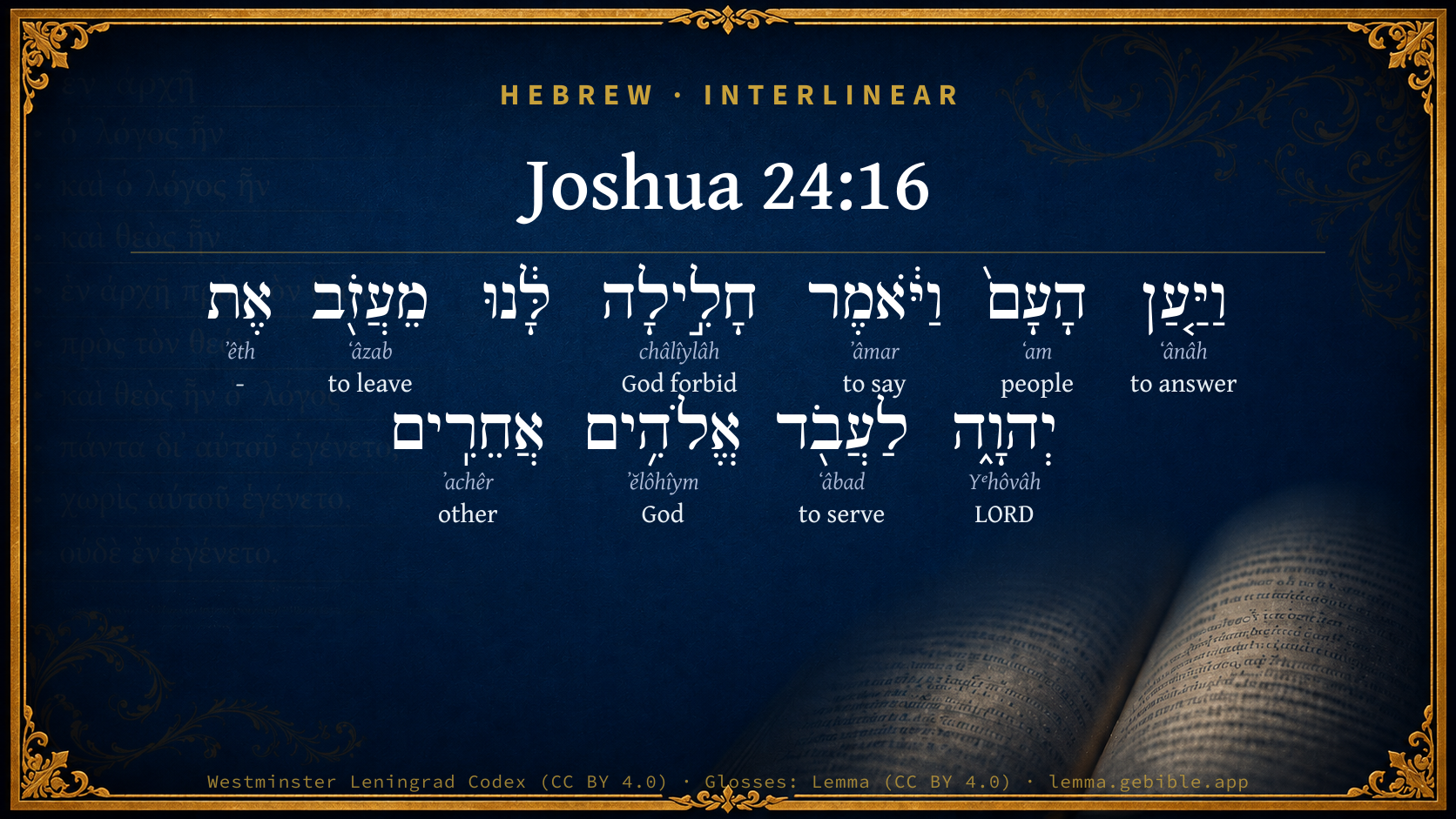
Hebrew (Westminster Leningrad Codex) Joshua 24:16 appears in the Hebrew Old Testament. The text above is from the Westminster Leningrad Codex. Each word links to its Strong’s number, a concise gloss, and parsing drawn from the Open Scriptures Hebrew Bible morphology. Click any word for its full Brown-Driver-Briggs (BDB) entry.
Download image
Cite this verse

Joshua 24:16 (World English Bible). Public Domain. Lemma interlinear Bible study tool, https://lemma.gebible.app/v/joshua/24/16.

Show BibTeX & RIS
BibTeX
RIS
English Translation
The people answered, Far be it from us that we should forsake Yahweh, to serve other gods;
World English Bible · Public Domain
Download a study sheet

One document with this verse’s original text, its word-by-word gloss line, the meaning frame, cross-references with their text, attributed commentary, and full source and license credits — printable, and it pastes into notes with its structure intact.

This verse Autodidact and up

Study sheet (.html) Plain text (.txt)

A passage Seminary Student

Up to 50 verses in one chapter. A passage sheet keeps up to 6 commentary sources and 12 cross-references per verse, in the order this page ranks them, and says so on the sheet whenever that leaves anything out. Ask for a single verse and you get the Autodidact verse sheet above.

Everything on this page stays free to read, with no account — the sheet is a download of what is already on screen, not access to it.

Want to remove ads? Support Godless Engineer
Compare translations 3

The same verse in 3 English versions, stacked beneath the original-language interlinear above. Click any original word for its lexicon entry.

Each is an independent rendering of the whole verse — the interlinear is not word-aligned to these translations.

Highlighted words mark where these versions differ — a whole-verse word diff, not a word-by-word alignment.

  • World English Bible Public Domain
    The people answered, Far be it from us that we should forsake Yahweh, to serve other gods;
  • King James Version Public Domain
    And the people answered and said, God forbid that we should forsake the LORD, to serve other gods;
  • unfoldingWord Literal Text CC BY-SA 4.0
    And the people answered and said, “Profane to us from leaving Yahweh to serve other gods!

unfoldingWord Literal Text — © unfoldingWord, licensed CC BY-SA 4.0. Word-aligned USFM3 via Door43 (git.door43.org/unfoldingWord/en_ult).

Versions to compare (up to 4)

3 of 4 selected

Show all 18 translations

Every available English version of this verse, each an independent rendering of the whole verse.

  • World English Bible Public Domain
    The people answered, Far be it from us that we should forsake Yahweh, to serve other gods;
  • Berean Standard Bible Public Domain
    The people replied, “Far be it from us to forsake the LORD to serve other gods!
  • Majority Standard Bible Public Domain
    The people replied, “Far be it from us to forsake the LORD to serve other gods!
  • King James Version Public Domain
    And the people answered and said, God forbid that we should forsake the LORD, to serve other gods;
  • American Standard Version (1901) Public Domain
    And the people answered and said, Far be it from us that we should forsake Jehovah, to serve other gods;
  • Revised Version (1885) Public Domain
    And the people answered and said, God forbid that we should forsake the LORD, to serve other gods;
  • Geneva Bible (1599) Public Domain
    Then the people answered and saide, God forbid, that we shoulde forsake the Lord, to serue other gods.
  • Douay-Rheims (1899) Public Domain
    And the people answered, and said: God forbid we should leave the Lord, and serve strange gods.
  • Young's Literal Translation Public Domain
    And the people answer and say, `Far be it from us to forsake Jehovah, to serve other gods;
  • Literal Standard Version CC BY-SA 4.0
    And the people answer and say, “Far be it from us to forsake YHWH, to serve other gods;
  • Unlocked Literal Bible CC BY-SA 4.0
    The people answered and said, “We would never forsake Yahweh to serve other gods,
  • unfoldingWord Literal Text CC BY-SA 4.0
    And the people answered and said, “Profane to us from leaving Yahweh to serve other gods!
  • Darby Bible Public Domain
    And the people answered and said, Far be it from us that we should forsake Jehovah, to serve other gods;
  • World Messianic Bible Public Domain
    The people answered, “Far be it from us that we should forsake the LORD, to serve other gods;
  • Webster's Bible Public Domain
    And the people answered, and said, Be it far from us that we should forsake the LORD, to serve other gods;
  • Free Bible Version CC BY-SA 4.0
    The people responded, “We are never going to give up on the Lord and worship other gods!
  • Bible in Basic English Public Domain
    Then the people in answer said, Never will we give up the Lord to be the servants of other gods;
  • JPS Tanakh (1917) Public Domain
    And the people answered and said: 'Far be it from us that we should forsake the LORD, to serve other gods;

Literal Standard Version (2020), Covenant Press — licensed CC BY-SA 4.0. Text via the HelloAO Bible API (eBible.org). Unlocked Literal Bible (unfoldingWord) — licensed CC BY-SA 4.0. Text via the HelloAO Bible API (eBible.org). unfoldingWord Literal Text — © unfoldingWord, licensed CC BY-SA 4.0. Word-aligned USFM3 via Door43 (git.door43.org/unfoldingWord/en_ult). Free Bible Version, Dr. Jonathan Gallagher — licensed CC BY-SA 4.0. Text via the HelloAO Bible API (eBible.org).

Word by word

More ways to search: Search by grammar → Find every occurrence → Compare this word →

Practice this passage: Drill this verse → Learn its vocabulary →

חָלִ֣ילָה
châlîylâh
H2486
“God forbid”
Particle, Interjection + Suffix, h
Part of Speech
Particle
Type
Interjection
Full BDB Definition

Origin: a directive from H2490

TWOT: 661c

far be it (from me), God forbid that, let it not be
  1. וַיַּ֤עַן ʻânâh H6030 “and · to answer” Conjunction + Verb, Qal, Sequential Imperfect, 3rd Person, Masculine, Singular
  2. הָעָם֙ ʻam H5971 “the · people” Particle, Definite Article + Noun, Common, Masculine, Singular, Absolute
  3. וַיֹּ֔אמֶר ʼâmar H559 “and · to say” Conjunction + Verb, Qal, Sequential Imperfect, 3rd Person, Masculine, Singular
  4. מֵעֲזֹ֖ב ʻâzab H5800 “from · to leave” Preposition + Verb, Qal, Infinitive Construct
  5. אֶת ʼêth H853 “-” Particle, Direct Object
  6. יְהוָ֑ה Yᵉhôvâh H3068 “LORD” Noun, Proper
  7. לַעֲבֹ֖ד ʻâbad H5647 “to serve” Preposition + Verb, Qal, Infinitive Construct
  8. אֱלֹהִ֥ים ʼĕlôhîym H430 “God(s)” Noun, Common, Masculine, Plural, Absolute
  9. אֲחֵרִֽים ʼachêr H312 “other” Adjective, Adjective, Masculine, Plural, Absolute

About this verse

These counts appear in no published source. They are computed here, from the morphology-tagged text and Lemma’s own curated glosses. What Lemma adds →

11
words
10
distinct lemmas
Historical
section

Notable vocabulary

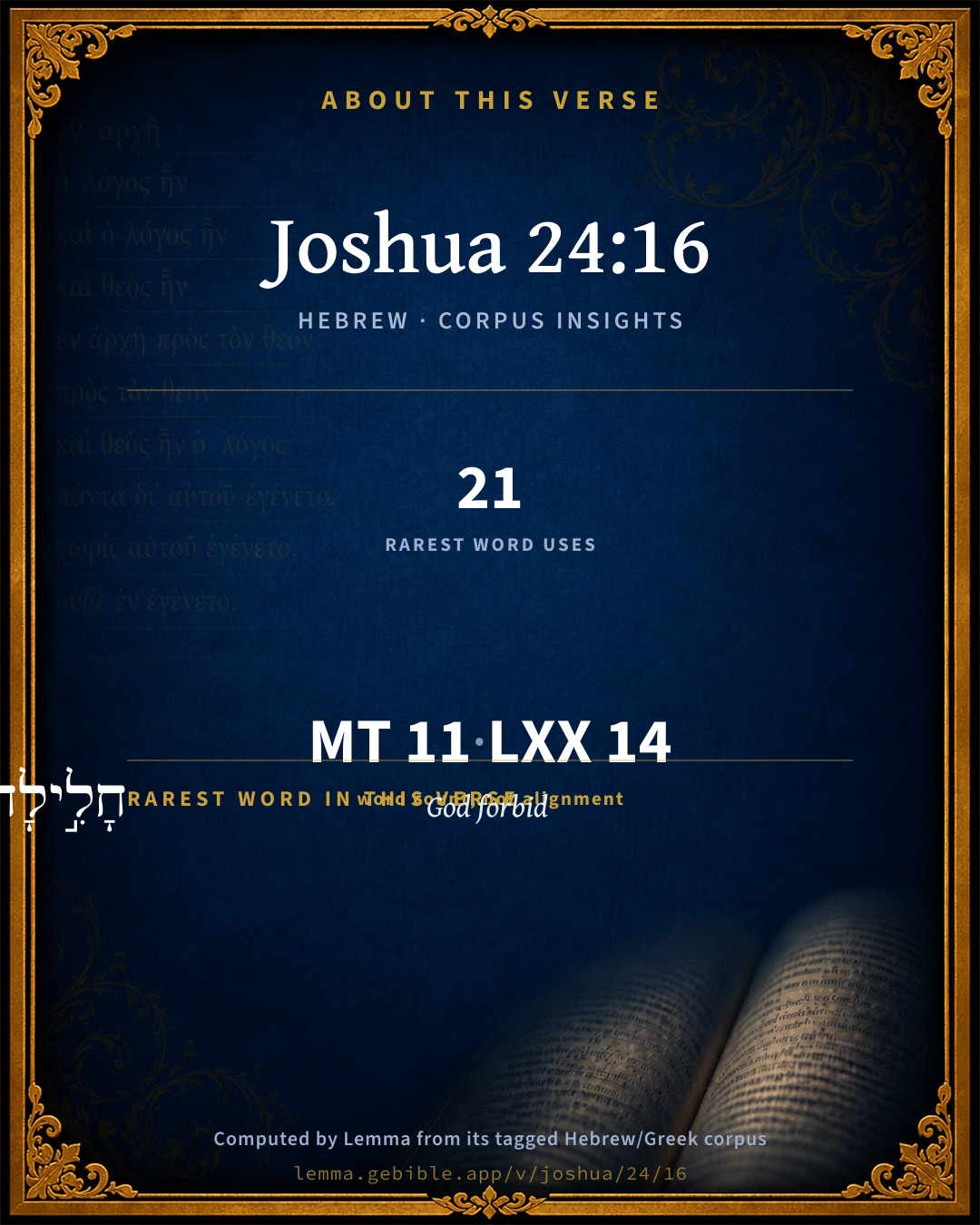
The rarest word here is חָלִ֣ילָה God forbid H2486 — appearing just 21 times in the whole Hebrew Bible.

Shared distinctive vocabulary

חָלִ֣ילָה God forbid H2486 occurs in 19 verses of the Hebrew Bible. Also found in:

Grammatical profile

  • 4 verbs
  • 3 nouns
  • 1 adjective
  • 1 preposition
  • 2 particles

Verb forms

  • וַיַּ֤עַן Qal · Sequential Imperfect
  • וַיֹּ֔אמֶר Qal · Sequential Imperfect
  • מֵעֲזֹ֖ב Qal · Infinitive Construct
  • לַעֲבֹ֖ד Qal · Infinitive Construct

Hebrew & Septuagint length

In English translation the verse runs 17 words from the Hebrew and 21 from the Septuagint (LXX English) — closely comparable.

A rough comparison of the two English renderings, which tokenize alike — not a word-level alignment.

Word counts can differ between the Hebrew and the Greek without any difference in meaning — e.g. the Hebrew direct-object marker אֵת has no separate Greek word, and Greek often adds the article ὁ.

In the original languages it is 11 Hebrew tokens and 14 Greek tokens — but the two are counted differently (Hebrew bundles its prefixes and suffixes into one token; the Greek is in lemma form), so that isn’t a like-for-like length.

Cross-references

4

Topical passages linked to Joshua 24:16 in the Treasury of Scripture Knowledge — connected by theme and wording, ordered by reader-vote popularity; previews shown in the World English Bible.

  • Hebrews 10:38–39 But the righteous will live by faith. If he shrinks back, my soul has no pleasure in him."
  • 1 Samuel 12:23 Moreover as for me, far be it from me that I should sin against Yahweh in ceasing to pray for you: but I will instruct you in the good and the right way.
  • Romans 3:6 May it never be! For then how will God judge the world?
  • Romans 6:2 May it never be! We who died to sin, how could we live in it any longer?

Cross-references courtesy of OpenBible.info (CC BY 4.0).

Hebrew and Greek witnesses Masoretic Hebrew ↔ Greek Septuagint

The same verse in the two great witnesses to the Old Testament, shown verse-for-verse.

These are two independent witnesses, not word-aligned to each other, and the Septuagint is shown in lemma (dictionary) form.

Hebrew Joshua 24:16 Masoretic · Westminster Leningrad Codex

וַיַּ֤עַן הָעָם֙ וַיֹּ֔אמֶר חָלִ֣ילָה לָּ֔נוּ מֵעֲזֹ֖ב אֶת יְהוָ֑ה לַעֲבֹ֖ד אֱלֹהִ֥ים אֲחֵרִֽים

The people answered, Far be it from us that we should forsake Yahweh, to serve other gods;

World English Bible · Public Domain

Greek LXX Joshua 24:16 Septuagint · lemma form

καί ἀποκρίνω ὁ λαός εἶπον μή γίγνομαι ἐγώ καταλείπω κύριος ὥστε λατρεύω θεός ἕτερος

And the people answered and said, Far be it from us to forsake the Lord, so as to serve other gods.

LXX2012 (modern English Septuagint) · Public Domain

Hebrew: Westminster Leningrad Codex (CC BY 4.0). Greek: Septuagint (public domain); English from LXX2012 (modern English Septuagint) (Public Domain). How the Septuagint differs from the Hebrew →

Targum (Aramaic paraphrase)

1

The Targum is the ancient Jewish Aramaic paraphrase of the Hebrew Scriptures — an interpretive translation, not the Hebrew text itself. Onkelos (literal) and Pseudo-Jonathan (expansive) render the Torah, and Jonathan the Prophets. Coverage is partial: where no permissively-licensed English translation exists for a verse, only the Aramaic is shown. This is verse-level text, not a word-by-word alignment to the Hebrew.

  1. Targum Jonathan Prophets (Joshua–Malachi)
    וַאֲתֵיב עַמָא וַאֲמַר חַס לָנָא מִלְמִשְׁבַּק יַת פּוּלְחָנָא דַייָ לְמִפְלַח לְטַעֲוַת עַמְמַיָא:

    (no public-domain English translation for this verse)

    Targum Jonathan — Aramaic: “Mikraot Gedolot” (public domain). English: “Sefaria Community Translation” (CC0 1.0 (public-domain dedication)); “London "Chaldee Paraphrase," 1871” (public domain). Text via Sefaria.

Commentary

Notes on Joshua 24:16 from classic Christian and Jewish commentators (each source and its license shown beneath its notes). The classic Christian expositions comment on the surrounding passage and are grouped to its opening verse, so a note may address several verses; the Jewish commentaries on the Tanakh (Rashi and others) are per-verse, so they appear only where the commentator wrote on this verse.

Lemma curates 59 commentaries, every one of them public domain or Creative Commons licensed, each selected and text-cleaned for this edition rather than reprinted as found. About our sources →

Trapp's Complete Commentary

John Trapp

Jos 24:16 And the people answered and said, God forbid that we should forsake the LORD, to serve other gods;

Ver. 16. God forbid that we should forsake the Lord.] And yet they did thus, not long after Joshua’s death. It is ordinary with the many headed multitude to turn with the stream, to tack about to every wind, to be of the same religion with others their superiors, to keep on the sunny side, wheresoever it be. Thus at Rome in Dioclesian’s time they were Pagans; in Constantine’s, Christians; in Constantius’s, Arians; in Julian’s, Apostates; in Jovinian’s, Christians again; and all this within less than the age of a man. It is therefore "a good thing that the heart be established with grace," {Heb 13:9} that men may "cleave to God with full purpose," {Act 11:23} being "steadfast and unmovable." {1Co 15:58}

John Trapp, A Commentary or Exposition upon All the Books of the Old and New Testament (1647–1656) — public domain. Text from a community e-Sword module.

Tyndale Open Study Notes

Tyndale Open Resources

24:16-18 The people recognized that it was God who rescued them, preserved them, and drove out the Amorites.

24:16 The people responded emphatically, reflecting their determination to follow Joshua’s lead in following the Lord.

Tyndale Open Study Notes — © Tyndale Open Resources, licensed CC BY-SA 4.0. Text via the HelloAO Bible API.

Adam Clarke's Commentary

Verse 16. God forbid that we should forsake the Lord] That they were now sincere cannot be reasonably doubted, for they served the Lord all the days of Joshua, and the elders that outlived him, Jos 24:31; but afterwards they turned aside, and did serve other gods. "It is ordinary," says Mr. Trapp, "for the many-headed multitude to turn with the stream - to be of the same religion with their superiors: thus at Rome, in DIOCLETIAN'S time, they were pagans; in CONSTANTINE'S Christians; in CONSTANTIUS'S, Arians; in JULIAN'S apostates, and in JOVINIAN'S, Christians again! And all this within less than the age of a man. It is, therefore, a good thing that the heart be established with grace."

Adam Clarke's Commentary on the Bible (1810–1826) — public domain. Text from a community e-Sword/MySword module.

John Calvin's Commentaries

16. And the people answered and said, etc Here we see he had no reason to repent of the option given, when the people, not swearing in the words of another, nor obsequiously submitting to extraneous dictation, declare that it would be an impious thing to revolt from God. And thus it tends, in no small degree, to confirm the covenant, when the people voluntarily lay the law upon themselves. The substance of the answer is, that since the Lord has, by a wonderful redemption, purchased them for himself as a peculiar people, has constantly lent them his aid, and shown that he is among them as their God, it would be detestable ingratitude to reject him and revolt to other gods.

John Calvin's Commentaries (1540-1563) — public domain. Text from the Calvin Translation Society English edition (1840s-50s) via the Christian Classics Ethereal Library (ccel.org). Calvin's coverage is partial (roughly two-thirds of the Bible); uncommented books and verses are honest gaps, never fabricated. The 19th-century editor's footnotes and remarks are omitted so the notes are faithfully Calvin's own voice.

Ellicott's Commentary for English Readers

(16) God forbid that we should forsake the Lord, to serve other gods.—The feelings of the people are naturally shocked by the bare mention of apostasy. They will not forsake Jehovah on any account. But their answer only betrayed their want of intelligence. They missed the point of Joshua’s argument, as may be seen by his reply.

A Bible Commentary for English Readers, edited by Charles John Ellicott (1878–1897) — public domain. Text from a community e-Sword module.

The Cambridge Bible for Schools and Colleges

gen. ed. J. J. S. Perowne

16–24. Reply of the People to Joshua’s Address

16. And the people answered and said] Struck by the solemn earnestness of the address of their leader, the entire people, with one voice, responded to his call by loud and hearty declarations of their determined faithfulness to their covenant with Jehovah.

The Cambridge Bible for Schools and Colleges (gen. ed. J. J. S. Perowne; Cambridge University Press, 1878–1918) — public domain. Text from a community e-Sword module.

John Gill's Exposition

And the people answered and said,.... To Joshua, upon his proposal to them, the option he gave them to serve the Lord or idols, and which was only done to try them:

God forbid that we should forsake the Lord, to serve other gods; they speak with the utmost abhorrence of idolatry, as a thing far from their hearts and thoughts, as the most abominable and execrable that could be thought or spoken of; to forsake the word, and worship, and ordinances of God, and serve the idols of the Gentiles, strange gods, whether more ancient or more recent, such as their fathers worshipped in former times, or the inhabitants of the land they now dwelt in, for which they were spewed out of it.

John Gill's Exposition of the Whole Bible (1746–1763) — public domain (CC PDM 1.0). Text via the HelloAO Bible API.

Haydock's Catholic Bible Commentary

CHAPTER XXIV.

George Leo Haydock (1774–1849), Haydock's Catholic Family Bible and Commentary, 1859 edition — public domain. Excludes Psalms (Douay-Rheims chapter numbering differs from Protestant) and Deuterocanonical books (Catholic canon only).

The Pulpit Commentary

And the people answered and said, God forbid that we should forsake the Lord. There could be no doubt of the sincerity of the people at that.moment. The only doubt is that afterwards expressed by Joshua, whether the feeling were likely to be permanent. The best test of sincerity is not always the open hostility of foes, for this very often braces up the energies to combat, while at the same time it makes the path of duty clear. Still less is it the hour of triumph over our foes, for then there is no temptation to rebel. The real test of our faithfulness to God is in most cases our power to continue steadfastly in one course of conduct when the excitement of conflict is removed, and the enemies with which we have to contend are the insidious allurements of ease or custom amid the common place duties of life. Thus the Israelites who, amid many murmurings and backslidings, kept faithful to the guidance of Moses in the wilderness, and who followed with unwavering fidelity the banner of Joshua in Palestine, succumbed fatally to the temptations of a life of peace and quietness after his death. So too often does the young Christian, who sets out on his heavenward path with earnest desires and high aspirations, who resists successfully the temptations of youth to unbelief or open immorality, fall a victim to the more insidious snares of compromise with a corrupt society, and instead of maintaining a perpetual warfare with the world, rejecting its principles and despising its precepts, sinks down into a life of ignoble ease and self indulgence, in the place of a life of devotion to the service of God. He does not east off God"s service, he does not reject Him openly, but mixes up insensibly with His worship the worship of idols which He hates. Such persons halt between two opinions, they strive to serve two masters, and the end, like that of Israel, is open apostasy and ruin. For "God forbid" see Jos_22:29.

HOMILIES BY R. GLOVER Vers. 16-31. A great decision.

One of the beautiful things about Scripture is the fine endings of all courses in which God has been leader. This book is no exception. The last view we have of Israel shows them entering into a solemn covenant with God, and one which, speaking roundly, all who made it kept. They respond grandly to Joshua"s challenge. "God forbid that we should serve other gods." And even when reminded of the difficulty of serving Him, their purpose remains unshaken. In this great decision there are many things worth noting.

I HE WHO LEADS MEN RIGHTLY WILL NEVER LACK FOLLOWERS, Some say, Go, and men go not. But when they say, "Come with us," they find men responsive. Advice that costs nothing is futile, but example that costs much constrains. Joshua leads grandly, because he moves before the people. "As for me and my house, we will serve the Lord." It is strange the contagiousness of faith and goodness; the force of unconscious influence. The courage of another wakes courage; the honour of another wakes honour. The faith of others is itself "evidence of the things unseen." A man like Joshua is a pillar of cloud by day, and a pillar of fire by night, that "marshals men the way that they were going." However arduous the calling to which you summon men, if you can say, "As for me, I will serve," you will always be answered by some, We will serve the Lord." Despair not of holy and saving influences. Every one marching on the Divine way of duty, mercy, faith will have more followers than he dared to hope for. It is the grandest illustration of the influence of man on man that we can guide men even to heaven itself by the constraint of a good example. Note this, the good leader has always good followers. See a beautiful treatment of this subject in Horace Bushnell"s sermon on "Unconscious Influence. Secondly observe

II A GREAT DECISION SHOULD BE SOLEMNLY AND FORMALLY MADE. He leads them to make a formal covenant with God. He constrains them at once to give up their idols, and in the spot where Jacob had buried the idols which his family had brought with them from Padanaram he buries them; and he sets up a pillar as a memorial. These several things all tend to fortify and consolidate the resolution to which they had come. Sometimes we make a great decision, but fail to keep it through some neglect to fortify it with special solemnities. One great object of the sacraments ordained by the Saviour, unquestionably, was to give to religious decisions this solemn and formal character. They were meant to bring vague feelings to a point; to detach utterly from the world; to attach strongly to the Saviour. If we mean to serve Christ, the idols should be brought out and buried, and the covenant rites of God entered into. There should be openness, for without confession we remain constantly amid entanglements. There should be thoroughness, for a great change is often more easily made than a gradual one. There should be the sacramental covenant and vows that we may have at once the strength and the constraint which come with the feeling that we belong to God. As here the determination was avowed carried out thoroughly solemnised in a covenant so ours should be. Men do not know what they lose by a secret and uncovenanted sanctity. When we are secret disciples there is a perpetual danger of the secresy destroying the discipleship. We lose the protection of a definite position, the power that lies in fellowship, and much of the usefulness which our goodness might carry if it were not counteracted by our reserve. If you are deciding to serve God, let your decision be thorough, open, sacramental. Observe lastly

III THE GRAND RESULTS OF THIS GREAT DECISION. Sometimes good resolves are badly kept. They are like "grass on the house tops, which withereth afore it groweth up." Whether they are well kept or not depends largely on whether they are well made. Generally it will be found where they are broken that there was some defective part: sin not wholly left; the surrender to God not absolutely made. Here the great decision is worthily and thoroughly made, and the grandest results flow from it.

(1) They keep the covenant they enter into with God. From the 31st verse we might conclude what from Jud_1:2:7, 10 we learnt explicitly, that all that generation which made the covenant kept it. We are called to resolve on what seem impossibilities: to deny self; to walk with God; to follow the Saviour"s leading. But when the great resolve is well made, the very making of it ensures the keeping of it. "Well begun is half done." Each step well taken developes strength to take the next. Each good deed done imparts the power to do one still better. God supplies the grace on which men depend. His smile heartens; His providence helps them. Be not afraid to enter into covenant with God. Perhaps none ever finally fall away from a great decision, thoroughly and religiously made.

(2) They have a period of freedom from assault in which to complete their occupation of the land. This period has been computed to be thirty-two years (Smith"s "Dict. Bible," art. Chronology). Godliness is not detrimental, but profitable for all things. A nation devout is a nation sober, united, strong; one left unattacked, or easily resisting an attack. It was of great moment that they should settle down, become accustomed to possession, multiply in strength, secure whatever of the inheritance was still in the enemy"s hands. And, following God,. they enjoy the favour of God, and find just the period of rest which they require. Is there not something here to which the experiences of individual men finish many a parallel? Your earthly welfare will not be wrecked by your Christian action. Your honesty will promote, it will not prevent success. No lie and no dishonour is necessary for getting on in life, only the weak and foolish think so. It is not the grasping that inherit the earth, but the meek. It is wisdom, not greed, that has "in her right hand length of days and in her left hand riches and honour." It is one of God"s "open secrets" that the shortest way to the enjoyment of anything we desire is simply deserving it. Enter into covenant with God, and keep His covenant, and "thou shalt dwell in the land, and verily thou shalt be fed. G.

The Pulpit Commentary (1880–1919), ed. H.D.M. Spence-Jones & Joseph S. Exell — public domain. Text from a community e-Sword module.

unfoldingWord translationNotes

Door43 World Missions Community

us and our ancestors ... we

The people speak as if they were present with their ancestors, and interchange the words "us" and "we" with "our ancestors." (See: Pronouns)

house of slavery

Here "house" is an idiom that refers to the location of their slavery. AT: "place where we were slaves" (See: Idiom)

nations through whom we passed

"nations that we passed through"

translationWords

people group

forsake

Yahweh

God

Egypt

servant

sign

nation

Amorite

worship

unfoldingWord translationNotes — © Distant Shores Media and the Door43 World Missions Community, licensed CC BY-SA 4.0. Source: git.door43.org/Door43/en_tn.

Lesson kit

Teaching starters — assembled from the data on this page, not authored interpretation. Every prompt links to the verse data it draws on. Edit before teaching.

Joshua, in the Historical, opens this verse with 11 words (10 distinct Hebrew lemmas). Its most distinctive word is châlîylâh (“God forbid”). A historical commentator’s framing appears above. Read the whole chapter for the surrounding context.

Discussion questions

  1. What does “God forbid” (châlîylâh) contribute to the verse as a whole?
  2. How does Genesis 18:25, which shares the word «God forbid», read alongside this verse?
  3. The translations on this page render this verse differently — a whole-verse word diff, not a word-by-word alignment. What might account for the different wordings?
  4. «וַיַּ֤עַן» is a Qal Sequential Imperfect verb. How does that grammatical form shape the action described?
  5. Compare how Trapp's Complete Commentary and Tyndale Open Study Notes read this verse. Where do they agree or differ?

Things to notice

Reading settings

Reading text

Shown beneath each verse's original-language words.

Old Testament
Old Testament edition

Read the OT as the Masoretic Hebrew (MT) or the Greek Septuagint (LXX).

English shown for the Greek Septuagint (in the Hebrew ↔ Greek comparison).

Comparing translations? Open the Compare panel on any verse page to stack up to four side by side.