
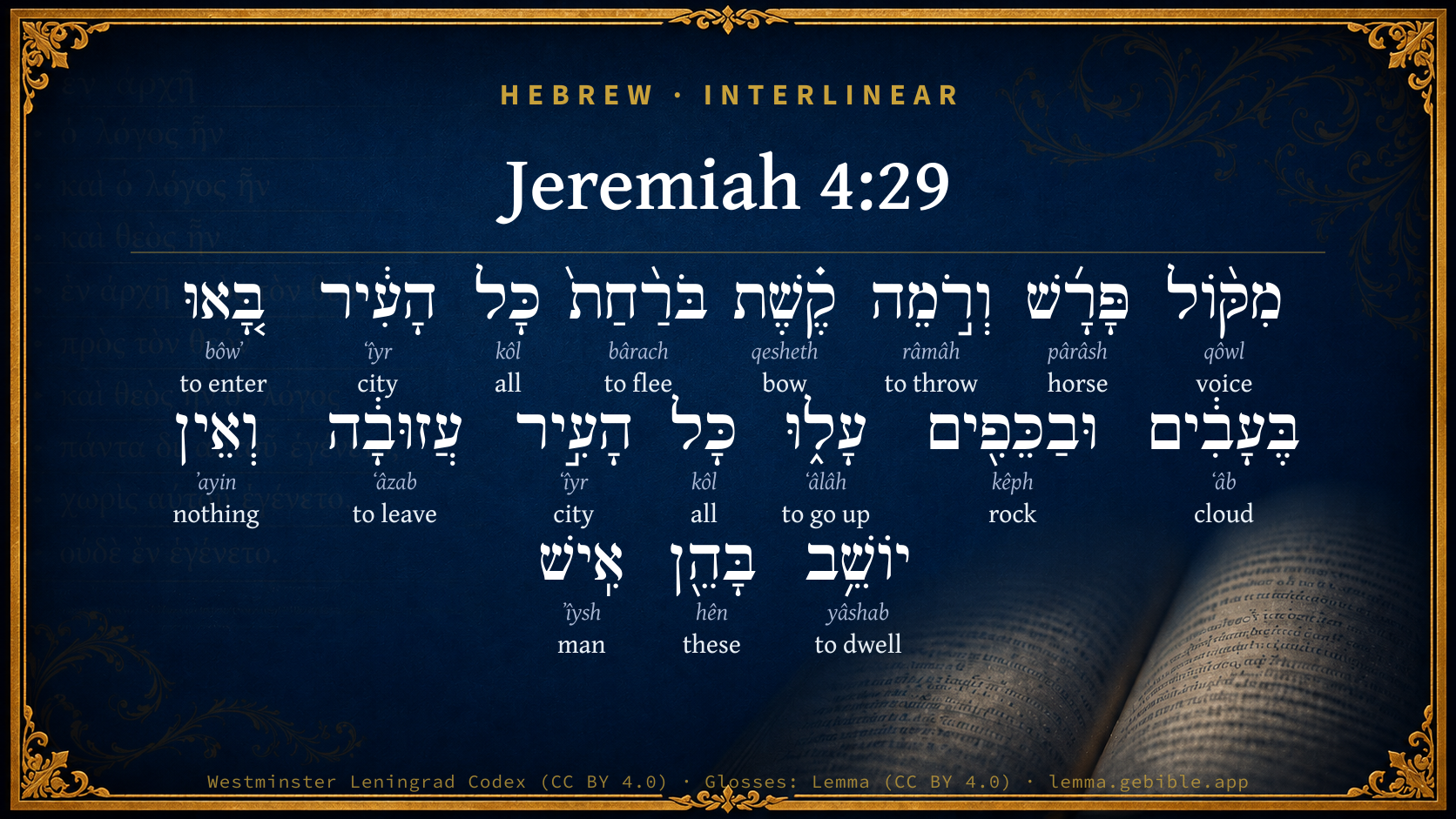
Jeremiah 4:29

Hebrew (Westminster Leningrad Codex) Jeremiah 4:29 appears in the Hebrew Old Testament. The text above is from the Westminster Leningrad Codex. Each word links to its Strong’s number, a concise gloss, and parsing drawn from the Open Scriptures Hebrew Bible morphology. Click any word for its full Brown-Driver-Briggs (BDB) entry.
Download image
Cite this verse

Jeremiah 4:29 (World English Bible). Public Domain. Lemma interlinear Bible study tool, https://lemma.gebible.app/v/jeremiah/4/29.

Show BibTeX & RIS
BibTeX
RIS
English Translation
Every city flees for the noise of the horsemen and archers; they go into the thickets, and climb up on the rocks: every city is forsaken, and not a man dwells therein.
World English Bible · Public Domain
Download a study sheet

One document with this verse’s original text, its word-by-word gloss line, the meaning frame, cross-references with their text, attributed commentary, and full source and license credits — printable, and it pastes into notes with its structure intact.

This verse Autodidact and up

Study sheet (.html) Plain text (.txt)

A passage Seminary Student

Up to 50 verses in one chapter. A passage sheet keeps up to 6 commentary sources and 12 cross-references per verse, in the order this page ranks them, and says so on the sheet whenever that leaves anything out. Ask for a single verse and you get the Autodidact verse sheet above.

Everything on this page stays free to read, with no account — the sheet is a download of what is already on screen, not access to it.

Want to remove ads? Support Godless Engineer
Compare translations 3

The same verse in 3 English versions, stacked beneath the original-language interlinear above. Click any original word for its lexicon entry.

Each is an independent rendering of the whole verse — the interlinear is not word-aligned to these translations.

Highlighted words mark where these versions differ — a whole-verse word diff, not a word-by-word alignment.

  • World English Bible Public Domain
    Every city flees for the noise of the horsemen and archers; they go into the thickets, and climb up on the rocks: every city is forsaken, and not a man dwells therein.
  • King James Version Public Domain
    The whole city shall flee for the noise of the horsemen and bowmen; they shall go into thickets, and climb up upon the rocks: every city shall be forsaken, and not a man dwell therein.
  • unfoldingWord Literal Text CC BY-SA 4.0
    From the noise of the horseman and the shooter of the bow every city will flee. They will go into the thickets and ascend among the rocks. Every city will be abandoned, and there will be no man dwelling in them. ts\*

unfoldingWord Literal Text — © unfoldingWord, licensed CC BY-SA 4.0. Word-aligned USFM3 via Door43 (git.door43.org/unfoldingWord/en_ult).

Versions to compare (up to 4)

3 of 4 selected

Show all 18 translations

Every available English version of this verse, each an independent rendering of the whole verse.

  • World English Bible Public Domain
    Every city flees for the noise of the horsemen and archers; they go into the thickets, and climb up on the rocks: every city is forsaken, and not a man dwells therein.
  • Berean Standard Bible Public Domain
    Every city flees at the sound of the horseman and archer. They enter the thickets and climb among the rocks. Every city is abandoned; no inhabitant is left.
  • Majority Standard Bible Public Domain
    Every city flees at the sound of the horseman and archer. They enter the thickets and climb among the rocks. Every city is abandoned; no inhabitant is left.
  • King James Version Public Domain
    The whole city shall flee for the noise of the horsemen and bowmen; they shall go into thickets, and climb up upon the rocks: every city shall be forsaken, and not a man dwell therein.
  • American Standard Version (1901) Public Domain
    Every city fleeth for the noise of the horsemen and bowmen; they go into the thickets, and climb up upon the rocks: every city is forsaken, and not a man dwelleth therein.
  • Revised Version (1885) Public Domain
    The whole city fleeth for the noise of the horsemen and bowmen; they go into the thickets, and climb up upon the rocks: every city is forsaken, and not a man dwelleth therein.
  • Geneva Bible (1599) Public Domain
    The whole citie shall flee, for the noyse of the horsemen and bowemen: they shall goe into thickets, and clime vp vpon the rockes: euery citie shall be forsaken, and not a man dwell therein.
  • Douay-Rheims (1899) Public Domain
    At the voice of the horsemen, and the archers, all the city is fled away; they have entered into thickets and have climbed up the rocks: all the cities are forsaken, and there dwelleth not a man in them.
  • Young's Literal Translation Public Domain
    From the voice of the horseman, And of him shooting with the bow, all the city is fleeing, They have come into thickets, And on cliffs they have gone up, All the city is forsaken, And there is no one dwelling in them.
  • Literal Standard Version CC BY-SA 4.0
    From the voice of the horseman, || And of him shooting with the bow, || All the city is fleeing, || They have come into thickets, || And they have gone up on cliffs, || All the city is forsaken, || And there is no one dwelling in them.
  • Unlocked Literal Bible CC BY-SA 4.0
    Every city will flee from the noise of the cavalry and the archers with a bow; they will run into the forests. Every city will climb up into the rocky places. The cities will be abandoned, for there will be no one to inhabit them.
  • unfoldingWord Literal Text CC BY-SA 4.0
    From the noise of the horseman and the shooter of the bow every city will flee. They will go into the thickets and ascend among the rocks. Every city will be abandoned, and there will be no man dwelling in them. ts\*
  • Darby Bible Public Domain
    At the noise of the horsemen and bowmen, every city fleeth; they go into the thickets, and climb up upon the rocks: every city is forsaken and no man dwelleth therein.
  • World Messianic Bible Public Domain
    Every city flees for the noise of the horsemen and archers. They go into the thickets and climb up on the rocks. Every city is forsaken, and not a man dwells therein.
  • Webster's Bible Public Domain
    The whole city shall flee for the noise of the horsemen and bowmen; they shall go into thickets, and climb up upon the rocks: every city shall be forsaken, and not a man dwell therein.
  • Free Bible Version CC BY-SA 4.0
    People from every town run away when they hear the enemy horsemen and archers coming. They hide in the forest and among the rocks. All the towns are abandoned; no one lives in them.
  • Bible in Basic English Public Domain
    All the land is in flight because of the noise of the horsemen and the bowmen; they have taken cover in the woodland and up on the rocks: every town has been given up, not a man is living in them.
  • JPS Tanakh (1917) Public Domain
    For the noise of the horsemen and bowmen the whole city fleeth; they go into the thickets, and climb up upon the rocks; every city is forsaken, and not a man dwelleth therein.

Literal Standard Version (2020), Covenant Press — licensed CC BY-SA 4.0. Text via the HelloAO Bible API (eBible.org). Unlocked Literal Bible (unfoldingWord) — licensed CC BY-SA 4.0. Text via the HelloAO Bible API (eBible.org). unfoldingWord Literal Text — © unfoldingWord, licensed CC BY-SA 4.0. Word-aligned USFM3 via Door43 (git.door43.org/unfoldingWord/en_ult). Free Bible Version, Dr. Jonathan Gallagher — licensed CC BY-SA 4.0. Text via the HelloAO Bible API (eBible.org).

Word by word

More ways to search: Search by grammar → Find every occurrence → Compare this word →

Practice this passage: Drill this verse → Learn its vocabulary →

וּבַכֵּפִ֖ים
kêph
H3710
“and · in/at the · rocks”
Conjunction + Preposition, Determined + Noun, Common, Masculine, Plural, Absolute
Part of Speech
Conjunction + Preposition + Noun
Type
Common
Gender
Masculine
Number
Plural
State
Absolute
Full BDB Definition

Origin: from H3721

TWOT: 1017

rock, hollow of a rock
  1. מִקּ֨וֹל qôwl H6963 “from · voice of” Preposition + Noun, Common, Masculine, Singular, Construct
  2. פָּרָ֜שׁ pârâsh H6571 “horse” Noun, Common, Masculine, Singular, Absolute
  3. וְרֹ֣מֵה râmâh H7411 “and · throwing” Conjunction + Verb, Qal, Participle Active, Masculine, Singular, Construct
  4. קֶ֗שֶׁת qesheth H7198 “bow” Noun, Common, Feminine, Singular, Absolute
  5. בֹּרַ֨חַת֙ bârach H1272 “fleeing” Verb, Qal, Participle Active, Feminine, Singular, Absolute
  6. כָּל kôl H3605 “all of” Noun, Common, Masculine, Singular, Construct
  7. הָעִ֔יר ʻîyr H5892 “the · city” Particle, Definite Article + Noun, Common, Feminine, Singular, Absolute
  8. בָּ֚אוּ bôwʼ H935 “to enter” Verb, Qal, Perfect, 3rd Person, Common, Plural
  9. בֶּעָבִ֔ים ʻâb H5645 “in/at the · clouds” Preposition, Determined + Noun, Common, Both, Plural, Absolute
  10. עָל֑וּ ʻâlâh H5927 “to go up” Verb, Qal, Perfect, 3rd Person, Common, Plural
  11. כָּל kôl H3605 “all of” Noun, Common, Masculine, Singular, Construct
  12. הָעִ֣יר ʻîyr H5892 “the · city” Particle, Definite Article + Noun, Common, Feminine, Singular, Absolute
  13. עֲזוּבָ֔ה ʻâzab H5800 “left” Verb, Qal, Participle Passive, Feminine, Singular, Absolute
  14. וְאֵין ʼayin H369 “and · nothing” Conjunction + Particle, Negative
  15. יוֹשֵׁ֥ב yâshab H3427 “dwelling” Verb, Qal, Participle Active, Masculine, Singular, Absolute
  16. בָּהֵ֖ן hên H2004 “in/at · them” Preposition + Suffix, Personal, 3rd Person, Feminine, Plural
  17. אִֽישׁ ʼîysh H376 “man” Noun, Common, Masculine, Singular, Absolute

About this verse

These counts appear in no published source. They are computed here, from the morphology-tagged text and Lemma’s own curated glosses. What Lemma adds →

18
words
16
distinct lemmas
Prophets
section

Notable vocabulary

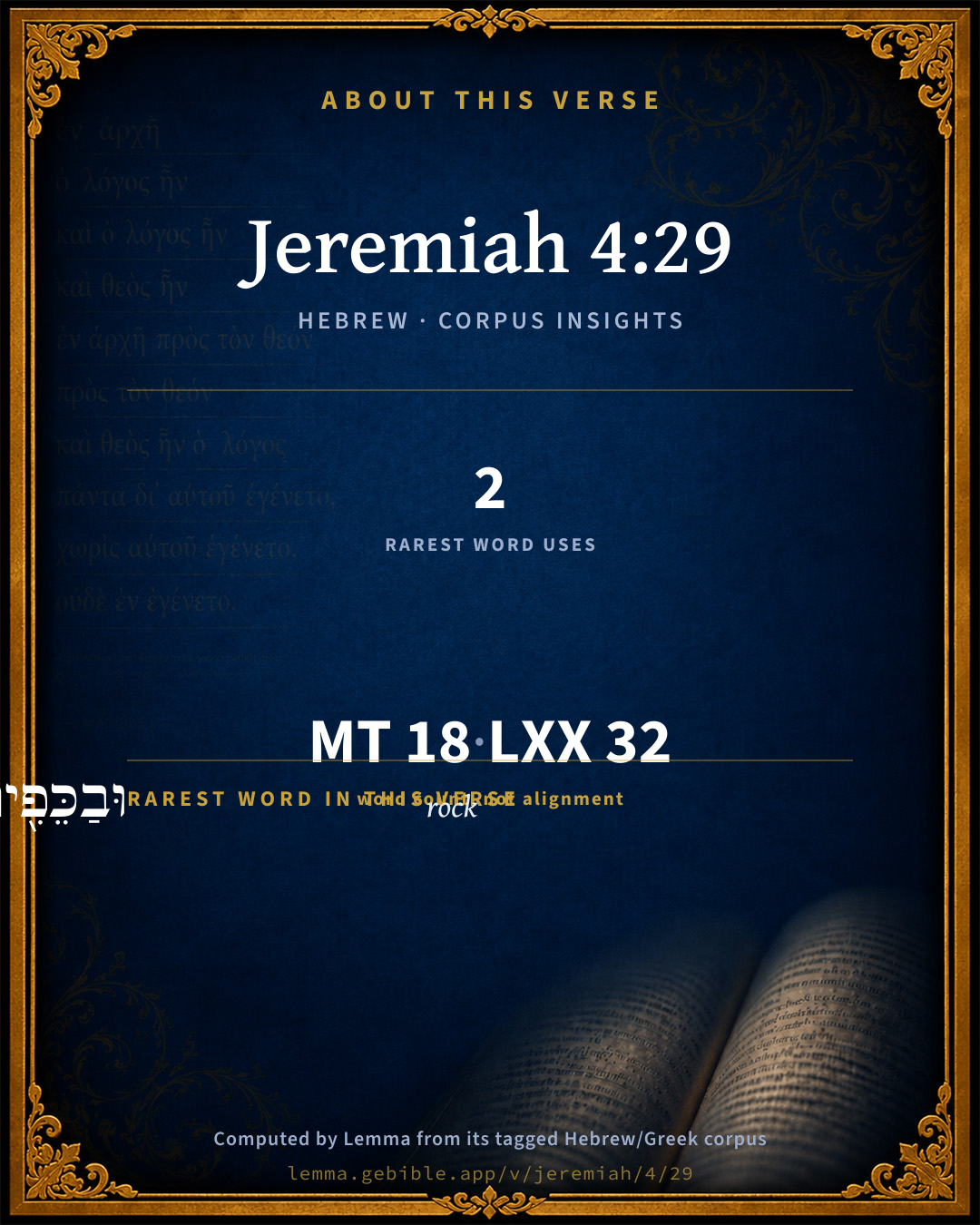
The rarest word here is וּבַכֵּפִ֖ים rock H3710 — appearing just 2 times in the whole Hebrew Bible.

Shared distinctive vocabulary

וּבַכֵּפִ֖ים rock H3710 occurs in 2 verses of the Hebrew Bible. Also found in:

Grammatical profile

  • 6 verbs
  • 10 nouns
  • 1 preposition
  • 1 particle

Verb forms

  • וְרֹ֣מֵה Qal · Participle Active
  • בֹּרַ֨חַת֙ Qal · Participle Active
  • בָּ֚אוּ Qal · Perfect
  • עָל֑וּ Qal · Perfect
  • עֲזוּבָ֔ה Qal · Participle Passive
  • יוֹשֵׁ֥ב Qal · Participle Active

Repetition

Words recur within this verse — often emphatic in Hebrew:

  • כָּל all H3605 ×2
  • הָעִ֔יר city H5892 ×2

Hebrew & Septuagint length

In the original languages it is 18 Hebrew tokens and 32 Greek tokens — but the two are counted differently (Hebrew bundles its prefixes and suffixes into one token; the Greek is in lemma form), so that isn’t a like-for-like length.

Cross-references

11

Topical passages linked to Jeremiah 4:29 in the Treasury of Scripture Knowledge — connected by theme and wording, ordered by reader-vote popularity; previews shown in the World English Bible.

  • Isaiah 2:19–21 Men shall go into the caves of the rocks, And into the holes of the earth, From before the terror of Yahweh, And from the glory of his majesty, When he arises to shake the earth mightily.
  • Jeremiah 4:7 A lion is gone up from his thicket, and a destroyer of nations; he is on his way, he is gone forth from his place, to make your land desolate, that your cities be laid waste, without inhabitant.
  • 1 Samuel 13:6 When the men of Israel saw that they were in a strait (for the people were distressed), then the people did hide themselves in caves, and in thickets, and in rocks, and in coverts, and in pits.
  • 2 Kings 25:4–7 Then a breach was made in the city, and all the men of war [fled] by night by the way of the gate between the two walls, which was by the king's garden (now the Chaldeans were against the city round about); and [the king] went by the way of the Arabah.
  • 2 Chronicles 33:11 Therefore Yahweh brought on them the captains of the host of the king of Assyria, who took Manasseh in chains, and bound him with fetters, and carried him to Babylon.
  • Isaiah 30:17 One thousand [shall flee] at the threat of one; at the threat of five shall you flee: until you be left as a beacon on the top of a mountain, and as an ensign on a hill.
  • Jeremiah 39:4–6 It happened that, when Zedekiah the king of Judah and all the men of war saw them, then they fled, and went forth out of the city by night, by the way of the king's garden, through the gate between the two walls; and he went out toward the Arabah.
  • Jeremiah 52:7 Then a breach was made in the city, and all the men of war fled, and went forth out of the city by night by the way of the gate between the two walls, which was by the king's garden; (now the Chaldeans were against the city round about;) and they went toward the Arabah.
  • Amos 9:1 I saw the Lord standing beside the altar, and he said, "Strike the tops of the pillars, that the thresholds may shake; and break them in pieces on the head of all of them; and I will kill the last of them with the sword: there shall not one of them flee away, and there shall not one of them escape.
  • Luke 23:30 Then they will begin to tell the mountains, 'Fall on us!' and tell the hills, 'Cover us.'
  • Revelation 6:15–17 The kings of the earth, the princes, the commanding officers, the rich, the strong, and every slave and free person, hid themselves in the caves and in the rocks of the mountains.

Cross-references courtesy of OpenBible.info (CC BY 4.0).

Hebrew and Greek witnesses Masoretic Hebrew ↔ Greek Septuagint

The same verse in the two great witnesses to the Old Testament, shown verse-for-verse.

These are two independent witnesses, not word-aligned to each other, and the Septuagint is shown in lemma (dictionary) form.

Hebrew Jeremiah 4:29 Masoretic · Westminster Leningrad Codex

מִקּ֨וֹל פָּרָ֜שׁ וְרֹ֣מֵה קֶ֗שֶׁת בֹּרַ֨חַת֙ כָּל הָעִ֔יר בָּ֚אוּ בֶּעָבִ֔ים וּבַכֵּפִ֖ים עָל֑וּ כָּל הָעִ֣יר עֲזוּבָ֔ה וְאֵין יוֹשֵׁ֥ב בָּהֵ֖ן אִֽישׁ

Every city flees for the noise of the horsemen and archers; they go into the thickets, and climb up on the rocks: every city is forsaken, and not a man dwells therein.

World English Bible · Public Domain

Greek LXX Structure differs

In the Septuagint, Jeremiah is about an eighth shorter than the Hebrew and arranges its material differently — the Oracles Against the Nations (Hebrew chapters 46–51) appear in the middle of the Greek book, after 25:13. Because the chapter and verse boundaries do not line up, a verse-for-verse comparison with the Hebrew is not shown.

A verse-for-verse comparison isn’t shown here because the chapters and verses don’t line up. Switch to the LXX edition with the MT / LXX toggle above to read the Greek directly.

On this verse, The Cambridge Bible for Schools and Colleges discusses the Septuagint’s reading. Read the note in Commentary ↓

Hebrew: Westminster Leningrad Codex (CC BY 4.0). Greek: Septuagint (public domain); English from a public-domain English Septuagint. How the Septuagint differs from the Hebrew →

Targum (Aramaic paraphrase)

1

The Targum is the ancient Jewish Aramaic paraphrase of the Hebrew Scriptures — an interpretive translation, not the Hebrew text itself. Onkelos (literal) and Pseudo-Jonathan (expansive) render the Torah, and Jonathan the Prophets. Coverage is partial: where no permissively-licensed English translation exists for a verse, only the Aramaic is shown. This is verse-level text, not a word-by-word alignment to the Hebrew.

  1. Targum Jonathan Prophets (Joshua–Malachi)
    מִקַל פָּרָשִׁין וּדְנַגְדִין בְּקַשְׁתָּא גְלוֹ כָּל יַתְבֵי אַרְעָא עָלוּ לְמֶעְרַק בְּחוּרְשֵׁיָא סְלִיקוּ לְאִטַמְרָא בְּכֵיפַיָא כָּל קִרְוֵיהוֹן שְׁבִיקָן וְלֵית דְיָתֵיב בְּהוֹן אֱנָשׁ:

    (no public-domain English translation for this verse)

    Targum Jonathan — Aramaic: “Mikraot Gedolot” (public domain). English: “Sefaria Community Translation” (CC0 1.0 (public-domain dedication)); “London "Chaldee Paraphrase," 1871” (public domain). Text via Sefaria.

Commentary

Notes on Jeremiah 4:29 from classic Christian and Jewish commentators (each source and its license shown beneath its notes). The classic Christian expositions comment on the surrounding passage and are grouped to its opening verse, so a note may address several verses; the Jewish commentaries on the Tanakh (Rashi and others) are per-verse, so they appear only where the commentator wrote on this verse.

Lemma curates 59 commentaries, every one of them public domain or Creative Commons licensed, each selected and text-cleaned for this edition rather than reprinted as found. About our sources →

Trapp's Complete Commentary

John Trapp

Jer 4:29 The whole city shall flee for the noise of the horsemen and bowmen; they shall go into thickets, and climb up upon the rocks: every city [shall be] forsaken, and not a man dwell therein.

Ver. 29. Every city shall be forsaken.] See Jer 4:25.

John Trapp, A Commentary or Exposition upon All the Books of the Old and New Testament (1647–1656) — public domain. Text from a community e-Sword module.

Tyndale Open Study Notes

Tyndale Open Resources

4:29 flee . . . hide . . . run: Panic gripped the people of Judah in reaction to the horrors of war. Their arrogance and smug confidence disappeared (see 6:23-24).

Tyndale Open Study Notes — © Tyndale Open Resources, licensed CC BY-SA 4.0. Text via the HelloAO Bible API.

Jamieson, Fausset & Brown

Robert Jamieson, A. R. Fausset & David Brown

whole city--Jerusalem: to it the inhabitants of the country had fled for refuge; but when it, too, is likely to fall, they flee out of it to hide in the "thickets." HENDERSON translates, "every city."

noise--The mere noise of the hostile horsemen shall put you to flight.

Jamieson, Fausset & Brown — Commentary Critical and Explanatory on the Whole Bible (1871) — public domain (CC PDM 1.0). Text via the HelloAO Bible API.

John Calvin's Commentaries

By saying, that at the voice or sound of horsemen and bowmen, there would be an universal flight, he means, that the enemies would come with such impetuosity, that the Jews would not dare to wait for their presence, but would flee here and there before they were attacked: for the word voice or sound, no doubt, is set here in opposition to wounds. They did swell, we know, with amazing pride; hence the Prophet ridicules that false confidence by which they were so inebriated as not to dread God’s judgment: “The sound alone of enemies,” he says, “will frighten you; so that all the cities, being left by their inhabitants, will easily fall into their hands, for walls will not defend themselves; nay, the gates will be open.” Flee then will every city; that is, all the cities will have recourse to flight. Then it follows, Ascend will they into the clouds, or into thicknesses: this may be applied to the enemies, to shew that they would be so nimble and active as to fly, as it were, to the clouds, and climb the highest rocks. But I prefer to connect this sentence with the former, as intimating, that to ascend the clouds would not be too arduous for the Jews in their anxious flight. Inasmuch as the tops of mountains were often covered with thick trees, in order to form a dark shade, this passage may mean, that they fled to such places. However this may have been, the Prophet here, no doubt, refers to such high situations. Hence, the meaning would be more evident if we retain the word, clouds. As to what is intended, we see that that is clear; which is, that the enemies of the Jews would in swiftness be equal to the eagles while pursuing them; or, what is more commonly thought, that the terror felt by the Jews would be so great, that in their flight they would not seek recesses nigh at hand, but would flee to the highest tops of mountains, and hide themselves there among the trees, as though they had climbed into the clouds. They would ascend into craggy rocks, as they could not think themselves otherwise safe from the attacks of their enemies.

He then adds, that every city would be forsaken, so that no one would dwell in them. We see that the Prophet had ever this in view — to rouse the Jews, who had deaf ears and stony hearts, so that they felt no concern for their own calamities, and even boldly despised God, as though they had made a covenant with death, according to what is said in another place. (Isaiah 28:15.) He afterwards subjoins —

John Calvin's Commentaries (1540-1563) — public domain. Text from the Calvin Translation Society English edition (1840s-50s) via the Christian Classics Ethereal Library (ccel.org). Calvin's coverage is partial (roughly two-thirds of the Bible); uncommented books and verses are honest gaps, never fabricated. The 19th-century editor's footnotes and remarks are omitted so the notes are faithfully Calvin's own voice.

Ellicott's Commentary for English Readers

(29) The horsemen and bowmen.—A specially characteristic picture, as we see from the Nineveh sculptures, of Assyrian and Chaldæan armies.

Thickets . . . rocks.—Both words are Aramaic in the original. The former, elsewhere rendered “clouds,” is here used for the dark shadowy coverts in which men sought for shelter; the latter is the root of the name Cephas (= Peter). On the caves of Palestine as places of refuge in time of war, see Isa_2:19; 1Sa_13:6.

A Bible Commentary for English Readers, edited by Charles John Ellicott (1878–1897) — public domain. Text from a community e-Sword module.

The Cambridge Bible for Schools and Colleges

gen. ed. J. J. S. Perowne

29. The whole city] the whole land. So LXX, supported by Targ. The word “city” was introduced by mistake from the latter part of the v.

bowmen] Cp. Jer_5:16. The Scythians were noted for skill in archery. See Herod. IV. 46.

they go … rocks] The original words for “thickets” and “rocks” have been held to throw some doubt on the genuineness of the two clauses. The former is in Hebrew properly dark clouds, though the root in Aramaic would yield the sense “thickets.” So “rocks” seems a “loanword” from Aramaic and occurs but once elsewhere (Job_30:6). For the first word LXX have a double rendering, caves and woods. For the former sense they seem to have connected the word with an Arabic root, to conceal. Rocks, and the caves which they contained, were often used as places of refuge in the course of Jewish history. See ch. Jer_16:16; also Jdg_6:2; 1Sa_13:6; cp. Isa_2:19; Isa_2:21.

29–31. Embellishments of the person are of no avail. Zion cries out in vain before an implacable foe.

29–31. See summary at commencement of section.

The Cambridge Bible for Schools and Colleges (gen. ed. J. J. S. Perowne; Cambridge University Press, 1878–1918) — public domain. Text from a community e-Sword module.

John Gill's Exposition

The whole city shall flee,.... Or, "every city"; for not Jerusalem only is meant, but every city, or the inhabitants of every city; and so the Targum paraphrases it,

"all the inhabitants of the land,''

who would be put into a panic, and flee: "for" or

at the noise of the horsemen and bowmen; of which the army of the enemy would greatly consist: it intimates that the inhabitants of Judea would not stand a battle; but at hearing the sound of the trampling of the horses, and the clattering of the bows and arrows, that the men upon them had, they would flee at once:

they shall go into the thickets, and climb upon the rocks; that is, either the horsemen and bowmen, who would pursue the inhabitants into those places: or rather the inhabitants themselves, who would flee thither to hide themselves from their enemies; namely, get into woods and forests, and among the thick trees, and cover themselves; and upon the highest mountains and rocks, and into the holes and caverns of them, and secure themselves from the enemy; see Mat 24:16, the word for "thickets" signifies "clouds" (i); and Kimchi interprets it of places as high as the clouds, as the tops of some mountains are, so that going up to them is like entering into the clouds; and which are sometimes covered with thick trees, and look like clouds; but the Targum explains it of woods or forests:

every city shall be forsaken; of its inhabitants:

and not a man dwell therein; as the prophet had seen in his vision, Jer 4:25, this was to be when a full end was made, not by the Babylonians, but by the Romans.

(i) "in nubes", Munster, Tigurine version, Junius & Tremellius, Piscator, Schmidt.

John Gill's Exposition of the Whole Bible (1746–1763) — public domain (CC PDM 1.0). Text via the HelloAO Bible API.

Albert Barnes' Notes on the Bible

The whole city ... - Rather, Every city is fleeing. All the inhabitants of the tokens flee to Jerusalem for protection, or seek refuge in the woods and rocks.

The horsemen and bowmen - The cavalry Jer 4:13 and bowmen formed the chief strength of the Assyrian armies.

They shall go - They have gone.

Albert Barnes' Notes on the Bible (1834–1885) — public domain. Text from a community e-Sword/MySword module.

Matthew Poole's English Annotations

The whole city shall flee; the inhabitants of all ranks and qualities shall seek to escape the fury of this Chaldean army, Jer 39:4.

For the noise; either upon the report of their coming, hereby as it were deriding their confidence; or rather at the approach of their vast armies, for they were close besieged before they fled, as appears, 2Ki 25:4.

They shall go into thickets, and climb up upon the rocks; such a consternation there shall be upon them, that they shall run into every hole to hide themselves: thus Manasseh was taken among the thorns, 2Ch 33:11. The Hebrew is abim, the clouds, possibly alluding to dark places on the tops of hills, reaching as it were to the clouds, or among the cloudy shades of trees and groves that usually grew there. The LXX. render it caves, and so the rocks for shelter, or the clefts, caves, and hiding-places in the rocks. See Isa 2:21.

Every city shall be forsaken, and not a man dwell therein; there shall be an utter desolation, their cities quite forsaken, not any to inhabit them, Jer 4:25,26.

Matthew Poole's English Annotations on the Holy Bible (1683–1685) — public domain. Text from a community e-Sword/MySword module.

The Pulpit Commentary

The whole city. The reading of which this is a version can hardly be the right one; for "the whole city" can only be Jerusalem, and in ver. 6 the people outside are bidden to take refuge in the capital. Hence Ewald, Hitzig, and Payne Smith (after Septuagint, Targum) would slightly amend the word rendered "city," so as to translate "the whole land" (of Judah). Shall flee; literally, fleeth. So afterwards render, "have gone.... is forsaken," "dwelleth." It is a vivid dramatic representation of the effects of the invasion. Bowmen. It is singular that Herodotus should say nothing about the use of the bow by the Chaldeans. But the monuments give ample evidence that they were a people of archers. So of course were the Scythians, as Herodotus testifies. The rooks; i.e. the limestone caverns which abound in Palestine, and which were frequently used as strongholds and hiding-places. (see Jud_1:6:2 15:8 1Sa_13:6 1Sa_14:11 1Sa_24:3 (especially) 1Ki_18:13)

The Pulpit Commentary (1880–1919), ed. H.D.M. Spence-Jones & Joseph S. Exell — public domain. Text from a community e-Sword module.

Rashi

Rabbi Shlomo Yitzchaki (Rashi)

archers Heb. רמה קשת, lit. bow shooters. Comp. “Cast (רמה) into the sea” (Exodus 15:1).

they came into the thickets Into the thick forests, a place intertwined with thorns, to hide.

and they ascended among the boulders Heb. ובכפים. סלע, a rock, is translated into Aramaic as בכפיא.

Rashi on the Tanakh — English translations: “The Judaica Press complete Tanach with Rashi, translated by A. J. Rosenberg” (CC BY 4.0); “Pentateuch with Rashi's commentary by M. Rosenbaum and A.M. Silbermann, 1929-1934” (public domain); “The Metsudah Tanach series, Lakewood, N.J” (CC BY 4.0); and “The Book of Joshua, Metsudah Publications, 1997” (CC BY 4.0). Text via Sefaria.

Lesson kit

Teaching starters — assembled from the data on this page, not authored interpretation. Every prompt links to the verse data it draws on. Edit before teaching.

Jeremiah, in the Prophets, opens this verse with 18 words (16 distinct Hebrew lemmas). Its most distinctive word is kêph (“rock”). A historical commentator’s framing appears above. Read the whole chapter for the surrounding context.

Discussion questions

  1. The word kêph carries the sense “rock.” How does it shape the verse?
  2. Job 30:6 shares the word «rock» with this verse. How do the two illuminate each other?
  3. “all” occurs 2× in this one verse. What is the effect of the repetition?
  4. These translations render this verse differently. What is at stake in choosing one wording over another?
  5. The verb «וְרֹ֣מֵה» is Qal Participle Active. How does its form color the action?
  6. Reading how Trapp's Complete Commentary and Tyndale Open Study Notes read this verse, where do the two commentators agree and where do they part?

Things to notice

Reading settings

Reading text

Shown beneath each verse's original-language words.

Old Testament
Old Testament edition

Read the OT as the Masoretic Hebrew (MT) or the Greek Septuagint (LXX).

English shown for the Greek Septuagint (in the Hebrew ↔ Greek comparison).

Comparing translations? Open the Compare panel on any verse page to stack up to four side by side.