
Isaiah 17:9

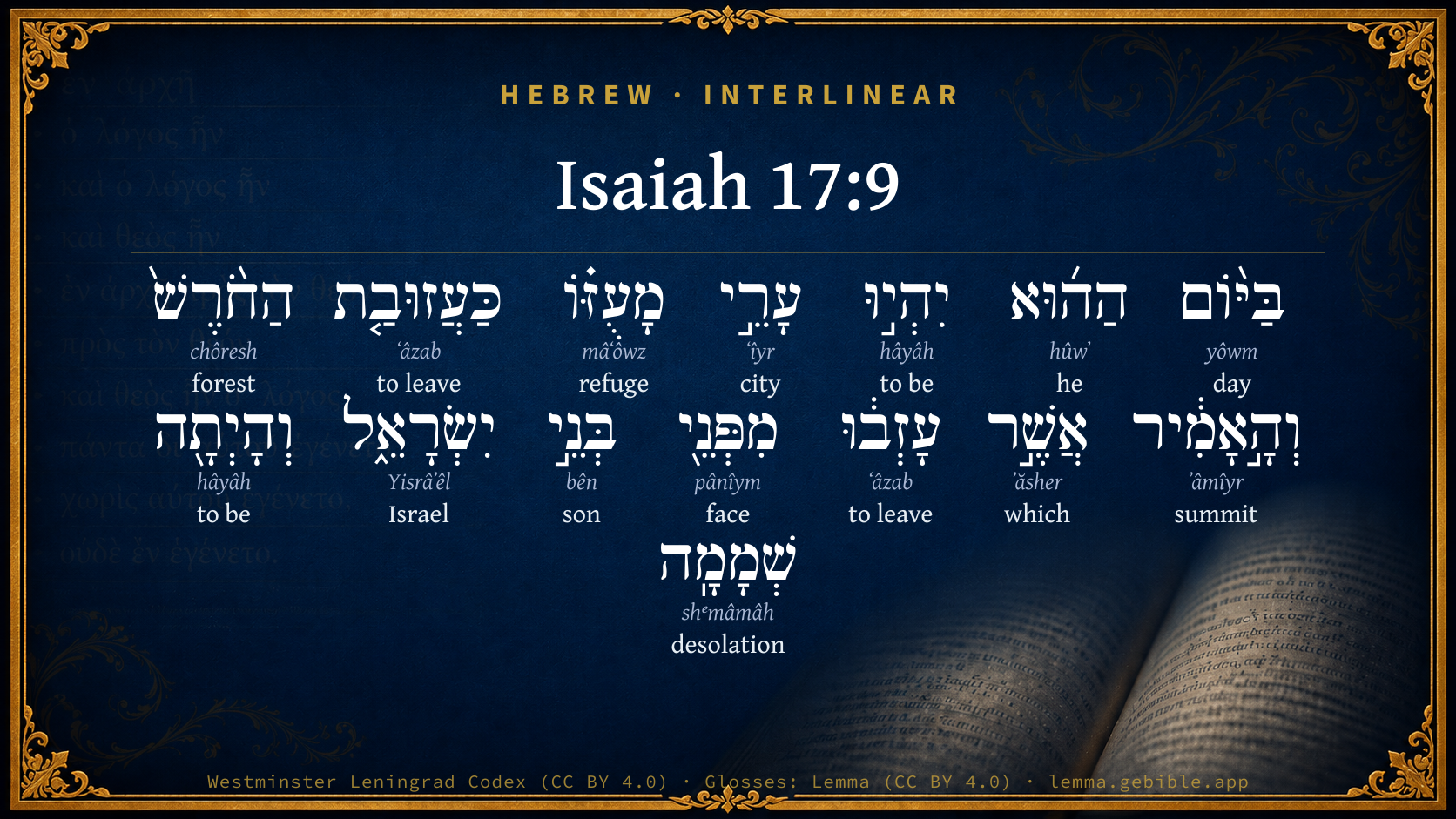
Hebrew (Westminster Leningrad Codex) Isaiah 17:9 appears in the Hebrew Old Testament. The text above is from the Westminster Leningrad Codex. Each word links to its Strong’s number, a concise gloss, and parsing drawn from the Open Scriptures Hebrew Bible morphology. Click any word for its full Brown-Driver-Briggs (BDB) entry.
Download image
Cite this verse

Isaiah 17:9 (World English Bible). Public Domain. Lemma interlinear Bible study tool, https://lemma.gebible.app/v/isaiah/17/9.

Show BibTeX & RIS
BibTeX
RIS
English Translation
In that day shall their strong cities be as the forsaken places in the wood and on the mountain top, which were forsaken from before the children of Israel; and it shall be a desolation.
World English Bible · Public Domain
Download a study sheet

One document with this verse’s original text, its word-by-word gloss line, the meaning frame, cross-references with their text, attributed commentary, and full source and license credits — printable, and it pastes into notes with its structure intact.

This verse Autodidact and up

Study sheet (.html) Plain text (.txt)

A passage Seminary Student

Up to 50 verses in one chapter. A passage sheet keeps up to 6 commentary sources and 12 cross-references per verse, in the order this page ranks them, and says so on the sheet whenever that leaves anything out. Ask for a single verse and you get the Autodidact verse sheet above.

Everything on this page stays free to read, with no account — the sheet is a download of what is already on screen, not access to it.

Want to remove ads? Support Godless Engineer
Compare translations 3

The same verse in 3 English versions, stacked beneath the original-language interlinear above. Click any original word for its lexicon entry.

Each is an independent rendering of the whole verse — the interlinear is not word-aligned to these translations.

Highlighted words mark where these versions differ — a whole-verse word diff, not a word-by-word alignment.

  • World English Bible Public Domain
    In that day shall their strong cities be as the forsaken places in the wood and on the mountain top, which were forsaken from before the children of Israel; and it shall be a desolation.
  • King James Version Public Domain
    In that day shall his strong cities be as a forsaken bough, and an uppermost branch, which they left because of the children of Israel: and there shall be desolation.
  • unfoldingWord Literal Text CC BY-SA 4.0
    In that day, the cities of his strength will be like the abandoned of the forest and the bough, which they abandoned from the face of the sons of Israel, and it will be a desolation.

unfoldingWord Literal Text — © unfoldingWord, licensed CC BY-SA 4.0. Word-aligned USFM3 via Door43 (git.door43.org/unfoldingWord/en_ult).

Versions to compare (up to 4)

3 of 4 selected

Show all 18 translations

Every available English version of this verse, each an independent rendering of the whole verse.

  • World English Bible Public Domain
    In that day shall their strong cities be as the forsaken places in the wood and on the mountain top, which were forsaken from before the children of Israel; and it shall be a desolation.
  • Berean Standard Bible Public Domain
    In that day their strong cities will be like forsaken thickets and summits, abandoned to the Israelites and to utter desolation.
  • Majority Standard Bible Public Domain
    In that day their strong cities will be like forsaken thickets and summits, abandoned to the Israelites and to utter desolation.
  • King James Version Public Domain
    In that day shall his strong cities be as a forsaken bough, and an uppermost branch, which they left because of the children of Israel: and there shall be desolation.
  • American Standard Version (1901) Public Domain
    In that day shall their strong cities be as the forsaken places in the wood and on the mountain top, which were forsaken from before the children of Israel; and it shall be a desolation.
  • Revised Version (1885) Public Domain
    In that day shall his strong cities be as the forsaken places in the wood and on the mountain top, which were forsaken from before the children of Israel: and it shall be a desolation.
  • Geneva Bible (1599) Public Domain
    In that day shall the cities of their strength be as the forsaking of boughes and branches, which they did forsake, because of the children of Israel, and there shall be desolation.
  • Douay-Rheims (1899) Public Domain
    In that day his strong cities shall be forsaken, as the ploughs, and the corn that were left before the face of the children of Israel, and thou shalt be desolate.
  • Young's Literal Translation Public Domain
    In that day are the cities of his strength As the forsaken thing of the forest, And the branch that they have left, Because of the sons of Israel, It also hath been a desolation.
  • Literal Standard Version CC BY-SA 4.0
    In that day the cities of his strength are || As the forsaken thing of the forest, || And the branch that they have left, || Because of the sons of Israel, || It has also been a desolation.
  • Unlocked Literal Bible CC BY-SA 4.0
    On that day their strong cities will be like the abandoned wooded slopes on the hill summits, that were forsaken because of the people of Israel and that will become a desolation.
  • unfoldingWord Literal Text CC BY-SA 4.0
    In that day, the cities of his strength will be like the abandoned of the forest and the bough, which they abandoned from the face of the sons of Israel, and it will be a desolation.
  • Darby Bible Public Domain
    In that day shall his strong cities be as the forsaken tract in the woodland, and the mountain-top which they forsook before the children of Israel; and there shall be desolation.
  • World Messianic Bible Public Domain
    In that day, their strong cities will be like the forsaken places in the woods and on the mountain top, which were forsaken from before the children of Israel; and it will be a desolation.
  • Webster's Bible Public Domain
    In that day shall his strong cities be as a forsaken bough, and an uppermost branch, which they left because of the children of Israel: and there shall be desolation.
  • Free Bible Version CC BY-SA 4.0
    At that time their fortified cities will be like places left to be taken over by bushes and trees, just as they were previously abandoned when the Israelites invaded. The country will become completely desolate.
  • Bible in Basic English Public Domain
    In that day your towns will be like the waste places of the Hivites and the Amorites which the children of Israel took for a heritage, and they will come to destruction.
  • JPS Tanakh (1917) Public Domain
    In that day shall his strong cities be as the forsaken places, which were forsaken from before the children of Israel, after the manner of woods and lofty forests; and it shall be a desolation.

Literal Standard Version (2020), Covenant Press — licensed CC BY-SA 4.0. Text via the HelloAO Bible API (eBible.org). Unlocked Literal Bible (unfoldingWord) — licensed CC BY-SA 4.0. Text via the HelloAO Bible API (eBible.org). unfoldingWord Literal Text — © unfoldingWord, licensed CC BY-SA 4.0. Word-aligned USFM3 via Door43 (git.door43.org/unfoldingWord/en_ult). Free Bible Version, Dr. Jonathan Gallagher — licensed CC BY-SA 4.0. Text via the HelloAO Bible API (eBible.org).

Word by word

More ways to search: Search by grammar → Find every occurrence → Compare this word →

Practice this passage: Drill this verse → Learn its vocabulary →

וְהָ֣אָמִ֔יר
ʼâmîyr
H534
“and · the · summit”
Conjunction + Particle, Definite Article + Noun, Common, Masculine, Singular, Absolute
Part of Speech
Conjunction + Particle + Noun
Type
Common
Gender
Masculine
Number
Singular
State
Absolute
Full BDB Definition

Origin: apparently from H559 (sense of self-exaltation)

TWOT: 118d

top, summit - of tree - of mountain
  1. בַּיּ֨וֹם yôwm H3117 “in/at the · day” Preposition, Determined + Noun, Common, Masculine, Singular, Absolute
  2. הַה֜וּא hûwʼ H1931 “the · he” Particle, Definite Article + Pronoun, Personal, 3rd Person, Masculine, Singular
  3. יִהְי֣וּ hâyâh H1961 “to be” Verb, Qal, Imperfect, 3rd Person, Masculine, Plural
  4. עָרֵ֣י ʻîyr H5892 “cities of” Noun, Common, Feminine, Plural, Construct
  5. מָעֻזּ֗וֹ mâʻôwz H4581 “refuge · his” Noun, Common, Masculine, Singular, Construct + Suffix, Personal, 3rd Person, Masculine, Singular
  6. כַּעֲזוּבַ֤ת ʻâzab H5800 “like/as · left” Preposition + Verb, Qal, Participle Passive, Feminine, Singular, Construct
  7. הַחֹ֨רֶשׁ֙ chôresh H2793 “the · forest” Particle, Definite Article + Noun, Common, Masculine, Singular, Absolute
  8. אֲשֶׁ֣ר ʼăsher H834 “which” Particle, Relative
  9. עָזְב֔וּ ʻâzab H5800 “to leave” Verb, Qal, Perfect, 3rd Person, Common, Plural
  10. מִפְּנֵ֖י pânîym H6440 “from · face(s) of” Preposition + Noun, Common, Both, Plural, Construct
  11. בְּנֵ֣י bên H1121 “sons of” Noun, Common, Masculine, Plural, Construct
  12. יִשְׂרָאֵ֑ל Yisrâʼêl H3478 “Israel” Noun, Proper
  13. וְהָיְתָ֖ה hâyâh H1961 “and · to be” Conjunction + Verb, Qal, Sequential Perfect, 3rd Person, Feminine, Singular
  14. שְׁמָמָֽה shᵉmâmâh H8077 “desolation” Noun, Common, Feminine, Singular, Absolute

About this verse

These counts appear in no published source. They are computed here, from the morphology-tagged text and Lemma’s own curated glosses. What Lemma adds →

15
words
13
distinct lemmas
Prophets
section

Notable vocabulary

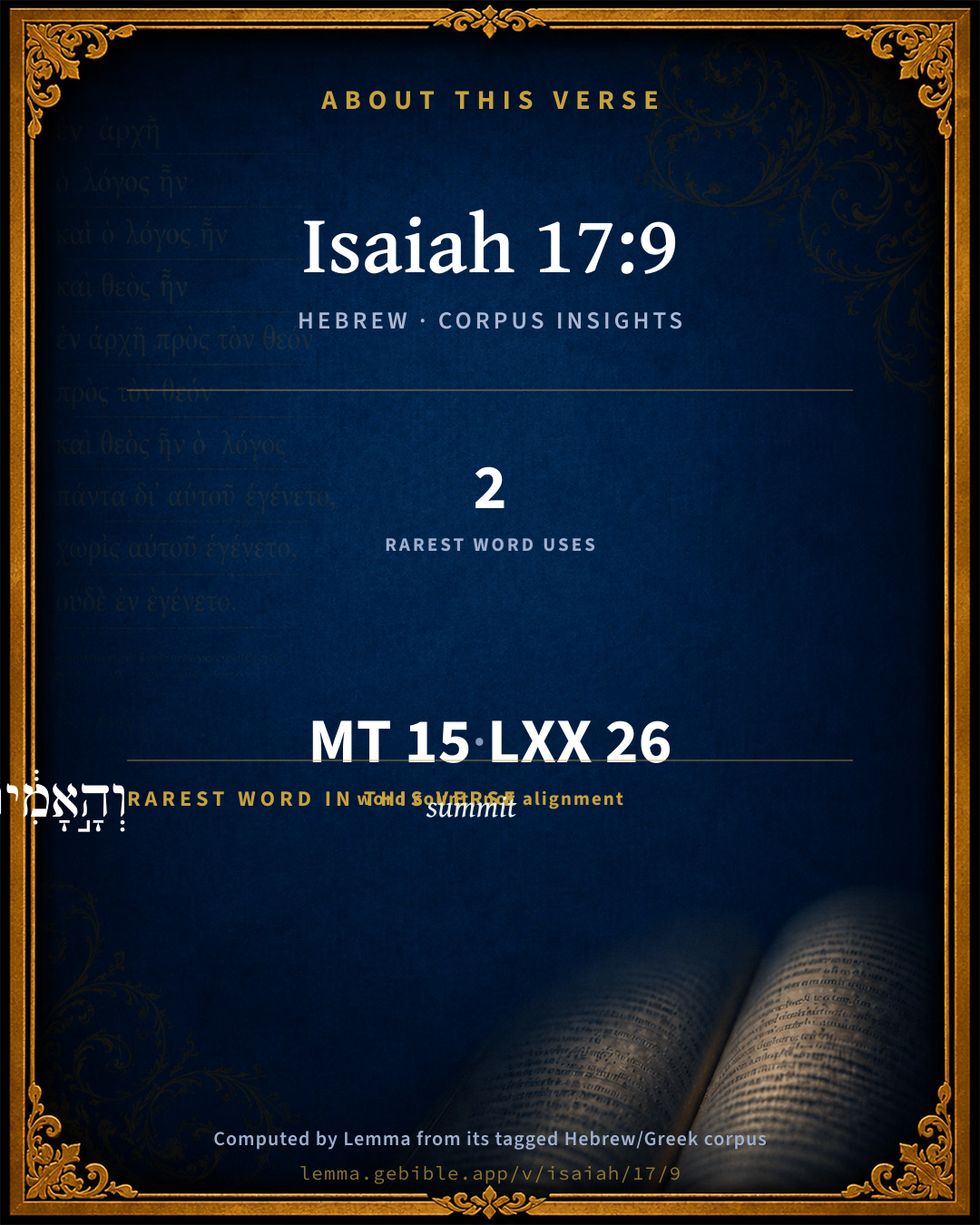
The rarest word here is וְהָ֣אָמִ֔יר summit H534 — appearing just 2 times in the whole Hebrew Bible.

Shared distinctive vocabulary

וְהָ֣אָמִ֔יר summit H534 occurs in 2 verses of the Hebrew Bible. Also found in:

Grammatical profile

  • 4 verbs
  • 9 nouns
  • 1 pronoun
  • 1 particle

Verb forms

  • יִהְי֣וּ Qal · Imperfect
  • כַּעֲזוּבַ֤ת Qal · Participle Passive
  • עָזְב֔וּ Qal · Perfect
  • וְהָיְתָ֖ה Qal · Sequential Perfect

Repetition

Words recur within this verse — often emphatic in Hebrew:

  • יִהְי֣וּ to be H1961 ×2
  • כַּעֲזוּבַ֤ת to leave H5800 ×2

Hebrew & Septuagint length

In English translation the verse runs 35 words from the Hebrew and 27 from the Septuagint (LXX English) — closely comparable.

A rough comparison of the two English renderings, which tokenize alike — not a word-level alignment.

Word counts can differ between the Hebrew and the Greek without any difference in meaning — e.g. the Hebrew direct-object marker אֵת has no separate Greek word, and Greek often adds the article ὁ.

In the original languages it is 15 Hebrew tokens and 26 Greek tokens — but the two are counted differently (Hebrew bundles its prefixes and suffixes into one token; the Greek is in lemma form), so that isn’t a like-for-like length.

Cross-references

14

Topical passages linked to Isaiah 17:9 in the Treasury of Scripture Knowledge — connected by theme and wording, ordered by reader-vote popularity; previews shown in the World English Bible.

  • Isaiah 27:10 For the fortified city is solitary, a habitation deserted and forsaken, like the wilderness: there shall the calf feed, and there shall he lie down, and consume the branches of it.
  • Amos 3:11–15 Therefore thus says the Lord Yahweh: "An adversary will overrun the land; And he will pull down your strongholds, And your fortresses will be plundered."
  • Isaiah 6:11–13 Then I said, "Lord, how long?" He answered, "Until cities are waste without inhabitant, And houses without man, And the land becomes utterly waste,
  • Isaiah 7:16–20 For before the child knows to refuse the evil, and choose the good, the land whose two kings you abhor shall be forsaken.
  • Isaiah 9:9–12 All the people shall know, [even] Ephraim and the inhabitant of Samaria, who say in pride and in arrogance of heart,
  • Isaiah 17:4–5 It shall happen in that day, that the glory of Jacob shall be made thin, and the fatness of his flesh shall wax lean.
  • Isaiah 24:1–12 Behold, Yahweh makes the earth empty, and makes it waste, and turns it upside down, and scatters abroad the inhabitants of it.
  • Isaiah 28:1–4 Woe to the crown of pride of the drunkards of Ephraim, and to the fading flower of his glorious beauty, which is on the head of the fat valley of those who are overcome with wine!
  • Hosea 10:14 Therefore a battle roar will arise among your people, And all your fortresses will be destroyed, As Shalman destroyed Beth Arbel in the day of battle. The mother was dashed in pieces with her children.
  • Hosea 13:15–16 Though he is fruitful among his brothers, an east wind will come, The breath of Yahweh coming up from the wilderness; And his spring will become dry, And his fountain will be dried up. He will plunder the storehouse of treasure.
  • Amos 7:9 The high places of Isaac will be desolate, the sanctuaries of Israel will be laid waste; and I will rise against the house of Jeroboam with the sword."
  • Micah 5:11 I will cut off the cities of your land, And will tear down all your strongholds.
  • Micah 6:16 For the statutes of Omri are kept, And all the works of the house of Ahab. You walk in their counsels, That I may make you a ruin, And her inhabitants a hissing; And you will bear the reproach of my people."
  • Micah 7:13 Yet the land will be desolate because of those who dwell therein, For the fruit of their doings.

Cross-references courtesy of OpenBible.info (CC BY 4.0).

Hebrew and Greek witnesses Masoretic Hebrew ↔ Greek Septuagint

The same verse in the two great witnesses to the Old Testament, shown verse-for-verse.

These are two independent witnesses, not word-aligned to each other, and the Septuagint is shown in lemma (dictionary) form.

Hebrew Isaiah 17:9 Masoretic · Westminster Leningrad Codex

בַּיּ֨וֹם הַה֜וּא יִהְי֣וּ עָרֵ֣י מָעֻזּ֗וֹ כַּעֲזוּבַ֤ת הַחֹ֨רֶשׁ֙ וְהָ֣אָמִ֔יר אֲשֶׁ֣ר עָזְב֔וּ מִפְּנֵ֖י בְּנֵ֣י יִשְׂרָאֵ֑ל וְהָיְתָ֖ה שְׁמָמָֽה

In that day shall their strong cities be as the forsaken places in the wood and on the mountain top, which were forsaken from before the children of Israel; and it shall be a desolation.

World English Bible · Public Domain

Greek LXX Isaiah 17:9 Septuagint · lemma form

ὁ ἡμέρα ἐκεῖνος εἰμί ὁ πόλις σύ ἐν καταλείπω ὅς τρόπος ἐν καταλείπω ὁ ἀμορραῖος καί ὁ ευαῖος ἀπό πρόσωπον ὁ υἱός ἰσραήλ καί εἰμί ἔρημος

In that day your cities shall be deserted, as the Amorites and the Evaeans deserted theirs, because of the children of Israel; and they shall be desolate.

LXX2012 (modern English Septuagint) · Public Domain

On this verse, Joseph Benson's Commentary discusses the Septuagint’s reading. Read the note in Commentary ↓

Hebrew: Westminster Leningrad Codex (CC BY 4.0). Greek: Septuagint (public domain); English from LXX2012 (modern English Septuagint) (Public Domain). How the Septuagint differs from the Hebrew →

Targum (Aramaic paraphrase)

1

The Targum is the ancient Jewish Aramaic paraphrase of the Hebrew Scriptures — an interpretive translation, not the Hebrew text itself. Onkelos (literal) and Pseudo-Jonathan (expansive) render the Torah, and Jonathan the Prophets. Coverage is partial: where no permissively-licensed English translation exists for a verse, only the Aramaic is shown. This is verse-level text, not a word-by-word alignment to the Hebrew.

  1. Targum Jonathan Prophets (Joshua–Malachi)
    בְּעִדָנָא הַהִיא יֶהֱוְיָן קִרְוֵי תוּקְפֵיהוֹן כִּכְרַךְ דַחֲרִיב וְאִתְחַמַר דִי אִשְׁתְּבֵיק מִן קֳדָם בְּנֵי יִשְׂרָאֵל וּתְהֵי לְצָדוּ:

    At that time the cities of their strength shall be as a fortification that was laid desolate and waste from before the children of Israel, and each shall be a desolation.

    Targum Jonathan — Aramaic: “Mikraot Gedolot” (public domain). English: “Sefaria Community Translation” (CC0 1.0 (public-domain dedication)); “London "Chaldee Paraphrase," 1871” (public domain). Text via Sefaria.

Commentary

Notes on Isaiah 17:9 from classic Christian and Jewish commentators (each source and its license shown beneath its notes). The classic Christian expositions comment on the surrounding passage and are grouped to its opening verse, so a note may address several verses; the Jewish commentaries on the Tanakh (Rashi and others) are per-verse, so they appear only where the commentator wrote on this verse.

Lemma curates 59 commentaries, every one of them public domain or Creative Commons licensed, each selected and text-cleaned for this edition rather than reprinted as found. About our sources →

Matthew Henry's Commentary

Here the prophet returns to foretel the woeful desolations that should be made in the land of Israel by the army of the Assyrians. 1. That the cities should be deserted. Even the strong cities, which should have protected the country, shall not be able to protect themselves: They shall be as a forsaken bough and an uppermost branch of an old tree, which has gone to decay, is forsaken of its leaves, and appears on the top of the tree, bare, and dry, and dead; so shall their strong cities look when the inhabitants have deserted them and the victorious army of the enemy pillaged and defaced them, Isa 17:9. They shall be as the cities (so it may be supplied) which the Canaanites left, the old inhabitants of the land, because of the children of Israel, when God brought them in with a high hand, to take possession of that good land, cities which they built not. As the Canaanites then fled before Israel, so Israel should now flee before the Assyrians. And herein the word of God was fulfilled, that, if they committed the same abominations, the land should spue them out, as it spued out the nations that were before them (Lev 18:28), and that as, while they had God on their side, one of them chased a thousand, so, when they had made him their enemy, a thousand of them should flee at the rebuke of one; so that in the cities should be desolation, according to the threatenings in the law, Lev 26:31; Deu 28:51. 2. That the country should be laid waste, Isa 17:10, Isa 17:11. Observe here, (1.) The sin that had provoked God to bring so great a destruction upon that pleasant land. It was for the iniquity of those that dwelt therein. "It is because thou hast forgotten the God of thy salvation and all the great salvations he has wrought for thee, hast forgotten thy dependence upon him and obligations to him, and hast not been mindful of the rock of thy strength, not only who is himself a strong rock, but who has been thy strength many a time, or thou wouldst have been sunk and broken long since." Note, The God of our salvation is the rock of our strength; and our forgetfulness and unmindfulness of him are at the bottom of all sin. Therefore have we perverted our way, because we have forgotten the Lord our God, and so we undo ourselves. (2.) The destruction itself, aggravated by the great care they took to improve their land and to make it yet more pleasant. [1.] Look upon it at the time of the seedness, and it was all like a garden and a vineyard; that pleasant land was replenished with pleasant plants, the choicest of its own growth; nay, so nice and curious were the inhabitants that, not content with them, they sent to all the neighbouring countries for strange slips, the more valuable for being strange, uncommon, far-fetched, and dear-bought, though perhaps they had of their own not inferior to them. This was an instance of their pride and vanity, and (that ruining error) their affection to be like the nations. Wheat, and honey, and oil were their staple commodities (Eze 27:17); but, not content with these, they must have flowers and greens with strange names imported from other nations, and a great deal of care and pains must be taken by hot-beds to make these plants to grow; the soil must be forced, and they must be covered with glasses to shelter them, and early in the morning the gardeners must be up to make the seed to flourish, that it may excel those of their neighbours. The ornaments of nature are not to be altogether slighted, but it is a folly to be over-fond of them, and to bestow more time, and cost, and pains about them than they deserve, as many do. But here this instance seems to be put in general for their great industry in cultivating their ground, and their expectations from it accordingly; they doubt not but their plants will grow and flourish. But, [2.] Look upon the same ground at the time of harvest, and it is all like a wilderness, a dismal melancholy place, even to the spectators, much more to the owners; for the harvest shall be a heap, all in confusion, in the day of grief and of desperate sorrow. The harvest used to be a time of joy, of singing and shouting (Isa 16:10); but this harvest the hungry eat up (Job 5:5), which makes it a day of grief, and the more because the plants were pleasant and costly (Isa 17:10) and their expectations proportionably raised. The harvest had sometimes been a day of grief, if the crop was thin and the weather unseasonable; and yet in that case there was hope that the next would be better. But this shall be desperate sorrow, for they shall see not only this year's products carried off, but the property of the ground altered and their conquerors lords of it. The margin reads it, The harvest shall be removed (into the enemy's country or camp, Deu 28:33) in the day of inheritance (when thou thoughtest to inherit it), and there shall be deadly sorrow. This is a good reason why we should not lay up our treasure in those things which we may so quickly be despoiled of, but in that good part which shall never be taken away from us.

Matthew Henry's Commentary on the Whole Bible (1708–1710) — public domain (CC PDM 1.0). Text via the HelloAO Bible API.

Trapp's Complete Commentary

John Trapp

Isa 17:9 In that day shall his strong cities be as a forsaken bough, and an uppermost branch, which they left because of the children of Israel: and there shall be desolation.

Ver. 9. Which they left for the children of Israel.] Which the enemy left, by a sweet providence of God; the like whereto see on Zec 7:14.

John Trapp, A Commentary or Exposition upon All the Books of the Old and New Testament (1647–1656) — public domain. Text from a community e-Sword module.

Joseph Benson's Commentary

Isa 17:9. In that day — The day of Jacob’s trouble, of which he spake, Isa 17:4; shall his strong cities be as a forsaken bough — The cities belonging to the ten tribes shall stand solitary and destitute of inhabitants, all the country about them being destroyed; and an uppermost branch, which they left because of the children of Israel — “The sense,” says Lowth, “is here imperfect: most expositors understand the words of the Assyrians, that they left some cities with a few inhabitants in the kingdom of Israel, that a remnant of that people might be preserved: see Isa 17:6. But the copy which the LXX. followed, instead of the Hebrew words, החרשׁ והאמיר, hacho-resh vehaamir, that is, bough and uppermost branch, must have read החוי והאמרי, hachivi vehaemori, the Hivites and Amorites:

for they translate the verse thus: Thy cities shall be forsaken, as when the Hivites and Amorites forsook them, because of the children of Israel. Which reading gives a plain and full sense to the text.” Thus also his son, Bishop Lowth: “The translation of the LXX has happily preserved what seems to be the true reading of the text, as it stood in the copies of their time. And it is remarkable, that many commentators, who never thought of admitting the reading of the LXX., yet understand the passage as referring to that very event, which their version expresses: so that, it is plain, nothing can be more suitable to the context.” Thus understood, the prophet’s words were calculated to awaken the Israelites to a serious belief of this threatening, as they reminded them that God had inflicted the same judgment upon the Canaanites, and for the same sins of which they were guilty: and therefore gave them reason to apprehend, according to the prediction of Moses, that as they committed the same abominations, the land would spew them out as it spewed out the nations which were before them.

Joseph Benson's Commentary on the Old and New Testaments (1811–1818) — public domain. Text from a community e-Sword module.

Keil & Delitzsch

C. F. Keil & F. Delitzsch

Third turn: "In that day will his fortified cities be like the ruins of the forest and of the mountain top, which they cleared before the sons of Israel: and there arises a waste place. For thou hast forgotten the God of thy salvation, and hast not thought of the Rock of thy stronghold, therefore thou plantedst charming plantations, and didst set them with strange vines. In the day that thou plantedst, thou didst make a fence; and with the morning dawn thou madest thy sowing to blossom: a harvest heap in the day of deep wounds and deadly sorrow of heart." The statement in Isa 17:3, "The fortress of Ephraim is abolished," is repeated in Isa 17:9 in a more descriptive manner. The fate of the strongly fortified cities of Ephraim would be the same as that of the old Canaanitish castles, which were still to be discerned in their antiquated remains, either in the depths of forests or high up on the mountains. The word ‛azubâh, which the early translators quite misunderstood, signifies, both here and in Isa 6:12, desolate places that have gone to ruin. They also misunderstood והאמיר הסהרשׁ. The Septuagint renders it, by a bold conjecture, οἱ Αμοῤῥηαῖοι καὶ οὶ Εὐαῖοι; but this is at once proved to be false by the inversion of the names of the two peoples, which was very properly thought to be necessary. האמיר undoubtedly signifies the top of a tree, which is quite unsuitable here. But as even this meaning points back to אמר, extollere, efferre (see at Psa 94:4), it may also mean the mountain-top. The name hâ'emori (the Amorites: those who dwell high up in the mountains) proves the possibility of this; and the prophet had this name in his mind, and was guided by it in his choice of a word. The subject of עזבוּ is self-evident. And the reason why only the ruins in forests and on mountains are mentioned is, that other places, which were situated on the different lines of traffic, merely changed their inhabitants when the land was taken by Israel. The reason why the fate of Ephraim's fortified castles was the same as that of the Amoritish castles, which were then lying in ruins, was that Ephraim, as stated in Isa 17:10, had turned away from its true rocky stronghold, namely from Jehovah. It was a consequence of this estrangement from God, that Ephraim planted נעמנים נטעי, plantations of the nature of pleasant things, or pleasant plantations (compare on Psa 78:49, and Ewald, 287, ab), i.e., cultivated all kinds of sensual accompaniments to its worship, in accordance with its heathen propensities; and sowed, or rather (as zemōrâh is the layer of a vine) "set," this garden-ground, to which the suffix ennu refers, with strange grapes, by forming an alliance with a zâr (a stranger), namely the king of Damascus. On the very day of the planting, Ephraim fenced it carefully (this is the meaning of the pilpel, sigsēg from שׂוּג = סוּג, not "to raise," as no such verb as שׂוּג = שׂגה, סגא, can be shown to exist), that is to say, he ensured the perpetuity of these sensuous modes of worship as a state religion, with all the shrewdness of a Jeroboam (see Amo 7:13). And the very next morning he had brought into blossom what he had sown: the foreign layer had shot up like a hot-house plant, i.e., the alliance had speedily grown into a hearty agreement, and had already produced one blossom at any rate, viz., the plan of a joint attack upon Judah. But this plantation, which was so flattering and promising for Israel, and which had succeeded so rapidly, and to all appearance so happily, was a harvest heap for the day of the judgment. Nearly all modern expositors have taken nēd as the third person (after the form mēth, Ges. 72, Anm. 1), and render it "the harvest flees;" but the third person of נוּד would be נד, like the participle in Gen 4:12; whereas the meaning cumulus (a heap), which it has elsewhere as a substantive, is quite appropriate, and the statement of the prophet resembles that of the apostle in Rom 2:5. The day of the judgment is called "the day of נחלה" (or, according to another reading, נחלה), not, however, as equivalent to nachal, a stream (Luzzatto, in giorno di fiumana), as in Psa 124:4 (the tone upon the last syllable proves this), nor in the sense of "in the day of possession," as Rosenmller and others suppose, since this necessarily gives to נד the former objectionable and (by the side of קציר) improbable verbal sense; but as the feminine of nachleh, written briefly for maccâh nachlâh (Jer 14:17), i.e., inasmuch as it inflicts grievous and mortal wounds. Ephraim's plantation is a harvest heap for that day (compare kâtzir, the harvest of punishment, in Hos 6:11 and Jer 51:33); and the hope set upon this plantation is changed into אנוּשׁ כּאב, a desperate and incurable heartfelt sorrow (Jer 30:15). The organic connection between Isa 17:12-14, which follow, and the oracle concerning Damascus and Israel, has also been either entirely misunderstood, or not thoroughly appreciated. The connection is the following: As the prophet sets before himself the manner in which the sin of Ephraim is punished by Asshur, as the latter sweeps over the Holy Land, the promise which already began to dawn in the second turn bursts completely through: the world-power is the instrument of punishment in the hands of Jehovah, but not for ever.

Keil & Delitzsch — Biblical Commentary on the Old Testament (1861–1891) — public domain (CC PDM 1.0). Text via the HelloAO Bible API. (Old Testament only.)

Lange's Commentary on the Holy Scriptures

ג) The Cause of Ephraim’s Destruction

Isa_17:9-11

9          In that day shall his strong cities be 13as a forsaken bough,

And an uppermost branch,

Which they left because of the children of Israel:

And there shall be desolation.

10     Because thou hast forgotten the God of thy salvation,

And hast not been mindful of the rock of thy strength,

Therefore 14shalt thou plant pleasant plants,

And shalt set it with strange slips:

11     15In the day shalt thou make thy plant to grow,

And in the morning shalt thou make thy seed to flourish:

16But the harvest shall be 17a heap in the day of grief

And of desperate sorrow.

TEXTUAL AND GRAMMATICAL

Isa_17:9. עזובה comp. Isa_6:12.—חֹרֶשׁ is saltus, “forest.” David dwelt בַּחֹרְשָׁה 1Sa_23:15-16; 1Sa_23:18. Jotham, according to 2Ch_27:4, built castles and towers בֶּ‍ֽחֳרָשִׁים. Comp. Eze_31:3.—אָמִיר, beside the present and Isa_17:6, does not occur again. The employment of this rare and ancient word here must be explained partly by the fact of its previous use, Isa_17:6, partly by the fact that in old times not only the tops of trees, but probably also the tops of mountains were so called. For the conjecture of Simon, sanctioned by Gesenius, that the Amorites were named the montani, from an old אֱמֹר mons (comp. הִתְאַמֵּר se efferre Psa_94:4) has certainly much in its favor. The LXX. also found in אמיר the name of that ancient race, and hence translated οῖ Ἀμοῤῥαῖοι καὶ οἳ Εὐαῖοι.—The subject of והיתה is any way the ideal notion אֶרֶץ contained in what precedes. This notion is likely the occasion also of the change in gender that we observe in what follows (comp. שׁכחת, ישׁעך etc., with מעזו, Isa_17:9). That a land may be personified, i.e., identified with the nation is proved by passages like Jer_6:19; Jer_22:29, etc.

Isa_17:10. יֵשַׁע occurs only here in the first part of Isa.; on the other hand four ties in the second part: Isa_45:8; Isa_51:5; Isa_61:10; Isa_62:11. The expression אלהי ישׁעי “God of my salvation,” is frequent in the Psa_18:47; Psa_25:5; Psa_27:9; Psa_62:8; Psa_65:6, etc., comp. Mic_7:7; Hab_3:18.—צוּר מַעוֹז Psa_31:3, comp. Psa_62:8.—נעמן = נָעִים occurs only here.—זמרה only here in Isaiah. The suffix -עֶנּוּ relates to the ideal unity ascribed in thought to the garden arrangements.

Isa_17:11. שִׂגְשֵׂג, Pilp, from שׂוּג (comp. סוּג, שׂךְ, מְשׂוּכָּה Isa_5:5) sepire, “to fence in,” occurs only here.—Hiph. of פרח occurs in Isaiah only here; Kal. often: Isa_27:6; Isa_35:1-2; Isa_66:14—The words נד קציר וגו are difficult. True, it is clear in general that the Prophet contrasts the notions of planting, sowing, fencing round, bringing to bloom and that of the harvest. But the question is does he speak of a disappearance of the hoped for harvest, or of the approach of a harvest not hoped for, and unwelcome. The former is maintained by those that take נֵד = נָד in the sense of effugit. But the verb נוּד where in its inflection has Zere as vowel of the second root syllable. Moreover נָד would not be the right word for the notion of vanishing. One would expect אָבַד or a similar word. For נוּד is moveri, agitari, vagari, errare; it designates, therefore, the state of instability, fluctuation, but not that of non-existence. We stand, therefore, by the usual meaning of נֵד, acervus, cumulus: “as a heap, heaped up is the harvest in the day of grief.”—נַֽחֲלָה cannot be understood of taking possession, for the word means possession. Moreover, since several Codices and ancient translations read נַחְלָה the latter is to be retained. נַחְלָה, indeed, occurs elsewhere only in connection with מַכָּה (Jer_10:19; Jer_14:17; Jer_30:12; Neh_3:19) or in the sense of aegrotus (Eze_34:4; Eze_34:21); but the day of the sick (Fem. to correspond to the preceding suffixes) is the day of being sick, as e.g., the time of the one leading is the time of leading (Jer_2:17).—כְּאֵב, “pain,” again only Isa_65:14.—אנוֹש occurs in Isaiah only here: often in Jer_17:16; Jer_30:12; Jer_30:15, etc.

EXEGETICAL AND CRITICAL

1. This strophe is distinguished from the preceding in this, that it assigns the reason for the destruction threatened against Ephraim. Therefore, after words that refer to both the strophes that precede, and that describe the impending ruin (Isa_17:9), the cause of the same is now named. It consists in this, that Israel has forsaken the God of its salvation. This has its consequence that it cherishes with delight untheocratic, idolatrous existence, like one lays out a pleasure garden and adorns it with exotics (Isa_17:10). Measures are not wanting which should surround that garden as a protecting hedge, and speedily bring it to a certain bloom; but the harvest? True enough there will be harvest in heaps; but not a day of joy. This harvest will be a day of deepest sorrow (Isa_17:11).

2. In that day—desolation.

Isa_17:9. “In that day” refers back to Isa_17:4; “his strong cities” to “the cities Aroer,” Isa_17:2, and “the fortress,” Isa_17:3; כעזובת, “like forsaken places,” to “forsaken,” Isa_17:2; האמיר, “the summits,” to אמיר “the summits (of the olive trees),” Isa_17:6. By these correspondences the Prophet gives us to understand that he speaks of the same subject as above, But he modifies his manner in two respects. First, he does not speak of the subject in figurative language as Isa_17:4-6, but boldly; second, he proves that the judgment was made necessary by the conduct of Israel. In as much as, therefore, “in that day” refers to Isa_17:4 (not to Isa_17:7, as the contents plainly show), the Prophet explains the figures used there by a reference to a fact well known to all Israel. In the forests and on elevated spots they had all seen the ruins of very ancient strong buildings that were evidence of the presence of a power long since overcome and vanished away. They were the ruins of castles which the Canaanities forsook, voluntarily or by compulsion, when the Israelites conquered the land (comp. Knobel, in loc.). A time will come when “the strong cities” of Israel shall lie like these castles. It is plain that this reference to that evidence of fact, besides the figurative language of Isa_17:4-6, was fitted to produce a deep impression.

3. Because thou hast—sorrow.

Isa_17:10-11. The evil conduct of Israel that was the cause of that judgment was twofold: 1) the negative reason was the not regarding, forgetting Jehovah: 2) the positive reason was the inclination to an idolatrous existence. In regard to the positive reason, I understand the Prophet to mean not merely the worship of strange gods, but also the political union with foreign powers that was most intimately connected with it, and the inclination to foreign ways in general (comp. Isa_2:6 sqq.). This culture of idolatry is compared to the culture of charming gardens (literally, plantations of lovely things). Israel itself, according to Isa_5:1 sqq. 7, was for Jehovah נְטַע שַֽׁעֲשׁוּעָיו, “his pleasant plant.” But the recreant nation, instead of cultivating the service of Jehovah, set up other enclosures that appealed more to their fleshly inclinations, which they sowed with foreign grape vines (properly grape vines of the foreigner), i.e. in which they cultivated foreign grape vines (comp. Jer_2:12) from seed. By these foreign vines must be understood everything untheocratic, all that was connected with heathen life to whose culture Israel devoted itself. The Imperfects express the continuance of the present. For at the time that the Prophet wrote this under Ahaz, this tendency to idolatrous living continued operative. The people provided also a protecting fence (comp. Isa_5:5). By the fencing the Prophet seems to me to understand everything that was undertaken for the purpose of giving security to the idolatrous efforts. That may have been partly positive measures (efforts in favor of idolatry of every sort), and partly negative protection against whatever was done on the part of true Israelites against the worship of idols, persecution of such, comp. e.g. 1Ki_18:4; 1Ki_18:19. The pains of planting and fencing were quickly rewarded: the heathen life bloomed only too soon. The whole history preceding the exile furnishes the proof of this. “In the morning” means the very next morning after the planting; therefore very quickly. We adhere to the usual meaning of נֵד acervus, cumulus: “as a heap, heaped up is a harvest in the day of grief.” See Text. and Gram. For I would not construe it, with Delitzsch, in the sense: “a harvest heap unto the day of judgment,” after Rom_2:5. For it does not read לְיוֹם, “to the day,” and in fact the day of the harvest is not distinguished from the day of judgment, which must be assumed by those that explain that the product of the harvesting heaps up for the day of judgment. But the Prophet says: in the day of judgment (ביום “in the day,” refers back to ביום in the first member of the verse), which is itself just at the same time the day of harvest, the produce of harvest is there in heaps. But this harvest day is “a day of grief and of desperate sorrow.” Being such, the harvest is a bad one, and the heaps signify heaped up misfortune. Therefore the Prophet says that the fruit of that planting shall be a harvest that shall come in on the day of grief and incurable pain, thus itself shall have the form of grief and incurable pain.

Footnotes:

[13]like forsaken places in the forests and summits.

[14]thou plantest pleasant gardens and sowest them with foreign seed.

[15]In the day of thy planting thou settest a fence.

[16]But there is a heaped-up harvest in the day, etc.

[17]Or, removed in the day of inheritance, and there shall be deadly sorrow.

Lange's Commentary on the Holy Scriptures (Critical, Doctrinal, and Homiletical), ed. John Peter Lange, English translation edited by Philip Schaff (1864–1880) — public domain. Text from a community e-Sword module.

Tyndale Open Study Notes

Tyndale Open Resources

17:9 The Hivites and Amorites were members of the original population of Canaan; they were to be destroyed when the Israelites conquered the land (see Deut 20:17).

Tyndale Open Study Notes — © Tyndale Open Resources, licensed CC BY-SA 4.0. Text via the HelloAO Bible API.

Geneva Bible (1599)

Geneva Bible translators

As the Canaanites left their cities when God did place the Israelites there, so the cities of Israel shall no more be able to defend their inhabitants than bushes, when God shall send the enemy to plague them.

Geneva Bible (1599) marginal notes — public domain. Text via Bolls.life.

Jamieson, Fausset & Brown

Robert Jamieson, A. R. Fausset & David Brown

forsaken bough--rather "the leavings of woods," what the axeman leaves when he cuts down the grove (compare Isa 17:6).

which they left because of--rather, "which (the enemies) shall leave for the children of Israel"; literally, "shall leave (in departing) from before the face of the children of Israel" [MAURER]. But a few cities out of many shall be left to Israel, by the purpose of God, executed by the Assyrian.

Jamieson, Fausset & Brown — Commentary Critical and Explanatory on the Whole Bible (1871) — public domain (CC PDM 1.0). Text via the HelloAO Bible API.

Adam Clarke's Commentary

Verse 9. As a forsaken bough, and an uppermost branch - "the Hivites and the Amorites"] החרש והאמיר hachoresh vehaamir. No one has ever yet been able to make any tolerable sense of these words. The translation of the Septuagint has happily preserved what seems to be the true reading of the text, as it stood in the copies of their time; though the words are now transposed, either in the text or in their Version; οἱ Αμαρῥαιοι και οἱ Ευαιοι, "the Amorites and the Hivites." It is remarkable that many commentators, who never thought of admitting the reading of the Septuagint, understand the passage as referring to that very event which their Version expresses; so that it is plain that nothing can be more suitable to the context. "My father," says Bishop Lowth, "saw the necessity of admitting this variation at a time when it was not usual to make so free with the Hebrew text." Mr. Parkhurst is not satisfied with the prelate's adoption of the reading of the Septuagint, "the Hivites and the Amorites." He thinks the difficult words should be thus rendered; he takes the whole verse: "And his fortified cities shall be like the leaving, or what is left כעזובת caazubath, of or in a ploughed field, החרש hachoresh, or on a branch which they leave coram, before, the children of Israel." Which he considers a plain reference to the Mosaic laws relative to the not gleaning of their ploughed fields, vineyards, and oliveyards, but leaving עזב ozeb, somewhat of the fruits, for the poor of the land; Le 9:9-10; De 24:19-21, in the Hebrew. I fear that the text is taken by storm on both interpretations. One MS. has כל ערי col arey, "all the cities;" and instead of החלש hachalash, "of the branch," six MSS. have החדש hachodesh, "of the month." But this is probably a mistake.

Adam Clarke's Commentary on the Bible (1810–1826) — public domain. Text from a community e-Sword/MySword module.

Ellicott's Commentary for English Readers

(9) In that day shall his strong cities be as a forsaken bough.—Better, his fortified cities shall be like a forsaken tract of forest and hill-top. These were naturally the usual sites of fortresses (2Ch_27:4), and the gist of the prediction is that they shall be left uninhabited and in ruins. The LXX., it may be noticed, either followed a different reading or else give a curious paraphrase, “thy cities shall be forsaken, like as the Amorites and Hivites forsook them before the face of the children of Israel.” The whole verse reminds us of the “great forsaking” of Isa_6:12.

A Bible Commentary for English Readers, edited by Charles John Ellicott (1878–1897) — public domain. Text from a community e-Sword module.

The Cambridge Bible for Schools and Colleges

gen. ed. J. J. S. Perowne

9. his strong cities] cf. Isa_17:10,—the “Rock of thy strength.”

as a forsaken bough, and an uppermost branch] Rather, if the text must be kept: “as the deserted places of the forest and the height” (so R.V.). For “forest” cf. 1Sa_23:15; 1Sa_23:19; 2Ch_27:4; Eze_31:3 (“shroud”). “Height” is the word rendered “uppermost bough” in Isa_17:6, which A.V. here follows. The construction in A.V. is altogether at fault, and the meaning “bough” cannot possibly be retained. But this is a case where the LXX. gives the clue to the true text, which reads like the deserted places of the Amorite and the Hivvite (see R.V. marg.). This alone gives an intelligible force to the next clause, and the textual change is comparatively slight save that the two words have been transposed (“Hivvite and Amorite”).

which they left because of] More strictly, which they forsook before, &c. The passive “were forsaken” (R.V.) is only adopted because the previous clause contains no suitable subject; the LXX. rendering supplies this defect, and at the same time makes the reference clear.

9–11. Continued from Isa_17:6. The rejection of Jehovah leads to failure and disappointment.

The Cambridge Bible for Schools and Colleges (gen. ed. J. J. S. Perowne; Cambridge University Press, 1878–1918) — public domain. Text from a community e-Sword module.

John Gill's Exposition

In that day shall his strong cities be as a forsaken bough, and an uppermost branch,.... Meaning the strong cities of Ephraim or Jacob, the ten tribes, which should be forsaken of their inhabitants; having fled from before the enemy, or being slain or carried captive; like a bough of a tree, that is forsaken stripped of its leaves, and an uppermost branch of a tree that is dead and dry, and has nothing on it:

which they left; or "as they left", or "were left":

because of the children of Israel; "from the face of" them; or for fear of them; that is, the same cities which the Canaanites left; and as they left them, or were left by them, for fear of the Israelites; the same, and in the same manner, shall they be left by the Israelites, for fear of the Assyrians; and so the Septuagint version reads the words,

"in that day thy cities shall be forsaken, in like manner as the Amorites and Hivites left them, from the face of the children of Israel;''

and this sense is given by Aben Ezra and Kimchi: though some interpret it of some places being spared and left for the remnant to dwell in; but what follows in this verse, and in the next Isa 17:10, shows the contrary sense:

and there shall be desolation; over all those cities, and in all the land; though Aben Ezra particularly applies it to Samaria, the royal city. Jerom interprets the whole of the cities of Judea being forsaken of their inhabitants, when the Romans besieged Jerusalem, and made the land desolate; which calamity came upon them, for their neglect and forgetfulness of Jesus the Saviour.

John Gill's Exposition of the Whole Bible (1746–1763) — public domain (CC PDM 1.0). Text via the HelloAO Bible API.

Albert Barnes' Notes on the Bible

His strong cities - The cities of the united kingdoms of Damascus and Samaria.

Be as a forsaken bough - There has been much difficulty in the interpretation of this passage. Lowth says, ‘No one has ever been able to make any tolerable sense of these words;’ and proposes himself the translation,

In that day shall his strongly fenced cities become

Like the desertion of the Hivites and the Amorites;

Following in this the translation of the Septuagint, but doing violence to the Hebrew text. Rosenmuller translates it, ‘As the remnant of a grove when the thicket is cut down, and when few trees are left.’ The word rendered ‘bough’ (חרשׁ choresh) means, properly, a thicket, or thick foliage, a wood that is entangled or intricate 1Sa 23:15-16, 1Sa 23:18; 2Ch 27:4; and probably this is the idea here. The phrase may be rendered, ‘as the leavings or residue of a grove, copse, or entangled wood;’ and the idea is, that as a “few” trees might be left when the axeman cuts down the grove, so a few inferior and smaller towns should be left in the desolation that would come upon Damascus.

And an uppermost branch - Isa 17:6. As a few berries are left in the topmost branch of the olive, or the vine, so shall I a few cities or people be left in the general desolation.

Which they left - Which “are” left, or which the invaders would leave.

Because of the children of Israel - literally, ‘from the face,’ that is, before the children of Israel. Lowth supposes that it refers to the Amorites, who left their land before the Israelites, or gave up their land for them. Vitringa renders it, ‘On account of the children of Israel;’ and supposes that it means that a few cities were spared by the purpose of God in the invasion by Tiglath-pileser, to be a residence of the Israelites that should remain; or that, for some reason which is not known, the Assyrians chose to spare a few towns, and not wholly to destroy the country. The “general” idea is plain, that a few towns would be left, and that it would be “before” the children of Israel, or in their presence, or in order that they might continue to dwell in them. Jerome interprets the whole as referring to the time when the land of Judea was forsaken on the invasion of the Romans.

And there shall be desolation - The land shall be desolated, except the few cities and towns that shall be left, like the gleaning of the olive tree.

Albert Barnes' Notes on the Bible (1834–1885) — public domain. Text from a community e-Sword/MySword module.

Haydock's Catholic Bible Commentary

Left. By the Chanaanites, when the children of Israel came into their land. (Challoner) --- Their consternation was become proverbial, Josue ii. 9., and v. 11.

George Leo Haydock (1774–1849), Haydock's Catholic Family Bible and Commentary, 1859 edition — public domain. Excludes Psalms (Douay-Rheims chapter numbering differs from Protestant) and Deuterocanonical books (Catholic canon only).

Matthew Poole's English Annotations

In that day; in the day of Jacob’s trouble, of which he spake Isa 17:4, and continueth his speech unto these words, and afterwards.

An uppermost branch; which he that pruneth the tree neglecteth, either because he esteems it useless and inconsiderable, or because he cannot reach it.

Which they left because of the children of Israel: the sense is either,

1. Which they, to wit, the enemies, left, or, which shall be left, (the active verb being put impersonally, as it frequently is in the Hebrew text,)

because of or for the children of Israel; which God inclined their hearts to leave or spare, out of his love to his Israel. Thus this is mentioned as a mercy, or mitigation of the calamity. But this seems not to agree either with the foregoing or following words, both which manifestly speak of the greatness of the judgment. And that their strong cities were not left for them, but taken from them, seems evident from Isa 17:3,4. Or,

2. As the cities (which words are easily understood out of the former part of the verse, where they are expressed) which they (to wit, the Canaanites, as the seventy interpreters express it; and it was needless to name them, because the history was so well known to them to whom the prophet writes) left or forsook (which they did either by departing from them, or being destroyed out of them) bemuse of (or before, or for fear of) the children of Israel. And this was a very fit example, to awaken the Israelites to a serious belief of this threatening, because God had inflicted the same judgment upon the Canaanites, and that for the same sins of which they were guilty.

Matthew Poole's English Annotations on the Holy Bible (1683–1685) — public domain. Text from a community e-Sword/MySword module.

Whedon's Commentary on the Bible

Daniel D. Whedon

9. Shall his strong cities — Those of Ephraim in the day of Assyrian capture.

Be as a forsaken bough — Rather, as the abandoned thicket, or forest.

And an uppermost branch — Or, mountain height, which men left or abandoned of old, as the Israelites under Joshua compelled. The Septuagint reads: Thy cities shall be “forsaken” in the way the Amorites (mountaineers) and Hivites (lowlanders occupying plains and groves) did forsake (or flee) before the children of Israel. To this rendering essentially most writers now accede. For sins not unlike those of the old races before them is Ephraim also to be punished, and in like way punished, namely, driven from their land.

Daniel D. Whedon (gen. ed.), Commentary on the Old and New Testaments (1874–1909) — public domain. Text from a community e-Sword module.

The Pulpit Commentary

In that day. While a remnant of the Israelites shall repent and turn to God, throwing in their lot with Judah, as it would seem the country generally shall feel the weight of God"s chastening hand, on account of Israel"s former sins and offences. As a forsaken bough, and an uppermost branch; rather, as the forsaken tract of woodland and mountain-crest (Kay). The reference is to the condition of the land when it passed out of the possession of the Canaanitish nations. It was then forsaken and desolate. So shall it be once more, when Israel is expelled for the same sins. (see 2Ki_17:7, 2Ki_17:8) Which they left because of the children of Israel; rather, which men forsook before the children of Israel; i.e. from which the Canaanites fled as the children of Israel advanced and took possession. The writer ignores the long and fierce struggle which the Canaanites made, and looks only to the result retirement from a desolated country.

Vers. 9-11. Forgetfulness of God and its consequences.

I GOD AS AN OBJECT OF THE SOUL"S ATTENTION. He is the "God of men"s salvation." His Name calls up all those ideas of power, of grace, of goodness, necessary to the Deliverer, the Savior. To acknowledge that such a Being exists is not enough; the eye of the spirit must be turned to him, its gaze fixed upon him, its ear bent towards the place of his holy oracle. Micah says in evil times, "I will look unto Jehovah; I will wait for the God of my salvation: my God will hear me." To think of God in his moral relations to us brings confidence and security to the heart. And hence the expressive image of the Rock on which the fortress stands, as symbolic of him, so frequently employed in Scripture. (Deu_32:4, Deu_32:15, Deu_32:18, Deu_32:30, Deu_32:31, 37 1Sa_2:2 2Sa_22:2, 2Sa_22:3, 32 Psa_18:31, 46 19:14 28:1 30:1, 2) How much depends in our intellectual life on attraction the grasp of objects, the remembrance of what they are, the firm hold of principles and truths I Impressions are made upon us as in wax or in running water, without this tension of the will. And how in various ways does Scripture press upon us the need of attention in religious things! "Earnestly give heed," "Remember," "Be mindful," "Look unto the Lord," etc., are all exhortations implying the need of prayer and habitual direction of the spirit to higher things. There can be no clear memory and no confident expectation where the mind has been lax and listless.

II CONSEQUENCES OF FORGETTING GOD. Ephraim, turning away from its true rocky stronghold in Jehovah, will see its own castles lie in ruin and desolation. The estrangement from God is marked by indulgence in pleasure and idolatry. The people planted pleasant gardens, and sowed them with strange grapes; i.e. formed an alliance with a stranger, the King of Damascus. And these new institutions were carefully fenced, i.e. apparently they were established as a state religion. "And the very next morning he had brought into blossom what he had sown. The foreign layer had shot up like a hot-house plant, i.e. the alliance had speedily grown into a hearty agreement, and had already produced one blossom at any rate, viz. the plan of a joint attack upon Judah. But this plantation, so flattering and promising for Israel, and which had succeeded so rapidly, and to all appearance so happily, was a harvest heap for the day of judgment." The closing words of this strophe are impressive: "The day of grief and desperate sorrow;" or, "The day of deep wounds and deadly sorrow of heat." Let us fix on these words. Let us forget Ephraim for the moment, and think of the individual, think of ourselves. The words hint at remorse, which has been called "the echo of a lost virtue." It will come upon all of us in so far as, remembering many things not to be neglected, self-interest, duty to family, Church, country, we have yet forgotten the one thing needful have not brought all our life"s concerns into that unity which reference to the Supreme Will imparts. Life should be direct and simple; a simple piety can only render it so. There may be mindfulness about many things, distracting us from the central interest. How can it avail us to have remembered to be prudent, to have regarded public opinion, to have taken care to be with the majority, to swim with the stream, and in the end we find that this has been a turning of the back on God, and so an illusion, a misconception of life? For if God be remembered, nothing important will be forgotten; if he be forgotten, nothing is truly seen attention is beguiled by fantasy, and life becomes the pursuit of a dream. J.

The Pulpit Commentary (1880–1919), ed. H.D.M. Spence-Jones & Joseph S. Exell — public domain. Text from a community e-Sword module.

John Wesley's Explanatory Notes

In - The day of Jacob's trouble, of which he spake ver. 4. Uppermost branch - Which he that prunes the tree neglects, because he esteems it useless and inconsiderable. Left - Which they (the Canaanites) left or forsook because of (or for fear of) the children of Israel. And this was a fit example, to awaken the Israelites to a serious belief of this threatening, because God had inflicted the same judgment upon the Canaanites, for the same sins of which they were guilty.

John Wesley, Explanatory Notes Upon the Whole Bible (1754–1765) — public domain. Text via the GEBible commentary corpus.

J. A. Alexander on Isaiah

Joseph Addison Alexander

“In that day shall his fortified cities be like what is left in the thicket and the lofty branch (namely the cities), which they leave (as they retire) from before the children of Israel, and (the land) shall be a waste.” It is universally agreed that the desolation of the ten tribes is here described by a comparison, but as to the precise form and meaning of the sentence there is great diversity of judgment. Some suppose the strongest towns to be here represented as no better defended than an open forest. Others on the contrary understand the strong towns alone to be left, the others being utterly destroyed. These are the principal interpretations of the whole verse, or at least of the comparison which it contains. The first supposes the forsaken cities of Ephraim to be here compared with those which the Canaanites forsook when they fled before the Israelites under Joshua, or with the forests which the Israelites left unoccupied after the conquest of the country. The other interpretation supposes no historical allusion, but a comparison of the approaching desolation with the neglected branches of a tree or forest that is felled, or a resumption of the figure of the olive tree in v. 6. This last is strongly recommended by its great simplicity by its superseding all gratuitous assumptions beyond what is expressed.

Joseph Addison Alexander, The Prophecies of Isaiah (1846–1847; New York: Scribner, 1870–1878) — public domain. Text from a community e-Sword module.

Kretzmann's Popular Commentary

Paul E. Kretzmann

A Woe upon Israel’s Enemies

v. 9. In that day shall his strong cities, namely, those of Ephraim, the northern kingdom, be as a forsaken bough and an uppermost branch, literally, "like the forsaken places in the forests and mountain summits," ruined strongholds in remote parts of the country, which they left because of the children of Israel, which the Canaanites deserted in retiring before the children of Israel; and there shall be desolation, all the great fortresses of Israel sharing the fate of these ruined castles. The prophet now addresses Ephraim directly:

v. 10. Because thou hast forgotten the God of thy salvation, the only one who can bring true redemption, and hast not been mindful of the Rock of thy strength, Jehovah being the one true Rock of Ages, Deu 32:15-18, therefore shalt thou plant pleasant plants and shalt set it with strange slips.

v. 11. In the day shalt thou make thy plant to grow, and in the morning shalt thou make thy seed to flourish; but the harvest shall be a heap in the day of grief and of desperate sorrow. It was because the northern kingdom, on the whole, had left the true God that its people had, literally, "planted plantings of pleasantness," had taken up the various sensuous heathen cults and had then planted a strange vine in their garden, namely, by becoming allies of the king of Damascus. The new plant had then been carefully fenced in, namely, by shrewd political schemes, so that the strange plant grew to maturity very rapidly, like a hothouse plant, for the alliance brought about a plan to attack Judah. But the whole scheme was frustrated by the action of Jehovah, who promptly reserved the garden of Ephraim as a heap, heaped up in the harvest, in the day of grief. Such is the consequence of the denial of the Lord and of fraternizing with the enemies of God. While Jehovah, however, used Assyria as His tool in punishing Ephraim, the great world-power itself would not escape His avenging power.

v. 12. Woe to the multitude of many people, with the turmoil and tumult of their advance, which make a noise like the noise of the seas; and to the rushing of nations, that make a rushing like the rushing of mighty waters! The enemies of Israel, who are also types of the enemies of the Church, are pictured as being in a state of seething unrest, anxiously striving to harm the Lord’s people.

v. 13. The nations shall rush like the rushing of many waters, in an apparently irresistible tidal wave; but God shall rebuke them, and they shall flee far off, rather, it, the threatening tide of hostility, and shall be chased as the chaff of the mountains before the wind, the picture being taken from the open threshing-floors of the Orient, which were usually situated in elevated places, and like a rolling thing before the whirlwind, like whirling dust or particles of straw from the threshing-floor, as the wind picks them up and flings them away.

v. 14. And behold at evening-tide trouble, horror falling upon the approaching enemies; and before the morning he is not, before ever the day dawns, they are destroyed. This is the portion of them that spoil us, and the lot of them that rob us. Thus the Lord will finally carry out His sentence of punishment upon all enemies of His Church and its work.

Paul E. Kretzmann, Popular Commentary of the Bible (1921–1924) — public domain. Text from a community e-Sword module.

Rashi

Rabbi Shlomo Yitzchaki (Rashi)

the cities of his strength [The antecedent is] Israel.

like the abandonment of the forest and the many branched trees Forsaken like this forest, desolate without people.

forest Heb. הַחֹרֶשׁ. This is a forest, as [Onkelos] translates בְחוּרְשַָׁא בַיַעַר, in the forest (Deut. 19:8).

and the many branched trees This, too, is a forest, a place of trees. Like the abandoned cities of the Amorites, which they left in desolation in the days of Joshua like the forest and the many branched trees and fled because of the children of Israel, and the land of Israel was desolate.

Rashi on the Tanakh — English translations: “The Judaica Press complete Tanach with Rashi, translated by A. J. Rosenberg” (CC BY 4.0); “Pentateuch with Rashi's commentary by M. Rosenbaum and A.M. Silbermann, 1929-1934” (public domain); “The Metsudah Tanach series, Lakewood, N.J” (CC BY 4.0); and “The Book of Joshua, Metsudah Publications, 1997” (CC BY 4.0). Text via Sefaria.

Ibn Ezra

Rabbi Abraham ibn Ezra

His strong cities. The strong cities of Israel.

החרש The tree. Comp. Ezek. 31:3.

והאמיר And the uppermost branch. They abandoned everything, the root and the branches, in their flight, when the Israelites entered the land of Canaan.

They left. By the pronoun they the Canaanites are meant.

And she shall be desolate. The prophet speaks here of Samaria, for she was the capital of the kingdom of Israel.

Ibn Ezra on the Tanakh — English translations: “Sefaria Community Translation” (CC0 1.0 (public-domain dedication)); “Yalkut, Sifsei Chachomim Chumash, Metsudah Publications, 2009” (CC BY 4.0); and “Commentary of Ibn Ezra on Isaiah - trans. by M. Friedlander, 1873” (public domain). Text via Sefaria.

Lesson kit

Teaching starters — assembled from the data on this page, not authored interpretation. Every prompt links to the verse data it draws on. Edit before teaching.

Isaiah, in the Prophets, opens this verse with 15 words (13 distinct Hebrew lemmas). Its most distinctive word is ʼâmîyr (“summit”). A historical commentator’s framing appears above. Read the whole chapter for the surrounding context.

Discussion questions

  1. What does “summit” (ʼâmîyr) contribute to the verse as a whole?
  2. Isaiah 17:6 shares the word «summit» with this verse. How do the two illuminate each other?
  3. “to be” occurs 2× in this one verse. What is the effect of the repetition?
  4. The translations on this page render this verse differently — a whole-verse word diff, not a word-by-word alignment. What might account for the different wordings?
  5. The verb «יִהְי֣וּ» is Qal Imperfect. How does its form color the action?
  6. Reading how Matthew Henry's Commentary and Trapp's Complete Commentary read this verse, where do the two commentators agree and where do they part?

Things to notice

Reading settings

Reading text

Shown beneath each verse's original-language words.

Old Testament
Old Testament edition

Read the OT as the Masoretic Hebrew (MT) or the Greek Septuagint (LXX).

English shown for the Greek Septuagint (in the Hebrew ↔ Greek comparison).

Comparing translations? Open the Compare panel on any verse page to stack up to four side by side.