
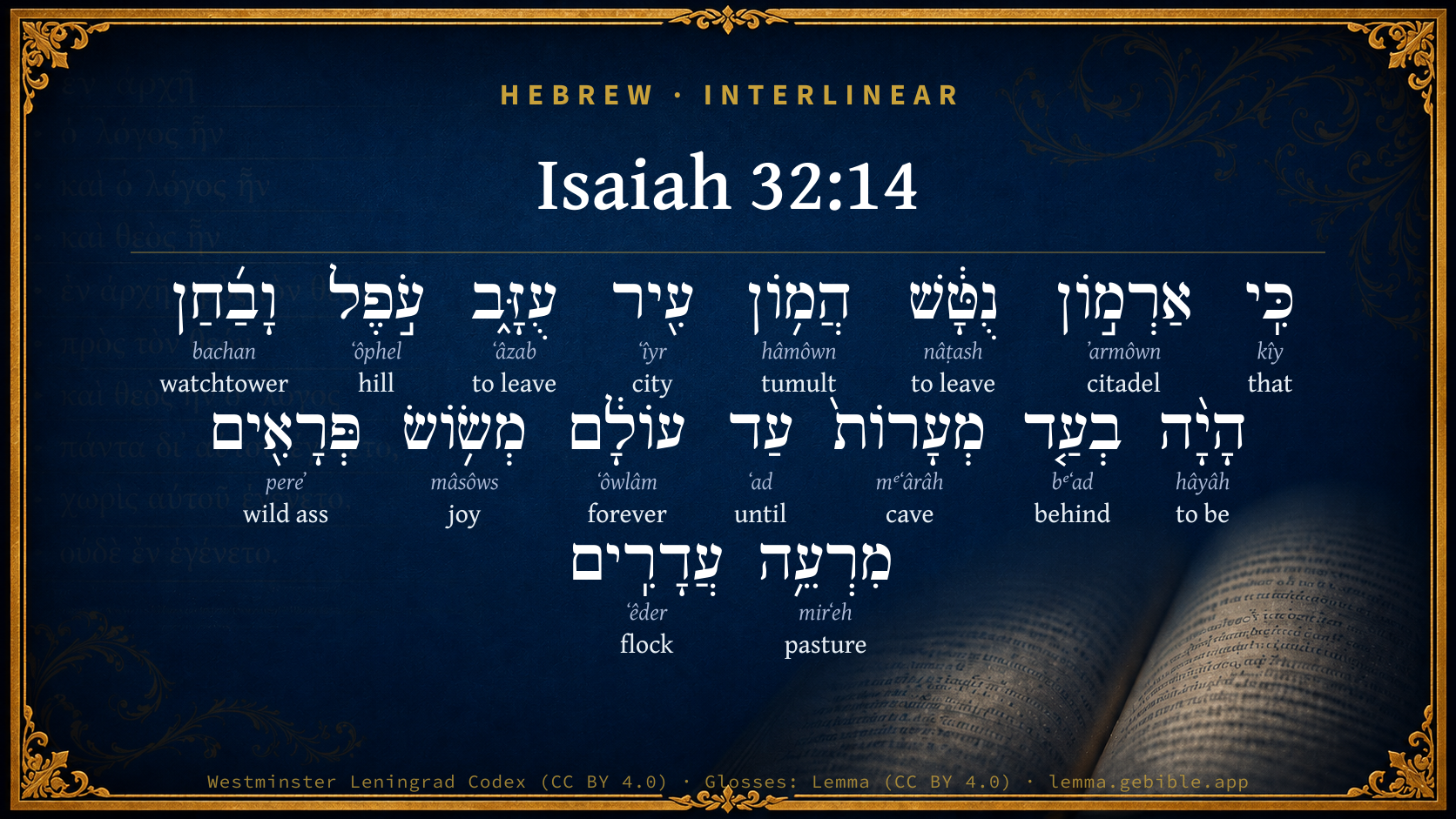
Isaiah 32:14

Hebrew (Westminster Leningrad Codex) Isaiah 32:14 appears in the Hebrew Old Testament. The text above is from the Westminster Leningrad Codex. Each word links to its Strong’s number, a concise gloss, and parsing drawn from the Open Scriptures Hebrew Bible morphology. Click any word for its full Brown-Driver-Briggs (BDB) entry.
Download image
Cite this verse

Isaiah 32:14 (World English Bible). Public Domain. Lemma interlinear Bible study tool, https://lemma.gebible.app/v/isaiah/32/14.

Show BibTeX & RIS
BibTeX
RIS
English Translation
For the palace shall be forsaken; the populous city shall be deserted; the hill and the watch-tower shall be for dens forever, a joy of wild donkeys, a pasture of flocks;
World English Bible · Public Domain
Highlights
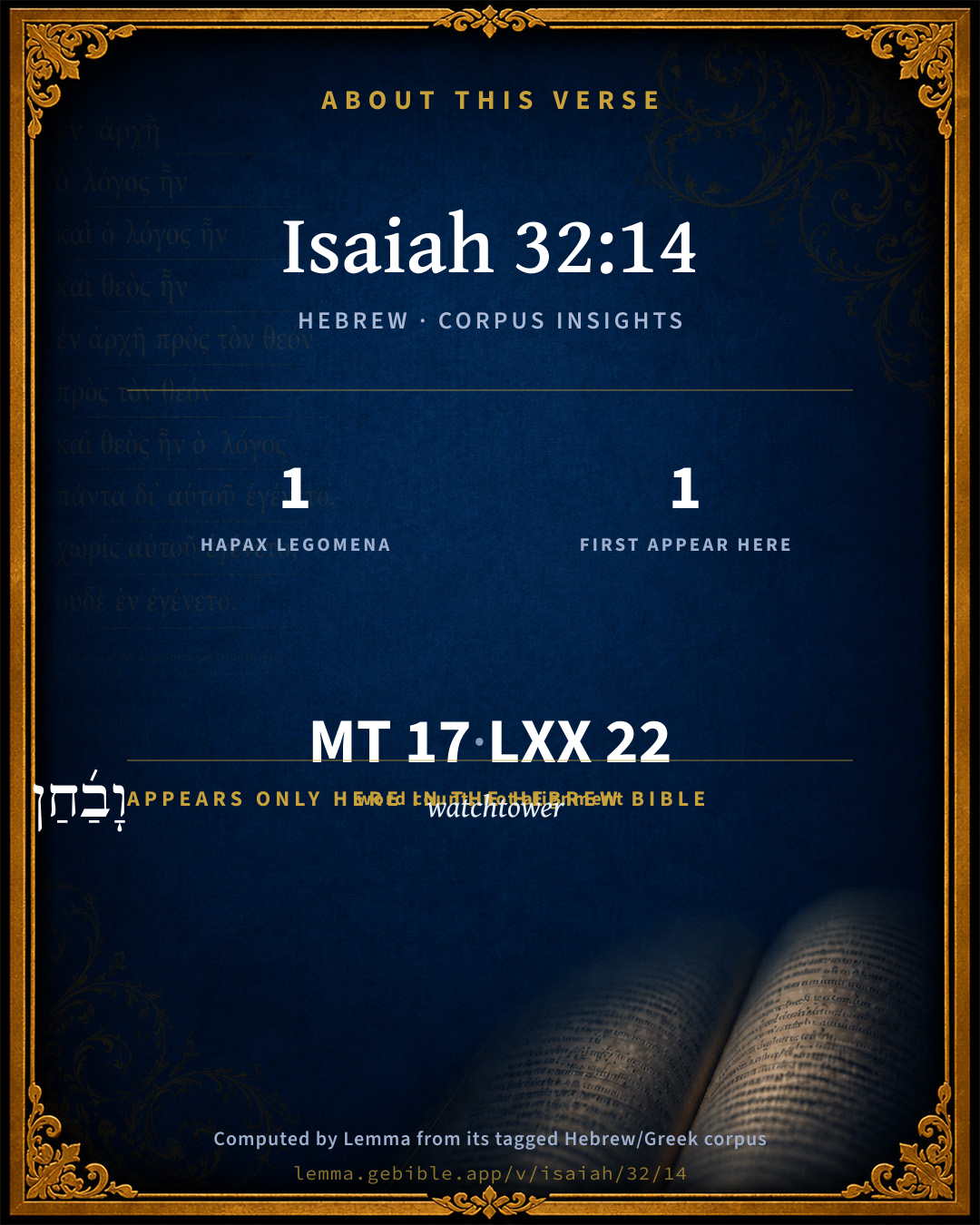
  • 1 hapax legomenon — only here in the Hebrew Bible
  • 1 first appearance in the Hebrew Bible
Full analysis ↓
Download a study sheet

One document with this verse’s original text, its word-by-word gloss line, the meaning frame, cross-references with their text, attributed commentary, and full source and license credits — printable, and it pastes into notes with its structure intact.

This verse Autodidact and up

Study sheet (.html) Plain text (.txt)

A passage Seminary Student

Up to 50 verses in one chapter. A passage sheet keeps up to 6 commentary sources and 12 cross-references per verse, in the order this page ranks them, and says so on the sheet whenever that leaves anything out. Ask for a single verse and you get the Autodidact verse sheet above.

Everything on this page stays free to read, with no account — the sheet is a download of what is already on screen, not access to it.

Want to remove ads? Support Godless Engineer
Compare translations 3

The same verse in 3 English versions, stacked beneath the original-language interlinear above. Click any original word for its lexicon entry.

Each is an independent rendering of the whole verse — the interlinear is not word-aligned to these translations.

Highlighted words mark where these versions differ — a whole-verse word diff, not a word-by-word alignment.

  • World English Bible Public Domain
    For the palace shall be forsaken; the populous city shall be deserted; the hill and the watch-tower shall be for dens forever, a joy of wild donkeys, a pasture of flocks;
  • King James Version Public Domain
    Because the palaces shall be forsaken; the multitude of the city shall be left; the forts and towers shall be for dens for ever, a joy of wild asses, a pasture of flocks;
  • unfoldingWord Literal Text CC BY-SA 4.0
    For the palace will be abandoned, the multitude of the city will be forsaken; the hill and the watchtower will become caves for a long time, a delight of donkeys, a pasture of flocks,

unfoldingWord Literal Text — © unfoldingWord, licensed CC BY-SA 4.0. Word-aligned USFM3 via Door43 (git.door43.org/unfoldingWord/en_ult).

Versions to compare (up to 4)

3 of 4 selected

Show all 18 translations

Every available English version of this verse, each an independent rendering of the whole verse.

  • World English Bible Public Domain
    For the palace shall be forsaken; the populous city shall be deserted; the hill and the watch-tower shall be for dens forever, a joy of wild donkeys, a pasture of flocks;
  • Berean Standard Bible Public Domain
    For the palace will be forsaken, the busy city abandoned. The hill and the watchtower will become caves forever—the delight of wild donkeys and a pasture for flocks—
  • Majority Standard Bible Public Domain
    For the palace will be forsaken, the busy city abandoned. The hill and the watchtower will become caves forever—the delight of wild donkeys and a pasture for flocks—
  • King James Version Public Domain
    Because the palaces shall be forsaken; the multitude of the city shall be left; the forts and towers shall be for dens for ever, a joy of wild asses, a pasture of flocks;
  • American Standard Version (1901) Public Domain
    For the palace shall be forsaken; the populous city shall be deserted; the hill and the watch-tower shall be for dens for ever, a joy of wild asses, a pasture of flocks;
  • Revised Version (1885) Public Domain
    For the palace shall be forsaken; the populous city shall be deserted; the hill and the watch-tower shall be for dens for ever, a joy of wild asses, a pasture of flocks;
  • Geneva Bible (1599) Public Domain
    Because the palace shalbe forsaken, and the noise of the citie shalbe left: the towre and fortresse shalbe dennes for euer, and the delite of wilde asses, and a pasture for flockes,
  • Douay-Rheims (1899) Public Domain
    For the house is forsaken, the multitude of the city is left, darkness and obscurity are come upon its dens for ever. A joy of wild asses, the pastures of docks,
  • Young's Literal Translation Public Domain
    Surely the palace hath been left, The multitude of the city forsaken, Fort and watch-tower hath been for dens unto the age, A joy of wild asses -- a pasture of herds;
  • Literal Standard Version CC BY-SA 4.0
    The palace has been left, || The multitude of the city forsaken, || Fort and watchtower have been for dens for all time, || A joy of wild donkeys—a pasture of herds;
  • Unlocked Literal Bible CC BY-SA 4.0
    For the palace will be forsaken, the crowded city will be deserted; the hill and the watchtower will become caves forever, a joy of wild donkeys, a pasture of flocks;
  • unfoldingWord Literal Text CC BY-SA 4.0
    For the palace will be abandoned, the multitude of the city will be forsaken; the hill and the watchtower will become caves for a long time, a delight of donkeys, a pasture of flocks,
  • Darby Bible Public Domain
    For the palace shall be deserted, the multitude of the city shall be forsaken; hill and watchtower shall be caves for ever, a joy of wild asses, a pasture of flocks;
  • World Messianic Bible Public Domain
    For the palace will be forsaken. The populous city will be deserted. The hill and the watchtower will be for dens forever, a delight for wild donkeys, a pasture of flocks,
  • Webster's Bible Public Domain
    Because the palaces shall be forsaken; the multitude of the city shall be left; the forts and towers shall be for dens for ever, a joy of wild asses, a pasture of flocks;
  • Free Bible Version CC BY-SA 4.0
    The palace is abandoned, the crowded town is deserted. Castles and watch towers will forever become homes loved by wild donkeys, and places where sheep graze,
  • Bible in Basic English Public Domain
    For the fair houses will have no man living in them; the town which was full of noise will become a waste; the hill and the watchtower will be unpeopled for ever, a joy for the asses of the woods, a place of food for the flocks;
  • JPS Tanakh (1917) Public Domain
    For the palace shall be forsaken; the city with its stir shall be deserted; the mound and the tower shall be for dens for ever, a joy of wild asses, a pasture of flocks;

Literal Standard Version (2020), Covenant Press — licensed CC BY-SA 4.0. Text via the HelloAO Bible API (eBible.org). Unlocked Literal Bible (unfoldingWord) — licensed CC BY-SA 4.0. Text via the HelloAO Bible API (eBible.org). unfoldingWord Literal Text — © unfoldingWord, licensed CC BY-SA 4.0. Word-aligned USFM3 via Door43 (git.door43.org/unfoldingWord/en_ult). Free Bible Version, Dr. Jonathan Gallagher — licensed CC BY-SA 4.0. Text via the HelloAO Bible API (eBible.org).

Word by word

More ways to search: Search by grammar → Find every occurrence → Compare this word →

Practice this passage: Drill this verse → Learn its vocabulary →

וָבַ֜חַן
bachan
H975
“and · watchtower”
Conjunction + Noun, Common, Masculine, Singular, Absolute
Part of Speech
Conjunction + Noun
Type
Common
Gender
Masculine
Number
Singular
State
Absolute
Full BDB Definition

Origin: from H974 (in the sense of keeping a look-out)

TWOT: 230b

watchtower
  1. כִּֽי kîy H3588 “that” Conjunction
  2. אַרְמ֣וֹן ʼarmôwn H759 “citadel” Noun, Common, Masculine, Singular, Absolute
  3. נֻטָּ֔שׁ nâṭash H5203 “to leave” Verb, Pual, Perfect, 3rd Person, Masculine, Singular
  4. הֲמ֥וֹן hâmôwn H1995 “tumult of” Noun, Common, Masculine, Singular, Construct
  5. עִ֖יר ʻîyr H5892 “city” Noun, Common, Feminine, Singular, Absolute
  6. עֻזָּ֑ב ʻâzab H5800 “to leave” Verb, Pual, Perfect, 3rd Person, Masculine, Singular
  7. עֹ֣פֶל ʻôphel H6076 “hill” Noun, Common, Masculine, Singular, Absolute
  8. הָיָ֨ה hâyâh H1961 “to be” Verb, Qal, Perfect, 3rd Person, Masculine, Singular
  9. בְעַ֤ד bᵉʻad H1157 “behind” Preposition
  10. מְעָרוֹת֙ mᵉʻârâh H4631 “caves” Noun, Common, Feminine, Plural, Absolute
  11. עַד ʻad H5704 “until” Preposition
  12. עוֹלָ֔ם ʻôwlâm H5769 “forever” Noun, Common, Masculine, Singular, Absolute
  13. מְשׂ֥וֹשׂ mâsôws H4885 “joy of” Noun, Common, Masculine, Singular, Construct
  14. פְּרָאִ֖ים pereʼ H6501 “wild asses” Noun, Common, Masculine, Plural, Absolute
  15. מִרְעֵ֥ה mirʻeh H4829 “pasture of” Noun, Common, Masculine, Singular, Construct
  16. עֲדָרִֽים ʻêder H5739 “flocks” Noun, Common, Masculine, Plural, Absolute

About this verse

These counts appear in no published source. They are computed here, from the morphology-tagged text and Lemma’s own curated glosses. What Lemma adds →

17
words
17
distinct lemmas
Prophets
section

Notable vocabulary

1 hapax legomenon — a word that appears only here in the entire Hebrew Bible:

  • וָבַ֜חַן watchtower H975

First appearance in Scripture

This word makes its first canonical appearance in the Hebrew Bible here:

  • וָבַ֜חַן watchtower H975

Shared distinctive vocabulary

עֹ֣פֶל hill H6076 occurs in 9 verses of the Hebrew Bible. Also found in:

Grammatical profile

  • 3 verbs
  • 11 nouns
  • 2 prepositions
  • 1 conjunction

Verb forms

  • נֻטָּ֔שׁ Pual · Perfect
  • עֻזָּ֑ב Pual · Perfect
  • הָיָ֨ה Qal · Perfect

Hebrew & Septuagint length

In English translation the verse runs 31 words from the Hebrew and 36 from the Septuagint (LXX English) — closely comparable.

A rough comparison of the two English renderings, which tokenize alike — not a word-level alignment.

Word counts can differ between the Hebrew and the Greek without any difference in meaning — e.g. the Hebrew direct-object marker אֵת has no separate Greek word, and Greek often adds the article ὁ.

In the original languages it is 17 Hebrew tokens and 22 Greek tokens — but the two are counted differently (Hebrew bundles its prefixes and suffixes into one token; the Greek is in lemma form), so that isn’t a like-for-like length.

Cross-references

14

Topical passages linked to Isaiah 32:14 in the Treasury of Scripture Knowledge — connected by theme and wording, ordered by reader-vote popularity; previews shown in the World English Bible.

  • Isaiah 24:10 The waste city is broken down; every house is shut up, that no man may come in.
  • Isaiah 24:12 In the city is left desolation, and the gate is struck with destruction.
  • Isaiah 25:2 For you have made of a city a heap, of a fortified city a ruin, a palace of strangers to be no city; it shall never be built.
  • Isaiah 27:10 For the fortified city is solitary, a habitation deserted and forsaken, like the wilderness: there shall the calf feed, and there shall he lie down, and consume the branches of it.
  • 2 Kings 25:9 He burnt the house of Yahweh, and the king's house; and all the houses of Jerusalem, even every great house, burnt he with fire.
  • Psalms 104:11 They give drink to every animal of the field. The wild donkeys quench their thirst.
  • Isaiah 5:9 In my ears, Yahweh of Hosts says: "Surely many houses will be desolate, Even great and beautiful, unoccupied.
  • Isaiah 6:11 Then I said, "Lord, how long?" He answered, "Until cities are waste without inhabitant, And houses without man, And the land becomes utterly waste,
  • Isaiah 13:19–22 Babylon, the glory of kingdoms, the beauty of the Chaldeans' pride, shall be as when God overthrew Sodom and Gomorrah.
  • Isaiah 24:1–3 Behold, Yahweh makes the earth empty, and makes it waste, and turns it upside down, and scatters abroad the inhabitants of it.
  • Isaiah 34:11–17 But the pelican and the porcupine shall possess it; and the owl and the raven shall dwell therein: and he will stretch over it the line of confusion, and the plummet of emptiness.
  • Luke 21:20 "But when you see Jerusalem surrounded by armies, then know that its desolation is at hand.
  • Luke 21:24 They will fall by the edge of the sword, and will be led captive into all the nations. Jerusalem will be trampled down by the Gentiles, until the times of the Gentiles are fulfilled.
  • Revelation 18:2–3 He cried with a mighty voice, saying, "Fallen, fallen is Babylon the great, and she has become a habitation of demons, a prison of every unclean spirit, and a prison of every unclean and hateful bird!

Cross-references courtesy of OpenBible.info (CC BY 4.0).

Hebrew and Greek witnesses Masoretic Hebrew ↔ Greek Septuagint

The same verse in the two great witnesses to the Old Testament, shown verse-for-verse.

These are two independent witnesses, not word-aligned to each other, and the Septuagint is shown in lemma (dictionary) form.

Hebrew Isaiah 32:14 Masoretic · Westminster Leningrad Codex

כִּֽי אַרְמ֣וֹן נֻטָּ֔שׁ הֲמ֥וֹן עִ֖יר עֻזָּ֑ב עֹ֣פֶל וָבַ֜חַן הָיָ֨ה בְעַ֤ד מְעָרוֹת֙ עַד עוֹלָ֔ם מְשׂ֥וֹשׂ פְּרָאִ֖ים מִרְעֵ֥ה עֲדָרִֽים

For the palace shall be forsaken; the populous city shall be deserted; the hill and the watch-tower shall be for dens forever, a joy of wild donkeys, a pasture of flocks;

World English Bible · Public Domain

Greek LXX Isaiah 32:14 Septuagint · lemma form

οἶκος ἐν καταλείπω πλοῦτος πόλις καί οἶκος ἐπιθυμητός ἀποἵημι καί εἰμί ὁ κώμη σπήλαιον ἕως ὁ αἰών εὐφροσύνη ὄνος ἄγριος βόσκημα ποιμήν

As for the rich city, the houses are deserted; they shall abandon the wealth of the city, and the pleasant houses: and the villages shall be caves for ever, the joy of wild asses, shepherds' pastures;

LXX2012 (modern English Septuagint) · Public Domain

Hebrew: Westminster Leningrad Codex (CC BY 4.0). Greek: Septuagint (public domain); English from LXX2012 (modern English Septuagint) (Public Domain). How the Septuagint differs from the Hebrew →

Targum (Aramaic paraphrase)

1

The Targum is the ancient Jewish Aramaic paraphrase of the Hebrew Scriptures — an interpretive translation, not the Hebrew text itself. Onkelos (literal) and Pseudo-Jonathan (expansive) render the Torah, and Jonathan the Prophets. Coverage is partial: where no permissively-licensed English translation exists for a verse, only the Aramaic is shown. This is verse-level text, not a word-by-word alignment to the Hebrew.

  1. Targum Jonathan Prophets (Joshua–Malachi)
    אֲרֵי בֵּית מַקְדְשָׁא חֲרוֹב הֲמוֹן קִרְוַיָא דַהֲוָאָה פַלְחִין בֵּיהּ צְרִיאָה בֵּית תָּקְפָנָא וּמַטְמוֹרָנָא אִתְבְּלֵשׁ וּכְרִי חֲרוֹב וּצְדִי עַד זְמַן אֲתַר דַהֲוָה בֵית חֶדְוָא וְחֵידוּ לְמַלְכַיָא כְדוֹ הֲוָה מִבַז לְמַשִׁרְיָן:

    For the house of the sanctuary shall be laid waste; the noisy city shall be desolate, in which they worship: the house of our strength and hiding place shall be searched out, dug up, desolate and waste unto a time. The place which was a house of joy and gladness for kings is now become a spoil for armies.

    Targum Jonathan — Aramaic: “Mikraot Gedolot” (public domain). English: “Sefaria Community Translation” (CC0 1.0 (public-domain dedication)); “London "Chaldee Paraphrase," 1871” (public domain). Text via Sefaria.

Commentary

Notes on Isaiah 32:14 from classic Christian and Jewish commentators (each source and its license shown beneath its notes). The classic Christian expositions comment on the surrounding passage and are grouped to its opening verse, so a note may address several verses; the Jewish commentaries on the Tanakh (Rashi and others) are per-verse, so they appear only where the commentator wrote on this verse.

Lemma curates 59 commentaries, every one of them public domain or Creative Commons licensed, each selected and text-cleaned for this edition rather than reprinted as found. About our sources →

Trapp's Complete Commentary

John Trapp

Isa 32:14 Because the palaces shall be forsaken; the multitude of the city shall be left; the forts and towers shall be for dens for ever, a joy of wild asses, a pasture of flocks;

Ver. 14. The multitude of the city shall be left.] For the city shall be left of its multitude.

The forts and towers.] Heb, Ophel and Bachan. The Hebrews tell us that these were two high towers in Jerusalem; now they were to be dismantled and lie waste.

John Trapp, A Commentary or Exposition upon All the Books of the Old and New Testament (1647–1656) — public domain. Text from a community e-Sword module.

Tyndale Open Study Notes

Tyndale Open Resources

32:14 Jerusalem was eventually destroyed, but by the Babylonians, not the Assyrians (for a prediction of this, see 39:1-8).

Tyndale Open Study Notes — © Tyndale Open Resources, licensed CC BY-SA 4.0. Text via the HelloAO Bible API.

Geneva Bible (1599)

Geneva Bible translators

Or, multitude.

Geneva Bible (1599) marginal notes — public domain. Text via Bolls.life.

Jamieson, Fausset & Brown

Robert Jamieson, A. R. Fausset & David Brown

palaces--most applicable to Jerusalem (see on Isa 32:13).

multitude . . . left--the noisy din of the city, that is, the city with its noisy multitude shall lie forsaken [MAURER].

forts--rather, "Ophel" (that is, the mound), the term applied specially to the declivity on the east of Zion, surrounded with its own wall (Ch2 27:3; Ch2 33:14; Kg2 5:24), and furnished with "towers" (or watchtowers), perhaps referred to here (Neh 3:26-27).

for ever--limited by thee, "until," &c., Isa 32:15, for a long time.

Jamieson, Fausset & Brown — Commentary Critical and Explanatory on the Whole Bible (1871) — public domain (CC PDM 1.0). Text via the HelloAO Bible API.

Adam Clarke's Commentary

Verse 14. The palaces shall be forsaken] The house of the sanctuary (the temple) shall be destroyed. - Targum.

The forts - "Ophel"] It was a part of Mount Zion, rising higher than the rest, at the eastern extremity, near to the temple, a little to the south of it; called by Micah, Mic 4:8, "Ophel of the daughter of Zion." It was naturally strong by its situation; and had a wall of its own, by which it was separated from the rest of Zion.

Adam Clarke's Commentary on the Bible (1810–1826) — public domain. Text from a community e-Sword/MySword module.

Ellicott's Commentary for English Readers

(14) The palaces shall be forsaken.—With a bold pencil and rapid strokes the picture of desolation is sketched in outline. The forts are those of Ophel (so in Heb.), the fortified south-eastern slope of the Temple mountain; the towers, probably such as “the tower of the flock,” mentioned in conjunction with Ophel in Mic_4:8. These would serve as dens for the wild asses, which commonly roved in the open country.

A Bible Commentary for English Readers, edited by Charles John Ellicott (1878–1897) — public domain. Text from a community e-Sword module.

The Cambridge Bible for Schools and Colleges

gen. ed. J. J. S. Perowne

14. Render: For the palace is forsaken, the tumult of the city is a solitude (as in ch. Isa_6:12), &c. The tenses are prophetic perfects.

the forts and towers] Better as in R.V.: the hill and the watch tower. The first word is ‘Ophel, the name of the southern projection of the hill on which the temple stood (Neh_3:26 f., Neh_11:21; 2Ch_27:3; 2Ch_33:14), and is doubtless mentioned as the aristocratic quarter of the city, near the royal palace. The word translated “watch tower” occurs nowhere else, and is of uncertain significance; probably, like Ophel, it denotes a particular locality in the capital.

The phrase for ever must be understood in a relative sense, being restricted by the “until” of Isa_32:15.

The verse contains an absolute and explicit prediction of the complete overthrow of Jerusalem. Dillmann’s assertion that such an expectation must have been expressed in different language is inexplicable, and his distinction between destruction and desolation is sophistical. Surprising as this idea may be alongside of certain passages in this section of the book, it is not to be explained away, and after all it does not go very much beyond what is said in ch. Isa_29:4. For a complete parallel, however, we must go back to the early prophecy of ch. Isa_5:14; Isa_5:17.

The Cambridge Bible for Schools and Colleges (gen. ed. J. J. S. Perowne; Cambridge University Press, 1878–1918) — public domain. Text from a community e-Sword module.

John Gill's Exposition

Because the palaces shall be forsaken,.... The palaces of the princes and nobles shall be forsaken by them, they being obliged to flee from the enemy, or being taken, and either slain, or carried captive. The word in the Hebrew is in the singular number, "the palace", meaning the royal palace; and so Aben Ezra and Jarchi interpret it of the king's palace; though the Targum paraphrases it the house of the sanctuary, or the temple, so Kimchi; which was left desolate, as Christ foretold it should be, Mat 23:38,

the multitude of the city shall be left; to take care of themselves, and to the fury of their enemies, their princes and nobles being killed or fled; or, "the city shall be left of the multitude" (p); the multitude of inhabitants that were in it shall forsake it, and flee, or be destroyed in it, so that few or none shall remain:

the forts and towers shall be for dens for ever; Ophel and Bachan, which some take to be the names of two towers of Jerusalem; of Ophel we read in Ch2 27:3 but rather these intend in general the high towers and strong fortifications of Jerusalem, which being cut out of rocks, when demolished served for dens for thieves and robbers, and wild creatures; and this being "for ever", that is, for a very long time, shows that it cannot be applied to the destruction of Jerusalem by the Chaldeans, and the seventy years' captivity; but it is to be understood of the last destruction, which continues unto this day:

a joy of wild asses; which delight in wild and desert places; see Job 39:5.

a pasture of flocks; where flocks of sheep feed, instead of being inhabited by men. Jarchi's note is pretty remarkable,

"for the desire, or at the will, of the Ishmaelites, and for the feeding of the Grecians, and their army;''

and certain it is that Jerusalem now is in the hands of the Ishmaelites, or Turks. The Targum is,

"the place which was a house of joy and gladness for kings is now become a spoil for armies.''

(p) So Gataker.

John Gill's Exposition of the Whole Bible (1746–1763) — public domain (CC PDM 1.0). Text via the HelloAO Bible API.

Albert Barnes' Notes on the Bible

Because the palaces shall be forsaken - That is, the palaces in the cities and towns which Sennacherib would lay waste. Or, if it refers, as Lowth supposes, to the invasion of the land in the time of the Chaldeans, then it relates to the palaces in Jerusalem. Vitringa supposes that the temple at Jerusalem is particularly designated by the word rendered palaces. But that is not the usual word to denote the temlple, and it is not necessary to suppose that that is particularly referred to. The word ארמון 'armôn usually denotes a palace, or royal residence in some part of the royal citadel (see 1Ki 16:18; Isa 25:2; Jer 30:18; Amo 1:4, Amo 1:7, Amo 1:10, Amo 1:12).

The forts - Margin, ‘Cliffs and watch-towers.’ Hebrew, עפל ‛opel. This word properly denotes a hill or a cliff, such as is an advantageous situation for fortresses. It is translated in Mic 4:8, ‘the stronghold;’ in 2Ki 5:24, ‘the tower;’ in 2Ch 27:3; 2Ch 30:14; Neh 3:27; Neh 11:21, ‘Ophel.’ With the article (the hill) it was given, by way of eminence, to a bluff or hilt lying northeast of mount Zion, and south of mount Moriah, which was surrounded and fortified with a wall (Jos. Jewish Wars, vi. 6). It extends south from mount Moriah, running down to the fountain of Siloam, lying between the valley of Jehoshaphat on the east, and the Tyropeon or valley of Cheesemongers on the west. It terminates over the pool of Siloam in a steep point of rock forty or fifty feet high. The top of the ridge is flat, and the ground is now tilled, and planted with olive and other fruit trees (see Robinson’s Bib. Researches, vol. i. pp. 341, 394). It may be used here, however, to denote a hill or cliff, a strongly-fortified place in general, without supposing of necessity that it refers to the mountain in Jerusalem.

Towers - Towers were erected on the walls of cities at convenient distances for purposes of observation.

Shall be for dens - Shall become places where banditti and robbers may abide, and secure themselves.

Forever - This is evidently one instance in which the word ‘forever’ (עד־עולם ‛ad-‛ôlâm), denotes a long time, because in the verse When the word is used without any suet limitation, it denotes proper eternity

A joy of wild asses - A place where wild animals will have unlimited range.

Albert Barnes' Notes on the Bible (1834–1885) — public domain. Text from a community e-Sword/MySword module.

Haydock's Catholic Bible Commentary

Ever. Some palaces had been demolished by Sennacherib, though this seems to refer to the Babylonian captivity.

George Leo Haydock (1774–1849), Haydock's Catholic Family Bible and Commentary, 1859 edition — public domain. Excludes Psalms (Douay-Rheims chapter numbering differs from Protestant) and Deuterocanonical books (Catholic canon only).

Matthew Poole's English Annotations

The palaces, Heb. the palace; the king’s house, and other magnificent buildings in the city.

Shall be left; or rather, shall be forsaken, to wit, of God, and given up into their enemies’ hands. And the verb in the foregoing clause may be rendered, shall be left.

A joy of wild asses; desolate places, in which wild asses delight to be, Job 39:5,6; Jer 2:24.

Matthew Poole's English Annotations on the Holy Bible (1683–1685) — public domain. Text from a community e-Sword/MySword module.

The Pulpit Commentary

The palaces shall be forsaken; literally, the palace; but the word is used in a generic sense. The prophet sees in vision Jerusalem deserted by her inhabitants, the grand houses of the rich empty, the strongholds haunted by wild beasts, and the slopes of the hills fed on by sheep, and even occasionally visited by the timid and solitude-loving wild ass. The description suits well the time of the Babylonian captivity, but not any earlier period. Probably it was not revealed to the prophet how soon the condition would be reached. The multitude of the city shall be left. The real meaning is, as Bishop Lowth expresses it, "The populous city shall be left desolate." But the whole passage is. as Delitzsch observes, "grammatically strange, the language becoming more complicated, disjointed, and difficult, the greater the wrath and indignation of the poet." The forts and towers; rather, hill and tower, with (perhaps) a special reference to the part of Jerusalem called Ophel, (2Ch_27:3 Neh_3:26, etc.) the long projecting spur from the eastern hill, which points a little west of south, and separates the Kedron valley from the Tyropoeon. Shall be for dens; literally, for caves; but dens for wild beasts seem to be meant. (comp. Isa_13:21 Isa_34:14 Jer_1:3-9) For ever. This expression must not be pressed. Hyperbole is a recognized feature of poetry written under strong excitement. A joy of wild asses. The wild ass is not now found nearer Palestine than Mesopotamia, or perhaps Northern Syria. It is exceedingly shy, and never approaches the habitations of men.

The Pulpit Commentary (1880–1919), ed. H.D.M. Spence-Jones & Joseph S. Exell — public domain. Text from a community e-Sword module.

John Wesley's Explanatory Notes

Forsaken - Of God, and given up into their enemies hands. A joy - Desolate places, in which wild asses delight to be.

John Wesley, Explanatory Notes Upon the Whole Bible (1754–1765) — public domain. Text via the GEBible commentary corpus.

J. A. Alexander on Isaiah

Joseph Addison Alexander

“For the palace is forsaken, the crowd of the city (or the crowded city) left, hill and watch-tower (are) for caves (or dens) forever, a joy (or favorite resort) of wild asses, a pasture of flocks.” The use of the word ‘palace’, and that in the singular number, clearly shows that the destruction of Jerusalem itself is here predicted. The Hebrew word in this verse originally meaning a hill is applied as a proper name (Ophel) to the southern extremity of Mount Moriah, overhanging the spot where the valleys of Jehoshaphat and Hinnom meet. "The top of the ridge is flat, descending rapidly towards the south, sometimes by offsets of rock; the ground is tilled and planted with olive and other fruit-trees." (Robinson’s Palestine, I p. 394.)

Joseph Addison Alexander, The Prophecies of Isaiah (1846–1847; New York: Scribner, 1870–1878) — public domain. Text from a community e-Sword module.

unfoldingWord translationNotes

Door43 World Missions Community

General Information:

Isaiah continues speaking.

For the palace will be forsaken, the crowded city will be deserted

This can be stated in active form. AT: "For the people will forsake the palace and the crowds will abandon the city" (See: Active or Passive)

the hill

This refers to the fort built on the top of the hill. AT: "the fort on the hill" (See: Metonymy)

the hill and the watchtower will become caves

This speaks of the fort and the watchtower being abandoned as if they became caves. AT: "the hill and the watchtower will become abandoned and empty" (See: Assumed Knowledge and Implicit Information)

a joy of wild donkeys, a pasture of flocks

This means the these animals will enjoy the grass that grows among the abandon fort and watchtower. AT: "the wild donkeys and the flocks of sheep will eat the grass there" (See: Assumed Knowledge and Implicit Information)

forever

This is an exaggeration for a very long time. AT: "an extremely long time" (See: Hyperbole and Generalization)

until the Spirit is poured

This can be stated in active form. AT: "until Yahweh pours the Spirit" (See: Active or Passive)

the Spirit is poured on us

This speaks of Yahweh giving him Spirit to his people as if his Spirit were a liquid that he would pour on them. AT: "the Spirit is given to us" (See: Metaphor)

from on high

Here heaven is referred to as "on high." AT: "from heaven" (See: Metonymy)

the fruitful field is considered as a forest

This can be written in active form. This compares how overly bountiful the fruitful fields are by comparing them to a thick, dense forest. AT: "people will say that the fruitful fields have grown thick like a forest" or "the fruitful fields will be overly bountiful" (See: Active or Passive and Simile)

translationWords

forsake

watchtower

eternity

donkey

flocks

Holy Spirit

desert

unfoldingWord translationNotes — © Distant Shores Media and the Door43 World Missions Community, licensed CC BY-SA 4.0. Source: git.door43.org/Door43/en_tn.

Rashi

Rabbi Shlomo Yitzchaki (Rashi)

For the palace The king’s palace has been forsaken.

the multitude of the city has been exiled.

rampart and tower My Temple, which was a fortification for them.

are amidst ruins (הָיָה בְּעַד מְעָרוֹת), shall be amidst ruins. מְעָרוֹת is an expression similar to (Psalms 137:7) “Raze it, raze it (עָרוּ עָרוּ).” בְּעַד is like “(Job 22:13) Can He judge through (הַבְעַד) a thick cloud?”

forever Until the time of the end.

a joy for wild donkeys For the lust of Ishmael and his hosts.

Rashi on the Tanakh — English translations: “The Judaica Press complete Tanach with Rashi, translated by A. J. Rosenberg” (CC BY 4.0); “Pentateuch with Rashi's commentary by M. Rosenbaum and A.M. Silbermann, 1929-1934” (public domain); “The Metsudah Tanach series, Lakewood, N.J” (CC BY 4.0); and “The Book of Joshua, Metsudah Publications, 1997” (CC BY 4.0). Text via Sefaria.

Ibn Ezra

Rabbi Abraham ibn Ezra

The palace of the king. נטש, shall be forsaken; עזב, shall be left. Pual.

עופל An elevated place. Comp. ויעפילו and they ascended.

ובחן And tower. Comp. בחוניו his towers. (23:13). היו מערות═ היה בעד מערות shall become dens.

Ibn Ezra on the Tanakh — English translations: “Sefaria Community Translation” (CC0 1.0 (public-domain dedication)); “Yalkut, Sifsei Chachomim Chumash, Metsudah Publications, 2009” (CC BY 4.0); and “Commentary of Ibn Ezra on Isaiah - trans. by M. Friedlander, 1873” (public domain). Text via Sefaria.

Lesson kit

Teaching starters — assembled from the data on this page, not authored interpretation. Every prompt links to the verse data it draws on. Edit before teaching.

Isaiah, in the Prophets, opens this verse with 17 words (17 distinct Hebrew lemmas). Its most distinctive word is bachan (“watchtower”). A historical commentator’s framing appears above. Read the whole chapter for the surrounding context.

Discussion questions

  1. The word bachan carries the sense “watchtower.” How does it shape the verse?
  2. 1 word here appears nowhere else in the Hebrew Bible. Why might the author reach for such rare wording?
  3. This is the first place “watchtower” appears in Scripture (first appears here). What does its debut here establish?
  4. How does Deuteronomy 28:27, which shares the word «hill», read alongside this verse?
  5. These translations render this verse differently; the difference is in the English rendering, not the original. What questions does that raise?
  6. «נֻטָּ֔שׁ» is a Pual Perfect verb. How does that grammatical form shape the action described?
  7. Compare how Trapp's Complete Commentary and Tyndale Open Study Notes read this verse. Where do they agree or differ?

Things to notice

Reading settings

Reading text

Shown beneath each verse's original-language words.

Old Testament
Old Testament edition

Read the OT as the Masoretic Hebrew (MT) or the Greek Septuagint (LXX).

English shown for the Greek Septuagint (in the Hebrew ↔ Greek comparison).

Comparing translations? Open the Compare panel on any verse page to stack up to four side by side.