
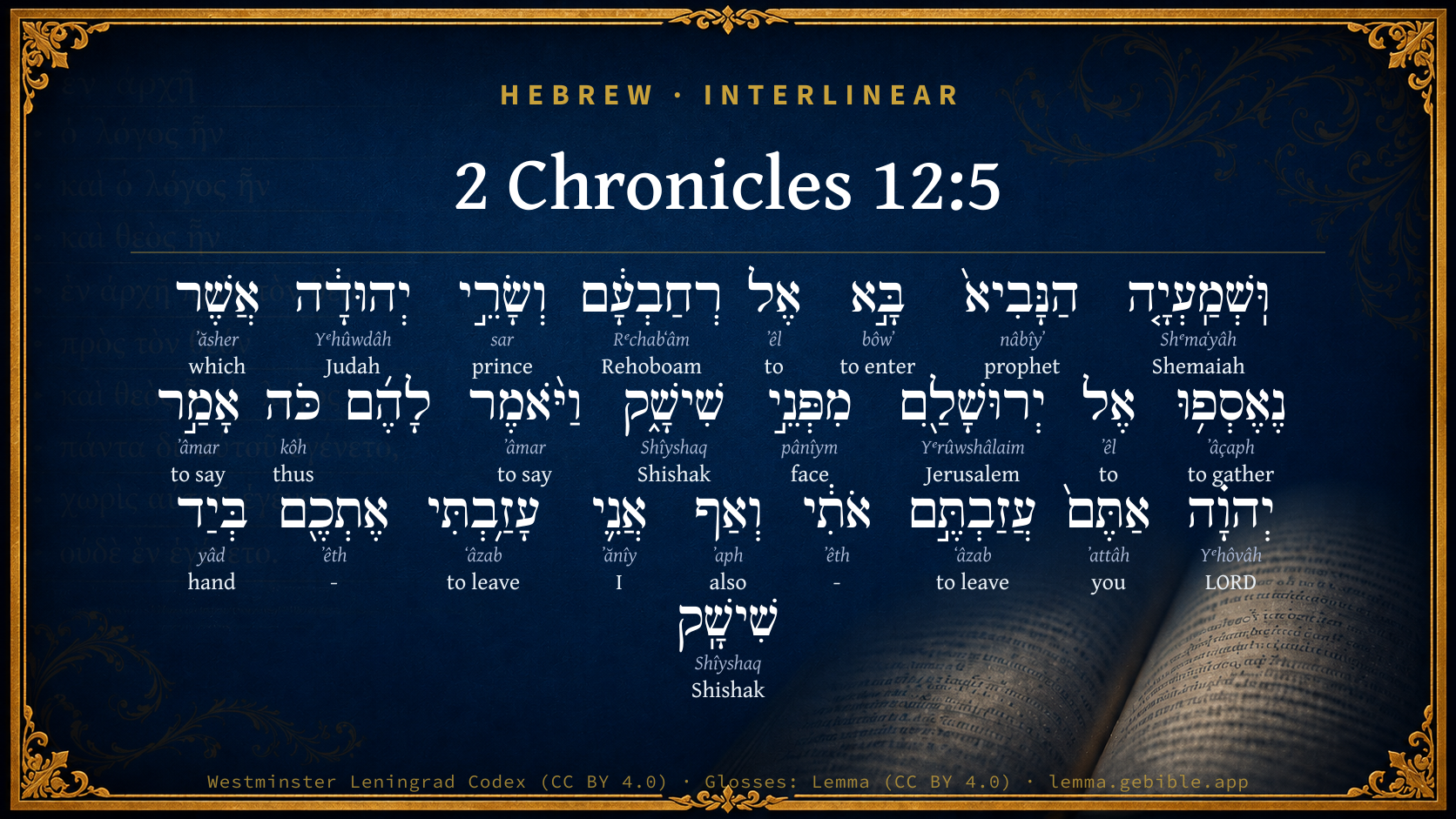
2 Chronicles 12:5

Hebrew (Westminster Leningrad Codex) 2 Chronicles 12:5 appears in the Hebrew Old Testament. The text above is from the Westminster Leningrad Codex. Each word links to its Strong’s number, a concise gloss, and parsing drawn from the Open Scriptures Hebrew Bible morphology. Click any word for its full Brown-Driver-Briggs (BDB) entry.
Download image
Cite this verse

2 Chronicles 12:5 (World English Bible). Public Domain. Lemma interlinear Bible study tool, https://lemma.gebible.app/v/2-chronicles/12/5.

Show BibTeX & RIS
BibTeX
RIS
English Translation
Now Shemaiah the prophet came to Rehoboam, and to the princes of Judah, who were gathered together to Jerusalem because of Shishak, and said to them, Thus says Yahweh, You have forsaken me, therefore have I also left you in the hand of Shishak.
World English Bible · Public Domain
Download a study sheet

One document with this verse’s original text, its word-by-word gloss line, the meaning frame, cross-references with their text, attributed commentary, and full source and license credits — printable, and it pastes into notes with its structure intact.

This verse Autodidact and up

Study sheet (.html) Plain text (.txt)

A passage Seminary Student

Up to 50 verses in one chapter. A passage sheet keeps up to 6 commentary sources and 12 cross-references per verse, in the order this page ranks them, and says so on the sheet whenever that leaves anything out. Ask for a single verse and you get the Autodidact verse sheet above.

Everything on this page stays free to read, with no account — the sheet is a download of what is already on screen, not access to it.

Want to remove ads? Support Godless Engineer
Compare translations 3

The same verse in 3 English versions, stacked beneath the original-language interlinear above. Click any original word for its lexicon entry.

Each is an independent rendering of the whole verse — the interlinear is not word-aligned to these translations.

Highlighted words mark where these versions differ — a whole-verse word diff, not a word-by-word alignment.

  • World English Bible Public Domain
    Now Shemaiah the prophet came to Rehoboam, and to the princes of Judah, who were gathered together to Jerusalem because of Shishak, and said to them, Thus says Yahweh, You have forsaken me, therefore have I also left you in the hand of Shishak.
  • King James Version Public Domain
    Then came Shemaiah the prophet to Rehoboam, and to the princes of Judah, that were gathered together to Jerusalem because of Shishak, and said unto them, Thus saith the LORD, Ye have forsaken me, and therefore have I also left you in the hand of Shishak.
  • unfoldingWord Literal Text CC BY-SA 4.0
    And Shemaiah the prophet came to Rehoboam and the chiefs of Judah who had gathered to Jerusalem because of Shishak. And he said to them, “Thus says Yahweh: You all yourselves have abandoned me, and I myself have also abandoned you all into the hand of Shishak.”

unfoldingWord Literal Text — © unfoldingWord, licensed CC BY-SA 4.0. Word-aligned USFM3 via Door43 (git.door43.org/unfoldingWord/en_ult).

Versions to compare (up to 4)

3 of 4 selected

Show all 18 translations

Every available English version of this verse, each an independent rendering of the whole verse.

  • World English Bible Public Domain
    Now Shemaiah the prophet came to Rehoboam, and to the princes of Judah, who were gathered together to Jerusalem because of Shishak, and said to them, Thus says Yahweh, You have forsaken me, therefore have I also left you in the hand of Shishak.
  • Berean Standard Bible Public Domain
    Then Shemaiah the prophet came to Rehoboam and the leaders of Judah who had gathered at Jerusalem because of Shishak, and he said to them, “This is what the LORD says: ‘You have forsaken Me; therefore, I have forsaken you into the hand of Shishak.’”
  • Majority Standard Bible Public Domain
    Then Shemaiah the prophet came to Rehoboam and the leaders of Judah who had gathered at Jerusalem because of Shishak, and he said to them, “This is what the LORD says: ‘You have forsaken Me; therefore, I have forsaken you into the hand of Shishak.’”
  • King James Version Public Domain
    Then came Shemaiah the prophet to Rehoboam, and to the princes of Judah, that were gathered together to Jerusalem because of Shishak, and said unto them, Thus saith the LORD, Ye have forsaken me, and therefore have I also left you in the hand of Shishak.
  • American Standard Version (1901) Public Domain
    Now Shemaiah the prophet came to Rehoboam, and to the princes of Judah, that were gathered together to Jerusalem because of Shishak, and said unto them, Thus saith Jehovah, Ye have forsaken me, therefore have I also left you in the hand of Shishak.
  • Revised Version (1885) Public Domain
    Now Shemaiah the prophet came to Rehoboam, and to the princes of Judah, that were gathered together to Jerusalem because of Shishak, and said unto them, Thus saith the LORD, Ye have forsaken me, therefore have I also left you in the hand of Shishak.
  • Geneva Bible (1599) Public Domain
    Then came Shemaiah the Prophet to Rehoboam, and to the princes of Iudah, that were gathered together in Hierusalem, because of Shishak, and sayde vnto them, Thus sayth the Lord, Ye haue forsaken me, therefore haue I also left you in the handes of Shishak.
  • Douay-Rheims (1899) Public Domain
    And Semeias the prophet came to Roboam, and to the princes of Juda, that were gathered together in Jerusalem, fleeing from Sesac, and he said to them: Thus saith the Lord: You have left me, and I have left you in the hand of Sesac.
  • Young's Literal Translation Public Domain
    And Shemaiah the prophet hath come in unto Rehoboam and the heads of Judah who have been gathered unto Jerusalem from the presence of Shishak, and saith to them, `Thus said Jehovah, Ye have forsaken Me, and also, I have left you in the hand of Shishak;'
  • Literal Standard Version CC BY-SA 4.0
    And Shemaiah the prophet has come to Rehoboam and the heads of Judah who have been gathered to Jerusalem [to escape] from the presence of Shishak, and says to them, “Thus said YHWH: You have forsaken Me, and also, I have left you in the hand of Shishak”;
  • Unlocked Literal Bible CC BY-SA 4.0
    Now Shemaiah the prophet came to Rehoboam and to the leaders of Judah who had gathered together to Jerusalem because of Shishak. Shemaiah said to them, “This is what Yahweh says: You have forsaken me, so I have also given you over into Shishak's hand.”
  • unfoldingWord Literal Text CC BY-SA 4.0
    And Shemaiah the prophet came to Rehoboam and the chiefs of Judah who had gathered to Jerusalem because of Shishak. And he said to them, “Thus says Yahweh: You all yourselves have abandoned me, and I myself have also abandoned you all into the hand of Shishak.”
  • Darby Bible Public Domain
    And Shemaiah the prophet came to Rehoboam and [to] the princes of Judah that had gathered together to Jerusalem because of Shishak, and said to them, Thus saith Jehovah: Ye have forsaken me, and therefore have I also left you in the hand of Shishak.
  • World Messianic Bible Public Domain
    Now Shemaiah the prophet came to Rehoboam and to the princes of Judah, who were gathered together to Jerusalem because of Shishak, and said to them, “The LORD says, ‘You have forsaken me, therefore I have also left you in the hand of Shishak.’”
  • Webster's Bible Public Domain
    Then came Shemaiah the prophet to Rehoboam, and to the princes of Judah, that were assembled at Jerusalem because of Shishak, and said to them, Thus saith the LORD, Ye have forsaken me, and therefore have I also left you in the hand of Shishak.
  • Free Bible Version CC BY-SA 4.0
    Shemaiah the prophet came to Rehoboam and the leaders of Judah who had run for safety to Jerusalem because of Shishak. He told them, “This is what the Lord says: ‘You have abandoned me, so I have abandoned you to Shishak.’”
  • Bible in Basic English Public Domain
    Now Shemaiah the prophet came to Rehoboam and the chiefs of Judah, who had come together in Jerusalem because of Shishak, and said to them, The Lord has said, Because you have given me up, I have given you up into the hands of Shishak.
  • JPS Tanakh (1917) Public Domain
    Now Shemaiah the prophet came to Rehoboam, and to the princes of Judah, that were gathered together to Jerusalem because of Shishak, and said unto them: 'Thus saith the LORD: Ye have forsaken Me, therefore have I also left you in the hand of Shishak.'

Literal Standard Version (2020), Covenant Press — licensed CC BY-SA 4.0. Text via the HelloAO Bible API (eBible.org). Unlocked Literal Bible (unfoldingWord) — licensed CC BY-SA 4.0. Text via the HelloAO Bible API (eBible.org). unfoldingWord Literal Text — © unfoldingWord, licensed CC BY-SA 4.0. Word-aligned USFM3 via Door43 (git.door43.org/unfoldingWord/en_ult). Free Bible Version, Dr. Jonathan Gallagher — licensed CC BY-SA 4.0. Text via the HelloAO Bible API (eBible.org).

Word by word

More ways to search: Search by grammar → Find every occurrence → Compare this word →

Practice this passage: Drill this verse → Learn its vocabulary →

שִׁישָׁ֑ק
Shîyshaq
H7895
“Shishak”
Noun, Proper
Part of Speech
Noun
Type
Proper
Full BDB Definition

Origin: of Egyptian derivation

TWOT: None

Shishak = "greedy of fine linen" - king of Egypt, Sheshonk I, 1st king of the Bubastite 22nd dynasty; ruled in Egypt during the reigns of Solomon and Rehoboam and attacked the southern kingdom under Rehoboam and apparently made it tributary
  1. וּֽשְׁמַֽעְיָ֤ה Shᵉmaʻyâh H8098 “and · Shemaiah” Conjunction + Noun, Proper
  2. הַנָּבִיא֙ nâbîyʼ H5030 “the · prophet” Particle, Definite Article + Noun, Common, Masculine, Singular, Absolute
  3. בָּ֣א bôwʼ H935 “to enter” Verb, Qal, Perfect, 3rd Person, Masculine, Singular
  4. אֶל ʼêl H413 “to” Preposition
  5. רְחַבְעָ֔ם Rᵉchabʻâm H7346 “Rehoboam” Noun, Proper
  6. וְשָׂרֵ֣י sar H8269 “and · princes of” Conjunction + Noun, Common, Masculine, Plural, Construct
  7. יְהוּדָ֔ה Yᵉhûwdâh H3063 “Judah” Noun, Proper
  8. אֲשֶׁר ʼăsher H834 “which” Particle, Relative
  9. נֶאֶסְפ֥וּ ʼâçaph H622 “to gather” Verb, Niphal, Perfect, 3rd Person, Common, Plural
  10. אֶל ʼêl H413 “to” Preposition
  11. יְרוּשָׁלִַ֖ם Yᵉrûwshâlaim H3389 “Jerusalem” Noun, Proper
  12. מִפְּנֵ֣י pânîym H6440 “from · face(s) of” Preposition + Noun, Common, Both, Plural, Construct
  13. וַיֹּ֨אמֶר ʼâmar H559 “and · to say” Conjunction + Verb, Qal, Sequential Imperfect, 3rd Person, Masculine, Singular
  14. כֹּה kôh H3541 “thus” Adverb
  15. אָמַ֣ר ʼâmar H559 “to say” Verb, Qal, Perfect, 3rd Person, Masculine, Singular
  16. יְהוָ֗ה Yᵉhôvâh H3068 “LORD” Noun, Proper
  17. אַתֶּם֙ ʼattâh H859 “you” Pronoun, Personal, 2nd Person, Masculine, Plural
  18. עֲזַבְתֶּ֣ם ʻâzab H5800 “to leave” Verb, Qal, Perfect, 2nd Person, Masculine, Plural
  19. אֹתִ֔י ʼêth H853 “- · me” Particle, Direct Object + Suffix, Personal, 1st Person, Common, Singular
  20. וְאַף ʼaph H637 “and · also” Conjunction + Adverb
  21. אֲנִ֛י ʼănîy H589 “I” Pronoun, Personal, 1st Person, Common, Singular
  22. עָזַ֥בְתִּי ʻâzab H5800 “to leave” Verb, Qal, Perfect, 1st Person, Common, Singular
  23. אֶתְכֶ֖ם ʼêth H853 “- · you” Particle, Direct Object + Suffix, Personal, 2nd Person, Masculine, Plural
  24. בְּיַד yâd H3027 “in/at · hand of” Preposition + Noun, Common, Both, Singular, Construct
  25. שִׁישָֽׁק Shîyshaq H7895 “Shishak” Noun, Proper

About this verse

These counts appear in no published source. They are computed here, from the morphology-tagged text and Lemma’s own curated glosses. What Lemma adds →

27
words
21
distinct lemmas
Historical
section

Notable vocabulary

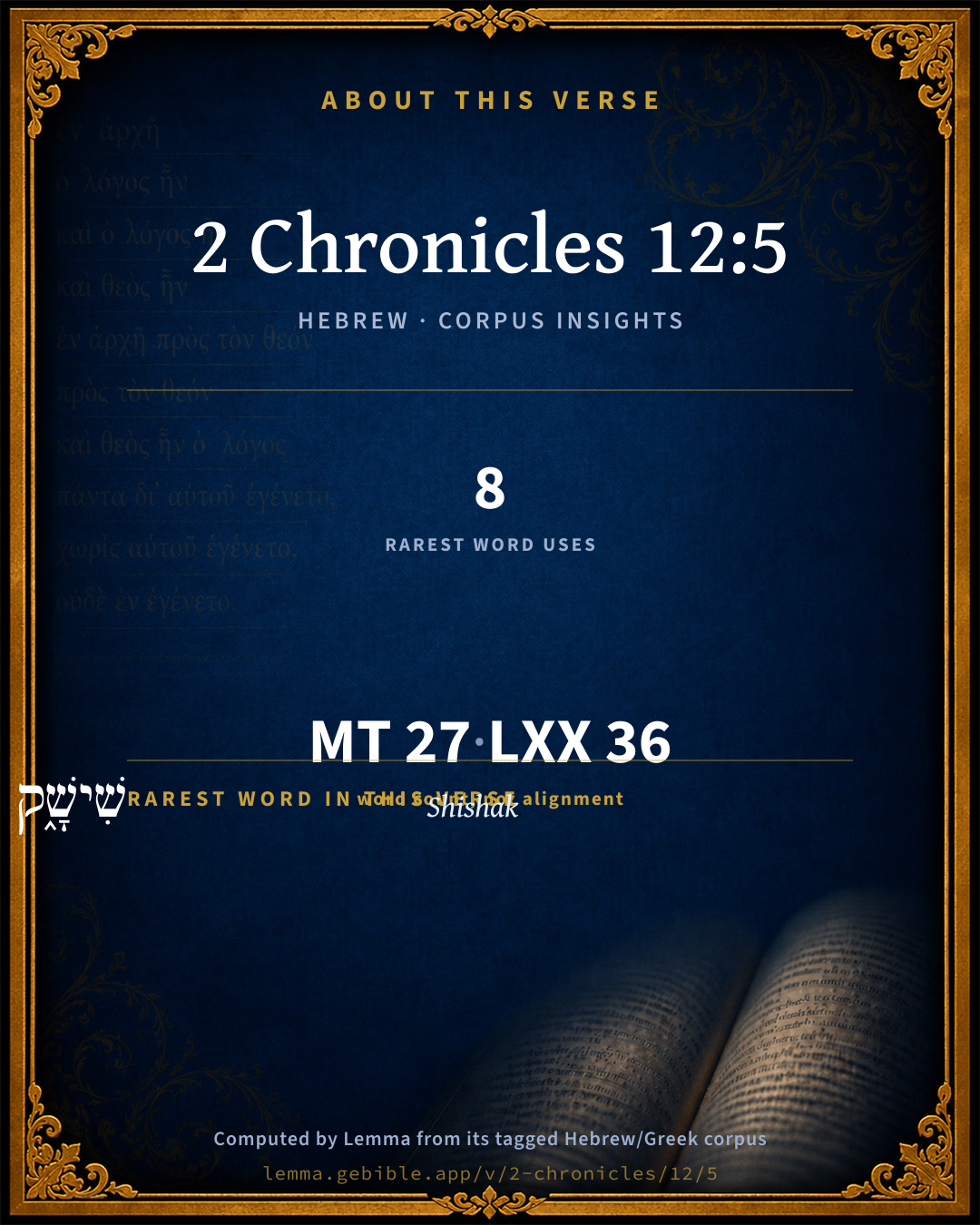
The rarest word here is שִׁישָׁ֑ק Shishak H7895 — appearing just 8 times in the whole Hebrew Bible.

Shared distinctive vocabulary

שִׁישָׁ֑ק Shishak H7895 occurs in 6 verses of the Hebrew Bible. Also found in:

Grammatical profile

  • 6 verbs
  • 11 nouns
  • 2 pronouns
  • 3 prepositions
  • 2 adverbs
  • 3 particles

Verb forms

  • בָּ֣א Qal · Perfect
  • נֶאֶסְפ֥וּ Niphal · Perfect
  • וַיֹּ֨אמֶר Qal · Sequential Imperfect
  • אָמַ֣ר Qal · Perfect
  • עֲזַבְתֶּ֣ם Qal · Perfect
  • עָזַ֥בְתִּי Qal · Perfect

Repetition

Words recur within this verse — often emphatic in Hebrew:

  • שִׁישָׁ֑ק Shishak H7895 ×2
  • וַיֹּ֨אמֶר to say H559 ×2
  • עֲזַבְתֶּ֣ם to leave H5800 ×2
  • אֶל to H413 ×2

Hebrew & Septuagint length

In English translation the verse runs 44 words from the Hebrew and 44 from the Septuagint (LXX English) — the same length.

A rough comparison of the two English renderings, which tokenize alike — not a word-level alignment.

Word counts can differ between the Hebrew and the Greek without any difference in meaning — e.g. the Hebrew direct-object marker אֵת has no separate Greek word, and Greek often adds the article ὁ.

In the original languages it is 27 Hebrew tokens and 36 Greek tokens — but the two are counted differently (Hebrew bundles its prefixes and suffixes into one token; the Greek is in lemma form), so that isn’t a like-for-like length.

Cross-references

13

Topical passages linked to 2 Chronicles 12:5 in the Treasury of Scripture Knowledge — connected by theme and wording, ordered by reader-vote popularity; previews shown in the World English Bible.

  • 2 Chronicles 11:2 But the word of Yahweh came to Shemaiah the man of God, saying,
  • 2 Chronicles 15:2 and he went out to meet Asa, and said to him, Hear you me, Asa, and all Judah and Benjamin: Yahweh is with you, while you are with him; and if you seek him, he will be found of you; but if you forsake him, he will forsake you.
  • 1 Kings 12:22 But the word of God came to Shemaiah the man of God, saying,
  • Deuteronomy 28:15–68 But it shall come to pass, if you will not listen to the voice of Yahweh your God, to observe to do all his commandments and his statutes which I command you this day, that all these curses shall come on you, and overtake you.
  • Judges 10:9–14 The children of Ammon passed over the Jordan to fight also against Judah, and against Benjamin, and against the house of Ephraim; so that Israel was sore distressed.
  • 2 Samuel 24:14 David said to Gad, I am in a great strait: let us fall now into the hand of Yahweh; for his mercies are great; and let me not fall into the hand of man.
  • 1 Chronicles 28:9 You, Solomon my son, know the God of your father, and serve him with a perfect heart and with a willing mind; for Yahweh searches all hearts, and understands all the imaginations of the thoughts: if you seek him, he will be found of you; but if you forsake him, he will cast you off forever.
  • 2 Chronicles 12:1–2 It happened, when the kingdom of Rehoboam was established, and he was strong, that he forsook the law of Yahweh, and all Israel with him.
  • Psalms 37:33 Yahweh will not leave him in his hand, Nor condemn him when he is judged.
  • Jeremiah 2:19 Your own wickedness shall correct you, and your backsliding shall reprove you: know therefore and see that it is an evil thing and a bitter, that you have forsaken Yahweh your God, and that my fear is not in you, says the Lord, Yahweh of Hosts.
  • Jeremiah 4:18 Your way and your doings have procured these things to you; this is your wickedness; for it is bitter, for it reaches to your heart.
  • Jeremiah 5:19 It shall happen, when you shall say, Why has Yahweh our God done all these things to us? then shall you say to them, Like as you have forsaken me, and served foreign gods in your land, so shall you serve strangers in a land that is not yours.
  • Jeremiah 23:33 When this people, or the prophet, or a priest, shall ask you, saying, What is the burden of Yahweh? then shall you tell them, What burden! I will cast you off, says Yahweh.

Cross-references courtesy of OpenBible.info (CC BY 4.0).

Hebrew and Greek witnesses Masoretic Hebrew ↔ Greek Septuagint

The same verse in the two great witnesses to the Old Testament, shown verse-for-verse.

These are two independent witnesses, not word-aligned to each other, and the Septuagint is shown in lemma (dictionary) form.

Hebrew 2 Chronicles 12:5 Masoretic · Westminster Leningrad Codex

וּֽשְׁמַֽעְיָ֤ה הַנָּבִיא֙ בָּ֣א אֶל רְחַבְעָ֔ם וְשָׂרֵ֣י יְהוּדָ֔ה אֲשֶׁר נֶאֶסְפ֥וּ אֶל יְרוּשָׁלִַ֖ם מִפְּנֵ֣י שִׁישָׁ֑ק וַיֹּ֨אמֶר לָהֶ֜ם כֹּה אָמַ֣ר יְהוָ֗ה אַתֶּם֙ עֲזַבְתֶּ֣ם אֹתִ֔י וְאַף אֲנִ֛י עָזַ֥בְתִּי אֶתְכֶ֖ם בְּיַד שִׁישָֽׁק

Now Shemaiah the prophet came to Rehoboam, and to the princes of Judah, who were gathered together to Jerusalem because of Shishak, and said to them, Thus says Yahweh, You have forsaken me, therefore have I also left you in the hand of Shishak.

World English Bible · Public Domain

Greek LXX 2 Chronicles 12:5 Septuagint · lemma form

καί σαμαιας ὁ προφήτης ἔρχομαι πρός ροβοαμ καί πρός ὁ ἄρχων ἰουδά ὁ συνἄγω εἰς ἰερουσαλήμ ἀπό πρόσωπον σουσακιμ καί εἶπον αὐτός οὕτως εἶπον κύριος σύ ἐν καταλείπω ἐγώ καΐἐγώ ἐν καταλείπω σύ ἐν χείρ σουσακιμ

And Samaias the prophet came to Roboam, and to the princes of Juda that were gathered to Jerusalem for fear of Susakim, and said to them, Thus said the Lord, You⌃ have left me, and I will leave you in the hand of Susakim.

LXX2012 (modern English Septuagint) · Public Domain

Hebrew: Westminster Leningrad Codex (CC BY 4.0). Greek: Septuagint (public domain); English from LXX2012 (modern English Septuagint) (Public Domain). How the Septuagint differs from the Hebrew →

Commentary

Notes on 2 Chronicles 12:5 from classic Christian and Jewish commentators (each source and its license shown beneath its notes). The classic Christian expositions comment on the surrounding passage and are grouped to its opening verse, so a note may address several verses; the Jewish commentaries on the Tanakh (Rashi and others) are per-verse, so they appear only where the commentator wrote on this verse.

Lemma curates 59 commentaries, every one of them public domain or Creative Commons licensed, each selected and text-cleaned for this edition rather than reprinted as found. About our sources →

Ellicott's Commentary for English Readers

(5) Then.—And.

Shemaiah the prophet.—The section relating to his mission and its results (2Ch_12:5-8) is peculiar to the chronicle.

The princes of Judah, that were gathered together to Jerusalem.—Repulsed by the Egyptian arms, they had fallen back upon Jerusalem, to defend the capital. While the invading host lay before the city, Shemaiah addressed the king and princes.

Ye have forsaken.—There is emphasis on the pronoun. Literally, Ye have forsaken me, and I also have forsaken you, in (into) the hand of Shishak. The phrase “to leave into the hand” of a foe occurs Neh_9:28. (Comp. also 2Ch_15:2; 2Ch_24:20; and Deu_31:16-17.) Here the words amount to a menace of utter destruction. (Comp. Jon_3:4.)

A Bible Commentary for English Readers, edited by Charles John Ellicott (1878–1897) — public domain. Text from a community e-Sword module.

Trapp's Complete Commentary

John Trapp

2Ch 12:5 Then came Shemaiah the prophet to Rehoboam, and [to] the princes of Judah, that were gathered together to Jerusalem because of Shishak, and said unto them, Thus saith the LORD, Ye have forsaken me, and therefore have I also left you in the hand of Shishak.

Ver. 5. Then came Shemaiah the prophet.] See 1Ki 12:12. This was a great mercy that a prophet was sent unto them to exhort them to repentance, and to prescribe them a course.

Because of Sishak.] Who was but the vial through whose hands God poured out his wrath. {2Ch 12:7}

John Trapp, A Commentary or Exposition upon All the Books of the Old and New Testament (1647–1656) — public domain. Text from a community e-Sword module.

Joseph Benson's Commentary

2Ch 12:5. Then came Shemaiah the prophet to Rehoboam and the princes of Judah — Lest they should not readily or rightly understand the meaning of this providence, God sends a prophet to explain it, namely, the same Shemaiah that had brought them an injunction from God not to fight against the ten tribes, who plainly tells them, that the reason why Shishak prevailed against them was, not because they had been impolitic in the management of their affairs, but because they had forsaken God.

Joseph Benson's Commentary on the Old and New Testaments (1811–1818) — public domain. Text from a community e-Sword module.

Geneva Bible (1599)

Geneva Bible translators

Signifying, that no calamity can come unto us except we forsake God, and that he never leaveth us till we have cast him off.

Geneva Bible (1599) marginal notes — public domain. Text via Bolls.life.

The Cambridge Bible for Schools and Colleges

gen. ed. J. J. S. Perowne

5. Then came Shemaiah] This intervention of Shemaiah is not mentioned in 1 Kin. For an earlier appearance of the prophet see 2Ch_11:2 ff. = 1Ki_12:22 ff.

have I also left you in the hand] Rather, I also have forsaken you and delivered you into the hand.

The Cambridge Bible for Schools and Colleges (gen. ed. J. J. S. Perowne; Cambridge University Press, 1878–1918) — public domain. Text from a community e-Sword module.

John Gill's Exposition

Then came Shemaiah the prophet to Rehoboam,.... The same as in Ch2 11:2, there called the man of God:

and to the princes of Judah that were gathered together to Jerusalem because of Shishak; through fear of him, and for safety and protection from him, and to consult what was to be done at this critical juncture, whether to fight him, or make peace with him on the best terms they could:

and said unto them, thus saith the Lord, ye have forsaken me; his law, his word, worship, and ordinances, Ch2 12:1,

and therefore have I also left you in the hand of Shishak; suffered him to invade their land, take their fenced cities, and come up to Jerusalem without any opposition, as a punishment of their apostasy; and to explain this providence to them, and call them to repentance, was the prophet sent.

John Gill's Exposition of the Whole Bible (1746–1763) — public domain (CC PDM 1.0). Text via the HelloAO Bible API.

Whedon's Commentary on the Bible

Daniel D. Whedon

5. Shemaiah the prophet — See note on 1Ki_12:22. The powerful influence of this prophet over the king and the princes is here very noticeable. The time had not yet come when the kings of Judah dared treat Jehovah’s prophets with contempt. Compare 2Ch_16:10; 2Ch_24:19; 2Ch_33:10.

Daniel D. Whedon (gen. ed.), Commentary on the Old and New Testaments (1874–1909) — public domain. Text from a community e-Sword module.

The Pulpit Commentary

Shemaiah (see Exposition,. (2Ch_11:2) The princes. These seem to have been a fruit of some original organization with Solomon, as they are not found with David. (1Ki_4:2-6) Ye have forsaken me therefore have I also left you. The same Hebrew verb is employed in both members of this sentence, and the rendering should follow in like manner. (see 2Ch_7:19-22)

Vers. 5-8.

Two messages from Jehovah.

I A MESSAGE OF WARNING. (Vers. 5, 6.)

1. By whom sent. Shemaiah the prophet, or man of God. (2Ch_11:2) When Jehovah has a message for any age, people, or individual, he can always find a messenger to bear it a Moses to go to Pharaoh, a Samuel to speak to Saul, a Nathan to send to David, an Elijah or a Micaiah to warn Ahab, a John the Baptist to preach to Israel and testify against Herod. The hour never comes without the man. When a Paul or a Polycarp, an Athanasius or an Augustine, a Calvin or a Luther, a Knox or a Wesley, is needed in the New Testament Church, he appears at the moment when most required.

2. To whom addressed. To Rehoboam and the princes of Judah whom Shishak"s invasion had caused to convene in Jerusalem. They had come together to consult about the safety of the capital; they had not called Jehovah to the council. They had not realized that in such a crisis as had arisen "vain was the help of man," and "through God alone could they do valiantly"; (Psa_60:11, Psa_60:12) that unless God kept the city, they the watchers would watch in vain. (Psa_127:1) Yet they seem to have discerned that their best efforts would prove ineffectual, and they were filled with fear. Happily Jehovah thought of them, though they forgat him.

3. In what terms it ran.

(1) It intimated a fact: "Ye have forsaken me." This showed that Jehovah had been cognizant of all that had taken place since Rehoboam got his garrisons erected, had witnessed the idolatries and unspeakable abominations of the faithless king and his coward princes, though perhaps they had reasoned that, as God was in the height of heaven, he could not know what transpired upon the earth. (Job_22:12-14) But though they had not seen him, he had observed them (Pro_15:3; Amo_9:8)

(2) It announced a consequence: "Therefore have I also left you in the hand of Shishak." Thus did Jehovah signify that it was he himself even more than Shishak that had come up against Rehoboam and his princes; Shishak had not appeared before their gates without his permission; and without his assistance nothing they could do would prevent them falling into Shishak"s hand. Jehovah, indeed, could avert that calamity. He could put a hook into Shishak"s nose and lead him back by the way he came, as he afterwards did to Sennacherib (2Ki_19:28; Isa_37:29) but in the mean time, as they had left him for the calves of Egypt, he had left them to be the prey of Egypt"s lord.

4. What effect it produced.

(1) Contrition, or at least seeming contrition: "They humbled themselves." To be sure, their penitence, like their previous reformation, was only skin deep. Nevertheless, it had the semblance of reality, and God accepted it as such.

(2) Confession: "They said, The Lord is righteous," i.e. in punishing them as he had done; in which was implied an acknowledgment that they had sinned. This the design of all God"s chastisements, whether national or individual, to excite personal humiliation and hearty recognition of the holiness and justice of God (Deu_8:5, Deu_8:16; Eze_20:37, . (Hos_5:15) Only confession may be on the lip where no real contrition is in the heart.

II A MESSAGE OF MERCY. (Vers. 7, 8.)

1. Its occasion. The success of the first message in the (at least seeming) penitence of the king and his princes. "God speaketh once, yea twice, (Job_33:14) to men, even to his people, who often fail to understand his first voice (1Sa_3:4; Dan_12:8; Mar_9:32; Joh_11:13) or understand but refuse to hear, (Isa_65:12) thoughoccasionally also they listen and submit. (Jon_3:5) In the first case,his second speaking may be nothing more than a repetition of the first, or an explanation of its contents; in the second, it commonly assumes the form of increased warnings and severer threatenings; in the thirds it is usually a voice of mercy following on a voice of judgment. It was so with Rehoboam and the princes of Judah.

2. Its contents.

(1) Their humiliation had been observed and accepted: "They have humbled themselves." So God still sees and regards with favour all who abase themselves before him (Jer_31:18; Psa_9:12 Psa_10:17; 1Ki_21:29)

(2) A degree, at least, of clemency would be extended towards them: "I will not destroy them, but I will grant them some deliverance, and. my wrath shall not be poured out upon Jerusalem by the hand of Shishak." So God delights to meet the first advances of returning penitents with such foretastes of mercy as will lure them on to desire its full fruition.

(3) Nevertheless, a measure of correction would be laid upon them. Though Shishak should not be suffered to work his will either upon them or their city, they would, nevertheless, fall into his hand. They" should be his servants, either as captives or as tributaries; and would learn the difference between Jehovah"s rule and the domination of foreign kings. So God still deals with his people forgives them, but permits them to reap the temporal fruits of their transgression, that they may know what an evil and bitter thing it is to forsake God, (Jer_2:19) and how much more easy is Christ"s yoke (Mat_11:29, Mat_11:30) than that of sin. (Lam_1:14)

Learn:

1. The omniscience of God: "All things are naked," etc., (Heb_4:13)

2. God"s compact with the soul: "The Lord is with us," etc. (2Ch_15:2)

3. The mercifulness of God: he is "long-suffering, and slow to wrath" (Exo_34:6; Psa_78:38)

4. The misery of sin: it ever entails sorrow. (Psa_32:10)

5. God"s ability to execute his own sentences: "It is a fearful thing," etc.; (Heb_10:31) "Though hand join in hand," etc. W. (Pro_11:21)

The Pulpit Commentary (1880–1919), ed. H.D.M. Spence-Jones & Joseph S. Exell — public domain. Text from a community e-Sword module.

unfoldingWord translationNotes

Door43 World Missions Community

Shemaiah

This is the name of a man. See how you translated this word in 2 Chronicles 11:2. (See: How to Translate Names)

so I have also given you over into Shishak's hand

Here the word "hand" represents power. Yahweh speaks of enabling Shishak's army to defeat the king and the others in Jerusalem as if he were placing them into Shishak's hand. AT: "so I have enabled Shishak to defeat you" or "so I have given you to Shishak as captives" (See: Metonymy and Metaphor)

translationWords

prophet

forsake

prince

humble

righteous

unfoldingWord translationNotes — © Distant Shores Media and the Door43 World Missions Community, licensed CC BY-SA 4.0. Source: git.door43.org/Door43/en_tn.

Lesson kit

Teaching starters — assembled from the data on this page, not authored interpretation. Every prompt links to the verse data it draws on. Edit before teaching.

2 Chronicles, in the Historical, opens this verse with 27 words (21 distinct Hebrew lemmas). Its most distinctive word is Shîyshaq (“Shishak”). A historical commentator’s framing appears above. Read the whole chapter for the surrounding context.

Discussion questions

  1. How does “Shishak” (Shîyshaq) shape what this verse is saying?
  2. 1 Kings 11:40 shares the word «Shishak» with this verse. How do the two illuminate each other?
  3. “Shishak” occurs 2× in this one verse. What is the effect of the repetition?
  4. These translations render this verse differently. What is at stake in choosing one wording over another?
  5. The verb «בָּ֣א» is Qal Perfect. How does its form color the action?
  6. Reading how Ellicott's Commentary for English Readers and Trapp's Complete Commentary read this verse, where do the two commentators agree and where do they part?

Things to notice

Reading settings

Reading text

Shown beneath each verse's original-language words.

Old Testament
Old Testament edition

Read the OT as the Masoretic Hebrew (MT) or the Greek Septuagint (LXX).

English shown for the Greek Septuagint (in the Hebrew ↔ Greek comparison).

Comparing translations? Open the Compare panel on any verse page to stack up to four side by side.