
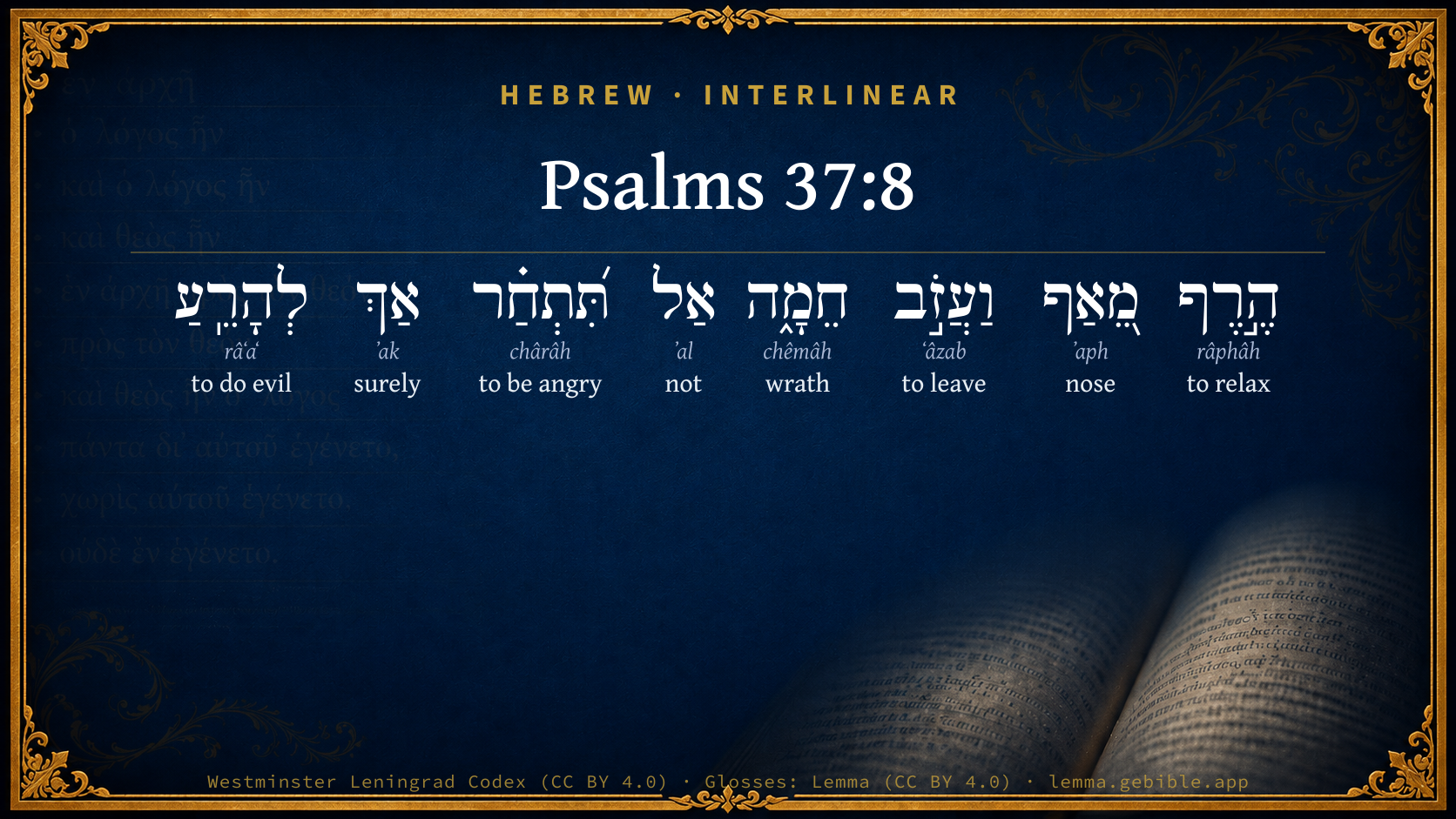
Psalms 37:8

Hebrew (Westminster Leningrad Codex) Psalms 37:8 appears in the Hebrew Old Testament. The text above is from the Westminster Leningrad Codex. Each word links to its Strong’s number, a concise gloss, and parsing drawn from the Open Scriptures Hebrew Bible morphology. Click any word for its full Brown-Driver-Briggs (BDB) entry.
Download image
Cite this verse

Psalms 37:8 (World English Bible). Public Domain. Lemma interlinear Bible study tool, https://lemma.gebible.app/v/psalms/37/8.

Show BibTeX & RIS
BibTeX
RIS
English Translation
Cease from anger, and forsake wrath. Don't fret, it leads only to evildoing.
World English Bible · Public Domain
Download a study sheet

One document with this verse’s original text, its word-by-word gloss line, the meaning frame, cross-references with their text, attributed commentary, and full source and license credits — printable, and it pastes into notes with its structure intact.

This verse Autodidact and up

Study sheet (.html) Plain text (.txt)

A passage Seminary Student

Up to 50 verses in one chapter. A passage sheet keeps up to 6 commentary sources and 12 cross-references per verse, in the order this page ranks them, and says so on the sheet whenever that leaves anything out. Ask for a single verse and you get the Autodidact verse sheet above.

Everything on this page stays free to read, with no account — the sheet is a download of what is already on screen, not access to it.

Want to remove ads? Support Godless Engineer
Compare translations 3

The same verse in 3 English versions, stacked beneath the original-language interlinear above. Click any original word for its lexicon entry.

Each is an independent rendering of the whole verse — the interlinear is not word-aligned to these translations.

Highlighted words mark where these versions differ — a whole-verse word diff, not a word-by-word alignment.

  • World English Bible Public Domain
    Cease from anger, and forsake wrath. Don't fret, it leads only to evildoing.
  • King James Version Public Domain
    Cease from anger, and forsake wrath: fret not thyself in any wise to do evil.
  • unfoldingWord Literal Text CC BY-SA 4.0
    Let go of nose and abandon wrath; do not be angry; only to cause evil.

unfoldingWord Literal Text — © unfoldingWord, licensed CC BY-SA 4.0. Word-aligned USFM3 via Door43 (git.door43.org/unfoldingWord/en_ult).

Versions to compare (up to 4)

3 of 4 selected

Show all 18 translations

Every available English version of this verse, each an independent rendering of the whole verse.

  • World English Bible Public Domain
    Cease from anger, and forsake wrath. Don't fret, it leads only to evildoing.
  • Berean Standard Bible Public Domain
    Refrain from anger and abandon wrath; do not fret—it can only bring harm.
  • Majority Standard Bible Public Domain
    Refrain from anger and abandon wrath; do not fret—it can only bring harm.
  • King James Version Public Domain
    Cease from anger, and forsake wrath: fret not thyself in any wise to do evil.
  • American Standard Version (1901) Public Domain
    Cease from anger, and forsake wrath: Fret not thyself, `it tendeth' only to evil-doing.
  • Revised Version (1885) Public Domain
    Cease from anger, and forsake wrath: fret not thyself, it tendeth only to evil-doing.
  • Geneva Bible (1599) Public Domain
    Cease from anger, and leaue off wrath: fret not thy selfe also to doe euill.
  • Douay-Rheims (1899) Public Domain
    Cease from anger, and leave rage; have no emulation to do evil.
  • Young's Literal Translation Public Domain
    Desist from anger, and forsake fury, Fret not thyself only to do evil.
  • Literal Standard Version CC BY-SA 4.0
    Desist from anger, and forsake fury, || Do not fret yourself to only do evil.
  • Unlocked Literal Bible CC BY-SA 4.0
    Do not be angry and frustrated. Do not worry. This only makes trouble.
  • unfoldingWord Literal Text CC BY-SA 4.0
    Let go of nose and abandon wrath; do not be angry; only to cause evil.
  • Darby Bible Public Domain
    Cease from anger, and forsake wrath; fret not thyself: it [would be] only to do evil.
  • World Messianic Bible Public Domain
    Cease from anger, and forsake wrath. Don’t fret; it leads only to evildoing.
  • Webster's Bible Public Domain
    Cease from anger, and forsake wrath: fret not thyself in any wise to do evil.
  • Free Bible Version CC BY-SA 4.0
    Give up your anger! Let go of your rage! Don't get mad—it only results in evil!
  • Bible in Basic English Public Domain
    Put an end to your wrath and be no longer bitter; do not give way to angry feeling which is a cause of sin.
  • JPS Tanakh (1917) Public Domain
    Cease from anger, and forsake wrath; fret not thyself, it tendeth only to evil-doing.

Literal Standard Version (2020), Covenant Press — licensed CC BY-SA 4.0. Text via the HelloAO Bible API (eBible.org). Unlocked Literal Bible (unfoldingWord) — licensed CC BY-SA 4.0. Text via the HelloAO Bible API (eBible.org). unfoldingWord Literal Text — © unfoldingWord, licensed CC BY-SA 4.0. Word-aligned USFM3 via Door43 (git.door43.org/unfoldingWord/en_ult). Free Bible Version, Dr. Jonathan Gallagher — licensed CC BY-SA 4.0. Text via the HelloAO Bible API (eBible.org).

Word by word

More ways to search: Search by grammar → Find every occurrence → Compare this word →

Practice this passage: Drill this verse → Learn its vocabulary →

הֶ֣רֶף
râphâh
H7503
“relax”
Verb, Hiphil, Imperative, 2nd Person, Masculine, Singular
Part of Speech
Verb
Stem
Hiphil
Form
Imperative
Person
2nd Person
Gender
Masculine
Number
Singular
Full BDB Definition

Origin: a primitive root

TWOT: 2198

to sink, relax, sink down, let drop, be disheartened - (Qal) - to sink down - to sink, drop - to sink, relax, abate - to relax, withdraw - (Niphal) idle (participle) - (Piel) to let drop - (Hiphil) - to let drop, abandon, relax, refrain, forsake - to let go - to refrain, let alone - to be quiet - (Hithpael) to show oneself slack
  1. מֵ֭אַף ʼaph H639 “from · nose” Preposition + Noun, Common, Masculine, Singular, Absolute
  2. וַעֲזֹ֣ב ʻâzab H5800 “and · leave” Conjunction + Verb, Qal, Imperative, 2nd Person, Masculine, Singular
  3. חֵמָ֑ה chêmâh H2534 “wrath” Noun, Common, Feminine, Singular, Absolute
  4. אַל ʼal H408 “not” Particle, Negative
  5. תִּ֝תְחַ֗ר chârâh H2734 “to be angry” Verb, Hithpael, Jussive, 2nd Person, Masculine, Singular
  6. אַךְ ʼak H389 “surely” Particle, Accusative
  7. לְהָרֵֽעַ râʻaʻ H7489 “to do evil” Preposition + Verb, Hiphil, Infinitive Construct

About this verse

These counts appear in no published source. They are computed here, from the morphology-tagged text and Lemma’s own curated glosses. What Lemma adds →

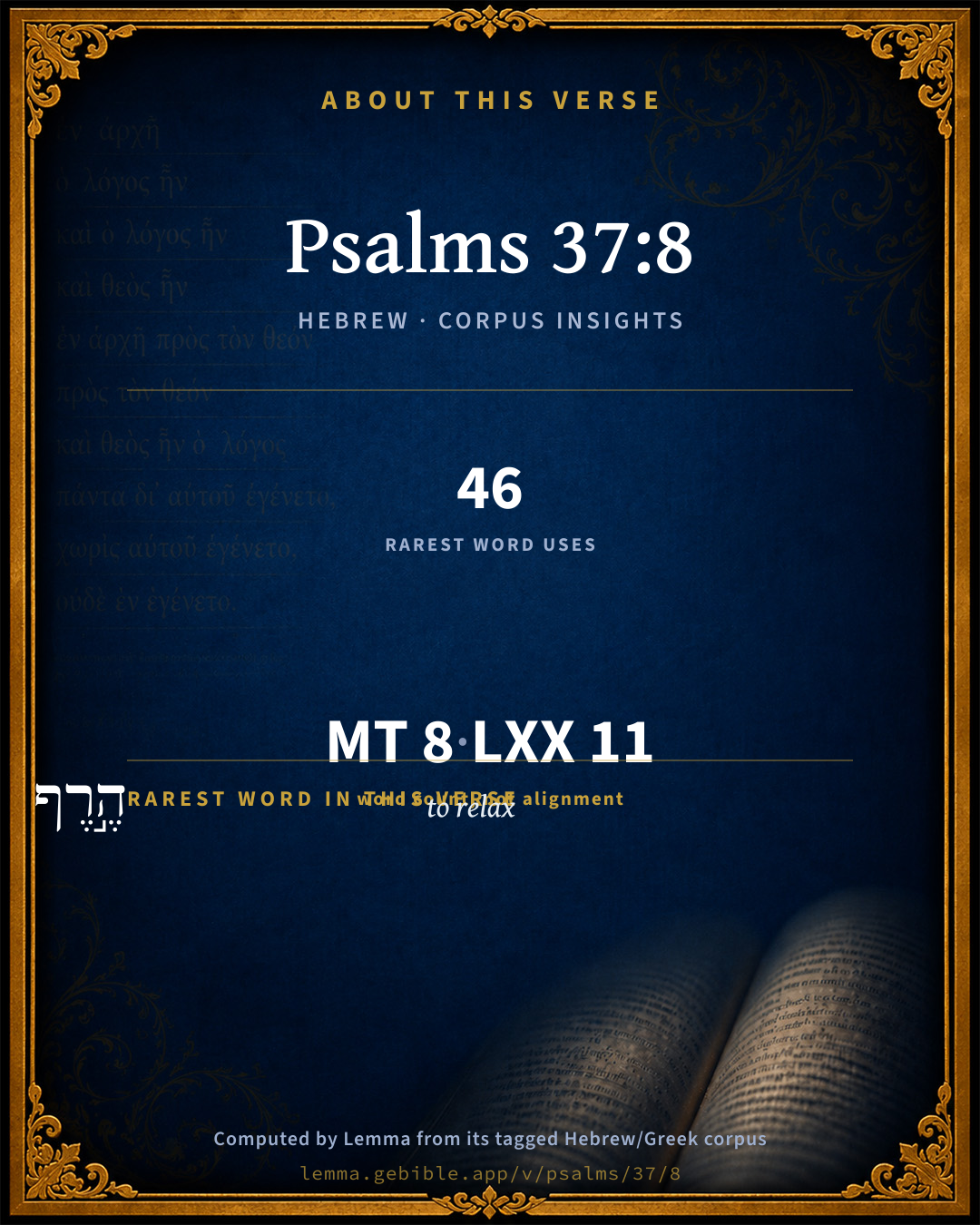
8
words
8
distinct lemmas
Wisdom
section

Shared distinctive vocabulary

הֶ֣רֶף to relax H7503 occurs in 45 verses of the Hebrew Bible. Also found in:

Grammatical profile

  • 4 verbs
  • 2 nouns
  • 2 particles

Verb forms

  • הֶ֣רֶף Hiphil · Imperative
  • וַעֲזֹ֣ב Qal · Imperative
  • תִּ֝תְחַ֗ר Hithpael · Jussive
  • לְהָרֵֽעַ Hiphil · Infinitive Construct

Hebrew & Septuagint length

In English translation the verse runs 13 words from the Hebrew and 14 from the Septuagint (LXX English) — closely comparable.

A rough comparison of the two English renderings, which tokenize alike — not a word-level alignment.

Word counts can differ between the Hebrew and the Greek without any difference in meaning — e.g. the Hebrew direct-object marker אֵת has no separate Greek word, and Greek often adds the article ὁ.

In the original languages it is 8 Hebrew tokens and 11 Greek tokens — but the two are counted differently (Hebrew bundles its prefixes and suffixes into one token; the Greek is in lemma form), so that isn’t a like-for-like length.

Cross-references

17

Topical passages linked to Psalms 37:8 in the Treasury of Scripture Knowledge — connected by theme and wording, ordered by reader-vote popularity; previews shown in the World English Bible.

  • Proverbs 14:29 He who is slow to anger has great understanding, But he who has a quick temper displays folly.
  • Proverbs 16:32 One who is slow to anger is better than the mighty; One who rules his spirit, than he who takes a city.
  • James 1:19–20 So, then, my beloved brothers, let every man be swift to hear, slow to speak, and slow to anger;
  • Ephesians 4:31 Let all bitterness, wrath, anger, outcry, and slander, be put away from you, with all malice.
  • Job 5:2 For resentment kills the foolish man, And jealousy kills the simple.
  • Ephesians 4:26 "Be angry, and don't sin." Don't let the sun go down on your wrath,
  • James 3:14–18 But if you have bitter jealousy and selfish ambition in your heart, don't boast and don't lie against the truth.
  • Colossians 3:8 but now you also put them all away: anger, wrath, malice, slander, and shameful speaking out of your mouth.
  • Job 18:4 You who tear yourself in your anger, Shall the earth be forsaken for you? Or shall the rock be removed out of its place?
  • Jonah 4:1 But it displeased Jonah exceedingly, and he was angry.
  • 1 Samuel 25:21–23 Now David had said, Surely in vain have I kept all that this fellow has in the wilderness, so that nothing was missed of all that pertained to him: and he has returned me evil for good.
  • Psalms 31:22 As for me, I said in my haste, "I am cut off from before your eyes." Nevertheless you heard the voice of my petitions when I cried to you.
  • Psalms 73:15 If I had said, "I will speak thus;" Behold, I would have betrayed the generation of your children.
  • Jonah 4:9 God said to Jonah, "Is it right for you to be angry about the vine?" He said, "I am right to be angry, even to death."
  • Luke 9:54–55 When his disciples, James and John, saw this, they said, "Lord, do you want us to command fire to come down from the sky, and destroy them, just as Elijah did?"
  • Psalms 116:11 I said in my haste, "All men are liars."
  • Jeremiah 20:14–15 Cursed be the day in which I was born: don't let the day in which my mother bore me be blessed.

Cross-references courtesy of OpenBible.info (CC BY 4.0).

Hebrew and Greek witnesses Masoretic Hebrew ↔ Greek Septuagint

The same verse in the two great witnesses to the Old Testament, shown verse-for-verse.

You’re reading Greek Psalm 36 (Hebrew Psalm 37). The Septuagint counts the superscription, so verse numbers can differ from the Hebrew — chapter-level alignment, not verse-by-verse. Numbering follows Rahlfs.

These are two independent witnesses, not word-aligned to each other, and the Septuagint is shown in lemma (dictionary) form.

Hebrew Psalms 37:8 Masoretic · Westminster Leningrad Codex

הֶ֣רֶף מֵ֭אַף וַעֲזֹ֣ב חֵמָ֑ה אַל תִּ֝תְחַ֗ר אַךְ לְהָרֵֽעַ

Cease from anger, and forsake wrath. Don't fret, it leads only to evildoing.

World English Bible · Public Domain

Greek LXX Greek Psalm 36:8 Septuagint · lemma form

παύω ἀπό ὀργή καί ἐν καταλείπω θυμός μή παραζηλόω ὥστε πονηρεύομαι

ease from anger, and forsake wrath: fret not yourself so as to do evil.

LXX2012 (modern English Septuagint) · Public Domain

Hebrew: Westminster Leningrad Codex (CC BY 4.0). Greek: Septuagint (public domain); English from LXX2012 (modern English Septuagint) (Public Domain). How the Septuagint differs from the Hebrew →

Commentary

Notes on Psalms 37:8 from classic Christian and Jewish commentators (each source and its license shown beneath its notes). The classic Christian expositions comment on the surrounding passage and are grouped to its opening verse, so a note may address several verses; the Jewish commentaries on the Tanakh (Rashi and others) are per-verse, so they appear only where the commentator wrote on this verse.

Lemma curates 59 commentaries, every one of them public domain or Creative Commons licensed, each selected and text-cleaned for this edition rather than reprinted as found. About our sources →

Trapp's Complete Commentary

John Trapp

Psa 37:8 Cease from anger, and forsake wrath: fret not thyself in any wise to do evil.

Ver. 8. Cease from anger, and forsake wrath] Repetitio est, ut magis iuculcet, saith Vatablus; This precept is doubled and redoubled, that we may the better retain and practise it. Angry a man may be, and must be at evildoers, inasmuch as they break God’s law, Psa 119:134, pollute his name, Eze 36:20; Eze 36:23 Rom 2:23-24; procure the judgments of God upon others also, Jos 22:18; pull down swift destruction upon themselves, 2Pe 2:1 Rom 2:5. Thus Moses was angry, Exo 32:19; and our Saviour, Mar 3:5; yet not so angry but that they could at some time pity those they were displeased with, and pray for them too. This they that cannot do are inordinately and sinfully angry, and must at any rate suppress such passionate distempers.

Fret not thyself in any wise to do evil] And he shall have nmch ado not to overdo, not to do amiss, that bridleth not his passions; for these, like heavy bodies down steep hills, once in motion, move themselves, and seldom know any ground but the bottom. Ne igitur accendaris ira saltem ad malefaciendum. Kimchi rendereth it, Ne misceas teipsum, Come not in company with the ungodly, at least to do evil; to do as they do. So to those words in the first verse, "Fret not thyself because of evildoers," the Chaldee addeth, to be like unto them.

John Trapp, A Commentary or Exposition upon All the Books of the Old and New Testament (1647–1656) — public domain. Text from a community e-Sword module.

The Biblical Illustrator

Joseph S. Exell

Psa_37:8

Fret not thyself in any wise to do evil.

Fretfulness

I. It is a sin against God. Caesar having prepared a sumptuous feast for his nobles and friends, the day appointed for it proved so inclement, that all went wrong. He was so much out of temper on this account, that he commanded all who had bows to shoot their arrows upward toward Jupiter, their chief god, as being the cause of their disappointment. The silly order was obeyed, but the arrows, instead of striking the mark aimed at, fell back with violence on their own heads. Thus, also, the inconsiderate complaints of the fretful are, in fact, arrows shot in defiance against the majesty of God, but certain to hurt none but those who send them.

II. It is sure to destroy affection, and is the bane of domestic happiness. Husbands, wives, children, relatives, or servants have little real love for the fretful and the fault-finding.

III. It oftentimes encourages and cultivates a spirit of hypocrisy in those who are brought under its baneful influence. Everybody is afraid of arousing the unhappy disposition and calling down the tempest on their own heads. Hence children and servants get into the habit of concealing all they possibly can from those who are so little disposed to make allowance and go forgive. They cannot get up their courage to be frank and open-hearted, and deceit and falsehood are the consequence. Fretfulness is always foolish; always a thing to be sorry for and ashamed of. Bitterness, harshness, and fault-finding are the offspring of it--and these are no agreeable inmates of the soul. However uncomfortable and hard our lot may be, it certainly will not make matters better to be sour with the world, and crusty and crabbed to those about us. (John W. Norton.)

The Biblical Illustrator, edited by Joseph S. Exell (c. 1880s–1900s) — public domain. Text from a community e-Sword module.

J. A. Alexander on Psalms

Joseph Addison Alexander

8. (Psa 37:8) Cease from anger, and forsake wrath; fret not thyself only to do evil. Do not indulge a passion which can only make thee a partaker in the guilt of those who are its objects.

Joseph Addison Alexander, The Psalms Translated and Explained (1850) — public domain. Text from a community e-Sword module.

Tyndale Open Study Notes

Tyndale Open Resources

37:8 Irritability and anger quickly corrode character.

Tyndale Open Study Notes — © Tyndale Open Resources, licensed CC BY-SA 4.0. Text via the HelloAO Bible API.

Geneva Bible (1599)

Geneva Bible translators

Meaning, except he moderate his affections, he shall be led to do as they do.

Geneva Bible (1599) marginal notes — public domain. Text via Bolls.life.

John Calvin's Commentaries

The accumulation of terms which occurs in the next verse, in which he lays a restraint as with a bridle upon anger, allays wrath and assuages passion, it is not superfluous; but, as in necessary, he rather prescribes numerous remedies for a disease which it is difficult to cure. By this means, he reminds us how easily we are provoked, and how ready we are to take offence, unless we lay a powerful restraint upon our tumultuous passions, and keep them under control. And although the faithful are not able to subdue the lusts of the flesh without much trouble and labour, whilst the prosperity of the wicked excites their impatience, yet this repetition teaches us that we ought unceasingly to wrestle against them; for if we steadily persevere, we know that our endeavors shall not be in vain in the end. I differ from other commentators in the exposition of the last clause. They translate it, at least to do evil; as if David meant that we should appease our anger lest it should lead us to do mischief. But as the particle אך, ach, which they translate at least, is often used affirmatively in Hebrew, I have no doubt that David here teaches, that it cannot be otherwise than that the offense which we take at the prosperity of the wicked should lead us to sin, unless we speedily check it; as it is said in another Psalm,

“God will break the cords of the ungodly, lest the righteous put forth their hands unto iniquity,” (Psalm 125:3.)

John Calvin's Commentaries (1540-1563) — public domain. Text from the Calvin Translation Society English edition (1840s-50s) via the Christian Classics Ethereal Library (ccel.org). Calvin's coverage is partial (roughly two-thirds of the Bible); uncommented books and verses are honest gaps, never fabricated. The 19th-century editor's footnotes and remarks are omitted so the notes are faithfully Calvin's own voice.

Ellicott's Commentary for English Readers

(8) In any wise to do evil . . .—Better, only to do evil, i.e., only evil can come of it. Comp. Pro_14:23, “tendeth only to penury.”

A Bible Commentary for English Readers, edited by Charles John Ellicott (1878–1897) — public domain. Text from a community e-Sword module.

The Cambridge Bible for Schools and Colleges

gen. ed. J. J. S. Perowne

8. Render with R.V., Fret not thyself, it tendeth only to evil-doing. Discontent is not only foolish and useless, but dangerous. It may lead the man who yields to it to deny God’s providence, and cast in his lot with the evil-doers. See Psa_73:2 ff., Psa_73:13 ff.

8, 9. Stanza of Hê. The warning of Psa_37:1-2 repeated and emphasised.

The Cambridge Bible for Schools and Colleges (gen. ed. J. J. S. Perowne; Cambridge University Press, 1878–1918) — public domain. Text from a community e-Sword module.

John Gill's Exposition

For evildoers shall be cut off,.... Though they flourish for a while, they shall be cut down like the grass or flower of the field, or they shall be cut off as branches from a flourishing tree; they shall be cut off from the earth, and rooted out of it by death or some desolating judgment; see Pro 2:22; and therefore not to be envied and fretted at;

but those that wait upon the Lord shall inherit the earth; such who attend his word, worship, and ordinances; obey his commands, trust in his grace and mercy; or, as the Targum, "trust in the word of the Lord"; who wait upon him for the manifestations of himself, for the performance of his promises, for answer of prayer, for supplies of grace, and live in the expectation of the heavenly glory; these shall have for their inheritance, not the land of Canaan, a land flowing with milk and honey, which the obedient Jews enjoyed; but either this world and the necessaries of it, which such persons have the promise of, a right unto through Christ, are heirs of, and do enjoy what they do with a blessing; or else the new earth after this, in which only righteous ones, those that wait upon the Lord, and trust in him, will dwell; unless the heavenly country, the good land afar off, is meant, often called an inheritance.

John Gill's Exposition of the Whole Bible (1746–1763) — public domain (CC PDM 1.0). Text via the HelloAO Bible API.

Albert Barnes' Notes on the Bible

Cease from anger - That is, in reference to the fact that there are wicked people, and that they are permitted to carry out their plans. Do not allow your mind to be excited with envious, fretful, wrathful, or murmuring feelings against God because he bears patiently with them, and because they are allowed a temporary prosperity and triumph. Be calm, whatever may be the wickedness of the world. The supreme direction belongs to God, and he will dispose of it in the best way.

And forsake wrath - That is, as above, in regard to the existence of evil, and to the conduct of wicked men.

Fret not thyself in any wise - See Psa 37:1. Let the mind be entirely calm and composed.

To do evil - So as to lead you to do evil. Do not allow your mind to become so excited that you will indulge in harsh or malignant remarks; or so as to lead you to do wrong to any man, however wicked he may be. See always that you are right, whatever others may be, and do not allow their conduct to be the means of leading you into sin in any form. Look to your own character and conduct first.

Albert Barnes' Notes on the Bible (1834–1885) — public domain. Text from a community e-Sword/MySword module.

Matthew Poole's English Annotations

Cease from anger; either against the sinner for his success; or against God for so disposing of things, as Jonah Was, Jon 4:1.

To do evil; or, at least so far as to do evil. If any such anger or grief do secretly arise in thee, take care that it do not transport thee, either to reproach or distrust God’s providence, or to the dislike of his ways, or to an approbation or imitation of the wicked practices of those men in hopes of the same success.

Matthew Poole's English Annotations on the Holy Bible (1683–1685) — public domain. Text from a community e-Sword/MySword module.

The Treasury of David

Charles H. Spurgeon

Ver. 8. Cease from anger and forsake wrath. Especially anger against the arrangements of Providence, and jealousies of the temporary pleasures of those who are so soon to be banished from all comfort. Anger anywhere is madness, here it is aggravate insanity. Yet since anger will try to keep us company, we must resolvedly forsake it. Fret not thyself in any wise to do evil. By no reasonings and under no circumstances be led into such a course. Fretfulness lies upon the verge of great sin. Many who have indulged a murmuring disposition have at last come to sin, in order to gain their fancied rights. Beware of carping at others, study to be yourself found in the right way; and as you would dread outward sin, tremble at inward repining.

Ver. 8. Forsake wrath; which is anger wrought up to a greater degree; and the rather to be shunned and avoided, as being very disagreeable to the character of a good man. Fret not thyself in any wise to do evil; evil may be done by fretting at the prosperity of wicked men, or by imitating them, doing as they do, in hope of being prosperous as they are. John Gill.

Ver. 8. A SERMON FOR THE FRETFUL.

1. Cease from present anger. It is madness, it is sin; it shuts out our prayers; it will grow into malice; it may lead to worse.

2. Forsake it for the future. Repent of it, watch temper, discipline thy passions, etc.

3. Avoid all kindred feelings of fretfulness, impatience, envy, etc., for they lead to evil.

Psalms 37:9*

Charles H. Spurgeon's The Treasury of David (1869–1885) — public domain. Psalms only. Text from a community e-Sword/MySword module.

Whedon's Commentary on the Bible

Daniel D. Whedon

8. Cease from anger—See on this rebuke of the avenging passions of men, Jas_1:20, and Rom_12:19. The phrase is to the same effect as “fret not thyself,” Psa_37:1, and in the second member of this verse. Thus far the drift of the exhortation is to the righteous; Psa_37:9-22 portray the brief triumph and certain overthrow of the wicked.

Daniel D. Whedon (gen. ed.), Commentary on the Old and New Testaments (1874–1909) — public domain. Text from a community e-Sword module.

The Pulpit Commentary

Cease from anger, and forsake wrath; i.e. such anger and such wrath as the prosperity of the wicked calls forth. Fret not thyself in any wise to do evil; rather, fret not thyself, only to do evil. No result could be looked for from the sort of "fretting" spoken of, but an evil one. If men will dwell unduly on the fact of the prosperity of the wicked, and brood upon it in their hearts, they will be apt, in the first instance, to envy the wicked, which is at once "to do evil;" and from this they will be naturally tempted to go on to an imitation of their wicked practices, which is to assimilate themselves altogether to the enemies of God, and to be guilty of practical apostasy. (comp. Psa_73:2, "But as for me, my feet were almost gone; my steps had well-nigh supped. For I was envious at the foolish, when I saw the prosperity of the wicked

The Pulpit Commentary (1880–1919), ed. H.D.M. Spence-Jones & Joseph S. Exell — public domain. Text from a community e-Sword module.

John Wesley's Explanatory Notes

Fret not - Either against the sinner for his success; or against God. Do evil - If grief arise in thee, take care that it do not transport thee to sin.

John Wesley, Explanatory Notes Upon the Whole Bible (1754–1765) — public domain. Text via the GEBible commentary corpus.

Keil & Delitzsch

C. F. Keil & F. Delitzsch

On הרף (let alone), imper. apoc. Hiph., instead of הרפּה, vid., Ges. ֗75, rem. 15. אך להרע is a clause to itself (cf. Pro 11:24; Psa 21:5; Psa 22:16): it tends only to evil-doing, it ends only in thy involving thyself in sin. The final issue, without any need that thou shouldst turn sullen, is that the מרעים, like to whom thou dost make thyself by such passionate murmuring and displeasure, will be cut off, and they who, turning from the troublous present, make Jahve the ground and aim of their hope, shall inherit the land (vid., Psa 25:13). It is the end, the final and consequently eternal end, that decides the matter.

Keil & Delitzsch — Biblical Commentary on the Old Testament (1861–1891) — public domain (CC PDM 1.0). Text via the HelloAO Bible API. (Old Testament only.)

unfoldingWord translationNotes

Door43 World Missions Community

will be cut off

The destruction of the wicked is spoken of as if they were a branch of a plant that was cut off and thrown away. (See: Metaphor)

but those who wait for Yahweh

"but those who trust in Yahweh"

will inherit the land

The possession of the land is spoken of as if it will be received as an inheritance. AT: "will receive the land as their own possession" or "will live safely in the land" (See: Metaphor)

will disappear

This idiom refers to the death of the evil man. AT: "will die and you will no longer see him" (See: Idiom)

translationWords

anger

trouble

evildoer

cut off

Yahweh

inherit

unfoldingWord translationNotes — © Distant Shores Media and the Door43 World Missions Community, licensed CC BY-SA 4.0. Source: git.door43.org/Door43/en_tn.

Rashi

Rabbi Shlomo Yitzchaki (Rashi)

Desist from anger Desist from being wicked so that anger does not come upon you.

and forsake a matter that will bring upon you the wrath of the Holy One, blessed be He.

Rashi on the Tanakh — English translations: “The Judaica Press complete Tanach with Rashi, translated by A. J. Rosenberg” (CC BY 4.0); “Pentateuch with Rashi's commentary by M. Rosenbaum and A.M. Silbermann, 1929-1934” (public domain); “The Metsudah Tanach series, Lakewood, N.J” (CC BY 4.0); and “The Book of Joshua, Metsudah Publications, 1997” (CC BY 4.0). Text via Sefaria.

Lesson kit

Teaching starters — assembled from the data on this page, not authored interpretation. Every prompt links to the verse data it draws on. Edit before teaching.

Psalms, in the Wisdom, opens this verse with 8 words (8 distinct Hebrew lemmas). Its most distinctive word is râphâh (“to relax”). A historical commentator’s framing appears above. Read the whole chapter for the surrounding context.

Discussion questions

  1. What does “to relax” (râphâh) contribute to the verse as a whole?
  2. Exodus 4:26 shares the word «to relax» with this verse. How do the two illuminate each other?
  3. The translations on this page render this verse differently — a whole-verse word diff, not a word-by-word alignment. What might account for the different wordings?
  4. The verb «הֶ֣רֶף» is Hiphil Imperative. How does its form color the action?
  5. Reading how Trapp's Complete Commentary and The Biblical Illustrator read this verse, where do the two commentators agree and where do they part?

Things to notice

Reading settings

Reading text

Shown beneath each verse's original-language words.

Old Testament
Old Testament edition

Read the OT as the Masoretic Hebrew (MT) or the Greek Septuagint (LXX).

English shown for the Greek Septuagint (in the Hebrew ↔ Greek comparison).

Comparing translations? Open the Compare panel on any verse page to stack up to four side by side.