
Jeremiah 19:4

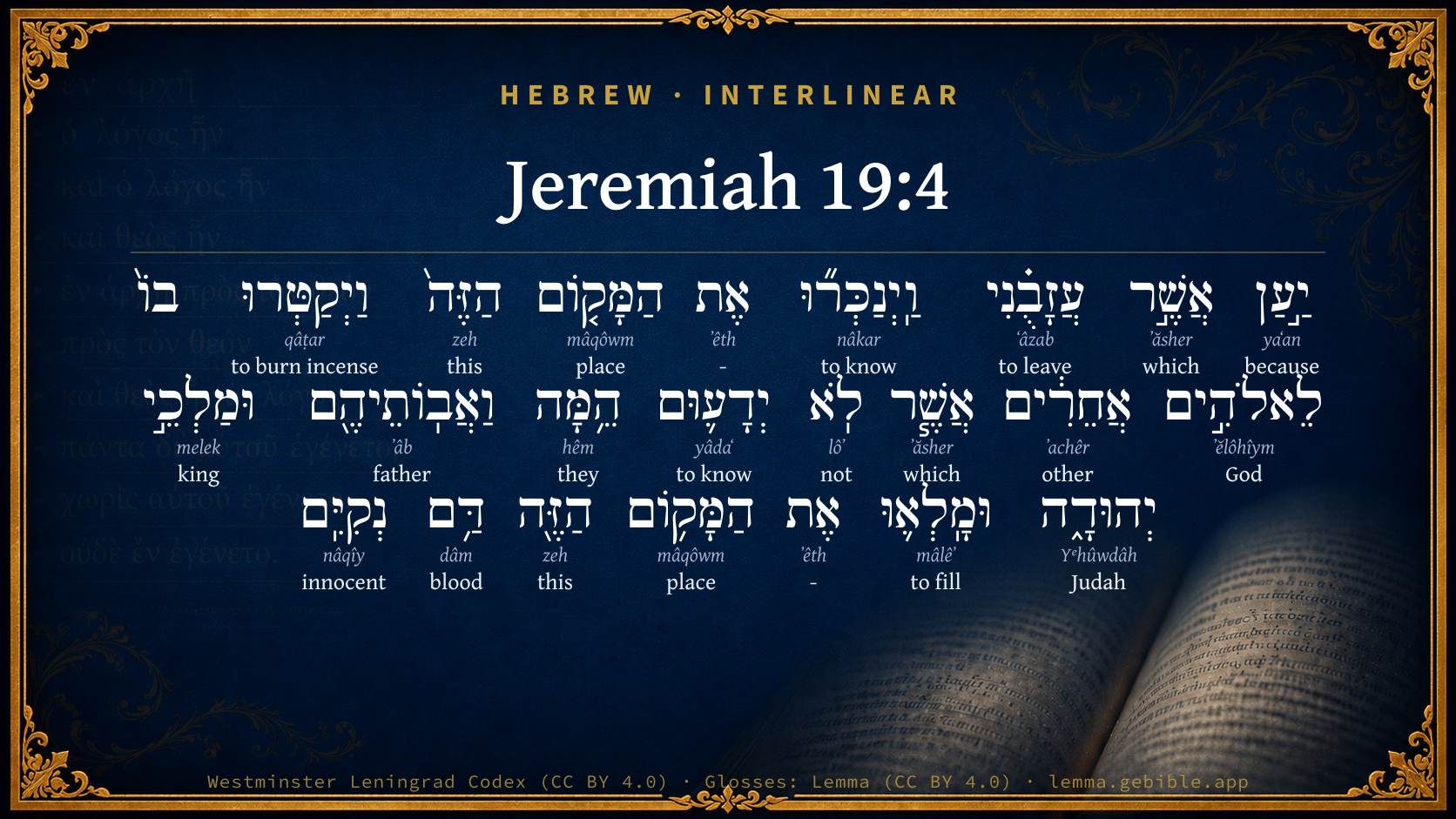
Hebrew (Westminster Leningrad Codex) Jeremiah 19:4 appears in the Hebrew Old Testament. The text above is from the Westminster Leningrad Codex. Each word links to its Strong’s number, a concise gloss, and parsing drawn from the Open Scriptures Hebrew Bible morphology. Click any word for its full Brown-Driver-Briggs (BDB) entry.
Download image
Cite this verse

Jeremiah 19:4 (World English Bible). Public Domain. Lemma interlinear Bible study tool, https://lemma.gebible.app/v/jeremiah/19/4.

Show BibTeX & RIS
BibTeX
RIS
English Translation
Because they have forsaken me, and have estranged this place, and have burned incense in it to other gods, that they didn't know, they and their fathers and the kings of Judah; and have filled this place with the blood of innocents,
World English Bible · Public Domain
Download a study sheet

One document with this verse’s original text, its word-by-word gloss line, the meaning frame, cross-references with their text, attributed commentary, and full source and license credits — printable, and it pastes into notes with its structure intact.

This verse Autodidact and up

Study sheet (.html) Plain text (.txt)

A passage Seminary Student

Up to 50 verses in one chapter. A passage sheet keeps up to 6 commentary sources and 12 cross-references per verse, in the order this page ranks them, and says so on the sheet whenever that leaves anything out. Ask for a single verse and you get the Autodidact verse sheet above.

Everything on this page stays free to read, with no account — the sheet is a download of what is already on screen, not access to it.

Want to remove ads? Support Godless Engineer
Compare translations 3

The same verse in 3 English versions, stacked beneath the original-language interlinear above. Click any original word for its lexicon entry.

Each is an independent rendering of the whole verse — the interlinear is not word-aligned to these translations.

Highlighted words mark where these versions differ — a whole-verse word diff, not a word-by-word alignment.

  • World English Bible Public Domain
    Because they have forsaken me, and have estranged this place, and have burned incense in it to other gods, that they didn't know, they and their fathers and the kings of Judah; and have filled this place with the blood of innocents,
  • King James Version Public Domain
    Because they have forsaken me, and have estranged this place, and have burned incense in it unto other gods, whom neither they nor their fathers have known, nor the kings of Judah, and have filled this place with the blood of innocents;
  • unfoldingWord Literal Text CC BY-SA 4.0
    On account that they have forsaken me and have made this place foreign, and they have burned incense in it to other gods that they did not know, they nor their fathers nor the kings of Judah, and they have filled this place the blood of innocents.

unfoldingWord Literal Text — © unfoldingWord, licensed CC BY-SA 4.0. Word-aligned USFM3 via Door43 (git.door43.org/unfoldingWord/en_ult).

Versions to compare (up to 4)

3 of 4 selected

Show all 18 translations

Every available English version of this verse, each an independent rendering of the whole verse.

  • World English Bible Public Domain
    Because they have forsaken me, and have estranged this place, and have burned incense in it to other gods, that they didn't know, they and their fathers and the kings of Judah; and have filled this place with the blood of innocents,
  • Berean Standard Bible Public Domain
    because they have abandoned Me and made this a foreign place. They have burned incense in this place to other gods that neither they nor their fathers nor the kings of Judah have ever known. They have filled this place with the blood of the innocent.
  • Majority Standard Bible Public Domain
    because they have abandoned Me and made this a foreign place. They have burned incense in this place to other gods that neither they nor their fathers nor the kings of Judah have ever known. They have filled this place with the blood of the innocent.
  • King James Version Public Domain
    Because they have forsaken me, and have estranged this place, and have burned incense in it unto other gods, whom neither they nor their fathers have known, nor the kings of Judah, and have filled this place with the blood of innocents;
  • American Standard Version (1901) Public Domain
    Because they have forsaken me, and have estranged this place, and have burned incense in it unto other gods, that they knew not, they and their fathers and the kings of Judah; and have filled this place with the blood of innocents,
  • Revised Version (1885) Public Domain
    Because they have forsaken me, and have estranged this place, and have burned incense in it unto other gods, whom they knew not, they and their fathers and the kings of Judah; and have filled this place with the blood of innocents;
  • Geneva Bible (1599) Public Domain
    Because they haue forsaken me, and prophaned this place, and haue burnt incense in it vnto other gods, whome neyther they, nor their fathers haue knowen, nor the Kings of Iudah (they haue filled this place also with the blood of innocents,
  • Douay-Rheims (1899) Public Domain
    Because they have forsaken me, and have profaned this place: and have sacrificed therein to strange gods, whom neither they nor their fathers knew, nor the kings of Juda: and they have filled this place with the blood of innocents.
  • Young's Literal Translation Public Domain
    because that they have forsaken Me, and make known this place, and make perfume in it to other gods, that they knew not, they and their fathers, and the kings of Judah, and they have filled this place `with' innocent blood,
  • Literal Standard Version CC BY-SA 4.0
    because that they have forsaken Me, and make known this place, and make incense in it to other gods, that they did not know, they and their fathers, and the kings of Judah, and they have filled this place [with] innocent blood,
  • Unlocked Literal Bible CC BY-SA 4.0
    I will do this because they have abandoned me and profaned this place. In this place they offer sacrifices to other gods that they did not know. They, their ancestors, and the kings of Judah have also filled this place with innocent blood.
  • unfoldingWord Literal Text CC BY-SA 4.0
    On account that they have forsaken me and have made this place foreign, and they have burned incense in it to other gods that they did not know, they nor their fathers nor the kings of Judah, and they have filled this place the blood of innocents.
  • Darby Bible Public Domain
    because they have forsaken me, and have estranged this place [from me], and have burned incense in it unto other gods, whom neither they nor their fathers have known, nor the kings of Judah; and have filled this place with the blood of innocents;
  • World Messianic Bible Public Domain
    Because they have forsaken me, and have defiled this place, and have burned incense in it to other gods that they didn’t know—they, their fathers, and the kings of Judah—and have filled this place with the blood of innocents,
  • Webster's Bible Public Domain
    Because they have forsaken me, and have estranged this place, and have burned incense in it to other gods, whom neither they nor their fathers have known, nor the kings of Judah, and have filled this place with the blood of innocents;
  • Free Bible Version CC BY-SA 4.0
    My people have deserted me and have made this a place where foreign gods are worshiped. They have burned incense in it to other gods that they and their forefathers and the kings of Judah never knew anything about. They have filled this place with the blood of innocent people.
  • Bible in Basic English Public Domain
    Because they have given me up, and made this place a strange place, burning perfumes in it to other gods, of whom they and their fathers and the kings of Judah had no knowledge; and they have made this place full of the blood of those who have done no wrong;
  • JPS Tanakh (1917) Public Domain
    because they have forsaken Me, and have estranged this place, and have offered in it unto other gods, whom neither they nor their fathers have known, nor the kings of Judah; and have filled this place with the blood of innocents;

Literal Standard Version (2020), Covenant Press — licensed CC BY-SA 4.0. Text via the HelloAO Bible API (eBible.org). Unlocked Literal Bible (unfoldingWord) — licensed CC BY-SA 4.0. Text via the HelloAO Bible API (eBible.org). unfoldingWord Literal Text — © unfoldingWord, licensed CC BY-SA 4.0. Word-aligned USFM3 via Door43 (git.door43.org/unfoldingWord/en_ult). Free Bible Version, Dr. Jonathan Gallagher — licensed CC BY-SA 4.0. Text via the HelloAO Bible API (eBible.org).

Word by word

More ways to search: Search by grammar → Find every occurrence → Compare this word →

Practice this passage: Drill this verse → Learn its vocabulary →

נְקִיִּֽם
nâqîy
H5355
“innocent”
Adjective, Adjective, Masculine, Plural, Absolute
Part of Speech
Adjective
Type
Adjective
Gender
Masculine
Number
Plural
State
Absolute
Full BDB Definition

Origin: from H5352

TWOT: 1412a , 1412b

clean, free from, exempt, clear, innocent - free from guilt, clean, innocent - free from punishment - free or exempt from obligations - innocent
  1. יַ֣עַן yaʻan H3282 “because” Conjunction
  2. אֲשֶׁ֣ר ʼăsher H834 “which” Particle, Relative
  3. עֲזָבֻ֗נִי ʻâzab H5800 “to leave · me” Verb, Qal, Perfect, 3rd Person, Common, Plural + Suffix, Personal, 1st Person, Common, Singular
  4. וַֽיְנַכְּר֞וּ nâkar H5234 “and · to know” Conjunction + Verb, Piel, Sequential Imperfect, 3rd Person, Masculine, Plural
  5. אֶת ʼêth H853 “-” Particle, Direct Object
  6. הַמָּק֤וֹם mâqôwm H4725 “the · place” Particle, Definite Article + Noun, Common, Masculine, Singular, Absolute
  7. הַזֶּה֙ zeh H2088 “the · this” Particle, Definite Article + Pronoun, Demonstrative, Masculine, Singular
  8. וַיְקַטְּרוּ qâṭar H6999 “and · to burn incense” Conjunction + Verb, Piel, Sequential Imperfect, 3rd Person, Masculine, Plural
  9. לֵאלֹהִ֣ים ʼĕlôhîym H430 “to/for · God(s)” Preposition + Noun, Common, Masculine, Plural, Absolute
  10. אֲחֵרִ֔ים ʼachêr H312 “other” Adjective, Adjective, Masculine, Plural, Absolute
  11. אֲשֶׁ֧ר ʼăsher H834 “which” Particle, Relative
  12. לֹֽא lôʼ H3808 “not” Particle, Negative
  13. יְדָע֛וּם yâdaʻ H3045 “to know · them” Verb, Qal, Perfect, 3rd Person, Common, Plural + Suffix, Personal, 3rd Person, Masculine, Plural
  14. הֵ֥מָּה hêm H1992 “they” Pronoun, Personal, 3rd Person, Masculine, Plural
  15. וַאֲבֽוֹתֵיהֶ֖ם ʼâb H1 “and · fathers · their” Conjunction + Noun, Common, Masculine, Plural, Construct + Suffix, Personal, 3rd Person, Masculine, Plural
  16. וּמַלְכֵ֣י melek H4428 “and · kings of” Conjunction + Noun, Common, Masculine, Plural, Construct
  17. יְהוּדָ֑ה Yᵉhûwdâh H3063 “Judah” Noun, Proper
  18. וּמָֽלְא֛וּ mâlêʼ H4390 “and · to fill” Conjunction + Verb, Qal, Perfect, 3rd Person, Common, Plural
  19. אֶת ʼêth H853 “-” Particle, Direct Object
  20. הַמָּק֥וֹם mâqôwm H4725 “the · place” Particle, Definite Article + Noun, Common, Masculine, Singular, Absolute
  21. הַזֶּ֖ה zeh H2088 “the · this” Particle, Definite Article + Pronoun, Demonstrative, Masculine, Singular
  22. דַּ֥ם dâm H1818 “blood of” Noun, Common, Masculine, Singular, Construct

About this verse

These counts appear in no published source. They are computed here, from the morphology-tagged text and Lemma’s own curated glosses. What Lemma adds →

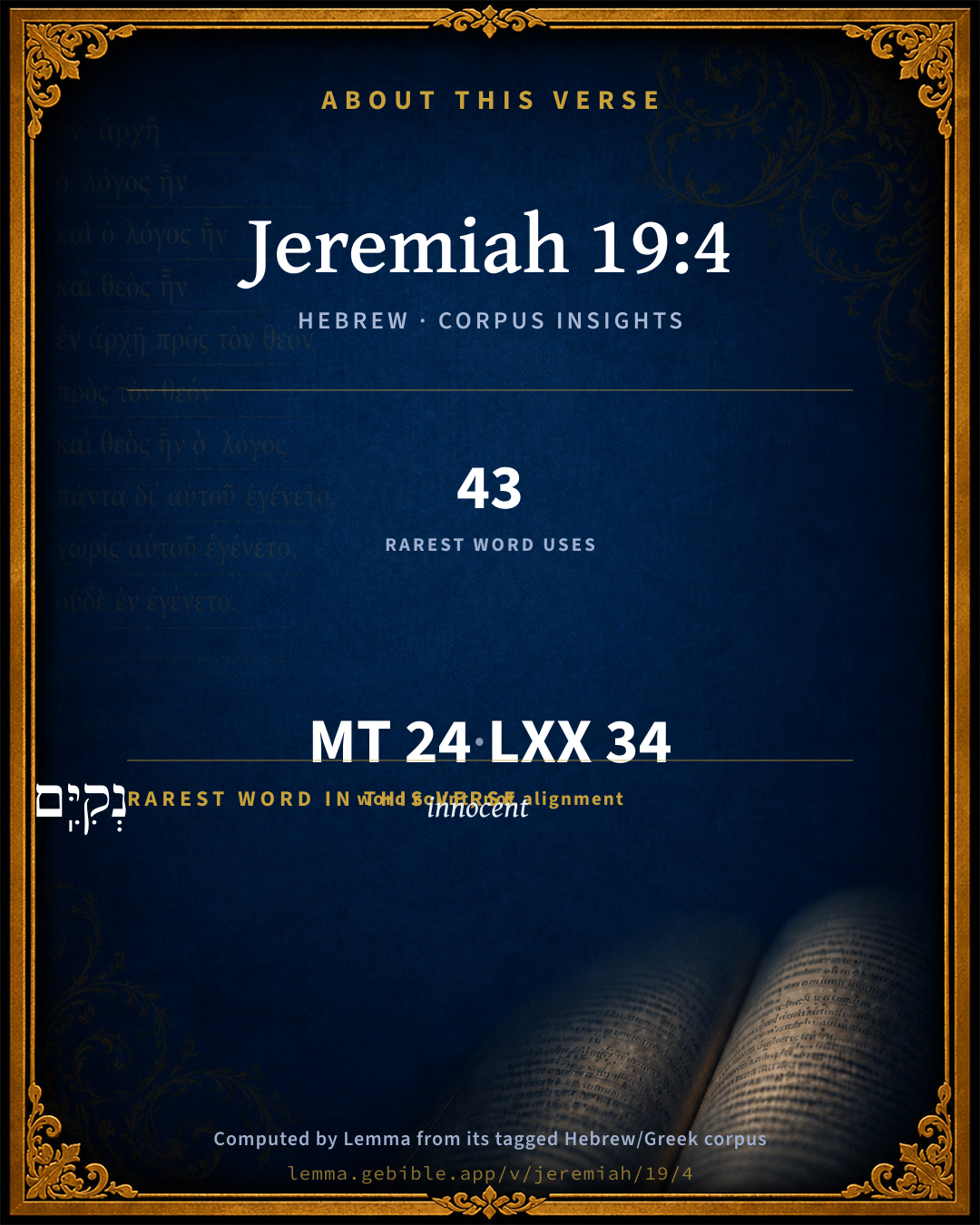
24
words
19
distinct lemmas
Prophets
section

Shared distinctive vocabulary

נְקִיִּֽם innocent H5355 occurs in 42 verses of the Hebrew Bible. Also found in:

Grammatical profile

  • 5 verbs
  • 7 nouns
  • 2 adjectives
  • 3 pronouns
  • 1 preposition
  • 1 conjunction
  • 5 particles

Verb forms

  • עֲזָבֻ֗נִי Qal · Perfect
  • וַֽיְנַכְּר֞וּ Piel · Sequential Imperfect
  • וַיְקַטְּרוּ Piel · Sequential Imperfect
  • יְדָע֛וּם Qal · Perfect
  • וּמָֽלְא֛וּ Qal · Perfect

Repetition

Words recur within this verse — often emphatic in Hebrew:

  • הַמָּק֤וֹם place H4725 ×2
  • אֲשֶׁ֣ר which H834 ×2
  • הַזֶּה֙ this H2088 ×2

Hebrew & Septuagint length

In the original languages it is 24 Hebrew tokens and 34 Greek tokens — but the two are counted differently (Hebrew bundles its prefixes and suffixes into one token; the Greek is in lemma form), so that isn’t a like-for-like length.

Cross-references

37

Topical passages linked to Jeremiah 19:4 in the Treasury of Scripture Knowledge — connected by theme and wording, ordered by reader-vote popularity; previews shown in the World English Bible.

  • Jeremiah 2:34 Also in your skirts is found the blood of the souls of the innocent poor: you did not find them breaking in; but it is because of all these things.
  • Deuteronomy 28:20 Yahweh will send on you cursing, confusion, and rebuke, in all that you put your hand to do, until you are destroyed, and until you perish quickly; because of the evil of your doings, by which you have forsaken me.
  • 2 Kings 21:16 Moreover Manasseh shed innocent blood very much, until he had filled Jerusalem from one end to another; besides his sin with which he made Judah to sin, in doing that which was evil in the sight of Yahweh.
  • Isaiah 65:11 But you who forsake Yahweh, who forget my holy mountain, who prepare a table for Fortune, and who fill up mixed wine to Destiny;
  • Jeremiah 7:9 Will you steal, murder, and commit adultery, and swear falsely, and burn incense to Baal, and walk after other gods that you have not known,
  • Deuteronomy 32:15–23 But Jeshurun grew fat, and kicked: You have grown fat, you are grown thick, you are become sleek; Then he forsook God who made him, Lightly esteemed the Rock of his salvation.
  • 2 Kings 21:4–7 He built altars in the house of Yahweh, of which Yahweh said, In Jerusalem will I put my name.
  • 2 Kings 24:4 and also for the innocent blood that he shed; for he filled Jerusalem with innocent blood: and Yahweh would not pardon.
  • Isaiah 59:7 Their feet run to evil, and they make haste to shed innocent blood: their thoughts are thoughts of iniquity; desolation and destruction are in their paths.
  • Jeremiah 2:13 For my people have committed two evils: they have forsaken me, the spring of living waters, and hewed them out cisterns, broken cisterns, that can hold no water.
  • Jeremiah 2:17 Haven't you procured this to yourself, in that you have forsaken Yahweh your God, when he led you by the way?
  • Jeremiah 2:19 Your own wickedness shall correct you, and your backsliding shall reprove you: know therefore and see that it is an evil thing and a bitter, that you have forsaken Yahweh your God, and that my fear is not in you, says the Lord, Yahweh of Hosts.
  • Jeremiah 11:13 For according to the number of your cities are your gods, Judah; and according to the number of the streets of Jerusalem have you set up altars to the shameful thing, even altars to burn incense to Baal.
  • Jeremiah 17:13 Yahweh, the hope of Israel, all who forsake you shall be disappointed. Those who depart from me shall be written in the earth, because they have forsaken Yahweh, the spring of living waters.
  • Daniel 9:5–15 we have sinned, and have dealt perversely, and have done wickedly, and have rebelled, even turning aside from your precepts and from your ordinances;
  • Deuteronomy 13:6 If your brother, the son of your mother, or your son, or your daughter, or the wife of your bosom, or your friend, who is as your own soul, entice you secretly, saying, Let us go and serve other gods, which you have not known, you, nor your fathers;
  • Deuteronomy 13:13 Certain base fellows are gone out from the midst of you, and have drawn away the inhabitants of their city, saying, Let us go and serve other gods, which you have not known;
  • Deuteronomy 28:36 Yahweh will bring you, and your king whom you shall set over you, to a nation that you have not known, you nor your fathers; and there shall you serve other gods, wood and stone.
  • Deuteronomy 28:64 Yahweh will scatter you among all peoples, from the one end of the earth even to the other end of the earth; and there you shall serve other gods, which you have not known, you nor your fathers, even wood and stone.
  • Deuteronomy 31:16–18 Yahweh said to Moses, Behold, you shall sleep with your fathers; and this people will rise up, and play the prostitute after the strange gods of the land, where they go to be among them, and will forsake me, and break my covenant which I have made with them.
  • 2 Kings 22:16–17 Thus says Yahweh, Behold, I will bring evil on this place, and on the inhabitants of it, even all the words of the book which the king of Judah has read.
  • 2 Kings 23:11–12 He took away the horses that the kings of Judah had given to the sun, at the entrance of the house of Yahweh, by the chamber of Nathan-melech the chamberlain, which was in the precincts; and he burned the chariots of the sun with fire.
  • 2 Chronicles 33:4–7 He built altars in the house of Yahweh, of which Yahweh said, In Jerusalem shall my name be forever.
  • Jeremiah 2:30 In vain have I struck your children; they received no correction: your own sword has devoured your prophets, like a destroying lion.
  • Jeremiah 5:6 Therefore a lion out of the forest shall kill them, a wolf of the evenings shall destroy them, a leopard shall watch against their cities; everyone who goes out there shall be torn in pieces; because their transgressions are many, [and] their backsliding is increased.
  • Jeremiah 7:31–32 They have built the high places of Topheth, which is in the valley of the son of Hinnom, to burn their sons and their daughters in the fire; which I didn't command, neither came it into my mind.
  • Jeremiah 15:6 You have rejected me, says Yahweh, you are gone backward: therefore have I stretched out my hand against you, and destroyed you; I am weary with repenting.
  • Jeremiah 16:11 Then shall you tell them, Because your fathers have forsaken me, says Yahweh, and have walked after other gods, and have served them, and have worshiped them, and have forsaken me, and have not kept my law;
  • Jeremiah 18:15 For my people have forgotten me, they have burned incense to false [gods]; and they have been made to stumble in their ways, in the ancient paths, to walk in byways, in a way not built up;
  • Jeremiah 22:17 But your eyes and your heart are not but for your covetousness, and for shedding innocent blood, and for oppression, and for violence, to do it.
  • Jeremiah 26:15 Only know for certain that, if you put me to death, you will bring innocent blood on yourselves, and on this city, and on the inhabitants of it; for of a truth Yahweh has sent me to you to speak all these words in your ears.
  • Jeremiah 26:23 and they fetched forth Uriah out of Egypt, and brought him to Jehoiakim the king, who killed him with the sword, and cast his dead body into the graves of the common people.
  • Jeremiah 32:29–35 and the Chaldeans, who fight against this city, shall come and set this city on fire, and burn it, with the houses, on whose roofs they have offered incense to Baal, and poured out drink-offerings to other gods, to provoke me to anger.
  • Lamentations 4:13 [It is] because of the sins of her prophets, [and] the iniquities of her priests, That have shed the blood of the just in the midst of her.
  • Matthew 23:34–35 Therefore, behold, I send to you prophets, wise men, and scribes. Some of them you will kill and crucify; and some of them you will scourge in your synagogues, and persecute from city to city;
  • Luke 11:50 that the blood of all the prophets, which was shed from the foundation of the world, may be required of this generation;
  • Revelation 16:6 For they poured out the blood of the saints and the prophets, and you have given them blood to drink. They deserve this."

Cross-references courtesy of OpenBible.info (CC BY 4.0).

Hebrew and Greek witnesses Masoretic Hebrew ↔ Greek Septuagint

The same verse in the two great witnesses to the Old Testament, shown verse-for-verse.

These are two independent witnesses, not word-aligned to each other, and the Septuagint is shown in lemma (dictionary) form.

Hebrew Jeremiah 19:4 Masoretic · Westminster Leningrad Codex

יַ֣עַן אֲשֶׁ֣ר עֲזָבֻ֗נִי וַֽיְנַכְּר֞וּ אֶת הַמָּק֤וֹם הַזֶּה֙ וַיְקַטְּרוּ בוֹ֙ לֵאלֹהִ֣ים אֲחֵרִ֔ים אֲשֶׁ֧ר לֹֽא יְדָע֛וּם הֵ֥מָּה וַאֲבֽוֹתֵיהֶ֖ם וּמַלְכֵ֣י יְהוּדָ֑ה וּמָֽלְא֛וּ אֶת הַמָּק֥וֹם הַזֶּ֖ה דַּ֥ם נְקִיִּֽם

Because they have forsaken me, and have estranged this place, and have burned incense in it to other gods, that they didn't know, they and their fathers and the kings of Judah; and have filled this place with the blood of innocents,

World English Bible · Public Domain

Greek LXX Structure differs

In the Septuagint, Jeremiah is about an eighth shorter than the Hebrew and arranges its material differently — the Oracles Against the Nations (Hebrew chapters 46–51) appear in the middle of the Greek book, after 25:13. Because the chapter and verse boundaries do not line up, a verse-for-verse comparison with the Hebrew is not shown.

A verse-for-verse comparison isn’t shown here because the chapters and verses don’t line up. Switch to the LXX edition with the MT / LXX toggle above to read the Greek directly.

On this verse, The Cambridge Bible for Schools and Colleges discusses the Septuagint’s reading. Read the note in Commentary ↓

Hebrew: Westminster Leningrad Codex (CC BY 4.0). Greek: Septuagint (public domain); English from a public-domain English Septuagint. How the Septuagint differs from the Hebrew →

Targum (Aramaic paraphrase)

1

The Targum is the ancient Jewish Aramaic paraphrase of the Hebrew Scriptures — an interpretive translation, not the Hebrew text itself. Onkelos (literal) and Pseudo-Jonathan (expansive) render the Torah, and Jonathan the Prophets. Coverage is partial: where no permissively-licensed English translation exists for a verse, only the Aramaic is shown. This is verse-level text, not a word-by-word alignment to the Hebrew.

  1. Targum Jonathan Prophets (Joshua–Malachi)
    חֲלַף דִשְׁבָקוּ פּוּלְחָנִי וְסָאִיבוּ יַת אַתְרָא הָדֵין וְאַסִיקוּ בֵיהּ בּוּסְמִין לְטַעֲוַת פַּלְחֵי כוֹכְבַיָא דְלָא יַדְעוּנוּן אִינוּן וַאֲבָהַתְהוֹן וּמַלְכַיָא דְבֵית יְהוּדָה וּמְלוֹ יַת אַתְרָא הָדֵין דַם זַכָּאִין:

    (no public-domain English translation for this verse)

    Targum Jonathan — Aramaic: “Mikraot Gedolot” (public domain). English: “Sefaria Community Translation” (CC0 1.0 (public-domain dedication)); “London "Chaldee Paraphrase," 1871” (public domain). Text via Sefaria.

Commentary

Notes on Jeremiah 19:4 from classic Christian and Jewish commentators (each source and its license shown beneath its notes). The classic Christian expositions comment on the surrounding passage and are grouped to its opening verse, so a note may address several verses; the Jewish commentaries on the Tanakh (Rashi and others) are per-verse, so they appear only where the commentator wrote on this verse.

Lemma curates 59 commentaries, every one of them public domain or Creative Commons licensed, each selected and text-cleaned for this edition rather than reprinted as found. About our sources →

Trapp's Complete Commentary

John Trapp

Jer 19:4 Because they have forsaken me, and have estranged this place, and have burned incense in it unto other gods, whom neither they nor their fathers have known, nor the kings of Judah, and have filled this place with the blood of innocents;

Ver. 4. Because they have forsaken me.] Jer 16:11.

And estranged this place.] Or, Strangely abused it, so as I scarce know it, or can find in my heart to own it.

Whom neither they, nor their fathers,] scil., Quamdiu probi fuerunt et pii; so long as they had any goodness in them, saith Jerome. Those afterwards that worshipped, they knew not what (as those Samaritans did, Joh 4:22), are not worthy to be reckoned on, much less to be imitated. Walk ye not in the statutes of your fathers, neither observe their judgments, nor defile yourselves with their idols. {Eze 20:18}

And have filled this place with the blood of innocents.] Especially of infants sacrificed to Moloch in Tophet, so filling up the measure of your sins.

John Trapp, A Commentary or Exposition upon All the Books of the Old and New Testament (1647–1656) — public domain. Text from a community e-Sword module.

Tyndale Open Study Notes

Tyndale Open Resources

19:4-5 The people burn incense: According to the Sinai covenant, offering incense while worshiping the Lord was to be an act of the priests (Exod 30:8). Offering incense to idols was a terrible affront to the Lord. • the blood of innocent children: Child sacrifice was practiced in Baal worship, and sometimes by the kings of Judah (2 Kgs 17:17; Ps 106:37-38).

Tyndale Open Study Notes — © Tyndale Open Resources, licensed CC BY-SA 4.0. Text via the HelloAO Bible API.

Jamieson, Fausset & Brown

Robert Jamieson, A. R. Fausset & David Brown

(Isa 65:11).

estranged this place--devoted it to the worship of strange gods: alienating a portion of the sacred city from God, the rightful Lord of the temple, city, and whole land.

nor their fathers--namely, the godly among them; their ungodly fathers God makes no account of.

blood of innocents--slain in honor of Molech (Jer 7:31; Psa 106:37).

Jamieson, Fausset & Brown — Commentary Critical and Explanatory on the Whole Bible (1871) — public domain (CC PDM 1.0). Text via the HelloAO Bible API.

Adam Clarke's Commentary

Verse 4. Estranged this place] Ye have devoted my temple to a widely different purpose from that for which it was erected.

Adam Clarke's Commentary on the Bible (1810–1826) — public domain. Text from a community e-Sword/MySword module.

John Calvin's Commentaries

The reason is given why God would so severely deal with that place. We indeed know that hypocrites are ever ready with their answer; as soon as God threatens them, they bark and bring forward their evasions. The Prophet then shews that the judgment announced would be just, lest the Jews should pretend that it was extreme.

God first complains that he had been forsaken by them, because they had changed the worship which had been prescribed in his Law. And this is what ought to be carefully considered; for no one would have willingly confessed what Jeremiah charged upon them all; they would have said, — “We have not forsaken God, for we are the children of Abraham; but what we wish to do is to add to his worship; and why should it be deemed a reproach to us, if we are not content with our own simple form of worship, and add various other forms? and we worship God not only in the Temple, but also in this place; and further, we do not spare our own children.” But God shews by one expression that these were frivolous evasions; for he is not acknowledged except what he orders and commands is obediently received. Let us know, that God is forsaken as soon as men turn aside from his pure word, and that all are apostates who turn here and there, and do not follow what God approves.

Then he says that they had alienated the place. God had consecrated to himself the whole of Judea: he would not indeed have sacrifices offered to him in every place; but when the Jews worshipped him, as they were taught by Moses and the prophets, the whole land was as it were an altar and a temple to him. Then God complains that his authority in that part of the suburbs was taken away; as though he had said, — “The whole of Judea is my right and my jurisdiction, and Jerusalem is the royal palace in which I dwell; but ye, deluded beings, do by force take away my right and transfer it to another, as though one gave to a robber a place nigh a royal residence.” Thus God justly complains that they had alienated that place

But we must remember the reason, which immediately follows, because they had burned incense to Baal. They pretended, no doubt, the name of God; but yet it was a most preposterous superstition, when they worshipped inferior gods, as the Papists do at this day. The word Baal is sometimes used in the singular number by the prophets, and sometimes in the plural: but what is Baal? a patron. They were not content with one patron, but every one desired a patron for himself: hence under the words Baal and Baalim, the prophets characterized all fictition is modes of worship: when they worshipped God’s name, they blended the worship of patrons, who had not been made known to them; hence he adds, They have made incense in it to foreign gods. He afterwards says, that these foreign gods were such as neither they nor their fathers nor their kings knew. By saying that they were gods unknown to their fathers as well as to themselves and to their kings, he no doubt calls their attention to the doctrine of the law, and to the many certain proofs by which they had found that he was the only true God.

The Jews might have raised such an objection as the Papists do at this day, — that their modes of worship were not devised in their time, but that they had derived them from their ancestors. But God regarded as nothing those kings and the fathers, who had long before degenerated from true and genuine religion. It must be here observed, that true knowledge is connected with verity: for they who had first contrived new forms of worship, doubtless followed their own foolish imaginations; as when any one in the present day asks the Papists, why they weary themselves so much with their superstitions, good intention is ever their shield, — “O, we think that this is pleasing to God.” Therefore rightly does God here repudiate their inventions as wholly vain, for they possess nothing solid or permanent. At the same time, he by implication condemns the Jews for rejecting his law, whose authority had been established among them, so that they ought not to have entertained any doubt: for it would have been the greatest ingratitude to say, “We know not who introduced the Law!” God had indeed sanctioned the law by so many miracles, that it could not have been disputed; and they had also found by many evidences and proofs that he was the only brue God. tie had then been known by their fathers as well as by their kings, even by David and by all his godly successors. Hence their crime was exaggerated, by seeking for themselves foreign gods.

Now we also see how foolishly the Papists lay hold on this passage and similar passages, in order to commend their abominations by the pretext of antiquity, for vain are their disguises when they say, “O, we have been thus taught by our ancestors, and we have the authority of kings.” But the Prophet here does not speak of fathers indiscriminately; but by fathers he means those who had embraced the true and pure worship of God, as they had been taught by the law; and those kings were alone worthy of imitation, who had faithfully worshipped God according to the doctrine of the law: and thus he excludes all those fathers and kings who had degenerated from the law of Moses.

John Calvin's Commentaries (1540-1563) — public domain. Text from the Calvin Translation Society English edition (1840s-50s) via the Christian Classics Ethereal Library (ccel.org). Calvin's coverage is partial (roughly two-thirds of the Bible); uncommented books and verses are honest gaps, never fabricated. The 19th-century editor's footnotes and remarks are omitted so the notes are faithfully Calvin's own voice.

Ellicott's Commentary for English Readers

(4) Have estranged this place.—i.e., have alienated it from Jehovah its true Lord, and given it to a strange god. The words refer specially to the guilt of Manasseh (2Ch_33:4).

The blood of innocents.—The words seem at first to refer to the Molech sacrifices, which had made the valley of Hinnom infamous. These, however, are mentioned separately in the next verse, and the prophet probably spoke rather here, as in Jer_2:34; Jer_7:6, of the “innocent blood” with which Manasseh had filled Jerusalem (2Ki_21:16; 2Ki_24:4, where the same word is used).

A Bible Commentary for English Readers, edited by Charles John Ellicott (1878–1897) — public domain. Text from a community e-Sword module.

The Cambridge Bible for Schools and Colleges

gen. ed. J. J. S. Perowne

4. have estranged] have refused to recognise its claims.

they and their fathers and the kings of Judah] rather, as LXX, they and their fathers; and the kings of Judah have filled, etc., generalizing from Manasseh’s acts (2Ki_21:16; 2Ki_24:4).

innocents] not children, the sacrifice of whom is first mentioned in the next verse, but in general innocent persons slain in persecution or by malversation of justice.

The Cambridge Bible for Schools and Colleges (gen. ed. J. J. S. Perowne; Cambridge University Press, 1878–1918) — public domain. Text from a community e-Sword module.

John Gill's Exposition

Because they have forsaken me,.... My worship, as the Targum; they had apostatized from God, relinquished his service, neglected and despised his word and ordinances, and left the religion they had been brought up in, and was agreeable to the will of God. This, with what follows, contain reasons of the Lord's threatening them to bring evil upon them, as before:

and have estranged this place; or made a strange place of it, so that it could scarcely be known to be the same, nor would the Lord own it as his; meaning either the city of Jerusalem, to which the prophet was near, and could point to it; or the temple, which was in sight, and which they had strangely abused, by offering strange sacrifices to strange gods; or the valley of Hinnom, the spot he was upon, and which they had alienated from its original use:

and have burnt incense in it unto other gods; to strange gods, the gods of the Gentiles; and this they did both in the city of Jerusalem and in the temple, and very probably in the valley of Hinnom, where they sacrificed their children: gods

whom neither they nor their fathers have known, nor the kings of Judah; of whose wisdom, power, and goodness, neither they nor their fathers before them, nor any of their kings, had had any instance; and whose help and assistance, in times of danger and difficulty, they had had no experience of; and, till now, neither they nor their ancestors had ever owned them, or acknowledged them; nor scarce had heard of their names; nor any of their pious kings, as David, Asa, Jehoshaphat, Hezekiah, and Josiah:

and have filled this place with the blood of innocents; young children that were sacrificed here to idols, as they were in the valley of Hinnom, which seems to be the place principally intended; so that they were not only guilty of idolatry, but of murder; and of the murder of innocent creatures, and even, of their own babes; which was shocking and unheard of cruelty!

John Gill's Exposition of the Whole Bible (1746–1763) — public domain (CC PDM 1.0). Text via the HelloAO Bible API.

Albert Barnes' Notes on the Bible

Have estranged this place - They have not recognized the sanctity of this place, but have treated it as a strange place, by worshipping in it strange gods.

Innocents - i. e., guiltless persons.

Albert Barnes' Notes on the Bible (1834–1885) — public domain. Text from a community e-Sword/MySword module.

Haydock's Catholic Bible Commentary

Profaned. Literally, "rendered strange." (Haydock) --- I have no farther regard for it. --- Innocents: their own children, ver. 5., and chap. vii. 31.

George Leo Haydock (1774–1849), Haydock's Catholic Family Bible and Commentary, 1859 edition — public domain. Excludes Psalms (Douay-Rheims chapter numbering differs from Protestant) and Deuterocanonical books (Catholic canon only).

Matthew Poole's English Annotations

Because they have forsaken me; the laws, statutes, and ordinances which God had given them, to direct them both in their religious behaviour towards him, and in their civil conversations.

Have estranged this place; either this city, or this temple, (which stood very nigh to this valley,) or this particular valley, which they had turned to a use quite contrary to the end for which God gave it them; for in it they had paid a religious homage to idols, strange idols, which their fathers knew not, and had filled that place with the blood of such as had not deserved death, either innocent men, or children, that they had there sacrificed to idols; of which he afterward speaketh more particularly.

Matthew Poole's English Annotations on the Holy Bible (1683–1685) — public domain. Text from a community e-Sword/MySword module.

Whedon's Commentary on the Bible

Daniel D. Whedon

4. Estranged this place — Rather, disowned this place. The same verb occurs in Job_21:29. The meaning is, they have treated it as a strange place, perhaps by worshipping strange gods. Neither they nor, etc. — The exact construction of the original is: Other gods which they knew not: they and their fathers and the kings of Judah; these nouns being subjects, not of have known, but of the verbs of the principal clause.

Innocents — Not, as some have hastily concluded, children slain to Moloch, but guiltless persons who were victims of persecution and judicial murder. See 2Ki_21:16, and Jer_7:6; Jer_22:3; Jer_22:17.

Daniel D. Whedon (gen. ed.), Commentary on the Old and New Testaments (1874–1909) — public domain. Text from a community e-Sword module.

The Pulpit Commentary

Have estranged this place; rather, have treated this place as strange; i.e. as one that did not belong to their God, that was unholy. (Jer_16:18, "They have defiled ray land With the blood of innocents; comp." Innocent blood, even the blood of their sons and of their daughters" (Psa_106:38) the children sacrificed in Hinnom to Moloch.

The Pulpit Commentary (1880–1919), ed. H.D.M. Spence-Jones & Joseph S. Exell — public domain. Text from a community e-Sword module.

John Wesley's Explanatory Notes

This place - Either this city, or this valley, which they had turned to an use quite contrary to the end for which God gave it them.

John Wesley, Explanatory Notes Upon the Whole Bible (1754–1765) — public domain. Text via the GEBible commentary corpus.

unfoldingWord translationNotes

Door43 World Missions Community

they have abandoned me

Here the word "they" refers to the people of Judah.

filled this place with innocent blood

Here "innocent blood" represents the murder of innocent people. Yahweh speaks of murdering many people as filling a place with blood. AT: "murdered many innocent people in this place" (See: Metonymy and Metaphor)

nor did it enter my mind

Here the word "mind" refers to Yahweh's thoughts. See how you translated this in Jeremiah 7:31. AT: "nor did I ever think about it" (See: Metonymy)

translationWords

profane

sacrifice

false god

know

innocent

blood

high place

Baal

son

fire

burnt offering

command

unfoldingWord translationNotes — © Distant Shores Media and the Door43 World Missions Community, licensed CC BY-SA 4.0. Source: git.door43.org/Door43/en_tn.

Rashi

Rabbi Shlomo Yitzchaki (Rashi)

and they estranged They made it strange before Me.

Rashi on the Tanakh — English translations: “The Judaica Press complete Tanach with Rashi, translated by A. J. Rosenberg” (CC BY 4.0); “Pentateuch with Rashi's commentary by M. Rosenbaum and A.M. Silbermann, 1929-1934” (public domain); “The Metsudah Tanach series, Lakewood, N.J” (CC BY 4.0); and “The Book of Joshua, Metsudah Publications, 1997” (CC BY 4.0). Text via Sefaria.

Lesson kit

Teaching starters — assembled from the data on this page, not authored interpretation. Every prompt links to the verse data it draws on. Edit before teaching.

Jeremiah, in the Prophets, opens this verse with 24 words (19 distinct Hebrew lemmas). Its most distinctive word is nâqîy (“innocent”). A historical commentator’s framing appears above. Read the whole chapter for the surrounding context.

Discussion questions

  1. The word nâqîy carries the sense “innocent.” How does it shape the verse?
  2. How does Genesis 24:41, which shares the word «innocent», read alongside this verse?
  3. What does the repetition of “place” (2× in this one verse) do in this verse?
  4. The translations on this page render this verse differently — a whole-verse word diff, not a word-by-word alignment. What might account for the different wordings?
  5. «עֲזָבֻ֗נִי» is a Qal Perfect verb. How does that grammatical form shape the action described?
  6. Compare how Trapp's Complete Commentary and Tyndale Open Study Notes read this verse. Where do they agree or differ?

Things to notice

Reading settings

Reading text

Shown beneath each verse's original-language words.

Old Testament
Old Testament edition

Read the OT as the Masoretic Hebrew (MT) or the Greek Septuagint (LXX).

English shown for the Greek Septuagint (in the Hebrew ↔ Greek comparison).

Comparing translations? Open the Compare panel on any verse page to stack up to four side by side.