2 Kings 14:26

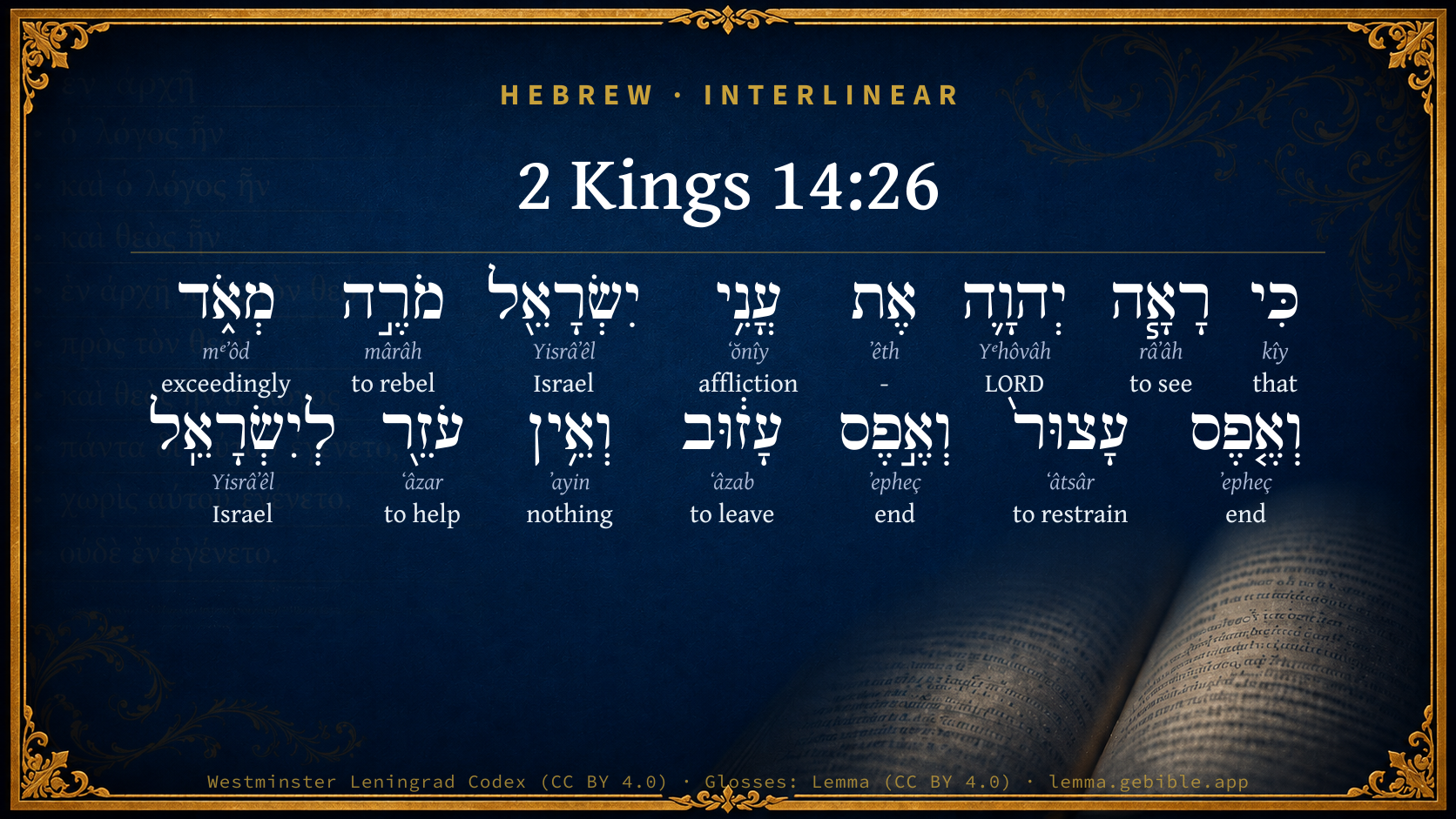
Hebrew (Westminster Leningrad Codex) 2 Kings 14:26 appears in the Hebrew Old Testament. The text above is from the Westminster Leningrad Codex. Each word links to its Strong’s number, a concise gloss, and parsing drawn from the Open Scriptures Hebrew Bible morphology. Click any word for its full Brown-Driver-Briggs (BDB) entry.
Download image
Cite this verse

2 Kings 14:26 (World English Bible). Public Domain. Lemma interlinear Bible study tool, https://lemma.gebible.app/v/2-kings/14/26.

Show BibTeX & RIS
BibTeX
RIS
English Translation
For Yahweh saw the affliction of Israel, that it was very bitter; for there was none shut up nor left at large, neither was there any helper for Israel.
World English Bible · Public Domain
Download a study sheet

One document with this verse’s original text, its word-by-word gloss line, the meaning frame, cross-references with their text, attributed commentary, and full source and license credits — printable, and it pastes into notes with its structure intact.

This verse Autodidact and up

Study sheet (.html) Plain text (.txt)

A passage Seminary Student

Up to 50 verses in one chapter. A passage sheet keeps up to 6 commentary sources and 12 cross-references per verse, in the order this page ranks them, and says so on the sheet whenever that leaves anything out. Ask for a single verse and you get the Autodidact verse sheet above.

Everything on this page stays free to read, with no account — the sheet is a download of what is already on screen, not access to it.

Want to remove ads? Support Godless Engineer
Compare translations 3

The same verse in 3 English versions, stacked beneath the original-language interlinear above. Click any original word for its lexicon entry.

Each is an independent rendering of the whole verse — the interlinear is not word-aligned to these translations.

Highlighted words mark where these versions differ — a whole-verse word diff, not a word-by-word alignment.

  • World English Bible Public Domain
    For Yahweh saw the affliction of Israel, that it was very bitter; for there was none shut up nor left at large, neither was there any helper for Israel.
  • King James Version Public Domain
    For the LORD saw the affliction of Israel, that it was very bitter: for there was not any shut up, nor any left, nor any helper for Israel.
  • unfoldingWord Literal Text CC BY-SA 4.0
    For Yahweh saw the very bitter affliction of Israel, and none restrained and none set free and no helper for Israel.

unfoldingWord Literal Text — © unfoldingWord, licensed CC BY-SA 4.0. Word-aligned USFM3 via Door43 (git.door43.org/unfoldingWord/en_ult).

Versions to compare (up to 4)

3 of 4 selected

Show all 18 translations

Every available English version of this verse, each an independent rendering of the whole verse.

  • World English Bible Public Domain
    For Yahweh saw the affliction of Israel, that it was very bitter; for there was none shut up nor left at large, neither was there any helper for Israel.
  • Berean Standard Bible Public Domain
    For the LORD saw that the affliction of the Israelites, both slave and free, was very bitter. There was no one to help Israel,
  • Majority Standard Bible Public Domain
    For the LORD saw that the affliction of the Israelites, both slave and free, was very bitter. There was no one to help Israel,
  • King James Version Public Domain
    For the LORD saw the affliction of Israel, that it was very bitter: for there was not any shut up, nor any left, nor any helper for Israel.
  • American Standard Version (1901) Public Domain
    For Jehovah saw the affliction of Israel, that it was very bitter; for there was none shut up nor left at large, neither was there any helper for Israel.
  • Revised Version (1885) Public Domain
    For the LORD saw the affliction of Israel, that it was very bitter: for there was none shut up nor left at large, neither was there any helper for Israel.
  • Geneva Bible (1599) Public Domain
    For the Lord saw the exceeding bitter affliction of Israel, so that there was none shutte vp, nor any left, neyther yet any that could helpe Israel.
  • Douay-Rheims (1899) Public Domain
    For the Lord saw the affliction of Israel that it was exceeding bitter, and that they were consumed even to them that were shut up in prison, and the lowest persons, and that there was no one to help Israel.
  • Young's Literal Translation Public Domain
    for Jehovah hath seen the affliction of Israel -- very bitter, and there is none restrained, and there is none left, and there is no helper to Israel;
  • Literal Standard Version CC BY-SA 4.0
    for YHWH has seen the very bitter affliction of Israel, and there is none restrained, and there is none left, and there is no helper for Israel;
  • Unlocked Literal Bible CC BY-SA 4.0
    For Yahweh saw the suffering of Israel, that it was very bitter for everyone, both slave and free, and that there was no rescuer for Israel.
  • unfoldingWord Literal Text CC BY-SA 4.0
    For Yahweh saw the very bitter affliction of Israel, and none restrained and none set free and no helper for Israel.
  • Darby Bible Public Domain
    For Jehovah saw that the affliction of Israel was very bitter; and that there was not any shut up, nor any left, nor any helper for Israel.
  • World Messianic Bible Public Domain
    For the LORD saw the affliction of Israel, that it was very bitter for all, slave and free; and there was no helper for Israel.
  • Webster's Bible Public Domain
    For the LORD saw the affliction of Israel, that it was very bitter: for there was not any shut up, nor any left, nor any helper for Israel.
  • Free Bible Version CC BY-SA 4.0
    The Lord had seen how badly the Israelites were suffering, both slave and free. No one was there to help Israel.
  • Bible in Basic English Public Domain
    For the Lord saw how bitter was the trouble of Israel, and that everyone was cut off, he who was shut up and he who went free, and that Israel had no helper.
  • JPS Tanakh (1917) Public Domain
    For the LORD saw the affliction of Israel, that it was very bitter; for there was none shut up nor left at large, neither was there any helper for Israel.

Literal Standard Version (2020), Covenant Press — licensed CC BY-SA 4.0. Text via the HelloAO Bible API (eBible.org). Unlocked Literal Bible (unfoldingWord) — licensed CC BY-SA 4.0. Text via the HelloAO Bible API (eBible.org). unfoldingWord Literal Text — © unfoldingWord, licensed CC BY-SA 4.0. Word-aligned USFM3 via Door43 (git.door43.org/unfoldingWord/en_ult). Free Bible Version, Dr. Jonathan Gallagher — licensed CC BY-SA 4.0. Text via the HelloAO Bible API (eBible.org).

Word by word

More ways to search: Search by grammar → Find every occurrence → Compare this word →

Practice this passage: Drill this verse → Learn its vocabulary →

עֳנִ֥י
ʻŏnîy
H6040
“affliction of”
Noun, Common, Masculine, Singular, Construct
Part of Speech
Noun
Type
Common
Gender
Masculine
Number
Singular
State
Construct
Full BDB Definition

Origin: from H6031

TWOT: 1652e

affliction, poverty, misery - affliction - poverty
  1. כִּי kîy H3588 “that” Conjunction
  2. רָאָ֧ה râʼâh H7200 “to see” Verb, Qal, Perfect, 3rd Person, Masculine, Singular
  3. יְהוָ֛ה Yᵉhôvâh H3068 “LORD” Noun, Proper
  4. אֶת ʼêth H853 “-” Particle, Direct Object
  5. יִשְׂרָאֵ֖ל Yisrâʼêl H3478 “Israel” Noun, Proper
  6. מֹרֶ֣ה mârâh H4784 “rebelling” Verb, Qal, Participle Active, Masculine, Singular, Absolute
  7. מְאֹ֑ד mᵉʼôd H3966 “exceedingly” Adverb
  8. וְאֶ֤פֶס ʼepheç H657 “and · end” Conjunction + Noun, Common, Masculine, Singular, Absolute
  9. עָצוּר֙ ʻâtsâr H6113 “restrained” Verb, Qal, Participle Passive, Masculine, Singular, Absolute
  10. וְאֶ֣פֶס ʼepheç H657 “and · end” Conjunction + Noun, Common, Masculine, Singular, Absolute
  11. עָז֔וּב ʻâzab H5800 “left” Verb, Qal, Participle Passive, Masculine, Singular, Absolute
  12. וְאֵ֥ין ʼayin H369 “and · nothing” Conjunction + Particle, Negative
  13. עֹזֵ֖ר ʻâzar H5826 “helping” Verb, Qal, Participle Active, Masculine, Singular, Absolute
  14. לְיִשְׂרָאֵֽל Yisrâʼêl H3478 “to/for · Israel” Preposition + Noun, Proper

About this verse

These counts appear in no published source. They are computed here, from the morphology-tagged text and Lemma’s own curated glosses. What Lemma adds →

15
words
13
distinct lemmas
Historical
section

Shared distinctive vocabulary

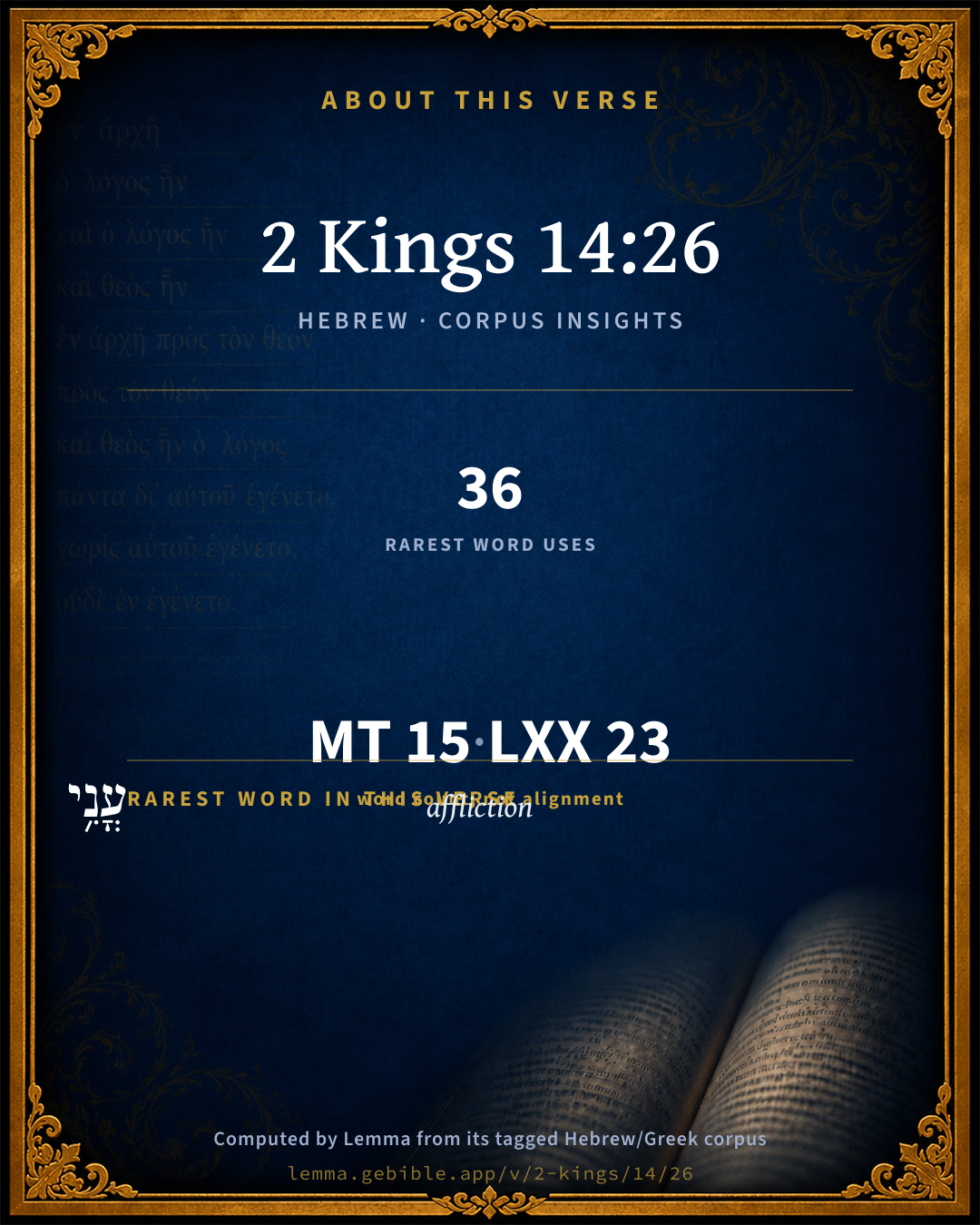
עֳנִ֥י affliction H6040 occurs in 36 verses of the Hebrew Bible. Also found in:

Grammatical profile

  • 5 verbs
  • 6 nouns
  • 1 conjunction
  • 1 adverb
  • 2 particles

Verb forms

  • רָאָ֧ה Qal · Perfect
  • מֹרֶ֣ה Qal · Participle Active
  • עָצוּר֙ Qal · Participle Passive
  • עָז֔וּב Qal · Participle Passive
  • עֹזֵ֖ר Qal · Participle Active

Repetition

Words recur within this verse — often emphatic in Hebrew:

  • יִשְׂרָאֵ֖ל Israel H3478 ×2
  • וְאֶ֤פֶס end H657 ×2

Hebrew & Septuagint length

In English translation the verse runs 29 words from the Hebrew and 30 from the Septuagint (LXX English) — closely comparable.

A rough comparison of the two English renderings, which tokenize alike — not a word-level alignment.

Word counts can differ between the Hebrew and the Greek without any difference in meaning — e.g. the Hebrew direct-object marker אֵת has no separate Greek word, and Greek often adds the article ὁ.

In the original languages it is 15 Hebrew tokens and 23 Greek tokens — but the two are counted differently (Hebrew bundles its prefixes and suffixes into one token; the Greek is in lemma form), so that isn’t a like-for-like length.

Cross-references

9

Topical passages linked to 2 Kings 14:26 in the Treasury of Scripture Knowledge — connected by theme and wording, ordered by reader-vote popularity; previews shown in the World English Bible.

  • Deuteronomy 32:36 For Yahweh will judge his people, Repent himself for his servants; When he sees that [their] power is gone, There is none [remaining], shut up or left at large.
  • Exodus 3:7 Yahweh said, "I have surely seen the affliction of my people who are in Egypt, and have heard their cry because of their taskmasters, for I know their sorrows.
  • 2 Kings 13:4 Jehoahaz begged Yahweh, and Yahweh listened to him; for he saw the oppression of Israel, how that the king of Syria oppressed them.
  • Exodus 3:9 Now, behold, the cry of the children of Israel has come to me. Moreover I have seen the oppression with which the Egyptians oppress them.
  • Judges 10:16 They put away the foreign gods from among them, and served Yahweh; and his soul was grieved for the misery of Israel.
  • Psalms 106:43–45 Many times he delivered them, But they were rebellious in their counsel, And were brought low in their iniquity.
  • Isaiah 63:9 In all their affliction he was afflicted, and the angel of his presence saved them: in his love and in his pity he redeemed them; and he bore them, and carried them all the days of old.
  • 1 Kings 14:10 therefore, behold, I will bring evil on the house of Jeroboam, and will cut off from Jeroboam every man-child, him who is shut up and him who is left at large in Israel, and will utterly sweep away the house of Jeroboam, as a man sweeps away dung, until it be all gone.
  • 1 Kings 21:21 Behold, I will bring evil on you, and will utterly sweep you away and will cut off from Ahab every man-child, and him who is shut up and him who is left at large in Israel:

Cross-references courtesy of OpenBible.info (CC BY 4.0).

Hebrew and Greek witnesses Masoretic Hebrew ↔ Greek Septuagint

The same verse in the two great witnesses to the Old Testament, shown verse-for-verse.

These are two independent witnesses, not word-aligned to each other, and the Septuagint is shown in lemma (dictionary) form.

Hebrew 2 Kings 14:26 Masoretic · Westminster Leningrad Codex

כִּי רָאָ֧ה יְהוָ֛ה אֶת עֳנִ֥י יִשְׂרָאֵ֖ל מֹרֶ֣ה מְאֹ֑ד וְאֶ֤פֶס עָצוּר֙ וְאֶ֣פֶס עָז֔וּב וְאֵ֥ין עֹזֵ֖ר לְיִשְׂרָאֵֽל

For Yahweh saw the affliction of Israel, that it was very bitter; for there was none shut up nor left at large, neither was there any helper for Israel.

World English Bible · Public Domain

Greek LXX 2 Kings 14:26 Septuagint · lemma form

ὅτι ὁράω κύριος ὁ ταπείνωσις ἰσραήλ πικρός σφόδρα καί ὀλιγοστός συνἔχω καί σπανίζω καί ἐν καταλείπω καί οὐ εἰμί ὁ βοηθέω ὁ ἰσραήλ

For the Lord saw that the affliction of Israel was very bitter, and that they were few in number, straitened and in lack, and destitute, and Israel had no helper.

LXX2012 (modern English Septuagint) · Public Domain

On this verse, Ellicott's Commentary for English Readers discusses the Septuagint’s reading. Read the note in Commentary ↓

Hebrew: Westminster Leningrad Codex (CC BY 4.0). Greek: Septuagint (public domain); English from LXX2012 (modern English Septuagint) (Public Domain). How the Septuagint differs from the Hebrew →

Targum (Aramaic paraphrase)

1

The Targum is the ancient Jewish Aramaic paraphrase of the Hebrew Scriptures — an interpretive translation, not the Hebrew text itself. Onkelos (literal) and Pseudo-Jonathan (expansive) render the Torah, and Jonathan the Prophets. Coverage is partial: where no permissively-licensed English translation exists for a verse, only the Aramaic is shown. This is verse-level text, not a word-by-word alignment to the Hebrew.

  1. Targum Jonathan Prophets (Joshua–Malachi)
    אֲרֵי גְלֵי קֳדָם יְיָ שִׁעְבּוּדָא דְיִשְׂרָאֵל תַּקִיף לַחֲדָא וְאִינוּן מְטַלְטְלִין וּשְׁבִיקִין וְלֵית דְסְעֵיד לְיִשְׂרָאֵל:

    (no public-domain English translation for this verse)

    Targum Jonathan — Aramaic: “Mikraot Gedolot” (public domain). English: “Sefaria Community Translation” (CC0 1.0 (public-domain dedication)); “London "Chaldee Paraphrase," 1871” (public domain). Text via Sefaria.

Commentary

Notes on 2 Kings 14:26 from classic Christian and Jewish commentators (each source and its license shown beneath its notes). The classic Christian expositions comment on the surrounding passage and are grouped to its opening verse, so a note may address several verses; the Jewish commentaries on the Tanakh (Rashi and others) are per-verse, so they appear only where the commentator wrote on this verse.

Lemma curates 59 commentaries, every one of them public domain or Creative Commons licensed, each selected and text-cleaned for this edition rather than reprinted as found. About our sources →

Trapp's Complete Commentary

John Trapp

2Ki 14:26 For the LORD saw the affliction of Israel, [that it was] very bitter: for [there was] not any shut up, nor any left, nor any helper for Israel.

Ver. 26. For the Lord saw, &c., ] sc., In the days of Jehoahaz, when, likely, Jonah was sent with the above said prophecy.

John Trapp, A Commentary or Exposition upon All the Books of the Old and New Testament (1647–1656) — public domain. Text from a community e-Sword module.

Joseph Benson's Commentary

2Ki 14:26-27. The Lord saw the affliction of Israel, that it was very bitter — Whereby he was moved to pity and help them, though they were an unworthy people. They that lived in those parts of their country, of which their enemies were masters, were miserably oppressed and enslaved, and could call nothing their own: the rest, we may suppose, were much empoverished by the frequent incursions which their enemies made upon them, to plunder them; and were continually frightened with their alarms; so that there was none shut up or left, but both towns and country were laid waste and stripped of their wealth, and no helper appeared. To this extremity they were reduced in many parts of the country in the beginning of Jeroboam’s reign, when God, in mere pity to them, heard the cry of their affliction, (for no mention is here made of the cry of their prayers,) and wrought this deliverance for them by the hand of Jeroboam. Reader, is thy case piteous? Then take comfort from the divine pity. He has bowels of mercy, and is full of compassion! For the Lord said not that he would blot out the name, &c. — That is, not yet: he had not yet declared this, as afterward he did by the succeeding prophets, though not in these very words, Hos 1:5-9. The decree was not yet gone forth for their utter destruction. If it be understood of the dispersion of the ten tribes, he did both say it and do it not long after: reprieves are not pardons. If of the utter extirpation of the name of Israel, he never said it, nor will ever do it: for that name still remains under heaven in the spiritual Israel, and will to the end of time.

Joseph Benson's Commentary on the Old and New Testaments (1811–1818) — public domain. Text from a community e-Sword module.

Tyndale Open Study Notes

Tyndale Open Resources

14:26-28 The Lord . . . used Jeroboam II: God saw his people’s helplessness and remained faithful to the covenant established with Israel’s patriarchs (13:23). • everything he did: The narrator hints at the extent of Jeroboam’s God-given power and prosperity. The Samaria ostraca also indicate the prosperity of the era. The prophecies of Hosea and Amos show that despite the prosperity during Jeroboam’s reign, the Israelites refused to turn to the Lord.

Tyndale Open Study Notes — © Tyndale Open Resources, licensed CC BY-SA 4.0. Text via the HelloAO Bible API.

Geneva Bible (1599)

Geneva Bible translators

Read 1 Kings 14:10.

Geneva Bible (1599) marginal notes — public domain. Text via Bolls.life.

Adam Clarke's Commentary

Verse 26. The Lord saw the affliction of Israel] It appears that about this time Israel had been greatly reduced; and great calamities had fallen upon all indiscriminately; even the diseased and captives in the dungeon had the hand of God heavy upon them, and there was no helper; and then God sent Jonah to encourage them, and to assure them of better days. He was the first of the prophets, after Samuel, whose writings are preserved; yet the prophecy delivered on this occasion is not extant; for what is now in the prophecies of Jonah, relates wholly to Nineveh.

Adam Clarke's Commentary on the Bible (1810–1826) — public domain. Text from a community e-Sword/MySword module.

Ellicott's Commentary for English Readers

(26) Affliction.—Better, oppression.

Bitter.—So the LXX., Syriac, and Vulg. Better, stubborn, and so, inveterate, unyielding, enduring. (Comp. Deu_21:18-20.) Targum, “hard;” Arabic, “strong” or “violent.”

For there was . . . left.—Comp. Note on 1Ki_14:10.

A Bible Commentary for English Readers, edited by Charles John Ellicott (1878–1897) — public domain. Text from a community e-Sword module.

The Cambridge Bible for Schools and Colleges

gen. ed. J. J. S. Perowne

26. the affliction of Israel] Occasioned by the inroads of the Syrians, who had not only conquered the lands on the east side, but also at one time some considerable portions on the west of the Jordan. (Cf. above 2Ki_13:3; 2Ki_13:7.)

for there was not any shut up, nor any left [R.V. adds at large] nor [R.V. neither was there] any helper] For the change cf. 1Ki_14:10 note. The expression means that there was no one, great or small, young or old, to whom they could look for aid.

The Cambridge Bible for Schools and Colleges (gen. ed. J. J. S. Perowne; Cambridge University Press, 1878–1918) — public domain. Text from a community e-Sword module.

Albert Barnes' Notes on the Bible

The affliction of Israel - That which the Israelites had suffered for two reigns at the hands of the Syrians 2Ki 10:32-33; 2Ki 13:3, 2Ki 13:7,2Ki 13:22.

There was not any shut up, nor any left - A phrase implying complete depopulation (see the marginal reference note; 1Ki 14:10), but here meaning no more than extreme depression and weakness.

Albert Barnes' Notes on the Bible (1834–1885) — public domain. Text from a community e-Sword/MySword module.

Haydock's Catholic Bible Commentary

In prison is not expressed in the original, (Calmet) which has, "not any shut up, nor last." Neither those who had strong castles, nor the poorest people, were exempt from suffering. (Haydock) --- None durst appear, 3 Kings xiv. 10. (Menochius)

George Leo Haydock (1774–1849), Haydock's Catholic Family Bible and Commentary, 1859 edition — public domain. Excludes Psalms (Douay-Rheims chapter numbering differs from Protestant) and Deuterocanonical books (Catholic canon only).

Matthew Poole's English Annotations

It was very bitter; whereby he was moved to pity and help them, though they were an unworthy people.

There was not any shut up, nor any left: See Poole "Deu 32:36"; See Poole "1Ki 14:10"; See Poole "1Ki 21:21".

Matthew Poole's English Annotations on the Holy Bible (1683–1685) — public domain. Text from a community e-Sword/MySword module.

Whedon's Commentary on the Bible

Daniel D. Whedon

26. Not any shut up, nor any left — On this idiomatic phrase, see 1Ki_14:10, note. Israel had become reduced to great extremities; the prisoner and the free seemed gone, and thus was fulfilled in them a prophecy of Moses. Compare Deu_32:36.

Nor any helper — No God-sent deliverer, or “saviour,” (comp. 2Ki_13:5; 2Ki_19:25,) to effectually deliver them from the oppression of the Syrians. Joash had thrice smitten Syria, but as the dying Elisha prophesied, he secured no permanent victory.

Daniel D. Whedon (gen. ed.), Commentary on the Old and New Testaments (1874–1909) — public domain. Text from a community e-Sword module.

The Pulpit Commentary

For the Lord saw the affliction of Israel, that it was very bitter. (comp. 2Ki_13:4, 2Ki_13:23) The repetition is perhaps to be accounted for by the desire of the writer to explain how it came to pass that so great a deliverance was granted to Israel under a king who maintained the worship of the calves. He views it as the consequence of God"s infinite compassion, and of the extreme bitterness of Israel"s sufferings under the Syrians. (comp. 2Ki_13:7 and Amo_1:3). For there was not any shut up, nor any left, (see the comment on 1Ki_14:10) nor any helper for Israel. Apart from Jehovah, Israel had no one to come to her aid. Judah would not help her, for Judah had just suffered at her hands (vers. 11-14); still less would Philistia, or Moab, or Ammon, who were her constant enemies. Her isolation rendered her all the more an object for the Divine compassion.

The Pulpit Commentary (1880–1919), ed. H.D.M. Spence-Jones & Joseph S. Exell — public domain. Text from a community e-Sword module.

John Wesley's Explanatory Notes

Was bitter - Whereby he was moved to pity and help them, though they were an unworthy people. Nor any left - Both towns and country were utterly laid waste.

John Wesley, Explanatory Notes Upon the Whole Bible (1754–1765) — public domain. Text via the GEBible commentary corpus.

Keil & Delitzsch

C. F. Keil & F. Delitzsch

The higher ground for this strengthening of Israel in the time of Jeroboam was to be found in the compassion of God. The Lord saw the great oppression and helpless condition of Israel, and had not yet pronounced the decree of rejection. He therefore sent help through Jeroboam. מאד מרה without the article, and governed by ישׂ אני (see Ewald, 293, a.), signifies very bitter, מרה having taken the meaning of מרר. This is the explanation adopted in all the ancient versions, and also by Dietrich in Ges. Lex. וגו עצוּר ואפס, verbatim from Deu 32:36, to show that the kingdom of Israel had been brought to the utmost extremity of distress predicted there by Moses, and it was necessary that the Lord should interpose with His help, if His people were not utterly to perish. דבּר לא: He had not yet spoken, i.e., had not yet uttered the decree of rejection through the mouth of a prophet. To blot out the name under the heavens is an abbreviated expression for: among the nations who dwelt under the heavens.

Keil & Delitzsch — Biblical Commentary on the Old Testament (1861–1891) — public domain (CC PDM 1.0). Text via the HelloAO Bible API. (Old Testament only.)

unfoldingWord translationNotes

Door43 World Missions Community

it was very bitter

Suffering that was difficult is spoken of as if it had a bitter taste. AT: "it was very difficult" (See: Metaphor)

there was no rescuer for Israel

"there was no one who could rescue Israel"

blot out

To completely destroy Israel is spoken of as if Yahweh wiped them away with a cloth. AT: "completely destroy" (See: Metaphor)

the name of Israel

Here "the name of Israel" represents all of Israel and its inhabitants. AT: "the Israelite people" (See: Metonymy)

under heaven

"on earth"

he saved them by the hand of Jeroboam son of Jehoash

Here "hand" is a metonym for power. Also, "Jehoash" is a synecdoche representing Jehoash and his army. AT: "he enabled King Jeroboam and his army to rescue them" (See: Metonymy and Synecdoche)

translationWords

suffer

servant

free

name

heaven

save

hand

unfoldingWord translationNotes — © Distant Shores Media and the Door43 World Missions Community, licensed CC BY-SA 4.0. Source: git.door43.org/Door43/en_tn.

Rashi

Rabbi Shlomo Yitzchaki (Rashi)

Intensifying increasingly. Very vexing, contrarios, in O.F., as in, “who will rebel [יַמְרֶה] against your command,” [and as in,] “You have been contrary [מַמְרִים],” [and as in,] “and they were a source of spiritual bitterness [מֹרַת רוּח].” Others interpret מוֹרֶה מְאֹד as “very low,” an expression of, “He hurled [יָרָה] into the sea.”

Rashi on the Tanakh — English translations: “The Judaica Press complete Tanach with Rashi, translated by A. J. Rosenberg” (CC BY 4.0); “Pentateuch with Rashi's commentary by M. Rosenbaum and A.M. Silbermann, 1929-1934” (public domain); “The Metsudah Tanach series, Lakewood, N.J” (CC BY 4.0); and “The Book of Joshua, Metsudah Publications, 1997” (CC BY 4.0). Text via Sefaria.

Lesson kit

Teaching starters — assembled from the data on this page, not authored interpretation. Every prompt links to the verse data it draws on. Edit before teaching.

2 Kings, in the Historical, opens this verse with 15 words (13 distinct Hebrew lemmas). Its most distinctive word is ʻŏnîy (“affliction”). A historical commentator’s framing appears above. Read the whole chapter for the surrounding context.

Discussion questions

  1. The word ʻŏnîy carries the sense “affliction.” How does it shape the verse?
  2. How does Genesis 16:11, which shares the word «affliction», read alongside this verse?
  3. What does the repetition of “Israel” (2× in this one verse) do in this verse?
  4. These translations render this verse differently; the difference is in the English rendering, not the original. What questions does that raise?
  5. «רָאָ֧ה» is a Qal Perfect verb. How does that grammatical form shape the action described?
  6. Compare how Trapp's Complete Commentary and Joseph Benson's Commentary read this verse. Where do they agree or differ?

Things to notice

Reading settings

Reading text

Shown beneath each verse's original-language words.

Old Testament
Old Testament edition

Read the OT as the Masoretic Hebrew (MT) or the Greek Septuagint (LXX).

English shown for the Greek Septuagint (in the Hebrew ↔ Greek comparison).

Comparing translations? Open the Compare panel on any verse page to stack up to four side by side.