
2 Kings 17:16

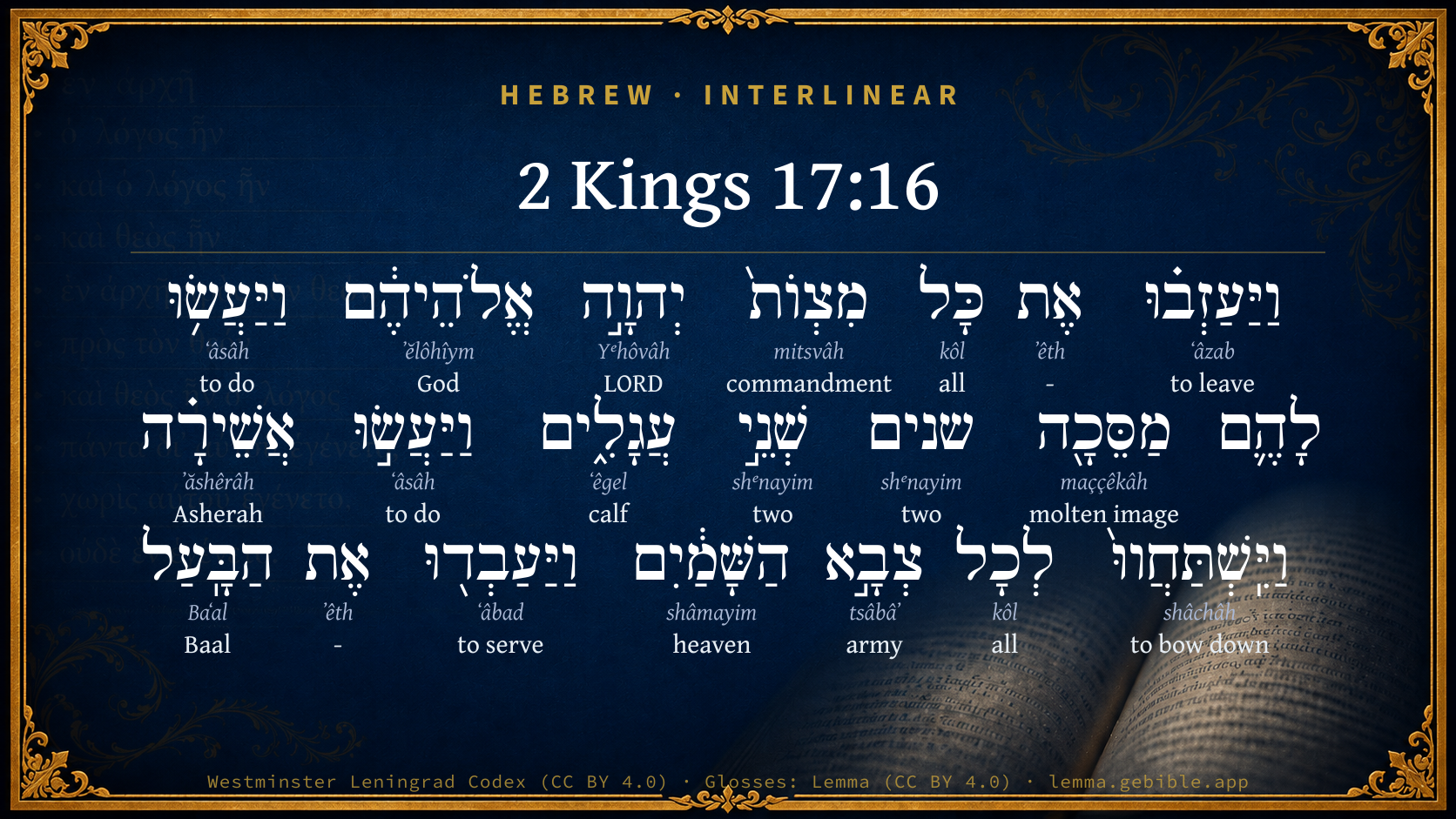
Hebrew (Westminster Leningrad Codex) 2 Kings 17:16 appears in the Hebrew Old Testament. The text above is from the Westminster Leningrad Codex. Each word links to its Strong’s number, a concise gloss, and parsing drawn from the Open Scriptures Hebrew Bible morphology. Click any word for its full Brown-Driver-Briggs (BDB) entry.
Download image
Cite this verse

2 Kings 17:16 (World English Bible). Public Domain. Lemma interlinear Bible study tool, https://lemma.gebible.app/v/2-kings/17/16.

Show BibTeX & RIS
BibTeX
RIS
English Translation
They forsook all the commandments of Yahweh their God, and made them molten images, even two calves, and made an Asherah, and worshiped all the host of the sky, and served Baal.
World English Bible · Public Domain
Download a study sheet

One document with this verse’s original text, its word-by-word gloss line, the meaning frame, cross-references with their text, attributed commentary, and full source and license credits — printable, and it pastes into notes with its structure intact.

This verse Autodidact and up

Study sheet (.html) Plain text (.txt)

A passage Seminary Student

Up to 50 verses in one chapter. A passage sheet keeps up to 6 commentary sources and 12 cross-references per verse, in the order this page ranks them, and says so on the sheet whenever that leaves anything out. Ask for a single verse and you get the Autodidact verse sheet above.

Everything on this page stays free to read, with no account — the sheet is a download of what is already on screen, not access to it.

Want to remove ads? Support Godless Engineer
Compare translations 3

The same verse in 3 English versions, stacked beneath the original-language interlinear above. Click any original word for its lexicon entry.

Each is an independent rendering of the whole verse — the interlinear is not word-aligned to these translations.

Highlighted words mark where these versions differ — a whole-verse word diff, not a word-by-word alignment.

  • World English Bible Public Domain
    They forsook all the commandments of Yahweh their God, and made them molten images, even two calves, and made an Asherah, and worshiped all the host of the sky, and served Baal.
  • King James Version Public Domain
    And they left all the commandments of the LORD their God, and made them molten images, even two calves, and made a grove, and worshipped all the host of heaven, and served Baal.
  • unfoldingWord Literal Text CC BY-SA 4.0
    And they forsook all of the commandments of Yahweh their God, and they made for themselves a molded image, two calves. And they made an Asherah, and they prostrated themselves to the whole army of the heavens, and they served Baal.

unfoldingWord Literal Text — © unfoldingWord, licensed CC BY-SA 4.0. Word-aligned USFM3 via Door43 (git.door43.org/unfoldingWord/en_ult).

Versions to compare (up to 4)

3 of 4 selected

Show all 18 translations

Every available English version of this verse, each an independent rendering of the whole verse.

  • World English Bible Public Domain
    They forsook all the commandments of Yahweh their God, and made them molten images, even two calves, and made an Asherah, and worshiped all the host of the sky, and served Baal.
  • Berean Standard Bible Public Domain
    They abandoned all the commandments of the LORD their God and made for themselves two cast idols of calves and an Asherah pole. They bowed down to all the host of heaven and served Baal.
  • Majority Standard Bible Public Domain
    They abandoned all the commandments of the LORD their God and made for themselves two cast idols of calves and an Asherah pole. They bowed down to all the host of heaven and served Baal.
  • King James Version Public Domain
    And they left all the commandments of the LORD their God, and made them molten images, even two calves, and made a grove, and worshipped all the host of heaven, and served Baal.
  • American Standard Version (1901) Public Domain
    And they forsook all the commandments of Jehovah their God, and made them molten images, even two calves, and made an Asherah, and worshipped all the host of heaven, and served Baal.
  • Revised Version (1885) Public Domain
    And they forsook all the commandments of the LORD their God, and made them molten images, even two calves, and made an Asherah, and worshipped all the host of heaven, and served Baal.
  • Geneva Bible (1599) Public Domain
    Finally they left all the commandements of the Lord their God, and made them molten images, euen two calues, and made a groue, and worshipped all the hoste of heauen, and serued Baal.
  • Douay-Rheims (1899) Public Domain
    And they forsook all the precepts of the Lord their God: and made to themselves two molten calves, and groves, and adored all the host of heaven: and they served Baal.
  • Young's Literal Translation Public Domain
    And they forsake all the commands of Jehovah their God, and make to them a molten image -- two calves, and make a shrine, and bow themselves to all the host of the heavens, and serve Baal,
  • Literal Standard Version CC BY-SA 4.0
    And they forsake all the commands of their God YHWH, and make a molten image for themselves—two calves, and make an Asherah, and bow themselves to all the host of the heavens, and serve Ba‘al,
  • Unlocked Literal Bible CC BY-SA 4.0
    They ignored all the commandments of Yahweh their God. They made cast metal figures of two calves to worship. They made an Asherah pole, and they worshiped all the stars of the heavens and Baal.
  • unfoldingWord Literal Text CC BY-SA 4.0
    And they forsook all of the commandments of Yahweh their God, and they made for themselves a molded image, two calves. And they made an Asherah, and they prostrated themselves to the whole army of the heavens, and they served Baal.
  • Darby Bible Public Domain
    And they forsook all the commandments of Jehovah their God, and made them molten images, two calves, and made an Asherah, and worshipped all the host of the heavens, and served Baal;
  • World Messianic Bible Public Domain
    They abandoned all the commandments of the LORD their God, and made molten images for themselves, even two calves, and made an Asherah, and worshiped all the army of the sky, and served Baal.
  • Webster's Bible Public Domain
    And they left all the commandments of the LORD their God, and made for themselves molten images, even two calves, and made a grove, and worshiped all the host of heaven, and served Baal.
  • Free Bible Version CC BY-SA 4.0
    They ignored all the commandments of the Lord their God, and they made themselves two metal idols of calves and an Asherah pole. They bowed down in worship to the sun, moon, and stars and served Baal.
  • Bible in Basic English Public Domain
    And turning their backs on all the orders which the Lord had given them, they made for themselves images of metal, and the image of Asherah, worshipping all the stars of heaven and becoming servants to Baal.
  • JPS Tanakh (1917) Public Domain
    and they forsook all the commandments of the LORD their God, and made them molten images, even two calves, and made an Asherah, and worshipped all the host of heaven, and served Baal;

Literal Standard Version (2020), Covenant Press — licensed CC BY-SA 4.0. Text via the HelloAO Bible API (eBible.org). Unlocked Literal Bible (unfoldingWord) — licensed CC BY-SA 4.0. Text via the HelloAO Bible API (eBible.org). unfoldingWord Literal Text — © unfoldingWord, licensed CC BY-SA 4.0. Word-aligned USFM3 via Door43 (git.door43.org/unfoldingWord/en_ult). Free Bible Version, Dr. Jonathan Gallagher — licensed CC BY-SA 4.0. Text via the HelloAO Bible API (eBible.org).

Word by word

More ways to search: Search by grammar → Find every occurrence → Compare this word →

Practice this passage: Drill this verse → Learn its vocabulary →

מַסֵּכָ֖ה
maççêkâh
H4541
“molten image”
Noun, Common, Feminine, Singular, Absolute
Part of Speech
Noun
Type
Common
Gender
Feminine
Number
Singular
State
Absolute
Full BDB Definition

Origin: from H5258

TWOT: 1375c , 1376a

a pouring, libation, molten metal, cast image, drink offering - libation (with covenant sacrifice) - molten metal, molten image, molten gods - web, covering, veil, woven stuff
  1. וַיַּעַזְב֗וּ ʻâzab H5800 “and · to leave” Conjunction + Verb, Qal, Sequential Imperfect, 3rd Person, Masculine, Plural
  2. אֶת ʼêth H853 “-” Particle, Direct Object
  3. כָּל kôl H3605 “all of” Noun, Common, Masculine, Singular, Construct
  4. מִצְוֺת֙ mitsvâh H4687 “commandments of” Noun, Common, Feminine, Plural, Construct
  5. יְהוָ֣ה Yᵉhôvâh H3068 “LORD” Noun, Proper
  6. אֱלֹהֵיהֶ֔ם ʼĕlôhîym H430 “God(s) · their” Noun, Common, Masculine, Plural, Construct + Suffix, Personal, 3rd Person, Masculine, Plural
  7. וַיַּעֲשׂ֥וּ ʻâsâh H6213 “and · to do” Conjunction + Verb, Qal, Sequential Imperfect, 3rd Person, Masculine, Plural
  8. שנים shᵉnayim H8147 “two” Adjective, Cardinal number, Masculine, Dual, Absolute
  9. שְׁנֵ֣י shᵉnayim H8147 “two” Adjective, Cardinal number, Masculine, Dual, Construct
  10. עֲגָלִ֑ים ʻêgel H5695 “calves” Noun, Common, Masculine, Plural, Absolute
  11. וַיַּעֲשׂ֣וּ ʻâsâh H6213 “and · to do” Conjunction + Verb, Qal, Sequential Imperfect, 3rd Person, Masculine, Plural
  12. אֲשֵׁירָ֗ה ʼăshêrâh H842 “Asherah” Noun, Proper
  13. וַיִּֽשְׁתַּחֲווּ֙ shâchâh H7812 “and · to bow down” Conjunction + Verb, Hithpael, Sequential Imperfect, 3rd Person, Masculine, Plural
  14. לְכָל kôl H3605 “to/for · all of” Preposition + Noun, Common, Masculine, Singular, Construct
  15. צְבָ֣א tsâbâʼ H6635 “army of” Noun, Common, Both, Singular, Construct
  16. הַשָּׁמַ֔יִם shâmayim H8064 “the · heaven(s)” Particle, Definite Article + Noun, Common, Masculine, Plural, Absolute
  17. וַיַּעַבְד֖וּ ʻâbad H5647 “and · to serve” Conjunction + Verb, Qal, Sequential Imperfect, 3rd Person, Masculine, Plural
  18. אֶת ʼêth H853 “-” Particle, Direct Object
  19. הַבָּֽעַל Baʻal H1168 “the · Baal” Particle, Definite Article + Noun, Proper

About this verse

These counts appear in no published source. They are computed here, from the morphology-tagged text and Lemma’s own curated glosses. What Lemma adds →

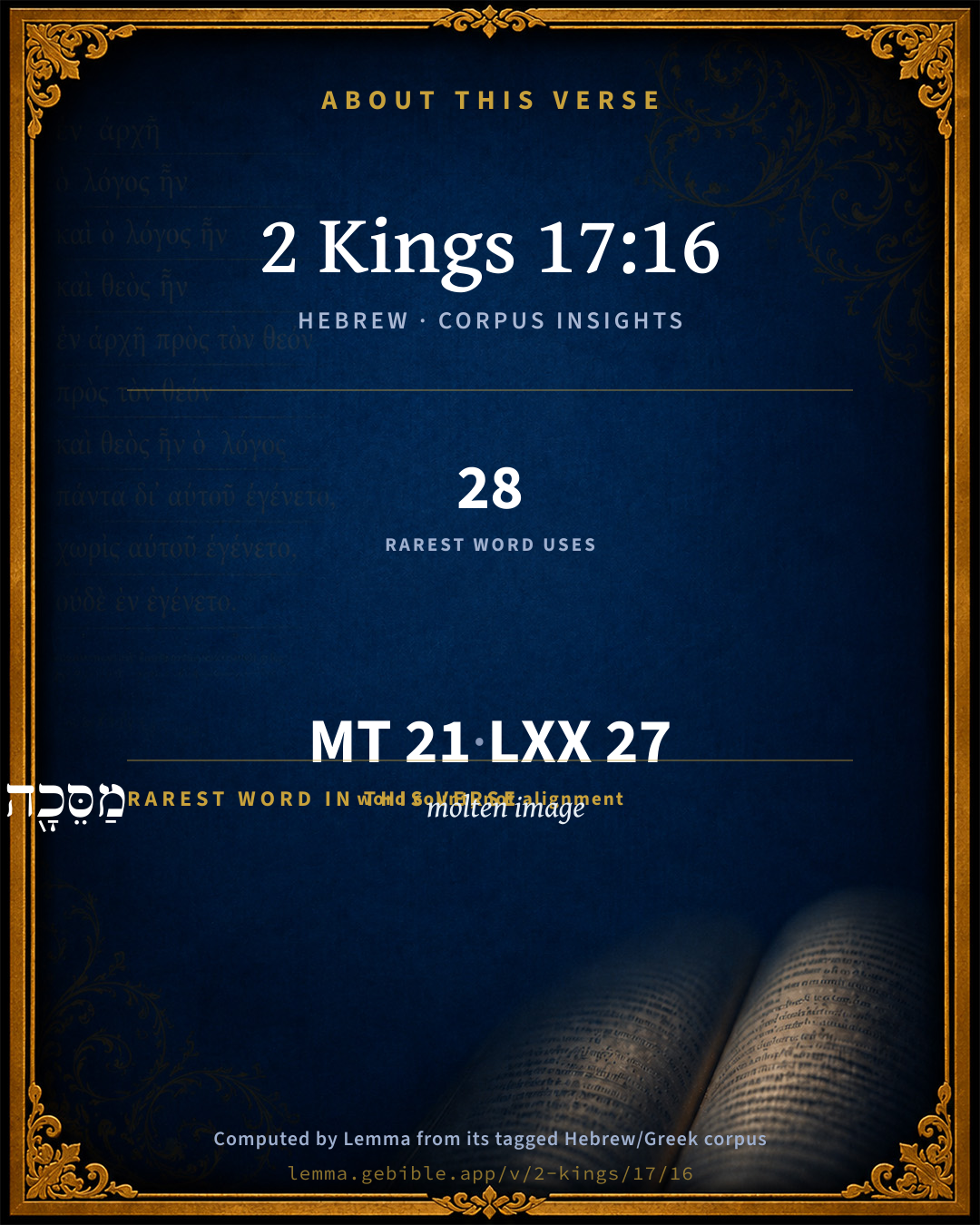
21
words
16
distinct lemmas
Historical
section

Shared distinctive vocabulary

מַסֵּכָ֖ה molten image H4541 occurs in 28 verses of the Hebrew Bible. Also found in:

Grammatical profile

  • 5 verbs
  • 11 nouns
  • 2 adjectives
  • 1 preposition
  • 2 particles

Verb forms

  • וַיַּעַזְב֗וּ Qal · Sequential Imperfect
  • וַיַּעֲשׂ֥וּ Qal · Sequential Imperfect
  • וַיַּעֲשׂ֣וּ Qal · Sequential Imperfect
  • וַיִּֽשְׁתַּחֲווּ֙ Hithpael · Sequential Imperfect
  • וַיַּעַבְד֖וּ Qal · Sequential Imperfect

Repetition

Words recur within this verse — often emphatic in Hebrew:

  • כָּל all H3605 ×2
  • וַיַּעֲשׂ֥וּ to do H6213 ×2
  • שנים two H8147 ×2

Hebrew & Septuagint length

In English translation the verse runs 32 words from the Hebrew and 31 from the Septuagint (LXX English) — closely comparable.

A rough comparison of the two English renderings, which tokenize alike — not a word-level alignment.

Word counts can differ between the Hebrew and the Greek without any difference in meaning — e.g. the Hebrew direct-object marker אֵת has no separate Greek word, and Greek often adds the article ὁ.

In the original languages it is 21 Hebrew tokens and 27 Greek tokens — but the two are counted differently (Hebrew bundles its prefixes and suffixes into one token; the Greek is in lemma form), so that isn’t a like-for-like length.

Cross-references

17

Topical passages linked to 2 Kings 17:16 in the Treasury of Scripture Knowledge — connected by theme and wording, ordered by reader-vote popularity; previews shown in the World English Bible.

  • 1 Kings 12:28 Whereupon the king took counsel, and made two calves of gold; and he said to them, It is too much for you to go up to Jerusalem: see your gods, Israel, which brought you up out of the land of Egypt.
  • 1 Kings 14:15 For Yahweh will strike Israel, as a reed is shaken in the water; and he will root up Israel out of this good land which he gave to their fathers, and will scatter them beyond the River, because they have made their Asherim, provoking Yahweh to anger.
  • 1 Kings 14:23 For they also built them high places, and pillars, and Asherim, on every high hill, and under every green tree;
  • 1 Kings 16:31 It happened, as if it had been a light thing for him to walk in the sins of Jeroboam the son of Nebat, that he took as wife Jezebel the daughter of Ethbaal king of the Sidonians, and went and served Baal, and worshiped him.
  • Deuteronomy 4:19 and lest you lift up your eyes to the sky, and when you see the sun and the moon and the stars, even all the host of the sky, you are drawn away and worship them, and serve them, which Yahweh your God has allotted to all the peoples under the whole sky.
  • 1 Kings 15:13 Also Maacah his mother he removed from being queen, because she had made an abominable image for an Asherah; and Asa cut down her image, and burnt it at the brook Kidron.
  • 1 Kings 16:33 Ahab made the Asherah; and Ahab did yet more to provoke Yahweh, the God of Israel, to anger than all the kings of Israel who were before him.
  • 1 Kings 22:53 He served Baal, and worshiped him, and provoked to anger Yahweh, the God of Israel, according to all that his father had done.
  • 2 Kings 11:18 All the people of the land went to the house of Baal, and broke it down; his altars and his images broke they in pieces thoroughly, and killed Mattan the priest of Baal before the altars. The priest appointed officers over the house of Yahweh.
  • 2 Kings 21:3 For he built again the high places which Hezekiah his father had destroyed; and he reared up altars for Baal, and made an Asherah, as did Ahab king of Israel, and worshiped all the host of the sky, and served them.
  • Exodus 32:4 He received what they handed him, and fashioned it with an engraving tool, and made it a molten calf; and they said, "These are your gods, Israel, which brought you up out of the land of Egypt."
  • Exodus 32:8 They have turned aside quickly out of the way which I commanded them. They have made themselves a molten calf, and have worshiped it, and have sacrificed to it, and said, 'These are your gods, Israel, which brought you up out of the land of Egypt.'"
  • 2 Kings 10:18–28 Jehu gathered all the people together, and said to them, Ahab served Baal a little; but Jehu will serve him much.
  • 2 Kings 17:10 and they set them up pillars and Asherim on every high hill, and under every green tree;
  • Psalms 106:18–20 A fire was kindled in their company. The flame burned up the wicked.
  • Isaiah 44:9–10 Those who fashion an engraved image are all of them vanity; and the things that they delight in shall not profit; and their own witnesses don't see, nor know: that they may be disappointed.
  • Jeremiah 8:2 and they shall spread them before the sun, and the moon, and all the host of the sky, which they have loved, and which they have served, and after which they have walked, and which they have sought, and which they have worshiped: they shall not be gathered, nor be buried, they shall be for dung on the surface of the earth.

Cross-references courtesy of OpenBible.info (CC BY 4.0).

Hebrew and Greek witnesses Masoretic Hebrew ↔ Greek Septuagint

The same verse in the two great witnesses to the Old Testament, shown verse-for-verse.

These are two independent witnesses, not word-aligned to each other, and the Septuagint is shown in lemma (dictionary) form.

Hebrew 2 Kings 17:16 Masoretic · Westminster Leningrad Codex

וַיַּעַזְב֗וּ אֶת כָּל מִצְוֺת֙ יְהוָ֣ה אֱלֹהֵיהֶ֔ם וַיַּעֲשׂ֥וּ לָהֶ֛ם מַסֵּכָ֖ה שנים שְׁנֵ֣י עֲגָלִ֑ים וַיַּעֲשׂ֣וּ אֲשֵׁירָ֗ה וַיִּֽשְׁתַּחֲווּ֙ לְכָל צְבָ֣א הַשָּׁמַ֔יִם וַיַּעַבְד֖וּ אֶת הַבָּֽעַל

They forsook all the commandments of Yahweh their God, and made them molten images, even two calves, and made an Asherah, and worshiped all the host of the sky, and served Baal.

World English Bible · Public Domain

Greek LXX 2 Kings 17:16 Septuagint · lemma form

ἐν καταλείπω ὁ ἐντολή κύριος θεός αὐτός καί ποιέω ἑαυτοῦ χώνευμα δύο δάμαλις καί ποιέω ἄλσος καί προςκυνέω πᾶς ὁ δύναμις ὁ οὐρανός καί λατρεύω ὁ βααλ

They forsook the commandments of the Lord their God, and made themselves graven images, even two heifers, and they made groves, and worshipped all the host of heaven, and served Baal.

LXX2012 (modern English Septuagint) · Public Domain

On this verse, Ellicott's Commentary for English Readers discusses the Septuagint’s reading. Read the note in Commentary ↓

Hebrew: Westminster Leningrad Codex (CC BY 4.0). Greek: Septuagint (public domain); English from LXX2012 (modern English Septuagint) (Public Domain). How the Septuagint differs from the Hebrew →

Targum (Aramaic paraphrase)

1

The Targum is the ancient Jewish Aramaic paraphrase of the Hebrew Scriptures — an interpretive translation, not the Hebrew text itself. Onkelos (literal) and Pseudo-Jonathan (expansive) render the Torah, and Jonathan the Prophets. Coverage is partial: where no permissively-licensed English translation exists for a verse, only the Aramaic is shown. This is verse-level text, not a word-by-word alignment to the Hebrew.

  1. Targum Jonathan Prophets (Joshua–Malachi)
    וּשְׁבַקוּ יַת כָּל פִקוּדַיָא דַייָ אֱלָהָהוֹן וַעֲבַדוּ לְהוֹן מַתְּכָא תְּרֵין עֶגְלִין וַעֲבָדוּ אֲשֵׁירָתָא וּסְגִידוּ לְכָל חֵילֵי שְׁמַיָא וּפְלַחוּ יַת בְּעָלָא:

    (no public-domain English translation for this verse)

    Targum Jonathan — Aramaic: “Mikraot Gedolot” (public domain). English: “Sefaria Community Translation” (CC0 1.0 (public-domain dedication)); “London "Chaldee Paraphrase," 1871” (public domain). Text via Sefaria.

Commentary

Notes on 2 Kings 17:16 from classic Christian and Jewish commentators (each source and its license shown beneath its notes). The classic Christian expositions comment on the surrounding passage and are grouped to its opening verse, so a note may address several verses; the Jewish commentaries on the Tanakh (Rashi and others) are per-verse, so they appear only where the commentator wrote on this verse.

Lemma curates 59 commentaries, every one of them public domain or Creative Commons licensed, each selected and text-cleaned for this edition rather than reprinted as found. About our sources →

Trapp's Complete Commentary

John Trapp

2Ki 17:16 And they left all the commandments of the LORD their God, and made them molten images, [even] two calves, and made a grove, and worshipped all the host of heaven, and served Baal.

Ver. 16. And they left all the commandments of God.] So they will soon do, who take liberty to leave any; for the whole law is but one copulative, as the schools speak.

All the host of heaven.] So the heavenly bodies, sun, moon, and stars are called, for their (1.) number; (2.) order; (3.) obedience.

John Trapp, A Commentary or Exposition upon All the Books of the Old and New Testament (1647–1656) — public domain. Text from a community e-Sword module.

Tyndale Open Study Notes

Tyndale Open Resources

17:16-17 all the commands of the Lord: The narrator lists specific examples of Israel’s disobedience: the two calves made from metal erected at Dan and Bethel (1 Kgs 12:28-30), the Canaanite fertility symbol known as an Asherah pole (2 Kgs 13:6; 17:10; 1 Kgs 14:23; 16:33; Mic 5:14), the persistent worship of Baal (1 Kgs 16:31-33; Hos 2:13; 13:1), and the detestable Molech rites (2 Kgs 16:3; Ps 106:37).

Tyndale Open Study Notes — © Tyndale Open Resources, licensed CC BY-SA 4.0. Text via the HelloAO Bible API.

Geneva Bible (1599)

Geneva Bible translators

That is, the sun, the moon, and stars, Deut. 4:19.

Geneva Bible (1599) marginal notes — public domain. Text via Bolls.life.

Ellicott's Commentary for English Readers

(16) Molten images.—1Ki_12:28. Literally, a casting.

A grove.—An Asherah (1Ki_14:23; 1Ki_16:33). Schlottmann writes: “That Ashera was only another name for the same supreme goddess (i.e., Ashtoreth) is at once shown by the parallelism of ‘Baal and Ashtaroth’ (Jdg_2:13) with ‘Baal and Asherim’ (the plural of Ashera) in Jdg_3:7. In quite the same way Baal and Ashera stand side by side in Jdg_6:28, 2Ki_23:4; and in 1Ki_18:19 the 450 prophets of the Baal and the 400 of the Ashera. further, in 2Ch_15:16; 2Ch_24:18, the LXX. render Ashera by Astarte; and in other passages Aquila, Symmachus, and the Peshito do the same thing.” He then refers to 1Ki_14:23 and Isa_17:8; Isa_27:9, and continues: “according to these and many other passages, Ashera was used as the designation of the commonest material representation of the goddess. It consisted of a block of wood, of considerable size (Jdg_6:26), and resembling a tree, as is shown by the expressions used in connection with it, such as ‘setting up,’ ‘planting,’ and ‘cutting down’ (2Ki_17:10; Deu_16:21; Jdg_6:28; 2Ki_18:4, &c). In Isa_27:9 the LXX. actually renders tree; ‘and so the Peshito in Deut. vi 21, Mic_5:13. Hence, we must not think of pillars like the Greek Hermae, but of a real trunk planted in the ground, rootless, but not branchless; for which purpose pines and evergreens were preferred. The tree signifies, according to an ancient and widespread conception, nature, or the world, which in this case stands as goddess at the side of the Baal——the lord of the world. (Comp. the Norse tree, Yggdrasil, and the Assyrian sacred tree.) Hence, the Ashera was set up by the altar of Baal (Jdg_6:28). (Comp. Deu_16:21.)” Schlottmann adds that Movers is wrong in making Astarte and Ashera two different goddesses, the former being “the stern, cruel virgin,” the latter, “the goddess who excites to pleasure;” and he justly observes that, as in the case of Baal, the same deity may be conceived under contrary aspects (Riehm’s Handworterbuch Bibl. Alterthums, pp. Ill—114). For the Hebrew conception of Astarte see Jer_7:18; Jer_44:17 seq. Kuenen, Rel. of Isr. i. 88 seq., agrees with Movers, but hardly proves his case.

Worshipped all the host of heaven.—2Ki_21:3; comp. 2Ki_23:4.

A Bible Commentary for English Readers, edited by Charles John Ellicott (1878–1897) — public domain. Text from a community e-Sword module.

The Cambridge Bible for Schools and Colleges

gen. ed. J. J. S. Perowne

16. And they left [R.V. forsook] all the commandments] The R.V. adopts the most usual rendering of the verb, which is stronger in such a combination than ‘left’. It is noteworthy that the sin of the calves is connected with the casting away of all the divine law. As soon as any other object is set up instead of God, all that He values has perished from man’s worship.

a grove] R.V. an Asherah. See above on verse 10.

and worshipped all the host of heaven] On the temptation to this worship of the heavenly bodies, and its prohibition, cf. Deu_4:19; Deu_17:3. See also what is said of Hezekiah’s and Josiah’s reformations. That God’s people did fall into this sin we know from Jer_8:2; Jer_19:13; Zep_1:5. Most likely it was introduced through the communications of Ahaz with Assyria.

The Cambridge Bible for Schools and Colleges (gen. ed. J. J. S. Perowne; Cambridge University Press, 1878–1918) — public domain. Text from a community e-Sword module.

John Gill's Exposition

And they left all the commandments of the Lord their God,.... Which their idolatry led them to; and indeed he that offends in one point is guilty of them all, Jam 2:10.

and made them molten images, even two calves; which they set up at Dan and Bethel, in the times of their first king Jeroboam, Kg1 13:28.

and made a grove; as Ahab, another of their kings, did, Kg1 16:33.

and worshipped all the host of heaven: not the angels, sometimes so called, but, besides the sun and moon, Saturn, Jupiter, Mars, Mercury, Venus:

and served Baal; which was service to the sun, as Abarbinel interprets it; this was the god of the Zidonians Ahab worshipped, having married a princess of that people, Kg1 16:31.

John Gill's Exposition of the Whole Bible (1746–1763) — public domain (CC PDM 1.0). Text via the HelloAO Bible API.

Albert Barnes' Notes on the Bible

In 2Ki 17:10 there is a reference to the old high-place worship, which was professedly a worship of Yahweh, but with unauthorized rites and emblems; here the reference is to Ahab’s setting up a grove to Baal in the city of Samaria (marginal reference).

And worshipped all the host of heaven - Astral worship has not hitherto been mentioned as practiced by the Israelites. Moses had warned against it Deu 4:19; Deu 17:3, so that it no doubt existed in his day, either among the Canaanite nations or among the Arabians Job 31:26-28. Perhaps it was involved to some extent in the Baal worship of the Phoenicians, for Baal and Astarte were probably associated in the minds of their worshippers with the Sun and moon. Later in the history we shall find a very decided and well-developed astral worship prevalent among the Jews, which is probably Assyro-Babylonian (2Ki 21:3 note).

Albert Barnes' Notes on the Bible (1834–1885) — public domain. Text from a community e-Sword/MySword module.

Haydock's Catholic Bible Commentary

Heaven: sun and mood; and the stars, which were like the soldiers of the two former. This expression is very common in Scripture.

George Leo Haydock (1774–1849), Haydock's Catholic Family Bible and Commentary, 1859 edition — public domain. Excludes Psalms (Douay-Rheims chapter numbering differs from Protestant) and Deuterocanonical books (Catholic canon only).

Matthew Poole's English Annotations

They left all the commandments of the Lord; they grew worse and worse; from a partial disobedience to some of God’s laws, they fell by degrees to a total apostacy from all of them.

The host of heaven; the stars, as Saturn, Jupiter, Mars, Venus, &c. See Deu 4:19.

Matthew Poole's English Annotations on the Holy Bible (1683–1685) — public domain. Text from a community e-Sword/MySword module.

Whedon's Commentary on the Bible

Daniel D. Whedon

16. Two calves — See at 1Ki_12:28.

Grove — See note on 1Ki_14:15.

Worshipped all the host of heaven — In our note on 2Ki_16:10 we observed that the Assyrian astral worship was probably introduced into the kingdoms of Israel and Judah in the times of Pekah and Ahaz, and 2Ki_21:3; 2Ki_23:5; 2Ki_23:11 show that it was common in Judah in the times of Manasseh and Ammon. But long anterior to this it may have been introduced in connexion with the Baal and Ashtoreth worship of Phenicia, for Ashtoreth was not without a sidereal character. “It is not by any means easy,” says Wilkins, (Phenicia and Israel, p. 171,) “to determine the exact form which the worship of the heavenly bodies took in the various nations of Western Asia. The purest form of star worship was that of the Assyrio-Persian magism; it admitted of no images of the deity, and in its adoration of the heavenly bodies it drew its deepest inspiration from the thought of their perfect beauty. This was the cultus to which Job (xxxi, 26) felt himself tempted when he ‘beheld the sun when it shined, or the moon walking in brightness.’ Compare Deu_4:19. A second mode of regarding the stars was that of the Phenicians, by whom they were looked upon as the originators of the growth and decay of nature — the embodiment of the creative and generative principle; and from this view there was readily developed a further symbolism, which led ere long to the grossest idolatry. The third great system of astral worship was that whose leading tendency was to dwell rather on the contemplation of the eternal unchangeableness of the heavenly bodies, as contrasted with the chances and changes of this transitory life. This was the form most common among the Chaldeans, and naturally produced the astrology for which they were famous. It is not always possible to determine which form of the worship of the host of heaven was that which presented itself as a temptation to the children of Israel; on the whole, we may assume it to have been the second, not only from the connexion in which it is mentioned, but also from the circumstances of the case.”

Served Baal — See note on 1Ki_16:31.

Daniel D. Whedon (gen. ed.), Commentary on the Old and New Testaments (1874–1909) — public domain. Text from a community e-Sword module.

The Pulpit Commentary

Vers. 16, 17. The main sins of Israel are now specified, that they themselves may stand self-convicted, and that others may be warned against doing the like. First, generally.

They left all the commandments of the Lord their God; i.e. neglected them, rendered them no obedience, offered none of the stated sacrifices, attended none of the appointed feasts, broke the moral law (Hos_4:1, Hos_4:2, 11 7:1, etc.) by swearing, and lying, and stealing, and committing adultery, by drunkenness, and lewdness, and bloodshed. And made them molten images, even two calves. These at least were undeniable there they were at Dan and Bethel, until the Captivity came (Hos_8:5 Hos_10:5, 6 13:2; Amo_8:14) worshipped, sworn by, (Amo_8:14) viewed as living gods, (Amo_8:14) offered to, trusted in. Every king had upheld them, so that Bethel was regarded as "the king"s court," and "the king"s chapel"; (Amo_7:13) all the people were devoted to them, and "brought their sacrifices to Bethel every morning", (Amo_4:4) "and their tithes after three years." And made a grove. The "grove "(asherah) which Ahab set up at Samaria, (1Ki_16:3-8) and which remained there certainly to the time of Jehoahaz. (see the comment on 2Ki_13:6) And worshipped all the host of heaven. This worship had not been mentioned before; and it is nowhere else ascribed to the Israelites of the northern kingdom. Manasseh seems to have introduced it into Judah. (2Ki_21:3 2Ki_23:5, 2Ki_23:11) Such knowledge as we have of the Western Asiatic religions seems to indicate that astral worship, strictly so called, was a peculiarity of the Assyro-Babylonian and Arabian systems only, and did not belong to the Syrian, or the Phoenician, or the Canaanite. It may be suspected that the present passage is somewhat rhetorical, and assigns to the Israelites the "worship of the host of heaven," simply because an astral character attached to Baal and Ashtoreth, who were associated in the religion of the Phoenicians with the sun and moon. On the ether hand, it is just possible that the Assyro-Babylonian star-worship had been introduced into Israel under Menahem, Pekah, or Hoshea. And served Baal. The Baal-worship, introduced by Ahab, (1Ki_16:31) was not finally abolished by Jehu. (2Ki_10:28) Like other popular religions, it had a revival Hosea, writing under the later kings from Jeroboam II to Hoshea, alludes to the Baal-worship (Hos_2:8, Hos_2:17) as continuing.

The Pulpit Commentary (1880–1919), ed. H.D.M. Spence-Jones & Joseph S. Exell — public domain. Text from a community e-Sword module.

John Wesley's Explanatory Notes

Left all - They grew worse and worse; from a partial disobedience to some of God's laws, they fell by degrees to a total apostacy from all. The host - The stars, as Saturn, Jupiter, Mars, Venus.

John Wesley, Explanatory Notes Upon the Whole Bible (1754–1765) — public domain. Text via the GEBible commentary corpus.

unfoldingWord translationNotes

Door43 World Missions Community

General Information:

The summary of Yahweh's judgment on Israel continues.

cast metal figures

Cast metal figures are objects made by pouring melted metal into a form (or mold) to make a shape.

used ... enchantments

used magic to say what would happen in the future

sold themselves to do that which was evil in the sight of Yahweh

To "sell themselves" is a metaphor for committing completely to do that which was evil. AT: "committed themselves to do things that Yahweh said were evil" (See: Metaphor)

removed them out of his sight

"Sight" is metonymy for being within the attention of Yahweh so he no longer cared for them. AT: "removed them from his attention" (See: Metonymy)

translationWords

cow

worship

Asherah

heaven

Baal

sacrifice

fire

burnt offering

divination

evil

anger

tribe

kingdom of Judah

unfoldingWord translationNotes — © Distant Shores Media and the Door43 World Missions Community, licensed CC BY-SA 4.0. Source: git.door43.org/Door43/en_tn.

Rashi

Rabbi Shlomo Yitzchaki (Rashi)

Two molten calves. In Beis Eil and in Dan.

The Baal. A pagan deity named Baal.

Rashi on the Tanakh — English translations: “The Judaica Press complete Tanach with Rashi, translated by A. J. Rosenberg” (CC BY 4.0); “Pentateuch with Rashi's commentary by M. Rosenbaum and A.M. Silbermann, 1929-1934” (public domain); “The Metsudah Tanach series, Lakewood, N.J” (CC BY 4.0); and “The Book of Joshua, Metsudah Publications, 1997” (CC BY 4.0). Text via Sefaria.

Lesson kit

Teaching starters — assembled from the data on this page, not authored interpretation. Every prompt links to the verse data it draws on. Edit before teaching.

2 Kings, in the Historical, opens this verse with 21 words (16 distinct Hebrew lemmas). Its most distinctive word is maççêkâh (“molten image”). A historical commentator’s framing appears above. Read the whole chapter for the surrounding context.

Discussion questions

  1. The word maççêkâh carries the sense “molten image.” How does it shape the verse?
  2. How does Exodus 32:4, which shares the word «molten image», read alongside this verse?
  3. What does the repetition of “all” (2× in this one verse) do in this verse?
  4. The translations on this page render this verse differently — a whole-verse word diff, not a word-by-word alignment. What might account for the different wordings?
  5. «וַיַּעַזְב֗וּ» is a Qal Sequential Imperfect verb. How does that grammatical form shape the action described?
  6. Compare how Trapp's Complete Commentary and Tyndale Open Study Notes read this verse. Where do they agree or differ?

Things to notice

Reading settings

Reading text

Shown beneath each verse's original-language words.

Old Testament
Old Testament edition

Read the OT as the Masoretic Hebrew (MT) or the Greek Septuagint (LXX).

English shown for the Greek Septuagint (in the Hebrew ↔ Greek comparison).

Comparing translations? Open the Compare panel on any verse page to stack up to four side by side.