
2 Kings 2:4

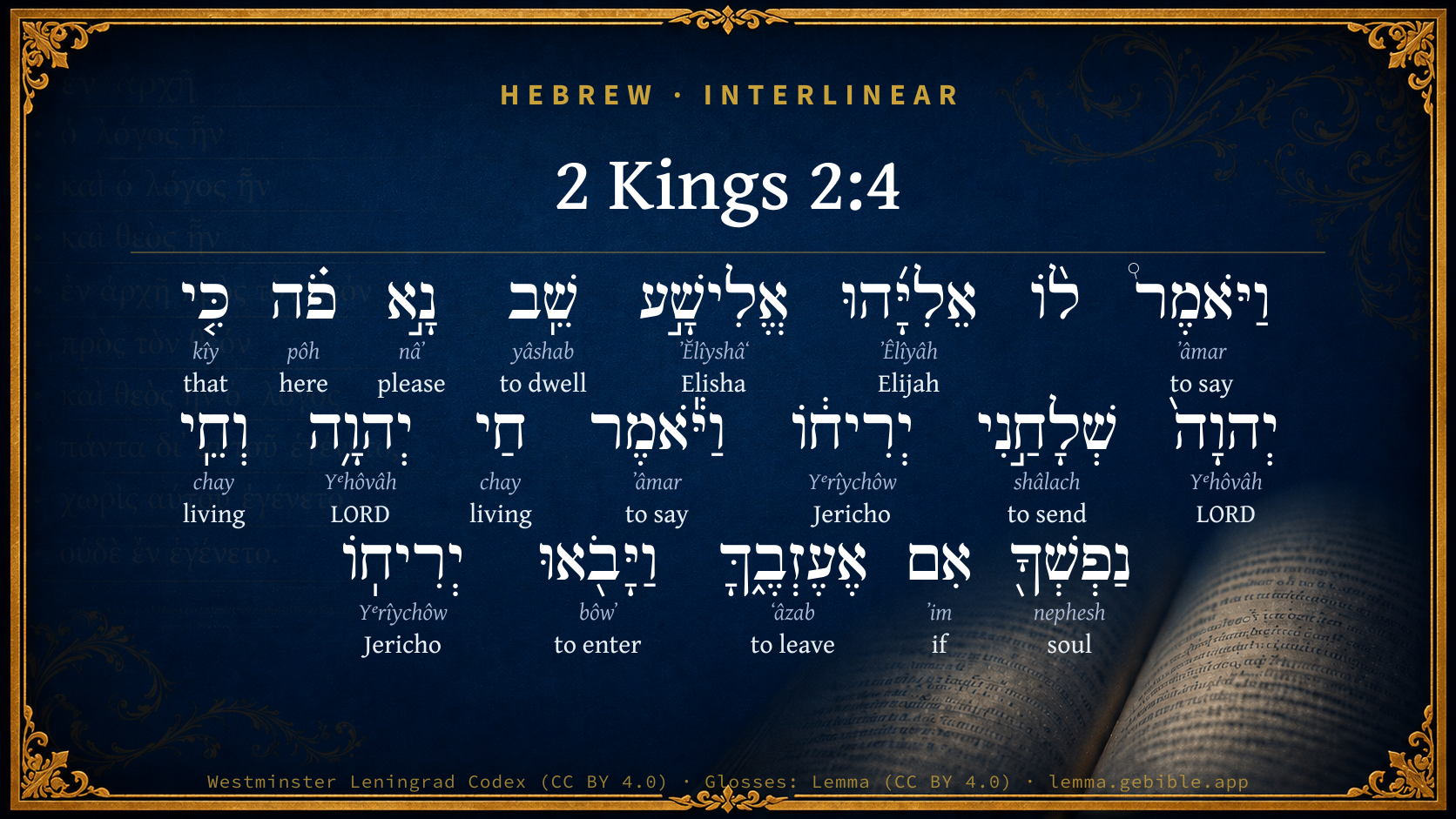
Hebrew (Westminster Leningrad Codex) 2 Kings 2:4 appears in the Hebrew Old Testament. The text above is from the Westminster Leningrad Codex. Each word links to its Strong’s number, a concise gloss, and parsing drawn from the Open Scriptures Hebrew Bible morphology. Click any word for its full Brown-Driver-Briggs (BDB) entry.
Download image
Cite this verse

2 Kings 2:4 (World English Bible). Public Domain. Lemma interlinear Bible study tool, https://lemma.gebible.app/v/2-kings/2/4.

Show BibTeX & RIS
BibTeX
RIS
English Translation
Elijah said to him, Elisha, please wait here, for Yahweh has sent me to Jericho. He said, As Yahweh lives, and as your soul lives, I will not leave you. So they came to Jericho.
World English Bible · Public Domain
Download a study sheet

One document with this verse’s original text, its word-by-word gloss line, the meaning frame, cross-references with their text, attributed commentary, and full source and license credits — printable, and it pastes into notes with its structure intact.

This verse Autodidact and up

Study sheet (.html) Plain text (.txt)

A passage Seminary Student

Up to 50 verses in one chapter. A passage sheet keeps up to 6 commentary sources and 12 cross-references per verse, in the order this page ranks them, and says so on the sheet whenever that leaves anything out. Ask for a single verse and you get the Autodidact verse sheet above.

Everything on this page stays free to read, with no account — the sheet is a download of what is already on screen, not access to it.

Want to remove ads? Support Godless Engineer
Compare translations 3

The same verse in 3 English versions, stacked beneath the original-language interlinear above. Click any original word for its lexicon entry.

Each is an independent rendering of the whole verse — the interlinear is not word-aligned to these translations.

Highlighted words mark where these versions differ — a whole-verse word diff, not a word-by-word alignment.

  • World English Bible Public Domain
    Elijah said to him, Elisha, please wait here, for Yahweh has sent me to Jericho. He said, As Yahweh lives, and as your soul lives, I will not leave you. So they came to Jericho.
  • King James Version Public Domain
    And Elijah said unto him, Elisha, tarry here, I pray thee; for the LORD hath sent me to Jericho. And he said, As the LORD liveth, and as thy soul liveth, I will not leave thee. So they came to Jericho.
  • unfoldingWord Literal Text CC BY-SA 4.0
    And Elijah said to Elisha, “Stay here, please, because Yahweh has sent me Jericho.” And he said, “The life of Yahweh, and the life of your soul, if I should leave you.” And they came Jericho.

unfoldingWord Literal Text — © unfoldingWord, licensed CC BY-SA 4.0. Word-aligned USFM3 via Door43 (git.door43.org/unfoldingWord/en_ult).

Versions to compare (up to 4)

3 of 4 selected

Show all 18 translations

Every available English version of this verse, each an independent rendering of the whole verse.

  • World English Bible Public Domain
    Elijah said to him, Elisha, please wait here, for Yahweh has sent me to Jericho. He said, As Yahweh lives, and as your soul lives, I will not leave you. So they came to Jericho.
  • Berean Standard Bible Public Domain
    And Elijah said to Elisha, “Please stay here, for the LORD has sent me on to Jericho.” But Elisha replied, “As surely as the LORD lives and as you yourself live, I will not leave you.” So they went to Jericho.
  • Majority Standard Bible Public Domain
    And Elijah said to Elisha, “Please stay here, for the LORD has sent me on to Jericho.” But Elisha replied, “As surely as the LORD lives and as you yourself live, I will not leave you.” So they went to Jericho.
  • King James Version Public Domain
    And Elijah said unto him, Elisha, tarry here, I pray thee; for the LORD hath sent me to Jericho. And he said, As the LORD liveth, and as thy soul liveth, I will not leave thee. So they came to Jericho.
  • American Standard Version (1901) Public Domain
    And Elijah said unto him, Elisha, tarry here, I pray thee; for Jehovah hath sent me to Jericho. And he said, As Jehovah liveth, and as thy soul liveth, I will not leave thee. So they came to Jericho.
  • Revised Version (1885) Public Domain
    And Elijah said unto him, Elisha, tarry here, I pray thee; for the LORD hath sent me to Jericho. And he said, As the LORD liveth, and as thy soul liveth, I will not leave thee. So they came to Jericho.
  • Geneva Bible (1599) Public Domain
    Againe Eliiah saide vnto him, Elisha, tarie here, I pray thee: for the Lord hath sent me to Iericho: But he said, As the Lord liueth, and as thy soule liueth, I will not leaue thee. So they came to Iericho.
  • Douay-Rheims (1899) Public Domain
    And Elias said to Eliseus: Stay here because the Lord hath sent me to Jericho. And he said: As the Lord liveth, and as thy soul liveth, I will not leave thee. And when they were come to Jericho,
  • Young's Literal Translation Public Domain
    And Elijah saith to him, `Elisha, abide, I pray thee, here, for Jehovah hath sent me to Jericho;' and he saith, `Jehovah liveth, and thy soul liveth, if I leave thee;' and they come in to Jericho.
  • Literal Standard Version CC BY-SA 4.0
    And Elijah says to him, “Elisha, please abide here, for YHWH has sent me to Jericho”; and he says, “YHWH lives, and your soul lives, if I leave you”; and they come to Jericho.
  • Unlocked Literal Bible CC BY-SA 4.0
    Elijah said to him, “Elisha, wait here, please, for Yahweh has sent me to Jericho.” Then Elisha replied, “As Yahweh lives, and as you live, I will not leave you.” So they went to Jericho.
  • unfoldingWord Literal Text CC BY-SA 4.0
    And Elijah said to Elisha, “Stay here, please, because Yahweh has sent me Jericho.” And he said, “The life of Yahweh, and the life of your soul, if I should leave you.” And they came Jericho.
  • Darby Bible Public Domain
    And Elijah said to him, Elisha, abide here, I pray thee; for Jehovah has sent me to Jericho. And he said, As Jehovah liveth, and as thy soul liveth, I will not leave thee! And they came to Jericho.
  • World Messianic Bible Public Domain
    Elijah said to him, “Elisha, please wait here, for the LORD has sent me to Jericho.” He said, “As the LORD lives, and as your soul lives, I will not leave you.” So they came to Jericho.
  • Webster's Bible Public Domain
    And Elijah said to him, Elisha, tarry here, I pray thee; for the LORD hath sent me to Jericho. And he said, As the LORD liveth, and as thy soul liveth, I will not leave thee. So they came to Jericho.
  • Free Bible Version CC BY-SA 4.0
    Then Elijah said to him, “Please stay here, Elisha, for the Lord has sent me to Jericho.” He replied, “As the Lord lives, and as you live, I will not leave you.” So they went to Jericho.
  • Bible in Basic English Public Domain
    Then Elijah said to him, Come no farther, for the Lord has sent me to Jericho. But he said, As the Lord is living and as your soul is living, I will not be parted from you. So they went on to Jericho.
  • JPS Tanakh (1917) Public Domain
    And Elijah said unto him: 'Elisha, tarry here, I pray thee; for the LORD hath sent me to Jericho.' And he said: 'As the LORD liveth, and as thy soul liveth, I will not leave thee.' So they came to Jericho. —

Literal Standard Version (2020), Covenant Press — licensed CC BY-SA 4.0. Text via the HelloAO Bible API (eBible.org). Unlocked Literal Bible (unfoldingWord) — licensed CC BY-SA 4.0. Text via the HelloAO Bible API (eBible.org). unfoldingWord Literal Text — © unfoldingWord, licensed CC BY-SA 4.0. Word-aligned USFM3 via Door43 (git.door43.org/unfoldingWord/en_ult). Free Bible Version, Dr. Jonathan Gallagher — licensed CC BY-SA 4.0. Text via the HelloAO Bible API (eBible.org).

Word by word

More ways to search: Search by grammar → Find every occurrence → Compare this word →

Practice this passage: Drill this verse → Learn its vocabulary →

יְרִיח֔וֹ
Yᵉrîychôw
H3405
“Jericho”
Noun, Proper
Part of Speech
Noun
Type
Proper
Full BDB Definition

Origin: perhaps from H3394

TWOT: 915

Jericho = "its moon" - a city 5 miles (8 kilometers) west of the Jordan and 7 miles (11.5 kilometers) north of the Dead Sea and the first city conquered by the Israelites upon entering the promised land of Canaan
  1. וַיֹּאמֶר֩ ʼâmar H559 “and · to say” Conjunction + Verb, Qal, Sequential Imperfect, 3rd Person, Masculine, Singular
  2. אֵלִיָּ֜הוּ ʼÊlîyâh H452 “Elijah” Noun, Proper
  3. אֱלִישָׁ֣ע ʼĔlîyshâʻ H477 “Elisha” Noun, Proper
  4. שֵֽׁב yâshab H3427 “dwell” Verb, Qal, Imperative, 2nd Person, Masculine, Singular
  5. נָ֣א nâʼ H4994 “please” Particle, Exhortation
  6. פֹ֗ה pôh H6311 “here” Adverb
  7. כִּ֤י kîy H3588 “that” Conjunction
  8. יְהוָה֙ Yᵉhôvâh H3068 “LORD” Noun, Proper
  9. שְׁלָחַ֣נִי shâlach H7971 “to send · me” Verb, Qal, Perfect, 3rd Person, Masculine, Singular + Suffix, Personal, 1st Person, Common, Singular
  10. וַיֹּ֕אמֶר ʼâmar H559 “and · to say” Conjunction + Verb, Qal, Sequential Imperfect, 3rd Person, Masculine, Singular
  11. חַי chay H2416 “living” Adjective, Adjective, Masculine, Singular, Absolute
  12. יְהוָ֥ה Yᵉhôvâh H3068 “LORD” Noun, Proper
  13. וְחֵֽי chay H2416 “and · living” Conjunction + Adjective, Adjective, Masculine, Singular, Absolute
  14. נַפְשְׁךָ֖ nephesh H5315 “soul · your” Noun, Common, Both, Singular, Construct + Suffix, Personal, 2nd Person, Masculine, Singular
  15. אִם ʼim H518 “if” Conjunction
  16. אֶעֶזְבֶ֑ךָּ ʻâzab H5800 “to leave · you” Verb, Qal, Imperfect, 1st Person, Common, Singular + Suffix, Personal, 2nd Person, Masculine, Singular
  17. וַיָּבֹ֖אוּ bôwʼ H935 “and · to enter” Conjunction + Verb, Qal, Sequential Imperfect, 3rd Person, Masculine, Plural
  18. יְרִיחֽוֹ Yᵉrîychôw H3405 “Jericho” Noun, Proper

About this verse

These counts appear in no published source. They are computed here, from the morphology-tagged text and Lemma’s own curated glosses. What Lemma adds →

20
words
15
distinct lemmas
Historical
section

Shared distinctive vocabulary

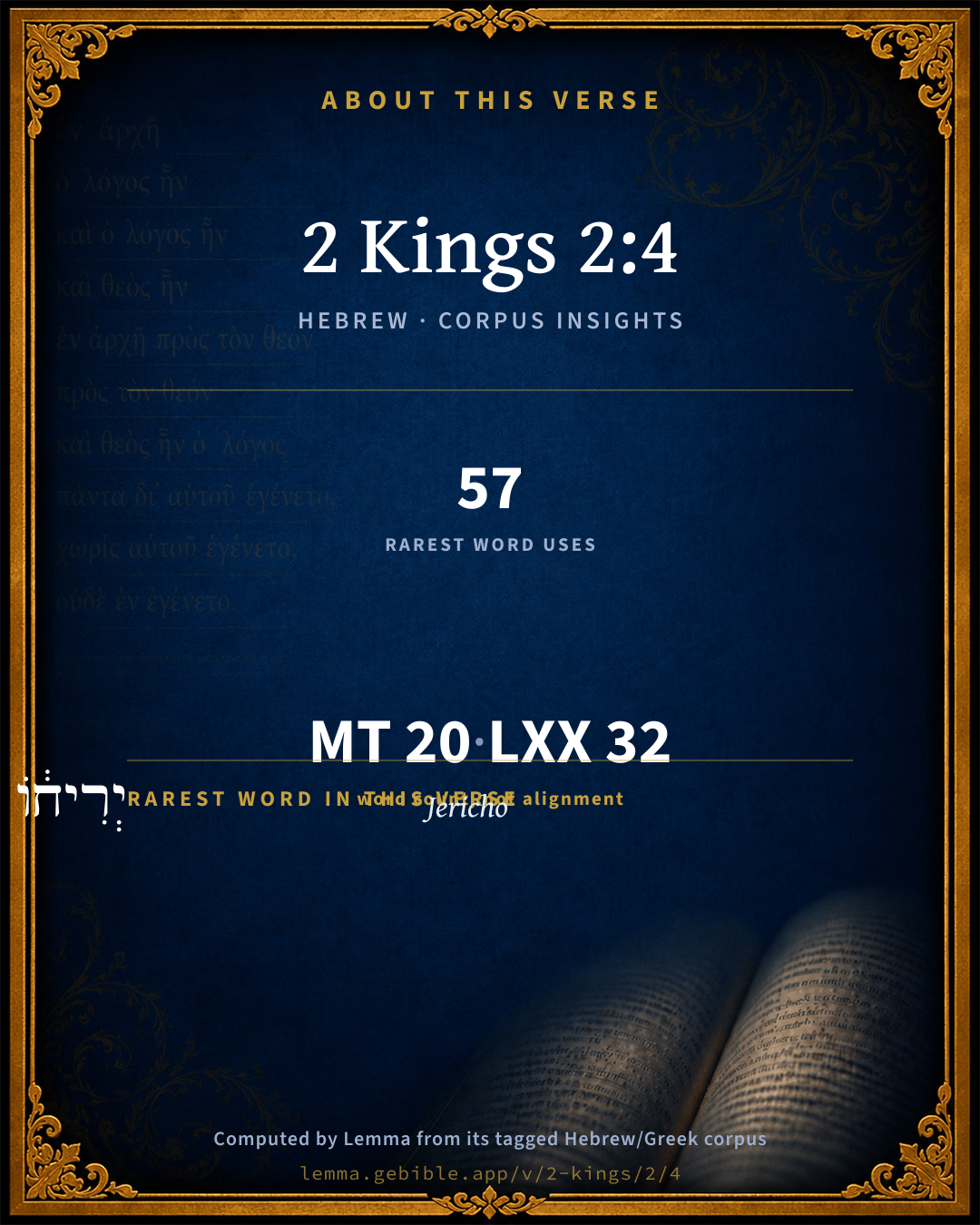
יְרִיח֔וֹ Jericho H3405 occurs in 53 verses of the Hebrew Bible. Also found in:

Grammatical profile

  • 6 verbs
  • 7 nouns
  • 2 adjectives
  • 1 preposition
  • 2 conjunctions
  • 1 adverb
  • 1 particle

Verb forms

  • וַיֹּאמֶר֩ Qal · Sequential Imperfect
  • שֵֽׁב Qal · Imperative
  • שְׁלָחַ֣נִי Qal · Perfect
  • וַיֹּ֕אמֶר Qal · Sequential Imperfect
  • אֶעֶזְבֶ֑ךָּ Qal · Imperfect
  • וַיָּבֹ֖אוּ Qal · Sequential Imperfect

Repetition

Words recur within this verse — often emphatic in Hebrew:

  • וַיֹּאמֶר֩ to say H559 ×2
  • יְהוָה֙ LORD H3068 ×2
  • יְרִיח֔וֹ Jericho H3405 ×2
  • חַי living H2416 ×2

Hebrew & Septuagint length

In English translation the verse runs 35 words from the Hebrew and 39 from the Septuagint (LXX English) — closely comparable.

A rough comparison of the two English renderings, which tokenize alike — not a word-level alignment.

Word counts can differ between the Hebrew and the Greek without any difference in meaning — e.g. the Hebrew direct-object marker אֵת has no separate Greek word, and Greek often adds the article ὁ.

In the original languages it is 20 Hebrew tokens and 32 Greek tokens — but the two are counted differently (Hebrew bundles its prefixes and suffixes into one token; the Greek is in lemma form), so that isn’t a like-for-like length.

Cross-references

7

Topical passages linked to 2 Kings 2:4 in the Treasury of Scripture Knowledge — connected by theme and wording, ordered by reader-vote popularity; previews shown in the World English Bible.

  • 2 Kings 2:2 Elijah said to Elisha, Please wait here, for Yahweh has sent me as far as Bethel. Elisha said, As Yahweh lives, and as your soul lives, I will not leave you. So they went down to Bethel.
  • Joshua 6:26 Joshua charged them with an oath at that time, saying, Cursed be the man before Yahweh, that rises up and builds this city Jericho: with the loss of his firstborn shall he lay the foundation of it, and with the loss of his youngest son shall he set up the gates of it.
  • 1 Kings 16:34 In his days did Hiel the Bethelite build Jericho: he laid the foundation of it with the loss of Abiram his firstborn, and set up the gates of it with the loss of his youngest son Segub, according to the word of Yahweh, which he spoke by Joshua the son of Nun.
  • 2 Kings 4:30 The mother of the child said, As Yahweh lives, and as your soul lives, I will not leave you. He arose, and followed her.
  • Luke 19:1 He entered and was passing through Jericho.
  • Acts 2:42 They continued steadfastly in the apostles' teaching and fellowship, in the breaking of bread, and prayer.
  • Acts 11:23 who, when he had come, and had seen the grace of God, was glad. He exhorted them all, that with purpose of heart they should remain near to the Lord.

Cross-references courtesy of OpenBible.info (CC BY 4.0).

Hebrew and Greek witnesses Masoretic Hebrew ↔ Greek Septuagint

The same verse in the two great witnesses to the Old Testament, shown verse-for-verse.

These are two independent witnesses, not word-aligned to each other, and the Septuagint is shown in lemma (dictionary) form.

Hebrew 2 Kings 2:4 Masoretic · Westminster Leningrad Codex

וַיֹּאמֶר֩ ל֨וֹ אֵלִיָּ֜הוּ אֱלִישָׁ֣ע שֵֽׁב נָ֣א פֹ֗ה כִּ֤י יְהוָה֙ שְׁלָחַ֣נִי יְרִיח֔וֹ וַיֹּ֕אמֶר חַי יְהוָ֥ה וְחֵֽי נַפְשְׁךָ֖ אִם אֶעֶזְבֶ֑ךָּ וַיָּבֹ֖אוּ יְרִיחֽוֹ

Elijah said to him, Elisha, please wait here, for Yahweh has sent me to Jericho. He said, As Yahweh lives, and as your soul lives, I will not leave you. So they came to Jericho.

World English Bible · Public Domain

Greek LXX 2 Kings 2:4 Septuagint · lemma form

καί εἶπον ηλιου πρός ελισαιε καταἧμαι δή ἐνταῦθα ὅτι κύριος ἀποστέλλω ἐγώ εἰς ιεριχω καί εἶπον ελισαιε ζάω κύριος καί ζάω ὁ ψυχή σύ εἰ ἐν καταλείπω σύ καί ἔρχομαι εἰς ιεριχω

And Eliu said to Elisaie, Stay here, I pray you; for the Lord has sent me to Jericho. And he said, As the Lord lives and your soul lives, I will not leave you. And they came to Jericho.

LXX2012 (modern English Septuagint) · Public Domain

Hebrew: Westminster Leningrad Codex (CC BY 4.0). Greek: Septuagint (public domain); English from LXX2012 (modern English Septuagint) (Public Domain). How the Septuagint differs from the Hebrew →

Targum (Aramaic paraphrase)

1

The Targum is the ancient Jewish Aramaic paraphrase of the Hebrew Scriptures — an interpretive translation, not the Hebrew text itself. Onkelos (literal) and Pseudo-Jonathan (expansive) render the Torah, and Jonathan the Prophets. Coverage is partial: where no permissively-licensed English translation exists for a verse, only the Aramaic is shown. This is verse-level text, not a word-by-word alignment to the Hebrew.

  1. Targum Jonathan Prophets (Joshua–Malachi)
    וַאֲמַר לֵיהּ אֵלִיָהוּ אֱלִישָׁע תּוּב כְּעַן הָכָא אֲרֵי יְיָ שַׁלְחַנִי לִירִיחוֹ וַאֲמַר קַיָם הוּא יְיָ וְחֵי נַפְשָׁךְ אִם אֶשְׁבְּקִינָךְ וַאֲתוֹ לִירִיחוֹ:

    (no public-domain English translation for this verse)

    Targum Jonathan — Aramaic: “Mikraot Gedolot” (public domain). English: “Sefaria Community Translation” (CC0 1.0 (public-domain dedication)); “London "Chaldee Paraphrase," 1871” (public domain). Text via Sefaria.

Commentary

Notes on 2 Kings 2:4 from classic Christian and Jewish commentators (each source and its license shown beneath its notes). The classic Christian expositions comment on the surrounding passage and are grouped to its opening verse, so a note may address several verses; the Jewish commentaries on the Tanakh (Rashi and others) are per-verse, so they appear only where the commentator wrote on this verse.

Lemma curates 59 commentaries, every one of them public domain or Creative Commons licensed, each selected and text-cleaned for this edition rather than reprinted as found. About our sources →

Trapp's Complete Commentary

John Trapp

2Ki 2:4 And Elijah said unto him, Elisha, tarry here, I pray thee; for the LORD hath sent me to Jericho. And he said, [As] the LORD liveth, and [as] thy soul liveth, I will not leave thee. So they came to Jericho.

Ver. 4. For the Lord hath sent me to Jericho.] Where was another college of prophets, whom he would likewise visit ere he left the earth, that he might pray with them, and advise them - see the like, 2Pe 1:14 - and haply leave with them that letter to Jehoram, king of Judah, which, some years after, was to be delivered, {2Ch 21:12} prophesying and foretelling his sins and punishments.

John Trapp, A Commentary or Exposition upon All the Books of the Old and New Testament (1647–1656) — public domain. Text from a community e-Sword module.

Joseph Benson's Commentary

2Ki 2:4. Tarry here, I pray thee — Elijah seems to have said this only with a view to try Elisha, whether he would accompany him to the last, and be the witness of his translation. And Elisha certainly, by not leaving him, testified, both great fidelity to his master, and great faith in what God had revealed respecting the taking him up to heaven.

Joseph Benson's Commentary on the Old and New Testaments (1811–1818) — public domain. Text from a community e-Sword module.

Keil & Delitzsch

C. F. Keil & F. Delitzsch

In Bethel, and again in Jericho, to which they both proceeded from Bethel, Elijah repeated the appeal to Elisha to stay there, but always in vain. The taking away of Elijah had also been revealed to the disciples of the prophets at Jericho. Thus they both came to the Jordan, whilst fifty disciples of the prophets from Jericho followed them at a distance, to be eye-witnesses of the miraculous translation of their master. The course which Elijah took before his departure from this earth, viz., from Gilgal past Bethel and Jericho, was not merely occasioned by the fact that he was obliged to touch at these places on the way to the Jordan, but had evidently also the same higher purpose, for which his ascension to heaven had been revealed both to Elisha and to the disciples of the prophets at Bethel and Jericho. Elijah himself said that the Lord had sent him to Bethel, to Jericho, to the Jordan (Kg2 2:2, Kg2 2:4, Kg2 2:6). He therefore took this way from an impulse received from the Spirit of God, that he might visit the schools of the prophets, which he had founded, once more before his departure, and strengthen and fortify the disciples of the prophets in the consecration of their lives to the service of the Lord, though without in the least surmising that they had been informed by the Spirit of the Lord of his approaching departure from this life. But as his ascension to heaven took place not so much for his own sake, as because of those associates in his office who were left behind, God had revealed it to so many, that they might be even more firmly established in their calling by the miraculous glorification of their master than by his words, his teaching, and his admonitions, so that they might carry it on without fear or trembling, even if their great master should no longer stand by their side with the might of his spiritual power to instruct, advise, or defend. Btu above all, Elisha, whom the Lord had appointed as his successor (Kg1 19:16), was to be prepared for carrying on his work by the last journey of his master. He did not leave his side therefore, and resolved, certainly also from an inward impulse of the Spirit of God, to be an eye-witness of his glorification, that he might receive the spiritual inheritance of the first-born from his departing spiritual father.

Keil & Delitzsch — Biblical Commentary on the Old Testament (1861–1891) — public domain (CC PDM 1.0). Text via the HelloAO Bible API. (Old Testament only.)

Ellicott's Commentary for English Readers

(4) And Elijah said.—The exact repetition of the language of 2Ki_2:2-3 in this and the next two verses, appears to indicate that the narrative had originally been handed on by oral tradition, probably in the prophetic guilds at the local sanctuaries.

A Bible Commentary for English Readers, edited by Charles John Ellicott (1878–1897) — public domain. Text from a community e-Sword module.

The Cambridge Bible for Schools and Colleges

gen. ed. J. J. S. Perowne

4. hath sent me to Jericho] The famous city which played a part in the history of Israel from their first entry into Canaan. It had been rebuilt in Ahab’s reign (1Ki_16:34) in spite of the divine curse pronounced in Joshua’s time on any who should restore it (Jos_6:26). And now it had been chosen as the seat of one of the prophetic colleges.

The Cambridge Bible for Schools and Colleges (gen. ed. J. J. S. Perowne; Cambridge University Press, 1878–1918) — public domain. Text from a community e-Sword module.

John Gill's Exposition

And Elijah said unto him, Elisha, tarry here, I pray thee,.... At Bethel:

for the Lord hath sent me to Jericho; to the school of the prophets there, to strengthen, encourage, and advise them:

and he said, as the lord liveth, &c. using the same form of oath as before:

so they came to Jericho; together, which, as the above writer says (i), was four miles from Bethel.

(i) Travels, &c. p. 205.

John Gill's Exposition of the Whole Bible (1746–1763) — public domain (CC PDM 1.0). Text via the HelloAO Bible API.

Whedon's Commentary on the Bible

Daniel D. Whedon

4. Jericho — A city in the Jordan valley. See on Jos_2:1. In Ahab’s reign Hiel, the Beth-elite, had rebuilt this city. 1Ki_16:34.

Daniel D. Whedon (gen. ed.), Commentary on the Old and New Testaments (1874–1909) — public domain. Text from a community e-Sword module.

The Pulpit Commentary

And Elijah said unto him, Tarry here, I pray thee. The first trial of Elisha"s fidelity is followed by a second. The master suggests his tarrying at Bethel, the sacred center, where he will have the company of the "sons of the prophets," and will not be companionless, as perhaps he would have been at Gilgal. He himself is ordered to take a second journey, longer and rougher than the first. For the Lord hath sent me to Jericho. Will it not be better that Elisha shall spare himself the long and rugged descent from the high-land of Ephraim to the deep gully of Jordan, and remain with the friends who have sought him out, while his master accomplishes the remainder of Iris journey alone? And he said, As the Lord liveth, and as thy soul liveth, I will not leave thee. Absolute unchangeableness of resolution is best shown by absolute un-changingness of speech. Elisha, therefore, simply repeats his previous words. And the master once more yields. So they came to Jericho.

The Pulpit Commentary (1880–1919), ed. H.D.M. Spence-Jones & Joseph S. Exell — public domain. Text from a community e-Sword module.

Lesson kit

Teaching starters — assembled from the data on this page, not authored interpretation. Every prompt links to the verse data it draws on. Edit before teaching.

2 Kings, in the Historical, opens this verse with 20 words (15 distinct Hebrew lemmas). Its most distinctive word is Yᵉrîychôw (“Jericho”). A historical commentator’s framing appears above. Read the whole chapter for the surrounding context.

Discussion questions

  1. The word Yᵉrîychôw carries the sense “Jericho.” How does it shape the verse?
  2. Numbers 22:1 shares the word «Jericho» with this verse. How do the two illuminate each other?
  3. “to say” occurs 2× in this one verse. What is the effect of the repetition?
  4. These translations render this verse differently; the difference is in the English rendering, not the original. What questions does that raise?
  5. The verb «וַיֹּאמֶר֩» is Qal Sequential Imperfect. How does its form color the action?
  6. Reading how Trapp's Complete Commentary and Joseph Benson's Commentary read this verse, where do the two commentators agree and where do they part?

Things to notice

Reading settings

Reading text

Shown beneath each verse's original-language words.

Old Testament
Old Testament edition

Read the OT as the Masoretic Hebrew (MT) or the Greek Septuagint (LXX).

English shown for the Greek Septuagint (in the Hebrew ↔ Greek comparison).

Comparing translations? Open the Compare panel on any verse page to stack up to four side by side.