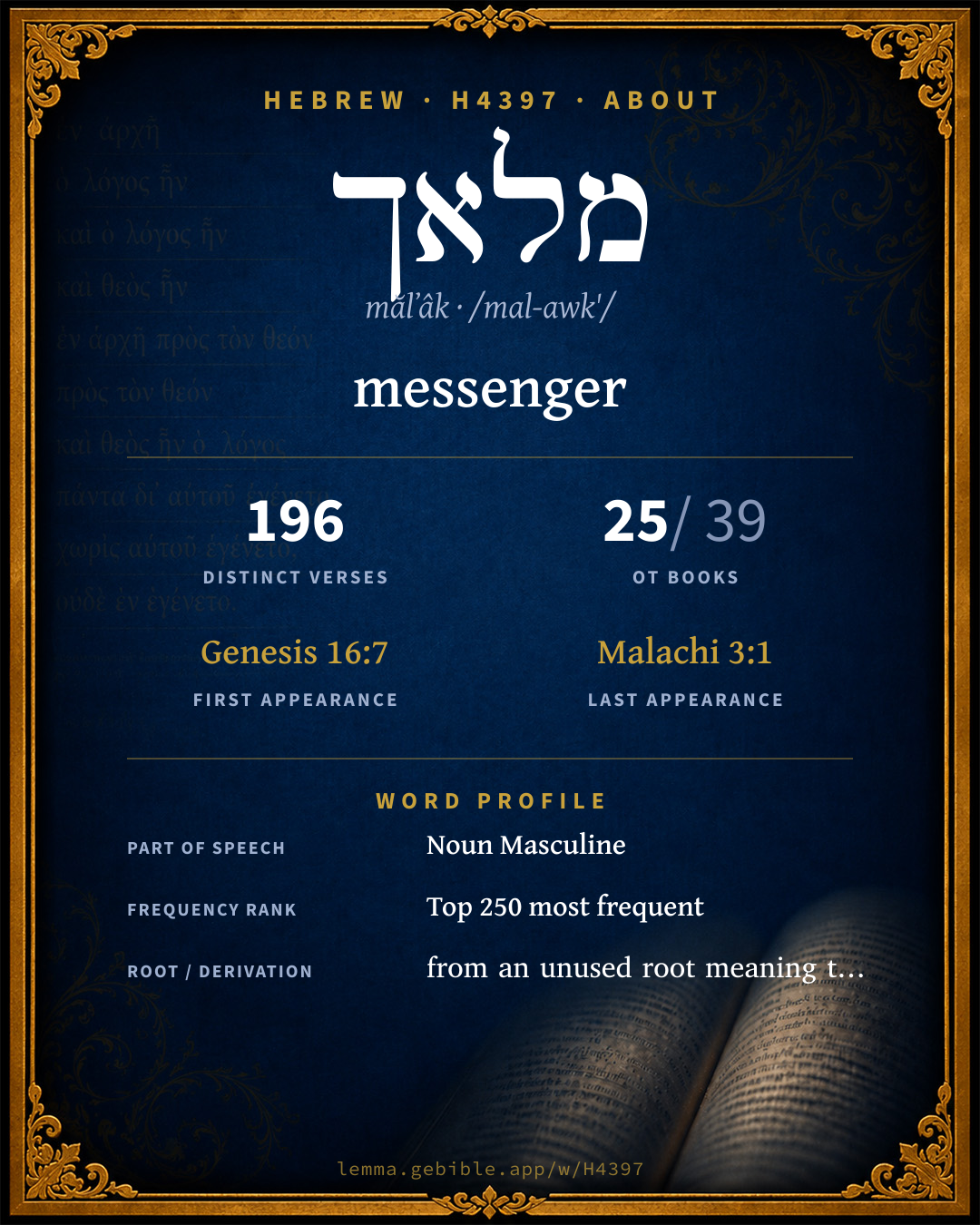
מַלְאָךְ
messenger
‘messenger’ is one of 4 main senses fuller range ↓
Full lexicon entry — Brown-Driver-Briggs (BDB)
From Brown-Driver-Briggs (BDB)
Where this word appears
See every Absolute-state word in the Hebrew Bible →
Grammar key — what these labels mean
Part of speech
- Noun
- A naming word — a person, place, thing, or idea.
Noun type
- Common
- A common noun — a general class of person, place, or thing (“king,” “city,” “water”), not a specific name.
State
- Construct
- A noun bound to a following noun in a possessive / “of” relationship (the construct chain).
- Absolute
- The independent form of a noun, not bound to a following word.
Gender
- Masculine
- Grammatically masculine.
Number
- Singular
- One.
- Plural
- More than one (in Hebrew, generally three or more).
Grammatical forms
- Noun, Common, Masculine, Singular, Construct 76 times (36%)
- Noun, Common, Masculine, Plural, Absolute 64 times (30%)
- Noun, Common, Masculine, Singular, Absolute 49 times (23%)
- Noun, Common, Masculine, Plural, Construct 24 times (11%)
Parsed forms decoded from the imported morphology (morphhb / Westminster Leningrad Codex — WLC text public domain, morphhb tagging CC BY 4.0), counted across 213 parsed occurrences — not distinct verses.
Every verse where H4397 appears — 196 distinct verses across 25 books. Click any verse to open its interlinear word-by-word view. Verse text shown in the World English Bible for context — . Each verse’s Hebrew form is shown with its reference; the English is not keyword-highlighted, since the data carries no word-level English alignment. Use “Compare translations” on any verse to read it across multiple English versions. This concordance covers the Hebrew Bible; Septuagint (Greek Old Testament) occurrences are not indexed here.
Genesis 17 verses
- Genesis 16:7 מַלְאַ֧ךְ n c ms cs The angel of Yahweh found her by a fountain of water in the wilderness, by the fountain in the way to Shur.
- Genesis 16:9 מַלְאַ֣ךְ n c ms cs The angel of Yahweh said to her, "Return to your mistress, and submit yourself under her hands."
- Genesis 16:10 מַלְאַ֣ךְ n c ms cs The angel of Yahweh said to her, "I will greatly multiply your seed, that they will not be numbered for multitude."
- Genesis 16:11 מַלְאַ֣ךְ n c ms cs The angel of Yahweh said to her, "Behold, you are with child, and will bear a son. You shall call his name Ishmael, because Yahweh has heard your affliction.
- Genesis 19:1 הַ/מַּלְאָכִ֤ים ptcl def.art + n c mp The two angels came to Sodom at evening. Lot sat in the gate of Sodom. Lot saw them, and rose up to meet them. He bowed himself with his face to the earth,
- Genesis 19:15 הַ/מַּלְאָכִ֖ים ptcl def.art + n c mp When the morning arose, then the angels hurried Lot, saying, "Arise, take your wife, and your two daughters who are here, lest you be consumed in the iniquity of the city."
- Genesis 21:17 מַלְאַ֨ךְ n c ms cs God heard the voice of the boy. The angel of God called to Hagar out of the sky, and said to her, "What ails you, Hagar? Don't be afraid. For God has heard the voice of the boy where he is.
- Genesis 22:11 מַלְאַ֤ךְ n c ms cs The angel of Yahweh called to him out of the sky, and said, "Abraham, Abraham!" He said, "Here I am."
- Genesis 22:15 מַלְאַ֥ךְ n c ms cs The angel of Yahweh called to Abraham a second time out of the sky,
- Genesis 24:7 מַלְאָכ/וֹ֙ n c ms cs + sfx pers 3ms Yahweh, the God of heaven, who took me from my father's house, and from the land of my birth, who spoke to me, and who swore to me, saying, 'I will give this land to your seed.' He will send his angel before you, and you shall take a wife for my son from there.
- Genesis 24:40 מַלְאָכ֤/וֹ n c ms cs + sfx pers 3ms He said to me, 'Yahweh, before whom I walk, will send his angel with you, and prosper your way. You shall take a wife for my son of my relatives, and of my father's house.
- Genesis 28:12 מַלְאֲכֵ֣י n c mp cs He dreamed. Behold, a stairway set up on the earth, and the top of it reached to heaven. Behold, the angels of God ascending and descending on it.
- Genesis 31:11 מַלְאַ֧ךְ n c ms cs The angel of God said to me in the dream, 'Jacob,' and I said, 'Here I am.'
- Genesis 32:1 מַלְאֲכֵ֥י n c mp cs Jacob went on his way, and the angels of God met him.
- Genesis 32:3 מַלְאָכִים֙ n c mp Jacob sent messengers in front of him to Esau, his brother, to the land of Seir, the field of Edom.
- Genesis 32:6 הַ/מַּלְאָכִ֔ים ptcl def.art + n c mp The messengers returned to Jacob, saying, "We came to your brother Esau. Not only that, but he comes to meet you, and four hundred men with him."
- Genesis 48:16 הַ/מַּלְאָךְ֩ ptcl def.art + n c ms the angel who has redeemed me from all evil, bless the lads, and let my name be named on them, and the name of my fathers Abraham and Isaac. Let them grow into a multitude in the midst of the earth."
Exodus 6 verses
- Exodus 3:2 מַלְאַ֨ךְ n c ms cs The angel of Yahweh appeared to him in a flame of fire out of the midst of a bush. He looked, and behold, the bush burned with fire, and the bush was not consumed.
- Exodus 14:19 מַלְאַ֣ךְ n c ms cs The angel of God, who went before the camp of Israel, moved and went behind them; and the pillar of cloud moved from before them, and stood behind them.
- Exodus 23:20 מַלְאָךְ֙ n c ms "Behold, I send an angel before you, to keep you by the way, and to bring you into the place which I have prepared.
- Exodus 23:23 מַלְאָכִ/י֮ n c ms cs + sfx pers 1cs For my angel shall go before you, and bring you in to the Amorite, the Hittite, the Perizzite, the Canaanite, the Hivite, and the Jebusite; and I will cut them off.
- Exodus 32:34 מַלְאָכִ֖/י n c ms cs + sfx pers 1cs Now go, lead the people to the place of which I have spoken to you. Behold, my angel shall go before you. Nevertheless in the day when I punish, I will punish them for their sin."
- Exodus 33:2 מַלְאָ֑ךְ n c ms I will send an angel before you; and I will drive out the Canaanite, the Amorite, and the Hittite, and the Perizzite, the Hivite, and the Jebusite:
Numbers 15 verses
- Numbers 20:14 מַלְאָכִ֛ים n c mp Moses sent messengers from Kadesh to the king of Edom, Thus says your brother Israel, You know all the travail that has happened to us:
- Numbers 20:16 מַלְאָ֔ךְ n c ms and when we cried to Yahweh, he heard our voice, and sent an angel, and brought us forth out of Egypt: and, behold, we are in Kadesh, a city in the uttermost of your border.
- Numbers 21:21 מַלְאָכִ֔ים n c mp Israel sent messengers to Sihon king of the Amorites, saying,
- Numbers 22:5 מַלְאָכִ֜ים n c mp He sent messengers to Balaam the son of Beor, to Pethor, which is by the River, to the land of the children of his people, to call him, saying, Behold, there is a people come out from Egypt: behold, they cover the surface of the earth, and they abide over against me.
- Numbers 22:22 מַלְאַ֧ךְ n c ms cs God's anger was kindled because he went; and the angel of Yahweh placed himself in the way for an adversary against him. Now he was riding on his donkey, and his two servants were with him.
- Numbers 22:23 מַלְאַ֨ךְ n c ms cs The donkey saw the angel of Yahweh standing in the way, with his sword drawn in his hand; and the donkey turned aside out of the way, and went into the field: and Balaam struck the donkey, to turn her into the way.
- Numbers 22:24 מַלְאַ֣ךְ n c ms cs Then the angel of Yahweh stood in a narrow path between the vineyards, a wall being on this side, and a wall on that side.
- Numbers 22:25 מַלְאַ֣ךְ n c ms cs The donkey saw the angel of Yahweh, and she thrust herself to the wall, and crushed Balaam's foot against the wall: and he struck her again.
- Numbers 22:26 מַלְאַךְ n c ms cs The angel of Yahweh went further, and stood in a narrow place, where was no way to turn either to the right hand or to the left.
- Numbers 22:27 מַלְאַ֣ךְ n c ms cs The donkey saw the angel of Yahweh, and she lay down under Balaam: and Balaam's anger was kindled, and he struck the donkey with his staff.
- Numbers 22:31 מַלְאַ֤ךְ n c ms cs Then Yahweh opened the eyes of Balaam, and he saw the angel of Yahweh standing in the way, with his sword drawn in his hand; and he bowed his head, and fell on his face.
- Numbers 22:32 מַלְאַ֣ךְ n c ms cs The angel of Yahweh said to him, Why have you struck your donkey these three times? behold, I am come forth for an adversary, because your way is perverse before me:
- Numbers 22:34 מַלְאַ֤ךְ n c ms cs Balaam said to the angel of Yahweh, I have sinned; for I didn't know that you stood in the way against me: now therefore, if it displease you, I will get me back again.
- Numbers 22:35 מַלְאַ֨ךְ n c ms cs The angel of Yahweh said to Balaam, Go with the men; but only the word that I shall speak to you, that you shall speak. So Balaam went with the princes of Balak.
- Numbers 24:12 מַלְאָכֶ֛י/ךָ n c mp cs + sfx pers 2ms Balaam said to Balak, Didn't I also tell your messengers who you sent to me, saying,
Deuteronomy 1 verse
Joshua 3 verses
- Joshua 6:17 הַ/מַּלְאָכִ֖ים ptcl def.art + n c mp The city shall be devoted, even it and all that is therein, to Yahweh: only Rahab the prostitute shall live, she and all who are with her in the house, because she hid the messengers that we sent.
- Joshua 6:25 הַ/מַּלְאָכִ֔ים ptcl def.art + n c mp But Rahab the prostitute, and her father's household, and all that she had, did Joshua save alive; and she lived in the midst of Israel to this day, because she hid the messengers, whom Joshua sent to spy out Jericho.
- Joshua 7:22 מַלְאָכִ֔ים n c mp So Joshua sent messengers, and they ran to the tent; and, behold, it was hid in his tent, and the silver under it.
Judges 26 verses
- Judges 2:1 מַלְאַךְ n c ms cs The angel of Yahweh came up from Gilgal to Bochim. He said, I made you to go up out of Egypt, and have brought you to the land which I swore to your fathers; and I said, I will never break my covenant with you:
- Judges 2:4 מַלְאַ֤ךְ n c ms cs It happened, when the angel of Yahweh spoke these words to all the children of Israel, that the people lifted up their voice, and wept.
- Judges 5:23 מַלְאַ֣ךְ n c ms cs Curse you Meroz, said the angel of Yahweh. Curse you bitterly the inhabitants of it, Because they didn't come to the help of Yahweh, To the help of Yahweh against the mighty.
- Judges 6:11 מַלְאַ֣ךְ n c ms cs The angel of Yahweh came, and sat under the oak which was in Ophrah, that pertained to Joash the Abiezrite: and his son Gideon was beating out wheat in the winepress, to hide it from the Midianites.
- Judges 6:12 מַלְּאַ֣ךְ n c ms cs The angel of Yahweh appeared to him, and said to him, Yahweh is with you, you mighty man of valor.
- Judges 6:20 מַלְאַ֣ךְ n c ms cs The angel of God said to him, Take the flesh and the unleavened cakes, and lay them on this rock, and pour out the broth. He did so.
- Judges 6:21 מַלְאַ֣ךְ וּ/מַלְאַ֣ךְ n c ms cs conj + n c ms cs Then the angel of Yahweh put forth the end of the staff that was in his hand, and touched the flesh and the unleavened cakes; and there went up fire out of the rock, and consumed the flesh and the unleavened cakes; and the angel of Yahweh departed out of his sight.
- Judges 6:22 מַלְאַ֥ךְ מַלְאַ֣ךְ n c ms cs n c ms cs Gideon saw that he was the angel of Yahweh; and Gideon said, Alas, Lord Yahweh! because I have seen the angel of Yahweh face to face.
- Judges 6:35 וּ/מַלְאָכִים֙ וּ/מַלְאָכִ֣ים conj + n c mp conj + n c mp He sent messengers throughout all Manasseh; and they also were gathered together after him: and he sent messengers to Asher, and to Zebulun, and to Naphtali; and they came up to meet them.
- Judges 7:24 וּ/מַלְאָכִ֡ים conj + n c mp Gideon sent messengers throughout all the hill-country of Ephraim, saying, Come down against Midian, and take before them the waters, as far as Beth Barah, even the Jordan. So all the men of Ephraim were gathered together, and took the waters as far as Beth Barah, even the Jordan.
- Judges 9:31 מַלְאָכִ֛ים n c mp He sent messengers to Abimelech craftily, saying, Behold, Gaal the son of Ebed and his brothers are come to Shechem; and, behold, they constrain the city [to take part] against you.
- Judges 11:12 מַלְאָכִ֔ים n c mp Jephthah sent messengers to the king of the children of Ammon, saying, What have you to do with me, that you are come to me to fight against my land?
- Judges 11:13 מַלְאֲכֵ֣י n c mp cs The king of the children of Ammon answered to the messengers of Jephthah, Because Israel took away my land, when he came up out of Egypt, from the Arnon even to the Jabbok, and to the Jordan: now therefore restore those [lands] again peaceably.
- Judges 11:14 מַלְאָכִ֔ים n c mp Jephthah sent messengers again to the king of the children of Ammon;
- Judges 11:17 מַלְאָכִ֣ים n c mp then Israel sent messengers to the king of Edom, saying, Please let me pass through your land; but the king of Edom didn't listen. In the same way, he sent to the king of Moab; but he would not: and Israel abode in Kadesh.
- Judges 11:19 מַלְאָכִ֔ים n c mp Israel sent messengers to Sihon king of the Amorites, the king of Heshbon; and Israel said to him, Let us pass, we pray you, through your land to my place.
- Judges 13:3 מַלְאַךְ n c ms cs The angel of Yahweh appeared to the woman, and said to her, See now, you are barren, and don't bear; but you shall conceive, and bear a son.
- Judges 13:6 מַלְאַ֥ךְ n c ms cs Then the woman came and told her husband, saying, A man of God came to me, and his face was like the face of the angel of God, very awesome; and I didn't ask him whence he was, neither did he tell me his name:
- Judges 13:9 מַלְאַךְ֩ n c ms cs God listened to the voice of Manoah; and the angel of God came again to the woman as she sat in the field: but Manoah, her husband, wasn't with her.
- Judges 13:13 מַלְאַ֥ךְ n c ms cs The angel of Yahweh said to Manoah, Of all that I said to the woman let her beware.
- Judges 13:15 מַלְאַ֣ךְ n c ms cs Manoah said to the angel of Yahweh, I pray you, let us detain you, that we may make ready a kid for you.
- Judges 13:16 מַלְאַ֨ךְ מַלְאַ֥ךְ n c ms cs n c ms cs The angel of Yahweh said to Manoah, Though you detain me, I won't eat of your bread; and if you will make ready a burnt offering, you must offer it to Yahweh. For Manoah didn't know that he was the angel of Yahweh.
- Judges 13:17 מַלְאַ֥ךְ n c ms cs Manoah said to the angel of Yahweh, What is your name, that when your words happen, we may honor you?
- Judges 13:18 מַלְאַ֣ךְ n c ms cs The angel of Yahweh said to him, Why do you ask after my name, seeing it is wonderful?
- Judges 13:20 מַלְאַךְ n c ms cs For it happened, when the flame went up toward the sky from off the altar, that the angel of Yahweh ascended in the flame of the altar: and Manoah and his wife looked on; and they fell on their faces to the ground.
- Judges 13:21 מַלְאַ֣ךְ מַלְאַ֥ךְ n c ms cs n c ms cs But the angel of Yahweh did no more appear to Manoah or to his wife. Then Manoah knew that he was the angel of Yahweh.
1 Samuel 16 verses
- 1 Samuel 6:21 מַלְאָכִ֔ים n c mp They sent messengers to the inhabitants of Kiriath Jearim, saying, The Philistines have brought back the ark of Yahweh; come you down, and bring it up to you.
- 1 Samuel 11:3 מַלְאָכִ֔ים n c mp The elders of Jabesh said to him, Give us seven days' respite, that we may send messengers to all the borders of Israel; and then, if there be none to save us, we will come out to you.
- 1 Samuel 11:4 הַ/מַּלְאָכִים֙ ptcl def.art + n c mp Then came the messengers to Gibeah of Saul, and spoke these words in the ears of the people: and all the people lifted up their voice, and wept.
- 1 Samuel 11:7 הַ/מַּלְאָכִ֣ים ptcl def.art + n c mp He took a yoke of oxen, and cut them in pieces, and sent them throughout all the borders of Israel by the hand of messengers, saying, Whoever doesn't come forth after Saul and after Samuel, so shall it be done to his oxen. The dread of Yahweh fell on the people, and they came out as one man.
- 1 Samuel 11:9 לַ/מַּלְאָכִ֣ים הַ/מַּלְאָכִ֗ים prep det + n c mp ptcl def.art + n c mp They said to the messengers who came, Thus shall you tell the men of Jabesh Gilead, Tomorrow, by the time the sun is hot, you shall have deliverance. The messengers came and told the men of Jabesh; and they were glad.
- 1 Samuel 16:19 מַלְאָכִ֖ים n c mp Therefore Saul sent messengers to Jesse, and said, Send me David your son, who is with the sheep.
- 1 Samuel 19:11 מַלְאָכִ֜ים n c mp Saul sent messengers to David's house, to watch him, and to kill him in the morning: and Michal, David's wife, told him, saying, If you don't save your life tonight, tomorrow you will be slain.
- 1 Samuel 19:14 מַלְאָכִ֖ים n c mp When Saul sent messengers to take David, she said, He is sick.
- 1 Samuel 19:15 הַ/מַּלְאָכִ֔ים ptcl def.art + n c mp Saul sent the messengers to see David, saying, Bring him up to me in the bed, that I may kill him.
- 1 Samuel 19:16 הַ/מַּלְאָכִ֔ים ptcl def.art + n c mp When the messengers came in, behold, the teraphim was in the bed, with the pillow of goats' [hair] at the head of it.
- 1 Samuel 19:20 מַלְאָכִים֮ מַלְאֲכֵ֤י n c mp n c mp cs Saul sent messengers to take David: and when they saw the company of the prophets prophesying, and Samuel standing as head over them, the Spirit of God came on the messengers of Saul, and they also prophesied.
- 1 Samuel 19:21 מַלְאָכִ֣ים מַלְאָכִ֣ים n c mp n c mp When it was told Saul, he sent other messengers, and they also prophesied. Saul sent messengers again the third time, and they also prophesied.
- 1 Samuel 23:27 וּ/מַלְאָ֣ךְ conj + n c ms But there came a messenger to Saul, saying, Haste you, and come; for the Philistines have made a raid on the land.
- 1 Samuel 25:14 מַלְאָכִ֧ים n c mp But one of the young men told Abigail, Nabal's wife, saying, Behold, David sent messengers out of the wilderness to Greet our master; and he railed at them.
- 1 Samuel 25:42 מַלְאֲכֵ֣י n c mp cs Abigail hurried, and arose, and rode on a donkey, with five ladies of hers who followed her; and she went after the messengers of David, and became his wife.
- 1 Samuel 29:9 כְּ/מַלְאַ֣ךְ prep + n c ms cs Achish answered David, I know that you are good in my sight, as an angel of God: notwithstanding the princes of the Philistines have said, He shall not go up with us to the battle.
2 Samuel 16 verses
- 2 Samuel 2:5 מַלְאָכִ֔ים n c mp David sent messengers to the men of Jabesh Gilead, and said to them, Blessed be you of Yahweh, that you have shown this kindness to your lord, even to Saul, and have buried him.
- 2 Samuel 3:12 מַלְאָכִ֧ים n c mp Abner sent messengers to David on his behalf, saying, Whose is the land? saying [also], Make your league with me, and, behold, my hand shall be with you, to bring about all Israel to you.
- 2 Samuel 3:14 מַלְאָכִ֔ים n c mp David sent messengers to Ish-bosheth, Saul's son, saying, Deliver me my wife Michal, whom I pledged to be married to me for one hundred foreskins of the Philistines.
- 2 Samuel 3:26 מַלְאָכִים֙ n c mp When Joab was come out from David, he sent messengers after Abner, and they brought him back from the well of Sirah: but David didn't know it.
- 2 Samuel 5:11 מַלְאָכִים֮ n c mp Hiram king of Tyre sent messengers to David, and cedar trees, and carpenters, and masons; and they built David a house.
- 2 Samuel 11:4 מַלְאָכִ֜ים n c mp David sent messengers, and took her; and she came in to him, and he lay with her (for she was purified from her uncleanness); and she returned to her house.
- 2 Samuel 11:19 הַ/מַּלְאָ֖ךְ ptcl def.art + n c ms and he charged the messenger, saying, "When you have made an end of telling all the things concerning the war to the king,
- 2 Samuel 11:22 הַ/מַּלְאָ֑ךְ ptcl def.art + n c ms So the messenger went, and came and shown David all that Joab had sent him for.
- 2 Samuel 11:23 הַ/מַּלְאָךְ֙ ptcl def.art + n c ms The messenger said to David, The men prevailed against us, and came out to us into the field, and we were on them even to the entrance of the gate.
- 2 Samuel 11:25 הַ/מַּלְאָ֗ךְ ptcl def.art + n c ms Then David said to the messenger, Thus shall you tell Joab, Don't let this thing displease you, for the sword devours one as well as another; make your battle more strong against the city, and overthrow it: and encourage you him.
- 2 Samuel 12:27 מַלְאָכִ֖ים n c mp Joab sent messengers to David, and said, I have fought against Rabbah; yes, I have taken the city of waters.
- 2 Samuel 14:17 כְּ/מַלְאַ֣ךְ prep + n c ms cs Then your handmaid said, Please let the word of my lord the king be comfortable; for as an angel of God, so is my lord the king to discern good and bad: and Yahweh your God be with you.
- 2 Samuel 14:20 מַלְאַ֣ךְ n c ms cs to change the face of the matter has your servant Joab done this thing: and my lord is wise, according to the wisdom of an angel of God, to know all things that are in the earth.
- 2 Samuel 19:27 כְּ/מַלְאַ֣ךְ prep + n c ms cs He has slandered your servant to my lord the king; but my lord the king is as an angel of God: do therefore what is good in your eyes.
- 2 Samuel 24:16 הַ/מַּלְאָ֥ךְ לַ/מַּלְאָ֞ךְ וּ/מַלְאַ֤ךְ ptcl def.art + n c ms prep det + n c ms conj + n c ms cs When the angel stretched out his hand toward Jerusalem to destroy it, Yahweh repented him of the evil, and said to the angel who destroyed the people, It is enough; now stay your hand. The angel of Yahweh was by the threshing floor of Araunah the Jebusite.
- 2 Samuel 24:17 הַ/מַּלְאָ֣ךְ ptcl def.art + n c ms David spoke to Yahweh when he saw the angel who struck the people, and said, Behold, I have sinned, and I have done perversely; but these sheep, what have they done? Please let your hand be against me, and against my father's house.
1 Kings 8 verses
- 1 Kings 13:18 וּ/מַלְאָ֡ךְ conj + n c ms He said to him, I also am a prophet as you are; and an angel spoke to me by the word of Yahweh, saying, Bring him back with you into your house, that he may eat bread and drink water. [But] he lied to him.
- 1 Kings 19:2 מַלְאָ֔ךְ n c ms Then Jezebel send a messenger to Elijah, saying, So let the gods do to me, and more also, if I don't make your life as the life of one of them by tomorrow about this time.
- 1 Kings 19:5 מַלְאָךְ֙ n c ms He lay down and slept under a juniper tree; and, behold, an angel touched him, and said to him, Arise and eat.
- 1 Kings 19:7 מַלְאַ֨ךְ n c ms cs The angel of Yahweh came again the second time, and touched him, and said, Arise and eat, because the journey is too great for you.
- 1 Kings 20:2 מַלְאָכִ֛ים n c mp He sent messengers to Ahab king of Israel, into the city, and said to him, Thus says Ben Hadad,
- 1 Kings 20:5 הַ/מַּלְאָכִ֔ים ptcl def.art + n c mp The messengers came again, and said, Thus speaks Ben Hadad, saying, I sent indeed to you, saying, You shall deliver me your silver, and your gold, and your wives, and your children;
- 1 Kings 20:9 לְ/מַלְאֲכֵ֣י הַ/מַּלְאָכִ֔ים prep + n c mp cs ptcl def.art + n c mp Therefore he said to the messengers of Ben Hadad, Tell my lord the king, All that you did send for to your servant at the first I will do; but this thing I may not do. The messengers departed, and brought him word again.
- 1 Kings 22:13 וְ/הַ/מַּלְאָ֞ךְ conj + ptcl def.art + n c ms The messenger who went to call Micaiah spoke to him, saying, See now, the words of the prophets [declare] good to the king with one mouth: please let your word be like the word of one of them, and speak you good.
2 Kings 18 verses
- 2 Kings 1:2 מַלְאָכִ֔ים n c mp Ahaziah fell down through the lattice in his upper chamber that was in Samaria, and was sick: and he sent messengers, and said to them, Go, inquire of Baal Zebub, the god of Ekron, whether I shall recover of this sickness.
- 2 Kings 1:3 וּ/מַלְאַ֣ךְ מַלְאֲכֵ֣י conj + n c ms cs n c mp cs But the angel of Yahweh said to Elijah the Tishbite, Arise, go up to meet the messengers of the king of Samaria, and tell them, Is it because there is no God in Israel, that you go to inquire of Baal Zebub, the god of Ekron?
- 2 Kings 1:5 הַ/מַּלְאָכִ֖ים ptcl def.art + n c mp The messengers returned to him, and he said to them, Why is it that you have returned?
- 2 Kings 1:15 מַלְאַ֤ךְ n c ms cs The angel of Yahweh said to Elijah, Go down with him: don't be afraid of him. He arose, and went down with him to the king.
- 2 Kings 1:16 מַלְאָכִים֮ n c mp He said to him, Thus says Yahweh, Because you have sent messengers to inquire of Baal Zebub, the god of Ekron, is it because there is no God in Israel to inquire of his word? therefore you shall not come down from the bed where you are gone up, but shall surely die.
- 2 Kings 5:10 מַלְאָ֣ךְ n c ms Elisha sent a messenger to him, saying, Go and wash in the Jordan seven times, and your flesh shall come again to you, and you shall be clean.
- 2 Kings 6:32 הַ/מַּלְאָ֨ךְ הַ/מַּלְאָ֗ךְ ptcl def.art + n c ms ptcl def.art + n c ms But Elisha was sitting in his house, and the elders were sitting with him; and [the king] sent a man from before him: but before the messenger came to him, he said to the elders, See you how this son of a murderer has sent to take away my head? behold, when the messenger comes, shut the door, and hold the door fast against him: isn't the sound of his master's feet behind him?
- 2 Kings 6:33 הַ/מַּלְאָ֖ךְ ptcl def.art + n c ms While he was yet talking with them, behold, the messenger came down to him: and he said, Behold, this evil is of Yahweh; why should I wait for Yahweh any longer?
- 2 Kings 7:15 הַ/מַּלְאָכִ֔ים ptcl def.art + n c mp They went after them to the Jordan: and, behold, all the way was full of garments and vessels, which the Syrians had cast away in their haste. The messengers returned, and told the king.
- 2 Kings 9:18 הַ/מַּלְאָ֥ךְ ptcl def.art + n c ms So there went one on horseback to meet him, and said, Thus says the king, Is it peace? Jehu said, What have you to do with peace? turn you behind me. The watchman told, saying, The messenger came to them, but he isn't coming back.
- 2 Kings 10:8 הַ/מַּלְאָךְ֙ ptcl def.art + n c ms There came a messenger, and told him, saying, They have brought the heads of the king's sons. He said, Lay you them in two heaps at the entrance of the gate until the morning.
- 2 Kings 14:8 מַלְאָכִ֔ים n c mp Then Amaziah sent messengers to Jehoash, the son of Jehoahaz son of Jehu, king of Israel, saying, Come, let us look one another in the face.
- 2 Kings 16:7 מַלְאָכִ֗ים n c mp So Ahaz sent messengers to Tiglath Pileser king of Assyria, saying, I am your servant and your son: come up, and save me out of the hand of the king of Syria, and out of the hand of the king of Israel, who rise up against me.
- 2 Kings 17:4 מַלְאָכִים֙ n c mp The king of Assyria found conspiracy in Hoshea; for he had sent messengers to So king of Egypt, and offered no tribute to the king of Assyria, as he had done year by year: therefore the king of Assyria shut him up, and bound him in prison.
- 2 Kings 19:9 מַלְאָכִ֔ים n c mp When he heard say of Tirhakah king of Ethiopia, Behold, he is come out to fight against you, he sent messengers again to Hezekiah, saying,
- 2 Kings 19:14 הַ/מַּלְאָכִ֖ים ptcl def.art + n c mp Hezekiah received the letter from the hand of the messengers, and read it; and Hezekiah went up to the house of Yahweh, and spread it before Yahweh.
- 2 Kings 19:23 מַלְאָכֶי/ךָ֮ n c mp cs + sfx pers 2ms By your messengers you have defied the Lord, and have said, With the multitude of my chariots am I come up to the height of the mountains, to the innermost parts of Lebanon; and I will cut down the tall cedars of it, and the choice fir trees of it; and I will enter into his farthest lodging-place, the forest of his fruitful field.
- 2 Kings 19:35 מַלְאַ֣ךְ n c ms cs It happened that night, that the angel of Yahweh went forth, and struck in the camp of the Assyrians one hundred eighty-five thousand: and when men arose early in the morning, behold, these were all dead bodies.
1 Chronicles 10 verses
- 1 Chronicles 14:1 מַלְאָכִים֮ n c mp Hiram king of Tyre sent messengers to David, and cedar trees, and masons, and carpenters, to build him a house.
- 1 Chronicles 19:2 מַלְאָכִ֖ים n c mp David said, I will show kindness to Hanun the son of Nahash, because his father shown kindness to me. So David sent messengers to comfort him concerning his father. David's servants came into the land of the children of Ammon to Hanun, to comfort him.
- 1 Chronicles 19:16 מַלְאָכִ֔ים n c mp When the Syrians saw that they were put to the worse before Israel, they sent messengers, and drew forth the Syrians who were beyond the River, with Shophach the captain of the host of Hadarezer at their head.
- 1 Chronicles 21:12 וּ/מַלְאַ֣ךְ conj + n c ms cs either three years of famine; or three months to be consumed before your foes, while the sword of your enemies overtakes you; or else three days the sword of Yahweh, even pestilence in the land, and the angel of Yahweh destroying throughout all the borders of Israel. Now therefore consider what answer I shall return to him who sent me.
- 1 Chronicles 21:15 מַלְאָ֥ךְ לַ/מַּלְאָ֤ךְ וּ/מַלְאַ֤ךְ n c ms prep det + n c ms conj + n c ms cs God sent an angel to Jerusalem to destroy it: and as he was about to destroy, Yahweh saw, and he repented him of the evil, and said to the destroying angel, It is enough; now stay your hand. The angel of Yahweh was standing by the threshing floor of Ornan the Jebusite.
- 1 Chronicles 21:16 מַלְאַ֤ךְ n c ms cs David lifted up his eyes, and saw the angel of Yahweh standing between earth and the sky, having a drawn sword in his hand stretched out over Jerusalem. Then David and the elders, clothed in sackcloth, fell on their faces.
- 1 Chronicles 21:18 וּ/מַלְאַ֧ךְ conj + n c ms cs Then the angel of Yahweh commanded Gad to tell David, that David should go up, and raise an altar to Yahweh in the threshing floor of Ornan the Jebusite.
- 1 Chronicles 21:20 הַ/מַּלְאָ֔ךְ ptcl def.art + n c ms Ornan turned back, and saw the angel; and his four sons who were with him hid themselves. Now Ornan was threshing wheat.
- 1 Chronicles 21:27 לַ/מַּלְאָ֔ךְ prep det + n c ms Yahweh commanded the angel; and he put up his sword again into the sheath of it.
- 1 Chronicles 21:30 מַלְאַ֥ךְ n c ms cs But David couldn't go before it to inquire of God; for he was afraid because of the sword of the angel of Yahweh.
2 Chronicles 5 verses
- 2 Chronicles 18:12 וְ/הַ/מַּלְאָ֞ךְ conj + ptcl def.art + n c ms The messenger who went to call Micaiah spoke to him, saying, Behold, the words of the prophets [declare] good to the king with one mouth: let your word therefore, Please be like one of theirs, and speak you good.
- 2 Chronicles 32:21 מַלְאָ֔ךְ n c ms Yahweh sent an angel, who cut off all the mighty men of valor, and the leaders and captains, in the camp of the king of Assyria. So he returned with shame of face to his own land. When he was come into the house of his god, those who came forth from his own bowels killed him there with the sword.
- 2 Chronicles 35:21 מַלְאָכִ֣ים n c mp But he sent ambassadors to him, saying, What have I to do with you, you king of Judah? [I come] not against you this day, but against the house with which I have war; and God has commanded me to make haste: forbear you from [meddling with] God, who is with me, that he not destroy you.
- 2 Chronicles 36:15 מַלְאָכָ֖י/ו n c mp cs + sfx pers 3ms Yahweh, the God of their fathers, sent to them by his messengers, rising up early and sending, because he had compassion on his people, and on his dwelling-place:
- 2 Chronicles 36:16 בְּ/מַלְאֲכֵ֣י prep + n c mp cs but they mocked the messengers of God, and despised his words, and scoffed at his prophets, until the wrath of Yahweh arose against his people, until there was no remedy.
Nehemiah 1 verse
Job 3 verses
- Job 1:14 וּ/מַלְאָ֛ךְ conj + n c ms that there came a messenger to Job, and said, "The oxen were plowing, and the donkeys feeding beside them,
- Job 4:18 וּ֝/בְ/מַלְאָכָ֗י/ו conj + prep + n c mp cs + sfx pers 3ms Behold, he puts no trust in his servants. He charges his angels with error.
- Job 33:23 מַלְאָ֗ךְ n c ms "If there is beside him an angel, An interpreter, one among a thousand, To show to man what is right for him;
Psalms 8 verses
- Psalms 34:7 מַלְאַךְ n c ms cs The angel of Yahweh encamps round about those who fear him, And delivers them.
- Psalms 35:5 וּ/מַלְאַ֖ךְ conj + n c ms cs Let them be as chaff before the wind, Yahweh's angel driving them on.
- Psalms 35:6 וּ/מַלְאַ֥ךְ conj + n c ms cs Let their way be dark and slippery, Yahweh's angel pursuing them.
- Psalms 78:49 מַלְאֲכֵ֥י n c mp cs He threw on them the fierceness of his anger, Wrath, indignation, and trouble, And a band of angels of evil.
- Psalms 91:11 מַ֭לְאָכָי/ו n c mp cs + sfx pers 3ms For he will give his angels charge over you, To guard you in all your ways.
- Psalms 103:20 מַלְאָ֫כָ֥י/ו n c mp cs + sfx pers 3ms Praise Yahweh, you angels of his, Who are mighty in strength, who fulfill his word, Obeying the voice of his word.
- Psalms 104:4 מַלְאָכָ֣י/ו n c mp cs + sfx pers 3ms He makes his messengers winds; His servants flames of fire.
- Psalms 148:2 מַלְאָכָ֑י/ו n c mp cs + sfx pers 3ms Praise him, all his angels! Praise him, all his host!
Proverbs 3 verses
- Proverbs 13:17 מַלְאָ֣ךְ n c ms A wicked messenger falls into trouble, But a trustworthy envoy gains healing.
- Proverbs 16:14 מַלְאֲכֵי n c mp cs The king's wrath is a messenger of death, But a wise man will pacify it.
- Proverbs 17:11 וּ/מַלְאָ֥ךְ conj + n c ms An evil man seeks only rebellion; Therefore a cruel messenger shall be sent against him.
Ecclesiastes 1 verse
Isaiah 10 verses
- Isaiah 14:32 מַלְאֲכֵי n c mp cs What then shall one answer the messengers of the nation? That Yahweh has founded Zion, and in her shall the afflicted of his people take refuge.
- Isaiah 18:2 מַלְאָכִ֣ים n c mp that sends ambassadors by the sea, even in vessels of papyrus on the waters, [saying], Go, you swift messengers, to a nation tall and smooth, to a people awesome from their beginning onward, a nation that measures out and treads down, whose land the rivers divide!
- Isaiah 30:4 וּ/מַלְאָכָ֖י/ו conj + n c mp cs + sfx pers 3ms For their princes are at Zoan, and their ambassadors are come to Hanes.
- Isaiah 33:7 מַלְאֲכֵ֣י n c mp cs Behold, their valiant ones cry outside; the ambassadors of peace weep bitterly.
- Isaiah 37:9 מַלְאָכִ֔ים n c mp He heard say concerning Tirhakah king of Ethiopia, He is come out to fight against you. When he heard it, he sent messengers to Hezekiah, saying,
- Isaiah 37:14 הַ/מַּלְאָכִ֖ים ptcl def.art + n c mp Hezekiah received the letter from the hand of the messengers, and read it; and Hezekiah went up to the house of Yahweh, and spread it before Yahweh.
- Isaiah 37:36 מַלְאַ֣ךְ n c ms cs The angel of Yahweh went forth, and struck in the camp of the Assyrians one hundred and eighty-five thousand; and when men arose early in the morning, behold, these were all dead bodies.
- Isaiah 42:19 כְּ/מַלְאָכִ֣/י prep + n c ms cs + sfx pers 1cs Who is blind, but my servant? or deaf, as my messenger whom I send? Who is blind as he who is at peace, and blind as Yahweh's servant?
- Isaiah 44:26 מַלְאָכָ֖י/ו n c mp cs + sfx pers 3ms who confirms the word of his servant, and performs the counsel of his messengers; who says of Jerusalem, She shall be inhabited; and of the cities of Judah, They shall be built, and I will raise up the waste places of it;
- Isaiah 63:9 וּ/מַלְאַ֤ךְ conj + n c ms cs In all their affliction he was afflicted, and the angel of his presence saved them: in his love and in his pity he redeemed them; and he bore them, and carried them all the days of old.
Jeremiah 1 verse
Ezekiel 4 verses
- Ezekiel 17:15 מַלְאָכָי/ו֙ n c mp cs + sfx pers 3ms But he rebelled against him in sending his ambassadors into Egypt, that they might give him horses and much people. Shall he prosper? shall he escape who does such things? shall he break the covenant, and yet escape?
- Ezekiel 23:16 מַלְאָכִ֛ים n c mp As soon as she saw them she doted on them, and sent messengers to them into Chaldea.
- Ezekiel 23:40 מַלְאָ֜ךְ n c ms Furthermore you have sent for men who come from far, to whom a messenger was sent, and, behold, they came; for whom you did wash yourself, paint your eyes, and deck yourself with ornaments,
- Ezekiel 30:9 מַלְאָכִ֤ים n c mp In that day shall messengers go forth from before me in ships to make the careless Ethiopians afraid; and there shall be anguish on them, as in the day of Egypt; for, behold, it comes.
Hosea 1 verse
Nahum 1 verse
Haggai 1 verse
Zechariah 19 verses
- Zechariah 1:9 הַ/מַּלְאָךְ֙ ptcl def.art + n c ms Then I asked, 'My lord, what are these?'" The angel who talked with me said to me, "I will show you what these are."
- Zechariah 1:11 מַלְאַ֣ךְ n c ms cs They reported to the angel of Yahweh who stood among the myrtle trees, and said, "We have walked back and forth through the earth, and, behold, all the earth is at rest and in peace."
- Zechariah 1:12 מַלְאַךְ n c ms cs Then the angel of Yahweh replied, "O Yahweh of Hosts, how long will you not have mercy on Jerusalem and on the cities of Judah, against which you have had indignation these seventy years?"
- Zechariah 1:13 הַ/מַּלְאָ֛ךְ ptcl def.art + n c ms Yahweh answered the angel who talked with me with kind and comforting words.
- Zechariah 1:14 הַ/מַּלְאָךְ֙ ptcl def.art + n c ms So the angel who talked with me said to me, "Proclaim, saying, 'Thus says Yahweh of Hosts: "I am jealous for Jerusalem and for Zion with a great jealousy.
- Zechariah 1:19 הַ/מַּלְאָ֛ךְ ptcl def.art + n c ms I asked the angel who talked with me, "What are these?" He answered me, "These are the horns which have scattered Judah, Israel, and Jerusalem."
- Zechariah 2:3 הַ/מַּלְאָ֛ךְ וּ/מַלְאָ֣ךְ ptcl def.art + n c ms conj + n c ms Behold, the angel who talked with me went forth, and another angel went out to meet him,
- Zechariah 3:1 מַלְאַ֣ךְ n c ms cs He showed me Joshua the high priest standing before the angel of Yahweh, and Satan standing at his right hand to be his adversary.
- Zechariah 3:3 הַ/מַּלְאָֽךְ ptcl def.art + n c ms Now Joshua was clothed with filthy garments, and was standing before the angel.
- Zechariah 3:5 וּ/מַלְאַ֥ךְ conj + n c ms cs I said, "Let them set a clean turban on his head." So they set a clean turban on his head, and clothed him; and the angel of Yahweh was standing by.
- Zechariah 3:6 מַלְאַ֣ךְ n c ms cs The angel of Yahweh protested to Joshua, saying,
- Zechariah 4:1 הַ/מַּלְאָ֖ךְ ptcl def.art + n c ms The angel who talked with me came again, and wakened me, as a man who is wakened out of his sleep.
- Zechariah 4:4 הַ/מַּלְאָ֛ךְ ptcl def.art + n c ms I answered and spoke to the angel who talked with me, saying, "What are these, my lord?"
- Zechariah 4:5 הַ/מַּלְאָ֞ךְ ptcl def.art + n c ms Then the angel who talked with me answered me, "Don't you know what these are?" I said, "No, my lord."
- Zechariah 5:5 הַ/מַּלְאָ֖ךְ ptcl def.art + n c ms Then the angel who talked with me came forward, and said to me, "Lift up now your eyes, and see what is this that is appearing."
- Zechariah 5:10 הַ/מַּלְאָ֖ךְ ptcl def.art + n c ms Then said I to the angel who talked with me, "Where are these carrying the ephah basket?"
- Zechariah 6:4 הַ/מַּלְאָ֖ךְ ptcl def.art + n c ms Then I asked the angel who talked with me, "What are these, my lord?"
- Zechariah 6:5 הַ/מַּלְאָ֖ךְ ptcl def.art + n c ms The angel answered me, "These are the four winds of the sky, which go forth from standing before the Lord of all the earth.
- Zechariah 12:8 כְּ/מַלְאַ֥ךְ prep + n c ms cs In that day Yahweh will defend the inhabitants of Jerusalem. He who is feeble among them at that day will be like David, and the house of David will be like God, like the angel of Yahweh before them.
Malachi 2 verses
- Malachi 2:7 מַלְאַ֥ךְ n c ms cs For the priest's lips should keep knowledge, and they should seek the law at his mouth; for he is the messenger of Yahweh of Hosts.
- Malachi 3:1 מַלְאָכִ֔/י וּ/מַלְאַ֨ךְ n c ms cs + sfx pers 1cs conj + n c ms cs "Behold, I send my messenger, and he will prepare the way before me; and the Lord, whom you seek, will suddenly come to his temple; and the messenger of the covenant, whom you desire, behold, he comes!" says Yahweh of hosts.
About this entry
At a glance — auto-summarized from this page’s data, not written by a person. Every figure links to its source below. This summary describes the numbers; it doesn’t interpret them.
At its core, מלאך (mălʼâk) means “messenger.” Not a single-sense word: explore its full sense range. With 196 verses in 25 books, it is a common word in the Hebrew Bible. Scripture first uses it in Genesis 16:7. Sharing its root, it stands alongside מלאך, מלאכה and מלאכות. Dig into 196-verse concordance and the renderings breakdown below.
Gloss history
Strong's 1890 vs modern scholarship

About this word
Strong's H4397 catalogs a Hebrew word from the Hebrew Old Testament.
These counts are not copied from any lexicon or concordance. They are computed here, from the morphology-tagged Hebrew Old Testament. What Lemma adds →
- 196
- distinct verses
- The word appears in 196 distinct verses.
- 25 / 39
- OT books
- The word appears in 25 of 39 Old Testament books.
- #225
- by frequency
- Top 250 most frequent Hebrew words (rank 225 of 8,640 Hebrew words by occurrence).
View all 196 occurrences in the concordance →
By section of the Old Testament
By traditional corpus
Conventional, traditional groupings — biblical authorship is debated, so this is a traditional corpus grouping, not an authorship claim. Each share is this word’s portion of its verses in that division of the Hebrew canon. Each figure is a share of the word’s 196 distinct verses.
- Prophets (Nevi'im) 126 verses · 64%
- Torah (Pentateuch) 39 verses · 20%
- Writings (Ketuvim) 31 verses · 16%
How translations render this word
Counts come from each version’s own published word-to-Strong’s tagging or interlinear alignment — an approximate guide to how each version renders this word, not a word-level alignment the data otherwise carries. Because each total is that version’s own tagged count, the per-version totals vary from one another and need not match the appearance or distinct-verse counts above. These counts may also differ from a printed concordance because Lemma counts each distinctly tagged rendering and does not collapse phrase taggings into a single head-word total. This is a fixed set of word-tagged versions (KJV, ASV, BSB, ULT) and does not change with the reading translation you choose elsewhere. Each version’s license is shown beside its name below (and on Sources).
- King James Version: Angel 87×, Messengers 70×, Messenger 20×
- American Standard Version: Angel 88×, Messengers 67×, Messenger 18×
- Berean Standard Bible: Angel 92×, Messengers 65×, Messenger 21×
- unfoldingWord Literal Text: Messengers 69×, Angel of 58×, Angel 32×
King James Version Public Domain
Renders H4397 across 213 tagged occurrences — most commonly:
Plus 21 renderings that appear only once — usually multi-word phrases or single function words the recovered tagging swept in, not distinct renderings. Not rendered by a distinct English word in 1 further occurrence.
American Standard Version Public Domain
Renders H4397 across 212 tagged occurrences — most commonly:
Plus 21 renderings that appear only once — usually multi-word phrases or single function words the recovered tagging swept in, not distinct renderings.
Berean Standard Bible Public Domain
Renders H4397 across 212 tagged occurrences — most commonly:
Plus 12 renderings that appear only once — usually multi-word phrases or single function words the recovered tagging swept in, not distinct renderings. Not rendered by a distinct English word in 2 further occurrences.
unfoldingWord Literal Text CC BY-SA 4.0
Renders H4397 across 221 tagged occurrences — most commonly:
Plus other, less common renderings. Plus 10 renderings that appear only once — usually multi-word phrases or single function words the recovered tagging swept in, not distinct renderings.
8 senses and sub-senses in the full BDB
What do BDB’s symbols mean?
BDB uses these scholarly abbreviations:
| Symbol | Meaning |
|---|---|
| 𝔊 | the Septuagint (the ancient Greek translation, LXX) |
| 𝔙 | the Vulgate (the Latin translation) |
| 𝔖 | the Syriac version (the Peshitta) |
| 𝔗 | the Targum (the Aramaic translation) |
| ψ | the Psalms |
| √ | root (the underlying root or stem) |
| ‖ | parallel passage (a synonymous or contrasted parallel) |
| † | the dagger: every passage where the word occurs is cited |
The 8 senses and sub-senses the full Brown-Driver-Briggs lexicon distinguishes for this word, in lexicon order (not ranked by frequency), with BDB’s own verbatim wording and sub-sense lettering. Shown in Hebrew script with BDB’s own scholarly abbreviations. The condensed entry is in the Lexicon Entry tab. See also the Forms in the corpus table below.
- 1. messenger,
- a. one sent with a message Gn 32:4 + 8 times JE; Dt 2:26, (not in P); Ju 6:35 + 8 times; 1 S 6:21 + 51 times S K, 1 Ch 14:1; 19:2, 16 2 Ch 18:12; 35:21; Ne 6:3; Jb 1:14; Pr 13:17; 17:11; Is 14:32; 18:2; 30:4; 37:9, 14; Je 27:3; Ez 17:15; 23:16, 40; 30:9; Na 2:14; מלאכי שׁלום, messengers of peace Is 33:7. e.g. Genesis 32:4
- b. a prophet Is 42:19; 44:26; 2 Ch 36:15, 16; Hg 1:13; the herald of the advent מלאכי Mal 3:1. e.g. Isaiah 42:19
- c. priest Mal 2:7, prob. Ec. 5:5 (RV angel). e.g. Malachi 2:7
- d. ‖ מֵלִיץ Jb 33:23, a messenger from God acting as an interpreter and declaring what is right (angel of RV too specific). e.g. Job 33:23
- e. fig. מ׳ רָעִים messengers of evil ψ 78:49; מ׳ מות messengers of death Pr 16:14; ‖ רוחות winds his messengers ψ 104:4. e.g. Psalms 78:49
- 2. angel, as messenger of God, מלאכים with God in theophanies Gn 19:1, 15; 28:12; 32:2 (JE), praising him; ψ 103:20; 148:2; in his sight not without error Jb 4:18 charged with the care of the pious ψ 91:11; elsewhere sg. sent to a prophet 1 K 13:18; 19:5, 7; 2 K 1:3, 15; Zc 1:9 + 18 times in Zc 1–6; excellent, wise, powerful 1 S 29:9 2 S 14:17, 20; 19:28 Zc 12:8; encamping about the faithful ψ 34:8; chasing his enemies ψ 35:5, 6; destroying by judgment of Yahweh 2 S 24:16, 17 = 1 Ch 21:12–30; 2 K 19:35 = Is 37:36 = 2 Ch 32:21. e.g. Genesis 19:1
- 3. the theophanic angel (ה)אלהים מ׳ in the story of E: Gn 21:17; 31:11 Ex 14:19, also in Ju 6:20; 13:6, 9; מ׳ יהוה in the story of J: Gn 16:7, 9, 10, 11; 22:11, 15; Ex 3:2 Nu 22:22, 23, 24, 25, 26, 27, 31, 32, 34, 35 and in Ju 2:1, 4; 5:23; 6:11, 12, 21(×2), 22(×2); 13:3, 13, 15, 16(×2), 17, 18, 20(×2), 21; הַמַּלְאָךְ Gn 48:16 (E); מַלְאָךְ Ex 23:20 (E), 33:2; Nu 20:16 (JE), Ho 12:5; מַלְאָכִי Ex 23:23 (E), 32:34 (J); מַלְאָכוֹ Gn 24:7, 40 (J), מ׳ פניו Is 63:9 (referring to the ancient מלאך); מ׳ הברית Mal 3:1 (referring to the advent of י׳ for judgment, see Br MP 473). The theophanic angel is not mentioned in D and P. e.g. Genesis 21:17
Senses from the full Brown-Driver-Briggs lexicon (Brown, Driver, Briggs; Oxford 1906 — public domain), digitized via Sefaria, supplemented by the OpenScriptures HebrewLexicon (CC BY 4.0). Full attribution on Sources.
Word origin
n.m. messenger;—מ׳ Ex 23:20 + 48 times; cstr. מַלְאַךְ Gn 16:7 + 69 times; sfs. מַלְאָכִי Ex 23:23 + 3 times; מַלְאָכוֹ Gn 24:7, 40; pl. מַלְאָכִים Gn 32:4 + 63 times + מלאכים 2 S 11:1 Kt (מלכים); cstr. מַלְאֲכֵי Gn 28:12 + 11 times; מַלְאָכֶיךָ Nu 24:12, 2 K 19:23; מַלְאָכֵכֵה Na 2:14 error for מַלְאָכֵכִי = מַלְאָכַיְכִי Ges§ 91, (2), Anm. 2 or מַלְאָכֵךְ by dittogr. from foll. הוֹי Kö ii. 1.S 571). מַלְאָכָיו 2 Ch 36:15 + 8 times;—
— Brown-Driver-Briggs (Oxford 1906, public domain), digitized via Sefaria, supplemented by the OpenScriptures HebrewLexicon (CC BY 4.0). See Sources.
Origin: from an unused root meaning to despatch as a deputy
Jastrow Dictionary
A second Hebrew/Aramaic lexicon for comparison, covering Aramaic and post-biblical (Talmudic, Targumic, Midrashic) usage that the biblical-Hebrew BDB does not. Matched by lemma rather than by Strong’s number, so a lemma may carry more than one Jastrow headword (shown separately below), and the entries cover usage well beyond the Bible.
מַלְאָךְ
- לאך to work, messenger, esp. angel. Gen. R. s. 50 אין מ׳ אחד עושה וכ׳ one angel never performs two missions. Snh. 96ᵃ אותו מ׳ שנזדמן וכ׳ the name of the angel that came to Abraham was Night. Gen. R. s. 9 מַלְאַךְ חיים angel of life. Ib., a. fr. מ׳ המות (abbrev. מה"מ) angel of death; a. v. fr.—Pl. מַלְאָכִים. Gen. R. s. 50 ולא שני מ׳ וכ׳ nor do two angels go on one mission. Ib. נדמו לו בדמות מ׳ they appeared to him as angels. Ib. משעשו שליחותן קראן מ׳ after they have done their mission, the text calls them messengers. Y. R. Hash. I, 56ᵈ bot. אף שמות המ׳ עלו וכ׳ the names of the angels, too, came (to Palestine) with them (the exiles) from Babylonia; Gen. R. s. 48.—מַלְאֲכֵי (ה)שרת (abbrev. מה"ש, מ"ה) the ministering angels. Sabb. 55ᵇ תנא דמ"ה the teacher who said (ib. top) that the angels asked the Lord &c. Ned. 20ᵃ ד׳ דברים סחו לי מ"ה four things did the ministering angels tell me; ib. 20ᵇ מאן מ"ה רבנן ‘the ministering angels’ means teachers; מ"ה ממש ministering angels in the true sense.—Tosef. Sabb. XVII (XVIII), 3 מַלְאֲכֵי שטן messengers of hindrance, opp. to מה"ש.—Y. Shebu. VI, 37ᵃ bot., a. fr. מלאכי חבלה, v. חַבָּלָה.—Ḥag. 5ᵇ, a. fr. מלאכי (ה)שלום the angels of peace; a. v. fr.
מַלְאָךְ ²
- Targ. Y. I Ex. IV, 25; a. fr.—Pl. מַלְאָכַיָּא, מַלְאָכִין, מַלְאָכֵי. Targ. Gen. XIX, 1; a. fr.—B. Bath. 75ᵃ פליגי תרי מ׳ ברקיע וכ׳ two angels in heaven, Michael and Gabriel, differ. Ib. חזא מ׳ שרת וכ׳ he saw ministering angels sitting &c. Koh. R. to IX, 11 (ref. to Ps. LXVIII, 13) אפי׳ מלכיהון דמ׳ וכ׳ even the chiefs of the angels, Michael and Gabriel, were afraid of Moses. Taan. 24ᵇ, v. מַלָּחָא; a. fr. e.g. Psalms 68:13
A Dictionary of the Targumim, the Talmud Babli and Yerushalmi, and the Midrashic Literature (Marcus Jastrow; London, Luzac, 1903) — Public Domain. Digitized via Sefaria. Digitized via Sefaria. Full attribution on Sources.
Forms in the corpus
The 86 distinct written forms H4397 takes in the Hebrew Bible, most frequent first — each parse links to that state’s occurrences in the concordance. Hebrew forms include their vowel points and cantillation, so a single lemma takes many written forms.
The 60 most common forms are shown; 26 rarer forms follow in the full concordance.
Same root — word family
Other BDB entries built from the same root as H4397, grouped by Strong’s listed origin. These share a root / origin per the lexicon — not necessarily a shared meaning. Each links to that word’s own entry.
Derived from this word
Proper names from this root
People and places named from this root — a name, not an additional meaning of the word.
Compare all same-root words → Showing 4 of 5 — not the complete family. 1 of the same-root words is a proper name (a person or place). They share a root, not necessarily a meaning.
Septuagint verse parallels
This word appears in 193 verses that also exist in the Greek Old Testament (Septuagint), out of the 196 Hebrew verses it occurs in. You can read those verses in Greek by switching the Old Testament edition to the Septuagint.
Read these verses in the Septuagint
- Genesis 16:7
- Exodus 3:2
- Numbers 20:14
- Deuteronomy 2:26
- Joshua 6:17
- Judges 2:1
- 1 Samuel 6:21
- 2 Samuel 2:5
- 1 Kings 13:18
- 2 Kings 1:2
- 1 Chronicles 14:1
- 2 Chronicles 18:12
This is a verse-level parallel only — the same verses exist in both the Hebrew and Greek Old Testaments. No word-level Hebrew↔Greek correspondence is claimed: the data carries no such alignment, so no Greek word is shown as this Hebrew word’s translation. Coverage is not total — the Septuagint omits the deuterocanon and renumbers the Psalms, so some Hebrew verses have no direct Greek parallel.