
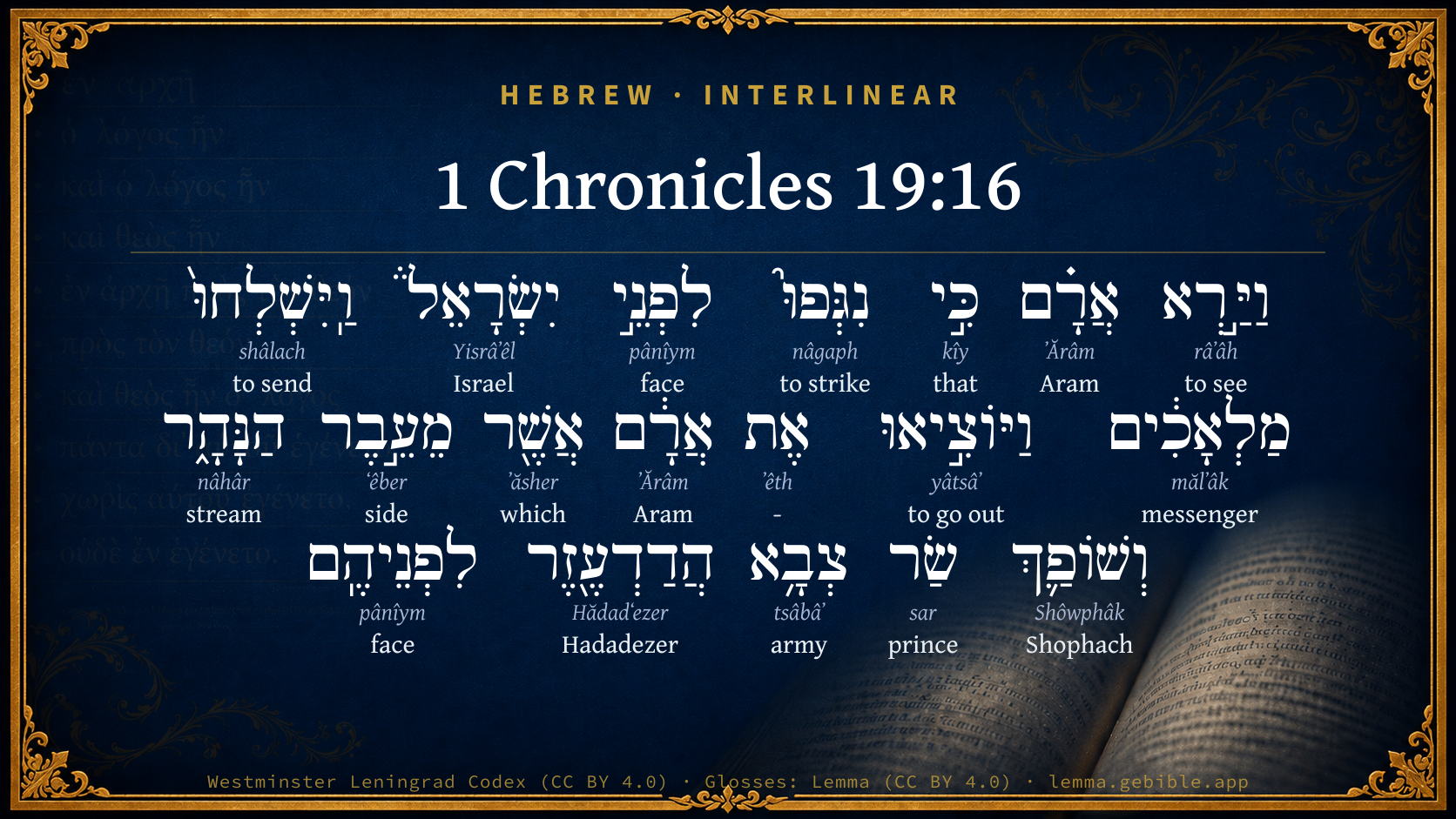
1 Chronicles 19:16

Hebrew (Westminster Leningrad Codex) 1 Chronicles 19:16 appears in the Hebrew Old Testament. The text above is from the Westminster Leningrad Codex. Each word links to its Strong’s number, a concise gloss, and parsing drawn from the Open Scriptures Hebrew Bible morphology. Click any word for its full Brown-Driver-Briggs (BDB) entry.
Download image
Cite this verse

1 Chronicles 19:16 (World English Bible). Public Domain. Lemma interlinear Bible study tool, https://lemma.gebible.app/v/1-chronicles/19/16.

Show BibTeX & RIS
BibTeX
RIS
English Translation
When the Syrians saw that they were put to the worse before Israel, they sent messengers, and drew forth the Syrians who were beyond the River, with Shophach the captain of the host of Hadarezer at their head.
World English Bible · Public Domain
Highlights
  • 1 first appearance in the Hebrew Bible
Full analysis ↓
Download a study sheet

One document with this verse’s original text, its word-by-word gloss line, the meaning frame, cross-references with their text, attributed commentary, and full source and license credits — printable, and it pastes into notes with its structure intact.

This verse Autodidact and up

Study sheet (.html) Plain text (.txt)

A passage Seminary Student

Up to 50 verses in one chapter. A passage sheet keeps up to 6 commentary sources and 12 cross-references per verse, in the order this page ranks them, and says so on the sheet whenever that leaves anything out. Ask for a single verse and you get the Autodidact verse sheet above.

Everything on this page stays free to read, with no account — the sheet is a download of what is already on screen, not access to it.

Want to remove ads? Support Godless Engineer
Compare translations 3

The same verse in 3 English versions, stacked beneath the original-language interlinear above. Click any original word for its lexicon entry.

Each is an independent rendering of the whole verse — the interlinear is not word-aligned to these translations.

Highlighted words mark where these versions differ — a whole-verse word diff, not a word-by-word alignment.

  • World English Bible Public Domain
    When the Syrians saw that they were put to the worse before Israel, they sent messengers, and drew forth the Syrians who were beyond the River, with Shophach the captain of the host of Hadarezer at their head.
  • King James Version Public Domain
    And when the Syrians saw that they were put to the worse before Israel, they sent messengers, and drew forth the Syrians that were beyond the river: and Shophach the captain of the host of Hadarezer went before them.
  • unfoldingWord Literal Text CC BY-SA 4.0
    And Aram saw that they had been defeated to the face of Israel. And they sent messengers, and they brought Aram that from beyond the River and Shophach, the commander of the army of Hadadezer, to their faces.

unfoldingWord Literal Text — © unfoldingWord, licensed CC BY-SA 4.0. Word-aligned USFM3 via Door43 (git.door43.org/unfoldingWord/en_ult).

Versions to compare (up to 4)

3 of 4 selected

Show all 18 translations

Every available English version of this verse, each an independent rendering of the whole verse.

  • World English Bible Public Domain
    When the Syrians saw that they were put to the worse before Israel, they sent messengers, and drew forth the Syrians who were beyond the River, with Shophach the captain of the host of Hadarezer at their head.
  • Berean Standard Bible Public Domain
    When the Arameans saw that they had been defeated by Israel, they sent messengers to bring more Arameans from beyond the Euphrates, with Shophach the commander of Hadadezer’s army leading them.
  • Majority Standard Bible Public Domain
    When the Arameans saw that they had been defeated by Israel, they sent messengers to bring more Arameans from beyond the Euphrates, with Shophach the commander of Hadadezer’s army leading them.
  • King James Version Public Domain
    And when the Syrians saw that they were put to the worse before Israel, they sent messengers, and drew forth the Syrians that were beyond the river: and Shophach the captain of the host of Hadarezer went before them.
  • American Standard Version (1901) Public Domain
    And when the Syrians saw that they were put to the worse before Israel, they sent messengers, and drew forth the Syrians that were beyond the River, with Shophach the captain of the host of Hadarezer at their head.
  • Revised Version (1885) Public Domain
    And when the Syrians saw that they were put to the worse before Israel, they sent messengers, and drew forth the Syrians that were beyond the River, with Shophach the captain of the host of Hadarezer at their head.
  • Geneva Bible (1599) Public Domain
    And when the Aramites sawe that they were discomfited before Israel, they sent messengers and caused the Aramites to come forth that were beyond the riuer: and Shophach the captaine of the hoste of Hadarezer went before them.
  • Douay-Rheims (1899) Public Domain
    But the Syrians seeing that they had fallen before Israel, sent messengers, and brought to them the Syrians that were beyond the river: and Sophach, general of the army of Adarezer, was their leader.
  • Young's Literal Translation Public Domain
    And Aram seeth that they have been smitten before Israel, and send messengers, and bring out Aram that `is' beyond the River, and Shophach head of the host of Hadarezer `is' before them.
  • Literal Standard Version CC BY-SA 4.0
    And Aram sees that they have been struck before Israel, and send messengers, and bring out Aram that [is] beyond the River, and Shophach head of the host of Hadarezer [is] before them.
  • Unlocked Literal Bible CC BY-SA 4.0
    When the Arameans saw that they were being defeated by Israel, they sent for reinforcements from beyond the Euphrates River, with Shophak the commander of Hadadezer's army.
  • unfoldingWord Literal Text CC BY-SA 4.0
    And Aram saw that they had been defeated to the face of Israel. And they sent messengers, and they brought Aram that from beyond the River and Shophach, the commander of the army of Hadadezer, to their faces.
  • Darby Bible Public Domain
    And when the Syrians saw that they were routed before Israel, they sent messengers, and drew forth the Syrians that were beyond the river; and Shophach the captain of the host of Hadarezer [went] before them.
  • World Messianic Bible Public Domain
    When the Syrians saw that they were defeated by Israel, they sent messengers and called out the Syrians who were beyond the River, with Shophach the captain of the army of Hadadezer leading them.
  • Webster's Bible Public Domain
    And when the Syrians saw that they were defeated before Israel, they sent messengers, and drew forth the Syrians that were beyond the river: and Shophach the captain of the host of Hadarezer went before them.
  • Free Bible Version CC BY-SA 4.0
    As soon as the Arameans saw they had been defeated by the Israelites they sent for reinforcements from the other side of the Euphrates River, under the leadership of Shobach, commander of Hadadezer's army.
  • Bible in Basic English Public Domain
    And when the Aramaeans saw that Israel had overcome them, they sent men to get the Aramaeans who were on the other side of the River, with Shophach, the captain of Hadadezer's army, at their head.
  • JPS Tanakh (1917) Public Domain
    And when the Arameans saw that they were put to the worse before Israel, they sent messengers, and brought out the Arameans that were beyond the River, with Shophach the captain of the host of Hadarezer at their head.

Literal Standard Version (2020), Covenant Press — licensed CC BY-SA 4.0. Text via the HelloAO Bible API (eBible.org). Unlocked Literal Bible (unfoldingWord) — licensed CC BY-SA 4.0. Text via the HelloAO Bible API (eBible.org). unfoldingWord Literal Text — © unfoldingWord, licensed CC BY-SA 4.0. Word-aligned USFM3 via Door43 (git.door43.org/unfoldingWord/en_ult). Free Bible Version, Dr. Jonathan Gallagher — licensed CC BY-SA 4.0. Text via the HelloAO Bible API (eBible.org).

Word by word

More ways to search: Search by grammar → Find every occurrence → Compare this word →

Practice this passage: Drill this verse → Learn its vocabulary →

וְשׁוֹפַ֛ךְ
Shôwphâk
H7780
“and · Shophach”
Conjunction + Noun, Proper
Part of Speech
Conjunction + Noun
Type
Proper
Full BDB Definition

Origin: from H8210

TWOT: None

Shophach = "expansion" - the general of Hadarezer - also 'Shobach'
  1. וַיַּ֣רְא râʼâh H7200 “and · to see” Conjunction + Verb, Qal, Sequential Imperfect, 3rd Person, Masculine, Singular
  2. אֲרָ֗ם ʼĂrâm H758 “Aram” Noun, Proper
  3. כִּ֣י kîy H3588 “that” Conjunction
  4. נִגְּפוּ֮ nâgaph H5062 “to strike” Verb, Niphal, Perfect, 3rd Person, Common, Plural
  5. לִפְנֵ֣י pânîym H6440 “to/for · face(s) of” Preposition + Noun, Common, Both, Plural, Construct
  6. יִשְׂרָאֵל֒ Yisrâʼêl H3478 “Israel” Noun, Proper
  7. וַֽיִּשְׁלְחוּ֙ shâlach H7971 “and · to send” Conjunction + Verb, Qal, Sequential Imperfect, 3rd Person, Masculine, Plural
  8. מַלְאָכִ֔ים mălʼâk H4397 “messengers” Noun, Common, Masculine, Plural, Absolute
  9. וַיּוֹצִ֣יאוּ yâtsâʼ H3318 “and · to go out” Conjunction + Verb, Hiphil, Sequential Imperfect, 3rd Person, Masculine, Plural
  10. אֶת ʼêth H853 “-” Particle, Direct Object
  11. אֲרָ֔ם ʼĂrâm H758 “Aram” Noun, Proper
  12. אֲשֶׁ֖ר ʼăsher H834 “which” Particle, Relative
  13. מֵעֵ֣בֶר ʻêber H5676 “from · side of” Preposition + Noun, Common, Masculine, Singular, Construct
  14. הַנָּהָ֑ר nâhâr H5104 “the · stream” Particle, Definite Article + Noun, Common, Masculine, Singular, Absolute
  15. שַׂר sar H8269 “prince of” Noun, Common, Masculine, Singular, Construct
  16. צְבָ֥א tsâbâʼ H6635 “army of” Noun, Common, Both, Singular, Construct
  17. הֲדַדְעֶ֖זֶר Hădadʻezer H1909 “Hadadezer” Noun, Proper
  18. לִפְנֵיהֶֽם pânîym H6440 “to/for · face(s) · their” Preposition + Noun, Common, Both, Plural, Construct + Suffix, Personal, 3rd Person, Masculine, Plural

About this verse

These counts appear in no published source. They are computed here, from the morphology-tagged text and Lemma’s own curated glosses. What Lemma adds →

19
words
17
distinct lemmas
Historical
section

Notable vocabulary

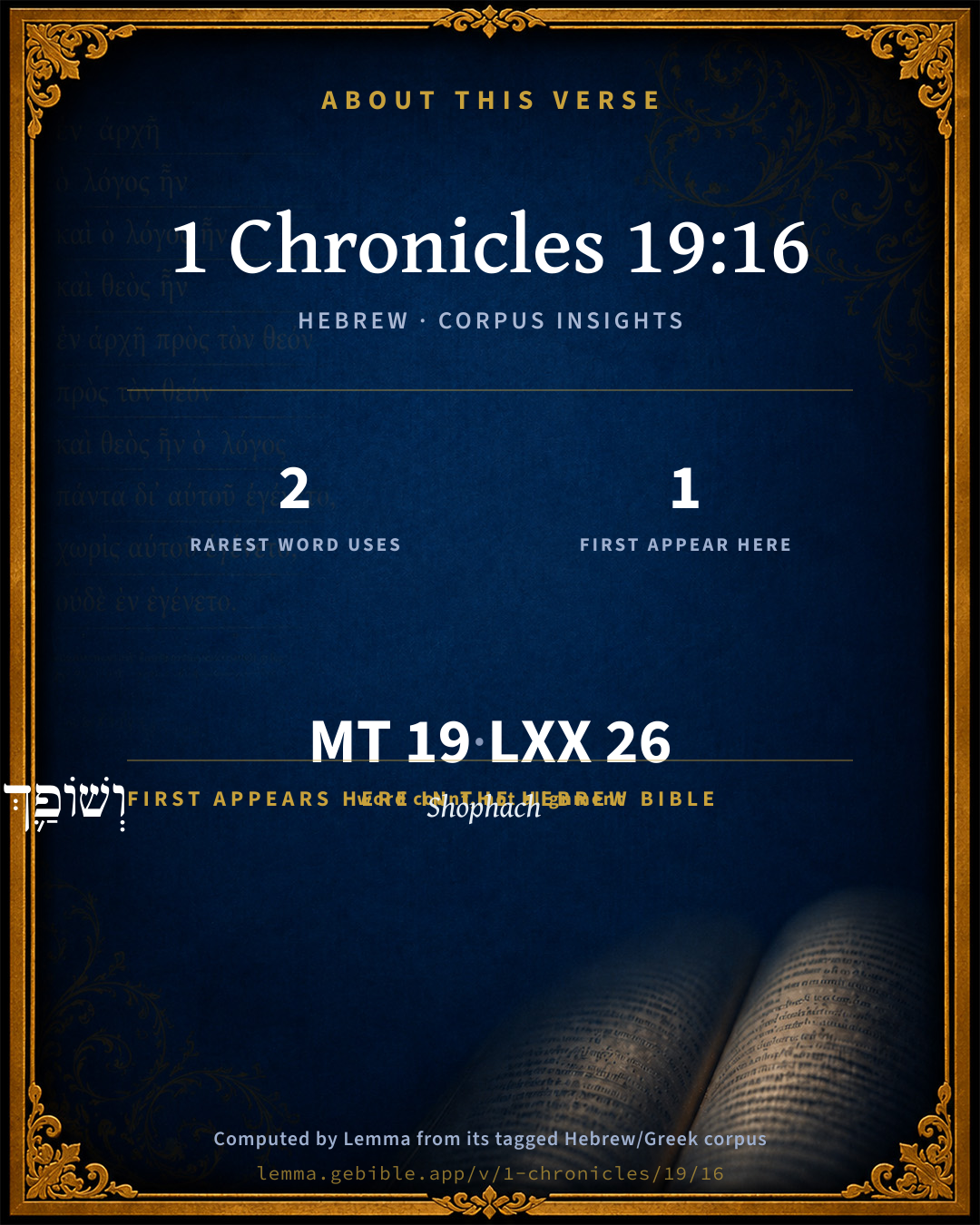
The rarest word here is וְשׁוֹפַ֛ךְ Shophach H7780 — appearing just 2 times in the whole Hebrew Bible.

First appearance in Scripture

This word makes its first canonical appearance in the Hebrew Bible here:

  • וְשׁוֹפַ֛ךְ Shophach H7780

Shared distinctive vocabulary

וְשׁוֹפַ֛ךְ Shophach H7780 occurs in 2 verses of the Hebrew Bible. Also found in:

Grammatical profile

  • 4 verbs
  • 12 nouns
  • 1 conjunction
  • 2 particles

Verb forms

  • וַיַּ֣רְא Qal · Sequential Imperfect
  • נִגְּפוּ֮ Niphal · Perfect
  • וַֽיִּשְׁלְחוּ֙ Qal · Sequential Imperfect
  • וַיּוֹצִ֣יאוּ Hiphil · Sequential Imperfect

Repetition

Words recur within this verse — often emphatic in Hebrew:

  • אֲרָ֗ם Aram H758 ×2
  • לִפְנֵ֣י face H6440 ×2

Hebrew & Septuagint length

In English translation the verse runs 38 words from the Hebrew and 35 from the Septuagint (LXX English) — closely comparable.

A rough comparison of the two English renderings, which tokenize alike — not a word-level alignment.

Word counts can differ between the Hebrew and the Greek without any difference in meaning — e.g. the Hebrew direct-object marker אֵת has no separate Greek word, and Greek often adds the article ὁ.

In the original languages it is 19 Hebrew tokens and 26 Greek tokens — but the two are counted differently (Hebrew bundles its prefixes and suffixes into one token; the Greek is in lemma form), so that isn’t a like-for-like length.

Cross-references

5

Topical passages linked to 1 Chronicles 19:16 in the Treasury of Scripture Knowledge — connected by theme and wording, ordered by reader-vote popularity; previews shown in the World English Bible.

  • 2 Samuel 10:16 Hadarezer sent, and brought out the Syrians who were beyond the River: and they came to Helam, with Shobach the captain of the host of Hadarezer at their head.
  • Zechariah 14:1–3 Behold, a day of Yahweh comes, when your spoil will be divided in your midst.
  • Psalms 2:1 Why do the nations rage, And the peoples plot a vain thing?
  • Isaiah 8:9 Make an uproar, O you peoples, and be broken in pieces! And give ear, all you of far countries: gird yourselves, and be broken in pieces! Gird yourselves, and be broken in pieces!
  • Micah 4:11–12 Now many nations have assembled against you, that say, 'Let her be defiled, And let our eye gloat over Zion.'

Cross-references courtesy of OpenBible.info (CC BY 4.0).

Hebrew and Greek witnesses Masoretic Hebrew ↔ Greek Septuagint

The same verse in the two great witnesses to the Old Testament, shown verse-for-verse.

These are two independent witnesses, not word-aligned to each other, and the Septuagint is shown in lemma (dictionary) form.

Hebrew 1 Chronicles 19:16 Masoretic · Westminster Leningrad Codex

וַיַּ֣רְא אֲרָ֗ם כִּ֣י נִגְּפוּ֮ לִפְנֵ֣י יִשְׂרָאֵל֒ וַֽיִּשְׁלְחוּ֙ מַלְאָכִ֔ים וַיּוֹצִ֣יאוּ אֶת אֲרָ֔ם אֲשֶׁ֖ר מֵעֵ֣בֶר הַנָּהָ֑ר וְשׁוֹפַ֛ךְ שַׂר צְבָ֥א הֲדַדְעֶ֖זֶר לִפְנֵיהֶֽם

When the Syrians saw that they were put to the worse before Israel, they sent messengers, and drew forth the Syrians who were beyond the River, with Shophach the captain of the host of Hadarezer at their head.

World English Bible · Public Domain

Greek LXX 1 Chronicles 19:16 Septuagint · lemma form

καί ὁράω σύρος ὅτι τροπόω αὐτός ἰσραήλ καί ἀποστέλλω ἄγγελος καί ἐκἄγω ὁ σύρος ἐκ ὁ πέραν ὁ ποταμός καί σωφαχ ἀρχιστράτηγος δύναμις αδρααζαρ ἔμπροσθεν αὐτός

And the Syrian saw that Israel had defeated him, and he sent messengers, and they brought out the Syrians from beyond the river; and Sophath the commander-in-chief of the forces of Adraazar was before them.

LXX2012 (modern English Septuagint) · Public Domain

Hebrew: Westminster Leningrad Codex (CC BY 4.0). Greek: Septuagint (public domain); English from LXX2012 (modern English Septuagint) (Public Domain). How the Septuagint differs from the Hebrew →

Commentary

Notes on 1 Chronicles 19:16 from classic Christian and Jewish commentators (each source and its license shown beneath its notes). The classic Christian expositions comment on the surrounding passage and are grouped to its opening verse, so a note may address several verses; the Jewish commentaries on the Tanakh (Rashi and others) are per-verse, so they appear only where the commentator wrote on this verse.

Lemma curates 59 commentaries, every one of them public domain or Creative Commons licensed, each selected and text-cleaned for this edition rather than reprinted as found. About our sources →

Jamieson, Fausset & Brown

Robert Jamieson, A. R. Fausset & David Brown

SHOPHACH SLAIN BY DAVID. (Ch1 19:16-19)

And when the Syrians saw that they were put to the worse before Israel--(See on Sa2 10:15-19).

Jamieson, Fausset & Brown — Commentary Critical and Explanatory on the Whole Bible (1871) — public domain (CC PDM 1.0). Text via the HelloAO Bible API.

The Cambridge Bible for Schools and Colleges

gen. ed. J. J. S. Perowne

16. the Syrians that were beyond the river] i.e. the Syrians of “Mesopotamia”; cp. 1Ch_19:6, note. 2Sa_10:16 adds, and they came to Helam; the position of Helam however is unknown, but it was probably not far from the Euphrates.

Shophach] In 2Sa_10:16 called “Shobach.” The whole allied army was united under one general.

16–19. The End of the Aramaean War

Three stages are apparent in the war with Zobah, (a) that in which David secured a position on the Euphrates, 1Ch_18:3-8, (b) the stage during which troops from Zobah acted as auxiliaries to the Ammonites, 1Ch_19:6-15, (c) the final stage which ended la the conclusion of a formal peace, ib. 1Ch_19:16-19.

The Cambridge Bible for Schools and Colleges (gen. ed. J. J. S. Perowne; Cambridge University Press, 1878–1918) — public domain. Text from a community e-Sword module.

The Biblical Illustrator

Joseph S. Exell

1Ch_19:16-18

Now when Joab saw that the battle was set against him.

The war-cry

I. The purpose for which they fought.

II. The method in which they fought.

1. A wise economy of forces.

2. A determination to render mutual help.

III. The spirit in which they fought.

1. Of exalted courage.

2. Of true patriotism.

3. Of submission to God. (J. Wolfendale.)

The Biblical Illustrator, edited by Joseph S. Exell (c. 1880s–1900s) — public domain. Text from a community e-Sword module.

Tyndale Open Study Notes

Tyndale Open Resources

19:16-19 In the battle against the Arameans, David accomplished three objectives: He challenged Hadadezer’s supremacy, threw the alliance of the Arameans into disarray, and prevented any possible future alliance between the Arameans and the Ammonites.

Tyndale Open Study Notes — © Tyndale Open Resources, licensed CC BY-SA 4.0. Text via the HelloAO Bible API.

Geneva Bible (1599)

Geneva Bible translators

That is, Euphrates.

Geneva Bible (1599) marginal notes — public domain. Text via Bolls.life.

Ellicott's Commentary for English Readers

(16) They sent messengers.—Samuel, “Hadarezer sent and drew forth” (literally, made to come out: i.e., to war, 1Ch_20:1). The name “Hadarezer” (Hadadezer) is important, as helping us to identify this campaign with that of 1Ch_18:3-8.

Beyond the river.—The Euphrates, called Purât, Purâtu, by the Babylonians and Assyrians, Furât by the Arabs, and Ufrâtus by the ancient Persians. The name is derived from the Accadian Pura-nunu (great river). The Assyrian Purât, Hebrew Pĕrâth, is simply the word Pura with a feminine ending; so that this well-known name means “The River par excellence. (Comp. Gen_15:18; Isa_8:7.)

The use of this phrase, “beyond the river,” to denote the position of the Eastern Aramæans, shows that the narrative here borrowed by the chronicler was originally written in Palestine. The Syriac and Arabic add here, “and they came to Hîlâm.” (So Samuel; see next verse.)

Shophach.—Samuel, “Shobach.” The letters p and b are much alike in Hebrew. The Syriac has Sh’bûk. Shophach may be compared with the Arabic safaka, “to shed blood” (saffâk, a shedder of blood).

Went before them.—Commanded them. It thus appears that the suzerainty of Hadadezer was recognised by some Aramæan States lying east of the Euphrates.

(16-19) The last effort of the Arameans. They are defeated, and become vassals to David.

A Bible Commentary for English Readers, edited by Charles John Ellicott (1878–1897) — public domain. Text from a community e-Sword module.

Haydock's Catholic Bible Commentary

River, in Mesopotamia. Joab did not allow them time to arrive. --- Sophach, or Sobac. Adarezer sent also to collect these forces, 2 Kings.

George Leo Haydock (1774–1849), Haydock's Catholic Family Bible and Commentary, 1859 edition — public domain. Excludes Psalms (Douay-Rheims chapter numbering differs from Protestant) and Deuterocanonical books (Catholic canon only).

The Pulpit Commentary

Beyond the river; i.e. the river Euphrates. Shophach. In the parallel place spelt Shobach. Of him nothing else is known except his death, as recorded in ver. 18 and in 2Sa_10:18.

The Pulpit Commentary (1880–1919), ed. H.D.M. Spence-Jones & Joseph S. Exell — public domain. Text from a community e-Sword module.

Kretzmann's Popular Commentary

Paul E. Kretzmann

The Syrians Overthrown

v. 16. And when the Syrians saw that they were put to the worse before Israel, they sent messengers and drew forth the Syrians that were beyond the river, those from Mesopotamia proper, who had not come down for this campaign; and Shophach (or Shobach), the captain of the host of Hadarezer, went before them, as commander-in-chief of the united Syrian forces.

v. 17. And it was told David; and he gathered all Israel, the entire military forces of his realm, and passed over Jordan, and came upon them, evidently as they were approaching to attack him, and set the battle in array against them. This was at Helam, 2Sa 10:16-17. So when David had put the battle in array against the Syrians, they fought with him.

v. 18. But the Syrians fled before Israel; and David slew of the Syrians seven thousand men which fought in chariots, and forty thousand footmen, and killed Shophach, the captain of the host. In combining this account with that of 2Sa 10:18, we have the total list of those destroyed: 7,000 chariots, 7,000 horsemen, and 40,000 footmen.

v. 19. And when the servants of Hadarezer saw that they were put to the worse before Israel, that they were utterly defeated, having no chance to stand up before David’s men, they made peace with David and became his servants, tributary vassals once more; neither would the Syrians help the children of Ammon any more, Thus the Lord crowns the labor of His believers with success, He lets their battles result in victory, all for the honor of His name, even if the spiritual victories are not always apparent to human eyes.

Paul E. Kretzmann, Popular Commentary of the Bible (1921–1924) — public domain. Text from a community e-Sword module.

unfoldingWord translationNotes

Door43 World Missions Community

General Information:

Verses 16-19 describes a second battle when the Arameans who fled from Joab in 1 Chronicles 19:15 were reinforced by other Arameans and attacked Israel again.

the Arameans saw

What the Arameans understood is spoken of as what they saw. AT: "the Arameans understood" (See: Metonymy)

sent for reinforcements

"requested more soliders"

Shophak ... Hadadezer

These are the names of men. (See: How to Translate Names)

When David was told this

This can be stated in active form. AT: When David's messengers told him that a larger Aramean army was coming" (See: Active or Passive)

he gathered ... He arranged

David did not do these things alone. His official and officers helped him. AT: "David and his officials gathered ... David and his officers arranged" (See: Synecdoche)

all Israel

This is a generalization. Not every person in Israel came to fight. AT: "a very large number of Israelites" (See: Hyperbole and Generalization)

He arranged

"He organized"

they fought him

Here "him" refers to David's soldiers, in addition to David. AT: "the Arameans fought David and his soldiers" (See: Synecdoche)

translationWords

Euphrates River

commander

Jordan River

unfoldingWord translationNotes — © Distant Shores Media and the Door43 World Missions Community, licensed CC BY-SA 4.0. Source: git.door43.org/Door43/en_tn.

Rashi

Rabbi Shlomo Yitzchaki (Rashi)

and Shophach the general And in Samuel (ad loc.) it is written: “and Shobach the general.” Our Rabbis explained in Sotah (42b): “Shobach, because he was as tall as a dovecote (שׁוֹבָךְ). Shophach, because he would shed (שׁוֹפֵךְ) blood like water.”

Rashi on the Tanakh — English translations: “The Judaica Press complete Tanach with Rashi, translated by A. J. Rosenberg” (CC BY 4.0); “Pentateuch with Rashi's commentary by M. Rosenbaum and A.M. Silbermann, 1929-1934” (public domain); “The Metsudah Tanach series, Lakewood, N.J” (CC BY 4.0); and “The Book of Joshua, Metsudah Publications, 1997” (CC BY 4.0). Text via Sefaria.

Lesson kit

Teaching starters — assembled from the data on this page, not authored interpretation. Every prompt links to the verse data it draws on. Edit before teaching.

1 Chronicles, in the Historical, opens this verse with 19 words (17 distinct Hebrew lemmas). Its most distinctive word is Shôwphâk (“Shophach”). A historical commentator’s framing appears above. Read the whole chapter for the surrounding context.

Discussion questions

  1. How does “Shophach” (Shôwphâk) shape what this verse is saying?
  2. The word “Shophach” first appears here in Scripture. What is being introduced at this debut?
  3. 1 Chronicles 19:18 shares the word «Shophach» with this verse. How do the two illuminate each other?
  4. “Aram” occurs 2× in this one verse. What is the effect of the repetition?
  5. These translations render this verse differently; the difference is in the English rendering, not the original. What questions does that raise?
  6. The verb «וַיַּ֣רְא» is Qal Sequential Imperfect. How does its form color the action?
  7. Reading how Jamieson, Fausset & Brown and The Cambridge Bible for Schools and Colleges read this verse, where do the two commentators agree and where do they part?

Things to notice

Reading settings

Reading text

Shown beneath each verse's original-language words.

Old Testament
Old Testament edition

Read the OT as the Masoretic Hebrew (MT) or the Greek Septuagint (LXX).

English shown for the Greek Septuagint (in the Hebrew ↔ Greek comparison).

Comparing translations? Open the Compare panel on any verse page to stack up to four side by side.