
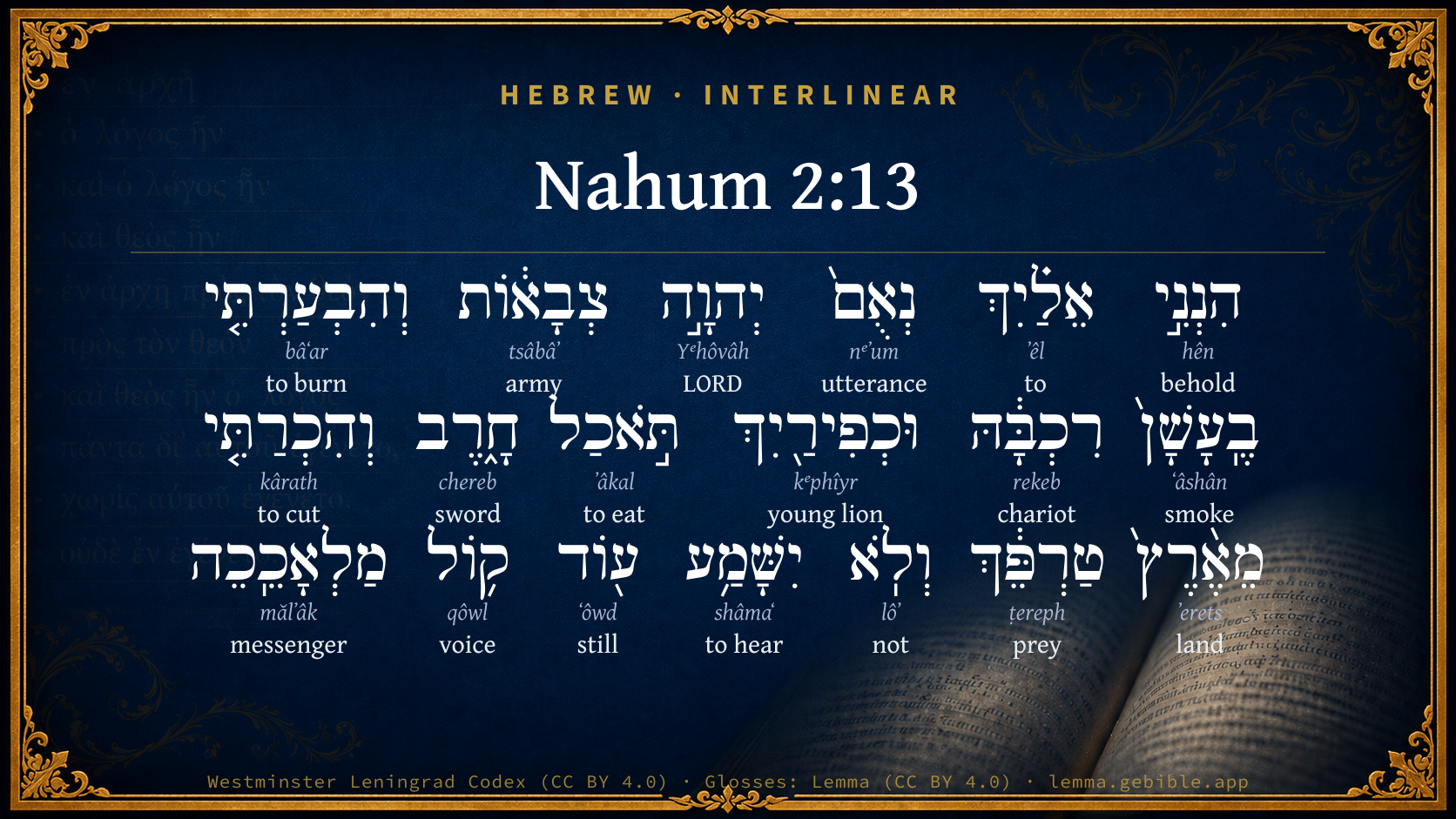
Nahum 2:13

Hebrew (Westminster Leningrad Codex) Nahum 2:13 appears in the Hebrew Old Testament. The text above is from the Westminster Leningrad Codex. Each word links to its Strong’s number, a concise gloss, and parsing drawn from the Open Scriptures Hebrew Bible morphology. Click any word for its full Brown-Driver-Briggs (BDB) entry.
Download image
Cite this verse

Nahum 2:13 (World English Bible). Public Domain. Lemma interlinear Bible study tool, https://lemma.gebible.app/v/nahum/2/13.

Show BibTeX & RIS
BibTeX
RIS
English Translation
"Behold, I am against you," says Yahweh of Hosts, "and I will burn her chariots in the smoke, and the sword will devour your young lions; and I will cut off your prey from the earth, and the voice of your messengers will no longer be heard."
World English Bible · Public Domain
Download a study sheet

One document with this verse’s original text, its word-by-word gloss line, the meaning frame, cross-references with their text, attributed commentary, and full source and license credits — printable, and it pastes into notes with its structure intact.

This verse Autodidact and up

Study sheet (.html) Plain text (.txt)

A passage Seminary Student

Up to 50 verses in one chapter. A passage sheet keeps up to 6 commentary sources and 12 cross-references per verse, in the order this page ranks them, and says so on the sheet whenever that leaves anything out. Ask for a single verse and you get the Autodidact verse sheet above.

Everything on this page stays free to read, with no account — the sheet is a download of what is already on screen, not access to it.

Want to remove ads? Support Godless Engineer
Compare translations 3

The same verse in 3 English versions, stacked beneath the original-language interlinear above. Click any original word for its lexicon entry.

Each is an independent rendering of the whole verse — the interlinear is not word-aligned to these translations.

Highlighted words mark where these versions differ — a whole-verse word diff, not a word-by-word alignment.

  • World English Bible Public Domain
    "Behold, I am against you," says Yahweh of Hosts, "and I will burn her chariots in the smoke, and the sword will devour your young lions; and I will cut off your prey from the earth, and the voice of your messengers will no longer be heard."
  • King James Version Public Domain
    Behold, I am against thee, saith the LORD of hosts, and I will burn her chariots in the smoke, and the sword shall devour thy young lions: and I will cut off thy prey from the earth, and the voice of thy messengers shall no more be heard.
  • unfoldingWord Literal Text CC BY-SA 4.0
    “Behold me, against you—the declaration of Yahweh of armies— I will burn her chariot in the smoke, and the sword will devour your young lions. I will cut off your prey from your land, and the voices of your messengers will be heard no more.”

unfoldingWord Literal Text — © unfoldingWord, licensed CC BY-SA 4.0. Word-aligned USFM3 via Door43 (git.door43.org/unfoldingWord/en_ult).

Versions to compare (up to 4)

3 of 4 selected

Show all 18 translations

Every available English version of this verse, each an independent rendering of the whole verse.

  • World English Bible Public Domain
    "Behold, I am against you," says Yahweh of Hosts, "and I will burn her chariots in the smoke, and the sword will devour your young lions; and I will cut off your prey from the earth, and the voice of your messengers will no longer be heard."
  • Berean Standard Bible Public Domain
    “Behold, I am against you,” declares the LORD of Hosts. “I will send your chariots up in smoke, and the sword will devour your young lions. I will cut off your prey from the earth, and the voices of your messengers will no longer be heard.”
  • Majority Standard Bible Public Domain
    “Behold, I am against you,” declares the LORD of Hosts. “I will reduce your chariots to cinders, and the sword will devour your young lions. I will cut off your prey from the earth, and the voices of your messengers will no longer be heard.”
  • King James Version Public Domain
    Behold, I am against thee, saith the LORD of hosts, and I will burn her chariots in the smoke, and the sword shall devour thy young lions: and I will cut off thy prey from the earth, and the voice of thy messengers shall no more be heard.
  • American Standard Version (1901) Public Domain
    Behold, I am against thee, saith Jehovah of hosts, and I will burn her chariots in the smoke, and the sword shall devour thy young lions; and I will cut off thy prey from the earth, and the voice of thy messengers shall no more be heard.
  • Revised Version (1885) Public Domain
    Behold, I am against thee, saith the LORD of hosts, and I will burn her chariots in the smoke, and the sword shall devour thy young lions: and I will cut off thy prey from the earth, and the voice of thy messengers shall no more be heard.
  • Geneva Bible (1599) Public Domain
    Beholde, I come vnto thee, sayeth the Lord of hostes, and I will burne her charets in the smoke, and the sworde shall deuoure thy yong lyons, and I will cut off thy spoyle from the earth, and the voyce of thy messengers shall no more be heard.
  • Douay-Rheims (1899) Public Domain
    Behold I come against thee, saith the Lord of hosts, and I will burn thy chariots even to smoke, and the sword shall devour thy young lions: and I will cut off thy prey out of the land, and the voice of thy messengers shall be heard no more.
  • Young's Literal Translation Public Domain
    Lo, I `am' against thee, An affirmation of Jehovah of Hosts, And I have burned in smoke its chariot, And thy young lions consume doth a sword, And I have cut off from the land thy prey, And not heard any more is the voice of thy messengers!
  • Literal Standard Version CC BY-SA 4.0
    “Behold, I [am] against you,” || A declaration of YHWH of Hosts, || “And I have burned its chariot in smoke, || And a sword consumes your young lions, || And I have cut off your prey from the land, || And the voice of your messengers is not heard anymore!”
  • Unlocked Literal Bible CC BY-SA 4.0
    “See, I am against you—this is the declaration of Yahweh of hosts. I will burn your chariots in the smoke, and the sword will devour your young lions. I will cut off your prey from your land, and the voices of your messengers will be heard no more.”
  • unfoldingWord Literal Text CC BY-SA 4.0
    “Behold me, against you—the declaration of Yahweh of armies— I will burn her chariot in the smoke, and the sword will devour your young lions. I will cut off your prey from your land, and the voices of your messengers will be heard no more.”
  • Darby Bible Public Domain
    Behold, I am against thee, saith Jehovah of hosts: and I will burn her chariots into smoke; and the sword shall devour thy young lions, and I will cut off thy prey from the earth; and the voice of thy messengers shall no more be heard.
  • World Messianic Bible Public Domain
    “Behold, I am against you,” says the LORD of Hosts, “and I will burn her chariots in the smoke, and the sword will devour your young lions; and I will cut off your prey from the earth, and the voice of your messengers will no longer be heard.”
  • Webster's Bible Public Domain
    \\2:12\\The lion tore in pieces enough for his whelps, and strangled for his lionesses, and filled his holes with prey, and his dens with ravin.
  • Free Bible Version CC BY-SA 4.0
    Watch out! For I am against you, declares the Lord Almighty. I will set fire to your chariots and they will go up in smoke. Your strong young men will be killed by the sword. I will stop you plundering other peoples. The demands of your ambassadors will no longer be heard.
  • Bible in Basic English Public Domain
    Food enough for his young and for his she-lions was pulled down by the lion; his hole was full of flesh and his resting-place stored with meat.
  • JPS Tanakh (1917) Public Domain
    (2-14) Behold, I am against thee, saith the LORD of hosts, and I will burn her chariots in the smoke, and the sword shall devour thy young lions; and I will cut off thy prey from the earth, and the voice of thy messengers shall no more be heard.

Literal Standard Version (2020), Covenant Press — licensed CC BY-SA 4.0. Text via the HelloAO Bible API (eBible.org). Unlocked Literal Bible (unfoldingWord) — licensed CC BY-SA 4.0. Text via the HelloAO Bible API (eBible.org). unfoldingWord Literal Text — © unfoldingWord, licensed CC BY-SA 4.0. Word-aligned USFM3 via Door43 (git.door43.org/unfoldingWord/en_ult). Free Bible Version, Dr. Jonathan Gallagher — licensed CC BY-SA 4.0. Text via the HelloAO Bible API (eBible.org).

Word by word

More ways to search: Search by grammar → Find every occurrence → Compare this word →

Practice this passage: Drill this verse → Learn its vocabulary →

טַרְפֵּ֔ךְ
ṭereph
H2964
“prey · your”
Noun, Common, Masculine, Singular, Construct + Suffix, Personal, 2nd Person, Feminine, Singular
Part of Speech
Noun
Type
Common
Gender
Masculine
Number
Singular
State
Construct
Full BDB Definition

Origin: from H2963

TWOT: 827b

prey, food, leaf - prey - food - leaf
  1. הִנְנִ֣י hên H2005 “behold · me” Particle, Demonstrative + Suffix, Personal, 1st Person, Common, Singular
  2. אֵלַ֗יִךְ ʼêl H413 “to · you” Preposition + Suffix, Personal, 2nd Person, Feminine, Singular
  3. נְאֻם֙ nᵉʼum H5002 “utterance of” Noun, Common, Masculine, Singular, Construct
  4. יְהוָ֣ה Yᵉhôvâh H3068 “LORD” Noun, Proper
  5. צְבָא֔וֹת tsâbâʼ H6635 “armies” Noun, Common, Both, Plural, Absolute
  6. וְהִבְעַרְתִּ֤י bâʻar H1197 “and · to burn” Conjunction + Verb, Hiphil, Perfect, 1st Person, Common, Singular
  7. בֶֽעָשָׁן֙ ʻâshân H6227 “in/at the · smoke” Preposition, Determined + Noun, Common, Masculine, Singular, Absolute
  8. רִכְבָּ֔הּ rekeb H7393 “chariot · her” Noun, Common, Masculine, Singular, Construct + Suffix, Personal, 3rd Person, Feminine, Singular
  9. וּכְפִירַ֖יִךְ kᵉphîyr H3715 “and · young lions · your” Conjunction + Noun, Common, Masculine, Plural, Construct + Suffix, Personal, 2nd Person, Feminine, Singular
  10. תֹּ֣אכַל ʼâkal H398 “to eat” Verb, Qal, Imperfect, 3rd Person, Feminine, Singular
  11. חָ֑רֶב chereb H2719 “sword” Noun, Common, Feminine, Singular, Absolute
  12. וְהִכְרַתִּ֤י kârath H3772 “and · to cut” Conjunction + Verb, Hiphil, Sequential Perfect, 1st Person, Common, Singular
  13. מֵאֶ֨רֶץ֙ ʼerets H776 “from · land” Preposition + Noun, Common, Both, Singular, Absolute
  14. וְלֹֽא lôʼ H3808 “and · not” Conjunction + Particle, Negative
  15. יִשָּׁמַ֥ע shâmaʻ H8085 “to hear” Verb, Niphal, Imperfect, 3rd Person, Masculine, Singular
  16. ע֖וֹד ʻôwd H5750 “still” Adverb
  17. ק֥וֹל qôwl H6963 “voice of” Noun, Common, Masculine, Singular, Construct
  18. מַלְאָכֵֽכֵה mălʼâk H4397 “messengers · your” Noun, Common, Masculine, Plural, Construct + Suffix, Personal, 2nd Person, Feminine, Singular

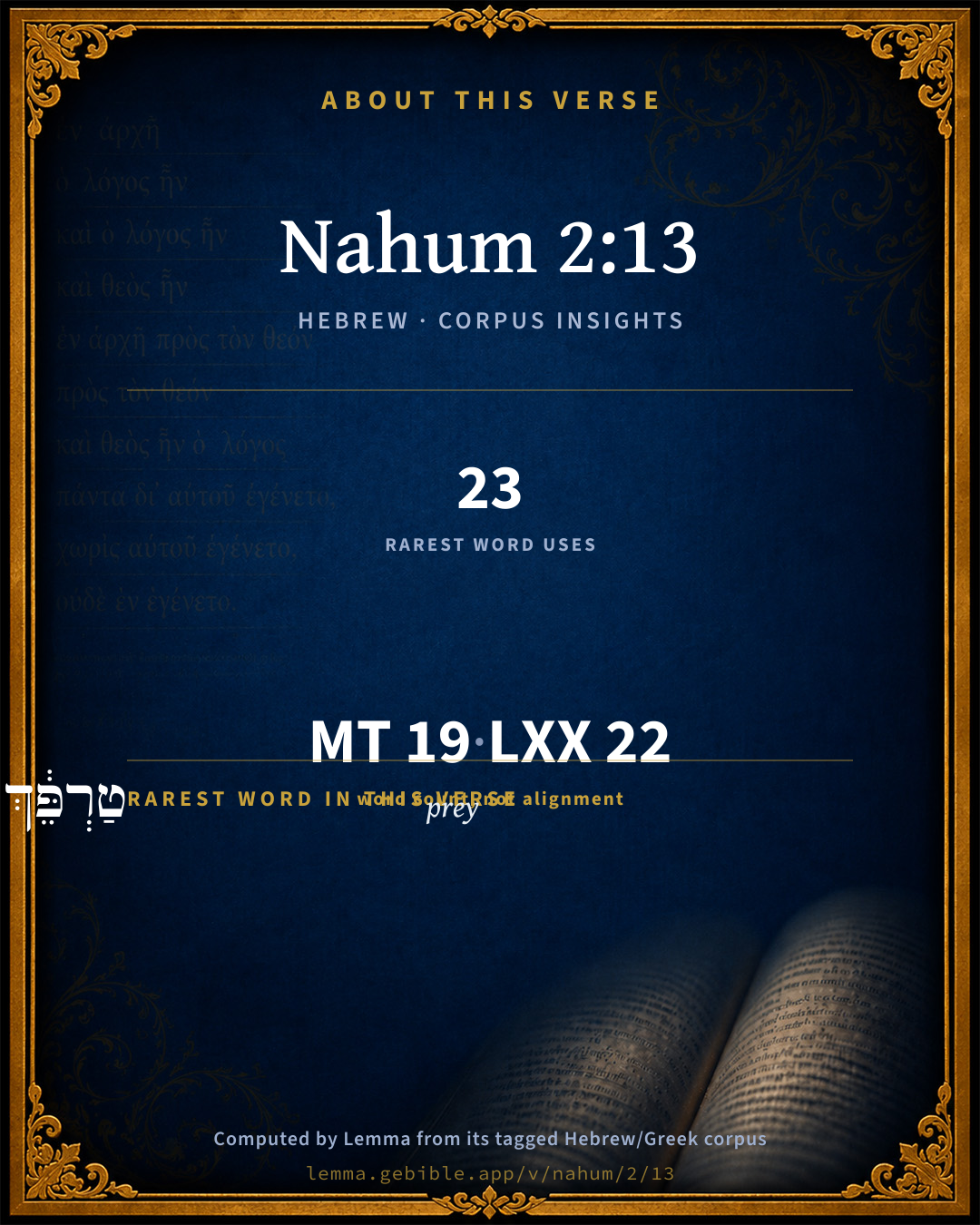
About this verse

These counts appear in no published source. They are computed here, from the morphology-tagged text and Lemma’s own curated glosses. What Lemma adds →

19
words
19
distinct lemmas
Prophets
section

Notable vocabulary

The rarest word here is טַרְפֵּ֔ךְ prey H2964 — appearing just 23 times in the whole Hebrew Bible.

Shared distinctive vocabulary

טַרְפֵּ֔ךְ prey H2964 occurs in 23 verses of the Hebrew Bible. Also found in:

Grammatical profile

  • 4 verbs
  • 11 nouns
  • 1 preposition
  • 1 adverb
  • 2 particles

Verb forms

  • וְהִבְעַרְתִּ֤י Hiphil · Perfect
  • תֹּ֣אכַל Qal · Imperfect
  • וְהִכְרַתִּ֤י Hiphil · Sequential Perfect
  • יִשָּׁמַ֥ע Niphal · Imperfect

Hebrew & Septuagint length

In English translation the verse runs 47 words from the Hebrew and 48 from the Septuagint (LXX English) — closely comparable.

A rough comparison of the two English renderings, which tokenize alike — not a word-level alignment.

Word counts can differ between the Hebrew and the Greek without any difference in meaning — e.g. the Hebrew direct-object marker אֵת has no separate Greek word, and Greek often adds the article ὁ.

In the original languages it is 19 Hebrew tokens and 22 Greek tokens — but the two are counted differently (Hebrew bundles its prefixes and suffixes into one token; the Greek is in lemma form), so that isn’t a like-for-like length.

Cross-references

27

Topical passages linked to Nahum 2:13 in the Treasury of Scripture Knowledge — connected by theme and wording, ordered by reader-vote popularity; previews shown in the World English Bible.

  • Psalms 46:9 He makes wars cease to the end of the earth. He breaks the bow, and shatters the spear. He burns the chariots in the fire.
  • Jeremiah 21:13 Behold, I am against you, O inhabitant of the valley, [and] of the rock of the plain, says Yahweh; you that say, Who shall come down against us? or who shall enter into our habitations?
  • Nahum 3:5 "Behold, I am against you," says Yahweh of Hosts, "and I will lift your skirts over your face. I will show the nations your nakedness, and the kingdoms your shame.
  • 2 Kings 19:23 By your messengers you have defied the Lord, and have said, With the multitude of my chariots am I come up to the height of the mountains, to the innermost parts of Lebanon; and I will cut down the tall cedars of it, and the choice fir trees of it; and I will enter into his farthest lodging-place, the forest of his fruitful field.
  • Joshua 11:9 Joshua did to them as Yahweh bade him: he hamstrung their horses, and burnt their chariots with fire.
  • 2 Kings 19:9 When he heard say of Tirhakah king of Ethiopia, Behold, he is come out to fight against you, he sent messengers again to Hezekiah, saying,
  • Isaiah 49:24–25 Shall the prey be taken from the mighty, or the lawful captives be delivered?
  • Ezekiel 5:8 therefore thus says the Lord Yahweh: Behold, I, even I, am against you; and I will execute judgments in the midst of you in the sight of the nations.
  • Nahum 3:1 Woe to the bloody city! It is all full of lies and robbery. The prey doesn't depart.
  • 2 Kings 18:17 The king of Assyria sent Tartan and Rabsaris and Rabshakeh from Lachish to king Hezekiah with a great army to Jerusalem. They went up and came to Jerusalem. When they were come up, they came and stood by the conduit of the upper pool, which is in the highway of the fuller's field.
  • 2 Kings 18:19 Rabshakeh said to them, Say you now to Hezekiah, Thus says the great king, the king of Assyria, What confidence is this in which you trust?
  • 2 Kings 18:27–35 But Rabshakeh said to them, Has my master sent me to your master, and to you, to speak these words? Hasn't he sent me to the men who sit on the wall, to eat their own dung, and to drink their own water with you?
  • 2 Chronicles 32:9–16 After this did Sennacherib king of Assyria send his servants to Jerusalem, (now he was before Lachish, and all his power with him), to Hezekiah king of Judah, and to all Judah who were at Jerusalem, saying,
  • 2 Chronicles 32:19 They spoke of the God of Jerusalem, as of the gods of the peoples of the earth, which are the work of men's hands.
  • Isaiah 31:8–9 The Assyrian shall fall by the sword, not of man; and the sword, not of men, shall devour him; and he shall flee from the sword, and his young men shall become subject to forced labor.
  • Isaiah 33:1–4 Woe to you who destroy, and you weren't destroyed; and deal treacherously, and they didn't deal treacherously with you! When you have ceased to destroy, you shall be destroyed; and when you have made an end of dealing treacherously, they shall deal treacherously with you.
  • Isaiah 37:36–38 The angel of Yahweh went forth, and struck in the camp of the Assyrians one hundred and eighty-five thousand; and when men arose early in the morning, behold, these were all dead bodies.
  • Jeremiah 50:31 Behold, I am against you, you proud one, says the Lord, Yahweh of Hosts; for your day is come, the time that I will visit you.
  • Jeremiah 51:25 Behold, I am against you, destroying mountain, says Yahweh, which destroy all the earth; and I will stretch out my hand on you, and roll you down from the rocks, and will make you a burnt mountain.
  • Ezekiel 26:3 therefore thus says the Lord Yahweh, Behold, I am against you, Tyre, and will cause many nations to come up against you, as the sea causes its waves to come up.
  • Ezekiel 28:22 and say, Thus says the Lord Yahweh: Behold, I am against you, Sidon; and I will be glorified in the midst of you; and they shall know that I am Yahweh, when I shall have executed judgments in her, and shall be sanctified in her.
  • Ezekiel 29:3 speak, and say, Thus says the Lord Yahweh: Behold, I am against you, Pharaoh king of Egypt, the great monster that lies in the midst of his rivers, that has said, My river is my own, and I have made it for myself.
  • Ezekiel 29:10 therefore, behold, I am against you, and against your rivers, and I will make the land of Egypt an utter waste and desolation, from the tower of Seveneh even to the border of Ethiopia.
  • Ezekiel 35:3 and tell it, Thus says the Lord Yahweh: Behold, I am against you, Mount Seir, and I will stretch out my hand against you, and I will make you a desolation and an astonishment.
  • Ezekiel 38:3 and say, Thus says the Lord Yahweh: Behold, I am against you, Gog, prince of Rosh, Meshech, and Tubal:
  • Ezekiel 39:1 You, son of man, prophesy against Gog, and say, Thus says the Lord Yahweh: Behold, I am against you, Gog, prince of Rosh, Meshech, and Tubal:
  • Nahum 3:12 All your fortresses will be like fig trees with the first-ripe figs: if they are shaken, they fall into the mouth of the eater.

Cross-references courtesy of OpenBible.info (CC BY 4.0).

Hebrew and Greek witnesses Masoretic Hebrew ↔ Greek Septuagint

The same verse in the two great witnesses to the Old Testament, shown verse-for-verse.

These are two independent witnesses, not word-aligned to each other, and the Septuagint is shown in lemma (dictionary) form.

Hebrew Nahum 2:13 Masoretic · Westminster Leningrad Codex

הִנְנִ֣י אֵלַ֗יִךְ נְאֻם֙ יְהוָ֣ה צְבָא֔וֹת וְהִבְעַרְתִּ֤י בֶֽעָשָׁן֙ רִכְבָּ֔הּ וּכְפִירַ֖יִךְ תֹּ֣אכַל חָ֑רֶב וְהִכְרַתִּ֤י מֵאֶ֨רֶץ֙ טַרְפֵּ֔ךְ וְלֹֽא יִשָּׁמַ֥ע ע֖וֹד ק֥וֹל מַלְאָכֵֽכֵה

"Behold, I am against you," says Yahweh of Hosts, "and I will burn her chariots in the smoke, and the sword will devour your young lions; and I will cut off your prey from the earth, and the voice of your messengers will no longer be heard."

World English Bible · Public Domain

Greek LXX Nahum 2:13 Septuagint · lemma form

λέων ἁρπάζω ὁ ἱκανός ὁ σκύμνος αὐτός καί ἀποπνίγω ὁ λέων αὐτός καί πίμπλημι θήρα νοσσιά αὐτός καί ὁ κατοικητήριον αὐτός ἁρπαγή

Behold, I am against you, says the Lord Almighty, and I will burn up your multitude in the smoke, and the sword shall devour your lions; and I will utterly destroy your prey from off the land, and your deeds shall no more at all be heard of.

LXX2012 (modern English Septuagint) · Public Domain

On this verse, Haydock's Catholic Bible Commentary discusses the Septuagint’s reading. Read the note in Commentary ↓

Hebrew: Westminster Leningrad Codex (CC BY 4.0). Greek: Septuagint (public domain); English from LXX2012 (modern English Septuagint) (Public Domain). How the Septuagint differs from the Hebrew →

Targum (Aramaic paraphrase)

1

The Targum is the ancient Jewish Aramaic paraphrase of the Hebrew Scriptures — an interpretive translation, not the Hebrew text itself. Onkelos (literal) and Pseudo-Jonathan (expansive) render the Torah, and Jonathan the Prophets. Coverage is partial: where no permissively-licensed English translation exists for a verse, only the Aramaic is shown. This is verse-level text, not a word-by-word alignment to the Hebrew.

  1. Targum Jonathan Prophets (Joshua–Malachi)
    מַלְכַיָא מַיְתָן חֲטוֹף לִנְשֵׁיהוֹן וּבִזַיָא לִבְנֵיהוֹן וּמְמַלָן אוֹצְרֵיהוֹן חֲטוֹף וּבִרְנְיָתֵיהוֹן בִּזָא:

    (no public-domain English translation for this verse)

    Targum Jonathan — Aramaic: “Mikraot Gedolot” (public domain). English: “Sefaria Community Translation” (CC0 1.0 (public-domain dedication)); “London "Chaldee Paraphrase," 1871” (public domain). Text via Sefaria.

Commentary

Notes on Nahum 2:13 from classic Christian and Jewish commentators (each source and its license shown beneath its notes). The classic Christian expositions comment on the surrounding passage and are grouped to its opening verse, so a note may address several verses; the Jewish commentaries on the Tanakh (Rashi and others) are per-verse, so they appear only where the commentator wrote on this verse.

Lemma curates 59 commentaries, every one of them public domain or Creative Commons licensed, each selected and text-cleaned for this edition rather than reprinted as found. About our sources →

Trapp's Complete Commentary

John Trapp

Nah 2:13 Behold, I [am] against thee, saith the LORD of hosts, and I will burn her chariots in the smoke, and the sword shall devour thy young lions: and I will cut off thy prey from the earth, and the voice of thy messengers shall no more be heard.

Ver. 13. Behold, I am against thee] Ecce me conira te (Hoc ecce non excitat mode sed perterrefacit). Behold, I, who am of myself a whole army of men, van and rear both, Isa 52:12. I am against thee, saith the Lord of hosts ( Deus serierum) God of order, who have all creatures at command, if need were, as auxiliaries; and can arm your forces against you, sheath your own swords in your own bowels. Woe be to those that have God against them! The Tigurine rendereth it, En me tibi hostem, &c.

And I will burn her chariots in the smoke] That is, saith Danaeus, I will burn all their munition and furniture for war, with a most bitter and soft fire, that they may be the more grieved and the more tormented thereby. Others by smoke understand the suddenness of the judgment, q.d. No sooner shall my wrath begin to kindle, but I will consume them; primo impetu, on the first assult, so soon as ever the flame beginneth to break forth, or rather before. By chariots may be also meant those that were carried in them. The Hebrew gloss here is, By smoke, that is, by a fire whose smoke is seen afar off, see Jdg 20:40. Such shall be the fire of the last day, as A Lapide here noteth out of Jerome; when all the lions and lions’ whelps, that is, all tyrants and oppressors, shall be burnt, together with all their chariots, pomps, and messengers, ac imprimis eorum dux et princeps Antichristus, and especially antichrist, their captain and chieftain. He and his Jesuits shall doubtless then be cast "alive into a lake of fire burning with brimstone," Rev 19:20. Let A Lapide note that.

And the sword shall devour thy young lions] Thou shalt bring forth children to the murderer, and those that have taken the sword (though never so young) shall perish by the sword, Mat 26:52. As a nettle stings quickly, an urchin is rough while young, and a crab soon goes backward; so sanguinary dispositions will soon discover themselves.

And I will cut off thy prey from the earth] Thou shalt be no further terrible and troublesome to the nations, whom thou hast vexed and spoiled. Of Baldwin, that apostate, one saith, that when he died, desiit simul maledicere et vivere, he ceased at once to live and to rail. And of our Henry II the chronicler writeth, that in a great distemperature against his rebellious sons he departed the world, which so often himself had distempered. Nineveh, the great huntress, was now under that woe, Isa 33:1.

And the voice of thy messengers] Thy heralds, by whom thou hast proclaimed war, or made unreasonable demands, or laid hard laws upon other nations, or exacted grievous tributes, or published thy new victories, to keep people in awe; or lastly, blasphemed my great name, as Rabshakeh, one of thy messengers, will do, 2Ki 18:19. These shall all be silenced, an end shall be put to them and thee.

John Trapp, A Commentary or Exposition upon All the Books of the Old and New Testament (1647–1656) — public domain. Text from a community e-Sword module.

The Biblical Illustrator

Joseph S. Exell

Nah_2:13

Behold, I am against thee, saith the Lord of hosts

Man incurring the Divine displeasure

This attitude of God towards man--

I.

Implies wrong-doing on mans part. God is not thus adverse to man for naught. His delights are with the sons of men (Pro_8:31). Sin alienates man from God, and causes God to be righteously displeased with man.

II. Involves man in present distress. Man cannot be at ease whilst under the ban of Jehovah. In His favour is life (Psa_30:5). Separation from Him through sin means disquietude and unrest. The worst troubler in the world is a wilful heart. Conscience makes cowards of us all! The heart melteth, the knees smite together (ver. 10).

III. Resulting in ultimate ruin to such as wilfully persist in sin. God is the Lord of hosts. All power is His. Who shall stand when He is angry? (Psa_76:7). All have sinned, and hence have incurred the displeasure of Him who is of purer eyes than to behold iniquity, but in Christ, whose day the seers saw afar off, God is reconciled to man; so that the distress and ruin indicated can alone result from man refusing to be reconciled unto God. (De Wettes Introduction.)

And the voice of thy messengers shall no more be heard (with chap. 1:15).

The messengers of Nineveh and the messengers of Zion a comparison

And the voice of thy messengers shall no more be heard (ver. 13); Behold upon the mountains the feet of him that bringeth good tidings, that publisheth peace! (chap 1:15) The messengers of Nineveh and the messengers of Zion are alluded to in these passages. A comparison of these respective messengers may prove suggestive and useful in its application to certain developments in these modern times. From the Second Book of Kings and the Sccond Book of Chronicles we learn that the heralds or messengers of Nineveh cherished the spirit of blasphemy with reference to the God of heaven. The faith of the pious Hebrews consisted in the recognition of the one living and true God, and of His providential care over all His creatures; and it was against this bulwark that the emissaries of Assyria constantly directed their assaults in words foul and filthy (see Rabshakehs appeal to the Jews, 2Ki_18:33-35; and his letter, 2Ch_32:17). The great and dis tinguishing characteristic of the messengers of Zion was loyalty to the God of heaven. Their feet stood upon the mountains, and their voice proclaimed to the people, Behold your God! (Isa_40:9); Thy God reigneth! (Isa_52:7). In the present age there are messengers who boldly declare their none acceptance of the teaching that recognises the Divine Being and His working, and who seek to disseminate their views, and in doing so are not particular if they blaspheme the God of heaven. And whilst there are such messengers in the world doing their injurious work, there are also those who are thoroughly loyal to the King of kings, who delight to show forth His praise, to tell the story of His love in the gift and work of Christ, and to seek to draw men in loving obedience to His authority and will. Note certain contrasts, then, suggested; thus--

I. Captivity in contrast with freedom. The messengers of Nineveh approached Jerusalem, to which Sennacherib was laying siege, but they bore no tidings of liberty. They claimed full submission, and declared that even this must be followed by captivity in a strange land (2Ki_18:31-32). The assurance of ultimate deliverance came from the messengers of the Lord (chap. 1:12, 13). Sin is bondage. Transgressors are slaves. And scepticism has nothing to offer such by way of helping them to escape. Lo! the messengers of Zion come. They tell him of the great Fathers unwearying love, the Saviours obedience unto the death of the Cross, the energising and sanctifying Spirit ready to gird him with all-sufficient strength.

II. Strife in contrast to peace. The messengers of Nineveh to Judah had nothing conciliatory to convey; they told only of contention and strife. The assurance that peace should ultimately be enjoyed came to the anxious King of Judah from Gods messengers, who published peace. The messengers of scepticism have no proclamation of peace to make. It is the privilege, however, of the messengers of Zion to proclaim those spiritual and eternal verities in which the heart may securely and tranquilly repose, and to point to him who can quell every storm and give rest unto the soul

III. Gloom in contrast to gladness. Hezekiah and his people were in extremity; it was to them a time of trouble; but not a ray of hope came to them through the messengers of Nineveh. Their worst fears were confirmed; the foe was unrelenting. Their hope was in God, and in the words spoken by His holy prophets. So in the extremities of life--in sickness and sorrow, and especially at lifes close, hope springs not from unbelief, but from the words God has addressed to us through His servants. The Gospel has no rival in such seasons. Scepticism has no voice then, or, if it speaks, it but deepens the prevailing gloom; but the good tidings God has revealed dispels our sadness and fills the soul with immortal hopes. Happy messengers who are thus enabled to comfort all that mourn, etc. (Isa_61:2).

IV. Shame in contrast to honour. The voice of all messengers who blaspheme the holy name of God shall be no more heard, for God will put them to silence; but voices publishing His love and grace shall go sounding on through the ages,--the bright succession of proclaimers shall not cease. Growing numbers shall be raised up who shall find their way to all nations and kindreds and tribes, until the glad tidings shall reach every shore, and the knowledge of the Lord shall fill the earth (Isa_11:9). (De Wettes Introduction.)

The Biblical Illustrator, edited by Joseph S. Exell (c. 1880s–1900s) — public domain. Text from a community e-Sword module.

Tyndale Open Study Notes

Tyndale Open Resources

2:13 Examples of the voices of Assyria’s proud messengers are found in 2 Kgs 18:19–19:13.

Tyndale Open Study Notes — © Tyndale Open Resources, licensed CC BY-SA 4.0. Text via the HelloAO Bible API.

Geneva Bible (1599)

Geneva Bible translators

Signifying the heralds, which were accustomed to proclaim war. Some read, of thy gum teeth, wherewith Nineveh was wont to bruise the bones of the poor.

That is, as soon as my wrath beginneth to kindle.

Geneva Bible (1599) marginal notes — public domain. Text via Bolls.life.

Jamieson, Fausset & Brown

Robert Jamieson, A. R. Fausset & David Brown

burn . . . in the smoke--or (so as to pass) "into smoke," that is, "entirely" [MAURER], (Psa 37:20; Psa 46:9). CALVIN, like English Version, explains, As soon as the flame catches, and the fire smokes, by the mere smoke I will burn her chariots.

cut off thy prey from the earth--Thou shalt no more carry off prey from the nations of the earth.

the voice of thy messengers . . . no more . . . heard--No more shall thy emissaries be heard throughout thy provinces conveying thy king's commands, and exacting tribute of subject nations.

Next: Nahum Chapter 3

Jamieson, Fausset & Brown — Commentary Critical and Explanatory on the Whole Bible (1871) — public domain (CC PDM 1.0). Text via the HelloAO Bible API.

Adam Clarke's Commentary

Verse 13. Behold, I am against thee] Assyria, and Nineveh its capital. I will deal with you as you have dealt with others.

The voice of thy messengers] Announcing thy splendid victories, and the vast spoils taken - shall no more be heard - thou and thy riches, and ill-got spoils, shall perish together.

Adam Clarke's Commentary on the Bible (1810–1826) — public domain. Text from a community e-Sword/MySword module.

John Calvin's Commentaries

To give more effect to what he says, the Prophet introduces God here as the speaker. Behold, he says, I am against thee He has been hitherto, as it were, the herald of God, and in this character gave an authoritative command to the Chaldeans to plunder Nineveh: but when God himself comes forward, and uses not the mouth of man, but declares himself his own decrees, it is much more impressive. This then is the reason why God now openly speaks: Behold, I am, he says, against thee. We understand the emphatical import of the demonstrative particle, Behold; for God, as if awakened from sleep, shows that it will be at length his work, to undertake the cause of his people, and also to punish the world for its wickedness, Behold, I am against thee, he says. We have elsewhere seen a similar mode of speaking; there is therefore no need of dwelling on it here.

I will burn, he says, with smoke her chariots Here by smoke some understand a smoky fire; but the Prophet, I think, meant another thing, — that at the first onset God would consume all the chariots of Nineveh; as though he had said, that as soon as the flame burst forth, it would be all over with all the forces of Nineveh; for by chariots he no doubt means all their warlike preparations; and we know that they fought then from chariots: as at this day there are employed in wars horsemen in armor, so there were then chariots. But the Prophet, by taking a part for the whole, includes all warlike forces: I will burn then the chariots — How? By smoke alone, that is as soon as the first flame begins to emerge; for the smoke rises before the fire appears or gathers strength: in short, the Prophet shows that Nineveh would be, as it were, in a moment, reduced to nothing, as soon as it pleased God to avenge its wickedness.

He then adds in the third person, And thy young lions shall the sword devour He indeed changes the person here; but the discourse is more striking, when God manifests his wrath in abrupt sentences. He had said, Behold, I am against thee; then, I will burn her chariots, he now hardly deigns to direct his speech to Nineveh; but afterwards he returns to her, and thy young lions shall the sword devour Then God, by speaking thus in broken sentences, more fully expresses the dreadful vengeance which he had determined to execute on the Ninevites. He then says, And I will exterminate from the earth thy prey; that is, it will not now be allowed thee to go on as usual; for I will put a stop to thy inhuman cruelty. Thus prey may be taken for the act itself; or it may be fitly explained of the spoils taken from the nations, for the Ninevites, by their tyrannical ravening, had everywhere plundered; and thus it may be applied to the pillaging of the city. I will then exterminate from the land, that is from thy country, those riches which have been hitherto heaped together as though a lion had been everywhere gathering a prey.

And heard no more shall be the voice of thy messengers They who understand מלאכים, melakim, to be messengers, apply the word to the heralds, by whom the Assyrians were wont to proclaim wars on neighboring nations. As then they sent here and there their heralds to announce war, and as their terrible voice sounded everywhere, the words of the Prophet have this meaning given them, — that God would at length produce silence, so that they should not hereafter disturb all their neighboring countries with the clamor of war. But as this explanation is strained, I am inclined to adopt what others think, — that the grinding teeth are here intended. The word is not written, if it be taken for messengers, according to grammar; it is מלאככה, melakke; there ought not to have been the ה, he at the end, and י, jod, ought to have been inserted before the last letter but one: and if it be deemed as meaning the king, it ought then to have been written מלכך, melkak. All then confess, that the word is not written according to the rule of grammar; and as the Persians call the grinders מלאככה, melakke, we may give this version, which well suits the context, ‘No more shall be heard the sound of grinders.’ For since lions seize the prey with their teeth, and also break the bones, and thus make a great noise when they tear an animal or a man with their teeth, this rendering seems to be the most suitable, Heard no more shall be the sound of teeth, that is, heard shall not be the noise made by thy teeth; for when thou now tearest thy prey, thy teeth make a noise. No more heard then shall the noise from that breaking, or the clashing or the crashing of the teeth. But as to the chief point, this is no matter of importance.

The Prophet simply teaches us here that it could not be, but that God would at length restrain tyrants; for though he hides himself for a time, he yet never forgets the groans of those whom he sees to be unjustly afflicted: and particularly when tyrants molest the Church, it is proved here by the Prophet that God will at length be a defender; and hence we ought to consider well these words, Behold, I am against thee For though God addresses these words only to the Assyrians, yet as he points out the reasons why he rises up with so much displeasure against them, they ought to be extended to all tyrants, and to all who exercise cruelty towards distressed and innocent men. But this is more clearly expressed in the following verse.

John Calvin's Commentaries (1540-1563) — public domain. Text from the Calvin Translation Society English edition (1840s-50s) via the Christian Classics Ethereal Library (ccel.org). Calvin's coverage is partial (roughly two-thirds of the Bible); uncommented books and verses are honest gaps, never fabricated. The 19th-century editor's footnotes and remarks are omitted so the notes are faithfully Calvin's own voice.

The Cambridge Bible for Schools and Colleges

gen. ed. J. J. S. Perowne

13. her chariots in the smoke] in smoke, i.e. so that they go up in smoke. For “her chariots” Sept., Syr. read thy multitude or abundance (rubka for rikba). One might even suggest “thy lair” (ribçka). The pronoun “thy” is more natural than “her,” though changes in person are very common.

voice of thy messengers] i.e. emissaries, exacting tribute or compelling submission, 2Ki_18:17; 2Ki_18:19; 2Ki_19:9; 2Ki_19:23. The form of the word is anomalous; the anomaly would disappear if the pronouns were read in the masc.

The Cambridge Bible for Schools and Colleges (gen. ed. J. J. S. Perowne; Cambridge University Press, 1878–1918) — public domain. Text from a community e-Sword module.

John Gill's Exposition

Behold, I am against thee, saith the Lord of hosts,.... Against Nineveh, and the whole Assyrian empire, for such rapine, violence, and oppression, their kings had been guilty of; and if he, who is the Lord of hosts, of all the armies of heaven and earth, was against them, nothing but ruin must inevitably ensue: or, "I come unto thee" (s); or will shortly come unto thee, and reckon with thee for all this; will visit thee in a way of wrath and vengeance. The Targum is,

"behold, I will send my fury upon thee:''

and I will burn her chariots in the smoke; either those in which the inhabitants of Nineveh rode in great splendour about the city; or those which were used in war with their enemies; and this he would do "in the smoke"; or, "unto smoke", as the Vulgate Latin version; or, "into smoke", as the Syriac (t); easily, quickly, at once, suddenly, so that they should evaporate into smoke, and be no more; or, with fire, as the Targum; that is, as Kimchi interprets it, with a great fire, whose smoke is seen afar off; and may be figuratively understood of the smoke of divine wrath, as Aben Ezra explains it:

and the sword shall devour thy young lions; the swords of the Medes and Chaldeans shall destroy the princes, the sons of their king. The Targum interprets this of towns or villages destroyed thereby:

and I will cut thy prey from the earth; cut them off that they should no more prey upon their neighbours; and what they had got should be taken away from them, and be of no use to them:

and the voice of thy messengers shall no more be heard; in foreign courts, demanding homage and subjection; exacting and collecting tribute; blaspheming the God of heaven, and menacing his people, as Rabshakeh, a messenger of one of these kings, did; and which is mentioned by most of the Jewish commentators as being then a recent thing. Some render it, "the voice", or "noise of thy jaw teeth" (u); alluding to the lion's breaking the bones of its prey, which is done with a great noise; signifying that such cruelty and oppression the Assyrians had been guilty of should be used no more; or rather, as R. Judah ben Balaam observes, as it signifies the noise of the teeth devouring the prey, it is as if it was said, I will cut off thy prey from the earth; and Ben Melech says that, in the Persian language, grinding stones are expressed by this word, and teeth are called grinders; see Ecc 12:3.

(s) "ad te venturus sum", Vatablus; "ego ad te venio", Drusius. (t) "in fumum", Junius & Tremellius, Piscator. (u) "vox dentium molarium", Calvin.

Next: Nahum Chapter 3

John Gill's Exposition of the Whole Bible (1746–1763) — public domain (CC PDM 1.0). Text via the HelloAO Bible API.

Albert Barnes' Notes on the Bible

Behold I, Myself, am against thee - (Literally, “toward thee”). God, in His long-suffering, had, as it were, looked away from him; now He looked toward (as in Psa 37:20) him, and in His sight what wicked one should stand? “Saith the Lord of hosts,” whose power is infinite and He changes not, and all the armies of heaven, the truly angels and evil spirits and men are in His Hand, whereto He directs or overrules them. “And I will burn her chariots in the smoke.” The Assyrian sculptures attest how greatly their pride and strength lay in their chariots. They exhibit the minute embellishment of the chariots and horses . Almost inconceivably light for speed, they are pictured as whirled onward by the two or, more often, three powerful steeds with eye of fire , the bodies of the slain (or, in peace, the lion ) under their feet, the mailed warriors, with bows stretched to the utmost, shooting at the more distant foe.

Sennacherib gives a terrific picture of the fierceness of their onslaught. “The armor, the arms, taken in my attacks, swam in the blood of my enemies as in a river; the war-chariots, which destroy man and beast, had, in their course, crushed the bloody bodies and limbs” . All this their warlike pride should be but fuel for fire, and vanish in smoke, an emblem of pride, swelling, mounting like a column toward heaven, disappearing. Not a brand shall then be saved out of the burning; nothing half-consumed; but the fire shall burn, until there be nothing left to consume, as, in Sodom and Gomorrah, “the smoke of the country went up as the smoke of a furnace. And the sword of the vengeance of God shall devour the young lions” Gen 19:28, his hope for the time to come, the flower of his youth; “and I will cut off thy prey,” what thou hast robbed, and so that thou shouldest rob no more, but that thy spoil should utterly cease from “the earth, and the voice of thy messengers shall be no more heard,” such as Rabshakeh, whereby they insulted and terrified the nations and blasphemed God.

In the spiritual sense, Nineveh being an image of the world, the prophecy speaks of the inroad made upon it through the Gospel, its resistance, capture, desolation, destruction. First, He that “ruleth with a rod of iron,” came and denounced “woe to it because of offenses;” then His mighty ones in His Name. Their shield is red, “the shield of faith,” kindled and glowing with love. Their raiment too is red, because they wash it in the Blood of the Lamb, and conquer through the Blood of the Lamb, and many shed their own blood “for a witness to them.” “The day of His preparation” is the whole period, until the end of the world, in which the Gospel is preached, of which the prophets and apostles speak, as the day of salvation Isa 49:8; 2Co 6:2; to the believing world a day of salvation; to the unbelieving, of preparation for judgment. All which is done, judgments, mercy, preaching, miracles, patience of the saints, martyrdom, all which is spoken, done, suffered, is part of the one preparation for the final judgment. The chariots, flashing with light as they pass, are “the chariots of salvation” Hab 3:8, bearing the brightness of the doctrine of Christ and the glory of His truth throughout the world, enlightening while they wound; the “spears” are the word of God, slaying to make alive.

On the other hand, in resisting, the world clashes with itself. It would oppose the Gospel, yet knows not how; is “maddened with rage, and gnashes its teeth, that it can prevail nothing” . On the broad ways which lead to death, where “Wisdom uttereth her voice” and is not heard, it is hemmed in, and cannot find a straight path; its chariots dash one against another, and yet they breathe their ancient fury, and run to and fro like lightning, as the Lord saith, “I beheld Satan, as lightning, fall from heaven” Luk 10:18. Then shall they “remember their mighty ones,” all the might of this world which they ascribed to their gods, their manifold triumphs, whereby in pagan times their empire was established; they shall gather strength against strength, but it shall be powerless and real weakness. While they prepare for a long siege, without hand their gates give way; the kingdom falls, the world is taken captive by a blessed captivity, suddenly, unawares, as one says in the second century ; “Men cry out that the state is beset, that the Christians are in their fields, in their forts, in their islands!” These mourn over their past sins, and beat their breasts, in token of their sorrow; yet sweeter shall be the plaint of their sorrow, than any past joy.

Sit they shall mourn as doves, and their mourning is as melody and the voice of praise in the ear of the Most High. One part of the inhabitants of the world being thus blessedly taken, the rest are fled. So in all nearness of God’s judgments, those who are net brought nearer, flee further. “They flee, and look not back, and none heareth the Lord speaking, “Return, ye backsliding children, and I will heal your backslidings” Jer 3:22. So then, hearing not His Voice, stand, stand, they flee away from His presence in mercy, into darkness for ever. Such is the lot of the inhabitants of the world; and what is the world itself? The prophet answers what it has been. A pool of water, into which all things, the riches and glory, and wisdom, and pleasures of this world, have flowed in on all sides, and which gave back nothing. All ended in itself. The water came from above, and became stagnant in the lowest part of the earth. “For all the wisdom of this world, apart from the sealed fountain of the Church, and of which it cannot be said, the streams thereof make glad the city of God nor are of those waters which, above the heavens, praise the Name of the Lord, however large they may seem, yet are little, and are enclosed in a narrow bound” Luk 10:18.

These either are hallowed to God, like the spoils of Egypt, as when the eloquence of Cyprian was won through the fishermen , or the gold and silver are offered to Him, or they are left to be wasted and burned up. “All which is in the world, the lust of the flesh, and the lust of the eyes, and the pride of life, all under the sun,” remain here. : “If they are thine, take them with thee. When be dieth, he shall carry nothing away, his glory shall not descend after him” Psa 49:17. True riches are, not wealth, but virtues, which the conscience carries with it, that it may be rich forever.” The seven-fold terrors Nah 2:10, singly, may have a good sense , that the stony heart shall be melted, and the stiff knees, which before were not bent to God, be bowed in the Name of Jesus. Yet more fully are they the deepening horrors of the wicked in the Day of Judgment, when “men’s hearts shall fail them for fear and for looking after those things which are coming on the earth” Luk 21:26, closing with the everlasting confusion of face, “the shame and everlasting contempt,” to which the wicked shall rise.

As the vessel over the fire is not cleansed, but blackened, so through the judgments of God, whereby the righteous are cleansed, the wicked gather but fresh defilement and hate. Lastly, the prophet asks, “Where is the dwelling of those who had made the world a den of ravin, where the lion,” even the devil who is “a roaring lion,” and all antichrists 1Jo 2:18, destroyed at will; where Satan made his dwelling in the hearts of the worldly, and “tore in pieces for his whelps,” i. e., killed souls of men and gave them over to inferior evil spirits to be tormented, and “filled his holes with prey,” the pit of hell with the souls which he deceived? . The question implies that they shall not be. “They which have seen him shall say, Where is he?” Job 20:7. God Himself answers, that He Himself will come against it to judgment, and destroy all might arrayed against God; and Christ shall “smite the Wicked one with the rod of His Mouth” Isa 11:4, and the “sharp two-edged sword out of His mouth shall smite all nations” Rev 1:16; Rev 19:15, Rev 19:21, “and the smoke of their torment ascendeth up forever and ever” Rev 14:11; and it should no more oppress, nor “any messenger of Satan” go forth to harass the saints of God.

Albert Barnes' Notes on the Bible (1834–1885) — public domain. Text from a community e-Sword/MySword module.

Haydock's Catholic Bible Commentary

Chariots. Septuagint, "multitude." Some wild beasts were thus suffocated in their dens. (Theodoret) --- More, like that of the impious Rabsaces, 4 Kings xviii. 17. (Calmet)

George Leo Haydock (1774–1849), Haydock's Catholic Family Bible and Commentary, 1859 edition — public domain. Excludes Psalms (Douay-Rheims chapter numbering differs from Protestant) and Deuterocanonical books (Catholic canon only).

Matthew Poole's English Annotations

Behold: this calls for our attention.

I, the God of Israel, whom thou hast despised and blasphemed, am against thee, Assyrian kingdom, and Nineveh,

saith the Lord of hosts, whose command all must obey.

I will burn her, Nineveh’s,

chariots in the smoke; in wrath, or suddenly; or what if, when the city, first plundered, then burnt, these chariots were burnt in that smoke.

The sword, of the conquering enemy,

shall devour thy young lions; young princes, that either are found in arms, or else are cut off in the places of their retirements for safety.

I will cut off thy prey; cause thee to cease from making a prey any more, or destroy all thou hast gotten by thy prey.

Thy messengers; either ambassadors sent forth, or tribute-gatherers, or muster-masters to enlist soldiers, or heralds to proclaim edicts.

Shall no more be heard; none shall concern themselves with one or other of them. None obey or fear thee.

Matthew Poole's English Annotations on the Holy Bible (1683–1685) — public domain. Text from a community e-Sword/MySword module.

The Pulpit Commentary

I am against thee. The destruction shall be surely accomplished, because God himself directs it. Literally, I to thee. (Nah_3:5 Jer_51:25 Eze_38:3) The Lord of hosts (sabaoth), Lord of the forces of heaven and earth, and therefore omnipotent. Kuriov pantokratwr (Septuagint): I will burn her chariots in the smoke. "Chariots" stand for the whole apparatus of war and military power. Sop-tuagint for "chariots" gives plhyov , "multitudes." Thy young lions. Thy fighting men, the metaphor being continued. Cut off thy prey. Thou shalt no more be able to pillage other countries. Thy messengers. These are the heralds who carried the king"s commands to his lieutenants, or those, like the imperious Rabshakeh, (2Ki_18:17 2Ki_19:23) who summoned nations to surrender, and imposed tributes. "O Nineveh," writes St. Jerome, "thou shalt suffer all that has been spoken. I the Lord will burn to ashes thy chariots, and will cause thy nobles and satraps to be devoured by the sword; never again shalt thou lay countries waste, nor exact tribute, nor will thy emissaries" voice be heard throughout thy provinces.

Man incuring the Divine displeasure

"Behold, I am against thee, saith the Lord of hosts." This attitude of God towards man

I IMPLIES WRONG DOING ON MAN"S PART. God is not thus adverse to man for naught. "His delights are with the sons of men". (Pro_8:31) Sin alienates man from God, and causes God to be righteously displeased with man.

II INVOLVES MAN IN PRESENT DISTRESS. Man cannot be at ease whilst under the ban of Jehovah. "In his favour is life". (Psa_30:5) Separation from him through sin means disquietude and unrest. "The worst troubler in the world is a wilful heart." "Conscience makes cowards of us all." "The heart melteth, the knees smite together" (ver. 10).

III RESULTING IN ULTIMATE RUIN TO SUCH AS WILFULLY PERSIST IN SIN. God is the Lord of hosts. " All power is his. "Who shall stand when he is angry?". (Psa_76:7) All have sinned, and hence have incurred the displeasure of him who "is of purer eyes than to behold iniquity;" but in Christ, whose day the seers saw afar off, God is reconciled to man; so that the distress and ruin indicated can alone result from man refusing to be reconciled unto God. S.D.H.

The messengers of Nineveh and the messengers of Zion. a comparison. (Nah_1:15)

"And the voice of thy messengers shall no more be heard. (Ver. 13) "Behold upon the mountains the feet of him that bringeth good tidings, that publisheth peace!". (Nah_1:15) Messengers, differing very materially in their character and mission, are referred to in these words. The messengers of Nineveh and the messengers of Zion are alluded to in these passages. A comparison of these respective messengers may prove suggestive and useful in its application to certain developments in these modern times. From the Second Book of Kings and the Second Book of Chronicles we learn that the heralds or messengers of Nineveh cherished the spirit of blasphemy with reference to the God of heaven. The faith of the pious Hebrews consisted in the recognition of the one living and true God, and of his providential care over all his creatures; and it was against this bulwark that the emissaries of Assyria constantly directed their assaults in words foul and filthy (see Rabshakeh"s appeal to the Jews, 2Ki_18:33-35; and his letter, 2Ch_32:17). The great and distinguishing characteristic of the messengers of Zion was loyalty to the God of heaven. Their feet stood upon the mountains, and their voice proclaimed to the people, "Behold your God!"; (Isa_40:9) "Thy God reigneth!". (Isa_52:7) In the present age there are messengers who boldly declare their non-acceptance of the teaching that recognizes the Divine Being and his working, and who seek to disseminate their views, and in doing so are not particular if they blaspheme the God of heaven. And whilst there are such messengers in the world doing their injurious work, there are also those who are thoroughly loyal to the King of kings, who delight to show forth his praise, to tell the story of his love in the gift and work of Christ, and to seek to draw men in loving obedience to his authority and will. Note certain contrasts, then, suggested; thus

I CAPTIVITY IN CONTRAST WITH FREEDOM. The messengers of Nineveh approached Jerusalem, to which Sennacherib was laying siege, but they bore no tidings of liberty. They claimed full submission, and declared that even this must be followed by captivity in a strange land. (2Ki_18:31, 2Ki_18:32) The assurance of ultimata deliverance came from the messengers of the Lord. (Nah_1:12, Nah_1:13) Sin is bondage. Evil passions, habits, desires, are fetters; a life of alienation from the true and the right is a life of hard bondage. Transgressors are slaves. And scepticism has nothing to offer such by way of helping them to escape. The messengers may expatiate to such a one upon the nobleness of virtue, may sound in his ears some wise sayings of sages and philosophers, may remind him of the injury he is inflicting upon himself, and bid him "be a man," and "turn over a new leaf." But he is down; he is conscious of moral inability; he lacks inward strength. Lo! the messengers of Zion come. They tell him of the great Father"s unwearying love, the Saviour"s obedience unto the death of the cross, the energizing and sanctifying Spirit ready to gird him with all-sufficient strength, the elder Brother who has proved his trials and his tears, and who is prepared to be near him in every season of need as his "strong siding Champion." He feels the tidings to be "good;" is bowed low in penitence; his eye of faith turns to the hill called Calvary, and rises to the everlasting hills whence cometh help; the fettered soul is released, is free, for the messengers on the mountains have proclaimed deliverance to the captive, and the opening of the prison to the bound. (Isa_61:1)

II STRIFE IN CONTRAST TO PEACE. The messengers of Nineveh to Judah had nothing conciliatory to convey; they told only of contention and strife. The assurance that peace should ultimately be enjoyed came to the anxious King of Judah from God"s messengers, who published peace. The messengers of scepticism have no proclamation of peace to make; their work is altogether destructive; contumely is their delight; to seek to unsettle the minds of men and to shake their faith is their poor mission. It is the privilege, however, of the messengers of Zion to proclaim those spiritual and eternal verities in which the heart may securely and tranquilly repose, and to point to him who can quell every storm and give rest unto the soul.

III GLOOM IN CONTRAST TO GLADNESS. Hezekiah and his people were in extremity; it was to them a time of "trouble;" but not a ray of hope came to them through the fears were confirmed; the foe was unrelenting. messengers of Nineveh. Their worst Their hope was in God, and in the words spoken by his holy prophets. So in the extremities of life in sickness and sorrow, and specially at life"s close, hope springs not from unbelief, but from the words God has addressed to us through his servants. The gospel has no rival in such seasons. Scepticism has no voice then, or, if it speaks, it. but deepens the prevailing gloom; but the good tidings God has revealed dispels our sadness and fills the soul with immortal hopes. Happy messengers, who are thus enabled to "comfort all that mourn," etc.! (Isa_61:2)

IV SHAME IN CONTRAST TO HONOUR. The voice of all messengers who blaspheme the holy Name of God "shall be no more heard," for God will put them to silence; but voices publishing his love and grace shall go sounding on through the ages the bright succession of proclaimers shall not cease. Growing numbers shall be raised up who shall find their way to all nations and kindreds and tribes, until the glad tidings shall reach every shore, and the knowledge of the Lord shall fill the earth. S.D.H. (Isa_11:9)

The Pulpit Commentary (1880–1919), ed. H.D.M. Spence-Jones & Joseph S. Exell — public domain. Text from a community e-Sword module.

John Wesley's Explanatory Notes

I will burn her - Nineveh. In the smoke - The city being first plundered, then burnt; these chariots were burnt in that smoke. Thy prey - Cause thee to cease from making a prey any more. Thy messengers - Embassadors or muster-masters. Probably this refers to Rabshaketh who had blasphemed the living God. Those are not worthy to be heard again, that have once spoken reproachfully against God.

John Wesley, Explanatory Notes Upon the Whole Bible (1754–1765) — public domain. Text via the GEBible commentary corpus.

unfoldingWord translationNotes

Door43 World Missions Community

See, I am against you

Here Yahweh begins to speak.

See

"Look" or "Listen" or "Pay attention to what I am about to tell you."

the sword will devour your young lions

Here the word "sword" is a metonym for soldiers who attack with swords and is spoken of as if it were a person who eats its victims. Nahum also continues to speak to the people of Nineveh as if they were lions. AT: "attackers will kill your people with swords" (See: Metonymy and Personification and Metaphor)

I will cut off your prey from your land

Yahweh speaks of the people of Nineveh as if they were lions who preyed upon the nations. Possible meanings are 1) the word "prey" is a metonym for the things that they have taken from those upon whom they preyed, and Yahweh speaks of taking those things away from them as if it were cutting off their prey. AT: "I will take away from your land all the things that you took from others" or 2) Yahweh speaks of the nations whom the people of Nineveh had plundered as if they were Nineveh's prey, and preventing Nineveh from plundering any more nations as if he were cutting off their prey. AT: "I will stop you from preying upon any other nation" (See: Metaphor and Metonymy)

the voices of your messengers will be heard no more

This likely refers to the messengers that the Assyrians sent out to other nations to demand surrender or payment of tribute. This can be stated in active form. AT: "no one will ever hear the voices of your messengers again" (See: Active or Passive)

translationWords

Yahweh of hosts

chariot

sword

lions

voice

unfoldingWord translationNotes — © Distant Shores Media and the Door43 World Missions Community, licensed CC BY-SA 4.0. Source: git.door43.org/Door43/en_tn.

Rashi

Rabbi Shlomo Yitzchaki (Rashi)

The grown lion tore enough for his whelps—As Jonathan renders it: The kings would bring much plunder, until there was enough for the members of their households.

and strangled—beasts, for the necessity of his lionesses; i.e., he would increase his treasures for his children (sic). for his lionesses—for his wives.

and he filled his caves with prey—And they filled their treasuries with plunder.

Rashi on the Tanakh — English translations: “The Judaica Press complete Tanach with Rashi, translated by A. J. Rosenberg” (CC BY 4.0); “Pentateuch with Rashi's commentary by M. Rosenbaum and A.M. Silbermann, 1929-1934” (public domain); “The Metsudah Tanach series, Lakewood, N.J” (CC BY 4.0); and “The Book of Joshua, Metsudah Publications, 1997” (CC BY 4.0). Text via Sefaria.

Lesson kit

Teaching starters — assembled from the data on this page, not authored interpretation. Every prompt links to the verse data it draws on. Edit before teaching.

Nahum, in the Prophets, opens this verse with 19 words (19 distinct Hebrew lemmas). Its most distinctive word is ṭereph (“prey”). A historical commentator’s framing appears above. Read the whole chapter for the surrounding context.

Discussion questions

  1. The word ṭereph carries the sense “prey.” How does it shape the verse?
  2. How does Genesis 49:9, which shares the word «prey», read alongside this verse?
  3. These translations render this verse differently. What is at stake in choosing one wording over another?
  4. «וְהִבְעַרְתִּ֤י» is a Hiphil Perfect verb. How does that grammatical form shape the action described?
  5. Compare how Trapp's Complete Commentary and The Biblical Illustrator read this verse. Where do they agree or differ?

Things to notice

Reading settings

Reading text

Shown beneath each verse's original-language words.

Old Testament
Old Testament edition

Read the OT as the Masoretic Hebrew (MT) or the Greek Septuagint (LXX).

English shown for the Greek Septuagint (in the Hebrew ↔ Greek comparison).

Comparing translations? Open the Compare panel on any verse page to stack up to four side by side.