1 Chronicles 21:20

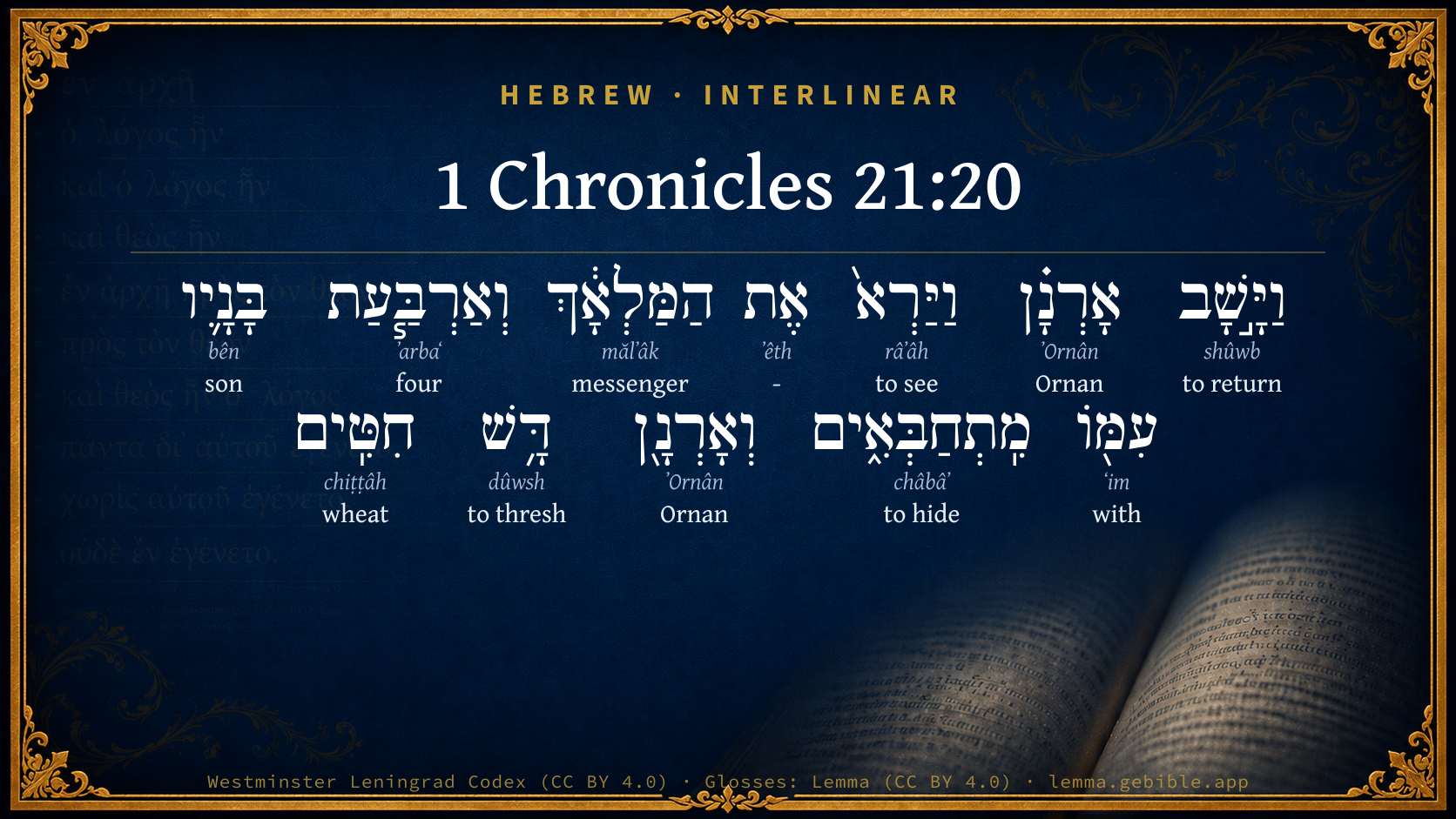
Hebrew (Westminster Leningrad Codex) 1 Chronicles 21:20 appears in the Hebrew Old Testament. The text above is from the Westminster Leningrad Codex. Each word links to its Strong’s number, a concise gloss, and parsing drawn from the Open Scriptures Hebrew Bible morphology. Click any word for its full Brown-Driver-Briggs (BDB) entry.
Download image
Cite this verse

1 Chronicles 21:20 (World English Bible). Public Domain. Lemma interlinear Bible study tool, https://lemma.gebible.app/v/1-chronicles/21/20.

Show BibTeX & RIS
BibTeX
RIS
English Translation
Ornan turned back, and saw the angel; and his four sons who were with him hid themselves. Now Ornan was threshing wheat.
World English Bible · Public Domain
Download a study sheet

One document with this verse’s original text, its word-by-word gloss line, the meaning frame, cross-references with their text, attributed commentary, and full source and license credits — printable, and it pastes into notes with its structure intact.

This verse Autodidact and up

Study sheet (.html) Plain text (.txt)

A passage Seminary Student

Up to 50 verses in one chapter. A passage sheet keeps up to 6 commentary sources and 12 cross-references per verse, in the order this page ranks them, and says so on the sheet whenever that leaves anything out. Ask for a single verse and you get the Autodidact verse sheet above.

Everything on this page stays free to read, with no account — the sheet is a download of what is already on screen, not access to it.

Want to remove ads? Support Godless Engineer
Compare translations 3

The same verse in 3 English versions, stacked beneath the original-language interlinear above. Click any original word for its lexicon entry.

Each is an independent rendering of the whole verse — the interlinear is not word-aligned to these translations.

Highlighted words mark where these versions differ — a whole-verse word diff, not a word-by-word alignment.

  • World English Bible Public Domain
    Ornan turned back, and saw the angel; and his four sons who were with him hid themselves. Now Ornan was threshing wheat.
  • King James Version Public Domain
    And Ornan turned back, and saw the angel; and his four sons with him hid themselves. Now Ornan was threshing wheat.
  • unfoldingWord Literal Text CC BY-SA 4.0
    And Ornan turned, and he saw the angel. And the four of his sons with him were hiding themselves. And Ornan was threshing wheat.

unfoldingWord Literal Text — © unfoldingWord, licensed CC BY-SA 4.0. Word-aligned USFM3 via Door43 (git.door43.org/unfoldingWord/en_ult).

Versions to compare (up to 4)

3 of 4 selected

Show all 18 translations

Every available English version of this verse, each an independent rendering of the whole verse.

  • World English Bible Public Domain
    Ornan turned back, and saw the angel; and his four sons who were with him hid themselves. Now Ornan was threshing wheat.
  • Berean Standard Bible Public Domain
    Now Ornan was threshing wheat when he turned and saw the angel; and his four sons who were with him hid themselves.
  • Majority Standard Bible Public Domain
    Now Ornan was threshing wheat when he turned and saw the angel; and his four sons who were with him hid themselves.
  • King James Version Public Domain
    And Ornan turned back, and saw the angel; and his four sons with him hid themselves. Now Ornan was threshing wheat.
  • American Standard Version (1901) Public Domain
    And Ornan turned back, and saw the angel; and his four sons that were with him hid themselves. Now Ornan was threshing wheat.
  • Revised Version (1885) Public Domain
    And Ornan turned back, and saw the angel; and his four sons that were with him hid themselves. Now Ornan was threshing wheat.
  • Geneva Bible (1599) Public Domain
    And Ornan turned about, and sawe the Angel, and his foure sonnes, that were with him, hid them selues, and Ornan thresshed wheat.
  • Douay-Rheims (1899) Public Domain
    and David went up, according to the word of Gad, which he spoke to him in the name of the Lord.
  • Young's Literal Translation Public Domain
    And Ornan turneth back, and seeth the messenger, and his four sons `are' with him, hiding themselves, and Ornan is threshing wheat.
  • Literal Standard Version CC BY-SA 4.0
    And Ornan turns back and sees the messenger, and his four sons [are] with him hiding themselves, and Ornan is threshing wheat.
  • Unlocked Literal Bible CC BY-SA 4.0
    While Ornan was threshing wheat, he turned and saw the angel. He and his four sons with him hid themselves.
  • unfoldingWord Literal Text CC BY-SA 4.0
    And Ornan turned, and he saw the angel. And the four of his sons with him were hiding themselves. And Ornan was threshing wheat.
  • Darby Bible Public Domain
    And Ornan turned back and saw the angel; and his four sons with him hid themselves. Now Ornan was threshing wheat.
  • World Messianic Bible Public Domain
    Ornan turned back and saw the angel; and his four sons who were with him hid themselves. Now Ornan was threshing wheat.
  • Webster's Bible Public Domain
    And Ornan turned back, and saw the angel; and his four sons with him hid themselves. Now Ornan was threshing wheat.
  • Free Bible Version CC BY-SA 4.0
    Ornan was busy threshing wheat. He turned around and saw the angel; and his four sons who were with him went and hid.
  • Bible in Basic English Public Domain
    And Ornan, turning back, saw the angel, and his four sons who were with him went to a secret place. Now Ornan was crushing his grain.
  • JPS Tanakh (1917) Public Domain
    And Ornan turned back, and saw the angel; and his four sons that were with him hid themselves. Now Ornan was threshing wheat.

Literal Standard Version (2020), Covenant Press — licensed CC BY-SA 4.0. Text via the HelloAO Bible API (eBible.org). Unlocked Literal Bible (unfoldingWord) — licensed CC BY-SA 4.0. Text via the HelloAO Bible API (eBible.org). unfoldingWord Literal Text — © unfoldingWord, licensed CC BY-SA 4.0. Word-aligned USFM3 via Door43 (git.door43.org/unfoldingWord/en_ult). Free Bible Version, Dr. Jonathan Gallagher — licensed CC BY-SA 4.0. Text via the HelloAO Bible API (eBible.org).

Word by word

More ways to search: Search by grammar → Find every occurrence → Compare this word →

Practice this passage: Drill this verse → Learn its vocabulary →

אָרְנָ֗ן
ʼOrnân
H771
“Ornan”
Noun, Proper
Part of Speech
Noun
Type
Proper
Full BDB Definition

Origin: probably from H766

TWOT: None

Ornan = "light was perpetuated: their fir trees" - a Jebusite who sold, to David, a threshing floor for an altar
  1. וַיָּ֣שָׁב shûwb H7725 “and · to return” Conjunction + Verb, Qal, Sequential Imperfect, 3rd Person, Masculine, Singular
  2. וַיַּרְא֙ râʼâh H7200 “and · to see” Conjunction + Verb, Qal, Sequential Imperfect, 3rd Person, Masculine, Singular
  3. אֶת ʼêth H853 “-” Particle, Direct Object
  4. הַמַּלְאָ֔ךְ mălʼâk H4397 “the · messenger” Particle, Definite Article + Noun, Common, Masculine, Singular, Absolute
  5. וְאַרְבַּ֧עַת ʼarbaʻ H702 “and · four” Conjunction + Adjective, Cardinal number, Masculine, Singular, Construct
  6. בָּנָ֛יו bên H1121 “sons · his” Noun, Common, Masculine, Plural, Construct + Suffix, Personal, 3rd Person, Masculine, Singular
  7. עִמּ֖וֹ ʻim H5973 “with · him” Preposition + Suffix, Personal, 3rd Person, Masculine, Singular
  8. מִֽתְחַבְּאִ֑ים châbâʼ H2244 “hiding” Verb, Hithpael, Participle Active, Masculine, Plural, Absolute
  9. וְאָרְנָ֖ן ʼOrnân H771 “and · Ornan” Conjunction + Noun, Proper
  10. דָּ֥שׁ dûwsh H1758 “threshing” Verb, Qal, Participle Active, Masculine, Singular, Absolute
  11. חִטִּֽים chiṭṭâh H2406 “wheat” Noun, Common, Feminine, Plural, Absolute

About this verse

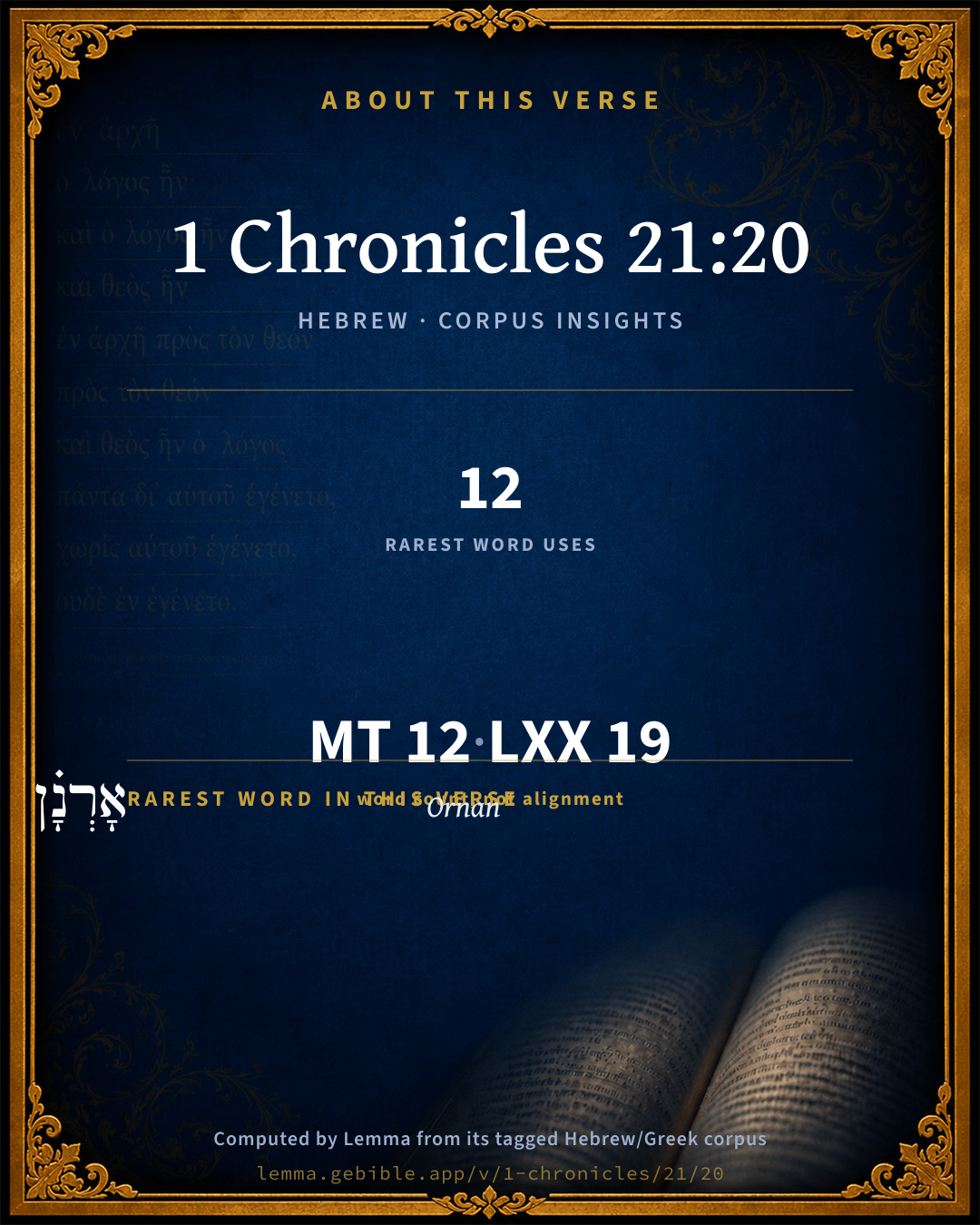
These counts appear in no published source. They are computed here, from the morphology-tagged text and Lemma’s own curated glosses. What Lemma adds →

12
words
11
distinct lemmas
Historical
section

Notable vocabulary

The rarest word here is אָרְנָ֗ן Ornan H771 — appearing just 12 times in the whole Hebrew Bible.

Shared distinctive vocabulary

אָרְנָ֗ן Ornan H771 occurs in 10 verses of the Hebrew Bible. Also found in:

Grammatical profile

  • 4 verbs
  • 5 nouns
  • 1 adjective
  • 1 preposition
  • 1 particle

Verb forms

  • וַיָּ֣שָׁב Qal · Sequential Imperfect
  • וַיַּרְא֙ Qal · Sequential Imperfect
  • מִֽתְחַבְּאִ֑ים Hithpael · Participle Active
  • דָּ֥שׁ Qal · Participle Active

Repetition

A word recurs within this verse — often emphatic in Hebrew:

  • אָרְנָ֗ן Ornan H771 ×2

Hebrew & Septuagint length

In English translation the verse runs 22 words from the Hebrew and 22 from the Septuagint (LXX English) — the same length.

A rough comparison of the two English renderings, which tokenize alike — not a word-level alignment.

Word counts can differ between the Hebrew and the Greek without any difference in meaning — e.g. the Hebrew direct-object marker אֵת has no separate Greek word, and Greek often adds the article ὁ.

In the original languages it is 12 Hebrew tokens and 19 Greek tokens — but the two are counted differently (Hebrew bundles its prefixes and suffixes into one token; the Greek is in lemma form), so that isn’t a like-for-like length.

Cross-references

1

Topical passages linked to 1 Chronicles 21:20 in the Treasury of Scripture Knowledge — connected by theme and wording, ordered by reader-vote popularity; previews shown in the World English Bible.

  • Judges 6:11 The angel of Yahweh came, and sat under the oak which was in Ophrah, that pertained to Joash the Abiezrite: and his son Gideon was beating out wheat in the winepress, to hide it from the Midianites.

Cross-references courtesy of OpenBible.info (CC BY 4.0).

Hebrew and Greek witnesses Masoretic Hebrew ↔ Greek Septuagint

The same verse in the two great witnesses to the Old Testament, shown verse-for-verse.

These are two independent witnesses, not word-aligned to each other, and the Septuagint is shown in lemma (dictionary) form.

Hebrew 1 Chronicles 21:20 Masoretic · Westminster Leningrad Codex

וַיָּ֣שָׁב אָרְנָ֗ן וַיַּרְא֙ אֶת הַמַּלְאָ֔ךְ וְאַרְבַּ֧עַת בָּנָ֛יו עִמּ֖וֹ מִֽתְחַבְּאִ֑ים וְאָרְנָ֖ן דָּ֥שׁ חִטִּֽים

Ornan turned back, and saw the angel; and his four sons who were with him hid themselves. Now Ornan was threshing wheat.

World English Bible · Public Domain

Greek LXX 1 Chronicles 21:20 Septuagint · lemma form

καί ἐπιστρέφω ορνα καί ὁράω ὁ βασιλεύς καί τέσσαρες υἱός αὐτός μετά αὐτός μεθαχαβιν καί ορνα εἰμί ἀλοάω πυρός

And Orna turned and saw the king; and he hid himself and his four sons with him. Now Orna was threshing wheat.

LXX2012 (modern English Septuagint) · Public Domain

On this verse, Adam Clarke's Commentary discusses the Septuagint’s reading. Read the note in Commentary ↓

Hebrew: Westminster Leningrad Codex (CC BY 4.0). Greek: Septuagint (public domain); English from LXX2012 (modern English Septuagint) (Public Domain). How the Septuagint differs from the Hebrew →

Commentary

Notes on 1 Chronicles 21:20 from classic Christian and Jewish commentators (each source and its license shown beneath its notes). The classic Christian expositions comment on the surrounding passage and are grouped to its opening verse, so a note may address several verses; the Jewish commentaries on the Tanakh (Rashi and others) are per-verse, so they appear only where the commentator wrote on this verse.

Lemma curates 59 commentaries, every one of them public domain or Creative Commons licensed, each selected and text-cleaned for this edition rather than reprinted as found. About our sources →

Trapp's Complete Commentary

John Trapp

1Ch 21:20 And Ornan turned back, and saw the angel; and his four sons with him hid themselves. Now Ornan was threshing wheat.

Ver. 20. Now Ornan was threshing wheat.] Though he had sometime been a king, as some gather from 2Sa 24:23. {See Trapp on "2Sa 24:23"}

John Trapp, A Commentary or Exposition upon All the Books of the Old and New Testament (1647–1656) — public domain. Text from a community e-Sword module.

Joseph Benson's Commentary

1Ch 21:20. His four sons with him hid themselves — Because of the glory and majesty in which the angel appeared, which men’s weak natures are not able to bear; and from the fear of God’s vengeance, which now seemed to be coming to their family.

Joseph Benson's Commentary on the Old and New Testaments (1811–1818) — public domain. Text from a community e-Sword module.

Geneva Bible (1599)

Geneva Bible translators

If man hide himself at the sight of an Angel which is a creature, how much as a sinner able to appear before the face of God?

Geneva Bible (1599) marginal notes — public domain. Text via Bolls.life.

Jamieson, Fausset & Brown

Robert Jamieson, A. R. Fausset & David Brown

Ornan was threshing wheat--If the census was entered upon in autumn, the beginning of the civil year, the nine and a half months it occupied would end at wheat harvest. The common way of threshing corn is by spreading it out on a high level area, and driving backwards and forwards upon it two oxen harnessed to a clumsy sledge with three rollers and some sharp spikes. The driver sits on his knees on the box, while another person is employed in drawing back the straw and separating it from the grain underneath. By this operation the chaff is very much chopped, and the grain threshed out.

Jamieson, Fausset & Brown — Commentary Critical and Explanatory on the Whole Bible (1871) — public domain (CC PDM 1.0). Text via the HelloAO Bible API.

Adam Clarke's Commentary

Verse 20. Ornan turned back, and saw the angel] The Septuagint say, And Orna turned, και ειδε τον βασιλεα, and saw the KING. The Syriac and Arabic say, David saw the angel; and do not mention Ornan in this place. Houbigant translates the same reading המלך hammalech, the king, for המלעך hammalach, the angel, and vindicates his version from the parallel place, 2Sa 24:20, where it is said, he saw David: but there is no word of his seeing the angel. But the seeing David is mentioned in 1Ch 21:21; though Houbigant supposes that the 20th verse refers to his seeing the king while he was at a distance; the 21st, to his seeing him when he came into the threshing-floor. In the first instance he and his sons were afraid when they saw the king coming, and this caused them to hide themselves; but when he came into the threshing-floor, they were obliged to appear before him. One of Kennicott's MSS. has המלך the king, instead of המלאך the angel. Some learned men contend for the former reading.

Adam Clarke's Commentary on the Bible (1810–1826) — public domain. Text from a community e-Sword/MySword module.

Ellicott's Commentary for English Readers

(20) And Ornan turned back (returned), and saw the angel; and his four sons with him hid themselves (were hiding). There can be little doubt that this is corrupt, and that the text of Samuel is right, “And Araunah looked up, and saw the king and his servants passing by him.” The LXX. here has “Ornan turned, and saw the king;” the Vulg., “when Ornan had looked up” The Hebrew words for “returned” and “looked up,” “angel” and “king,” are similar enough to be easily confused in an ill-written or failed MS.

Now Ornan was threshing wheat.—This clause does not harmonise with the preceding statement, but its genuineness is made probable by the fact that Ornan was in his threshingfloor at the time. Moreover, the LXX. adds to 2Sa_24:15, “And David chose for himself the death; and it was the days of wheat harvest.”

A Bible Commentary for English Readers, edited by Charles John Ellicott (1878–1897) — public domain. Text from a community e-Sword module.

Haydock's Catholic Bible Commentary

Now. Hebrew, "and Oranan turned back." --- Angel. Vatican Septuagint, the king and his four sons with him, along with Achabin." Other editions have, "and his four sons hidden with him." Arabic, "and the king, being come near to Aran, he saw David and his," &c. Syriac reads in like manner; but says nothing of the children either of David or of Ornan. We do not read that Ornan saw the angel, 2 Kings, but this circumstance may be here supplied. It is evident the Septuagint have read melec, "king," instead of malac, "angel." (Calmet) --- Eupolemus says the angel Dianathan shewed David were to build the temple. (Eusebius, Præp. ix. 30.)

George Leo Haydock (1774–1849), Haydock's Catholic Family Bible and Commentary, 1859 edition — public domain. Excludes Psalms (Douay-Rheims chapter numbering differs from Protestant) and Deuterocanonical books (Catholic canon only).

Matthew Poole's English Annotations

Or,

And Ornan turned back, ( i.e. turned his face from the angel,) for, or when, (for the Hebrew vau is frequently used both those ways,)

he saw the angel and (so did) his four sons with him hiding themselves; partly because of the glory and majesty in which the angel appeared, which men’s weak and sinful natures are not able to bear; and partly from the fear of God’s vengeance, which was at this time riding circuit in the land, and now seemed to be coming to their family.

Matthew Poole's English Annotations on the Holy Bible (1683–1685) — public domain. Text from a community e-Sword/MySword module.

The Pulpit Commentary

This verse is not found in the parallel place. The Septuagint reading of "king" in this verse, in place of "angel," is no doubt an error. The drift of this and the following verse is plain and continuous. Ornan and his sons had hidden themselves on the apparition of the angel, but came out on the advent of David, to welcome him.

The Pulpit Commentary (1880–1919), ed. H.D.M. Spence-Jones & Joseph S. Exell — public domain. Text from a community e-Sword module.

John Wesley's Explanatory Notes

Hid themselves - Because of the glory and majesty in which the angel appeared, which mens weak natures are not able to bear; and from the fear of God's vengeance which now seemed to be coming to their family.

John Wesley, Explanatory Notes Upon the Whole Bible (1754–1765) — public domain. Text via the GEBible commentary corpus.

Scofield Reference Notes

C. I. Scofield

angel

(See Scofield "Heb 1:4").

The Scofield Reference Bible (1917 edition), notes by C. I. Scofield — public domain. Text from a community e-Sword module.

Rashi

Rabbi Shlomo Yitzchaki (Rashi)

hid from the angel, to fulfill the verse (Isa. 26:20): “Go, My people, come into your chambers and close your door about you; hide for but a moment, until the wrath passes.” And Scripture also says (Exod. 12:22): “... as for you, none of you shall go out of his house until morning.”

and Ornan was threshing wheat since Scripture states further (verse 23): “and the wheat for a meal offering,” lest you wonder how wheat was there.

Rashi on the Tanakh — English translations: “The Judaica Press complete Tanach with Rashi, translated by A. J. Rosenberg” (CC BY 4.0); “Pentateuch with Rashi's commentary by M. Rosenbaum and A.M. Silbermann, 1929-1934” (public domain); “The Metsudah Tanach series, Lakewood, N.J” (CC BY 4.0); and “The Book of Joshua, Metsudah Publications, 1997” (CC BY 4.0). Text via Sefaria.

Lesson kit

Teaching starters — assembled from the data on this page, not authored interpretation. Every prompt links to the verse data it draws on. Edit before teaching.

1 Chronicles, in the Historical, opens this verse with 12 words (11 distinct Hebrew lemmas). Its most distinctive word is ʼOrnân (“Ornan”). A historical commentator’s framing appears above. Read the whole chapter for the surrounding context.

Discussion questions

  1. What does “Ornan” (ʼOrnân) contribute to the verse as a whole?
  2. 1 Chronicles 21:15 shares the word «Ornan» with this verse. How do the two illuminate each other?
  3. “Ornan” occurs 2× in this one verse. What is the effect of the repetition?
  4. The translations on this page render this verse differently — a whole-verse word diff, not a word-by-word alignment. What might account for the different wordings?
  5. The verb «וַיָּ֣שָׁב» is Qal Sequential Imperfect. How does its form color the action?
  6. Reading how Trapp's Complete Commentary and Joseph Benson's Commentary read this verse, where do the two commentators agree and where do they part?

Things to notice

Reading settings

Reading text

Shown beneath each verse's original-language words.

Old Testament
Old Testament edition

Read the OT as the Masoretic Hebrew (MT) or the Greek Septuagint (LXX).

English shown for the Greek Septuagint (in the Hebrew ↔ Greek comparison).

Comparing translations? Open the Compare panel on any verse page to stack up to four side by side.