
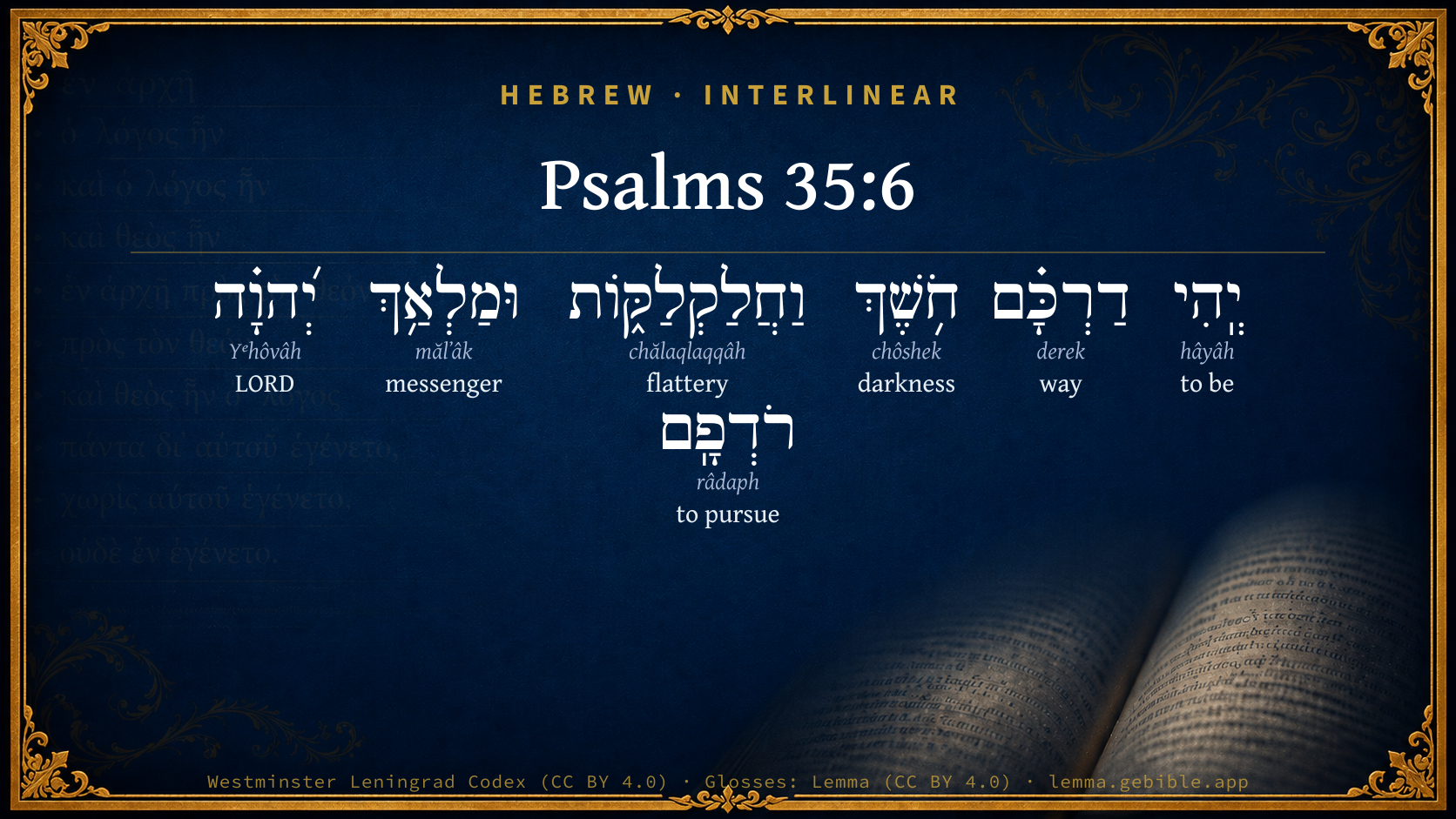
Psalms 35:6

Hebrew (Westminster Leningrad Codex) Psalms 35:6 appears in the Hebrew Old Testament. The text above is from the Westminster Leningrad Codex. Each word links to its Strong’s number, a concise gloss, and parsing drawn from the Open Scriptures Hebrew Bible morphology. Click any word for its full Brown-Driver-Briggs (BDB) entry.
Download image
Cite this verse

Psalms 35:6 (World English Bible). Public Domain. Lemma interlinear Bible study tool, https://lemma.gebible.app/v/psalms/35/6.

Show BibTeX & RIS
BibTeX
RIS
English Translation
Let their way be dark and slippery, Yahweh's angel pursuing them.
World English Bible · Public Domain
Highlights
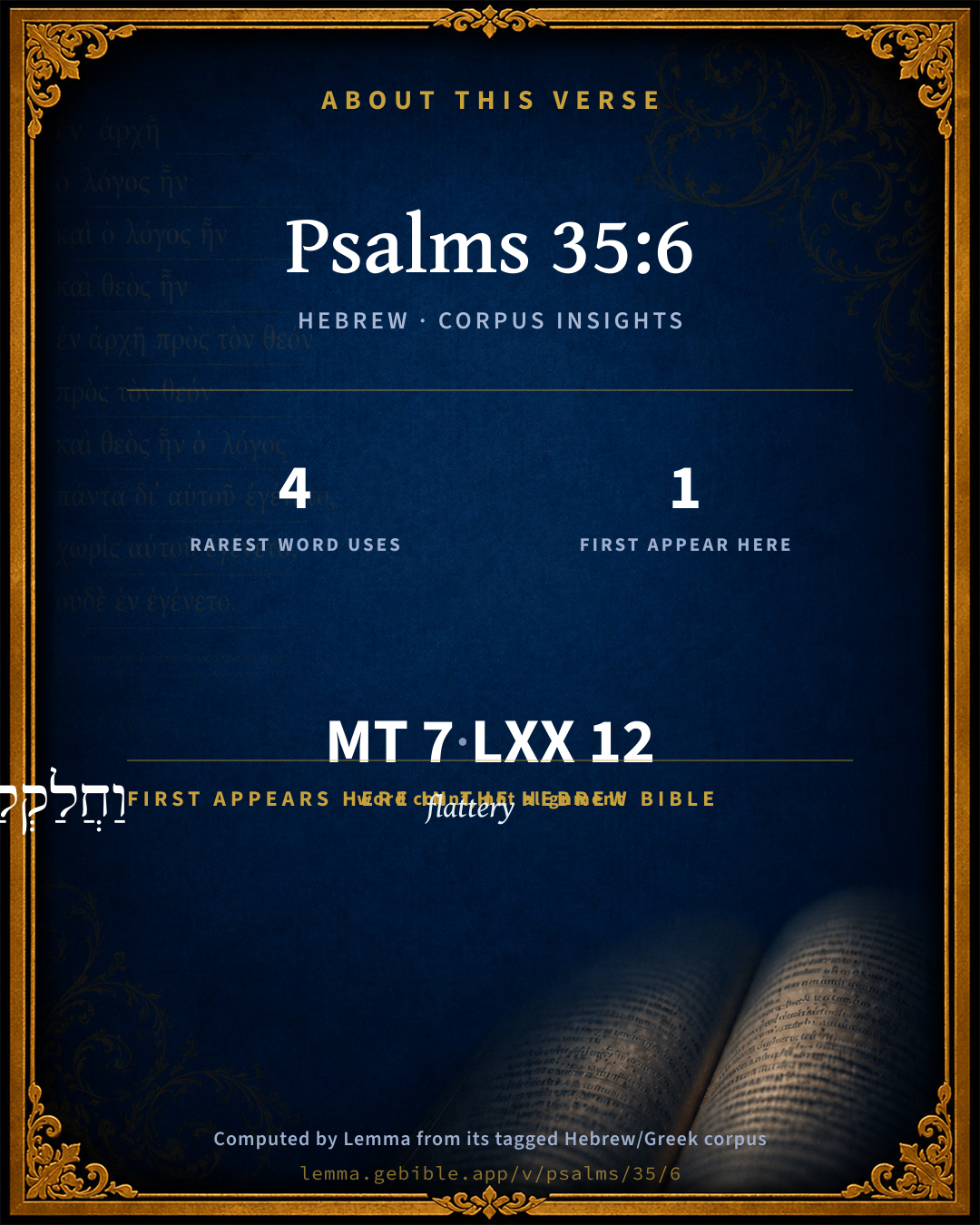
  • 1 first appearance in the Hebrew Bible
Full analysis ↓
Download a study sheet

One document with this verse’s original text, its word-by-word gloss line, the meaning frame, cross-references with their text, attributed commentary, and full source and license credits — printable, and it pastes into notes with its structure intact.

This verse Autodidact and up

Study sheet (.html) Plain text (.txt)

A passage Seminary Student

Up to 50 verses in one chapter. A passage sheet keeps up to 6 commentary sources and 12 cross-references per verse, in the order this page ranks them, and says so on the sheet whenever that leaves anything out. Ask for a single verse and you get the Autodidact verse sheet above.

Everything on this page stays free to read, with no account — the sheet is a download of what is already on screen, not access to it.

Want to remove ads? Support Godless Engineer
Compare translations 3

The same verse in 3 English versions, stacked beneath the original-language interlinear above. Click any original word for its lexicon entry.

Each is an independent rendering of the whole verse — the interlinear is not word-aligned to these translations.

Highlighted words mark where these versions differ — a whole-verse word diff, not a word-by-word alignment.

  • World English Bible Public Domain
    Let their way be dark and slippery, Yahweh's angel pursuing them.
  • King James Version Public Domain
    Let their way be dark and slippery: and let the angel of the LORD persecute them.
  • unfoldingWord Literal Text CC BY-SA 4.0
    May their way be dark and slippery places, and the angel of Yahweh chasing them.

unfoldingWord Literal Text — © unfoldingWord, licensed CC BY-SA 4.0. Word-aligned USFM3 via Door43 (git.door43.org/unfoldingWord/en_ult).

Versions to compare (up to 4)

3 of 4 selected

Show all 18 translations

Every available English version of this verse, each an independent rendering of the whole verse.

  • World English Bible Public Domain
    Let their way be dark and slippery, Yahweh's angel pursuing them.
  • Berean Standard Bible Public Domain
    May their path be dark and slick, as the angel of the LORD pursues.
  • Majority Standard Bible Public Domain
    May their path be dark and slick, as the angel of the LORD pursues.
  • King James Version Public Domain
    Let their way be dark and slippery: and let the angel of the LORD persecute them.
  • American Standard Version (1901) Public Domain
    Let their way be dark and slippery, And the angel of Jehovah pursuing them.
  • Revised Version (1885) Public Domain
    Let their way be dark and slippery, and the angel of the LORD pursuing them.
  • Geneva Bible (1599) Public Domain
    Let their way be darke and slipperie: and let the Angel of the Lord persecute them.
  • Douay-Rheims (1899) Public Domain
    Let their way become dark and slippery; and let the angel of the Lord pursue them.
  • Young's Literal Translation Public Domain
    Their way is darkness and slipperiness, And a messenger of Jehovah their pursuer.
  • Literal Standard Version CC BY-SA 4.0
    Their way is darkness and slipperiness, || And a messenger of YHWH—their pursuer.
  • Unlocked Literal Bible CC BY-SA 4.0
    May their way be dark and slippery, as the angel of Yahweh chases them.
  • unfoldingWord Literal Text CC BY-SA 4.0
    May their way be dark and slippery places, and the angel of Yahweh chasing them.
  • Darby Bible Public Domain
    Let their way be dark and slippery, and let the angel of Jehovah pursue them.
  • World Messianic Bible Public Domain
    Let their way be dark and slippery, the LORD’s angel pursuing them.
  • Webster's Bible Public Domain
    Let their way be dark and slippery: and let the angel of the LORD persecute them.
  • Free Bible Version CC BY-SA 4.0
    May their path be dark and slippery, with the angel of the Lord chasing them down.
  • Bible in Basic English Public Domain
    Let their way be dark and full of danger; let them be troubled by the angel of the Lord.
  • JPS Tanakh (1917) Public Domain
    Let their way be dark and slippery, the angel of the LORD pursuing them.

Literal Standard Version (2020), Covenant Press — licensed CC BY-SA 4.0. Text via the HelloAO Bible API (eBible.org). Unlocked Literal Bible (unfoldingWord) — licensed CC BY-SA 4.0. Text via the HelloAO Bible API (eBible.org). unfoldingWord Literal Text — © unfoldingWord, licensed CC BY-SA 4.0. Word-aligned USFM3 via Door43 (git.door43.org/unfoldingWord/en_ult). Free Bible Version, Dr. Jonathan Gallagher — licensed CC BY-SA 4.0. Text via the HelloAO Bible API (eBible.org).

Word by word

More ways to search: Search by grammar → Find every occurrence → Compare this word →

Practice this passage: Drill this verse → Learn its vocabulary →

About this verse

These counts appear in no published source. They are computed here, from the morphology-tagged text and Lemma’s own curated glosses. What Lemma adds →

7
words
7
distinct lemmas
Wisdom
section

Notable vocabulary

The rarest word here is וַחֲלַקְלַקּ֑וֹת flattery H2519 — appearing just 4 times in the whole Hebrew Bible.

First appearance in Scripture

This word makes its first canonical appearance in the Hebrew Bible here:

  • וַחֲלַקְלַקּ֑וֹת flattery H2519

Shared distinctive vocabulary

וַחֲלַקְלַקּ֑וֹת flattery H2519 occurs in 4 verses of the Hebrew Bible. Also found in:

Grammatical profile

  • 2 verbs
  • 5 nouns

Verb forms

  • יְֽהִי Qal · Jussive
  • רֹדְפָֽם Qal · Participle Active

Hebrew & Septuagint length

In English translation the verse runs 11 words from the Hebrew and 15 from the Septuagint (LXX English) — closely comparable.

A rough comparison of the two English renderings, which tokenize alike — not a word-level alignment.

Word counts can differ between the Hebrew and the Greek without any difference in meaning — e.g. the Hebrew direct-object marker אֵת has no separate Greek word, and Greek often adds the article ὁ.

In the original languages it is 7 Hebrew tokens and 12 Greek tokens — but the two are counted differently (Hebrew bundles its prefixes and suffixes into one token; the Greek is in lemma form), so that isn’t a like-for-like length.

Cross-references

4

Topical passages linked to Psalms 35:6 in the Treasury of Scripture Knowledge — connected by theme and wording, ordered by reader-vote popularity; previews shown in the World English Bible.

  • Jeremiah 23:12 Therefore their way shall be to them as slippery places in the darkness: they shall be driven on, and fall therein; for I will bring evil on them, even the year of their visitation, says Yahweh.
  • Psalms 73:18 Surely you set them in slippery places. You throw them down to destruction.
  • Proverbs 4:19 The way of the wicked is like darkness. They don't know what they stumble over.
  • Jeremiah 13:16 Give glory to Yahweh your God, before he cause darkness, and before your feet stumble on the dark mountains, and, while you look for light, he turn it into the shadow of death, and make it gross darkness.

Cross-references courtesy of OpenBible.info (CC BY 4.0).

Hebrew and Greek witnesses Masoretic Hebrew ↔ Greek Septuagint

The same verse in the two great witnesses to the Old Testament, shown verse-for-verse.

You’re reading Greek Psalm 34 (Hebrew Psalm 35). The Septuagint counts the superscription, so verse numbers can differ from the Hebrew — chapter-level alignment, not verse-by-verse. Numbering follows Rahlfs.

These are two independent witnesses, not word-aligned to each other, and the Septuagint is shown in lemma (dictionary) form.

Hebrew Psalms 35:6 Masoretic · Westminster Leningrad Codex

יְֽהִי דַרְכָּ֗ם חֹ֥שֶׁךְ וַחֲלַקְלַקּ֑וֹת וּמַלְאַ֥ךְ יְ֝הוָ֗ה רֹדְפָֽם

Let their way be dark and slippery, Yahweh's angel pursuing them.

World English Bible · Public Domain

Greek LXX Greek Psalm 34:6 Septuagint · lemma form

γίγνομαι ὁ ὁδός αὐτός σκότος καί ὀλίσθημα καί ἄγγελος κύριος καταδιώκω αὐτός

Let their way be dark and slippery, and an angel of the Lord persecuting them.

LXX2012 (modern English Septuagint) · Public Domain

Hebrew: Westminster Leningrad Codex (CC BY 4.0). Greek: Septuagint (public domain); English from LXX2012 (modern English Septuagint) (Public Domain). How the Septuagint differs from the Hebrew →

Commentary

Notes on Psalms 35:6 from classic Christian and Jewish commentators (each source and its license shown beneath its notes). The classic Christian expositions comment on the surrounding passage and are grouped to its opening verse, so a note may address several verses; the Jewish commentaries on the Tanakh (Rashi and others) are per-verse, so they appear only where the commentator wrote on this verse.

Lemma curates 59 commentaries, every one of them public domain or Creative Commons licensed, each selected and text-cleaned for this edition rather than reprinted as found. About our sources →

Trapp's Complete Commentary

John Trapp

Psa 35:6 Let their way be dark and slippery: and let the angel of the LORD persecute them.

Ver. 6. Let their way be dark and slippery] Heb. Darkness and slipperiness. If a man have neither light nor firm footing, and a fierce enemy at his heels, what shift can he make for himself? The word rendered slippery is of a double form (like that libbi secharchar, my heart panteth or beateth about, throbbeth, Psa 38:10), to increase the signfication. See Jer 23:12. The soul of a wicked man is in a sling, 1Sa 25:29, violently tossed about.

John Trapp, A Commentary or Exposition upon All the Books of the Old and New Testament (1647–1656) — public domain. Text from a community e-Sword module.

Joseph Benson's Commentary

Psa 35:6-7. Let their way — By which they flee, being chased, as was now said; be dark and slippery — So as that they can neither discern the right path, nor be able to stand in it, and much less to escape, especially from so swift a pursuer as an angel. For without cause — Out of mere malice, without any injury or provocation on my part; have they hid, &c. — The sundry expressions used in this clause, aggravate their sin, and signify that their persecution of him was not the effect of a sudden passion, but of a deep and habitual hatred and malice, carried on in a constant and continued course, with deliberation, craft, and deceit, and that against David’s soul, or life; for nothing less would satisfy them.

Joseph Benson's Commentary on the Old and New Testaments (1811–1818) — public domain. Text from a community e-Sword module.

J. A. Alexander on Psalms

Joseph Addison Alexander

6. (Psa 35:6) Let their way be dark and slippery, and the angel of Jehovah chasing them. The optative form of the verb at the beginning determines the sense of those which go before, and which otherwise might be ambiguous.—Dark and slippery, literally darkness and srnoothnesses, an emphatic substitution of the abstract for the concrete. The fearful image thus suggested of men driven, like chaff before the wind, along a dark and slippery path, is rendered more terrific by the additional idea of their being hotly pursued by the destroying angel. The construction of the last clause, both in this verse and the one before it, is: (let) the angel of Jehovah (be) pursuing them.

Joseph Addison Alexander, The Psalms Translated and Explained (1850) — public domain. Text from a community e-Sword module.

Tyndale Open Study Notes

Tyndale Open Resources

35:6 A path that is dark and slippery suggests instability and untimely doom under the Lord’s judgment (see 69:23; 73:18; 82:5; 107:10; 143:3). • The angel of the Lord is an agent of judgment as well as salvation.

Tyndale Open Study Notes — © Tyndale Open Resources, licensed CC BY-SA 4.0. Text via the HelloAO Bible API.

Adam Clarke's Commentary

Verse 6. Let their way be dark] Let them lose their way, be entangled in morasses and thickets, and be confounded in all their attempts to injure me. All these phrases are military; and relate to ambushes, hidden snares, forced marches in order to surprise, and stratagems of different kinds.

Adam Clarke's Commentary on the Bible (1810–1826) — public domain. Text from a community e-Sword/MySword module.

Ellicott's Commentary for English Readers

(6) Dark and slippery.—See margin. Delitzsch supposes an allusion to the passage of the Red Sea, but the picture suggests rather the passage of some dangerous mountain pass in a raging storm. “The tracks in the limestone hills of Palestine are often worn as smooth as marble; comp. Psa_73:18” (quoted from Kay, in the Speaker’s Commentary).

A Bible Commentary for English Readers, edited by Charles John Ellicott (1878–1897) — public domain. Text from a community e-Sword module.

John Gill's Exposition

Let their way be dark and slippery,.... In which they run before the angel, chasing and pursuing them; so that they know not where they are, at what they stumble, whither to flee, nor how to stand; the ways of wicked men are as darkness, they know not in what condition they are, and whither they are going; and utter darkness, even blackness of darkness, is reserved for them: but here it means a calamitous, uncomfortable, fickle, and unstable situation in this life; see Jer 23:11. The allusion is to some of the valleys in the land of Palestine, which were dark, and the roads in them very smooth and slippery, as travellers in those parts have observed (q);

and let the angel of God persecute them; See Gill on Psa 35:5.

(q) See Maundrell's Travel's, p. 7.

John Gill's Exposition of the Whole Bible (1746–1763) — public domain (CC PDM 1.0). Text via the HelloAO Bible API.

Albert Barnes' Notes on the Bible

Let their way be dark - Margin, as in Hebrew: “darkness.” That is, let them not be able to see where they go; what danger they incur; what is before them. The idea is that of persons who wander in the night, not knowing what is before them, or what danger may be near. The succession of images and figures here is terrific. The representation is that of persons scattered as the chaff is before the wind; pursued by the angel seeking vengeance; and driven along a dark and slippery path, with no guide, and no knowledge as to the precipices which may be before them, or the enemies that may be pressing upon them.

And slippery - Margin, as in Hebrew: “slipperiness.” This is a circumstance which adds increased terror to the image. It is not only a dark road, but a road made slippery by rains; a road where they are in danger every moment of sliding down a precipice where they will be destroyed.

And let the angel of the Lord persecute them - Pursue or follow them. The word “persecute” we use now in the sense of subjecting one to pain, torture, or privation, on account of his religious opinions. This is not the meaning of the word used here. It is simply to “follow” or “pursue.” The image is that of the avenging angel following on, or pursuing them in this dark and slippery way; a flight in a dark and dangerous path, with a destroying angel close in the rear.

Albert Barnes' Notes on the Bible (1834–1885) — public domain. Text from a community e-Sword/MySword module.

Matthew Poole's English Annotations

Their way, by which they flee, being chased, as was now said.

Dark and slippery; so as they can neither discern the right path, nor be able to stand in it, and much less to run away, especially from so swift a persecutor as an angel, whereby they must unavoidably fall into their enemies’ hands, and be destroyed.

Matthew Poole's English Annotations on the Holy Bible (1683–1685) — public domain. Text from a community e-Sword/MySword module.

The Treasury of David

Charles H. Spurgeon

Ver. 6. Let their way be dark and slippery. What terrors are gathered Here! No light, no foothold, and a fierce avenger at their heels! What a doom is appointed for the enemies of God! They may rage and rave today, but how altered will be their plight ere long! And let the angel of the Lord persecute them. He will follow them hot foot, as we say, never turning aside, but like a trusty pursuivant serving the writ of vengeance upon them, and arresting them in the name of unflinching justice. Woe, woe, woe, unto those who touch the people of God; their destruction is both swift and sure.

Ver. 6. Let their way be dark and slippery. A horrible way! Darkness alone who feareth not? A slippery way alone who avoids not? In a dark and slippery way, how shalt thou go? where set foot? These two ills are the great punishments of men: darkness, ignorance; a slippery way, luxury. Let their way be darkness and slipping; and let the angel of the Lord persecute them, that they be not able to stand. For anyone in a dark and slippery way, when he seeth that if he move his foot he will fall, and there is no light before his feet, haply resolves to wait until light come; but here is the angel of the Lord persecuting them. Augustine.

Ver. 6. Slippery. Margin, as in Hebrew, slipperiness. This is a circumstance which adds increased terror to the image. It is not only a dark road, but a road made slippery by rains; a road where they are in danger every moment of sliding down a precipice where they will be destroyed. Albert Barnes.

Ver. 6. The horrible pilgrimage of the ungodly.

Ver. 6. The trinity of dangers in the pathway of the wicked, their way dark with ignorance, and slippery with temptation, while behind them is the avenger.

Psalms 35:7*

Charles H. Spurgeon's The Treasury of David (1869–1885) — public domain. Psalms only. Text from a community e-Sword/MySword module.

The Pulpit Commentary

Let their way be dark and slippery; literally, darkness and slipperiness; i.e. let them fly along dark and slippery paths, where they cannot see their way, and will be sure to stumble and fall. And let the angel of the Lord persecute them; rather, pursue after them.

The Pulpit Commentary (1880–1919), ed. H.D.M. Spence-Jones & Joseph S. Exell — public domain. Text from a community e-Sword module.

John Wesley's Explanatory Notes

Their way - By which they flee, being chased.

John Wesley, Explanatory Notes Upon the Whole Bible (1754–1765) — public domain. Text via the GEBible commentary corpus.

Scofield Reference Notes

C. I. Scofield

angel

(See Scofield Heb 1:4).

The Scofield Reference Bible (1917 edition), notes by C. I. Scofield — public domain. Text from a community e-Sword module.

Rashi

Rabbi Shlomo Yitzchaki (Rashi)

dark and slippery Both together, so that their feet should slip on the slippery places and the darkness should not allow them to beware of the slippery places, as it is written (in Jer. 23: 12): “Therefore, their way shall be for them like slippery places in the dark: ‘let them be thrust and fall therein.’ “

Rashi on the Tanakh — English translations: “The Judaica Press complete Tanach with Rashi, translated by A. J. Rosenberg” (CC BY 4.0); “Pentateuch with Rashi's commentary by M. Rosenbaum and A.M. Silbermann, 1929-1934” (public domain); “The Metsudah Tanach series, Lakewood, N.J” (CC BY 4.0); and “The Book of Joshua, Metsudah Publications, 1997” (CC BY 4.0). Text via Sefaria.

Lesson kit

Teaching starters — assembled from the data on this page, not authored interpretation. Every prompt links to the verse data it draws on. Edit before teaching.

Psalms, in the Wisdom, opens this verse with 7 words (7 distinct Hebrew lemmas). Its most distinctive word is chălaqlaqqâh (“flattery”). A historical commentator’s framing appears above. Read the whole chapter for the surrounding context.

Discussion questions

  1. What does “flattery” (chălaqlaqqâh) contribute to the verse as a whole?
  2. The word “flattery” first appears here in Scripture. What is being introduced at this debut?
  3. Jeremiah 23:12 shares the word «flattery» with this verse. How do the two illuminate each other?
  4. These translations render this verse differently; the difference is in the English rendering, not the original. What questions does that raise?
  5. The verb «יְֽהִי» is Qal Jussive. How does its form color the action?
  6. Reading how Trapp's Complete Commentary and Joseph Benson's Commentary read this verse, where do the two commentators agree and where do they part?

Things to notice

Reading settings

Reading text

Shown beneath each verse's original-language words.

Old Testament
Old Testament edition

Read the OT as the Masoretic Hebrew (MT) or the Greek Septuagint (LXX).

English shown for the Greek Septuagint (in the Hebrew ↔ Greek comparison).

Comparing translations? Open the Compare panel on any verse page to stack up to four side by side.