
2 Kings 19:14

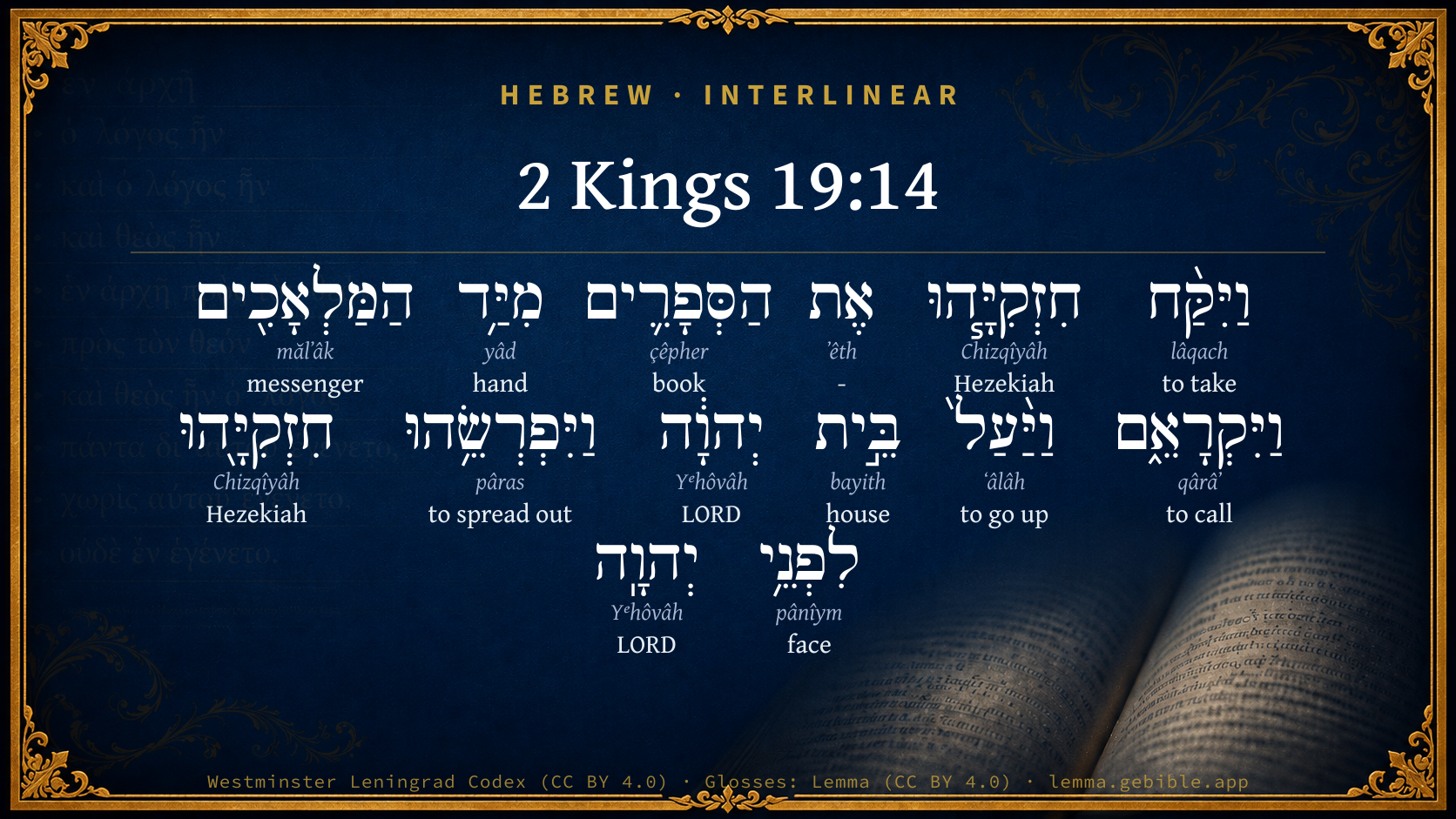
Hebrew (Westminster Leningrad Codex) 2 Kings 19:14 appears in the Hebrew Old Testament. The text above is from the Westminster Leningrad Codex. Each word links to its Strong’s number, a concise gloss, and parsing drawn from the Open Scriptures Hebrew Bible morphology. Click any word for its full Brown-Driver-Briggs (BDB) entry.
Download image
Cite this verse

2 Kings 19:14 (World English Bible). Public Domain. Lemma interlinear Bible study tool, https://lemma.gebible.app/v/2-kings/19/14.

Show BibTeX & RIS
BibTeX
RIS
English Translation
Hezekiah received the letter from the hand of the messengers, and read it; and Hezekiah went up to the house of Yahweh, and spread it before Yahweh.
World English Bible · Public Domain
Download a study sheet

One document with this verse’s original text, its word-by-word gloss line, the meaning frame, cross-references with their text, attributed commentary, and full source and license credits — printable, and it pastes into notes with its structure intact.

This verse Autodidact and up

Study sheet (.html) Plain text (.txt)

A passage Seminary Student

Up to 50 verses in one chapter. A passage sheet keeps up to 6 commentary sources and 12 cross-references per verse, in the order this page ranks them, and says so on the sheet whenever that leaves anything out. Ask for a single verse and you get the Autodidact verse sheet above.

Everything on this page stays free to read, with no account — the sheet is a download of what is already on screen, not access to it.

Want to remove ads? Support Godless Engineer
Compare translations 3

The same verse in 3 English versions, stacked beneath the original-language interlinear above. Click any original word for its lexicon entry.

Each is an independent rendering of the whole verse — the interlinear is not word-aligned to these translations.

Highlighted words mark where these versions differ — a whole-verse word diff, not a word-by-word alignment.

  • World English Bible Public Domain
    Hezekiah received the letter from the hand of the messengers, and read it; and Hezekiah went up to the house of Yahweh, and spread it before Yahweh.
  • King James Version Public Domain
    And Hezekiah received the letter of the hand of the messengers, and read it: and Hezekiah went up into the house of the LORD, and spread it before the LORD.
  • unfoldingWord Literal Text CC BY-SA 4.0
    And Hezekiah took the writings from the hand of the messengers, and he read them. And he went up the house of Yahweh, and Hezekiah spread it out to the face of Yahweh.

unfoldingWord Literal Text — © unfoldingWord, licensed CC BY-SA 4.0. Word-aligned USFM3 via Door43 (git.door43.org/unfoldingWord/en_ult).

Versions to compare (up to 4)

3 of 4 selected

Show all 18 translations

Every available English version of this verse, each an independent rendering of the whole verse.

  • World English Bible Public Domain
    Hezekiah received the letter from the hand of the messengers, and read it; and Hezekiah went up to the house of Yahweh, and spread it before Yahweh.
  • Berean Standard Bible Public Domain
    So Hezekiah received the letter from the messengers, read it, and went up to the house of the LORD and spread it out before the LORD.
  • Majority Standard Bible Public Domain
    So Hezekiah received the letter from the messengers, read it, and went up to the house of the LORD and spread it out before the LORD.
  • King James Version Public Domain
    And Hezekiah received the letter of the hand of the messengers, and read it: and Hezekiah went up into the house of the LORD, and spread it before the LORD.
  • American Standard Version (1901) Public Domain
    And Hezekiah received the letter from the hand of the messengers, and read it; and Hezekiah went up unto the house of Jehovah, and spread it before Jehovah.
  • Revised Version (1885) Public Domain
    And Hezekiah received the letter from the hand of the messengers, and read it: and Hezekiah went up unto the house of the LORD, and spread it before the LORD.
  • Geneva Bible (1599) Public Domain
    So Hezekiah receiued the letter of the hande of the messengers, and read it: and Hezekiah went vp into the house of the Lord, and Hezekiah spread it before the Lord.
  • Douay-Rheims (1899) Public Domain
    And when Ezechias had received the letter of the hand of the messengers, and had read it, he went up to the house of the Lord, and spread it before the Lord,
  • Young's Literal Translation Public Domain
    And Hezekiah taketh the letters out of the hand of the messengers, and readeth them, and goeth up to the house of Jehovah, and Hezekiah spreadeth it before Jehovah.
  • Literal Standard Version CC BY-SA 4.0
    And Hezekiah takes the letters out of the hand of the messengers and reads them, and goes up to the house of YHWH, and Hezekiah spreads it before YHWH.
  • Unlocked Literal Bible CC BY-SA 4.0
    Hezekiah received this letter from the messengers and read it. Then he went up to the house of Yahweh and spread it before him.
  • unfoldingWord Literal Text CC BY-SA 4.0
    And Hezekiah took the writings from the hand of the messengers, and he read them. And he went up the house of Yahweh, and Hezekiah spread it out to the face of Yahweh.
  • Darby Bible Public Domain
    And Hezekiah received the letter from the hand of the messengers, and read it; and Hezekiah went up into the house of Jehovah, and spread it before Jehovah.
  • World Messianic Bible Public Domain
    Hezekiah received the letter from the hand of the messengers and read it. Then Hezekiah went up to the LORD’s house, and spread it before the LORD.
  • Webster's Bible Public Domain
    And Hezekiah received the letter from the hand of the messengers, and read it: and Hezekiah went up into the house of the LORD, and spread it before the LORD.
  • Free Bible Version CC BY-SA 4.0
    Hezekiah received the letter from the messengers and read it. Then he went up to the Lord's Temple and opened it out before the Lord.
  • Bible in Basic English Public Domain
    And Hezekiah took the letter from the hands of those who had come with it; and after reading it, Hezekiah went up to the house of the Lord, opening the letter there before the Lord.
  • JPS Tanakh (1917) Public Domain
    And Hezekiah received the letter from the hand of the messengers, and read it; and Hezekiah went up unto the house of the LORD, and spread it before the LORD.

Literal Standard Version (2020), Covenant Press — licensed CC BY-SA 4.0. Text via the HelloAO Bible API (eBible.org). Unlocked Literal Bible (unfoldingWord) — licensed CC BY-SA 4.0. Text via the HelloAO Bible API (eBible.org). unfoldingWord Literal Text — © unfoldingWord, licensed CC BY-SA 4.0. Word-aligned USFM3 via Door43 (git.door43.org/unfoldingWord/en_ult). Free Bible Version, Dr. Jonathan Gallagher — licensed CC BY-SA 4.0. Text via the HelloAO Bible API (eBible.org).

Word by word

More ways to search: Search by grammar → Find every occurrence → Compare this word →

Practice this passage: Drill this verse → Learn its vocabulary →

וַיִּפְרְשֵׂ֥הוּ
pâras
H6566
“and · to spread out · him”
Conjunction + Verb, Qal, Sequential Imperfect, 3rd Person, Masculine, Singular + Suffix, Personal, 3rd Person, Masculine, Singular
Part of Speech
Conjunction + Verb
Stem
Qal
Form
Sequential Imperfect
Person
3rd Person
Gender
Masculine
Number
Singular
Full BDB Definition

Origin: a primitive root

TWOT: 1832

to spread, spread out, stretch, break in pieces - (Qal) - to spread out, display - to spread over - (Niphal) to be scattered, be spread out - (Piel) - to spread out - to scatter
  1. וַיִּקַּ֨ח lâqach H3947 “and · to take” Conjunction + Verb, Qal, Sequential Imperfect, 3rd Person, Masculine, Singular
  2. חִזְקִיָּ֧הוּ Chizqîyâh H2396 “Hezekiah” Noun, Proper
  3. אֶת ʼêth H853 “-” Particle, Direct Object
  4. הַסְּפָרִ֛ים çêpher H5612 “the · books” Particle, Definite Article + Noun, Common, Masculine, Plural, Absolute
  5. מִיַּ֥ד yâd H3027 “from · hand of” Preposition + Noun, Common, Both, Singular, Construct
  6. הַמַּלְאָכִ֖ים mălʼâk H4397 “the · messengers” Particle, Definite Article + Noun, Common, Masculine, Plural, Absolute
  7. וַיִּקְרָאֵ֑ם qârâʼ H7121 “and · to call · them” Conjunction + Verb, Qal, Sequential Imperfect, 3rd Person, Masculine, Singular + Suffix, Personal, 3rd Person, Masculine, Plural
  8. וַיַּ֨עַל֙ ʻâlâh H5927 “and · to go up” Conjunction + Verb, Qal, Sequential Imperfect, 3rd Person, Masculine, Singular
  9. בֵּ֣ית bayith H1004 “house of” Noun, Common, Masculine, Singular, Construct
  10. יְהוָ֔ה Yᵉhôvâh H3068 “LORD” Noun, Proper
  11. חִזְקִיָּ֖הוּ Chizqîyâh H2396 “Hezekiah” Noun, Proper
  12. לִפְנֵ֥י pânîym H6440 “to/for · face(s) of” Preposition + Noun, Common, Both, Plural, Construct
  13. יְהוָֽה Yᵉhôvâh H3068 “LORD” Noun, Proper

About this verse

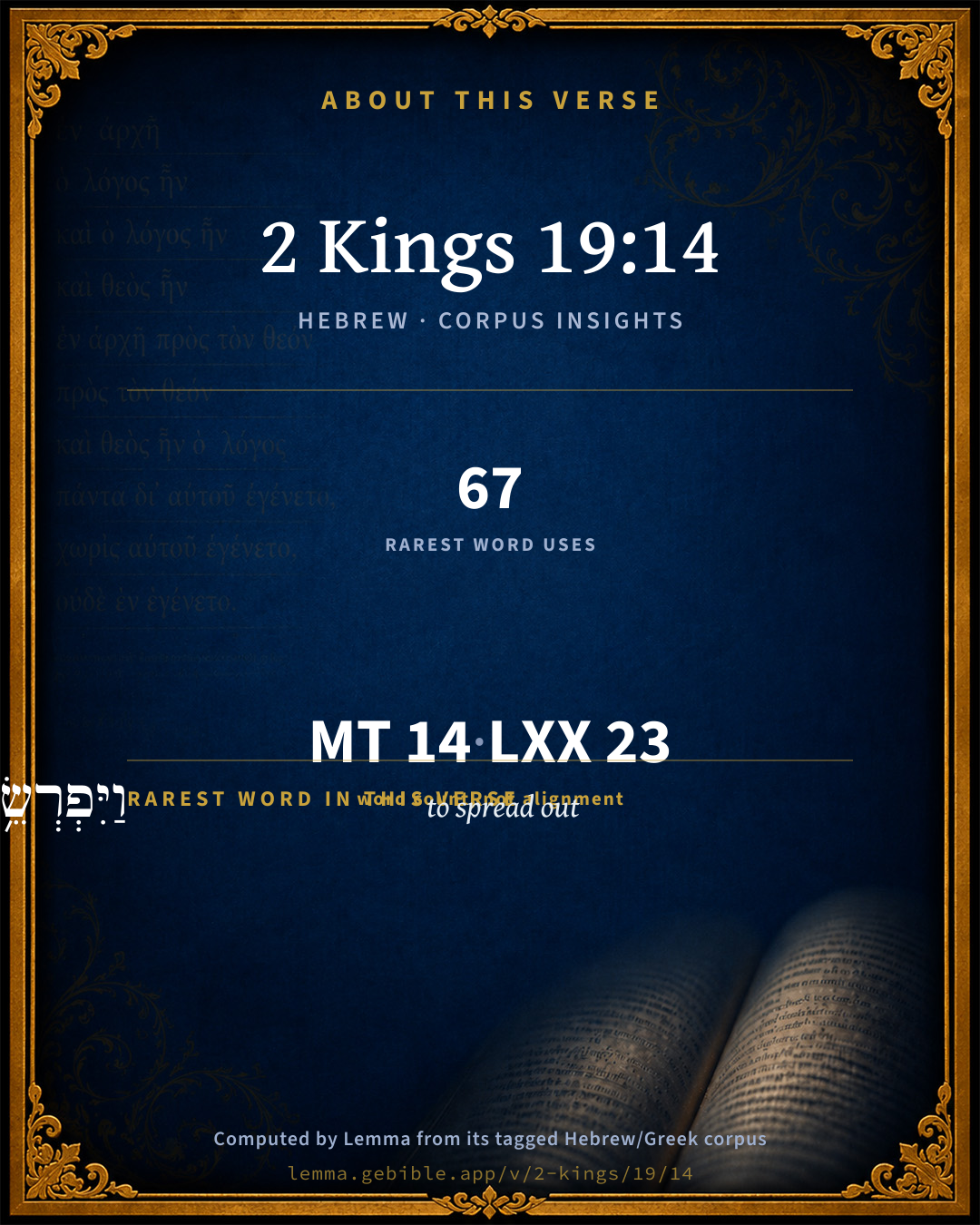
These counts appear in no published source. They are computed here, from the morphology-tagged text and Lemma’s own curated glosses. What Lemma adds →

14
words
12
distinct lemmas
Historical
section

Grammatical profile

  • 4 verbs
  • 9 nouns
  • 1 particle

Verb forms

  • וַיִּקַּ֨ח Qal · Sequential Imperfect
  • וַיִּקְרָאֵ֑ם Qal · Sequential Imperfect
  • וַיַּ֨עַל֙ Qal · Sequential Imperfect
  • וַיִּפְרְשֵׂ֥הוּ Qal · Sequential Imperfect

Repetition

Words recur within this verse — often emphatic in Hebrew:

  • חִזְקִיָּ֧הוּ Hezekiah H2396 ×2
  • יְהוָ֔ה LORD H3068 ×2

Hebrew & Septuagint length

In English translation the verse runs 27 words from the Hebrew and 31 from the Septuagint (LXX English) — closely comparable.

A rough comparison of the two English renderings, which tokenize alike — not a word-level alignment.

Word counts can differ between the Hebrew and the Greek without any difference in meaning — e.g. the Hebrew direct-object marker אֵת has no separate Greek word, and Greek often adds the article ὁ.

In the original languages it is 14 Hebrew tokens and 23 Greek tokens — but the two are counted differently (Hebrew bundles its prefixes and suffixes into one token; the Greek is in lemma form), so that isn’t a like-for-like length.

Cross-references

6

Topical passages linked to 2 Kings 19:14 in the Treasury of Scripture Knowledge — connected by theme and wording, ordered by reader-vote popularity; previews shown in the World English Bible.

  • Isaiah 37:14 Hezekiah received the letter from the hand of the messengers, and read it; and Hezekiah went up to the house of Yahweh, and spread it before Yahweh.
  • Psalms 91:1–2 He who dwells in the secret place of the Most High Will rest in the shadow of the Almighty.
  • Psalms 123:1–4 To you I do lift up my eyes, You who sit in the heavens.
  • 1 Kings 8:28–30 Yet have respect for the prayer of your servant, and for his supplication, Yahweh my God, to listen to the cry and to the prayer which your servant prays before you this day;
  • Ezra 9:5 At the evening offering I arose up from my humiliation, even with my garment and my robe torn; and I fell on my knees, and spread out my hands to Yahweh my God;
  • Psalms 74:10–11 How long, God, shall the adversary reproach? Shall the enemy blaspheme your name forever?

Cross-references courtesy of OpenBible.info (CC BY 4.0).

Hebrew and Greek witnesses Masoretic Hebrew ↔ Greek Septuagint

The same verse in the two great witnesses to the Old Testament, shown verse-for-verse.

These are two independent witnesses, not word-aligned to each other, and the Septuagint is shown in lemma (dictionary) form.

Hebrew 2 Kings 19:14 Masoretic · Westminster Leningrad Codex

וַיִּקַּ֨ח חִזְקִיָּ֧הוּ אֶת הַסְּפָרִ֛ים מִיַּ֥ד הַמַּלְאָכִ֖ים וַיִּקְרָאֵ֑ם וַיַּ֨עַל֙ בֵּ֣ית יְהוָ֔ה וַיִּפְרְשֵׂ֥הוּ חִזְקִיָּ֖הוּ לִפְנֵ֥י יְהוָֽה

Hezekiah received the letter from the hand of the messengers, and read it; and Hezekiah went up to the house of Yahweh, and spread it before Yahweh.

World English Bible · Public Domain

Greek LXX 2 Kings 19:14 Septuagint · lemma form

καί λαμβάνω εζεκιας ὁ βιβλίον ἐκ χείρ ὁ ἄγγελος καί ἀναγιγνώσκω αὐτός καί ἀναβαίνω εἰς οἶκος κύριος καί ἀναπτύσσω αὐτός εζεκιας ἐναντίον κύριος

And Ezekias took the letter from the hand of the messengers, and read it: and he went up to the house of the Lord, and Ezekias spread it before the Lord,

LXX2012 (modern English Septuagint) · Public Domain

Hebrew: Westminster Leningrad Codex (CC BY 4.0). Greek: Septuagint (public domain); English from LXX2012 (modern English Septuagint) (Public Domain). How the Septuagint differs from the Hebrew →

Targum (Aramaic paraphrase)

1

The Targum is the ancient Jewish Aramaic paraphrase of the Hebrew Scriptures — an interpretive translation, not the Hebrew text itself. Onkelos (literal) and Pseudo-Jonathan (expansive) render the Torah, and Jonathan the Prophets. Coverage is partial: where no permissively-licensed English translation exists for a verse, only the Aramaic is shown. This is verse-level text, not a word-by-word alignment to the Hebrew.

  1. Targum Jonathan Prophets (Joshua–Malachi)
    וּנְסִיב חִזְקִיָהוּ יַת אִגְרָתָא מִיַד אִזְגַדַיָא וְקָרִינָן וּסְלִיק לְבֵית מַקְדְשָׁא דַייָ וּפַרְסִינָן חִזְקִיָהוּ קֳדָם יְיָ:

    (no public-domain English translation for this verse)

    Targum Jonathan — Aramaic: “Mikraot Gedolot” (public domain). English: “Sefaria Community Translation” (CC0 1.0 (public-domain dedication)); “London "Chaldee Paraphrase," 1871” (public domain). Text via Sefaria.

Commentary

Notes on 2 Kings 19:14 from classic Christian and Jewish commentators (each source and its license shown beneath its notes). The classic Christian expositions comment on the surrounding passage and are grouped to its opening verse, so a note may address several verses; the Jewish commentaries on the Tanakh (Rashi and others) are per-verse, so they appear only where the commentator wrote on this verse.

Lemma curates 59 commentaries, every one of them public domain or Creative Commons licensed, each selected and text-cleaned for this edition rather than reprinted as found. About our sources →

Jamieson, Fausset & Brown

Robert Jamieson, A. R. Fausset & David Brown

HEZEKIAH'S PRAYER. (2Ki. 19:14-34)

Hezekiah received the letter . . . and went up into the house of the Lord--Hezekiah, after reading it, hastened into the temple, spread it in the childlike confidence of faith before the Lord, as containing taunts deeply affecting the divine honor, and implored deliverance from this proud defier of God and man. The devout spirit of this prayer, the recognition of the Divine Being in the plenitude of His majesty--so strikingly contrasted with the fancy of the Assyrians as to His merely local power; his acknowledgment of the conquests obtained over other lands; and of the destruction of their wooden idols which, according to the Assyrian practice, were committed to the flames--because their tutelary deities were no gods; and the object for which he supplicated the divine interposition--that all the kingdoms of the earth might know that the Lord was the only God--this was an attitude worthy to be assumed by a pious theocratic king of the chosen people.

Jamieson, Fausset & Brown — Commentary Critical and Explanatory on the Whole Bible (1871) — public domain (CC PDM 1.0). Text via the HelloAO Bible API.

Trapp's Complete Commentary

John Trapp

2Ki 19:14 And Hezekiah received the letter of the hand of the messengers, and read it: and Hezekiah went up into the house of the LORD, and spread it before the LORD.

Ver. 14. And read it.] Heb., Them: and spread it. That which had the blasphemies in it: or, if it was all but one letter, he spread that part of it that was most reproachful to the just and jealous God.

John Trapp, A Commentary or Exposition upon All the Books of the Old and New Testament (1647–1656) — public domain. Text from a community e-Sword module.

The Biblical Illustrator

Joseph S. Exell

2Ki_19:14

And Hezekiah received the letter of the hand of the messengers.

The history of a letter

How easy to say, the letter; and yet, how much the words may mean! The postman, as he goes his rounds, would become the most melancholy of men if he thought much upon the budget he carries. To some houses joy, to others misery,--nay, to the same house joy treads on the heels of sorrow. We dont know what to-morrow may bring us; the postmans knock may be the knell of doom or the signal for peals of joyous laughter. What a letter was that which Hezekiah received! In form it would be very different to our ideas of a letter. The Assyrians did not use paper, or even skins, but did their writing on clay. You may see, in the British Museum, a conveyance of land, written, not on parchment, but on clay, and then baked hard. So it is very likely that the letter was a tablet of terra cotta. It has been thought by some that Rabshakeh was the writer of these railing letters. This was trouble, but it was trouble that might have been prevented. Hezekiah ought never to have paid tribute to Sennacherib. When first the demand was made, he should have called on the name of the Lord. Let us learn to never submit to the claims of sin. We can never satisfy it. Much will have more. Sin, like Sennacherib, will take all you will give, and then come for more, and when it has got all it will come for you. The devil has no right to a penny of our money, or a moment of our time.

I. What did Hezekiah do with the letter? He did not send a hasty answer. Many a quarrel might have been prevented if men would spread disagreeable letters before the Lord. Many a family feud would never have been brought about but for the want of this. If you get letters that give you pain, before you pen a reply send a message to God, and He will teach you to indite what may turn away wrath. He did not send to Egypt; he was cured of that now. If some one who reads this is in trouble, let me counsel you to remember what is a command as well as a promise, Call upon Me in the day of trouble. Far too many of us treat God as though He had no existence. We try everybody else before going to the Lord. He went up into the house of the Lord. Where was he so likely to find God as in His house? There is much force in the promise, If any of you lack wisdom, let him ask of God, that giveth to all men liberally and upbraideth not. It is a model prayer; not like many, which must try the patience of God, going all round the world, instead of fastening upon the thing needed, and asking for that. If our prayers were more like telegrams we should have speedier answers. The prayer of the pious king appealed to God for the sake of His honour--that all the kingdoms of the earth may know that Thou art the Lord God. How the Almighty is touched by an appeal of this sort. If we thought more of Gods honour in our prayers, we should be more often answered.

II. Was the letter ever answered? Yes, for Jehovah answered it Himself. He did not trouble Hezekiah to do it; and the answer is worthy of the Lord. There is a postscript to Gods answer (see 2Ki_19:35). It came to pass that night--they were all dead corpses. Fancy if you saw in the newspaper to-morrow Sudden death of 185,000 soldiers! What a stir it would make! What a sight the camp must have been next morning. There has been much discussion as to how it happened. There is no mention of it in the Assyrian record. They were ready enough to boast, but when Sennacherib crept back to his palace, he did not instruct the historian to chronicle his disgrace. Herodotus tells us that the Egyptians, against whom Sennacherib was then at war, ascribed the destruction of their foes to the power of their gods. There has been considerable discussion amongst the learned as to the cause of the destruction of so large an army, and it is generally understood now to have been the simeon. Cambyses, king of the Medea, lost 50,000 men by one of these dreadful winds. But whether the wind was the messenger, or whether an angel had the wind in his power, it matters not; we read of stormy wind fulfilling His word. God willed it, and nature hasted to do His bidding. (T. Champness.)

The Biblical Illustrator, edited by Joseph S. Exell (c. 1880s–1900s) — public domain. Text from a community e-Sword module.

Joseph Benson's Commentary

2Ki 19:14. Hezekiah went up into the house of the Lord — Into the outward court of the temple, for further he might not go, and at the entrance of the court of the priests, he looked toward the sanctuary, where God was peculiarly present, and spread the letter before him; which he did, not to acquaint God with its contents, but as a token that he appealed to him concerning them, and referred himself and his cause to his righteous judgment, expecting him to answer for himself, and manifest that power which the king of Assyria had so daringly blasphemed. He meant also hereby to affect his own mind, strengthen his own faith, and quicken his desires in prayer, to a greater degree of fervency.

Joseph Benson's Commentary on the Old and New Testaments (1811–1818) — public domain. Text from a community e-Sword module.

Whedon's Commentary on the Bible

Daniel D. Whedon

HEZEKIAH’S PRAYER, 2Ki_19:14-19.

14. Spread it before the Lord — As containing that which burdens his soul, and brings him in profound humiliation before the most holy place. “The act of spreading out the letter before Jehovah,” says Sisco, “is a symbolic presentation of the great distress into which Hezekiah has been brought by Sennacherib, and to which his prayer refers.”

Daniel D. Whedon (gen. ed.), Commentary on the Old and New Testaments (1874–1909) — public domain. Text from a community e-Sword module.

Keil & Delitzsch

C. F. Keil & F. Delitzsch

Hezekiah's prayer. - Kg2 19:14. Hezekiah took the letter, read it, went into the temple and spread it out before Jehovah, to lay open its contents before God. The contents of the letter are given in Kg2 19:10-13 in the form of the message which the ambassadors delivered to Hezekiah from their king, because the ambassadors communicated to Hezekiah by word of mouth the essential contents of the writing which they conveyed, and simply handed him the letter as a confirmation of their words. ספרים, like litterae, means a letter; hence the singular suffix attached to ויּפרשׂהוּ, whereas in the case of ויּקראם, which stands nearer, the suffix follows the number of the noun to which it refers. The spreading out of the letter before God was an embodiment of the wish, which sprang from a child-like and believing trust, that the Lord would notice and punish that defiance of the living God which it contained. What Hezekiah meant by this action he expressed in the following prayer.

Kg2 19:15

In opposition to the delusion of the Assyrians, he describes Jehovah, the God of Israel, as the only God of all the kingdoms of the earth, since He was the Creator of heaven and earth. הכּרבים ישׁב (see at Sa1 4:4 and Exo 25:22) indicates the covenant-relation into which Jehovah, the almighty Creator and Ruler of the whole world, had entered towards Israel. As the covenant God who was enthroned above the cherubim the Lord was bound to help His people, if they turned to Him with faith in the time of their distress and entreated His assistance; and as the only God of all the world He had the power to help. In Isaiah, צבאות, which is very rare in historical prose, but very common in prophetical addresses, is added to the name יהוה, and thus Jehovah at the very outset is addressed as the God of the universe. On the meaning of צבאות, see at Sa1 1:3. On האלהים הוּא אתּה, see Sa2 7:28 and Kg1 18:39.

Kg2 19:16

The accumulation of the words, "bow down Thine ear, Jehovah, and hear; open, Jehovah, Thine eyes and see, and hear the words," etc., indicates the earnestness and importunity of the prayer. The plural עיניך by the side of the singular אזנך is the correct reading, since the expression "to incline the ear" is constantly met with (Psa 17:6; Psa 31:3; Psa 45:11, etc.); and even in the plural, "incline ye your ear" (Psa 78:1; Isa 55:3), and on the other hand "to open the eyes" (Job 27:19; Pro 20:13; Zac 12:4; Dan 9:18), because a man always opens both eyes to see anything, whereas he turns one ear to a person speaking. The עינך of Isaiah is also plural, though written defectively, as the Masora has already observed. The suffix in שׁלחו, which is wanting in Isaiah, belongs to אשׁר, and refers with this to דּברי in the sense of speech: the speech which Sennacherib had made in his letter.

Kg2 19:17-19

After the challenge, to observe the blasphemies of Sennacherib, Hezekiah mentions the fact that the Assyrians have really devastated all lands, and therefore that it is not without ground that they boast of their mighty power; but he finds the explanation of this in the impotence and nothingness of the gods of the heathen. אמנם, truly, indeed - the kings of Asshur have devastated the nations and their land. Instead of this we find in Isaiah: "they have devastated all lands and their (own) land" - which is evidently the more difficult and also the more original reading, and has been altered in our account, because the thought that the Assyrians had devastated their own land by making war upon other lands, that is to say, had depopulated it and thereby laid it waste, was not easy to understand. "And have cast their gods into the fire, for they are not gods, but works of human hands, wood and stone, and have thus destroyed them." Hezekiah does not mention this as a sign of the recklessness of the Assyrians (Knobel), but, because Sennacherib had boasted that the gods of no nation had been able to resist him (vv. 12, 13), to put this fact in the right light, and attach thereto the prayer that Jehovah, by granting deliverance, would make known to all the kingdoms of the earth that He alone was God. Instead of ונתנוּ we have in Isaiah ונתון, the inf. absol.; in this connection the more difficult and more genuine reading. This also applies to the omission of אלהים (Kg2 19:19) in Isa 37:20, since the use of Jehovah as a predicate, "that Thou alone art Jehovah," is very rare, and has therefore been misunderstood even by Gesenius. By the introduction of Elohim, the thought "that Thou Jehovah art God alone" is simplified.

Keil & Delitzsch — Biblical Commentary on the Old Testament (1861–1891) — public domain (CC PDM 1.0). Text via the HelloAO Bible API. (Old Testament only.)

Tyndale Open Study Notes

Tyndale Open Resources

19:14-19 Hezekiah received Sennacherib’s blasphemous letter and immediately took it to theinto the house of the Lord’s Temple. His prayer to God was a lament of praise (19:15) and petition (19:16-19).

Tyndale Open Study Notes — © Tyndale Open Resources, licensed CC BY-SA 4.0. Text via the HelloAO Bible API.

Geneva Bible (1599)

Geneva Bible translators

Before the Ark of the covenant.

Geneva Bible (1599) marginal notes — public domain. Text via Bolls.life.

Adam Clarke's Commentary

Verse 14. Spread it before the Lord] The temple was considered to be God's dwelling-place; and that whatever was there was peculiarly under his eye. Hezekiah spread the letter before the Lord, as he wished him to read the blasphemies spoken against himself.

Adam Clarke's Commentary on the Bible (1810–1826) — public domain. Text from a community e-Sword/MySword module.

Ellicott's Commentary for English Readers

(14) The letter.—The Hebrew word is plural, like the Latin litterae. The first “it” is plural, the second singular. 2Ki_19:10-13 may be regarded as embodying the substance of the letter, which the envoys first delivered orally, and then presented the letter to authenticate it. But perhaps the contents of the letter were not preserved in the Hebrew annals.

Spread it before the Lord.—Commentators have taken offence at this act, as if it betokened some heathenish conception of Jehovah. “Très-naïvement, pour que Dieu la lût aussi” (Reuss). But one who could think of his God as having “made heaven and earth,” and as the only God, would not be likely to imagine Him ignorant of the contents of a letter until it had been laid before Him in His sanctuary. Hezekiall’s act was a solemn and perfectly natural indication to his ministers and people that he had put the matter into the hands of Jehovah.

A Bible Commentary for English Readers, edited by Charles John Ellicott (1878–1897) — public domain. Text from a community e-Sword module.

The Cambridge Bible for Schools and Colleges

gen. ed. J. J. S. Perowne

14–19. Hezekiah spreads the letter before the Lord, and prays for deliverance (2Ch_32:20; Isa_37:14-20)

14. Hezekiah received the letter] Though bringing a written document the messengers of Sennacherib may be supposed to have also enforced their message by words of their own.

went up into [R.V. unto] the house of the Lord] The change brings the words into exact likeness with the verse in Isaiah. It is not likely that the king entered the temple. He would go into no place which was set apart only for priests and Levites. It is more reasonable to suppose that standing at the porch he made his prayer towards the Holy of Holies to which he alludes.

spread it before the Lord] We are not to think of this act as intended by the king to exhibit the letter for the divine inspection. It was rather done that the object being present to his own sight, his prayer might be prompted thereby and rendered more fervent. The letter was no doubt in the Hebrew character, and the sight of its language would help his thoughts.

The Cambridge Bible for Schools and Colleges (gen. ed. J. J. S. Perowne; Cambridge University Press, 1878–1918) — public domain. Text from a community e-Sword module.

Albert Barnes' Notes on the Bible

Hezekiah received the letter - The inscriptions show that scribes accompanied the Assyrian armies, with the materials of their craft, so that such a dispatch might be easily drawn up. As Hezekiah himself “read” it, we may presume that it was in the Hebrew tongue.

Albert Barnes' Notes on the Bible (1834–1885) — public domain. Text from a community e-Sword/MySword module.

Haydock's Catholic Bible Commentary

Before the Lord, to move him to revenge his own cause, (Haydock) and to shew that he looked upon the Lord, as a father, with the utmost confidence (Menochius) and resignation. He spreads the blasphemous letter (Haydock) before the ark, which was the special place for prayer. (Worthington)

George Leo Haydock (1774–1849), Haydock's Catholic Family Bible and Commentary, 1859 edition — public domain. Excludes Psalms (Douay-Rheims chapter numbering differs from Protestant) and Deuterocanonical books (Catholic canon only).

Matthew Poole's English Annotations

Into the house of the Lord, i.e. into the court of the temple; for further he might not enter.

Before the Lord, i.e. before the ark or temple; which he did, not to acquaint God, but to strengthen his own faith, and quicken himself to prayer.

Matthew Poole's English Annotations on the Holy Bible (1683–1685) — public domain. Text from a community e-Sword/MySword module.

The Pulpit Commentary

And Hezekiah received the letter. It had not been previously stated that Sennacherib had written a letter. But the author forgets this, and so speaks of "the letter." Kings generally communicated by letters, and not merely by messages (see 2Ki_5:5 2Ki_20:12; 2Ch_2:11; Neh_1:9, etc.) Of the hand of the messengers, and read it. Probably Sennacherib had caused it to be written in Hebrew. And Hezekiah went up into the house of the Lord, and spread it before the Lord. Not as if God would not otherwise know the contents of the letter, but to emphasize his detestation of the letter, and to make it silently plead for him with God. Ewald rightly compares what Judas Maccabaeus did with the disfigured copies of the Law at Maspha, (RAPC 1Macc 3:48) but incorrectly calls it ("History of Israel," vol. 4. p. 183, note 1, Eng. trans.) "a laying down of the object in the sanctuary." Maspha was "over against" the temple, at the distance of a mile or more.

The Pulpit Commentary (1880–1919), ed. H.D.M. Spence-Jones & Joseph S. Exell — public domain. Text from a community e-Sword module.

Kretzmann's Popular Commentary

Paul E. Kretzmann

Hezekiah’s Prayer and the Deliverance of Jerusalem

v. 14. And Hezekiah received the letter of the hand of the messengers and read it. And Hezekiah went up into the house of the Lord, and spread it before the Lord. This is a fine example to follow in case of every difficulty, namely, to lay the matter before the Lord first.

v. 15. And Hezekiah prayed before the Lord and said, O Lord God of Israel, which dwellest between the cherubim, that being the place where the glory of the Lord appeared to His servants, Exo 25:22, Thou art the God, even Thou alone, of all the kingdoms of the earth, not merely of Judah, Thou hast made heaven and earth.

v. 16. Lord, bow down Thine ear and hear, in the attitude of the most careful attention; open, Lord, Thine eyes and see, the entire form of the prayer showing the importunity of the request; and hear the words of Sennacherib, which hath sent him to reproach, to heap contempt upon, the living God.

v. 17. of a truth, Lord, the kings of Assyria have destroyed the nations and their lands,

v. 18. and have cast their gods into the fire, thereby really wiping out the whole nationality of the conquered peoples, which was connected with their gods; for they were no gods, but the work of men’s hands, wood and stone, Psa 115:4; therefore they had destroyed them. It was the vanity, the nothingness, of the idols of the heathen which made their overthrow such an easy matter, and which also explains the subjection of the nations worshiping them. But the supposition that Jehovah of Israel is also a god like the idols of the heathen will quickly be shown to be foolish.

v. 19. Now, therefore, O Lord, our God, I beseech Thee, save Thou us out of his hand, that all the kingdoms of the earth may know that Thou art the Lord God, even Thou only, and not a vain idol of man s imagination. It is a model prayer of confidence in the Lord and the victory of His cause.

v. 20. Then Isaiah, the son of Amoz, sent to Hezekiah, saying, Thus saith the Lord God of Israel, That which thou hast prayed to Me against Sennacherib, king of Assyria, I have heard.

v. 21. This is the word that the Lord hath spoken concerning him. Now follows a prophecy in poetical form, full of powerful beauty. The first section is a scornful rebuke of Sennacherib’s boast. The virgin, the daughter of Zion, the entire city with all its inhabitants, all the true believers in Jehovah being meant, hath despised thee and laughed thee to scorn; the daughter of Jerusalem hath shaken her head at thee, in utter mockery and derision.

v. 22. Whom hast thou reproached and blasphemed, and against whom hast thou exalted thy voice, when he lifted it up to utter proud words, and lifted up thine eyes on high? Even against the Holy One of Israel, whose majesty cannot be outraged with impunity.

v. 23. By thy messengers, in both delegations, thou hast reproached the Lord and hast said, With the multitude of my chariots I am come up to the height of the mountains, to the sides of Lebanon, and will cut down the tall cedar-trees thereof, the finest specimens, and the choice fir-trees thereof; and I will enter into the lodgings of his borders and Into the forest of his Carmel, literally, "the forest of his tree-garden," said of the thick forest of cedars near the highest points of the Lebanon.

v. 24. I have digged and drunk strange waters, and with the sole of my feet have I dried up all the rivers of besieged, fortified, places. This was setting forth the measureless boast of the Assyrian with the proper scorn, for he not only prided himself on the fact that he had overrun the entire Lebanon district, subdued Phoenicia, Galilee, and Samaria, but he also asserted, with great boldness, that he would, in overcoming the power of Egypt, dig cisterns in the wilderness, and command the very Nile to dry up before him. This arrogant self-assumption is now properly rebuked.

v. 25. Hast thou not heard long ago how I, Jehovah, have done it, that it was in reality God who had planned and executed these decrees upon the nations, the Assyrian king being but a small instrument in His hand, and of ancient times that I have formed it? If the arrogant boaster had never heard it, then it was time now that he knew the Lord to be the one who had fashioned and determined it. Now have I brought it to pass that thou shouldest be to lay waste fenced cities into ruinous heaps. Without this will and permission of God the Assyrian could have accomplished nothing; he was, without knowing it, carrying out the plan of the Lord.

v. 26. Therefore, because the Lord had so decreed it, their inhabitants were of small power, unable to offer a successful resistance; they were dismayed and confounded; they were as the grass of the field and as the green herb, tender and easily scorched, as the grass on the housetops, which withers quickly on account of lack of soil, and as corn blasted before It be grown up, having the germ of decay in it before it has fairly begun to grow.

v. 27. But I know thy abode, his quiet resting, and thy going out and thy coming in, all the activity of the ordinary person, and thy rage against Me.

v. 28. Because thy rage against Me and thy tumult is come up into Mine ears, the arrogant security of which he boasted, therefore I will put My hook in thy nose, as is done in taming wild animals, and My bridle in thy lips, as in managing spirited horses, and I will turn thee back by the way by which thou camest, without having reached his object. After this rebuke of the enemy, the Lord, through His prophet, encouraged Hezekiah and Judah.

v. 29. And this shall be a sign unto thee, namely, Hezekiah, Ye shall eat this year such things as grow of themselves, the volunteer grain growing from kernels lost during harvest, and in the second year that which springeth of the same, the fruit-bearing stalks of grain growing up after harvest; and in the third year sow ye, and reap, and plant vineyards, and eat the fruits thereof, the country by that time having been restored to perfect peace, so that the farmer could do his work in security.

v. 30. And the remnant that is escaped of the house of Judah, those of Jerusalem and elsewhere who had escaped the destructive hand of the Assyrians, shall yet again take root downward and bear fruit upward, be firmly established in the land.

v. 31. For out of 3erusalem shall go forth a remnant, and they that escape out of Mount Zion, this being the capital and center of the Old Testament Church. The zeal of the Lord of hosts shall do this. There is a Messianic thought underlying the prophet’s words, of the deliverance of the daughter of Zion, of those chosen by the Lord, to be kept by His power throughout eternity. The Lord now pronounces His decree in the crisis which was upon Judah-Jerusalem.

v. 32. Therefore, thus saith the Lord concerning the king of Assyria, He shall not come into this city, nor shoot an arrow there, nor come before it with shield, not make an attack upon it in closed formation, with the shields held out for protection, nor cast a bank, dig trenches and erect bulwarks, against it. The four statements form a climax showing the utter futility of Sennacherib’s hopes.

v. 33. By the way that he came, by the same shall he return, and shall not come into this city, saith the Lord.

v. 34. ForI will defend this city, to save it, for Mine own sake, to uphold His honor against the blasphemy of the Assyrian, and for My servant David’s sake, on account of the promise made to him, 1Ki 11:13.

v. 35. And it came to pass that night, the very same night after Isaiah had pronounced these words, that the angel of the Lord went out, in this case an angel of vengeance, a destroyer, and smote in the camp of the Assyrians an hundred fourscore and five thousand, this being an extraordinary destruction and not to be explained by merely natural causes. And when they arose early in the morning, behold, they were all dead corpses, it was a ghastly sight which the comparatively small number of survivors beheld.

v. 36. So Sennacherib, king of Assyria, departed, and went, and returned, the heaping of similar terms indicating the haste of his departure, and dwelt at Nineveh, his capital city.

v. 37. And it came to pass, as he was worshiping in the house of Nisroch, his god, the chief Assyrian divinity, shown in human form with double wings and an eagle’s head, that Adrammelech and Sharezer, his sons, smote him with the sword, as the Lord had foretold, v. 7; and they escaped into the land of Armenia. And Esarhaddon, his son, reigned in his stead. Thus all the enemies of the Lord will find all their plans frustrated and themselves the victims of a terrible destruction.

Paul E. Kretzmann, Popular Commentary of the Bible (1921–1924) — public domain. Text from a community e-Sword module.

unfoldingWord translationNotes

Door43 World Missions Community

this letter

This refers to the letter that King Sennacherib of Assyria sent to Hezekiah. (See: 2 Kings 19:8)

you who sit above the cherubim

You may need to make explicit that the cherubim are those on the lid of the ark of the covenant. The biblical writers often spoke of the ark of the covenant as if it were Yahweh's footstool upon which he rested his feet as he sat on his throne in heaven above. AT: "you who sit on your throne above the cherubim on the ark of the covenant" (See: Assumed Knowledge and Implicit Information)

translationWords

receive

messenger

house of God

pray

Yahweh of hosts

God

Israel

cherub

kingdom

heaven

unfoldingWord translationNotes — © Distant Shores Media and the Door43 World Missions Community, licensed CC BY-SA 4.0. Source: git.door43.org/Door43/en_tn.

Lesson kit

Teaching starters — assembled from the data on this page, not authored interpretation. Every prompt links to the verse data it draws on. Edit before teaching.

2 Kings, in the Historical, opens this verse with 14 words (12 distinct Hebrew lemmas). Its most distinctive word is pâras (“to spread out”). A historical commentator’s framing appears above. Read the whole chapter for the surrounding context.

Discussion questions

  1. The word pâras carries the sense “to spread out.” How does it shape the verse?
  2. How does Isaiah 37:14, which shares this passage’s theme, read alongside this verse?
  3. What does the repetition of “Hezekiah” (2× in this one verse) do in this verse?
  4. These translations render this verse differently; the difference is in the English rendering, not the original. What questions does that raise?
  5. «וַיִּקַּ֨ח» is a Qal Sequential Imperfect verb. How does that grammatical form shape the action described?
  6. Compare how Jamieson, Fausset & Brown and Trapp's Complete Commentary read this verse. Where do they agree or differ?

Things to notice

Reading settings

Reading text

Shown beneath each verse's original-language words.

Old Testament
Old Testament edition

Read the OT as the Masoretic Hebrew (MT) or the Greek Septuagint (LXX).

English shown for the Greek Septuagint (in the Hebrew ↔ Greek comparison).

Comparing translations? Open the Compare panel on any verse page to stack up to four side by side.