
Zechariah 3:5

Hebrew (Westminster Leningrad Codex) Zechariah 3:5 appears in the Hebrew Old Testament. The text above is from the Westminster Leningrad Codex. Each word links to its Strong’s number, a concise gloss, and parsing drawn from the Open Scriptures Hebrew Bible morphology. Click any word for its full Brown-Driver-Briggs (BDB) entry.
Download image
Cite this verse

Zechariah 3:5 (World English Bible). Public Domain. Lemma interlinear Bible study tool, https://lemma.gebible.app/v/zechariah/3/5.

Show BibTeX & RIS
BibTeX
RIS
English Translation
I said, "Let them set a clean turban on his head." So they set a clean turban on his head, and clothed him; and the angel of Yahweh was standing by.
World English Bible · Public Domain
Download a study sheet

One document with this verse’s original text, its word-by-word gloss line, the meaning frame, cross-references with their text, attributed commentary, and full source and license credits — printable, and it pastes into notes with its structure intact.

This verse Autodidact and up

Study sheet (.html) Plain text (.txt)

A passage Seminary Student

Up to 50 verses in one chapter. A passage sheet keeps up to 6 commentary sources and 12 cross-references per verse, in the order this page ranks them, and says so on the sheet whenever that leaves anything out. Ask for a single verse and you get the Autodidact verse sheet above.

Everything on this page stays free to read, with no account — the sheet is a download of what is already on screen, not access to it.

Want to remove ads? Support Godless Engineer
Compare translations 3

The same verse in 3 English versions, stacked beneath the original-language interlinear above. Click any original word for its lexicon entry.

Each is an independent rendering of the whole verse — the interlinear is not word-aligned to these translations.

Highlighted words mark where these versions differ — a whole-verse word diff, not a word-by-word alignment.

  • World English Bible Public Domain
    I said, "Let them set a clean turban on his head." So they set a clean turban on his head, and clothed him; and the angel of Yahweh was standing by.
  • King James Version Public Domain
    And I said, Let them set a fair mitre upon his head. So they set a fair mitre upon his head, and clothed him with garments. And the angel of the LORD stood by.
  • unfoldingWord Literal Text CC BY-SA 4.0
    And I said, “Let them set a clean turban on his head.” And they set the clean turban on his head and clothed him garments, and the angel of Yahweh was standing

unfoldingWord Literal Text — © unfoldingWord, licensed CC BY-SA 4.0. Word-aligned USFM3 via Door43 (git.door43.org/unfoldingWord/en_ult).

Versions to compare (up to 4)

3 of 4 selected

Show all 18 translations

Every available English version of this verse, each an independent rendering of the whole verse.

  • World English Bible Public Domain
    I said, "Let them set a clean turban on his head." So they set a clean turban on his head, and clothed him; and the angel of Yahweh was standing by.
  • Berean Standard Bible Public Domain
    Then I said, “Let them put a clean turban on his head.” So a clean turban was placed on his head, and they clothed him, as the angel of the LORD stood by.
  • Majority Standard Bible Public Domain
    Then I said, “Let them put a clean turban on his head.” So a clean turban was placed on his head, and they clothed him, as the angel of the LORD stood by.
  • King James Version Public Domain
    And I said, Let them set a fair mitre upon his head. So they set a fair mitre upon his head, and clothed him with garments. And the angel of the LORD stood by.
  • American Standard Version (1901) Public Domain
    And I said, Let them set a clean mitre upon his head. So they set a clean mitre upon his head, and clothed him with garments; and the angel of Jehovah was standing by.
  • Revised Version (1885) Public Domain
    And I said, Let them set a fair mitre upon his head. So they set a fair mitre upon his head, and clothed him with garments; and the angel of the LORD stood by.
  • Geneva Bible (1599) Public Domain
    And I saide, Let them set a faire diademe vpon his head. So they set a faire diademe vpon his head, and clothed him with garments, and the Angel of the Lord stoode by.
  • Douay-Rheims (1899) Public Domain
    And he said: Put a clean mitre upon his head: and they put a clean mitre upon his head, and clothed him with garments, and the angel of the Lord stood.
  • Young's Literal Translation Public Domain
    He also said, `Let them set a pure diadem on his head. And they set the pure diadem on his head, and clothe him with garments. And the messenger of Jehovah is standing,
  • Literal Standard Version CC BY-SA 4.0
    He also said, “Let them set a pure turban on his head.” And they set the pure turban on his head, and clothe him with garments. And the Messenger of YHWH is standing,
  • Unlocked Literal Bible CC BY-SA 4.0
    Then I said, “Let them put a clean turban on his head!” So they set a clean turban on Joshua's head and clothed him with clean garments, while the angel of Yahweh was standing by.
  • unfoldingWord Literal Text CC BY-SA 4.0
    And I said, “Let them set a clean turban on his head.” And they set the clean turban on his head and clothed him garments, and the angel of Yahweh was standing
  • Darby Bible Public Domain
    And I said, Let them set a pure turban upon his head. And they set the pure turban upon his head, and clothed him with garments; and the Angel of Jehovah stood by.
  • World Messianic Bible Public Domain
    I said, “Let them set a clean turban on his head.” So they set a clean turban on his head, and clothed him; and the LORD’s angel was standing by.
  • Webster's Bible Public Domain
    And I said, Let them set a fair miter upon his head. So they set a fair miter upon his head, and clothed him with garments. And the angel of the LORD stood by.
  • Free Bible Version CC BY-SA 4.0
    Then I said, “Wrap a clean turban around his head.” So they wrapped a clean turban around his head and put the clothes on him while the angel of the Lord stood there.
  • Bible in Basic English Public Domain
    And let them put a clean head-dress on his head. So they put a clean head-dress on his head, clothing him with clean robes: and to him he said, See, I have taken your sin away from you.
  • JPS Tanakh (1917) Public Domain
    And I said: 'Let them set a fair mitre upon his head.' So they set a fair mitre upon his head, and clothed him with garments; and the angel of the LORD stood by.

Literal Standard Version (2020), Covenant Press — licensed CC BY-SA 4.0. Text via the HelloAO Bible API (eBible.org). Unlocked Literal Bible (unfoldingWord) — licensed CC BY-SA 4.0. Text via the HelloAO Bible API (eBible.org). unfoldingWord Literal Text — © unfoldingWord, licensed CC BY-SA 4.0. Word-aligned USFM3 via Door43 (git.door43.org/unfoldingWord/en_ult). Free Bible Version, Dr. Jonathan Gallagher — licensed CC BY-SA 4.0. Text via the HelloAO Bible API (eBible.org).

Word by word

More ways to search: Search by grammar → Find every occurrence → Compare this word →

Practice this passage: Drill this verse → Learn its vocabulary →

צָנִ֥יף
tsânîyph
H6797
“turban”
Noun, Common, Both, Singular, Absolute
Part of Speech
Noun
Type
Common
Gender
Both
Number
Singular
State
Absolute
Full BDB Definition

Origin: from H6801

TWOT: 1940a

turban, headdress
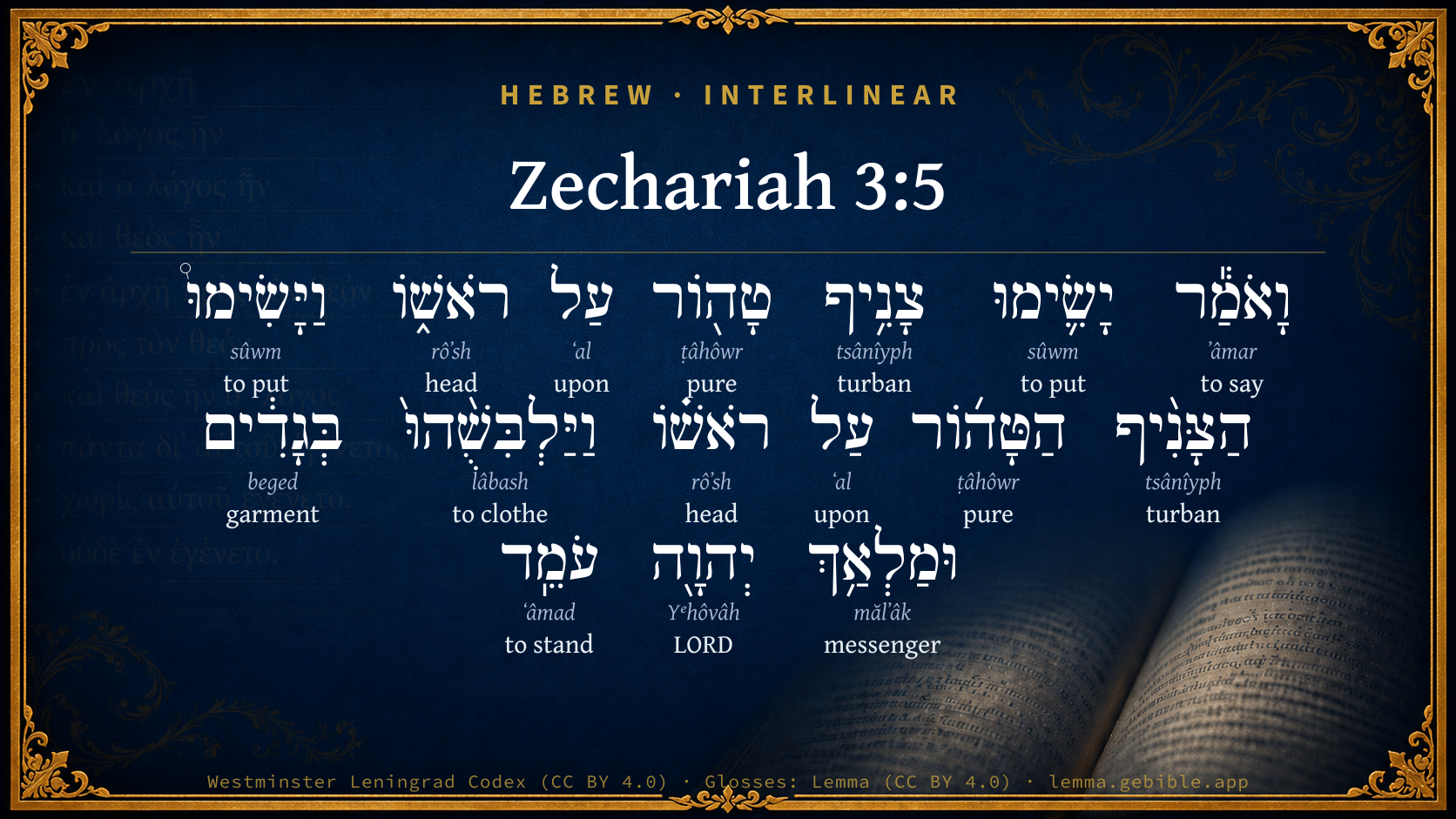
  1. וָאֹמַ֕ר ʼâmar H559 “and · to say” Conjunction + Verb, Qal, Sequential Imperfect, 1st Person, Common, Singular
  2. יָשִׂ֛ימוּ sûwm H7760 “to put” Verb, Qal, Jussive, 3rd Person, Masculine, Plural
  3. טָה֖וֹר ṭâhôwr H2889 “pure” Adjective, Adjective, Masculine, Singular, Absolute
  4. עַל ʻal H5921 “upon” Preposition
  5. רֹאשׁ֑וֹ rôʼsh H7218 “head · his” Noun, Common, Masculine, Singular, Construct + Suffix, Personal, 3rd Person, Masculine, Singular
  6. וַיָּשִׂימוּ֩ sûwm H7760 “and · to put” Conjunction + Verb, Qal, Sequential Imperfect, 3rd Person, Masculine, Plural
  7. הַצָּנִ֨יף tsânîyph H6797 “the · turban” Particle, Definite Article + Noun, Common, Both, Singular, Absolute
  8. הַטָּה֜וֹר ṭâhôwr H2889 “the · pure” Particle, Definite Article + Adjective, Adjective, Masculine, Singular, Absolute
  9. עַל ʻal H5921 “upon” Preposition
  10. רֹאשׁ֗וֹ rôʼsh H7218 “head · his” Noun, Common, Masculine, Singular, Construct + Suffix, Personal, 3rd Person, Masculine, Singular
  11. וַיַּלְבִּשֻׁ֨הוּ֙ lâbash H3847 “and · to clothe · him” Conjunction + Verb, Hiphil, Sequential Imperfect, 3rd Person, Masculine, Plural + Suffix, Personal, 3rd Person, Masculine, Singular
  12. בְּגָדִ֔ים beged H899 “garments” Noun, Common, Masculine, Plural, Absolute
  13. וּמַלְאַ֥ךְ mălʼâk H4397 “and · messenger of” Conjunction + Noun, Common, Masculine, Singular, Construct
  14. יְהוָ֖ה Yᵉhôvâh H3068 “LORD” Noun, Proper
  15. עֹמֵֽד ʻâmad H5975 “standing” Verb, Qal, Participle Active, Masculine, Singular, Absolute

About this verse

These counts appear in no published source. They are computed here, from the morphology-tagged text and Lemma’s own curated glosses. What Lemma adds →

16
words
11
distinct lemmas
Prophets
section

Notable vocabulary

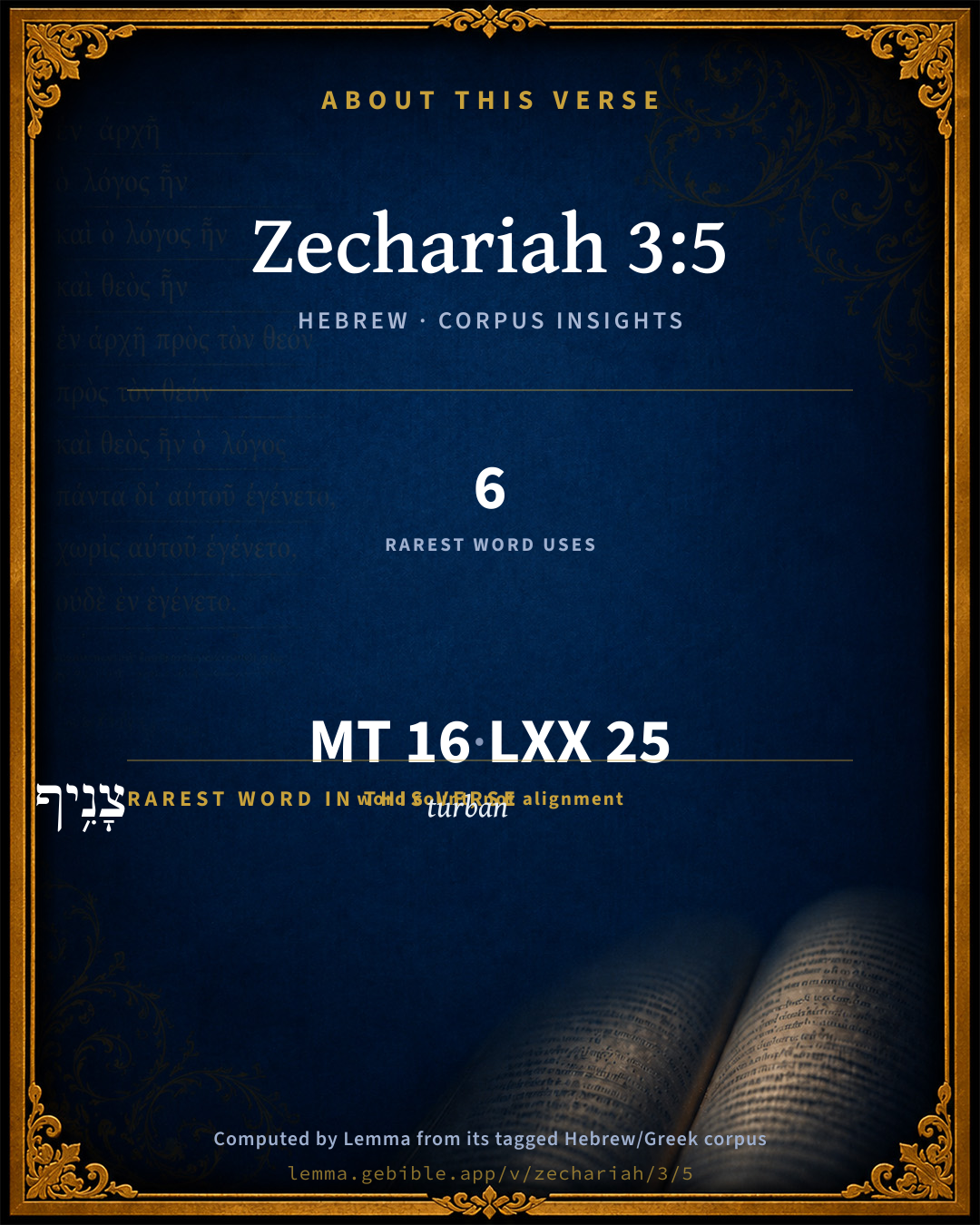
The rarest word here is צָנִ֥יף turban H6797 — appearing just 6 times in the whole Hebrew Bible.

Shared distinctive vocabulary

צָנִ֥יף turban H6797 occurs in 4 verses of the Hebrew Bible. Also found in:

Grammatical profile

  • 5 verbs
  • 7 nouns
  • 2 adjectives
  • 2 prepositions

Verb forms

  • וָאֹמַ֕ר Qal · Sequential Imperfect
  • יָשִׂ֛ימוּ Qal · Jussive
  • וַיָּשִׂימוּ֩ Qal · Sequential Imperfect
  • וַיַּלְבִּשֻׁ֨הוּ֙ Hiphil · Sequential Imperfect
  • עֹמֵֽד Qal · Participle Active

Repetition

Words recur within this verse — often emphatic in Hebrew:

  • יָשִׂ֛ימוּ to put H7760 ×2
  • צָנִ֥יף turban H6797 ×2
  • טָה֖וֹר pure H2889 ×2
  • עַל upon H5921 ×2
  • רֹאשׁ֑וֹ head H7218 ×2

Hebrew & Septuagint length

In English translation the verse runs 31 words from the Hebrew and 40 from the Septuagint (LXX English) — closely comparable.

A rough comparison of the two English renderings, which tokenize alike — not a word-level alignment.

Word counts can differ between the Hebrew and the Greek without any difference in meaning — e.g. the Hebrew direct-object marker אֵת has no separate Greek word, and Greek often adds the article ὁ.

In the original languages it is 16 Hebrew tokens and 25 Greek tokens — but the two are counted differently (Hebrew bundles its prefixes and suffixes into one token; the Greek is in lemma form), so that isn’t a like-for-like length.

Cross-references

9

Topical passages linked to Zechariah 3:5 in the Treasury of Scripture Knowledge — connected by theme and wording, ordered by reader-vote popularity; previews shown in the World English Bible.

  • Zechariah 6:11 Yes, take silver and gold, and make crowns, and set them on the head of Joshua the son of Jehozadak, the high priest;
  • Exodus 29:6 and you shall set the turban on his head, and put the holy crown on the turban.
  • Job 29:14 I put on righteousness, and it clothed me. My justice was as a robe and a diadem.
  • Exodus 28:2–4 You shall make holy garments for Aaron your brother, for glory and for beauty.
  • Leviticus 8:6–9 Moses brought Aaron and his sons, and washed them with water.
  • Hebrews 2:8–9 You have put all things in subjection under his feet." For in that he subjected all things to him, he left nothing that is not subject to him. But now we don't see all things subjected to him, yet.
  • Revelation 4:4 Around the throne were twenty-four thrones. On the thrones were twenty-four elders sitting, dressed in white garments, with crowns of gold on their heads.
  • Revelation 4:10 the twenty-four elders fall down before him who sits on the throne, and worship him who lives forever and ever, and throw their crowns before the throne, saying,
  • Revelation 5:8–14 Now when he had taken the book, the four living creatures and the twenty-four elders fell down before the Lamb, each one having a harp, and golden bowls full of incense, which are the prayers of the saints.

Cross-references courtesy of OpenBible.info (CC BY 4.0).

Hebrew and Greek witnesses Masoretic Hebrew ↔ Greek Septuagint

The same verse in the two great witnesses to the Old Testament, shown verse-for-verse.

These are two independent witnesses, not word-aligned to each other, and the Septuagint is shown in lemma (dictionary) form.

Hebrew Zechariah 3:5 Masoretic · Westminster Leningrad Codex

וָאֹמַ֕ר יָשִׂ֛ימוּ צָנִ֥יף טָה֖וֹר עַל רֹאשׁ֑וֹ וַיָּשִׂימוּ֩ הַצָּנִ֨יף הַטָּה֜וֹר עַל רֹאשׁ֗וֹ וַיַּלְבִּשֻׁ֨הוּ֙ בְּגָדִ֔ים וּמַלְאַ֥ךְ יְהוָ֖ה עֹמֵֽד

I said, "Let them set a clean turban on his head." So they set a clean turban on his head, and clothed him; and the angel of Yahweh was standing by.

World English Bible · Public Domain

Greek LXX Zechariah 3:5 Septuagint · lemma form

καί ἐπιτίθημι κίδαρις καθαρός ἐπί ὁ κεφαλή αὐτός καί περιβάλλω αὐτός ἱμάτιον καί ἐπιτίθημι κίδαρις καθαρός ἐπί ὁ κεφαλή αὐτός καί ὁ ἄγγελος κύριος ἵστημι

And the Lord answered and spoke to those who stood before him, saying, Take away the filthy raiment from him: and he said to him, Behold, I have taken away your iniquities: and clothe you⌃ him with a long robe,

LXX2012 (modern English Septuagint) · Public Domain

On this verse, Whedon's Commentary on the Bible discusses the Septuagint’s reading. Read the note in Commentary ↓

Hebrew: Westminster Leningrad Codex (CC BY 4.0). Greek: Septuagint (public domain); English from LXX2012 (modern English Septuagint) (Public Domain). How the Septuagint differs from the Hebrew →

Targum (Aramaic paraphrase)

1

The Targum is the ancient Jewish Aramaic paraphrase of the Hebrew Scriptures — an interpretive translation, not the Hebrew text itself. Onkelos (literal) and Pseudo-Jonathan (expansive) render the Torah, and Jonathan the Prophets. Coverage is partial: where no permissively-licensed English translation exists for a verse, only the Aramaic is shown. This is verse-level text, not a word-by-word alignment to the Hebrew.

  1. Targum Jonathan Prophets (Joshua–Malachi)
    וַאֲמָרֵית שַׁווּ מִצְנֵיפָא דַכְיָא עַל רֵישֵׁיהּ וְשַׁוִיאוּ מִצְנְפָא דַכְיָא עַל רֵישֵׁיה וְאַסְבוּהִי אִתְּתָא דְכָשְׁרָא לִכְהוּנְתָא וּמַלְאֲכָא דַייָ קָאִים:

    (no public-domain English translation for this verse)

    Targum Jonathan — Aramaic: “Mikraot Gedolot” (public domain). English: “Sefaria Community Translation” (CC0 1.0 (public-domain dedication)); “London "Chaldee Paraphrase," 1871” (public domain). Text via Sefaria.

Commentary

Notes on Zechariah 3:5 from classic Christian and Jewish commentators (each source and its license shown beneath its notes). The classic Christian expositions comment on the surrounding passage and are grouped to its opening verse, so a note may address several verses; the Jewish commentaries on the Tanakh (Rashi and others) are per-verse, so they appear only where the commentator wrote on this verse.

Lemma curates 59 commentaries, every one of them public domain or Creative Commons licensed, each selected and text-cleaned for this edition rather than reprinted as found. About our sources →

Trapp's Complete Commentary

John Trapp

Zec 3:5 And I said, Let them set a fair mitre upon his head. So they set a fair mitre upon his head, and clothed him with garments. And the angel of the LORD stood by.

Ver. 5. And I said, Let them set a fair mitre upon his head] Who said this? The prophet, grounding his speech on the last precious words of the angel, taketh the boldness to interpose his request for the bestowing of the priestly ornaments upon Joshua, and accordingly it is done. This the prophet knew would be a comfort to the whole people, and a confirmation to Joshua’s faith, for the pardon of his sins; like as it was to Peter and the rest of the apostles, that Christ after his resurrection restored them to their office, after they had all shamefully forsaken him, Mat 28:19 Joh 20:21.

Let them set a fair mitre upon his head] Not a diadem, as the old translation hath it (that is for a king’s head), much less a triple crown with the word Mystery (Babylon’s motto, Rev 17:5) engraven in it, as Brocard and many other eyewitnesses affirm of the Pope’s crown, but a mitre or tiara. It hath its name from compassing about, because it environed the high priest’s head. It had a holy crown with it, Exo 29:6, signifying the Deity and dignity of Christ. It had also upon the forefront of it a plate of pure gold with this caelature, Holiness to the Lord. Hence it was not lawful for the high priest (say the Jews) to put off his mitre to whomsoever he met, were he never so great a man; lest the name and glory of God (whose person he sustained) should seem to submit to any living. With this mysterious mitre upon his head, with other priestly ornaments and vestments, it was that Alexander the Great met the high priest Jaddus (nephew and successor to Joshua in the text) as he was marching against Jerusalem with hostile intent; and adoring that God whose name was seen written on the golden plate of his mitre, he entered the city peaceably, offered sacrifice in the temple, as the priests directed him, and having seen there the prophecy of Daniel concerning himself, he granted the Jews many immunities and privileges, and so departed, Dan 8:7; Dan 8:20-21; Dan 11:13. Parmenion, one of his favourites, asked him the reason of his friendly dealing with the Jews, who, by denying him help and tribute, had highly displeased him. He answered, that while he was yet in Macedonia, and but thinking of the conquest of Asia a certain man appeared unto him in the clothes of that high priest, encouraging him to set upon the work, and assuring him of good success therein.

And the angel of the Lord] That is, Christ, the master of these ceremonies, the effect of this Levitical office.

John Trapp, A Commentary or Exposition upon All the Books of the Old and New Testament (1647–1656) — public domain. Text from a community e-Sword module.

Whedon's Commentary on the Bible

Daniel D. Whedon

5. And I said — If the present Hebrew text is original, the prophet must be the speaker. He has been an interested bystander; now he can contain himself no longer, and he prays that the diadem be restored to the high priest. LXX. omits these words and continues with the imperative, “set,” which is co-ordinated to “take away” and “clothe” in Zec_3:4. LXX. presents the smoother reading and may be original.

Set a fair [“clean”] miter upon his head — The miter completes the high-priestly dress; its restoration will prepare Joshua to act again as the mediator between God and the people; therefore the placing of the miter upon the head completes the transaction begun by the removing of the filthy garments. The people are not only cleansed, but fellowship and communion with Jehovah is re-established. The word translated “miter” is not identical with the one used in Exo_28:4; Exo_28:36-38, but it undoubtedly refers to the same thing.

The command of the angel was executed, Joshua was clothed with clean garments, and the miter was placed upon his head.

The angel of Jehovah stood by — Superintending the proceedings and by his presence giving to them his approval. Some commentators combine the last clause of Zec_3:5 with Zec_3:6 and read the two, “And the angel of Jehovah rose and protested unto Joshua,” which is smoother; but is there sufficient justification for the change?

Daniel D. Whedon (gen. ed.), Commentary on the Old and New Testaments (1874–1909) — public domain. Text from a community e-Sword module.

Tyndale Open Study Notes

Tyndale Open Resources

3:5 The high priest’s turban bore a gold medallion inscribed with the words “Holy to the Lord” (Exod 28:36-38; see also study note on Zech 14:20). The clean turban was placed on Jeshua’s head as an act of ordination that reinstated him as priest and mediator for the people.

Tyndale Open Study Notes — © Tyndale Open Resources, licensed CC BY-SA 4.0. Text via the HelloAO Bible API.

Geneva Bible (1599)

Geneva Bible translators

The Prophet prayeth, that besides the raiment, the Priest might also have tyre for his head accordingly, that is, that the dignity of the Priesthood might be perfect: and this was fulfilled in Christ, who was both Priest and King: and here all such are condemned, that can content themselves with any mean reformation in religion, seeing the Prophet desireth the perfection, and obtaineth it.

Geneva Bible (1599) marginal notes — public domain. Text via Bolls.life.

Jamieson, Fausset & Brown

Robert Jamieson, A. R. Fausset & David Brown

And I said--Here the prophet, rejoicing at the change of raiment so far made, interposes to ask for the crowning assurance that the priesthood would be fully restored, namely, the putting the miter or priestly turban on Joshua: its fair color symbolizing the official purity of the order restored. He does not command, but prays; not "Set," but "Let them set." Vulgate and Syriac version read it, "He then said," which is the easier reading; but the very difficulty of the present Hebrew reading makes it less likely to come from a modern corrector of the text.

angel of . . . Lord stood by--the Divine Angel had been sitting (the posture of a judge, Dan 7:9); now He "stands" to see that Zechariah's prayer be executed, and then to give the charge (Zac 3:6-7).

Jamieson, Fausset & Brown — Commentary Critical and Explanatory on the Whole Bible (1871) — public domain (CC PDM 1.0). Text via the HelloAO Bible API.

Adam Clarke's Commentary

Verse 5. A fair mitre upon his head] To signify that he had renewed to him the office of the high priesthood, which had been defiled and profaned before. The mitre was the bonnet which the high priest put on his head when he entered into the sanctuary, Ex 28:4, c.

Clothed him with garments] Referring to the vestments of the high priest. The true high priest, who is over the house of God, will establish his office among them, when they shall acknowledge him as their Messiah, and seek redemption in the blood of the sacrifice which he has offered for their sins and not for theirs only, but for the sins of the whole world.

Adam Clarke's Commentary on the Bible (1810–1826) — public domain. Text from a community e-Sword/MySword module.

John Calvin's Commentaries

The Prophet had said that Joshua was clothed in splendid and beautiful garments, who had on before such as were sordid, and that this was done by the command of the angel: he now adds, that he wished that a still greater glory should be bestowed on him, for he saw that something was wanting. He therefore desired that the high priest should be adorned with a crown, so that his dress might in every way correspond with the dignity of his office. But what is here stated, that the Prophet spoke, is not to be taken as spoken authoritatively, but rather expressed as a wish, as though he had said, that it was indeed a pleasant and delightful spectacle to see the high priest decently and honorably clothed; but that it was also desirable, that a crown or a diadem should be added, as a symbol of the priesthood, and not of royalty. There is indeed no disadvantage in considering royalty also as signified; for the kingly office, we know, is united with the priestly in the person of Christ: but I take the crown here to be the priest’s mitre; for we know that this was the chief ornament whenever the priest came to the altar of incense. But as to the main point, we must bear in mind the design of the Prophet, — that the high priest was adorned with splendid vestments, and yet his dignity appeared only in part; therefore the Prophet desires that a pure crown or mitre should be added: and he says that this took place even in the presence of the angel, thereby intimating that his wish was by God approved.

Now we ought first to contemplate the zeal and godly concern of the Prophet, which he had for the glory and honor of the priesthood; for though he regarded with joy the splendid dress of the high priest, he could not restrain himself from wishing that the highest ornament should be added. And this example is exhibited to us for imitation, so that we ought to desire the increase of those favors of God, by which the priesthood of Christ is signalised, until it arrives at the most perfect state. But we see that many are against such a wish; for at this day there are those who profess some zeal for true religion, but are satisfied with a mere shadow; or at least, it would abundantly satisfy them to see the Church half purified: and the world is full of men who indeed confess that the Church is defiled by many pollutions, but wish only for some small measure of reformation. But the Prophet seems to invite us to do a very different thing: he saw that the high priest was already adorned with new garments; but when he considered that the honor of the priesthood was not fully restored, he wished the mitre to be also added. And by saying that the angels seconded his wish, he encourages us fully to believe, that if we desire from the heart that his glory should be given to Christ, God will hear our prayers: for the Prophet, when he sighed, did not in vain ask the angel to put a mitre on the high priest.

The expression, that the angel of God stood, is not without meaning. He was not an idle spectator; and it is intimated that God had not only once a care for the priesthood, but that the angel was always watching to defend Joshua; for it would not be enough to be once adorned by God, who presides over the Church, except his guardianship were perpetual. We now then understand the import of the words. It follows —

John Calvin's Commentaries (1540-1563) — public domain. Text from the Calvin Translation Society English edition (1840s-50s) via the Christian Classics Ethereal Library (ccel.org). Calvin's coverage is partial (roughly two-thirds of the Bible); uncommented books and verses are honest gaps, never fabricated. The 19th-century editor's footnotes and remarks are omitted so the notes are faithfully Calvin's own voice.

Ellicott's Commentary for English Readers

(5) Fair—i.e., clean. (Comp. the words of the Rubric, “a fair white linen cloth.”) The prophet seems to have felt constrained to make the request contained in this verse from an idea that the changing of Joshua’s raiment might be only a sign of the removal of the high priest’s own guilt.

Mitre, or turban, it was upon which was fastened the golden plate inscribed with “Holiness to the Lord” (comp. Zec_14:20), by virtue of which the shortcomings of the sanctuary were atoned (Exo_28:38). That the prophet was justified in making the request is shown by the fact that it was granted. and that even before the “garments” were put on.

Stood by.—Better, kept standing (where he was).

A Bible Commentary for English Readers, edited by Charles John Ellicott (1878–1897) — public domain. Text from a community e-Sword module.

The Cambridge Bible for Schools and Colleges

gen. ed. J. J. S. Perowne

5. And I said] The speaker might be the Angel of the Lord, reciting further the commands which he had given. But it is better to suppose that Zechariah, looking on with intense interest, gives vent to his feelings, in the request that the now comely attire of the High Priest should not be left incomplete.

mitre] The word is not the same (though from the same root) as that used in Exo_28:4; Exo_28:36-38; but there is no doubt that the same thing is intended.

stood by] i.e. remained in the same position that he had occupied before, to superintend and sanction the proceedings.

The Cambridge Bible for Schools and Colleges (gen. ed. J. J. S. Perowne; Cambridge University Press, 1878–1918) — public domain. Text from a community e-Sword module.

John Gill's Exposition

And I said, Let them set a fair mitre upon his head,.... These are either the words of Jehovah the Father, who has all the angels at his command, and can order them to do what he pleases; always regards the intercession of Christ; is ever well pleased with his righteousness, and with his people, as clothed with it; and, where he gives grace, he gives more grace: a man clothed with Christ's righteousness is upon rising ground; he is in the way to great honour and glory: or, as some think, they are the words of the Angel of the Lord, the Messiah, continued, who willed, ordered, and commanded his ministering servants to do this, that Joshua might appear agreeably to the dignity of his office, and look great, as well as clean and neat: or rather they are the words of Zechariah the prophet; and design either the inward thoughts and secret wishes of his mind; or were an humble request of his, and was regarded; who, seeing something wanting to make Joshua a complete high priest, intercedes for it: so one saint rejoices in the restoration of another; and is so far from envying the gifts and graces of the greatest, that he wishes him more:

so they set a fair mitre upon his head; such as the high priest wore; on which was a plate of gold, and on it written "Holiness to the Lord"; and was an emblem of Christ being made sanctification to his people; see Exo 28:4. The mitre was a garment of the high priest, a sort of covering for the head, a cap or turban: it was made of linen, and is called the linen mitre, Lev 16:4 and that which Joshua might have wore before, being stained and foul, it is requested that a "fair" or "clean" (l) one might be set upon his head. It consisted, as the Jewish writers say (m), of sixteen cubits or ells, which were rolled up in the form of a Turkish turban; and has its name in Hebrew from its being thus rolled up. The account Josephus (n) gives of it is, that it was

"a cap or bonnet wore on the head, not rising up in a point, nor encompassing the whole head, but put on little more than the middle of it; and is called "masnaempthes" (it should be "mitznephet"); and is formed in such a manner, as to look like a crown, made of a linen web, like a swath or roller; for it is many times rolled about and sewed;''

and with which Jerom's account of it agrees; who says (o),

"the fourth sort of garment is a round cap or bonnet, such as we see painted on Ulysses, like a globe, circle, or sphere, divided in the middle, and one part set on the head: this we and the Greeks call a "tiara"; the Hebrews, "mitznephet": it has no point at top, nor does it cover the whole head to the hair, but leaves a third part of the forehead uncovered; and so bound with a lace at the back of the head, that it cannot easily fall from it: it is made of fine linen; and is so well covered with a linen cloth, (and which also Josephus takes notice of in the above place), that no traces of the needle appear without.''

It hid the seams, and the deformity of them: both the high priest and the common priests wore mitres, as appears from Exo 28:4 and the difference between them, according to the Jewish writers (p), seems chiefly to lie in the manner of rolling and wrapping them: the mitre of the high priest was wrapped about his head, as you roll a broken limb, roll upon roll, and did not rise up to a point, but was flat on his head; but that of the common priests consisted of various folds and rolls; which gradually rose up to a point, as a nightcap, or high crowned hat. Josephus (q) contrary to all other writers, makes the high priest to have two mitres; for he says, he had a cap like to the former, such as all the rest of the priests had, upon which another was sewed, variegated with blue, or a violet colour; which Braunius (r) thinks is a mistake of his, arising from the blue lace, with which the plate of gold, that had engraven on it Holiness to the Lord, was fastened to the mitre; or else that the place is corrupted, or has been interpolated by some other hand; since this would make the high priest to have nine garments, and not eight only; but Fortunatus Scacchus (s) takes the passage to be genuine, and argues from it for another mitre or cap, more worthy of the high priest; and which was peculiar to him, and was very curiously wrought, and on which the celestial globe was figured; and so Josephus says (t), that the cap being made of blue or hyacinth, seemed to signify heaven; for otherwise the name of God would not have been put upon it. The son of Sirach, Ecclesiasticus 45:12 speaks very highly of this covering of the high priest's head, calling it

"a crown of gold upon the mitre, wherein was engraved Holiness, an ornament of honour, a costly work, the desires of the eyes, goodly and beautiful;''

as here a fair mitre:

and clothed him with garments; priestly ones, suitable to his office, which were in all eight; which were the linen breeches; the coat of linen; an embroidered girdle; a robe of blue; an ephod of gold; a breastplate curiously wrought, in which were the Urim and Thummim; a mitre of fine linen, and a plate of pure gold on it, Lev 8:7 and on the day of atonement he wore the four following extraordinary garments, breeches, coat, girdle, and mitre all of linen, Lev 16:4 (u); all which were typical of the clothing of believers by Christ, by whom they are made priests unto God: "and clothed him with garments"; priestly robes, suitable to his office:

and the Angel of the Lord stood by; to see all done according to his order; and not as a mere spectator, for he was concerned in clothing him himself; and he still stood to denote his constant care of Joshua, and his regard to him, and as having something more to say to him, as follows:

(l) , Sept.; "cidarim mundam", V. L. Pagninus, Montanus, &c. Targum. (m) Maimon. Cele Hamikdash, c. 8. sect. 19. (n) Antiqu. l. 3. c. 7. sect. 3. (o) De Vestitu Sacerdotum ad Fabiolam, fol. 19. I. (p) Maimon. Cele Hamikdash, c. 8. sect. 2. Aben Ezra in Exod. xxviii. 36. (q) Ut supra, (Antiqu. l. 3. c. 7.) sect. 6. (r) De Vestitu Sacerdot. Hebr. l. 2. c. 21. p. 795. (s) Sacr. Elaeochrism. Myroth. l. 3. c. 39. p. 995. Vid. Solerium de Pileo, sect. 12. p. 257. (t) Ut supra, (Antiqu. l. 3. c. 7.) sect 7. (u) Maimon Cele Hamikdash, c. 8. sect. 1, 2, 3.

John Gill's Exposition of the Whole Bible (1746–1763) — public domain (CC PDM 1.0). Text via the HelloAO Bible API.

Albert Barnes' Notes on the Bible

And I said, let them set a fair mitre on his head - This seems to have been purposely omitted, in order to leave something, and that, the completion of all, to be done at the intercession of the prophet. The glory and complement of the high priest’s sacrificial attire was the mitre with the “holy crown upon it and the plate of prate gold, on which was graven, Holiness to the Lord” Exo 28:36-38; Exo 29:6; which was to “be upon” the high priest’s “forehead, that he may bear the iniquity of the holy things which the children of Israel shall hallow in all their holy gifts; which was always to be upon his forehead, that they may be accepted before the Lord.” The renewed gift of this was reserved for the intercession of man co-working with God.

And the angel of the Lord standing by - Seeing that all was done aright, and, now that the acquittal was complete, standing to give the charge.

Albert Barnes' Notes on the Bible (1834–1885) — public domain. Text from a community e-Sword/MySword module.

Haydock's Catholic Bible Commentary

Mitre, (cydarim) the pontiff’s tiara, of byssus, Exodus xxviii. 4.

George Leo Haydock (1774–1849), Haydock's Catholic Family Bible and Commentary, 1859 edition — public domain. Excludes Psalms (Douay-Rheims chapter numbering differs from Protestant) and Deuterocanonical books (Catholic canon only).

Matthew Poole's English Annotations

And I said: Zechariah takes the boldness to desire that for Joshua which might add to his veneration and authority; and he asks the thing of Christ, or rather Christ commandeth this be done. Let them, who minister before Christ,

set a fair mitre; a rich and beautiful ornament for the head of the high priest; not a crown, which is for royal heads, but a tire, a pontifical ensign.

So they set, as they were commanded by Christ at the request of the prophet.

And clothed him with garments; all the garments which did appertain to the high priest, of which you read Exo 28:4, which probably were put on, though they are not expressly mentioned here.

The angel, who is the Lord Christ himself,

stood by; withdrew not till all this was done.

Matthew Poole's English Annotations on the Holy Bible (1683–1685) — public domain. Text from a community e-Sword/MySword module.

The Pulpit Commentary

I said. If this is the true reading (which Ewald doubts), we must consider that the prophet, excited by what has passed, cannot stand by as a mere spectator, but feels constrained to take part in the scene, and to request that the change of garments may be completed by the addition of the fair head dress. The LXX omits the word, continuing the address to the attendant. The Vulgate has, et dixit. So the Syriac and the Targum and some few manuscripts. But the received reading is confirmed, as Dr. Alexander points out, by the change in the mood of the following verb from the imperative to the optative, "let them put," "would that they put." There is nothing incongruous in the prophet thus intervening in his own person. Thus Isaiah, in the midst of a solemn vision, gives vent to his feelings, (Isa_6:5) and St. John in the Apocalypse often mingles his own sentiments and actions with what he beheld. (comp. Rev_5:4 Rev_10:9 Rev_11:1) Mitre (tsaniph); Septuagint, kidarin : so the Vulgate, cidarim. This is not the same word as that used in Exo_28:4, etc. (which is mitsnepheth), for the official head dress of Aaron, though it is probably a synonym for it; and the prophet"s wish is to see Joshua not only reinstated in his office and dignity, but found holy also. For the fair linen mitre, or tiara, was that which bore upon its front the golden plate inscribed, "Holiness unto the Lord", (Exo_28:36-38) and therefore showed that he was qualified to intercede for the people. Stood by. The Angel of Jehovah continued standing in his place, contemplating, sanctioning, and directing what was being done.

We may take this as A picture of Christ and the soul.

"Stood by.

I TENDER CONCERN. The beginnings of life are full of interest. So it is with the budding of the flower; the lispings of infancy; the first tokens of love. How carefully the gardener watches the germinating of some rare seed! With what tender solicitude friends wait for the signs of returning health to the loved one brought low by disease! So in an infinitely higher way as to our Lord. Our souls are precious in his sight. (Luk_15:20 Joh_1:48)

II HOLY SATISFACTION IN THE DEFEAT OF THE GREAT ENEMY. Sympathetic. Ever on the alert. Ready to interpose effectively at the right moment. The wilderness, Gethsemane, Calvary, testify to his love and mighty power. His victory was our victory. Every sinner converted, every backslider restored, every believer strengthened and fitted for higher service, is to the shame of Satan and to the glory of Christ.

III EXULTING JOY IN THE RESCUE OF SOULS. "Standing" implies continued interest. Lasts all through, from the first struggle to the final victory. (cf. Stephen, Act_7:36) Christ"s love never faileth, and his joy is the joy of eternity and of God. "He shall see of the travail of his soul, and be satisfied. F.

The Pulpit Commentary (1880–1919), ed. H.D.M. Spence-Jones & Joseph S. Exell — public domain. Text from a community e-Sword module.

John Wesley's Explanatory Notes

I said - Zechariah takes the boldness to desire that for Joshua, which might add to his authority, and he asks the thing of Christ. A fair mitre - The proper ornament for the head of the high-priest. With garments - All the garments which appertained to the high priest. The angel - Christ.

John Wesley, Explanatory Notes Upon the Whole Bible (1754–1765) — public domain. Text via the GEBible commentary corpus.

Keil & Delitzsch

C. F. Keil & F. Delitzsch

At this moment the prophet feels compelled to utter the prayer that they may also put a clean mitre upon Joshua's head, which prayer is immediately granted. The prayer appears at first to be superfluous, inasmuch as the mitre would certainly not be forgotten when the dirty clothes were taken away and the festal dress was put on. Nevertheless, the fact that it is granted shows that it was not superfluous. The meaning of the prayer was hardly that the high priest might be newly attired from head to foot, as Hengstenberg supposes, but is rather connected with the significance of the mitre. Tsânı̄ph is not a turban, such as might be worn by anybody (Koehler), but the headdress of princely persons and kings (Job 29:14; Isa 62:3), and is synonymous with mitsnepheth, the technical word for the tiara prescribed for the high priest in the law (Ex. and Lev.), as we may see from Eze 21:31, where the regal diadem, which is called tsânı̄ph in Isa 62:3, is spoken of under the name of mitsnepheth. The turban of the high priest was that portion of his dress in which he carried his office, so to speak, upon his forehead; and the clean turban was the substratum for the golden plate that was fastened upon it, and by which he was described as holy to the Lord, and called to bear the guilt of the children of Israel (Exo 28:38). The prayer for a clean mitre to be put upon his head, may therefore be accounted for from the wish that Joshua should not only be splendidly decorated, but should be shown to be holy, and qualified to accomplish the expiation of the people. Purity, as the earthly type of holiness, forms the foundation for glory. In the actual performance of the matter, therefore, the putting on of the clean mitre is mentioned first, and then the clothing with festal robes. This took place in the presence of the angel of the Lord. That is the meaning of the circumstantial clause, "and the angel of the Lord stood" (ritum tanquam herus imperans, probans et praesentia sua ornans, C. B. Mich.), and not merely that the angel of the Lord, who had hitherto been sitting in the judge's seat, rose up from his seat for the purpose of speaking while the robing was going on (Hofmann, Koehler). עמד does not mean to stand up, but simply to remain standing.

Keil & Delitzsch — Biblical Commentary on the Old Testament (1861–1891) — public domain (CC PDM 1.0). Text via the HelloAO Bible API. (Old Testament only.)

Scofield Reference Notes

C. I. Scofield

angel

(See Scofield "Heb 1:4").

The Scofield Reference Bible (1917 edition), notes by C. I. Scofield — public domain. Text from a community e-Sword module.

Rashi

Rabbi Shlomo Yitzchaki (Rashi)

And I said I, Zechariah.

“Let them put a pure miter, etc.” I begged mercy for him.

Rashi on the Tanakh — English translations: “The Judaica Press complete Tanach with Rashi, translated by A. J. Rosenberg” (CC BY 4.0); “Pentateuch with Rashi's commentary by M. Rosenbaum and A.M. Silbermann, 1929-1934” (public domain); “The Metsudah Tanach series, Lakewood, N.J” (CC BY 4.0); and “The Book of Joshua, Metsudah Publications, 1997” (CC BY 4.0). Text via Sefaria.

Lesson kit

Teaching starters — assembled from the data on this page, not authored interpretation. Every prompt links to the verse data it draws on. Edit before teaching.

Zechariah, in the Prophets, opens this verse with 16 words (11 distinct Hebrew lemmas). Its most distinctive word is tsânîyph (“turban”). A historical commentator’s framing appears above. Read the whole chapter for the surrounding context.

Discussion questions

  1. The word tsânîyph carries the sense “turban.” How does it shape the verse?
  2. How does Job 29:14, which shares the word «turban», read alongside this verse?
  3. What does the repetition of “to put” (2× in this one verse) do in this verse?
  4. These translations render this verse differently. What is at stake in choosing one wording over another?
  5. «וָאֹמַ֕ר» is a Qal Sequential Imperfect verb. How does that grammatical form shape the action described?
  6. Compare how Trapp's Complete Commentary and Whedon's Commentary on the Bible read this verse. Where do they agree or differ?

Things to notice

Reading settings

Reading text

Shown beneath each verse's original-language words.

Old Testament
Old Testament edition

Read the OT as the Masoretic Hebrew (MT) or the Greek Septuagint (LXX).

English shown for the Greek Septuagint (in the Hebrew ↔ Greek comparison).

Comparing translations? Open the Compare panel on any verse page to stack up to four side by side.