

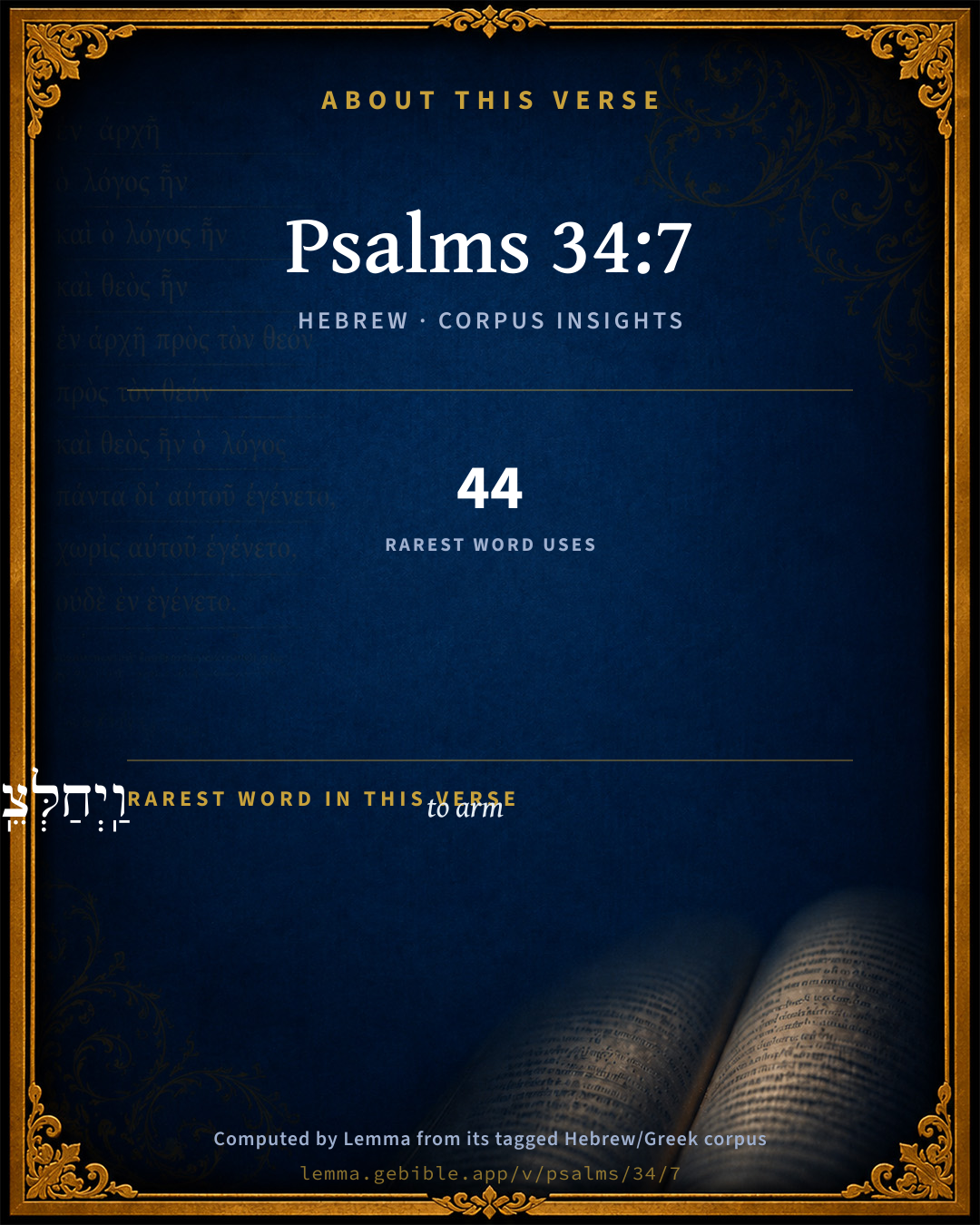
Psalms 34:7

Hebrew (Westminster Leningrad Codex) Psalms 34:7 appears in the Hebrew Old Testament. The text above is from the Westminster Leningrad Codex. Each word links to its Strong’s number, a concise gloss, and parsing drawn from the Open Scriptures Hebrew Bible morphology. Click any word for its full Brown-Driver-Briggs (BDB) entry.
Download image
Cite this verse

Psalms 34:7 (World English Bible). Public Domain. Lemma interlinear Bible study tool, https://lemma.gebible.app/v/psalms/34/7.

Show BibTeX & RIS
BibTeX
RIS
English Translation
The angel of Yahweh encamps round about those who fear him, And delivers them.
World English Bible · Public Domain
Download a study sheet

One document with this verse’s original text, its word-by-word gloss line, the meaning frame, cross-references with their text, attributed commentary, and full source and license credits — printable, and it pastes into notes with its structure intact.

This verse Autodidact and up

Study sheet (.html) Plain text (.txt)

A passage Seminary Student

Up to 50 verses in one chapter. A passage sheet keeps up to 6 commentary sources and 12 cross-references per verse, in the order this page ranks them, and says so on the sheet whenever that leaves anything out. Ask for a single verse and you get the Autodidact verse sheet above.

Everything on this page stays free to read, with no account — the sheet is a download of what is already on screen, not access to it.

Want to remove ads? Support Godless Engineer
Compare translations 3

The same verse in 3 English versions, stacked beneath the original-language interlinear above. Click any original word for its lexicon entry.

Each is an independent rendering of the whole verse — the interlinear is not word-aligned to these translations.

Highlighted words mark where these versions differ — a whole-verse word diff, not a word-by-word alignment.

  • World English Bible Public Domain
    The angel of Yahweh encamps round about those who fear him, And delivers them.
  • King James Version Public Domain
    The angel of the LORD encampeth round about them that fear him, and delivereth them.
  • unfoldingWord Literal Text CC BY-SA 4.0
    The angel of Yahweh is encamping around the fearers of him, and he rescues them.

unfoldingWord Literal Text — © unfoldingWord, licensed CC BY-SA 4.0. Word-aligned USFM3 via Door43 (git.door43.org/unfoldingWord/en_ult).

Versions to compare (up to 4)

3 of 4 selected

Show all 18 translations

Every available English version of this verse, each an independent rendering of the whole verse.

  • World English Bible Public Domain
    The angel of Yahweh encamps round about those who fear him, And delivers them.
  • Berean Standard Bible Public Domain
    The angel of the LORD encamps around those who fear Him, and he delivers them.
  • Majority Standard Bible Public Domain
    The angel of the LORD encamps around those who fear Him, and he delivers them.
  • King James Version Public Domain
    The angel of the LORD encampeth round about them that fear him, and delivereth them.
  • American Standard Version (1901) Public Domain
    The angel of Jehovah encampeth round about them that fear him, And delivereth them.
  • Revised Version (1885) Public Domain
    The angel of the LORD encampeth round about them that fear him, and delivereth them.
  • Geneva Bible (1599) Public Domain
    The Angel of the Lord pitcheth round about them, that feare him, and deliuereth them.
  • Douay-Rheims (1899) Public Domain
    This poor man cried, and the Lord heard him: and saved him out of all his troubles.
  • Young's Literal Translation Public Domain
    A messenger of Jehovah is encamping, Round about those who fear Him, And He armeth them.
  • Literal Standard Version CC BY-SA 4.0
    A messenger of YHWH is encamping, || Around those who fear Him, || And He arms them.
  • Unlocked Literal Bible CC BY-SA 4.0
    The angel of Yahweh camps around those who fear him and rescues them.
  • unfoldingWord Literal Text CC BY-SA 4.0
    The angel of Yahweh is encamping around the fearers of him, and he rescues them.
  • Darby Bible Public Domain
    The angel of Jehovah encampeth round about them that fear him, and delivereth them.
  • World Messianic Bible Public Domain
    The LORD’s angel encamps around those who fear him, and delivers them.
  • Webster's Bible Public Domain
    \\34:6\\This poor man cried, and the LORD heard him, and saved him out of all his troubles.
  • Free Bible Version CC BY-SA 4.0
    The angel of the Lord stands guard over all those who honor him, keeping them safe.
  • Bible in Basic English Public Domain
    The angel of the Lord is ever watching over those who have fear of him, to keep them safe.
  • JPS Tanakh (1917) Public Domain
    (34-8) The angel of the LORD encampeth round about them that fear Him, and delivereth them.

Literal Standard Version (2020), Covenant Press — licensed CC BY-SA 4.0. Text via the HelloAO Bible API (eBible.org). Unlocked Literal Bible (unfoldingWord) — licensed CC BY-SA 4.0. Text via the HelloAO Bible API (eBible.org). unfoldingWord Literal Text — © unfoldingWord, licensed CC BY-SA 4.0. Word-aligned USFM3 via Door43 (git.door43.org/unfoldingWord/en_ult). Free Bible Version, Dr. Jonathan Gallagher — licensed CC BY-SA 4.0. Text via the HelloAO Bible API (eBible.org).

Word by word

More ways to search: Search by grammar → Find every occurrence → Compare this word →

Practice this passage: Drill this verse → Learn its vocabulary →

וַֽיְחַלְּצֵֽם
châlats
H2502
“and · to arm · them”
Conjunction + Verb, Piel, Sequential Imperfect, 3rd Person, Masculine, Singular + Suffix, Personal, 3rd Person, Masculine, Plural
Part of Speech
Conjunction + Verb
Stem
Piel
Form
Sequential Imperfect
Person
3rd Person
Gender
Masculine
Number
Singular
Full BDB Definition

Origin: a primitive root

TWOT: 667 , 668

to remove, draw out, draw off, take off, withdraw, equip (for war), arm for war, rescue, be rescued - (Qal) equipped (participle) - (Niphal) - to be equipped - to go equipped - to be armed - (Hiphil) - to make strong, brace up - to invigorate - to draw off or out, withdraw - (Qal) - to draw, draw off - to withdraw - (Niphal) - to be delivered - to be saved - (Piel) - to pull out, tear out - to rescue, deliver, set free - to take away, plunder
  1. חֹנֶ֤ה chânâh H2583 “encamping” Verb, Qal, Participle Active, Masculine, Singular, Absolute
  2. מַלְאַךְ mălʼâk H4397 “messenger of” Noun, Common, Masculine, Singular, Construct
  3. יְהוָ֓ה Yᵉhôvâh H3068 “LORD” Noun, Proper
  4. סָ֘בִ֤יב çâbîyb H5439 “round about” Noun, Common, Both, Singular, Absolute
  5. לִֽירֵאָ֗יו yârêʼ H3373 “to/for · fearing · his” Preposition + Adjective, Adjective, Masculine, Plural, Construct + Suffix, Personal, 3rd Person, Masculine, Singular

About this verse

These counts appear in no published source. They are computed here, from the morphology-tagged text and Lemma’s own curated glosses. What Lemma adds →

6
words
6
distinct lemmas
Wisdom
section

Shared distinctive vocabulary

וַֽיְחַלְּצֵֽם to arm H2502 occurs in 44 verses of the Hebrew Bible. Also found in:

Grammatical profile

  • 2 verbs
  • 3 nouns
  • 1 adjective

Verb forms

  • חֹנֶ֤ה Qal · Participle Active
  • וַֽיְחַלְּצֵֽם Piel · Sequential Imperfect

Hebrew & Septuagint length

In English translation the verse runs 14 words from the Hebrew and 17 from the Septuagint (LXX English) — closely comparable.

A rough comparison of the two English renderings, which tokenize alike — not a word-level alignment.

Word counts can differ between the Hebrew and the Greek without any difference in meaning — e.g. the Hebrew direct-object marker אֵת has no separate Greek word, and Greek often adds the article ὁ.

Cross-references

9

Topical passages linked to Psalms 34:7 in the Treasury of Scripture Knowledge — connected by theme and wording, ordered by reader-vote popularity; previews shown in the World English Bible.

  • Psalms 91:11 For he will give his angels charge over you, To guard you in all your ways.
  • Daniel 6:22 My God has sent his angel, and has shut the lions' mouths, and they have not hurt me; because as before him innocence was found in me; and also before you, O king, have I done no hurt.
  • Hebrews 1:14 Aren't they all ministering spirits, sent out to do service for the sake of those who will inherit salvation?
  • 2 Kings 19:35 It happened that night, that the angel of Yahweh went forth, and struck in the camp of the Assyrians one hundred eighty-five thousand: and when men arose early in the morning, behold, these were all dead bodies.
  • 2 Kings 6:17 Elisha prayed, and said, Yahweh, Please open his eyes, that he may see. Yahweh opened the eyes of the young man; and he saw: and, behold, the mountain was full of horses and chariots of fire round about Elisha.
  • Genesis 32:1–2 Jacob went on his way, and the angels of God met him.
  • Matthew 18:10 See that you don't despise one of these little ones, for I tell you that in heaven their angels always see the face of my Father who is in heaven.
  • Zechariah 9:8 I will encamp around my house against the army, That none pass through or return; And no oppressor will pass through them any more: For now I have seen with my eyes.
  • Luke 16:22 It happened that the beggar died, and that he was carried away by the angels to Abraham's bosom. The rich man also died, and was buried.

Cross-references courtesy of OpenBible.info (CC BY 4.0).

Hebrew and Greek witnesses Masoretic Hebrew ↔ Greek Septuagint

The same verse in the two great witnesses to the Old Testament, shown verse-for-verse.

You’re reading Greek Psalm 33 (Hebrew Psalm 34). The Septuagint counts the superscription, so verse numbers can differ from the Hebrew — chapter-level alignment, not verse-by-verse. Numbering follows Rahlfs.

These are two independent witnesses, not word-aligned to each other, and the Septuagint is shown in lemma (dictionary) form.

Hebrew Psalms 34:7 Masoretic · Westminster Leningrad Codex

חֹנֶ֤ה מַלְאַךְ יְהוָ֓ה סָ֘בִ֤יב לִֽירֵאָ֗יו וַֽיְחַלְּצֵֽם

The angel of Yahweh encamps round about those who fear him, And delivers them.

World English Bible · Public Domain

Greek LXX Greek Psalm 33:7 Septuagint · lemma form

οὗτος ὁ πτωχός κράζω καί ὁ κύριος εἰςἀκούω αὐτός καί ἐκ πᾶς ὁ θλῖψις αὐτός σώζω αὐτός

The angel of the Lord will encamp round about them that fear him, and will deliver them.

LXX2012 (modern English Septuagint) · Public Domain

Hebrew: Westminster Leningrad Codex (CC BY 4.0). Greek: Septuagint (public domain); English from LXX2012 (modern English Septuagint) (Public Domain). How the Septuagint differs from the Hebrew →

Commentary

Notes on Psalms 34:7 from classic Christian and Jewish commentators (each source and its license shown beneath its notes). The classic Christian expositions comment on the surrounding passage and are grouped to its opening verse, so a note may address several verses; the Jewish commentaries on the Tanakh (Rashi and others) are per-verse, so they appear only where the commentator wrote on this verse.

Lemma curates 59 commentaries, every one of them public domain or Creative Commons licensed, each selected and text-cleaned for this edition rather than reprinted as found. About our sources →

Trapp's Complete Commentary

John Trapp

Psa 34:7 The angel of the LORD encampeth round about them that fear him, and delivereth them.

Ver. 7. The angel of the Lord encampeth round about, &c.] Not one guardian angel only, as some have hence conceited, nor Michael the archangel only, that angel of the covenant, Jesus Christ, as Augustine expoundeth this text, but a host of created angels, those ministering spirits, sent forth to minister for them who shall be heirs of salvation, Heb 1:14. For although Christ, the Captain of our salvation, needeth not their help for the safeguard of his people; yet for our comfort he maketh use of the holy angels, who meet us still, as they did Jacob at Mahanaim (where they made a lane for him, as the guard doth for their prince, as the word importeth), Gen 32:1; they minister many blessings to us, though invisibly; stand at our right hands, Luk 1:11, as ready to relieve us as the devils are to mischief us, Zec 3:1; yea, they pitch camp round about us, Sicut hostes sunt in circuitu, (Kimchi), (oh the dignity and safety of a saint in this respect!) fight in battle array against our enemies, Dan 10:20 (the heathens speak much of their Castor and Pollux fighting for them and Hesiod telleth of thirty thousand demi-gods that were φυλακες μεροπων ανθρωπων, keepers of mankind), and convey them at death, as they did Lazarus, through the enemies’ country, the air, into Abraham’s bosom, Luk 16:22

John Trapp, A Commentary or Exposition upon All the Books of the Old and New Testament (1647–1656) — public domain. Text from a community e-Sword module.

Joseph Benson's Commentary

Psa 34:7. The angel of the Lord, &c. — This is another reason why men should praise and glorify God. The singular number is here put for the plural; for the psalmist does not speak of one single angel, but of a guard of angels, as unanimous, however, in their service as if they were but one; Encampeth round about them that fear him — As a lifeguard about a prince; and delivereth them — Guardeth them from dangers on every side, or rescueth them from them, and from trials and troubles when they are suffered to fall into them: to which work they are appointed by God, Heb 1:14. God makes use of the attendance of good spirits, for the protection of his people from the malice and power of evil spirits, and more good offices the holy angels do us daily than we are aware of. Though in dignity and endowments of nature they are very superior to us; though they retain their primitive rectitude, which we have lost; though they have constant employment in the upper world to praise God, and are entitled to constant rest and bliss there; yet, in obedience to their Maker, and in love to those that bear his image, they condescend to minister to the saints, and stand up for them against the powers of darkness. They not only visit them, but encamp round about them, acting for their good as really, though not as sensibly, as for Jacob’s, Gen 32:1, and Elisha’s, 2Ki 6:17. All the glory be to the God of the angels!

Joseph Benson's Commentary on the Old and New Testaments (1811–1818) — public domain. Text from a community e-Sword module.

J. A. Alexander on Psalms

Joseph Addison Alexander

8. (Psa 34:7). Encamping (is) the angel of Jehovah round about his fearers—and (now) he has rescued them. The angel, not only in the collective sense of angels, but in its specific sense, as denoting the Angel of the Lord by way of eminence, the angel of the covenant and of the divine presence (Isa 63:9), in whom the manifestation of the Godhead took place under the Old Testament. As this angel was the captain of the Lord's host (Jos 5:14, 1Ki 22:19), his presence implies that of many others, and the word encamp is therefore perfectly appropriate. The conversive future represents the act denoted by the last verb as consequent upon the other. This grammatical relation can only be imperfectly expressed in a translation, though the general idea is sufficiently clear.

Joseph Addison Alexander, The Psalms Translated and Explained (1850) — public domain. Text from a community e-Sword module.

MacLaren's Expositions of Holy Scripture

Alexander MacLaren

Psalms

THE ENCAMPING ANGEL

Psa 34:7.

If we accept the statement in the superscription of this psalm, it dates from one of the darkest hours in David’s life. His fortunes were never lower than when he fled from Gath, the city of Goliath, to Adullam. He never appears in a less noble light than when he feigned madness to avert the dangers which he might well dread there. How unlike the terror and self-degradation of the man who ‘scrabbled on the doors,’ and let ‘the spittle run down his beard,’ is the heroic and saintly constancy of this noble psalm! And yet the contrast is not so violent as to make the superscription improbable, and the tone of the whole well corresponds to what we should expect from a man delivered from some great peril, but still surrounded with dangers. There, in the safety of his retreat among the rocks, with the bit of level ground where he had fought Goliath just at his feet in the valley, and Gath, from which he had escaped, away down at the mouth of the glen {if Conder’s identification of Adullam be correct}, he sings his song of trust and praise; he hears the lions roar among the rocks where Samson had found them in his day; he teaches his ‘children,’ the band of broken men who there began to gather around him, the fear of the Lord; and calls upon them to help him in his praise. What a picture of the outlaw and his wild followers tamed into something like order, and lifted into something like worship, rises before us, if we follow the guidance of that old commentary contained in the superscription!

The words of our text gain especial force and vividness by thus localising the psalm. Not only ‘the clefts of the rock’ but the presence of God’s Angel is his defence; and round him is flung, not only the strength of the hills, but the garrison and guard of heaven.

It is generally supposed that the ‘Angel of the Lord’ here is to be taken collectively, and that the meaning is-the ‘bright-harnessed’ hosts of these divine messengers are as an army of protectors round them who fear God. But I see no reason for departing from the simpler and certainly grander meaning which results from taking the word in its proper force of a singular. True, Scripture does speak of the legions of ministering spirits, who in their chariots of fire were once seen by suddenly opened eyes ‘round about’ a prophet in peril, and are ever ministering to the heirs of salvation. But Scripture also speaks of One, who is in an eminent sense ‘the Angel of the Lord’; in whom, as in none other, God sets His ‘Name’; whose form, dimly seen, towers above even the ranks of the angels that ‘excel in strength’; whose offices and attributes blend in mysterious fashion with those of God Himself. There may be some little incongruity in thinking of the single Person as ‘encamping round about’ us; but that does not seem a sufficient reason for obliterating the reference to that remarkable Old Testament doctrine, the retention of which seems to me to add immensely to the power of the words.

Remember some of the places in which the ‘Angel of the Lord’ appears, in order to appreciate more fully the grandeur of this promised protection. At that supreme moment when Abraham ‘took the knife to slay his son,’ the voice that ‘called to him out of heaven’ was ‘the voice of the Angel of the Lord.’ He assumes the power of reversing a divine command. He says, ‘Thou hast not withheld thy son, thine only son, from Me,’ and then pronounces a blessing, in the utterance of which one cannot distinguish His voice from the voice of Jehovah. In like manner it is the Angel of the Lord that speaks to Jacob, and says, ‘I am the God of Bethel.’ The dying patriarch invokes in the same breath ‘the God which fed me all my life long,’ ‘the Angel which redeemed me from all evil,’ to bless the boys that stand before him, with their wondering eyes gazing in awe on his blind face. It was that Angel’s glory that appeared to the outcast, flaming in the bush that burned unconsumed. It was He who stood before the warrior leader of Israel, sword in hand, and proclaimed Himself to be the Captain of the Lord’s host, the Leader of the armies of heaven, and the true Leader of the armies of Israel; and His commands to Joshua, His lieutenant, are the commands of ‘the Lord.’ And, to pass over other instances, Isaiah correctly sums up the spirit of the whole earlier history in words which go far to lift the conception of this Angel of the Lord out of the region of created beings-’In all their affliction He was afflicted, and the Angel of His face saved them,’ It is this lofty and mysterious Messenger, and not the hosts whom He commands, that our Psalmist sees standing ready to help, as He once stood, sword-bearing by the side of Joshua. To the warrior leader, to the warrior Psalmist, He appears, as their needs required, armoured and militant. The last of the prophets saw that dim, mysterious Figure, and proclaimed, ‘The Lord whom ye seek shall suddenly come to His temple; even the Angel of the Covenant, whom ye delight in’; and to his gaze it was wrapped in obscure majesty and terror of purifying flame. But for us the true Messenger of the Lord is His Son, whom He has sent, in whom He has put His name; who is the Angel of His face, in that we behold the glory of God in the face of Jesus Christ; who is the Angel of the Covenant, in that He has sealed the new and everlasting covenant with His blood; and whose own parting promise, ‘Lo! I am with you always,’ is the highest fulfilment to us Christians of that ancient confidence: ‘The Angel of the Lord encampeth round about them that fear Him.’

Whatever view we adopt of the significance of the first part of the text, the force and beauty of the metaphor in the second remain the same. If this psalm were indeed the work of the fugitive in his rocky hold at Adullam, how appropriate the thought becomes that his little encampment has such a guard. It reminds one of the incident in Jacob’s life, when his timid and pacific nature was trembling at the prospect of meeting Esau, and when, as he travelled along, encumbered with his pastoral wealth, and scantily provided with means of defence, ‘the angels of God met him, and he named the place Mahanaim,’ that is, two camps-his own feeble company, mostly made up of women and children, and that heavenly host that hovered above them. David’s faith sees the same defence encircling his weakness, and though sense saw no protection for him and his men but their own strong arms and their mountain fastness, his opened eyes beheld the mountain full of the chariots of fire, and the flashing of armour and light in the darkness of his cave.

The vision of the divine presence ever takes the form which our circumstances most require. David’s then need was safety and protection. Therefore he saw the Encamping Angel; even as to Joshua the leader He appeared as the Captain of the Lord’s host; and as to Isaiah, in the year that the throne of Judah was emptied by the death of the earthly king, was given the vision of the Lord sitting on a throne, the King Eternal and Immortal. So to us all His grace shapes its expression according to our wants, and the same gift is Protean in its power of transformation; being to one man wisdom, to another strength, to the solitary companionship, to the sorrowful consolation, to the glad sobering, to the thinker truth, to the worker practical force-to each his heart’s desire, if the heart’s delight be God. So manifold are the aspects of God’s infinite sufficiency, that every soul, in every possible variety of circumstance, will find there just what will suit it. That armour fits every man who puts it on. That deep fountain is like some of those fabled springs which give forth whatsoever precious draught any thirsty lip asked. He takes the shape that our circumstances most need. Let us see that we, on our parts, use our circumstances to help us in anticipating the shapes in which God will draw near for our help.

Learn, too, from this image, in which the Psalmist appropriates to himself the experience of a past generation, how we ought to feed our confidence and enlarge our hopes by all God’s past dealings with men. David looks back to Jacob, and believes that the old fact is repeated in his own day. So every old story is true for us; though outward form may alter, inward substance remains the same. Mahanaim is still the name of every place where a man who loves God pitches his tent. We may be wandering, solitary, defenceless, but we are not alone. Our feeble encampment may lie open to assault, and we be all unfit to guard it, but the other camp is there too, and our enemies must force their way through it before they get at us. We are in its centre-as they put the cattle and the sick in the midst of the encampment on the prairies when they fear an assault from the Indians-because we are so weak. Jacob’s experience may be ours: ‘The Lord of Hosts is with us: the God of Jacob is our refuge.’

Only remember that the eye of faith alone can see that guard, and that therefore we must labour to keep our consciousness of its reality fresh and vivid. Many a man in David’s little band saw nothing but cold gray stone where David saw the flashing armour of the heavenly Warrior. To the one all the mountain blazed with fiery chariots, to the other it was a lone hillside, with the wind moaning among the rocks. We shall lose the joy and the strength of that divine protection unless we honestly and constantly try to keep our sense of it bright. Eyes that have been gazing on earthly joys, or perhaps gloating on evil sights, cannot see the Angel presence. A Christian man, on a road which he cannot travel with a clear conscience, will see no angel, not even the Angel with the drawn sword in His hand, that barred Balaam’s path among the vineyards. A man coming out of some room blazing with light cannot all at once see into the violet depths of the mighty heavens, that lie above him with all their shimmering stars. So this truth of our text is a truth of faith, and the believing eye alone beholds the Angel of the Lord.

Notice, too, that final word of deliverance. This psalm is continually recurring to that idea. The word occurs four times in it, and the thought still oftener. Whether the date is rightly given, as we have assumed it to be, or not, at all events that harping upon this one phrase indicates that some season of great trial was its birth-time, when all the writer’s thoughts were engrossed and his prayers summed up in the one thing-deliverance. He is quite sure that such deliverance must follow if the Angel presence be there. But he knows too that the encampment of the Angel of the Lord will not keep away sorrows, and trial, and sharp need. So his highest hope is not of immunity from these, but of rescue out of them. And his ground of hope is that his heavenly Ally cannot let him be overcome. That He will let him be troubled and put in peril he has found; that He will not let him be crushed he believes. Shadowed and modest hopes are the brightest we can venture to cherish. The protection which we have is protection in, and not protection from, strife and danger. It is a filter which lets the icy cold water of sorrow drop numbing upon us, but keeps back the poison that was in it. We have to fight, but He will fight with us; to sorrow, but not alone nor without hope; to pass through many a peril, but we shall get through them. Deliverance, which implies danger, need, and woe, is the best we can hope for.

It is the least we are entitled to expect if we love Him. It is the certain issue of His encamping round about us. Always with us, He will strike for us at the best moment. The Lord God is in the midst of her always; ‘the Lord will help her, and that right early.’ So like the hunted fugitive in Adullam we may lift up our confident voices even when the stress of strife and sorrow is upon us; and though Gath be in sight and Saul just over the hills, and we have no better refuge than a cave in a hillside; yet in prophecy built upon our consciousness that the Angel of the Covenant is with us now, we may antedate the deliverance that shall be, and think of it as even now accomplished. So the Apostle, when within sight of the block and the headsman’s axe, broke into the rapture of his last words: ‘The Lord shall deliver me from every evil work, and will preserve me to His heavenly kingdom: to whom be glory for ever and ever. Amen.’ Was he wrong?

Alexander MacLaren, Expositions of Holy Scripture (1904–1910) — public domain. Text from a community e-Sword module.

Tyndale Open Study Notes

Tyndale Open Resources

34:7 The angel of the Lord represented the Lord’s presence during the wilderness journey. He protected Israel from the forces of Egypt (Exod 14:19-20), and he will guard all the godly (Ps 91:11).

Tyndale Open Study Notes — © Tyndale Open Resources, licensed CC BY-SA 4.0. Text via the HelloAO Bible API.

Geneva Bible (1599)

Geneva Bible translators

Though God’s power be sufficient to govern us, yet for man’s infirmity he appointeth his Angels to watch over us.

Geneva Bible (1599) marginal notes — public domain. Text via Bolls.life.

Jamieson, Fausset & Brown

Robert Jamieson, A. R. Fausset & David Brown

angel--of the covenant (Isa 63:9), of whom as a leader of God's host (Jos 5:14; Kg1 22:19), the phrase--

encampeth, &c.--is appropriate; or, "angel" used collectively for angels (Heb 1:14).

Jamieson, Fausset & Brown — Commentary Critical and Explanatory on the Whole Bible (1871) — public domain (CC PDM 1.0). Text via the HelloAO Bible API.

Adam Clarke's Commentary

Verse 7. The angel of the Lord encampeth round] I should rather consider this angel in the light of a watchman going round his circuit, and having for the objects of his especial care such as fear the Lord.

Adam Clarke's Commentary on the Bible (1810–1826) — public domain. Text from a community e-Sword/MySword module.

John Calvin's Commentaries

7. The angel of Jehovah encampeth round about them that fear him. David here discourses in general of God’s fatherly favor towards all the godly; and as the life of man is exposed to innumerable dangers, he at the same time teaches us that God is able to deliver them. The faithful especially, who are as sheep in the midst of wolves, beset as it were with death in every form, are constantly harassed with the dread of some approaching danger. David therefore affirms, that the servants of God are protected and defended by angels. The design of the Psalmist is to show, that although the faithful are exposed to many dangers, yet they may rest assured that God will be the faithful guardian of their life. But in order to confirm them the more in this hope, he adds at the same time, and not without reason, that those whom God would preserve in safety he defends by the power and ministration of angels. The power of God alone would indeed be sufficient of itself to perform this; but in mercy to our infirmity he vouchsafes to employ angels as his ministers. It serves not a little for the confirmation of our faith to know that God has innumerable legions of angels who are always ready for his service as often as he is pleased to aid us; nay, more, that the angels too, who are called principalities and powers, are ever intent upon the preservation of our life, because they know that this duty is intrusted to them. God is indeed designated with propriety the wall of his Church, and every kind of fortress and place of defense “Toute sorte de forteresse et lieu de defense.” — Fr.

“ministering spirits sent forth to minister to them who shall be the heirs of salvation,” (Hebrews 1:14;)

and the Scriptures in other places teach us, that whenever it pleases God, and whenever he knows it to be for their benefit, many angels are appointed to take care of each of his people, (2 Kings 6:15; Psalm 91:11; Luke 16:22.) The amount then of what has been said is, that however great the number of our enemies and the dangers by which we are surrounded may be, yet the angels of God, armed with invincible power, constantly watch over us, and array themselves on every side to aid and deliver us from all evil.

John Calvin's Commentaries (1540-1563) — public domain. Text from the Calvin Translation Society English edition (1840s-50s) via the Christian Classics Ethereal Library (ccel.org). Calvin's coverage is partial (roughly two-thirds of the Bible); uncommented books and verses are honest gaps, never fabricated. The 19th-century editor's footnotes and remarks are omitted so the notes are faithfully Calvin's own voice.

Ellicott's Commentary for English Readers

(7) The angel of the Lord is an expression which has given rise to much discussion. From comparison with other passages it may be (1) any commissioned agent of God, as a prophet (Hag_1:13). (2) One of the celestial court (Gen_22:11). (3) Any manifestation of the Divine presence, as the flame in the bush (Exo_3:2), the winds (Psa_35:5-6; Psa_104:4). (4) Jehovah Himself, as in the phrase “the angel of his presence” (Isa_63:9). It may very well be, therefore, that the psalmist uses it here in a general sense for the Divine manifestation of protection. We thus avoid the difficulty in the image of one angel encamping round the sufferer, which other commentators try to avoid by supposing angel to mean either a troop of angels, or captain or chief of an angelic army. But for this difficulty, we should connect the psalmist's words immediately with the well-known incident in Jacob's life at Mahanaim, or with the story of Elisha and “the horses and chariots of fire” round about him. We certainly must not let go the beautiful thought that round God's elect—

“The spangled hosts keep watch in squadrons bright.”

A Bible Commentary for English Readers, edited by Charles John Ellicott (1878–1897) — public domain. Text from a community e-Sword module.

The Cambridge Bible for Schools and Colleges

gen. ed. J. J. S. Perowne

7. The angel of the Lord] That mysterious Being who appears as Jehovah’s representative in His intercourse with man, called also the angel of His presence (Isa_63:9). See especially Exo_23:20 ff. Only here and in Psa_35:5-6 is he mentioned in the Psalter. He protects those who fear Jehovah like an army encamping round a city to defend it (Zec_9:8); or perhaps, since he is ‘the captain of Jehovah’s host’ (Jos_5:14), he is to be thought of as surrounding them with the angelic legions at his command. See for illustration Gen_32:2 (God’s camp); 2Ki_6:16 f. For an examination of the doctrine of the angel of the Lord see Oehler’s O.T. Theology, §§ 59, 60.

The Cambridge Bible for Schools and Colleges (gen. ed. J. J. S. Perowne; Cambridge University Press, 1878–1918) — public domain. Text from a community e-Sword module.

John Gill's Exposition

The angel of the Lord encampeth round about them that fear him,.... By whom may be meant, either the uncreated Angel, the Lord Jesus Christ, the Angel of God's presence, and of the covenant, the Captain of salvation, the Leader and Commander of the people; and whose salvation is as walls and bulwarks about them; or as an army surrounding them: or a created angel may be intended, even a single one, which is sufficient to guard a multitude of saints, since one could destroy at once such a vast number of enemies, as in Kg2 19:35; or one may be put for more, since they are an innumerable company that are on the side of the Lord's people, and to whom they are joined; and these may be said to encamp about them, because they are an host or army; see Gen 32:1; and are the guardians of the saints, that stand up for them and protect them, as well as minister to them;

and delivereth them; out of the hands of all their enemies. David had a guard, an army of these about him, in the court of Achish, who preserved him from being seized, and receiving any harm there; and who brought him from thence in safety: there is no doubt but he here speaks his own experience.

John Gill's Exposition of the Whole Bible (1746–1763) — public domain (CC PDM 1.0). Text via the HelloAO Bible API.

Albert Barnes' Notes on the Bible

The angel of the Lord - The angel whom the Lord sends, or who comes, at his command, for the purpose of protecting the people of God. This does not refer to any particular angel as one who was specifically called “the angel of the Lord,” but it, may refer to any one of the angels whom the Lord may commission for this purpose; and the phrase is equivalent to saying that “angels” encompass and protect the friends of God. The word “angel” properly means a “messenger,” and then is applied to those holy beings around the throne of God who are sent forth as his “messengers” to mankind; who are appointed to communicate his will, to execute his commands; or to protect his people. Compare Mat 24:31, note; Job 4:18, note; Heb 1:6, note; Joh 5:4, note. Since the word has a general signification, and would denote in itself merely a messenger, the qualification is added here that it is an “angel of the Lord” that is referred to, and that becomes a protector of the people of God.

Encampeth - literally, “pitches his tent.” Gen 26:17; Exo 13:20; Exo 17:1. Then the word comes to mean “to defend;” to “protect:” Zec 9:8. The idea here is, that the angel of the Lord protects the people of God as an army defends a country, or as such an army would be a protection. He “pitches his tent” near the people of God, and is there to guard them from danger.

About them that fear him - His true friends, friendship for God being often denoted by the word fear or reverence. See the notes at Job 1:1.

And delivereth them - Rescues them from danger. The psalmist evidently has his own case in view, and the general remark here is founded on his own experience. He attributes his safety from danger at the time to which he is referring, not to his own art or skill; not to the valor of his own arm, or to the prowess of his followers, but, to the goodness of God in sending an angel, or a company of angels, to rescue him; and hence, he infers that what was true of himself would be true of others, and that the general statement might be made which is presented in this verse. The doctrine is one that is frequently affirmed in the Scriptures. Nothing is more clearly or constantly asserted than that the angels are employed in defending the people of God; in leading and guiding them; in comforting them under trial, and sustaining them in death; as it is also affirmed, on the other hand, that wicked angels are constantly employed in leading men to ruin. Compare Dan 6:22, note; Heb 1:14, note. See also Gen 32:1-2; 2Ki 6:17; Psa 91:11; Luk 16:22; Luk 22:43; Joh 20:12. It may be added that no one can prove that what is here stated by the psalmist may not be literally true at the present time; and to believe that we are under the protection of angels may be as philosophical as it is pious. The most lonely, the most humble, the most obscure, and the poorest child of God, may have near him and around him a retinue and a defense which kings never have when their armies pitch their tents around their palaces, and when a thousand swords would at once be drawn to defend them.

Albert Barnes' Notes on the Bible (1834–1885) — public domain. Text from a community e-Sword/MySword module.

Matthew Poole's English Annotations

The angel, i.e. the angels; the singular number being put for the plural, as it is Psa 78:45; 105:33,40; for it is both improper and unusual to ascribe

encamping, and that round about all good men, to one created angel. And we find many angels employed in this work, Gen 32:1,2; 2Ki 6:17.

Encampeth round about them; guardeth them from dangers on every side; to which work they are appointed by God, Heb 1:14.

Matthew Poole's English Annotations on the Holy Bible (1683–1685) — public domain. Text from a community e-Sword/MySword module.

The Treasury of David

Charles H. Spurgeon

Ver. 7. The angel of the Lord. The covenant angel, the Lord Jesus, at the head of all the bands of heaven, surrounds with his army the dwellings of the saints. Like hosts entrenched so are the ministering spirits encamped around the Lord's chosen, to serve and succour, to defend and console them. Encampeth round about them that fear him. On every side the watch is kept by warriors of sleepless eyes, and the Captain of the host is one whose prowess none can resist. And delivereth them. We little know how many providential deliverances we owe to those unseen hands which are charged to bear us up lest we dash our foot against a stone.

Ver. 7. The angel of the Lord encampeth round about them that fear him, and delivereth them. I will not rub the questions, whether these angels can contract themselves, and whether they can subsist in a point, and so stand together the better in so great a number, neither will I trouble myself to examine whether they are in such and such a place in their substance, or only in their virtue and operation. But this the godly man may assure himself of, that whensoever he shall want their help, in spite of doors, and locks, and bars, he may have it in a moment's warning. For there is no impediment, either for want of power because they are spirits, or from want of good will, both because it is their duty, and because they bear an affection to him; not only rejoicing at his first conversion Lu 15:10, but, I dare confidently affirm, always disposed with abundance of cheerfulness to do anything for him. I cannot let pass some words I remember of Origen's to this purpose, as I have them from his interpreter. He brings in the angels speaking after this manner: --"If he (meaning the Son of God) went down, and went down into a body, and was clothed with flesh, and endured its infirmities and died for men, what do we stand still for? Come, let's all down from heaven together." Zachary Bogan.

Ver. 7. The angel of the Lord encampeth round about them that fear him. This is the first time that, in the psalter, we read of the ministrations of angels. But many fathers rather take this passage of the "Angel of the Great Counsel, "and gloriously to him it applies. J. M. Neale.

Ver. 7. The angel of the Lord encampeth round about them that fear him, etc. By whom may be meant, either the uncreated Angel, the Lord Jesus Christ, the Angel of God's presence, and of the covenant, the Captain of salvation, the Leader and Commander of the people; and whose salvation is as walls and bulwarks about them, or as an army surrounding them; or a created angel may be intended, even a single one, which is sufficient to guard a multitude of saints, since one could destroy at once such a vast number of enemies, as in 2Ki 19:35; or one may be put for more, since they are an innumerable company that are on the side of the Lord's people, and to whom they are joined; and these may be said to encamp about them, because they are an host or army (see Ge 32:1-2 Lu 2:13); and are the guardians of the saints, that stand up for them and protect them, as well as minister to them. John Gill.

Ver. 7. The angel of the Lord is represented in his twofold character in this pair of Psalms, as an angel of mercy, and also as an angel of judgment, Ps 35:6. This pair of Psalms (the thirty-fourth and thirty-fifth), may in this respect be compared with the twelfth chapter of the Acts of the Apostles, where the angel of the Lord is displayed as encamping about St. Peter, and delivering him, and also as smiting the persecutor, Herod Agrippa. Christopher Wordsworth, D.D.

Ver. 7. Round about. In illustration of this it may be observed, that according to D'Arvieux, it is the practice of the Arabs to pitch their tents in a circular form; the prince being in the middle, and the Arabs about him, but so as to leave a respectful distance between them. And Thevenot, describing a Turkish encampment near Cairo, having particularly; noticed the spaciousness, decorations, and conveniences of the Bashaw's tent, or pavilion, adds, "Round the pale of his tent, within a pistol shot, were above two hundred tents, pitched in such a manner that the doors of them all looked towards the Bashaw's tent; and it ever is so, that they may have their eye always upon their master's lodging, and be in readiness to assist him if he be attacked." Richard Mant.

Ver. 7. Castra angelorum, salvatio bonorum.

Ver. 7. The ministry of angels.

In what sense Jesus is "The angel of the Lord."

Psalms 34:8*

Charles H. Spurgeon's The Treasury of David (1869–1885) — public domain. Psalms only. Text from a community e-Sword/MySword module.

Whedon's Commentary on the Bible

Daniel D. Whedon

7. Angel of the Lord—If this, as many suppose, is the “Angel of his presence,” (Isa_63:9,) the leader of Israel, called the “Captain of the Lord’s host,” (Jos_5:14,) “Angel of the covenant,” (Mal_3:1,) and technically understood as the Christ of the Old Testament, it makes a good sense; if otherwise, it must be taken collectively, as comprehending the host of subordinate angels, and encampeth, supposes plurality. See Psa_91:11

Daniel D. Whedon (gen. ed.), Commentary on the Old and New Testaments (1874–1909) — public domain. Text from a community e-Sword module.

The Pulpit Commentary

The angel of the Lord eneampeth round about them that fear him, and delivereth them. According to some commentators (Rosenmuller, "Four Friends," and others), the expression, "angel of the Lord," is here used as a collective, and means the angels generally. With this certainly agrees the statement that the angel "encampeth round about them that fear him;" and the illustration from 2Ki_6:14-18 is thus exactly apposite. But others deny that "the angel of the Lord" has ever a collective sense, and think a single personality must necessarily be intended, which they regard as identical with "the captain of the Lord"s host," who appeared to Joshua, (Jos_5:14, Jos_5:15) and "the angel of the Lord"s presence" spoken of by Isaiah; (Isa_63:9) so Kay, Hengstenberg, Bishop Horsley, Professor Alexander, and the "Speaker"s Commentary." When pressed to say how this one angel can "encamp round" a number of persons, they reply that, of course, he has his subordinates with him a "spangled host," that "keep watch in squadrons bright;" and that he is said to do what they do, which is no doubt quite in accordance with ordinary modes of speech. Thus, however, the two expositions become nearly identical, since, according to both, it is the angelic host which "encamps around" the faithful.

The Pulpit Commentary (1880–1919), ed. H.D.M. Spence-Jones & Joseph S. Exell — public domain. Text from a community e-Sword module.

John Wesley's Explanatory Notes

The angel - The angels, the singular number being put for the plural.

John Wesley, Explanatory Notes Upon the Whole Bible (1754–1765) — public domain. Text via the GEBible commentary corpus.

Keil & Delitzsch

C. F. Keil & F. Delitzsch

(Heb.: 34:8-11) This praise is supported by a setting forth of the gracious protection under which God's saints continually are. The מלאך יהוה, is none other than He who was the medium of Jahve's intercourse with the patriarchs, and who accompanied Israel to Canaan. This name is not collective (Calvin, Hupfeld, Kamphausen, and others). He, the One, encampeth round about them, in so far as He is the Captain of the host of Jahve (Jos 5:14), and consequently is accompanied by a host of inferior ministering angels; or insofar as He can, as being a spirit not limited by space, furnish protection that covers them on every side. חנה (cf. Zac 9:8) is perhaps an allusion to מחנים in Gen 32:2., that angel-camp which joined itself to Jacob's camp, and surrounded it like a barricade or carrago. On the fut. consec. ויחלּצם, et expedit eos, as a simple expression of the sequence, or even only of a weak or loose internal connection, vid., Ewald, 343, a. By reason of this protection by the Angel of God arises (Psa 34:9) the summons to test the graciousness of God in their own experience. Tasting (γεύσαστηαι, Heb 6:4., Pe1 2:3) stands before seeing; for spiritual experience leads to spiritual perception or knowledge, and not vice versa. Nisi gustaveris, says Bernard, non videbis. David is desirous that others also should experience what he has experienced in order that they may come to know what he has come to know, viz., the goodness of God.

(Note: On account of this Psa 34:9, Γεύσασθε καὶ Ἴδετε κ. τ. λ., Ps 33 (34) was the Communion Psalm of the early church, Constit. Apost. viii. 13, Cyril,. Catech. Myst. v 17.)

Hence, in Psa 34:10, the call to the saints to fear Jahve (יראוּ instead of יראוּ, in order to preserve the distinction between veremini and videbunt, as in Jos 24:14; Sa1 12:24); for whoso fears Him, possesses everything in Him. The young mature lions may sooner lack and suffer hunger, because they have no prey, than that he should suffer any want whatsoever, the goal of whose striving is fellowship with God. The verb רוּשׁ (to lack, be poor, once by metaplasm ירשׁ, Sa1 2:7, root רשׁ, to be or to make loose, lax), elsewhere used only of men, is here, like Psa 104:21 בּקּשׁ מאל, transferred to the lions, without כּפירים being intended to refer emblematically (as in Psa 35:17; Psa 57:5; Psa 17:12) to his powerful foes at the courts of Saul and of Achish.

Keil & Delitzsch — Biblical Commentary on the Old Testament (1861–1891) — public domain (CC PDM 1.0). Text via the HelloAO Bible API. (Old Testament only.)

Scofield Reference Notes

C. I. Scofield

angel

(See Scofield "Heb 1:4")

The Scofield Reference Bible (1917 edition), notes by C. I. Scofield — public domain. Text from a community e-Sword module.

unfoldingWord translationNotes

Door43 World Missions Community

camps around

The angel of Yahweh is spoken of as if he were an army that camps around someone in order to protect them. AT: "guards" (See: Metaphor)

Taste and see that Yahweh is good

Yahweh's goodness is spoken of as something that can be tasted and seen. AT: "Try and experience that Yahweh is good" (See: Metaphor)

takes refuge

Yahweh is spoken of as if he were a place where people can hide for protection from their enemies. AT: "trust him to protect them" (See: Metaphor)

There is no lack for those who fear him

This can be stated in positive form. AT: "Those who fear him will always have what they need" (See: Litotes)

translationWords

angel

fear

bless

refuge

holy

unfoldingWord translationNotes — © Distant Shores Media and the Door43 World Missions Community, licensed CC BY-SA 4.0. Source: git.door43.org/Door43/en_tn.

Lesson kit

Teaching starters — assembled from the data on this page, not authored interpretation. Every prompt links to the verse data it draws on. Edit before teaching.

Psalms, in the Wisdom, opens this verse with 6 words (6 distinct Hebrew lemmas). Its most distinctive word is châlats (“to arm”). A historical commentator’s framing appears above. Read the whole chapter for the surrounding context.

Discussion questions

  1. The word châlats carries the sense “to arm.” How does it shape the verse?
  2. Leviticus 14:40 shares the word «to arm» with this verse. How do the two illuminate each other?
  3. The translations on this page render this verse differently — a whole-verse word diff, not a word-by-word alignment. What might account for the different wordings?
  4. The verb «חֹנֶ֤ה» is Qal Participle Active. How does its form color the action?
  5. Reading how Trapp's Complete Commentary and Joseph Benson's Commentary read this verse, where do the two commentators agree and where do they part?

Things to notice

Reading settings

Reading text

Shown beneath each verse's original-language words.

Old Testament
Old Testament edition

Read the OT as the Masoretic Hebrew (MT) or the Greek Septuagint (LXX).

English shown for the Greek Septuagint (in the Hebrew ↔ Greek comparison).

Comparing translations? Open the Compare panel on any verse page to stack up to four side by side.