
2 Samuel 11:22

Hebrew (Westminster Leningrad Codex) 2 Samuel 11:22 appears in the Hebrew Old Testament. The text above is from the Westminster Leningrad Codex. Each word links to its Strong’s number, a concise gloss, and parsing drawn from the Open Scriptures Hebrew Bible morphology. Click any word for its full Brown-Driver-Briggs (BDB) entry.
Download image
Cite this verse

2 Samuel 11:22 (World English Bible). Public Domain. Lemma interlinear Bible study tool, https://lemma.gebible.app/v/2-samuel/11/22.

Show BibTeX & RIS
BibTeX
RIS
English Translation
So the messenger went, and came and shown David all that Joab had sent him for.
World English Bible · Public Domain
Download a study sheet

One document with this verse’s original text, its word-by-word gloss line, the meaning frame, cross-references with their text, attributed commentary, and full source and license credits — printable, and it pastes into notes with its structure intact.

This verse Autodidact and up

Study sheet (.html) Plain text (.txt)

A passage Seminary Student

Up to 50 verses in one chapter. A passage sheet keeps up to 6 commentary sources and 12 cross-references per verse, in the order this page ranks them, and says so on the sheet whenever that leaves anything out. Ask for a single verse and you get the Autodidact verse sheet above.

Everything on this page stays free to read, with no account — the sheet is a download of what is already on screen, not access to it.

Want to remove ads? Support Godless Engineer
Compare translations 3

The same verse in 3 English versions, stacked beneath the original-language interlinear above. Click any original word for its lexicon entry.

Each is an independent rendering of the whole verse — the interlinear is not word-aligned to these translations.

Highlighted words mark where these versions differ — a whole-verse word diff, not a word-by-word alignment.

  • World English Bible Public Domain
    So the messenger went, and came and shown David all that Joab had sent him for.
  • King James Version Public Domain
    So the messenger went, and came and showed David all that Joab had sent him for.
  • unfoldingWord Literal Text CC BY-SA 4.0
    So the messenger went, and he came and declared to David all that Joab had sent him.

unfoldingWord Literal Text — © unfoldingWord, licensed CC BY-SA 4.0. Word-aligned USFM3 via Door43 (git.door43.org/unfoldingWord/en_ult).

Versions to compare (up to 4)

3 of 4 selected

Show all 18 translations

Every available English version of this verse, each an independent rendering of the whole verse.

  • World English Bible Public Domain
    So the messenger went, and came and shown David all that Joab had sent him for.
  • Berean Standard Bible Public Domain
    So the messenger set out and reported to David all that Joab had sent him to say.
  • Majority Standard Bible Public Domain
    So the messenger set out and reported to David all that Joab had sent him to say.
  • King James Version Public Domain
    So the messenger went, and came and showed David all that Joab had sent him for.
  • American Standard Version (1901) Public Domain
    So the messenger went, and came and showed David all that Joab had sent him for.
  • Revised Version (1885) Public Domain
    So the messenger went, and came and shewed David all that Joab had sent him for.
  • Geneva Bible (1599) Public Domain
    So the messenger went, and came and shewed Dauid all that Ioab had sent him for.
  • Douay-Rheims (1899) Public Domain
    So the messenger departed, and came and told David all that Joab had commanded him.
  • Young's Literal Translation Public Domain
    And the messenger goeth, and cometh in, and declareth to David all that with which Joab sent him,
  • Literal Standard Version CC BY-SA 4.0
    And the messenger goes, and comes in, and declares to David all that with which Joab sent him,
  • Unlocked Literal Bible CC BY-SA 4.0
    So the messenger left and went to David and told him everything that Joab had sent him to say.
  • unfoldingWord Literal Text CC BY-SA 4.0
    So the messenger went, and he came and declared to David all that Joab had sent him.
  • Darby Bible Public Domain
    And the messenger went; and he came and told David all that Joab had sent him for.
  • World Messianic Bible Public Domain
    So the messenger went, and came and showed David all that Joab had sent him for.
  • Webster's Bible Public Domain
    So the messenger went, and came and showed David all that Joab had sent him for.
  • Free Bible Version CC BY-SA 4.0
    The messenger left, and when he arrived he told David everything Joab had directed him to say.
  • Bible in Basic English Public Domain
    So the man went, and came to David, and gave him all the news which Joab had sent him to give; then David was angry with Joab and said, Why did you go so near the town for the fight? was it not certain that their archers would be on the wall? who put Abimelech, the son of Jerubbaal, to death? did not a woman send a great stone down on him from the wall, putting him to death at Thebez? why did you go so near the wall?
  • JPS Tanakh (1917) Public Domain
    So the messenger went, and came and told David all that Joab had sent him for.

Literal Standard Version (2020), Covenant Press — licensed CC BY-SA 4.0. Text via the HelloAO Bible API (eBible.org). Unlocked Literal Bible (unfoldingWord) — licensed CC BY-SA 4.0. Text via the HelloAO Bible API (eBible.org). unfoldingWord Literal Text — © unfoldingWord, licensed CC BY-SA 4.0. Word-aligned USFM3 via Door43 (git.door43.org/unfoldingWord/en_ult). Free Bible Version, Dr. Jonathan Gallagher — licensed CC BY-SA 4.0. Text via the HelloAO Bible API (eBible.org).

Word by word

More ways to search: Search by grammar → Find every occurrence → Compare this word →

Practice this passage: Drill this verse → Learn its vocabulary →

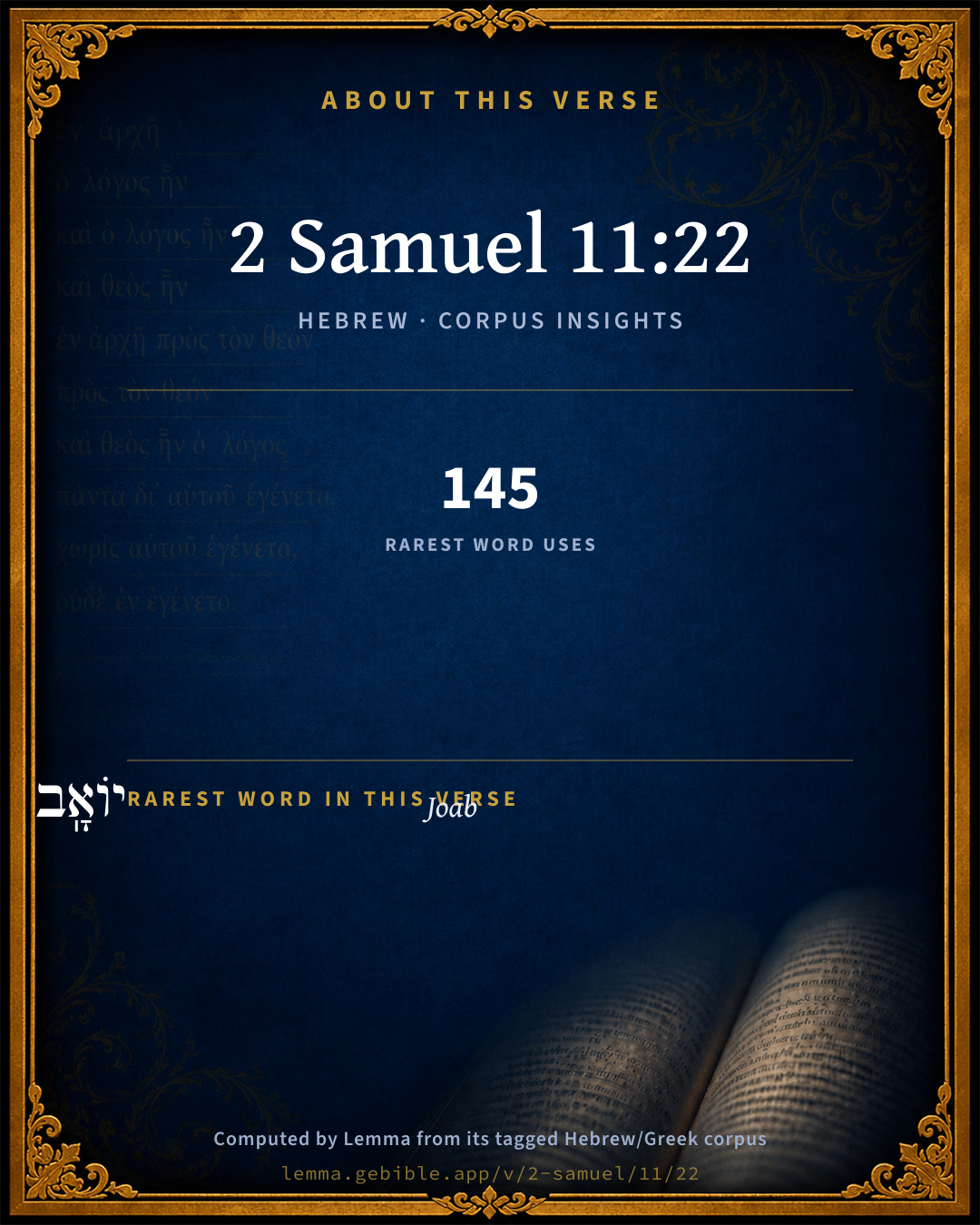
יוֹאָֽב
Yôwʼâb
H3097
“Joab”
Noun, Proper
Part of Speech
Noun
Type
Proper
Full BDB Definition

Origin: from H3068 and H1

TWOT: None

Joab = "Jehovah is father" - son of David's sister Zeruiah and general of David's army - a Judaite descendant of Kenaz - a post exilic family
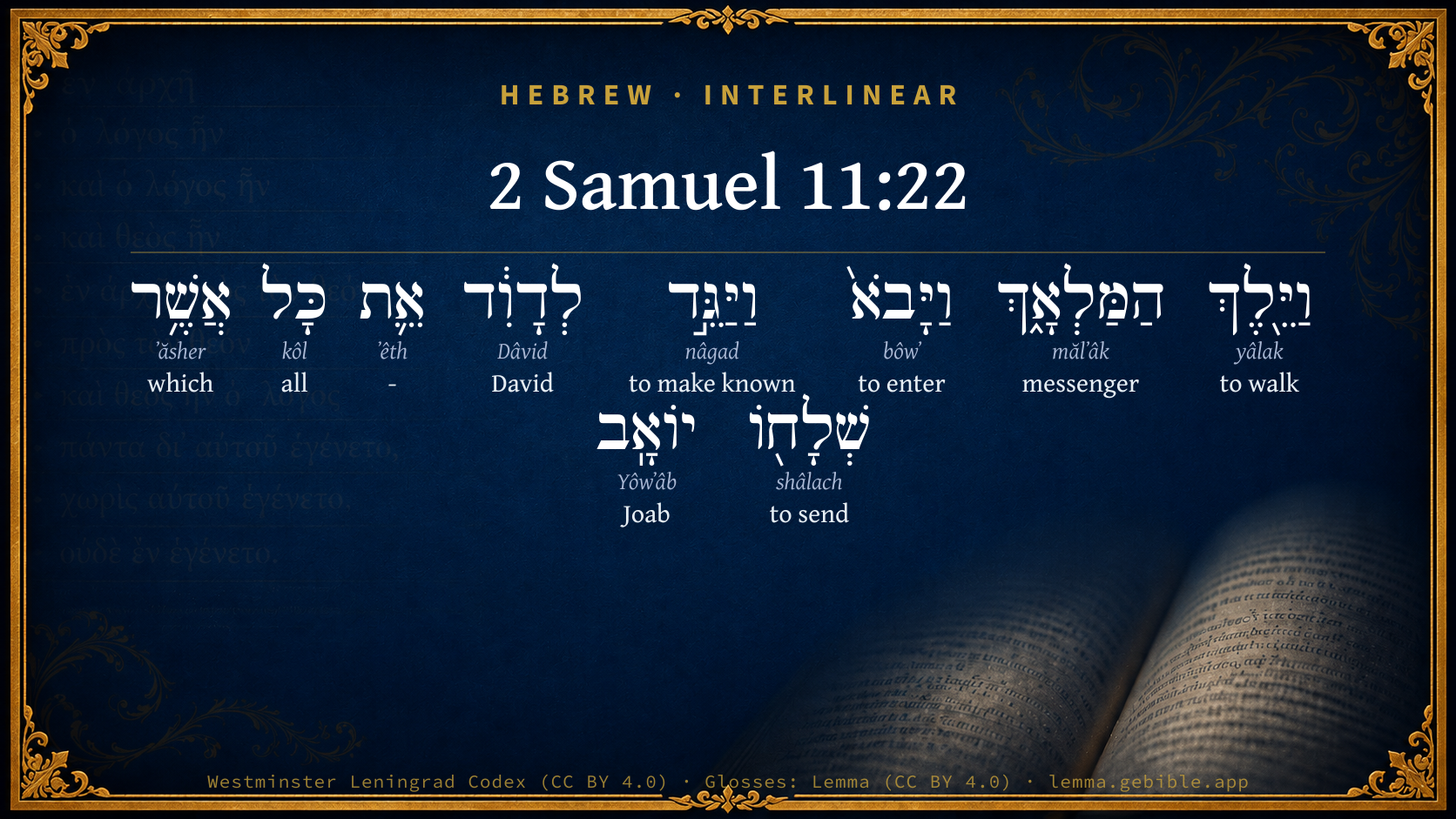
  1. וַיֵּ֖לֶךְ yâlak H3212 “and · to walk” Conjunction + Verb, Qal, Sequential Imperfect, 3rd Person, Masculine, Singular
  2. הַמַּלְאָ֑ךְ mălʼâk H4397 “the · messenger” Particle, Definite Article + Noun, Common, Masculine, Singular, Absolute
  3. וַיָּבֹא֙ bôwʼ H935 “and · to enter” Conjunction + Verb, Qal, Sequential Imperfect, 3rd Person, Masculine, Singular
  4. וַיַּגֵּ֣ד nâgad H5046 “and · to make known” Conjunction + Verb, Hiphil, Sequential Imperfect, 3rd Person, Masculine, Singular
  5. לְדָוִ֔ד Dâvid H1732 “to/for · David” Preposition + Noun, Proper
  6. אֵ֛ת ʼêth H853 “-” Particle, Direct Object
  7. כָּל kôl H3605 “all of” Noun, Common, Masculine, Singular, Construct
  8. אֲשֶׁ֥ר ʼăsher H834 “which” Particle, Relative
  9. שְׁלָח֖וֹ shâlach H7971 “to send · him” Verb, Qal, Perfect, 3rd Person, Masculine, Singular + Suffix, Personal, 3rd Person, Masculine, Singular

About this verse

These counts appear in no published source. They are computed here, from the morphology-tagged text and Lemma’s own curated glosses. What Lemma adds →

10
words
10
distinct lemmas
Historical
section

Grammatical profile

  • 4 verbs
  • 4 nouns
  • 2 particles

Verb forms

  • וַיֵּ֖לֶךְ Qal · Sequential Imperfect
  • וַיָּבֹא֙ Qal · Sequential Imperfect
  • וַיַּגֵּ֣ד Hiphil · Sequential Imperfect
  • שְׁלָח֖וֹ Qal · Perfect

Hebrew & Septuagint length

In English translation the verse runs 16 words from the Hebrew and 97 from the Septuagint (LXX English) — the Septuagint runs noticeably longer here. See the side-by-side →

A rough comparison of the two English renderings, which tokenize alike — not a word-level alignment.

Word counts can differ between the Hebrew and the Greek without any difference in meaning — e.g. the Hebrew direct-object marker אֵת has no separate Greek word, and Greek often adds the article ὁ.

Hebrew and Greek witnesses Masoretic Hebrew ↔ Greek Septuagint

The same verse in the two great witnesses to the Old Testament, shown verse-for-verse.

Here the Septuagint runs noticeably longer than the Hebrew — LXX2012 (modern English Septuagint) 97 words vs World English Bible 16. A rough length comparison of the two English translations, not a word-level alignment — read both below.

These are two independent witnesses, not word-aligned to each other, and the Septuagint is shown in lemma (dictionary) form.

Hebrew 2 Samuel 11:22 Masoretic · Westminster Leningrad Codex

וַיֵּ֖לֶךְ הַמַּלְאָ֑ךְ וַיָּבֹא֙ וַיַּגֵּ֣ד לְדָוִ֔ד אֵ֛ת כָּל אֲשֶׁ֥ר שְׁלָח֖וֹ יוֹאָֽב

So the messenger went, and came and shown David all that Joab had sent him for.

World English Bible · Public Domain

Greek LXX 2 Samuel 11:22 Septuagint · lemma form

καί πορεύομαι ὁ ἄγγελος ιωαβ πρός ὁ βασιλεύς εἰς ἰερουσαλήμ καί παραγίγνομαι καί ἀποἀγγέλλω ὁ δαυίδ πᾶς ὅσος ἀποἀγγέλλω αὐτός ιωαβ πᾶς ὁ ῥῆμα ὁ πόλεμος καί θυμόω δαυίδ πρός ιωαβ καί εἶπον πρός ὁ ἄγγελος ἵνα τίς προςἄγω πρός ὁ πόλις ὁ πολεμέω οὐ οἶδα ὅτι πλήσσω ἀπό ὁ τεῖχος τίς πατάσσω ὁ αβιμελεχ υἱός ιεροβααλ οὐ γυνή ῥίπτω ἐπί αὐτός κλάσμα μύλος ἀπό ὁ τεῖχος καί ἀποθνήσκω ἐν θαμασι ἵνα τίς προςἄγω πρός ὁ τεῖχος

And the messenger of Joab went to the king to Jerusalem, and he came and reported to David all that Joab told him, all the affairs of the war. And David was very angry with Joab, and said to the messenger, Why did you⌃ draw near to the wall to fight? knew you⌃ not that you⌃ would be wounded from off the wall? Who struck Abimelech the son of Jerobaal? did not a woman cast upon him a piece of millstone from the wall, and he died in Thamasi? why did you⌃ draw near to the wall?

LXX2012 (modern English Septuagint) · Public Domain

Hebrew: Westminster Leningrad Codex (CC BY 4.0). Greek: Septuagint (public domain); English from LXX2012 (modern English Septuagint) (Public Domain). How the Septuagint differs from the Hebrew →

Targum (Aramaic paraphrase)

1

The Targum is the ancient Jewish Aramaic paraphrase of the Hebrew Scriptures — an interpretive translation, not the Hebrew text itself. Onkelos (literal) and Pseudo-Jonathan (expansive) render the Torah, and Jonathan the Prophets. Coverage is partial: where no permissively-licensed English translation exists for a verse, only the Aramaic is shown. This is verse-level text, not a word-by-word alignment to the Hebrew.

  1. Targum Jonathan Prophets (Joshua–Malachi)
    וַאֲזַל אִזְגַדָא וַאֲתָא וְחַוֵי לְדָוִד יַת כָּל דְשַׁלְחֵיהּ יוֹאָב:

    (no public-domain English translation for this verse)

    Targum Jonathan — Aramaic: “Mikraot Gedolot” (public domain). English: “Sefaria Community Translation” (CC0 1.0 (public-domain dedication)); “London "Chaldee Paraphrase," 1871” (public domain). Text via Sefaria.

Commentary

Notes on 2 Samuel 11:22 from classic Christian and Jewish commentators (each source and its license shown beneath its notes). The classic Christian expositions comment on the surrounding passage and are grouped to its opening verse, so a note may address several verses; the Jewish commentaries on the Tanakh (Rashi and others) are per-verse, so they appear only where the commentator wrote on this verse.

Lemma curates 59 commentaries, every one of them public domain or Creative Commons licensed, each selected and text-cleaned for this edition rather than reprinted as found. About our sources →

Trapp's Complete Commentary

John Trapp

2Sa 11:22 So the messenger went, and came and shewed David all that Joab had sent him for.

Ver. 22. And showed David all.] Playing his part notably to flatter, and make all fair weather, as they say.

John Trapp, A Commentary or Exposition upon All the Books of the Old and New Testament (1647–1656) — public domain. Text from a community e-Sword module.

The Cambridge Bible for Schools and Colleges

gen. ed. J. J. S. Perowne

22. The Sept. reads this verse as follows: “And Joab’s messenger went to the king to Jerusalem. And he came and told David all that Joab had told him, even all the things concerning the war. And David was wroth with Joab, and said unto the messenger, Wherefore did ye approach unto the city to fight? Knew ye not that ye would be struck from the wall? Who smote Abimelech the son of Jerubbaal? Did not a woman cast upon him a piece of a millstone from the wall, and he died in Thebez? Wherefore did ye approach unto the wall?” Such a repetition may have formed part of the original text. But it is somewhat strange that Joab should anticipate the illustration which the king would use: and it is possible that the reference to Abimelech originally occurred in David’s speech only, and was transferred by mistake to that of Joab also, and finally in the revision of the Hebrew text omitted in the second place, instead of in the first, as it should have been.

The Cambridge Bible for Schools and Colleges (gen. ed. J. J. S. Perowne; Cambridge University Press, 1878–1918) — public domain. Text from a community e-Sword module.

John Gill's Exposition

So the messenger went,.... From Joab, from the army before Rabbah:

and came; to David in Jerusalem, a course of sixty four miles:

and showed David all that Joab had sent him for; all the events of the war hitherto.

John Gill's Exposition of the Whole Bible (1746–1763) — public domain (CC PDM 1.0). Text via the HelloAO Bible API.

The Pulpit Commentary

Vers. 22-27. (JERUSALEM, RABBAH.)

Concealment of sin.

Order of events:

1. Report of Uriah"s death (vers. 22-25).

2. Bathsheba mourns, (seven days 1Sa_31:13) for her husband (ver. 26), being probably unacquainted with the manner in which it was brought about.

3. David makes her his wife.

4. Joab takes Rabbah, except the citadel. (2Sa_12:26)

5. David, on receiving Joab"s message, goes to Rabbah and conquers the. (2Sa_12:27-31)

1. David and all the people return to Jerusalem.

2. Bathsheba bears a son (ver. 27).

When I kept silence my bones waxed old Whilst I continually groaned; For day and night thy hand was heavy upon me: My moisture was turned into the drought of summer. (Psa_32:3, Psa_32:4)

The life of David has an outward and an inward aspect: the one described in the history, the other by himself in his psalms; each the necessary complement of the other. They are, in general, closely connected and correspond, the outward being the expression of the inward, and explained by it. But sometimes they appear at variance, and in some respects present a melancholy contrast; as in the period that followed his transgression. He had succeeded in hiding it from public view; but he could not hide it altogether from himself. Consider concealment of sin in relation to

I THE OUTWARD LIFE. Many a man carries in his breast a guilty secret, unsuspected by others. He may be the object of their admiration and envy, and distinguished (as David was) by:

1. Apparent sincerity in public and in private life. He judges offenders in the gate, or receives news (from the battlefield) with words of resignation or encouragement (ver. 25). "Alas! how often do men hide baseness and satisfaction at successful plotting under the commonplace of resignation to the inevitable, of submission to the conditions of existence!" He goes to the house of God, (2Sa_7:8) "returns to bless his household", (2Sa_6:20) and maintains the form of private devotion. Yet he is inwardly "like the troubled sea when it cannot rest," etc.. (Isa_57:20)

2. Restless activity, (2Sa_12:29) which, though it appear to be a display of admirable energy, is really pursued as a welcome diversion from disquieting thoughts. "The enterprise promised an opportunity of escaping from himself; and he probably went thither in the maddest of all attempts, that, namely, of outrunning a guilty conscience" (W.M. Taylor).

1. Earthly prosperity. "And he took the king"s crown," etc.. (2Sa_12:30) In this there was, probably, something of vain glory. (1Jn_2:16) It was the culmination of his victories over the heathen. But the honour of wearing the crown of "their king" (or Milcom, Moloch) was a poor compensation for the dishonour he had done to his own, and the loss

2. of uprightness of heart; his triumph over idolatry a miserable set off against his overthrow by Satan.

3. Unusual severity. (2Sa_12:31) The effect of sin is to harden the heart.

I waive the quantum o" the sin, The hazard of concealing; But och! it hardens a" within, And petrifies the feeling! (Burns)

It also perverts the judgment. He who is wanting in a due sense of his own sinfulness is apt to be a severe judge of others (2Sa_12:5; Mat_18:28 Mat_21:41; Rom_2:21) A conscience ill at ease makes the temper sullen and irritable; and a repressed feeling of justice in relation to a man himself sometimes finds relief in the infliction of cruel vengeance on other men. "An evil conscience is the concealed root of bitterness from which spring a thousand poisonous plants, to shed their baleful influence upon the possessor and upon society at large" (McCosh).

II THE INWARD LIFE. The experience of David was marked by:

1. Obstinate silence. (Psa_32:3) He not only sought to conceal his transgression from men, but also sullenly refused to admit "the iniquity of his sin" to himself, or acknowledge it before God. The impulse to confession in such a man must have been strong; but he struggled against it with all his might, (Psa_32:9) as others have done.

2. Self-deceiving guile. "The deceit of the impenitent heart consists in its seeking to excuse and justify itself despite the condemnation of conscience, while it obtains no relief from the feeling of guilt, but rather brings about a sharper reaction of conscience, and increases the pains that come from the conflict of mutually accusing and excusing thoughts" (Erdmann). "The roots of this deceit, which makes its appearance immediately after a fall into sin, are pride, lack of trust in God, and love of sin" (Hengstenberg).

3. Spiritual deprivation. For during these long, weary months of silence the light of God"s countenance was hidden, the joy of his salvation lost. (Psa_51:8, Psa_51:12) "His harp was out of tune, and his soul like a tree in winter, with the life in the root only" (Matthew Henry). "We are not to conceive of him as one who had quite fallen, nor as one spiritually dead, but as sick unto death. It is certain that he had not quite lost all desire after God, that he had not entirely given up prayer; doubtless there were still many fruits of faith perceptible in him; but his soul was checked in its flight toward God, a curse rested upon him, which made solitary communion with the Divine Being for any length of time intolerable, and moved him to seek distractions in order to escape the torment of conscience and keep it from attaining to full life.

4. Inexpressible misery; consisting of "the burden of the heart weighing on itself, the burden of a secret, the sense of hypocrisy, the knowledge of inward depravity, while all without looks pure as snow to men" (F.W. Robertson); the remembrance of sin that cannot be forgotten, (Psa_51:3) the remorse of conscience that cannot be quieted, the sense of Divine displeasure, the dread of approaching woes; (Psa_51:11) continuing without cessation; consuming the vital energies, and exhausting the physical strength. (Psa_38:6) "Whithersoever the sinner may turn himself, or however he may be mentally affected, his malady is in no degree lightened nor his welfare in any degree promoted until he is restored to God" (Calvin, in Ps 32). "I will reprove thee" etc.. (Psa_50:21) Although for a season concealed, it will be in due time revealed. (Mat_10:26) "Not only was the fruit of the sin to be first of all brought to light (ver. 27), and the hardened sinner to be deprived of the possibility of either denying or concealing his crimes; God would first of all break his unbroken heart by the torture of his own conscience, and prepare it to feel the reproaches of the prophet .... Nathan"s reproof could not possibly have berne its saving fruit if David had been still living in utter blindness as to the character of his sin at the time the prophet went to him" (Keil). "No language ever described so vividly the sense of a weight at the heart a weight that cannot be uplifted; and it was the weight of God"s own presence, of that presence which he had once spoken of as the fulness of joy. With this oppression, like that of the air before the thunderstorm, came the drying up of all the moisture and freshness of life, the parching heat of fever. Did the Prophet Nathan bring all this to his consciousness? No, surely. The Prophet Nathan came at the appointed time to tell him in clear words, by a living instance, that which he had been hearing in muttered accents within his heart for months before. He came to tell him that the God of righteousness and mercy, who cared for Uriah, the poor man with the single ewe lamb, was calling him, the king, to account for an act of unrighteousness and unmercifulness. Nathan brought him to face steadily the light at which he had been winking, and to own that the light was good, that it was the darkness which was horrible and hateful, so that he might turn to the light and crave that it should once more penetrate into the depths of his being, and take possession of him" (Maurice). D.

The Pulpit Commentary (1880–1919), ed. H.D.M. Spence-Jones & Joseph S. Exell — public domain. Text from a community e-Sword module.

unfoldingWord translationNotes

Door43 World Missions Community

the gate

"the city gate"

translationWords

messenger

David

Joab

gate

unfoldingWord translationNotes — © Distant Shores Media and the Door43 World Missions Community, licensed CC BY-SA 4.0. Source: git.door43.org/Door43/en_tn.

Lesson kit

Teaching starters — assembled from the data on this page, not authored interpretation. Every prompt links to the verse data it draws on. Edit before teaching.

2 Samuel, in the Historical, opens this verse with 10 words (10 distinct Hebrew lemmas). Its most distinctive word is Yôwʼâb (“Joab”). The Greek Septuagint runs longer here. A historical commentator’s framing appears above. Read the whole chapter for the surrounding context.

Discussion questions

  1. The word Yôwʼâb carries the sense “Joab.” How does it shape the verse?
  2. The Septuagint runs longer here than the Hebrew. What might account for the difference?
  3. These translations render this verse differently; the difference is in the English rendering, not the original. What questions does that raise?
  4. «וַיֵּ֖לֶךְ» is a Qal Sequential Imperfect verb. How does that grammatical form shape the action described?
  5. Compare how Trapp's Complete Commentary and The Cambridge Bible for Schools and Colleges read this verse. Where do they agree or differ?

Things to notice

Reading settings

Reading text

Shown beneath each verse's original-language words.

Old Testament
Old Testament edition

Read the OT as the Masoretic Hebrew (MT) or the Greek Septuagint (LXX).

English shown for the Greek Septuagint (in the Hebrew ↔ Greek comparison).

Comparing translations? Open the Compare panel on any verse page to stack up to four side by side.