Judges 13:15

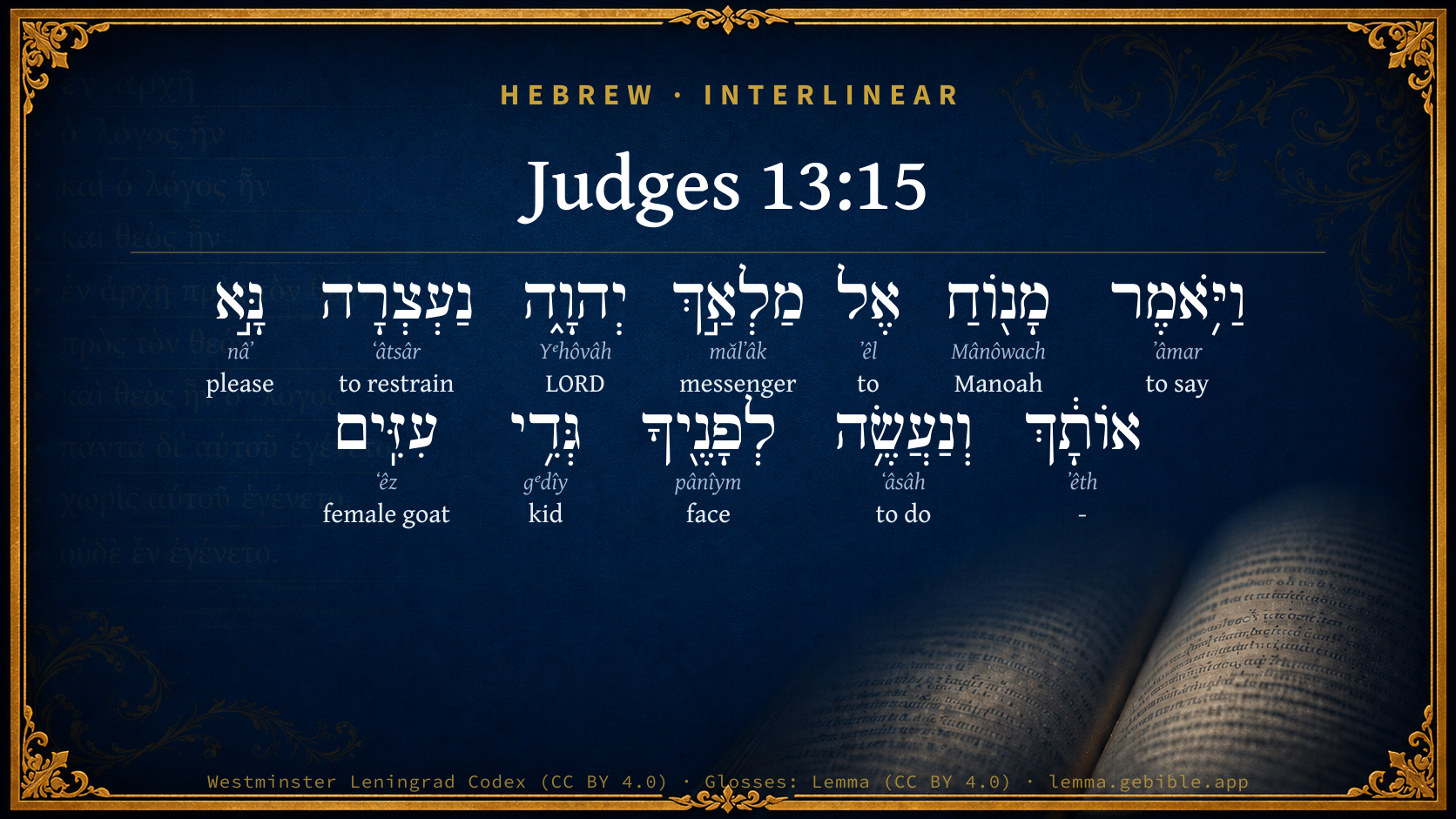
Hebrew (Westminster Leningrad Codex) Judges 13:15 appears in the Hebrew Old Testament. The text above is from the Westminster Leningrad Codex. Each word links to its Strong’s number, a concise gloss, and parsing drawn from the Open Scriptures Hebrew Bible morphology. Click any word for its full Brown-Driver-Briggs (BDB) entry.
Download image
Cite this verse

Judges 13:15 (World English Bible). Public Domain. Lemma interlinear Bible study tool, https://lemma.gebible.app/v/judges/13/15.

Show BibTeX & RIS
BibTeX
RIS
English Translation
Manoah said to the angel of Yahweh, I pray you, let us detain you, that we may make ready a kid for you.
World English Bible · Public Domain
Download a study sheet

One document with this verse’s original text, its word-by-word gloss line, the meaning frame, cross-references with their text, attributed commentary, and full source and license credits — printable, and it pastes into notes with its structure intact.

This verse Autodidact and up

Study sheet (.html) Plain text (.txt)

A passage Seminary Student

Up to 50 verses in one chapter. A passage sheet keeps up to 6 commentary sources and 12 cross-references per verse, in the order this page ranks them, and says so on the sheet whenever that leaves anything out. Ask for a single verse and you get the Autodidact verse sheet above.

Everything on this page stays free to read, with no account — the sheet is a download of what is already on screen, not access to it.

Want to remove ads? Support Godless Engineer
Compare translations 3

The same verse in 3 English versions, stacked beneath the original-language interlinear above. Click any original word for its lexicon entry.

Each is an independent rendering of the whole verse — the interlinear is not word-aligned to these translations.

Highlighted words mark where these versions differ — a whole-verse word diff, not a word-by-word alignment.

  • World English Bible Public Domain
    Manoah said to the angel of Yahweh, I pray you, let us detain you, that we may make ready a kid for you.
  • King James Version Public Domain
    And Manoah said unto the angel of the LORD, I pray thee, let us detain thee, until we shall have made ready a kid for thee.
  • unfoldingWord Literal Text CC BY-SA 4.0
    And Manoah said to the angel of Yahweh, “Please let us detain you, and we will prepare to your face a kid of goats.”

unfoldingWord Literal Text — © unfoldingWord, licensed CC BY-SA 4.0. Word-aligned USFM3 via Door43 (git.door43.org/unfoldingWord/en_ult).

Versions to compare (up to 4)

3 of 4 selected

Show all 18 translations

Every available English version of this verse, each an independent rendering of the whole verse.

  • World English Bible Public Domain
    Manoah said to the angel of Yahweh, I pray you, let us detain you, that we may make ready a kid for you.
  • Berean Standard Bible Public Domain
    “Please stay here,” Manoah said to the angel of the LORD, “and we will prepare a young goat for you.”
  • Majority Standard Bible Public Domain
    “Please stay here,” Manoah said to the angel of the LORD, “and we will prepare a young goat for you.”
  • King James Version Public Domain
    And Manoah said unto the angel of the LORD, I pray thee, let us detain thee, until we shall have made ready a kid for thee.
  • American Standard Version (1901) Public Domain
    And Manoah said unto the angel of Jehovah, I pray thee, let us detain thee, that we may make ready a kid for thee.
  • Revised Version (1885) Public Domain
    And Manoah said unto the angel of the LORD, I pray thee, let us detain thee, that we may make ready a kid for thee.
  • Geneva Bible (1599) Public Domain
    Manoah then said vnto the Angell of the Lord, I pray thee, let vs reteine thee, vntill we haue made readie a kid for thee.
  • Douay-Rheims (1899) Public Domain
    And Manue said to the angel of the Lord: I beseech thee to consent to my request, and let us dress a kid for thee.
  • Young's Literal Translation Public Domain
    And Manoah saith unto the messenger of Jehovah, `Let us detain thee, we pray thee, and prepare before thee a kid of the goats.'
  • Literal Standard Version CC BY-SA 4.0
    And Manoah says to the Messenger of YHWH, “Please let us detain You, and we prepare a kid of the goats before You.”
  • Unlocked Literal Bible CC BY-SA 4.0
    Manoah said to the angel of Yahweh, “Please stay for a while, to give us time to prepare a young goat for you.”
  • unfoldingWord Literal Text CC BY-SA 4.0
    And Manoah said to the angel of Yahweh, “Please let us detain you, and we will prepare to your face a kid of goats.”
  • Darby Bible Public Domain
    Mano'ah said to the angel of the LORD, "Pray, let us detain you, and prepare a kid for you."
  • World Messianic Bible Public Domain
    Manoah said to the LORD’s angel, “Please stay with us, that we may make a young goat ready for you.”
  • Webster's Bible Public Domain
    And Manoah said to the angel of the LORD, I pray thee, let us detain thee, until we shall have made ready a kid for thee.
  • Free Bible Version CC BY-SA 4.0
    Manoah said to the angel of the Lord, “Please let us keep you here while we prepare a meal of a young goat for you.”
  • Bible in Basic English Public Domain
    And Manoah said to the angel of the Lord, Now let us keep you while we make ready a young goat for you.
  • JPS Tanakh (1917) Public Domain
    And Manoah said unto the angel of the LORD: 'I pray thee, let us detain thee, that we may make ready a kid for thee.'

Literal Standard Version (2020), Covenant Press — licensed CC BY-SA 4.0. Text via the HelloAO Bible API (eBible.org). Unlocked Literal Bible (unfoldingWord) — licensed CC BY-SA 4.0. Text via the HelloAO Bible API (eBible.org). unfoldingWord Literal Text — © unfoldingWord, licensed CC BY-SA 4.0. Word-aligned USFM3 via Door43 (git.door43.org/unfoldingWord/en_ult). Free Bible Version, Dr. Jonathan Gallagher — licensed CC BY-SA 4.0. Text via the HelloAO Bible API (eBible.org).

Word by word

More ways to search: Search by grammar → Find every occurrence → Compare this word →

Practice this passage: Drill this verse → Learn its vocabulary →

גְּדִ֥י
gᵉdîy
H1423
“kid of”
Noun, Common, Masculine, Singular, Construct
Part of Speech
Noun
Type
Common
Gender
Masculine
Number
Singular
State
Construct
Full BDB Definition

Origin: from the same as H1415

TWOT: 314b

kid, young male goat
  1. וַיֹּ֥אמֶר ʼâmar H559 “and · to say” Conjunction + Verb, Qal, Sequential Imperfect, 3rd Person, Masculine, Singular
  2. מָנ֖וֹחַ Mânôwach H4495 “Manoah” Noun, Proper
  3. אֶל ʼêl H413 “to” Preposition
  4. מַלְאַ֣ךְ mălʼâk H4397 “messenger of” Noun, Common, Masculine, Singular, Construct
  5. יְהוָ֑ה Yᵉhôvâh H3068 “LORD” Noun, Proper
  6. נַעְצְרָה ʻâtsâr H6113 “to restrain” Verb, Qal, Cohortative, 1st Person, Common, Plural
  7. נָּ֣א nâʼ H4994 “please” Particle, Interjection
  8. אוֹתָ֔ךְ ʼêth H853 “- · you” Particle, Direct Object + Suffix, Personal, 2nd Person, Feminine, Singular
  9. וְנַעֲשֶׂ֥ה ʻâsâh H6213 “and · to do” Conjunction + Verb, Qal, Imperfect, 1st Person, Common, Plural
  10. לְפָנֶ֖יךָ pânîym H6440 “to/for · face(s) · your” Preposition + Noun, Common, Both, Plural, Construct + Suffix, Personal, 2nd Person, Masculine, Singular
  11. עִזִּֽים ʻêz H5795 “female goats” Noun, Common, Feminine, Plural, Absolute

About this verse

These counts appear in no published source. They are computed here, from the morphology-tagged text and Lemma’s own curated glosses. What Lemma adds →

12
words
12
distinct lemmas
Historical
section

Notable vocabulary

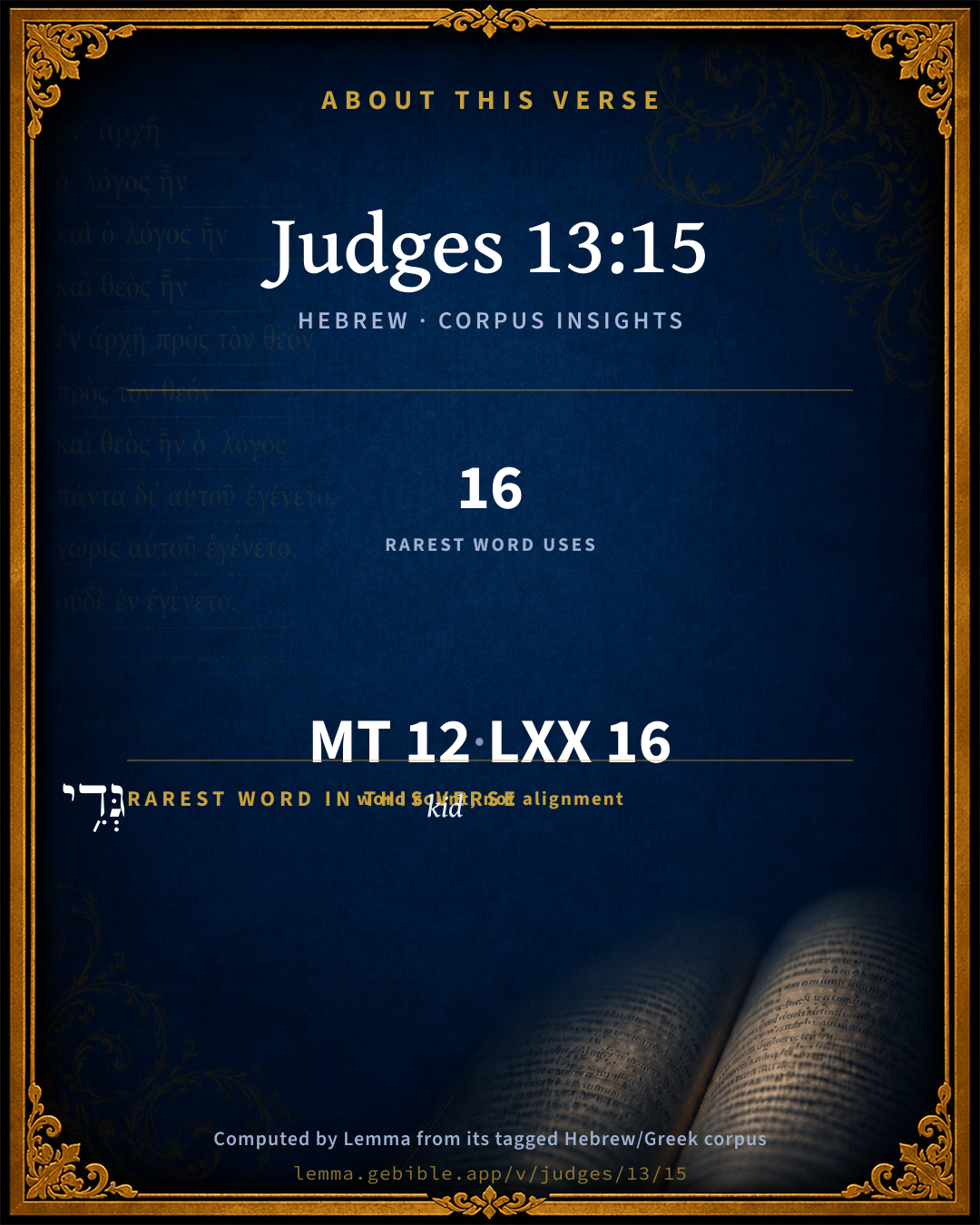
The rarest word here is גְּדִ֥י kid H1423 — appearing just 16 times in the whole Hebrew Bible.

Shared distinctive vocabulary

גְּדִ֥י kid H1423 occurs in 16 verses of the Hebrew Bible. Also found in:

Grammatical profile

  • 3 verbs
  • 6 nouns
  • 1 preposition
  • 2 particles

Verb forms

  • וַיֹּ֥אמֶר Qal · Sequential Imperfect
  • נַעְצְרָה Qal · Cohortative
  • וְנַעֲשֶׂ֥ה Qal · Imperfect

Hebrew & Septuagint length

In English translation the verse runs 23 words from the Hebrew and 23 from the Septuagint (LXX English) — the same length.

A rough comparison of the two English renderings, which tokenize alike — not a word-level alignment.

Word counts can differ between the Hebrew and the Greek without any difference in meaning — e.g. the Hebrew direct-object marker אֵת has no separate Greek word, and Greek often adds the article ὁ.

In the original languages it is 12 Hebrew tokens and 16 Greek tokens — but the two are counted differently (Hebrew bundles its prefixes and suffixes into one token; the Greek is in lemma form), so that isn’t a like-for-like length.

Cross-references

3

Topical passages linked to Judges 13:15 in the Treasury of Scripture Knowledge — connected by theme and wording, ordered by reader-vote popularity; previews shown in the World English Bible.

  • Genesis 18:3–5 and said, "My lord, if now I have found favor in your sight, please don't go away from your servant.
  • Judges 6:18–19 Please don't go away, until I come to you, and bring out my present, and lay it before you. He said, I will wait until you come again.
  • Judges 13:3 The angel of Yahweh appeared to the woman, and said to her, See now, you are barren, and don't bear; but you shall conceive, and bear a son.

Cross-references courtesy of OpenBible.info (CC BY 4.0).

Hebrew and Greek witnesses Masoretic Hebrew ↔ Greek Septuagint

The same verse in the two great witnesses to the Old Testament, shown verse-for-verse.

These are two independent witnesses, not word-aligned to each other, and the Septuagint is shown in lemma (dictionary) form.

Hebrew Judges 13:15 Masoretic · Westminster Leningrad Codex

וַיֹּ֥אמֶר מָנ֖וֹחַ אֶל מַלְאַ֣ךְ יְהוָ֑ה נַעְצְרָה נָּ֣א אוֹתָ֔ךְ וְנַעֲשֶׂ֥ה לְפָנֶ֖יךָ גְּדִ֥י עִזִּֽים

Manoah said to the angel of Yahweh, I pray you, let us detain you, that we may make ready a kid for you.

World English Bible · Public Domain

Greek LXX Judges 13:15 Septuagint · lemma form

καί εἶπον μανωε πρός ὁ ἄγγελος κύριος καταἔχω ὧδε σύ καί ποιέω ἐνώπιον σύ ἔριφος αἴξ

And Manoe said to the angel of the Lord, Let us detain you here, and prepare before you a kid of the goats.

LXX2012 (modern English Septuagint) · Public Domain

On this verse, Ellicott's Commentary for English Readers discusses the Septuagint’s reading. Read the note in Commentary ↓

Hebrew: Westminster Leningrad Codex (CC BY 4.0). Greek: Septuagint (public domain); English from LXX2012 (modern English Septuagint) (Public Domain). How the Septuagint differs from the Hebrew →

Targum (Aramaic paraphrase)

1

The Targum is the ancient Jewish Aramaic paraphrase of the Hebrew Scriptures — an interpretive translation, not the Hebrew text itself. Onkelos (literal) and Pseudo-Jonathan (expansive) render the Torah, and Jonathan the Prophets. Coverage is partial: where no permissively-licensed English translation exists for a verse, only the Aramaic is shown. This is verse-level text, not a word-by-word alignment to the Hebrew.

  1. Targum Jonathan Prophets (Joshua–Malachi)
    וַאֲמַר מָנוֹחַ לְמַלְאָכָא דַייָ נֵיחוֹד כְּעַן יָתָךְ וְנַעְבֵּיד קֳדָמָךְ גַדְיָא בַּר עִזֵי:

    (no public-domain English translation for this verse)

    Targum Jonathan — Aramaic: “Mikraot Gedolot” (public domain). English: “Sefaria Community Translation” (CC0 1.0 (public-domain dedication)); “London "Chaldee Paraphrase," 1871” (public domain). Text via Sefaria.

Commentary

Notes on Judges 13:15 from classic Christian and Jewish commentators (each source and its license shown beneath its notes). The classic Christian expositions comment on the surrounding passage and are grouped to its opening verse, so a note may address several verses; the Jewish commentaries on the Tanakh (Rashi and others) are per-verse, so they appear only where the commentator wrote on this verse.

Lemma curates 59 commentaries, every one of them public domain or Creative Commons licensed, each selected and text-cleaned for this edition rather than reprinted as found. About our sources →

Matthew Henry's Commentary

We have here an account,

I. Of what further passed between Manoah and the angel at this interview. It was in kindness to him that while the angel was with him it was concealed from him that he was an angel; for, had he known it, it would have been such a terror to him that he durst not have conversed with him as he did (Jdg 13:16): He knew not that he was an angel. So Christ was in the world, and the world knew him not. Verily thou art a God that hidest thyself. We could not bear the sight of the divine glory unveiled. God having determined to speak to us by men like ourselves, prophets and ministers, even when he spoke by his angels, or by his Son, they appeared in the likeness of men, and were taken but for men of God. Now,

1. The angel declined to accept his treat, and appointed him to turn it into a sacrifice. Manoah, being desirous to show some token of respect and gratitude to this venerable stranger who had brought them these glad tidings, begged he would take some refreshment with him (Jdg 13:15): We will soon make ready a kid for thee. Those that welcome the message will be kind to the messengers for his sake that sends them, Th1 5:13. But the angel told him (Jdg 13:16) he would not eat of his bread, any more than he would of Gideon's, but, as there, directed him to offer it to God, Jdg 6:20, Jdg 6:21. Angels need not meat nor drink; but the glorifying of God is their meat and drink, and it was Christ's, Joh 4:34. And we in some measure do the will of God as they do it if, though we cannot live without meat and drink, yet we eat and drink to the glory of God, and so turn even our common meals into sacrifices.

2. The angel declined telling him his name, and would not so far gratify his curiosity. Manoah desired to know his name (Jdg 13:17), and of what tribe he was, not as if he doubted the truth of his message, but that they might return his visit, and be better acquainted with him (it is good to increase and improve our acquaintance with good men and good ministers); and he has a further design: "That when thy sayings come to pass, we may do thee honour, celebrate thee as a true prophet, and recommend others to thee for divine instructions, - that we may call the child that shall be born after thy name, and so do thee honour, - or that we may send thee a present, honouring one whom God has honoured." But the angel denies his request with something of a check to his curiosity (Jdg 13:18): Why askest thou thus after my name? Jacob himself could not prevail for this favour, Gen 32:29. Note, We have not what we ask when we ask we know not what. Manoah's request was honestly meant and yet was denied. God told Moses his name (Exo 3:13, Exo 3:14), because there was a particular occasion for his knowing it, but here there was no occasion. What Manoah asked for instruction in his duty he was readily told (Jdg 13:12, Jdg 13:13), but what he asked to gratify his curiosity was denied. God has in his word given us full directions concerning our duty, but never designed to answer all the enquiries of a speculative head. He gives him a reason for his refusal: It is secret. The names of angels were not as yet revealed, to prevent the idolizing of them. After the captivity, when the church was cured of idolatry, angels made themselves known to Daniel by their names, Michael and Gabriel; and to Zacharias the angel told his name unasked (Luk 1:19): I am Gabriel. But here it is secret, or it is wonderful, too wonderful for us. One of Christ's names is Wonderful, Isa 9:6. His name was long a secret, but by the gospel it is brought to light: Jesus a Saviour. Manoah must not ask because he must not know. Note, (1.) There are secret things which belong not to us, and which we must content ourselves to be in the dark about while we are here in this world. (2.) We must therefore never indulge a vain curiosity in our enquiries concerning these things, Col 2:18. Nescire velle quae Magister maximus docere non vult erudita inscitia est - To be willingly ignorant of those things which our great Master refuses to teach us is to be at once ignorant and wise.

3. The angel assisted and owned their sacrifice, and, at parting, gave them to understand who he was. He had directed them to offer their burnt-offering to the Lord, Jdg 13:16. Praises offered up to God are the most acceptable entertainment of the angels; see Rev 22:9, worship God. And Manoah, having so good a warrant, though he was no priest and had no altar, turned his meat into a meat offering, and offered it upon a rock to the Lord (Jdg 13:19), that is, he brought and laid it to be offered. "Lord, here it is, do what thou pleasest with it." Thus we must bring our hearts to God as living sacrifices, and submit them to the operation of his Spirit. All things being now ready, (1.) The angel did wondrously, for his name was Wonderful. Probably the wonder he did was the same with what he had done for Gideon, he made fire to come either down from heaven or up out of the rock to consume the sacrifice. (2.) He ascended up towards heaven in the flame of the sacrifice, Jdg 13:20. By this it appeared that he was not, as they thought, a mere man, but a messenger immediately from heaven. Thence certainly he descended, for thither he ascended, Joh 3:13; Joh 6:62. This signified God's acceptance of the offering and intimates to what we owe the acceptance of all our offerings, even to the mediation of the angel of the covenant, that other angel, who puts much incense to the prayers of saints and so offers them before the throne, Rev 8:3. Prayer is the ascent of the soul to God. But it is Christ in the heart by faith that makes it an offering of a sweet-smelling savour: without him our services are offensive smoke, but, in him, acceptable flame. We may apply it to Christ's sacrifice of himself for us; he ascended in the flame of his own offering, for by his own blood he entered in once into the holy place, Heb 9:12. While the angel did this, it is twice said (Jdg 13:19, Jdg 13:20) that Manoah and his wife looked on. This is a proof of the miracle: the matter of fact was true, for out of the mouth of these two eye-witnesses the report of it is established. The angel did all that was done in the sacrifice; they did but look on; yet doubtless, when the angel ascended towards heaven, their hearts ascended with him in thanksgiving for the promise which came thence and in expectation of the performance to come thence too. Yet, when the angel has ascended, they dared not, as those that were the witnesses of Christ's ascension, stand gazing up into heaven, but in holy fear and reverence they fell on their faces to the ground. And now, [1.] They knew that it was an angel, Jdg 13:21. It was plain it was not the body of a man they saw, since it was not chained to the earth, nor prejudiced by fire; but ascended, and ascended in flame, and therefore with good reason they conclude it was an angel; for he maketh his angels spirits, and his ministers a flame of fire. [2.] But he did not any more appear to them; it was for a particular occasion, now over, that he was sent, not to settle a constant correspondence, as with prophets. They must remember and observe what the angel had said and not expect to hear more.

II. We have an account of the impressions which this vision made upon Manoah and his wife. While the angel did wondrously, they looked on, and said nothing (so it becomes us carefully to observe the wondrous works of God, and to be silent before him); but when he had gone, having finished his work, they had time to make their reflections. 1. In Manoah's reflection upon it there is great fear, Jdg 13:22. He had spoken with great assurance of the son they should shortly be the joyful parents of (Jdg 13:8, Jdg 13:12), and yet is now put into such a confusion by that very thing which should have strengthened and encouraged his faith that he counts upon nothing but their being both cut off immediately: We shall surely die. It was a vulgar opinion generally received among the ancient Jews that it was present death to see God or an angel; and this notion quite overcome his faith for the present, as it did Gideon's, Jdg 6:22. 2. In his wife's reflection upon it there is great faith, Jdg 13:23. Here the weaker vessel was the stronger believer, which perhaps was the reason why the angel chose once and again to appear to her. Manoah's heart began to fail him, but his wife, as a help meet for him, encouraged him. Two are better than one, for, if one fall into dejections and despondencies, the other will help to raise him up. Yoke-fellows should piously assist each other's faith and joy as there is occasion. None could argue better than Manoah's wife does here: We shall surely die, said her husband; "Nay," said she, "we need not fear that; let us never turn that against us which is really for us. We shall not die unless God be pleased to kill us: our death must come from his hand and his pleasure. Now the tokens of his favour which we have received forbid us to think that he designs our destruction. Had he thought fit to kill us, (1.) He would not have accepted our sacrifice, and signified to us his acceptance of it by turning it to ashes, Psa 20:3, margin. The sacrifice was the ransom of our lives, and the fire fastening upon that was a plain indication of the turning away of his wrath from us. The sacrifice of the wicked is an abomination, but you see ours is not so. (2.) He would not have shown us all these things, these strange sights, now at a time when there is little or no open vision (Sa1 3:1), nor would he have given these exceedingly great and precious promises of a son that shall be a Nazarite and a deliverer of Israel - he would not have told us such things as these if he had been pleased to kill us. We need not fear the withering of those roots out of which such a branch is yet to spring." Note, Hereby it appears that God designs not the death of sinners that he has accepted the great sacrifice which Christ offered up for their salvation, has put them in a way of obtaining his favour, and has assured them of it upon their repentance. Had he been pleased to kill them, he would not have done so. And let those good Christians who have had communion with God in the word and prayer, to whom he has graciously manifested himself, and who have had reason to think God has accepted their works, take encouragement thence in a cloudy and dark day. "God would not have done what he has done for my soul if he had designed to forsake me, and leave me to perish at last; for his work is perfect, nor will he mock his people with his favours." Learn to reason as Manoah's wife did, "If God had designed me to perish under his wrath, he would not have given me such distinguishing tokens of his favour." O woman! great is thy faith.

Matthew Henry's Commentary on the Whole Bible (1708–1710) — public domain (CC PDM 1.0). Text via the HelloAO Bible API.

Jamieson, Fausset & Brown

Robert Jamieson, A. R. Fausset & David Brown

MANOAH'S SACRIFICE. (Jdg 13:15-23)

Manoah said unto the angel . . ., I pray thee, let us detain thee, until we shall have made ready a kid--The stranger declined the intended hospitality and intimated that if the meat were to be an offering, it must be presented to the Lord [Jdg 13:6]. Manoah needed this instruction, for his purpose was to offer the prepared viands to him, not as the Lord, but as what he imagined him to be, not even an angel (Jdg 13:16), but a prophet or merely human messenger. It was on this account, and not as rejecting divine honors, that he spoke in this manner to Manoah. The angel's language was exactly similar to that of our Lord (Mat 19:17).

Jamieson, Fausset & Brown — Commentary Critical and Explanatory on the Whole Bible (1871) — public domain (CC PDM 1.0). Text via the HelloAO Bible API.

Trapp's Complete Commentary

John Trapp

Jdg 13:15 And Manoah said unto the angel of the LORD, I pray thee, let us detain thee, until we shall have made ready a kid for thee.

Ver. 15. Let us detain thee, until we shall, &c.] A prophet’s reward they held him worthy of, even "double honour," {1Ti 5:17} that is, Reverentia et alimonia, saith Ambrose: Officium et subsidium, saith Beza.

John Trapp, A Commentary or Exposition upon All the Books of the Old and New Testament (1647–1656) — public domain. Text from a community e-Sword module.

Joseph Benson's Commentary

Jdg 13:15-16. Until we shall have made ready a kid — He supposed him to be a man and a prophet, to whom he would in this manner express his respect, as was usual to strangers. I will not eat of thy bread — That is, meat, as bread is commonly taken in Scripture. If thou wilt offer a burnt- offering — As Manoah had made no mention of a burnt-offering, but only desired the angel, whom he took for a prophet, to accept of a repast with them, Le Clerc’s translation of this passage is to be preferred. But (not and, as we render it) if thou wilt offer a burnt-offering to the Lord, do it: that is, if thou desirest to express thy thankfulness to the Lord, thou mayest do it by offering a burnt-offering.

Joseph Benson's Commentary on the Old and New Testaments (1811–1818) — public domain. Text from a community e-Sword module.

Adam Clarke's Commentary

Verse 15. Until we shall have made ready a kid] Not knowing his quality, Manoah wished to do this as an act of hospitality.

Adam Clarke's Commentary on the Bible (1810–1826) — public domain. Text from a community e-Sword/MySword module.

Ellicott's Commentary for English Readers

(15) A kid for thee.—Literally, before thy face. The narrative is closely analogous to that of the appearance of the angel to Gideon, and there is the same uncertainty in the terms used, so that we cannot certainly decide whether Manoah’s object was to offer a sacrifice or to offer hospitality. The verb gnasoth, like the Greek rezein (LXX., poisin) and the Latin facere, means either “to do” or “to sacrifice.” A kid was a special delicacy (Gen_27:9; 1Sa_16:20). (See Augustine, Quaest., in Jud. vii. 53.)

A Bible Commentary for English Readers, edited by Charles John Ellicott (1878–1897) — public domain. Text from a community e-Sword module.

The Cambridge Bible for Schools and Colleges

gen. ed. J. J. S. Perowne

15. that we may make ready a kid for thee] The prep, has a pregnant sense: ‘prepare a meal and set it before thee’; cf. Jdg_6:19 and Gen_18:6-8. The words might mean offer a kid in thy presence; but under the circumstances this rendering is not probable.

The Cambridge Bible for Schools and Colleges (gen. ed. J. J. S. Perowne; Cambridge University Press, 1878–1918) — public domain. Text from a community e-Sword module.

John Gill's Exposition

And Manoah said unto the angel of the Lord,.... Being satisfied with what he had said, and perceiving that he chose to say no more, and was about to depart:

I pray thee let me detain thee, until we shall have made ready a kid for thee; to eat a meal with them, in token of gratitude for the trouble he had been at in bringing these messages to them, taking him to be a man, a prophet of the Lord, for whom they were wont to make entertainments; and Abarbinel thinks Manoah proposed this, on purpose to detain him, in hope that while they were eating together he would reveal some secrets unto him.

John Gill's Exposition of the Whole Bible (1746–1763) — public domain (CC PDM 1.0). Text via the HelloAO Bible API.

Albert Barnes' Notes on the Bible

The language of Manoah, like that of Gideon Jdg 6:18, seems to indicate some suspicion that his visitor was more than human. The word rendered “made ready,” is also the proper word for “offering a sacrifice,” and is so used by the Angel in the next verse. By which it appears that the Angel understood Manoah to speak of offering a kid as a burnt-offering. Hence, his caution, “thou must offer it unto the Lord.” (Compare Rev 19:10; Rev 22:8; Act 10:25-26.)

Albert Barnes' Notes on the Bible (1834–1885) — public domain. Text from a community e-Sword/MySword module.

Haydock's Catholic Bible Commentary

CHAPTER XIII.

Dress. Hebrew and Septuagint, "let us make." Vulgate faciamus, is used either for a common feast or for a sacrifice, Exodus xxix. 36. Virgil, (eclog. iii.) Cras faciam vitula. Manue did not yet know who the angel was. He only designed to give him something to eat. A kid was then esteemed the most delicious food, and physicians esteem it very wholesome. The taste of people has since altered. (Bochart, Anim. p. i. b. ii. 52.) (Calmet)

George Leo Haydock (1774–1849), Haydock's Catholic Family Bible and Commentary, 1859 edition — public domain. Excludes Psalms (Douay-Rheims chapter numbering differs from Protestant) and Deuterocanonical books (Catholic canon only).

Matthew Poole's English Annotations

Supposing him to be a man and a prophet, to whom he would in this manner express his respect, as was usual to strangers. See Gen 18:5; Jdg 6:18.

Matthew Poole's English Annotations on the Holy Bible (1683–1685) — public domain. Text from a community e-Sword/MySword module.

Whedon's Commentary on the Bible

Daniel D. Whedon

15. Let us detain thee — Manoah would observe those rites of oriental hospitality by attention to which Abraham entertained angels unawares.

Gen_18:1-8.

Daniel D. Whedon (gen. ed.), Commentary on the Old and New Testaments (1874–1909) — public domain. Text from a community e-Sword module.

The Pulpit Commentary

Let us detain thee, etc. He wishes to detain him as a guest till he has had time to cook a kid for him. (cf. Gen_18:7) For thee. The Hebrew is before thee. The phrase is elliptical. The full sentence would be, until we have dressed a kid and set it before thee, as in Gen_18:8.

Vers. 15-21. Cf. on Jud 6:17-21. M.

The Pulpit Commentary (1880–1919), ed. H.D.M. Spence-Jones & Joseph S. Exell — public domain. Text from a community e-Sword module.

John Wesley's Explanatory Notes

Made ready - Supposing him to be a man and a prophet, to whom he would in this manner express his respect, as was usual to strangers.

John Wesley, Explanatory Notes Upon the Whole Bible (1754–1765) — public domain. Text via the GEBible commentary corpus.

Keil & Delitzsch

C. F. Keil & F. Delitzsch

As Manoah had not yet recognised in the man the angel of the Lord, as is observed by way of explanation in Jdg 13:16, he wished, like Gideon (Jdg 6:18), to give a hospitable entertainment to the man who had brought him such joyful tidings, and therefore said to him, "Let us detain thee, and prepare a kid for thee." The construction לפניך נעשׂה is a pregnant one: "prepare and set before thee." On the fact itself, see Jdg 6:19.

Keil & Delitzsch — Biblical Commentary on the Old Testament (1861–1891) — public domain (CC PDM 1.0). Text via the HelloAO Bible API. (Old Testament only.)

unfoldingWord translationNotes

Door43 World Missions Community

prepare a young goat for you

You can make explicit the implicit meaning of Manoah's statement. AT: "cook a young goat for you to eat" (See: Assumed Knowledge and Implicit Information)

translationWords

angel

Yahweh

goat

burnt offering

unfoldingWord translationNotes — © Distant Shores Media and the Door43 World Missions Community, licensed CC BY-SA 4.0. Source: git.door43.org/Door43/en_tn.

Rashi

Rabbi Shlomo Yitzchaki (Rashi)

Allow us to detain you as our house guest.

Rashi on the Tanakh — English translations: “The Judaica Press complete Tanach with Rashi, translated by A. J. Rosenberg” (CC BY 4.0); “Pentateuch with Rashi's commentary by M. Rosenbaum and A.M. Silbermann, 1929-1934” (public domain); “The Metsudah Tanach series, Lakewood, N.J” (CC BY 4.0); and “The Book of Joshua, Metsudah Publications, 1997” (CC BY 4.0). Text via Sefaria.

Lesson kit

Teaching starters — assembled from the data on this page, not authored interpretation. Every prompt links to the verse data it draws on. Edit before teaching.

Judges, in the Historical, opens this verse with 12 words (12 distinct Hebrew lemmas). Its most distinctive word is gᵉdîy (“kid”). A historical commentator’s framing appears above. Read the whole chapter for the surrounding context.

Discussion questions

  1. What does “kid” (gᵉdîy) contribute to the verse as a whole?
  2. Genesis 27:9 shares the word «kid» with this verse. How do the two illuminate each other?
  3. The translations on this page render this verse differently — a whole-verse word diff, not a word-by-word alignment. What might account for the different wordings?
  4. The verb «וַיֹּ֥אמֶר» is Qal Sequential Imperfect. How does its form color the action?
  5. Reading how Matthew Henry's Commentary and Jamieson, Fausset & Brown read this verse, where do the two commentators agree and where do they part?

Things to notice

Reading settings

Reading text

Shown beneath each verse's original-language words.

Old Testament
Old Testament edition

Read the OT as the Masoretic Hebrew (MT) or the Greek Septuagint (LXX).

English shown for the Greek Septuagint (in the Hebrew ↔ Greek comparison).

Comparing translations? Open the Compare panel on any verse page to stack up to four side by side.