
Numbers 22:35

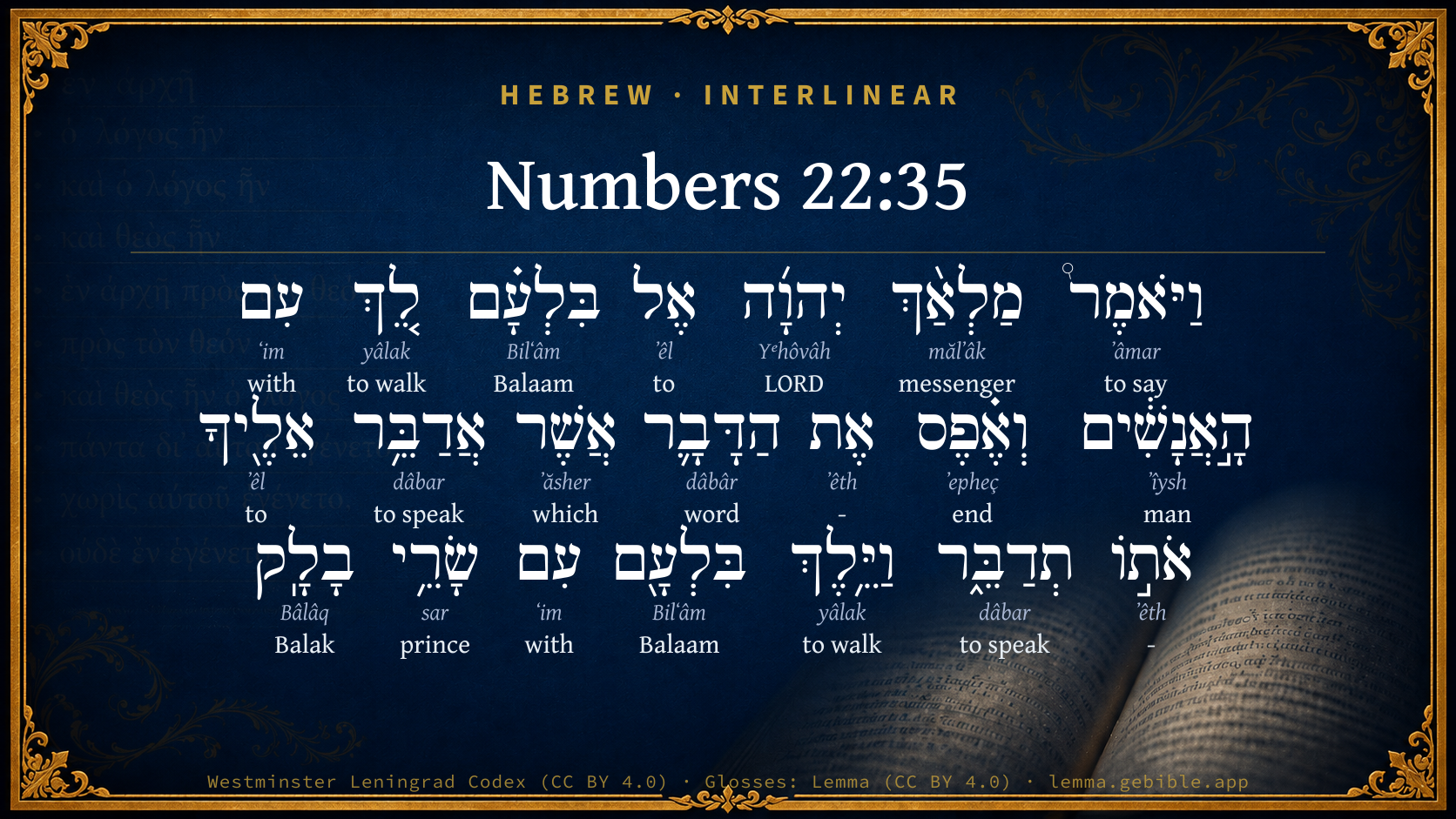
Hebrew (Westminster Leningrad Codex) Numbers 22:35 appears in the Hebrew Old Testament. The text above is from the Westminster Leningrad Codex. Each word links to its Strong’s number, a concise gloss, and parsing drawn from the Open Scriptures Hebrew Bible morphology. Click any word for its full Brown-Driver-Briggs (BDB) entry.
Download image
Cite this verse

Numbers 22:35 (World English Bible). Public Domain. Lemma interlinear Bible study tool, https://lemma.gebible.app/v/numbers/22/35.

Show BibTeX & RIS
BibTeX
RIS
English Translation
The angel of Yahweh said to Balaam, Go with the men; but only the word that I shall speak to you, that you shall speak. So Balaam went with the princes of Balak.
World English Bible · Public Domain
Download a study sheet

One document with this verse’s original text, its word-by-word gloss line, the meaning frame, cross-references with their text, attributed commentary, and full source and license credits — printable, and it pastes into notes with its structure intact.

This verse Autodidact and up

Study sheet (.html) Plain text (.txt)

A passage Seminary Student

Up to 50 verses in one chapter. A passage sheet keeps up to 6 commentary sources and 12 cross-references per verse, in the order this page ranks them, and says so on the sheet whenever that leaves anything out. Ask for a single verse and you get the Autodidact verse sheet above.

Everything on this page stays free to read, with no account — the sheet is a download of what is already on screen, not access to it.

Want to remove ads? Support Godless Engineer
Compare translations 3

The same verse in 3 English versions, stacked beneath the original-language interlinear above. Click any original word for its lexicon entry.

Each is an independent rendering of the whole verse — the interlinear is not word-aligned to these translations.

Highlighted words mark where these versions differ — a whole-verse word diff, not a word-by-word alignment.

  • World English Bible Public Domain
    The angel of Yahweh said to Balaam, Go with the men; but only the word that I shall speak to you, that you shall speak. So Balaam went with the princes of Balak.
  • King James Version Public Domain
    And the angel of the LORD said unto Balaam, Go with the men: but only the word that I shall speak unto thee, that thou shalt speak. So Balaam went with the princes of Balak.
  • unfoldingWord Literal Text CC BY-SA 4.0
    And the angel of Yahweh said to Balaam, “Go with the men, but only the word that I speak to you, it you shall speak.” And Balaam went with the princes of Balak.

unfoldingWord Literal Text — © unfoldingWord, licensed CC BY-SA 4.0. Word-aligned USFM3 via Door43 (git.door43.org/unfoldingWord/en_ult).

Versions to compare (up to 4)

3 of 4 selected

Show all 18 translations

Every available English version of this verse, each an independent rendering of the whole verse.

  • World English Bible Public Domain
    The angel of Yahweh said to Balaam, Go with the men; but only the word that I shall speak to you, that you shall speak. So Balaam went with the princes of Balak.
  • Berean Standard Bible Public Domain
    But the angel of the LORD said to Balaam, “Go with the men, but you are to speak only what I tell you.” So Balaam went with the princes of Balak.
  • Majority Standard Bible Public Domain
    But the angel of the LORD said to Balaam, “Go with the men, but you are to speak only what I tell you.” So Balaam went with the princes of Balak.
  • King James Version Public Domain
    And the angel of the LORD said unto Balaam, Go with the men: but only the word that I shall speak unto thee, that thou shalt speak. So Balaam went with the princes of Balak.
  • American Standard Version (1901) Public Domain
    And the angel of Jehovah said unto Balaam, Go with the men; but only the word that I shall speak unto thee, that thou shalt speak. So Balaam went with the princes of Balak.
  • Revised Version (1885) Public Domain
    And the angel of the LORD said unto Balaam, Go with the men: but only the word that I shall speak unto thee, that thou shalt speak. So Balaam went with the princes of Balak.
  • Geneva Bible (1599) Public Domain
    But the Angel said vnto Balaam, Go with the men: but what I say vnto thee, that shalt thou speake. So Balaam went with ye princes of Balak.
  • Douay-Rheims (1899) Public Domain
    The angel said: Go with these men, and see thou speak no other thing than what I shall command thee. He went therefore with the princes.
  • Young's Literal Translation Public Domain
    And the messenger of Jehovah saith unto Balaam, `Go with the men; and only the word which I speak unto thee -- it thou dost speak;' and Balaam goeth with the princes of Balak.
  • Literal Standard Version CC BY-SA 4.0
    And the Messenger of YHWH says to Balaam, “Go with the men; and only the word which I speak to you—it you speak”; and Balaam goes with the princes of Balak.
  • Unlocked Literal Bible CC BY-SA 4.0
    But the angel of Yahweh said to Balaam, “Go on ahead with the men. But you must only speak the words that I tell you.” So Balaam went with the leaders of Balak.
  • unfoldingWord Literal Text CC BY-SA 4.0
    And the angel of Yahweh said to Balaam, “Go with the men, but only the word that I speak to you, it you shall speak.” And Balaam went with the princes of Balak.
  • Darby Bible Public Domain
    And the Angel of Jehovah said to Balaam, Go with the men, but only the word that I shall speak unto thee, that shalt thou speak. And Balaam went with the princes of Balak.
  • World Messianic Bible Public Domain
    The LORD’s angel said to Balaam, “Go with the men; but you shall only speak the word that I shall speak to you.” So Balaam went with the princes of Balak.
  • Webster's Bible Public Domain
    And the angel of the LORD said to Balaam, Go with the men: but only the word that I shall speak to thee, that thou shalt speak: So Balaam went with the princes of Balak.
  • Free Bible Version CC BY-SA 4.0
    The angel of the Lord told Balaam, “No, you can go with the men, but only say what I tell you.” So Balaam continued on with Balak's officials.
  • Bible in Basic English Public Domain
    And the angel of the Lord said to Balaam, Go with the men; but say only what I give you to say. Then Balaam went on with the chiefs of Balak.
  • JPS Tanakh (1917) Public Domain
    And the angel of the LORD said unto Balaam: 'Go with the men; but only the word that I shall speak unto thee, that thou shalt speak.' So Balaam went with the princes of Balak.

Literal Standard Version (2020), Covenant Press — licensed CC BY-SA 4.0. Text via the HelloAO Bible API (eBible.org). Unlocked Literal Bible (unfoldingWord) — licensed CC BY-SA 4.0. Text via the HelloAO Bible API (eBible.org). unfoldingWord Literal Text — © unfoldingWord, licensed CC BY-SA 4.0. Word-aligned USFM3 via Door43 (git.door43.org/unfoldingWord/en_ult). Free Bible Version, Dr. Jonathan Gallagher — licensed CC BY-SA 4.0. Text via the HelloAO Bible API (eBible.org).

Word by word

More ways to search: Search by grammar → Find every occurrence → Compare this word →

Practice this passage: Drill this verse → Learn its vocabulary →

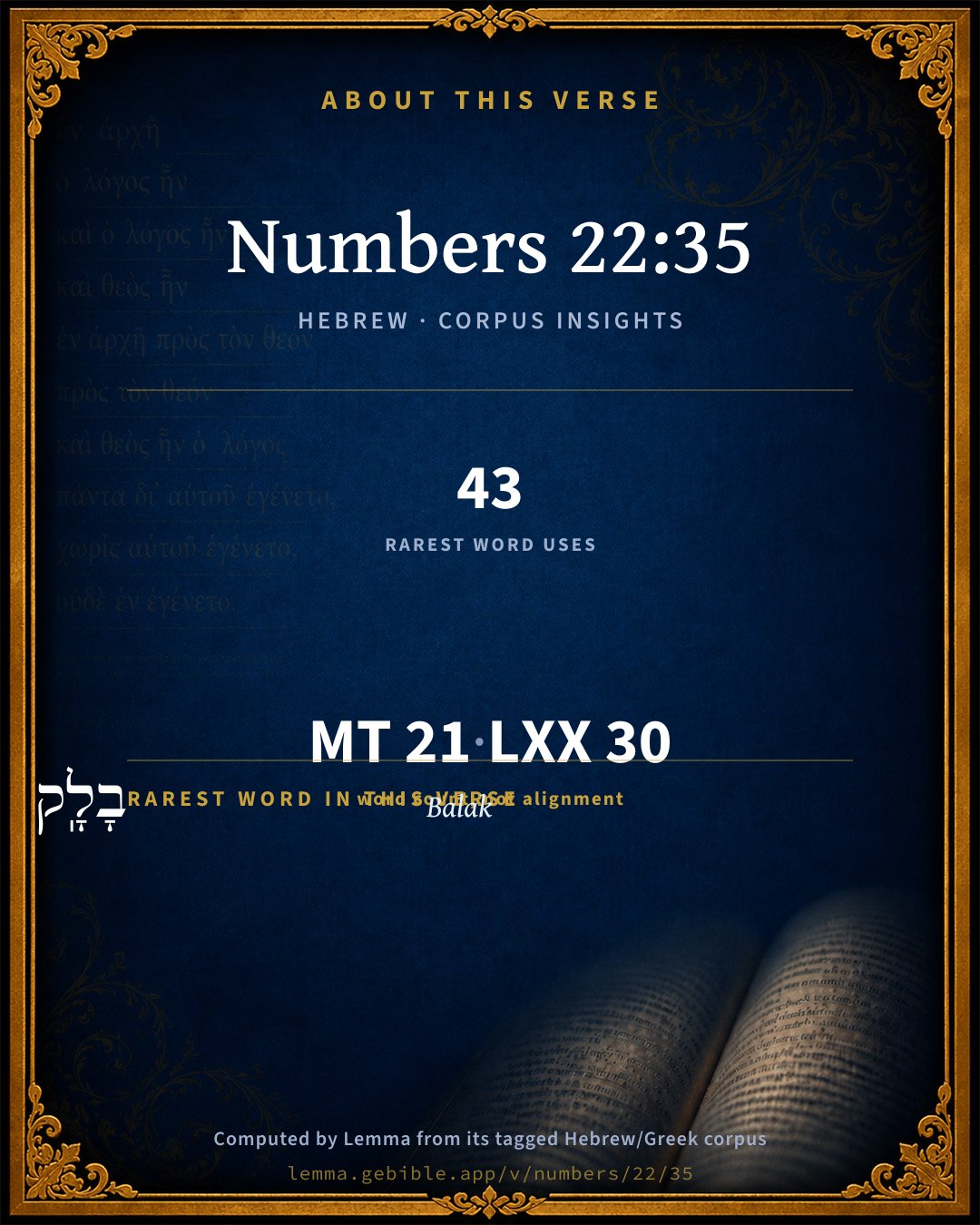
בָלָֽק
Bâlâq
H1111
“Balak”
Noun, Proper
Part of Speech
Noun
Type
Proper
Full BDB Definition

Origin: from H1110

TWOT: None

Balak = "devastator" - a king of Moab who hired Balaam to curse Israel
  1. וַיֹּאמֶר֩ ʼâmar H559 “and · to say” Conjunction + Verb, Qal, Sequential Imperfect, 3rd Person, Masculine, Singular
  2. מַלְאַ֨ךְ mălʼâk H4397 “messenger of” Noun, Common, Masculine, Singular, Construct
  3. יְהוָ֜ה Yᵉhôvâh H3068 “LORD” Noun, Proper
  4. אֶל ʼêl H413 “to” Preposition
  5. בִּלְעָ֗ם Bilʻâm H1109 “Balaam” Noun, Proper
  6. לֵ֚ךְ yâlak H3212 “walk” Verb, Qal, Imperative, 2nd Person, Masculine, Singular
  7. עִם ʻim H5973 “with” Preposition
  8. הָ֣אֲנָשִׁ֔ים ʼîysh H376 “the · men” Particle, Definite Article + Noun, Common, Masculine, Plural, Absolute
  9. וְאֶ֗פֶס ʼepheç H657 “and · end” Conjunction + Noun, Common, Masculine, Singular, Absolute
  10. אֶת ʼêth H853 “-” Particle, Direct Object
  11. הַדָּבָ֛ר dâbâr H1697 “the · word” Particle, Definite Article + Noun, Common, Masculine, Singular, Absolute
  12. אֲשֶׁר ʼăsher H834 “which” Particle, Relative
  13. אֲדַבֵּ֥ר dâbar H1696 “to speak” Verb, Piel, Imperfect, 1st Person, Common, Singular
  14. אֵלֶ֖יךָ ʼêl H413 “to · you” Preposition + Suffix, Personal, 2nd Person, Masculine, Singular
  15. אֹת֣וֹ ʼêth H853 “- · him” Particle, Direct Object + Suffix, Personal, 3rd Person, Masculine, Singular
  16. תְדַבֵּ֑ר dâbar H1696 “to speak” Verb, Piel, Imperfect, 2nd Person, Masculine, Singular
  17. וַיֵּ֥לֶךְ yâlak H3212 “and · to walk” Conjunction + Verb, Qal, Sequential Imperfect, 3rd Person, Masculine, Singular
  18. בִּלְעָ֖ם Bilʻâm H1109 “Balaam” Noun, Proper
  19. עִם ʻim H5973 “with” Preposition
  20. שָׂרֵ֥י sar H8269 “princes of” Noun, Common, Masculine, Plural, Construct

About this verse

These counts appear in no published source. They are computed here, from the morphology-tagged text and Lemma’s own curated glosses. What Lemma adds →

21
words
15
distinct lemmas
Pentateuch
section

Shared distinctive vocabulary

בָלָֽק Balak H1111 occurs in 40 verses of the Hebrew Bible. Also found in:

Grammatical profile

  • 5 verbs
  • 9 nouns
  • 4 prepositions
  • 3 particles

Verb forms

  • וַיֹּאמֶר֩ Qal · Sequential Imperfect
  • לֵ֚ךְ Qal · Imperative
  • אֲדַבֵּ֥ר Piel · Imperfect
  • תְדַבֵּ֑ר Piel · Imperfect
  • וַיֵּ֥לֶךְ Qal · Sequential Imperfect

Repetition

Words recur within this verse — often emphatic in Hebrew:

  • בִּלְעָ֗ם Balaam H1109 ×2
  • לֵ֚ךְ to walk H3212 ×2
  • אֲדַבֵּ֥ר to speak H1696 ×2
  • אֶל to H413 ×2
  • עִם with H5973 ×2

Hebrew & Septuagint length

In English translation the verse runs 33 words from the Hebrew and 37 from the Septuagint (LXX English) — closely comparable.

A rough comparison of the two English renderings, which tokenize alike — not a word-level alignment.

Word counts can differ between the Hebrew and the Greek without any difference in meaning — e.g. the Hebrew direct-object marker אֵת has no separate Greek word, and Greek often adds the article ὁ.

In the original languages it is 21 Hebrew tokens and 30 Greek tokens — but the two are counted differently (Hebrew bundles its prefixes and suffixes into one token; the Greek is in lemma form), so that isn’t a like-for-like length.

Cross-references

4

Topical passages linked to Numbers 22:35 in the Treasury of Scripture Knowledge — connected by theme and wording, ordered by reader-vote popularity; previews shown in the World English Bible.

  • 2 Thessalonians 2:9–12 even he whose coming is according to the working of Satan with all power and signs and lying wonders,
  • Numbers 22:20–21 God came to Balaam at night, and said to him, If the men are come to call you, rise up, go with them; but only the word which I speak to you, that shall you do.
  • Psalms 81:12 So I let them go after the stubbornness of their hearts, That they might walk in their own counsels.
  • Isaiah 37:26–29 Have you not heard how I have done it long ago, and formed it of ancient times? now have I brought it to pass, that it should be your to lay waste fortified cities into ruinous heaps.

Cross-references courtesy of OpenBible.info (CC BY 4.0).

Hebrew and Greek witnesses Masoretic Hebrew ↔ Greek Septuagint

The same verse in the two great witnesses to the Old Testament, shown verse-for-verse.

These are two independent witnesses, not word-aligned to each other, and the Septuagint is shown in lemma (dictionary) form.

Hebrew Numbers 22:35 Masoretic · Westminster Leningrad Codex

וַיֹּאמֶר֩ מַלְאַ֨ךְ יְהוָ֜ה אֶל בִּלְעָ֗ם לֵ֚ךְ עִם הָ֣אֲנָשִׁ֔ים וְאֶ֗פֶס אֶת הַדָּבָ֛ר אֲשֶׁר אֲדַבֵּ֥ר אֵלֶ֖יךָ אֹת֣וֹ תְדַבֵּ֑ר וַיֵּ֥לֶךְ בִּלְעָ֖ם עִם שָׂרֵ֥י בָלָֽק

The angel of Yahweh said to Balaam, Go with the men; but only the word that I shall speak to you, that you shall speak. So Balaam went with the princes of Balak.

World English Bible · Public Domain

Greek LXX Numbers 22:35 Septuagint · lemma form

καί εἶπον ὁ ἄγγελος ὁ θεός πρός βαλααμ συνπορεύομαι μετά ὁ ἄνθρωπος πλήν ὁ ῥῆμα ὅς ἐάν εἶπον πρός σύ οὗτος φυλάσσω λαλέω καί πορεύομαι βαλααμ μετά ὁ ἄρχων βαλακ

And the angel of the Lord said to Balaam, Go with the men: nevertheless the word which I shall speak to you, that you shall take heed to speak. And Balaam went with the princes of Balac.

LXX2012 (modern English Septuagint) · Public Domain

Hebrew: Westminster Leningrad Codex (CC BY 4.0). Greek: Septuagint (public domain); English from LXX2012 (modern English Septuagint) (Public Domain). How the Septuagint differs from the Hebrew →

Targum (Aramaic paraphrase)

2

The Targum is the ancient Jewish Aramaic paraphrase of the Hebrew Scriptures — an interpretive translation, not the Hebrew text itself. Onkelos (literal) and Pseudo-Jonathan (expansive) render the Torah, and Jonathan the Prophets. Coverage is partial: where no permissively-licensed English translation exists for a verse, only the Aramaic is shown. This is verse-level text, not a word-by-word alignment to the Hebrew.

  1. Targum Onkelos Torah (Genesis–Deuteronomy)
    וַאֲמַר מַלְאָכָא דַיְיָ לְבִלְעָם אִיזֵיל עִם גוּבְרַיָא וּלְחוֹד יַת פִּתְגָמָא דִי אֲמַלֵיל עִמָךְ יָתֵיהּ תְּמַלֵיל וַאֲזַל בִּלְעָם עִם רַבְרְבֵי בָּלָק

    (no public-domain English translation for this verse)

    Targum Onkelos — Aramaic: “Onkelos Genesis” (public domain); “Onkelos Exodus” (public domain); “Onkelos Leviticus” (public domain); “Onkelos Numbers” (public domain); “Onkelos Deuteronomy” (public domain). English: “Sefaria Community Translation” (CC0 1.0 (public-domain dedication)); “J.W. Etheridge. The Targums of Onkelos and Jonathan Ben Uzziel on the Pentateuch. London: Longmans, Green, 1862” (public domain). Text via Sefaria.

  2. Targum Pseudo-Jonathan Torah (Genesis–Deuteronomy)
    וַאֲמַר מַלְאָכָא דַיְיָ לְבִלְעָם אִיזֵיל עִם גוּבְרַיָא וּבְרַם יַת פִּתְגָמָא דַאֲמַלֵיל עִמָךְ יָתֵיהּ תְמַלֵיל וְאָזַל בִּלְעָם יַת רַבְרְבֵי בָּלָק

    But the angel of the Lord said to Bileam, Go with these men; but the word that I will tell thee that thou shalt speak. And Bileam went with the princes of Balak.

    Targum Pseudo-Jonathan — Aramaic: “Targum Jonathan on Genesis” (public domain); “Targum Jonathan on Exodus” (public domain); “Targum Jonathan on Leviticus” (public domain); “Targum Jonathan on Numbers” (public domain); “Targum Jonathan on Deuteronomy” (public domain). English: “The Targum of Jonathan ben Uzziel, trans. J. W. Etheridge, London, 1862” (public domain). Text via Sefaria.

Commentary

Notes on Numbers 22:35 from classic Christian and Jewish commentators (each source and its license shown beneath its notes). The classic Christian expositions comment on the surrounding passage and are grouped to its opening verse, so a note may address several verses; the Jewish commentaries on the Tanakh (Rashi and others) are per-verse, so they appear only where the commentator wrote on this verse.

Lemma curates 59 commentaries, every one of them public domain or Creative Commons licensed, each selected and text-cleaned for this edition rather than reprinted as found. About our sources →

Joseph Benson's Commentary

Num 22:35. Go with the men — I allow thee to go upon the following terms. It must have tended to convince the Moabites how much Israel was under the divine protection, to see that Balaam, covetous as he was, and even after such great rewards were set before him, durst not imprecate evil against that people. Only the word that I shall speak, &c. — These words may be understood as a prediction, as well as a command; importing that he would find himself unable to pronounce either more or less about Israel than what God would put in his mouth.

Joseph Benson's Commentary on the Old and New Testaments (1811–1818) — public domain. Text from a community e-Sword module.

Tyndale Open Study Notes

Tyndale Open Resources

22:35 The Lord ensured that Balaam would say only what God commanded (cp. 22:20).

Tyndale Open Study Notes — © Tyndale Open Resources, licensed CC BY-SA 4.0. Text via the HelloAO Bible API.

Geneva Bible (1599)

Geneva Bible translators

Because his heart was evil, his charge was renewed, that he should not pretend ignorance.

Geneva Bible (1599) marginal notes — public domain. Text via Bolls.life.

Ellicott's Commentary for English Readers

(35) Go with the men: but only the word that I shall speak unto thee . . . —The command contained in Num_22:20 is here repeated, and the unrighteous prophet is punished by being constrained to reap the fruit of his own perversity. It should be observed that here, as elsewhere, the angel who speaks to Balaam identifies himself with Him who sent him: “The word that I shall speak unto thee, that thou shalt speak.” (Comp. Num_22:20, where God Himself is represented as delivering to Balaam the same injunction.)

A Bible Commentary for English Readers, edited by Charles John Ellicott (1878–1897) — public domain. Text from a community e-Sword module.

The Cambridge Bible for Schools and Colleges

gen. ed. J. J. S. Perowne

35–41. At this point the narrative of E , interrupted after Num_22:21, is resumed. Balak went to the border of his territory to meet Balaam. A sacrificial feast was held, and on the next day Balaam was conducted to a point of vantage from which he could see Israel. These verses, however, are not without difficulties; and it is probable that with E have been fused those portions of J which related that Balaam was allowed to proceed to Moab, and that Balak received him on his arrival.

The Cambridge Bible for Schools and Colleges (gen. ed. J. J. S. Perowne; Cambridge University Press, 1878–1918) — public domain. Text from a community e-Sword module.

John Gill's Exposition

And Balaam said unto Balak, lo, I am come unto thee,.... And therefore let nothing more be said of what is past: and as for future things:

have I now any power at all to say anything? that would be agreeable to the king, and answer his purpose in sending for him, namely, to curse the people of Israel; he suggests that he had not, he was under the powerful restraint of God; he could not say what he himself was inclined to say, and what the king would have him say, and he expected he should; he could not say as some in Psa 12:4, the word

that God putteth in my mouth, that shall I speak; whether agreeable to Balak's will and design or not, and whether for or against Israel: however, it being expressed in such indefinite terms might leave room for Balak to hope it might answer his expectations and wishes.

John Gill's Exposition of the Whole Bible (1746–1763) — public domain (CC PDM 1.0). Text via the HelloAO Bible API.

Albert Barnes' Notes on the Bible

Go with the men - A command, not a permission merely. Balaam, no longer a faithful servant of God, was henceforth overruled in all his acts so that he might subserve the divine purpose as an instrument.

Num 22:26

A city of Moab - Or, Ir-Moab, probably the same with Ar-Moab Num 21:15. As Balaam in his journey would avoid the districts occupied by the Israelites, he must have approached this city from the east, by the course of the Nahaliel; and in the name Balu’a, still borne by one of the upper branches of this stream, there is perhaps a reminiscence of the name of the prophet.

Albert Barnes' Notes on the Bible (1834–1885) — public domain. Text from a community e-Sword/MySword module.

Matthew Poole's English Annotations

Go with the men: this may be either,

1. A mere permission; Since neither the convictions of thy own conscience, nor the experience of thy danger, have weaned thee from thy base designs and inclinations, I shall no further restrain thee; my angel shall give thee no more disturbance; go on and prosper. Or,

2. A concession; I allow thee to go upon the following terms; for the words here are more absolute and unconditional than those Num 22:20.

That thou shalt speak: these words may express either,

1. The event; or,

2. His duty. See Poole on "Num 22:20".

Matthew Poole's English Annotations on the Holy Bible (1683–1685) — public domain. Text from a community e-Sword/MySword module.

Whedon's Commentary on the Bible

Daniel D. Whedon

35. Go with the men — Since neither the first prohibition of his going (Num_22:12) nor the portents and perils which he had encountered in the way had turned his heart from his wicked purpose, the Lord permitted him to go on in his judicial blindness, till he should stumble over the precipice of ruin. His primal error was in admitting to his breast, through the cursed thirst for gold, the intent to curse Israel. This cherished desire vitiated his repentance, and proved his faint offer to turn back to be hypocritical.

That thou shalt speak — “The whole procedure was intended to sharpen his conscience and sober his mind, that he might pay attention to the word which the Lord would speak.” — Keil. Thus the immutability of the divine purpose in the adoption of Abraham and his seed is to be more clearly demonstrated through the mouth of a Gentile soothsayer.

Daniel D. Whedon (gen. ed.), Commentary on the Old and New Testaments (1874–1909) — public domain. Text from a community e-Sword module.

The Pulpit Commentary

Go with the men. It may be asked to what purpose the angel appeared, if Balaam was to proceed just the same. The answer is that the angel was not a warning, but a destroying, angel, a visible embodiment of the anger of God which burnt against Beldam for his perversity. The angel would have slain Balaam, as the lion slew the disobedient prophet, but that God in his mercy permitted the fidelity and wisdom of the ass to save her master from the immediate consequences of his folly. If Balaam had had a mind capable of instruction, he would indeed have gone on as he was bidden, but in a very different spirit and with very different designs.

The Pulpit Commentary (1880–1919), ed. H.D.M. Spence-Jones & Joseph S. Exell — public domain. Text from a community e-Sword module.

John Wesley's Explanatory Notes

Go with the men - I allow thee to go, upon the following terms.

John Wesley, Explanatory Notes Upon the Whole Bible (1754–1765) — public domain. Text via the GEBible commentary corpus.

Rashi

Rabbi Shlomo Yitzchaki (Rashi)

לך עם האנשים GO WITH THE MEN — On that road which a man is resolved to go, he is allowed to go (Makkot 10b).

לך עם האנשים GO WITH THE MEN — for thy lot is with them, for in the end you will perish from the world.

ואפס BUT — in spite of yourself, את הדבר אשר אדבר וגו׳ THE WORD THAT I SHALL SPEAK [TO THEE, THAT THOU SHALT SPEAK].

עם שרי בלק [SO BALAAM WENT] WITH THE PRINCES OF BALAK — he was glad to curse them, even as they were (see Rashi v. 21) (Midrash Tanchuma, Balak 10).

Rashi on the Tanakh — English translations: “The Judaica Press complete Tanach with Rashi, translated by A. J. Rosenberg” (CC BY 4.0); “Pentateuch with Rashi's commentary by M. Rosenbaum and A.M. Silbermann, 1929-1934” (public domain); “The Metsudah Tanach series, Lakewood, N.J” (CC BY 4.0); and “The Book of Joshua, Metsudah Publications, 1997” (CC BY 4.0). Text via Sefaria.

Ramban (Nachmanides)

Rabbi Moshe ben Nachman (Ramban / Nachmanides)

GO WITH THE MEN; BUT ONLY THE WORD THAT I SHALL SPEAK UNTO THEE, THAT THOU SHALT SPEAK. It is possible that He means to say: “Go with the men; but only the word that I shall speak unto thee, that thou shalt speak, and you should inform them [of this limitation of your powers].” Or it may mean that after Balaam had confessed [his evil intention, and said]: if it displease thee, I will get me back, He said to him, “Go with them, for I have forgiven you your sin, but only [on condition] that you remember My warning which I have given you [only to speak that which I tell you to say].” He had to say this [again] to him, in order that Balaam should not think that He was telling him: “Go with them to do what they have asked you to do.” It is also possible that since he who went [on the journey, i.e., Balaam] wanted to curse the people and did not want to bless them under any circumstances, therefore G-d warns him on every occasion that He speaks to him. It is for this reason that Balaam informed Balak at the very start of his speaking to him, [saying]: Lo, I am ‘come’ unto thee, [meaning to say that] “I have only been permitted to come, but as far as [cursing] the people [of Israel] is concerned, have I now any power at all to speak any thing in accordance with your wish? The word that G-d putteth in my mouth, that shall I speak — whether it be a curse or a blessing. Decide therefore if you [Balak] want me to speak about them [despite this risk], and if you do not want it, I will already now get me back.”

Ramban (Nachmanides) on the Tanakh — English translation: “Commentary on the Torah by Ramban (Nachmanides). Translated and annotated by Charles B. Chavel. New York, Shilo Pub. House, 1971-1976” (CC BY 4.0). Text via Sefaria.

Lesson kit

Teaching starters — assembled from the data on this page, not authored interpretation. Every prompt links to the verse data it draws on. Edit before teaching.

Numbers, in the Pentateuch, opens this verse with 21 words (15 distinct Hebrew lemmas). Its most distinctive word is Bâlâq (“Balak”). A historical commentator’s framing appears above. Read the whole chapter for the surrounding context.

Discussion questions

  1. What does “Balak” (Bâlâq) contribute to the verse as a whole?
  2. Numbers 22:2 shares the word «Balak» with this verse. How do the two illuminate each other?
  3. “Balaam” occurs 2× in this one verse. What is the effect of the repetition?
  4. These translations render this verse differently; the difference is in the English rendering, not the original. What questions does that raise?
  5. The verb «וַיֹּאמֶר֩» is Qal Sequential Imperfect. How does its form color the action?
  6. Reading how Joseph Benson's Commentary and Tyndale Open Study Notes read this verse, where do the two commentators agree and where do they part?

Things to notice

Reading settings

Reading text

Shown beneath each verse's original-language words.

Old Testament
Old Testament edition

Read the OT as the Masoretic Hebrew (MT) or the Greek Septuagint (LXX).

English shown for the Greek Septuagint (in the Hebrew ↔ Greek comparison).

Comparing translations? Open the Compare panel on any verse page to stack up to four side by side.