
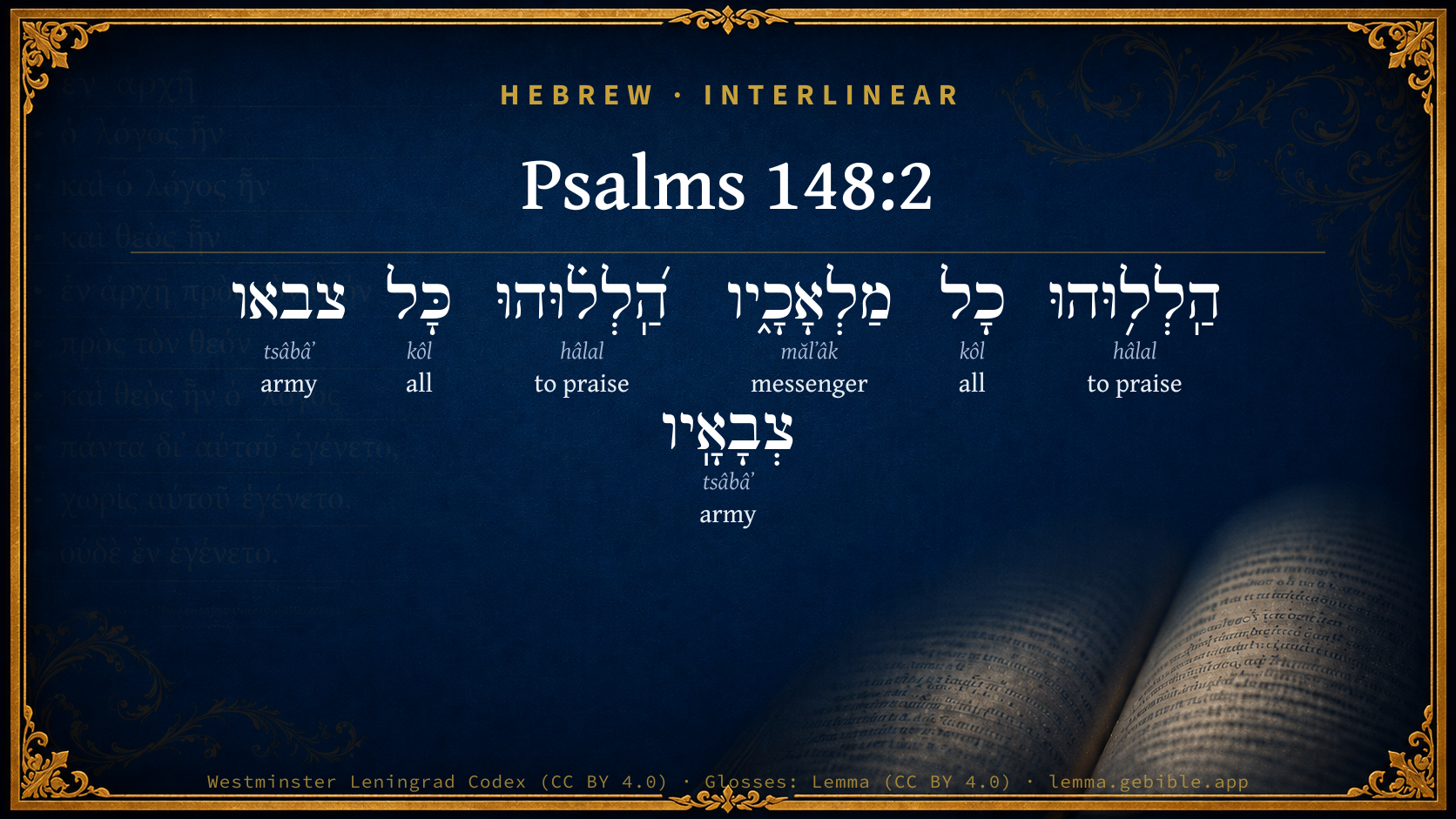
Psalms 148:2

Hebrew (Westminster Leningrad Codex) Psalms 148:2 appears in the Hebrew Old Testament. The text above is from the Westminster Leningrad Codex. Each word links to its Strong’s number, a concise gloss, and parsing drawn from the Open Scriptures Hebrew Bible morphology. Click any word for its full Brown-Driver-Briggs (BDB) entry.
Download image
Cite this verse

Psalms 148:2 (World English Bible). Public Domain. Lemma interlinear Bible study tool, https://lemma.gebible.app/v/psalms/148/2.

Show BibTeX & RIS
BibTeX
RIS
English Translation
Praise him, all his angels! Praise him, all his host!
World English Bible · Public Domain
Download a study sheet

One document with this verse’s original text, its word-by-word gloss line, the meaning frame, cross-references with their text, attributed commentary, and full source and license credits — printable, and it pastes into notes with its structure intact.

This verse Autodidact and up

Study sheet (.html) Plain text (.txt)

A passage Seminary Student

Up to 50 verses in one chapter. A passage sheet keeps up to 6 commentary sources and 12 cross-references per verse, in the order this page ranks them, and says so on the sheet whenever that leaves anything out. Ask for a single verse and you get the Autodidact verse sheet above.

Everything on this page stays free to read, with no account — the sheet is a download of what is already on screen, not access to it.

Want to remove ads? Support Godless Engineer
Compare translations 3

The same verse in 3 English versions, stacked beneath the original-language interlinear above. Click any original word for its lexicon entry.

Each is an independent rendering of the whole verse — the interlinear is not word-aligned to these translations.

Highlighted words mark where these versions differ — a whole-verse word diff, not a word-by-word alignment.

  • World English Bible Public Domain
    Praise him, all his angels! Praise him, all his host!
  • King James Version Public Domain
    Praise ye him, all his angels: praise ye him, all his hosts.
  • unfoldingWord Literal Text CC BY-SA 4.0
    Praise him, all of his angels; praise him, all of his armies.

unfoldingWord Literal Text — © unfoldingWord, licensed CC BY-SA 4.0. Word-aligned USFM3 via Door43 (git.door43.org/unfoldingWord/en_ult).

Versions to compare (up to 4)

3 of 4 selected

Show all 18 translations

Every available English version of this verse, each an independent rendering of the whole verse.

  • World English Bible Public Domain
    Praise him, all his angels! Praise him, all his host!
  • Berean Standard Bible Public Domain
    Praise Him, all His angels; praise Him, all His heavenly hosts.
  • Majority Standard Bible Public Domain
    Praise Him, all His angels; praise Him, all His heavenly hosts.
  • King James Version Public Domain
    Praise ye him, all his angels: praise ye him, all his hosts.
  • American Standard Version (1901) Public Domain
    Praise ye him, all his angels: Praise ye him, all his host.
  • Revised Version (1885) Public Domain
    Praise ye him, all his angels: praise ye him, all his host.
  • Geneva Bible (1599) Public Domain
    Prayse ye him, all ye his Angels: praise him, all his armie.
  • Douay-Rheims (1899) Public Domain
    The Lord buildeth up Jerusalem: he will gather together the dispersed of Israel.
  • Young's Literal Translation Public Domain
    Praise ye Him, all His messengers, Praise ye Him, all His hosts.
  • Literal Standard Version CC BY-SA 4.0
    Praise Him, all His messengers, || Praise Him, all His hosts.
  • Unlocked Literal Bible CC BY-SA 4.0
    Praise him, all his angels; praise him, all his hosts.
  • unfoldingWord Literal Text CC BY-SA 4.0
    Praise him, all of his angels; praise him, all of his armies.
  • Darby Bible Public Domain
    Praise ye him, all his angels; praise ye him, all his hosts.
  • World Messianic Bible Public Domain
    Praise him, all his angels! Praise him, all his army!
  • Webster's Bible Public Domain
    Praise ye him, all his angels: praise ye him, all his hosts.
  • Free Bible Version CC BY-SA 4.0
    Praise him, all his angels; praise him, all his heavenly armies!
  • Bible in Basic English Public Domain
    Give praise to him, all you his angels: give praise to him, all his armies.
  • JPS Tanakh (1917) Public Domain
    Praise ye Him, all His angels; praise ye Him, all His hosts.

Literal Standard Version (2020), Covenant Press — licensed CC BY-SA 4.0. Text via the HelloAO Bible API (eBible.org). Unlocked Literal Bible (unfoldingWord) — licensed CC BY-SA 4.0. Text via the HelloAO Bible API (eBible.org). unfoldingWord Literal Text — © unfoldingWord, licensed CC BY-SA 4.0. Word-aligned USFM3 via Door43 (git.door43.org/unfoldingWord/en_ult). Free Bible Version, Dr. Jonathan Gallagher — licensed CC BY-SA 4.0. Text via the HelloAO Bible API (eBible.org).

Word by word

More ways to search: Search by grammar → Find every occurrence → Compare this word →

Practice this passage: Drill this verse → Learn its vocabulary →

הַֽלְל֥וּהוּ
hâlal
H1984
“praise · him”
Verb, Piel, Imperative, 2nd Person, Masculine, Plural + Suffix, Personal, 3rd Person, Masculine, Singular
Part of Speech
Verb
Stem
Piel
Form
Imperative
Person
2nd Person
Gender
Masculine
Number
Plural
Full BDB Definition

Origin: a primitive root

TWOT: 499 , 500

to shine - (Qal) to shine (figuratively of God's favour) - (Hiphil) to flash forth light - to praise, boast, be boastful - (Qal) - to be boastful - boastful ones, boasters (participle) - (Piel) - to praise - to boast, make a boast - (Pual) - to be praised, be made praiseworthy, be commended, be worthy of praise - (Hithpael) to boast, glory, make one's boast - (Poel) to make a fool of, make into a fool - (Hithpoel) to act madly, act like a madman
  1. כָל kôl H3605 “all of” Noun, Common, Masculine, Singular, Construct
  2. מַלְאָכָ֑יו mălʼâk H4397 “messengers · his” Noun, Common, Masculine, Plural, Construct + Suffix, Personal, 3rd Person, Masculine, Singular
  3. הַֽ֝לְל֗וּהוּ hâlal H1984 “praise · him” Verb, Piel, Imperative, 2nd Person, Masculine, Plural + Suffix, Personal, 3rd Person, Masculine, Singular
  4. כָּל kôl H3605 “all of” Noun, Common, Masculine, Singular, Construct
  5. צבאו tsâbâʼ H6635 “army · his” Noun, Common, Both, Singular, Construct + Suffix, Personal, 3rd Person, Masculine, Singular
  6. צְבָאָֽיו tsâbâʼ H6635 “armies · his” Noun, Common, Both, Plural, Construct + Suffix, Personal, 3rd Person, Masculine, Singular

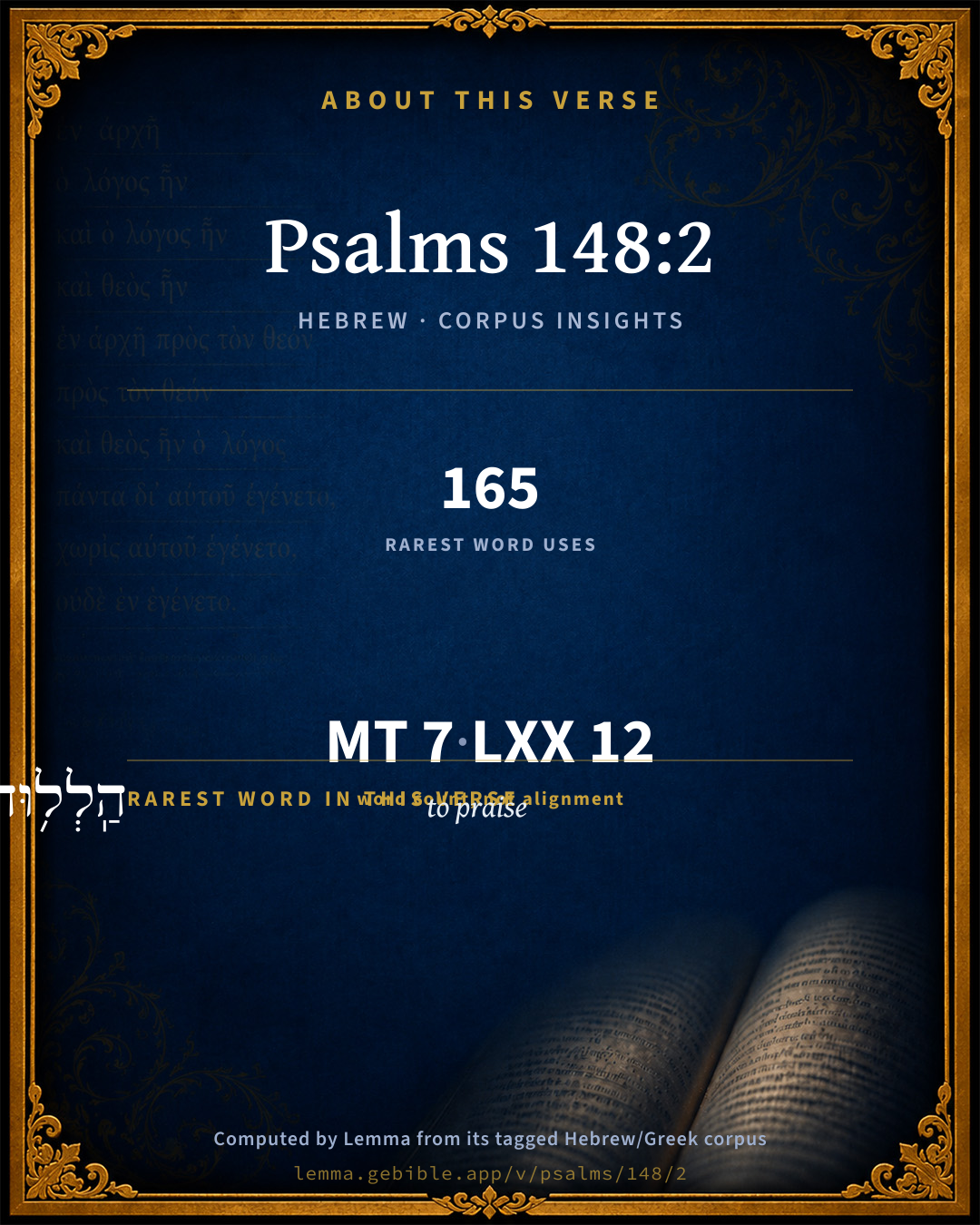
About this verse

These counts appear in no published source. They are computed here, from the morphology-tagged text and Lemma’s own curated glosses. What Lemma adds →

7
words
4
distinct lemmas
Wisdom
section

Grammatical profile

  • 2 verbs
  • 5 nouns

Verb forms

  • הַֽלְל֥וּהוּ Piel · Imperative
  • הַֽ֝לְל֗וּהוּ Piel · Imperative

Repetition

Words recur within this verse — often emphatic in Hebrew:

  • הַֽלְל֥וּהוּ to praise H1984 ×2
  • כָל all H3605 ×2
  • צבאו army H6635 ×2

Hebrew & Septuagint length

In English translation the verse runs 10 words from the Hebrew and 12 from the Septuagint (LXX English) — closely comparable.

A rough comparison of the two English renderings, which tokenize alike — not a word-level alignment.

Word counts can differ between the Hebrew and the Greek without any difference in meaning — e.g. the Hebrew direct-object marker אֵת has no separate Greek word, and Greek often adds the article ὁ.

In the original languages it is 7 Hebrew tokens and 12 Greek tokens — but the two are counted differently (Hebrew bundles its prefixes and suffixes into one token; the Greek is in lemma form), so that isn’t a like-for-like length.

Cross-references

6

Topical passages linked to Psalms 148:2 in the Treasury of Scripture Knowledge — connected by theme and wording, ordered by reader-vote popularity; previews shown in the World English Bible.

  • Psalms 103:20–21 Praise Yahweh, you angels of his, Who are mighty in strength, who fulfill his word, Obeying the voice of his word.
  • Isaiah 6:2–4 Above him stood the seraphim. Each one had six wings. With two he covered his face. With two he covered his feet. With two he flew.
  • Genesis 2:1 The heavens and the earth were finished, and all the host of them.
  • Job 38:7 When the morning stars sang together, And all the sons of God shouted for joy?
  • Ezekiel 3:12 Then the Spirit lifted me up, and I heard behind me the voice of a great rushing, [saying], Blessed be the glory of Yahweh from his place.
  • Revelation 5:11–13 I saw, and I heard something like a voice of many angels around the throne, the living creatures, and the elders; and the number of them was ten thousands of ten thousands, and thousands of thousands;

Cross-references courtesy of OpenBible.info (CC BY 4.0).

Hebrew and Greek witnesses Masoretic Hebrew ↔ Greek Septuagint

The same verse in the two great witnesses to the Old Testament, shown verse-for-verse.

You’re reading Greek Psalm 148 (Hebrew Psalm 148). The Septuagint counts the superscription, so verse numbers can differ from the Hebrew — chapter-level alignment, not verse-by-verse. Numbering follows Rahlfs.

These are two independent witnesses, not word-aligned to each other, and the Septuagint is shown in lemma (dictionary) form.

Hebrew Psalms 148:2 Masoretic · Westminster Leningrad Codex

הַֽלְל֥וּהוּ כָל מַלְאָכָ֑יו הַֽ֝לְל֗וּהוּ כָּל צבאו צְבָאָֽיו

Praise him, all his angels! Praise him, all his host!

World English Bible · Public Domain

Greek LXX Greek Psalm 148:2 Septuagint · lemma form

αἰνέω αὐτός πᾶς ὁ ἄγγελος αὐτός αἰνέω αὐτός πᾶς ὁ δύναμις αὐτός

Praise you⌃ him, all his angels: praise you⌃ him, all his hosts.

LXX2012 (modern English Septuagint) · Public Domain

Hebrew: Westminster Leningrad Codex (CC BY 4.0). Greek: Septuagint (public domain); English from LXX2012 (modern English Septuagint) (Public Domain). How the Septuagint differs from the Hebrew →

Commentary

Notes on Psalms 148:2 from classic Christian and Jewish commentators (each source and its license shown beneath its notes). The classic Christian expositions comment on the surrounding passage and are grouped to its opening verse, so a note may address several verses; the Jewish commentaries on the Tanakh (Rashi and others) are per-verse, so they appear only where the commentator wrote on this verse.

Lemma curates 59 commentaries, every one of them public domain or Creative Commons licensed, each selected and text-cleaned for this edition rather than reprinted as found. About our sources →

Trapp's Complete Commentary

John Trapp

Psa 148:2 Praise ye him, all his angels: praise ye him, all his hosts.

Ver. 2. Praise ye him, all his angels] Whose proper office it is to adore and praise God, Job 38:7 Isa 6:3 Heb 1:6, which also they do constantly and completely; as those that both perfectly know him and love him. Jacob saw them, 1. Ascending, to contemplate and praise the Lord, and minister to him, Luk 2:13 Dan 7:10 Mat 18:10 Psa 103:20. 2. Descending, to execute God’s will upon men, for mercy to some, and for judgment to others; which tendeth much to his praise. And David, by calling upon these heavenly courtiers, provoketh and pricketh on himself to praise God.

Praise ye him, all his hosts] i.e. His creatures (those above especially, which are as his cavalry), called his hosts for their, 1. Number 2. Order; 3. Obedience.

John Trapp, A Commentary or Exposition upon All the Books of the Old and New Testament (1647–1656) — public domain. Text from a community e-Sword module.

J. A. Alexander on Psalms

Joseph Addison Alexander

2. (Psa 148:2) Praise ye him, all his angels! Praise ye him, all his hosts! As this last expression is applied both to the angels and the heavenly bodies, it here affords a natural transition from the one to the other. See above, on Psa 24:10; Psa 29:1; Psa 103:21.

Joseph Addison Alexander, The Psalms Translated and Explained (1850) — public domain. Text from a community e-Sword module.

Geneva Bible (1599)

Geneva Bible translators

Because they are members of the same body, he setteth them before our eyes, which are most willing hereunto, and by their prompt obedience teach us to do our duty.

Geneva Bible (1599) marginal notes — public domain. Text via Bolls.life.

Jamieson, Fausset & Brown

Robert Jamieson, A. R. Fausset & David Brown

hosts--(compare Psa 103:21).

Jamieson, Fausset & Brown — Commentary Critical and Explanatory on the Whole Bible (1871) — public domain (CC PDM 1.0). Text via the HelloAO Bible API.

The Cambridge Bible for Schools and Colleges

gen. ed. J. J. S. Perowne

2. Cp. Psa_103:20 a, 21 a. Hosts may include both heavenly beings and heavenly bodies, and in Job_38:7 angels and stars join in praise: but here as in Psa_103:21 the angels only seem to be meant (cp. 1Ki_22:19; Neh_9:6); the heavenly bodies follow in Psa_148:3. The Q’rç and all the Versions read the plur. hosts; the K’thîbh has the sing. host.

The Cambridge Bible for Schools and Colleges (gen. ed. J. J. S. Perowne; Cambridge University Press, 1878–1918) — public domain. Text from a community e-Sword module.

John Gill's Exposition

Praise ye him, all his angels,.... The Targum adds, who minister before him: the ministering spirits, the angels of Jehovah, even of Christ, who are his creatures, and at his command; and whom he sends forth to minister to others, Heb 1:7. And great numbers there are of them, thousands and tens of thousands, yea, an innumerable company; and all of them are under obligation to praise the Lord for their creation: for invisible spirits, as well as visible bodies, even the celestial thrones, dominions, principalities, and powers, were created by him, by Christ, Col 1:16. And for their preservation in their beings, and confirmation in that happy estate in which they were created; being chosen and secured in Christ, the head of all principality and power, and so stood while others fell: and also for the various excellent powers, and faculties and properties, they are endowed with; they excel in strength, are possessed of great agility and swiftness; have a large share of knowledge, of things natural, civil, moral, spiritual, and evangelical; are perfectly holy, and without sin; and happy in the enjoyment of God, in whose presence they always are, and whose face they continually behold; and will ever remain in this state, being immaterial and immortal beings. And as praise is their duty, it is their work; in this they were employed at the creation of all things, then these sons of God and morning stars sang and shouted for joy; and at the incarnation of Christ, when they worshipped him; at the conversion of every sinner; and frequently join the church in this service, and will be concerned in it to all eternity: and when the psalmist calls upon them to engage in it, it does not suppose that they were deficient in it, or backward to it, or that he had any authority over them to require it of them; but it shows his great desire that the Lord might be praised by the noblest creatures, and in the best manner that could be, and how much his heart was in this work; and he does it to stir up himself and others the more unto it, from this consideration; that if those heavenly creatures should praise the Lord, then much more such as he and others, who were so very unworthy of the divine favours, and so much beholden to the Lord for them;

praise ye him, all his hosts; meaning either the angels as before, sometimes called the hosts of heaven, and the heavenly host; there being armies and legions of them, and these encamping about the saints in a military way; see Kg2 19:35; or else the celestial bodies, the sun, moon, and stars, as follow, sometimes called the host of heaven; and who are represented as militant, Gen 2:1, Kg2 21:3.

John Gill's Exposition of the Whole Bible (1746–1763) — public domain (CC PDM 1.0). Text via the HelloAO Bible API.

Albert Barnes' Notes on the Bible

Praise ye him, all his angels - Dwelling in the heavens. Compare the notes at Psa 103:20.

Praise ye him, all his hosts - See the notes at Psa 103:21 and the notes at Isa 1:9. All his armies - referring to the angels considered as marshalled into hosts, of which God is the Head and Leader.

Albert Barnes' Notes on the Bible (1834–1885) — public domain. Text from a community e-Sword/MySword module.

Matthew Poole's English Annotations

He inviteth the angels here, and the senseless creatures afterward, to praise God; not as if the former needed, or the latter were capable of, his exhortation, but only by a poetical rapture; the design whereof is, that men by this means might be more provoked to this duty. The angels are called

hosts, here and 1Ki 22:19, for their vast numbers, exquisite order, and perfect subjection to their General, the Lord of hosts.

Matthew Poole's English Annotations on the Holy Bible (1683–1685) — public domain. Text from a community e-Sword/MySword module.

The Treasury of David

Charles H. Spurgeon

Ver. 2. Praise ye him, all his angels. Living intelligences, perfect in character and in bliss, lift up your loudest music to your Lord, each one, of you. Not one bright spirit is exempted from this consecrated service. However many ye be, O angels, ye are all his angels, and therefore ye are bound, all of you, to render service to your Lord. Ye have all seen enough of him to be able to praise him, and ye have all abundant reasons for so doing. Whether ye be named Gabriel, or Michael, or by whatever other titles ye are known, praise ye the Lord. Whether ye bow before him, or fly on his errands, or desire to look into his covenant, or behold his Son, cease not, ye messengers of Jehovah, to sound forth his praise while ye move at his bidding.

Praise ye him, all his hosts. This includes angelic armies, but groups with them all the heavenly bodies. Though they be inanimate, the stars, the clouds, the lightnings, have their ways of praising Jehovah. Let each one of the countless legions of the Lord of hosts show forth his glory; for the countless armies are all his, his by creation, and preservation, and consequent obligation. Both these sentences claim unanimity of praise from those in the upper regions who are called upon to commence the strain"all his angels, all his hosts." That same hearty oneness must pervade the whole orchestra of praising ones; hence, further on, we read of all stars of light, all deeps, all hills, all cedars, and all people. How well the concert begins when all angels, and all the heavenly host, strike the first joyful notes! In that concert our souls would at once take their part.

Ver. 2. Praise ye him, all his angels. Angels are first invoked, because they can praise God with humility, reverence, and purity. The highest are the humblest, the leaders of all created hosts are the most ready themselves to obey. Thomas Le Blanc.

Ver. 2. Praise ye him, all his angels. The angels of God were his first creatures; it has even been thought that they existed prior to the inanimate universe. They were already praising their Maker before the light of day, and they have never ceased their holy song. Angels praise God best in their holy service. They praised Christ as God when they sang their Gloria in Excelsis at the Incarnation, and they praised him as man when they ministered to him after his temptation and before his crucifixion. So also now angels praise the Lord by their alacrity in ministering to his saints. John Lorinus.

Ver. 2. Praise ye him, all his hosts. That is, his creatures (those above especially which are as his cavalry) called his "hosts", for, 1. Their number; 2, their order; 3, their obedience. John Trapp.

Ver. 2.

1. The angels as praiseful servants.

2. The other hosts of God, and how they praise him.

3. The rule without exception: "allall." Imagine one heavenly being living without praising the Lord!

Psalms 148:3*

Charles H. Spurgeon's The Treasury of David (1869–1885) — public domain. Psalms only. Text from a community e-Sword/MySword module.

Whedon's Commentary on the Bible

Daniel D. Whedon

2. Angels—The highest order of holy created beings in heaven, who immediately war on God.

Hosts—Hebrew, Sab’aoth; literally, armies. The title primarily applies to the national army of Israel, whose captain and leader was God. Hence, the frequent title, “God of hosts,” or armies. The idea of the word is not merely that of multitude, but of order, organization, and active martial service. The psalmist seems to use it here for the inhabitants of heaven generally, under whatsoever title they may be revealed to us—as of angel, archangel, seraph, cherub, principality, or power. As he mentions the “stars” in Psa_148:3, it would seem they were not here included in the Sab’aoth, as they often are.

Daniel D. Whedon (gen. ed.), Commentary on the Old and New Testaments (1874–1909) — public domain. Text from a community e-Sword module.

The Pulpit Commentary

Praise ye him, all his angels. (comp. Psa_103:20, Psa_103:21) As the angels occupy the first rank in creation, and have the most to praise God for, they are fitly called upon to commence the song of jubilation. The praises of God must form their chief occupation through all eternity. Praise ye him, all his hosts; rather, all his host. In the "host of God" are included beings of inferior rank to angels of his that do his pleasure". (Psa_103:21)

The Pulpit Commentary (1880–1919), ed. H.D.M. Spence-Jones & Joseph S. Exell — public domain. Text from a community e-Sword module.

Scofield Reference Notes

C. I. Scofield

angels

(See Scofield "Heb 1:4") .

The Scofield Reference Bible (1917 edition), notes by C. I. Scofield — public domain. Text from a community e-Sword module.

Lesson kit

Teaching starters — assembled from the data on this page, not authored interpretation. Every prompt links to the verse data it draws on. Edit before teaching.

Psalms, in the Wisdom, opens this verse with 7 words (4 distinct Hebrew lemmas). Its most distinctive word is hâlal (“to praise”). A historical commentator’s framing appears above. Read the whole chapter for the surrounding context.

Discussion questions

  1. The word hâlal carries the sense “to praise.” How does it shape the verse?
  2. How does Psalms 103:20–21, which shares this passage’s theme, read alongside this verse?
  3. What does the repetition of “to praise” (2× in this one verse) do in this verse?
  4. These translations render this verse differently; the difference is in the English rendering, not the original. What questions does that raise?
  5. «הַֽלְל֥וּהוּ» is a Piel Imperative verb. How does that grammatical form shape the action described?
  6. Compare how Trapp's Complete Commentary and J. A. Alexander on Psalms read this verse. Where do they agree or differ?

Things to notice

Reading settings

Reading text

Shown beneath each verse's original-language words.

Old Testament
Old Testament edition

Read the OT as the Masoretic Hebrew (MT) or the Greek Septuagint (LXX).

English shown for the Greek Septuagint (in the Hebrew ↔ Greek comparison).

Comparing translations? Open the Compare panel on any verse page to stack up to four side by side.