Zechariah 6:5

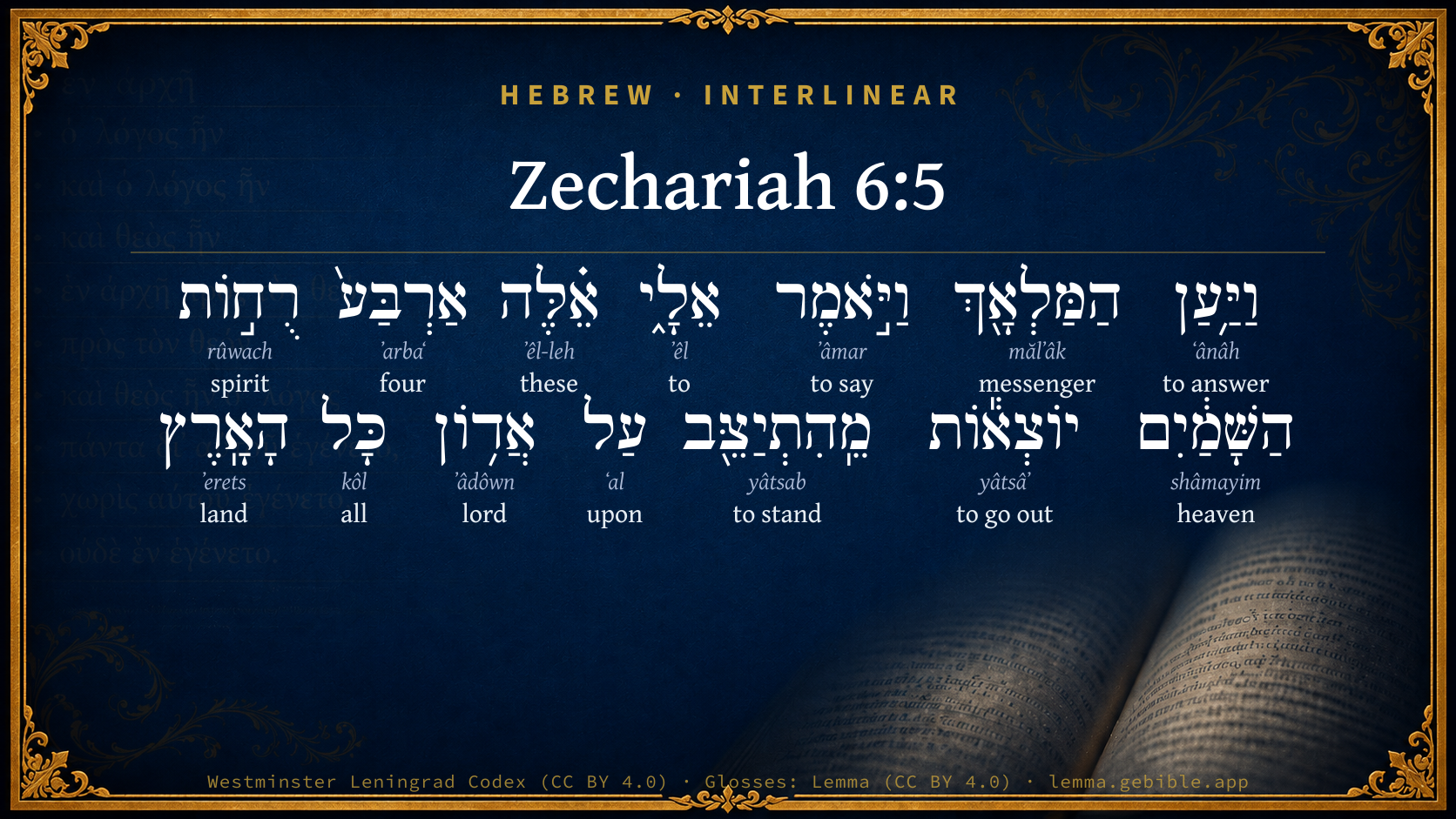
Hebrew (Westminster Leningrad Codex) Zechariah 6:5 appears in the Hebrew Old Testament. The text above is from the Westminster Leningrad Codex. Each word links to its Strong’s number, a concise gloss, and parsing drawn from the Open Scriptures Hebrew Bible morphology. Click any word for its full Brown-Driver-Briggs (BDB) entry.
Download image
Cite this verse

Zechariah 6:5 (World English Bible). Public Domain. Lemma interlinear Bible study tool, https://lemma.gebible.app/v/zechariah/6/5.

Show BibTeX & RIS
BibTeX
RIS
English Translation
The angel answered me, "These are the four winds of the sky, which go forth from standing before the Lord of all the earth.
World English Bible · Public Domain
Download a study sheet

One document with this verse’s original text, its word-by-word gloss line, the meaning frame, cross-references with their text, attributed commentary, and full source and license credits — printable, and it pastes into notes with its structure intact.

This verse Autodidact and up

Study sheet (.html) Plain text (.txt)

A passage Seminary Student

Up to 50 verses in one chapter. A passage sheet keeps up to 6 commentary sources and 12 cross-references per verse, in the order this page ranks them, and says so on the sheet whenever that leaves anything out. Ask for a single verse and you get the Autodidact verse sheet above.

Everything on this page stays free to read, with no account — the sheet is a download of what is already on screen, not access to it.

Want to remove ads? Support Godless Engineer
Compare translations 3

The same verse in 3 English versions, stacked beneath the original-language interlinear above. Click any original word for its lexicon entry.

Each is an independent rendering of the whole verse — the interlinear is not word-aligned to these translations.

Highlighted words mark where these versions differ — a whole-verse word diff, not a word-by-word alignment.

  • World English Bible Public Domain
    The angel answered me, "These are the four winds of the sky, which go forth from standing before the Lord of all the earth.
  • King James Version Public Domain
    And the angel answered and said unto me, These are the four spirits of the heavens, which go forth from standing before the LORD of all the earth.
  • unfoldingWord Literal Text CC BY-SA 4.0
    And the angel answered and said to me, “These are the four winds of the heavens going out from standing before the Lord of all the earth.

unfoldingWord Literal Text — © unfoldingWord, licensed CC BY-SA 4.0. Word-aligned USFM3 via Door43 (git.door43.org/unfoldingWord/en_ult).

Versions to compare (up to 4)

3 of 4 selected

Show all 18 translations

Every available English version of this verse, each an independent rendering of the whole verse.

  • World English Bible Public Domain
    The angel answered me, "These are the four winds of the sky, which go forth from standing before the Lord of all the earth.
  • Berean Standard Bible Public Domain
    And the angel told me, “These are the four spirits of heaven, going forth from their station before the Lord of all the earth.
  • Majority Standard Bible Public Domain
    And the angel told me, “These are the four spirits of heaven, going forth from their station before the Lord of all the earth.
  • King James Version Public Domain
    And the angel answered and said unto me, These are the four spirits of the heavens, which go forth from standing before the LORD of all the earth.
  • American Standard Version (1901) Public Domain
    And the angel answered and said unto me, These are the four winds of heaven, which go forth from standing before the Lord of all the earth.
  • Revised Version (1885) Public Domain
    And the angel answered and said unto me, These are the four winds of heaven, which go forth from standing before the Lord of all the earth.
  • Geneva Bible (1599) Public Domain
    And the Angell answered, and sayde vnto mee, These are the foure spirites of the heauen, which goe foorth from standing with the Lord of all the earth.
  • Douay-Rheims (1899) Public Domain
    And the angel answered, and said to me: These are the four winds of the heaven, which go forth to stand before the Lord of all the earth.
  • Young's Literal Translation Public Domain
    And the messenger answereth and saith unto me, `These `are' four spirits of the heavens coming forth from presenting themselves before the Lord of the whole earth.
  • Literal Standard Version CC BY-SA 4.0
    And the messenger answers and says to me, “These [are] four spirits of the heavens coming forth from presenting themselves before the Lord of the whole earth.
  • Unlocked Literal Bible CC BY-SA 4.0
    The angel answered and said to me, “These are the four winds of heaven that go out from the place where they were standing before the Lord of all the earth.
  • unfoldingWord Literal Text CC BY-SA 4.0
    And the angel answered and said to me, “These are the four winds of the heavens going out from standing before the Lord of all the earth.
  • Darby Bible Public Domain
    And the angel answered and said unto me, These are the four spirits of the heavens, which go forth from standing before the Lord of all the earth.
  • World Messianic Bible Public Domain
    The angel answered me, “These are the four winds of the sky, which go out from standing before the Lord of all the earth.
  • Webster's Bible Public Domain
    And the angel answered and said to me, These are the four spirits of the heavens, which go forth from standing before the Lord of all the earth.
  • Free Bible Version CC BY-SA 4.0
    “They are going out to the four winds of heaven, after presenting themselves to the Lord of all the earth,” the angel explained.
  • Bible in Basic English Public Domain
    And the angel, answering, said to me, These go out to the four winds of heaven from their place before the Lord of all the earth.
  • JPS Tanakh (1917) Public Domain
    And the angel answered and said unto me: 'These chariots go forth to the four winds of heaven, after presenting themselves before the Lord of all the earth.

Literal Standard Version (2020), Covenant Press — licensed CC BY-SA 4.0. Text via the HelloAO Bible API (eBible.org). Unlocked Literal Bible (unfoldingWord) — licensed CC BY-SA 4.0. Text via the HelloAO Bible API (eBible.org). unfoldingWord Literal Text — © unfoldingWord, licensed CC BY-SA 4.0. Word-aligned USFM3 via Door43 (git.door43.org/unfoldingWord/en_ult). Free Bible Version, Dr. Jonathan Gallagher — licensed CC BY-SA 4.0. Text via the HelloAO Bible API (eBible.org).

Word by word

More ways to search: Search by grammar → Find every occurrence → Compare this word →

Practice this passage: Drill this verse → Learn its vocabulary →

מֵֽהִתְיַצֵּ֖ב
yâtsab
H3320
“from · to stand”
Preposition + Verb, Hithpael, Infinitive Construct
Part of Speech
Preposition + Verb
Stem
Hithpael
Form
Infinitive Construct
Full BDB Definition

Origin: a primitive root

TWOT: 894

to place, set, stand, set or station oneself, present oneself - (Hithpael) to station oneself, take one's stand, stand, present oneself, stand with someone
  1. וַיַּ֥עַן ʻânâh H6030 “and · to answer” Conjunction + Verb, Qal, Sequential Imperfect, 3rd Person, Masculine, Singular
  2. הַמַּלְאָ֖ךְ mălʼâk H4397 “the · messenger” Particle, Definite Article + Noun, Common, Masculine, Singular, Absolute
  3. וַיֹּ֣אמֶר ʼâmar H559 “and · to say” Conjunction + Verb, Qal, Sequential Imperfect, 3rd Person, Masculine, Singular
  4. אֵלָ֑י ʼêl H413 “to · me” Preposition + Suffix, Personal, 1st Person, Common, Singular
  5. אֵ֗לֶּה ʼêl-leh H428 “these” Pronoun, Demonstrative, Common, Plural
  6. אַרְבַּע֙ ʼarbaʻ H702 “four” Adjective, Cardinal number, Feminine, Singular, Absolute
  7. רֻח֣וֹת rûwach H7307 “spirits of” Noun, Common, Both, Plural, Construct
  8. הַשָּׁמַ֔יִם shâmayim H8064 “the · heaven(s)” Particle, Definite Article + Noun, Common, Masculine, Plural, Absolute
  9. יוֹצְא֕וֹת yâtsâʼ H3318 “going out” Verb, Qal, Participle Active, Feminine, Plural, Absolute
  10. עַל ʻal H5921 “upon” Preposition
  11. אֲד֥וֹן ʼâdôwn H113 “lord of” Noun, Common, Masculine, Singular, Construct
  12. כָּל kôl H3605 “all of” Noun, Common, Masculine, Singular, Construct
  13. הָאָֽרֶץ ʼerets H776 “the · land” Particle, Definite Article + Noun, Common, Both, Singular, Absolute

About this verse

These counts appear in no published source. They are computed here, from the morphology-tagged text and Lemma’s own curated glosses. What Lemma adds →

14
words
14
distinct lemmas
Prophets
section

Shared distinctive vocabulary

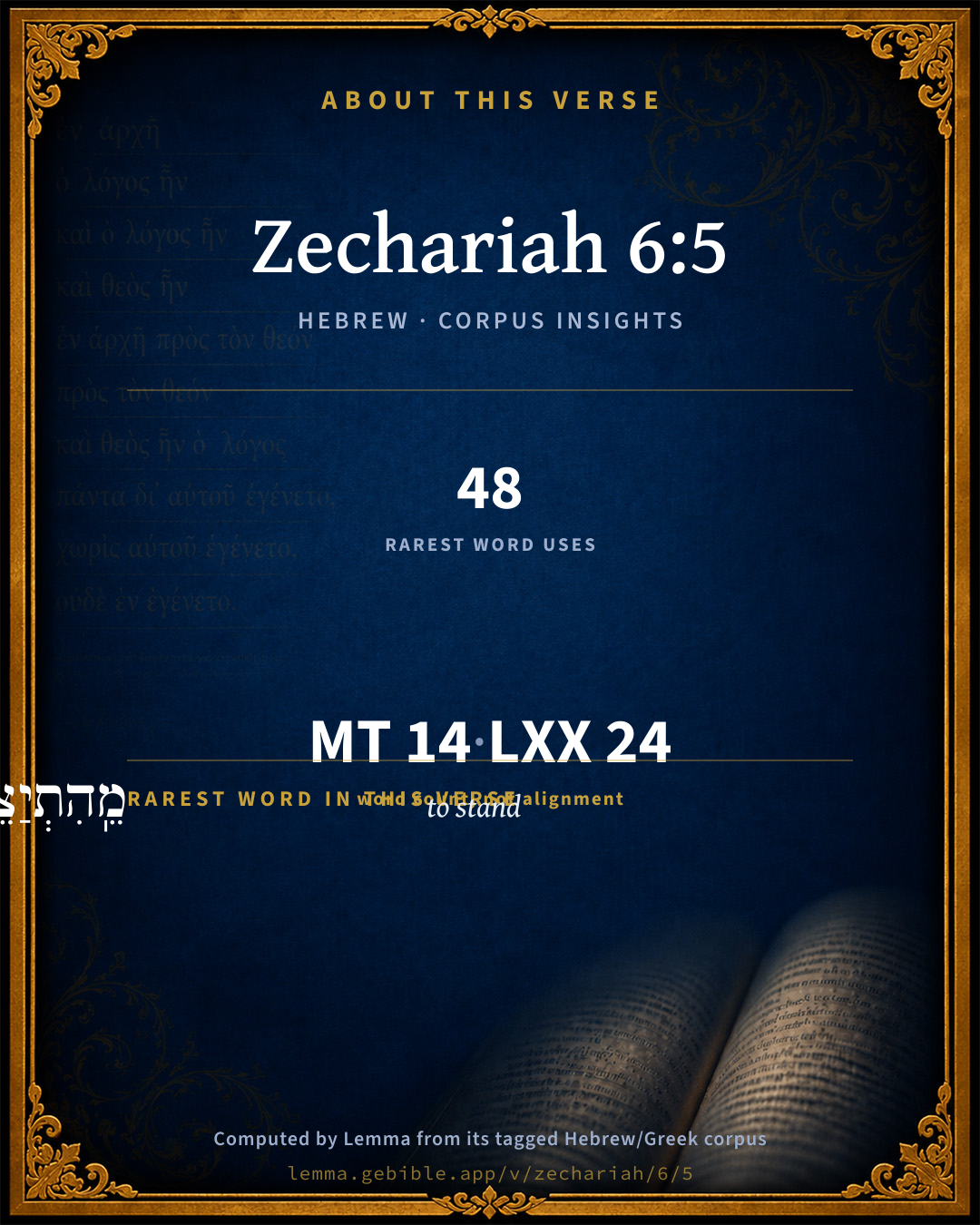
מֵֽהִתְיַצֵּ֖ב to stand H3320 occurs in 45 verses of the Hebrew Bible. Also found in:

Grammatical profile

  • 4 verbs
  • 6 nouns
  • 1 adjective
  • 1 pronoun
  • 2 prepositions

Verb forms

  • וַיַּ֥עַן Qal · Sequential Imperfect
  • וַיֹּ֣אמֶר Qal · Sequential Imperfect
  • יוֹצְא֕וֹת Qal · Participle Active
  • מֵֽהִתְיַצֵּ֖ב Hithpael · Infinitive Construct

Hebrew & Septuagint length

In English translation the verse runs 24 words from the Hebrew and 31 from the Septuagint (LXX English) — closely comparable.

A rough comparison of the two English renderings, which tokenize alike — not a word-level alignment.

Word counts can differ between the Hebrew and the Greek without any difference in meaning — e.g. the Hebrew direct-object marker אֵת has no separate Greek word, and Greek often adds the article ὁ.

In the original languages it is 14 Hebrew tokens and 24 Greek tokens — but the two are counted differently (Hebrew bundles its prefixes and suffixes into one token; the Greek is in lemma form), so that isn’t a like-for-like length.

Cross-references

25

Topical passages linked to Zechariah 6:5 in the Treasury of Scripture Knowledge — connected by theme and wording, ordered by reader-vote popularity; previews shown in the World English Bible.

  • Hebrews 1:7 Of the angels he says, "Who makes his angels winds, And his servants a flame of fire."
  • Psalms 104:3–4 He lays the beams of his chambers in the waters. He makes the clouds his chariot. He walks on the wings of the wind.
  • Ezekiel 10:9–19 I looked, and behold, four wheels beside the cherubim, one wheel beside one cherub, and another wheel beside another cherub; and the appearance of the wheels was like a beryl stone.
  • Ezekiel 37:9 Then said he to me, Prophesy to the wind, prophesy, son of man, and tell the wind, Thus says the Lord Yahweh: Come from the four winds, breath, and breathe on these slain, that they may live.
  • Hebrews 1:14 Aren't they all ministering spirits, sent out to do service for the sake of those who will inherit salvation?
  • Revelation 7:1 After this, I saw four angels standing at the four corners of the earth, holding the four winds of the earth, so that no wind would blow on the earth, or on the sea, or on any tree.
  • 1 Kings 22:19 [Micaiah] said, Therefore hear you the word of Yahweh: I saw Yahweh sitting on his throne, and all the host of heaven standing by him on his right hand and on his left.
  • Psalms 68:17 The chariots of God are tens of thousands and thousands of thousands. The Lord is among them, from Sinai, into the sanctuary.
  • Ezekiel 1:5–28 Out of the midst of it came the likeness of four living creatures. This was their appearance: they had the likeness of a man.
  • Daniel 7:2 Daniel spoke and said, I saw in my vision by night, and, behold, the four winds of the sky broke forth on the great sea.
  • Daniel 7:10 A fiery stream issued and came forth from before him: thousands of thousands ministered to him, and ten thousand times ten thousand stood before him: the judgment was set, and the books were opened.
  • Zechariah 1:10–11 The man who stood among the myrtle trees answered, "They are the ones Yahweh has sent to go back and forth through the earth."
  • Matthew 24:31 He will send out his angels with a great sound of a trumpet, and they will gather together his chosen ones from the four winds, from one end of the sky to the other.
  • 1 Kings 19:11 He said, Go forth, and stand on the mountain before Yahweh. Behold, Yahweh passed by, and a great and strong wind tore the mountains, and broke in pieces the rocks before Yahweh; but Yahweh was not in the wind: and after the wind an earthquake; but Yahweh was not in the earthquake:
  • 2 Chronicles 18:18–19 [Micaiah] said, Therefore hear you the word of Yahweh: I saw Yahweh sitting on his throne, and all the host of heaven standing on his right hand and on his left.
  • Job 2:1–2 Again it happened on the day when the sons of God came to present themselves before Yahweh, that Satan came also among them to present himself before Yahweh.
  • Psalms 148:8 Lightning and hail, snow and clouds; Stormy wind, fulfilling his word;
  • Isaiah 54:5 For your Maker is your husband; Yahweh of Hosts is his name: and the Holy One of Israel is your Redeemer; the God of the whole earth shall he be called.
  • Ezekiel 11:22 Then did the cherubim lift up their wings, and the wheels were beside them; and the glory of the God of Israel was over them above.
  • Zechariah 4:10 Indeed, who despises the day of small things? For these seven shall rejoice, and shall see the plumb line in the hand of Zerubbabel. These are the eyes of Yahweh, which run back and forth through the whole earth."
  • Matthew 18:10 See that you don't despise one of these little ones, for I tell you that in heaven their angels always see the face of my Father who is in heaven.
  • Luke 1:19 The angel answered him, "I am Gabriel, who stands in the presence of God. I was sent to speak to you, and to bring you this good news.
  • Job 1:6 Now it happened on the day when the sons of God came to present themselves before Yahweh, that Satan also came among them.
  • Zechariah 4:14 Then he said, "These are the two anointed ones who stand by the Lord of the whole earth."
  • Revelation 14:6–13 I saw an angel flying in mid heaven, having an eternal Gospel to proclaim to those who dwell on the earth, and to every nation, tribe, language, and people.

Cross-references courtesy of OpenBible.info (CC BY 4.0).

Hebrew and Greek witnesses Masoretic Hebrew ↔ Greek Septuagint

The same verse in the two great witnesses to the Old Testament, shown verse-for-verse.

These are two independent witnesses, not word-aligned to each other, and the Septuagint is shown in lemma (dictionary) form.

Hebrew Zechariah 6:5 Masoretic · Westminster Leningrad Codex

וַיַּ֥עַן הַמַּלְאָ֖ךְ וַיֹּ֣אמֶר אֵלָ֑י אֵ֗לֶּה אַרְבַּע֙ רֻח֣וֹת הַשָּׁמַ֔יִם יוֹצְא֕וֹת מֵֽהִתְיַצֵּ֖ב עַל אֲד֥וֹן כָּל הָאָֽרֶץ

The angel answered me, "These are the four winds of the sky, which go forth from standing before the Lord of all the earth.

World English Bible · Public Domain

Greek LXX Zechariah 6:5 Septuagint · lemma form

καί ἀποκρίνω ὁ ἄγγελος ὁ λαλέω ἐν ἐγώ καί εἶπον οὗτος εἰμί ὁ τέσσαρες ἄνεμος ὁ οὐρανός ἐκπορεύομαι παραἵστημι ὁ κύριος πᾶς ὁ γῆ

And the angel that talked with me answered and said, These are the four winds of heaven, and they are going forth to stand before the Lord of all the earth.

LXX2012 (modern English Septuagint) · Public Domain

On this verse, Joseph Benson's Commentary discusses the Septuagint’s reading. Read the note in Commentary ↓

Hebrew: Westminster Leningrad Codex (CC BY 4.0). Greek: Septuagint (public domain); English from LXX2012 (modern English Septuagint) (Public Domain). How the Septuagint differs from the Hebrew →

Targum (Aramaic paraphrase)

1

The Targum is the ancient Jewish Aramaic paraphrase of the Hebrew Scriptures — an interpretive translation, not the Hebrew text itself. Onkelos (literal) and Pseudo-Jonathan (expansive) render the Torah, and Jonathan the Prophets. Coverage is partial: where no permissively-licensed English translation exists for a verse, only the Aramaic is shown. This is verse-level text, not a word-by-word alignment to the Hebrew.

  1. Targum Jonathan Prophets (Joshua–Malachi)
    וַאֲתִיב מַלְאֲכָא וַאֲמַר לִי אִלֵין אַרְבַּע מַלְכְּוָן דְאִינוּן כְּאַרְבַּע רוּחֵי שְׁמַיָא גַלְיָן מִלְאִתְעַתָּדָא קֳדָם רִבּוֹן כָּל אַרְעָא:

    (no public-domain English translation for this verse)

    Targum Jonathan — Aramaic: “Mikraot Gedolot” (public domain). English: “Sefaria Community Translation” (CC0 1.0 (public-domain dedication)); “London "Chaldee Paraphrase," 1871” (public domain). Text via Sefaria.

Commentary

Notes on Zechariah 6:5 from classic Christian and Jewish commentators (each source and its license shown beneath its notes). The classic Christian expositions comment on the surrounding passage and are grouped to its opening verse, so a note may address several verses; the Jewish commentaries on the Tanakh (Rashi and others) are per-verse, so they appear only where the commentator wrote on this verse.

Lemma curates 59 commentaries, every one of them public domain or Creative Commons licensed, each selected and text-cleaned for this edition rather than reprinted as found. About our sources →

Trapp's Complete Commentary

John Trapp

Zec 6:5 And the angel answered and said unto me, These [are] the four spirits of the heavens, which go forth from standing before the Lord of all the earth.

Ver. 5. These are the four spirits of the heavens] Angels are spirits, Heb 1:7; Heb 1:14, and spirits of heaven, Mat 24:36 Gal 1:8, resembling their creator, as Children do their Father (hence they are called sons of God, Job 1:6; Job 38:7), both in their substance, which is incorporeal, and in their excellent properties, life and immortality, blessedness and glory; a part whereof is their just lordship and command over inferior creatures. For like as ministering spirits they stand before the Lord of the whole earth, who sends them out at his pleasure, to serve his providence; so, they have, as his agents and instruments, no small stroke in the ordering and managing of natural and civil affairs, as may be seen in the first of Ezekiel. The wheels, that is, the events of things, have eyes, that is, something that might show the reason of their turnings, if we could see it. And they are stirred but as the living creatures, that is, the angels, stirred them; and both the wheels and living creatures were acted and guided by God’s Spirit as the principal and supreme cause of all, the Lord of the whole earth, as he is here called.

That stand before, &c.] As waiting his commands, and ready to run on his errand, Mat 18:10 Dan 7:10. Jacob at Bethel saw them, 1. Ascending, sc. to contemplate and praise God, and to minister to him. 2. Descending, sc. to execute God’s will upon men, for mercy, or for judgment, Psa 103:20. For which purpose, Ezekiel tells us that they have four faces, to look every way, when as God’s watchmen they stand sentinel in heaven’s turret. And that the sole of their feet is like the sole of calves’ feet, round, and ready to go either forward or backward with greatest facility; that as they see every way, so they are apt to go every way for the dispensing of God’s benefits, and executing of his chastisements toward the elect, and vengeance on the reprobates, 2Sa 24:17 2Ki 19:35 Gen 19:1; Gen 19:11 Act 12:23 Rev 16:12; Rev 16:16. All this they do justly, diligently, and purely, with faith in receiving God’s commands, Rev 15:6, clothed in pure white linen, and having their breasts girded with golden girdles. Let us labour to obey God, as angels do; else we may be angels for gifts, and yet go to hell.

John Trapp, A Commentary or Exposition upon All the Books of the Old and New Testament (1647–1656) — public domain. Text from a community e-Sword module.

Joseph Benson's Commentary

Zec 6:5. These are the four spirits of the heavens — Or rather, The four winds, as the word רוחות very frequently signifies, and as it is here rendered in the margin, and also by the LXX. and the Vulgate: that is, these chariots are the four empires in the different parts of the world. Thus Daniel, beginning to foretel the rise of these four great empires, Dan 7:2, observes, Behold, the four winds of heaven strove upon the great sea. But how, it may be asked, could these chariots be said to be winds? Like strong winds they rushed violently on, and produced great agitations and commotions in the earth, resembling the effects of strong winds, both by sea and land. These winds are said to go forth from standing before the Lord of all the earth, to signify that, as winds are frequently made God’s ministers, and fulfil his word, (Psa 148:8,) so these empires, as his servants, should do his pleasure, and execute his purposes, whether of judgment or mercy, upon the different nations of the earth. In other words, they should be made subservient to the designs of his providence.

Joseph Benson's Commentary on the Old and New Testaments (1811–1818) — public domain. Text from a community e-Sword module.

Tyndale Open Study Notes

Tyndale Open Resources

6:5 The four spirits (or the four winds) of heaven are divine council members who report to God on their reconnaissance missions to the four compass points (see 2:6). The whole world is under God’s dominion. The teams of chariot horses are agents of God’s judgment.

Tyndale Open Study Notes — © Tyndale Open Resources, licensed CC BY-SA 4.0. Text via the HelloAO Bible API.

Geneva Bible (1599)

Geneva Bible translators

Meaning, all the actions and motions of God’s Spirit, which according to his unchangeable counsel he causeth to appear through all the world.

Geneva Bible (1599) marginal notes — public domain. Text via Bolls.life.

Jamieson, Fausset & Brown

Robert Jamieson, A. R. Fausset & David Brown

four spirits of the heavens--heavenly spirits who "stand before Jehovah" to receive God's commands (Zac 4:14; Kg1 22:19; Job 2:1; Luk 1:19) in heaven (of which Zion is the counterpart on earth, see on Zac 6:1), and proceed with chariot speed (Kg2 6:17; Psa 68:17) to execute them on earth in its four various quarters (Psa 104:4; Heb 1:7, Heb 1:14) [PEMBELLUS]. Or, the secret impulses of God which emanate from His counsel and providence; the prophet implies that all the revolutions in the world are from the Spirit of God and are as it were, His messengers or spirits [CALVIN].

Jamieson, Fausset & Brown — Commentary Critical and Explanatory on the Whole Bible (1871) — public domain (CC PDM 1.0). Text via the HelloAO Bible API.

Adam Clarke's Commentary

Verse 5. The four spirits of the heavens] Ministers of God's wrath against the sinful nations of the world.

Adam Clarke's Commentary on the Bible (1810–1826) — public domain. Text from a community e-Sword/MySword module.

John Calvin's Commentaries

I come now to the words, The angel answered, These are four spirits, etc. Some give another rendering, These chariots go forth to the four winds, or parts of heaven; but this is forced, and the words simply mean, “these are four spirits.” The word spirit, I have no doubt, has led interpreters astray, for they have thought it frigid to call different events winds or quarters of the world. But I take this word in a different sense, that is, as designating the impulses of God. I do not then understand them to be four winds, but the secret emotions produced by God. Though God’s Spirit is one, yet all actions proceed from him, and whatever is done in the world can with no impropriety be attributed to his Spirit. It is yet certain, that the Prophet alludes to the four quarters of the world, as though he had said, that nothing happens in the world which has not been decreed in heaven; for God’s providence includes under it the whole world. Though then the universe is designated here, yet by the Spirit the Prophet means those secret movements which proceed from the eternal counsel and providence of God. And it is a very apt metaphor; for the word Spirit is set in opposition to fortune. We have already said, that profane men imagine that fortune possesses a blind power, but the Prophet says, that all revolutions seen in the world proceed from the Spirit of God, and that they are as it were his spirits or ambassadors.

We now then perceive the real meaning of the Prophet when the angel says, that these were the four spirits of heaven. And the word heaven is by no means added in vain, for the Prophet seems here to exclude all other causes, so that sovereignty might remain with God only. For though God works often by instruments, or intermediate causes, as they say, yet his own hidden decree ought to be placed first. This is the reason why he says that they were the spirits of heaven; he says it, that we may not think that God is dependent on the will of men, or is blended with the intervening causes, but that he himself has fixed whatever he has in his good pleasure determined. We hence see, that they who render the words, “into the four parts of heaven,” have not sufficiently considered the intention of the Prophet.

He then says, that they went forth from their station before the Lord of the whole earth. Now the Prophet calls that space between the two mountains of brass their station before God. Let us hence know that God does not adopt suddenly new counsels, and that he is not like us who, in emergencies or on occasions unlooked for, attempt this and then that; but that his course is very different, and that things in heaven do not revolve up and down, for the chariots here had a fixed and undisturbed station. For though they were chariots capable of moving quickly, they yet remained still and, as it were, fixed, until God permitted their going forth. We hence learn that when God seems to us to rest, he does not sit idly in heaven, as ungodly men foolishly talk, but that he there determines whatever he intends at a suitable time to do. And then when he says, that the chariots stood before God, we may hence conclude, that what seems to be contingently to us is fixed in God’s counsel, so that there is a necessity at the same time. How comes it, that the greater part of mankind think that all things are contingent, except that they continue looking at nature only? The will of man is changeable; then changeable is everything that proceeds from the will of man. The tree also either becomes scorched through heat, or dies through cold, or brings forth fruit. They hence conclude that everything is contingent, for there appears to be a changeable variety. When men thus judge of things by nature alone, it is no wonder that they think that contingency reigns in the world. But the Prophet distinguishes here between the things of nature and the counsel of God; for he says, that the chariots stood, and went forth when God commanded them. Was there no motion in the wheels? nay, the chariots were from the first ready to move, how was it then that they rested? even because they were detained by the secret purpose of God. Now when he sends them forth they show that celerity which was naturally in them. We hence clearly learn, that those things happen by nature which seem capable of being done in two ways, and that yet the counsel of God is always fulfilled, so that immutable necessity presides, which is at the same time hid from us. The Prophet adds, that the first chariot had red horses. I have now explained the whole of this: what is subjoined remains —

John Calvin's Commentaries (1540-1563) — public domain. Text from the Calvin Translation Society English edition (1840s-50s) via the Christian Classics Ethereal Library (ccel.org). Calvin's coverage is partial (roughly two-thirds of the Bible); uncommented books and verses are honest gaps, never fabricated. The 19th-century editor's footnotes and remarks are omitted so the notes are faithfully Calvin's own voice.

Ellicott's Commentary for English Readers

(5) Spirits.—Better, winds.

Which go forth.—Better, going forth. “Winds,” out of which He makes His messages (Psa_104:4), are most appropriately used here, as symbolical of the working of God’s Spirit. (Comp. Jer_49:36; Dan_7:21; Joh_3:8.) Here the words of the angel-interpreter pass imperceptibly into the prophet’s own description of the scene.

From standing is correct; but LXX. have παραστῆναι, “to stand by.”

A Bible Commentary for English Readers, edited by Charles John Ellicott (1878–1897) — public domain. Text from a community e-Sword module.

The Cambridge Bible for Schools and Colleges

gen. ed. J. J. S. Perowne

5. spirits] Rather, winds. Comp. Rev_7:1.

from standing before] as servants to receive His commands. Psa_104:4.

The Cambridge Bible for Schools and Colleges (gen. ed. J. J. S. Perowne; Cambridge University Press, 1878–1918) — public domain. Text from a community e-Sword module.

John Gill's Exposition

And the angel answered and said unto me,.... In order to grant him his request, and explain the vision of the chariots:

these are the four spirits of the heavens; or, "the four winds of the heavens"; the apostles and ministers of the Gospel may be compared to "the winds", because their ministry is the ministration of the Spirit, which is like wind that blows invisibly, powerfully, and where it listeth; and because in and by it the Spirit breathes life and comfort into the souls of men; and because of the powerful efficacy and penetrating nature of the word preached by them, and their swiftness and readiness to do the will of God: angels are called "spirits" or "winds", Psa 104:3 they are created spirits, and so differ from God; are incorporeal ones, and so differ from men; and are immaterial and immortal, and so die not: they are spiritual subsistences, and spirits of the heavens, or heavenly spirits; heaven being the place of their abode and residence; and they may be compared to "winds", for their invisibility, wonderful penetration into places and things, their very great swiftness, and prodigious power and strength. The Targum paraphrases the words thus,

"these are the four kingdoms, which are as the winds of heaven;''

and so the same are signified by the four winds in Dan 7:2 to which they may be compared for their swift and forcible carrying all before them, and for their fickleness and changeableness; and to which, the several parts of the world, into which they went, agree:

which go forth, from standing before the Lord of all the earth: so the apostles of Christ, and ministers of the Gospel, stood before him in his eternal purposes and decrees from everlasting; and went forth, having their commission from him in time; and were sent by him into the several parts of the world he is the Lord of; and by whom they were filled with gifts, grace, and courage, fitting them for their work. Angels also stand before him, ministering unto him; always behold him; are in his presence, and enjoy his favour; and go forth from him, being sent forth by him on various accounts into all the parts of the world; which Jehovah is the Creator, Upholder, and Governor of: moreover, this is applicable to the four monarchies; these stood before the Lord in his vast and infinite mind; in the secret decrees of it, before the world was; and the sending and going forth of them from him show that they were powers ordained of God, who has the government of the whole world in his hands.

John Gill's Exposition of the Whole Bible (1746–1763) — public domain (CC PDM 1.0). Text via the HelloAO Bible API.

Albert Barnes' Notes on the Bible

These are the four spirits of the heavens - They cannot be literal winds: for spirits, not winds, stand before God, as His servants, as in Job, “the sons of God came to present themselves before the Lord” (Job 1:6; Job 2:1. This they did, (Jerome), “for these four kingdoms did nothing without the will of God.” Zechariah sums up in one, what former prophets had said separately of the Assyrian, the Babylonian, Egyptian, Persian. “O Assyria, the rod of Mine anger - I will send him against an ungodly nation, and against the people of My wrath I will give him a charge” Isa 10:5. “I will send and take all the families of the north, and Nebuchadrezzar, the king of Babylon, My servant, and will bring them against this land” Jer 25:9. “The Lord shall hiss for the fly, that is in the uttermost part of Egypt, and for the bee that is in the land of Assyria, and they shall come, and shall rest, all of them, in the desolate valleys” Isa 7:18-19. “I will call all the families of the kingdoms of the north, saith the Lord; and they shall come, and shall set every one his throne at the entering of the gates of Jerusalem” Jer 1:15. Whatever the human impulse or the human means, all stand before the Lord of the whole earth, ministering to His will whose are all things, the Judge of all, who withholdeth the chastisement till the iniquity is full, and then, through man’s injustice, executes His own just judgment. Osorius: “He says that they went forth from where they had stood before the Lord of the whole earth, to show that their power had been obtained by the counsel of God, that they might serve His will. For no empire was ever set up on earth without the mind, counsel and power of God. He exalts the humble and obscure, He prostrates the lofty, who trust overmuch in themselves, arms one against the other, so that no fraud or pride shall be without punishment.”

Albert Barnes' Notes on the Bible (1834–1885) — public domain. Text from a community e-Sword/MySword module.

Haydock's Catholic Bible Commentary

Winds. These angels go throughout the world to punish, Daniel x. 13. We commonly suppose the tutelar angels to be for the defence of their kingdoms. (Calmet) --- But they may often promote our real welfare by chastisements. (Haydock) --- The four monarchies fight like the winds, and soon disappear. (Menochius)

George Leo Haydock (1774–1849), Haydock's Catholic Family Bible and Commentary, 1859 edition — public domain. Excludes Psalms (Douay-Rheims chapter numbering differs from Protestant) and Deuterocanonical books (Catholic canon only).

Matthew Poole's English Annotations

These are, signify, or are the emblems of, the four spirits, Heb. winds, to which the empires are compared, Dan 7:2, and for the bustlings of them may be well compared so; and forasmuch as they are raised by the Lord, and are under his command, may properly enough be called

winds of the heavens, which blow as God orders. Or,

spirits, i.e. angels of heaven, who have, as ministers of the Divine Providence, a great share in the management of affairs both of church and states. Or, the impulses of God’s Spirit moving as he pleaseth in the kingdoms of men, and in his church. Indeed this is the great spring which moves angels, and sets them on work about what is to be done by them, either for or against states and kingdoms, especially in reference to the church of God.

Of the heavens, which, as they reside in heaven till employed, so go thence when employed, and observe the will of their God in heaven; and, having done their work, return thither again.

Standing before; they stand as servants attending the will and command of their Lord.

The Lord of the whole earth, their God is Lord of all, and their business, to do his will in all the earth, not in one part only, but every where, whithersoever they are sent.

Matthew Poole's English Annotations on the Holy Bible (1683–1685) — public domain. Text from a community e-Sword/MySword module.

The Pulpit Commentary

The four spirits of the heavens. Both the Septuagint and Vulgate render, "the four winds of heaven;" and this is doubtless correct. It was a familiar symbol to the Jews. The winds are often introduced in executing God"s will on sinners. (comp. Psa_104:4 Psa_148:8 Jer_49:36 Dan_7:2) Which go forth from standing before the Lord. (comp. Job_1:6 Job_2:1) The winds are supposed to be God"s servants, waiting his pleasure to be sent forth on his errands. The Septuagint and Vulgate translate, "which go forth to stand before the Lord." This denotes merely their usual obedience; but the text implies that the prophet sees them moving from their usual expectant attitude, and hastening forth to do God"s commands.

The Pulpit Commentary (1880–1919), ed. H.D.M. Spence-Jones & Joseph S. Exell — public domain. Text from a community e-Sword module.

John Wesley's Explanatory Notes

These are - The angels of heaven, who have a great share in the management of the affairs both of the church and states. Of the heavens - Which reside in heaven, 'till employed, go thence when employed, and having done their work, return thither. Standing - They stand as servants attending the command of their Lord.

John Wesley, Explanatory Notes Upon the Whole Bible (1754–1765) — public domain. Text via the GEBible commentary corpus.

Scofield Reference Notes

C. I. Scofield

angel

(See Scofield Heb 1:4).

The Scofield Reference Bible (1917 edition), notes by C. I. Scofield — public domain. Text from a community e-Sword module.

unfoldingWord translationNotes

Door43 World Missions Community

These are the four winds of heaven

The chariots symbolize the four winds of heaven, but they are not literally the four winds. AT: "These chariots represent the four winds of heaven" (See: Symbolic Language)

the four winds of heaven

This phrase refers to the four directions from which the wind blows: north, east, south, and west. However, some modern versions interpret this Hebrew expression to mean "four spirits."

standing before the Lord of all the earth

The idiom to "stand before" means to be in a person's presence and to serve him. See how you translated this in Zechariah 4:14. AT: "serving the Lord of all the earth" (See: Idiom)

the white horses are going out to the west country

Some modern versions interpret this Hebrew phrase to mean "the white horses are going out after them," that is, following the black horses to the north country.

the white horses are ... the spotted gray horses are

Here the horses represent the chariots that they pull. AT: "the chariot with the white horses is ... the chariot with the spotted gray horses is" (See: Metonymy)

translationWords

heaven

lord

earth

chariot

horse

unfoldingWord translationNotes — © Distant Shores Media and the Door43 World Missions Community, licensed CC BY-SA 4.0. Source: git.door43.org/Door43/en_tn.

Rashi

Rabbi Shlomo Yitzchaki (Rashi)

These are the four corners of the heavens The heavenly princes of the nations that rule over the four corners of the heavens.

coming forth from standing, etc. They came before Him, and He gave them permission from His mouth to rule.

Rashi on the Tanakh — English translations: “The Judaica Press complete Tanach with Rashi, translated by A. J. Rosenberg” (CC BY 4.0); “Pentateuch with Rashi's commentary by M. Rosenbaum and A.M. Silbermann, 1929-1934” (public domain); “The Metsudah Tanach series, Lakewood, N.J” (CC BY 4.0); and “The Book of Joshua, Metsudah Publications, 1997” (CC BY 4.0). Text via Sefaria.

Lesson kit

Teaching starters — assembled from the data on this page, not authored interpretation. Every prompt links to the verse data it draws on. Edit before teaching.

Zechariah, in the Prophets, opens this verse with 14 words (14 distinct Hebrew lemmas). Its most distinctive word is yâtsab (“to stand”). A historical commentator’s framing appears above. Read the whole chapter for the surrounding context.

Discussion questions

  1. The word yâtsab carries the sense “to stand.” How does it shape the verse?
  2. Exodus 2:4 shares the word «to stand» with this verse. How do the two illuminate each other?
  3. These translations render this verse differently. What is at stake in choosing one wording over another?
  4. The verb «וַיַּ֥עַן» is Qal Sequential Imperfect. How does its form color the action?
  5. Reading how Trapp's Complete Commentary and Joseph Benson's Commentary read this verse, where do the two commentators agree and where do they part?

Things to notice

Reading settings

Reading text

Shown beneath each verse's original-language words.

Old Testament
Old Testament edition

Read the OT as the Masoretic Hebrew (MT) or the Greek Septuagint (LXX).

English shown for the Greek Septuagint (in the Hebrew ↔ Greek comparison).

Comparing translations? Open the Compare panel on any verse page to stack up to four side by side.