
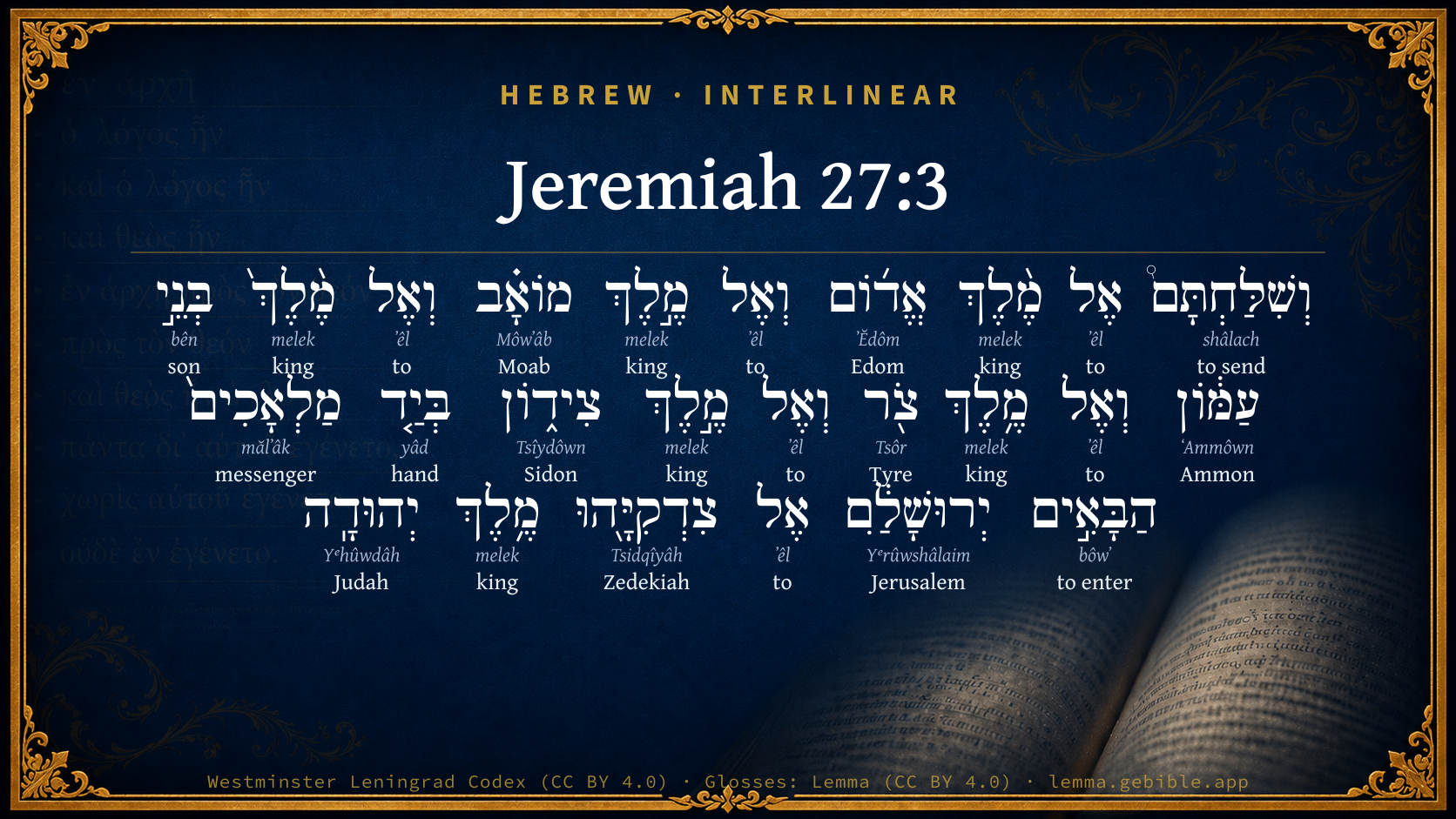
Jeremiah 27:3

Hebrew (Westminster Leningrad Codex) Jeremiah 27:3 appears in the Hebrew Old Testament. The text above is from the Westminster Leningrad Codex. Each word links to its Strong’s number, a concise gloss, and parsing drawn from the Open Scriptures Hebrew Bible morphology. Click any word for its full Brown-Driver-Briggs (BDB) entry.
Download image
Cite this verse

Jeremiah 27:3 (World English Bible). Public Domain. Lemma interlinear Bible study tool, https://lemma.gebible.app/v/jeremiah/27/3.

Show BibTeX & RIS
BibTeX
RIS
English Translation
and send them to the king of Edom, and to the king of Moab, and to the king of the children of Ammon, and to the king of Tyre, and to the king of Sidon, by the hand of the messengers who come to Jerusalem to Zedekiah king of Judah;
World English Bible · Public Domain
Download a study sheet

One document with this verse’s original text, its word-by-word gloss line, the meaning frame, cross-references with their text, attributed commentary, and full source and license credits — printable, and it pastes into notes with its structure intact.

This verse Autodidact and up

Study sheet (.html) Plain text (.txt)

A passage Seminary Student

Up to 50 verses in one chapter. A passage sheet keeps up to 6 commentary sources and 12 cross-references per verse, in the order this page ranks them, and says so on the sheet whenever that leaves anything out. Ask for a single verse and you get the Autodidact verse sheet above.

Everything on this page stays free to read, with no account — the sheet is a download of what is already on screen, not access to it.

Want to remove ads? Support Godless Engineer
Compare translations 3

The same verse in 3 English versions, stacked beneath the original-language interlinear above. Click any original word for its lexicon entry.

Each is an independent rendering of the whole verse — the interlinear is not word-aligned to these translations.

Highlighted words mark where these versions differ — a whole-verse word diff, not a word-by-word alignment.

  • World English Bible Public Domain
    and send them to the king of Edom, and to the king of Moab, and to the king of the children of Ammon, and to the king of Tyre, and to the king of Sidon, by the hand of the messengers who come to Jerusalem to Zedekiah king of Judah;
  • King James Version Public Domain
    And send them to the king of Edom, and to the king of Moab, and to the king of the Ammonites, and to the king of Tyrus, and to the king of Zidon, by the hand of the messengers which come to Jerusalem unto Zedekiah king of Judah;
  • unfoldingWord Literal Text CC BY-SA 4.0
    And send them to the king of Edom, and to the king of Moab, and to the king of the sons of Ammon, and to the king of Tyre, and to the king of Sidon, by the hand of the messengers who are coming Jerusalem to Zedekiah king of Judah.

unfoldingWord Literal Text — © unfoldingWord, licensed CC BY-SA 4.0. Word-aligned USFM3 via Door43 (git.door43.org/unfoldingWord/en_ult).

Versions to compare (up to 4)

3 of 4 selected

Show all 18 translations

Every available English version of this verse, each an independent rendering of the whole verse.

  • World English Bible Public Domain
    and send them to the king of Edom, and to the king of Moab, and to the king of the children of Ammon, and to the king of Tyre, and to the king of Sidon, by the hand of the messengers who come to Jerusalem to Zedekiah king of Judah;
  • Berean Standard Bible Public Domain
    Send word to the kings of Edom, Moab, Ammon, Tyre, and Sidon through the envoys who have come to Jerusalem to Zedekiah king of Judah.
  • Majority Standard Bible Public Domain
    Send word to the kings of Edom, Moab, Ammon, Tyre, and Sidon through the envoys who have come to Jerusalem to Zedekiah king of Judah.
  • King James Version Public Domain
    And send them to the king of Edom, and to the king of Moab, and to the king of the Ammonites, and to the king of Tyrus, and to the king of Zidon, by the hand of the messengers which come to Jerusalem unto Zedekiah king of Judah;
  • American Standard Version (1901) Public Domain
    and send them to the king of Edom, and to the king of Moab, and to the king of the children of Ammon, and to the king of Tyre, and to the king of Sidon, by the hand of the messengers that come to Jerusalem unto Zedekiah king of Judah;
  • Revised Version (1885) Public Domain
    and send them to the king of Edom, and to the king of Moab, and to the king of the children of Ammon, and to the king of Tyre, and to the king of Zidon, by the hand of the messengers which come to Jerusalem unto Zedekiah king of Judah;
  • Geneva Bible (1599) Public Domain
    And send them to the King of Edom, and to the King of Moab, and to the King of the Ammonites, and to the King of Tyrus, and to the king of Zidon, by the hande of the messengers which come to Ierusale vnto Zedekiah ye king of Iudah,
  • Douay-Rheims (1899) Public Domain
    And thou shalt send them to the of Edom, and to the king of Moab, and to the king of the children of Ammon, and to the king of Tyre, and to the king of Sidon: by the hand of the messengers that are come to Jerusalem to Sedecias the king of Juda.
  • Young's Literal Translation Public Domain
    And thou hast put them on thy neck, and hast sent them unto the king of Edom, and unto the king of Moab, and unto the king of the sons of Ammon, and unto the king of Tyre, and unto the king of Zidon, by the hand of messengers who are coming in to Jerusalem, unto Zedekiah king of Judah;
  • Literal Standard Version CC BY-SA 4.0
    and you have put them on your neck, and have sent them to the king of Edom, and to the king of Moab, and to the king of the sons of Ammon, and to the king of Tyre, and to the king of Sidon, by the hand of messengers who are coming to Jerusalem, to Zedekiah king of Judah;
  • Unlocked Literal Bible CC BY-SA 4.0
    Then send them out to the king of Edom, the king of Moab, the king of the people of Ammon, the king of Tyre, and to the king of Sidon. Send them by the hand of those kings' ambassadors who have come to Jerusalem to Zedekiah king of Judah.
  • unfoldingWord Literal Text CC BY-SA 4.0
    And send them to the king of Edom, and to the king of Moab, and to the king of the sons of Ammon, and to the king of Tyre, and to the king of Sidon, by the hand of the messengers who are coming Jerusalem to Zedekiah king of Judah.
  • Darby Bible Public Domain
    and send them to the king of Edom, and to the king of Moab, and to the king of the children of Ammon, and to the king of Tyre, and to the king of Zidon, by the hand of the messengers that come to Jerusalem unto Zedekiah king of Judah.
  • World Messianic Bible Public Domain
    Then send them to the king of Edom, to the king of Moab, to the king of the children of Ammon, to the king of Tyre, and to the king of Sidon, by the hand of the messengers who come to Jerusalem to Zedekiah king of Judah.
  • Webster's Bible Public Domain
    And send them to the king of Edom, and to the king of Moab, and to the king of the Ammonites, and to the king of Tyre, and to the king of Zidon, by the hand of the messengers who come to Jerusalem to Zedekiah king of Judah;
  • Free Bible Version CC BY-SA 4.0
    Send a message to the kings of Edom, Moab, Ammon, Tyre, and Sidon through the ambassadors who have come to Jerusalem to see Zedekiah king of Judah.
  • Bible in Basic English Public Domain
    And send them to the king of Edom, and to the king of Moab, and to the king of the children of Ammon, and to the king of Tyre, and to the king of Zidon, by their servants who come to Jerusalem, to Zedekiah, king of Judah;
  • JPS Tanakh (1917) Public Domain
    and send them to the king of Edom, and to the king of Moab, and to the king of the children of Ammon, and to the king of Tyre, and to the king of Zidon, by the hand of the messengers that come to Jerusalem unto Zedekiah king of Judah;

Literal Standard Version (2020), Covenant Press — licensed CC BY-SA 4.0. Text via the HelloAO Bible API (eBible.org). Unlocked Literal Bible (unfoldingWord) — licensed CC BY-SA 4.0. Text via the HelloAO Bible API (eBible.org). unfoldingWord Literal Text — © unfoldingWord, licensed CC BY-SA 4.0. Word-aligned USFM3 via Door43 (git.door43.org/unfoldingWord/en_ult). Free Bible Version, Dr. Jonathan Gallagher — licensed CC BY-SA 4.0. Text via the HelloAO Bible API (eBible.org).

Word by word

More ways to search: Search by grammar → Find every occurrence → Compare this word →

Practice this passage: Drill this verse → Learn its vocabulary →

צִיד֑וֹן
Tsîydôwn
H6721
“Sidon”
Noun, Proper
Part of Speech
Noun
Type
Proper
Full BDB Definition

Origin: from H6679 in the sense of catching fish

TWOT: None

Sidon = "hunting" - ancient Phoenician city, on Mediterranean coast north of Tyre
  1. וְשִׁלַּחְתָּם֩ shâlach H7971 “and · to send · them” Conjunction + Verb, Piel, Sequential Perfect, 2nd Person, Masculine, Singular + Suffix, Personal, 3rd Person, Masculine, Plural
  2. אֶל ʼêl H413 “to” Preposition
  3. מֶ֨לֶךְ melek H4428 “king of” Noun, Common, Masculine, Singular, Construct
  4. אֱד֜וֹם ʼĔdôm H123 “Edom” Noun, Proper
  5. וְאֶל ʼêl H413 “and · to” Conjunction + Preposition
  6. מֶ֣לֶךְ melek H4428 “king of” Noun, Common, Masculine, Singular, Construct
  7. מוֹאָ֗ב Môwʼâb H4124 “Moab” Noun, Proper
  8. וְאֶל ʼêl H413 “and · to” Conjunction + Preposition
  9. מֶ֨לֶךְ֙ melek H4428 “king of” Noun, Common, Masculine, Singular, Construct
  10. בְּנֵ֣י bên H1121 “sons of” Noun, Common, Masculine, Plural, Construct
  11. עַמּ֔וֹן ʻAmmôwn H5983 “Ammon” Noun, Proper
  12. וְאֶל ʼêl H413 “and · to” Conjunction + Preposition
  13. מֶ֥לֶךְ melek H4428 “king of” Noun, Common, Masculine, Singular, Construct
  14. צֹ֖ר Tsôr H6865 “Tyre” Noun, Proper
  15. וְאֶל ʼêl H413 “and · to” Conjunction + Preposition
  16. מֶ֣לֶךְ melek H4428 “king of” Noun, Common, Masculine, Singular, Construct
  17. בְּיַ֤ד yâd H3027 “in/at · hand of” Preposition + Noun, Common, Both, Singular, Construct
  18. מַלְאָכִים֙ mălʼâk H4397 “messengers” Noun, Common, Masculine, Plural, Absolute
  19. הַבָּאִ֣ים bôwʼ H935 “the · entering” Particle, Definite Article + Verb, Qal, Participle Active, Masculine, Plural, Absolute
  20. יְרוּשָׁלִַ֔ם Yᵉrûwshâlaim H3389 “Jerusalem” Noun, Proper
  21. אֶל ʼêl H413 “to” Preposition
  22. צִדְקִיָּ֖הוּ Tsidqîyâh H6667 “Zedekiah” Noun, Proper
  23. מֶ֥לֶךְ melek H4428 “king of” Noun, Common, Masculine, Singular, Construct
  24. יְהוּדָֽה Yᵉhûwdâh H3063 “Judah” Noun, Proper

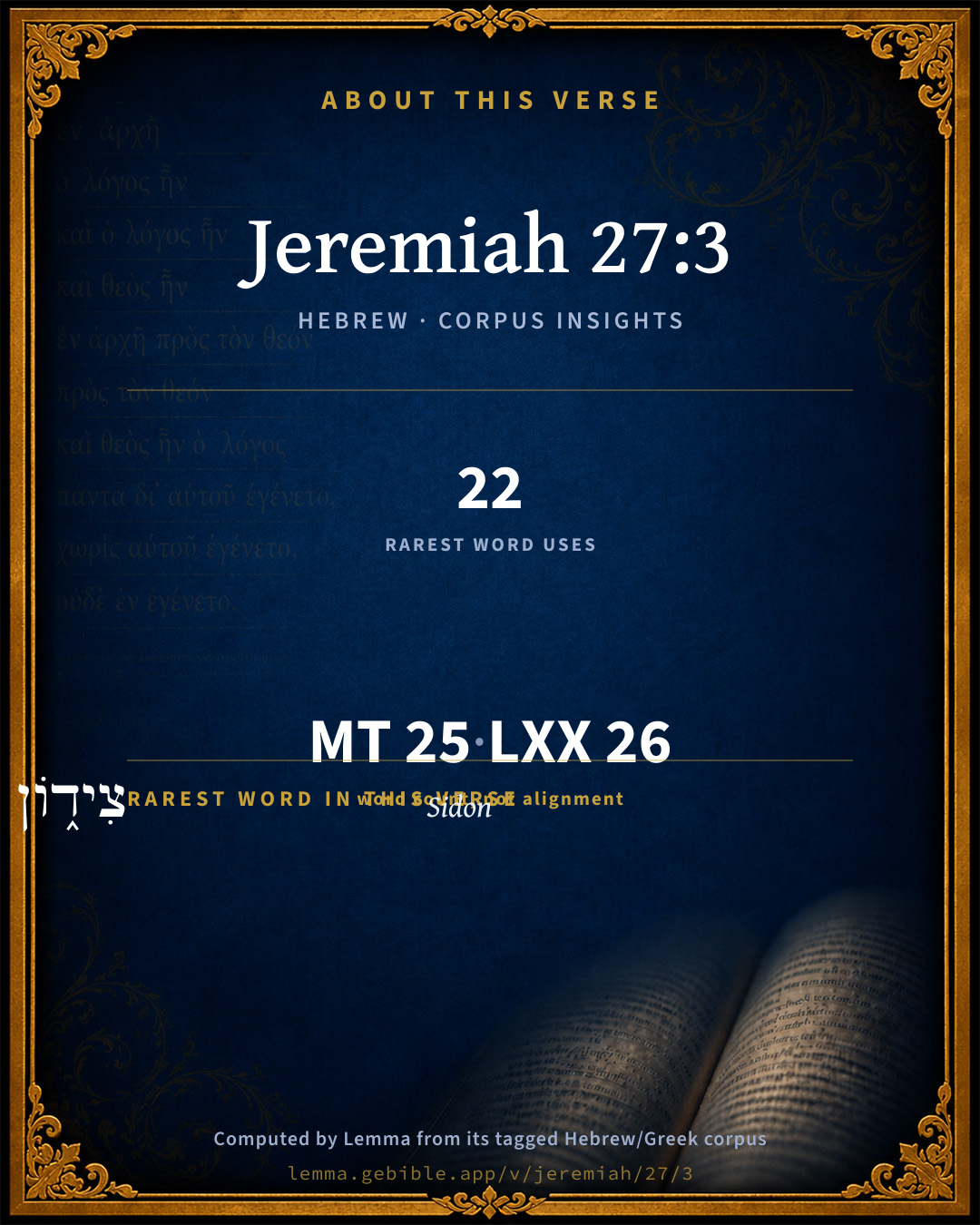
About this verse

These counts appear in no published source. They are computed here, from the morphology-tagged text and Lemma’s own curated glosses. What Lemma adds →

25
words
15
distinct lemmas
Prophets
section

Notable vocabulary

The rarest word here is צִיד֑וֹן Sidon H6721 — appearing just 22 times in the whole Hebrew Bible.

Shared distinctive vocabulary

צִיד֑וֹן Sidon H6721 occurs in 22 verses of the Hebrew Bible. Also found in:

Grammatical profile

  • 2 verbs
  • 17 nouns
  • 6 prepositions

Verb forms

  • וְשִׁלַּחְתָּם֩ Piel · Sequential Perfect
  • הַבָּאִ֣ים Qal · Participle Active

Repetition

Words recur within this verse — often emphatic in Hebrew:

  • מֶ֨לֶךְ king H4428 ×6
  • אֶל to H413 ×6

Hebrew & Septuagint length

In the original languages it is 25 Hebrew tokens and 26 Greek tokens — but the two are counted differently (Hebrew bundles its prefixes and suffixes into one token; the Greek is in lemma form), so that isn’t a like-for-like length.

Cross-references

7

Topical passages linked to Jeremiah 27:3 in the Treasury of Scripture Knowledge — connected by theme and wording, ordered by reader-vote popularity; previews shown in the World English Bible.

  • 2 Chronicles 36:13 He also rebelled against king Nebuchadnezzar, who had made him swear by God: but he stiffened his neck, and hardened his heart against turning to Yahweh, the God of Israel.
  • Jeremiah 25:19–26 Pharaoh king of Egypt, and his servants, and his princes, and all his people;
  • Ezekiel 17:15–21 But he rebelled against him in sending his ambassadors into Egypt, that they might give him horses and much people. Shall he prosper? shall he escape who does such things? shall he break the covenant, and yet escape?
  • Ezekiel 25:1–17 The word of Yahweh came to me, saying,
  • Ezekiel 29:18 Son of man, Nebuchadrezzar king of Babylon caused his army to serve a great service against Tyre: every head was made bald, and every shoulder was worn; yet had he no wages, nor his army, from Tyre, for the service that he had served against it.
  • Amos 1:9–2:3 Thus says Yahweh: "For three transgressions of Tyre, yes, for four, I will not turn away its punishment; Because they delivered up the whole community to Edom, And didn't remember the brotherly covenant;
  • Jeremiah 47:1–7 The word of Yahweh that came to Jeremiah the prophet concerning the Philistines, before that Pharaoh struck Gaza.

Cross-references courtesy of OpenBible.info (CC BY 4.0).

Hebrew and Greek witnesses Masoretic Hebrew ↔ Greek Septuagint

The same verse in the two great witnesses to the Old Testament, shown verse-for-verse.

These are two independent witnesses, not word-aligned to each other, and the Septuagint is shown in lemma (dictionary) form.

Hebrew Jeremiah 27:3 Masoretic · Westminster Leningrad Codex

וְשִׁלַּחְתָּם֩ אֶל מֶ֨לֶךְ אֱד֜וֹם וְאֶל מֶ֣לֶךְ מוֹאָ֗ב וְאֶל מֶ֨לֶךְ֙ בְּנֵ֣י עַמּ֔וֹן וְאֶל מֶ֥לֶךְ צֹ֖ר וְאֶל מֶ֣לֶךְ צִיד֑וֹן בְּיַ֤ד מַלְאָכִים֙ הַבָּאִ֣ים יְרוּשָׁלִַ֔ם אֶל צִדְקִיָּ֖הוּ מֶ֥לֶךְ יְהוּדָֽה

and send them to the king of Edom, and to the king of Moab, and to the king of the children of Ammon, and to the king of Tyre, and to the king of Sidon, by the hand of the messengers who come to Jerusalem to Zedekiah king of Judah;

World English Bible · Public Domain

Greek LXX Structure differs

In the Septuagint, Jeremiah is about an eighth shorter than the Hebrew and arranges its material differently — the Oracles Against the Nations (Hebrew chapters 46–51) appear in the middle of the Greek book, after 25:13. Because the chapter and verse boundaries do not line up, a verse-for-verse comparison with the Hebrew is not shown.

A verse-for-verse comparison isn’t shown here because the chapters and verses don’t line up. Switch to the LXX edition with the MT / LXX toggle above to read the Greek directly.

On this verse, The Cambridge Bible for Schools and Colleges discusses the Septuagint’s reading. Read the note in Commentary ↓

Hebrew: Westminster Leningrad Codex (CC BY 4.0). Greek: Septuagint (public domain); English from a public-domain English Septuagint. How the Septuagint differs from the Hebrew →

Targum (Aramaic paraphrase)

1

The Targum is the ancient Jewish Aramaic paraphrase of the Hebrew Scriptures — an interpretive translation, not the Hebrew text itself. Onkelos (literal) and Pseudo-Jonathan (expansive) render the Torah, and Jonathan the Prophets. Coverage is partial: where no permissively-licensed English translation exists for a verse, only the Aramaic is shown. This is verse-level text, not a word-by-word alignment to the Hebrew.

  1. Targum Jonathan Prophets (Joshua–Malachi)
    וְתִשְׁלְחִינוּן לְוַת מַלְכָּא דֶאֱדוֹם וּלְוַת מַלְכָּא דְמוֹאָב וּלְוַת מַלְכָּא דִבְנֵי עַמוֹן וּלְוַת מַלְכָּא דְצוֹר וּלְוַת מַלְכָּא דְצִידוֹן בְּיַד אִזְגְדַיָא דְאָתָן לִירוּשְׁלֵם לְוַת צִדְקִיָה מְלַךְ שִׁבְטָא דְבֵית יְהוּדָה:

    (no public-domain English translation for this verse)

    Targum Jonathan — Aramaic: “Mikraot Gedolot” (public domain). English: “Sefaria Community Translation” (CC0 1.0 (public-domain dedication)); “London "Chaldee Paraphrase," 1871” (public domain). Text via Sefaria.

Commentary

Notes on Jeremiah 27:3 from classic Christian and Jewish commentators (each source and its license shown beneath its notes). The classic Christian expositions comment on the surrounding passage and are grouped to its opening verse, so a note may address several verses; the Jewish commentaries on the Tanakh (Rashi and others) are per-verse, so they appear only where the commentator wrote on this verse.

Lemma curates 59 commentaries, every one of them public domain or Creative Commons licensed, each selected and text-cleaned for this edition rather than reprinted as found. About our sources →

Trapp's Complete Commentary

John Trapp

Jer 27:3 And send them to the king of Edom, and to the king of Moab, and to the king of the Ammonites, and to the king of Tyrus, and to the king of Zidon, by the hand of the messengers which come to Jerusalem unto Zedekiah king of Judah;

Ver. 3. By the hand of the messengers,] i.e., Ambassadors of those neighbouring states, who might come to Zedekiah, to confederate with him against Nebuchadnezzar’s growing greatness; but all in vain, and to their own ruin. Deus quem destruit dementat. The wicked oft run to meet their bane, as if they were even ambitious of destruction.

John Trapp, A Commentary or Exposition upon All the Books of the Old and New Testament (1647–1656) — public domain. Text from a community e-Sword module.

Jamieson, Fausset & Brown

Robert Jamieson, A. R. Fausset & David Brown

And send them to the king of Edom, &c.--Appropriate symbol, as these ambassadors had come to Jerusalem to consult as to shaking off the yoke of Nebuchadnezzar. According to PHERECYDES in CLEMENT OF ALEXANDRIA [Miscellanies, 567], Idanthura, king of the Scythians, intimated to Darius, who had crossed the Danube, that he would lead an army against him, by sending him, instead of a letter, a mouse, a frog, a bird, an arrow, and a plough. The task assigned to Jeremiah required great faith, as it was sure to provoke alike his own countrymen and the foreign ambassadors and their kings, by a seeming insult, at the very time that all were full of confident hopes grounded on the confederacy.

Jamieson, Fausset & Brown — Commentary Critical and Explanatory on the Whole Bible (1871) — public domain (CC PDM 1.0). Text via the HelloAO Bible API.

John Calvin's Commentaries

The Prophet seems to have addressed the ambassadors who were sent by neighboring kings to King Zedekiah; and he was bidden to command them to declare each to his master, that they were all to come under the yoke of the king of Babylon. There is, moreover, no doubt but that God designed especially and chiefly to give a lesson to Zedekiah and to the Jews; for these legations mentioned here might have so emboldened them as to despise all prophecies, and to think themselves beyond all danger. For the purpose for which these legations were sent by the king of Sidon, by the king of Tyrus, by the king of Moab and Ammon, ought to be particularly observed: when they saw that the king of Babylon would not spare them, they began to join their forces. Every one at first consulted his own advantage, and saw no need of mutual help; and so it was that the Chaldeans easily overcame them while they were disunited. Experience at length taught them, that neither the king of Judah nor ally of the neighboring kings could sustain the contest unless they formed a confederacy. Thus, then, it happened that the king of Tyrus, the king of Sidon, the king of Moab, and the king of Ammon, offered their forces and their money to the king of Judah, and that he also promised to help them in return, if the Chaldean attacked them. It was therefore a new occasion for confidence to the Jews, so that they gathered courage, and thus were emboldened to resist, relying on so many neighboring kings.

The Chaldeans had been hitherto successful, for they had assailed each by himself; but when all of them were ready by their united forces to oppose and restrain their attacks, it was hardly credible that they could be conquered. It was therefore God’s purpose to remove this false confidence, and to warn Zedekiah and the whole people, lest they should be deceived by such allurements, but that they might know that they were patiently to endure the punishment inflicted on them by God. This therefore was the reason why the Prophet was sent to the ambassadors who had come to Jerusalem. He was not set a teacher over them; but this was done with reference to Zedekiah and the people. It is yet probable that these commands were set forth before the king, that the king might know that he had been wholly deceived, and that he still foolishly trusted to the subsidies which had been offered.

We may easily imagine how grievous it must have been to the king and to the people to hear this prophecy. The ambassadors were in a manner dishonored; the kings, by whom they had been sent, might have complained that they were treated with great indignity. Hence the king and the people must have been very incensed against Jeremiah. But the Prophet boldly performed what God commanded him, as it behoved him. And we shall hereafter see, that his words were addressed to King Zedekiah rather than to these heathens.

We now understand the reason why God would have his Prophet to give these commands to the ambassadors, who had been sent by heathen kings to King Zedekiah: it was that the king might know that it was wholly useless for these kings to promise their assistance; for he had to do, not with the Chaldean king, but rather with the judgment of God, which is irresistible, and which men in vain struggle with.

John Calvin's Commentaries (1540-1563) — public domain. Text from the Calvin Translation Society English edition (1840s-50s) via the Christian Classics Ethereal Library (ccel.org). Calvin's coverage is partial (roughly two-thirds of the Bible); uncommented books and verses are honest gaps, never fabricated. The 19th-century editor's footnotes and remarks are omitted so the notes are faithfully Calvin's own voice.

Ellicott's Commentary for English Readers

(3) And send them to the king of Edom.—The princes that are named had, as the context shows, sent their ambassadors to Zedekiah, proposing an alliance against Nebuchadnezzar. They are named in the same order as in the prophecy of Jer_25:21-22, which had been delivered fifteen years before. The prophecy then delivered had been in part fulfilled, but these princes were still struggling against it, encouraged, apparently, by the difficulties which in Media and elsewhere seemed to delay the complete triumph of the Chaldæan king; and the prophet is commissioned to tell all of them alike that their efforts are in vain, and that the supremacy of Babylon was, for the time, part of God’s order, for the chastisement of the nations. In Jeremiah 49 we have a fuller, and probably later, development of the same strain of prediction.

A Bible Commentary for English Readers, edited by Charles John Ellicott (1878–1897) — public domain. Text from a community e-Sword module.

The Cambridge Bible for Schools and Colleges

gen. ed. J. J. S. Perowne

3. and send them] We should probably omit the pronoun, which (being in the Hebrew only one letter attached to the end of the verb) seems to have crept in under the influence of the preceding clause. It was the warning only that Jeremiah was to send. Du. points out that it was nothing unusual that an Israelitish prophet should be listened to with respect, when addressing a foreign nation (Jdg_3:20; 1Ki_19:15 ff.; Isa_18:2; Isa_21:11 f.).

the messengers] rather (with LXX), their messengers. Ezekiel (Jer_17:15) charges Zedekiah with taking the initiative in negotiations with Egypt against Babylon.

The Cambridge Bible for Schools and Colleges (gen. ed. J. J. S. Perowne; Cambridge University Press, 1878–1918) — public domain. Text from a community e-Sword module.

John Gill's Exposition

And send them to the king of Edom, and to the king of Moab,

and to the king of the Ammonites, and to the king of Tyrus, and to the king of Zidon,.... All neighbouring kings and states, to whom the wine cup of God's wrath was to be sent, and they made to drink of it, Jer 25:21; and against whom Jeremiah afterwards prophesies:

by the hand of the messengers which come to Jerusalem unto Zedekiah king of Judah; who were sent by their masters, either to congratulate Zedekiah upon his accession to the throne; or to enter into a league with him against the king of Babylon, and shake off his yoke; or to reside at his court, as ambassadors of nations at peace and in alliance usually do; and it may be for all those purposes. The yokes therefore are ordered to be sent to them, as being the most proper and easy way and method of conveying them, with the meaning of them, to their respective masters.

John Gill's Exposition of the Whole Bible (1746–1763) — public domain (CC PDM 1.0). Text via the HelloAO Bible API.

Albert Barnes' Notes on the Bible

Come - Or, are come. The ambassadors of these five kings had probably come to Jerusalem to consult about forming a league to throw off the Babylonian supremacy. The attempt failed.

Albert Barnes' Notes on the Bible (1834–1885) — public domain. Text from a community e-Sword/MySword module.

Haydock's Catholic Bible Commentary

Edom. Thus he exercises the function of prophet among the nations, chap. i. 5. These had come to compliment Sedecias, or rather to form a league.

George Leo Haydock (1774–1849), Haydock's Catholic Family Bible and Commentary, 1859 edition — public domain. Excludes Psalms (Douay-Rheims chapter numbering differs from Protestant) and Deuterocanonical books (Catholic canon only).

Matthew Poole's English Annotations

It was and is the custom of neighbour princes, to send ambassadors into each other’s countries to reside there, and maintain correspondence on the behalf of their masters. These nations were neighbours to the Jews, and their princes had their ambassadors resident at Jerusalem. Jeremiah is directed to carry each of these ambassadors a yoke with a bond, as a present from God to their masters; the meaning he is also ordered to tell them in the following words.

Matthew Poole's English Annotations on the Holy Bible (1683–1685) — public domain. Text from a community e-Sword/MySword module.

Whedon's Commentary on the Bible

Daniel D. Whedon

3. Which come to Jerusalem — Probably for the purpose of forming a coalition against the Chaldean power. Hence the position of Jeremiah was a peculiarly trying one, in that he had to stand against this widespread and popular sentiment.

Daniel D. Whedon (gen. ed.), Commentary on the Old and New Testaments (1874–1909) — public domain. Text from a community e-Sword module.

The Pulpit Commentary

And send them, etc. The letter of the text certainly suggests that Jeremiah actually delivered a separate yoke to each of the five ambassadors. Some commentators, however, finding such an act almost incredible, suppose the statement to be allegorical, and the "sending of the yoke" to mean the declaration of the subjection of the nations to Nebuchadnezzar which follows, somewhat as in Jer_25:15 the "causing all the nations to drink "means the utterance of a prophecy of woe to the various peoples concerned. But we can hardly pronounce upon this passage by itself. We have to consider whether a whole group of similar statements is or is not to be taken literally. It may be enough to instance Jer_13:1-7. Which come ; rather, which are come.

The Pulpit Commentary (1880–1919), ed. H.D.M. Spence-Jones & Joseph S. Exell — public domain. Text from a community e-Sword module.

John Wesley's Explanatory Notes

Of Edom - These nations were neighbours to the Jews, and their princes had their ambassadors resident in Jerusalem.

John Wesley, Explanatory Notes Upon the Whole Bible (1754–1765) — public domain. Text via the GEBible commentary corpus.

Rashi

Rabbi Shlomo Yitzchaki (Rashi)

And you shall send them to the king of Edom In the days of Zedekiah in the fourth year of his reign, when Nebuchadnezzar made him ruler over five kings.

the king of Edom, the king of Moab, the king of the children of Ammon, etc. These five kings Nebuchadnezzar placed under the authority of Zedekiah. Fifteen years they (the bars and thongs) were on his neck, from the first year of Jehoiakim until the fourth year of Zedekiah, when Hananiah son of Azzur broke them off him.

Rashi on the Tanakh — English translations: “The Judaica Press complete Tanach with Rashi, translated by A. J. Rosenberg” (CC BY 4.0); “Pentateuch with Rashi's commentary by M. Rosenbaum and A.M. Silbermann, 1929-1934” (public domain); “The Metsudah Tanach series, Lakewood, N.J” (CC BY 4.0); and “The Book of Joshua, Metsudah Publications, 1997” (CC BY 4.0). Text via Sefaria.

Lesson kit

Teaching starters — assembled from the data on this page, not authored interpretation. Every prompt links to the verse data it draws on. Edit before teaching.

Jeremiah, in the Prophets, opens this verse with 25 words (15 distinct Hebrew lemmas). Its most distinctive word is Tsîydôwn (“Sidon”). A historical commentator’s framing appears above. Read the whole chapter for the surrounding context.

Discussion questions

  1. How does “Sidon” (Tsîydôwn) shape what this verse is saying?
  2. How does Genesis 10:15, which shares the word «Sidon», read alongside this verse?
  3. What does the repetition of “king” (6× in this one verse) do in this verse?
  4. These translations render this verse differently; the difference is in the English rendering, not the original. What questions does that raise?
  5. «וְשִׁלַּחְתָּם֩» is a Piel Sequential Perfect verb. How does that grammatical form shape the action described?
  6. Compare how Trapp's Complete Commentary and Jamieson, Fausset & Brown read this verse. Where do they agree or differ?

Things to notice

Reading settings

Reading text

Shown beneath each verse's original-language words.

Old Testament
Old Testament edition

Read the OT as the Masoretic Hebrew (MT) or the Greek Septuagint (LXX).

English shown for the Greek Septuagint (in the Hebrew ↔ Greek comparison).

Comparing translations? Open the Compare panel on any verse page to stack up to four side by side.