
Numbers 22:32

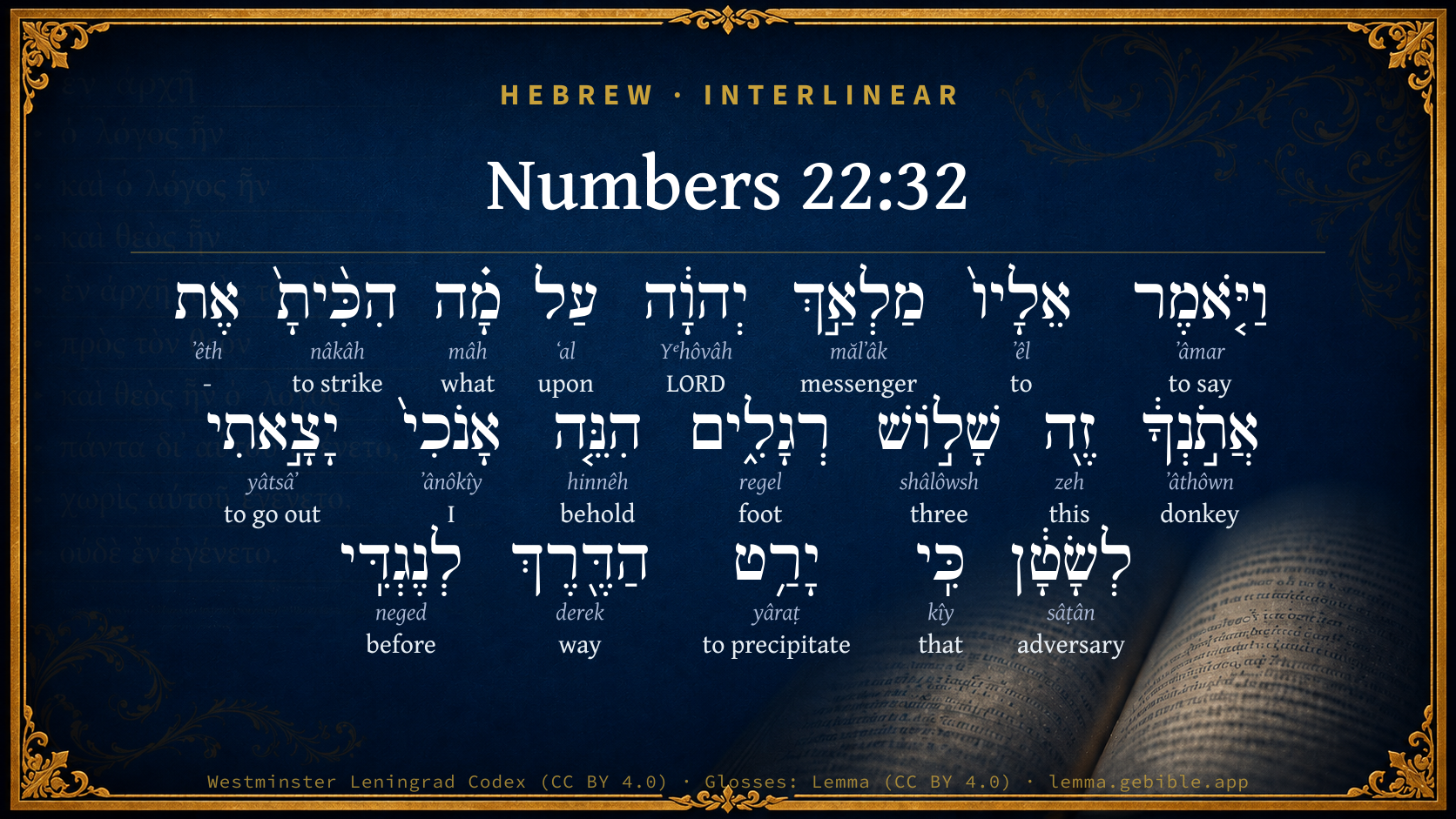
Hebrew (Westminster Leningrad Codex) Numbers 22:32 appears in the Hebrew Old Testament. The text above is from the Westminster Leningrad Codex. Each word links to its Strong’s number, a concise gloss, and parsing drawn from the Open Scriptures Hebrew Bible morphology. Click any word for its full Brown-Driver-Briggs (BDB) entry.
Download image
Cite this verse

Numbers 22:32 (World English Bible). Public Domain. Lemma interlinear Bible study tool, https://lemma.gebible.app/v/numbers/22/32.

Show BibTeX & RIS
BibTeX
RIS
English Translation
The angel of Yahweh said to him, Why have you struck your donkey these three times? behold, I am come forth for an adversary, because your way is perverse before me:
World English Bible · Public Domain
Highlights Full analysis ↓
Download a study sheet

One document with this verse’s original text, its word-by-word gloss line, the meaning frame, cross-references with their text, attributed commentary, and full source and license credits — printable, and it pastes into notes with its structure intact.

This verse Autodidact and up

Study sheet (.html) Plain text (.txt)

A passage Seminary Student

Up to 50 verses in one chapter. A passage sheet keeps up to 6 commentary sources and 12 cross-references per verse, in the order this page ranks them, and says so on the sheet whenever that leaves anything out. Ask for a single verse and you get the Autodidact verse sheet above.

Everything on this page stays free to read, with no account — the sheet is a download of what is already on screen, not access to it.

Want to remove ads? Support Godless Engineer
Compare translations 3

The same verse in 3 English versions, stacked beneath the original-language interlinear above. Click any original word for its lexicon entry.

Each is an independent rendering of the whole verse — the interlinear is not word-aligned to these translations.

Highlighted words mark where these versions differ — a whole-verse word diff, not a word-by-word alignment.

  • World English Bible Public Domain
    The angel of Yahweh said to him, Why have you struck your donkey these three times? behold, I am come forth for an adversary, because your way is perverse before me:
  • King James Version Public Domain
    And the angel of the LORD said unto him, Wherefore hast thou smitten thine ass these three times? behold, I went out to withstand thee, because thy way is perverse before me:
  • unfoldingWord Literal Text CC BY-SA 4.0
    And the angel of Yahweh said to him, “On account of what have you struck your female donkey these three times? Behold, I have come out as an adversary, for the road is reckless before me.

unfoldingWord Literal Text — © unfoldingWord, licensed CC BY-SA 4.0. Word-aligned USFM3 via Door43 (git.door43.org/unfoldingWord/en_ult).

Versions to compare (up to 4)

3 of 4 selected

Show all 18 translations

Every available English version of this verse, each an independent rendering of the whole verse.

  • World English Bible Public Domain
    The angel of Yahweh said to him, Why have you struck your donkey these three times? behold, I am come forth for an adversary, because your way is perverse before me:
  • Berean Standard Bible Public Domain
    The angel of the LORD asked him, “Why have you beaten your donkey these three times? Behold, I have come out to oppose you, because your way is perverse before me.
  • Majority Standard Bible Public Domain
    The angel of the LORD asked him, “Why have you beaten your donkey these three times? Behold, I have come out to oppose you, because your way is perverse before me.
  • King James Version Public Domain
    And the angel of the LORD said unto him, Wherefore hast thou smitten thine ass these three times? behold, I went out to withstand thee, because thy way is perverse before me:
  • American Standard Version (1901) Public Domain
    And the angel of Jehovah said unto him, Wherefore hast thou smitten thine ass these three times? behold, I am come forth for an adversary, because thy way is perverse before me:
  • Revised Version (1885) Public Domain
    And the angel of the LORD said unto him, Wherefore hast thou smitten thine ass these three times? behold, I am come forth for an adversary, because thy way is perverse before me:
  • Geneva Bible (1599) Public Domain
    And the Angel of the Lord said vnto him, Wherefore hast thou nowe smitten thine asse three times? beholde, I came out to withstande thee, because thy way is not straight before me.
  • Douay-Rheims (1899) Public Domain
    And the angel said to him: Why beatest thou thy ass these three times? I am come to withstand thee, because thy way is perverse, and contrary to me:
  • Young's Literal Translation Public Domain
    and the messenger of Jehovah saith unto him, `Wherefore hast thou smitten thine ass these three times? lo, I -- I have come out for an adversary, for `thy' way hath been perverse before me,
  • Literal Standard Version CC BY-SA 4.0
    and the Messenger of YHWH says to him, “Why have you struck your donkey these three times? Behold, I have come out for an adversary, for [your] way has been perverse before Me,
  • Unlocked Literal Bible CC BY-SA 4.0
    The angel of Yahweh said to him, “Why have you struck your donkey these three times? Look, I have come as someone hostile to you because your actions before me have been wicked.
  • unfoldingWord Literal Text CC BY-SA 4.0
    And the angel of Yahweh said to him, “On account of what have you struck your female donkey these three times? Behold, I have come out as an adversary, for the road is reckless before me.
  • Darby Bible Public Domain
    And the Angel of Jehovah said to him, Wherefore hast thou smitten thine ass these three times? behold, it was I who came forth to withstand thee, for the way [thou walkest in] is for ruin before me.
  • World Messianic Bible Public Domain
    The LORD’s angel said to him, “Why have you struck your donkey these three times? Behold, I have come out as an adversary, because your way is perverse before me.
  • Webster's Bible Public Domain
    And the angel of the LORD said to him, Why hast thou smitten thy ass these three times? behold, I went out to withstand thee, because thy way is perverse before me:
  • Free Bible Version CC BY-SA 4.0
    The angel of the Lord asked him, “Why did you beat your donkey three times? Listen, I have come to confront you because you're being obstinate.
  • Bible in Basic English Public Domain
    And the angel of the Lord said to him, Why have you given your ass blows these three times? See, I have come out against you to keep you back, because your purpose is not pleasing to me.
  • JPS Tanakh (1917) Public Domain
    And the angel of the LORD said unto him: 'Wherefore hast thou smitten thine ass these three times? behold, I am come forth for an adversary, because thy way is contrary unto me;

Literal Standard Version (2020), Covenant Press — licensed CC BY-SA 4.0. Text via the HelloAO Bible API (eBible.org). Unlocked Literal Bible (unfoldingWord) — licensed CC BY-SA 4.0. Text via the HelloAO Bible API (eBible.org). unfoldingWord Literal Text — © unfoldingWord, licensed CC BY-SA 4.0. Word-aligned USFM3 via Door43 (git.door43.org/unfoldingWord/en_ult). Free Bible Version, Dr. Jonathan Gallagher — licensed CC BY-SA 4.0. Text via the HelloAO Bible API (eBible.org).

Word by word

More ways to search: Search by grammar → Find every occurrence → Compare this word →

Practice this passage: Drill this verse → Learn its vocabulary →

יָרַ֥ט
yâraṭ
H3399
“to precipitate”
Verb, Qal, Perfect, 3rd Person, Masculine, Singular
Part of Speech
Verb
Stem
Qal
Form
Perfect
Person
3rd Person
Gender
Masculine
Number
Singular
Full BDB Definition

Origin: a primitive root

TWOT: 914

to precipitate, be precipitate, push headlong, drive recklessly - (Qal) to precipitate, wring out, be precipitate
  1. וַיֹּ֤אמֶר ʼâmar H559 “and · to say” Conjunction + Verb, Qal, Sequential Imperfect, 3rd Person, Masculine, Singular
  2. אֵלָיו֙ ʼêl H413 “to · him” Preposition + Suffix, Personal, 3rd Person, Masculine, Singular
  3. מַלְאַ֣ךְ mălʼâk H4397 “messenger of” Noun, Common, Masculine, Singular, Construct
  4. יְהוָ֔ה Yᵉhôvâh H3068 “LORD” Noun, Proper
  5. עַל ʻal H5921 “upon” Preposition
  6. מָ֗ה mâh H4100 “what” Particle, Interrogative
  7. הִכִּ֨יתָ֙ nâkâh H5221 “to strike” Verb, Hiphil, Perfect, 2nd Person, Masculine, Singular
  8. אֶת ʼêth H853 “-” Particle, Direct Object
  9. אֲתֹ֣נְךָ֔ ʼâthôwn H860 “donkey · your” Noun, Common, Feminine, Singular, Construct + Suffix, Personal, 2nd Person, Masculine, Singular
  10. זֶ֖ה zeh H2088 “this” Pronoun, Demonstrative, Masculine, Singular
  11. שָׁל֣וֹשׁ shâlôwsh H7969 “three” Adjective, Cardinal number, Feminine, Singular, Absolute
  12. רְגָלִ֑ים regel H7272 “feet” Noun, Common, Feminine, Plural, Absolute
  13. הִנֵּ֤ה hinnêh H2009 “behold” Particle, Demonstrative
  14. אָנֹכִי֙ ʼânôkîy H595 “I” Pronoun, Personal, 1st Person, Common, Singular
  15. יָצָ֣אתִי yâtsâʼ H3318 “to go out” Verb, Qal, Perfect, 1st Person, Common, Singular
  16. לְשָׂטָ֔ן sâṭân H7854 “to/for · adversary” Preposition + Noun, Common, Masculine, Singular, Absolute
  17. כִּֽי kîy H3588 “that” Conjunction
  18. הַדֶּ֖רֶךְ derek H1870 “the · way” Particle, Definite Article + Noun, Common, Both, Singular, Absolute
  19. לְנֶגְדִּֽי neged H5048 “to/for · before · me” Preposition + Preposition + Suffix, Personal, 1st Person, Common, Singular

About this verse

These counts appear in no published source. They are computed here, from the morphology-tagged text and Lemma’s own curated glosses. What Lemma adds →

20
words
20
distinct lemmas
Pentateuch
section

Notable vocabulary

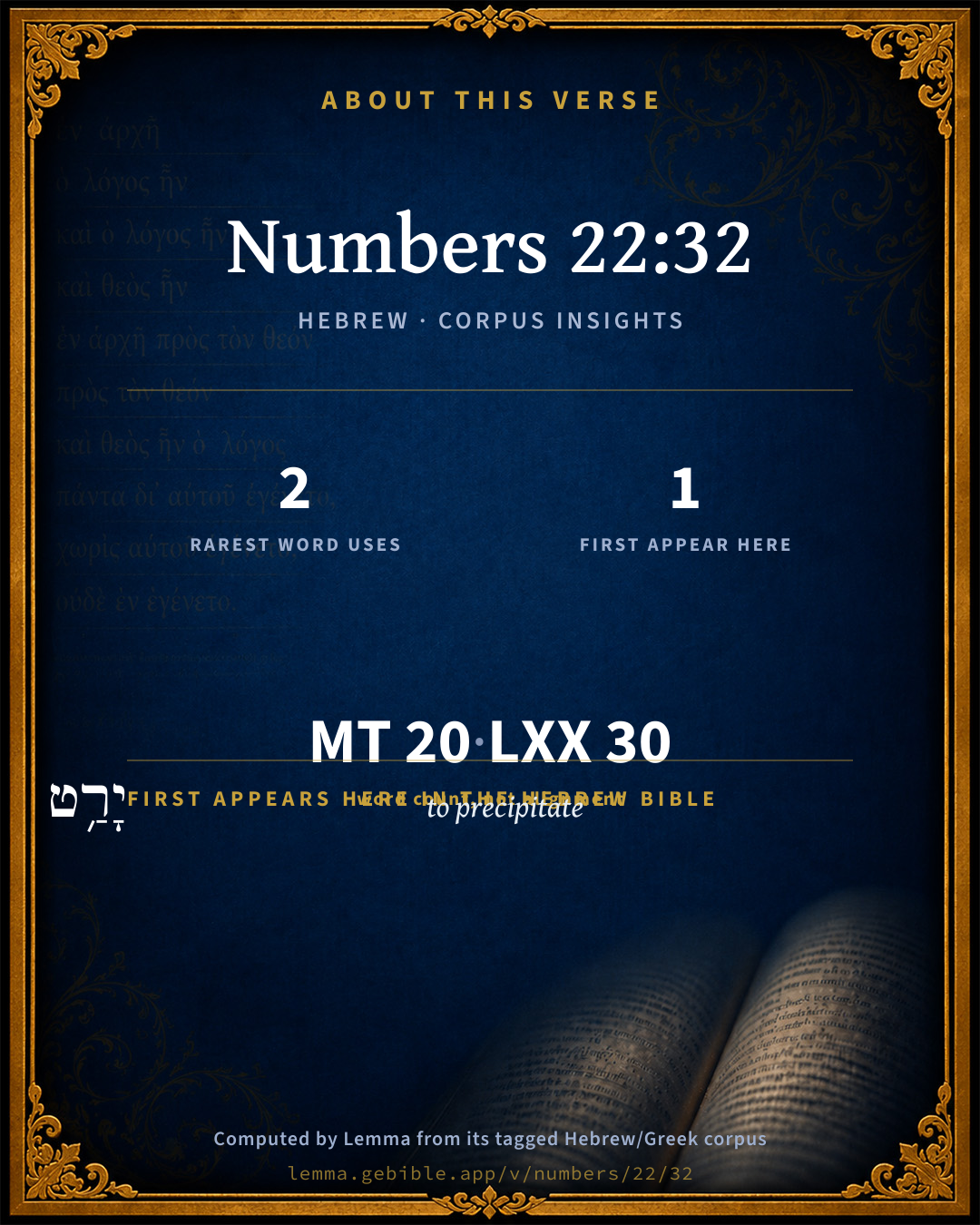
The rarest word here is יָרַ֥ט to precipitate H3399 — appearing just 2 times in the whole Hebrew Bible.

First appearance in Scripture

This word makes its first canonical appearance in the Hebrew Bible here:

  • יָרַ֥ט to precipitate H3399

Shared distinctive vocabulary

יָרַ֥ט to precipitate H3399 occurs in 2 verses of the Hebrew Bible. Also found in:

Grammatical profile

  • 4 verbs
  • 6 nouns
  • 1 adjective
  • 2 pronouns
  • 3 prepositions
  • 1 conjunction
  • 3 particles

Verb forms

  • וַיֹּ֤אמֶר Qal · Sequential Imperfect
  • הִכִּ֨יתָ֙ Hiphil · Perfect
  • יָצָ֣אתִי Qal · Perfect
  • יָרַ֥ט Qal · Perfect

Hebrew & Septuagint length

In English translation the verse runs 31 words from the Hebrew and 47 from the Septuagint (LXX English) — the Septuagint runs noticeably longer here. See the side-by-side →

A rough comparison of the two English renderings, which tokenize alike — not a word-level alignment.

Word counts can differ between the Hebrew and the Greek without any difference in meaning — e.g. the Hebrew direct-object marker אֵת has no separate Greek word, and Greek often adds the article ὁ.

In the original languages it is 20 Hebrew tokens and 30 Greek tokens — but the two are counted differently (Hebrew bundles its prefixes and suffixes into one token; the Greek is in lemma form), so that isn’t a like-for-like length.

Cross-references

17

Topical passages linked to Numbers 22:32 in the Treasury of Scripture Knowledge — connected by theme and wording, ordered by reader-vote popularity; previews shown in the World English Bible.

  • Numbers 22:22 God's anger was kindled because he went; and the angel of Yahweh placed himself in the way for an adversary against him. Now he was riding on his donkey, and his two servants were with him.
  • Proverbs 28:18 Whoever walks blamelessly is kept safe; But one with perverse ways will fall suddenly.
  • Acts 13:10 and said, "Full of all deceit and all cunning, you son of the devil, you enemy of all righteousness, will you not cease to pervert the right ways of the Lord?
  • Proverbs 14:2 He who walks in his uprightness fears Yahweh, But he who is perverse in his ways despises him.
  • Proverbs 28:6 Better is the poor who walks in his integrity, Than he who is perverse in his ways, and he is rich.
  • Exodus 3:2–6 The angel of Yahweh appeared to him in a flame of fire out of the midst of a bush. He looked, and behold, the bush burned with fire, and the bush was not consumed.
  • Numbers 22:20 God came to Balaam at night, and said to him, If the men are come to call you, rise up, go with them; but only the word which I speak to you, that shall you do.
  • Numbers 22:28 Yahweh opened the mouth of the donkey, and she said to Balaam, What have I done to you, that you have struck me these three times?
  • Numbers 22:35 The angel of Yahweh said to Balaam, Go with the men; but only the word that I shall speak to you, that you shall speak. So Balaam went with the princes of Balak.
  • Deuteronomy 23:4 because they didn't meet you with bread and with water in the way, when you came forth out of Egypt, and because they hired against you Balaam the son of Beor from Pethor of Mesopotamia, to curse you.
  • Deuteronomy 25:4 You shall not muzzle the ox when he treads out [the grain].
  • Psalms 36:6 Your righteousness is like the mountains of God. Your judgments are like a great deep. Yahweh, you preserve man and animal.
  • Psalms 145:9 Yahweh is good to all. His tender mercies are over all his works.
  • Psalms 147:9 He provides food for the cattle, And for the young ravens when they call.
  • Jonah 4:11 Shouldn't I be concerned for Nineveh, that great city, in which are more than one hundred twenty thousand persons who can't discern between their right hand and their left hand; and also much cattle?"
  • Micah 6:5 My people, remember now what Balak king of Moab devised, And what Balaam the son of Beor answered him from Shittim to Gilgal, That you may know the righteous acts of Yahweh."
  • 2 Peter 2:14–15 having eyes full of adultery, and who can't cease from sin; enticing unsettled souls; having a heart trained in greed; children of cursing;

Cross-references courtesy of OpenBible.info (CC BY 4.0).

Hebrew and Greek witnesses Masoretic Hebrew ↔ Greek Septuagint

The same verse in the two great witnesses to the Old Testament, shown verse-for-verse.

Here the Septuagint runs noticeably longer than the Hebrew — LXX2012 (modern English Septuagint) 47 words vs World English Bible 31. A rough length comparison of the two English translations, not a word-level alignment — read both below.

These are two independent witnesses, not word-aligned to each other, and the Septuagint is shown in lemma (dictionary) form.

Hebrew Numbers 22:32 Masoretic · Westminster Leningrad Codex

וַיֹּ֤אמֶר אֵלָיו֙ מַלְאַ֣ךְ יְהוָ֔ה עַל מָ֗ה הִכִּ֨יתָ֙ אֶת אֲתֹ֣נְךָ֔ זֶ֖ה שָׁל֣וֹשׁ רְגָלִ֑ים הִנֵּ֤ה אָנֹכִי֙ יָצָ֣אתִי לְשָׂטָ֔ן כִּֽי יָרַ֥ט הַדֶּ֖רֶךְ לְנֶגְדִּֽי

The angel of Yahweh said to him, Why have you struck your donkey these three times? behold, I am come forth for an adversary, because your way is perverse before me:

World English Bible · Public Domain

Greek LXX Numbers 22:32 Septuagint · lemma form

καί εἶπον αὐτός ὁ ἄγγελος ὁ θεός διά τίς πατάσσω ὁ ὄνος σύ οὗτος τρίτος καί ἰδού ἐγώ ἐκἔρχομαι εἰς διαβολή σύ ὅτι οὐ ἀστεῖος ὁ ὁδός σύ ἐναντίον ἐγώ

And the angel of God said to him, Why have you struck your ass this third time? and, behold, I came out to withstand you, for your way was not seemly before me; and when the ass saw me, she turned away from me this third time.

LXX2012 (modern English Septuagint) · Public Domain

Hebrew: Westminster Leningrad Codex (CC BY 4.0). Greek: Septuagint (public domain); English from LXX2012 (modern English Septuagint) (Public Domain). How the Septuagint differs from the Hebrew →

Targum (Aramaic paraphrase)

2

The Targum is the ancient Jewish Aramaic paraphrase of the Hebrew Scriptures — an interpretive translation, not the Hebrew text itself. Onkelos (literal) and Pseudo-Jonathan (expansive) render the Torah, and Jonathan the Prophets. Coverage is partial: where no permissively-licensed English translation exists for a verse, only the Aramaic is shown. This is verse-level text, not a word-by-word alignment to the Hebrew.

  1. Targum Onkelos Torah (Genesis–Deuteronomy)
    וַאֲמַר לֵיהּ מַלְאָכָא דַיְיָ עַל מָה מָחִיתָא יַת אֲתָּנָךְ דְנַן תְּלַת זִמְנִין הָא אֲנָא נְפָקִית לְמִשְׂטַן אֲרֵי גְלֵי קֳדָמַי דְאַתְּ רָעֵי לְמֵיזַל בְּאוֹרְחָא לְקִבְּלִי

    (no public-domain English translation for this verse)

    Targum Onkelos — Aramaic: “Onkelos Genesis” (public domain); “Onkelos Exodus” (public domain); “Onkelos Leviticus” (public domain); “Onkelos Numbers” (public domain); “Onkelos Deuteronomy” (public domain). English: “Sefaria Community Translation” (CC0 1.0 (public-domain dedication)); “J.W. Etheridge. The Targums of Onkelos and Jonathan Ben Uzziel on the Pentateuch. London: Longmans, Green, 1862” (public domain). Text via Sefaria.

  2. Targum Pseudo-Jonathan Torah (Genesis–Deuteronomy)
    וַאֲמַר לֵיהּ מַלְאָכָא דַיְיָ מְטוֹל מַה מָחִית יַת אַתְנָא דְנַן תְּלַת זִמְנִין הָא אֲנָא נְפָקִית לְמִשְטַן לָךְ וְאַתְנָא דְחִילַת חָמַת סָטַת מִן אָרְחָא וּגְלֵי קֳדָמַי דְאַנְתְּ בָּעֵי לְמֵיזַל לְמֵילוֹט יַת עַמָא וּמִילָא לָא מְהוֹגְנָא לְקִבְלִי

    And the angel of the Lord said to him, why hast thou smitten thine ass these three times? Behold, I have come out to withstand thee; and the ass, fearing, saw, and turned from the way. It is known before me that thou seekest to go to curse the people, a thing that is not pleasing to me.

    Targum Pseudo-Jonathan — Aramaic: “Targum Jonathan on Genesis” (public domain); “Targum Jonathan on Exodus” (public domain); “Targum Jonathan on Leviticus” (public domain); “Targum Jonathan on Numbers” (public domain); “Targum Jonathan on Deuteronomy” (public domain). English: “The Targum of Jonathan ben Uzziel, trans. J. W. Etheridge, London, 1862” (public domain). Text via Sefaria.

Commentary

Notes on Numbers 22:32 from classic Christian and Jewish commentators (each source and its license shown beneath its notes). The classic Christian expositions comment on the surrounding passage and are grouped to its opening verse, so a note may address several verses; the Jewish commentaries on the Tanakh (Rashi and others) are per-verse, so they appear only where the commentator wrote on this verse.

Lemma curates 59 commentaries, every one of them public domain or Creative Commons licensed, each selected and text-cleaned for this edition rather than reprinted as found. About our sources →

Trapp's Complete Commentary

John Trapp

Num 22:32 And the angel of the LORD said unto him, Wherefore hast thou smitten thine ass these three times? behold, I went out to withstand thee, because [thy] way is perverse before me:

Ver. 32. Because thy way is perverse.] Thou art resolved to curse howsoever, and not to lose so fair a preferment, which he must needs buy at a dear rate that pays his honesty for it. Better a great deal lie in the dust, than rise by such ill principles. I shall shut up with that excellent prayer of Zuinglius: {a} Deum Opt. Max. precor, ut vias nostras dirigat: ac sicubi simus Bileami in morem, veritati pertinaciter obluctaturi, angelum suum opponat, qui machaerae suae minis hunc asinum, inscitiam et audaciam dico nostram sic ad maceriam affigat, ut fractum pedem, hoc est, impurum illicitumque carnis sensum auferamus, nec ultra blasphememus nomen Domini Dei nostri.

{a} Zuing., Epist., lib. tertio.

John Trapp, A Commentary or Exposition upon All the Books of the Old and New Testament (1647–1656) — public domain. Text from a community e-Sword module.

Geneva Bible (1599)

Geneva Bible translators

Both thy heart is corrupt, and thine enterprise wicked.

Geneva Bible (1599) marginal notes — public domain. Text via Bolls.life.

Ellicott's Commentary for English Readers

(32) Because thy way is perverse before me.—Or, because the way leads to destruction in my sight.

A Bible Commentary for English Readers, edited by Charles John Ellicott (1878–1897) — public domain. Text from a community e-Sword module.

The Cambridge Bible for Schools and Colleges

gen. ed. J. J. S. Perowne

32. thy [lit. the] way is headlong] The word, however, is doubtful. Perhaps we should read יָרַטְתָּ for יָרַט, ‘thou hast precipitated [undertaken precipitately] the journey.’

The Cambridge Bible for Schools and Colleges (gen. ed. J. J. S. Perowne; Cambridge University Press, 1878–1918) — public domain. Text from a community e-Sword module.

John Gill's Exposition

And the angel of the Lord said unto Balaam, go with the men,.... Which was not a command, but a concession, or rather a permission, leaving him to go if he would, suffering him to follow his own heart's lusts, and giving him up to them to his own destruction; and besides, it was not his going barely that was displeasing to God, but his going with such a bad intention:

but only the word that I shall speak unto thee, that thou shalt speak; which expresses not only what he ought to do, but what he should be obliged to do, even to bless the people against his will, when his mind was to curse them, it being for his worldly interest; and therefore it is suggested he had better not go at all, since he never would be able to carry his point, yea, would be brought to shame and confusion before Balak and his nobles: the angel speaking in the same language as God did before to Balaam, Num 22:20 shows that not a created angel, but a divine Person, is here meant:

so Balaam went with the princes of Balak; whom after this he quickly overtook, or they him, or they met together at some appointed place, and proceeded on in their journey.

John Gill's Exposition of the Whole Bible (1746–1763) — public domain (CC PDM 1.0). Text via the HelloAO Bible API.

Albert Barnes' Notes on the Bible

Is perverse - Rather, is headlong. Compare Peter’s words 2Pe 2:16, “the madness of the prophet.”

Albert Barnes' Notes on the Bible (1834–1885) — public domain. Text from a community e-Sword/MySword module.

Matthew Poole's English Annotations

Howsoever thou mayst deceive thyself or others, I see the perverseness of thy heart and way, the wickedness of thy design and desires in this journey, which thou hast undertaken, not to please me, but to gratify Balak, and, if it be possible, to curse my people.

Matthew Poole's English Annotations on the Holy Bible (1683–1685) — public domain. Text from a community e-Sword/MySword module.

Whedon's Commentary on the Bible

Daniel D. Whedon

32. Wherefore hast thou smitten thine ass — That God cares for the well being of the brutes is shown by the fact that the first words of the angel of the Lord are a reproof for the abuse of the ass.

To withstand thee — Hebrew, to be Satan, that is, adversary unto thee. The name Satan is here given to a good angel who opposes himself to Balaam, both for the sake of Israel and of Balaam himself. But the devil is called Satan because he arrays himself against God and his people.

Thy way is perverse — He had formed the purpose to curse Israel. See Num_22:22, note. As Balaam smote the beast for turning from the way of his master, so Jehovah would have rightfully smitten to death Balaam for turning in his heart aside from the Lord’s way.

Daniel D. Whedon (gen. ed.), Commentary on the Old and New Testaments (1874–1909) — public domain. Text from a community e-Sword module.

The Pulpit Commentary

Because thy way is perverse. fry, an uncommon word, which seems to mean "leading headlong," i.e. to destruction.

On cruelty to animals.

In verse 28 we are reminded of the silent protest of the brute creation against the cruelty of men. From verse 32 ("Wherefore hast thou smitten thine ass these three times?") we may learn that this protest is heeded and supported by God. Cruelty of all kinds is one of the foulest of the works of the flesh, opposed to the character of God and to the instincts of humanity. Cruelty to animals is especially hateful, because of

I THE WRONG DONE TO THE CREATURES

II THE EFFECTS ON OURSELVES.

I They are our inferiors, therefore magnanimity and sympathy should protect them.

1. They are often helpless to defend themselves; cruelty is then unutterably mean.

2. Some of these animals are part of our property, and of great value to us, though absolutely within our power.

3. If they are not "wont to do so" when they provoke us, some good reason may exist which we should seek to discover. Therefore

4. When tempted to harshness, short of cruelty, it is our duty to consider whether they need it, and in this sense deserve it. For

5. Past misconduct of ourselves or of others may have occasioned their present obstinacy, through timidity or some other cause.

6. Animals suffer too much already, directly or indirectly, through men"s sins (war, famines, &c.) without the addition of gratuitous cruelties. ;

7. No future life for them is revealed, so that we have the more reason for not making them miserable in this life.

II It fosters a despotic habit of mind, as though might and right were identical.

1. It hardens the heart and tends to nurture cruelty to men as well as brutes. E.g., the child Nero delighting in killing flies.

2. It still further alienates us from the mind of Christ, the character of "the Father of mercies.

3. It is a sign of unrighteousness, (Pro_12:10) against which God"s wrath is revealed, and from which we need to be saved by Christ. (Rom_1:18 1Jn_1:9) P.

The Pulpit Commentary (1880–1919), ed. H.D.M. Spence-Jones & Joseph S. Exell — public domain. Text from a community e-Sword module.

John Wesley's Explanatory Notes

Thy way is perverse - Springing from covetousness.

John Wesley, Explanatory Notes Upon the Whole Bible (1754–1765) — public domain. Text via the GEBible commentary corpus.

Keil & Delitzsch

C. F. Keil & F. Delitzsch

To humble him deeply and inwardly, the Lord help up before him the injustice of his cruel treatment of the ass, and told him at the same time that it had saved his life by turning out of the way. "I have come out," said the angel of the Lord, "as an adversary; for the way leads headlong into destruction before me;" i.e., the way which thou art going is leading thee, in my eyes, in my view, into destruction. ירט, to plunge, sc., into destruction, both here, and also in Job 16:11, the only other passage in which it occurs.

Keil & Delitzsch — Biblical Commentary on the Old Testament (1861–1891) — public domain (CC PDM 1.0). Text via the HelloAO Bible API. (Old Testament only.)

Rashi

Rabbi Shlomo Yitzchaki (Rashi)

כי ירט הדרך לנגדי BECAUSE THY WAY IS PERVERSE BEFORE ME — Our Rabbis, the Mishnaic Sages, explain it as an acrostic, יראה she feared when ראתה, she saw, and נטתה she turned aside (Shabbat 105a), because that the journey (הדרך) is לנגדי, is against me, that is to say, to anger me, to affront me. — But according to its literal meaning, it is equivalent to חרד הדרך לנגדי, the word ירט being associated in meaning with רטט, “rapid movement” (cf. 49:24). The phrase therefore signifies: for I have seen the man who is taking the journey (Balaam) that he hastened and hurried on the journey, which was taken to my anger and to my despite. It is an elliptical verse (the words בעל הדרך being omitted after ירט), just as (II Samuel 13:39) “And the soul of David longed” (the word נפש being omitted). Another explanation is: ירט is an expression denoting “being pleased”. Similar is, (Job 16:11) “Through the wicked ירטני” — i.e., He appeases and comforts me through the wicked, whilst indeed they do nought but annoy me (Midrash Tanchuma, Balak 9).

Rashi on the Tanakh — English translations: “The Judaica Press complete Tanach with Rashi, translated by A. J. Rosenberg” (CC BY 4.0); “Pentateuch with Rashi's commentary by M. Rosenbaum and A.M. Silbermann, 1929-1934” (public domain); “The Metsudah Tanach series, Lakewood, N.J” (CC BY 4.0); and “The Book of Joshua, Metsudah Publications, 1997” (CC BY 4.0). Text via Sefaria.

Ramban (Nachmanides)

Rabbi Moshe ben Nachman (Ramban / Nachmanides)

FOR THE WAY ‘YARAT L’NEGDI’ — for he who is going [on this journey, i.e., Balaam], has distorted his way and perverted it in front of my eyes, for I am He that knoweth, and am witness. Or [the word] l’negdi [may not mean “in My presence”, but] that he perverted the way [i.e., the journey] to act “against My Will,” as Onkelos rendered it, [“because you wanted to go on the journey against My Will”], as in [the verse]: for they have vexed ‘l’neged’ (before) the builders. does not mean “in the presence of,” but means that they have vexed the builders by speaking “against” them. The word yarat is an expression of “perverting.” Similarly, through the hands of the wicked ‘yirteini’ which means “He warps me.” And the meaning of our verse is as I have explained, namely that the [actual] journey had the permission of the Glorious Name, but Balaam perverted it by going with them and apparently having them believe that he would curse the people [since he had not informed them of the conditions under which G-d had allowed him to go].

Ramban (Nachmanides) on the Tanakh — English translation: “Commentary on the Torah by Ramban (Nachmanides). Translated and annotated by Charles B. Chavel. New York, Shilo Pub. House, 1971-1976” (CC BY 4.0). Text via Sefaria.

Sforno

Rabbi Ovadia Sforno

Why did you hit your donkey. For when you saw these signs, you should have understood that your going is unacceptable and will not be successful.

These three times. How could you stiffen your neck three times to force the hour [of success].

Sforno on the Tanakh — English translation: “Yalkut, Sifsei Chachomim Chumash, Metsudah Publications, 2009” (CC BY 4.0). Text via Sefaria.

Lesson kit

Teaching starters — assembled from the data on this page, not authored interpretation. Every prompt links to the verse data it draws on. Edit before teaching.

Numbers, in the Pentateuch, opens this verse with 20 words (20 distinct Hebrew lemmas). Its most distinctive word is yâraṭ (“to precipitate”). The Greek Septuagint runs longer here. A historical commentator’s framing appears above. Read the whole chapter for the surrounding context.

Discussion questions

  1. The word yâraṭ carries the sense “to precipitate.” How does it shape the verse?
  2. This is the first place “to precipitate” appears in Scripture (first appears here). What does its debut here establish?
  3. How does Job 16:11, which shares the word «to precipitate», read alongside this verse?
  4. The Septuagint runs longer here than the Hebrew. What might account for the difference?
  5. The translations on this page render this verse differently — a whole-verse word diff, not a word-by-word alignment. What might account for the different wordings?
  6. «וַיֹּ֤אמֶר» is a Qal Sequential Imperfect verb. How does that grammatical form shape the action described?
  7. Compare how Trapp's Complete Commentary and Geneva Bible (1599) read this verse. Where do they agree or differ?

Things to notice

Reading settings

Reading text

Shown beneath each verse's original-language words.

Old Testament
Old Testament edition

Read the OT as the Masoretic Hebrew (MT) or the Greek Septuagint (LXX).

English shown for the Greek Septuagint (in the Hebrew ↔ Greek comparison).

Comparing translations? Open the Compare panel on any verse page to stack up to four side by side.