
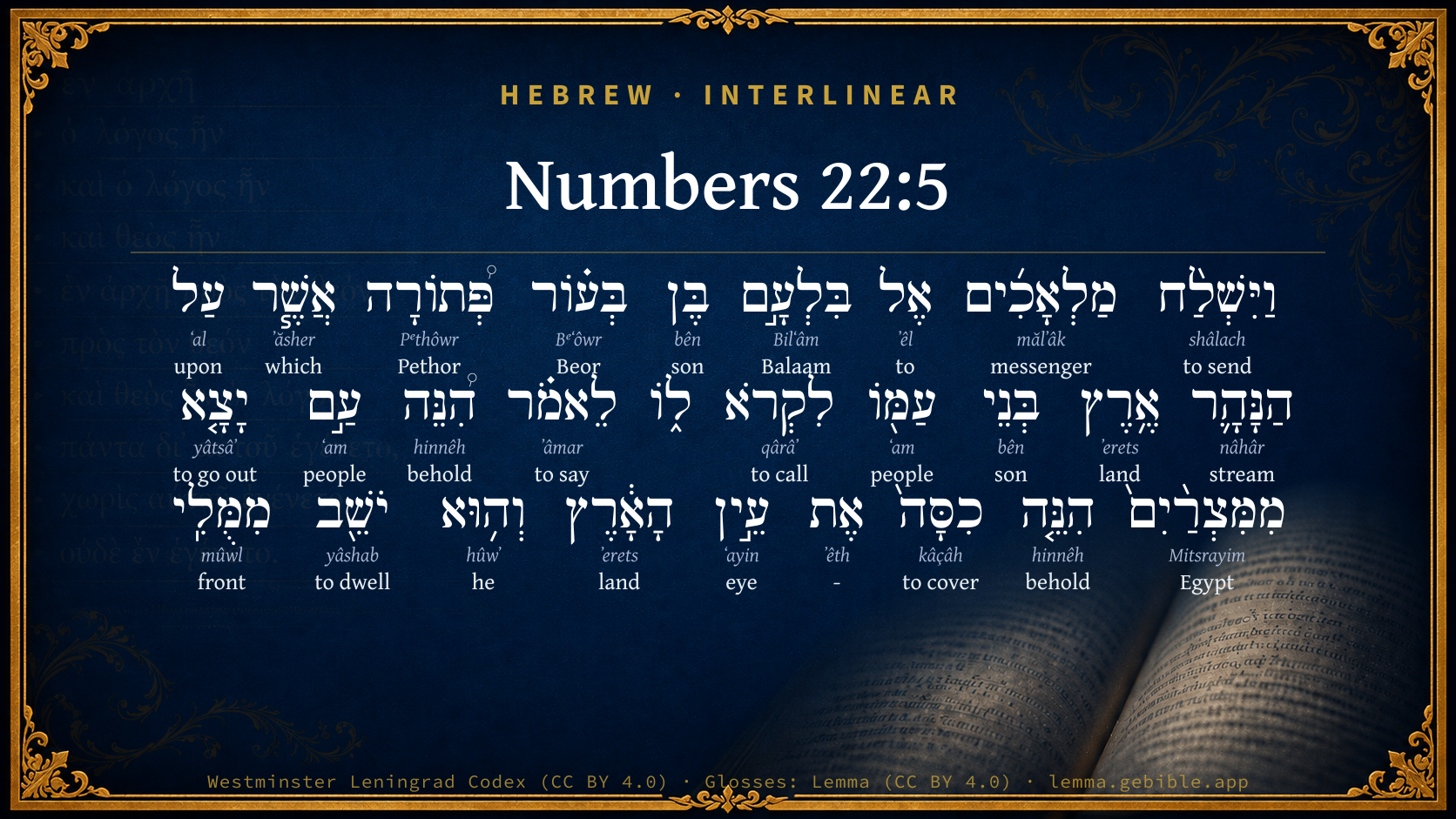
Numbers 22:5

Hebrew (Westminster Leningrad Codex) Numbers 22:5 appears in the Hebrew Old Testament. The text above is from the Westminster Leningrad Codex. Each word links to its Strong’s number, a concise gloss, and parsing drawn from the Open Scriptures Hebrew Bible morphology. Click any word for its full Brown-Driver-Briggs (BDB) entry.
Download image
Cite this verse

Numbers 22:5 (World English Bible). Public Domain. Lemma interlinear Bible study tool, https://lemma.gebible.app/v/numbers/22/5.

Show BibTeX & RIS
BibTeX
RIS
English Translation
He sent messengers to Balaam the son of Beor, to Pethor, which is by the River, to the land of the children of his people, to call him, saying, Behold, there is a people come out from Egypt: behold, they cover the surface of the earth, and they abide over against me.
World English Bible · Public Domain
Highlights
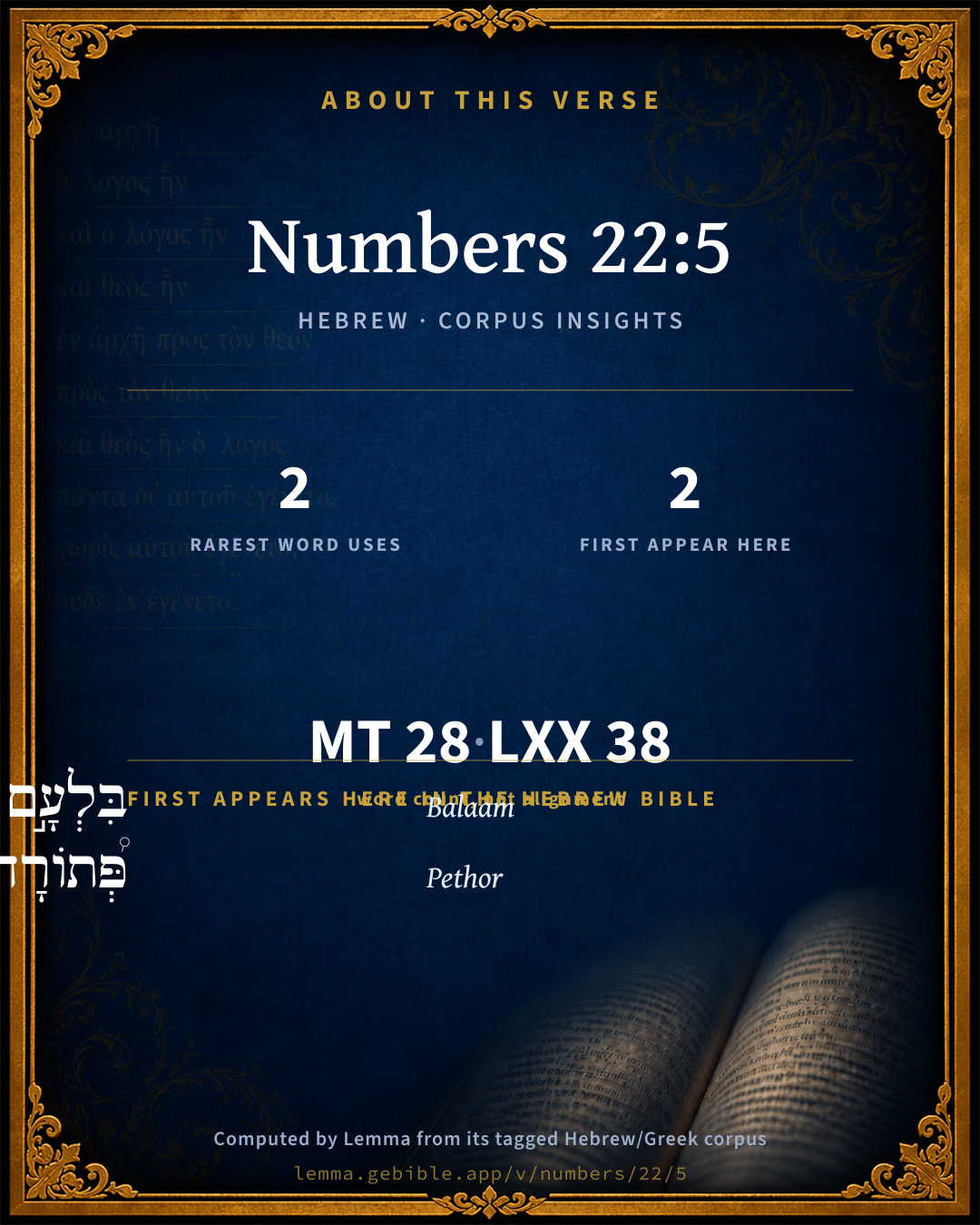
  • 2 first appearances in the Hebrew Bible
Full analysis ↓
Download a study sheet

One document with this verse’s original text, its word-by-word gloss line, the meaning frame, cross-references with their text, attributed commentary, and full source and license credits — printable, and it pastes into notes with its structure intact.

This verse Autodidact and up

Study sheet (.html) Plain text (.txt)

A passage Seminary Student

Up to 50 verses in one chapter. A passage sheet keeps up to 6 commentary sources and 12 cross-references per verse, in the order this page ranks them, and says so on the sheet whenever that leaves anything out. Ask for a single verse and you get the Autodidact verse sheet above.

Everything on this page stays free to read, with no account — the sheet is a download of what is already on screen, not access to it.

Want to remove ads? Support Godless Engineer
Compare translations 3

The same verse in 3 English versions, stacked beneath the original-language interlinear above. Click any original word for its lexicon entry.

Each is an independent rendering of the whole verse — the interlinear is not word-aligned to these translations.

Highlighted words mark where these versions differ — a whole-verse word diff, not a word-by-word alignment.

  • World English Bible Public Domain
    He sent messengers to Balaam the son of Beor, to Pethor, which is by the River, to the land of the children of his people, to call him, saying, Behold, there is a people come out from Egypt: behold, they cover the surface of the earth, and they abide over against me.
  • King James Version Public Domain
    He sent messengers therefore unto Balaam the son of Beor to Pethor, which is by the river of the land of the children of his people, to call him, saying, Behold, there is a people come out from Egypt: behold, they cover the face of the earth, and they abide over against me:
  • unfoldingWord Literal Text CC BY-SA 4.0
    And he sent messengers to Balaam the son of Beor, to Pethor, which on the River, the land of the sons of his people, to summon him, saying, “Behold, a people has come out from Egypt. Behold, it has covered the eye of the land, and it is dwelling opposite me.

unfoldingWord Literal Text — © unfoldingWord, licensed CC BY-SA 4.0. Word-aligned USFM3 via Door43 (git.door43.org/unfoldingWord/en_ult).

Versions to compare (up to 4)

3 of 4 selected

Show all 18 translations

Every available English version of this verse, each an independent rendering of the whole verse.

  • World English Bible Public Domain
    He sent messengers to Balaam the son of Beor, to Pethor, which is by the River, to the land of the children of his people, to call him, saying, Behold, there is a people come out from Egypt: behold, they cover the surface of the earth, and they abide over against me.
  • Berean Standard Bible Public Domain
    he sent messengers to Balaam son of Beor at Pethor, which is by the Euphrates in the land of his people. “Behold, a people has come out of Egypt,” said Balak. “They cover the face of the land and have settled next to me.
  • Majority Standard Bible Public Domain
    he sent messengers to summon Balaam son of Beor at Pethor, which is by the Euphrates in the land of his people. “Behold, a people has come out of Egypt,” said Balak. “They cover the face of the land and have settled next to me.
  • King James Version Public Domain
    He sent messengers therefore unto Balaam the son of Beor to Pethor, which is by the river of the land of the children of his people, to call him, saying, Behold, there is a people come out from Egypt: behold, they cover the face of the earth, and they abide over against me:
  • American Standard Version (1901) Public Domain
    And he sent messengers unto Balaam the son of Beor, to Pethor, which is by the River, to the land of the children of his people, to call him, saying, Behold, there is a people come out from Egypt: behold, they cover the face of the earth, and they abide over against me.
  • Revised Version (1885) Public Domain
    And he sent messengers unto Balaam the son of Beor, to Pethor, which is by the River, to the land of the children of his people, to call him, saying, Behold, there is a people come out from Egypt: behold, they cover the face of the earth, and they abide over against me:
  • Geneva Bible (1599) Public Domain
    Hee sent messengers therefore vnto Balaam the sonne of Beor to Pethor (which is by the riuer of the lande of the children of his folke) to call him, saying, Beholde, there is a people come out of Egypt, which couer the face of the earth, and lye ouer against me.
  • Douay-Rheims (1899) Public Domain
    He sent therefore messengers to Balaam the son of Beer, a soothsayer, who dwelt by the river of the land of the children of Ammon, to call him, and to say: Behold a people is come out of Egypt, that hath covered the face of the earth, sitting over against me.
  • Young's Literal Translation Public Domain
    and he sendeth messengers unto Balaam son of Beor, to Pethor, which `is' by the River of the land of the sons of his people, to call for him, saying, `Lo, a people hath come out of Egypt; lo, it hath covered the eye of the land, and it is abiding over-against me;
  • Literal Standard Version CC BY-SA 4.0
    and he sends messengers to Balaam son of Beor, to Pethor, which [is] by the River of the land of the sons of his people, to call for him, saying, “Behold, a people has come out of Egypt; behold, it has covered the eye of the land, and it is abiding in front of me;
  • Unlocked Literal Bible CC BY-SA 4.0
    He sent messengers to Balaam son of Beor, at Pethor which is by the Euphrates River, in the land of his nation and his people. He called him and said, “Look, a nation has come here from Egypt. They cover the face of the earth and they are right now next to me.
  • unfoldingWord Literal Text CC BY-SA 4.0
    And he sent messengers to Balaam the son of Beor, to Pethor, which on the River, the land of the sons of his people, to summon him, saying, “Behold, a people has come out from Egypt. Behold, it has covered the eye of the land, and it is dwelling opposite me.
  • Darby Bible Public Domain
    And he sent messengers to Balaam the son of Beor, to Pethor, which is on the river in the land of the children of his people, to call him, saying, Behold, a people is come out from Egypt; behold, they cover the face of the land, and they abide over against me.
  • World Messianic Bible Public Domain
    He sent messengers to Balaam the son of Beor, to Pethor, which is by the River, to the land of the children of his people, to call him, saying, “Behold, there is a people who came out of Egypt. Behold, they cover the surface of the earth, and they are staying opposite me.
  • Webster's Bible Public Domain
    He sent messengers therefore to Balaam the son of Beor to Pethor, which is by the river of the land of the children of his people, to call him, saying, Behold, there has a people come out from Egypt: behold, they cover the face of the earth, and they abide over against me:
  • Free Bible Version CC BY-SA 4.0
    He sent messengers to call Balaam, son of Beor, who lived in Pethor near the Euphrates River in his own country. “Listen, a group of people has arrived here who came from Egypt,” Balak said in his message to Balaam. “There are hordes of them and they present a real threat to me.
  • Bible in Basic English Public Domain
    So he sent men to Balaam, son of Beor, at Pethor by the River in the land of the children of his people, saying to him, See, a people has come out of Egypt, covering all the face of the earth, and they have put up their tents opposite to me:
  • JPS Tanakh (1917) Public Domain
    And he sent messengers unto Balaam the son of Beor, to Pethor, which is by the River, to the land of the children of his people, to call him, saying: 'Behold, there is a people come out from Egypt; behold, they cover the face of the earth, and they abide over against me.

Literal Standard Version (2020), Covenant Press — licensed CC BY-SA 4.0. Text via the HelloAO Bible API (eBible.org). Unlocked Literal Bible (unfoldingWord) — licensed CC BY-SA 4.0. Text via the HelloAO Bible API (eBible.org). unfoldingWord Literal Text — © unfoldingWord, licensed CC BY-SA 4.0. Word-aligned USFM3 via Door43 (git.door43.org/unfoldingWord/en_ult). Free Bible Version, Dr. Jonathan Gallagher — licensed CC BY-SA 4.0. Text via the HelloAO Bible API (eBible.org).

Word by word

More ways to search: Search by grammar → Find every occurrence → Compare this word →

Practice this passage: Drill this verse → Learn its vocabulary →

פְּ֠תוֹרָה
Pᵉthôwr
H6604
“Pethor · toward”
Noun, Proper + Suffix, Demonstrative
Part of Speech
Noun
Type
Proper
Full BDB Definition

Origin: of foreign origin

TWOT: None

Pethor = "soothsayer" - a town of Mesopotamia and the home of Balaam; located on a river; site unknown
  1. וַיִּשְׁלַ֨ח shâlach H7971 “and · to send” Conjunction + Verb, Qal, Sequential Imperfect, 3rd Person, Masculine, Singular
  2. מַלְאָכִ֜ים mălʼâk H4397 “messengers” Noun, Common, Masculine, Plural, Absolute
  3. אֶל ʼêl H413 “to” Preposition
  4. בִּלְעָ֣ם Bilʻâm H1109 “Balaam” Noun, Proper
  5. בֶּן bên H1121 “son of” Noun, Common, Masculine, Singular, Construct
  6. בְּע֗וֹר Bᵉʻôwr H1160 “Beor” Noun, Proper
  7. אֲשֶׁ֧ר ʼăsher H834 “which” Particle, Relative
  8. עַל ʻal H5921 “upon” Preposition
  9. הַנָּהָ֛ר nâhâr H5104 “the · stream” Particle, Definite Article + Noun, Common, Masculine, Singular, Absolute
  10. אֶ֥רֶץ ʼerets H776 “land of” Noun, Common, Both, Singular, Construct
  11. בְּנֵי bên H1121 “sons of” Noun, Common, Masculine, Plural, Construct
  12. עַמּ֖וֹ ʻam H5971 “people · his” Noun, Common, Masculine, Singular, Construct + Suffix, Personal, 3rd Person, Masculine, Singular
  13. לִקְרֹא qârâʼ H7121 “to call” Preposition + Verb, Qal, Infinitive Construct
  14. לֵאמֹ֗ר ʼâmar H559 “to say” Preposition + Verb, Qal, Infinitive Construct
  15. הִ֠נֵּה hinnêh H2009 “behold” Particle, Demonstrative
  16. עַ֣ם ʻam H5971 “people” Noun, Common, Masculine, Singular, Absolute
  17. יָצָ֤א yâtsâʼ H3318 “to go out” Verb, Qal, Perfect, 3rd Person, Masculine, Singular
  18. מִמִּצְרַ֨יִם֙ Mitsrayim H4714 “from · Egypt” Preposition + Noun, Proper
  19. הִנֵּ֤ה hinnêh H2009 “behold” Particle, Demonstrative
  20. כִסָּה֙ kâçâh H3680 “to cover” Verb, Piel, Perfect, 3rd Person, Masculine, Singular
  21. אֶת ʼêth H853 “-” Particle, Direct Object
  22. עֵ֣ין ʻayin H5869 “eye of” Noun, Common, Both, Singular, Construct
  23. הָאָ֔רֶץ ʼerets H776 “the · land” Particle, Definite Article + Noun, Common, Both, Singular, Absolute
  24. וְה֥וּא hûwʼ H1931 “and · he” Conjunction + Pronoun, Personal, 3rd Person, Masculine, Singular
  25. יֹשֵׁ֖ב yâshab H3427 “dwelling” Verb, Qal, Participle Active, Masculine, Singular, Absolute
  26. מִמֻּלִֽי mûwl H4136 “from · front · me” Preposition + Preposition + Suffix, Personal, 1st Person, Common, Singular

About this verse

These counts appear in no published source. They are computed here, from the morphology-tagged text and Lemma’s own curated glosses. What Lemma adds →

28
words
23
distinct lemmas
Pentateuch
section

Notable vocabulary

The rarest word here is פְּ֠תוֹרָה Pethor H6604 — appearing just 2 times in the whole Hebrew Bible.

First appearance in Scripture

These words make their first canonical appearance in the Hebrew Bible here:

  • בִּלְעָ֣ם Balaam H1109
  • פְּ֠תוֹרָה Pethor H6604

Shared distinctive vocabulary

פְּ֠תוֹרָה Pethor H6604 occurs in 2 verses of the Hebrew Bible. Also found in:

Grammatical profile

  • 6 verbs
  • 13 nouns
  • 1 pronoun
  • 4 prepositions
  • 4 particles

Verb forms

  • וַיִּשְׁלַ֨ח Qal · Sequential Imperfect
  • לִקְרֹא Qal · Infinitive Construct
  • לֵאמֹ֗ר Qal · Infinitive Construct
  • יָצָ֤א Qal · Perfect
  • כִסָּה֙ Piel · Perfect
  • יֹשֵׁ֖ב Qal · Participle Active

Repetition

Words recur within this verse — often emphatic in Hebrew:

  • בֶּן son H1121 ×2
  • אֶ֥רֶץ land H776 ×2
  • עַמּ֖וֹ people H5971 ×2
  • הִ֠נֵּה behold H2009 ×2

Hebrew & Septuagint length

In English translation the verse runs 52 words from the Hebrew and 55 from the Septuagint (LXX English) — closely comparable.

A rough comparison of the two English renderings, which tokenize alike — not a word-level alignment.

Word counts can differ between the Hebrew and the Greek without any difference in meaning — e.g. the Hebrew direct-object marker אֵת has no separate Greek word, and Greek often adds the article ὁ.

In the original languages it is 28 Hebrew tokens and 38 Greek tokens — but the two are counted differently (Hebrew bundles its prefixes and suffixes into one token; the Greek is in lemma form), so that isn’t a like-for-like length.

Cross-references

12

Topical passages linked to Numbers 22:5 in the Treasury of Scripture Knowledge — connected by theme and wording, ordered by reader-vote popularity; previews shown in the World English Bible.

  • Deuteronomy 23:4 because they didn't meet you with bread and with water in the way, when you came forth out of Egypt, and because they hired against you Balaam the son of Beor from Pethor of Mesopotamia, to curse you.
  • Joshua 24:9 Then Balak the son of Zippor, king of Moab, arose and fought against Israel: and he sent and called Balaam the son of Beor to curse you;
  • Micah 6:5 My people, remember now what Balak king of Moab devised, And what Balaam the son of Beor answered him from Shittim to Gilgal, That you may know the righteous acts of Yahweh."
  • Jude 1:11 Woe to them! For they went in the way of Cain, and ran riotously in the error of Balaam for hire, and perished in Korah's rebellion.
  • Numbers 23:7 He took up his parable, and said, From Aram has Balak brought me, The king of Moab from the mountains of the East: Come, curse me Jacob, Come, defy Israel.
  • Joshua 13:22 Balaam also the son of Beor, the soothsayer, did the children of Israel kill with the sword among the rest of their slain.
  • Genesis 13:16 I will make your offspring as the dust of the earth, so that if a man can number the dust of the earth, then your seed may also be numbered.
  • Exodus 1:7–10 The children of Israel were fruitful, and increased abundantly, and multiplied, and grew exceedingly mighty; and the land was filled with them.
  • Nehemiah 13:1–2 On that day they read in the book of Moses in the audience of the people; and therein was found written, that an Ammonite and a Moabite should not enter into the assembly of God forever,
  • Psalms 105:24 He increased his people greatly, And made them stronger than their adversaries.
  • 2 Peter 2:15–16 forsaking the right way, they went astray, having followed the way of Balaam the son of Beor, who loved the wages of wrong-doing;
  • Revelation 2:14 But I have a few things against you, because you have there some who hold the teaching of Balaam, who taught Balak to throw a stumbling block before the children of Israel, to eat things sacrificed to idols, and to commit sexual immorality.

Cross-references courtesy of OpenBible.info (CC BY 4.0).

Hebrew and Greek witnesses Masoretic Hebrew ↔ Greek Septuagint

The same verse in the two great witnesses to the Old Testament, shown verse-for-verse.

These are two independent witnesses, not word-aligned to each other, and the Septuagint is shown in lemma (dictionary) form.

Hebrew Numbers 22:5 Masoretic · Westminster Leningrad Codex

וַיִּשְׁלַ֨ח מַלְאָכִ֜ים אֶל בִּלְעָ֣ם בֶּן בְּע֗וֹר פְּ֠תוֹרָה אֲשֶׁ֧ר עַל הַנָּהָ֛ר אֶ֥רֶץ בְּנֵי עַמּ֖וֹ לִקְרֹא ל֑וֹ לֵאמֹ֗ר הִ֠נֵּה עַ֣ם יָצָ֤א מִמִּצְרַ֨יִם֙ הִנֵּ֤ה כִסָּה֙ אֶת עֵ֣ין הָאָ֔רֶץ וְה֥וּא יֹשֵׁ֖ב מִמֻּלִֽי

He sent messengers to Balaam the son of Beor, to Pethor, which is by the River, to the land of the children of his people, to call him, saying, Behold, there is a people come out from Egypt: behold, they cover the surface of the earth, and they abide over against me.

World English Bible · Public Domain

Greek LXX Numbers 22:5 Septuagint · lemma form

καί ἀποστέλλω πρέσβυς πρός βαλααμ υἱός βεωρ φαθουρα ὅς εἰμί ἐπί ὁ ποταμός γῆ υἱός λαός αὐτός καλέω αὐτός λέγω ἰδού λαός ἐκἔρχομαι ἐκ αἴγυπτος καί ἰδού κατακαλύπτω ὁ ὄψις ὁ γῆ καί οὗτος ἐν καταἧμαι ἔχω ἐγώ

And he sent ambassadors to Balaam the son of Beor, to Phathura, which is on a river of the land of the sons of his people, to call him, saying, Behold, a people is come out of Egypt, and behold it has covered the face of the earth, and it has encamped close to me.

LXX2012 (modern English Septuagint) · Public Domain

On this verse, The Cambridge Bible for Schools and Colleges discusses the Septuagint’s reading. Read the note in Commentary ↓

Hebrew: Westminster Leningrad Codex (CC BY 4.0). Greek: Septuagint (public domain); English from LXX2012 (modern English Septuagint) (Public Domain). How the Septuagint differs from the Hebrew →

Targum (Aramaic paraphrase)

2

The Targum is the ancient Jewish Aramaic paraphrase of the Hebrew Scriptures — an interpretive translation, not the Hebrew text itself. Onkelos (literal) and Pseudo-Jonathan (expansive) render the Torah, and Jonathan the Prophets. Coverage is partial: where no permissively-licensed English translation exists for a verse, only the Aramaic is shown. This is verse-level text, not a word-by-word alignment to the Hebrew.

  1. Targum Onkelos Torah (Genesis–Deuteronomy)
    וּשְׁלַח אִזְגַדִין לְוָת בִּלְעָם בַּר בְּעוֹר לִפְּתוֹר אֲרָם דְעַל פְּרָת אֲרַע בְּנֵי עַמֵיהּ לְמִקְרֵי לֵיהּ לְמֵימָר הָא עַמָא נְפַק מִמִצְרַיִם הָא חֲפָא יַת עֵין שִׁמְשָׁא דְאַרְעָא וְהוּא שָׁרֵי מִלְקִבְלִי

    (no public-domain English translation for this verse)

    Targum Onkelos — Aramaic: “Onkelos Genesis” (public domain); “Onkelos Exodus” (public domain); “Onkelos Leviticus” (public domain); “Onkelos Numbers” (public domain); “Onkelos Deuteronomy” (public domain). English: “Sefaria Community Translation” (CC0 1.0 (public-domain dedication)); “J.W. Etheridge. The Targums of Onkelos and Jonathan Ben Uzziel on the Pentateuch. London: Longmans, Green, 1862” (public domain). Text via Sefaria.

  2. Targum Pseudo-Jonathan Torah (Genesis–Deuteronomy)
    וְשָׁדַר עִזְגְדִין לְוַת לָבָן אֲרַמִי הוּא בִּלְעָם דִבְעָא לְמִבְלוֹעַ יַת עַמָא בֵּית יִשְׂרָאֵל בַּר בְּעוֹר דְאִיטַפַּשׁ מִסוֹגְעֵי חָכְמָתֵיהּ וְלָא חַס עַל יִשְׂרָאֵל זַרְעָא דִבְנֵי בְנָתֵיהּ וּבֵית מוֹתְבֵיהּ בְּפַדַן הִיא פְּתוֹר עַל שְׁמֵיהּ פָּתִיר חֶלְמַיָא וְהִיא מִתְבַּנְיָא בַּאֲרָם דְעַל פְּרָת אַרַע דְפַלְחִין וְסַגְדִין לֵיהּ בְּנֵי עַמָא לְמִקְרֵי לֵיהּ לְמֵימַר הָא עַמָא נְפַק מִמִצְרַיִם וְהָא חָפָא יַת חֶזְוָא דְאַרְעָא וְהוּא שְׁרֵי מִן קִבְלִי

    And he sent unto Laban the Aramite, who was Bileam, (so called because he it was) who sought (Biluva) to swallow up (Amma) the people of the house of Israel: the son of Beor, who was insane from the vastness of his knowledge; and would not spare Israel, the descendants of his sons and daughters: and the house of his habitation in Padan was at Pethor, a name signifying an interpreter of dreams. It was built in Aram upon the Phrat, in a land where the children of the people worshipped and adored him. (To him did Balak send) to call him, saying: Behold, a people hath come out of Mizraim, and, lo, they cover the face of the earth, and are encamped over against me.

    Targum Pseudo-Jonathan — Aramaic: “Targum Jonathan on Genesis” (public domain); “Targum Jonathan on Exodus” (public domain); “Targum Jonathan on Leviticus” (public domain); “Targum Jonathan on Numbers” (public domain); “Targum Jonathan on Deuteronomy” (public domain). English: “The Targum of Jonathan ben Uzziel, trans. J. W. Etheridge, London, 1862” (public domain). Text via Sefaria.

Commentary

Notes on Numbers 22:5 from classic Christian and Jewish commentators (each source and its license shown beneath its notes). The classic Christian expositions comment on the surrounding passage and are grouped to its opening verse, so a note may address several verses; the Jewish commentaries on the Tanakh (Rashi and others) are per-verse, so they appear only where the commentator wrote on this verse.

Lemma curates 59 commentaries, every one of them public domain or Creative Commons licensed, each selected and text-cleaned for this edition rather than reprinted as found. About our sources →

Trapp's Complete Commentary

John Trapp

Num 22:5 He sent messengers therefore unto Balaam the son of Beor to Pethor, which [is] by the river of the land of the children of his people, to call him, saying, Behold, there is a people come out from Egypt: behold, they cover the face of the earth, and they abide over against me:

Ver. 5. Balaam, the son of Beor.] The devil’s spelman, as one calls him, a soothsayer, or sorcerer, called a prophet, {2Pe 2:16} as false prophets are called diviners {Jer 27:9}

John Trapp, A Commentary or Exposition upon All the Books of the Old and New Testament (1647–1656) — public domain. Text from a community e-Sword module.

Joseph Benson's Commentary

Num 22:5. He sent messengers — Ancient history informs us that it was a general custom among most of the heathen nations, before they took up arms, to consult their gods by oracles and other methods of divination, about the event of the war. Thus the king of Moab is desirous, before he engaged in this war, to know the event, to interest the gods in his cause, and turn their power against his enemies. Unto Balaam — He is called a soothsayer, or diviner, Jos 13:22; and is thought by some to have used enchantments; see on chap. Num 24:1. And it was the opinion of the generality of the fathers, as it is of numbers of commentators, that he was a mere magician, a false prophet, and idolater. But that he was a true prophet, or one who had revelations from the true God, is evident from 2Pe 2:16, compared with Num 22:8-13; Num 24:1. And indeed no prophet in Israel could speak of God more reverently, and yet in more familiar terms, than he does, Num 22:18. The Jewish writers say that he had been a great prophet, who, for the accomplishment of his predictions, and the answers of his prayers, had been justly looked upon as a man having great interest with God. But the history shows that afterward his covetousness and ambition got the better of his piety, and that God departed from him. Beor — Or Bosor, (2Pe 2:15,) for he had two names, like many others. Pethor — A city of Mesopotamia. By the river — Euphrates, called the river, by way of eminence, and here the river of Balaam’s land, or country, namely, of Mesopotamia.

Joseph Benson's Commentary on the Old and New Testaments (1811–1818) — public domain. Text from a community e-Sword module.

Tyndale Open Study Notes

Tyndale Open Resources

22:5-6 Balaam was a pagan religious specialist (a diviner) from northwest Mesopotamia (see “Balaam” Profile). Like other ancient peoples, Moab and Midian believed that the spoken word—in the form of a blessing or curse—was powerful when uttered by a skilled diviner. Members of this trained profession claimed to possess special powers to learn about and manipulate the future course of events (see Deut 18:14; 1 Sam 6:2; 2 Kgs 21:6; Isa 44:25; Dan 2:1-12, 27-28; Mic 5:12; Zech 10:2). Israel’s enemies appealed to Balaam to pronounce curses upon the Hebrews, for they believed that such spoken words would be effective against them. Ancient armies pronounced such curses on their enemies before they entered battle. Belief in the power of the spoken word was common in ancient Israel even when not linked with divination (e.g., Gen 27:1-40; Deut 27:15-26; 1 Sam 14:24-28; cp. Matt 21:18-22). • Pethor (Num 22:5) is probably ancient Pitru, located on the west side of the Euphrates River south of Carchemish, 400 miles from Moab.

Tyndale Open Study Notes — © Tyndale Open Resources, licensed CC BY-SA 4.0. Text via the HelloAO Bible API.

Geneva Bible (1599)

Geneva Bible translators

To wit, Euphrates, upon the which stood this city Pethor.

Geneva Bible (1599) marginal notes — public domain. Text via Bolls.life.

Jamieson, Fausset & Brown

Robert Jamieson, A. R. Fausset & David Brown

He sent messengers therefore unto Balaam--that is, "lord" or "devourer" of people, a famous soothsayer (Jos 13:22).

son of Beor--or, in the Chaldee form, Bosor--that is, "destruction."

Pethor--a city of Mesopotamia, situated on the Euphrates.

Jamieson, Fausset & Brown — Commentary Critical and Explanatory on the Whole Bible (1871) — public domain (CC PDM 1.0). Text via the HelloAO Bible API.

Adam Clarke's Commentary

Verse 5. To Pethor, which is by the river of the land of the children of his people] Dr. Kennicott justly remarks, that "the description now given of Balaam's residence, instead of being particular, agrees with any place in any country where there is a river; for he lived by Pethor, which is by the river of the land of the children of his people. But was Pethor then near the Nile in Egypt? Or in Canaan, near Jordan? Or in Mesopotamia, near the Euphrates, and belonging to the Ammonites? This last was in fact the case; and therefore it is well that twelve Hebrew MSS. (with two of De Rossi's) confirm the Samaritan text here in reading, instead of עמו ammo, his people, עמון Ammon, with the Syriac and Vulgate versions." Houbigant properly contends for this reading; and necessity urges the propriety of adopting it. It should therefore stand thus: by the river of the land of the children of Ammon; and thus it agrees with De 23:4.

Adam Clarke's Commentary on the Bible (1810–1826) — public domain. Text from a community e-Sword/MySword module.

Ellicott's Commentary for English Readers

(5) Balaam the son of Beor.—The name of Balaam is probably derived from bala (to devour), with the terminal syllable am, or from the two words bala (he devoured), and am (people). His father’s name (Beor), from baar (to consume), has been thought to denote that Balaam belonged to a family in which the magical art was hereditary. He is described in Jos_13:22 as “the soothsayer” (Hebrew, kosem)—i.e., one of that class of persons who were not to be tolerated amongst the Israelites, and who are spoken of as “an abomination unto the Lord” (Deu_18:10-12). The form Bosor (2Pe_2:15) probably arose from a peculiar mode of pronouncing the guttural letter Ain in baar. (See Keil, On the Pentateuch, 3 p. 159, and Note.) On the character and history of Balaam, reference may be made to Bishop Butler (Serm. vii.); Waterland (Works, 9:397); Keil, On the Pentateuch, in loc.; Hengstenberg (Dissertation on the Histories and Prophecies of Balaam, p. 747, Clark, 1848); and to the Article in Smith’s Dictionary of the Bible, by Professor Stanley Leathes.

To Pethor, which is by the river of the land . . . —Better, To Pethor, which is by the river, (even to) the land of the children of his people. Pethcr was in Mesopotamia (Num_23:7), where Lot, from whom the Moabites were descended, had dwelt (Gen_12:5). “The river” is the Euphrates here, as elsewhere. (See, e.g., Gen_15:18; Gen_31:21; Exo_23:31; 2Ch_9:26.)

They cover the face of the earth.—Literally, the eye of the earth (or, the land). (Comp. Exo_10:5.)

A Bible Commentary for English Readers, edited by Charles John Ellicott (1878–1897) — public domain. Text from a community e-Sword module.

The Cambridge Bible for Schools and Colleges

gen. ed. J. J. S. Perowne

5. Balaam the son of Beor] It is interesting that the name Bela the son of Beor occurs of a king of Edom (Gen_36:32). Balaam (Heb. Bil‘âm) and Bela‘ are practically identical words; and some have thought that the two men are the same, and that different conceptions of them were handed down in the Israelite and Edomite traditions. But there is no other evidence for the conjecture (see art. ‘Bela’ in Enc. Bibl. [Note: nc. Bibl. Encyclopaedia Biblica.] ).

Pethor, which is by the River] i.e. by the Euphrates. Cf. Deu_23:4 ‘Pethor of Aram-naharaim (Mesopotamia).’ It is probably to be identified with Pitru (mentioned in an Assyr. and an Egypt, inscription), which was situated a few miles from the Euphrates, a little to the south of Carchemish. This sentence, which is probably from E , represents Balaam as living some 400 miles from Moab.

the land of the children of his people] This must mean ‘his native land’; but it is a very awkward periphrasis. The Sam. , Syr., Lucianic LXX. , Vulg. and some Heb. MSS. read ‘Ammon, for ‘ammô ‘his people.’ If this is correct, J and E contained different traditions as to the country from which Balaam came. This reading is supported by the narrative of J (Num_22:22-34) which relates that Balaam rode upon an ass, with two servants, suggesting a short journey through cultivated country rather than a long desert journey for which camels and a tent caravan would be required.

The Cambridge Bible for Schools and Colleges (gen. ed. J. J. S. Perowne; Cambridge University Press, 1878–1918) — public domain. Text from a community e-Sword module.

John Gill's Exposition

Come now, therefore, I pray thee,.... To my country, city, and court:

curse me this people; by imprecations on them; and which being attended with various rites and ceremonies, brought calamities on persons, which men of Balaam's character were supposed to have power to do:

for they are too mighty for me; to oppose and subdue by force of arms; and therefore was obliged to have recourse to such arts and methods he was master of; suggesting, that he was able to do more by his divinations than could be effected by an army of men:

peradventure I shall prevail, that we may smite them, and that I may drive them out of the land; there is hope, by taking such measures, that they may be prevailed over and conquered; and that, together with your curses, and my army, we may be able to smite them, and destroy them; you with your tongue, and I and my people with the sword, and so drive them quite out of the land, and get a clear riddance of them:

for I wot that he whom thou blessest is blessed, and he whom thou cursest is cursed; so high an opinion had the king of Moab of this soothsayer and diviner, from the report he had had of the mighty feats done by him; as, that those for whom he asked for blessings from heaven had them, and those on whom he imprecated evils, they came upon them; and this was a prevailing custom among the Heathens in later times, and particularly the Romans; not only to endeavour to get the gods of the people from them they were at war with, and whose cities they besieged, praying that they would leave such places, cities, and their temples; but also wished evils to cities and armies, and prayed the gods to fill them with flight, fear, and terror, and that such evils might come upon them, which had on others (d).

(d) Vid. Macrob. Saturnal. l. 3. c. 9.

John Gill's Exposition of the Whole Bible (1746–1763) — public domain (CC PDM 1.0). Text via the HelloAO Bible API.

Albert Barnes' Notes on the Bible

Balaam the son of Beor was from the first a worshipper in some sort of the true God; and had learned some elements of pure and true religion in his home in the far East, the cradle of the ancestors of Israel. But though prophesying, doubtless even before the ambassadors of Balak came to him, in the name of the true God, yet prophecy was still to him as before a mere business, not a religion. The summons of Balak proved to be a crisis in his career: and he failed under the trial. When the gold and honors of Balak seemed to be finally lost, he became reckless and desperate; and, as if in defiance, counseled the evil stratagem by which he hoped to compass indirectly that ruin of God’s people which he had been withheld from working otherwise. He thus, like Judas and Ahithophel, set in motion a train of events which involved his own destruction.

The name Balaam signifies “destroyer,” or “glutton,” and is in part identical with “Bela, son of Beor,” the first king of Edom Gen 36:32. The name “Beor” (“to burn up”) is that of the father, or possibly ancestor, of the prophet.

Pethor, which is by the river of the land of the children of his people - Rather, Pethor which was ... land. Pethor (Pitru, Assyrian) was on the river Sagura (modern: Sajur) near its junction with the Euphrates.

Albert Barnes' Notes on the Bible (1834–1885) — public domain. Text from a community e-Sword/MySword module.

Haydock's Catholic Bible Commentary

Beor. St. Peter (ii. 11, 15) reads Bosor. --- A soothsayer, or magician, (ariolum) as this word always indicates, Josue xiii. 22. The Hebrews believe he was once a true prophet, a descendant of Buz, the son of Melcha, and the same as Eliu, the friend of Job. (St. Jerome, q. 3. Hebrew in Genesis) He certainly foretold the Messias, or star of Jacob, by divine inspiration, chap. xxiv. 17. (Haydock) --- He consults and acknowledges the true God, ver. 8, 18, 20. Origen (hom. 13,) believes that he left a book of his prophecies, which was known to the wise men, and discovered to them the birth of the Messias; and some Rabbins think that Moses has here inserted from that work what relates to Balaam. St. Augustine (q. 48) shews that he was a wicked man, of whom nevertheless God made use to convey important instructions; and that he is one of those reprobates who will say, Lord, have we not prophesied in thy name? He is placed with Cain and Core, St. Jude 11. St. Ambrose (ep. 50,) observes, that he might prophesy, like Caiphas, without knowing what he said, and that the gift of prophecy on this occasion, was no proof of his virtue. Many of the Fathers look upon him as a mere magician, who could utter no blessing, but only curses, by the rules of his infernal art. He did not design to consult God, but the Lord puts answers into his mouth. (Theodoret, q. 39, 42.) The method of consultation seemed to border on superstition. He wished to make God change his resolutions, as if he were an idol, and attempted to evade the impressions of his spirit. (Calmet) --- The river, Euphrates, which waters the country of the Ammonites. (Menochius) --- Hebrew, "to Pethora, which is by the land of the children of his people." St. Jerome has translated Pethora "soothsayer," and left Ammon un declined. (Haydock) --- The Chaldean informs us, that he was a resident at Petor, a city of Syria, on the Euphrates. It is probably the same town with the Pacora of Ptolemy, near Thapsacus. Balaam is styled an Aramean; (chap. xxiii. 17,) and we know that he came from Mesopotamia. Hebrew Aram Naharaim, (Deuteronomy xxiii. 4.; Calmet) or "Syria, between the two rivers," the Euphrates and Tigris. (Salien) --- Me, ready to fall upon my dominions. It appears hence, that Balaam was in high estimation, since a distant king depends more upon his power, that upon the efforts of all his own armies, and those of his auxiliaries, and is willing to pay him for cursing his enemies at do dear a rate. Perhaps he thought that they employed magical arts to conquer their enemies, by prayer. See Exodus xvii. 11.; Origen, hom. 13. (Haydock)

George Leo Haydock (1774–1849), Haydock's Catholic Family Bible and Commentary, 1859 edition — public domain. Excludes Psalms (Douay-Rheims chapter numbering differs from Protestant) and Deuterocanonical books (Catholic canon only).

Matthew Poole's English Annotations

Balaam is called a prophet, 2Pe 2:16, because God was pleased to inspire and direct him to speak the following prophecy, as he did inspire Caiaphas to speak those words, Joh 11:51,52, and as sometimes he did for a time inspire other wicked men; but in truth he was a soothsayer, as he is called, Jos 13:22. See Num 24:1.

Beor, or Bosor, 2Pe 2:15; for he had two names, as many others had.

Pethor; a city in Mesopotamia or Aram: see Num 23:7; Deu 23:4.

By the river, i.e. by Euphrates, which is oft called the river, by way of eminency, as Gen 15:18; Jos 24:2,15, and here the river of Balaam’s land or country, to wit, of Mesopotamia or Aram, Num 21:7.

They abide over against me; they are encamped in my neighbourhood, ready to invade my kingdom.

Matthew Poole's English Annotations on the Holy Bible (1683–1685) — public domain. Text from a community e-Sword/MySword module.

Whedon's Commentary on the Bible

Daniel D. Whedon

5. He sent messengers — Balak was the originator of the scheme; Midian was an accessary. See Num_22:7.

Balaam — Hebrew, Destroyer, Devourer. It is unknown whether he received this name at his birth, as a member of a family in which soothsaying was hereditary, or after he had acquired the reputation of a dreaded wizard and conjurer. From the fact that Beor signifies burning, eating off, destroying, we infer with Keil “that Balaam belonged to a family in which the mantic character, or magical art, was hereditary.” To Balaam the title of prophet, or seer, is never applied, but in Jos_13:22, he is called the soothsayer, a term never predicated of any true prophet. But it is evident that he was not a mere heathen soothsayer; his acquaintance with Jehovah and his obedience to his commands, as well as his widespread reputation, indicate that he did not belong to the common herd of his profession. “It is one of the striking proofs of the divine universality of the Old Testament that the veil is from time to time drawn aside, and other characters than those which belonged to the chosen people appear in the distance, fraught with an instruction which even transcends the limits of the Jewish Church, and not only in place, but in time, far outruns the teaching of any peculiar age or nation. Such is the discussion of the profoundest questions of religious philosophy in the book of the Gentile Job. Such is the appearance of the Gentile prophet Balaam. He is one of those characters of whom, while so little is told that we seem to know nothing of him, yet whatever that little is, raises him at once to the highest pitch of interest.” — Stanley. For a portraiture of his character and a discussion of its apparently contradictory elements, see chapter xxiv, concluding note. Pethor is a place in Aram, (chap. xxiii, 7,) Mesopotamia, which modern research has failed to identify. It was doubtless a seat of Babylonian magi, who were accustomed to congregate in separate towns, as were the Levites in the Levitical cities among the Israelites. It is evident that Pethor was situated among the highlands in Mesopotamia, upon the Euphrates, eighteen or twenty days’ journey from the plains of Moab. From this very region that extraordinary genius, Manes, the early Christian heresiarch, arose from a Magian family, A.D. 240.

The river — The Hebrew Nahar, with the article, here, as elsewhere in the Old Testament, designates the Euphrates.

Of the children of his people — This describes Balaam as a native of Aram, which distant residence renders his blessing of Israel more unexpected and wonderful.

Daniel D. Whedon (gen. ed.), Commentary on the Old and New Testaments (1874–1909) — public domain. Text from a community e-Sword module.

The Pulpit Commentary

He sent messengers therefore. It appears from verse 7 that Balak acted for Midian as well as for Moab; as the Midianites were but a weak people, they may have placed themselves more or less under the protection of Balak. Unto Balaam the son of Beer. (Bileam: our common form is from the Septuagint and New Testament, Balaam ) is derived either from lB, to destroy or devour, and the people; or simply from lB, with the terminal syllable "the destroyer." The former derivation receives some support from Rev_2:14, Rev_2:15, where "Nicolaitans" are thought by many to be only a Greek form of" Balaamites" Nikolaov , from nikaw and laov ). Beor (rWB) has a similar signification, from rB, to burn, or consume. Both names have probable reference to the supposed effect of their maledictions, for successful cursing was an hereditary profession in many. lands, as it still is in some. Beer appears in 2Pe_2:15 as Bosor, which is called a Chaldeeism, but the origin of the change is really unknown. A "Bela son of Beer" is named in Gen_36:32 as reigning in Edom, but the coincidence is of no importance: kings and magicians have always loved to give themselves names of fear, and their vocabulary was not extensive. To Pother, which is by the river of the land of the children of his people. Rather, "which is on the river," i.e., the great river Euphrates, "in the land of the children of his people," i.e., in his native land. The situation of Pethor (Septuagint, Fayoura ) is unknown. Here is a people come out of Egypt. Forty years had passed since their fathers had left Egypt. Yet Balak"s words expressed a great truth, for this people was no wandering desert tribe, but for all intents the same great organized nation which had spoiled Egypt, and left Pharaoh"s host dead behind them. They abide over against me yliMumi. Septuagint, ecomenov mou . This would hardly have been said when Israel was encamped thirty miles north of Arnon, opposite to Jericho. The two embassies to Balaam must have occupied some time, and in the mean while Israel would have gone further on his way. We may naturally conclude that the first message was sent immediately after the defeat of Sihon, at a time when Israel was encamped very near the border of Moab.

HOMILIES BY E.S. PROUT Vers. 5, 6. Balaam"s greatness and fall.

Balaam"s character and history have supplied materials for many theological and ethical studies. His character and conduct, though somewhat perplexing, are not more so than those of many around us, and are full of instruction and warning. At present we confine ourselves to two points:

I BALAAM"S LOFTY POSITION AND PRIVILEGES.

II THE SECRET OF BALAAM"S HUMILIATING FALL.

(1) He had a knowledge of the true God. Among the heathens of Mesopotamia he retains a knowledge of the God revealed "from the creation of the world." (Compare the cases of Melchizedec and Job.) He was like the evening star, showing in which direction the sun of truth had set, (Rom_1:21) and reflecting some of its light. His knowledge may be illustrated by his lofty utterances respecting God and his people; e.g., Num_23:10, Num_23:19; and according to some interpreters, Num_6:8.

(2) He enjoyed the gift of inspiration by God. Though there were no Scriptures, God was not left without witnesses, and among them was Balaam "the prophet". (2Pe_2:16) He expected Divine communications, and was not disappointed. No wonder then that

(3) he enjoyed wide-spread fame. It extended hundreds of miles away, to Moab and Midian, whence more than once an embassy crossed the desert with such flattering words as those in verse 6. Yet we know that Balaam was a bad man who came to a bad end. Thus we have lessons of warning for ourselves, who have a fuller knowledge of God than Balaam, and may enjoy gifts, if not as brilliant, yet more useful than his. All of these may avail nothing for our salvation, but may be perverted to the worst ends. Illustrations: Hymenoeus and Alexander, the companions of St. Paul; (1Ti_1:19, 1Ti_1:20) Judas, the apostle of Jesus Christ. (cf. Mat_7:21-23 Mat_11:23 1Co_13:1, 1Co_13:2)

II Balaam"s name mentioned in the New Testament only three times, and each time it is covered with reproach. (2Pe_2:15 Jud_1:11 Rev_2:14) His root sin was the ancient, inveterate vice of human nature, selfishness. He knew God, but did not love him, for "he loved the wages of unrighteousness." He did not follow the Divine voice, but "followed after" reward. God taught him sublime truths; he "taught Balak" base arts of seduction. His selfishness was shown in

(1) Ambition. There was nothing of the self-forgetfulness of such prophets as Elijah, Elisha, Jeremiah, or Balaam"s contemporary, Moses. He is esteemed as a great man, and he takes good care he shall be so esteemed. He knows divination has no power with God, but to magnify himself among the heathens of Moab, he resorts to it. He constantly aspires to the "very great honour" to which Balak offers to promote him. (cf. Psa_131:1-3 Jer_45:5)

(2) Covetousness. He would be rich, and therefore fell into temptation, &c. ; (1Ti_6:9 2Pe_2:15) His words were fair (verse 18), yet suspicious, like those of a venal voter boasting his incorruptibility. Balaam coveted the offered honour and wealth. How could be gain them while God was keeping him back? Two ways were possible. He might get God to change his mind. He wanted to get permission from God to do what was at present a sin. He might have known from the first, as he says. (Num_23:19) But he struggles to conquer God, as though the fact was not that God cannot change, but that God will not change. Hence his repeated changes of place and new sacrifices. At length it was clear that this way was closed against him. He is constrained to bless Israel again and again. At the close of the narrative (Num_24:10-24) he seems to be taking his place boldly as an ally of the people of God. But it was only a temporary impulse, not a true conversion. Greedy for the wages of unrighteousness, he allies himself with hell. ("Flectere si nequeo superos, Acheronta movebo. ) What a contrast between his fair promises (verse 18) and this wicked deed l The reason is that in trying to "bend" God he was miserably perverting himself (like a weak tool used to move a great weight), while seeking permission to sin he was growing less sensitive to sin (see next Homily). Learn then from the fall of this great and gifted prophet to what a depth of infamy selfishness, that mother of sins, and its offspring, ambition and covetousness, may lead us. Warned by the selfishness of Balaam, may we copy the unselfishness of Christ. P. (Rom_15:3 Php_2:3-8)

Vers. 5, 6. Balak"s message to Balaam.

War being useless, what shall Balak do? In his mind there were only two alternatives, either to fight or to send for Balaam. And yet there was a better course, had he thought of it, viz., to approach Israel peacefully. But prejudice, a fixed persuasion that Israel was his enemy, dominated his mind. We do very foolish things through allowing traditional conceptions to rule us. That Israel was the enemy of Moab was an assumption with not the smallest basis of experience. Many of the oppositions and difficulties of life arise from assuming that those who have the opportunity to injure are likely to use the opportunity. He who will show himself friendly may find friends and allies where he least expects them. We must do our best in dubious positions to make sure that we have exhausted the possibilities of action. Balak then sends a message to Balaam. Notice

I A TESTIMONY TO THE POWER OF RELIGION. Balak cannot find sufficient resources in nature, therefore he seeks above nature. When men, who in their selfishness and unspirituality are furthest from God, find themselves in extremity, it is then precisely that they are seen turning to a power higher than their own. (1Sa 28) Man has a clinging nature, and if he cannot lay hold of the truth as it is in Jesus, he must find some substitute. Balak did not know God as Moses knew him; he knew nothing of his spiritual perfections and holy purposes. But still he recognized the God of Israel as really existent, as a mighty potentate; he felt that Balaam had some power with him; and thus even in his ignorance he believes. It is a long, long way to pure atheism, and surely it must be a dreary and difficult one. May not the question be fairly raised whether there are any consistent atheists, those whose practice agrees even approximately with their theory? There are men without God in the world, i.e., lacking conscious and happy connection with the God and Father of our Lord Jesus Christ; but even so they may bear testimony unthinkingly to their need of him. The witnesses to the power of religion are not only many, but of all sorts, giving testimony often when they least suspect it.

II A TESTIMONY TO THE EMPTINESS OF IDOLATRY. Balak had a god of his own, probably more than one, and doubtless he would have felt very uncomfortable in omitting the worship of them; but he did not trust in his gods. He may have sacrificed to them on this very occasion with great profusion and scrupulosity, but he did not trust them. Though they were near at hand, he felt more hope from Balaam far away; and yet if there was any good in his gods, this was the very time to prove it and receive it. There is a Nemesis for all idolatry. The idols of Moab were put to shame before the God of Israel, and that by the very man who was bound to be their champion. It does not need always for a Dagon to fall in the presence of the ark. There are other ways of dishonouring idols than casting them to the moles and the bats. They may have shame written across their brows, even while they stand on the pedestal of honour. Thus we see also an exposure of formalism. Balak"s great need strips the mask off his religion, and underneath we see, not living organs, but dead machinery. And bear in mind, formalism in serving the true God is just as certain to come to shame as formalism in serving an idol. The principle is the same, Whatever deity be formally acknowledged.

III AFTER ALL, THE RESORT TO BALAAM WAS A VERY PRECARIOUS ONE, even supposing Balaam had all the power with which Balak credited him. For Pethor was a long way off, and the dreaded, victorious Israelites were close at hand. Balaam did not live in the next street. While you are sending from Land"s End for the celebrated London physician, the patient"s life is steadily ebbing away. That is no sufficient help in our supreme necessities which has to be brought over land and sea. "Say not in thine heart, Who shall ascend into heaven? (that is, to bring Christ down from above:) or, Who shall descend into the deep? (that is, to bring up Christ again from the dead). The word is nigh thee, even in thy mouth, and in thy heart". (Rom_10:6-8) Go into thy closet; retreat into the seclusion and security of thine own heart, and meet the mighty Guide and Helper there. The God of Israel went about with his people. Jesus did not say, "Wheresoever I am, there my people are to gather together," but, "Where two or three are gathered together in my name, there am I in the midst of them." "God attributes to place No sanctity, if none be thither brought By men who there frequent, or therein dwell.

IV A MAN MAY BE IGNORANT OF THINGS LYING NEAREST HIM AND UNSPEAKABLY IMPORTANT, while he abounds in useless knowledge of things far away. Balak knew not the needs of his own heart, the real power of Israel, the disposition of Israel"s God to him, the possibilities of friendship which lay within those tents on which he looked with so much apprehension. But somehow he had got to know concerning Balaam in far-away Pethor. How much useless, deceiving, pretentious knowledge we may accumulate with infinite labour, and at the time feeling great certainty, of its value. "Knowledge comes, but wisdom lingers." It is of great moment in a world where so much is to be known, and yet so little can he acquired, not to miss acquiring the right things. Said Dr. Arnold, "If one might wish for impossibilities, I might then wish that my children might be well versed in physical science, hut in due subordination to the fullness and freshness of their knowledge on moral subjects. This, however, I believe cannot be; and physical science, if studied at all, seems too great to be studied en parergw , Wherefore, rather than have it the principal thing in my son"s mind, I would gladly have him think that the sun went round the earth, and that the stars were so many spangles set in the bright blue firmament." Thus also the great discoverer Faraday in his old age worldly faculties are slipping away, day by day. Happy is it for all of us that the true good lies not in them. As they ebb, may they leave us as little children, trusting in the Father of mercies and accepting his unspeakable gift!

V THE MESSAGE WAS VERY FLATTERING TO BALAAM. Kings have much to do with courtiers, and all the delicate preparations of flattery must be well known to them. Balak made Balaam to understand that it was not for a trifle he had summoned him, for a service that could be rendered by a second-rate soothsayer. The people he so dreaded had come out from Egypt, that home of strength in those days, that populous and wealthy land, and by no means lacking in reputed wise men, sorcerers and magicians. They had come in great numbers: "behold, they cover the face of the earth;" and they were in close proximity and apparently settled condition: "they abide over against me." There is the willing confession by Balak of his own inability, and his evident faith in Balaam"s power to cast a fatal paralysis over all the energy of Israel. Now all this must have been very pleasant for Balaam to hear, sweeter maybe than the jingle of the rewards of divination. Thus did the temptation to Balaam, already only too open to temptation, begin. His carnal mind was appealed to in many ways. The rewards of divination were only a part of the expected wages of unrighteousness. "Pride goeth before destruction, and a haughty spirit before a fall. (Pro_16:18)

VI BALAK HAD MORE FAITH IN FALSEHOOD THAN ISRAEL FOR A LONG TIME HAD shows TOWARDS TRUTH. The conduct of Balak in sending so far, in casting the fortunes of his kingdom with such simplicity on what was utterly false, should put us to shame, who have the opportunity of resorting at all times to well ascertained and established truth. Balak had only a Balaam to seek, such an ignoble and double-minded man as appears in the sequel; not a Moses, who could have told him truly, not only how the blessing and the curse really come, but how to secure the one and escape the other. Y.

The Pulpit Commentary (1880–1919), ed. H.D.M. Spence-Jones & Joseph S. Exell — public domain. Text from a community e-Sword module.

John Wesley's Explanatory Notes

Balaam - Who is called a prophet, 2Pet ii, 16, because God was pleased to inspire and direct him to speak the following prophecies. Indeed many of the Jewish writers say, that Balaam had been a great prophet, who for the accomplishment of his predictions, and the answers of his prayers, had been looked upon justly as a man of great interest with God. However it is certain, that afterwards for his covetousness, God departed from him. Beor - Or, Bosor, 2Pet ii, 15, for he had two names, as many others had. Pethor - A city in Mesopotamia. By the river - By Euphrates, which is called the river, by way of eminency, and here the river of Balaam's land or country, to wit, of Mesopotamia.

John Wesley, Explanatory Notes Upon the Whole Bible (1754–1765) — public domain. Text via the GEBible commentary corpus.

Scofield Reference Notes

C. I. Scofield

Balaam

Balaam is the typical hireling prophet, seeking only to make a market of his gift. This is "the way of Balaam" 2Pe 2:15 and characterizes false teachers. The "error" of Balaam" Jud 1:11 was that he could see only the natural morality--a holy God, he reasoned, must curse such a people as Israel. Like all false teachers he was ignorant of the higher morality of vicarious atonement, by which God could be just and yet the justifier of believing sinners Rom 3:26. The "doctrine of Balaam" Rev 2:14 refers to his teaching Balak to corrupt the people whom he could not curse; Num 31:16; Num 25:1-3; Jas 4:4. Spiritually, Balaamism in teaching never rises above natural reasonings; in practice, it is easy world- conformity. Scofield "Rev 2:14".

The Scofield Reference Bible (1917 edition), notes by C. I. Scofield — public domain. Text from a community e-Sword module.

unfoldingWord translationNotes

Door43 World Missions Community

He sent messengers

"Balak sent messengers"

Beor

This is the name of Balaam's father. (See: How to Translate Names)

Pethor

This is the name of a city. (See: How to Translate Names)

of his nation and his people

"of Balaam's nation and people"

He called him

"Balak called Balaam." Balak did not speak to Balaam directly, but did so through the messengers he sent.

They cover the face of the earth

This is an exaggeration to emphasize how many of them there were. AT: "They are extremely numerous" (See: Hyperbole and Generalization)

the face of the earth

This refers to the surface of the earth. (See: Idiom)

drive them

"chase them"

I know that whomever you bless will be blessed, and whomever you curse will be cursed

This can be stated in active form. AT: "I know you have the power to bless or to curse people" (See: Active or Passive)

translationWords

send

messenger

Balaam

Euphrates River

nation

call

Egypt

face

earth

curse

cast out

bless

unfoldingWord translationNotes — © Distant Shores Media and the Door43 World Missions Community, licensed CC BY-SA 4.0. Source: git.door43.org/Door43/en_tn.

Rashi

Rabbi Shlomo Yitzchaki (Rashi)

פתורה HE SENT TO BALAAM פתורה because he was like a money changer before whom everyone lays coins; similarly all the kings used to send him their letters, asking for his advice. However, according to the literal sense of the text, this was the name of the place (Midrash Tanchuma, Balak 4).

ארץ בני עמו THE LAND OF THE CHILDREN OF HIS PEOPLE — of Balak's people, for he came from there, and this man (Balaam) had prophesied saying to him, “You are destined to be king”. — And if you ask: Why did the Holy One blessed be He, let his Shechina rest upon so wicked a heathen, I reply that in order that the heathen peoples should have no excuse to say, “If we had prophets, we would have changed for the better”, He raised up prophets for them. Yet they (these prophets) broke down the moral fence of the world, because at first they (the heathens) were fenced in against (they refrained from) immoral living, but this man (Balaam) counselled them to freely offer themselves to prostitution (Midrash Tanchuma, Balak 1; cf. Rashi on Numbers 24:14).

לקרא לו TO CALL HIM — the call was for him, for his benefit; for he (Balak) fixed for him (agreed to pay him) a large sum.

עם יצא ממצרים [THERE IS] A PEOPLE COME OUT FROM EGYPT — and if you ask: What harm does that do you?

הנה כסה את עין הארץ BEHOLD THEY COVER THE FACE OF THE EARTH — Sihon and Og who used to protect us stood up against them, but they slew them (Midrash Tanchuma, Balak 4).

והוא ישב ממלי AND THEY ARE STATIONED OPPOSITE ME — ממלי is written deficient in the ו (the full form is ממולי, so that it may be connected with מול “to cut off”) — they are near enough to cut me off. The word is the same as in (Psalms 118:10): “that I shall cut them off (אמילם)” (Midrash Tanchuma, Balak 4).

Rashi on the Tanakh — English translations: “The Judaica Press complete Tanach with Rashi, translated by A. J. Rosenberg” (CC BY 4.0); “Pentateuch with Rashi's commentary by M. Rosenbaum and A.M. Silbermann, 1929-1934” (public domain); “The Metsudah Tanach series, Lakewood, N.J” (CC BY 4.0); and “The Book of Joshua, Metsudah Publications, 1997” (CC BY 4.0). Text via Sefaria.

Ramban (Nachmanides)

Rabbi Moshe ben Nachman (Ramban / Nachmanides)

THE LAND OF THE CHILDREN OF HIS PEOPLE — “[the people] of Balak, for he [Balak] came from there [i.e., from Pethor which is by the river], and this man [Balaam] had prophesied and told him, ‘You are destined to be king.’” This is Rashi’s language, taken from an Agadic explanation. 20. But the plain meaning of Scripture is [that the land of the children of ‘his people’ is a reference to] Balaam’s people’s land [and not Balak’s], for there he [Balaam] was born and there was his family background. The reason for [Scripture] mentioning this is [to indicate] that he [Balaam] was a diviner, from the land where all the people were diviners, similar to that which is written, for they are replenished from the east, and with soothsayers like the Philistines.

Ramban (Nachmanides) on the Tanakh — English translation: “Commentary on the Torah by Ramban (Nachmanides). Translated and annotated by Charles B. Chavel. New York, Shilo Pub. House, 1971-1976” (CC BY 4.0). Text via Sefaria.

Lesson kit

Teaching starters — assembled from the data on this page, not authored interpretation. Every prompt links to the verse data it draws on. Edit before teaching.

Numbers, in the Pentateuch, opens this verse with 28 words (23 distinct Hebrew lemmas). Its most distinctive word is Pᵉthôwr (“Pethor”). A historical commentator’s framing appears above. Read the whole chapter for the surrounding context.

Discussion questions

  1. The word Pᵉthôwr carries the sense “Pethor.” How does it shape the verse?
  2. 2 words make their first appearance in Scripture here. What does this debut establish?
  3. How does Deuteronomy 23:4, which shares the word «Pethor», read alongside this verse?
  4. What does the repetition of “son” (2× in this one verse) do in this verse?
  5. These translations render this verse differently; the difference is in the English rendering, not the original. What questions does that raise?
  6. «וַיִּשְׁלַ֨ח» is a Qal Sequential Imperfect verb. How does that grammatical form shape the action described?
  7. Compare how Trapp's Complete Commentary and Joseph Benson's Commentary read this verse. Where do they agree or differ?

Things to notice

Reading settings

Reading text

Shown beneath each verse's original-language words.

Old Testament
Old Testament edition

Read the OT as the Masoretic Hebrew (MT) or the Greek Septuagint (LXX).

English shown for the Greek Septuagint (in the Hebrew ↔ Greek comparison).

Comparing translations? Open the Compare panel on any verse page to stack up to four side by side.