Haggai 1:13

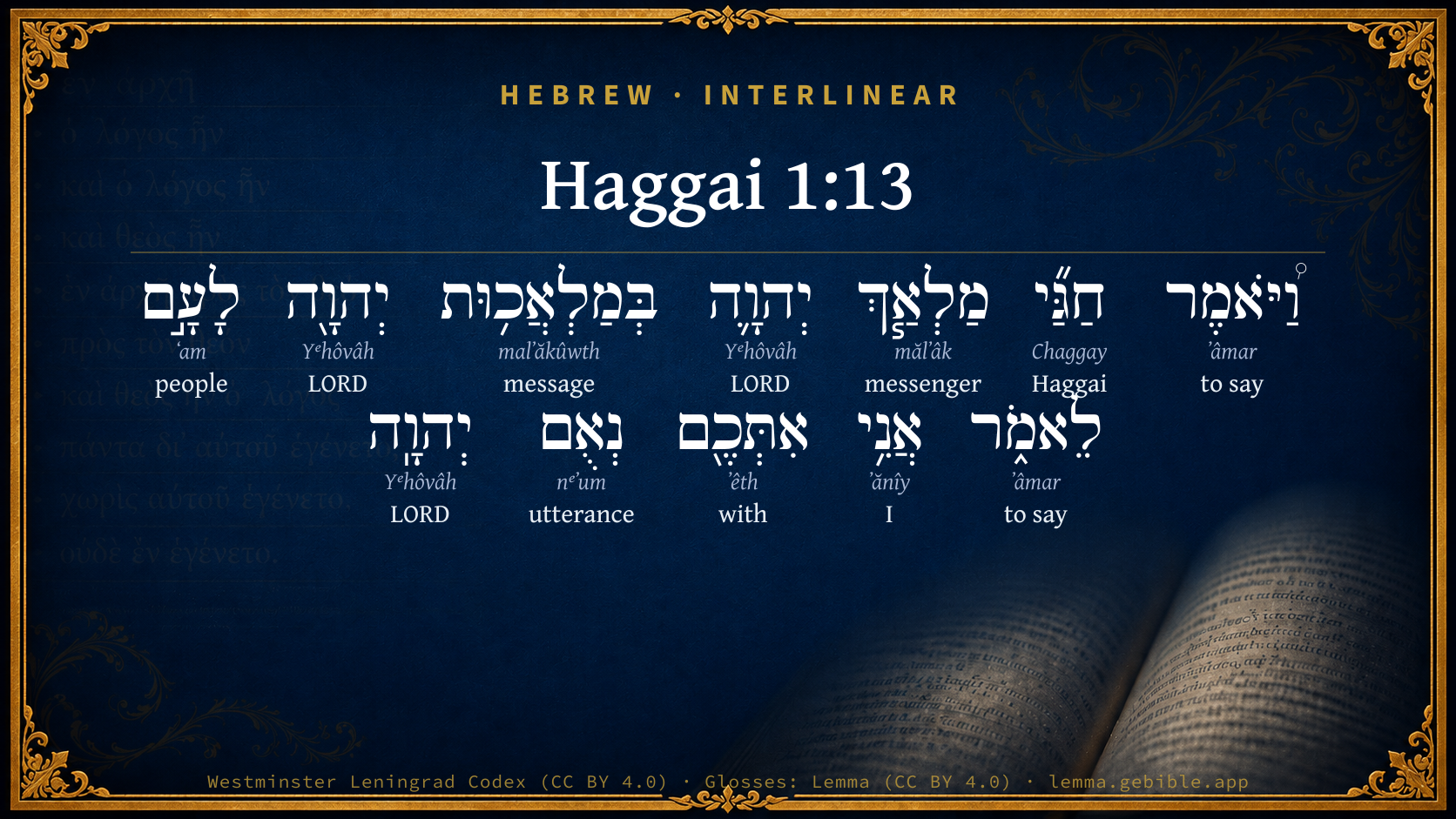
Hebrew (Westminster Leningrad Codex) Haggai 1:13 appears in the Hebrew Old Testament. The text above is from the Westminster Leningrad Codex. Each word links to its Strong’s number, a concise gloss, and parsing drawn from the Open Scriptures Hebrew Bible morphology. Click any word for its full Brown-Driver-Briggs (BDB) entry.
Download image
Cite this verse

Haggai 1:13 (World English Bible). Public Domain. Lemma interlinear Bible study tool, https://lemma.gebible.app/v/haggai/1/13.

Show BibTeX & RIS
BibTeX
RIS
English Translation
Then Haggai, Yahweh's messenger, spoke in Yahweh's message to the people, saying, "I am with you," says Yahweh.
World English Bible · Public Domain
Highlights
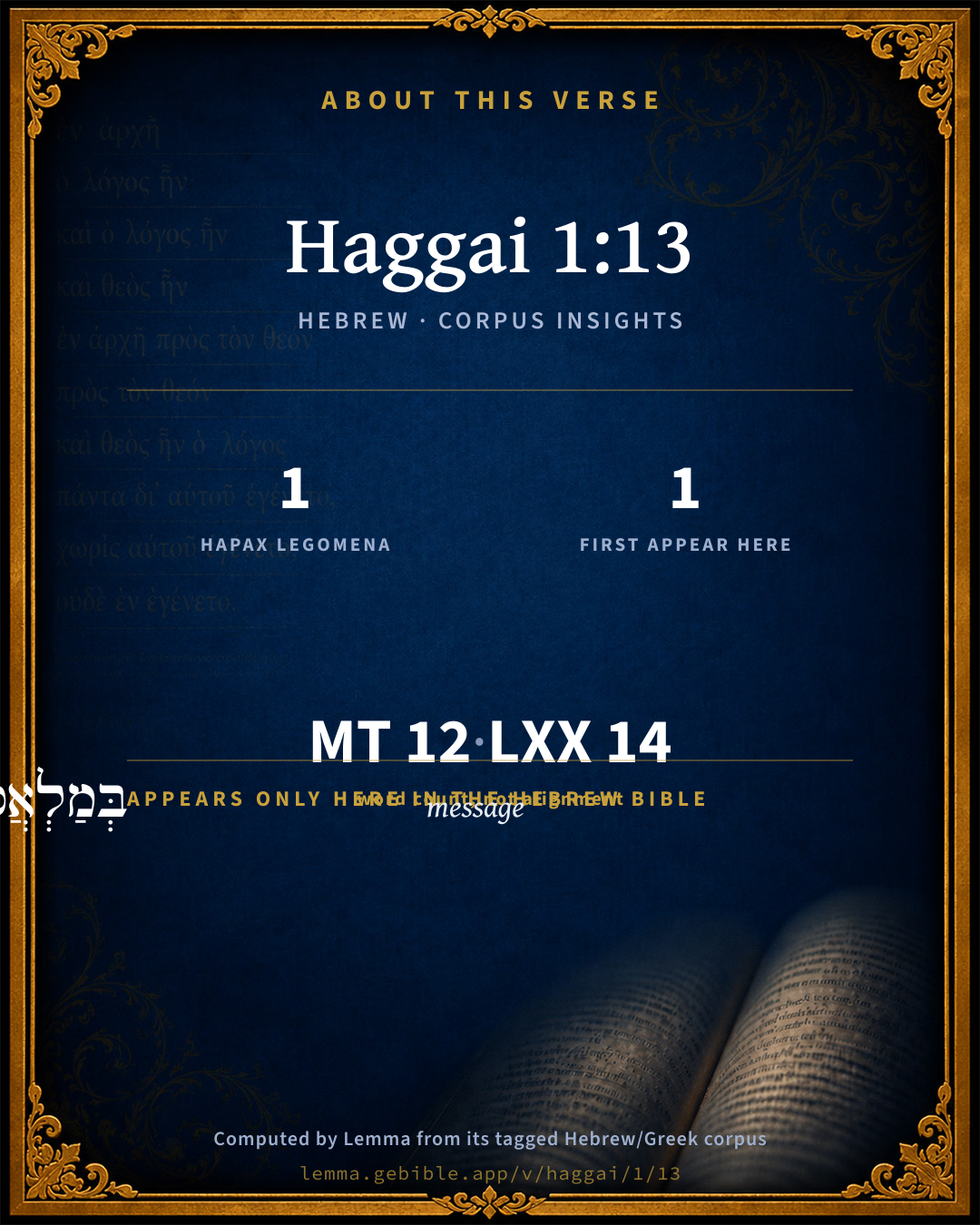
  • 1 hapax legomenon — only here in the Hebrew Bible
  • 1 first appearance in the Hebrew Bible
Full analysis ↓
Download a study sheet

One document with this verse’s original text, its word-by-word gloss line, the meaning frame, cross-references with their text, attributed commentary, and full source and license credits — printable, and it pastes into notes with its structure intact.

This verse Autodidact and up

Study sheet (.html) Plain text (.txt)

A passage Seminary Student

Up to 50 verses in one chapter. A passage sheet keeps up to 6 commentary sources and 12 cross-references per verse, in the order this page ranks them, and says so on the sheet whenever that leaves anything out. Ask for a single verse and you get the Autodidact verse sheet above.

Everything on this page stays free to read, with no account — the sheet is a download of what is already on screen, not access to it.

Want to remove ads? Support Godless Engineer
Compare translations 3

The same verse in 3 English versions, stacked beneath the original-language interlinear above. Click any original word for its lexicon entry.

Each is an independent rendering of the whole verse — the interlinear is not word-aligned to these translations.

Highlighted words mark where these versions differ — a whole-verse word diff, not a word-by-word alignment.

  • World English Bible Public Domain
    Then Haggai, Yahweh's messenger, spoke in Yahweh's message to the people, saying, "I am with you," says Yahweh.
  • King James Version Public Domain
    Then spake Haggai the LORD's messenger in the LORD's message unto the people, saying, I am with you, saith the LORD.
  • unfoldingWord Literal Text CC BY-SA 4.0
    Then Haggai, the messenger of Yahweh, spoke the message of Yahweh to the people, saying, “‘I with you!’—the declaration of Yahweh.”

unfoldingWord Literal Text — © unfoldingWord, licensed CC BY-SA 4.0. Word-aligned USFM3 via Door43 (git.door43.org/unfoldingWord/en_ult).

Versions to compare (up to 4)

3 of 4 selected

Show all 18 translations

Every available English version of this verse, each an independent rendering of the whole verse.

  • World English Bible Public Domain
    Then Haggai, Yahweh's messenger, spoke in Yahweh's message to the people, saying, "I am with you," says Yahweh.
  • Berean Standard Bible Public Domain
    Haggai, the messenger of the LORD, delivered the message of the LORD to the people: “I am with you,” declares the LORD.
  • Majority Standard Bible Public Domain
    Haggai, the messenger of the LORD, delivered the message of the LORD to the people: “I am with you,” declares the LORD.
  • King James Version Public Domain
    Then spake Haggai the LORD's messenger in the LORD's message unto the people, saying, I am with you, saith the LORD.
  • American Standard Version (1901) Public Domain
    Then spake Haggai Jehovah's messenger in Jehovah's message unto the people, saying, I am with you, saith Jehovah.
  • Revised Version (1885) Public Domain
    Then spake Haggai the LORD’S messenger in the LORD’S message unto the people, saying, I am with you, saith the LORD.
  • Geneva Bible (1599) Public Domain
    Then spake Haggai the Lords messenger in the Lords message vnto the people, saying, I am with you, sayth the Lord.
  • Douay-Rheims (1899) Public Domain
    And Aggeus the messenger of the Lord, as one of the messengers of the Lord, spoke, saying to the people: I am with you, saith the Lord.
  • Young's Literal Translation Public Domain
    And Haggai, messenger of Jehovah, in messages of Jehovah, speaketh to the people, saying: `I `am' with you, an affirmation of Jehovah.'
  • Literal Standard Version CC BY-SA 4.0
    And Haggai, messenger of YHWH, in messages of YHWH, speaks to the people, saying, “I [am] with you, a declaration of YHWH.”
  • Unlocked Literal Bible CC BY-SA 4.0
    Then Haggai, the messenger of Yahweh, spoke Yahweh's message to the people and said, “I am with you!—this is Yahweh's declaration!”
  • unfoldingWord Literal Text CC BY-SA 4.0
    Then Haggai, the messenger of Yahweh, spoke the message of Yahweh to the people, saying, “‘I with you!’—the declaration of Yahweh.”
  • Darby Bible Public Domain
    Then spoke Haggai, Jehovah's messenger, in Jehovah's message unto the people, saying, I am with you, saith Jehovah.
  • World Messianic Bible Public Domain
    Then Haggai, the LORD’s messenger, spoke the LORD’s message to the people, saying, “I am with you,” says the LORD.
  • Webster's Bible Public Domain
    Then spoke Haggai the LORD'S messenger in the LORD'S message to the people, saying, I am with you, saith the LORD.
  • Free Bible Version CC BY-SA 4.0
    Then Haggai, the Lord's messenger, delivered this message from the Lord telling the people, I am with you! says the Lord.
  • Bible in Basic English Public Domain
    Then Haggai, whom the Lord had sent to give his words to the people, said, I am with you, says the Lord.
  • JPS Tanakh (1917) Public Domain
    Then spoke Haggai the LORD'S messenger in the LORD'S message unto the people, saying: 'I am with you, saith the LORD.'

Literal Standard Version (2020), Covenant Press — licensed CC BY-SA 4.0. Text via the HelloAO Bible API (eBible.org). Unlocked Literal Bible (unfoldingWord) — licensed CC BY-SA 4.0. Text via the HelloAO Bible API (eBible.org). unfoldingWord Literal Text — © unfoldingWord, licensed CC BY-SA 4.0. Word-aligned USFM3 via Door43 (git.door43.org/unfoldingWord/en_ult). Free Bible Version, Dr. Jonathan Gallagher — licensed CC BY-SA 4.0. Text via the HelloAO Bible API (eBible.org).

Word by word

More ways to search: Search by grammar → Find every occurrence → Compare this word →

Practice this passage: Drill this verse → Learn its vocabulary →

בְּמַלְאֲכ֥וּת
malʼăkûwth
H4400
“in/at · message of”
Preposition + Noun, Common, Feminine, Singular, Construct
Part of Speech
Preposition + Noun
Type
Common
Gender
Feminine
Number
Singular
State
Construct
Full BDB Definition

Origin: from the same as H4397

TWOT: 1068c

message
  1. וַ֠יֹּאמֶר ʼâmar H559 “and · to say” Conjunction + Verb, Qal, Sequential Imperfect, 3rd Person, Masculine, Singular
  2. חַגַּ֞י Chaggay H2292 “Haggai” Noun, Proper
  3. מַלְאַ֧ךְ mălʼâk H4397 “messenger of” Noun, Common, Masculine, Singular, Construct
  4. יְהוָ֛ה Yᵉhôvâh H3068 “LORD” Noun, Proper
  5. יְהוָ֖ה Yᵉhôvâh H3068 “LORD” Noun, Proper
  6. לָעָ֣ם ʻam H5971 “to/for the · people” Preposition, Determined + Noun, Common, Masculine, Singular, Absolute
  7. לֵאמֹ֑ר ʼâmar H559 “to say” Preposition + Verb, Qal, Infinitive Construct
  8. אֲנִ֥י ʼănîy H589 “I” Pronoun, Personal, 1st Person, Common, Singular
  9. אִתְּכֶ֖ם ʼêth H854 “with · you” Preposition + Suffix, Personal, 2nd Person, Masculine, Plural
  10. נְאֻם nᵉʼum H5002 “utterance of” Noun, Common, Masculine, Singular, Construct
  11. יְהוָֽה Yᵉhôvâh H3068 “LORD” Noun, Proper

About this verse

These counts appear in no published source. They are computed here, from the morphology-tagged text and Lemma’s own curated glosses. What Lemma adds →

12
words
9
distinct lemmas
Prophets
section

Notable vocabulary

1 hapax legomenon — a word that appears only here in the entire Hebrew Bible:

  • בְּמַלְאֲכ֥וּת message H4400

First appearance in Scripture

This word makes its first canonical appearance in the Hebrew Bible here:

  • בְּמַלְאֲכ֥וּת message H4400

Shared distinctive vocabulary

חַגַּ֞י Haggai H2292 occurs in 11 verses of the Hebrew Bible. Also found in:

Grammatical profile

  • 2 verbs
  • 8 nouns
  • 1 pronoun
  • 1 preposition

Verb forms

  • וַ֠יֹּאמֶר Qal · Sequential Imperfect
  • לֵאמֹ֑ר Qal · Infinitive Construct

Repetition

Words recur within this verse — often emphatic in Hebrew:

  • יְהוָ֛ה LORD H3068 ×3
  • וַ֠יֹּאמֶר to say H559 ×2

Hebrew & Septuagint length

In English translation the verse runs 18 words from the Hebrew and 23 from the Septuagint (LXX English) — closely comparable.

A rough comparison of the two English renderings, which tokenize alike — not a word-level alignment.

Word counts can differ between the Hebrew and the Greek without any difference in meaning — e.g. the Hebrew direct-object marker אֵת has no separate Greek word, and Greek often adds the article ὁ.

In the original languages it is 12 Hebrew tokens and 14 Greek tokens — but the two are counted differently (Hebrew bundles its prefixes and suffixes into one token; the Greek is in lemma form), so that isn’t a like-for-like length.

Cross-references

26

Topical passages linked to Haggai 1:13 in the Treasury of Scripture Knowledge — connected by theme and wording, ordered by reader-vote popularity; previews shown in the World English Bible.

  • Isaiah 43:2 When you pass through the waters, I will be with you; and through the rivers, they shall not overflow you: when you walk through the fire, you shall not be burned, neither shall the flame kindle on you.
  • Matthew 28:20 teaching them to observe all things that I commanded you. Behold, I am with you always, even to the end of the age." Amen.
  • Romans 8:31 What then shall we say about these things? If God is for us, who can be against us?
  • Psalms 46:11 Yahweh of Hosts is with us. The God of Jacob is our refuge. Selah.
  • Isaiah 41:10 Don't you be afraid, for I am with you; don't be dismayed, for I am your God; I will strengthen you; yes, I will help you; yes, I will uphold you with the right hand of my righteousness.
  • Haggai 2:4 Yet now be strong, Zerubbabel,' says Yahweh. 'Be strong, Joshua, son of Jehozadak, the high priest. Be strong, all you people of the land,' says Yahweh, 'and work, for I am with you,' says Yahweh of Hosts.
  • Malachi 3:1 "Behold, I send my messenger, and he will prepare the way before me; and the Lord, whom you seek, will suddenly come to his temple; and the messenger of the covenant, whom you desire, behold, he comes!" says Yahweh of hosts.
  • Acts 18:9–10 The Lord said to Paul in the night by a vision, "Don't be afraid, but speak and don't be silent;
  • 2 Chronicles 20:17 You shall not need to fight in this [battle]: set yourselves, stand you still, and see the salvation of Yahweh with you, O Judah and Jerusalem; don't be afraid, nor be dismayed: tomorrow go out against them: for Yahweh is with you.
  • 2 Chronicles 32:8 with him is an arm of flesh; but with us is Yahweh our God to help us, and to fight our battles. The people rested themselves on the words of Hezekiah king of Judah.
  • Psalms 46:7 Yahweh of Hosts is with us. The God of Jacob is our refuge. Selah.
  • Jeremiah 15:20 I will make you to this people a fortified brazen wall; and they shall fight against you, but they shall not prevail against you; for I am with you to save you and to deliver you, says Yahweh.
  • Jeremiah 20:11 But Yahweh is with me as an awesome mighty one: therefore my persecutors shall stumble, and they shall not prevail; they shall be utterly disappointed, because they have not dealt wisely, even with an everlasting dishonor which shall never be forgotten.
  • Jeremiah 30:11 For I am with you, says Yahweh, to save you: for I will make a full end of all the nations where I have scattered you, but I will not make a full end of you; but I will correct you in measure, and will in no way leave you unpunished.
  • Malachi 2:7 For the priest's lips should keep knowledge, and they should seek the law at his mouth; for he is the messenger of Yahweh of Hosts.
  • Matthew 1:23 "Behold, the virgin shall be with child, And shall bring forth a son. They shall call his name Immanuel;" Which is, being interpreted, "God with us."
  • Matthew 18:20 For where two or three are gathered together in my name, there I am in the midst of them."
  • 2 Timothy 4:17 But the Lord stood by me, and strengthened me, that through me the message might be fully proclaimed, and that all the Gentiles might hear; and I was delivered out of the mouth of the lion.
  • Isaiah 44:26 who confirms the word of his servant, and performs the counsel of his messengers; who says of Jerusalem, She shall be inhabited; and of the cities of Judah, They shall be built, and I will raise up the waste places of it;
  • Ezekiel 3:17 Son of man, I have made you a watchman to the house of Israel: therefore hear the word at my mouth, and give them warning from me.
  • Judges 2:1 The angel of Yahweh came up from Gilgal to Bochim. He said, I made you to go up out of Egypt, and have brought you to the land which I swore to your fathers; and I said, I will never break my covenant with you:
  • 2 Chronicles 15:2 and he went out to meet Asa, and said to him, Hear you me, Asa, and all Judah and Benjamin: Yahweh is with you, while you are with him; and if you seek him, he will be found of you; but if you forsake him, he will forsake you.
  • Isaiah 8:8–10 and it shall sweep onward into Judah; it shall overflow and pass through; it shall reach even to the neck; and the stretching out of its wings shall fill the breadth of your land, Immanuel.
  • Isaiah 42:19 Who is blind, but my servant? or deaf, as my messenger whom I send? Who is blind as he who is at peace, and blind as Yahweh's servant?
  • 2 Corinthians 5:20 We are therefore ambassadors on behalf of Christ, as though God were entreating by us. We beg you on behalf of Christ, be reconciled to God.
  • 2 Timothy 4:22 The Lord Jesus Christ be with your spirit. Grace be with you. Amen.

Cross-references courtesy of OpenBible.info (CC BY 4.0).

Hebrew and Greek witnesses Masoretic Hebrew ↔ Greek Septuagint

The same verse in the two great witnesses to the Old Testament, shown verse-for-verse.

These are two independent witnesses, not word-aligned to each other, and the Septuagint is shown in lemma (dictionary) form.

Hebrew Haggai 1:13 Masoretic · Westminster Leningrad Codex

וַ֠יֹּאמֶר חַגַּ֞י מַלְאַ֧ךְ יְהוָ֛ה בְּמַלְאֲכ֥וּת יְהוָ֖ה לָעָ֣ם לֵאמֹ֑ר אֲנִ֥י אִתְּכֶ֖ם נְאֻם יְהוָֽה

Then Haggai, Yahweh's messenger, spoke in Yahweh's message to the people, saying, "I am with you," says Yahweh.

World English Bible · Public Domain

Greek LXX Haggai 1:13 Septuagint · lemma form

καί εἶπον αγγαιος ὁ ἄγγελος κύριος ὁ λαός ἐγώ εἰμί μετά σύ λέγω κύριος

And Aggaeus the Lord's messenger spoke among the messengers of the Lord to the people, saying, I am with you, says the Lord.

LXX2012 (modern English Septuagint) · Public Domain

On this verse, Keil & Delitzsch discusses the Septuagint’s reading. Read the note in Commentary ↓

Hebrew: Westminster Leningrad Codex (CC BY 4.0). Greek: Septuagint (public domain); English from LXX2012 (modern English Septuagint) (Public Domain). How the Septuagint differs from the Hebrew →

Targum (Aramaic paraphrase)

1

The Targum is the ancient Jewish Aramaic paraphrase of the Hebrew Scriptures — an interpretive translation, not the Hebrew text itself. Onkelos (literal) and Pseudo-Jonathan (expansive) render the Torah, and Jonathan the Prophets. Coverage is partial: where no permissively-licensed English translation exists for a verse, only the Aramaic is shown. This is verse-level text, not a word-by-word alignment to the Hebrew.

  1. Targum Jonathan Prophets (Joshua–Malachi)
    וַאֲמַר חַגַי נְבִיָא דַייָ בִּשְׁלוּחֵית מִן קֳדָם יְיָ לְעַמָא לְמֵימַר מֵימְרִי בְּסַעְדְכוֹן אֲמַר יְיָ:

    (no public-domain English translation for this verse)

    Targum Jonathan — Aramaic: “Mikraot Gedolot” (public domain). English: “Sefaria Community Translation” (CC0 1.0 (public-domain dedication)); “London "Chaldee Paraphrase," 1871” (public domain). Text via Sefaria.

Commentary

Notes on Haggai 1:13 from classic Christian and Jewish commentators (each source and its license shown beneath its notes). The classic Christian expositions comment on the surrounding passage and are grouped to its opening verse, so a note may address several verses; the Jewish commentaries on the Tanakh (Rashi and others) are per-verse, so they appear only where the commentator wrote on this verse.

Lemma curates 59 commentaries, every one of them public domain or Creative Commons licensed, each selected and text-cleaned for this edition rather than reprinted as found. About our sources →

Trapp's Complete Commentary

John Trapp

Hag 1:13 Then spake Haggai the LORD’S messenger in the LORD’S message unto the people, saying, I [am] with you, saith the LORD.

Ver. 13. Then spake Haggai the Lord’s messenger] Or angel. {See Trapp on "Mal 1:1"} (Then speaks) Namely, on the four and twentieth day of the month, as it is in the last verse; until which day they had been building for three weeks together. But Governor Tatnai and his complices came upon them, and discouraged the people and hindered the work, Ezr 5:6; Ezr 5:8. It was but needful, therefore, that God’s command should be repeated, and a special promise added, "I am with you," saith the Lord. Where we may well take up that of Cicero concerning Brutus’ laconical epistle, Quam multa, quam paucis! how much in a little. "I am with you," saith the Lord, you need not therefore fear what man can do unto you. God is all-sufficient to those that are altogether his, see 2Ch 15:2. The Church is called Jehovah Shammah, that is, "The Lord is there," Eze 48:35 "God is in the midst of her, she shall not be moved," Psa 46:5. Immota manet may better be her motto than Venice’s. She is surely invincible, Zec 12:5-7, as having a mighty champion, even the Holy One of Israel; and this makes her (though but a virgin) to laugh to scorn her proudest enemies; yea, to shake her head at them, Isa 37:22-23, as rather to be pitied than envied. There were they in great fear (saith David, of the Church’s enemies); for what reason? God is in the generation of the righteous, Psa 14:5 Hence those Philistines were so woe-begone, 1Sa 4:7. And the Eygptians no less, Exo 14:25. Let us flee, say they, from the face of Israel; for the Lord fights for them. "What shall we then say to these things?" saith Paul (who had often heard when he was in the enemy’s hand, Fear not, I am with thee), "If God be for us, who can be against us?" who dare be so fool-hardy, so ambitious of his own destruction? Hath ever any waxed fierce against God and prospered? Job 9:4. Where is Pharaoh, Nero, Nebuchadnezzar, &c.? Was it safe for these or any other to provoke the Lord to anger? were they stronger than he? Oh that men would (according to Solomon’s counsel) meddle with their match, and not contend with him that is mightier than they! Can God be with his people and see them abused to his face? Will they force the queen also before him in the house, Est 7:8. Will they, giant-like, fight against God? will they needs touch the apple of his eye, that tenderest piece of the tenderest part? Will they invade his portion, plunder him of his jewels, pull the signet from his right hand? Surely God is so with his people, that as he taketh notice of the least courtesy done to them to reward it (even to a cup of cold water), so of the least affront or offence, to revenge it, be it but a frown or a frump, Gen 4:6 Num 12:10 "Better a millstone were hanged," &c. Better anger all the witches in the country than one of God’s zealous witnesses, Rev 11:5. Death cannot hurt them, Psa 23:3. Hell could no more hold them (the pains of hell got hold on David, but he was delivered, Psa 116:3) than the whale could hold Jonas; it must needs render them up again, because God is with them. Now I had rather be in hell (said Luther) with God than in heaven without him, and it were far safer for me.

John Trapp, A Commentary or Exposition upon All the Books of the Old and New Testament (1647–1656) — public domain. Text from a community e-Sword module.

The Biblical Illustrator

Joseph S. Exell

Hag_1:13

Then spake Haggai, the Lords messenger, in the Lords message unto the people.

The message of Jehovah

This means in his official capacity as a messenger or ambassador of Jehovah, with the authority of Him in whose name he spake. There is something very beautiful in the sudden change of tone manifest in the message of God. The people had not yet begun to work, but as soon as they showed a disposition to do so, the stern and reproving tone of God is changed for one of the most exquisite tenderness. It is as if He hastened to forget their former unfaithfulness, and to assure them that, in spite of all, He was not only willing to be with them, but actually was with them as soon as their hearts turned towards Him. This presence of God is regarded rightly as being the highest blessing that could be bestowed on them, and the surest guarantee of success. They had the same jealous enemies yet round them that had arrested the work before, but God assures them that now He was with them, and nothing should be allowed again to hinder the work. (T. V. Moore, D. D.)

The Lords messenger proclaiming union

I. Jehovahs messenger. Ministers are messengers. It is not every man that gets into a pulpit that is a messenger. God only can appoint messengers.

II. The Lords message. Their message is one of mercy, of everlasting life. It is the Gospel. Salvation as the gift of God. Not of works. All boasting is excluded.

III. The message is to the people. Jehovahs elect are a peculiar people, a purchased people, a special people, elect and redeemed. We cannot tell who the elect are.

IV. The special message in the text. I am with you. Jehovah is always with His people, and has been, and will be so everlastingly. (J. J. West, M. A.)

The Biblical Illustrator, edited by Joseph S. Exell (c. 1880s–1900s) — public domain. Text from a community e-Sword module.

Whedon's Commentary on the Bible

Daniel D. Whedon

13. The “fear” can hardly be considered an evidence of a “penitential state of mind”; nevertheless the prophet saw that the indifference had been shaken and that a message of encouragement might prove effective.

Messenger — The prophet is called a messenger of Jehovah, because he is sent by him (12) to deliver his message.

In Jehovah’s message — The root of this noun is the same as that of “messenger,” and the phrase seems to mean “in the capacity of a messenger of Jehovah,” that is, not of his own accord.

I am with you — The task may seem difficult, but with Jehovah’s co-operation assured they need not fear (compare Hag_2:4; see on Zec_4:6-7). Some commentators question the originality of Hag_1:13, because (1) it interrupts the thought, Hag_1:14 being the natural continuation of Hag_1:12; (2) Haggai is not called a prophet, as elsewhere, but a messenger, which is thought to point to diversity of authorship.

Daniel D. Whedon (gen. ed.), Commentary on the Old and New Testaments (1874–1909) — public domain. Text from a community e-Sword module.

Keil & Delitzsch

C. F. Keil & F. Delitzsch

This penitential state of mind on the part of the people and their rulers was met by the Lord with the promise of His assistance, in order to elevate this disposition into determination and deed. Hag 1:13. "Then spake Haggai, the messenger of Jehovah, in the message of Jehovah to the people, thus: I am with you, is the saying of Jehovah. Hag 1:14. And Jehovah stirred up the spirit of Zerubbabel, and the spirit of Joshua, and the spirit of all the remnant of the nation; and they came and did work at the house of Jehovah of hosts, their God." The prophet is called מלאך in Hag 1:13, i.e., messenger (not "angel," as many in the time of the fathers misunderstood the word as meaning), as being sent by Jehovah to the people, to make known to them His will (compare Mal 2:7, where the same epithet is applied to the priest). As the messenger of Jehovah, he speaks by command of Jehovah, and not in his own name or by his own impulse. אני אתּכם, I am with you, will help you, and will remove all the obstacles that stand in the way of your building (cf. Hag 2:4). This promise Jehovah fulfilled, first of all by giving to Zerubbabel, Joshua, and the people, a willingness to carry out the work. העיר רוּח, to awaken the spirit of any man, i.e., to make him willing and glad to carry out His resolutions (compare Ch1 5:26; Ch2 21:16; Ezr 1:1, Ezr 1:5). Thus filled with joyfulness, courage, and strength, they began the work on the twenty-fourth day of the sixth month, in the second year of king Darius (Hag 1:15), that is to say, twenty-three days after Haggai had first addressed his challenge to them. The interval had been spent in deliberation and counsel, and in preparations for carrying out the work. In several editions and some few mss in Kennicott, in Tischendorf's edition of the lxx, in the Itala and in the Vulgate, Hag 1:15 is joined to the next chapter. But this is proved to be incorrect by the fact that the chronological statements in Hag 1:15 and Hag 2:1 are irreconcilable with one another. Hag 1:15 is really so closely connected with Hag 1:14, that it is rather to be regarded as the last clause of that verse.

Keil & Delitzsch — Biblical Commentary on the Old Testament (1861–1891) — public domain (CC PDM 1.0). Text via the HelloAO Bible API. (Old Testament only.)

Tyndale Open Study Notes

Tyndale Open Resources

1:13 Haggai’s unusual title as the Lord’s messenger (the same Hebrew phrase is often translated angel of the Lord) ascribes distinctive authority to Haggai as the Lord’s agent. • I am with you: This affirmed God’s covenant with the people of Judea, his personal presence, and his support in the building project (2:4-5; see Gen 26:3; Exod 3:12; Isa 41:10; 43:5; Jer 30:11).

Tyndale Open Study Notes — © Tyndale Open Resources, licensed CC BY-SA 4.0. Text via the HelloAO Bible API.

Jamieson, Fausset & Brown

Robert Jamieson, A. R. Fausset & David Brown

the Lord's messenger--so the priests (Mal 2:7) are called (compare Gal 4:14; Pe2 1:21).

in the Lord's message--by the Lord's authority and commission: on the Lord's embassage.

I am with you-- (Mat 28:20). On the people showing the mere disposition to obey, even before they actually set to work, God passes at once from the reproving tone to that of tenderness. He hastens as it were to forget their former unfaithfulness, and to assure them, when obedient, that He both is and will be with them: Hebrew, "I with you!" God's presence is the best of blessings, for it includes all others. This is the sure guarantee of their success no matter how many their foes might be (Rom 8:31). Nothing more inspirits men and rouses them from torpor, than, when relying on the promises of divine aid, they have a sure hope of a successful issue [CALVIN].

Jamieson, Fausset & Brown — Commentary Critical and Explanatory on the Whole Bible (1871) — public domain (CC PDM 1.0). Text via the HelloAO Bible API.

Adam Clarke's Commentary

Verse 13. Then spake Haggai] He was the Lord's messenger, and he came with the Lord's message, and consequently he came with authority. He is called מלאך יהוה malach Yehovah, the angel of Jehovah, just as the pastors of the seven Asiatic churches are called ANGELS of the Churches, Re 1:20.

I am with you, saith the Lord.] Here was high encouragement. What may not a man do when God is his helper?

Adam Clarke's Commentary on the Bible (1810–1826) — public domain. Text from a community e-Sword/MySword module.

John Calvin's Commentaries

The Prophet tells us here, that he had again roused the leaders as well as the common people; for except God frequently repeats his exhortations, our alacrity relaxes. Though then they had all attended to God’s command, it was yet necessary that they should be strengthened by a new promise: for men can be encouraged, and their indifference can be corrected, by no other means, to such a degree, as when God offers and promises his help. This, then, was the way in which they were now encouraged, I am with you. And experience sufficiently shows, that we never really and from the heart obey, except when we rely on his promises and hope for a happy success. For were God only to call us to our work, and were our hope doubtful, all our zeal would doubtless die away. We cannot then devote our services to God, except he supports and encourages us by promises. We also see, that it is not enough that God should speak once, and that we should once receive his word, but there is need that he should rouse us again and again; for the greatest ardor grows cold when no goads are applied.

And the Prophet makes known again his vocation, for he says, that he spake in the message of Jehovah, for he was his messenger. The word מלאך, malak, means a messenger; and as angels are called מלאכים, melakim, some foolish men have thought that Haggai was one of the celestial angels, clothed with the form of man: but this is a most frivolous conjecture; for priests, we know, are honored with this title in the second chapter of Malachi, Malachi 2:1, and God in many other places calls his Prophets messengers or ambassadors. There is, therefore, no doubt but that Haggai meant simply to testify, that he brought forward nothing presumptuously, but was a faithful dispenser of the word; for he knew that he was sent by God; and that he might attain attention, he was able justly to testify that his message came from heaven.

Hence he says, that he spake as a messenger of Jehovah in the message of Jehovah; that is, he spoke according to his calling, and not as a private individual, but as one who derived his authority from heaven, and could call to order the whole people; for he was to give way neither to the chief priest nor to Zerubbabel the ruler of the people, inasmuch as he was superior to them on this account, because he had a message which had been committed to him by God. We now then understand the design of the Prophet.

And we hence learn that there is no dignity which exempts us from obedience common to all, when God’s word is addressed to us. Doubtless Joshua the high priest was superior to all the rest in matters of religion, and he was the chief angel or messenger of the God of hosts; and yet he refused not to submit himself to God’s Prophet, for he understood that he was in a special manner appointed by God to this office. Zerubbabel, the governor of the people, followed also his example. Let us, then, know that God’s word is proclaimed under this condition, that no eminence, either in honor or in dignity, exempts us, as it were, by a sort of privilege, from the obligation of receiving it.

The Prophet at length adds, that the people hastened quickly to the work, because God had given encouragement to them all. He had lately spoken of the fruit of his doctrine; but he now declares that his voice had not so penetrated into the hearts of all, as though it had been of itself efficacious, but that it had been connected with the hidden influence of the Spirit.

And this passage is remarkable; for the Prophet includes both these things—that God allows not his word to be useless or unfruitful—and yet that this proceeds not from the diligence of men, but from the hidden power of the Spirit. The Prophet, then, did not fail in his efforts; for his labor was not in vain, but brought forth fruit. At the same time, that that saying might remain true,

‘He who plants and he who waters is nothing,’ (1 Corinthians 3:7,)

he says, that the Israelites were ready for the work, because the Lord roused them; Jehovah, he says, stirred up the spirit of Zerubbabel, the spirit of Joshua, and of the whole people. It is not right to restrict the influence of the Spirit to one thing only, as some do, who imagine that the Israelites were confirmed in their good resolution, as they say, having before spontaneously obeyed the word of God. These separate, without reason, what ought to be read in the Prophet as connected together. For God roused the spirit of Zerubbabel and of the whole people; and hence it was that they received the message of the Prophet, and were attentive to his words. Foolishly, then, do they imagine that the Israelites were led by their own free-will to obey the word of God, and then that some aid of the Holy Spirit followed, to make them firmly to persevere in their course. But the Prophet declared, in the first place, that his message was respectfully received by the people; and now he explains how it was, even because God had touched the hearts of the whole people.

And we ought to notice the expression, when it is said that the spirit of Zerubbabel and of all the people was stirred up. For much sloth, we know, prevailed, especially among the multitude. But as to Zerubbabel and Joshua, they were, as we have said, already willing, but delayed until the coldness under which they labored was reproved. But the Prophet here simply means, that they became thus obedient through the hidden impulse of God, and also that they were made firm in their purpose. God does not form new souls in us, when he draws us to his service; but changes what is wrong in us: for we should never be attentive to his word, were he not to open our ears; and there would be no inclination to obey, were he not to turn our hearts; in a word, both will and effort would immediately fail in us, were he not to add his gift of perseverance. Let us, then, know that Haggai’s labors produced fruits, because the Lord effectually touched the hearts of the people; for we indeed know that it is his special gift, that the elect are made disciples, according to that declaration,

‘No one comes to me, except my Father draw him.’ (John 6:44.)

It is therefore said that they came and did the work in the house of Jehovah

We may also hence learn, that no one is fit to offer sacrifices to God, or to do any other service, but he who has been moulded by the hidden operation of the Spirit. Willingly, indeed, we offer ourselves and our all to God, and build his temple; but whence is this voluntary action, except that the Lord subdues us, and thus renders us teachable and obedient? It is afterwards added—

John Calvin's Commentaries (1540-1563) — public domain. Text from the Calvin Translation Society English edition (1840s-50s) via the Christian Classics Ethereal Library (ccel.org). Calvin's coverage is partial (roughly two-thirds of the Bible); uncommented books and verses are honest gaps, never fabricated. The 19th-century editor's footnotes and remarks are omitted so the notes are faithfully Calvin's own voice.

Ellicott's Commentary for English Readers

(13) In the Lord’s message.—Or, on the Lord’s mission.

A Bible Commentary for English Readers, edited by Charles John Ellicott (1878–1897) — public domain. Text from a community e-Sword module.

The Cambridge Bible for Schools and Colleges

gen. ed. J. J. S. Perowne

13. messenger] The word is that commonly used for an angel in the O.T., but its first and proper meaning is messenger. In the same way in the N.T., the same word (ἄγγελος) is used generally in its restricted sense for an angel, and occasionally in its wider sense for a messenger (Luk_7:27; Luk_9:52; Jas_2:25). Haggai is the only prophet who uses this title of himself. It is, to say the least, doubtful whether Moses as a prophet is intended by it in Num_20:16. Malachi (“my angel or messenger”) has it for the only name by which we know him, and he uses it of the Jewish priest (Mal_2:7), and of John Baptist the forerunner of our Lord, and of our Lord Himself, “the messenger of the Covenant” (Mal_3:1).

I am with you] Lit. I with you. This short but all-sufficient promise, varied sometimes by the corresponding expression of faith, “God with us,” or by the record of its fulfilment, “Jehovah was with him,” shines out like a bright star in times of darkness and need to individual saints, and to the Church at large in the O.T. It is given to Jacob at Bethel at the outset of his journey (Gen_28:15); to Moses at the Bush, when called to be the deliverer of his people (Exo_3:12); to Joshua, when he took up for completion the unfinished work of Moses (Jos_1:5); to Jeremiah at his entrance on the difficult work of prophesying (Jer_1:8). It was fulfilled to Joseph when sold a slave into Egypt (Gen_39:2), and when made a prisoner there on a false accusation (ver. 21). It was the battle-cry of the Church when threatened with the invasion of the proud Assyrian (Isa_8:10), and the refrain of her song of victory when the Assyrian was overthrown (Psa_46:7; Psa_46:11). In the N. T. it finds its full accomplishment in Him who is “Emmanuel, God with us” (Mat_1:23). Here Haggai sums up the promise of all needful resources for the work, and protection from the jealous foes who had so long hindered it, and conveys the assurance of a prosperous issue in the few short words, “I with you, saith Jehovah.”

The Cambridge Bible for Schools and Colleges (gen. ed. J. J. S. Perowne; Cambridge University Press, 1878–1918) — public domain. Text from a community e-Sword module.

John Gill's Exposition

Then spoke Haggai the Lord's messenger,.... Which some render "angel"; hence sprung that notion, imbibed by some, that he was not a man, but an angel; whereas this only respects his office, being sent of God as an ambassador in his name with a message to his people: he now observing what effect his prophecy had upon the people; they being convinced of their sin, and terrified with the judgments of God upon them, and fearing that worse still would attend them; in order to revive their spirits and comfort them, spake the words unto them which follow: and this he did

in the Lord's message unto the people; not of his own head, nor out of the pity of his own heart merely; but as a prophet of the Lord, having a fresh message from him to carry a promise to them for their comfort and encouragement:

saying, I am with you, saith the Lord; to pardon their sins; to accept their persons; to remove his rod from them; to assist them in the work of building the temple, they were now willing to engage in; to protect them from their enemies, and to strengthen them to go on with the work till they had finished it; a short promise, but a very full one: it was saying much in a little, and enough to remove all their fears, to scatter all their doubts, and to bear them up, and through all discouragements.

John Gill's Exposition of the Whole Bible (1746–1763) — public domain (CC PDM 1.0). Text via the HelloAO Bible API.

Albert Barnes' Notes on the Bible

And Haggai, the Lord’s messenger - Malachi, whose own name was framed to express that he was “the Lord’s messenger,” and Haggai alone use the title, as the title of a prophet; perhaps as forerunners of the great prophet whom Malachi announced. Malachi also speaks of the priest, as Mal 2:7 “the messenger of the Lord of hosts,” and prophesies of John Baptist as Mal 3:1 “the messenger” of the Lord, who should go before His face. Haggai, as he throughout repeats that his words were God’s words, frames a new word to express, in the language of the New Testament; 2Co 5:20 that he had an embassy from God; “in the Lord’s message.”

I am with you - All the needs and longings of the creature are summed up in those two words, “I with you.” “Who art Thou and who am I? Thou, He Who Is; I, he who am not;” nothing, yea worse than nothing. Yet “if Rom 8:31, God be for us,” Paul asks, “who can be against us?” Our blessed Lord’s parting promise to the Apostles, and in them to the Church, was, Mat 28:20. “Lo I am with you alway, even to the end of the world.” The all-containing assurance goes beyond any particular promise of aid, as , “I will help you, and will protect you, so that your building shall have its completion.” This is one fruit of it , “since I am in the midst of you, no one shall be able to hinder your building.” But, more widely, the words bespeak “His” presence in love, who knows all our needs, and is Almighty to support and save us in all. So David says Psa 23:4, “when I walk through the valley of the shadow of death, I will fear no evil, for Thou art with me:” and God says by another Psa 91:15, I will be “with him in trouble,” and by Isaiah Isa 43:2, “When thou passest through the waters,” I will be “with thee.”

Albert Barnes' Notes on the Bible (1834–1885) — public domain. Text from a community e-Sword/MySword module.

Haydock's Catholic Bible Commentary

Messenger. To excite the people’s attention, Aggeus declares that he is sent by God, (Worthington) like the prophets of old. Some Jews have asserted (Calmet) that he, Malachias, [John] the Baptist, and Jacob, were angels incarnate. But let us leave (St. Jerome) these learned dreams. (Calmet) --- They have no better foundation than the ambiguity of malac, which signifies "an angel, or a messenger." (Haydock) --- With you. This is often repeated, to encourage the dejected people. (Menochius)

George Leo Haydock (1774–1849), Haydock's Catholic Family Bible and Commentary, 1859 edition — public domain. Excludes Psalms (Douay-Rheims chapter numbering differs from Protestant) and Deuterocanonical books (Catholic canon only).

Matthew Poole's English Annotations

Then; when the people showed their obedience, and the willingness of their minds, then God encourageth them by his prophet.

Messenger; legate or envoy, the Hebrew word signifieth also an angel; but this is not surf, clout to prove their opinion, who dream that Haggai was not a man, but an angel in the form of a man; the word here used (arising from a word that signifieth to send, and paraphrased by a word that primarily signifieth to send as messengers are sent) doth speak an angel from his office and work, as he ministereth before the Lord, and runneth swiftly on his errand; it speaketh not the nature or essence of angels, as they are spirits. The French version (which I use, printed at Rochelle, 1616) reads it, like ours, ambassador. So Haggai was God’s messenger or ambassador to his people; no angel.

In the Lord’s message; as becometh an ambassador. in the words of his master, so Haggai delivered the Lord’s message.

Unto the people; not excluding the governors; but the people are only mentioned, for that the prophet spake to the whole assembly, or because the Lord would encourage them most, who most needed encouragement.

I am with you; a great promise, and which contains all they can need or desire; it insureth God’s presence always with them, and his assistance always to them, and his blessing always upon them. He will be always for, as well as always with them, and then Tatnai, Shethar-bozhal, Sanballat, and all other conspirators with them, shall not prevail to hinder the work. Such a promise as this, see Exo 3:12; 4:11-13; Mat 28:20; Rom 8:31; 2Co 12:9.

Saith the Lord: this solemn attestation addeth weight to the promise.

Matthew Poole's English Annotations on the Holy Bible (1683–1685) — public domain. Text from a community e-Sword/MySword module.

The Pulpit Commentary

Then spake Haggai. God hastens to accept their repentance and to assure them of his protection. The Lord"s messenger. Haggai alone of the prophets uses this title of himself, implying that he came with authority and bearing a message from the Lord. (comp. Num_20:16, where the word "angel" is by some applied to Moses) Malachi"s very name expresses that he was the Lord"s messenger, and he uses the term of the priest, (Mal_2:7) and of John the Baptist, and of Messiah himself. (Mal_3:1) In the Lord"s message. (1Ki_13:18) In the special message of consolation which he was commissioned to deliver. The Septuagint rendering, ejn ajggeloiv Kuriou, "anong the angels of the Lord," led some to fancy that Haggai was an angel in human farm, which opinion is refuted by Jerome, in loc. I am with you. (Hag_2:4) A brief message comprised in two words, "I with you," yet full of comfort, promising God"s presence, protection, aid, and blessing. (comp. Gen_28:15 Gen_39:2; Jos_1:5; Jer_1:8; Mat_28:20)

The Pulpit Commentary (1880–1919), ed. H.D.M. Spence-Jones & Joseph S. Exell — public domain. Text from a community e-Sword module.

John Wesley's Explanatory Notes

In the Lord's message - ln the words of his master. The people - The whole assembly.

John Wesley, Explanatory Notes Upon the Whole Bible (1754–1765) — public domain. Text via the GEBible commentary corpus.

Rashi

Rabbi Shlomo Yitzchaki (Rashi)

in [fulfilling] the Lord’s mission In the messengership of the Omnipresent.

Rashi on the Tanakh — English translations: “The Judaica Press complete Tanach with Rashi, translated by A. J. Rosenberg” (CC BY 4.0); “Pentateuch with Rashi's commentary by M. Rosenbaum and A.M. Silbermann, 1929-1934” (public domain); “The Metsudah Tanach series, Lakewood, N.J” (CC BY 4.0); and “The Book of Joshua, Metsudah Publications, 1997” (CC BY 4.0). Text via Sefaria.

Lesson kit

Teaching starters — assembled from the data on this page, not authored interpretation. Every prompt links to the verse data it draws on. Edit before teaching.

Haggai, in the Prophets, opens this verse with 12 words (9 distinct Hebrew lemmas). Its most distinctive word is malʼăkûwth (“message”). A historical commentator’s framing appears above. Read the whole chapter for the surrounding context.

Discussion questions

  1. What does “message” (malʼăkûwth) contribute to the verse as a whole?
  2. This verse holds 1 word here found nowhere else in the Hebrew Bible. What might the rare word draw attention to?
  3. The word “message” first appears here in Scripture. What is being introduced at this debut?
  4. Ezra 5:1 shares the word «Haggai» with this verse. How do the two illuminate each other?
  5. “LORD” occurs 3× in this one verse. What is the effect of the repetition?
  6. These translations render this verse differently; the difference is in the English rendering, not the original. What questions does that raise?
  7. The verb «וַ֠יֹּאמֶר» is Qal Sequential Imperfect. How does its form color the action?
  8. Reading how Trapp's Complete Commentary and The Biblical Illustrator read this verse, where do the two commentators agree and where do they part?

Things to notice

  • 1 word in this verse appears nowhere else in the Hebrew Bible.
  • 1 word makes its first canonical appearance in Scripture here.
  • This verse counts 12 Hebrew ↔ 14 Greek words.
  • These translations choose different wording for 11 words in this verse.
  • “LORD” occurs 3× in this single verse.

Reading settings

Reading text

Shown beneath each verse's original-language words.

Old Testament
Old Testament edition

Read the OT as the Masoretic Hebrew (MT) or the Greek Septuagint (LXX).

English shown for the Greek Septuagint (in the Hebrew ↔ Greek comparison).

Comparing translations? Open the Compare panel on any verse page to stack up to four side by side.