Zechariah 4:5

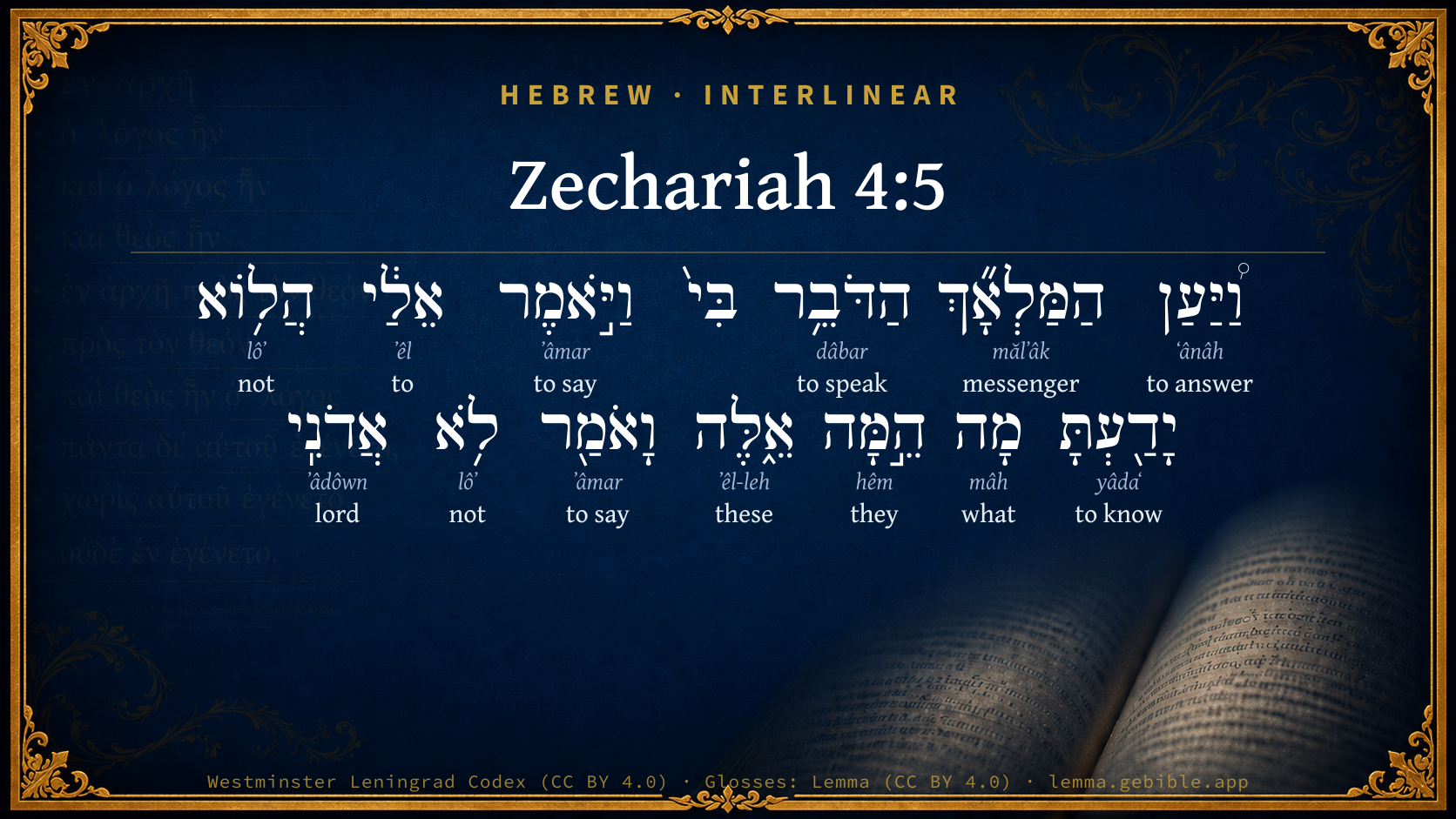
Hebrew (Westminster Leningrad Codex) Zechariah 4:5 appears in the Hebrew Old Testament. The text above is from the Westminster Leningrad Codex. Each word links to its Strong’s number, a concise gloss, and parsing drawn from the Open Scriptures Hebrew Bible morphology. Click any word for its full Brown-Driver-Briggs (BDB) entry.
Download image
Cite this verse

Zechariah 4:5 (World English Bible). Public Domain. Lemma interlinear Bible study tool, https://lemma.gebible.app/v/zechariah/4/5.

Show BibTeX & RIS
BibTeX
RIS
English Translation
Then the angel who talked with me answered me, "Don't you know what these are?" I said, "No, my lord."
World English Bible · Public Domain
Download a study sheet

One document with this verse’s original text, its word-by-word gloss line, the meaning frame, cross-references with their text, attributed commentary, and full source and license credits — printable, and it pastes into notes with its structure intact.

This verse Autodidact and up

Study sheet (.html) Plain text (.txt)

A passage Seminary Student

Up to 50 verses in one chapter. A passage sheet keeps up to 6 commentary sources and 12 cross-references per verse, in the order this page ranks them, and says so on the sheet whenever that leaves anything out. Ask for a single verse and you get the Autodidact verse sheet above.

Everything on this page stays free to read, with no account — the sheet is a download of what is already on screen, not access to it.

Want to remove ads? Support Godless Engineer
Compare translations 3

The same verse in 3 English versions, stacked beneath the original-language interlinear above. Click any original word for its lexicon entry.

Each is an independent rendering of the whole verse — the interlinear is not word-aligned to these translations.

Highlighted words mark where these versions differ — a whole-verse word diff, not a word-by-word alignment.

  • World English Bible Public Domain
    Then the angel who talked with me answered me, "Don't you know what these are?" I said, "No, my lord."
  • King James Version Public Domain
    Then the angel that talked with me answered and said unto me, Knowest thou not what these be? And I said, No, my lord.
  • unfoldingWord Literal Text CC BY-SA 4.0
    And the angel who was speaking with me answered and said to me, “Do you not know what these are?” And I said, “No, my lord.”

unfoldingWord Literal Text — © unfoldingWord, licensed CC BY-SA 4.0. Word-aligned USFM3 via Door43 (git.door43.org/unfoldingWord/en_ult).

Versions to compare (up to 4)

3 of 4 selected

Show all 18 translations

Every available English version of this verse, each an independent rendering of the whole verse.

  • World English Bible Public Domain
    Then the angel who talked with me answered me, "Don't you know what these are?" I said, "No, my lord."
  • Berean Standard Bible Public Domain
    “Do you not know what they are?” replied the angel. “No, my lord,” I answered.
  • Majority Standard Bible Public Domain
    “Do you not know what they are?” replied the angel. “No, my lord,” I answered.
  • King James Version Public Domain
    Then the angel that talked with me answered and said unto me, Knowest thou not what these be? And I said, No, my lord.
  • American Standard Version (1901) Public Domain
    Then the angel that talked with me answered and said unto me, Knowest thou not what these are? And I said, No, my lord.
  • Revised Version (1885) Public Domain
    Then the angel that talked with me answered and said unto me, Knowest thou not what these be? And I said, No, my lord.
  • Geneva Bible (1599) Public Domain
    Then the Angel that talked with mee, answered and said vnto me, Knowest thou not what these be? And I said, No, my Lord.
  • Douay-Rheims (1899) Public Domain
    And the angel that spoke in me answered, and said to me: Knowest thou not what these things are? And I said: No, my lord.
  • Young's Literal Translation Public Domain
    And the messenger who is speaking with me answereth and saith unto me, `Hast thou not known what these `are'?' And I say, `No, my lord.'
  • Literal Standard Version CC BY-SA 4.0
    And the messenger who is speaking with me answers and says to me, “Have you not known what these [are]?” And I say, “No, my lord.”
  • Unlocked Literal Bible CC BY-SA 4.0
    The angel who was talking with me answered and said to me, “Do you not know what these things mean?” I said, “No, my master.”
  • unfoldingWord Literal Text CC BY-SA 4.0
    And the angel who was speaking with me answered and said to me, “Do you not know what these are?” And I said, “No, my lord.”
  • Darby Bible Public Domain
    And the angel that talked with me answered and said unto me, Knowest thou not what these are? And I said, No, my lord.
  • World Messianic Bible Public Domain
    Then the angel who talked with me answered me, “Don’t you know what these are?” I said, “No, my lord.”
  • Webster's Bible Public Domain
    Then the angel that talked with me answered and said to me, Knowest thou not what these are? and I said, No, my lord.
  • Free Bible Version CC BY-SA 4.0
    “Don't you know what these are?” the angel replied. “No, my lord,” I responded.
  • Bible in Basic English Public Domain
    Then the angel who was talking to me, answering me, said, Have you no knowledge of what these are? And I said, No, my lord.
  • JPS Tanakh (1917) Public Domain
    Then the angel that spoke with me answered and said unto me: 'Knowest thou not what these are?' And I said: 'No, my lord.'

Literal Standard Version (2020), Covenant Press — licensed CC BY-SA 4.0. Text via the HelloAO Bible API (eBible.org). Unlocked Literal Bible (unfoldingWord) — licensed CC BY-SA 4.0. Text via the HelloAO Bible API (eBible.org). unfoldingWord Literal Text — © unfoldingWord, licensed CC BY-SA 4.0. Word-aligned USFM3 via Door43 (git.door43.org/unfoldingWord/en_ult). Free Bible Version, Dr. Jonathan Gallagher — licensed CC BY-SA 4.0. Text via the HelloAO Bible API (eBible.org).

Word by word

More ways to search: Search by grammar → Find every occurrence → Compare this word →

Practice this passage: Drill this verse → Learn its vocabulary →

הַמַּלְאָ֞ךְ
mălʼâk
H4397
“the · messenger”
Particle, Definite Article + Noun, Common, Masculine, Singular, Absolute
Part of Speech
Particle + Noun
Type
Common
Gender
Masculine
Number
Singular
State
Absolute
Full BDB Definition

Origin: from an unused root meaning to despatch as a deputy

TWOT: 1068a

messenger, representative - messenger - angel - the theophanic angel
  1. וַ֠יַּעַן ʻânâh H6030 “and · to answer” Conjunction + Verb, Qal, Sequential Imperfect, 3rd Person, Masculine, Singular
  2. הַדֹּבֵ֥ר dâbar H1696 “the · speaking” Particle, Definite Article + Verb, Qal, Participle Active, Masculine, Singular, Absolute
  3. וַיֹּ֣אמֶר ʼâmar H559 “and · to say” Conjunction + Verb, Qal, Sequential Imperfect, 3rd Person, Masculine, Singular
  4. אֵלַ֔י ʼêl H413 “to · me” Preposition + Suffix, Personal, 1st Person, Common, Singular
  5. הֲל֥וֹא lôʼ H3808 “not” Particle, Interrogative + Particle, Negative
  6. יָדַ֖עְתָּ yâdaʻ H3045 “to know” Verb, Qal, Perfect, 2nd Person, Masculine, Singular
  7. מָה mâh H4100 “what” Particle, Interrogative
  8. הֵ֣מָּה hêm H1992 “they” Pronoun, Personal, 3rd Person, Masculine, Plural
  9. אֵ֑לֶּה ʼêl-leh H428 “these” Pronoun, Demonstrative, Common, Plural
  10. וָאֹמַ֖ר ʼâmar H559 “and · to say” Conjunction + Verb, Qal, Sequential Imperfect, 1st Person, Common, Singular
  11. לֹ֥א lôʼ H3808 “not” Particle, Negative
  12. אֲדֹנִֽי ʼâdôwn H113 “lord · my” Noun, Common, Masculine, Singular, Construct + Suffix, Personal, 1st Person, Common, Singular

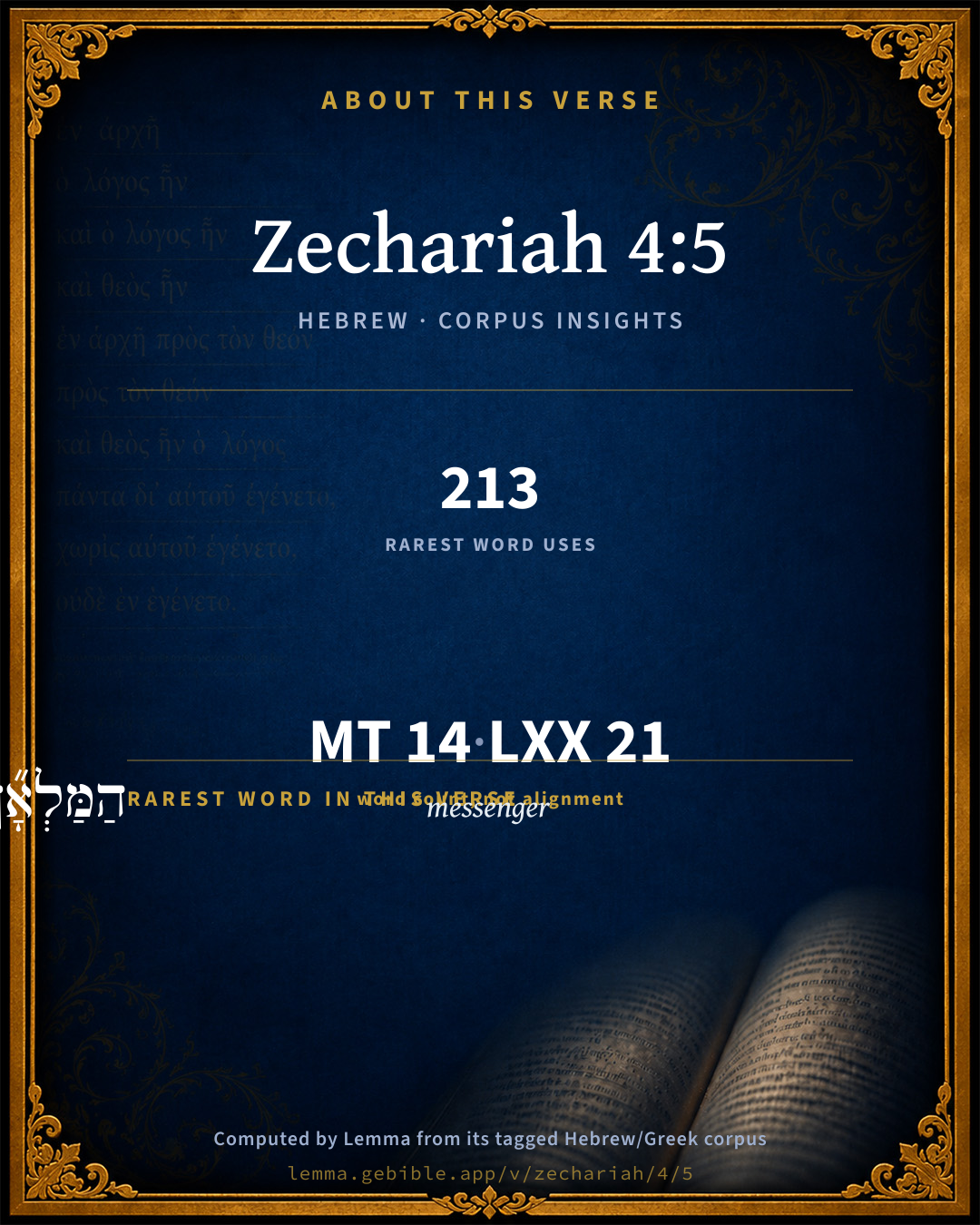
About this verse

These counts appear in no published source. They are computed here, from the morphology-tagged text and Lemma’s own curated glosses. What Lemma adds →

14
words
11
distinct lemmas
Prophets
section

Grammatical profile

  • 5 verbs
  • 2 nouns
  • 2 pronouns
  • 2 prepositions
  • 3 particles

Verb forms

  • וַ֠יַּעַן Qal · Sequential Imperfect
  • הַדֹּבֵ֥ר Qal · Participle Active
  • וַיֹּ֣אמֶר Qal · Sequential Imperfect
  • יָדַ֖עְתָּ Qal · Perfect
  • וָאֹמַ֖ר Qal · Sequential Imperfect

Repetition

Words recur within this verse — often emphatic in Hebrew:

  • וַיֹּ֣אמֶר to say H559 ×2
  • הֲל֥וֹא not H3808 ×2

Hebrew & Septuagint length

In English translation the verse runs 20 words from the Hebrew and 26 from the Septuagint (LXX English) — closely comparable.

A rough comparison of the two English renderings, which tokenize alike — not a word-level alignment.

Word counts can differ between the Hebrew and the Greek without any difference in meaning — e.g. the Hebrew direct-object marker אֵת has no separate Greek word, and Greek often adds the article ὁ.

In the original languages it is 14 Hebrew tokens and 21 Greek tokens — but the two are counted differently (Hebrew bundles its prefixes and suffixes into one token; the Greek is in lemma form), so that isn’t a like-for-like length.

Cross-references

7

Topical passages linked to Zechariah 4:5 in the Treasury of Scripture Knowledge — connected by theme and wording, ordered by reader-vote popularity; previews shown in the World English Bible.

  • Zechariah 4:13 He answered me, "Don't you know what these are?" I said, "No, my lord."
  • Mark 4:13 He said to them, "Don't you understand this parable? How will you understand all of the parables?
  • 1 Corinthians 2:12–15 But we received, not the spirit of the world, but the Spirit which is from God, that we might know the things that were freely given to us by God.
  • Genesis 41:16 Joseph answered Pharaoh, saying, "It isn't in me. God will give Pharaoh an answer of peace."
  • Psalms 139:6 This knowledge is beyond me. It's lofty. I can't attain it.
  • Daniel 2:30 But as for me, this secret is not revealed to me for any wisdom that I have more than any living, but to the intent that the interpretation may be made known to the king, and that you may know the thoughts of your heart.
  • Zechariah 1:9 Then I asked, 'My lord, what are these?'" The angel who talked with me said to me, "I will show you what these are."

Cross-references courtesy of OpenBible.info (CC BY 4.0).

Hebrew and Greek witnesses Masoretic Hebrew ↔ Greek Septuagint

The same verse in the two great witnesses to the Old Testament, shown verse-for-verse.

These are two independent witnesses, not word-aligned to each other, and the Septuagint is shown in lemma (dictionary) form.

Hebrew Zechariah 4:5 Masoretic · Westminster Leningrad Codex

וַ֠יַּעַן הַמַּלְאָ֞ךְ הַדֹּבֵ֥ר בִּי֙ וַיֹּ֣אמֶר אֵלַ֔י הֲל֥וֹא יָדַ֖עְתָּ מָה הֵ֣מָּה אֵ֑לֶּה וָאֹמַ֖ר לֹ֥א אֲדֹנִֽי

Then the angel who talked with me answered me, "Don't you know what these are?" I said, "No, my lord."

World English Bible · Public Domain

Greek LXX Zechariah 4:5 Septuagint · lemma form

καί ἀποκρίνω ὁ ἄγγελος ὁ λαλέω ἐν ἐγώ καί εἶπον πρός ἐγώ οὐ γιγνώσκω τίς εἰμί οὗτος καί εἶπον οὐ κύριος

And the angel that talked with me answered, and spoke to me, saying, Know you not what these things are? And I said, No, my lord.

LXX2012 (modern English Septuagint) · Public Domain

Hebrew: Westminster Leningrad Codex (CC BY 4.0). Greek: Septuagint (public domain); English from LXX2012 (modern English Septuagint) (Public Domain). How the Septuagint differs from the Hebrew →

Targum (Aramaic paraphrase)

1

The Targum is the ancient Jewish Aramaic paraphrase of the Hebrew Scriptures — an interpretive translation, not the Hebrew text itself. Onkelos (literal) and Pseudo-Jonathan (expansive) render the Torah, and Jonathan the Prophets. Coverage is partial: where no permissively-licensed English translation exists for a verse, only the Aramaic is shown. This is verse-level text, not a word-by-word alignment to the Hebrew.

  1. Targum Jonathan Prophets (Joshua–Malachi)
    וַאֲתִיב מַלְאֲכָא דְמַלֵיל עִמִי וַאֲמַר לִי הֲלָא יְדַעְתָּא מַן אִינוּן אִלֵין וַאֲמָרֵית לִי רִבּוֹנִי:

    (no public-domain English translation for this verse)

    Targum Jonathan — Aramaic: “Mikraot Gedolot” (public domain). English: “Sefaria Community Translation” (CC0 1.0 (public-domain dedication)); “London "Chaldee Paraphrase," 1871” (public domain). Text via Sefaria.

Commentary

Notes on Zechariah 4:5 from classic Christian and Jewish commentators (each source and its license shown beneath its notes). The classic Christian expositions comment on the surrounding passage and are grouped to its opening verse, so a note may address several verses; the Jewish commentaries on the Tanakh (Rashi and others) are per-verse, so they appear only where the commentator wrote on this verse.

Lemma curates 59 commentaries, every one of them public domain or Creative Commons licensed, each selected and text-cleaned for this edition rather than reprinted as found. About our sources →

Trapp's Complete Commentary

John Trapp

Zec 4:5 Then the angel that talked with me answered and said unto me, Knowest thou not what these be? And I said, No, my lord.

Ver. 5. Knowest thou not what these be?] Thus preparation is made to the ensuing interpretation of the vision by this dialogue; that we might give better heed to that manifold wisdom of God made known to and by the Church; wherein the very angels themselves are great students and daily proficients, Eph 3:10. Docent proficiendo, et docendo proficiunt. The best of men know not so much as they might have known. "Are ye also ignorant of these things" (saith our Saviour to the twelve)? "are ye also without understanding?" Mat 15:16 : what? know you not, six different times in one chapter, 1Co 6:2-3; 1Co 6:9; 1Co 6:15-16; 1Co 6:19 And how doth the apostle disgrace and shame his Hebrews for their dulness and doltishness, Heb 5:12. It was expected, it seems, by the angel here, that Zechariah, a master in Israel, should have known more than he did of the meaning of this candlestick, by Moses’s ancient candlestick. For the godly of those times did not believe those rites and ceremonies of the law did of themselves please God, or that they were dumb shows and insignificant, Heb 9:1-13, but they acknowledged them to be figures; the truth and signification whereof was to be sought in Christ. The ceremonial law was indeed their gospel.

And I said, No, my lord] An ingenuous confession of his ignorance; and this was far better than to plead for it (as many today), or to pretend more skill than he had; that he at least might seem to be somebody. Ignorantiam meam non ignoro, saith Origen. Though I know little else, yet this I know, that it is but little that I know. And not only in innumerable other things am I ignorant, saith Austin; but even in the very Scriptures also, my chief study, multo plura nescio quam scio, I am to seek many more things than I understand. Surely, saith Agur, I am more brutish than any man, and yet he had commerce with Ithiel and Ucal; Pro 30:1, and have not the understanding of a man, sc. of a man in Christ. I neither learned wisdom (though taught it) nor have the knowledge of the holy, that is, of the angels, as Dan 4:13; Dan 4:17; Dan 8:13. Zechariah here saw himself far short of the holy angel that talked with him; and therefore desireth to be taught by him.

John Trapp, A Commentary or Exposition upon All the Books of the Old and New Testament (1647–1656) — public domain. Text from a community e-Sword module.

Jamieson, Fausset & Brown

Robert Jamieson, A. R. Fausset & David Brown

Knowest thou not, &c.--Not a reproof of his ignorance, but a stimulus to reflection on the mystery.

No, my lord--ingenious confession of ignorance; as a little child he casts himself for instruction at the feet of the Lord.

Jamieson, Fausset & Brown — Commentary Critical and Explanatory on the Whole Bible (1871) — public domain (CC PDM 1.0). Text via the HelloAO Bible API.

John Calvin's Commentaries

He calls the angel his Lord, according to the custom of the Jews; for they were wont thus to address those who were eminent in power, or in anything superior. He did not call him Lord with the intention of transferring to him the glory of God; but he thus addressed him only for the sake of honor. And here again we are reminded, that if we desire to become proficient in the mysteries of God, we must not arrogate any thing to ourselves; for here the Prophet honestly confesses his own want of knowledge. And let us not at this day be ashamed to lie down at God’s feet, that he may teach us as little children; for whosoever desires to be God’s disciple must necessarily be conscious of his own folly, that is, he must come free from a conceit of his own acumen and wisdom, and be willing to be taught by God.

John Calvin's Commentaries (1540-1563) — public domain. Text from the Calvin Translation Society English edition (1840s-50s) via the Christian Classics Ethereal Library (ccel.org). Calvin's coverage is partial (roughly two-thirds of the Bible); uncommented books and verses are honest gaps, never fabricated. The 19th-century editor's footnotes and remarks are omitted so the notes are faithfully Calvin's own voice.

John Gill's Exposition

Then the angel that talked with me answered and said unto me,.... Either to upbraid him with his ignorance and stupidity; or rather to quicken his attention, and that of others, to the interpretation of it he was about to give him:

Knowest thou not what these be? art thou ignorant of the design of them? or knowest thou not what is meant by them?

and I said, No, my lord; he made an ingenuous confession of his ignorance, joined with great respect unto, and veneration of, the angel that conversed with him.

John Gill's Exposition of the Whole Bible (1746–1763) — public domain (CC PDM 1.0). Text via the HelloAO Bible API.

Haydock's Catholic Bible Commentary

Are? Thou art a prophet, and art thou ignorant? (Menochius)

George Leo Haydock (1774–1849), Haydock's Catholic Family Bible and Commentary, 1859 edition — public domain. Excludes Psalms (Douay-Rheims chapter numbering differs from Protestant) and Deuterocanonical books (Catholic canon only).

Matthew Poole's English Annotations

Then; when the prophet had inquired into the meaning of these emblems.

The angel that talked with me: see Zec 1:19.

Knowest thou not? it is not a question either to upbraid the prophet as an ignoramus, Christ doth not reproach his for not knowing deep and dark mysteries at first sight of them; nor is it the question of one that was uncertain about the thing inquired into, Christ knew the prophet’s ignorance though he ask the question; but it is to excite him to attend and learn.

And I said, No; Zechariah freely confesseth he knew not, he pretends not to know what indeed he did not know.

My lord: he owns the greatness and sovereignty of Christ.

Matthew Poole's English Annotations on the Holy Bible (1683–1685) — public domain. Text from a community e-Sword/MySword module.

The Pulpit Commentary

Knowest thou not? The angel speaks not so much in surprise at the prophet"s slowness of comprehension (comp. Joh_3:10) as desirous of calling his most serious attention to the coming explanation.

The learner and the learned.

I THE SPIRIT OF THE LEARNER. Humility. The first thing to know, as the ancient sage said, is that we know nothing. Love of truth. For its own sake. To be sought for as hidden treasure with ardour and delight. Obedience. Not merely readiness to receive, but courage to act. Faithful carrying out of principles. Progress. Step by step, in the spirit of self-sacrifice "When first thine eyes unveil, give thy soul leave to do the like" (Vaughan). Study is like the heaven"s glorious sun, That will not be deep search"d with saucy looks; Small have continuous plodders ever won, Save base authority from others" books. (Shakespeare)

II THE SPIRIT OF THE LEARNED.

1. Wisdom. Not mere knowledge, but insight into character, and capacity to turn knowledge to the best account.

2. Kindness. Hence patience with ignorance and prejudice. Loving endeavour to give to others what has been good and a joy to themselves.

3. Faithfulness. Not hiding what should be told; not making compromises of principle; not striving for the mastery, but for the victory of truth.

4. Humility is as much the character of the learned as of the learner (cf. Newton likening himself to a child gathering shells). "Were man to live coeval with the sun, The patriarch-pupil would be learning still, And dying leave his lesson half unlearnt. F.

The Pulpit Commentary (1880–1919), ed. H.D.M. Spence-Jones & Joseph S. Exell — public domain. Text from a community e-Sword module.

Lesson kit

Teaching starters — assembled from the data on this page, not authored interpretation. Every prompt links to the verse data it draws on. Edit before teaching.

Zechariah, in the Prophets, opens this verse with 14 words (11 distinct Hebrew lemmas). Its most distinctive word is mălʼâk (“messenger”). A historical commentator’s framing appears above. Read the whole chapter for the surrounding context.

Discussion questions

  1. The word mălʼâk carries the sense “messenger.” How does it shape the verse?
  2. Zechariah 4:13 shares this passage’s theme. How do the two illuminate each other?
  3. “to say” occurs 2× in this one verse. What is the effect of the repetition?
  4. These translations render this verse differently. What is at stake in choosing one wording over another?
  5. The verb «וַ֠יַּעַן» is Qal Sequential Imperfect. How does its form color the action?
  6. Reading how Trapp's Complete Commentary and Jamieson, Fausset & Brown read this verse, where do the two commentators agree and where do they part?

Things to notice

Reading settings

Reading text

Shown beneath each verse's original-language words.

Old Testament
Old Testament edition

Read the OT as the Masoretic Hebrew (MT) or the Greek Septuagint (LXX).

English shown for the Greek Septuagint (in the Hebrew ↔ Greek comparison).

Comparing translations? Open the Compare panel on any verse page to stack up to four side by side.