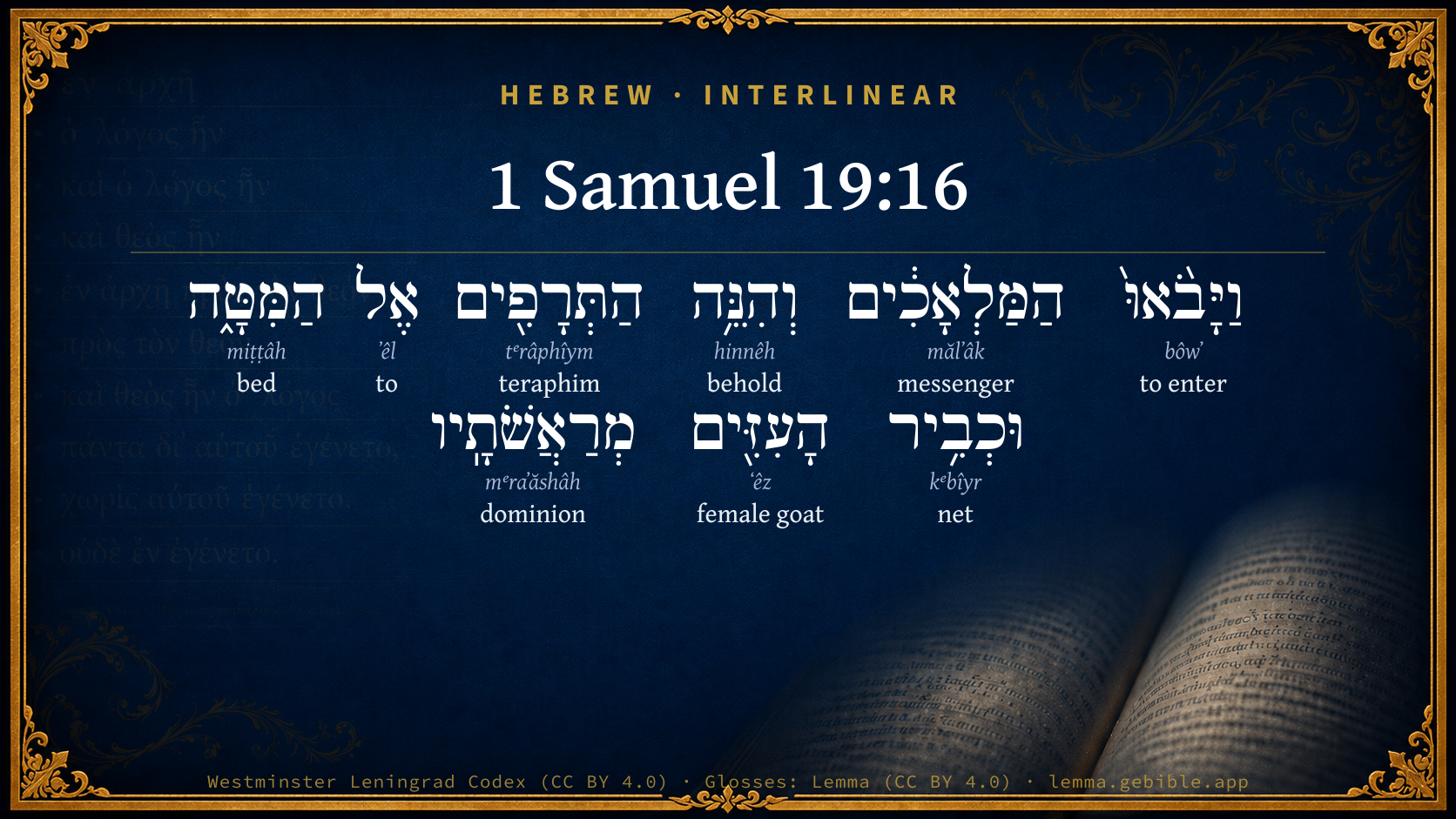
1 Samuel 19:16

Hebrew (Westminster Leningrad Codex) 1 Samuel 19:16 appears in the Hebrew Old Testament. The text above is from the Westminster Leningrad Codex. Each word links to its Strong’s number, a concise gloss, and parsing drawn from the Open Scriptures Hebrew Bible morphology. Click any word for its full Brown-Driver-Briggs (BDB) entry.
Download image
Cite this verse

1 Samuel 19:16 (World English Bible). Public Domain. Lemma interlinear Bible study tool, https://lemma.gebible.app/v/1-samuel/19/16.

Show BibTeX & RIS
BibTeX
RIS
English Translation
When the messengers came in, behold, the teraphim was in the bed, with the pillow of goats' [hair] at the head of it.
World English Bible · Public Domain
Download a study sheet

One document with this verse’s original text, its word-by-word gloss line, the meaning frame, cross-references with their text, attributed commentary, and full source and license credits — printable, and it pastes into notes with its structure intact.

This verse Autodidact and up

Study sheet (.html) Plain text (.txt)

A passage Seminary Student

Up to 50 verses in one chapter. A passage sheet keeps up to 6 commentary sources and 12 cross-references per verse, in the order this page ranks them, and says so on the sheet whenever that leaves anything out. Ask for a single verse and you get the Autodidact verse sheet above.

Everything on this page stays free to read, with no account — the sheet is a download of what is already on screen, not access to it.

Want to remove ads? Support Godless Engineer
Compare translations 3

The same verse in 3 English versions, stacked beneath the original-language interlinear above. Click any original word for its lexicon entry.

Each is an independent rendering of the whole verse — the interlinear is not word-aligned to these translations.

Highlighted words mark where these versions differ — a whole-verse word diff, not a word-by-word alignment.

  • World English Bible Public Domain
    When the messengers came in, behold, the teraphim was in the bed, with the pillow of goats' [hair] at the head of it.
  • King James Version Public Domain
    And when the messengers were come in, behold, there was an image in the bed, with a pillow of goats' hair for his bolster.
  • unfoldingWord Literal Text CC BY-SA 4.0
    And the messengers came, and behold, the teraphim on the bed, and the weaving of goats at its head.

unfoldingWord Literal Text — © unfoldingWord, licensed CC BY-SA 4.0. Word-aligned USFM3 via Door43 (git.door43.org/unfoldingWord/en_ult).

Versions to compare (up to 4)

3 of 4 selected

Show all 18 translations

Every available English version of this verse, each an independent rendering of the whole verse.

  • World English Bible Public Domain
    When the messengers came in, behold, the teraphim was in the bed, with the pillow of goats' [hair] at the head of it.
  • Berean Standard Bible Public Domain
    And when the messengers entered, there was the idol in the bed with the quilt of goats’ hair on its head.
  • Majority Standard Bible Public Domain
    And when the messengers entered, there was the idol in the bed with the goat hair on its head.
  • King James Version Public Domain
    And when the messengers were come in, behold, there was an image in the bed, with a pillow of goats' hair for his bolster.
  • American Standard Version (1901) Public Domain
    And when the messengers came in, behold, the teraphim was in the bed, with the pillow of goats' `hair' at the head thereof.
  • Revised Version (1885) Public Domain
    And when the messengers came in, behold, the teraphim was in the bed, with the pillow of goats’ hair at the head thereof.
  • Geneva Bible (1599) Public Domain
    And when the messengers were come in, behold, an image was in the bed, with a pillow of goates heare vnder the head of it.
  • Douay-Rheims (1899) Public Domain
    And when the messengers were come in, they found an image upon the bed, and a goat's skin at its head.
  • Young's Literal Translation Public Domain
    And the messengers come in, and lo, the teraphim `are' on the bed, and the mattress of goats' `hair', `for' his pillows.
  • Literal Standard Version CC BY-SA 4.0
    And the messengers come in, and behold, the teraphim [are] on the bed, and the mattress of goats’ [hair for] his pillows.
  • Unlocked Literal Bible CC BY-SA 4.0
    When the messengers came in, behold, the household idol was in the bed along with the pillow of goats' hair at its head.
  • unfoldingWord Literal Text CC BY-SA 4.0
    And the messengers came, and behold, the teraphim on the bed, and the weaving of goats at its head.
  • Darby Bible Public Domain
    And the messengers came in, and behold, the image was in the bed, and the net of goats' [hair] at its head.
  • World Messianic Bible Public Domain
    When the messengers came in, behold, the teraphim was in the bed, with the pillow of goats’ hair at its head.
  • Webster's Bible Public Domain
    And when the messengers had come in, behold, there was an image in the bed, with a pillow of goat's hair for his bolster.
  • Free Bible Version CC BY-SA 4.0
    But when the messengers went into the bedroom, there was the idol in the bed with the goat hair wig on its head.
  • Bible in Basic English Public Domain
    And when the men came in, there was the image in the bed, with the cushion of goat's hair at its head
  • JPS Tanakh (1917) Public Domain
    And when the messengers came in, behold, the teraphim was in the bed, with the quilt of goats' hair at the head thereof.

Literal Standard Version (2020), Covenant Press — licensed CC BY-SA 4.0. Text via the HelloAO Bible API (eBible.org). Unlocked Literal Bible (unfoldingWord) — licensed CC BY-SA 4.0. Text via the HelloAO Bible API (eBible.org). unfoldingWord Literal Text — © unfoldingWord, licensed CC BY-SA 4.0. Word-aligned USFM3 via Door43 (git.door43.org/unfoldingWord/en_ult). Free Bible Version, Dr. Jonathan Gallagher — licensed CC BY-SA 4.0. Text via the HelloAO Bible API (eBible.org).

Word by word

More ways to search: Search by grammar → Find every occurrence → Compare this word →

Practice this passage: Drill this verse → Learn its vocabulary →

וּכְבִ֥יר
kᵉbîyr
H3523
“and · net of”
Conjunction + Noun, Common, Masculine, Singular, Construct
Part of Speech
Conjunction + Noun
Type
Common
Gender
Masculine
Number
Singular
State
Construct
Full BDB Definition

Origin: from H3527 in the original sense of plaiting

TWOT: 948a

(something) netted, a quilt, fly net, pillow
  1. וַיָּבֹ֨אוּ֙ bôwʼ H935 “and · to enter” Conjunction + Verb, Qal, Sequential Imperfect, 3rd Person, Masculine, Plural
  2. הַמַּלְאָכִ֔ים mălʼâk H4397 “the · messengers” Particle, Definite Article + Noun, Common, Masculine, Plural, Absolute
  3. וְהִנֵּ֥ה hinnêh H2009 “and · behold” Conjunction + Particle, Demonstrative
  4. הַתְּרָפִ֖ים tᵉrâphîym H8655 “the · teraphim” Particle, Definite Article + Noun, Common, Masculine, Plural, Absolute
  5. אֶל ʼêl H413 “to” Preposition
  6. הַמִּטָּ֑ה miṭṭâh H4296 “the · bed” Particle, Definite Article + Noun, Common, Feminine, Singular, Absolute
  7. הָעִזִּ֖ים ʻêz H5795 “the · female goats” Particle, Definite Article + Noun, Common, Feminine, Plural, Absolute
  8. מְרַאֲשֹׁתָֽיו mᵉraʼăshâh H4763 “head place · his” Noun, Common, Feminine, Plural, Construct + Suffix, Personal, 3rd Person, Masculine, Singular

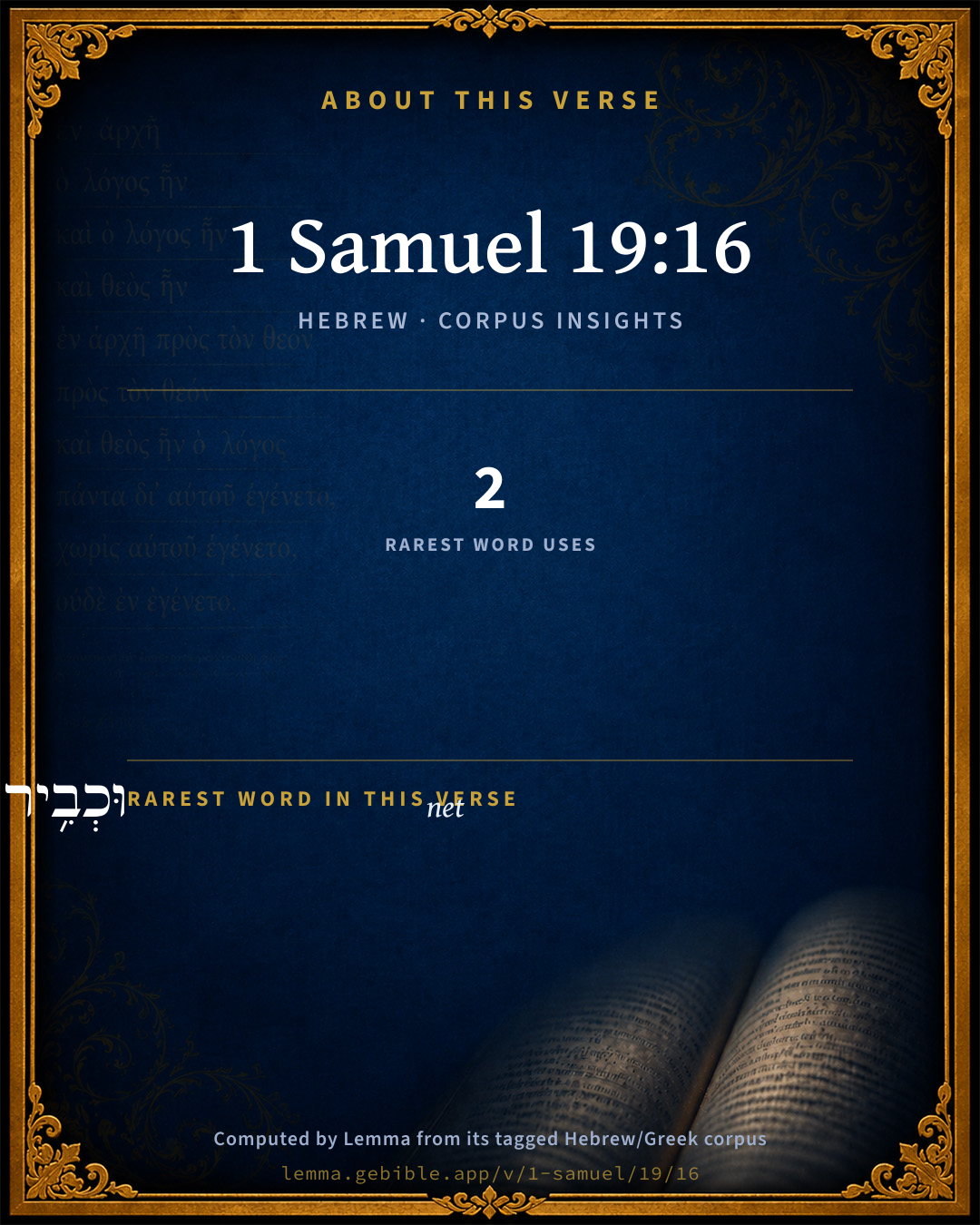
About this verse

These counts appear in no published source. They are computed here, from the morphology-tagged text and Lemma’s own curated glosses. What Lemma adds →

9
words
9
distinct lemmas
Historical
section

Notable vocabulary

The rarest word here is וּכְבִ֥יר net H3523 — appearing just 2 times in the whole Hebrew Bible.

Shared distinctive vocabulary

וּכְבִ֥יר net H3523 occurs in 2 verses of the Hebrew Bible. Also found in:

Grammatical profile

  • 1 verb
  • 6 nouns
  • 1 preposition
  • 1 particle

Verb forms

  • וַיָּבֹ֨אוּ֙ Qal · Sequential Imperfect

Hebrew & Septuagint length

In English translation the verse runs 23 words from the Hebrew and 19 from the Septuagint (LXX English) — closely comparable.

A rough comparison of the two English renderings, which tokenize alike — not a word-level alignment.

Word counts can differ between the Hebrew and the Greek without any difference in meaning — e.g. the Hebrew direct-object marker אֵת has no separate Greek word, and Greek often adds the article ὁ.

Hebrew and Greek witnesses Masoretic Hebrew ↔ Greek Septuagint

The same verse in the two great witnesses to the Old Testament, shown verse-for-verse.

These are two independent witnesses, not word-aligned to each other, and the Septuagint is shown in lemma (dictionary) form.

Hebrew 1 Samuel 19:16 Masoretic · Westminster Leningrad Codex

וַיָּבֹ֨אוּ֙ הַמַּלְאָכִ֔ים וְהִנֵּ֥ה הַתְּרָפִ֖ים אֶל הַמִּטָּ֑ה וּכְבִ֥יר הָעִזִּ֖ים מְרַאֲשֹׁתָֽיו

When the messengers came in, behold, the teraphim was in the bed, with the pillow of goats' [hair] at the head of it.

World English Bible · Public Domain

Greek LXX 1 Samuel 19:16 Septuagint · lemma form

καί ἔρχομαι ὁ ἄγγελος καί ἰδού ὁ κενοτάφιον ἐπί ὁ κλίνη καί ἧπαρ ὁ αἴξ πρός κεφαλή αὐτός

And the messengers come, and, behold, the images were on the bed, and the goat's liver at his head.

LXX2012 (modern English Septuagint) · Public Domain

Hebrew: Westminster Leningrad Codex (CC BY 4.0). Greek: Septuagint (public domain); English from LXX2012 (modern English Septuagint) (Public Domain). How the Septuagint differs from the Hebrew →

Targum (Aramaic paraphrase)

1

The Targum is the ancient Jewish Aramaic paraphrase of the Hebrew Scriptures — an interpretive translation, not the Hebrew text itself. Onkelos (literal) and Pseudo-Jonathan (expansive) render the Torah, and Jonathan the Prophets. Coverage is partial: where no permissively-licensed English translation exists for a verse, only the Aramaic is shown. This is verse-level text, not a word-by-word alignment to the Hebrew.

  1. Targum Jonathan Prophets (Joshua–Malachi)
    וַאֲתוֹ אִזְגַדַיָא וְהָא צַלְמָנַיָא עַל עַרְסָא וְנוֹדָא דְעִזָא אִסָדוֹהִי:

    (no public-domain English translation for this verse)

    Targum Jonathan — Aramaic: “Mikraot Gedolot” (public domain). English: “Sefaria Community Translation” (CC0 1.0 (public-domain dedication)); “London "Chaldee Paraphrase," 1871” (public domain). Text via Sefaria.

Commentary

Notes on 1 Samuel 19:16 from classic Christian and Jewish commentators (each source and its license shown beneath its notes). The classic Christian expositions comment on the surrounding passage and are grouped to its opening verse, so a note may address several verses; the Jewish commentaries on the Tanakh (Rashi and others) are per-verse, so they appear only where the commentator wrote on this verse.

Lemma curates 59 commentaries, every one of them public domain or Creative Commons licensed, each selected and text-cleaned for this edition rather than reprinted as found. About our sources →

Trapp's Complete Commentary

John Trapp

1Sa 19:16 And when the messengers were come in, behold, [there was] an image in the bed, with a pillow of goats’ [hair] for his bolster.

Ver. 16. Behold, there was an image.] See 1Sa 19:13. So have persecutors been frequently frustrated, as those that sought after Jeremiah and Baruch, Athanasius, Luther, and others whom the Lord hid till the storm was over.

John Trapp, A Commentary or Exposition upon All the Books of the Old and New Testament (1647–1656) — public domain. Text from a community e-Sword module.

The Cambridge Bible for Schools and Colleges

gen. ed. J. J. S. Perowne

16. There was an image, &c.] The teraphim was in the bed, and the quilt of goat’s hair at its head.

17 He said unto me, &c.] Michal adds another lie to screen herself from Saul’s anger. In this she was but following her father’s example (1Sa_19:6), and with more excuse. Compare the deceit practised by Rahab (Jos_2:4 ff.); by the woman at Bahurim (2Sa_17:20); and in modern times, by Grotius’ wife, who to save her husband represented the box in which he was concealed as a box of theological books. Scripture affirms the universal duty of Truth without any exception (Lev_19:11), nor can it he understood to sanction breaches of this general law by recording them without disapproval. It is left to the casuist to discuss whether any necessity is sufficient to justify a falsehood or an act of deception. See Whewell’s Elements of Morality, Chaps. 15, 16.

The Cambridge Bible for Schools and Colleges (gen. ed. J. J. S. Perowne; Cambridge University Press, 1878–1918) — public domain. Text from a community e-Sword module.

John Gill's Exposition

And when the messengers were come in,.... To David's house, and into the room where he was supposed to lie:

behold, there was an image in the bed to their great surprise; they expected to see David, but instead of him the teraphim, as in Sa1 19:13; if they had been in the room before, and thought they had seen David in the bed, they might be the more surprised to find that it was only an image they saw:

with a pillow of goats' hair for his bolster; See Gill on Sa1 19:13.

John Gill's Exposition of the Whole Bible (1746–1763) — public domain (CC PDM 1.0). Text via the HelloAO Bible API.

unfoldingWord translationNotes

Door43 World Missions Community

pillow of goats' hair

See how you translated this in 1 Samuel 19:13.

behold

The word "behold" here shows that the messengers were surprised by what they saw.

Why have you deceived me and let my enemy go, so that he has escaped?

Possible meanings are 1) Saul really wants to know why Michal did what she did or 2) Saul uses this question to rebuke Michal. This rhetorical question can be translated as a statement. AT: "You should not have deceived me and let my enemy go, so that he has escaped." (See: Rhetorical Question)

Let me go. Why should I kill you?

Although David did not actually say this, Michal tells Saul that David threatened her with this question. This rhetorical question can be translated as a statement. AT: "I will kill you if you do not help me to escape." (See: Rhetorical Question)

translationWords

messenger

deceive

unfoldingWord translationNotes — © Distant Shores Media and the Door43 World Missions Community, licensed CC BY-SA 4.0. Source: git.door43.org/Door43/en_tn.

Lesson kit

Teaching starters — assembled from the data on this page, not authored interpretation. Every prompt links to the verse data it draws on. Edit before teaching.

1 Samuel, in the Historical, opens this verse with 9 words (9 distinct Hebrew lemmas). Its most distinctive word is kᵉbîyr (“net”). A historical commentator’s framing appears above. Read the whole chapter for the surrounding context.

Discussion questions

  1. The word kᵉbîyr carries the sense “net.” How does it shape the verse?
  2. How does 1 Samuel 19:13, which shares the word «net», read alongside this verse?
  3. The translations on this page render this verse differently — a whole-verse word diff, not a word-by-word alignment. What might account for the different wordings?
  4. «וַיָּבֹ֨אוּ֙» is a Qal Sequential Imperfect verb. How does that grammatical form shape the action described?
  5. Compare how Trapp's Complete Commentary and The Cambridge Bible for Schools and Colleges read this verse. Where do they agree or differ?

Things to notice

Reading settings

Reading text

Shown beneath each verse's original-language words.

Old Testament
Old Testament edition

Read the OT as the Masoretic Hebrew (MT) or the Greek Septuagint (LXX).

English shown for the Greek Septuagint (in the Hebrew ↔ Greek comparison).

Comparing translations? Open the Compare panel on any verse page to stack up to four side by side.