
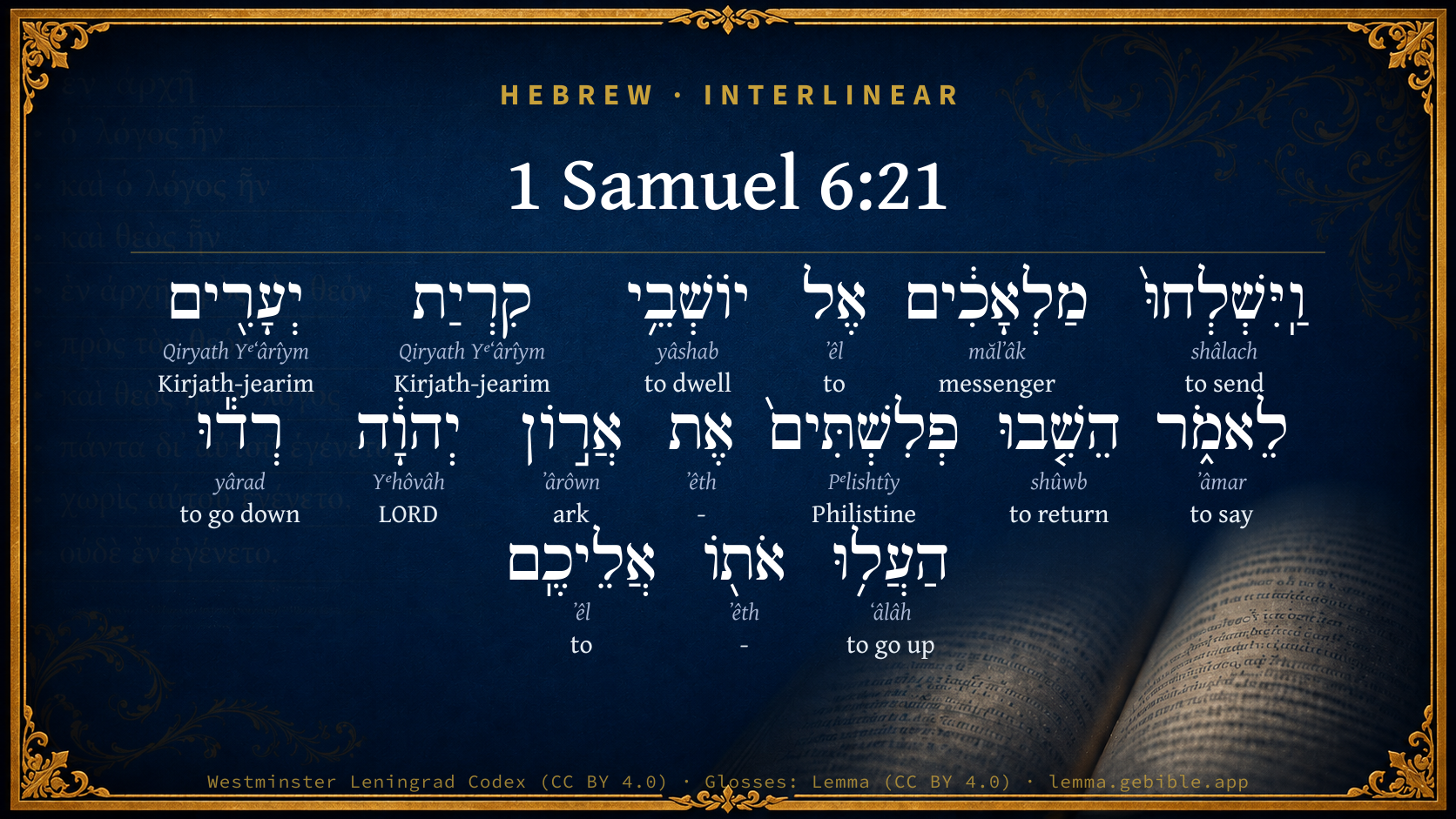
1 Samuel 6:21

Hebrew (Westminster Leningrad Codex) 1 Samuel 6:21 appears in the Hebrew Old Testament. The text above is from the Westminster Leningrad Codex. Each word links to its Strong’s number, a concise gloss, and parsing drawn from the Open Scriptures Hebrew Bible morphology. Click any word for its full Brown-Driver-Briggs (BDB) entry.
Download image
Cite this verse

1 Samuel 6:21 (World English Bible). Public Domain. Lemma interlinear Bible study tool, https://lemma.gebible.app/v/1-samuel/6/21.

Show BibTeX & RIS
BibTeX
RIS
English Translation
They sent messengers to the inhabitants of Kiriath Jearim, saying, The Philistines have brought back the ark of Yahweh; come you down, and bring it up to you.
World English Bible · Public Domain
Download a study sheet

One document with this verse’s original text, its word-by-word gloss line, the meaning frame, cross-references with their text, attributed commentary, and full source and license credits — printable, and it pastes into notes with its structure intact.

This verse Autodidact and up

Study sheet (.html) Plain text (.txt)

A passage Seminary Student

Up to 50 verses in one chapter. A passage sheet keeps up to 6 commentary sources and 12 cross-references per verse, in the order this page ranks them, and says so on the sheet whenever that leaves anything out. Ask for a single verse and you get the Autodidact verse sheet above.

Everything on this page stays free to read, with no account — the sheet is a download of what is already on screen, not access to it.

Want to remove ads? Support Godless Engineer
Compare translations 3

The same verse in 3 English versions, stacked beneath the original-language interlinear above. Click any original word for its lexicon entry.

Each is an independent rendering of the whole verse — the interlinear is not word-aligned to these translations.

Highlighted words mark where these versions differ — a whole-verse word diff, not a word-by-word alignment.

  • World English Bible Public Domain
    They sent messengers to the inhabitants of Kiriath Jearim, saying, The Philistines have brought back the ark of Yahweh; come you down, and bring it up to you.
  • King James Version Public Domain
    And they sent messengers to the inhabitants of Kirjathjearim, saying, The Philistines have brought again the ark of the LORD; come ye down, and fetch it up to you.
  • unfoldingWord Literal Text CC BY-SA 4.0
    And they sent messengers to the dwellers of Kiriath Jearim, saying, “The Philistines have returned the Box of Yahweh. Come down and bring it up to you.”

unfoldingWord Literal Text — © unfoldingWord, licensed CC BY-SA 4.0. Word-aligned USFM3 via Door43 (git.door43.org/unfoldingWord/en_ult).

Versions to compare (up to 4)

3 of 4 selected

Show all 18 translations

Every available English version of this verse, each an independent rendering of the whole verse.

  • World English Bible Public Domain
    They sent messengers to the inhabitants of Kiriath Jearim, saying, The Philistines have brought back the ark of Yahweh; come you down, and bring it up to you.
  • Berean Standard Bible Public Domain
    So they sent messengers to the people of Kiriath-jearim, saying, “The Philistines have returned the ark of the LORD. Come down and take it up with you.”
  • Majority Standard Bible Public Domain
    So they sent messengers to the people of Kiriath-jearim, saying, “The Philistines have returned the ark of the LORD. Come down and take it up with you.”
  • King James Version Public Domain
    And they sent messengers to the inhabitants of Kirjathjearim, saying, The Philistines have brought again the ark of the LORD; come ye down, and fetch it up to you.
  • American Standard Version (1901) Public Domain
    And they sent messengers to the inhabitants of Kiriath-jearim, saying, The Philistines have brought back the ark of Jehovah; come ye down, and fetch it up to you.
  • Revised Version (1885) Public Domain
    And they sent messengers to the inhabitants of Kiriath-jearim, saying, The Philistines have brought again the ark of the LORD; come ye down, and fetch it up to you.
  • Geneva Bible (1599) Public Domain
    And they sent messengers to the inhabitans of Kiriath-iearim, saying, The Philistims haue brought againe the Arke of the Lord: come ye downe and take it vp to you.
  • Douay-Rheims (1899) Public Domain
    And they sent messengers to the inhabitants of Cariathiarim, saying: The Philistines have brought back the ark of the Lord, come ye down and fetch it up to you.
  • Young's Literal Translation Public Domain
    And they send messengers unto the inhabitants of Kirjath-Jearim, saying, `The Philistines have sent back the ark of Jehovah; come down, take it up unto you.'
  • Literal Standard Version CC BY-SA 4.0
    And they send messengers to the inhabitants of Kirjath-Jearim, saying, “The Philistines have sent back the Ark of YHWH; come down, take it up with you.”
  • Unlocked Literal Bible CC BY-SA 4.0
    They sent messengers to the inhabitants of Kiriath Jearim, saying, “The Philistines have brought back the ark of Yahweh; come down and take it back with you.”
  • unfoldingWord Literal Text CC BY-SA 4.0
    And they sent messengers to the dwellers of Kiriath Jearim, saying, “The Philistines have returned the Box of Yahweh. Come down and bring it up to you.”
  • Darby Bible Public Domain
    And they sent messengers to the inhabitants of Kirjath-jearim, saying, The Philistines have brought again the ark of Jehovah; come down, fetch it up to you.
  • World Messianic Bible Public Domain
    They sent messengers to the inhabitants of Kiriath Jearim, saying, “The Philistines have brought back the LORD’s ark. Come down and bring it up to yourselves.”
  • Webster's Bible Public Domain
    And they sent messengers to the inhabitants of Kirjath-jearim, saying, The Philistines have brought again the ark of the LORD; come ye down, and bring it up to you.
  • Free Bible Version CC BY-SA 4.0
    They sent messengers to the people of Kiriath-jearim to say, “The Philistines have returned the Ark of the Lord. Come down and take it home with you.”
  • Bible in Basic English Public Domain
    And they sent men to the people living in Kiriath-jearim, saying, The Philistines have sent back the ark of the Lord; come and take it up to your country.
  • JPS Tanakh (1917) Public Domain
    And they sent messengers to the inhabitants of Kiriath-jearim, saying: 'The Philistines have brought back the ark of the LORD; come ye down, and fetch it up to you.'

Literal Standard Version (2020), Covenant Press — licensed CC BY-SA 4.0. Text via the HelloAO Bible API (eBible.org). Unlocked Literal Bible (unfoldingWord) — licensed CC BY-SA 4.0. Text via the HelloAO Bible API (eBible.org). unfoldingWord Literal Text — © unfoldingWord, licensed CC BY-SA 4.0. Word-aligned USFM3 via Door43 (git.door43.org/unfoldingWord/en_ult). Free Bible Version, Dr. Jonathan Gallagher — licensed CC BY-SA 4.0. Text via the HelloAO Bible API (eBible.org).

Word by word

More ways to search: Search by grammar → Find every occurrence → Compare this word →

Practice this passage: Drill this verse → Learn its vocabulary →

קִרְיַת
Qiryath Yᵉʻârîym
H7157
“Kirjath-jearim”
Noun, Proper
Part of Speech
Noun
Type
Proper
Full BDB Definition

Origin: from H7151 and the pl. of H3293 or H5892

TWOT: None

Kirjath-jearim = "city of forests" - a city on the northern boundary of Judah and on the western and southern boundaries of Benjamin - also 'Kirjath-baal' and 'Baalah'
  1. וַֽיִּשְׁלְחוּ֙ shâlach H7971 “and · to send” Conjunction + Verb, Qal, Sequential Imperfect, 3rd Person, Masculine, Plural
  2. מַלְאָכִ֔ים mălʼâk H4397 “messengers” Noun, Common, Masculine, Plural, Absolute
  3. אֶל ʼêl H413 “to” Preposition
  4. יוֹשְׁבֵ֥י yâshab H3427 “dwelling” Verb, Qal, Participle Active, Masculine, Plural, Construct
  5. יְעָרִ֖ים Qiryath Yᵉʻârîym H7157 “Kirjath-jearim” Noun, Proper
  6. לֵאמֹ֑ר ʼâmar H559 “to say” Preposition + Verb, Qal, Infinitive Construct
  7. הֵשִׁ֤בוּ shûwb H7725 “to return” Verb, Hiphil, Perfect, 3rd Person, Common, Plural
  8. פְלִשְׁתִּים֙ Pᵉlishtîy H6430 “Philistines” Noun, Gentilic, Masculine, Plural, Absolute
  9. אֶת ʼêth H853 “-” Particle, Direct Object
  10. אֲר֣וֹן ʼârôwn H727 “ark of” Noun, Common, Both, Singular, Construct
  11. יְהוָ֔ה Yᵉhôvâh H3068 “LORD” Noun, Proper
  12. רְד֕וּ yârad H3381 “go down” Verb, Qal, Imperative, 2nd Person, Masculine, Plural
  13. הַעֲל֥וּ ʻâlâh H5927 “go up” Verb, Hiphil, Imperative, 2nd Person, Masculine, Plural
  14. אֹת֖וֹ ʼêth H853 “- · him” Particle, Direct Object + Suffix, Personal, 3rd Person, Masculine, Singular
  15. אֲלֵיכֶֽם ʼêl H413 “to · you” Preposition + Suffix, Personal, 2nd Person, Masculine, Plural

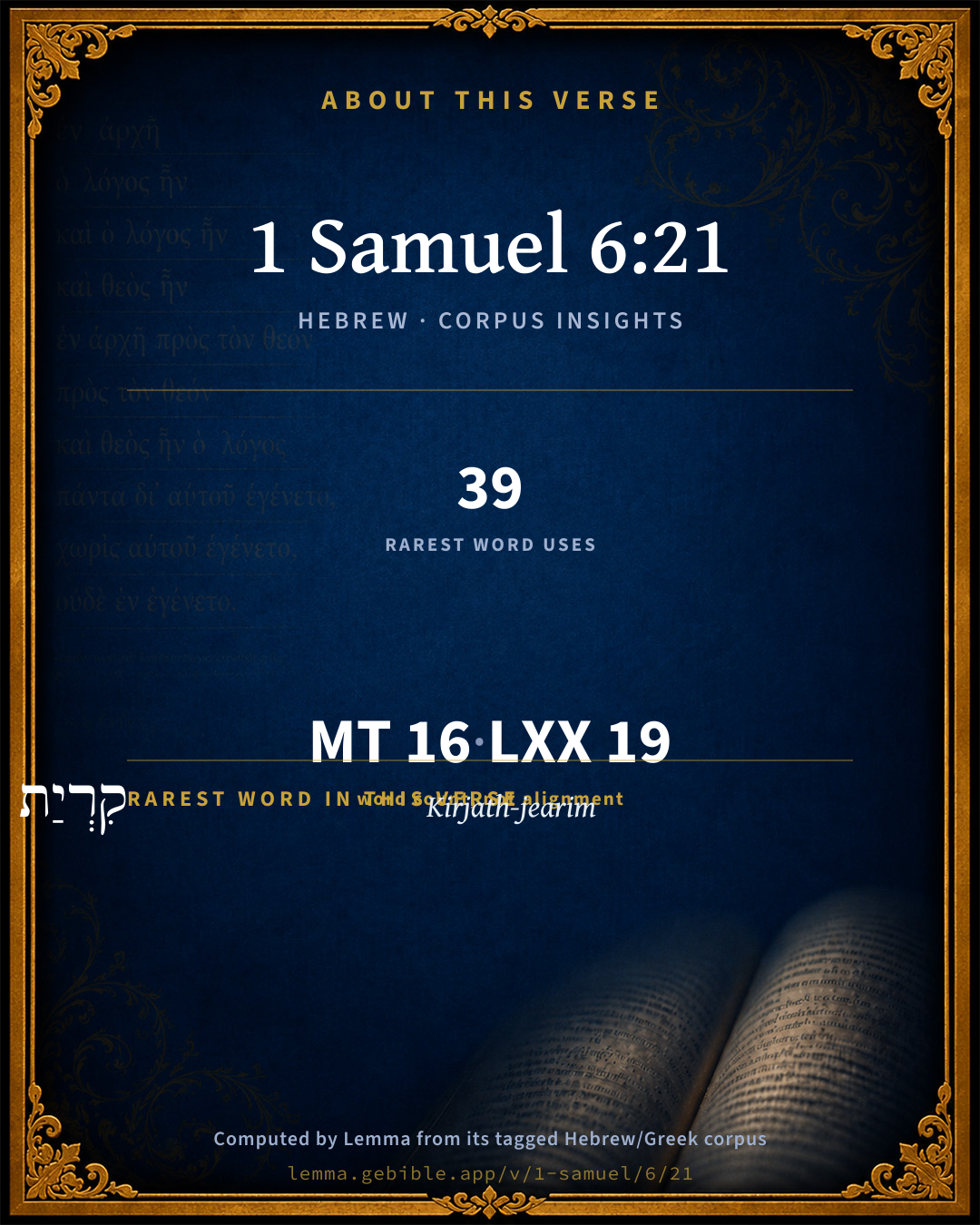
About this verse

These counts appear in no published source. They are computed here, from the morphology-tagged text and Lemma’s own curated glosses. What Lemma adds →

16
words
13
distinct lemmas
Historical
section

Shared distinctive vocabulary

קִרְיַת Kirjath-jearim H7157 occurs in 19 verses of the Hebrew Bible. Also found in:

Grammatical profile

  • 6 verbs
  • 6 nouns
  • 2 prepositions
  • 2 particles

Verb forms

  • וַֽיִּשְׁלְחוּ֙ Qal · Sequential Imperfect
  • יוֹשְׁבֵ֥י Qal · Participle Active
  • לֵאמֹ֑ר Qal · Infinitive Construct
  • הֵשִׁ֤בוּ Hiphil · Perfect
  • רְד֕וּ Qal · Imperative
  • הַעֲל֥וּ Hiphil · Imperative

Repetition

Words recur within this verse — often emphatic in Hebrew:

  • קִרְיַת Kirjath-jearim H7157 ×2
  • אֶל to H413 ×2

Hebrew & Septuagint length

In English translation the verse runs 28 words from the Hebrew and 28 from the Septuagint (LXX English) — the same length.

A rough comparison of the two English renderings, which tokenize alike — not a word-level alignment.

Word counts can differ between the Hebrew and the Greek without any difference in meaning — e.g. the Hebrew direct-object marker אֵת has no separate Greek word, and Greek often adds the article ὁ.

In the original languages it is 16 Hebrew tokens and 19 Greek tokens — but the two are counted differently (Hebrew bundles its prefixes and suffixes into one token; the Greek is in lemma form), so that isn’t a like-for-like length.

Cross-references

9

Topical passages linked to 1 Samuel 6:21 in the Treasury of Scripture Knowledge — connected by theme and wording, ordered by reader-vote popularity; previews shown in the World English Bible.

  • 1 Chronicles 13:5–6 So David assembled all Israel together, from the Shihor [the brook] of Egypt even to the entrance of Hamath, to bring the ark of God from Kiriath Jearim.
  • Joshua 9:17 The children of Israel traveled, and came to their cities on the third day. Now their cities were Gibeon, and Chephirah, and Beeroth, and Kiriath Jearim.
  • Joshua 18:14 The border extended [there], and turned about on the west quarter southward, from the mountain that lies before Beth Horon southward; and the goings out of it were at Kiriath Baal (the same is Kiriath Jearim), a city of the children of Judah: this was the west quarter.
  • Joshua 15:9 and the border extended from the top of the mountain to the spring of the waters of Nephtoah, and went out to the cities of Mount Ephron; and the border extended to Baalah (the same is Kiriath Jearim);
  • Joshua 15:60 Kiriath Baal (the same is Kiriath Jearim), and Rabbah; two cities with their villages.
  • Judges 18:12 They went up, and encamped in Kiriath Jearim, in Judah: therefore they called that place Mahaneh-dan, to this day; behold, it is behind Kiriath Jearim.
  • Psalms 78:60 So that he forsook the tent of Shiloh, The tent which he placed among men;
  • Jeremiah 7:12 But go you now to my place which was in Shiloh, where I caused my name to dwell at the first, and see what I did to it for the wickedness of my people Israel.
  • Jeremiah 7:14 therefore will I do to the house which is called by my name, in which you trust, and to the place which I gave to you and to your fathers, as I did to Shiloh.

Cross-references courtesy of OpenBible.info (CC BY 4.0).

Hebrew and Greek witnesses Masoretic Hebrew ↔ Greek Septuagint

The same verse in the two great witnesses to the Old Testament, shown verse-for-verse.

These are two independent witnesses, not word-aligned to each other, and the Septuagint is shown in lemma (dictionary) form.

Hebrew 1 Samuel 6:21 Masoretic · Westminster Leningrad Codex

וַֽיִּשְׁלְחוּ֙ מַלְאָכִ֔ים אֶל יוֹשְׁבֵ֥י קִרְיַת יְעָרִ֖ים לֵאמֹ֑ר הֵשִׁ֤בוּ פְלִשְׁתִּים֙ אֶת אֲר֣וֹן יְהוָ֔ה רְד֕וּ הַעֲל֥וּ אֹת֖וֹ אֲלֵיכֶֽם

They sent messengers to the inhabitants of Kiriath Jearim, saying, The Philistines have brought back the ark of Yahweh; come you down, and bring it up to you.

World English Bible · Public Domain

Greek LXX 1 Samuel 6:21 Septuagint · lemma form

καί ἀποστέλλω ἄγγελος πρός ὁ καταοἰκέω καριαθιαριμ λέγω ἀποστρέφω ἀλλόφυλος ὁ κιβωτός κύριος καταβαίνω καί ἀναἄγω αὐτός πρός ἑαυτοῦ

And they send messengers to the inhabitants of Cariathiarim, saying, The Philistines have brought back the ark of the Lord, go down and take it home to yourselves.

LXX2012 (modern English Septuagint) · Public Domain

Hebrew: Westminster Leningrad Codex (CC BY 4.0). Greek: Septuagint (public domain); English from LXX2012 (modern English Septuagint) (Public Domain). How the Septuagint differs from the Hebrew →

Targum (Aramaic paraphrase)

1

The Targum is the ancient Jewish Aramaic paraphrase of the Hebrew Scriptures — an interpretive translation, not the Hebrew text itself. Onkelos (literal) and Pseudo-Jonathan (expansive) render the Torah, and Jonathan the Prophets. Coverage is partial: where no permissively-licensed English translation exists for a verse, only the Aramaic is shown. This is verse-level text, not a word-by-word alignment to the Hebrew.

  1. Targum Jonathan Prophets (Joshua–Malachi)
    וּשְׁלָחוּ אִזְגַדִין לְוַת יַתְבֵי קִרְיַת יְעָרִים לְמֵימַר אָתִיבוּ פְלִשְׁתָּאֵי יַת אֲרוֹנָא דַייָ חוּתוּ אַסִיקוּ יָתֵיהּ לְוַתְכוֹן:

    (no public-domain English translation for this verse)

    Targum Jonathan — Aramaic: “Mikraot Gedolot” (public domain). English: “Sefaria Community Translation” (CC0 1.0 (public-domain dedication)); “London "Chaldee Paraphrase," 1871” (public domain). Text via Sefaria.

Commentary

Notes on 1 Samuel 6:21 from classic Christian and Jewish commentators (each source and its license shown beneath its notes). The classic Christian expositions comment on the surrounding passage and are grouped to its opening verse, so a note may address several verses; the Jewish commentaries on the Tanakh (Rashi and others) are per-verse, so they appear only where the commentator wrote on this verse.

Lemma curates 59 commentaries, every one of them public domain or Creative Commons licensed, each selected and text-cleaned for this edition rather than reprinted as found. About our sources →

Trapp's Complete Commentary

John Trapp

1Sa 6:21 And they sent messengers to the inhabitants of Kirjathjearim, saying, The Philistines have brought again the ark of the LORD; come ye down, [and] fetch it up to you.

Ver. 21. Fetch it up to you,] viz., Lest the Philistines fetch it again; so they pretend, howsoever. Nature need not be taught to tell her own tale.

John Trapp, A Commentary or Exposition upon All the Books of the Old and New Testament (1647–1656) — public domain. Text from a community e-Sword module.

Joseph Benson's Commentary

1Sa 6:21. Kirjath-jearim — Whither they sent, either because the place was not far off from them, and so it might soon be removed: or, because it was a place of eminence and strength, and somewhat farther distant from the Philistines, where therefore it was likely to be better preserved from any new attempts of the Philistines, and to be better attended by the Israelites, who would more freely and frequently come to it at such a place than in Beth-shemesh, which was upon the border of their enemies’ land.

Joseph Benson's Commentary on the Old and New Testaments (1811–1818) — public domain. Text from a community e-Sword module.

Tyndale Open Study Notes

Tyndale Open Resources

6:21 Kiriath-jearim was nearby, about ten miles northeast of Beth-shemesh.

Tyndale Open Study Notes — © Tyndale Open Resources, licensed CC BY-SA 4.0. Text via the HelloAO Bible API.

Jamieson, Fausset & Brown

Robert Jamieson, A. R. Fausset & David Brown

Kirjath-jearim--"the city of woods," also called Kirjath-baal (Jos 15:60; Jos 18:14; Ch1 13:6-7). This was the nearest town to Beth-shemesh; and being a place of strength, it was a more fitting place for the residence of the ark. Beth-shemesh being in a low plain, and Kirjath-jearim on a hill, explains the message, "Come ye down, and fetch it up to you."

Next: 1 Samuel Chapter 7

Jamieson, Fausset & Brown — Commentary Critical and Explanatory on the Whole Bible (1871) — public domain (CC PDM 1.0). Text via the HelloAO Bible API.

Adam Clarke's Commentary

Verse 21. To the inhabitants of Kirjath-jearim] They wished the ark away out of their village, but why they sent to this city instead of sending to Shiloh, does not appear: probably Shiloh had been destroyed by the Philistines, after the late defeat of Israel. This is most likely, as the ark was never more taken back to that place.

IT was a very ancient usage, when a plague or other calamity infested a country, city, c. for the magicians to form an image of the destroyer, or of the things on which the plague particularly rested, in gold, silver, ivory, wax, clay, c., under certain configurations of the heavens and to set this up in some proper place, that the evils thus represented might be driven away. These consecrated images were the same that are called talismans, or rather telesms, among the Asiatics. Mr. Locke calls the diviners talismans, but this is a mistake the image, not the fabricator, was called by this name.

I have seen several of these talismans, of different countries; and such images were probably the origin of all the forms of gods which, in after times, were the objects of religious worship. It is well known that Ireland is not infested with any venomous creature; no serpent of any kind is found in it: -

"No poison there infects, no scaly snake

Lurks in the grass, nor toads annoy the lake."

This has been attributed to a telesm, formed with certain rites under the sign Scorpio. Such opinions have been drawn from very ancient pagan sources: e.g.: A stone engraved with the figure of a scorpion, while the moon is in the sign Scorpio, is said to cure those who are stung by this animal. Apollonius Tyaneus is said to have prevented flies from infesting Antioch, and storks from appearing in Byzantium, by figures of those animals formed under certain constellations. A brazen scorpion, placed on a pillar in the city of Antioch, is said to have expelled all such animals from that country. And a crocodile of lead is also said to have preserved Cairo from the depredations of those monsters. See Calmet.

Virgil refers to this custom, Eclogue viii., ver. 80, where he represents a person making two images or telesms, one of wax, another of clay, which were to represent an absent person, who was to be alternately softened or hardened, as the wax or clay image was exposed to the fire: -

Limus ut hic durescit, et haec ut cera liquescit

Uno et eodem igni: sic nostro Daphnis amore.

"As this clay hardens, and this wax softens, by one and the same fire, so may Daphnis by my love."

This thought is borrowed from Theocritus, Idyl. ii., ver. 28.

A beautiful marble figure of Osiris, about four inches and a quarter high, now stands before me, entirely covered with hieroglyphics; he is standing, and holds in each hand a scorpion and a snake by the tails, and with each foot he stands on the neck of a crocodile. This I have no doubt was a telesm, formed under some peculiar configuration of the heavens, intended to drive away both scorpions and crocodiles. This image is of the highest antiquity, and was formed probably long before the Christian era.

Tavernier observes that something like what is mentioned in the text is practiced among the Indians; for when a pilgrim goes to one of the idol temples for a cure, he brings the figure of the member affected, made either of gold, silver, or copper, according to his circumstances, which he offers to his god. This custom was common among the heathens, and they consecrated to their gods the monuments of their deliverance. From heathenism it was adopted by corrupt Christianity; and Theodoret informs us that in his time there might be seen about the tombs of the martyrs figures of eyes, hands, feet, and other parts of the body, which represented those of the offerers which they supposed had been healed by the intercession of those holy persons! This degrading superstition is continued among the papists to the present day: I have seen at St. Winifred's well, in Holywell, Flintshire several staves, crutches, and handbarrows, hung up in different places, which were reported to be the votive offerings of the maimed, the halt, the withered, c., who had received their cure by the virtue of the saint! It is true the crutches are such as no man or woman could ever walk with and the barrows are such as most evidently never carried any human being. But they serve the purpose of superstition, and keep up an idolatrous reverence for the well and the legendary virgin.

After all, I need not say that the system of judicial astrology is vain, unfounded, absurd, and wicked. It in effect presumes to take the government of the world out of the hand of an all-wise God, and to abandon it to the most fortuitous and unconnected occurrences of life; for the stars have their influences according to this pretended science, conformably to the occurrences here below: e.g., if a child be born but one hour sooner or later than a particular configuration of the heavens, his destiny will be widely different from what it otherwise would have been; and as an almost infinite number of casualties may accelerate or retard a birth, consequently the whole destiny of man is influenced and ruled by these casualties: to say nothing of the absurdity, that those omnipotent stars ever can affect the infant while invested with a thin covering of flesh in the womb of its parent. But the whole science is a tissue of absurdities.

Adam Clarke's Commentary on the Bible (1810–1826) — public domain. Text from a community e-Sword/MySword module.

Ellicott's Commentary for English Readers

(21) Kirjath-jearim.—Kirjath-jearim should be spelt and pronounced Kirjatb-jearim, the “city of woods” (wood-ville, wood-town, wooton). Its modern name is Kurzet-el-Erab, “the city of grapes,” the woods being in later days replaced by vines.

A Bible Commentary for English Readers, edited by Charles John Ellicott (1878–1897) — public domain. Text from a community e-Sword module.

The Cambridge Bible for Schools and Colleges

gen. ed. J. J. S. Perowne

21. Kirjath-jearim] i.e. “city of forests,” originally belonged to the Gibeonites (Jos_9:17), and was one of the frontier cities of Judah (Jos_15:9).

The site is probably to be fixed at the modern village of Kuryet-el-enab, i.e. “city of the grape,” which stands among the hills, 8 or 9 miles N.E. of Ain Shems. “A ride over ruined rocky paths, some of the worst in the country, brought us to Kureit-el-Enab, the ancient Kirjath-jearim, in a pleasant valley of olive-groves, abounding in jays and hawks. We dismounted to visit the old Gothic church, said to have been built by the English Crusaders, and still quite perfect, though desecrated by the Moslem villagers to the uses of a cow-shed.” Tristram, Land of Israel, p. 397. [See however Add. Note IX. p. 245.]

Kirjath-jearim was also called Baalah (Jos_15:9), Baale-Judah (2Sa_6:2), and Kirjath-baal (Jos_15:60), names which point to the former existence of Baal-worship in the place.

The Ark was probably taken to Kirjath-jearim, which was neither a priestly nor Levitical city, as being the nearest place of importance on the road to Shiloh, but why it was not restored to its old resting-place does not appear. Possibly Shiloh, as the central seat of worship and government, was occupied by the Philistines after the battle of Aphek. Certainly it never regained its old importance. See Jer_7:12-14; Jer_26:6.

come ye down] Kirjath-jearim was among the hills of Judah on higher ground than Beth-shemesh.

The Cambridge Bible for Schools and Colleges (gen. ed. J. J. S. Perowne; Cambridge University Press, 1878–1918) — public domain. Text from a community e-Sword module.

John Gill's Exposition

And they sent messengers to the inhabitants of Kirjathjearim,.... Which was a city further on in the tribe of Judah, and lay among some woods, from whence it had its name, and was formerly called Kirjathbaal, from Baal's being worshipped there; of which see Jos 15:9, they might choose to send hither to fetch the ark from them, because it was at a greater distance from the Philistines, their city Bethshemesh being on the borders of them; and because it might be a place of greater eminence and strength, and besides lay in the way to Shiloh, whereby they might suppose it was intended to be had; unless Shiloh was before this time destroyed:

saying, the Philistines have brought again the ark of the Lord; which they doubted not would be good news to them:

come ye down, and fetch it up to you; but say not one word of the reason of this request, lest it should discourage them; but rather represent it as a favour to them, and an honour done them, as indeed it was. Kirjathjearim seems to have stood on an eminence in comparison of Bethshemesh, and therefore it is said to come down from the one, and go up to the other. That Bethshemesh was in a valley, see Sa1 6:13 and this on a hill, Sa1 7:1.

Next: 1 Samuel Chapter 7

John Gill's Exposition of the Whole Bible (1746–1763) — public domain (CC PDM 1.0). Text via the HelloAO Bible API.

Albert Barnes' Notes on the Bible

Kirjath-jearim - See Jos 9:17 note. It has been thought that there was a high place at Kirjath-jearim (the hill, 1Sa 7:1), the remnant of its old pagan sanctity when it was called Kirjath-Baal, “the city of Baal” (see Jos 18:14; 2Sa 6:2); and that for this reason it was selected as a proper place to send the ark to.

Albert Barnes' Notes on the Bible (1834–1885) — public domain. Text from a community e-Sword/MySword module.

Haydock's Catholic Bible Commentary

Up. This is the import of the Hebrew. The Vulgate reducite, "bring it back," insinuates, that the Bethsamites desired the people of Cariathiarim to convey the ark to their city, on the road to Silo, where they probably thought it ought to be placed, in the tabernacle. But it seems God ordered it otherwise, and the ark was never restored to its former splendid station, surrounded with all the vessels and ornaments of the tabernacle. David made something similar, and place an altar before it, while the Mosaic tabernacle and altar were removed from Silo to Nobe, (chap. xxi. 1.) and afterwards to Gabaon, 2 Paralipomenon i. 5. Salien (the year of the world 3030) doubts not but they were thence translated to Solomon’s temple, during the octave of the dedication, along with those of David, from Mount Sion, 2 Paralipomenon v. 2., and viii. 3. Why the ark was not placed in this most magnificent abode, but removed from the stone of Abel to the houses of Abinadab, of Obededom, of David in Sion, till all the original ornaments, prescribed by God to Moses, with a still more splendid apparatus, met to adorn the temple of Solomon, we cannot easily explain. Perhaps it might be to render that event more glorious, and to represent the troubled state of the Jewish Synagogue, immediately preceding the appearance of the great Redeemer, who would establish a church without spot or wrinkle, shining brighter than the sun, and replenished with all heavenly graces. (Haydock) --- Cariathiarim is the same place as Cariathbaal, and Baala, (Josue xv. 9, 60.) Baalim Juda, (2 Kings vi. 2.) and Sedeiarim, about ten miles from Jerusalem. Gabaa was "a hill," (Calmet) belonging to the same city, where the house of Abinadab stood; (Haydock) and Nobe was also in the vicinity, while Silo was much farther north. (Calmet) --- The priests still remained, and offered sacrifice in the tabernacle, though occasionally some of them might come to offer extraordinary victims before the ark, in those private houses which were thus converted, as it were, into the holy of holies. Salien, the year of the world 2941, were he observes from St. Jerome, that the tabernacle was removed to Nobe about the same time as the ark was deposited at Cariathiarim; and no doubt both the translations were in consequence of the divine command, signified by the mouth of his prophet Samuel. (Haydock)

George Leo Haydock (1774–1849), Haydock's Catholic Family Bible and Commentary, 1859 edition — public domain. Excludes Psalms (Douay-Rheims chapter numbering differs from Protestant) and Deuterocanonical books (Catholic canon only).

Matthew Poole's English Annotations

They sent to Kirjath-jearim, either because the place was not far from them, and so it might soon be removed, which they mainly desired; or because it was a place of eminency and strength, and somewhat further distant from the Philistines, where therefore it was likely to be better preserved from any new attempts of the Philistines, and to be better attended by the Israelites, who would more freely and frequently come to it at such a place, than in Beth-shemesh, which was upon the border of their enemies’ land; or because they thought they would gladly receive it, being a pious and zealous people; or because it was in the way to Shiloh, its ancient habitation, and whither they might suppose it was to be carried by degrees and several stages, whereof this was one.

Matthew Poole's English Annotations on the Holy Bible (1683–1685) — public domain. Text from a community e-Sword/MySword module.

Whedon's Commentary on the Bible

Daniel D. Whedon

21. Kirjath-jearim — A city about seven miles northeast of Beth-shemesh, and the nearest large town on the way from Beth-shemesh to Shiloh. This may have been one reason why the Beth-shemites sent thither for men to come down and fetch up the ark. Ancient Kirjath is represented by the modern village Kuriet-el-Enab, “city of grapes.” See note on Jos_9:17.

Daniel D. Whedon (gen. ed.), Commentary on the Old and New Testaments (1874–1909) — public domain. Text from a community e-Sword module.

John Wesley's Explanatory Notes

Kirjath-jearim - Whither they sent, either because the place was not far off from them, and so it might soon be removed: or because it was a place of eminency and strength, and somewhat farther distant from the Philistines, where therefore it was likely to be better preserved from any new attempts of the Philistines, and to be better attended by the Israelites, who would more freely and frequently come to it at such a place, than in Beth-shemesh, which was upon the border of their enemies land.

John Wesley, Explanatory Notes Upon the Whole Bible (1754–1765) — public domain. Text via the GEBible commentary corpus.

unfoldingWord translationNotes

Door43 World Missions Community

Kiriath Jearim

This was a town in Israel. (See: How to Translate Names)

translationWords

messenger

Philistines

unfoldingWord translationNotes — © Distant Shores Media and the Door43 World Missions Community, licensed CC BY-SA 4.0. Source: git.door43.org/Door43/en_tn.

Lesson kit

Teaching starters — assembled from the data on this page, not authored interpretation. Every prompt links to the verse data it draws on. Edit before teaching.

1 Samuel, in the Historical, opens this verse with 16 words (13 distinct Hebrew lemmas). Its most distinctive word is Qiryath Yᵉʻârîym (“Kirjath-jearim”). A historical commentator’s framing appears above. Read the whole chapter for the surrounding context.

Discussion questions

  1. What does “Kirjath-jearim” (Qiryath Yᵉʻârîym) contribute to the verse as a whole?
  2. How does Joshua 9:17, which shares the word «Kirjath-jearim», read alongside this verse?
  3. What does the repetition of “Kirjath-jearim” (2× in this one verse) do in this verse?
  4. These translations render this verse differently; the difference is in the English rendering, not the original. What questions does that raise?
  5. «וַֽיִּשְׁלְחוּ֙» is a Qal Sequential Imperfect verb. How does that grammatical form shape the action described?
  6. Compare how Trapp's Complete Commentary and Joseph Benson's Commentary read this verse. Where do they agree or differ?

Things to notice

Reading settings

Reading text

Shown beneath each verse's original-language words.

Old Testament
Old Testament edition

Read the OT as the Masoretic Hebrew (MT) or the Greek Septuagint (LXX).

English shown for the Greek Septuagint (in the Hebrew ↔ Greek comparison).

Comparing translations? Open the Compare panel on any verse page to stack up to four side by side.