
1 Kings 22:13

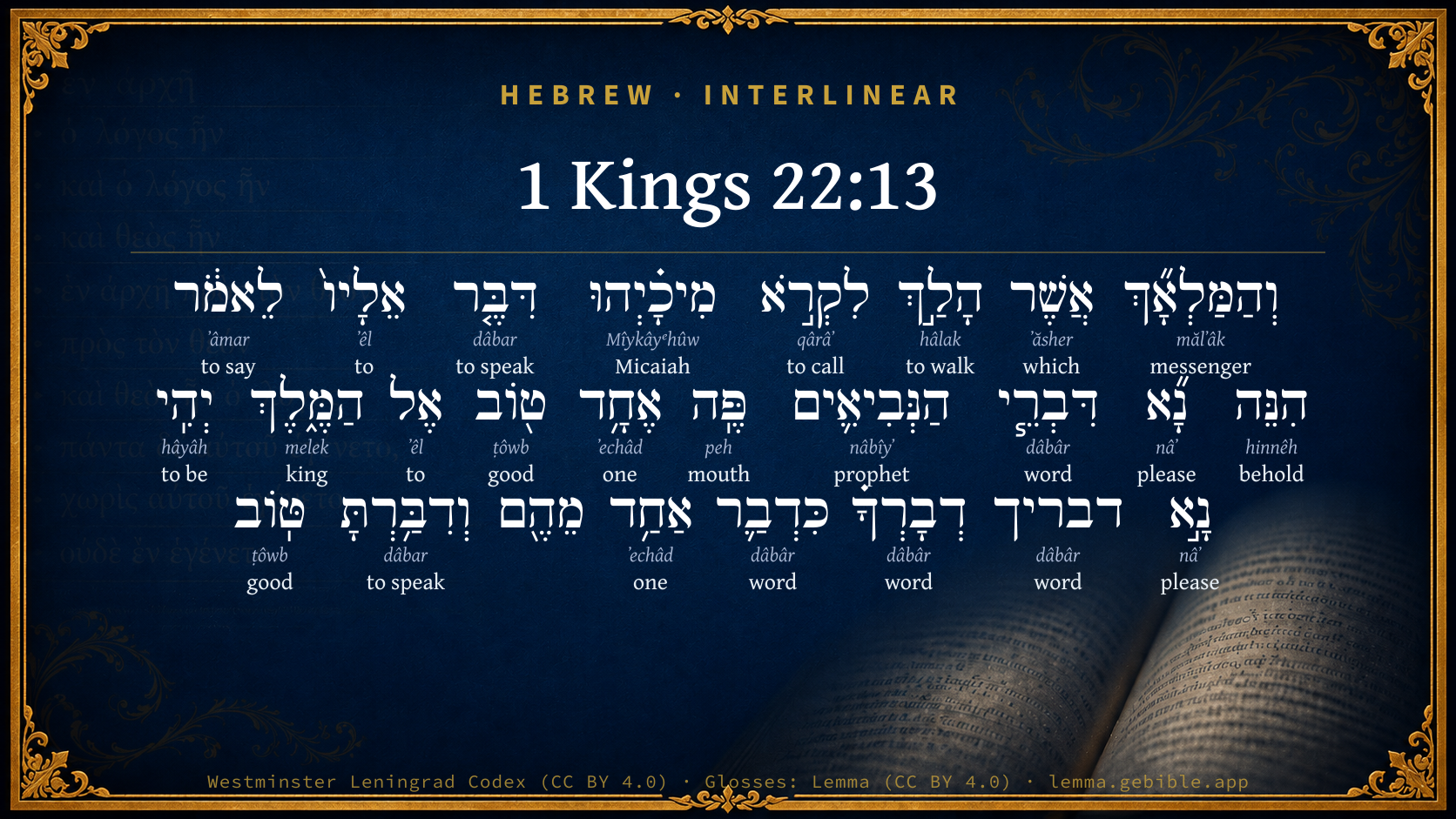
Hebrew (Westminster Leningrad Codex) 1 Kings 22:13 appears in the Hebrew Old Testament. The text above is from the Westminster Leningrad Codex. Each word links to its Strong’s number, a concise gloss, and parsing drawn from the Open Scriptures Hebrew Bible morphology. Click any word for its full Brown-Driver-Briggs (BDB) entry.
Download image
Cite this verse

1 Kings 22:13 (World English Bible). Public Domain. Lemma interlinear Bible study tool, https://lemma.gebible.app/v/1-kings/22/13.

Show BibTeX & RIS
BibTeX
RIS
English Translation
The messenger who went to call Micaiah spoke to him, saying, See now, the words of the prophets [declare] good to the king with one mouth: please let your word be like the word of one of them, and speak you good.
World English Bible · Public Domain
Download a study sheet

One document with this verse’s original text, its word-by-word gloss line, the meaning frame, cross-references with their text, attributed commentary, and full source and license credits — printable, and it pastes into notes with its structure intact.

This verse Autodidact and up

Study sheet (.html) Plain text (.txt)

A passage Seminary Student

Up to 50 verses in one chapter. A passage sheet keeps up to 6 commentary sources and 12 cross-references per verse, in the order this page ranks them, and says so on the sheet whenever that leaves anything out. Ask for a single verse and you get the Autodidact verse sheet above.

Everything on this page stays free to read, with no account — the sheet is a download of what is already on screen, not access to it.

Want to remove ads? Support Godless Engineer
Compare translations 3

The same verse in 3 English versions, stacked beneath the original-language interlinear above. Click any original word for its lexicon entry.

Each is an independent rendering of the whole verse — the interlinear is not word-aligned to these translations.

Highlighted words mark where these versions differ — a whole-verse word diff, not a word-by-word alignment.

  • World English Bible Public Domain
    The messenger who went to call Micaiah spoke to him, saying, See now, the words of the prophets [declare] good to the king with one mouth: please let your word be like the word of one of them, and speak you good.
  • King James Version Public Domain
    And the messenger that was gone to call Micaiah spake unto him, saying, Behold now, the words of the prophets declare good unto the king with one mouth: let thy word, I pray thee, be like the word of one of them, and speak that which is good.
  • unfoldingWord Literal Text CC BY-SA 4.0
    And the messenger who went to call Micaiah spoke to him, saying, “Behold, please, the words of the prophets one mouth good for the king. Please let your word be like the word of one from them, and speak good.”

unfoldingWord Literal Text — © unfoldingWord, licensed CC BY-SA 4.0. Word-aligned USFM3 via Door43 (git.door43.org/unfoldingWord/en_ult).

Versions to compare (up to 4)

3 of 4 selected

Show all 18 translations

Every available English version of this verse, each an independent rendering of the whole verse.

  • World English Bible Public Domain
    The messenger who went to call Micaiah spoke to him, saying, See now, the words of the prophets [declare] good to the king with one mouth: please let your word be like the word of one of them, and speak you good.
  • Berean Standard Bible Public Domain
    Then the messenger who had gone to call Micaiah instructed him, “Behold now, with one accord the words of the prophets are favorable to the king. So please let your words be like theirs, and speak favorably.”
  • Majority Standard Bible Public Domain
    Then the messenger who had gone to call Micaiah instructed him, “Behold now, with one accord the words of the prophets are favorable to the king. So please let your words be like theirs, and speak favorably.”
  • King James Version Public Domain
    And the messenger that was gone to call Micaiah spake unto him, saying, Behold now, the words of the prophets declare good unto the king with one mouth: let thy word, I pray thee, be like the word of one of them, and speak that which is good.
  • American Standard Version (1901) Public Domain
    And the messenger that went to call Micaiah spake unto him, saying, Behold now, the words of the prophets `declare' good unto the king with one mouth: let thy word, I pray thee, be like the word of one of them, and speak thou good.
  • Revised Version (1885) Public Domain
    And the messenger that went to call Micaiah spake unto him, saying, Behold now, the words of the prophets declare good unto the king with one mouth: let thy word, I pray thee, be like the word of one of them, and speak thou good.
  • Geneva Bible (1599) Public Domain
    And the messenger that was gone to call Michaiah spake vnto him, saying, Beholde now, the wordes of the prophets declare good vnto the King with one accorde: let thy word therefore, I pray thee, be like the worde of one of them, and speake thou good.
  • Douay-Rheims (1899) Public Domain
    And the messenger, that went to call Micheas, spoke to him, saying: Behold the words of the prophets with one month declare good things to the king: let thy word therefore be like to theirs, and speak that which is good.
  • Young's Literal Translation Public Domain
    And the messenger who hath gone to call Micaiah hath spoken unto him, saying, `Lo, I pray thee, the words of the prophets, with one mouth, `are' good towards the king; let it be, I pray thee, thy word as the word of one of them -- and thou hast spoken good.'
  • Literal Standard Version CC BY-SA 4.0
    And the messenger who has gone to call Micaiah has spoken to him, saying, “Now behold, the words of the prophets, with one mouth, [are] good toward the king; please let your word be as the word of one of them—and you have spoken good.”
  • Unlocked Literal Bible CC BY-SA 4.0
    The messenger who went to call Micaiah spoke to him, saying, “Now look, the words of the prophets declare good things to the king with one mouth. Please let your word be like one of them and say good things.”
  • unfoldingWord Literal Text CC BY-SA 4.0
    And the messenger who went to call Micaiah spoke to him, saying, “Behold, please, the words of the prophets one mouth good for the king. Please let your word be like the word of one from them, and speak good.”
  • Darby Bible Public Domain
    And the messenger that went to call Micah spoke to him saying, Behold now, the words of the prophets [declare] good to the king with one assent: let thy word, I pray thee, be like the word of one of them, and speak good.
  • World Messianic Bible Public Domain
    The messenger who went to call Micaiah spoke to him, saying, “See now, the prophets declare good to the king with one mouth. Please let your word be like the word of one of them, and speak good.”
  • Webster's Bible Public Domain
    And the messenger that went to call Micaiah, spoke to him, saying, Behold now, the words of the prophets declare good to the king with one mouth: let thy word, I pray thee, be like the word of one of them, and speak that which is good.
  • Free Bible Version CC BY-SA 4.0
    The messenger who went to call Micaiah told him, “Look, all the prophets are unanimous in prophesying positively to the king. So please make sure to speak positively like them.”
  • Bible in Basic English Public Domain
    Now the servant who had gone to get Micaiah said to him, See now, all the prophets with one voice are saying good things to the king; so let your words be like theirs and say good things.
  • JPS Tanakh (1917) Public Domain
    And the messenger that went to call Micaiah spoke unto him, saying: 'Behold now, the words of the prophets declare good unto the king with one mouth, let thy word, I pray thee, be like the word of one of them, and speak thou good.'

Literal Standard Version (2020), Covenant Press — licensed CC BY-SA 4.0. Text via the HelloAO Bible API (eBible.org). Unlocked Literal Bible (unfoldingWord) — licensed CC BY-SA 4.0. Text via the HelloAO Bible API (eBible.org). unfoldingWord Literal Text — © unfoldingWord, licensed CC BY-SA 4.0. Word-aligned USFM3 via Door43 (git.door43.org/unfoldingWord/en_ult). Free Bible Version, Dr. Jonathan Gallagher — licensed CC BY-SA 4.0. Text via the HelloAO Bible API (eBible.org).

Word by word

More ways to search: Search by grammar → Find every occurrence → Compare this word →

Practice this passage: Drill this verse → Learn its vocabulary →

מִיכָ֗יְהוּ
Mîykâyᵉhûw
H4321
“Micaiah”
Noun, Proper
Part of Speech
Noun
Type
Proper
Full BDB Definition

Origin: abbrev. for H4322

TWOT: None

Micah or Micaiah or Michaiah = "who is like God" - an Ephraimite during the period of the judges - son of Imlah and a prophet of Samaria who predicted the defeat and death of king Ahab of Israel - son of Gemariah in the time of Jeremiah
  1. וְהַמַּלְאָ֞ךְ mălʼâk H4397 “and · the · messenger” Conjunction + Particle, Definite Article + Noun, Common, Masculine, Singular, Absolute
  2. אֲשֶׁר ʼăsher H834 “which” Particle, Relative
  3. הָלַ֣ךְ hâlak H1980 “to walk” Verb, Qal, Perfect, 3rd Person, Masculine, Singular
  4. לִקְרֹ֣א qârâʼ H7121 “to call” Preposition + Verb, Qal, Infinitive Construct
  5. דִּבֶּ֤ר dâbar H1696 “to speak” Verb, Piel, Perfect, 3rd Person, Masculine, Singular
  6. אֵלָיו֙ ʼêl H413 “to · him” Preposition + Suffix, Personal, 3rd Person, Masculine, Singular
  7. לֵאמֹ֔ר ʼâmar H559 “to say” Preposition + Verb, Qal, Infinitive Construct
  8. הִנֵּה hinnêh H2009 “behold” Particle, Demonstrative
  9. נָ֞א nâʼ H4994 “please” Particle, Exhortation
  10. דִּבְרֵ֧י dâbâr H1697 “words of” Noun, Common, Masculine, Plural, Construct
  11. הַנְּבִיאִ֛ים nâbîyʼ H5030 “the · prophets” Particle, Definite Article + Noun, Common, Masculine, Plural, Absolute
  12. פֶּֽה peh H6310 “mouth” Noun, Common, Masculine, Singular, Absolute
  13. אֶחָ֥ד ʼechâd H259 “one” Adjective, Cardinal number, Masculine, Singular, Absolute
  14. ט֖וֹב ṭôwb H2896 “good” Adjective, Adjective, Masculine, Singular, Absolute
  15. אֶל ʼêl H413 “to” Preposition
  16. הַמֶּ֑לֶךְ melek H4428 “the · king” Particle, Definite Article + Noun, Common, Masculine, Singular, Absolute
  17. יְהִֽי hâyâh H1961 “to be” Verb, Qal, Jussive, 3rd Person, Masculine, Singular
  18. נָ֣א nâʼ H4994 “please” Particle, Exhortation
  19. דבריך dâbâr H1697 “words · your” Noun, Common, Masculine, Plural, Construct + Suffix, Personal, 2nd Person, Masculine, Singular
  20. דְבָרְךָ֗ dâbâr H1697 “word · your” Noun, Common, Masculine, Singular, Construct + Suffix, Personal, 2nd Person, Masculine, Singular
  21. כִּדְבַ֛ר dâbâr H1697 “like/as · word of” Preposition + Noun, Common, Masculine, Singular, Construct
  22. אַחַ֥ד ʼechâd H259 “one” Adjective, Cardinal number, Masculine, Singular, Absolute
  23. וְדִבַּ֥רְתָּ dâbar H1696 “and · to speak” Conjunction + Verb, Piel, Perfect, 2nd Person, Masculine, Singular
  24. טּֽוֹב ṭôwb H2896 “good” Adjective, Adjective, Masculine, Singular, Absolute

About this verse

These counts appear in no published source. They are computed here, from the morphology-tagged text and Lemma’s own curated glosses. What Lemma adds →

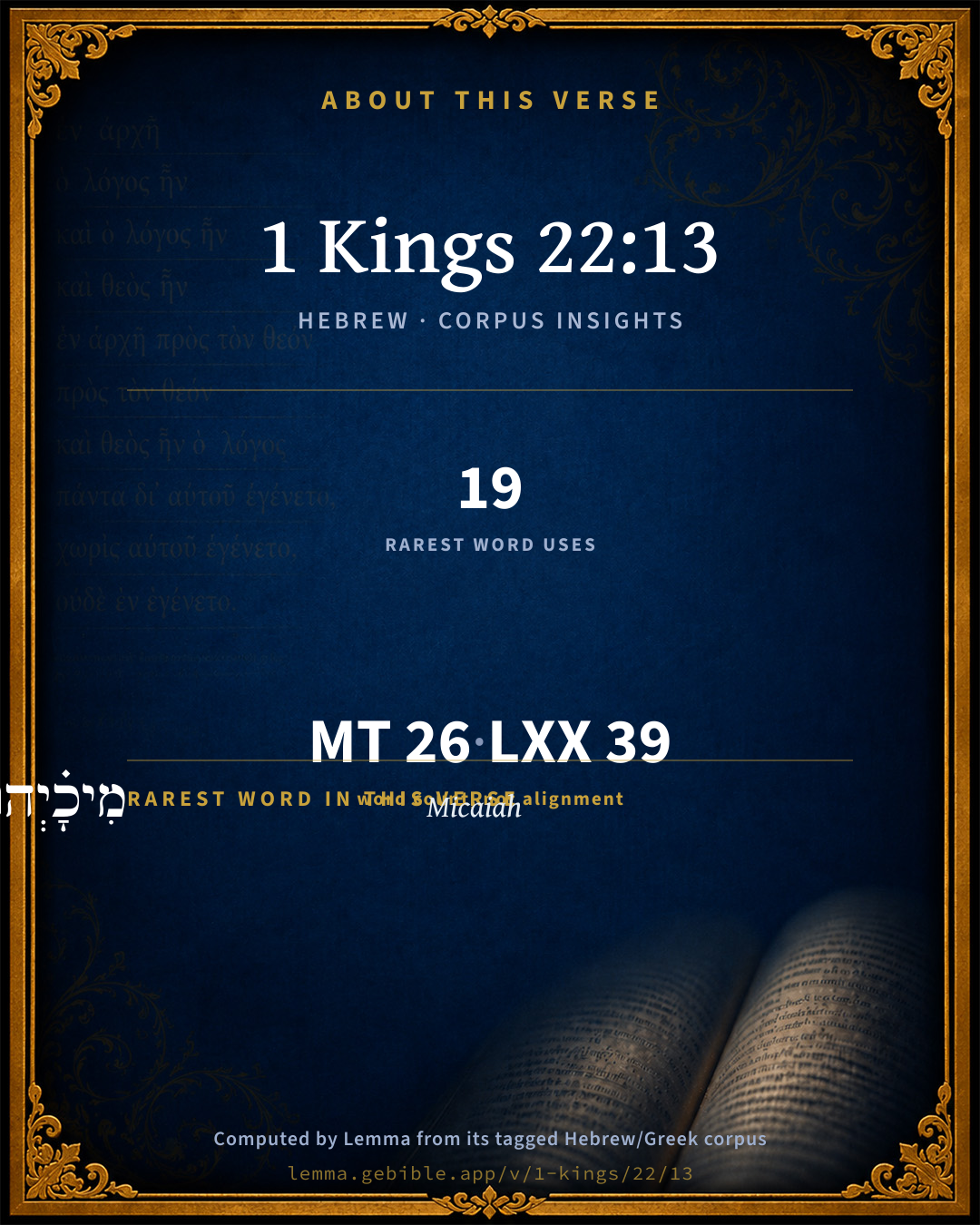
26
words
17
distinct lemmas
Historical
section

Notable vocabulary

The rarest word here is מִיכָ֗יְהוּ Micaiah H4321 — appearing just 19 times in the whole Hebrew Bible.

Shared distinctive vocabulary

מִיכָ֗יְהוּ Micaiah H4321 occurs in 19 verses of the Hebrew Bible. Also found in:

Grammatical profile

  • 6 verbs
  • 9 nouns
  • 4 adjectives
  • 3 prepositions
  • 4 particles

Verb forms

  • הָלַ֣ךְ Qal · Perfect
  • לִקְרֹ֣א Qal · Infinitive Construct
  • דִּבֶּ֤ר Piel · Perfect
  • לֵאמֹ֔ר Qal · Infinitive Construct
  • יְהִֽי Qal · Jussive
  • וְדִבַּ֥רְתָּ Piel · Perfect

Repetition

Words recur within this verse — often emphatic in Hebrew:

  • דִּבְרֵ֧י word H1697 ×4
  • דִּבֶּ֤ר to speak H1696 ×2
  • נָ֞א please H4994 ×2
  • אֶחָ֥ד one H259 ×2
  • ט֖וֹב good H2896 ×2
  • אֵלָיו֙ to H413 ×2

Hebrew & Septuagint length

In English translation the verse runs 42 words from the Hebrew and 41 from the Septuagint (LXX English) — closely comparable.

A rough comparison of the two English renderings, which tokenize alike — not a word-level alignment.

Word counts can differ between the Hebrew and the Greek without any difference in meaning — e.g. the Hebrew direct-object marker אֵת has no separate Greek word, and Greek often adds the article ὁ.

In the original languages it is 26 Hebrew tokens and 39 Greek tokens — but the two are counted differently (Hebrew bundles its prefixes and suffixes into one token; the Greek is in lemma form), so that isn’t a like-for-like length.

Cross-references

10

Topical passages linked to 1 Kings 22:13 in the Treasury of Scripture Knowledge — connected by theme and wording, ordered by reader-vote popularity; previews shown in the World English Bible.

  • Psalms 10:11 He says in his heart, "God has forgotten. He hides his face. He will never see it."
  • Psalms 11:1 In Yahweh, I take refuge. How can you say to my soul, "Flee as a bird to your mountain!"
  • Psalms 14:1 The fool has said in his heart, "There is no God." They are corrupt. They have done abominable works. There is none who does good.
  • Psalms 50:21 You have done these things, and I kept silent. You thought that the "I AM" was just like you. I will rebuke you, and accuse you in front of your eyes.
  • Isaiah 30:10–11 who tell the seers, "Don't see;" and to the prophets, "Don't prophesy to us right things, speak to us smooth things, prophesy deceits,
  • Hosea 7:3 They make the king glad with their wickedness, And the princes with their lies.
  • Amos 7:13–17 but don't prophesy again any more at Bethel; for it is the king's sanctuary, and it is a royal house!"
  • Micah 2:6–7 "Don't you prophesy!" They prophesy. "Don't prophesy about these things. Disgrace won't overtake us."
  • Micah 2:11 If a man walking in a spirit of falsehood lies: 'I will prophesy to you of wine and of strong drink;' He would be the prophet of this people.
  • 1 Corinthians 2:14–16 Now the natural man doesn't receive the things of God's Spirit, for they are foolishness to him, and he can't know them, because they are spiritually discerned.

Cross-references courtesy of OpenBible.info (CC BY 4.0).

Hebrew and Greek witnesses Masoretic Hebrew ↔ Greek Septuagint

The same verse in the two great witnesses to the Old Testament, shown verse-for-verse.

These are two independent witnesses, not word-aligned to each other, and the Septuagint is shown in lemma (dictionary) form.

Hebrew 1 Kings 22:13 Masoretic · Westminster Leningrad Codex

וְהַמַּלְאָ֞ךְ אֲשֶׁר הָלַ֣ךְ לִקְרֹ֣א מִיכָ֗יְהוּ דִּבֶּ֤ר אֵלָיו֙ לֵאמֹ֔ר הִנֵּה נָ֞א דִּבְרֵ֧י הַנְּבִיאִ֛ים פֶּֽה אֶחָ֥ד ט֖וֹב אֶל הַמֶּ֑לֶךְ יְהִֽי נָ֣א דבריך דְבָרְךָ֗ כִּדְבַ֛ר אַחַ֥ד מֵהֶ֖ם וְדִבַּ֥רְתָּ טּֽוֹב

The messenger who went to call Micaiah spoke to him, saying, See now, the words of the prophets [declare] good to the king with one mouth: please let your word be like the word of one of them, and speak you good.

World English Bible · Public Domain

Greek LXX 1 Kings 22:13 Septuagint · lemma form

καί ὁ ἄγγελος ὁ πορεύομαι καλέω ὁ μιχαιας λαλέω αὐτός λέγω ἰδού δή λαλέω πᾶς ὁ προφήτης ἐν στόμα εἷς καλός περί ὁ βασιλεύς γίγνομαι δή καί σύ εἰς λόγος σύ κατά ὁ λόγος εἷς οὗτος καί λαλέω καλός

And the messenger that went to call Michaias spoke to him, saying, Behold now, all the prophets speak with one mouth good concerning the king, let now your words be like the words of one of them, and speak good things.

LXX2012 (modern English Septuagint) · Public Domain

Hebrew: Westminster Leningrad Codex (CC BY 4.0). Greek: Septuagint (public domain); English from LXX2012 (modern English Septuagint) (Public Domain). How the Septuagint differs from the Hebrew →

Targum (Aramaic paraphrase)

1

The Targum is the ancient Jewish Aramaic paraphrase of the Hebrew Scriptures — an interpretive translation, not the Hebrew text itself. Onkelos (literal) and Pseudo-Jonathan (expansive) render the Torah, and Jonathan the Prophets. Coverage is partial: where no permissively-licensed English translation exists for a verse, only the Aramaic is shown. This is verse-level text, not a word-by-word alignment to the Hebrew.

  1. Targum Jonathan Prophets (Joshua–Malachi)
    וְאִזְגַדָא דַאֲזַל לְמִקְרֵי מִיכָיְהוּ מַלֵיל עִמֵיהּ לְמֵימַר הָא כְעַן פִתְגָמֵי נְבִיֵי שִׁקְרָא מַמְלַל חַד שַׁוִי קֳדָם מַלְכָּא יְהֵי כְעַן פִּתְגָמָךְ כְּפִתְגָמָא דְחַד מִנְהוֹן וּתְמַלֵיל פִּתְגָמִין תַּקְנִין:

    (no public-domain English translation for this verse)

    Targum Jonathan — Aramaic: “Mikraot Gedolot” (public domain). English: “Sefaria Community Translation” (CC0 1.0 (public-domain dedication)); “London "Chaldee Paraphrase," 1871” (public domain). Text via Sefaria.

Commentary

Notes on 1 Kings 22:13 from classic Christian and Jewish commentators (each source and its license shown beneath its notes). The classic Christian expositions comment on the surrounding passage and are grouped to its opening verse, so a note may address several verses; the Jewish commentaries on the Tanakh (Rashi and others) are per-verse, so they appear only where the commentator wrote on this verse.

Lemma curates 59 commentaries, every one of them public domain or Creative Commons licensed, each selected and text-cleaned for this edition rather than reprinted as found. About our sources →

Trapp's Complete Commentary

John Trapp

1Ki 22:13 And the messenger that was gone to call Micaiah spake unto him, saying, Behold now, the words of the prophets [declare] good unto the king with one mouth: let thy word, I pray thee, be like the word of one of them, and speak [that which is] good.

Ver. 13. The words of the prophets declare good.] Nihil assentatione suavius, nihil veritate gravius. See 2Th 2:10-11.

Let thy word, I pray thee, be like the word.] This he might counsel the prophet out of a carnal courtesy, as wishing well to him, as also out of a special desire that the war might go forward.

John Trapp, A Commentary or Exposition upon All the Books of the Old and New Testament (1647–1656) — public domain. Text from a community e-Sword module.

The Biblical Illustrator

Joseph S. Exell

1Ki_22:13-14

Behold now, the words of the prophets declare good unto the king with one mouth.

Prophets of smooth speech

I. A certain fear of God is made to serve the selfish ends of worldly men. Here is a wicked king, a pervert from the true faith, a patron of idolatry, a man whose actions were only evil continually, a man buckling on his armour for an unnecessary war, yet a man who will not move until he gets a sign that the gods will take his part. Ahab is a religious man, although a man of sin--a man who has his priests and prophets, as well as his warriors, and who in doing wrong likes to fortify himself by the assurance that the heavens are on his side. Shall I go against Ramoth-Gilead to battle, or shall I forbear said the king. In form that was an inquiry; in reality it was an attempt to blend religion with worldly designs, that thus he might the better compass their fulfilment. There is much of this incongruous mixture in the conduct of ungodly men among us now. There are few persons so worldly but that they have a vein of the religious running through them; and generally they are shrewd enough to somehow turn this element to their own advantage. Many persons going to church on Sunday is done to keep their conscience quiet through the week of questionable conduct. Religion is to some a refuge from uncomfortable thoughts, and as much a means of keeping a man in face with himself as with his neighbours. It is oftentimes a valuable auxiliary to a worldlings temporal progress, winning him the good opinion of his fellows as well as furnishing a basis of self-confidence.

II. The wide prevalence of the demand for smooth-speaking prophets. Ahab said to his assembled seers, Shall I go, or shall I forbear? There is always a demand for prophets who tell us what we like. There is a good deal of satisfaction to the man who all the week long is driving doubtful bargains, indulging in sharp practices, and living by the worlds smart maxims rather than the principles of Scripture--it is most gratifying to such a person when he comes to church to find a man in the pulpit who dwells only on the brighter side of human conduct, who seldom mentions peoples sins, who is too polite to speak of hell, and who in general seems in favour of a downgrade in morals as well as in theology. And this demand is always followed by an adequate supply. If the pew clamours for smooth-tongued prophets it will not have to wait many Sundays before one mounts the pulpit. The Christian Church has never been without such men. As a rule, they abound.

III. However much smooth-speaking may abound, we can never get away entirely from the intermingled voice of truth. Micaiah was not at first summoned into the royal presence. No; Ahab knew he had a rasping voice and an awkward honesty about him which would ill harmonise with the general concurrence he expected. But somehow Micaiah was fated to appear. This world of ours has never lacked true prophets, as it has never wanted false ones. Even in the most unfriendly times there have been more of them than the prophets themselves have thought. And, somehow, as in this case, bad men are obliged to hear the prophet of the Lord sometimes. The jarring note will break in upon the smooth current of man-pleasing doctrine. Despite mens evasions, the rousing voice makes itself heard above the sibilations of your religious parasites end sycophants; the pure light flashes convincingly into the dark places of the corrupt heart; and the word of the Lord moves right royally over mens cowering souls and crooked lives. In the providence of God it is always ordered that the truth shall speak to evil men, whether they will hear or whether they will forbear. If it speaks but seldom it makes up for it by compensating emphasis. (J. J. Ingram.)

Enmity to truth

I. A man may deliberately set himself against god. This may appear an improbable thing, as there must be an apprehension that the only clear issue to such conduct is the defeat of the man, and the triumph of God.

II. A man may turn the faithfulness of God into a personal. Grievance. This evidently Ahab did; and also the men of Christs day, who, resenting the plainness of His speech, became His bitter adversaries. To be reproved when wrong is meditated or pursued should be regarded as an advantage. Warning is an indication of interest in ones well-being when uttered by a friend, and ought never to be thought of other than as a kindness.

III. A may come to regard what is truth as evil instead of its being good. A man must have had his way for a long time before such a verdict may be announced; but selfishness is not long indulged before he is upon this track.

IV. A man may never be taught by experience, but ever rush on to destruction, well knowing what is before him. It was so with Ahab. No amount of teaching or experience--and his life had not been without instruction--sufficed to turn him from his set purpose and awaken him to the danger in which by his conduct he was placed. (Homiletic Magazine.)

Resisting conviction

John Wesley tells us in his famous Journal that when he was about twenty-two, before he knew by joyous experience the salvation of God, he read Thomas Kempis Christian Pattern, and he began to see that true religion was seated in the heart, and that Gods law extended to all our thoughts, as well as words and actions. He says with brave frankness, I was, however, very angry with Kempis for being so strict! This is an illuminating sentence. The sense of guilt recoils in anger from that which exposes our sin.

The Biblical Illustrator, edited by Joseph S. Exell (c. 1880s–1900s) — public domain. Text from a community e-Sword module.

Joseph Benson's Commentary

1Ki 22:13-14. Speak that which is good — This was a most absurd request: for if Micaiah was a true prophet, he could say nothing but what was suggested to him by divine inspiration, and if he were not, why should he speak at all? Of what use could his prophesying be unless to deceive? What the Lord saith unto me, that will I speak — What answer the Lord shall put into my mind and mouth. He resolves as became one who had an eye to a greater king than either of these. He seems, as yet, to have had no revelation about the matter. But when the question was put to him, God taught him what to answer.

Joseph Benson's Commentary on the Old and New Testaments (1811–1818) — public domain. Text from a community e-Sword module.

Tyndale Open Study Notes

Tyndale Open Resources

22:13-14 The messenger who went to get Micaiah warned that he had better agree with the false prophets. However, Micaiah promised only that he would faithfully deliver the Lord’s word (see Num 22:38; 24:13).

Tyndale Open Study Notes — © Tyndale Open Resources, licensed CC BY-SA 4.0. Text via the HelloAO Bible API.

Geneva Bible (1599)

Geneva Bible translators

Hebrew, mouth.

This is the common argument of the wicked, who think that none should speak against a thing, if the greater part approve it, be they never so ungodly.

Geneva Bible (1599) marginal notes — public domain. Text via Bolls.life.

Adam Clarke's Commentary

Verse 13. The words of the prophets declare good] What notion could these men have of prophecy, when they supposed it was in the power of the prophet to model the prediction as he pleased, and have the result accordingly?

Adam Clarke's Commentary on the Bible (1810–1826) — public domain. Text from a community e-Sword/MySword module.

Ellicott's Commentary for English Readers

(13) Behold now.—In the whole history, as especially in the words of the officer, there is evidence of the strange confusion of idea, so common in superstition at all times, which in some sense believes in the inspiration of the prophets as coming from God, and yet fancies that they can direct it as they will, and that accordingly they can be bribed, or beguiled, or coerced, to “prophesy smooth things.” The extremest form of this infatuation is exemplified in Simon Magus, who believed that the Apostles were the medium for conferring the highest spiritual gifts from God, and yet madly persuaded himself that this power could be bought for money (Act_8:18-19). The natural result is a mingled awe and contempt, such as Balak feels for Balaam. The delusion is, of course, silenced at once by such declarations as the stern reply of Micaiah, which even Balaam could convey (Num_22:18). But, as all false religions and corruptions of true religion show, it is never rooted out, except by real spiritual knowledge of God and of His dealings with the soul.

A Bible Commentary for English Readers, edited by Charles John Ellicott (1878–1897) — public domain. Text from a community e-Sword module.

The Cambridge Bible for Schools and Colleges

gen. ed. J. J. S. Perowne

13–28. Micaiah’s prophecy. Ahab, in displeasure, sends him to prison (2Ch_18:12-27)

13. And the messenger that was gone [R.V. went] to call Micaiah] The tradition, which Josephus preserves, that the ‘son of the prophets’ mentioned in 1Ki_20:35, was Micaiah, and that Ahab put him in prison for his actions at that time (see notes on 1Ki_20:35; 1Ki_20:43) has been derived from the circumstance that Micaiah on this occasion was sent to prison, and the king uses the words (1Ki_22:26) ‘Take Micaiah and carry him back,’ &c. But there is nothing in this account of the message to him which proves that he was in prison when Ahab sent to call him; and ‘Put this fellow in prison’ (1Ki_22:27) is no evidence that he had been there before, but rather the reverse.

speak that which is good] R.V. speak thou good. This is the A.V. in 2 Chronicles.

The Cambridge Bible for Schools and Colleges (gen. ed. J. J. S. Perowne; Cambridge University Press, 1878–1918) — public domain. Text from a community e-Sword module.

John Gill's Exposition

And the king said unto him, how many times shall I adjure thee,.... Not that he had as yet adjured him at all, or not till now; but he asks him how often he must be obliged to do it; and now he adjures him once for all, that he might not be forced to repeat it:

that thou tell me nothing but that which is true in the name of the Lord? for he observed he did not speak in the name of the Lord before, and what he said was not in a serious but ludicrous manner, and not to be regarded as truth.

John Gill's Exposition of the Whole Bible (1746–1763) — public domain (CC PDM 1.0). Text via the HelloAO Bible API.

Albert Barnes' Notes on the Bible

And the messenger spake unto him ... - There seems to have been a widespread notion among the irreligious and the half-religious of the ancient world, that their prophets were not the mere mouth-pieces of the god, but that they were persons who had power with the god, and could compel, or at least induce, Him to work their will (compare Num 24:10; Isa 30:10). They saw that the prophet’s word was accomplished; they did not understand that if he falsified his message the accomplishment would no longer follow.

Albert Barnes' Notes on the Bible (1834–1885) — public domain. Text from a community e-Sword/MySword module.

Matthew Poole's English Annotations

This he designs, not out of any love to Micaiah, (whom he persuades to debauch his conscience,) but merely out of a desire to gratify his king’s humour.

Matthew Poole's English Annotations on the Holy Bible (1683–1685) — public domain. Text from a community e-Sword/MySword module.

The Pulpit Commentary

And the messenger that was gone or went to call Micaiah, spake unto him, saying, Behold now, the words of the prophets declare good unto the king with one mouth Heb. one mouth good to the king. The messenger may possibly have had instructions to seek to conciliate Micaiah. In any case he thinks it well to tell him of the unanimity of the prophets. His testimony, he suggests, will surely agree with theirs: let thy word, I pray thee, be like the word of one of them, and speak that which is good of the Heb. speak good.

The Pulpit Commentary (1880–1919), ed. H.D.M. Spence-Jones & Joseph S. Exell — public domain. Text from a community e-Sword module.

unfoldingWord translationNotes

Door43 World Missions Community

Now look

"Listen" or "Pay attention to what I am about to tell you"

the words of the prophets declare good things to the king with one mouth

The prophets all saying the same thing is spoken of as if they all spoke with the same mouth. AT: "the prophets all declare the same good things to the king" (See: Metaphor)

let your word be like one of them

Here the word "them" refers to "the words of the prophets." AT: "let what you say agree with what they have said" (See: Assumed Knowledge and Implicit Information)

should we go

The word "we" refers to Ahab, Jehoshaphat, and their armies but not to Micaiah. (See: Exclusive and Inclusive "We")

will give it into the hand of the king

Here the word "hand" refers to power. AT: "will allow the king to capture it" (See: Metonymy)

translationWords

messenger

call

word

life

unfoldingWord translationNotes — © Distant Shores Media and the Door43 World Missions Community, licensed CC BY-SA 4.0. Source: git.door43.org/Door43/en_tn.

Lesson kit

Teaching starters — assembled from the data on this page, not authored interpretation. Every prompt links to the verse data it draws on. Edit before teaching.

1 Kings, in the Historical, opens this verse with 26 words (17 distinct Hebrew lemmas). Its most distinctive word is Mîykâyᵉhûw (“Micaiah”). A historical commentator’s framing appears above. Read the whole chapter for the surrounding context.

Discussion questions

  1. The word Mîykâyᵉhûw carries the sense “Micaiah.” How does it shape the verse?
  2. How does 1 Kings 22:8, which shares the word «Micaiah», read alongside this verse?
  3. What does the repetition of “word” (4× in this one verse) do in this verse?
  4. These translations render this verse differently; the difference is in the English rendering, not the original. What questions does that raise?
  5. «הָלַ֣ךְ» is a Qal Perfect verb. How does that grammatical form shape the action described?
  6. Compare how Trapp's Complete Commentary and The Biblical Illustrator read this verse. Where do they agree or differ?

Things to notice

Reading settings

Reading text

Shown beneath each verse's original-language words.

Old Testament
Old Testament edition

Read the OT as the Masoretic Hebrew (MT) or the Greek Septuagint (LXX).

English shown for the Greek Septuagint (in the Hebrew ↔ Greek comparison).

Comparing translations? Open the Compare panel on any verse page to stack up to four side by side.