
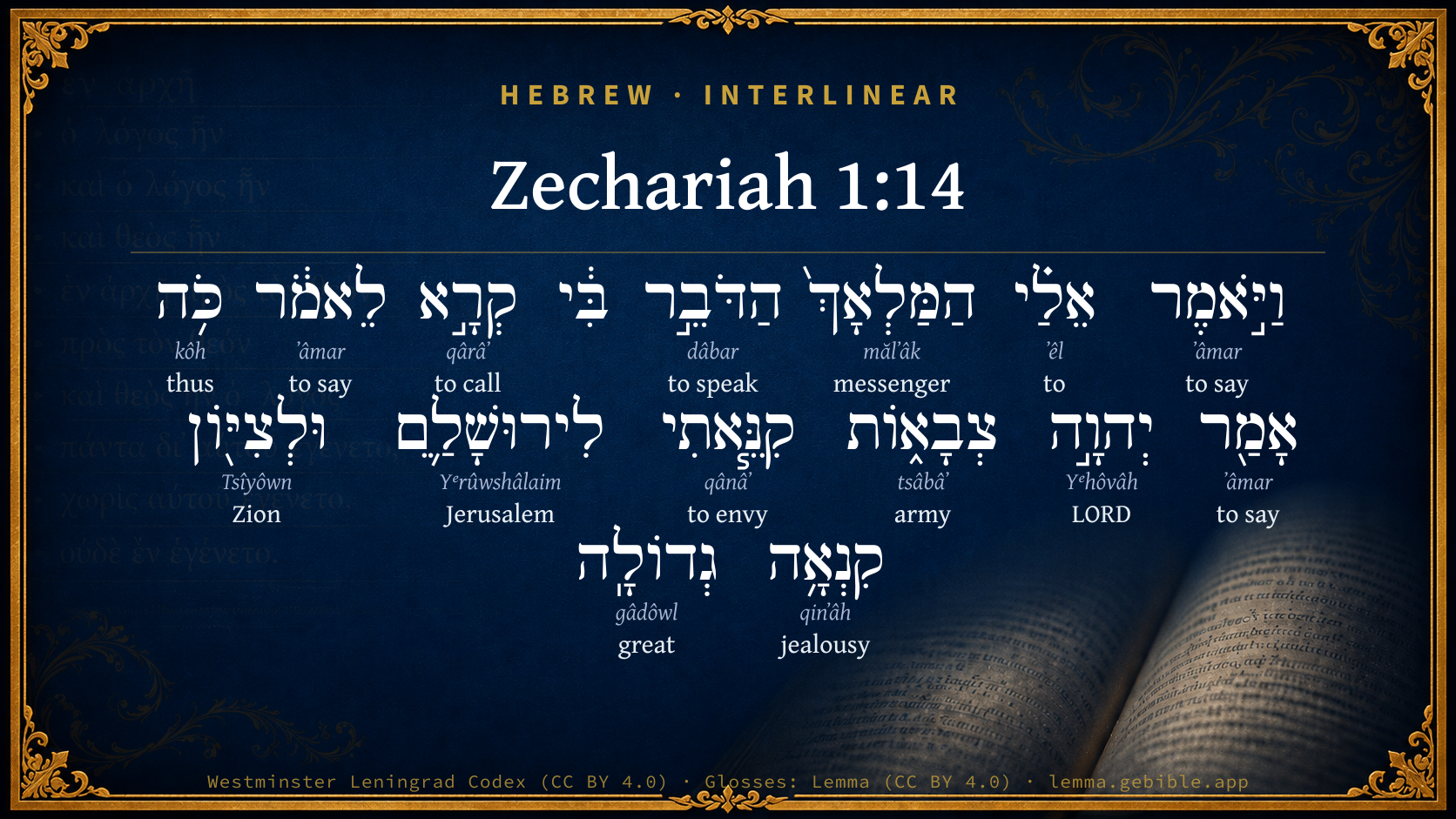
Zechariah 1:14

Hebrew (Westminster Leningrad Codex) Zechariah 1:14 appears in the Hebrew Old Testament. The text above is from the Westminster Leningrad Codex. Each word links to its Strong’s number, a concise gloss, and parsing drawn from the Open Scriptures Hebrew Bible morphology. Click any word for its full Brown-Driver-Briggs (BDB) entry.
Download image
Cite this verse

Zechariah 1:14 (World English Bible). Public Domain. Lemma interlinear Bible study tool, https://lemma.gebible.app/v/zechariah/1/14.

Show BibTeX & RIS
BibTeX
RIS
English Translation
So the angel who talked with me said to me, "Proclaim, saying, 'Thus says Yahweh of Hosts: "I am jealous for Jerusalem and for Zion with a great jealousy.
World English Bible · Public Domain
Download a study sheet

One document with this verse’s original text, its word-by-word gloss line, the meaning frame, cross-references with their text, attributed commentary, and full source and license credits — printable, and it pastes into notes with its structure intact.

This verse Autodidact and up

Study sheet (.html) Plain text (.txt)

A passage Seminary Student

Up to 50 verses in one chapter. A passage sheet keeps up to 6 commentary sources and 12 cross-references per verse, in the order this page ranks them, and says so on the sheet whenever that leaves anything out. Ask for a single verse and you get the Autodidact verse sheet above.

Everything on this page stays free to read, with no account — the sheet is a download of what is already on screen, not access to it.

Want to remove ads? Support Godless Engineer
Compare translations 3

The same verse in 3 English versions, stacked beneath the original-language interlinear above. Click any original word for its lexicon entry.

Each is an independent rendering of the whole verse — the interlinear is not word-aligned to these translations.

Highlighted words mark where these versions differ — a whole-verse word diff, not a word-by-word alignment.

  • World English Bible Public Domain
    So the angel who talked with me said to me, "Proclaim, saying, 'Thus says Yahweh of Hosts: "I am jealous for Jerusalem and for Zion with a great jealousy.
  • King James Version Public Domain
    So the angel that communed with me said unto me, Cry thou, saying, Thus saith the LORD of hosts; I am jealous for Jerusalem and for Zion with a great jealousy.
  • unfoldingWord Literal Text CC BY-SA 4.0
    And the angel who was speaking with me said to me, “Call out, saying, ‘Thus says Yahweh of Armies: “I have been jealous for Jerusalem and for Zion a great jealousy.

unfoldingWord Literal Text — © unfoldingWord, licensed CC BY-SA 4.0. Word-aligned USFM3 via Door43 (git.door43.org/unfoldingWord/en_ult).

Versions to compare (up to 4)

3 of 4 selected

Show all 18 translations

Every available English version of this verse, each an independent rendering of the whole verse.

  • World English Bible Public Domain
    So the angel who talked with me said to me, "Proclaim, saying, 'Thus says Yahweh of Hosts: "I am jealous for Jerusalem and for Zion with a great jealousy.
  • Berean Standard Bible Public Domain
    Then the angel who was speaking with me said, “Proclaim this word: This is what the LORD of Hosts says: ‘I am very jealous for Jerusalem and Zion,
  • Majority Standard Bible Public Domain
    Then the angel who was speaking with me said, “Proclaim this word: This is what the LORD of Hosts says: ‘I am very jealous for Jerusalem and Zion,
  • King James Version Public Domain
    So the angel that communed with me said unto me, Cry thou, saying, Thus saith the LORD of hosts; I am jealous for Jerusalem and for Zion with a great jealousy.
  • American Standard Version (1901) Public Domain
    So the angel that talked with me said unto me, Cry thou, saying, Thus saith Jehovah of hosts: I am jealous for Jerusalem and for Zion with a great jealousy.
  • Revised Version (1885) Public Domain
    So the angel that talked with me said unto me, Cry thou, saying, Thus saith the LORD of hosts: I am jealous for Jerusalem and for Zion with a great jealousy.
  • Geneva Bible (1599) Public Domain
    So the Angel that communed with me, said vnto me, Crie thou, and speake, Thus saith the Lord of hostes, I am ielous ouer Ierusalem and Zion with a great zeale,
  • Douay-Rheims (1899) Public Domain
    And the angel that spoke in me, said to me: Cry thou, saying: Thus saith the Lord of hosts: I am zealous for Jerusalem, and Sion with a great zeal.
  • Young's Literal Translation Public Domain
    And the messenger who is speaking with me, saith unto me, `Call, saying: Thus said Jehovah of Hosts: I have been zealous for Jerusalem, and for Zion `with' great zeal.
  • Literal Standard Version CC BY-SA 4.0
    And the messenger who is speaking with me, says to me, “Call, saying, Thus said YHWH of Hosts: I have been zealous for Jerusalem, || And for Zion [with] great zeal.
  • Unlocked Literal Bible CC BY-SA 4.0
    So the angel who had talked with me said to me, “Call out and say, 'Yahweh of hosts says this: I have been jealous for Jerusalem and for Zion with a great passion!
  • unfoldingWord Literal Text CC BY-SA 4.0
    And the angel who was speaking with me said to me, “Call out, saying, ‘Thus says Yahweh of Armies: “I have been jealous for Jerusalem and for Zion a great jealousy.
  • Darby Bible Public Domain
    And the angel that talked with me said unto me, Cry, saying, Thus saith Jehovah of hosts: I am jealous for Jerusalem and for Zion with a great jealousy,
  • World Messianic Bible Public Domain
    So the angel who talked with me said to me, “Proclaim, saying, ‘The LORD of Hosts says: “I am jealous for Jerusalem and for Zion with a great jealousy.
  • Webster's Bible Public Domain
    So the angel that communed with me said to me, Cry thou, saying, Thus saith the LORD of hosts; I am jealous for Jerusalem and for Zion with a great jealousy.
  • Free Bible Version CC BY-SA 4.0
    Then the angel I was talking with told me, “This is what you are to announce. The Lord Almighty says this: I am jealously protective of Jerusalem and Mount Zion,
  • Bible in Basic English Public Domain
    And the angel who was talking to me said to me, Let your voice be loud and say, These are the words of the Lord of armies: I am greatly moved about the fate of Jerusalem and of Zion.
  • JPS Tanakh (1917) Public Domain
    so the angel that spoke with me said unto me: 'Proclaim thou, saying: Thus saith the LORD of hosts: I am jealous for Jerusalem and for Zion with a great jealousy;

Literal Standard Version (2020), Covenant Press — licensed CC BY-SA 4.0. Text via the HelloAO Bible API (eBible.org). Unlocked Literal Bible (unfoldingWord) — licensed CC BY-SA 4.0. Text via the HelloAO Bible API (eBible.org). unfoldingWord Literal Text — © unfoldingWord, licensed CC BY-SA 4.0. Word-aligned USFM3 via Door43 (git.door43.org/unfoldingWord/en_ult). Free Bible Version, Dr. Jonathan Gallagher — licensed CC BY-SA 4.0. Text via the HelloAO Bible API (eBible.org).

Word by word

More ways to search: Search by grammar → Find every occurrence → Compare this word →

Practice this passage: Drill this verse → Learn its vocabulary →

קִנֵּ֧אתִי
qânâʼ
H7065
“to envy”
Verb, Piel, Perfect, 1st Person, Common, Singular
Part of Speech
Verb
Stem
Piel
Form
Perfect
Person
1st Person
Gender
Common
Number
Singular
Full BDB Definition

Origin: a primitive root

TWOT: 2038

to envy, be jealous, be envious, be zealous - (Piel) - to be jealous of - to be envious of - to be zealous for - to excite to jealous anger - (Hiphil) to provoke to jealous anger, cause jealousy
  1. וַיֹּ֣אמֶר ʼâmar H559 “and · to say” Conjunction + Verb, Qal, Sequential Imperfect, 3rd Person, Masculine, Singular
  2. אֵלַ֗י ʼêl H413 “to · me” Preposition + Suffix, Personal, 1st Person, Common, Singular
  3. הַמַּלְאָךְ֙ mălʼâk H4397 “the · messenger” Particle, Definite Article + Noun, Common, Masculine, Singular, Absolute
  4. הַדֹּבֵ֣ר dâbar H1696 “the · speaking” Particle, Definite Article + Verb, Qal, Participle Active, Masculine, Singular, Absolute
  5. קְרָ֣א qârâʼ H7121 “call” Verb, Qal, Imperative, 2nd Person, Masculine, Singular
  6. לֵאמֹ֔ר ʼâmar H559 “to say” Preposition + Verb, Qal, Infinitive Construct
  7. כֹּ֥ה kôh H3541 “thus” Adverb
  8. אָמַ֖ר ʼâmar H559 “to say” Verb, Qal, Perfect, 3rd Person, Masculine, Singular
  9. יְהוָ֣ה Yᵉhôvâh H3068 “LORD” Noun, Proper
  10. צְבָא֑וֹת tsâbâʼ H6635 “armies” Noun, Common, Both, Plural, Absolute
  11. לִירוּשָׁלִַ֛ם Yᵉrûwshâlaim H3389 “to/for · Jerusalem” Preposition + Noun, Proper
  12. וּלְצִיּ֖וֹן Tsîyôwn H6726 “and · to/for · Zion” Conjunction + Preposition + Noun, Proper
  13. קִנְאָ֥ה qinʼâh H7068 “jealousy” Noun, Common, Feminine, Singular, Absolute
  14. גְדוֹלָֽה gâdôwl H1419 “great” Adjective, Adjective, Feminine, Singular, Absolute

About this verse

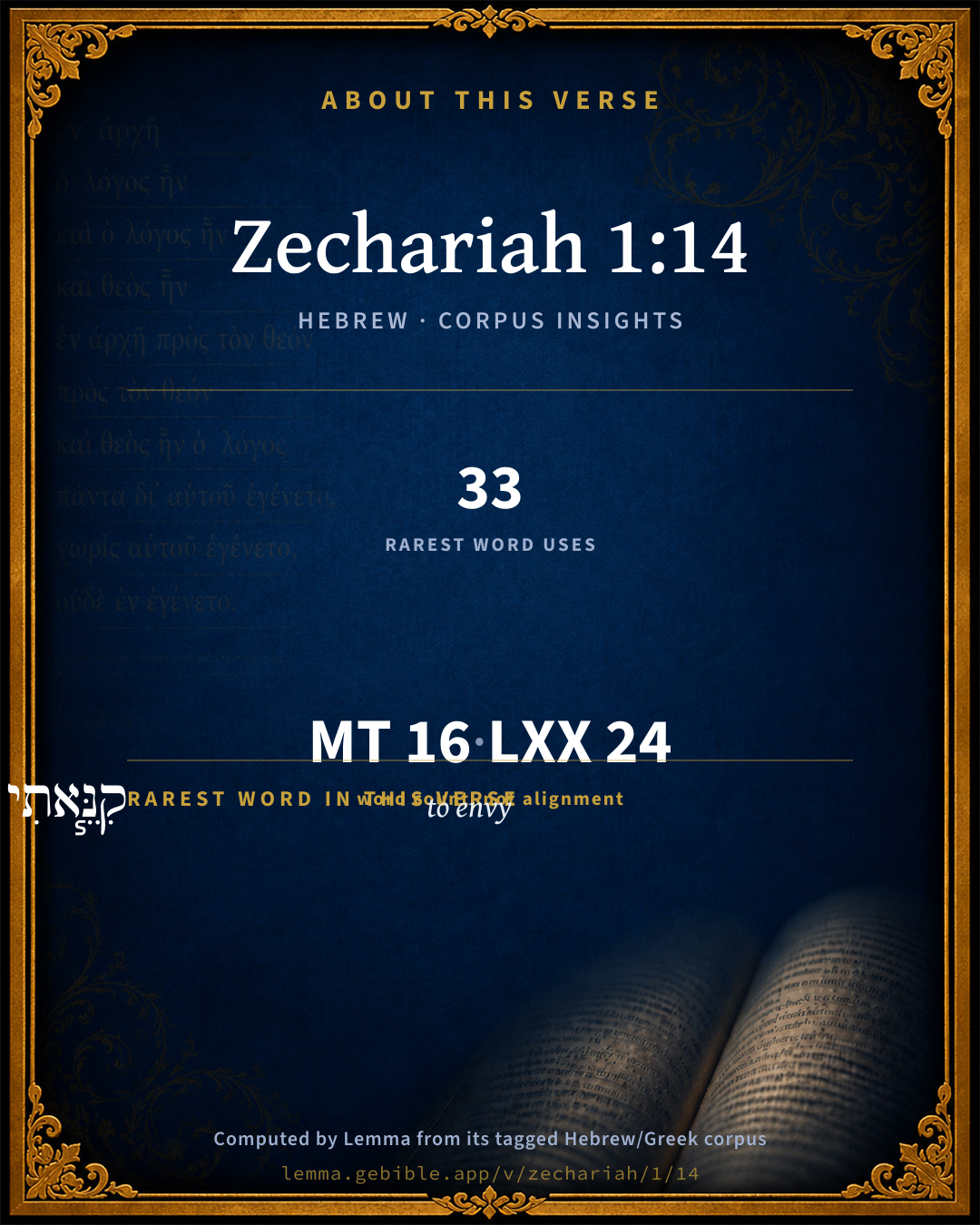
These counts appear in no published source. They are computed here, from the morphology-tagged text and Lemma’s own curated glosses. What Lemma adds →

16
words
13
distinct lemmas
Prophets
section

Shared distinctive vocabulary

קִנֵּ֧אתִי to envy H7065 occurs in 28 verses of the Hebrew Bible. Also found in:

Grammatical profile

  • 6 verbs
  • 6 nouns
  • 1 adjective
  • 2 prepositions
  • 1 adverb

Verb forms

  • וַיֹּ֣אמֶר Qal · Sequential Imperfect
  • הַדֹּבֵ֣ר Qal · Participle Active
  • קְרָ֣א Qal · Imperative
  • לֵאמֹ֔ר Qal · Infinitive Construct
  • אָמַ֖ר Qal · Perfect
  • קִנֵּ֧אתִי Piel · Perfect

Repetition

A word recurs within this verse — often emphatic in Hebrew:

  • וַיֹּ֣אמֶר to say H559 ×3

Hebrew & Septuagint length

In English translation the verse runs 29 words from the Hebrew and 30 from the Septuagint (LXX English) — closely comparable.

A rough comparison of the two English renderings, which tokenize alike — not a word-level alignment.

Word counts can differ between the Hebrew and the Greek without any difference in meaning — e.g. the Hebrew direct-object marker אֵת has no separate Greek word, and Greek often adds the article ὁ.

In the original languages it is 16 Hebrew tokens and 24 Greek tokens — but the two are counted differently (Hebrew bundles its prefixes and suffixes into one token; the Greek is in lemma form), so that isn’t a like-for-like length.

Cross-references

16

Topical passages linked to Zechariah 1:14 in the Treasury of Scripture Knowledge — connected by theme and wording, ordered by reader-vote popularity; previews shown in the World English Bible.

  • Joel 2:18 Then Yahweh was jealous for his land, And had pity on his people.
  • Isaiah 40:6 The voice of one saying, Cry. One said, What shall I cry? All flesh is grass, and all the glory of it is as the flower of the field.
  • Isaiah 40:1 Comfort you, comfort you my people, says your God.
  • Zechariah 1:9 Then I asked, 'My lord, what are these?'" The angel who talked with me said to me, "I will show you what these are."
  • Zechariah 1:17 "Proclaim further, saying, 'Thus says Yahweh of Hosts: "My cities will again overflow with prosperity, and Yahweh will again comfort Zion, and will again choose Jerusalem."'"
  • Isaiah 9:7 Of the increase of his government and of peace there shall be no end, on the throne of David, and on his kingdom, to establish it, and to uphold it with justice and with righteousness from henceforth even forever. The zeal of Yahweh of Hosts will perform this.
  • Isaiah 38:22 Hezekiah also had said, What is the sign that I shall go up to the house of Yahweh?
  • Isaiah 42:13 Yahweh will go forth as a mighty man; he will stir up [his] zeal like a man of war: he will cry, yes, he will shout aloud; he will do mightily against his enemies.
  • Isaiah 59:17 He put on righteousness as a breastplate, and a helmet of salvation on his head; and he put on garments of vengeance for clothing, and was clad with zeal as a mantle.
  • Isaiah 63:15 Look down from heaven, and see from the habitation of your holiness and of your glory: where are your zeal and your mighty acts? the yearning of your heart and your compassion is restrained toward me.
  • Hosea 11:8 "How can I give you up, Ephraim? How can I hand you over, Israel? How can I make you like Admah? How can I make you like Zeboiim? My heart is turned within me, My compassion is aroused.
  • Nahum 1:2 Yahweh is a jealous God and avenges. Yahweh avenges and is full of wrath. Yahweh takes vengeance on his adversaries, and he maintains wrath against his enemies.
  • Zechariah 1:13 Yahweh answered the angel who talked with me with kind and comforting words.
  • Zechariah 2:3–4 Behold, the angel who talked with me went forth, and another angel went out to meet him,
  • Zechariah 8:2–3 Thus says Yahweh of Hosts: "I am jealous for Zion with great jealousy, and I am jealous for her with great wrath."
  • Zechariah 4:1 The angel who talked with me came again, and wakened me, as a man who is wakened out of his sleep.

Cross-references courtesy of OpenBible.info (CC BY 4.0).

Hebrew and Greek witnesses Masoretic Hebrew ↔ Greek Septuagint

The same verse in the two great witnesses to the Old Testament, shown verse-for-verse.

These are two independent witnesses, not word-aligned to each other, and the Septuagint is shown in lemma (dictionary) form.

Hebrew Zechariah 1:14 Masoretic · Westminster Leningrad Codex

וַיֹּ֣אמֶר אֵלַ֗י הַמַּלְאָךְ֙ הַדֹּבֵ֣ר בִּ֔י קְרָ֣א לֵאמֹ֔ר כֹּ֥ה אָמַ֖ר יְהוָ֣ה צְבָא֑וֹת קִנֵּ֧אתִי לִירוּשָׁלִַ֛ם וּלְצִיּ֖וֹן קִנְאָ֥ה גְדוֹלָֽה

So the angel who talked with me said to me, "Proclaim, saying, 'Thus says Yahweh of Hosts: "I am jealous for Jerusalem and for Zion with a great jealousy.

World English Bible · Public Domain

Greek LXX Zechariah 1:14 Septuagint · lemma form

καί εἶπον πρός ἐγώ ὁ ἄγγελος ὁ λαλέω ἐν ἐγώ ἀνακράζω λέγω ὅδε λέγω κύριος παντοκράτωρ ζηλόω ὁ ἰερουσαλήμ καί ὁ σιων ζῆλος μέγας

And the angel that spoke with me said to me, Cry out and say, Thus says the Lord Almighty; I have been jealous for Jerusalem and Sion with great jealousy.

LXX2012 (modern English Septuagint) · Public Domain

Hebrew: Westminster Leningrad Codex (CC BY 4.0). Greek: Septuagint (public domain); English from LXX2012 (modern English Septuagint) (Public Domain). How the Septuagint differs from the Hebrew →

Targum (Aramaic paraphrase)

1

The Targum is the ancient Jewish Aramaic paraphrase of the Hebrew Scriptures — an interpretive translation, not the Hebrew text itself. Onkelos (literal) and Pseudo-Jonathan (expansive) render the Torah, and Jonathan the Prophets. Coverage is partial: where no permissively-licensed English translation exists for a verse, only the Aramaic is shown. This is verse-level text, not a word-by-word alignment to the Hebrew.

  1. Targum Jonathan Prophets (Joshua–Malachi)
    וַאֲמַר לִי מַלְאֲכָא דִי מַלֵיל עַמִי אִתְנַבִּי לְמֵימַר כִּדְנַן אֲמַר יְיָ צְבָאוֹת מִתְפְּרַע אֲנָא פּוּרְעֲנוּת יְרוּשְׁלֵם וּלְצִיוֹן קִנְאָה רַבָּא:

    (no public-domain English translation for this verse)

    Targum Jonathan — Aramaic: “Mikraot Gedolot” (public domain). English: “Sefaria Community Translation” (CC0 1.0 (public-domain dedication)); “London "Chaldee Paraphrase," 1871” (public domain). Text via Sefaria.

Commentary

Notes on Zechariah 1:14 from classic Christian and Jewish commentators (each source and its license shown beneath its notes). The classic Christian expositions comment on the surrounding passage and are grouped to its opening verse, so a note may address several verses; the Jewish commentaries on the Tanakh (Rashi and others) are per-verse, so they appear only where the commentator wrote on this verse.

Lemma curates 59 commentaries, every one of them public domain or Creative Commons licensed, each selected and text-cleaned for this edition rather than reprinted as found. About our sources →

Trapp's Complete Commentary

John Trapp

Zec 1:14 So the angel that communed with me said unto me, Cry thou, saying, Thus saith the LORD of hosts; I am jealous for Jerusalem and for Zion with a great jealousy.

Ver. 14. So the angel that communed with me] See the note on Zec 1:10.

Cry thou, saying] q.d. Comfort ye, comfort ye my people, saith your God, speak ye comfortably to Jerusalem, speak ye to her heart and cry unto her, saying, that her appointed time is accomplished, that her iniquity is pardoned, and so the quarrel is ended; for she hath received of the Lord’s hands double for her sins. Nothing so much as I have deserved, saith she, Ezr 9:13; twice so much as she hath deserved, saith he. O sweet contradiction! O beautiful contention! The same Hebrew word signifieth to repent and to comfort, 1Sa 15:35 Isa 60:1. God’s care is to comfort those that are cast down. His command to his prophet is, to cry comfort to the penitent with an extraordinary earnestness, from the God of all consolation.

I am jealous for Jerusalem and for Zion with a great jealousy] Love is strong as death, zeal, or jealousy (for the same word signifieth both), is hard as hell, Son 8:6. Non amat qui non zelat, saith Augustine. He loves not that zeals not. And Basil, venturing himself very far from his friend, and by some blamed for it, answered, Ego aliter amare non didici, I cannot love a man, but I must do mine utmost for him. When one desired to know what manner of man Basil was, it is said there was presented in a dream to him a pillar of fire with this motto, Talis est Basilius, Lo, such a one is Basil. It is certain that our God is a consuming fire. "Who would set the briers and the thorns," saith he, that is, the Church’s enemies, "against me in battle? I would go through them, I would burn them together," Isa 27:4. And yet he saith in the same place, "Fury is not in me." What will he do then when jealousy is in him as here? "Jealousy is the rage of a man," Pro 6:34, and hath these three properties:

First, it is exceeding watchful and quick sighted; hardly shall the paramour escape the husband’s eye, and a wanton glance is soon noted and noticed. God is no less sensible and observant of the least indignity done to his dear spouse, his Hephzibah, be it but in a frown or a frump. Why is thy countenance cast down? saith God to that dog-bolt Cain, Gen 4:6. Why dost lower upon my righteous Abel? What, will he force the queen also before me in the house? Est 7:8. If David’s enemies mow and make mouths at him, if they cry, Aha, aha, so would we have it, God will reckon with them for it, Psa 40:15. If Edom say jeeringly to the prophet, Watchman, what of the night? watchman, what of the night? If Ammon clap but his hands at God’s Israel, if he stamp with the feet, and rejoice in heart only, when it goes ill with the Church, "God will stretch out his hand upon him, and cut him off out of his country, and he shall know that he is Jehovah," Eze 25:6-7; yea, that the Lord God of Israel is a jealous God. He will be jealous for his land, and pity his people, Joe 2:18.

Secondly, jealousy is violent, it is cruel as the grave, the coals thereof are coals of fire, Son 8:6. The same word is elsewhere put for fiery thunderbolts, Psa 78:48; also for a carbuncle or burning fever, Deu 32:24. Jealousy puts a man into a fever fit of outrage; arms him with fiery darts, yea, with lightbolts; makes him cast firebrands, be ready to take any revenge. Think the same of God in a way of justice. He will spit in the face of a Miriam, that shall but mutter against his Moses, Num 12:14; what, then, will he do (or rather, what will he not do) against Jezebel, Athaliah, Herodias.

Thirdly, jealousy is irreconcilable, implacable: Pro 6:34-35 "He will not spare in the day of vengeance, He will not regard any ransom, neither will he rest content though thou give many gifts." What would not Balak have given to have had his will upon Israel? What large offers made Haman! he would pay ten thousand talents of silver to those that had the charge of the business to destroy the Jews. Ahasuerus yielded; but so did not God. "We are sold (said Esther), I and my people, to be destroyed, to be slain and to perish." But God never consented to the bargain, Est 3:9; Est 7:4. He had war with Amalek for ever, and laid his hand upon his own throne, as swearing to root him out, Exo 17:16. And this proud Agagite Haman shall feel the force of his curse in his very bowels. Let the labouring Church but cry out, Help, O King, hear, O husband, give ear, O shepherd of Israel, the enemy is come into thy land, O Immanuel, and the stretching out of his wings filleth the whole breadth of it. Where is thy zeal (or jealousy) and thy strength, the sounding of thy bowels, and of thy mercies towards me? are they restrained? Doubtless thou art our Father, our Redeemer, or near kinsman, nay, our husband, Isa 8:8; Isa 63:15. Thy Church is unto thee a sister, a spouse; and canst thou hide thine eyes from thine own flesh? Isa 58:7, from her that is joined to the Lord, and is one spirit? 1Co 6:17; shall Abraham venture for the rescue of his kinsman, David of his two wives, and wilt thou do nothing for the dearly beloved of thy soul? shall she be given up into the hand of her enemies? shall the sword reach unto the soul? Gen 14:14 1Sa 30:18 Jer 12:7; Jer 4:10. Let Christ but hear such words from the mouth of his spouse; and he will soon gird his sword upon his thigh, he will act Phineas’ part and execute judgment; he will smite his enemies in the hinder parts (whip them, as men used to do boys), and so put them to a perpetual reproach; shame them for ever, as a company of punies or zanies, Psa 78:66.

John Trapp, A Commentary or Exposition upon All the Books of the Old and New Testament (1647–1656) — public domain. Text from a community e-Sword module.

The Biblical Illustrator

Joseph S. Exell

Zec_1:14-17

I am jealous for Jerusalem

Mercy mingled with chastisement

Jealousy is that particular uneasiness which arises in our minds from the fear that some rival may rob us of the affection of one whom we greatly love, or from suspicion that he has already done it.

Gods jealousy, or zeal, denotes His distrust of His creatures, His eminent care of His people, and His readiness to punish such as injure them. He is peculiarly jealous for everything whereby He maketh Himself known. Comparatively speaking, God may be said to be but a little displeased with His people, whatever be the manner of His dealing with them in this world. Their afflictions are only temporary and of short duration. They are also designed for their profit, and overruled for promoting their best interests. And though the troubles that afflict the just be great and many in number, the Lord will deliver him out of them all. Let us take the comfort which the good words spoken to Israel are designed to yield, amid all the trials and afflictive dispensations of providence with which we may be visited in this life. You may be in darkness and in doubts, perplexed on every side, and encompassed with difficulties, but still you need not despair. The Lord is jealous for you with a great jealousy. Weeping may endure for a night, but joy cometh in the morning. (Matthew Fraser.)

The Biblical Illustrator, edited by Joseph S. Exell (c. 1880s–1900s) — public domain. Text from a community e-Sword module.

Tyndale Open Study Notes

Tyndale Open Resources

1:14 My love . . . is passionate and strong: This phrase, sometimes translated as “I am very jealous,” reflects intense, single-minded devotion that could produce hatred and envy or zeal and devotion. God is jealous—as the one true and living God, he has exclusive rights to his creatures’ worship (see Exod 20:5; 34:14). • Jerusalem signifies the territories ruled by Judean kings; Mount Zion was the site of the Lord’s Temple.

Tyndale Open Study Notes — © Tyndale Open Resources, licensed CC BY-SA 4.0. Text via the HelloAO Bible API.

Geneva Bible (1599)

Geneva Bible translators

Though for a time God defer his help and comfort from his Church, yet this declareth that he loveth them still most dearly, as a most merciful father his children, or an husband his wife, and when it is expedient for them, his help is ever ready.

Geneva Bible (1599) marginal notes — public domain. Text via Bolls.life.

Jamieson, Fausset & Brown

Robert Jamieson, A. R. Fausset & David Brown

Cry--Proclaim so as to be heard clearly by all (Isa 40:6; Isa 58:1).

I am jealous for Jerusalem--As a husband jealous for his wife, wronged by others, so Jehovah is for Judah, who has been injured wantonly by the heathen (Zac 8:2; Num 25:11, Num 25:13; Kg1 19:10; Joe 2:18).

Jamieson, Fausset & Brown — Commentary Critical and Explanatory on the Whole Bible (1871) — public domain (CC PDM 1.0). Text via the HelloAO Bible API.

Adam Clarke's Commentary

Verse 14. I am jealous for Jerusalem] I have for them a strong affection; and indignation against their enemies.

Adam Clarke's Commentary on the Bible (1810–1826) — public domain. Text from a community e-Sword/MySword module.

John Calvin's Commentaries

Zechariah now mentions the chief consolation to which he had referred; for it would not have been sufficient to say in general, and in a few words without explanation, that God gave a kind answer to the angel. For we know how strong were those temptations with which the faithful had to struggle. It was then needful for them to be furnished, not with light weapons, in so arduous a contest. This is the reason why Zechariah more fully expressed the words by which God then strengthened the faith of his people.

He says that the angel had spoken; and he thus intimates that the consolation was not given privately to the angel that he might keep it in his own bosom, but convey it to the whole people. This was not then a secret consolation but what the Lord intended to be proclaimed by his Prophets, according to what is said by Isaiah in the passage to which we have already referred — “Comfort ye, comfort ye my people saith your God.”

What God says, that he was moved with great zeal for Jerusalem and Sion, is according to the common language of Scripture. For as God cannot otherwise sufficiently express the ineffable favor which he has towards his elect he is pleased to adopt this similitude, that he undertakes the defense of his people according to what is done by a husband who fights with the greatest zeal for his own wife. This is the reason why he says that he was zealous for Jerusalem. And we ought especially to notice this mode of speaking, that we may not think that God is indifferent when he delays and defers his aid: for as we are hasty in our wishes so we would have God to be precipitant in the same manner; and we impute to him indifference when he does not hasten according to our desires. These doubts God checks when he testifies that he is zealous: for he intimates that his slowness did not proceed from neglect or because he despised or disregarded them; but that there was another reason why he held them in suspense. We may therefore be fully persuaded that even when God withholds his aid he is not otherwise affected towards us than the best of fathers towards his own children; and further that the signs of his love do not appear because it is not always expedient for us to be delivered soon from our troubles. Let this then be our shield against all hasty desires, so that we may not indulge our too ardent wishes, or think that our salvation is neglected by God, when he hides himself for a time and does not immediately stretch forth his hand to help us. It follows —

John Calvin's Commentaries (1540-1563) — public domain. Text from the Calvin Translation Society English edition (1840s-50s) via the Christian Classics Ethereal Library (ccel.org). Calvin's coverage is partial (roughly two-thirds of the Bible); uncommented books and verses are honest gaps, never fabricated. The 19th-century editor's footnotes and remarks are omitted so the notes are faithfully Calvin's own voice.

Ellicott's Commentary for English Readers

(14) That communed with me.—The Hebrew words are the same as those rendered elsewhere, “that spake with me.”

I am jealous.—The verb is in the perfect, like “I am returned” (Zec_1:16), and denotes that the Lord had already shown His jealous love for Israel in bringing them out of captivity, and that He would continue to do so in completing the restoration of Jerusalem. “The hour of darkest desolation to the Church, and of haughtiest triumph to her enemies, is often the very hour when God begins His work of judgment on the one, and returning mercy on the other” (Moore).

A Bible Commentary for English Readers, edited by Charles John Ellicott (1878–1897) — public domain. Text from a community e-Sword module.

The Cambridge Bible for Schools and Colleges

gen. ed. J. J. S. Perowne

14. I am jealous] “I have been, not now only, but in time past even when I did not shew it, and am jealous, with the tender love which allows not what it loves to be injured.” Pusey. Comp. chap. Zec_8:2.

The Cambridge Bible for Schools and Colleges (gen. ed. J. J. S. Perowne; Cambridge University Press, 1878–1918) — public domain. Text from a community e-Sword module.

John Gill's Exposition

So the angel that communed with me,.... Having an order from the other Angel, or the Lord of hosts:

said unto me, Cry thou; proclaim, publish, declare in the hearing of the people, for their comfort and encouragement. The Targum renders it, "prophesy":

saying, Thus saith the Lord of hosts, I am jealous for Jerusalem, and for Zion, with a great jealousy; which is expressive of his conjugal affection for his church and people, his zeal for their good, and his indignation at their enemies, and of the vengeance he would execute on them.

John Gill's Exposition of the Whole Bible (1746–1763) — public domain (CC PDM 1.0). Text via the HelloAO Bible API.

Albert Barnes' Notes on the Bible

Cry thou - The vision was not for the prophet alone. What he saw and heard, that he was to proclaim to others. The vision, which he now saw alone, was to be the basis and substance of his subsequent preaching Jon 1:2; Isa 40:2, Isa 40:6, whereby he was to encourage his people to persevere.

I am jealous for Jerusalem - Literally, “I have been,” not now only but in time past even when I did not show it, “and am jealous”, with the tender love which allows not what it loves to be injured . The love of God, until finally shut out, is unchangeable, He pursues the sinner with chastisements and scourges in His love, that he may yet be converted and live . But for God’s love to him and the solicitations of His grace, while yet impenitent and displeasing Him, he could not turn and please Him.

And for Zion - Which especially He had chosen to put His Name there, and there to receive the worship of His people; “the hill which God desired to dwell in” Psa 68:16, “which He loved” (Psa 78:68; add Psa 132:13-14). Dionysius: “With great and special love have I loved the people of the Jews and what pertained to them, and out of that love have I so diligently and severely corrected her excesses, that she may be more careful for the time to come, as a husband corrects most sharply a wife most dear to him, if she be unfaithful. Whence in the book of Maccabees it is written, “It is a token of His great goodness, when wicked doers are not suffered any long time, but are immediately punished. For not as with other nations, whom the Lord patiently forbeareth to punish, till they be come to the fullness of their sins, so dealeth He with us; lest, being come to the height of sin, afterward He should take vengeance of us. And therefore He never withdraweth His mercy from us, and though He punisheth with adversity, yet doth He never forsake His people” (2 Macc. 6:13-16).

Albert Barnes' Notes on the Bible (1834–1885) — public domain. Text from a community e-Sword/MySword module.

Haydock's Catholic Bible Commentary

Zeal. I will again treat her as my spouse. (Haydock)

George Leo Haydock (1774–1849), Haydock's Catholic Family Bible and Commentary, 1859 edition — public domain. Excludes Psalms (Douay-Rheims chapter numbering differs from Protestant) and Deuterocanonical books (Catholic canon only).

Matthew Poole's English Annotations

So, i.e. when the Father had heard the Son and answered him; this is spoken to our apprehension, and so must be understood.

The angel of the covenant, the Lord Christ. That communed with me: see Zec 1:13.

Cry thou; now publish what thou hearest, preach by commission from me, and assure my poor captive, impoverished church, that God, my God and her God, will do good for her.

Saying, Thus saith the Lord of hosts; publish what God, Lord of hosts, and Father of his people, promised to do for them.

I am jealous; I have been jealous against, but now am jealous for Jerusalem; my love is now heightened to a very high degree of compassion for my people, and of indignation against her enemies and oppressors.

For Jerusalem; the city called by my name.

For Zion; where my temple stood; those gates of Zion, which I loved more than all the dwellings of Jacob.

With a great jealousy; that zeal I bear, and now will, show for them, is great to a wonder; it is the zeal of a God who infinitely loves and pitieth his people.

Matthew Poole's English Annotations on the Holy Bible (1683–1685) — public domain. Text from a community e-Sword/MySword module.

Whedon's Commentary on the Bible

Daniel D. Whedon

14-17. The interpreting angel joins to the interpretation an exhortation to make the message known to all the people.

Cry thou — So that all may hear (compare Zec_1:4).

Thus saith Jehovah — The present announcement is the word of Jehovah as much as the pre-exilic prophecies.

I am jealous… with a great jealousy — See on Joe_2:18. The intensity of the divine emotion is indicated by the addition “with a great jealousy.” The Hebrew tense implies the continuity of the divine jealousy. The restoration from exile was an expression of it, and even when there was no external manifestation of it, it was there, and soon it will show itself again.

Daniel D. Whedon (gen. ed.), Commentary on the Old and New Testaments (1874–1909) — public domain. Text from a community e-Sword module.

The Pulpit Commentary

Cry thou. (Isa_40:6) The prophet has to publish two things:

(1) God"s love for his people, however humiliated and miserable their present position might be; and

(2) the promise of coming prosperity. I am jealous. The term implies ardent love, which cannot bear itself to be slighted, or the object of its affection to be injured. (comp. Zec_8:2, and note there; Num_25:11, 13Jo 2:18) For Jerusalem, as the capital of the kingdom; and for Zion, as the seat of worship.

The Pulpit Commentary (1880–1919), ed. H.D.M. Spence-Jones & Joseph S. Exell — public domain. Text from a community e-Sword module.

John Wesley's Explanatory Notes

Cry thou - Now publish what thou hearest, and assure my poor captive church, that God will do good for her.

John Wesley, Explanatory Notes Upon the Whole Bible (1754–1765) — public domain. Text via the GEBible commentary corpus.

unfoldingWord translationNotes

Door43 World Missions Community

I have been jealous for Jerusalem

Here the word "jealous" refers to Yahweh's strong desire to protect his people.

I am very angry with the nations that are at ease

The phrase "at ease" means that the people thought that they lived in peace and security. AT: "I am very angry with the nations that enjoy peace and security" (See: Idiom)

I was only a little angry with them

"I was only a little angry with the people of Jerusalem"

they made the disaster worse

"the nations that are at ease made the disaster worse." This means that although Yahweh used these nations to punish Jerusalem, they did more harm to Jerusalem than what Yahweh had intended for them to do. (See: Assumed Knowledge and Implicit Information)

translationWords

angel

Yahweh of hosts

jealous

Jerusalem

Zion

anger

nation

unfoldingWord translationNotes — © Distant Shores Media and the Door43 World Missions Community, licensed CC BY-SA 4.0. Source: git.door43.org/Door43/en_tn.

Rashi

Rabbi Shlomo Yitzchaki (Rashi)

I am jealous for Jerusalem I am exacting the retribution [for] the cause of Jerusalem from those who oppress her.

Rashi on the Tanakh — English translations: “The Judaica Press complete Tanach with Rashi, translated by A. J. Rosenberg” (CC BY 4.0); “Pentateuch with Rashi's commentary by M. Rosenbaum and A.M. Silbermann, 1929-1934” (public domain); “The Metsudah Tanach series, Lakewood, N.J” (CC BY 4.0); and “The Book of Joshua, Metsudah Publications, 1997” (CC BY 4.0). Text via Sefaria.

Lesson kit

Teaching starters — assembled from the data on this page, not authored interpretation. Every prompt links to the verse data it draws on. Edit before teaching.

Zechariah, in the Prophets, opens this verse with 16 words (13 distinct Hebrew lemmas). Its most distinctive word is qânâʼ (“to envy”). A historical commentator’s framing appears above. Read the whole chapter for the surrounding context.

Discussion questions

  1. The word qânâʼ carries the sense “to envy.” How does it shape the verse?
  2. How does Genesis 26:14, which shares the word «to envy», read alongside this verse?
  3. What does the repetition of “to say” (3× in this one verse) do in this verse?
  4. The translations on this page render this verse differently — a whole-verse word diff, not a word-by-word alignment. What might account for the different wordings?
  5. «וַיֹּ֣אמֶר» is a Qal Sequential Imperfect verb. How does that grammatical form shape the action described?
  6. Compare how Trapp's Complete Commentary and The Biblical Illustrator read this verse. Where do they agree or differ?

Things to notice

Reading settings

Reading text

Shown beneath each verse's original-language words.

Old Testament
Old Testament edition

Read the OT as the Masoretic Hebrew (MT) or the Greek Septuagint (LXX).

English shown for the Greek Septuagint (in the Hebrew ↔ Greek comparison).

Comparing translations? Open the Compare panel on any verse page to stack up to four side by side.