
Isaiah 37:36

Hebrew (Westminster Leningrad Codex) Isaiah 37:36 appears in the Hebrew Old Testament. The text above is from the Westminster Leningrad Codex. Each word links to its Strong’s number, a concise gloss, and parsing drawn from the Open Scriptures Hebrew Bible morphology. Click any word for its full Brown-Driver-Briggs (BDB) entry.
Download image
Cite this verse

Isaiah 37:36 (World English Bible). Public Domain. Lemma interlinear Bible study tool, https://lemma.gebible.app/v/isaiah/37/36.

Show BibTeX & RIS
BibTeX
RIS
English Translation
The angel of Yahweh went forth, and struck in the camp of the Assyrians one hundred and eighty-five thousand; and when men arose early in the morning, behold, these were all dead bodies.
World English Bible · Public Domain
Download a study sheet

One document with this verse’s original text, its word-by-word gloss line, the meaning frame, cross-references with their text, attributed commentary, and full source and license credits — printable, and it pastes into notes with its structure intact.

This verse Autodidact and up

Study sheet (.html) Plain text (.txt)

A passage Seminary Student

Up to 50 verses in one chapter. A passage sheet keeps up to 6 commentary sources and 12 cross-references per verse, in the order this page ranks them, and says so on the sheet whenever that leaves anything out. Ask for a single verse and you get the Autodidact verse sheet above.

Everything on this page stays free to read, with no account — the sheet is a download of what is already on screen, not access to it.

Want to remove ads? Support Godless Engineer
Compare translations 3

The same verse in 3 English versions, stacked beneath the original-language interlinear above. Click any original word for its lexicon entry.

Each is an independent rendering of the whole verse — the interlinear is not word-aligned to these translations.

Highlighted words mark where these versions differ — a whole-verse word diff, not a word-by-word alignment.

  • World English Bible Public Domain
    The angel of Yahweh went forth, and struck in the camp of the Assyrians one hundred and eighty-five thousand; and when men arose early in the morning, behold, these were all dead bodies.
  • King James Version Public Domain
    Then the angel of the LORD went forth, and smote in the camp of the Assyrians a hundred and fourscore and five thousand: and when they arose early in the morning, behold, they were all dead corpses.
  • unfoldingWord Literal Text CC BY-SA 4.0
    And the angel of Yahweh went out and struck in the camp of Assyria, 185, 000. And they arose early in the morning and behold, all of them dead corpses.

unfoldingWord Literal Text — © unfoldingWord, licensed CC BY-SA 4.0. Word-aligned USFM3 via Door43 (git.door43.org/unfoldingWord/en_ult).

Versions to compare (up to 4)

3 of 4 selected

Show all 18 translations

Every available English version of this verse, each an independent rendering of the whole verse.

  • World English Bible Public Domain
    The angel of Yahweh went forth, and struck in the camp of the Assyrians one hundred and eighty-five thousand; and when men arose early in the morning, behold, these were all dead bodies.
  • Berean Standard Bible Public Domain
    Then the angel of the LORD went out and struck down 185,000 men in the camp of the Assyrians. When the people got up the next morning, there were all the dead bodies!
  • Majority Standard Bible Public Domain
    Then the angel of the LORD went out and struck down 185,000 men in the camp of the Assyrians. When the people got up the next morning, there were all the dead bodies!
  • King James Version Public Domain
    Then the angel of the LORD went forth, and smote in the camp of the Assyrians a hundred and fourscore and five thousand: and when they arose early in the morning, behold, they were all dead corpses.
  • American Standard Version (1901) Public Domain
    And the angel of Jehovah went forth, and smote in the camp of the Assyrians a hundred and fourscore and five thousand; and when men arose early in the morning, behold, these were all dead bodies.
  • Revised Version (1885) Public Domain
    And the angel of the LORD went forth, and smote in the camp of the Assyrians a hundred and fourscore and five thousand: and when men arose early in the morning, behold, they were all dead corpses.
  • Geneva Bible (1599) Public Domain
    Then the Angel of the Lord went out, and smote in the campe of Asshur an hundreth, fourescore, and fiue thousand: so when they arose early in the morning, beholde, they were all dead corpses.
  • Douay-Rheims (1899) Public Domain
    And the angel of the Lord went out, and slew in the camp of the Assyrians a hundred and eighty-five thousand. And they arose in the morning, and behold they were all dead corpses.
  • Young's Literal Translation Public Domain
    And a messenger of Jehovah goeth out, and smiteth in the camp of Asshur a hundred and eighty and five thousand; and `men' rise early in the morning, and lo, all of them `are' dead corpses.
  • Literal Standard Version CC BY-SA 4.0
    And a messenger of YHWH goes out, and strikes in the camp of Asshur one hundred and eighty-five thousand; and [men] rise early in the morning, and behold, all of them [are] dead corpses.
  • Unlocked Literal Bible CC BY-SA 4.0
    Then the angel of Yahweh went out and attacked the camp of the Assyrians, putting to death 185,000 soldiers. When the men arose early in the morning, dead bodies lay everywhere.
  • unfoldingWord Literal Text CC BY-SA 4.0
    And the angel of Yahweh went out and struck in the camp of Assyria, 185, 000. And they arose early in the morning and behold, all of them dead corpses.
  • Darby Bible Public Domain
    And an angel of Jehovah went forth, and smote in the camp of the Assyrians a hundred and eighty-five thousand. And when they arose early in the morning, behold, they were all dead bodies.
  • World Messianic Bible Public Domain
    Then the LORD’s angel went out and struck one hundred and eighty-five thousand men in the camp of the Assyrians. When men arose early in the morning, behold, these were all dead bodies.
  • Webster's Bible Public Domain
    Then the angel of the LORD went forth, and smote in the camp of the Assyrians a hundred and eighty five thousand: and when they arose early in the morning, behold, they were all dead corpses.
  • Free Bible Version CC BY-SA 4.0
    Then the angel of the Lord went to the Assyrian camp and killed 185,000 of them. When the survivors woke up in the morning, they were surrounded by dead bodies.
  • Bible in Basic English Public Domain
    And the angel of the Lord went out and put to death in the army of the Assyrians a hundred and eighty-five thousand men: and when the people got up early in the morning, there was nothing to be seen but dead bodies.
  • JPS Tanakh (1917) Public Domain
    And the angel of the LORD went forth, and smote in the camp of the Assyrians a hundred and fourscore and five thousand; and when men arose early in the morning, behold, they were all dead corpses.

Literal Standard Version (2020), Covenant Press — licensed CC BY-SA 4.0. Text via the HelloAO Bible API (eBible.org). Unlocked Literal Bible (unfoldingWord) — licensed CC BY-SA 4.0. Text via the HelloAO Bible API (eBible.org). unfoldingWord Literal Text — © unfoldingWord, licensed CC BY-SA 4.0. Word-aligned USFM3 via Door43 (git.door43.org/unfoldingWord/en_ult). Free Bible Version, Dr. Jonathan Gallagher — licensed CC BY-SA 4.0. Text via the HelloAO Bible API (eBible.org).

Word by word

More ways to search: Search by grammar → Find every occurrence → Compare this word →

Practice this passage: Drill this verse → Learn its vocabulary →

פְּגָרִ֥ים
peger
H6297
“corpses”
Noun, Common, Masculine, Plural, Absolute
Part of Speech
Noun
Type
Common
Gender
Masculine
Number
Plural
State
Absolute
Full BDB Definition

Origin: from H6296

TWOT: 1732a

corpse, carcass, monument, stela - corpse (of man) - carcass (of animals)
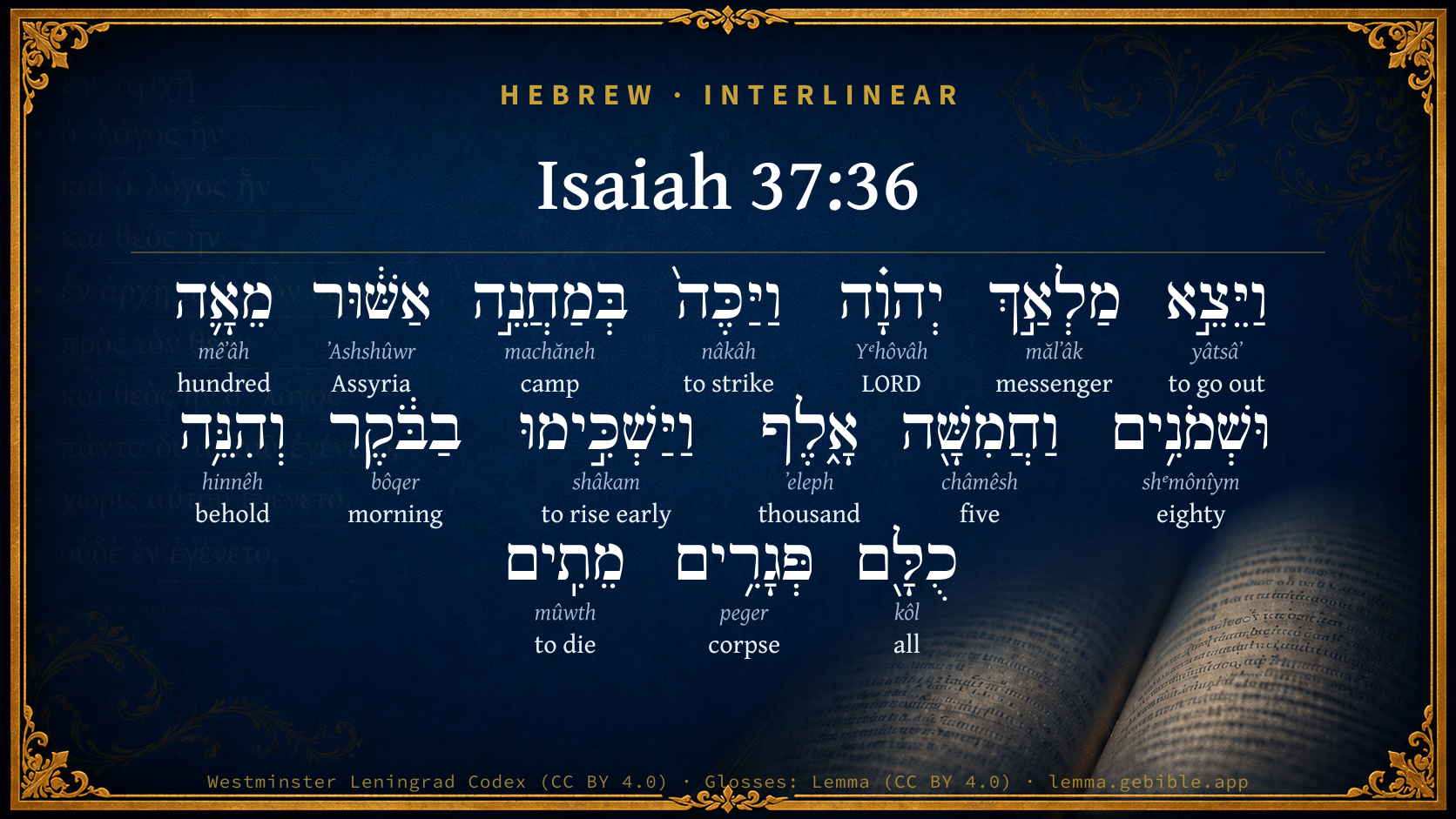
  1. וַיֵּצֵ֣א yâtsâʼ H3318 “and · to go out” Conjunction + Verb, Qal, Sequential Imperfect, 3rd Person, Masculine, Singular
  2. מַלְאַ֣ךְ mălʼâk H4397 “messenger of” Noun, Common, Masculine, Singular, Construct
  3. יְהוָ֗ה Yᵉhôvâh H3068 “LORD” Noun, Proper
  4. וַיַּכֶּה֙ nâkâh H5221 “and · to strike” Conjunction + Verb, Hiphil, Sequential Imperfect, 3rd Person, Masculine, Singular
  5. בְּמַחֲנֵ֣ה machăneh H4264 “in/at · camp of” Preposition + Noun, Common, Both, Singular, Construct
  6. אַשּׁ֔וּר ʼAshshûwr H804 “Assyria” Noun, Proper
  7. מֵאָ֛ה mêʼâh H3967 “hundred” Adjective, Cardinal number, Both, Singular, Absolute
  8. וּשְׁמֹנִ֥ים shᵉmônîym H8084 “and · eighty” Conjunction + Adjective, Cardinal number, Both, Plural, Absolute
  9. וַחֲמִשָּׁ֖ה châmêsh H2568 “and · five” Conjunction + Adjective, Cardinal number, Masculine, Singular, Absolute
  10. אָ֑לֶף ʼeleph H505 “thousand” Adjective, Cardinal number, Both, Singular, Absolute
  11. וַיַּשְׁכִּ֣ימוּ shâkam H7925 “and · to rise early” Conjunction + Verb, Hiphil, Sequential Imperfect, 3rd Person, Masculine, Plural
  12. בַבֹּ֔קֶר bôqer H1242 “in/at the · morning” Preposition, Determined + Noun, Common, Masculine, Singular, Absolute
  13. וְהִנֵּ֥ה hinnêh H2009 “and · behold” Conjunction + Particle, Demonstrative
  14. כֻלָּ֖ם kôl H3605 “all · their” Noun, Common, Masculine, Singular, Construct + Suffix, Personal, 3rd Person, Masculine, Plural
  15. מֵתִֽים mûwth H4191 “dying” Verb, Qal, Participle Active, Masculine, Plural, Absolute

About this verse

These counts appear in no published source. They are computed here, from the morphology-tagged text and Lemma’s own curated glosses. What Lemma adds →

16
words
16
distinct lemmas
Prophets
section

Notable vocabulary

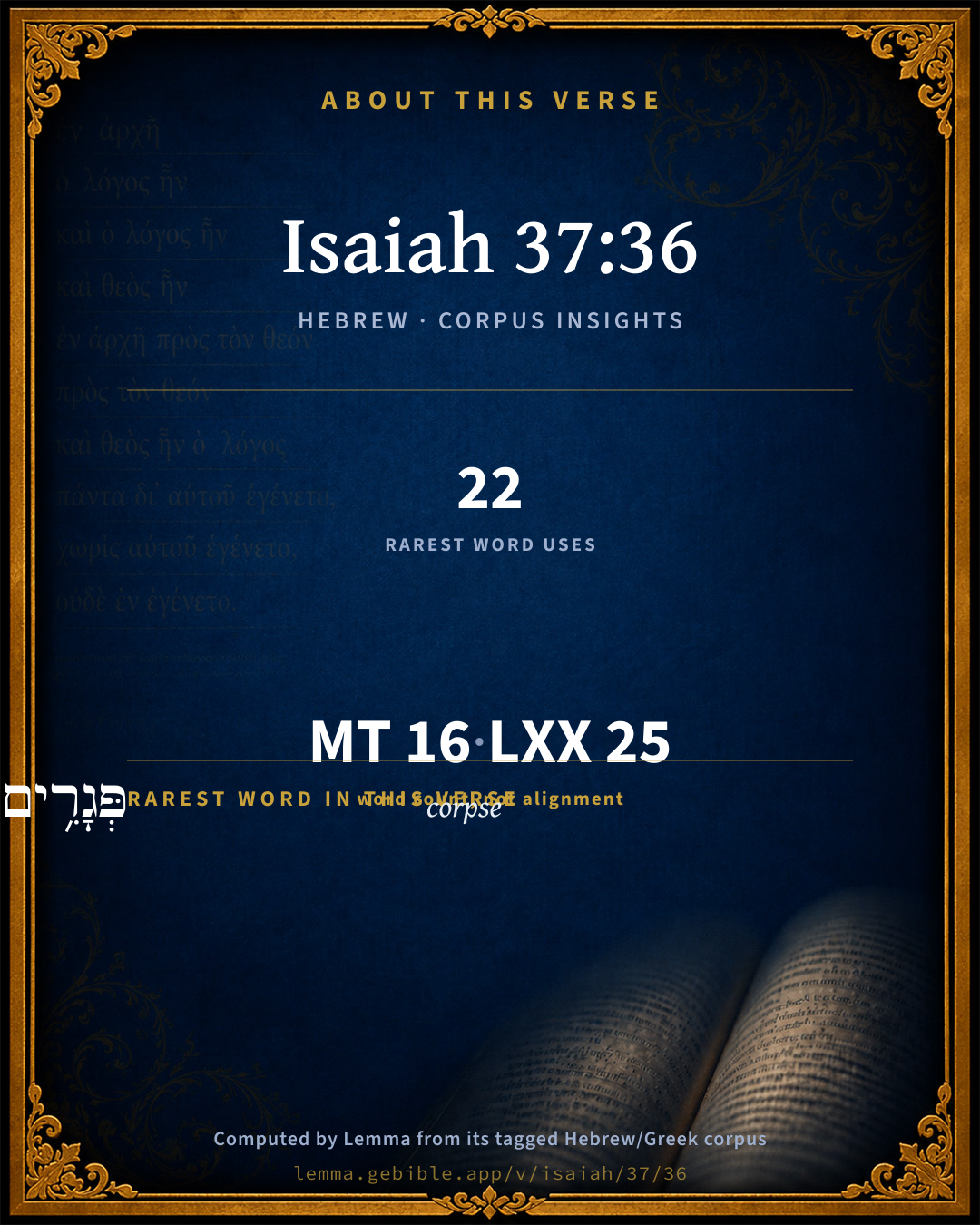
The rarest word here is פְּגָרִ֥ים corpse H6297 — appearing just 22 times in the whole Hebrew Bible.

Shared distinctive vocabulary

פְּגָרִ֥ים corpse H6297 occurs in 21 verses of the Hebrew Bible. Also found in:

Grammatical profile

  • 4 verbs
  • 7 nouns
  • 4 adjectives
  • 1 particle

Verb forms

  • וַיֵּצֵ֣א Qal · Sequential Imperfect
  • וַיַּכֶּה֙ Hiphil · Sequential Imperfect
  • וַיַּשְׁכִּ֣ימוּ Hiphil · Sequential Imperfect
  • מֵתִֽים Qal · Participle Active

Hebrew & Septuagint length

In English translation the verse runs 33 words from the Hebrew and 34 from the Septuagint (LXX English) — closely comparable.

A rough comparison of the two English renderings, which tokenize alike — not a word-level alignment.

Word counts can differ between the Hebrew and the Greek without any difference in meaning — e.g. the Hebrew direct-object marker אֵת has no separate Greek word, and Greek often adds the article ὁ.

In the original languages it is 16 Hebrew tokens and 25 Greek tokens — but the two are counted differently (Hebrew bundles its prefixes and suffixes into one token; the Greek is in lemma form), so that isn’t a like-for-like length.

Cross-references

20

Topical passages linked to Isaiah 37:36 in the Treasury of Scripture Knowledge — connected by theme and wording, ordered by reader-vote popularity; previews shown in the World English Bible.

  • 2 Kings 19:35 It happened that night, that the angel of Yahweh went forth, and struck in the camp of the Assyrians one hundred eighty-five thousand: and when men arose early in the morning, behold, these were all dead bodies.
  • Isaiah 10:12 Therefore it shall happen that, when the Lord has performed his whole work on Mount Zion and on Jerusalem, I will punish the fruit of the stout heart of the king of Assyria, and the glory of his high looks.
  • 2 Samuel 24:16 When the angel stretched out his hand toward Jerusalem to destroy it, Yahweh repented him of the evil, and said to the angel who destroyed the people, It is enough; now stay your hand. The angel of Yahweh was by the threshing floor of Araunah the Jebusite.
  • Isaiah 10:33–34 Behold, the Lord, Yahweh of Hosts, will lop the boughs with terror: and the high of stature shall be hewn down, and the lofty shall be brought low.
  • Isaiah 31:8 The Assyrian shall fall by the sword, not of man; and the sword, not of men, shall devour him; and he shall flee from the sword, and his young men shall become subject to forced labor.
  • 1 Thessalonians 5:2–3 For you yourselves know well that the day of the Lord comes like a thief in the night.
  • Psalms 35:5–6 Let them be as chaff before the wind, Yahweh's angel driving them on.
  • Isaiah 33:10–12 Now will I arise, says Yahweh; now will I lift up myself; now will I be exalted.
  • Acts 12:23 Immediately an angel of the Lord struck him, because he didn't give God the glory, and he was eaten by worms and died.
  • 1 Chronicles 21:16 David lifted up his eyes, and saw the angel of Yahweh standing between earth and the sky, having a drawn sword in his hand stretched out over Jerusalem. Then David and the elders, clothed in sackcloth, fell on their faces.
  • Job 24:24 They are exalted; yet a little while, and they are gone. Yes, they are brought low, they are taken out of the way as all others, And are cut off as the tops of the ears of grain.
  • Psalms 76:5–7 Valiant men lie plundered, They have slept their last sleep. None of the men of war can lift their hands.
  • Isaiah 10:16–19 Therefore will the Lord, Yahweh of Hosts, send among his fat ones leanness; and under his glory there shall be kindled a burning like the burning of fire.
  • Isaiah 30:30–33 Yahweh will cause his glorious voice to be heard, and will show the lighting down of his arm, with the indignation of [his] anger, and the flame of a devouring fire, with a blast, and tempest, and hailstones.
  • Exodus 12:23 For Yahweh will pass through to strike the Egyptians; and when he sees the blood on the lintel, and on the two side-posts, Yahweh will pass over the door, and will not allow the destroyer to come in to your houses to strike you.
  • Exodus 12:30 Pharaoh rose up in the night, he, and all his servants, and all the Egyptians; and there was a great cry in Egypt, for there was not a house where there was not one dead.
  • 1 Chronicles 21:12 either three years of famine; or three months to be consumed before your foes, while the sword of your enemies overtakes you; or else three days the sword of Yahweh, even pestilence in the land, and the angel of Yahweh destroying throughout all the borders of Israel. Now therefore consider what answer I shall return to him who sent me.
  • 2 Chronicles 32:21–22 Yahweh sent an angel, who cut off all the mighty men of valor, and the leaders and captains, in the camp of the king of Assyria. So he returned with shame of face to his own land. When he was come into the house of his god, those who came forth from his own bowels killed him there with the sword.
  • Psalms 46:6–11 The nations raged. The kingdoms were moved. He lifted his voice, and the earth melted.
  • Job 20:5–7 That the triumphing of the wicked is short, The joy of the godless but for a moment?

Cross-references courtesy of OpenBible.info (CC BY 4.0).

Hebrew and Greek witnesses Masoretic Hebrew ↔ Greek Septuagint

The same verse in the two great witnesses to the Old Testament, shown verse-for-verse.

These are two independent witnesses, not word-aligned to each other, and the Septuagint is shown in lemma (dictionary) form.

Hebrew Isaiah 37:36 Masoretic · Westminster Leningrad Codex

וַיֵּצֵ֣א מַלְאַ֣ךְ יְהוָ֗ה וַיַּכֶּה֙ בְּמַחֲנֵ֣ה אַשּׁ֔וּר מֵאָ֛ה וּשְׁמֹנִ֥ים וַחֲמִשָּׁ֖ה אָ֑לֶף וַיַּשְׁכִּ֣ימוּ בַבֹּ֔קֶר וְהִנֵּ֥ה כֻלָּ֖ם פְּגָרִ֥ים מֵתִֽים

The angel of Yahweh went forth, and struck in the camp of the Assyrians one hundred and eighty-five thousand; and when men arose early in the morning, behold, these were all dead bodies.

World English Bible · Public Domain

Greek LXX Isaiah 37:36 Septuagint · lemma form

καί ἐκἔρχομαι ἄγγελος κύριος καί ἀνααἱρέω ἐκ ὁ παρεμβολή ὁ ἀσσύριος ἑκατόν ὀγδοηκοντα πέντε χιλιάς καί ἐκ ἀναἵστημι ὁ πρωί εὑρίσκω πᾶς ὁ σῶμα νεκρός

And the angel of the Lord went forth, and killed out of the camp of the Assyrians one hundred and eighty-five thousand: and they arose in the morning and found all these bodies dead.

LXX2012 (modern English Septuagint) · Public Domain

On this verse, Keil & Delitzsch discusses the Septuagint’s reading. Read the note in Commentary ↓

Hebrew: Westminster Leningrad Codex (CC BY 4.0). Greek: Septuagint (public domain); English from LXX2012 (modern English Septuagint) (Public Domain). How the Septuagint differs from the Hebrew →

Targum (Aramaic paraphrase)

1

The Targum is the ancient Jewish Aramaic paraphrase of the Hebrew Scriptures — an interpretive translation, not the Hebrew text itself. Onkelos (literal) and Pseudo-Jonathan (expansive) render the Torah, and Jonathan the Prophets. Coverage is partial: where no permissively-licensed English translation exists for a verse, only the Aramaic is shown. This is verse-level text, not a word-by-word alignment to the Hebrew.

  1. Targum Jonathan Prophets (Joshua–Malachi)
    וּנְפַק מַלְאָכָא דַייָ וּקְטַל בְּמַשְׁרִית אַתּוּרָאָה מְאָה וְתַמְנָן וְחַמְשָׁא אַלְפִין וְאַקְדִימוּ בְצַפְרָא וְהָא כוּלְהוֹן פִּגְרִין מֵתִין:

    Then the angel of the Lord went forth, and slew in the camp of the Assyrians a hundred and four score and five thousand: and when they arose early in the morning, behold, they were all of them dead corpses.

    Targum Jonathan — Aramaic: “Mikraot Gedolot” (public domain). English: “Sefaria Community Translation” (CC0 1.0 (public-domain dedication)); “London "Chaldee Paraphrase," 1871” (public domain). Text via Sefaria.

Commentary

Notes on Isaiah 37:36 from classic Christian and Jewish commentators (each source and its license shown beneath its notes). The classic Christian expositions comment on the surrounding passage and are grouped to its opening verse, so a note may address several verses; the Jewish commentaries on the Tanakh (Rashi and others) are per-verse, so they appear only where the commentator wrote on this verse.

Lemma curates 59 commentaries, every one of them public domain or Creative Commons licensed, each selected and text-cleaned for this edition rather than reprinted as found. About our sources →

The Biblical Illustrator

Joseph S. Exell

Isa_37:36

Then the angel of the Lord went forth

The destruction of Sennacheribs army

The narrative does not say here (but see Isa_30:30-31) what secondary means, if any, were used.it does not exclude the use of secondary means. As Dean Plumptre remarks, a modern historian would dwell on the details of the pestilence. To Isaiah, who had learnt to see in the winds the messengers of God Psa_104:4), it was nothing else than the angel of the Lord. (Expository Times.)

A parallel in English history

In English history there is a striking parallel to the events of this period of Jewish history. Edward VI., under the guardianship of Cranmer, had established a pure form of religious worship in England. On his death, Queen Mary upset everything, and drove into retirement those who escaped the fires of Smithfield for their allegiance to the Protestant faith. With Elizabeth a new era dawned, and the religious life of the country displayed itself in great enthusiasm, resulting in the overthrow of the Armada. The reign of Ahaz was like unto that of Mary; with the accession of Hezekiah begins a reign like unto that of Elizabeth, having in its course the magnificent defeat of Sennacheribs hosts by the arm of the Lord. (B. Blake, B. D.)

The Biblical Illustrator, edited by Joseph S. Exell (c. 1880s–1900s) — public domain. Text from a community e-Sword module.

Keil & Delitzsch

C. F. Keil & F. Delitzsch

To this culminating prophecy there is now appended an account of the catastrophe itself. "Then (K. And it came to pass that night, that) the angel of Jehovah went forth and smote (vayyakkeh, K. vayyakh) in the camp of Asshur a hundred and eighty-five thousand; and when men rose up in the morning, behold, they were all lifeless corpses. Then Sennacherib king of Asshur decamped, and went forth and returned, and settled down in Nineveh. And it cam to pass, as he was worshipping in the temple of Misroch, his god, Adrammelech and Sharezer his sons (L. chethib omits 'his sons') smote him with the sword; and when they escaped to the land of Ararat, Esarhaddon ascended the throne in his stead." The first pair of histories closes here with a short account of the result of the Assyrian drama, in which Isaiah's prophecies were most gloriously fulfilled: not only the prophecies immediately preceding, but all the prophecies of the Assyrian era since the time of Ahaz, which pointed to the destruction of the Assyrian forces (e.g., Isa 10:33-34), and to the flight and death of the king of Assyrian (Isa 31:9; Isa 30:33). If we look still further forward to the second pair of histories (chapters 38-39), we see from Isa 38:6 that it is only by anticipation that the account of these closing events is finished here; for the third history carries us back to the period before the final catastrophe. We may account in some measure for the haste and brevity of this closing historical fragment, from the prophet's evident wish to finish up the history of the Assyrian complications, and the prophecy bearing upon it. But if we look back, there is a gap between Isa 37:36 and the event narrated here. For, according to Isa 37:30, there was to be an entire year of trouble between the prophecy and the fulfilment, during which the cultivation of the land would be suspended. What took place during that year? There can be no doubt that Sennacherib was engaged with Egypt; for (1.) when he made his second attempt to get Jerusalem into his power, he had received intelligence of the advance of Tirhakah, and therefore had withdrawn the centre of his army from Lachish, and encamped before Libnah (Isa 37:8-9); (2.) according to Josephus (Ant. x. 1, 4), there was a passage of Berosus, which has been lost, in which he stated that Sennacherib "made an expedition against all Asia and Egypt;" (3.) Herodotus relates (ii. 141) that, after Anysis the blind, who lost his throne for fifty years in consequence of an invasion of Egypt by the Ethiopians under Sabakoa, but who recovered it again, Sethon the priest of Hephaestus ascended the throne. The priestly caste was so oppressed by him, that when Sanacharibos, the king of the Arabians and Assyrians, led a great army against Egypt, they refused to perform their priestly functions. but the priest-king went into the temple to pray, and his God promised to help him. He experienced the fulfilment of this prophecy before Pelusium, where the invasion was to take place, and where he awaited the foe with such as continued true to him. "Immediately after the arrival of Sanacharibos, an army of field-mice swarmed throughout the camp of the foe, and devoured their quivers, bows, and shield-straps, so that when morning came on they had to flee without arms, and lost many men in consequence. This is the origin of the stone of Sethon in the temple of Hephaestus (at Memphis), which is standing there still, with a mouse in one hand, and with this inscription: Whosoever looks at me, let him fear the gods!" This Σέθως (possibly the Zet whose name occurs in the lists at the close of the twenty-third dynasty, and therefore in the wrong place) is to be regarded as one of the Saitic princes of the twenty-sixth dynasty, who seem to have ruled in Lower Egypt contemporaneously with the Ethiopians

(Note: A seal of Pharaoh Sabakon has been found among the ruins of the palace of Kuyunjik. The colossal image of Tarakos is found among the bas-reliefs of Mediet-Habu. He is holding firmly a number of Asiatic prisoners by the hair of their head, and threatening them with a club. There are several other stately monuments in imitation of the Egyptian style in the ruins of Nepata, the northern capital of the Meriotic state, which belong to him (Lepsius, Denkmler, p. 10 of the programme).)

(as, in fact, is stated in a passage of the Armenian Eusebius, Aethiopas et Saitas regnasse aiunt eodem tempore), until they succeeded at length in ridding themselves of the hateful supremacy. Herodotus evidently depended in this instance upon the hearsay of Lower Egypt, which transferred the central point of the Assyrian history to their own native princely house. The question, whether the disarming of the Assyrian army in front of Pelusium merely rested upon a legendary interpretation of the mouse in Sethon's hand,

(Note: This Sethos monument has not yet been discovered (Brugsch, Reiseberichte, p. 79). The temple of Phta was on the south side of Memphis; the site is marked by the ruins at Mitrahenni.)

which may possibly have been originally intended as a symbol of destruction; or whether it was really founded upon an actual occurrence which was exaggerated in the legend,

(Note: The inhabitants of Troas worshipped mice, "because they gnawed the strings of the enemies' bows" (see Wesseling on Il. i. 39).)

may be left undecided.

But it is a real insult to Isaiah, when Thenius and G. Rawlinson place the scene of Isa 37:36 at Pelusium, and thus give the preference to Herodotus. Has not Isaiah up to this point constantly prophesied that the power of Asshur was to be broken in the holy mountain land of Jehovah (Isa 14:25), that the Lebanon forest of the Assyrian army would break to pieces before Jerusalem (Isa 10:32-34), and that there the Assyrian camp would become the booty of the inhabitants of the city, and that without a conflict? And is not the catastrophe that would befal Assyria described in Isa 18:1-7 as an act of Jehovah, which would determine the Ethiopians to do homage to God who was enthroned upon Zion? We need neither cite Ch2 32:21 nor Psa 76:1-12 (lxx ὠδὴ πρὸς τὸν Ἀσσύριον), according to which the weapons of Asshur break to pieces upon Jerusalem; Isaiah's prophecies are quite sufficient to prove, that to force this Pelusiac disaster

(Note: G. Rawlinson, Monarchies, ii. 445.)

into Isa 37:36 is a most thoughtless concession to Herodotus. The final catastrophe occurred before Jerusalem, and the account in Herodotus gives us no certain information even as to the issue of the Egyptian campaign, which took place in the intervening year. Such a gap as the one which occurs before Isa 37:36 is not without analogy in the historical writings of the Bible; see, for example, Num 20:1, where an abrupt leap is made over the thirty-seven years of the wanderings in the desert. The abruptness is not affected by the addition of the clause in the book of Kings, "It came to pass that night." For, in the face of the "sign" mentioned in Isa 37:30, this cannot mean "in that very night" (viz., the night following the answer given by Isaiah); but (unless it is a careless interpolation) it must refer to Isa 37:33, Isa 37:34, and mean illa nocte, viz., the night in which the Assyrian had encamped before Jerusalem. The account before us reads just like that of the slaying of the first-born in Egypt (Exo 12:12; Exo 11:4). The plague of Egypt is marked as a pestilence by the use of the word nâgaph in connection with hikkâh in Exo 12:23, Exo 12:13 (compare Amo 4:10, where it seems to be alluded to under the name דּבר); and in the case before us also we cannot think of anything else than a divine judgment of this kind, which even to the present day defies all attempts at an aetiological solution, and which is described in 2 Sam as effected through the medium of angels, just as it is here. Moreover, the concise brevity of the narrative leaves it quite open to assume, as Hensler and others do, that the ravages of the pestilence in the Assyrian army, which carried off thousands in the night (Psa 91:6), even to the number of 185,000, may have continued for a considerable time.

(Note: The pestilence in Mailand in 1629 carried off, according to Tadino, 160,000 men; that in Vienna, in 1679, 122,849; that in Moscow, at the end of the last century, according to Martens, 670,000; but this was during the whole time that the ravages of the pestilence lasted.)

The main thing is the fact that the prophecy in Isa 31:8 was actually fulfilled. According to Josephus (Ant. x. 1, 5), when Sennacherib returned from his unsuccessful Egyptian expedition, he found the detachment of his army, which he had left behind in Palestine, in front of Jerusalem, where a pestilential disease sent by God was making great havoc among the soldiers, and that on the very first night of the siege. The three verses, "he broke up, and went away, and returned home," depict the hurried character of the retreat, like "abiit excessit evasit erupit" (Cic. ii. Catil. init.). The form of the sentence in Isa 37:38 places Sennacherib's act of worship and the murderous act of his sons side by side, as though they had occurred simultaneously. The connection would be somewhat different if the reading had been ויּכּהוּ (cf., Ewald, 341, a).

Nisroch apparently signifies the eagle-like, or hawk-like (from nisr, nesher), possibly like "Arioch from 'ărı̄. (The lxx transcribe it νασαραχ, A. ασαραχ, א ασαρακ (K. ἐσθραχ, where B. has μεσεραχ), and explorers of the monuments imagined at one time that they had discovered this god as Asarak;

(Note: Journal of the Royal Asiatic Society, xii. 2, pp. 426-7.)

but they have more recently retracted this, although there really is a hawk-headed figure among the images of the Assyrian deities or genii.

(Note: Rawlinson, Monarchies, ii. 265.)

The name has nothing to do with that of the supreme Assyrian deity, Asur, Asshur. A better derivation of Nisroch would be from סרך, שׂרך, שׂרג; and this is confirmed by Oppert, who has discovered among the inscriptions in the harem of Khorsabad a prayer of Sargon to Nisroch, who appears there, like the Hymen of Greece, as the patron of marriage, and therefore as a "uniter."

(Note: Expdition Scientifique en Mesopotamie, t. ii. p. 339.)

The name 'Adrammelekh (a god in Kg2 17:31) signifies, as we now known, gloriosus ('addı̄r) est rex;" and Sharetser (for which we should expect to find Saretser), dominator tuebitur. The Armenian form of the latter name (in Moses Chroen. i. 23), San-asar (by the side of Adramel, who is also called Arcamozan), probably yields the original sense of "Lunus (the moon-god Sin) tuebitur." Polyhistorus (in Euseb. chron. arm. p. 19), on the authority of Berosus, mentions only the former, Ardumuzan, as the murderer, and gives eighteen years as the length of Sennacherib's reign. The murder did not take place immediately after his return, as Josephus says (Ant. x. 1, 5; cf., Tobit i. 21-25, Vulg.); and the expression used by Isaiah, he "dwelt (settled down) in Nineveh," suggests the idea of a considerable interval. This interval embraced the suppression of the rebellion in Babylon, where Sennacherib made his son Asordan king, and the campaign in Cilicia (both from Polyhistorus),

(Note: Vid., Richter, Berosi quae supersunt (1825), p. 62; Mller, Fragmenta Hist. Gr. ii. 504.)

and also, according to the monuments, wars both by sea and land with Susiana, which supported the Babylonian thirst for independence. The Asordan of Polyhistorus is Esar-haddon (also written without the makkeph, Esarhaddon), which is generally supposed to be the Assyrian form of אשׁור־ח־ידן, Assur fratrem dedit. It is so difficult to make the chronology tally here, that Oppert, on Isa 36:1, proposes to alter the fourteenth year into the twenty-ninth, and Rawlinson would alter it into the twenty-seventh.

(Note: Sargonides, p. 10, and Monarchies, ii. 434.)

They both of them assign to king Sargon a reign of seventeen (eighteen) years, and to Sennacherib (in opposition to Polyhistorus) a reign of twenty-three (twenty-four) years; and they both agree in giving 680 as the year of Sennacherib's death. This brings us down below the first decade of Manasseh's reign, and would require a different author from Isaiah for Isa 37:37, Isa 37:38. But the accounts given by Polyhistorus, Abydenus, and the astronomical canon, however we may reconcile them among themselves, do not extend the reign of Sennacherib beyond 693.

(Note: See Duncker, Gesch. des Alterthums. i. pp. 708-9.)

It is true that even then Isaiah would have been at least about ninety years old. But the tradition which represents him as dying a martyr's death in the reign of Manasseh, does really assign him a most unusual old age. Nevertheless, Isa 37:37, Isa 37:38 may possibly have been added by a later hand. The two parricides fled to the "land of Ararat," i.e., to Central Armenia. The Armenian history describes them as the founders of the tribes of the Sassunians and Arzerunians. From the princely house of the latter, among whom the name of Sennacherib was a very common one, sprang Leo the Armenian, whom Genesios describes as of Assyrio-Armenian blood. If this were the case, there would be no less than ten Byzantine emperors who were descendants of Sennacherib, and consequently it would not be till a very late period that the prophecy of Nahum was fulfilled.

(Note: Duncker, on the contrary (p. 709), speaks of the parricides as falling very shortly afterwards by their brother's hand, and overlooks the Armenian tradition (cf., Rawlinson, Monarchies, ii. 465), which transfers the flight of the two, who were to have been sacrificed, as is reported by their own father, to the year of the world 4494, i.e., b.c. 705 (see the historical survey of Prince Hubbof in the Miscellaneous Translations, vol. ii. 1834). The Armenian historian Thomas (at the end of the ninth century) expressly states that he himself had sprung from the Arzerunians, and therefore from Sennacherib; and for this reason his historical work is chiefly devoted to Assyrian affairs (see Aucher on Euseb. chron. i. p. xv.).)

Keil & Delitzsch — Biblical Commentary on the Old Testament (1861–1891) — public domain (CC PDM 1.0). Text via the HelloAO Bible API. (Old Testament only.)

Lange's Commentary on the Holy Scriptures

6. THE DELIVERANCE.

Isa_37:36-38

36Then the angel of the Lord went forth, and smote in the camp of the Assyrians a hundred and fourscore and five thousand: and when they arose early in the morning, behold, they were all dead corpses. 37So Sennacherib king of Assyria departed, and went and returned, and dwelt at Nineveh. 38And it came to pass, as he was worshipping in the house of Nisroch his god, that Adrammelech and Sharezer his sons smote him with the sword; and they escaped into the land of 45Armenia: and Esar-haddon his son reigned in his stead.

EXEGETICAL AND CRITICAL

1. Then the angel—in his stead.

Isa_37:36-38. In 2Ki_19:35 it is said: “And it came to pass that night that the angel,” etc. If these additional words were supplied by some later copyist or glossarist, it is incomprehensible how they do not appear in both texts. For whoever made the addition must have wished to be credited. But in order to credibility both documents must agree in this respect. Or if it be assumed that these words were originally in the Isaiah text, but were omitted by some one who could not harmonize them with the view of Isa_37:29; then the question arises: why did not the same one omit the words at 2 Kings 19.? We must therefore hold that the words in 2 Kings 19 are genuine, and that the Author of our text omitted them, as he has done much beside, because they appeared to him superfluous or obscure. Of course, on a first view, this datum may appear strange. The events narrated in Isa_37:9-35 are unmarked by any data to indicate the time they required. Thus it may appear that they followed in quick succession, and that there is left no room for the battle between Sennacherib and Tirhaka, if the 185,000 were destroyed the night following Isaiah’s response. Yet that battle must have occurred between the announcement of Tirhaka’s approach (Isa_37:9) and the destruction of the 185,000.

According to the inscriptions on the hexagon cylinder (Schrader, p. 171) and on the Kujundschick bulls (ibid. p. 184), the battle of Altaku took place even before the payment of tribute by Hezekiah. But Schrader is undoubtedly correct in remarking (p. 190): “he (Sennacherib) purposely displaces the chronological order and concludes with the statement of the rich tribute, as if this stamped its seal on the whole, whereas we know from the Bible that this tribute was paid while the great king was encamped at Lacish, and before the battle of Altaku (2Ki_18:14).” The Assyrian documents, therefore, cannot prevent us from placing the battle in the period between Isa_37:9-36. But it could not have been attended with decisive results. For had Sennacherib sustained a decisive defeat, he must have retreated, and the destruction of the 185,000 would not have been necessary. On the contrary, had he conquered, then the Egyptians must have retreated, of which we have no trace. Moreover the Assyrian account of the battle sounds pretty modest. For though it speaks of a defeat of the Egyptians, and of the capture of “the charioteer and sons of the Egyptian king, and of the charioteer of the king of Meroe,” yet there is wanting that further statement of the number of prisoners taken, the chariots captured, etc., statements that otherwise never fail to be made. Schrader also concludes from this that it must have been a Pyrrhus victory, if a victory at all. According to Isa_31:8, Assyria was even not to fall by the sword of man. The Lord had reserved him for Himself.

If the battle of Altaku occurred as we have said, then it follows that the events narrated, Isa_37:9-36, cannot have occurred in such very rapid succession. “In that night,” 2Ki_19:35, therefore does not refer to a point of time immediately near the total events previously narrated. It seems to me to relate only to the day in which Isaiah gave his response. When Sennacherib heard of the approach of Tirhaka (Isa_37:9) he did not necessarily send off at once his message to Hezekiah. He had likely more important matters on hand. It sufficed for his object if he sent his messengers two or three days later. Then the messengers would require several days to reach Jerusalem. If, then, on the same day [of its receipt] Hezekiah spread the letter of the Assyrian before the Lord, still it is not at all to be assumed that the response immediately followed. That could not follow sooner than the Lord commissioned the Prophet. But the Lord postponed His response to the moment when the fulfilment could follow on the heels of the promise. It is apparent that, after days of anxious waiting, the facts of the comforting assurance and of the unspeakably glorious help, coming blow on blow, must have had a quite overpowering effect. It is, after all, but the Lord’s wise and usual way, in order to exercise men in faith and patience, to let them wait for His answer, that, when they have stood the trial, He may then let His help burst in on them mightily, to their greater joy (comp. Psa_22:3; Pro_13:12; Jer_42:7; 1Sa_14:37; 1Sa_14:41 sq., etc.).

The mention of “the angel of the Lord” calls to mind the destruction of the first-born in Egypt (Exo_12:12 sqq.), and the plague in Jerusalem (2Sa_24:15 sqq.). In these three places the angel is said “to smite” (הִכָּהExo_12:12 sq.; 2Sa_24:17 or נָגַףExo_12:13; Exo_12:23; 2Sa_24:21; 2Sa_24:25). He is therefore designated as מַשְׁחִית “destruction” (Exo_12:13; Exo_12:23; 2Sa_24:21; 2Sa_24:25). But in 2Sa_24:15 the destruction wrought by the angel is expressly called דֶּבֶר, “pest,” which word is employed by Amo_4:10, probably with reference to that destruction of the first-born. Thus, then, in our passage a pest is to be understood as the sword with which the angel smote the host of Assyria; to the rejection of other explanations, such as a tempest, a defeat by the enemy, or forsooth poisoning (comp. Winer, R. W. B., Art. Hezekiah). Even that plague in David’s time carried off in a short space (probably in less than a day, according as one understands עת מועד2Sa_24:15) 70,000 men in Palestine. Other examples of great pest-catastrophes in ancient and modern times, none of which however equal what is told here, see in Gesen. and Delitzsch. What is told here receives indirect confirmation from Herod. (II. 141), who narrates that “Sanacharibos, king of the Arabians and Assyrians” was compelled to retreat before king Sethos at Pelusium, because swarms of field mice had gnawed away the leather work of the Assyrian arms. As a monument of this victory there stands in the temple of Hephaestos [Vulcan], whose priest Sethos was, a stone statue of this king with a mouse on his hand, and the superscription “ἐς ἐμέ τις ὁρέων εὐσεβἠς ἕστω.” This superscription Herodotus accounts for, by narrating that this king in his necessity before the battle prayed to his god, and received the assurance of divine help. If this be perhaps a trace that the overthrow of Sennacherib was recognized as evidently a demonstration of divine help, so, too, the mouse is probably a reminiscence of the rescuing plague. For the hieoroglyphics employ the mouse as the symbol of wasting and dsestruction; so that the narrative of Herodotus contains probably only the signification of the mouse supporting statue ascribed to it by those of later times. This combination was first made by J. D. Michaelis, who has been followed by Gesen. [?], Hitzig, Thenius [Barnes, J. A. Alex., per contra see Baehr, 2 Kings 19]. Comp. Leyrer in Herz., R.-Encycl. XI. p. 411.

Though the plague is a natural agent, still the great number carried off in one night is something wonderful. It appears inadmissible to me to assume with Hensler and others (Delitzsch, too,) a longer prevalence of the plague. The deliverance of Israel was not to come about by the sword of Egypt, nor by a natural event of a common sort. Both Israel and the heathen must recognize the finger of God, that every one may fear Him and trust in Him alone. Comp. Isa_10:24 sqq.; Isa_14:24-27; Isa_17:12-14; Isa_29:1-8; Isa_30:7-15 sqq., 30 sqq.; Isa_31:1-9; Isa_33:1-4; Isa_33:10 sqq., 22 sqq. The subject of וישׁכימו is the surviving Assyrians, as those who actually in the morning came upon the corpses. In מתים is evidently to be made prominent the notion of inability to act, especially to fight. The strong warriors of Sennacherib were become motionless, harmless corpses. The ויסע וילך וישב, as has often been remarked, recalls Cicero’sabiit, evasit, excessit, erupit. The three verbs depict the haste of the retreat. In “and dwelt at Nineveh” the verb וישׁב has manifestly the meaning of remaining, comp. Gen_21:16; Gen_22:5; Gen_24:55; Exo_24:14, etc. In fact, after this overthrow, Sennacherib reigned still twenty years, and undertook five more campaigns. But these were all directed toward the north or south of Nineveh. He came no more to the west (Schrader, l. c. p. 205). What is narrated, therefore, in Isa_37:38, did not occur till twenty years after this.

According to Oppert (Exped. scient. en Mesop. II. p. 339) נִסְרֹךְ means “binder, joiner,” and as the prayers that have been found addressed to him have for their subject chiefly the blessing of marriage, the conclusion seems justified that Nisroch corresponded to Hymen of the Greeks and Romans. Schrader assents to this view, only that, according to him, the root “sarak” in Assyrian means “to vouchsafe, to dispense,” rather than “to bind,” so that נסדך would more properly be “the good, the gracious” or “the dispenser.” An inscription of Asurbanipal, the son and successor of Esar-haddon, in which he narrates his mounting the throne in the month Iyyar, calls this month “the month of Nisroch, the lord of humanity” (Schrader, p. 208). In the list of gods found in the library of Asurbanipal (comp. on Isa_46:1, and Schrader in the Stud. and Krit., 1874, II. p. 336 sq.), the name of Nisroch is not found. While Sennacherib worshipped in the house of his god, his two sons slew him. An awful deed: parricide and sacrilege at the same moment, each aggravating the other. Such was the end of the haughty Sennacherib who had dared to blaspheme the God of Israel. He, who had boasted that no god nor people could resist him, must fall before the swords of his sons. He that regarded himself unconquerable by the help of his idols, must suffer death in the temple and in the presence of his idol. [How different the experience of Hezekiah in the temple of Jehovah, and the fate of Sennacherib in the temple of his idol!—Tr.]. Hendewerk cites, as parallel instances of monarchs murdered while at prayer, the cases of Caliph Omar, and the emperor Leo V. No mention has been discovered thus far, in the Assyrian inscriptions of the murder of Sennacherib, whereas they do inform us of the murder of his father Sargon. Polyhystor, among profane historians, relates (in Euseb.Armen. Chron. ed. Mai, p. 19) the murder of Sennacherib. But he only names Ardumusanus, i.e., Adrammelech as the murderer. Abydenus, on the other hand (ibid. p. 25) makes Nergilus the son of Sennacherib succeed the latter. This one was murdered by his brother Adramelus, and the latter in turn by his brother Axerdis. Here Adramelus is evidently = Adrammelech, Axerdis = Esarhaddon. Nergilus, however, according to Schrader’s sagacious conjecture, = Sarezer. For Sarezer in Assyrian is Sar-usur, i.e., protect the king. But to this Imperative is prefixed the name of the god that protects, so that the complete name may sound, sometimes Bil-sar-usur, sometimes, Asur-sar-usur, sometimes Nirgal-sar-usur, etc. But the name may also be used in an abbreviated form, viz.: with the omission of the name of the god: so that thus this Sarezer when the name in full was spoken, may have been Nirgal-sar-usur.Abydenus then may have preserved the first half of this name, while the Bible preserved the latter half (Schrader, p. 206) Adrammelech occurs as the name of a god 2Ki_17:31. The word in Assyrian is Adar-malik, i.e. Adar is prince. (Schrader, p. 168).

According to Armenian tradition, the two sons of Sennacherib were to have been offered in sacrifice by their father (see Delitzschin loc.). According to the book of Tobit (Isa_1:18 sqq.), Sennacherib wreaked his vengeance for the overthrow he suffered on the captives of the Ten Tribes. On the other hand he was a hated person by the Jews, whence also they held his murderers in high honor. Later Rabbins were of the opinion that these became Jews, and in the middle ages their tombs were pointed out in Galilee (comp. Ewald, Hist. d. V. Isr. III. p. 690, Anm.). Our text says the parricides escaped to the land of Ararat, i.e., Central Armenia The Assyrian for Ararat is Ur-ar-ti. The word often occurs in the lists of government as the designation of Armenia (comp. Schrader, p. 10, 324, lines 37–40, 42, 44; p. 329, lines 31, 39). According to Armenian historians, the posterity of those two sons of the king long existed in the two princely races of the Sassunians, and Arzerunians. From the latter descended the Byzantine Emperor Leo the Armenian, from whom in turn a long row of Byzantine rulers were descended. “Not less than ten Byzantine Emperors, if such were the case, may be regarded as the posterity of Sennacherib: so that thus the prophecy of Nah_1:14 received its fulfilment only very late. Delitzsch, in loc.; Ritter, Erdkunde, X. p. 585 sq. Esar-haddon in Assyrian is Asur-ah-iddin, i.e., Asur gives a brother (Schrader, p. 208). According to the canon of regents (ibid. p. 320), Esarhaddon ascended the throne in the year 681 b. c. Ewald places the date of Isaiah’s entrance on his office under Uzziah in the year 757, his death under Manasseh in the year 695 (Gesch. d. V. Isr. III. p. 844, 846). Delitzsch, following Duncker sets the beginning of Esar-haddon’s reign in the year 693, and admits that in this case Isaiah must have been almost ninety years old. Now in as much as, according to the very certain data of the Assyrian documents, Isaiah, if he lived when Esar-haddon’s reign began, must have become almost 100 years old, one must recognize at least in Isa_37:37 sq., an addition by a later hand, which also Delitzsch admits. [The reader that desires to inform himself more particularly on these questions of chronology, and to see a defence of Isaiah’s data, is hereby referred to Birk’sComm. on Isa., Appendix III., “The Assyrian Reigns in Isaiah.” The same article will serve as an introduction to the English literature on the subject.—Tr.].

DOCTRINAL AND ETHICAL

1. On Isa_36:4 sqq. “Haec proprie est Satanae lingua et sunt non Rabsacis sed ipsissimi Diaboli verba, quibus non muros urbis, sed medullam Ezechiae, hoc est, tenerrimam ejus fidem oppugnat.”—Luther. “In this address the chief-butler, Satan performs in the way he uses when he would bring about our apostacy. 1) He urges that we are divested of all human support, Isa_36:5; Isaiah 2) We are deprived of divine support, Isa_36:7; Isaiah 3) God is angry with us because we have greatly provoked Him by our sins, Isa_36:7; Isaiah 4) He decks out the splendor, and power of the wicked, Isa_36:8-9; Isaiah 5) He appeals to God’s word, and knows how to turn and twist it to his uses. Such poisonous arrows were used by Satan against Christ in the desert, and may be compared with this light (Mat_4:2 sqq.). One needs to arm himself against Satan’s attack by God’s word, and to resort to constant watching and prayer.”—Cramer.

The Assyrian urges four particulars by which he would destroy Hezekiah’s confidence, in two of which he was right and in two wrong. He was right in representing that Hezekiah could rely neither on Egypt, nor on his own power. In this respect he was a messenger of God and announcer of divine truth. For everywhere the word of God preaches the same (Isa_30:1-3; Isa_31:1-3; Jer_17:5; Psa_118:8-9; Psa_146:3, etc.). But it is a merited chastisement if rude and hostile preachers must preach to us what we were unwilling to believe at the mild and friendly voice of God. But in two particulars the Assyrian was wrong, and therein lay Hezekiah’s strength. For just on this account the Lord is for him and against the Assyrian. These two things are, that the Assyrian asserts that Hezekiah cannot put his trust in the Lord, but rather he, the Assyrian is counseled by the Lord against Hezekiah. That, however, was a lie, and because of this lie, the corresponding truth makes all the deeper impression on Hezekiah, and reminds him how assuredly he may build on the Lord and importune Him. And when the enemy dares to say, that he is commissioned by the Lord to destroy the Holy Land, just that must bring to lively remembrance in the Israelite, that the Lord, who cannot lie, calls the land of Israel His land (Joel 4:2; Jer_2:7; Jer_16:18, etc.), and the people of Israel His people (Exo_3:7; Exo_3:10; Exo_5:1, etc.).

2. On Isa_36:12. [“In regard to the indelicacy of this passage we may observe: 1) The Masorets in the Hebrew text have so printed the words used, that in reading it the offensiveness would be considerably avoided. 2) The customs, habits and modes of expression of people in different nations and times, differ. What appears indelicate at one time or in one country, may not only be tolerated, but common in another. 3) Isaiah is not at all responsible for the indelicacy of the language here. He is simply an historian. 4) It was of importance to give the true character of the attack which was made on Jerusalem. The coming of Sennacherib was attended with pride, insolence and blasphemy; and it was important to state the true character of the transaction, and to record just what was said and done. Let him who used the language, and not him who recorded it bear the blame.”—Barnes in loc.].

3. On Isa_36:18 sqq. “Observandum hic, quod apud gentes olim viguerit πολύθεια adeo, ut quaevis etiam urbs peculiarem habuerit Deum tutelarem. Cujus ethnicismi exemplum vivum et spirans adhuc habemus apud pontificios, quibus non inscite objici potest illud Jeremiae: Quot civitates tibi, tot etiam Dei (Jer_2:28).”—Foerster.

4. On Isa_36:21. Answer not a fool according to his folly (Pro_26:4), much less the blasphemer, lest the flame of his wickedness be blown into the greater rage (Sir_8:3). Did not Christ the Lord answer His enemies, not always with words, but also with silence (Mat_26:62; Mat_27:14, etc.)? One must not cast pearls before swine (Mat_7:6). After Foerster and Cramer.

5. On Isa_36:21. “Est aureus textus, qui docet nos, ne cum Satana disputemus. Quando enim videt, quod sumus ejus spectatores et auditores, tum captat occasionem majoris fortitudinis et gravius premit. Petrus dicit, eum circuire et quaerere, quem devoret. Nullum facit insidiarum finem. Tutissimum autem est non respondere, sed contemnere eum.”—Luther.

6. [On Isa_37:1-7. “Rabshakeh intended to frighten Hezekiah from the Lord, but it proves that he frightens him to the Lord. The wind, instead of forcing the traveler’s coat from him, makes him wrap it the closer about him. The more Rabshakeh reproaches God, the more Hezekiah studies to honor Him.” On Isa_37:3. “When we are most at a plunge we should be most earnest in prayer. When pains are most strong, let prayers be most lively. Prayer is the midwife of mercy, that helps to bring it forth.”—M. Henry, in loc.]

7. On Isa_37:2 sqq. Hezekiah here gives a good example. He shows all princes, rulers and peoples what one ought to do when there is a great and common distress, and tribulation. One ought with sackcloth, i. e., with penitent humility, to bring prayers, and intercessions to the Lord that He would look on and help.

8. On Isa_37:6 sq. “God takes to Himself all the evil done to His people. For as when one does a great kindness to the saints, God appropriates it to Himself, so, too, when one torments the saints, it is an injury done to God, and He treats sin no other way than as if done to Himself. He that torments them torments Him (Isa_64:9). Therefore the saints pray: ‘Arise, O God, plead thine own cause: remember how the foolish man reproacheth thee daily’ (Psa_74:22).”—Cramer.

9. On Isa_37:7. “God raises up against His enemies other enemies, and thus prepares rest for His own people. Example: the Philistines against Saul who pursued David, 1Sa_23:27.”—Cramer.

10. On Isa_37:14. Vitringa here cites the following from Bonfin Rerum Hungar. Dec. III. Lib. VI. p. 464, ad annum Isaiah 1444: “Amorathes, cum suos laborare cerneret et ab Vladislao rege non sine magna caede fugari, depromtum e sinu codicem initi sanctissime foederis explicat intentis in coelum oculis. Haec sunt, inquit ingeminans, Jesu Christe, foedera, quae Christiani tui mecum percussere. Per numen tuum sanctum jurarunt, datamque sub nomine tuo fidem violarunt, perfide suum Deum abnegarunt. Nunc Christe, si Deus es (ut ajunt et nos hallucinamur), tuas measque hic injurias, te quaeso, ulciscere et his, qui sanctum tuum nomen nondum agnovere, violatae fidei poenas ostende. Vix haec dixerat .… cum proelium, quod anceps ac dubium diu fuerat, inclinare coepit, etc.”

[The desire of Hezekiah was not primarily his own personal safety, or the safety of his kingdom. It was that Jehovah might vindicate His great and holy name from reproach, and that the world might know that He was the only true God. We have here a beautiful model of the object which we should have in view when we come before God. This motive of prayer is one that is with great frequency presented in the Bible. Comp. Isa_42:8; Isa_43:10; Isa_43:13; Isa_43:25; Deu_32:39; Psa_83:18; Psa_46:10; Neh_9:6; Dan_9:18-19. Perhaps there could have been furnished no more striking proof that Jehovah was the true God, than would be by the defeat of Sennacherib. The time had come when the great Jehovah could strike a blow which would be felt on all nations, and carry the terror of His name, and the report of His power throughout the earth. Perhaps this was one of the main motives of the destruction of that mighty army.”—Barnes, on Isa_37:2].

11. On Isa_37:15. “Fides Ezechiae verba confirmata magis ac magis crescit. Ante non ausus est orare, jam orat et confutat blasphemias omnes Assyrii. Adeo magna vis verbi est, ut longe alius per verbum, quod Jesajas ei nunciari jussit, factus sit.”—Luther.

12. On Isa_37:17. [“It is bad to talk proudly and profanely, but it is worse to write so, for this argues more deliberation and design, and what is written spreads further and lasts longer, and does the more mischief. Atheism and irreligion, written, will certainly be reckoned for another day.”—M. Henry].

13. On Isa_37:21 sqq. [“Those who receive messages of terror from men with patience, and send messages of faith to God by prayer, may expect messages of grace and peace from God for their comfort, even when they are most cast down. Isaiah sent a long answer to Hezekiah’s prayer in God’s name, sent it in writing (for it was too long to be sent by word of mouth), and sent it by way of return to his prayer, relation being thereunto had: ‘Whereas thou hast prayed to me, know, for thy comfort, that thy prayer is heard.’ Isaiah might have referred him to the prophecies he had delivered (particularly to that of chap. 10), and bid him pick out an answer from thence. The correspondence between earth and heaven is never let fall on God’s side.”—M. Henry.].

14. On Isa_37:31 sqq. “This is a promise of great extent. For it applies not only to those that then remained, and were spared the impending destruction and captivity by the Assyrians, but to all subsequent times, when they should enjoy a deliverance; as after the Babylonish captivity, and after the persecutions of Antiochus. Yea, it applies even to New Testament times from the first to the last, since therein, in the order of conversion to Christ, the Jews will take root and bring forth fruit, and thus in the Jews (as also in the converted Gentiles) will appear in a spiritual and corporal sense, what God at that time did to their fields in the three following years.”—Starke.

15. On Isa_38:1. “Isaiah, although of a noble race and condition, does not for that regard it disgraceful, but rather an honor, to be a pastor and visitor of the sick, I would say, a prophet, teacher and comforter of the sick. God save the mark! How has the world become so different in our day, especially in our evangelical church Let a family be a little noble, and it is regarded as a reproach and injury to have a clergyman among its relations and friends, not to speak of a son studying theology and becoming a servant of the church. I speak not of all; I know that some have a better mind; yet such is the common course. Jeroboam’s maxim must rather obtain, who made priests of the lowest of the people (1Ki_12:31). For thus the parsons may be firmly held in rein (sub ferula) and in political submission. It is not at all good where the clergy have a say, says an old state-rule of our Politicorum.” Feuerlein, pastor in Nuremberg, in his Novissimorum primum, 1694, p. 553. The same quotes Spener: “Is it not so, that among the Roman Catholics the greatest lords are not ashamed to stand in the spiritual office, and that many of them even discharge the spiritual functions? Among the Reformed, too, persons born of the noblest families are not ashamed of the office of preacher. But, it seems, we Lutherans are the only ones that hold the service of the gospel so low, that, where from a noble or otherwise prominent family an ingenium has an inclination to theological study, almost every one seeks to hinder him, or, indeed, afterwards is ashamed of his friendship, as if it were something much too base for such people, by which more harm comes to our church than one might suppose. That is to be ashamed of the gospel.”

16. On Isa_38:1. [“We see here the boldness and fidelity of a man of God. Isaiah was not afraid to go in freely and tell even a monarch that he must die. The subsequent part of the narrative would lead us to suppose that, until this announcement, Hezekiah did not regard himself as in immediate danger. It is evident here, that the physician of Hezekiah had not informed him of it—perhaps from the apprehension that his disease would be aggravated by the agitation of his mind on the subject. The duty was, therefore, left, as it is often, to the minister of religion—a duty which even many ministers are slow to perform, and which many physicians are reluctant to have performed.

No danger is to be apprehended commonly from announcing to those who are sick their true condition. Physicians and friends often err in this. There is no species of cruelty greater than to suffer a friend to lie on a dying bed under a delusion. There is no sin more aggravated than that of designedly deceiving a dying man, and flattering him with the hope of recovery, when there is a moral certainty that he will not and cannot recover. And there is evidently no danger to be apprehended from communicating to the sick their true condition. It should be done tenderly and with affection; but it should be done faithfully. I have had many opportunities of witnessing the effect of apprising the sick of their situation, and of the moral certainty that they must die. And I cannot now recall an instance in which the announcement has had any unhappy effect on the disease. Often, on the contrary, the effect is to calm the mind, and to lead the dying to look up to God, and peacefully to repose on Him. And the effect of that is always salutary.” Barnes in loc.]

17. On Isa_38:2. It is an old opinion, found even in the Chald., that by the wall is meant the wall of the temple as a holy direction in which to pray, as the Mahometans pray in the direction of Mecca. But הקיר cannot mean that. Rather that is correct which is said by Forerius: “Nolunt pii homines testes habere suarum lacrymarum, ut eas liberius fundant, neque sensu distrahi, cum orare Deum ex animo volunt.”

18. On Isa_38:8 :—

Non Deus est numen Parcarum carcere clausum.

Quale putabatur Stoicus esse Deus.

Ille potest Solis cursus inhibere volantes,

At veluti scopulos flumina stare facit.”

—Melanchthon.

19. On Isa_38:12. “Beautiful parables that picture to us the transitoriness of this temporal life. For the parable of the shepherd’s tent means how restless a thing it is with us, that we have here no abiding place, but are driven from one locality to another, until at last we find a resting-spot in the church-yard. The other parable of the weaver’s thread means how uncertain is our life on earth. For how easily the thread breaks.” Cramer. “When the weaver’s work is progressing best, the thread breaks before he is aware. Thus when a man is in his best work, and supposes he now at last begins really to live, God breaks the thread of his life and lets him die. The rational heathen knew something of this when they, so to speak, invented the three goddesses of life (the three Parcas minime parcas) and included them in this little verse:

Clotho colum gestat, Lachesis trahit,

Atropos occat

But what does the weaver when the thread breaks? Does he stop his work at once? O no! He knows how to make a clever weaver’s knot, so that one cannot observe the break. Remember thereby that when thy life is broken off, yet the Lord Jesus, as a master artisan, can bring it together again at the last day. He will make such an artful, subtle weaver’s-knot as shall make us wonder through all eternity. It will do us no harm to have died.” Ibid.—Omnia sunt hominum tenui pendentia filo.

[“As suddenly as the tent of a shepherd is taken down, folded up, and transferred to another place. There is doubtless the idea here that he would continue to exist, but in another place, as the shepherd would pitch his tent in another place. He was to be cut off from the earth, but he expected to dwell among the dead. The whole passage conveys the idea that he expected to dwell in another state.” Barnes in loc.].

20. On Isa_38:17. [“Note 1) When God pardons sin, He casts it behind His back as not designing to look upon it with an eye of justice and jealousy. He remembers it no more, to visit for it. The pardon does not make the sin not to have been, or not to have been sin, but not to be punished as it deserves. When we cast our sins behind our back, and take no care to repent of them, God sets them before His face, and is ready to reckon for them; but when we set them before our face in true repentance, as David did when his sin was ever before him, God casts them behind His back. 2) When God pardons sin, He pardons all, casts them all behind His back, though they have been as scarlet and crimson. 3) The pardoning of sin is the delivering the soul from the pit of corruption. 4) It is pleasant indeed to think of our recoveries from sickness when we see them flowing from the remission of sin; then the cause is removed, and then it is in love to the soul.” M. Henry in loc.]

21. On Isa_38:18. [Cannot hope for thy truth. “They are shut out from all the means by which Thy truth is brought to mind, and the offers of salvation are presented. Their probation is at an end; their privileges are closed; their destiny is sealed up. The idea is, it is a privilege to live because this is a world where the offers of salvation are made, and where those who are conscious of guilt may hope in the mercy of God.” Barnes in loc.] God is not willing that any should perish, but that all should come to repentance (2Pe_3:9). Such is the New Testament sense of these Old Testament words. For though Hezekiah has primarily in mind the preferableness of life in the earthly body to the life in Hades, yet this whole manner of representation passes away with Hades itself. But Hezekiah’s words still remain true so far as they apply to heaven and hell. For of course in hell, the place of the damned, one does not praise God. But those that live praise Him. These, however, are in heaven. Since then God wills rather that men praise Him than not praise Him, so He is not willing that men should perish, but that all should turn to repentance and live.

22. On Isa_39:2. “Primo (Deus) per obsidionem et bellum, deinde per gravem morbum Ezechiam servaverat, ne in praesumtionem laberetur. Nondum tamen vinci potuit antiquus serpens, sed redit et levat caput suum. Adeo non possumus consistere, nisi Deos nos affligat. Vides igitur hic, quis sit afflictionum usus, ut mortificent scilicet carnem, quae non potest res ferre secundas.” Luther.

23. On Isa_39:7. “God also punishes the misdeeds of the parents on the children (Exo_20:5) because the children not only follow the misdeeds of their parents, but they also increase and heap them up, as is seen in the posterity of Hezekiah, viz.: Manasseh and Amon.”—Cramer.

HOMILETICAL HINTS

[The reader is referred to the ample hints covering the same matter to be found in the volume on 2 Kings 18-20. It is expedient to take advantage of that for the sake of keeping the present volume within reasonable bounds. Therefore but a minimum is here given of what the Author offers, much of which indeed is but the repetition in another form of matter already given.—Tr.]

1. On Isa_37:36. “1) The scorn and mockery of the visible world. 2) The scorn and mockery of the unseen world.” Sermon of Domprediger Zahn in Halle, 1870.

2. On the entire 38. chapter, beside the 22 sermons in FEUERLEIN’S Novissimorum primum, there is a great number of homiletical elaborations of an early date; Walther Magirus, Idea mortis et vitae in two parts, the second of which contains 20 penitential and consolatory sermons on Isaiah 38. Danzig, 1640 and 1642. Daniel Schaller (Stendal) 4 sermons on the sick Hezekiah, on Isaiah 38. Magdeburg, 1611. Peter Siegmund Pape in “Gott geheilighte Wochenpredigten,” Berlin, 1701, 4 sermons. Jacob Tichlerus (Elburg) Hiskiae Aufrichtigkeit bewiesen in Gesundheit, Krankheit und Genesung, 18 sermons on Isaiah 38. (Dutch), Campen, 1636. These are only the principal ones.

3. On Isa_38:1. “I will set my house in order. This, indeed, will not be hard for me to do. My debt account is crossed out; my best possession I take along with me; my children I commit to the great Father of orphans, to whom heaven and earth belongs, and my soul to the Lord, who has sued for it longer than a human age, and bought it with His blood. Thus I am eased and ready for the journey.” Tholuck, Stunden der Andacht, p. 620.

4. On Isa_38:1. “Now thou shouldest know that our word ‘order his house’ has a very broad meaning. It comprehends reconciliation to God by faith, the final confession of sin, the last Lord’s Supper, the humble committing of the soul to the grace of the Lord, and to death and the grave in the hope of the resurrection. In one word: There is an ordering of the house above. In reliance on the precious merit of my Saviour, I order my house above in which I wish to dwell. Moreover taking leave of loved ones, and the blessing of them belongs to ordering the house. And finally order must be taken concerning the guardianship of children, the abiding of the widow, and the friend on whom she must especially lean in her loneliness, also concerning earthly bequests.” Ahlfeld, Das Leben im Lichte des Wortes Gottes, Halle, 1867, p. 522.

5. On Isa_38:2-8. This account has much that seems strange to us Christians, but much, too, that quite corresponds to our Christian consciousness. Let us contemplate the difference between an Old Testament, and a New Testament suppliant, by noticing the differences and the resemblances. I. The resemblances. 1) Distress and grief there are in the Old, as in the New Testament (Isa_38:3). 2) Ready and willing to help beyond our prayers or comprehension (Isa_38:5-6) is the Lord in the Old as in the New Testament. II. The differences. 1) The Old Testament suppliant appealed to his having done nothing bad (Isa_38:3). The New Testament suppliant says: “God be merciful to me a sinner,” and “Give me through grace for Christ’s sake what it pleases Thee to give me.” 2) The Old Testament suppliant demands a sign (Isa_38:7-8; comp. Isa_38:22); the New Testament suppliant requires no sign but that of the crucified Son of man, for He knows that to those who bear this sign is given the promise of the hearing of all their prayers (Joh_16:23). 3) In Hezekiah’s case, the prayer of the Old Testament suppliant is indeed heard (Isa_38:5), yet in general it has not the certainty of being heard, whereas the New Testament suppliant has this certainty.

Footnotes:

[45]Heb. Ararat.

Lange's Commentary on the Holy Scriptures (Critical, Doctrinal, and Homiletical), ed. John Peter Lange, English translation edited by Philip Schaff (1864–1880) — public domain. Text from a community e-Sword module.

Tyndale Open Study Notes

Tyndale Open Resources

37:36 The angel of the Lord was a special heavenly agent through whom God worked on earth. Often his role was to communicate special messages (see Gen 16:7-14), but sometimes he brought judgment (see 2 Sam 24:16). • killed 185,000 Assyrian soldiers: The Lord began to fulfill what he had repeatedly promised—rescue of Jerusalem and judgment of Assyria (see Isa 10:16, 33-34; 30:31; 31:8).

Tyndale Open Study Notes — © Tyndale Open Resources, licensed CC BY-SA 4.0. Text via the HelloAO Bible API.

Jamieson, Fausset & Brown

Robert Jamieson, A. R. Fausset & David Brown

Some attribute the destruction to the agency of the plague (see on Isa 33:24), which may have caused Hezekiah's sickness, narrated immediately after; but Isa 33:1, Isa 33:4, proves that the Jews spoiled the corpses, which they would not have dared to do, had there been on them infection of a plague. The secondary agency seems, from Isa 29:6; Isa 30:30, to have been a storm of hail, thunder, and lightning (compare Exo 9:22-25). The simoon belongs rather to Africa and Arabia than Palestine, and ordinarily could not produce such a destructive effect. Some few of the army, as Ch2 32:21 seems to imply, survived and accompanied Sennacherib home. HERODOTUS (2.141) gives an account confirming Scripture in so far as the sudden discomfiture of the Assyrian army is concerned. The Egyptian priests told him that Sennacherib was forced to retreat from Pelusium owing to a multitude of field mice, sent by one of their gods, having gnawed the Assyrians' bow-strings and shield-straps. Compare the language (Isa 37:33), "He shall not shoot an arrow there, nor come before it with shields," which the Egyptians corrupted into their version of the story. Sennacherib was as the time with a part of his army, not at Jerusalem, but on the Egyptian frontier, southwest of Palestine. The sudden destruction of the host near Jerusalem, a considerable part of his whole army, as well as the advance of the Ethiopian Tirhakah, induced him to retreat, which the Egyptians accounted for in a way honoring to their own gods. The mouse was the Egyptian emblem of destruction. The Greek Apollo was called Sminthian, from a Cretan word for "a mouse," as a tutelary god of agriculture, he was represented with one foot upon a mouse, since field mice hurt corn. The Assyrian inscriptions, of course, suppress their own defeat, but nowhere boast of having taken Jerusalem; and the only reason to be given for Sennacherib not having, amidst his many subsequent expeditions recorded in the monuments, returned to Judah, is the terrible calamity he had sustained there, which convinced him that Hezekiah was under the divine protection. RAWLINSON says, In Sennacherib's account of his wars with Hezekiah, inscribed with cuneiform characters in the hall of the palace of Koyunjik, built by him (a hundred forty feet long by a hundred twenty broad), wherein even the Jewish physiognomy of the captives is portrayed, there occurs a remarkable passage; after his mentioning his taking two hundred thousand captive Jews, he adds, "Then I prayed unto God"; the only instance of an inscription wherein the name of GOD occurs without a heathen adjunct. The forty-sixth Psalm probably commemorates Judah's deliverance. It occurred in one "night," according to Kg2 19:35, with which Isaiah's words, "when they arose early in the morning," &c., are in undesigned coincidence.

they . . . they--"the Jews . . . the Assyrians."

Jamieson, Fausset & Brown — Commentary Critical and Explanatory on the Whole Bible (1871) — public domain (CC PDM 1.0). Text via the HelloAO Bible API.

Adam Clarke's Commentary

Verse 36. Then the angel] Before "the angel," the other copy, 2Kg 19:35, adds "it came to pass the same night, that"...

The Prophet Hosea, Ho 1:7, has given a plain prediction of the miraculous deliverance of the kingdom of Judah: -

"And to the house of Judah I will be tenderly merciful:

And I will save them by JEHOVAH their God.

And I will not save them by the bow;

Nor by sword, nor by battle;

By horses, nor by horsemen." - L.

Adam Clarke's Commentary on the Bible (1810–1826) — public domain. Text from a community e-Sword/MySword module.

Ellicott's Commentary for English Readers

(36) Then the angel of the Lord.—The words do not exclude—rather, as interpreted by 1Ch_21:14, they imply—the action of some form of epidemic disease, dysentery or the plague, such as has not seldom turned the fortunes of a campaign, spreading, it may be, for some days, and then, aggravated by atmospheric conditions, such as the thunderstorm implied in Isa_29:6; Isa_30:27-30, culminating in one night of horror. History, as written from the modern stand-point, would dwell on the details of the pestilence. To Isaiah, who had learnt to see in the winds the messengers of God (Psa_104:4), it was nothing else than the “angel of the Lord.” So he would have said of the wreck of the Armada, “Afflavit Deus et dissipantur inimici” or of Napoleon’s retreat from Moscow, “He sendeth forth his ice like morsels: who is able to abide his frost” (Psa_147:17). The Assyrian records, as might be expected, make no mention of the catastrophe, but a singular parallel is presented by the account which Herodotus gives (ii. 141), on the authority of the Egyptian priests, of the destruction of Sennacherib’s army when he invaded Egypt, then under the rule of Sethon, a priest of Ptha or Hephæstos. The priest-king prayed to his gods, and the Assyrian army, then encamped before Pelusium, were attacked by myriads of field-mice, who gnawed the straps of quivers, bows, and shields, and so made all their weapons useless, and led to their taking flight. Therefore, the historian adds, there stood a statue of Sethon in the Temple of Hephaestos at Memphis, with a mouse in one hand and with the inscription, “Whosoever looks at me let him fear the gods.” Some writers (e.g., Ewald and Canon Rawlinson) have been led by this to the conclusion that the pestilence fell on Sennacherib’s army at Pelusium, and not at Jerusalem. It may be questioned, however, whether, even admitting that the narrative in its present form may be later than the exile, the probabilities are not in favour of the Biblical record, compiled as it was by writers who had documents and inherited traditions, rather than of the travellers’ tales which the vergers of Egyptian temples told to the good Herodotus.

In the camp of the Assyrians.—Josephus (Bell. Jud., v. 7, 2) names a site in the outskirts of Jerusalem which in his time still bore this name. The narrative of Isaiah leaves room for a considerable interval between his prophecy and the dread work of the destroyer (2Ki_19:35). “In that night” does not necessarily imply immediate sequence, the demonstrative adjective being used, like the Latin iste, or ille, for “that memorable night.”

A Bible Commentary for English Readers, edited by Charles John Ellicott (1878–1897) — public domain. Text from a community e-Sword module.

The Cambridge Bible for Schools and Colleges

gen. ed. J. J. S. Perowne

36. The miraculous destruction of Sennacherib’s host. It is certainly remarkable that none of Isaiah’s prophecies delivered at the time predict this appalling disaster, the clearest anticipation of it being in ch. Isa_17:12-14, an oracle delivered some time before. At the same time some such occurrence is needed to account for Sennacherib’s precipitate retreat before Tirhakah. A confirmation of the main fact is also found in the Egyptian tradition, according to which Sennacherib had already reached Pelusium in Egypt, when in a single night his army was rendered helpless by a plague of field-mice which gnawed the bows of the soldiers and the thongs of their shields (Herodotus, ii. 141). Since the mouse was among the Egyptians a symbol of pestilence we may infer that the basis of truth in the legend was a deadly epidemic in the Assyrian camp; and this is the form of calamity which is naturally suggested by the terms of the biblical narrative. The scene of the disaster is not indicated in the O.T. record, and there is no obstacle to the supposition that it took place, as in the Egyptian legend, in the plague-haunted marshes of Pelusium. The silence of Sennacherib about his misfortune is quite intelligible.

the angel of the Lord] is associated with the plague in 2Sa_24:15-16.

The Cambridge Bible for Schools and Colleges (gen. ed. J. J. S. Perowne; Cambridge University Press, 1878–1918) — public domain. Text from a community e-Sword module.

John Gill's Exposition

And it came to pass, as he was worshipping in the house of Nisroch his god,.... Josephus says (z), in his temple, called Arasce; but Nisroch was the name of his deity he worshipped; though who he was is not certain. Jarchi says, in one of their expositions it is said to be "neser", a plank of the ark of Noah; in Tobit 1:24 (a) it is called his idol Dagon; according to Hillerus, the word signifies a prince; and with Vitringa, a king lifted up, or glorious, and whom he takes to be the Assyrian Belus, worshipped in the form and habit of Mars:

that Adrammelech and Sharezer his sons smote him with the sword; the former of these had his name from an idol so called, Kg2 17:31, which signifies a glorious king; and the other may signify a prince of treasure. Josephus says they were his eldest sons; what should move them to be guilty of this parricide is not known. Jarchi says that he prayed to his god, and vowed, if he would deliver him, that he might not be slain, he would offer up his two sons to him, who standing by, and hearing him, therefore slew him; the reason given for it in the Apocrypha:

"And there passed not five and fifty days, before two of his sons killed him, and they fled into the mountains of Ararath; and Sarchedonus his son reigned in his stead; who appointed over his father's accounts, and over all his affairs, Achiacharus my brother Anael's son.'' (Tobit 1:21)

According to Munster's edition, is, that Sennacherib asked his counsellors and senators why the holy blessed God was so zealous for Israel and Jerusalem, that an angel destroyed the host of Pharaoh, and all the firstborn of Egypt, but the young men the Lord gave them, salvation was continually by their hands; and his wise men and counsellors answered him, that Abraham the father of Israel led forth his son to slay him, that the Lord his God might be propitious to him, and hence it is he is so zealous for his children, and has executed vengeance on thy servants; then, said the king, I will slay my sons; by this means, perhaps, he may be propitious to me, and help me; which word, when it came to Adrammelech and Sharezer, they laid in wait for him, and killed him with the sword at the time he went to pray before Dagon his god:

and they escaped into the land of Armenia; or "Ararat;" on the mountains of which the ark rested, Gen 8:4. Both the Septuagint version and Josephus say it was Armenia into which he escaped; and Jerom observes, that Ararat is a champaign country in Armenia, through which the river Araxes flows, at the foot of Mount Taurus, whither it is extended. The Targum calls it the land of Kardu; and the Syriac version the land of the Keredeans, which also belonged to Armenia; in these mountainous places they might think themselves most safe:

and Esarhaddon his son reigned in his stead; whom Josephus calls Assarachoddas; and in Ptolemy's Caron he is named Assaradinus; the same, as some think, whom the Greeks call Sardanapalus; in the Apocrypha:

"And Achiacharus intreating for me, I returned to Nineve. Now Achiacharus was cupbearer, and keeper of the signet, and steward, and overseer of the accounts: and Sarchedonus appointed him next unto him: and he was my brother's son.'' (Tobit 1:22)

he is called Sarchedon, which some take to be the same with Sargon, Isa 20:1.

(a) I could not verify this reference. Editor. (z) Ibid. (Antiqu. l. 10. c. 1. sect. 5.)

Next: Isaiah Chapter 38

John Gill's Exposition of the Whole Bible (1746–1763) — public domain (CC PDM 1.0). Text via the HelloAO Bible API.

Albert Barnes' Notes on the Bible

Then the angel of the Lord went forth - This verse contains the record of one of the most remarkable events which have occurred in history. Many attempts have been made to explain the occurrence which is here recorded, and to trace the agencies or means which God employed. It may be observed that the use of the word ‘angel’ here does not determine the manner in which it was done. So far as the word is concerned, it might have been accomplished either by the power of an invisible messenger of God - a spiritual being commissioned for this purpose; or it might have been by some second causes under the direction of an angel - as the pestilence, or a storm and tempest; or it might have been by some agents sent by God whatever they were - the storm, the pestilence, or the simoom, to which the name angel might have been applied. The word ‘angel’ (מלאך mal'âk) from לאך lâ'ak to send) means properly one sent, a messenger, from a private person Job 1:14; from a king 1Sa 16:19; 1Sa 19:11, 1Sa 19:14, 1Sa 19:20. Then it means a messenger of God, and is applied:

(1) to an angel (Exo 23:20; 2Sa 14:16; et al.);

(2) to a prophet Hag 1:13; Mal 3:1;

(3) to a priest Ecc 5:5; Mal 2:7.

The word may be applied to any messenger sent from God, whoever or whatever that may be. Thus, in Psa 104:4, the winds are said to be his angels, or messengers:

Who maketh the winds (רוחות rûachôth) his angels (מלאכיו male'âkâyv);

The flaming fire his ministers.

The general sense of the word is that of ambassador, messenger, one sent to bear a message, to execute a commission, or to perform any work or service. It is known that the Jews were in the habit of tracing all events to the agency of invisible beings sent forth by God to accomplish his purposes in this world. There is nothing in this opinion that is contrary to reason; for there is no more improbability in the existence of a good angel than there is in the existence of a good man, or in the existence of an evil spirit than there is in the existence of a bad man. And there is no more improbability in the supposition that God employs invisible and heavenly messengers to accomplish his purposes, than there is that he employs man. Whatever, therefore, were the means used in the destruction of the Assyrian army, there is no improbability in the opinion that they were under the direction of a celestial agent sent forth to accomplish the purpose. The chief suppositions which have been made of the means of that destruction are the following:

1. It has been supposed that it was by the direct agency of an angel, without any second causes. But this supposition has not been generally adopted. It is contrary to the usual modes in which God directs the affairs of the world. His purposes are usually accomplished by some second causes, and in accordance with the usual course of events. Calvin supposes that it was accomplished by the direct agency of one or more angels sent forth for the purpose.

2. Some have supposed that it was accomplished by Tirhakah, king of Ethiopia, who is supposed to have pursned Sennacherib, and to have overthrown his army in a single night near Jerusalem. But it is sufficient to say in reply to this, that there is not the slightest historical evidence to support it; and had this been the mode, it would have been so recorded, and time fact would have been stated.

3. It has been attributed by some, among whom is Prideaux (Connection, vol. i. p. 143) and John E. Faber (the notes at Harmer’s Obs., i. 65), to the hot pestilential wind which often prevails in the East, and which is often represented as suddenly destroying travelers, and indeed whole caravans. This wind, called sam, simum, samiel, or simoom, has been usually supposed to be poisonous, and almost instantly destructive to life. It has been described by Mr. Bruce, by Sir R. K. Porter, by Niebuhr, and by others. Prof. Robinson has examined at length the supposition that the Assyrian army was destroyed by this wind, and has stated the results of the investigations of recent travelers. The conclusion to which he comes is, that the former accounts of the effects of this wind have been greatly exaggerated, and that the destruction of the army of the Assyrians cannot be attributed to any such cause. See the article winds, in his edition of Calmet’s Dictionary. Burckhardt says of this wind, whose effects have been regarded as so poisonous and destructive, ‘I am perfectly convinced that all the stories which travelers, or the inhabitants of the towns of Egypt and Syria, relate of the simoom of the desert are greatly exaggerated, and I never could hear of a single well-authenticated instance of its having proved mortal to either man or beast.’ Similar testimony has been given by other modern travelers; though it is to be remarked that the testimony is rather of a negative character, and does not entirely destroy the possibility of the supposition that this so often described pestilential wind may in some instances prove fatal. It is not, however, referred to in the Scripture account of the destruction of Sennacherib; and whatever may be true of it in the deserts of Arabia or Nubia, there is no evidence whatever that such poisonous effects are ever experienced in Palestine.

4. It has been attributed to a storm of hail, accompanied with thunder and lightning. This is the opinion of Vitringa, and seems to accord with the descriptions which are given in the prophecy of the destruction of the army in Isa 29:6; Isa 30:30. To this opinion, as the most probable, I have been disposed to incline, for although these passages may be regarded as figurative, yet the more natural interpretation is to regard them as descriptive of the event. We know that such a tempest might be easily produced by God, and that violent tornadoes are not unfrequent in the East. One of the plagues of Egypt consisted in such a tremendous storm of hail accompanied with thunder, when ‘the fire ran along the ground,’ so that ‘there was hail, and fire mingled with the hail,’ and so that ‘the hail smote throughout all the land of Egypt all that was in the field, both man and beast’ Exo 9:22-25. This description, in its terror, its suddenness, and its ruinous effects, accords more nearly with the account of the destruction of Sennacherib than any other which has been made. See the notes at Isa 30:30, for a remarkable description of the officer of a storm of hail.

5. It has been supposed by many that it was accomplished by the pestilence. This is the account which Josephus gives (Ant. x. 1. 5), and is the supposition which has been adopted by Rosenmuller, Doderlin, Michaelis, Hensler, and many others. But there are two objections to this supposition. One is, that it does not well accord with the descritption of the prophet Isa 29:6; Isa 30:30; and the other, and more material one is, that the plague does not accomplish its work so suddenly. This was done in a single night; whereas, though the plague appears suddenly, and has been known to destroy whole armies, yet there is no recorded instance in which it has been so destructive in a few hours as in this case. It may be added, also, that the plague does not often leave an army in the manner described here. One hundred and eighty five thousand were suddenly slain. The survivors, if there were any, as we have reason to suppose Isa 37:37, fled, and returned to Nineveh. There is no mention made of any who lingered, and who remained sick among the slain.

Nor is there any apprehension mentioned, as having existed among the Jews of going into the camp, and stripping the dead, and bearing the spoils of the army into the city. Had the army been destroyed by the plague, such is the fear of the contagion in countries where it prevails, that nothing would have induced them to endanger the city by the possibility of introducing the dreaded disease. The account leads us to suppose that the inhabitants of Jerusalem immediately sallied forth and stripped the dead, and bore the spoils of the army into the city (see the notes at Isa 33:4, Isa 33:24). On the whole, therefore, the most probable supposition seems to be, that, if any secondary causes were employed, it was the agency of a violent tempest - a tempest of mingled hail and fire, which suddenly descended upon the mighty army. Whatever was the agent, however, it was the hand of God that directed it. It was a most fearful exhibition of his power and justice; and it furnishes a most awful threatening to proud and haughty blasphemers and revilers, and a strong ground of assurance to the righteous that God will defend them in times of peril.

It may be added, that Herodotus has given an account which was undoubtedly derived from some rumour of the entire destruction of the Assyrian army. He says (ii. 141) that when Sennacherib was in Egypt and engaged in the siege of Pelusium, an Egyptian priest prayed to God, and God heard his prayer, and sent a judgment upon him. ‘For,’ says he, ‘a multitude of mice gnawed to pieces in one night both the bows and the rest of the armor of the Assyrians, and that it was on that account that the king, when he had no bows left, drew off his army from Pelusium.’ This is probably a corruption of the history which we have here. At all events, the account in Herodotus does not conflict with the main statement of Isaiah, but is rather a confirmation of that statement, that the army of Sennacherib met with sudden discomfiture.

And when they arose - At the time of rising in the morning; when the surviving part of the army arose, or when the Jews arose, and looked toward the camp of the Assyrians.

Albert Barnes' Notes on the Bible (1834–1885) — public domain. Text from a community e-Sword/MySword module.

Haydock's Catholic Bible Commentary

They. The people of Jerusalem, or rather the soldiers of Ezechias, who saw those who had been slain, near Pelusium. (Calmet)

George Leo Haydock (1774–1849), Haydock's Catholic Family Bible and Commentary, 1859 edition — public domain. Excludes Psalms (Douay-Rheims chapter numbering differs from Protestant) and Deuterocanonical books (Catholic canon only).

The Pulpit Commentary

Then the angel of the Lord went forth. The parallel passage of Kings (2Ki_19:35) has, "It came to pass that night, that the angel of the Lord went out." The word of Isaiah had its accomplishment within a few hours. On the camp of the Assyrians, wherever it was, whether at Libnah, or at Pelusium (Herod., 2:141), or between the two, in the dead of night, the destroying angel swooped down, and silently, without disturbance, took the lives of a hundred and eighty-five thousand" men. The camp was no doubt that in which Sennacherib commanded. It is contrary to the whole tenor of the Assyrian inscriptions to imagine that a mere corps d"armee, detached to threaten, not to besiege, Jerusalem, could have been one-half, or one-quarter, so numerous. It was Sennacherib"s host, not the Tartan"s, that was visited. So the Egyptian tradition; so ver. 37, by implication. That in later times the Jews should have transferred the scene of the slaughter to the vicinity of their own capital, as Josephus does ("Ant. Jud:," 10:2. 5), is not surprising, especially as the Egyptians claimed the glory of the discomfiture for their own gods, and the completion of the victory for their own soldiers. The nature of the destruction is not, perhaps, very important, if it be allowed to have been supernatural; but the "simoom" of Prideaux and Milman, the "storm" of Vitringa and Stanley, the "nocturnal attack by Tirhakah" of Usher, Preiss, and Michaelis, and the "pestilence" of most other commentators, seem to be alike precluded by the terms of the narrative, which imply the silent death in one night of a hundred and eighty-five thousand persons by what English juries call "the visitation of God." The nearest parallel which Holy Scripture offers is the destruction of the firstborn in Egypt; but that was not, as this, without disturbance. (see Exo_12:30) There a "great cry" broke the silence of the night; here it was not till morning, when men woke from their peaceful slumbers, that the discovery was made that "they were all dead corpses.

Humiliating judgments.

After such boastings and threatenings as the Rabshakeh had uttered, it was utterly humiliating to lose his army without fighting a battle, to be compelled to take a miserable remnant home, as a circumvented, disgraced general. It was all the more humiliating if Sennacherib himself headed the army at the later stage. "The greatest men cannot stand before God. The great King of Assyria looks very little when he is forced to return, not only with shame, because he cannot accomplish what he had projected with so much assurance, but with terror and fear, lest the angel that had destroyed his army should destroy him; yet he is made to look still less when his own sons, who should have guarded him, killed him.

I GOD"S JUDGMENTS OFTEN TAKE SURPRISING FORMS. Anything so overwhelming as this even his people, with all their experience, could not have imagined. God"s ways of judgment are never exhausted.

II GOD"S JUDGMENTS ALWAYS HAVE A PRECISE FITNESS. This humiliation was exactly the thing for a people so proud, boastful, and overconfident as the Assyrians. The high looks of the proud God will abase.

III GOD"S JUDGMENTS CARRY SOLEMN WARNINGS TO THOSE WHO HEAR OF THEM. They say, "Who art thou that repliest against God?" "Except ye repent, ye shall all likewise perish. R.T.

The Pulpit Commentary (1880–1919), ed. H.D.M. Spence-Jones & Joseph S. Exell — public domain. Text from a community e-Sword module.

J. A. Alexander on Isaiah

Joseph Addison Alexander

“And the angel of Jehovah went forth, and smote in the camp of Assyria a hundred and eighty and five thousand, and they (the survivors, or the Jews) rose early in the morning, and behold, all of them (that were smitten) were dead corpses.” Even if we give the phrase angel of the Lord its usual sense, "there is no more improbability in the existence of a good angel than there is in the existence of a good man, or in the existence of an evil spirit than there is in the existence of a bad man; there is no more improbability in the supposition that God employs invisible and heavenly messengers to accomplish his purposes than there is that he employs men.” (Barnes.) The terms used can naturally signify nothing but a single instantaneous stroke of divine vengeance, and the parallel passage (2Ki 19:35) says expressly that the angel smote this number in that night. The parallel narrative in 2Ch 32:21, instead of numbering the slain, says that all the mighty men of valor and the leaders and the captains in the camp of the Assyrian were cut off. Where this terrific overthrow took place, whether before Jerusalem, or at Libnah, or at some intervening point, has been disputed, and can never be determined, in the absence of all data, monumental or historical. Throughout the sacred narrative, it seems to be intentionally left uncertain, whether Jerusalem was besieged at all, whether Sennacherib in person ever came before it, whether his army was divided or united when the stroke befell them, and also what proportion of the host escaped. It is enough to know that one hundred and eighty-five thousand men perished in a single night.

Joseph Addison Alexander, The Prophecies of Isaiah (1846–1847; New York: Scribner, 1870–1878) — public domain. Text from a community e-Sword module.

Scofield Reference Notes

C. I. Scofield

angel

(See Scofield "Heb 1:4")

The Scofield Reference Bible (1917 edition), notes by C. I. Scofield — public domain. Text from a community e-Sword module.

unfoldingWord translationNotes

Door43 World Missions Community

putting to death

This idiom means to kill. AT: "killing" (See: Idiom)

185,000 soldiers

"one hundred and eighty-five thousand soldiers" (See: Numbers)

Sennacherib king of Assyria left Israel and went home and stayed in Nineveh

Here Sennacherib refers to both him and his army. They all left Israel and returned home to Assryia. Sennacherib returned to the city Nineveh. AT: "Sennacherib and his army left Israel and went home, and Sennacherib stayed in Nineveh" (See: Synecdoche)

Sennacherib

See how you translated this man's name in Isaiah 36:1. (See: How to Translate Names)

translationWords

angel

Yahweh

Assyria

king

Israel

Nineveh

unfoldingWord translationNotes — © Distant Shores Media and the Door43 World Missions Community, licensed CC BY-SA 4.0. Source: git.door43.org/Door43/en_tn.

Rashi

Rabbi Shlomo Yitzchaki (Rashi)

And an angel of the Lord went forth, etc. After he went and battled with Cush, he returned and came to Jerusalem, and at the time an angel of the Lord went forth. In the following manner, it was taught in Seder Olam (ch. 23): (supra v. 7) “Behold I will imbue him with a desire, and he will hear a rumor,” as it is said (v. 9): “And he heard about Tirhakah etc.” He swept Shebna (the scribe) ([Warsaw edition:] the treasurer) and his company and led them in chains, and went away to Cush, and took all the coveted treasures, and came to Jerusalem, to fulfill what was stated (infra 45: 14): “The toil of Egypt and the merchandise of Cush...shall pass over to you.” This refers to Jerusalem. “After you they shall go.” This refers to Hezekiah. At that time, “And...sent Tartan and Rabsaris.” They are the ones mentioned in the Book of Kings (2 18:17), and they are the emissaries concerning whom it is stated that he sent after the rumor, as it is said (v. 9), “And he sent emissaries to Hezekiah,” and they did not come with Rabshakeh on his first mission. And concerning those letters, Hezekiah replied (v. 22), “...has despised you, has mocked you.” At that time, “an angel of the Lord went out and slew, etc.” All of them were kings with crowns ti ed to their heads, and the smallest of them was an officer over two thousand men, and they and their armies fell.

Rashi on the Tanakh — English translations: “The Judaica Press complete Tanach with Rashi, translated by A. J. Rosenberg” (CC BY 4.0); “Pentateuch with Rashi's commentary by M. Rosenbaum and A.M. Silbermann, 1929-1934” (public domain); “The Metsudah Tanach series, Lakewood, N.J” (CC BY 4.0); and “The Book of Joshua, Metsudah Publications, 1997” (CC BY 4.0). Text via Sefaria.

Lesson kit

Teaching starters — assembled from the data on this page, not authored interpretation. Every prompt links to the verse data it draws on. Edit before teaching.

Isaiah, in the Prophets, opens this verse with 16 words (16 distinct Hebrew lemmas). Its most distinctive word is peger (“corpse”). A historical commentator’s framing appears above. Read the whole chapter for the surrounding context.

Discussion questions

  1. How does “corpse” (peger) shape what this verse is saying?
  2. Genesis 15:11 shares the word «corpse» with this verse. How do the two illuminate each other?
  3. These translations render this verse differently. What is at stake in choosing one wording over another?
  4. The verb «וַיֵּצֵ֣א» is Qal Sequential Imperfect. How does its form color the action?
  5. Reading how The Biblical Illustrator and Keil & Delitzsch read this verse, where do the two commentators agree and where do they part?

Things to notice

Reading settings

Reading text

Shown beneath each verse's original-language words.

Old Testament
Old Testament edition

Read the OT as the Masoretic Hebrew (MT) or the Greek Septuagint (LXX).

English shown for the Greek Septuagint (in the Hebrew ↔ Greek comparison).

Comparing translations? Open the Compare panel on any verse page to stack up to four side by side.