Zechariah 1:9

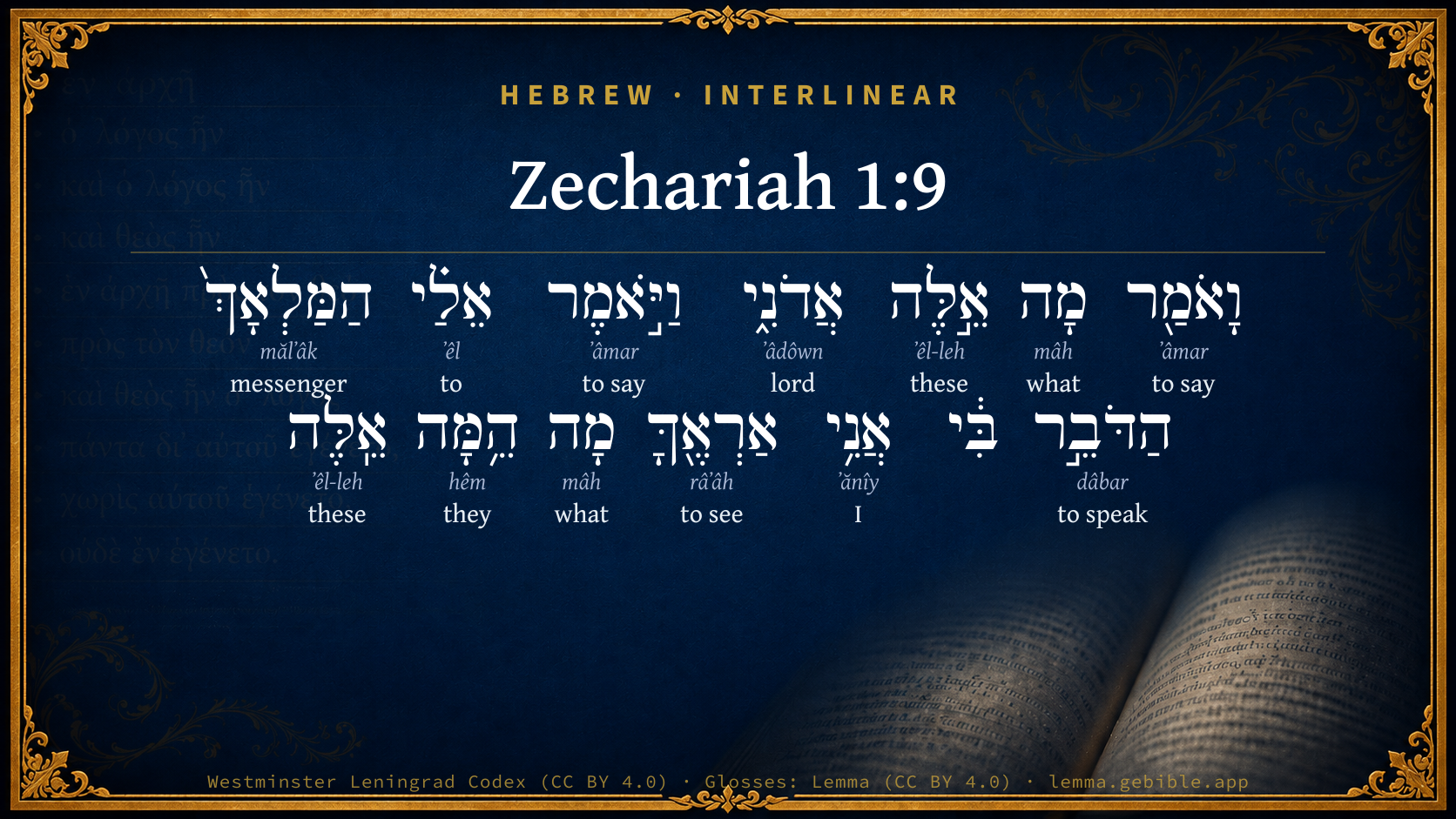
Hebrew (Westminster Leningrad Codex) Zechariah 1:9 appears in the Hebrew Old Testament. The text above is from the Westminster Leningrad Codex. Each word links to its Strong’s number, a concise gloss, and parsing drawn from the Open Scriptures Hebrew Bible morphology. Click any word for its full Brown-Driver-Briggs (BDB) entry.
Download image
Cite this verse

Zechariah 1:9 (World English Bible). Public Domain. Lemma interlinear Bible study tool, https://lemma.gebible.app/v/zechariah/1/9.

Show BibTeX & RIS
BibTeX
RIS
English Translation
Then I asked, 'My lord, what are these?'" The angel who talked with me said to me, "I will show you what these are."
World English Bible · Public Domain
Download a study sheet

One document with this verse’s original text, its word-by-word gloss line, the meaning frame, cross-references with their text, attributed commentary, and full source and license credits — printable, and it pastes into notes with its structure intact.

This verse Autodidact and up

Study sheet (.html) Plain text (.txt)

A passage Seminary Student

Up to 50 verses in one chapter. A passage sheet keeps up to 6 commentary sources and 12 cross-references per verse, in the order this page ranks them, and says so on the sheet whenever that leaves anything out. Ask for a single verse and you get the Autodidact verse sheet above.

Everything on this page stays free to read, with no account — the sheet is a download of what is already on screen, not access to it.

Want to remove ads? Support Godless Engineer
Compare translations 3

The same verse in 3 English versions, stacked beneath the original-language interlinear above. Click any original word for its lexicon entry.

Each is an independent rendering of the whole verse — the interlinear is not word-aligned to these translations.

Highlighted words mark where these versions differ — a whole-verse word diff, not a word-by-word alignment.

  • World English Bible Public Domain
    Then I asked, 'My lord, what are these?'" The angel who talked with me said to me, "I will show you what these are."
  • King James Version Public Domain
    Then said I, O my lord, what are these? And the angel that talked with me said unto me, I will shew thee what these be.
  • unfoldingWord Literal Text CC BY-SA 4.0
    And I said, “What these, my lord?” And the angel who was speaking with me said to me, “I will show you what these.”

unfoldingWord Literal Text — © unfoldingWord, licensed CC BY-SA 4.0. Word-aligned USFM3 via Door43 (git.door43.org/unfoldingWord/en_ult).

Versions to compare (up to 4)

3 of 4 selected

Show all 18 translations

Every available English version of this verse, each an independent rendering of the whole verse.

  • World English Bible Public Domain
    Then I asked, 'My lord, what are these?'" The angel who talked with me said to me, "I will show you what these are."
  • Berean Standard Bible Public Domain
    “What are these, my lord?” I asked. And the angel who was speaking with me replied, “I will show you what they are.”
  • Majority Standard Bible Public Domain
    “What are these, my lord?” I asked. And the angel who was speaking with me replied, “I will show you what they are.”
  • King James Version Public Domain
    Then said I, O my lord, what are these? And the angel that talked with me said unto me, I will shew thee what these be.
  • American Standard Version (1901) Public Domain
    Then said I, O my lord, what are these? And the angel that talked with me said unto me, I will show thee what these are.
  • Revised Version (1885) Public Domain
    Then said I, O my lord, what are these? And the angel that talked with me said unto me, I will shew thee what these be.
  • Geneva Bible (1599) Public Domain
    Then sayd I, O my Lord, what are these? And the Angel that talked with me, sayde vnto me, I wil shew thee what these be.
  • Douay-Rheims (1899) Public Domain
    And I said: What are these, my Lord? and the angel that spoke in me, said to me: I will shew thee what these are:
  • Young's Literal Translation Public Domain
    And I say, `What `are' these, my lord?' And the messenger who is speaking with me saith unto me, `I -- I do shew thee what these `are'.'
  • Literal Standard Version CC BY-SA 4.0
    And I say, “What [are] these, my lord?” And the messenger who is speaking with me says to me, “I show you what these [are].”
  • Unlocked Literal Bible CC BY-SA 4.0
    I said, “What are these things, Lord?” Then the angel who talked with me said to me, “I will show you what these things are.”
  • unfoldingWord Literal Text CC BY-SA 4.0
    And I said, “What these, my lord?” And the angel who was speaking with me said to me, “I will show you what these.”
  • Darby Bible Public Domain
    And I said, My lord, what are these? And the angel that talked with me said unto me, I will shew thee what these are.
  • World Messianic Bible Public Domain
    Then I asked, ‘My lord, what are these?’” The angel who talked with me said to me, “I will show you what these are.”
  • Webster's Bible Public Domain
    Then said I, O my lord, what are these? And the angel that talked with me said to me, I will show thee what these are.
  • Free Bible Version CC BY-SA 4.0
    I asked him, “My lord, what are these?” The angel I was talking to replied, “I will show you.”
  • Bible in Basic English Public Domain
    Then I said, O my lord, what are these? And the angel who was talking to me said to me, I will make clear to you what they are.
  • JPS Tanakh (1917) Public Domain
    Then said I: 'O my lord, what are these?' And the angel that spoke with me said unto me: 'I will show thee what these are.'

Literal Standard Version (2020), Covenant Press — licensed CC BY-SA 4.0. Text via the HelloAO Bible API (eBible.org). Unlocked Literal Bible (unfoldingWord) — licensed CC BY-SA 4.0. Text via the HelloAO Bible API (eBible.org). unfoldingWord Literal Text — © unfoldingWord, licensed CC BY-SA 4.0. Word-aligned USFM3 via Door43 (git.door43.org/unfoldingWord/en_ult). Free Bible Version, Dr. Jonathan Gallagher — licensed CC BY-SA 4.0. Text via the HelloAO Bible API (eBible.org).

Word by word

More ways to search: Search by grammar → Find every occurrence → Compare this word →

Practice this passage: Drill this verse → Learn its vocabulary →

הַמַּלְאָךְ֙
mălʼâk
H4397
“the · messenger”
Particle, Definite Article + Noun, Common, Masculine, Singular, Absolute
Part of Speech
Particle + Noun
Type
Common
Gender
Masculine
Number
Singular
State
Absolute
Full BDB Definition

Origin: from an unused root meaning to despatch as a deputy

TWOT: 1068a

messenger, representative - messenger - angel - the theophanic angel
  1. וָאֹמַ֖ר ʼâmar H559 “and · to say” Conjunction + Verb, Qal, Sequential Imperfect, 1st Person, Common, Singular
  2. מָה mâh H4100 “what” Particle, Interrogative
  3. אֵ֣לֶּה ʼêl-leh H428 “these” Pronoun, Demonstrative, Common, Plural
  4. אֲדֹנִ֑י ʼâdôwn H113 “lord · my” Noun, Common, Masculine, Singular, Construct + Suffix, Personal, 1st Person, Common, Singular
  5. וַיֹּ֣אמֶר ʼâmar H559 “and · to say” Conjunction + Verb, Qal, Sequential Imperfect, 3rd Person, Masculine, Singular
  6. אֵלַ֗י ʼêl H413 “to · me” Preposition + Suffix, Personal, 1st Person, Common, Singular
  7. הַדֹּבֵ֣ר dâbar H1696 “the · speaking” Particle, Definite Article + Verb, Qal, Participle Active, Masculine, Singular, Absolute
  8. אֲנִ֥י ʼănîy H589 “I” Pronoun, Personal, 1st Person, Common, Singular
  9. אַרְאֶ֖ךָּ râʼâh H7200 “to see · you” Verb, Hiphil, Imperfect, 1st Person, Common, Singular + Suffix, Personal, 2nd Person, Masculine, Singular
  10. מָה mâh H4100 “what” Particle, Interrogative
  11. הֵ֥מָּה hêm H1992 “they” Pronoun, Personal, 3rd Person, Masculine, Plural
  12. אֵֽלֶּה ʼêl-leh H428 “these” Pronoun, Demonstrative, Common, Plural

About this verse

These counts appear in no published source. They are computed here, from the morphology-tagged text and Lemma’s own curated glosses. What Lemma adds →

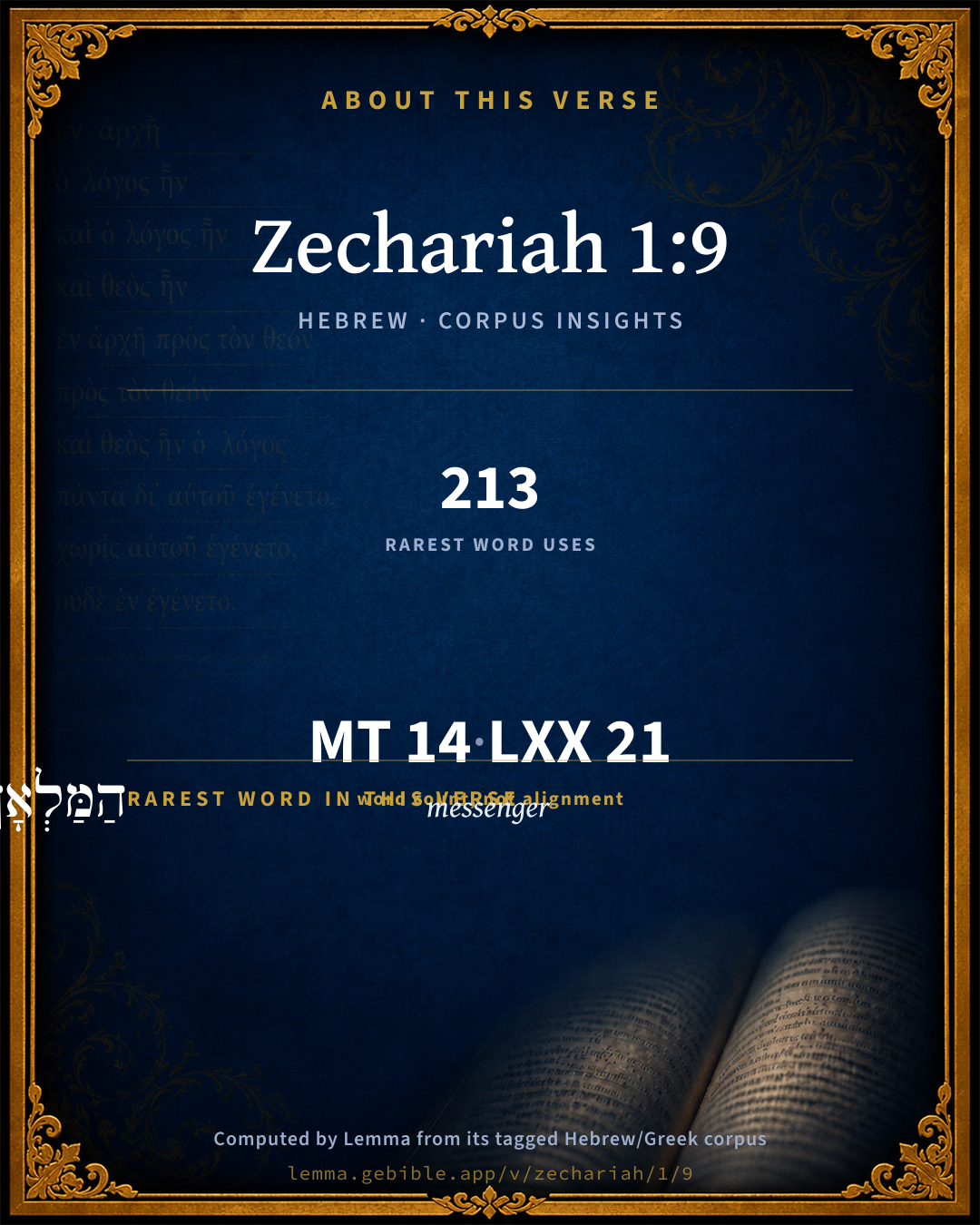
14
words
10
distinct lemmas
Prophets
section

Grammatical profile

  • 4 verbs
  • 2 nouns
  • 4 pronouns
  • 2 prepositions
  • 2 particles

Verb forms

  • וָאֹמַ֖ר Qal · Sequential Imperfect
  • וַיֹּ֣אמֶר Qal · Sequential Imperfect
  • הַדֹּבֵ֣ר Qal · Participle Active
  • אַרְאֶ֖ךָּ Hiphil · Imperfect

Repetition

Words recur within this verse — often emphatic in Hebrew:

  • וָאֹמַ֖ר to say H559 ×2
  • מָה what H4100 ×2
  • אֵ֣לֶּה these H428 ×2

Hebrew & Septuagint length

In English translation the verse runs 24 words from the Hebrew and 25 from the Septuagint (LXX English) — closely comparable.

A rough comparison of the two English renderings, which tokenize alike — not a word-level alignment.

Word counts can differ between the Hebrew and the Greek without any difference in meaning — e.g. the Hebrew direct-object marker אֵת has no separate Greek word, and Greek often adds the article ὁ.

In the original languages it is 14 Hebrew tokens and 21 Greek tokens — but the two are counted differently (Hebrew bundles its prefixes and suffixes into one token; the Greek is in lemma form), so that isn’t a like-for-like length.

Cross-references

15

Topical passages linked to Zechariah 1:9 in the Treasury of Scripture Knowledge — connected by theme and wording, ordered by reader-vote popularity; previews shown in the World English Bible.

  • Zechariah 4:4–5 I answered and spoke to the angel who talked with me, saying, "What are these, my lord?"
  • Revelation 7:13–14 One of the elders answered, saying to me, "These who are arrayed in white robes, who are they, and from where did they come?"
  • Genesis 31:11 The angel of God said to me in the dream, 'Jacob,' and I said, 'Here I am.'
  • Daniel 9:22–23 He instructed me, and talked with me, and said, Daniel, I am now come forth to give you wisdom and understanding.
  • Zechariah 1:19 I asked the angel who talked with me, "What are these?" He answered me, "These are the horns which have scattered Judah, Israel, and Jerusalem."
  • Zechariah 2:3 Behold, the angel who talked with me went forth, and another angel went out to meet him,
  • Zechariah 5:5 Then the angel who talked with me came forward, and said to me, "Lift up now your eyes, and see what is this that is appearing."
  • Daniel 7:16 I came near to one of those who stood by, and asked him the truth concerning all this. So he told me, and made me know the interpretation of the things.
  • Daniel 8:15–16 It happened, when I, even I Daniel, had seen the vision, that I sought to understand it; and, behold, there stood before me as the appearance of a man.
  • Daniel 10:11–14 He said to me, Daniel, you man greatly beloved, understand the words that I speak to you, and stand upright; for to you am I now sent. When he had spoken this word to me, I stood trembling.
  • Zechariah 4:11 Then I asked him, "What are these two olive trees on the right side of the lampstand and on the left side of it?"
  • Zechariah 6:4–5 Then I asked the angel who talked with me, "What are these, my lord?"
  • Revelation 17:1–7 One of the seven angels who had the seven bowls came and spoke with me, saying, "Come here. I will show you the judgment of the great prostitute who sits on many waters,
  • Revelation 19:9–10 He said to me, "Write, 'Blessed are those who are invited to the marriage supper of the Lamb.'" He said to me, "These are true words of God."
  • Revelation 22:8–16 Now I, John, am the one who heard and saw these things. When I heard and saw, I fell down to worship before the feet of the angel who had shown me these things.

Cross-references courtesy of OpenBible.info (CC BY 4.0).

Hebrew and Greek witnesses Masoretic Hebrew ↔ Greek Septuagint

The same verse in the two great witnesses to the Old Testament, shown verse-for-verse.

These are two independent witnesses, not word-aligned to each other, and the Septuagint is shown in lemma (dictionary) form.

Hebrew Zechariah 1:9 Masoretic · Westminster Leningrad Codex

וָאֹמַ֖ר מָה אֵ֣לֶּה אֲדֹנִ֑י וַיֹּ֣אמֶר אֵלַ֗י הַמַּלְאָךְ֙ הַדֹּבֵ֣ר בִּ֔י אֲנִ֥י אַרְאֶ֖ךָּ מָה הֵ֥מָּה אֵֽלֶּה

Then I asked, 'My lord, what are these?'" The angel who talked with me said to me, "I will show you what these are."

World English Bible · Public Domain

Greek LXX Zechariah 1:9 Septuagint · lemma form

καί εἶπον τίς οὗτος κύριος καί εἶπον πρός ἐγώ ὁ ἄγγελος ὁ λαλέω ἐν ἐγώ ἐγώ δεικνύω σύ τίς εἰμί οὗτος

And I said, What are these, my lord? And the angel spoke with me said to me, I will show you what these things are.

LXX2012 (modern English Septuagint) · Public Domain

On this verse, Ellicott's Commentary for English Readers discusses the Septuagint’s reading. Read the note in Commentary ↓

Hebrew: Westminster Leningrad Codex (CC BY 4.0). Greek: Septuagint (public domain); English from LXX2012 (modern English Septuagint) (Public Domain). How the Septuagint differs from the Hebrew →

Targum (Aramaic paraphrase)

1

The Targum is the ancient Jewish Aramaic paraphrase of the Hebrew Scriptures — an interpretive translation, not the Hebrew text itself. Onkelos (literal) and Pseudo-Jonathan (expansive) render the Torah, and Jonathan the Prophets. Coverage is partial: where no permissively-licensed English translation exists for a verse, only the Aramaic is shown. This is verse-level text, not a word-by-word alignment to the Hebrew.

  1. Targum Jonathan Prophets (Joshua–Malachi)
    וַאֲמָרֵית מַן אִלֵין רִבּוֹנִי וַאֲמַר לִי מַלְאֲכָא דִי מַלֵיל עִמִי אֲנָא אַחְזִינָךְ מָה אִינוּן אִלֵין:

    (no public-domain English translation for this verse)

    Targum Jonathan — Aramaic: “Mikraot Gedolot” (public domain). English: “Sefaria Community Translation” (CC0 1.0 (public-domain dedication)); “London "Chaldee Paraphrase," 1871” (public domain). Text via Sefaria.

Commentary

Notes on Zechariah 1:9 from classic Christian and Jewish commentators (each source and its license shown beneath its notes). The classic Christian expositions comment on the surrounding passage and are grouped to its opening verse, so a note may address several verses; the Jewish commentaries on the Tanakh (Rashi and others) are per-verse, so they appear only where the commentator wrote on this verse.

Lemma curates 59 commentaries, every one of them public domain or Creative Commons licensed, each selected and text-cleaned for this edition rather than reprinted as found. About our sources →

Trapp's Complete Commentary

John Trapp

Zec 1:9 Then said I, O my lord, what [are] these? And the angel that talked with me said unto me, I will shew thee what these [be].

Ver. 9. Then said I, O my Lord, what are these?] Thus the prophets inquired and searched diligently (as saith St Peter (ερευνωντες), 1Pe 1:11), for the truth of things, as hunters seek for game, and as men seek for gold in the very mines of the earth; who, not content with the first ore that offered itself to their view, dig deeper and deeper till they are owners of the whole treasure. See Pro 2:4; and rest not till ye see that blissful sight, Eph 1:18-19.

And the angel that talked with me] Or, in me, as the Vulgate rendereth it. This was some created angel, who might reveal things to the prophet by working on the phantasy and spirit, by way of information and instruction, as Dan 9:21 Luk 1:11 Rev 1:1.

I will show thee what these be] How ready are the holy angels to serve the saints, Heb 1:14, rejoicing more in their names of office than of honour, of employment than preferment, to be called angels, that is, messengers, or internuncios, than principalities, thrones, dominions, Eph 1:20; accounting it better to do good than to be great, to dispense God’s benefits than to enjoy them. Hence they are with and about the saints, as their companions, guides, protectors, monitors, and rulers of their actions, as here.

John Trapp, A Commentary or Exposition upon All the Books of the Old and New Testament (1647–1656) — public domain. Text from a community e-Sword module.

Joseph Benson's Commentary

Zec 1:9-11. Then said I, O my Lord, what are these — What is the meaning of these appearances, or visions? And the angel that talked with me said — “This was another heavenly minister, sent, probably, to present the visions to the prophet’s imagination, as well as to explain them. Angelus comes et interpres, “an accompanying angel and interpreter.” And under his direction the prophet receives satisfactory information from the month of the first angel and his attendants.” — Blayney. I will show thee what these be — “I will cause that it shall be explained to thee by the angel who stands first among the myrtles. This may have been done by a sign given to that angel, or by words omitted in the relation.” — Newcome. And the man that stood among the myrtle-trees — This was an angel of an order superior to him mentioned in the preceding verse, who either prevents that angel, and takes upon him to return an answer to the prophet’s question, or else sends his answer to Zechariah by that angel, as Christ sent his revelation to St. John by an angel, Rev 1:1. These are they whom the Lord hath sent — They are the messengers or ministering spirits of Jehovah. And they — The rest of the angels, implied at the end of Zec 1:8, and who came after the first; answered, We have walked to and fro through the earth — We have been diligent to execute that office which was allotted to us. And behold all the earth sitteth still, &c. — This must be understood here, and in many other places, in a restricted sense, for all the nations with whom the Jews had a connection. It means here chiefly the Persian empire, which enjoyed peace at that time. But the state of the Jews was unsettled: see Zec 1:16: which circumstance gives occasion to the following intercession.

Joseph Benson's Commentary on the Old and New Testaments (1811–1818) — public domain. Text from a community e-Sword module.

Whedon's Commentary on the Bible

Daniel D. Whedon

9. The prophet, who does not understand the vision (compare Amo_7:1-9), seeks an explanation.

O my lord — The one here addressed must be the person who replies, the heavenly interpreter.

The angel that talked with me — He is the constant companion of the prophet throughout the entire series of visions; his office is to interpret to Zechariah what he sees and hears (Zec_1:9; Zec_1:13-14; Zec_1:19; Zec_2:3; Zec_4:1; Zec_4:4-5; Zec_5:10; Zec_6:4; see Introduction, p. 599).

I will show thee — The angel does not promise a direct answer, but assures the prophet that an explanation will be given.

Daniel D. Whedon (gen. ed.), Commentary on the Old and New Testaments (1874–1909) — public domain. Text from a community e-Sword module.

Jamieson, Fausset & Brown

Robert Jamieson, A. R. Fausset & David Brown

the angel that talked with me--not the "man upon the red horse," as is evident from Zac 1:10, where he (the Divine Angel) is distinguished from the "angel that talked with me" (the phrase used of him, Zac 1:13-14; Zac 2:3; Zac 4:1, Zac 4:4-5; Zac 5:5, Zac 5:10; Zac 6:4), that is, the interpreting angel. The Hebrew for "with me," or, "in me" (Num 12:8), implies internal, intimate communication [JEROME].

show thee--reveal to thy mental vision.

Jamieson, Fausset & Brown — Commentary Critical and Explanatory on the Whole Bible (1871) — public domain (CC PDM 1.0). Text via the HelloAO Bible API.

Adam Clarke's Commentary

Verse 9. O my lord, what are these] The angel here mentioned was distinct from those mentioned in the eighth verse; he who talked with the prophet, Zec 1:13.

Adam Clarke's Commentary on the Bible (1810–1826) — public domain. Text from a community e-Sword/MySword module.

Ellicott's Commentary for English Readers

(9) O my lord.—This is addressed to “the angel that talked with me,” or, perhaps, in me, according as we regard him as discharging the office of the Virgil of Dante, or the Daimon of Socrates (but, see Lawes’ History of Philosophy). LXX., ὁ λαλῶν ἐν ἐμοί. This is the angel-interpreter, whose office it was to interpret the visions (Zec_1:18; Zec_2:3; Zec_4:1; Zec_4:4-5; Zec_5:5-10; Zec_6:4), and who is often referred to simply as “he.”

I will shew thee.—viz., by the word of “the man who stood among the myrtles.”

A Bible Commentary for English Readers, edited by Charles John Ellicott (1878–1897) — public domain. Text from a community e-Sword module.

The Cambridge Bible for Schools and Colleges

gen. ed. J. J. S. Perowne

9. O my lord] This question is addressed to the interpreting angel, of whose presence we are for the first time made aware by the fact that he replies to it.

the angel that talked with me] This is the title by which this angel is distinguished throughout the visions: Zec_1:13-14 (where the A. V. has “communed with me”), 19, Zec_2:3, Zec_4:1; Zec_4:4-5, Zec_5:10, Zec_6:4. The phrase has been variously interpreted. Some would render “in me,” “in that that angel formed in the spirit and imaginative power of Zechariah phantasms or images of things which were foreshown him, and gave him to understand what those images signified.” Others take it to mean “by me,” “the prophet being the channel through whom the divine revelations were made.” But there is no reason to depart from the rendering of the A. V., which accurately describes the office of the angel as actually discharged by him in explaining the visions, and which is supported by Hebrew usage. Comp. Num_12:8, where it is difficult to understand how God should speak “face to face,” either “in,” or “by,” a man.

The Cambridge Bible for Schools and Colleges (gen. ed. J. J. S. Perowne; Cambridge University Press, 1878–1918) — public domain. Text from a community e-Sword module.

John Gill's Exposition

Then said I, O my Lord,.... These are the words of the Prophet Zechariah to the angel that showed him this vision:

what are these? what is the meaning of this vision? particularly who are meant by the horses, red, speckled, and white, and those upon them?

And the angel that talked with me; who seems to be different from the Angel of the Lord, the man among the myrtle trees, Zac 1:8 he was one of the ministering spirits; see Rev 17:1,

said unto me, I will show thee what these be; that is, give an interpretation of the vision, and point out the persons intended by the horses.

John Gill's Exposition of the Whole Bible (1746–1763) — public domain (CC PDM 1.0). Text via the HelloAO Bible API.

Albert Barnes' Notes on the Bible

What are these? - He asks, not who, but what they import.

The angel that talked with me - Literally, “spake in me.” The very rare expression seems meant to convey the thought of an inward speaking, whereby the words should be borne directly into the soul, without the intervention of the ordinary outward organs. God says to Moses, “If there is a prophet among you, I, the Lord, will make Myself known unto him in a vision, I will speak (literally) in him in a dream. My servant Moses is not so - In him will I speak mouth to mouth Num 12:6-9;” and Habakkuk says of the like inward teaching, “I will watch to see, what He will speak in me” . It is the characteristic title of one attendant-angel, who was God’s expositor of the visions to Zechariah (Zec 1:13-14, Zec 1:19, (Zec 2:2 Hebrew) Zec 2:3; (7) Zec 4:1, Zec 4:4-5; Zec 5:5, Zec 5:10; Zec 6:4). Dionysius: “By his ministry God showed me things to come, in that that angel formed in the spirit and imaginative power of Zechariah phantasms or images of things which were foreshown him, and gave him to understand what those images signified.”

Albert Barnes' Notes on the Bible (1834–1885) — public domain. Text from a community e-Sword/MySword module.

Matthew Poole's English Annotations

Then; so soon as he had seen and observed. Said I; Zechariah.

O my Lord: this was Christ the Lord of hosts.

What are these? what is the meaning of these appearances or visions?

The angel; Christ, the Angel of the covenant; so I take this Angel, that promiseth to inform the prophet, to be the same that appears, a man on the red horse among the myrtles.

Matthew Poole's English Annotations on the Holy Bible (1683–1685) — public domain. Text from a community e-Sword/MySword module.

The Pulpit Commentary

O my lord. The prophet speaks to the angel of the Lord, who answers briefly, and is succeeded by the interpreting angel. What are these? Not "who," but "what;" i.e. what do they signify? (comp. Amo_7:8) That talked with me; literally, as the LXX and Vulgate, that spake in me. So vers. 13, 14, and in the following visions. Hence some regard the expression as intimating a communication borne inwardly to the soul without the aid of external organs, or that the angel overpowered and influenced the prophet as the evil spirit possessed the demoniac. But the same term is used, as Dr. Wright points out, in the sense of to commune with a person, (Num_12:6, 8 1Sa_25:39) and to speak to a person. (Hos_1:2; and perhaps Hab_2:1) It may, however, be that the angel of the Lord presented matters objectively, and the prophet"s own angel interpreted subjectively. But the Authorized Version is probably correct. I will show thee. This he does through the chief angel (ver. 10).

The Pulpit Commentary (1880–1919), ed. H.D.M. Spence-Jones & Joseph S. Exell — public domain. Text from a community e-Sword module.

John Wesley's Explanatory Notes

O my Lord - This was Christ, the Lord of hosts. What are these - What is the meaning of these appearances. The angel - Christ, the angel of the covenant.

John Wesley, Explanatory Notes Upon the Whole Bible (1754–1765) — public domain. Text via the GEBible commentary corpus.

Scofield Reference Notes

C. I. Scofield

angel

(See Scofield "Heb 1:4").

The Scofield Reference Bible (1917 edition), notes by C. I. Scofield — public domain. Text from a community e-Sword module.

Rashi

Rabbi Shlomo Yitzchaki (Rashi)

And I said to one angel who showed me all this. “What are these, my lord?” He was the one riding on the red horse.

Rashi on the Tanakh — English translations: “The Judaica Press complete Tanach with Rashi, translated by A. J. Rosenberg” (CC BY 4.0); “Pentateuch with Rashi's commentary by M. Rosenbaum and A.M. Silbermann, 1929-1934” (public domain); “The Metsudah Tanach series, Lakewood, N.J” (CC BY 4.0); and “The Book of Joshua, Metsudah Publications, 1997” (CC BY 4.0). Text via Sefaria.

Lesson kit

Teaching starters — assembled from the data on this page, not authored interpretation. Every prompt links to the verse data it draws on. Edit before teaching.

Zechariah, in the Prophets, opens this verse with 14 words (10 distinct Hebrew lemmas). Its most distinctive word is mălʼâk (“messenger”). A historical commentator’s framing appears above. Read the whole chapter for the surrounding context.

Discussion questions

  1. The word mălʼâk carries the sense “messenger.” How does it shape the verse?
  2. How does Zechariah 4:4–5, which shares this passage’s theme, read alongside this verse?
  3. What does the repetition of “to say” (2× in this one verse) do in this verse?
  4. These translations render this verse differently. What is at stake in choosing one wording over another?
  5. «וָאֹמַ֖ר» is a Qal Sequential Imperfect verb. How does that grammatical form shape the action described?
  6. Compare how Trapp's Complete Commentary and Joseph Benson's Commentary read this verse. Where do they agree or differ?

Things to notice

Reading settings

Reading text

Shown beneath each verse's original-language words.

Old Testament
Old Testament edition

Read the OT as the Masoretic Hebrew (MT) or the Greek Septuagint (LXX).

English shown for the Greek Septuagint (in the Hebrew ↔ Greek comparison).

Comparing translations? Open the Compare panel on any verse page to stack up to four side by side.