Isaiah 42:19

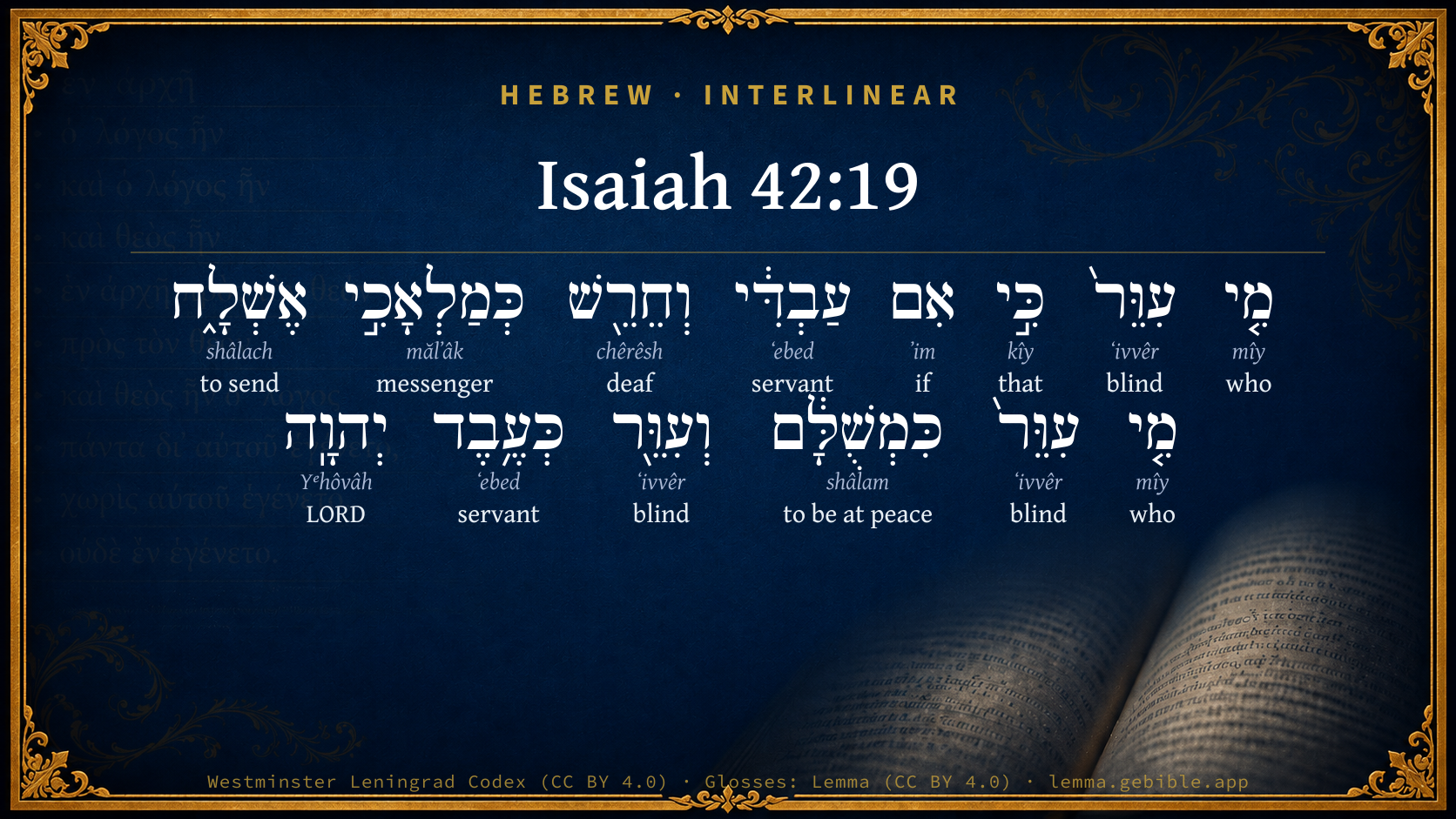
Hebrew (Westminster Leningrad Codex) Isaiah 42:19 appears in the Hebrew Old Testament. The text above is from the Westminster Leningrad Codex. Each word links to its Strong’s number, a concise gloss, and parsing drawn from the Open Scriptures Hebrew Bible morphology. Click any word for its full Brown-Driver-Briggs (BDB) entry.
Download image
Cite this verse

Isaiah 42:19 (World English Bible). Public Domain. Lemma interlinear Bible study tool, https://lemma.gebible.app/v/isaiah/42/19.

Show BibTeX & RIS
BibTeX
RIS
English Translation
Who is blind, but my servant? or deaf, as my messenger whom I send? Who is blind as he who is at peace, and blind as Yahweh's servant?
World English Bible · Public Domain
Download a study sheet

One document with this verse’s original text, its word-by-word gloss line, the meaning frame, cross-references with their text, attributed commentary, and full source and license credits — printable, and it pastes into notes with its structure intact.

This verse Autodidact and up

Study sheet (.html) Plain text (.txt)

A passage Seminary Student

Up to 50 verses in one chapter. A passage sheet keeps up to 6 commentary sources and 12 cross-references per verse, in the order this page ranks them, and says so on the sheet whenever that leaves anything out. Ask for a single verse and you get the Autodidact verse sheet above.

Everything on this page stays free to read, with no account — the sheet is a download of what is already on screen, not access to it.

Want to remove ads? Support Godless Engineer
Compare translations 3

The same verse in 3 English versions, stacked beneath the original-language interlinear above. Click any original word for its lexicon entry.

Each is an independent rendering of the whole verse — the interlinear is not word-aligned to these translations.

Highlighted words mark where these versions differ — a whole-verse word diff, not a word-by-word alignment.

  • World English Bible Public Domain
    Who is blind, but my servant? or deaf, as my messenger whom I send? Who is blind as he who is at peace, and blind as Yahweh's servant?
  • King James Version Public Domain
    Who is blind, but my servant? or deaf, as my messenger that I sent? who is blind as he that is perfect, and blind as the LORD's servant?
  • unfoldingWord Literal Text CC BY-SA 4.0
    Who blind except my servant, or deaf like my messenger I send? Who blind like the covenanted one, or blind like the servant of Yahweh?

unfoldingWord Literal Text — © unfoldingWord, licensed CC BY-SA 4.0. Word-aligned USFM3 via Door43 (git.door43.org/unfoldingWord/en_ult).

Versions to compare (up to 4)

3 of 4 selected

Show all 18 translations

Every available English version of this verse, each an independent rendering of the whole verse.

  • World English Bible Public Domain
    Who is blind, but my servant? or deaf, as my messenger whom I send? Who is blind as he who is at peace, and blind as Yahweh's servant?
  • Berean Standard Bible Public Domain
    Who is blind but My servant, or deaf like the messenger I am sending? Who is blind like My covenant partner, or blind like the servant of the LORD?
  • Majority Standard Bible Public Domain
    Who is blind but My servant, or deaf like the messenger I am sending? Who is blind like My covenant partner, or blind like the servant of the LORD?
  • King James Version Public Domain
    Who is blind, but my servant? or deaf, as my messenger that I sent? who is blind as he that is perfect, and blind as the LORD's servant?
  • American Standard Version (1901) Public Domain
    Who is blind, but my servant? or deaf, as my messenger that I send? who is blind as he that is at peace `with me', and blind as Jehovah's servant?
  • Revised Version (1885) Public Domain
    Who is blind, but my servant? or deaf, as my messenger that I send? who is blind as he that is at peace with me, and blind as the LORD’S servant?
  • Geneva Bible (1599) Public Domain
    Who is blinde but my seruaunt? or deafe as my messenger, that I sent? who is blind as the perfit, and blinde as the Lordes seruant?
  • Douay-Rheims (1899) Public Domain
    Who is blind, but my servant? or deaf, but he to whom I have sent my messengers? Who is blind, but he that is sold? or who is blind, but the servant of the Lord?
  • Young's Literal Translation Public Domain
    Who `is' blind but My servant? And deaf as My messenger I send? Who `is' blind as he who is at peace, Yea, blind, as the servant of Jehovah?
  • Literal Standard Version CC BY-SA 4.0
    Who [is] blind but My servant? And deaf as My messenger I send? Who [is] blind as he who is at peace, || Indeed, blind, as the servant of YHWH?
  • Unlocked Literal Bible CC BY-SA 4.0
    Who is blind but my servant? Or deaf like my messenger I send? Who is as blind as my covenant partner, or blind as Yahweh's servant?
  • unfoldingWord Literal Text CC BY-SA 4.0
    Who blind except my servant, or deaf like my messenger I send? Who blind like the covenanted one, or blind like the servant of Yahweh?
  • Darby Bible Public Domain
    Who is blind, but my servant? and deaf, as my messenger whom I sent? Who is blind as he in whom I have trusted, and blind as Jehovah's servant,
  • World Messianic Bible Public Domain
    Who is blind, but my servant? Or who is as deaf as my messenger whom I send? Who is as blind as he who is at peace, and as blind as the LORD’s servant?
  • Webster's Bible Public Domain
    Who is blind, but my servant? or deaf, as my messenger that I sent? who is blind as he that is perfect, and blind as the LORD'S servant?
  • Free Bible Version CC BY-SA 4.0
    Who is blind like my servant? Who is deaf like my messenger that I send? Who is as blind as the people of the agreement? Who is as blind as the servant of the Lord?
  • Bible in Basic English Public Domain
    Who is blind, but my servant? who has his ears stopped, but he whom I send? who is blind as my true one, or who has his ears shut like the Lord's servant?
  • JPS Tanakh (1917) Public Domain
    Who is blind, but My servant? Or deaf, as My messenger that I send? Who is blind as he that is wholehearted, and blind as the LORD'S servant?

Literal Standard Version (2020), Covenant Press — licensed CC BY-SA 4.0. Text via the HelloAO Bible API (eBible.org). Unlocked Literal Bible (unfoldingWord) — licensed CC BY-SA 4.0. Text via the HelloAO Bible API (eBible.org). unfoldingWord Literal Text — © unfoldingWord, licensed CC BY-SA 4.0. Word-aligned USFM3 via Door43 (git.door43.org/unfoldingWord/en_ult). Free Bible Version, Dr. Jonathan Gallagher — licensed CC BY-SA 4.0. Text via the HelloAO Bible API (eBible.org).

Word by word

More ways to search: Search by grammar → Find every occurrence → Compare this word →

Practice this passage: Drill this verse → Learn its vocabulary →

וְחֵרֵ֖שׁ
chêrêsh
H2795
“and · deaf”
Conjunction + Adjective, Adjective, Masculine, Singular, Absolute
Part of Speech
Conjunction + Adjective
Type
Adjective
Gender
Masculine
Number
Singular
State
Absolute
Full BDB Definition

Origin: from H2790

TWOT: 761a

deaf
  1. מִ֤י mîy H4310 “who” Particle, Interrogative
  2. עִוֵּר֙ ʻivvêr H5787 “blind” Adjective, Adjective, Masculine, Singular, Absolute
  3. כִּ֣י kîy H3588 “that” Conjunction
  4. אִם ʼim H518 “if” Conjunction
  5. עַבְדִּ֔י ʻebed H5650 “servant · my” Noun, Common, Masculine, Singular, Construct + Suffix, Personal, 1st Person, Common, Singular
  6. כְּמַלְאָכִ֣י mălʼâk H4397 “like/as · messenger · my” Preposition + Noun, Common, Masculine, Singular, Construct + Suffix, Personal, 1st Person, Common, Singular
  7. אֶשְׁלָ֑ח shâlach H7971 “to send” Verb, Qal, Imperfect, 1st Person, Common, Singular
  8. מִ֤י mîy H4310 “who” Particle, Interrogative
  9. עִוֵּר֙ ʻivvêr H5787 “blind” Adjective, Adjective, Masculine, Singular, Absolute
  10. כִּמְשֻׁלָּ֔ם shâlam H7999 “like/as · at peace” Preposition + Verb, Pual, Participle Passive, Masculine, Singular, Absolute
  11. וְעִוֵּ֖ר ʻivvêr H5787 “and · blind” Conjunction + Adjective, Adjective, Masculine, Singular, Absolute
  12. כְּעֶ֥בֶד ʻebed H5650 “like/as · servant of” Preposition + Noun, Common, Masculine, Singular, Construct
  13. יְהוָֽה Yᵉhôvâh H3068 “LORD” Noun, Proper

About this verse

These counts appear in no published source. They are computed here, from the morphology-tagged text and Lemma’s own curated glosses. What Lemma adds →

14
words
10
distinct lemmas
Prophets
section

Notable vocabulary

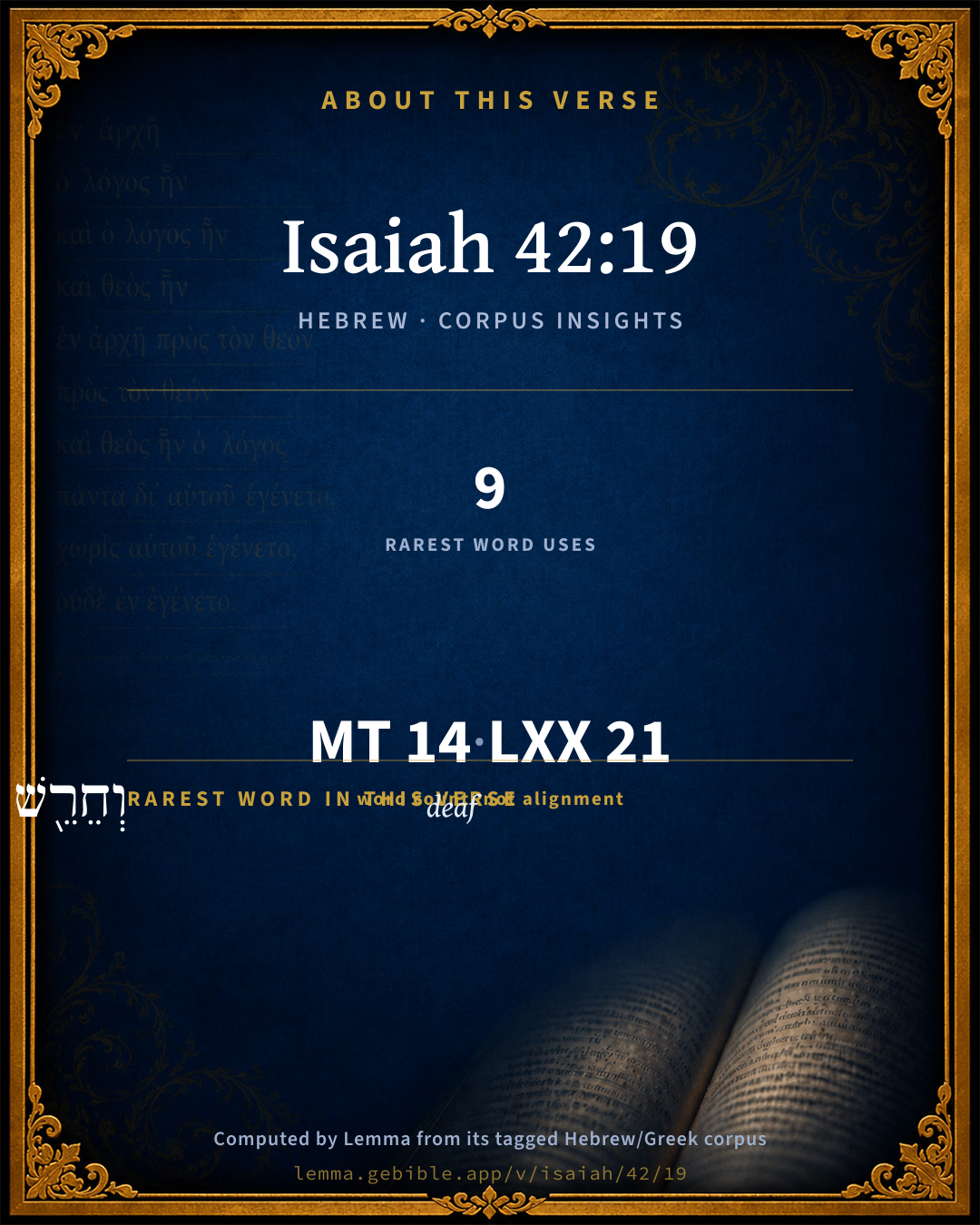
The rarest word here is וְחֵרֵ֖שׁ deaf H2795 — appearing just 9 times in the whole Hebrew Bible.

Shared distinctive vocabulary

וְחֵרֵ֖שׁ deaf H2795 occurs in 9 verses of the Hebrew Bible. Also found in:

Grammatical profile

  • 2 verbs
  • 4 nouns
  • 4 adjectives
  • 2 conjunctions
  • 2 particles

Verb forms

  • אֶשְׁלָ֑ח Qal · Imperfect
  • כִּמְשֻׁלָּ֔ם Pual · Participle Passive

Repetition

Words recur within this verse — often emphatic in Hebrew:

  • עִוֵּר֙ blind H5787 ×3
  • עַבְדִּ֔י servant H5650 ×2
  • מִ֤י who H4310 ×2

Hebrew & Septuagint length

In English translation the verse runs 28 words from the Hebrew and 24 from the Septuagint (LXX English) — closely comparable.

A rough comparison of the two English renderings, which tokenize alike — not a word-level alignment.

Word counts can differ between the Hebrew and the Greek without any difference in meaning — e.g. the Hebrew direct-object marker אֵת has no separate Greek word, and Greek often adds the article ὁ.

In the original languages it is 14 Hebrew tokens and 21 Greek tokens — but the two are counted differently (Hebrew bundles its prefixes and suffixes into one token; the Greek is in lemma form), so that isn’t a like-for-like length.

Cross-references

22

Topical passages linked to Isaiah 42:19 in the Treasury of Scripture Knowledge — connected by theme and wording, ordered by reader-vote popularity; previews shown in the World English Bible.

  • 2 Corinthians 4:4 in whom the god of this world has blinded the minds of the unbelieving, that the light of the Gospel of the glory of Christ, who is the image of God, should not dawn on them.
  • Jeremiah 5:21 Hear now this, foolish people, and without understanding; who have eyes, and don't see; who have ears, and don't hear:
  • Ezekiel 12:2 Son of man, you dwell in the midst of the rebellious house, who have eyes to see, and don't see, who have ears to hear, and don't hear; for they are a rebellious house.
  • Isaiah 6:9 He said, "Go, and tell this people, 'You hear indeed, But don't understand; And you see indeed, But don't perceive.'
  • Isaiah 26:3 You will keep [him] in perfect peace, [whose] mind [is] stayed [on you]; because he trusts in you.
  • Isaiah 29:9–14 Stay you and wonder; take your pleasure and be blind: they are drunken, but not with wine; they stagger, but not with strong drink.
  • Isaiah 41:8 But you, Israel, my servant, Jacob whom I have chosen, the seed of Abraham my friend,
  • Isaiah 44:26 who confirms the word of his servant, and performs the counsel of his messengers; who says of Jerusalem, She shall be inhabited; and of the cities of Judah, They shall be built, and I will raise up the waste places of it;
  • Isaiah 56:10 His watchmen are blind, they are all without knowledge; they are all mute dogs, they can't bark; dreaming, lying down, loving to slumber.
  • Jeremiah 4:22 For my people are foolish, they don't know me; they are foolish children, and they have no understanding; they are wise to do evil, but to do good they have no knowledge.
  • Matthew 13:14–15 In them the prophecy of Isaiah is fulfilled, which says, 'By hearing you will hear, And will in no way understand; Seeing you will see, And will in no way perceive:
  • Matthew 15:14–16 Leave them alone. They are blind guides of the blind. If the blind guide the blind, both will fall into a pit."
  • Matthew 23:16–24 "Woe to you, you blind guides, who say, 'Whoever swears by the temple, it is nothing; but whoever swears by the gold of the temple, he is obligated.'
  • Mark 8:17–18 Jesus, perceiving it, said to them, "Why do you reason that it's because you have no bread? Don't you perceive yet, neither understand? Is your heart still hardened?
  • John 7:47–49 The Pharisees therefore answered them, "You aren't also led astray, are you?
  • John 9:39 Jesus said, "I came into this world for judgment, that those who don't see may see; and that those who see may become blind."
  • John 9:41 Jesus said to them, "If you were blind, you would have no sin; but now you say, 'We see.' Therefore your sin remains.
  • John 12:40 "He has blinded their eyes and he hardened their heart, Lest they should see with their eyes, And perceive with their heart, And would turn, And I would heal them."
  • Romans 2:17–23 Indeed you bear the name of a Jew, and rest on the law, and glory in God,
  • Romans 11:7–10 What then? That which Israel seeks for, that he didn't obtain, but the chosen ones obtained it, and the rest were hardened.
  • Romans 11:25 For I don't desire, brothers, to have you ignorant of this mystery, so that you won't be wise in your own conceits, that a partial hardening has happened to Israel, until the fullness of the Gentiles has come in,
  • 2 Corinthians 3:14–15 But their minds were hardened, for until this very day at the reading of the old covenant the same veil remains, because in Christ it passes away.

Cross-references courtesy of OpenBible.info (CC BY 4.0).

Hebrew and Greek witnesses Masoretic Hebrew ↔ Greek Septuagint

The same verse in the two great witnesses to the Old Testament, shown verse-for-verse.

These are two independent witnesses, not word-aligned to each other, and the Septuagint is shown in lemma (dictionary) form.

Hebrew Isaiah 42:19 Masoretic · Westminster Leningrad Codex

מִ֤י עִוֵּר֙ כִּ֣י אִם עַבְדִּ֔י וְחֵרֵ֖שׁ כְּמַלְאָכִ֣י אֶשְׁלָ֑ח מִ֤י עִוֵּר֙ כִּמְשֻׁלָּ֔ם וְעִוֵּ֖ר כְּעֶ֥בֶד יְהוָֽה

Who is blind, but my servant? or deaf, as my messenger whom I send? Who is blind as he who is at peace, and blind as Yahweh's servant?

World English Bible · Public Domain

Greek LXX Isaiah 42:19 Septuagint · lemma form

καί τίς τυφλός ἀλλά ἤ ὁ παῖς ἐγώ καί κωφός ἀλλά ἤ ὁ κυριεύω αὐτός καί τυφλόω ὁ δοῦλος ὁ θεός

And who is blind, but my servants? and deaf, but they that rule over them? yes, the servants of God have been made blind.

LXX2012 (modern English Septuagint) · Public Domain

On this verse, Albert Barnes' Notes on the Bible discusses the Septuagint’s reading. Read the note in Commentary ↓

Hebrew: Westminster Leningrad Codex (CC BY 4.0). Greek: Septuagint (public domain); English from LXX2012 (modern English Septuagint) (Public Domain). How the Septuagint differs from the Hebrew →

Targum (Aramaic paraphrase)

1

The Targum is the ancient Jewish Aramaic paraphrase of the Hebrew Scriptures — an interpretive translation, not the Hebrew text itself. Onkelos (literal) and Pseudo-Jonathan (expansive) render the Torah, and Jonathan the Prophets. Coverage is partial: where no permissively-licensed English translation exists for a verse, only the Aramaic is shown. This is verse-level text, not a word-by-word alignment to the Hebrew.

  1. Targum Jonathan Prophets (Joshua–Malachi)
    הֲלָא אִם יְתוּבוּן רַשִׁיעַיָא יִתְקְרוֹן עַבְדֵי וְחַיָבַיָא דִנְבִיֵי שְׁלָחִית עֲלֵיהוֹן אֶלָא רַשִׁיעַיָא עֲתִידִין לְאִשְׁתַּלָמָא פּוּרְעֲנוּת חוֹבֵיהוֹן בְּרַם אִם יְתוּבוּן יִתְקְרוֹן עַבְדַיָא דַיָי:

    Is it not so? if the wicked and the sinners, to whom I have sent my prophets, will repent, they shall be called my servants; but the wicked shall be paid with vengeance for their sins; but if they will repent, they shall be called the servants of the Lord.

    Targum Jonathan — Aramaic: “Mikraot Gedolot” (public domain). English: “Sefaria Community Translation” (CC0 1.0 (public-domain dedication)); “London "Chaldee Paraphrase," 1871” (public domain). Text via Sefaria.

Commentary

Notes on Isaiah 42:19 from classic Christian and Jewish commentators (each source and its license shown beneath its notes). The classic Christian expositions comment on the surrounding passage and are grouped to its opening verse, so a note may address several verses; the Jewish commentaries on the Tanakh (Rashi and others) are per-verse, so they appear only where the commentator wrote on this verse.

Lemma curates 59 commentaries, every one of them public domain or Creative Commons licensed, each selected and text-cleaned for this edition rather than reprinted as found. About our sources →

Trapp's Complete Commentary

John Trapp

Isa 42:19 Who [is] blind, but my servant? or deaf, as my messenger [that] I sent? who [is] blind as [he that is] perfect, and blind as the LORD’S servant?

Ver. 19. Who is blind, but my servant?] Who so blind as he that will not see? Israel was God’s peculiar, and had the light of his law, yet were blind as beetles.

Or deaf, as my messenger?] The priests and Levites. {Mal 2:7} Such were the Papist dolts till awakened by the Reformation.

Who is blind as he that is perfect?] The elders of the people, who arrogated to themselves perfection {a} {Isa 65:5 Rom 2:17-20} as likewise the Popish perfectists, the Jewish doctors with their pretended Mashlamnuthas, and the Turkish Mussulmans - i.e., perfectionaries.

{a} Buxtorf. Tiber. p. 5.

John Trapp, A Commentary or Exposition upon All the Books of the Old and New Testament (1647–1656) — public domain. Text from a community e-Sword module.

The Biblical Illustrator

Joseph S. Exell

Isa_42:19

Who is blind, but My Servant?

--

The Lords Servant blind and deaf

I. CHRISTS BLINDNESS. How should it be said of the Servant and Messenger of the Lord that He was blind as none other? How should it be said of Him whose eyes are as a flame of fire, whose look struck like a sword? Are not all things naked and open to the eyes of Him with whom we have to do? Yes.

1. But as to the older expositors have pointed out, He was m a sense blind. They dwelt on the fact that His was the blindness that has no sense of difficulties. It is told of an officer attacking an almost impregnable fort that he was in great peril, and, was recalled by his chief. To disobey the recall was death if only he saw it. He was blind in one eye, and when told of the recall he turned the blind eye on the signal, and asked that the battle should continue. This is the blindness of Christ and His faithful. Who art thou, O great mountain? Christ indeed lifted His eyes to the hills, but not to these lower hills that block the way and close us in. He lifted His eyes to the everlasting mountains towering far above them, on whose summit the final feast of triumph is to be spread. Beyond the obstacles and thwartings that marked His earthly course He had a vision of the patience of God. He was blind to difficulty, even as His apostle was. None of these things moved Him. A king about to engage an army five times as large as his own, prayed to God that He would take away from him the sense of numbers. The sense of numbers, in the earthly manner, Christ never possessed. On that side He was blind.

2. But I speak specially of His blindness to much in life that we consider it legitimate to see. He was blind to the allurement of our ordinary ambitions. The desire for money never seemed to touch Him. Lay not up for yourselves treasures on earth, said He, and He kept His own precept. There is something suggestive in His request, Show Me a penny. Evidently He did not possess one, and when He died He left nothing behind Him but the garment for which they threw dice beneath the tree. Nor had He anything of the modern feeling, which is not all a sham, that those who can open new channels of commerce and industry, who can promote the peaceable intercourse of the world, are serving humanity. He was blind also, so far as we can tell, to that region which is the scene of the chief triumphs and apostasies of the heart--the rich and volcanic and often wasted region of passion. I think that Dora Greenwells remark is true, that the passion of love which forms the staple of imaginative literature is absolutely unknown to the New Testament. Then, let us think of the immense encroachment on human thought and interest that the subject of recreation has made. There is a legitimate place for recreation, but it did not enter into the Lords thought. His one way of resting was to go into a desert place, or to ascend a mountain and pray. Once more, the sphere of art and culture He seems to have left alone. He, the poet of the universe, was not interested in poetry. He glanced at the Divine glory of the lily, and said that it surpassed even the glory of Solomom But of the treasures and marvels of human art and imagination had nothing to say, and apparently nothing to think.

II. CHRISTS DEAFNESS. But who said, The Lord God hath opened Mine ears, and I was not rebellious, neither turned away back I gave My back to the smiters, and My cheeks to them that plucked off the hair? It was He who heard so well the lightest whisper of God. I delight to do Thy will, O my God; yea, Thy law is within My heart. What response ever came so quickly as our Lords, Lo, I come? To be obedient means to listen, and He was a listener unto death. But how deaf He was sometimes; how deaf when Satan tempted Him in the wilderness; how deaf to His friends when they sought to alter His course; how deaf to Peter when he said, This shall not be unto Thee; how deaf when they tried to make Him a King by force; how deaf in the judgment-hall when they asked Him, Whence art Thou? Hearest Thou not how many things they witness against Thee? The incarnate Lord stood with locked lips before Pilate, and answered only with a boding, fateful silence to questions such as these. And how supremely deaf when they called to Him, If Thou be the Son of God, come down from the Cross. But in the same way He was deaf,, not only to counsels of evil, but to much that seemed legitimate. Here, also, it appears as if many pleasant voices that spoke to Him might have been heeded without sin, and to His happiness. His life might have been richer, easier, more solaced, but He made sharp choices and stern renunciations and swift decisions, and so the fulness of life was not for Him, and the allurement and appeal were vain. Remember, He was never deaf and never blind when a soul sought Him. (W. Robertson Nicoll, LL. D)

Faculty should be used

Christianity makes no account of somnambulists in the daytime. Christianity expects us to use our faculties. The Church is to be the most sagacious of all institutions. The Christian is to be the most statesmanlike of all men. (J. Parker, D. D.)

The Biblical Illustrator, edited by Joseph S. Exell (c. 1880s–1900s) — public domain. Text from a community e-Sword module.

Geneva Bible (1599)

Geneva Bible translators

The Priest to whom my word is committed, which should not only hear it himself, but cause others to hear it.

To wit, Israel, which should have most light because of my Law.

As the Priests and Prophets that should be lights to others?

Geneva Bible (1599) marginal notes — public domain. Text via Bolls.life.

Jamieson, Fausset & Brown

Robert Jamieson, A. R. Fausset & David Brown

my servant--namely, Israel. Who of the heathen is so blind? Considering Israel's high privileges, the heathen's blindness was as nothing compared with that of Israelite idolaters.

my messenger . . . sent--Israel was designed by God to be the herald of His truth to other nations.

perfect--furnished with institutions, civil and religious, suited to their perfect well-being. Compare the title, "Jeshurun," the perfect one, applied to Israel (compare Isa 44:2), as the type of Messiah Or translate, the friend of God, which Israel was by virtue of descent from Abraham, who was so called (Isa 41:8), [GESENIUS]. The language, "my servant" (compare Isa 42:1), "messenger" (Mal 3:1), "perfect" (Rom 10:4; Heb 2:10; Pe1 2:22), can, in the full antitypical sense, only apply to Christ. So Isa 42:21 plainly refers to Him. "Blind" and "deaf" in His case refer to His endurance of suffering and reproach, as though He neither saw nor heard (Psa 38:13-14). Thus there is a transition by contrast from the moral blindness of Israel (Isa 42:18) to the patient blindness and deafness of Messiah [HORSLEY].

Jamieson, Fausset & Brown — Commentary Critical and Explanatory on the Whole Bible (1871) — public domain (CC PDM 1.0). Text via the HelloAO Bible API.

Adam Clarke's Commentary

Verse 19. As my messenger that I sent - "As he to whom I have sent my messengers"] כמלכי אשלח kemalachey eshlach, ut ad quem nuncios meos misi. The Vulgate and Chaldee are almost the only interpreters who render it rightly, in consistence with the rest of the sentence, and in perfect agreement with the Hebrew idiom; according to which the ellipsis is to be thus supplied: כלאשר מלאכי אשלח kelaasher malachey eshlach; "As he to whom I have sent my messengers."

As he that is perfect - "As he who is perfectly instructed"] See Clarke on Isa 44:2.

And blind as the Lord's servant - "And deaf, as the servant of JEHOVAH"] For ועור veivver, and blind, we must read וחרש vecheresh, and deaf: κωφος, Symmachus, and so a MS. The mistake is palpable, and the correction self-evident, and admissible though there had been no authority for it.

Adam Clarke's Commentary on the Bible (1810–1826) — public domain. Text from a community e-Sword/MySword module.

Ellicott's Commentary for English Readers

(19) Deaf, as my messenger . . .—The work of the messenger of God had been the ideal of Isaiah, as it was of the servant in whom the ideal was realised (Rom_10:15; Isa_42:1). But how could a blind and deaf messenger, like the actual Israel, do his work effectually? (Psa_123:2).

As he that is perfect.—Strictly speaking, the devoted, or surrendered one. The Hebrew meshullam is interesting, as connected with the modern Moslem and Islam, the man resigned to the will of God. The frequent use of this, or a cognate form, as a proper name after the exile (1Ch_9:21; Ezr_8:6; Ezr_10:15; Neh_3:4) may (on either assumption as to the date of 2 Isaiah) be connected with it by some link of causation. Other meanings given to it have been “perfect” as in the Authorised Version, “confident,” “recompensed,” “meritorious.”

A Bible Commentary for English Readers, edited by Charles John Ellicott (1878–1897) — public domain. Text from a community e-Sword module.

The Cambridge Bible for Schools and Colleges

gen. ed. J. J. S. Perowne

19. Israel is the blind and deaf nation par excellence, because no other nation has been so tested by the opportunity of seeing and hearing (see on Isa_42:21). my messenger that I send (R.V.)] Cf. ch. Isa_44:26, where “messengers” is parallel to “servant.”

as he that is perfect] R.V. has, “as he that is at peace with me.” The meaning of the Heb. mìshullâm (a proper name in 2Ki_22:3; Ezr_8:16, and often) is uncertain. Many take it as the equivalent of the Arabic “Moslim,” = “the surrendered one” (Cheyne, Comm.). It is no objection to this that it is based on an Aramaic use of the verb; but the idea seems hardly suitable, inasmuch as it implies a state of character which the actual Israel does not possess. Probably a better rendering is the befriended one (sc. by Jehovah), after the analogy of Job_5:23. Another possible translation would be “the requited one” (see R.V. marg.), but it is difficult to attach any definite meaning to the expression in this context.

blind in the last clause should no doubt be deaf, as is read in some MSS.

The Cambridge Bible for Schools and Colleges (gen. ed. J. J. S. Perowne; Cambridge University Press, 1878–1918) — public domain. Text from a community e-Sword module.

John Gill's Exposition

Seeing many things, but thou observest not,.... The Scribes and Pharisees, saw Christ in the flesh; they saw the miracles he did; they saw the blind receive their sight, the lame walk, the lepers cleansed, the deaf hear, and the dead raised; yet they did not give note to these things, and keep them in their minds, and regard them as clear proofs of his being the Messiah:

opening the ears, but he heareth not; they heard John Baptist preach, the forerunner of Christ, and the testimony he bore of him; they heard Christ himself and his apostles; they sometimes opened their ears, and seemed to listen and hear with attention, and wonder at what they heard; and some would own, that never man spake like Jesus; and yet understood not his speech, and hardened their hearts against him; they saw many things with their bodily eyes, but perceived them not with the eyes of their understandings; they heard with their ears, but understood not in their hearts; for their eyes were shut and their ears heavy, Isa 6:9.

John Gill's Exposition of the Whole Bible (1746–1763) — public domain (CC PDM 1.0). Text via the HelloAO Bible API.

Albert Barnes' Notes on the Bible

Who is blind, but my servant? - Some of the Jewish expositors suppose that by ‘servant’ here, the prophet himself is intended, who, they suppose is here called blind and deaf by the impious Jews who rejected his message. But it is evident, that by ‘servant’ here, the Jewish people themselves are intended, the singular being used for the plural, in a sense similar to that where they are so often called ‘Jacob’ and ‘Israel.’ The phrase ‘servants of God’ is often given to his people, and is used to denote true worshippers. The word is used here to denote those who professed to be the true worshippers of Yahweh. The prophet had, in the previous verses, spoken of the blindness and stupidity of the Gentile world. He here turns to his own countrymen, and addresses them as more blind, and deaf, and stupid than they. ‘Who,’ he asks, ‘is as blind as they are?’ Where are any of the pagan nations so insensible to the appeals of God, and so hard-hearted? The idea of the prophet is, that the Jews had had far greater advantages, and yet they were so sunk in sin that it might be said that comparatively none were blind but they. Even the degradation of the pagan nations, under the circumstances of the case, could not be compared with theirs.

As my messenger that I sent - Lowth renders this, ‘And deaf, as he to whom I have sent my messengers.’ The Septuagint renders it, ‘And deaf but those that rule over them;’ by a slight change in the Hebrew text. The Vulgate reads it as Lowth has rendered it. The Chaldee renders it,’ If the wicked are converted, shall they not be called my servants? And the sinners to whom I sent my prophets?’ But the sense seems to be this: The Jewish people were regarded as a people selected and preserved by God for the purpose of preserving and extending the true religion. They might be spoken of as sent for the great purpose of enlightening the world, as God’s messengers in the midst of the deep darkness of benighted nations, and as appointed to be the agents by which the true religion was to be perpetuated and propagated on earth. Or perhaps, the word ‘messenger’ here may denote collectively the Jewish leaders, teachers, and priests, who had been sent as the messengers of God to that people, and who were, with the people, sunk in deep debasement and sin.

As he that is perfect - (כמשׁלם kı̂meshullâm). A great variety of interpretations has been offered on this word - arising from the difficulty of giving the appellation ‘perfect’ to a people so corrupt as were the Jews in the time of Isaiah. Jerome renders it, Qui venundatus est - ‘He that is sold.’ The Syriac renders it, ‘Who is blind as the prince?’ Symmachus renders it, Ὡς ὁ τέλειος hōs ho teleios; and Kimchi in a similar manner by תמים tâmı̂ym - ‘perfect.’ The verb שׁלם shālam means properly “to be whole, sound, safe”; to be completed, finished, ended: and then, to be at peace or friendship with anyone. And it may he applied to the Jews, to whom it undoubtedly refers here, in one of the following senses; either

(1) ironically, as claiming to be perfect; or

(2) as those who professed to be perfect; or

(3) as being favored with rites and laws, and a civil and sacred constitution that were complete (Vitringa); or

(4) as being in friendship with God, as Grotius and Gesenius suppose.

It most probably refers to the fact that they were richly endowed by Yahweh with complete and happy institutions adapted to their entire welfare, and such as, in comparison with other nations, were suited to make them perfect.

As the Lord’s servant - The Jewish people, professing to serve and obey God.

Albert Barnes' Notes on the Bible (1834–1885) — public domain. Text from a community e-Sword/MySword module.

Haydock's Catholic Bible Commentary

Sold. Hebrew Cimshullam, (Haydock) the perfect, or favoured. The Turks call "believers" Musselmans. (Calmet)

George Leo Haydock (1774–1849), Haydock's Catholic Family Bible and Commentary, 1859 edition — public domain. Excludes Psalms (Douay-Rheims chapter numbering differs from Protestant) and Deuterocanonical books (Catholic canon only).

Matthew Poole's English Annotations

Who is blind, but my servant? but no people under heaven are so blind as the Jews, who call themselves my servants and people, who will not receive their Messiah, though he be recommended to them with such evident and illustrious signs and miraculous works, as force belief from the most unbelieving and obstinate Gentiles.

My messenger; my messengers, the singular number being put for the plural, as it is commonly in Scripture.

That I sent; the priests and other teachers whom I appointed to instruct my people in the right way.

As he that is perfect; as the most eminent teachers and rulers of the Jews, whom he calleth perfect, either because it was their duty to know and teach the way and truth of God perfectly; or rather sarcastically, because they pretended to greater perfection, and proudly called themselves rabbies and masters, as our Saviour observed, and despised the people as cursed, and not knowing the law, Joh 7:49, and derided Christ for calling them blind, Joh 9:40.

As the Lord’s servant; which rifle, as it was given to the Jewish people in the first clause of the verse, so here it scents to be given to the priests, because they were called and obliged to be the Lord’s servants in a special and eminent manner.

Matthew Poole's English Annotations on the Holy Bible (1683–1685) — public domain. Text from a community e-Sword/MySword module.

Whedon's Commentary on the Bible

Daniel D. Whedon

19. Who is blind, but my servant? — Gentiles are now out of the account. The “servant” is Israel, still so stupid that Jehovah can scarcely think of the blindness elsewhere. “What could I have done to my vineyard that I have not done?” Isa_5:4. Still beloved, but still under discipline, is Israel. Not yet clarified to the degree required in the “servant” — the one embodied, accepted, co-working Israel, who has his highest antitype in the individualized Messiah. See notes on Isa_42:1.

Daniel D. Whedon (gen. ed.), Commentary on the Old and New Testaments (1874–1909) — public domain. Text from a community e-Sword module.

The Pulpit Commentary

Who is blind, but my servant? or deaf, as my messenger? God"s original "servant" and "messenger" to the nations was his people Israel. It was only through their default that he needed to send another and truer messenger. He now asks, having regard to their opportunities, who are so blind and deaf as they are? The object of the question is to wake a feeling of shame in the hearts of those who are not shameless among the Israelites. That I sent; rather, whom I will send. Israel"s mediatorial office was not yet over. They were still, for above five hundred years, to be God"s messenger to the nations. As he that is perfect; rather, as he that receives reward from me. (see Pro_11:31 Pro_13:13) The word used is connected etymologically with the Arabic muslim (our "Moslem"); but it does not appear to have had the sense of "surrender" or "submission" in Hebrew.

Vers. 19, 20. Spiritual blindness.

"Who is blind, but my servant?" It is said, "None are so blind as those that won"t see." Can any be so blind as those who have been illumined of the Spirit, and who have seen the beauties of holiness, and the deformities of sin, whilst yet they turn back to their old paths?

I THE BLINDNESS OF INDIFFERENCE. The heart has lost its first love, and the King is not "beautiful" now. Like human love sometimes, which does not know how blessed it is in its estate of home, until it is aroused by accident, danger, or death to a sense of the value of the heart it has slighted. So at times even the Christian becomes indifferent. "I have somewhat against thee, because thou hast left thy first love.

II THE BLINDNESS OF INATTENTION. (Ver. 20.) "Seeing many things, but thou observest not.

1. Christians do not always see the value of their principles,

2. Nor do they mark the privileges and comforts which are the outcome of faith.

3. Nor do they observe the misery of the men of this world.

4. Nor do they see the slave"s fetters beneath the false liberty of the sinner.Others are blind by nature and habit. But who so blind as the Lord"s servants? W.M.S.

Vers. 19-25 (latter part). The hidden hurt.

I THERE ARE PENALTIES WHICH ARE PALPABLE TO EVERY EYE. When vice or crime leads down to poverty, or to serious sickness, or to desertion and consequent loneliness, or to confinement in prison, there is no possibility of mistake. God is "pouring out his anger" against the transgressors of his Law; he is "magnifying his Law, and making it honourable" (ver. 21). But

II THERE ARE PENALTIES WHICH ARE UNDETECTED EVEN BY THOSE WHO PAY THEM. As bodily privations deafness, blindness, feebleness, come on and sometimes reach even an advanced point before their subjects will allow it to be true, so is it with mental and moral evils, which are the righteous penalties of sin.

1. Mental. The gradual but serious decay of the intellectual powers of memory, of judgment, of the creative faculty.

2. Moral and spiritual. Loss of self-control; an increased absorption in self; a growing eagerness for fleshly enjoyments or worldly advantages; withdrawal of interest from those things which are spiritual and Divine; in fact, deterioration of soul.

III THIS UNDETECTED PENALTY IS DECIDEDLY THE MOST SERIOUS, For:

1. It is the most inward. It affects our very selves; it means that we, ourselves, are "set on fire," are being consumed, are perishing.

2. It is likely to be the most lasting. What evil thing a man sees and recognizes he takes care to expel; that which escapes his notice he leaves to itself, and, left undisturbed, it spreads and grows, it becomes rank, ruinous, fatal.

IV IT IS A PENALTY PAID BY THE APPARENTLY GOOD AS BY THE AVOWEDLY EVIL. "Who is blind, but my servant?" etc. (vers. 19, 20). The sons of privilege, the members of the visible Church, are sometimes found to be sadly deceived respecting their own condition; they are on the borders of bankruptcy when they think themselves rich and strong. (Rev_3:17) Pride, or worldliness, or indulgence, or covetousness, has eaten into their soul, and made them degenerate and unworthy before God, and they "know it not.

V IT IS A CASE WHICH CALLS FOR IMMEDIATE AND EARNEST EFFORT. When the truth is discovered, or even suspected, it becomes us

(1) to strive with all strenuousness to escape; and

(2) to entreat Divine help in our great spiritual peril: "Search me, O God," Psa_139:23, Psa_139:24). C.

The Pulpit Commentary (1880–1919), ed. H.D.M. Spence-Jones & Joseph S. Exell — public domain. Text from a community e-Sword module.

John Wesley's Explanatory Notes

My servant - The Jews, who will not receive their, Messiah. Messenger - My messengers, the singular number being put for the plural, namely the priests and other teachers whom I have appointed to instruct my people. The Lord's servant - As the most eminent teachers and rulers of the Jews, who were called and obliged to be the Lord's servants, in a special manner.

John Wesley, Explanatory Notes Upon the Whole Bible (1754–1765) — public domain. Text via the GEBible commentary corpus.

Keil & Delitzsch

C. F. Keil & F. Delitzsch

The next v. states who these self-willed deaf and blind are, and how necessary this arousing was. "Who is blind, but my servant? and deaf, as my messenger whom I send? who blind as the confidant of God, and blind as the servant of Jehovah?" The first double question implies that Jehovah's servant and messenger is blind and deaf in a singular and unparalleled way. The words are repeated, the questioner dwelling upon the one predicate ‛ı̄vvēr, "blind," in which everything is affirmed, and, according to Isaiah's favourite custom, returning palindromically to the opening expression "servant of Jehovah" (cf., Isa 40:19; Isa 42:15, and many other passages). משׁלּם does not mean "the perfect one," as Vitringa renders it, nor "the paid, i.e., purchased one," as Rosenmller supposes, but one allied in peace and friendship, the confidant of God. It is the passive of the Arabic muslim, one who trusts in God (compare the hophal in Job 5:23). It is impossible to read the expression, "My messenger whom I send," without thinking of Isa 42:1., where the "servant of Jehovah" is represented as a messenger to the heathen. (Jerome is wrong in following the Jewish commentators, and adopting the rendering, ad quem nuntios meos misi.) With this similarity both of name and calling, there must be a connection between the "servant" mentioned here, and the "servant" referred to there. Now the "servant of Jehovah" is always Israel. But since Israel might be regarded either according to the character of the overwhelming majority of its members (the mass), who had forgotten their calling, or according to the character of those living members who had remained true to their calling, and constituted the kernel, or as concentrated in that one Person who is the essence of Israel in the fullest truth and highest potency, statements of the most opposite kind could be made with respect to this one homonymous subject. In Isa 41:8. the "servant of Jehovah" is caressed and comforted, inasmuch as there the true Israel, which deserved and needed consolation, is addressed, without regard to the mass who had forgotten their calling. In Isa 42:1. that One person is referred to, who is, as it were, the centre of this inner circle of Israel, and the head upon the body of Israel. And in the passage before us, the idea is carried from this its highest point back again to its lowest basis; and the servant of Jehovah is blamed and reproved for the harsh contrast between its actual conduct and its divine calling, between the reality and the idea. As we proceed, we shall meet again with the "servant of Jehovah" in the same systole and diastole. The expression covers two concentric circles, and their one centre. The inner circle of the "Israel according to the Spirit" forms the connecting link between Israel in its widest sense, and Israel in a personal sense. Here indeed Israel is severely blamed as incapable, and unworthy of fulfilling its sacred calling; but the expression "whom I send" nevertheless affirms that it will fulfil it - namely, in the person of the servant of Jehovah, and in all those members of the "servant of Jehovah" in a national sense, who long for deliverance from the ban and bonds of the present state of punishment (see Isa 29:18). For it is really the mission of Israel to be the medium of salvation and blessing to the nations; and this is fulfilled by the servant of Jehovah, who proceeds from Israel, and takes his place at the head of Israel. And as the history of the fulfilment shows, when the foundation for the accomplishment of this mission had been laid by the servant of Jehovah in person, it was carried on by the servant of Jehovah in a national sense; for the Lord became "a covenant of the people" through His own preaching and that of His apostles. But "a light of the Gentiles" He became purely and simply through the apostles, who represented the true and believing Israel.

Keil & Delitzsch — Biblical Commentary on the Old Testament (1861–1891) — public domain (CC PDM 1.0). Text via the HelloAO Bible API. (Old Testament only.)

J. A. Alexander on Isaiah

Joseph Addison Alexander

“Who (is) blind but my servant, and deaf like my messenger (whom) I will send? Who (is) blind like the devoted one, and blind like the servant of Jehovah?” Why should he call the heathen blind and deaf, when Israel himself; with all his honors and advantages, refused to see or hear? The very people, whose mission and vocation it was to make the Gentiles see and hear, seemed to emulate their insensibility. ‘Servant of Jehovah’ is a title applicable not only to the Head but to the Body also. Here, where the language implies censure and reproach, the terms must be referred exclusively to Israel, the messenger whom God had sent to open the eyes of the other nations, but who had himself become willfully blind. The future verb implies that the mission was not yet fulfilled.

Joseph Addison Alexander, The Prophecies of Isaiah (1846–1847; New York: Scribner, 1870–1878) — public domain. Text from a community e-Sword module.

Rashi

Rabbi Shlomo Yitzchaki (Rashi)

Who is blind among you? There is no one but My servant; he is the most blind of all of you. And the most deaf among you is like My messenger whom I send to prophesy prophecies.

He who was blind is as the one who received his payment He who was blind among you has already received his chastisements, and he is as one who was paid all payments due him and has emerged cleansed.

Rashi on the Tanakh — English translations: “The Judaica Press complete Tanach with Rashi, translated by A. J. Rosenberg” (CC BY 4.0); “Pentateuch with Rashi's commentary by M. Rosenbaum and A.M. Silbermann, 1929-1934” (public domain); “The Metsudah Tanach series, Lakewood, N.J” (CC BY 4.0); and “The Book of Joshua, Metsudah Publications, 1997” (CC BY 4.0). Text via Sefaria.

Ibn Ezra

Rabbi Abraham ibn Ezra

Who is blind, etc. This verse proves the correctness of my explanation.

You are blind who say that none is so blind as the prophet.

כמלאכי As my messenger. Comp. חגי מלאך יי Haggai, the messenger of the Lord (Hag. 1:13).

כמשלם As he that is righteous. Comp. ישולם is recompensed (Prov. 11:31); שַׁלֵּם to pay (Exod. 22:5); פשלם lit., he who is recompensed, that is, the righteous.

As the servant of the Lord, who, though not a prophet, serves God.

Ibn Ezra on the Tanakh — English translations: “Sefaria Community Translation” (CC0 1.0 (public-domain dedication)); “Yalkut, Sifsei Chachomim Chumash, Metsudah Publications, 2009” (CC BY 4.0); and “Commentary of Ibn Ezra on Isaiah - trans. by M. Friedlander, 1873” (public domain). Text via Sefaria.

Lesson kit

Teaching starters — assembled from the data on this page, not authored interpretation. Every prompt links to the verse data it draws on. Edit before teaching.

Isaiah, in the Prophets, opens this verse with 14 words (10 distinct Hebrew lemmas). Its most distinctive word is chêrêsh (“deaf”). A historical commentator’s framing appears above. Read the whole chapter for the surrounding context.

Discussion questions

  1. How does “deaf” (chêrêsh) shape what this verse is saying?
  2. How does Exodus 4:11, which shares the word «deaf», read alongside this verse?
  3. What does the repetition of “blind” (3× in this one verse) do in this verse?
  4. These translations render this verse differently. What is at stake in choosing one wording over another?
  5. «אֶשְׁלָ֑ח» is a Qal Imperfect verb. How does that grammatical form shape the action described?
  6. Compare how Trapp's Complete Commentary and The Biblical Illustrator read this verse. Where do they agree or differ?

Things to notice

Reading settings

Reading text

Shown beneath each verse's original-language words.

Old Testament
Old Testament edition

Read the OT as the Masoretic Hebrew (MT) or the Greek Septuagint (LXX).

English shown for the Greek Septuagint (in the Hebrew ↔ Greek comparison).

Comparing translations? Open the Compare panel on any verse page to stack up to four side by side.